Blog

  • Building the Responsive City

    The Responsive City: Engaging Communities Through Data Smart Governance
    by Stephen Goldsmith and Susan Crawford

    Technology, and especially the use of data and analytics, has been transforming the way cities manage service delivery. Former Indianapolis mayor New York City deputy mayor Steve Goldsmith, and his colleague at Harvard Susan Crawford, recently wrote a book called “The Responsive City” looking at this technology revolution. I recently read the book and posted some thoughts in a review posted at City Journal. Here’s an excerpt:

    The book chronicles more than just technology’s potential; it also highlights what some local governments have already achieved with innovative approaches. After several fires resulted in the deaths of five people, New York City built a system to identify buildings at high fire risk, using predictive models and integrating data from multiple sources. City inspectors are now aggressively targeting those buildings for upgrades. To fight its rat problem, Chicago is using data analytics to predict where rats will gather, instead of waiting for resident complaints. Boston has developed a civic customer-relationship management system, with mobile-device apps, to link residents more easily with city services. Mimicking the way that Yelp collects restaurant reviews, Washington, D.C. uses a website to solicit ratings of city services. Cities around the country are adopting open-data portals.

    Goldsmith and Crawford are candid about the challenges facing their responsive-city vision. Progressive-era reforms designed to eliminate corruption also curtailed government employees’ discretion, leaving them with narrowly defined roles and limited ability to respond effectively to real-world problems. Rigid job descriptions, such as “temporary full-time permanent intermittent police officer,” are common in cities like New York, which has more than 2,000 such classifications. Procurement rules require that detailed specifications be prepared in advance, unlike in the private sector, where technology and other solutions are often developed iteratively. Government’s rigid contracting processes make it tough to respond to findings during development.

    You can click over to City Journal to read the entire thing

    I also sat down with Steve Goldsmith recently to talk about the book, and some of the challenges and pitfalls of this technology-drive approach. If the audio embed doesn’t display for you, click over to listen on Soundcloud.


    This piece originally appeared at The Urbanophile.

  • The Demographics That Sank The Democrats In The Midterm Elections

    Over the past five years, the Democratic Party has tried to add class warfare to its pre-existing focus on racial and gender grievances, and environmental angst. Shortly after his re-election in 2012, President Obama claimed to have “one mandate . . . to help middle-class families and families that are working hard to try to get into the middle class.”

    Yet despite the economic recovery, it is precisely these voters, particularly the white middle and working classes, who, for now, have deserted the Democrats for the GOP, the assumed party of plutocracy. The key in the 2014 mid-term elections was concern about the economy; early exit polls Tuesday night showed that seven in 10 voters viewed the economy negatively, and this did not help the Democratic cause.

    “The Democrats have committed political malpractice,” says Morley Winograd, a longtime party activist and a former top aide to Vice President Al Gore during the Clinton years. “They have not discussed the economy and have no real program. They are offering the middle class nothing.”

    Winograd believes that the depth of white middle- and working-class angst threatens the bold predictions in recent years about an “emerging Democratic majority” based on women, millennials, minorities and professionals. Non-college educated voters broke heavily for the GOP, according to the exit polling, including some 62% of white non-college voters. This reflects a growing trend: 20 years ago districts with white, working-class majorities tilted slightly Democratic; before the election they favored the GOP by a 5 to 1 margin, and several of the last white, Democratic congressional holdovers from the South, notably West Virginia’s Nick Rahall and Georgia’s John Barrow, went down to defeat Tuesday night.

    Perhaps the biggest attrition for the Democrats has been among middle-class voters employed in the private sector, particularly small property and business owners. In the 1980s and 1990s, middle- and working-class people benefited from economic expansions, garnering about half the gains; in the current recovery almost all benefits have gone to the top one percent, particularly the wealthiest sliver of that rarified group.

    Rather than the promise of “hope and change,” according to exit polls, 50% of voters said they lack confidence that their children will do better than they have, 10 points higher than in 2010. This is not surprisingly given that nearly 80% state that the recession has not ended, at least for them.

    The effectiveness of the Democrats’ class warfare message has been further undermined by the nature of the recovery; while failing most Americans, the Obama era has been very kind to plutocrats of all kinds. Low interest rates have hurt middle-income retirees while helping to send the stock market soaring. Quantitative easing has helped boost the price of assets like high-end real estate; in contrast middle and working class people, as well as small businesses, find access to capital or mortgages still very difficult.

    The Republicans made gains in states in New England and the upper Midwest where the vast majority of the population, including the working class, remains far whiter than the national norm of 64% Anglo, such as Massachusetts, where a Republican was elected governor, Michigan, Arkansas and Ohio. Anglos constitute 89% of the population in Iowa and 93% in the former working-class Democratic bastion of West Virginia, two states where the Republicans picked up Senate seats. In Colorado, another big Senate pickup for the GOP, some 80% of the electorate is white. In Kentucky, where Senator Mitch McConnell won a surprisingly easy re-election, only 11% of voters were non-white, down 4% from 2008.

    A more intriguing danger sign for Democrats has been the surprisingly strong GOP performance among the educated professionals that embraced Obama early on. This can be seen in gubernatorial victories in deep blue Massachusetts and Maryland,  and a close race in Connecticut; in all three states concerns over taxes have shifted some voters to the GOP. Voters making over $100,000 annually broke 56 to 43 for the GOP, according to NBC’s exit polls. College graduates leaned slightly toward the Republicans, but among white college graduates the GOP led by a decisive 55 to 43 margin.

    In Colorado, Senator-elect Cory Gardner, like many successful GOP candidates, also did well with middle-income voters (annual salaries between $50,000 and $100,000), who basically accounted for his margin of victory. These are voters that some Republicans are targeting to instigate a new “tax revolt,” like the one that helped catapult Ronald Reagan into the presidency. The potential may be there if the Republicans can wake up from their blind instinct to protect large corporations and big investors. Certainly Obama’s call for higher income taxes on the wealthy has alienated small business owners and professionals, though barely impacting tech oligarchs, whose wealth is taxed at far lower capital gains rates.

    It can be argued that changing demographics will make this year’s blowout a temporary setback. Among Latinos, a key constituency for the Democrats’ future, economic hardships and disappointment at the Democrats’ failure to achieve immigration reform have blunted but hardly reversed voting trends. This year, according to exit polls, Latinos remained strongly Democratic, but down from the nearly three-quarters who supported President Obama in 2012 to something slightly less than two-thirds.

    One encouraging sign for Republicans: Texas Governor-elect Abbott won 44% of the Hispanic vote.

    Perhaps the more serious may be shifts among millennials, a generation that, for the most part, stands most in danger of proleterianization. Once solidly pro-Democratic, this generation has become increasingly alienated as the economy has failed to produce notable gains. In states across the country, the Republican share of millennial votes grew considerably. According to exit polls, their deficit with voters under 30 has shrunk to 13%. The Republicans actually won among white voters under 30, 53% to 44%, even as they lost 30- to 44-year-olds, 58 to 40. If these trends hold, the generation gap that many Democrats saw as their long-term political meal ticket may prove somewhat less compelling.

    If they are losing the middle and working classes, and even some millennials, what are the Democrats left with? They did best in states like California and New York, where there is a high concentration of progressive post-graduates and non-whites, and where many of the sectors benefiting most from the recovery have thrived, notably tech, financial services, and high-end real estate.

    Yet these areas of strength could also prove a problem for the Democrats. A party increasingly dominated by progressives in New York, Los Angeles, the Bay Area and Seattle may embrace the liberal social and environmental agenda that captivates party’s loyalists but is less appealing to the middle class. Unless the Democrats develop a compelling economic policy that promises better things for the majority, they may find their core constituencies too narrow to prevent the Republicans from enjoying an unexpected, albeit largely undeserved, resurgence.

    This piece originally appeared at Forbes.

    Joel Kotkin is executive editor of NewGeography.com and Roger Hobbs Distinguished Fellow in Urban Studies at Chapman University, and a member of the editorial board of the Orange County Register. His newest book, The New Class Conflict is now available at Amazon and Telos Press. He is author of The City: A Global History and The Next Hundred Million: America in 2050. His most recent study, The Rise of Postfamilialism, has been widely discussed and distributed internationally. He lives in Los Angeles, CA.

    Illustration by Flickr user DonkeyHotey.

  • Los Angeles: Rail for Others

    A few years ago, the satirical publication, The Onion ran an article under the headline "98 Percent of US Commuters Favor Public Transit for Others." The spoof cited a mythical press release by the American Public Transit Association (APTA), in which Lance Holland of Anaheim, California said "Expanding mass transit isn’t just a good idea, it’s a necessity," Holland said. "My drive to work is unbelievable. I spend more than two hours stuck in 12 lanes of traffic. It’s about time somebody did something to get some of these other cars off the road." The Onion spoof said that APTA would be kicking off a new promotional campaign using the slogan "Take the Bus… I’ll be Glad You Did." The Onion spoof singled out Los Angeles County Metropolitan Transportation Authority (MTA) officials as saying that public support for mass transit will lead to its expansion and improvement."

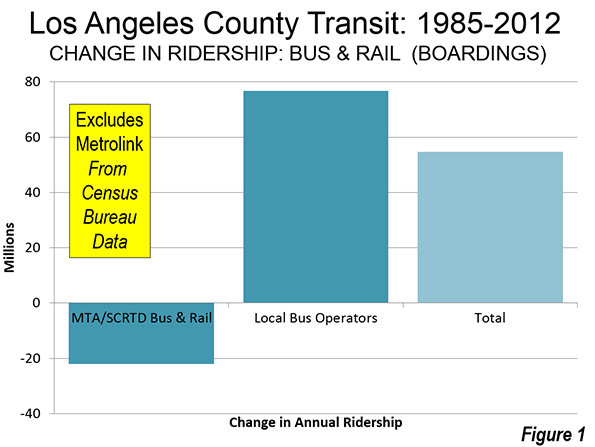
    "Transit for Others" characterizes three decades of transit in Los Angeles County. Despite its massive $10 billion plus rail program, MTA bus and rail services carried fewer riders in 2012 (latest Federal Transit Administration data) than were carried by the buses in 1985 (MTA was formed in the early 1990s from a merger between the Los Angeles County Transportation Commission and the Southern California Rapid Transit District).

    The Birth of Modern Rail

    The history of the modern Los Angeles rail revival began with a special meeting of the Los Angeles County Transportation Commission on August 20, 1980. I was to play a principal role.

    I had the honor of being appointed to LACTC by Mayor Tom Bradley to three terms and was the only principal commissioner who was not an elected official. The other members, under state law, were the Mayor of Los Angeles, a Los Angeles City Council Member, the Mayor of Long Beach, two city council members from other cities, the five county supervisors and an additional member appointed by the Mayor of Los Angeles (which was me).

    The special meeting had been requested by legendary county Supervisor Kenneth Hahn, who proposed a 5-year reduction of the bus fare to $0.50 to be financed by a sales tax increase, which would be submitted to the voters at the November election. Any money not needed for the bus fare reduction would be used for unspecified transit  purposes.

    The original motion by Supervisor Hahn was amended by Gardena Mayor Edmund Russ, who proposed a "local return program," which would dedicate 25 percent of the funding to municipalities (and Los Angeles County for unincorporated areas) on a population basis, to be used for transit services. At that time, local operators provided less than 20% of the bus service, with the overwhelming majority of services provided by the Southern California Rapid Transit District (SCRTD). 

    I was concerned that the proposal by Supervisor Hahn failed to provide funding for a rail system. I believed at the time that a rail system would reduce the intractable traffic congestion in Los Angeles. I was also concerned at the rapidly rising unit costs of bus operations and was convinced that unless there was a "firewall," no money would be available for rail.

    As a result, on the spur of the moment, I introduced an amendment to direct 35 percent of the proceeds to rail. This motion was seconded by Supervisor Baxter Ward and was incorporated into the final package Supervisor Hahn accepted a shortening of the reduced fare period to three years. The measure, Proposition A was placed on the ballot and was passed by the voters in November.

    Transit Since Proposition A

    The impacts of the three programs approved in 1980 had varying results on transit in Los Angeles.

    Three Year Fare Reduction (1982-1985): Between 1982 and 1985, there was a flat $0.50 fare for transit services in the county. SCRTD experienced an increase from 354 million to 497 million annual passengers. At 40%, this may be the largest three year relative increase in any large transit agency’s ridership in decades. Ridership fell after subsequent fare increases.

    Further, the fare reduction was cost effective. The cost per new rider was less than $1.00 (2012$), a small fraction of typical projected costs per new riders on proposed rail transit systems around the country. By comparison, the cost per new rider on the east extension of the Gold light rail line was projected at more than $30 (2012$, $24.19 in 2003). This is more than 30 times the cost per new rider of the low fare program.

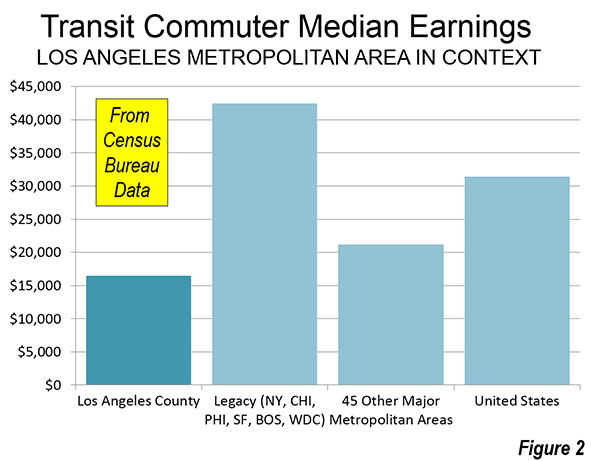
    The strong ridership increase in response to the low fare program is consistent with the relatively low incomes of Los Angeles transit commuters. In 2013, the median income of Los Angeles County transit commuters was approximately one-half that of the national, 60 percent below that of the six metropolitan areas with transit legacy cities (New York, Chicago, Philadelphia, San Francisco, Boston and Washington) and even lower than the other 45 metropolitan areas over 1,000,000 population (Figure 1)

    Local Return Program: Since 1985, when the bus fare reduction program ended, by far the greatest impact on ridership was from the Local Return program. In 1985, the existing local bus operators carried approximately 55 million annual passengers, a figure that rose to more than 130 million in 2012 (a nearly 140 percent increase). This ridership increase is more passengers that were carried on all the bus and rail systems of Dallas (DART), Salt Lake City and St. Louis in 2012, according to Federal Transit Administration data.

    Urban Rail Program: Many miles of urban rail have been built in Los Angeles County, including two subways and five light rail lines (determined by route termini from downtown). But the hope that others would leave their cars for transit, as expressed in The Onion has not occurred. By 2012, Federal Transit Administration data indicates that MTA (formed by a merger of LACTC and the Southern California Rapid Transit District, which operated the system before) bus and rail system was carrying 475 million annual riders, down from the 497 million carried on buses alone in 1985.

    This is despite constructing billions  in subway lines, light rail lines, and rapid busways and the addition of approximately 2 million residents to Los Angeles County.

    The "Return" on Local Return: The big surprise was the "return" on the local return program. A number of new systems were established, such as Foothill Transit and the Antelope Valley Transportation Authority. Many cities established new bus and paratransit systems. The city of Los Angeles now operates a number of commuter express bus services and local circulation bus services throughout the city. Many of the new systems used competitive tendering, under which services are awarded to competing private companies, with fares, routes, and schedules dictated by the public agencies. One important advantage of competitive tendering is lower costs, which makes it possible to provide more service. This service approach has been used extensively in Denver and San Diego. Further, virtually all of London’s largest public bus system in the high income world is competitively tendered as are  all of the bus, subway, commuter rail and light rail services in Stockholm.

    Overall, the Los Angeles County transit system, including MTA and the local operators experienced a ridership increase of 55 million between 1985 and 2012 (This excludes Metrolink, the five county commuter rail system established in the 1990s). Virtually all of the ridership increase is attributable to the local bus services operated by cities and by new sub-regional agencies (Figure 2).

    Overall Transit Work Trip Share

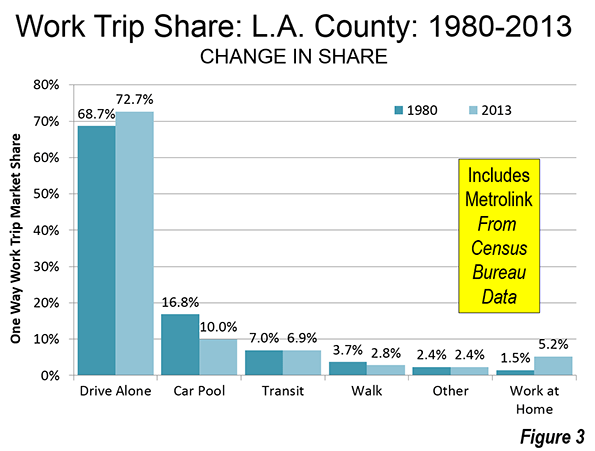
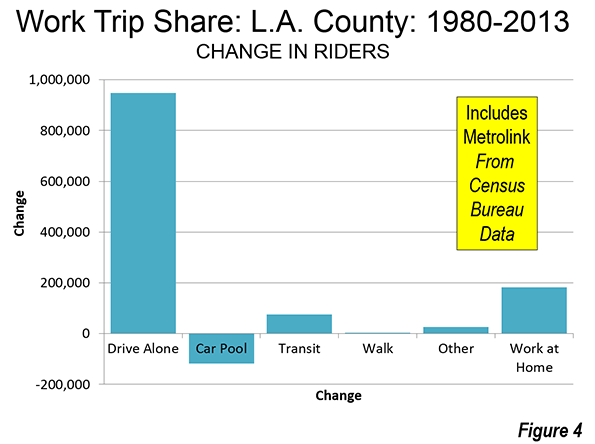
    Census Bureau data indicates that the employment access share of transit in Los Angeles County has declined modestly, from 7.0 percent in 1980 to 6.9 percent in 2013 (including Metrolink). Driving alone increased from 68.7 percent to 72.7 percent, while car pool commuting dropped from 16.8 percent to 10.0 percent. Outside of driving alone, the largest increase occurred in working at home rising from 1.5 percent to 5.2 percent (Figure 3). Unlike transit, working at home requires virtually no expenditures of public funds. Transit one-way work trips increased 77,000 daily, while driving along increased 947,000 and working at home increased 182,000. Car pools suffered a large loss (Figure 4).     

    Thus, despite rave reviews about its rail system, Los Angeles relies on cars to an even greater extent than before. Los Angeles qualifies as the next great transit city only if the standard is spending and construction, rather than ridership.

    Wendell Cox is principal of Demographia, an international public policy and demographics firm. He is co-author of the "Demographia International Housing Affordability Survey" and author of "Demographia World Urban Areas" and "War on the Dream: How Anti-Sprawl Policy Threatens the Quality of Life." He was appointed to three terms on the Los Angeles County Transportation Commission, where he served with the leading city and county leadership as the only non-elected member. He was appointed to the Amtrak Reform Council to fill the unexpired term of Governor Christine Todd Whitman and has served as a visiting professor at the Conservatoire National des Arts et Metiers, a national university in Paris.

    —-

    Note: Part of the MTA/SCRTD ridership loss was due to the transfer of services to Foothill Transit and the city of Los Angeles in the late 1980s.

    Photo: Los Angeles County Transportation Commission logo from 1980s

  • Choosing Fortune Over Freedom

    “If the 19th [century] was the century of the individual (liberalism means individualism), you may consider that this is the ‘collective’ century, and, therefore, the century of the state.”

    Benito Mussolini, “The Doctrine of Fascism” (1932), translated by Barbara Moroncini.

    Where goes the 21st century? Until recently, it could be said that, with the defeat of fascism, in 1945, followed by the collapse of the Soviet Union about a half century later, that we had seen the demise of what the Italian dictator Mussolini envisioned as “a century of authority.” But, now, liberalism’s global triumphal march, as was so brazenly predicted in some corners just two decades ago, seems to have slowed, and may even be going into reverse.

    Increasingly, authoritarian regimes are rising around the world, led by a pesky, resource-rich Russia and a new full-blown superpower, China. Today, few regimes are becoming more democratic, and many, such as Turkey, are evolving toward one-party, voter-blessed, autocracies. These regimes, like their fascist and communist antecedents, often show a kind of contempt for the messy work of pluralistic decision-making and constitutional restraint.

    Elections, long iconic for Americans, are increasingly beside the point. The regimes in Russia and Iran, like that of Turkey, can claim voter mandates, even if their electoral process is twisted by government control of the media and occasional outright repression. Adolf Hitler liked to boast that he, too, took power in Germany in 1933 through legal means.

    But, China, the most important authoritarian country, has little pretense of free elections, so it has become inconceivable that anyone other than the Communist Party will be in control for the foreseeable future. For Chinese whose concerns extend beyond material benefit to such concepts as secure property rights, artistic, political or religious freedom, the obvious option is not to agitate but migrate to one of a diminishing number of spots where such rights are guaranteed.

    But most people in China, like their counterparts elsewhere, are more concerned with their well-being than the freedom of a handful of writers, artists or even businesspeople. Having witnessed a remarkable shift from poverty to growing prosperity and power, the Chinese model, rather than seen as anachronistic, has evolved into the gold standard for many countries, particularly in the developing world.

    This is not surprising, given the rapid progress that country has made in recent years. China has expanded its share of global gross domestic product from 2 percent in 1995 to 12 percent in 2012. Its economic model – communist control of thought and politics but welcoming to most enterprise – has vastly outperformed that of the strongest democracies, the United States, the European Union and Japan, particularly in light of the Great Recession. This recalls the 1930s, where Germany’s state-directed economy and that of the Soviet Union seemed to cope far better with the Depression than their Western democratic counterparts.

    As in the 1930s, we are even seeing the emergence of a new authoritarian Axis. We can see this with Turkey’s decision to increase food exports to Russia to make up for sanction-tightened imports from the U.S. and the EU. Argentina, an increasingly authoritarian democracy, is also set to increase food exports to Moscow.

    Right now, the new Axis is changing global politics. Vladimir Putin’s break with the West reflects, in part, his confidence that his nation’s future lies more with the Middle Kingdom than with the whining democracies of the EU. For less-developed countries, it is more compelling to see in the Chinese model the quickest way to achieve a strong economy.

    Even in democratic and pluralistic India, the new government has sought stronger ties to China, under new Prime Minister Narendra Modi, who has a strongly authoritarian bent, which previously worked well in his management of Gujarat state.

    Chinese success has made it painfully clear that globalization of capitalism does not require pluralism or Western standards of legality. Nor has it done much to promote global understanding, in the China Sea or elsewhere in the world. Religious and ethnic divisions are, if anything, ever more pronounced. The failure of the much-heralded Arab Spring to create anything remotely pluralistic epitomizes this trend, leaving the West with the dilemma of selecting which repressive regimes to ally with to defeat even more heinous entities, like Hamas or the Islamic State.

    This rise of authoritarianism is not limited to the developing world. In the West, these tendencies are also getting stronger, and from both right and left. One powerful spur has been the growing sense among a once-comfortable middle class – beset by 15 years of flat or shrinking incomes – that they are being “proletarianized.”

    Such fear leads normally conservative or moderate people to look at more extreme solutions. Historian Eric Weitz notes that such fears abetted the rise of the National Socialist movement in Germany. Today, across Europe, nativist parties, albeit still far less terrifying than the Nazis, are on the upswing, from traditionally liberal and prosperous Scandinavia to increasingly impoverished Greece.

    Ukraine, facing dismemberment by Putin’s Russia, also has seen the rise internally of the neofascist and anti-Semitic Svoboda movement. The most notable example can be found in France, where the National Front’s Marine Le Pen is leading in the polls to become the Fifth Republic’s next president.

    Perhaps the first neoauthoritarian to gain power in Europe, Hungary’s Prime Minister Victor Orban, has suggested that the recession of the past decade marked the end of what he called “the era of liberal democracies.” For Hungary, he claims, inspiration in the future won’t come from America or the rest of the EU, but from such authoritarian countries as China, Russia, Turkey and Singapore.

    Far less discussed has been the rising authoritarianism on the Left. President Obama’s excessive use of federal regulations to circumvent troublesome Republicans in Congress demonstrates a new surge of executive and bureaucratic power. After the November election, there is good reason to suspect that, particularly if his party loses the Senate, the president’s approach in his final two years in office will increasingly resemble Louis XIV’s L’etat c’est moi.

    If the Right’s authoritarian priorities, including those of some elements aligned with the Tea Party, seek to protect traditional culture, values and the middle classes, the Left favors centralized control to redress wrongs done to selected groups – women, gays, undocumented immigrants – through regulation and taxation. Environmental activists, notably those mobilized around climate change, increasingly despair of addressing their concerns through legislative action, where support is often limited, relying mostly on executive action.

    When liberals abandon liberal principles, we lose one of the most important brakes on expanding central power. As we can see already in California and other places, decisions on virtually everything about how we live – from transportation, to housing and, most particularly, how we generate energy – are increasingly being made not by our elected representatives but through the administrative bureaucracy. The notion of “checks and balances,” of getting buy-in from the opposition and dissenters in your own party, means little to those who have found the “truth” and are determined to impose it on everyone else.

    In some ways, Mussolini, executed by his fellow Italians in 1945, may have been more prescient than his enduring image as a posturing buffoon might suggest. In 1934, Mussolini noted that “as civilization becomes more and more complex, individual freedom is more and more restricted.”This was clearly true in the industrial era, but may also characterize our current transition to a post-industrial, information economy.

    This view diverges from the popular wisdom that information technology is inherently liberating. The visionary MIT analyst Nicholas Negroponte maintained that “digital technology” could turn into “a natural force drawing people into greater world harmony.”

    It turns out that technology is not liberating by itself and can be corralled just as easily for authoritarian purposes. The media’s emphasis on young people posting on Facebook in places like Egypt, Iran and Russia gave us a false impression of how those societies operate. Governmental suppression and organized violence subsequently proved more powerful than digital technology. Smartphones, the Internet and the increasing reach of information technology are not sufficient to spawn conditions for pluralistic democracy. As anyone who spends time in China can attest, great things can be achieved without fundamental individual freedom.

    The sad truth is that we may be entering an era where classical liberalism – market capitalism, freedom of speech and safety from government intrusion – may be somewhat in retreat. As during most of world history, pluralistic democracy remains a fragile achievement that thrives only in a relative handful of places. For that reason, we need – more than ever – to cherish it.

    This piece originally appeared at The Orange County Register.

    Joel Kotkin is executive editor of NewGeography.com and Roger Hobbs Distinguished Fellow in Urban Studies at Chapman University, and a member of the editorial board of the Orange County Register. His newest book, The New Class Conflict is now available at Amazon and Telos Press. He is author of The City: A Global History and The Next Hundred Million: America in 2050. His most recent study, The Rise of Postfamilialism, has been widely discussed and distributed internationally. He lives in Los Angeles, CA.

    Benito Mussolini photo by Bundesarchiv, Bild 102-08300 / CC-BY-SA [CC-BY-SA-3.0-de], via Wikimedia Commons

  • Trustafarians Want to Tell You How to Live

    Americans have always prided themselves on being a nation of the self-made, where class and the accident of birth did not determine success. Yet increasingly we are changing into a society where lineage does matter—and likely this process has just started, threatening not only our future prosperity but the very nature of our society.

    In some ways the emerging age of inheritance stems from the success Americans enjoyed over the past half century. Think not only of the wealthy entrepreneurs, but the vast middle class that purchased their homes, often for what in hindsight look like very low sums, and which now can be sold at massively higher prices. In part this reflects the reality that previous generations simply had an easier time accumulating real estate and other assets at low prices. As a friend once told me, “A chimpanzee could have made money in L.A. real estate—and many did.”

    The oldsters have also have benefited more from the asset-led economic recovery, according to a St. Louis Federal Reserve study, in part because they tended to buy their homes earlier and tend to have larger stock holdings. By 2017, according to Nielsen (PDF), Americans over 50 will control some 70 percent of the nation’s disposable income.

    And the boomers—at least those in the more affluent classes—are about to get yet another windfall. As the members of World War II’s “Greatest Generation” die off, they are set to pass on between $8.4 trillion and $11.6 trillion to their Baby Boomer descendants, according to a study by MetLife.

    In the coming decades this tsunami of inherited money will likely accelerate class divisions, as those in the current top decile (in terms of income) gather in more than a million in parental bequests, while those in the lower class will at best count their inheritances in the thousands. Among boomers who will receive an inheritance, the top 10 percent will receive more than every other decile combined.

    This is just the beginning of the process. The well-born members of the millennial generation are set for an even greater inheritance, which will distort the economy even more. The Social Welfare Research Institute at Boston College estimatedthat a minimum of $41 trillion would pass between generations from 1998 to 2052. This huge transfer, the researchers believe, will usher in what they call “a golden age of philanthropy.” Even as most younger Americans struggle to obtain decent jobs and secure property, the Welfare Institute concluded, America is moving toward an “inheritance-based economy” where access to the last generation’s wealth could prove a critical determinant of both influence and power.

    These trends will affect everything from geography to culture and politics. For one thing, we are likely to see people settling in areas depending on their class status. For example, an examination of income data by Mark Schill of the Praxis Strategy Group finds that, with the exception of retirement communities, the areas with the greatest dependence on rents, dividends, and interest are concentrated in the expensive “luxury cities” New York, Boston, and the San Francisco Bay Area (and their surrounding pricey suburbs).

    With some areas, the differences are stark in terms of where this windfall lands. Manhattan, for example, was among the leaders of the nation’s core cities in asset-based wealth while the Bronx, just across the Harlem River, ranked at the absolute bottom. This inherited wealth is increasingly diffused among multiple cities as the expanding ranks of the ultra-rich purchase apartments in favored locations.

    In contrast, it’s still hard to find concentrations of inherited wealth in historically poorer regions such as the South, even in booming growth regions such as Houston, Dallas-Ft. Worth, and Atlanta. These are places that you don’t have to use family money—or parental co-signers—to afford a decent home, as is often the case in places like San Francisco, Manhattan, or Brownstone Brooklyn—all places where, as the Financial Times’ Simon Kuper has noted, you no longer go to be someone; you only live there once you are already successful or living on inherited largess. They are, as Kuper puts it, “the vast gated communities where the one percent reproduces itself.”

    In the coming decades, these trends could grow, particularly as economic and population growth slow. Of course, there have always been rich people, and wealthy enclaves, but the impact of inherited wealth on politics and culture—like that on real estate—may be more profound in the future. One key difference is education, which increasingly determines social status and wealth.

    Historically, education was one way the middle and working classes, and even the poor, ascended the class ladder. But we may be seeing the end of this trend, given what some see as the “death of meritocracy,” particularly if you also count the enormous advantage in education that comes from going to an elite private school or a well-placed suburban public school. Over the past two generations, notes former Treasury Secretary Larry Summers, the gap in educational achievement between the children of the rich and the children of the poor has doubled. While the college enrollment rate for children from the lowest quarter of income distribution has increased from 6 percent to 8 percent, the enrollment rate for children from the highest quarter has risen from 40 percent to 73 percent.

    So we have a graduate of Choate or Beverly Hills High who attends Wharton, and goes to work for, say, Goldman Sachs. And yes, this individual may work hard. But whether he or she works hard or not, the chances of success are much greater than those of an equally talented, equally diligent person who has to pay off college loans and whose choices about where to live—outside of places like New York or San Francisco—are driven as much by cost as they are by opportunity.

    This represents a sea change from the past, where the inheritors earned their “gentlemen’s Cs” while the aspiring class busted for As. After all, who needs good grades to simply engage in traditional charity work—like feeding the poor or supporting their churches? But now many of the rich feel compelled to “make a difference.” No longer satisfied to suck gin and tonics at the country club, they want to find fulfillment, and impress their friends with their cleverness and social worth.

    One place we can see this is in the cultural sphere. Hollywood, in particular, has always had a weakness for helping its own. Dorothy Parker once noted that “the only ‘ism’ Hollywood cares about is plagiarism.” But increasingly there is another “ism”—nepotism. And the trend can be seen across the the entertainment industry in such families as the Paltrows, Fondas, Douglases, and Smiths. You can see the wheels turning when someone like Jay Z puts his newborn baby’s cries—no doubt a budding rapper—on his songs.

    But some of the most obvious places where dynastic power can be seen are on the executive side of the business. In the early years, the big powers were often rough, self-made men such as Jack Warner or Louis B. Mayer. People like David Geffen who worked their way up from the mailroom are increasingly rare. Today the hottest new producers tend to come from the richest classes, such as William Pohlad, son and heir of a Minnesota billionaire; Gigi Pritzker, an heir to the Pritzker fortune; and Megan Ellison, daughter of Oracle Founder Larry Ellison, one of the world’s 10 richest men.

    At the same time, the media itself, particularly in its most visible manifestations, is increasingly populated by the children of prominent politicians and by those who come from the ranks of the plutocracy. Middle-class parents may have to grind their teeth and empty their wallets as their kids work in unpaid internships in pricey Gotham, but this is not the fate of the offspring of the Reagans, Bushes, Clintons, McCains, Pelosis, or Kennedys, all of whom have ascended to levels of media power that mere mortals take years to achieve, if ever. If you need a show for millennials, why not hand it over to Ronan Farrow, the offspring of celebrity parents. In my time, generally speaking, the icons of a generation were likely to be outsiders; the “screwed generation” of millennials get to have theirs defined by whose birthright landed them on third base.

    But perhaps the biggest long-term impact may come from the nonprofit institutions that the wealthy fund. Nonprofit foundations have been growing rapidly in size and influence since the late ’20s, paralleling the expansion of other parts of the clerisy like the universities and government. Between 2001 and 2011, the number of nonprofits increased 25 percent to more than 1.5 million. Their total employment has also soared: By 2010, 10.7 million people were employed by nonprofits—more than the number of people working in the construction and finance sectors combined—and the category has expanded far more rapidly than the rest of the economy, adding two million jobs since 2002. By 2010, nonprofits accounted for an economy of roughly $780 billion and paid upwards of 9 percent of wages and 10 percent of jobs in the overall economy.

    Nonprofits, due to their accumulated wealth, are able to thrive even in tough times, adding jobs even in the worst years of the Great Recession.

    In the past these organizations might have tended to be conservative, as inherited wealth followed the old notions of noblesse oblige and supported traditional aid to the poor, such as scholarships and food banks. But the new rich, particularly the young, tend to be more progressive, or at least gentry liberal. The direction of this rapidly expanding part of the clerisy will be increasingly important in the future, and already many of the largest foundations—Ford, Rockefeller, Carnegie, and MacArthur—veer far toward a left social-action agenda.This is particularly ironic since their founders were conservative, or even reactionary, and generally held strong, sometimes fundamentalist, religious beliefs.

    Much of this shift reflects the social phenomena of inheritors in general. Not involved with making their fortunes, and sometimes even embarrassed by how those fortunes were made, the new generation of “trust-fund progressives” often adopt viewpoints at odds with those of their ancestors. One particularly amusing, and revealing, development has been the recent announcement by the Rockefeller heirs that they would divest themselves of the very fossil fuels that built their vast fortune.

    Of course, there remain many conservative foundations, such as those funded by the Koch brothers, who wield their fortunes for highly conservative causes. But roughly 75 percent of the political contributions of nonprofits tend to go in a left, green, or progressive direction.

    This trend is likely to accelerate, as millennials—who will inherit the most money and may be the most inheritance-dominated generation in recent American history—enter adulthood. Schooled in political correctness, and not needing to engage in the mundane work of business, this large cadre of heirs to great fortunes will almost surely seek to shape what we think, how we live, and how we vote. They may consider themselves progressives, but they may more likely help shape a future that looks ever less like the egalitarian American of our imaginings, and ever more like a less elegant version of Downton Abbey.

    This piece originally appeared at The Daily Beast.

    Joel Kotkin is executive editor of NewGeography.com and Roger Hobbs Distinguished Fellow in Urban Studies at Chapman University, and a member of the editorial board of the Orange County Register. His newest book, The New Class Conflict is now available at Amazon and Telos Press. He is author of The City: A Global History and The Next Hundred Million: America in 2050. His most recent study, The Rise of Postfamilialism, has been widely discussed and distributed internationally. He lives in Los Angeles, CA.

    Photo: Trustafarian Handbook by Brian Griffin.
  • Aging America: The U.S. Cities Going Gray The Fastest

    For years we have been warned about the looming, profound impacts that the aging of the U.S. population will have on the country. Well, the gray wave has arrived. Since 2000, the senior population has increased 29% compared to overall population growth of 12%. The percentage of Americans in the senior set has risen from 12.4% to 14.1%, and their share of the population is projected to climb to 19.3% by 2030. There are two principal causes for this: the baby boom generation is reaching 65 years old, while the U.S. fertility rate has fallen markedly in recent decades, despite immigration, and now hovers around the replacement rate.

    To find the cities that are going gray the fastest, we looked at the change from 2000 through 2013 in the share of seniors in the populations of the nation’s largest metropolitan areas, the 52 metropolitan statistical areas that have more than a million residents. Some 13.2% of the residents of these 52 MSAs are seniors, a lower proportion than nationwide.

    Before we look at where the biggest changes have occurred, let’s take a look at where the highest overall concentrations of seniors are: no big surprise, in Florida, and in the slow-growing Northeast and Midwest. Among the 52 biggest metropolitan areas, Tampa-St. Petersburg has the highest share of seniors in its population at 18.2%. The retirement mecca of Miami, where 16.7% of its population is over 65, ranks third in the nation, and Jacksonville is 18th, at 13.7%.

    Outside of Florida almost all the retirement capitals are in the Northeast and Midwest. The second most senior region, for example, is Pittsburgh, where 18.0% of the population is over 65. The old Steel City is followed by a host of Rust Belt metro areas: Cleveland, Rochester, Providence, Hartford, St. Louis and Detroit, all of which have a senior set that makes up 14% or more of the overall population.

    Austin, Texas, has the smallest proportion of seniors, at 9.2%, but its senior share is rising — more on Austin later on. Salt Lake City, Houston and Dallas-Fort Worth are also below 10%, while Raleigh has the fifth-lowest proportion of seniors, at 10.2%. Not surprisingly, all of these relatively young cities are experiencing strong domestic in-migration.

    Cities That Are Aging The Most

    The metropolitan areas that have seen the biggest jumps in the senior proportion of their populations, have, for the most part, been the same ones that have drawn strong net domestic in-migration of millennials, families and working adults. The rise in the share of seniors in these cities isn’t because seniors are moving to them in overwhelming numbers — Census data shows they make major moves less than all other age groups. (In 2011-12, seniors moved to another state five times less frequently than those between the ages of 25-34, according to Current Population Survey figures.) Rather, many of those who have reached 65 since 2000 in the cities that top our list moved to them when they were younger, generally in search of economic opportunities or better lives, and have aged there.

    However, when seniors do decide to move, they can have a disproportionate impact on metropolitan economies because of their relative affluence. Over-65 households have a net worth 2.5 times the national average, according to Census Bureau data. Seniors (over 62) were far less damaged in the housing bust than younger households, and their incomes increased more with the tepid economic recovery, according to St. Louis Federal Reserve studies.

    In first place on our list is Atlanta, where the share of seniors in the population rose from 7.7% in 2000 to 10.4% in 2013, the biggest increase in the nation. In raw numbers, the over-65 population of the metro area rose to 572,534, an increase of  73.5% since 2000.

    The percentage of the population in fast-growing Raleigh, N.C., that is over 65 grew from 8.0% to 10.2% in 2013, putting it in second place.

    Austin may have a reputation as a youthful place, but it’s also getting older rapidly. The senior population has surged 91.7% since 2000 to 172,476, amid a general population boom – the share of seniors in the metro area has expanded from 7.2% to 9.2%, placing it third on our list. The metro area may be unprepared for a mounting “silver tsunami” of impoverished elderly, according to the Austin American-Statesman.

    Two of the cities that posted the biggest increases in the share of seniors in their populations also were among the largest overall domestic migration losers, San Jose, Calif., and Los Angeles. Since 2000, 1.7 million more U.S. residents moved away from the two metro areas than to them. Only Hurricane Katrina-ravaged New Orleans lost a larger share of its total population to domestic out-migration than San Jose, which ranks 4th in the increase of its senior population, going from 9.4% to 11.9%. Los Angeles, which trailed only New Orleans, San Jose and New York in the percentage of its population that it lost to domestic migration, went from 9.8% over-65 to 12.1%, the ninth biggest increase among the 52 largest metro areas. The combination of older households moving less and younger households leaving to take advantage of better job opportunities elsewhere may explain this.

    The balance of the top 10 all experienced net domestic migration gains since 2000.

    Meanwhile, the Rust Belt and Florida cities that already were among the oldest didn’t get much older. Tampa-St. Petersburg actually got younger, at least in part due to strong overall in-migration by younger people.

    Are Seniors Headed To Big Cities?

    One favorite meme of urban boosters is the assertion that seniors are heading to the inner city. The preponderance of evidence shows the opposite. Within the 52 largest metropolitan areas, the urban cores, measured at the small area level (zip codes) have lost seniors to the periphery. Between 2000 and 2010, the urban core senior population declined by  1.5 million, dropping from nearly 15% of the total population to 13%.The losses were pervasive, extending to all the 52 biggest MSAs except for San Diego (and there the urban core gain was miniscule, with 97% of the senior growth occurring in the suburbs and exurbs).

    In contrast, suburbs and exurbs together gained over 2.82 million seniors. But the largest increases were farthest from core, in the newer, outer suburbs and exurbs. Together these areas gained 2.4 million seniors. Rather than headed into the core, the prevailing trend has been quite the opposite.

    A similar pattern has been identified in Canada. A recent study of that country’s six largest cities found similar patterns, with older Canadians, if they move, tending to end up the suburban rings.

    Just The Beginning

    Over the next 15 years, cities are likely to age even faster. Those cities that attract the most among relatively few senior domestic migrants and which have seen their over-50 cohorts swelled by previous domestic migration should see the largest increases. At the same time, other cities with modest senior population gains could also age more quickly if more of the rest of the population moves away.

    Seniors in America’s Largest Metropolitan Areas, 2000-2013
    Ranked by change in share of seniors, 2000-2013
    Rank MMSA Seniors Share 2000 Seniors Share 2013 Seniors Share Change 2000-13% Number of Seniors 2013 Change in Total Seniors 2000-13%
    1 Atlanta, GA 7.7% 10.4% 34.0% 572,534 73.5%
    2 Raleigh, NC 8.0% 10.2% 28.6% 124,285 96.0%
    3 Austin, TX 7.2% 9.2% 27.2% 172,476 91.7%
    4 San Jose, CA 9.4% 11.9% 26.7% 229,062 40.1%
    5 Denver, CO 9.0% 11.3% 25.7% 304,698 57.1%
    6 Dallas-Fort Worth, TX 7.9% 9.9% 25.6% 676,537 64.4%
    7 Jacksonville, FL 11.0% 13.7% 24.2% 191,000 54.2%
    8 Houston, TX 7.7% 9.5% 24.0% 601,800 66.9%
    9 Los Angeles, CA 9.8% 12.1% 23.7% 1,584,236 31.4%
    10 Portland, OR-WA 10.4% 12.8% 23.5% 296,365 48.3%
    11 Minneapolis-St. Paul, MN-WI 9.7% 11.9% 23.1% 412,713 40.4%
    12 Washington, DC-VA-MD-WV 9.0% 11.0% 23.0% 656,678 51.3%
    13 Virginia Beach-Norfolk, VA-NC 10.3% 12.7% 22.7% 215,992 32.6%
    14 Grand Rapids, MI 10.5% 12.7% 20.5% 128,805 31.6%
    15 Las Vegas, NV 10.7% 12.8% 20.4% 260,156 77.5%
    16 Rochester, NY 12.9% 15.5% 20.0% 167,497 22.3%
    17 Detroit, MI 12.0% 14.3% 19.7% 616,033 15.5%
    18 Sacramento, CA 11.3% 13.5% 19.1% 298,327 46.8%
    19 Seattle, WA 10.1% 11.9% 17.9% 431,378 39.8%
    20 Richmond, VA 11.4% 13.3% 17.1% 166,173 38.2%
    21 San Francisco-Oakland, CA 11.7% 13.7% 16.8% 617,996 27.9%
    22 New Orleans. LA 11.4% 13.2% 16.4% 164,372 8.0%
    23 Memphis, TN-MS-AR 10.0% 11.7% 16.3% 156,792 28.7%
    24 Salt Lake City, UT 8.0% 9.3% 15.6% 105,993 40.3%
    25 Columbus, OH 10.1% 11.7% 15.5% 230,044 35.6%
    26 Charlotte, NC-SC 10.5% 12.0% 15.2% 281,202 56.7%
    27 Phoenix, AZ 11.9% 13.7% 15.1% 604,442 55.8%
    28 Nashville, TN 10.3% 11.8% 14.9% 208,133 46.3%
    29 Chicago, IL-IN-WI 10.9% 12.4% 14.3% 1,184,871 19.8%
    30 Baltimore, MD 12.0% 13.7% 14.1% 379,722 23.8%
    31 Cincinnati, OH-KY-IN 11.7% 13.3% 13.4% 283,518 21.5%
    32 Kansas City, MO-KS 11.5% 13.0% 12.8% 266,749 27.9%
    33 Louisville, KY-IN 12.4% 14.0% 12.4% 176,229 26.6%
    34 Cleveland, OH 14.5% 16.2% 11.8% 335,054 7.5%
    35 Boston, MA-NH 12.6% 14.1% 11.6% 658,710 19.0%
    36 St. Louis,, MO-IL 13.0% 14.4% 11.1% 404,297 16.3%
    37 San Diego, CA 11.1% 12.3% 10.8% 396,543 26.4%
    38 Hartford, CT 13.9% 15.4% 10.5% 187,183 16.9%
    39 New York, NY-NJ-PA 12.6% 13.9% 10.4% 2,768,694 16.3%
    40 Birmingham, AL 12.8% 14.1% 10.1% 160,686 19.3%
    41 San Antonio, TX 10.8% 11.9% 10.1% 270,480 46.5%
    42 Riverside-San Bernardino, CA 10.5% 11.5% 9.8% 502,846 47.8%
    43 Oklahoma City, OK 11.4% 12.5% 9.7% 164,481 32.2%
    44 Indianapolis. IN 11.0% 12.0% 9.5% 234,973 29.0%
    45 Orlando, FL 12.4% 13.4% 8.5% 304,660 49.7%
    46 Milwaukee,WI 12.6% 13.5% 7.4% 211,527 12.3%
    47 Providence, RI-MA 14.4% 15.4% 7.0% 247,689 8.4%
    48 Philadelphia, PA-NJ-DE-MD 13.4% 14.2% 6.5% 858,313 13.0%
    49 Buffalo, NY 15.9% 16.5% 3.7% 186,693 0.5%
    50 Miami, FL 16.4% 16.7% 1.8% 975,529 18.5%
    51 Pittsburgh, PA 17.7% 18.0% 1.6% 425,102 -1.3%
    52 Tampa-St. Petersburg, FL 19.2% 18.4% -4.3% 527,861 14.6%
    52 Major Metropolitan Areas 11.4% 12.9% 13.2% 22,588,129 29.2%
    Outside MMSAs 13.6% 15.7% 14.8% 22,115,945 26.4%
    United States 12.4% 14.1% 13.8% 44,704,074 27.8%

    This piece first appeared at the Orange County Register.

    Joel Kotkin is executive editor of NewGeography.com and Roger Hobbs Distinguished Fellow in Urban Studies at Chapman University, and a member of the editorial board of the Orange County Register. His newest book, The New Class Conflict is now available at Amazon and Telos Press. He is author of The City: A Global History and The Next Hundred Million: America in 2050. His most recent study, The Rise of Postfamilialism, has been widely discussed and distributed internationally. He lives in Los Angeles, CA.

    Wendell Cox is principal of Demographia, an international public policy and demographics firm. He is co-author of the “Demographia International Housing Affordability Survey” and author of “Demographia World Urban Areas” and “War on the Dream: How Anti-Sprawl Policy Threatens the Quality of Life.” He was appointed to three terms on the Los Angeles County Transportation Commission, where he served with the leading city and county leadership as the only non-elected member. He was appointed to the Amtrak Reform Council to fill the unexpired term of Governor Christine Todd Whitman and has served as a visiting professor at the Conservatoire National des Arts et Metiers, a national university in Paris.

    “Senior Citizens Crossing” photo by Flickr user auntjojo.

  • Brain Drain Hysteria Breeds Bad Policy

    Desperate times call for desperate measures. The Rust Belt, a region familiar to the air of anxiety, knows this all too well, particularly the “desperate measures” part.

    A case in point: During the 1990’s, Pittsburgh, like many of its Rust Belt peers, was in the midst of a fit of brain drain hysteria. Strategic policy was needed. So the powers that be thought of a marketing campaign meant to saturate the minds of the educated “young and the restless” who were thinking about exiting the Steel City. Pittsburgh demographer and economist Chris Briem, in a 2000 op-ed in the Post-Gazette, picks it up from here:

    “The focus on retaining vs. attracting workers is pervasive in local policies. One marketing character thought of by the Pittsburgh Regional Alliance, whose mission is to promote Pittsburgh, was the genial "Border Guard Bob." The image was of an older, uniformed sentinel on Pittsburgh’s borders keeping our citizens, in particular the younger workers, from leaving the region. This is the same logic that inspired the East Germans to build a wall around Berlin and is likely to have as much success in the long-run.”

    Luckily for Pittsburgh, Border Guard Bob never materialized. Policy-wise, building walls is terrible form in the age of information. Still, the aura of desperation remained in the region, despite its illogicality. For instance, in his 2002 piece called “Young people are not leaving Pittsburgh”, Briem crunched the numbers to find the region’s brain drain wasn’t. Yet he found it hard “to convince Pittsburghers that the outmigration of youth is not the problem it once was,” blaming “a persistence of memory” stemming from the regional exodus in the 1980’s.  

    As a demographer and economic thinker in Cleveland, I can sympathize with Briem. Cleveland, too, is prone to bouts of brain drain hysteria. A recent report highlighted in the New York Times called “The Young and Restless and the Nation’s Cities” was enough set off a flare-up. The report found that between 2000 and 2012, Greater Cleveland added less than 800 25- to 34-year-olds with a college degree—an increase of 1%. The metro ranked second last out of 51 metros, behind only Detroit.

    Obviously, those numbers are not good. That said, from a methodological standpoint, the study has its limitations. Specifically, the analysis cuts through four economic eras: 2000, the end of a prolonged expansionary period; 2005 to 2007, the middle of a jobless economic recovery; 2008 to 2010, the throes of a deep global recession; and 2011 to 2012, a period of economic recovery.

    Why does this matter? Migration patterns are affected by quite different economic circumstances nationally. This is especially true for the 25- to 34-year-old cohort, who are the most mobile, if not fickle, group.

    For example, Greater Cleveland’s lack of a young adult brain gain from 2000 to 2012 resulted from a substantial decrease of nearly 16,000 25- to 34-year-olds with a 4-year college degree from 2000 to 2006. The 2001 recession and subsequent jobless recovery hit Cleveland hard. However, my research at the Center for Population Dynamics at Cleveland State University showed that Greater Cleveland recouped the losses from earlier in the decade, gaining approximately 17,000 25- to 34-year-olds with a 4-year degree from 2006 to 2012—an increase of 23%.

    Moreover, the Census recently released data for 2013, which allows a comparison of the nation’s top big-city metros for 2011 to 2013: the current era of economic recovery. Put simply, what large metros have the momentum? Has there been a shift in where the “young and the restless” are attempting to settle down?

    The results are surprising. Cleveland ranks 3rd in the nation, with a 19.85% increase in the number of young adults with a college degree, behind the Sun Belt metros Nashville and Orlando. And no, this percentage “pop” for the region is not simply due to the fact that Cleveland had a really small base of young college graduates. In fact, the region’s 3-year gain of 15,557 ranks Cleveland 15th in total gains, despite being the 29th largest metro in the nation. To put this in perspective, Greater Cleveland had a larger total growth than Chicago, and nearly seven times the gain of Portland: the nation’s poster child for where the “young and restless” go to “live, work, play”.

    Table 1: 25-to-34-year-olds with at least a Bachelor’s degree, Change, 2011 to 2013
    Metro Area 2011 2013 % Change 2011 to 2013 Total Change 2011 to 2013
    Nashville-Davidson–Murfreesboro–Franklin, TN 82,588 103,239 25.01% 20,652
    Orlando-Kissimmee-Sanford, FL 83,706 101,066 20.74% 17,361
    Cleveland-Elyria, OH 78,392 93,949 19.85% 15,557
    Riverside-San Bernardino-Ontario, CA 97,804 116,767 19.39% 18,963
    Jacksonville, FL 47,792 56,256 17.71% 8,464
    Austin-Round Rock, TX 119,482 138,240 15.70% 18,758
    Seattle-Tacoma-Bellevue, WA 208,647 240,267 15.15% 31,620
    Sacramento–Roseville–Arden-Arcade, CA 77,075 87,435 13.44% 10,360
    Salt Lake City, UT 55,036 62,124 12.88% 7,088
    Pittsburgh, PA 117,402 131,770 12.24% 14,368
    Philadelphia-Camden-Wilmington, PA-NJ-DE-MD 306,271 341,220 11.41% 34,948
    Columbus, OH 106,144 118,224 11.38% 12,080
    Houston-The Woodlands-Sugar Land, TX 266,289 295,230 10.87% 28,941
    Buffalo-Cheektowaga-Niagara Falls, NY 52,231 57,727 10.52% 5,496
    Dallas-Fort Worth-Arlington, TX 296,927 327,330 10.24% 30,403
    New Orleans-Metairie, LA 54,104 59,616 10.19% 5,512
    San Jose-Sunnyvale-Santa Clara, CA 135,306 148,978 10.10% 13,672
    Detroit-Warren-Dearborn, MI 154,542 170,122 10.08% 15,580
    San Francisco-Oakland-Hayward, CA 320,585 350,490 9.33% 29,904
    Baltimore-Columbia-Towson, MD 150,003 163,941 9.29% 13,938
    New York-Newark-Jersey City, NY-NJ-PA 1,216,127 1,327,778 9.18% 111,651
    Los Angeles-Long Beach-Anaheim, CA 631,960 688,057 8.88% 56,098
    St. Louis, MO-IL 134,267 145,978 8.72% 11,710
    Oklahoma City, OK 58,027 63,084 8.71% 5,057
    San Antonio-New Braunfels, TX 85,240 92,524 8.55% 7,284
    Hartford-West Hartford-East Hartford, CT 59,780 64,784 8.37% 5,004
    Denver-Aurora-Lakewood, CO 163,026 176,237 8.10% 13,211
    Milwaukee-Waukesha-West Allis, WI 79,404 85,793 8.05% 6,390
    Louisville/Jefferson County, KY-IN 50,790 54,849 7.99% 4,060
    Virginia Beach-Norfolk-Newport News, VA-NC 67,664 72,888 7.72% 5,224
    Tampa-St. Petersburg-Clearwater, FL 99,316 106,504 7.24% 7,187
    San Diego-Carlsbad, CA 167,735 179,850 7.22% 12,114
    Birmingham-Hoover, AL 47,340 50,675 7.04% 3,335
    Kansas City, MO-KS 102,284 109,455 7.01% 7,171
    Rochester, NY 48,844 52,212 6.90% 3,368
    Boston-Cambridge-Newton, MA-NH 348,490 371,303 6.55% 22,813
    Phoenix-Mesa-Scottsdale, AZ 163,995 174,694 6.52% 10,699
    Providence-Warwick, RI-MA 64,205 68,349 6.45% 4,144
    Raleigh, NC 76,164 80,447 5.62% 4,283
    Indianapolis-Carmel-Anderson, IN 91,083 95,827 5.21% 4,744
    Las Vegas-Henderson-Paradise, NV 59,998 63,058 5.10% 3,060
    Cincinnati, OH-KY-IN 95,084 99,225 4.36% 4,142
    Minneapolis-St. Paul-Bloomington, MN-WI 214,755 223,640 4.14% 8,885
    Washington-Arlington-Alexandria, DC-VA-MD-WV 460,693 477,706 3.69% 17,013
    Chicago-Naperville-Elgin, IL-IN-WI 558,464 572,324 2.48% 13,860
    Atlanta-Sandy Springs-Roswell, GA 272,907 279,232 2.32% 6,325
    Portland-Vancouver-Hillsboro, OR-WA 119,490 121,794 1.93% 2,304
    Miami-Fort Lauderdale-West Palm Beach, FL 221,294 224,388 1.40% 3,094
    Richmond, VA 59,907 59,289 -1.03% -618
    Memphis, TN-MS-AR 52,911 49,412 -6.61% -3,499
    Source: ACS 1-Year, 2011, 2013 Note: Charlotte was removed from the analysis due to substantial geographic changes in the MSA designation from 2011 to 2013. Created by the Center for Population Dynamics at Cleveland State Univeristy, October, 2014. 


    What gives?

    Part of the answer may be economic. For example, my colleagues Joel Kotkin and Aaron Renn recently analyzed the growth in per capita GDP from 2010 to 2013 for Forbes in a piece entitled “The cities that are benefiting the most from the economic recovery”. Cleveland ranked 15th in the nation, with a 6% increase. In terms of income, the metro is 5th in the nation in the total per capita income increase from 2010 to 2012, behind Houston, San Jose, Oklahoma, and San Francisco.

    In understanding Cleveland’s nascent young adult brain gain, the broader economic performance is important. Healthier economies make metros “stickier” for those here and more of a magnet for those who aren’t. And while there also is the element of “Rust Belt Chic”, or the lure of so-called “authentic” places that counter the “Brooklynization” of American cities, Cleveland as a destination, or a “consumer city”, will always take a back seat to Cleveland as a “producer city”, which is a metro of good jobs, good schools, and affordable housing. The producer city focuses on the creation of value, not simply the consumption of things. This is not to say amenities, such as a good culinary and microbrew scene, are not important, it only says that if the talent you attract has nothing to produce or nowhere to live, well, all play and no work makes Jack a dull boy.

    Talent attraction, then, is only part of the formula in Cleveland’s ongoing and difficult economic restructuring. Talent production is also needed, for both natives and newcomers, regardless of the age group. But emphasizing the latter entails knowing the score on the former. Brain drain hysteria breeds desperation.

    And desperate times call for desperate measures—and bad policy.

    This piece first appeared at Crains Cleveland.

    Richey Piiparinen is a Clevelander, writer, and Senior Research Associate heading the Center for Population Dynamics at Cleveland State University.

  • New Zealand Seeks to Avoid “Generation Rent”

    The political leadership and others in New Zealand are talking about the consequences of its land use policies. Under the "urban containment" land use policy (also called by terms like "smart growth," "growth management," and "livability") in effect in every urban area, house prices have doubled relative to incomes over the last 25 years. The principal causes have been the restrictions inherent in urban containment policy, such as making most suburban land off limits for housing development, (which raises its price, like rationing oil raises the price of gasoline), and requirements for upfront payment of large development impact fees (which can also be higher than they need to be). The association between urban containment policy and unaffordable housing is consistent with both with both economic theory and also considerable economic research. The title of a report by Paul Cheshire, Professor of Economic Geography at the London School of Economics best indicates the reality: "Urban Containment, Housing Affordability, Price Stability – Irreconcilable Goals." 

    New Zealand Housing Unaffordability and Consequences

    According to the 10th Annual Demographia Housing Affordability Survey, Auckland, the nation’s largest city is now the 7th least affordable out of 85 major metropolitan markets rated. Auckland’s median multiple (median house price divided by median household income) is 8.0, approaching triple the level that prevailed before the adoption of urban containment policy. The other largest cities, Christchurch and Wellington have seen house prices relative to incomes double since they have adopted urban containment policy (which were 3.0 or less). Obviously, when houses cost more than necessary, households have less discretionary income. This leads directly to two consequences with respect to affluence and poverty.

    The first consequence of these policies is that households have less discretionary income (income after paying taxes and for necessities) to spend on other goods and services. Obviously this means a lower standard of living. This generally leads to a weaker economy, other things being equal, because households with less money are not able to purchase as much in goods and services as they would be able to afford if house prices had not been distorted.

    The second consequence is greater poverty. When the price of housing rises, discretionary incomes can fall enough to force lower income households into poverty.

    Land Use Policies Blamed for Poverty and Greater Inequality

    Recently, Deputy Prime Minister and Finance Minister Bill English said in an October 7 press conference that New Zealand’s land use policies have led to higher levels of poverty and increased inequality: "Inequality in New Zealand would have been improving had it not been for growing housing costs. So our planning processes have probably done more to increase income inequality and poverty in New Zealand than most other policies." Finally, the Deputy Prime Minister noted that house price increases have impacted the lowest income households most.

    Minister English had previously expressed concern about the extent to which land use policy had driven up house prices, in his preface to the 9th Annual Demographia Housing Affordability Survey: "It costs too much and takes too long to build a house in New Zealand. Land has been made artificially scarce by regulation that locks up land for development. This regulation has made land supply unresponsive to demand (see: "Unblocking Constipated Planning" in New Zealand").

    There was "pushback" on the Deputy Prime Ministers comments from the city of Auckland and the Green Party. Others saw it differently the well-read national blog, Whale Oil, however, opined that the Deputy Prime Minister "is onto something." Whale Oil continued "The squealing in unison means English is putting the pressure in the right places."  

    Housing Minister Nick Smith has decried the situation in Auckland:  "We’ve got a rigid Metropolitan Urban Limit (urban growth boundary) prohibiting any new housing developments beyond the artificial line drawn 15 years ago." At the same time, he said that resulting land cost increases had been more responsible for higher house prices than any other factor. Auckland accounts for approximately one-third of the nation’s population and has been growing rapidly, accounting for more than one-half of the nation’s population growth between the 2006 and 2013 censuses.

    On the government’s website, the Housing Minister expressed the government’s interest in reforming the Resource Management Act, which governs land-use planning. “It is the price of land and sections that has gone up so rapidly in unaffordable housing markets like Auckland, and it is the Resource Management Act and how it is implemented that is largely responsible for this cost escalation. The new law allowing Special Housing Areas is a short-term fix but we must address the fundamental problem with the Resource Management Act if we are serious about long-term housing affordability."

    Business Concerns

    Business interests are also raising concerns.

    The Property Council (similar in its advocacy function to the Urban Land Institute in the United States) has indicated support for the reforms.

    Other business support comes from ANZ Bank New Zealand Chief Executive Officer David Hisco. In expressing concern noting that" "The elevator of economic progress in New Zealand has always been home ownership for everyone – right across the socioeconomic spectrum. But at the current pace of house price rises we risk creating a generation of disenfranchised, second class citizens – ‘Generation Rent.’" He continues: "The housing affordability issue is a housing supply issue, pure and simple. In 1974 there were 34,400 new homes built. Last year there were 15,000 – less than half. It’s no wonder houses doubled in price in under a decade in Auckland. The solution is simple – urgently build more houses. To do that in places like Auckland we need to build more suburbs and allow intensification in existing areas."

    In noting that the poor are the "biggest victims" of Auckland’s land use policies, Eric Crampton (on Kiwiblog) says that Auckland should be allowed "to build both upwards and outwards: which would be a great step in reducing child poverty." Moreover, the Prime Minister, John Key, has expressed a particular interest in reducing child poverty.

    Building upwards and outwards is not an option  under the urban containment dictum favoring intensification and prohibiting greenfield suburban development.

    A similar connection between housing costs and high rates of poverty is indicated by California, which has the highest poverty rate, adjusted for housing costs, of all states as well as  the District of Columbia. California’s major metropolitan markets have severely unaffordable housing costs, with a median multiple of 7.1. This is lower than Auckland (8.0), New Zealand’s one major metropolitan market, but higher than Australia’s (6.3). Dartmouth economist William Fischel and others have associated California’s high housing costs with its land use policies. Fischel further noted that before these policies were implemented, house prices were about the same in California as in the rest of the nation, which have since more than doubled relative to incomes.

    New Zealand: Land Use Policy Leader

    There is virtual consensus among the world’s governments that the standard of living should be improved and poverty eradicated. Yet, many governments have adopted land use policies that raise the price of housing, which has the inevitable effect of lowering standard of living and more poverty. New Zealand’s government is seeking to restore an appropriate policy balance.

    Wendell Cox is principal of Demographia, an international public policy and demographics firm. He is co-author of the "Demographia International Housing Affordability Survey" and author of "Demographia World Urban Areas" and "War on the Dream: How Anti-Sprawl Policy Threatens the Quality of Life." He was appointed to three terms on the Los Angeles County Transportation Commission, where he served with the leading city and county leadership as the only non-elected member. He was appointed to the Amtrak Reform Council to fill the unexpired term of Governor Christine Todd Whitman and has served as a visiting professor at the Conservatoire National des Arts et Metiers, a national university in Paris.

    Photograph: Downtown Auckland (by author)

  • Silicon Valley’s Chips off the Old Block

    Silicon Valley long has been hailed as an exemplar of the American culture of opportunity, openness and entrepreneurship. Increasingly, however, the tech community is morphing into a ruling class with the potential for assuming unprecedented power over both our personal and political lives.

    Rather than the plucky entrepreneurs of legend, America’s rising tech oligarchy constitutes a narrow emerging elite. They are primarily beneficiaries of the limited pools of risk capital – nearly half of which is concentrated in Silicon Valley. They also have access to a highly incestuous club of skilled professional managers, lawyers, PR mavens and accountants that counterparts elsewhere are unlikely to enjoy.

    In contrast to the intense competitive environment that defined industries such as semiconductors, disc drives and personal computers in the 1980s, today’s “lords of cyberspace,” as author Katherine MacKinnon describes them, enjoy oligopolistic market shares that would thrill the likes of John D. Rockefeller. Google, for example, accounts for more than two-thirds of the market for Internet search. The fantastic wealth amassed by Bill Gates, like that of the other oligarchs, stems in large part from these kinds of “monopoly” rent; in his case, for consistently mediocre but dominant software.

    Of course, these oligarchs, like feudal lords or rival gangs, sometimes fight among themselves, say, Google versus Apple over operating systems or, increasingly, over hardware segments of the industry. Yet, this struggle between oligarchs is far from a competitive free for all: Together, these two firms provide almost 90 percent of the operating systems for smartphones.

    Faux Progressivism

    Normally, progressives would be expected to decry such concentrations of wealth and power. But Silicon Valley has largely insulated itself from such criticism by taking “progressive” policy stances, notably on climate change, and by cultivating both a “hip” image and close ties to the Obama administration. When Steve Jobs died in 2011 during the Occupy Wall Street movement, the passing of this brilliant, but often ruthless, 0.00001 percenter was openly mourned as if he was a counterculture hero.

    But this should not mask the fact that Silicon Valley entrepreneurs have turned out to be every bit as cutthroat – and odious to the individual – as any industrial group in modern American history. As technologist and author Jaron Lanier has suggested, the current oligarchical ascendency rests not on improving productivity or sparking broad-based growth, but mining the private lives of every consumer in order to reap riches from advertisers.

    Google, while a prime offender, is hardly alone in pursuing violations of privacy. Consumer Reports has detailed Facebook’s pervasive, and often deepening, privacy breaches. Ironically, as one blogger noted, even as Facebook has been loosening privacy restrictions for teenage users of its site, company founder Mark Zuckerberg acquired property around his Palo Alto estate to better-protect his privacy.

    Once seen as a liberating force, the social media firms are morphing into an overweening Big Brother. Apple’s new devices, the tech publication Wired recently noted, are aimed at “building a world in which there is a computer in your every interaction, waking and sleeping.” The ambition for control is remarkable. As Google’s Eric Schmidt put it: “We know where you are. We know where you’ve been. We can, more or less, know what you’re thinking about.”

    Political, social implications

    In the emerging era of the tech oligarchs, the rights of the individual computer user look increasingly like those of farmers or small-business people shipping products by rail at the turn of the 20th century; sitting at a home office or kitchen table, the individual computer user has precious little leverage.

    These odds will be made even longer as Silicon Valley leadership pursues sweeping ambitions to influence the political class. “Politics for me is the most obvious area [to be disrupted by the Web],” suggests former Facebook president Sean Parker.

    The success with which technology assisted President Obama’s re-election effort offers clear support to Parker’s assertion. And, not surprisingly, when Obama’s top aides leave government, several have landed lucrative jobs with the tech elite.

    Some see this ascendency as a positive. One tech booster foresees the old “nexus” between Wall Street and Washington being replaced by one between Silicon Valley and the federal leviathan, which will usher the world into a “new age of abundance, connectivity, innovation and sharing.” This viewpoint is beyond naïve, and closer to delusional.

    We often forget that, despite their green and counterculture allure, the tech oligarchs are, indeed, oligarchs, who live fantastically luxurious and consumptive lives. Google executives, for example, have burned the equivalent of upward of 59 million gallons of crude oil – for many years at subsidized federal rates – from 2007-13 on their private jets, even as they hectored regular consumers to cut back on energy use.

    But nothing so mimics the arrogance and hubris of the tech oligarchs as their largely successful efforts to avoid taxation. Bill Gates had voiced public support for higher taxes on the rich but tech companies, including Microsoft, have bargained over, and legally avoided paying, their own taxes while higher taxes fell on affluent, but hardly megarich, taxpayers.

    Similarly, the founders of Twitter have developed elaborate plans to avoid taxation and protect their suddenly vast estates. Facebook paid no taxes in 2012, despite making a profit of over $1 billion. Apple, which the New York Times described as “a pioneer in tactics to avoid taxes,” has kept much of its cash hoard abroad to keep it away from Uncle Sam.

    The Road to Oligarchy

    Emboldened by their access to individual data, the tech oligarchs could form the core of what a recent report from the professional services giant PWC described as virtual “ministates,” with control over markets and employees that more resemble an Orwellian nightmare than a technological utopia.

    This influence will be enhanced by growing control of the media. In the past, more hardware-oriented companies provided the “pipelines” through which traditional media disseminated their products. But, increasingly, the oligarchs – taking advantage of the online shift – are devastating traditional media. Google’s ad revenue in 2013 surpassed that of newspapers.

    The Valleyites are also moving into the culture business, with both YouTube (owned by Google) and Netflix getting into the entertainment content business. The oligarchs may need to source content from more-established vendors on the East Coast or in Hollywood, but they increasingly will control the financial purse strings as well as the critical pipelines.

    Diminishing benefits to society

    Tech industry boosters, such as UC Berkeley’s Enrico Moretti, claim the new tech oligarchs represent the key to a growing economy and greater regional well-being. This claim, however, is dubious, even in Silicon Valley. Tech companies restrain their employees’ wage growth through informal agreements to prevent poaching of each others’ employees and by importing relatively low-paid “technocoolies” to do their programming. Expanding this category of workers has become a major priority for tech firms – despite a surplus of American IT workers – such as Facebook.

    Rather than enhancing middle-class opportunities, high-technology industries have promoted an economy with sharp divisions between the top employees and low-wage workers in retail and other service industries such as janitors, clerks and cashiers. The mostly white and Asian employees at firms like Facebook and Google enjoy gourmet meals, child-care services, even complimentary housecleaning; but wages for the region’s African-American and large Latino populations, roughly one-third of the total, have actually dropped, notes a 2013 Joint Venture Silicon Valley report. As Russell Hancock, the group’s president, observed, “Silicon Valley is two valleys. There is a valley of haves, and a valley of have-nots.”

    In San Francisco, Silicon Valley companies provide free and more luxurious transport for the privileged few they employ, providing a daily reminder of the growing segregation between rich and poor. Increasingly large sections of the Bay Area resemble a gated community, where much of the working and middle classes fork over a large portion of their incomes in rent and often are forced to commute huge distances to jobs serving the Valley’s upper crust.

    There is no denying that the tech oligarchs will continue to play a critical role in the American economy; and, as Mike Malone, among others, suggests, they likely may become even more dominant in the years ahead. This will not be all bad; the country similarly benefited from the often-ruthless actions of the industrial moguls. But, at some point, the public has to weigh how much power and money can be concentrated in a relative handful of companies and people without posing a threat both to our individual rights and democracy itself.

    This piece first appeared at the Orange County Register.

    Joel Kotkin is executive editor of NewGeography.com and Roger Hobbs Distinguished Fellow in Urban Studies at Chapman University, and a member of the editorial board of the Orange County Register. His newest book, The New Class Conflict is now available at Amazon and Telos Press. He is author of The City: A Global History and The Next Hundred Million: America in 2050. His most recent study, The Rise of Postfamilialism, has been widely discussed and distributed internationally. He lives in Los Angeles, CA.

    Photo by TechCrunch (4S2A2079Uploaded by indeedous) [CC-BY-2.0], via Wikimedia Commons

  • RIP, NYC’s Middle Class: Why Families are Being Pushed Away From the City

    Mayor de Blasio has his work cut out for him if he really wants to end New York’s “tale of two cities.” Gotham has become the American capital of a national and even international trend toward greater income inequality and declining social mobility.

    There are things the new mayor can do to help, but the early signs aren’t promising that he will be able to reverse 30 years of the hollowing out of the city’s once vibrant middle class.

    As the cost of living has skyrocketed while pay has stagnated except for those at the very top, New York has shifted from a place people go to make it to a place for those who already have it made, or whose families have.

    And once here, the rich are indeed getting richer even as the rest of the city is barely holding on.

    Manhattan is now the most unequal county in America (it was 17th in 1980), with a Gini coefficient — which measures the disparity between the richest and poorest residents — higher than that of Apartheid-era South Africa.

    Between 1990 and 2010, the city’s 1% saw their median income shoot up from $452,415 to $716,625 in 2010 dollars, even as the bottom 60% hardly saw their incomes budge at all, according to a recent City University study. The trend precedes Michael Bloomberg, the billionaire mayor who envisioned New York as a “luxury city,” and it won’t be easy for de Blasio to reverse — especially as he rolls out pricey new public-employee contracts and programs like universal pre-K that further expand the city’s dependence on its wealthiest citizens.

    In 2009, the 0.5% of New Yorkers who made $1 million or more accounted for 27% of the city’s income (nearly three times their share nationally), and an even higher share of its tax take. But while the smart set that attends President Obama’s frequent Manhattan fundraisers has prospered, in no small part thanks to low-interest Federal Reserve policies that have helped big banks more than working people, just across the Harlem River roughly one in three Bronx households lives in poverty — making it the nation’s poorest urban county.Over the Bloomberg years, New York was the national leader in both luxury housing and in homelessness — with a 73% jump in the number of homeless families here. Last January, an unprecedented 21,000 children were in the city’s shelter system each night. This year, that number is rising.

    And as the city becomes more economically unequal, it’s also become more racially segregated. Demographer Daniel Herz’ census analysis shows New York is now America’s second most racially divided city, behind only Milwaukee.African-American incomes in New York are barely half those of whites, as compared to nearly 70% in Phoenix and Houston.

    And New York City now has the nation’s single most segregated public school system, according to a devastating report from the Civil Rights Project at UCLA.

    As the 2014 report put it: “In 2009, black and Latino students in the state had the highest concentration in intensely-segregated public schools (less than 10% white enrollment), the lowest exposure to white students, and the most uneven distribution with white students across schools.”

    Nowhere are these divergences more obvious than in nouveau hipster and increasingly expensive Brooklyn. In my parents’ native borough, the average income has actually dropped between 1999 and 2011, despite huge increases of wealth in areas closer to Manhattan.

    Roughly one in four Brooklynites — most of them black or Hispanic — lives in poverty.

    Bloomberg’s notion that if “we can find a bunch of billionaires around the world to move here, that would be a godsend,” with prosperity trickling down, hasn’t panned out, at least for most New Yorkers. The billionaires came, bought and flourished, but the same can not be said for Gotham’s middle and working classes.

    Using Bureau of Economic Analysis data, analyst Aaron Renn estimates that the city’s per capita GDP has grown a bare 2.3% since 2010, below the mediocre 3.8% national rate and behind such traditional hard-luck cases as Buffalo, Cleveland and Baltimore.

    The percentage of New Yorkers living in poverty has actually gone up by 1.1% since 2010, while household income has been flat.

    Rather than forge a more upwardly mobile society, New York epitomizes what Citigroup researchers have labeled a “plutonomy,” an economy and society driven largely by the investment behavior and spending of the uber-rich. This creates great demand for low-end service workers — dog-walkers, baristas and waiters — but not much for New York’s middle or aspiring middle class.

    Adjusting for the cost of living here, the average paycheck in New York is one of the lowest of any major metropolitan area. Put otherwise, working New Yorkers pay a huge premium to live in the five boroughs, one that repels middle-class individuals and families who aren’t compelled to be here.

    The exodus of the middle class has been ongoing for 30 years, with New York by one measure now having the second lowest share of middle-income neighborhoods of America’s 100 largest cities.As the middle class has waned, even exemplars of the celebrated creative class — musicians, artists, writers — find the going increasingly rough, and unrewarding. Laments rock icon Patti Smith: “New York has closed itself off to the young and the struggling. New York City has been taken away from you.”

    This is the dynamic New Yorkers elected de Blasio to fix. And he’s right the reality of rising inequality and, more important, diminishing opportunity, must be confronted.

    Critically — and here de Blasio has better instincts than his predecessor — more emphasis needs to be placed on the outer boroughs. Even if Manhattan remains the prototypical luxury city, the rest of New York can be reinvented as a generator of middle-class jobs and opportunities.

    One approach that’s paid dividends for workers in cities such as Houston, Dallas-Ft. Worth, Nashville and Pittsburgh is to concentrate on diversified economic growth.

    Certainly some middle class jobs could be created by boosting such things as the port and logistics, resuscitating industries such as food processing and specialized household goods, and rolling out policies that encourage, rather than overregulate, smaller firms in the business-service industry.

    But de Blasio’s press to bring in more tax revenue to pay for ambitious new programs, more generous social services and new contracts for city workers have the perverse effect of doubling down on Bloomberg’s bet on the wealthy.

    His ambitious ramping up of green-energy policy could be the straw that breaks the back of what remains of the logistics and manufacturing industries in New York, something that has already occurred in California.

    And his kowtowing to the teachers union and attempted assaults on charter schools threaten to further undermine the effectiveness of public education, something vital to middle and working class residents.

    In fact, the effect of de Blasio’s policies may turn out to be more neo-Victorian than progressive. Rather than new homeowners, the city may see a greater concentration of people dependent on government largesse.

    The poor-door phenomena, with a few lucky members of the lower class winning subsidized units in buildings for the rich, but with separate entrances and no access to luxury amenities, recreates not social democracy but the Victorian upstairs-downstairs society.

    The critical point is this: New York is losing its role as a place of opportunity, and the de Blasio toolbox is unlikely to put back the ladder that’s been pulled up.

    A great city does not only serve the rich, transforming others into their servants or recipients of noblesse oblige. New York need to be, as Rene Descartes described Gotham’s founding city, 17th century Amsterdam, “an inventory of the possible.”

    That must hold true for most New Yorkers, not just for the very rich.

    This piece first appeared at the New York Daily News.

    Joel Kotkin is executive editor of NewGeography.com and Roger Hobbs Distinguished Fellow in Urban Studies at Chapman University, and a member of the editorial board of the Orange County Register. His newest book, The New Class Conflict is now available at Amazon and Telos Press. He is author of The City: A Global History and The Next Hundred Million: America in 2050. His most recent study, The Rise of Postfamilialism, has been widely discussed and distributed internationally. He lives in Los Angeles, CA.

    Photo by Kevin Case from Bronx, NY, USA (Bill de Blasio) [CC-BY-2.0], via Wikimedia Commons