Blog

  • Battle of the Upstarts: Houston vs. San Francisco Bay

    “Human happiness,” the Greek historian Herodotus once observed, “does not abide long in one place.” In its 240 years or so of existence, the United States has experienced similar ebbs and flows, with Boston replaced as the nation’s commercial capital first by Philadelphia and then by New York. The 19th century saw the rise of frontier settlements—Cincinnati, Pittsburgh, Cleveland, and finally Chicago—that also sought out the post position. In the mid 20th century, formerly obscure Los Angeles emerged as New York’s most potent rival.

    Today we are seeing yet another shuffling of the deck among American regions. New York remains the country’s preeminent city, but its most powerful rivals are likely to be neither Chicago nor Los Angeles, but rather two regions rarely listed in the hierarchy of influential regions: the San Francisco Bay Area and Houston.

    Making of a new pecking order

    The Bay Area does not rank among the 20 top global cities in most studies, such as the 2014 A.T. Kearney listings. In the respected rankings of the London-based Globalization and World Cities Network, the Bay Area stood below not only Chicago, which is considered an “alpha” global city, but also such places as Toronto and Mexico City.

    Yet such rankings vastly underestimate the power now being wielded by the San Francisco region. As the headquarters for the largest concentration of cutting edge tech firms in the world, the Bay Area increasingly shapes the operations of companies from manufacturing and marketing to retail and media. And given that roughly half the nation’s venture capital is still being lavished on area start-ups, it is not surprising that Silicon Valley ranks number one in the world as a place to launch tech ventures, according to the Startup Genome.

    Tech dominance, according to a recent study on global cities conducted by my firm NewGeography, explains why the San Francisco Bay Area nudges out much larger Los Angeles for bragging rights on America’s Pacific Rim. Technology leaders, including Intel, Apple, Oracle, Google, and Facebook, are based in Silicon Valley, while Asian global tech firms such as Samsung also have North American headquarters there. Top technology firms from other cities often have their key R&D functions in the Bay Area. Even a frugal firm like Wal-Mart is enlarging its Silicon Valley presence.

    The current social media bubble will surely pop, but as Michael S. Malone and others have noted, the Bay Area’s preeminence will likely continue, fueled by its unique concentration of engineers, entrepreneurs, and risk capital. As a lure for the ambitious, Silicon Valley and San Francisco are replacing Wall Street. Google alone has 1,200 employees who formerly worked for large U.S. investment banks, and migration from the Big Apple to California is now at its highest level since 2006.

    Much of the appeal of the Bay Area is a result of happy coincidence of history and geography. The Bay Area—where I went to school and got my start in journalism, and where parts of my family have resided since the ’50s—has been blessed with excellent higher education and is centered around what is arguably America’s most beautiful city. Good weather, beautiful vistas, and access to nature have made the Bay Area a natural lure for people who can afford to live wherever they want.

    The Energy Capital

    Houston, where I have been working as a consultant, hardly qualifies as one of the most physically attractive or temperate cities. San Francisco may well have been, as Neil Morgan suggested a half century ago, “the Narcissus of the West,” but Houston, in most accounts, has been widely disparaged as hot, steamy, ugly and featureless. Yet despite this, its ascendency is no less compelling than that of the Bay Area.

    Houston’s trump card, like the Bay Area’s, resides in its control of one strategic industry, in this case energy. The majority of traded foreign oil majors, such as London-based Shell and British Petroleum, have their U.S. headquarters in Houston, and even companies based elsewhere boast a significant Houston presence. For example, Exxon, although it has its headquarters in Dallas-Fort Worth, is opening a massive Houston campus that will be home to 10,000 employees. Additionally, a majority of the world’s largest oil services companies, such as Baker Hughes, Schlumberger, and FMC Technologies, are based in Houston.

    Altogether, more than 5,000 energy-related companies call Houston home. The city employs three times more people in energy than its second place rival, Dallas-Ft. Worth, and more than the next five cities combined. This growth is likely to accelerate because foreign companies, notably from Germany, have begun buying up energy firms in the area, including Siemens’s recent $7.6 billion dollar purchase of the Dresser Rand Group, an energy equipment firm.

     Houston has added more than 10 percent more jobs since 2008, almost twice the increase in the Bay Area. Since 2000 Houston’s employment figures have shot up 32 percent, while the Bay Area has grown by barely 4 percent. And it’s not just energy that’s driving things—Houston is now the nation’s largest export port and boasts the world’s largest medical center. It has also become, by some measurements, the most ethnically diverse (PDF) region in the country. In the last decade, for example, Houston increased its foreign-born population by 400,000, second only to New York and well ahead of much larger Los Angeles.

    The big losers: LA and Chicago—but also New York

    In the past century New York and Los Angeles have dominated American media. This is being severely undermined by the Bay Area’s digital economy. Since 2001, notes Mark Schill at Praxis Strategy (where I am a senior fellow), book, periodical, and newspaper publishing—all traditionally concentrated in the New York area—have lost some 250,000 jobs, while Internet publishing and portals generated some 70,000 new positions, many of them in the Bay Area or Seattle.

    Google and Yahoo are already among the largest media companies in the world. (Yahoo now refers to itself as a digital media company rather than a technology company). With the ubiquity of its iTunes platform, Apple exercises ever greater control over consumer distribution of entertainment products such as music and video; Netflix, Hulu, and YouTube could become the studios of the future. This could shift global media decision-making from its familiar New York-Los Angeles axis to the Bay Area.

    This is particularly bad news for Los Angeles, whose grip on the entertainment industry was weakening even before Silicon Valley’s rise. Since 2004, LA’sentertainment industry lost roughly 11 percent of its jobs, as production shifted to Canada, Louisiana, and other locales.

    The decline in media employment comes on the heels of a rapid industrial decline—the area has lost more than 90,000 aerospace jobs since the end of the Cold War. The situation is so dismal that a report issued by many of the region’s top business and political leaders concluded that the city “is barely treading water while the rest of the world is moving forward.”

    Chicago’s situation is arguably even worse, but it is more threatened by Houston, which has already passed the Windy City in numbers of corporate headquarters. Since 2010, when U.S. industry began recovering, Houston manufacturing employment expanded by more than 17 percent, compared to flat growth in Chicago.

    “Houston is the Chicago of this era—like the old Chicago,” remarks David Peebles, who runs the Texas office of Odebrecht, a $45 billion engineering firm based in Brazil. “In the ’60s you had to go to Chicago, Cleveland, and Detroit. Now Houston is the place for new industry.”

    With its industrial base eroding, Chicago is no longer a strategic hub for any key industry. Outside of trading commodities, it also no longer serves as a major global financial center. Regional population growth has been meager over the past decade, and the city’s own pension issues may be worse than Detroit’s.

    Chicago retains its brilliant skyline, great cultural institutions, powerful political influence, and a strong business community. But its days of America’s number two city are long gone, and, as we enter the mid-2000s, it is falling behind not only Los Angeles and New York but the two rising Texas cities, Houston and Dallas, both expected to pass the “city of big shoulders” in population by mid-century, or earlier.

    Engineering the Future

    In the coming decades, New York will remain the nation’s top global city, due to its remarkable urban legacy, the power of Wall Street, and the entrenched traditional media. But its Achilles heel is a lack of the engineering power necessary to address key challenges such as the digitization of industry, energy efficiency or climate change. New York is profoundly weak in engineering talent (PDF)—ranking 78th out of 85 metropolitan areas in engineers per capita.

    In contrast, the Bay Area represents the epitome of engineering power, with the San Jose area boasting the largest per capita concentration of engineers of any major metropolitan area. The Bay Area’s power to develop new technologies and its almost unfathomable wealth will continue to undermine traditional institutions, from Hollywood and Wall Street to business services, tourism, automotive, and even aerospace industries.

    Far less appreciated, Houston, rather than being a southern city of duller wits, actually ranks second in engineers per capita. If the Bay Area is master of the digital economy, Houston ranks as the technological leader of the material one; it is the capital for the energy-driven revival of U.S. industry, not only in Texas but throughout the old industrial heartland. Revealingly, Houston actually has seen far more rapid growth in both college educated and millennial population since 2000 than the Bay Area, as well as New York, Chicago, and Los Angeles.

    Rival Approaches to Urbanism

    The Bay Area, for all its vaunted progressivism, increasingly resembles a “gated community” whose high prices repel most potential newcomers, particularly families. Already by far the nation’s least affordable city—only 14 percent of current residents can possibly afford to buy a home—it represents a growth model that is by definition exclusive, almost a throwback to medieval forms where the rich clustered inside the city gates.

    High housing prices, notes economist Jed Kolko, account for the fact that, despite the boom, population growth in the Bay Area remains well below national averages. From 2000 to 2013, the region lost approximately 550,000 domestic migrants. Despite sizable immigration, the regional population growth rate has fallen below the national average.

    In contrast, Houston is among the fastest growing regions in the country, with rapid increases both in domestic migrants and newcomers from abroad. This stems from both lower housing prices and a growth model that is far more amenable to higher paid blue collar and middle management positions. Since 2000, Houston’s population has grown by 30 percent compared, three times that of the Bay Area.

    Ironically, Houston’s growth has been more egalitarian than that of the notionally super-progressive San Francisco region. A recent Brookings report found that income inequality has increased most rapidly in what is probably the most left-leaning big city in America, where the wages of the poorest 20 percent of all households have actually declined amid the dot com billions.

    This inequality has a distinct racial element. The Bay Area gap between white residents (who dominate the tech economy) and minorities is among the highest in the nation while, during the boom, income has fallen for Hispanics and African-Americans, according to Joint Venture Silicon Valley.

    This racial divergence is far less pronounced in Houston, while the growth of poverty since 2000 has been slower, increasing at one third the rate of New York and San Francisco, and half that of Los Angeles. The Texas city may lack the great views of San Francisco, but Houston has turned out to be a better city for middle class minorities. Homeownership among African Americans stands at 42 percent and for Latinos at more than 53 percent; this compares to 32 and 37 percent in the Bay Area.

    Perhaps the biggest differences can be seen in families. Of the nation’s 52 largest metropolitan areas, the Bay Area has the lowest percentage, 11.5 percent, of people ages 5 to 14. In Houston, 23 percent of the population fits this age category. In particular San Francisco is notoriously inhospitable to families, with the lowest percentage of kids of any major city.

    The two regions also reflect very different urban forms. The Bay Area’s leadership has opted to favor dense “in fill” growth and sought to restrict suburbandevelopment. Houston has taken a different tack. As its population has expanded, so too has the metropolitan area. This includes the development of many planned communities that appeal to middle class families and many immigrants. In 2013, Houston alone had more housing starts than the entire state of California.

    But it would be wrong to dismiss Houston’s model as merely “sprawl.” Instead it is better seen as simply expansive. In fact, arguably no inner ring in the country has seen more rapid growth, with high-rise, mid-rise and townhouse development in many long neglected districts. The increase in high-density housing tracts (more than 5,000 per square mile) since 2000 has been almost ten times higher than the Bay Area.

    The Political Battle for the Future

    Increasingly America’s future will be determined by these two cities, with the issue of addressing climate change at the fore. Much of the Bay Area’s leadership—led by the likes of Google Chairman Eric Schmidt and investor Tom Steyer—have all but declared war on the oil and gas industry. Several colleges and universities in the region, including Stanford, have shed their energy holdings, and Silicon Valley has nurtured movements such as Bill McKibben’s 350.org that seek to revoke the “social license” of big oil, a tactic used previously against the tobacco companies and firms that did business in apartheid South Africa.

    The elites of Silicon Valley and San Francisco are not just interested in saving the earth; they wish to profit from a change in the nation’s energy economy. Google, Sun Microsystems founder Vinod Khosla, and top venture capitalists such as John Doerr have bolstered their already ultra-thick wallets by capitalizing on “green energy” subsidies and outright grants from various levels of government. Given these investments, it’s easier to understand the Valley’s support for draconian climate change legislation, complete with attempts to demonize “Texas oil.” (One won’t see such populist zeal on , say, increasing capital gains rates.)

    The Valley’s hostility to fossil fuel energy, and its jihad to destroy an entire industry, is only barely recognized in Houston. I also have never heard anyone there suggest that Silicon Valley should be closed down as a danger to the planet (or at least a threat to the attention span of younger Americans). Houstonians, particularly in the energy industry, generally lack media savvy, which is one reason why energy is widely rated as the country’s least popular industry. Also missing, thankfully, is the sense of entitlement and self-congratulation one finds in the Bay Area. But once the intention to devastate the oil and gas industry is better understood, expect the energy capital to square off against the tech center, generating what may be the regional battle royal of our era.

    This piece originally appeared at The Daily Beast.

    Joel Kotkin is executive editor of NewGeography.com and Roger Hobbs Distinguished Fellow in Urban Studies at Chapman University, and a member of the editorial board of the Orange County Register. His newest book, The New Class Conflict is now available at Amazon and Telos Press. He is author of The City: A Global History and The Next Hundred Million: America in 2050. His most recent study, The Rise of Postfamilialism, has been widely discussed and distributed internationally. He lives in Los Angeles, CA.

    Photos courtesy of University of Texas Health Science Center at Houston Office of Communications and Vincent Bloch.
  • Orlando Arts Scene: It’s an Urban Bus Trip

    Artists are bus riders. With day jobs to keep food on the table, they often forego luxuries, using feet and bicycles, as well as buses, instead of cars. They travel alongside many people for whom the bus is an absolute necessity. Too often, the bus is a class marker in America, and a racial marker in the South. Many do not want to cross the threshold of the bus. With artists increasingly passing through this doorway, the Transit Interpretation Project began, first in Orlando, Florida and now in Roanoke, Virginia. It is painting a new picture of the bus, revealing the reality behind the myths, and the humanity behind the faceless term “mass transit” that is so often used as a shorthand for problems and class divisions in our country.

    Taking the bus in the South still has a stigma. Since Rosa Parks’ era, the bus has remained an unfortunate symbol, reinforced by the waves of immigrants that have swelled the region’s population in recent decades. Many who move to the South seek the prosperous life of the American Dream, and the bus is not part of that pursuit.

    For many here in Orlando, Florida, the bus doesn’t register any significance in their lives. Its association with poverty and the working-class South remains visible, if a bit faded.

    I’ve ridden buses in Orlando and cities all over the country, and in a few other countries, too. Here in the South, the stigma still exists. I decided to ride a bus in Orlando during the summer, and learn firsthand what is happening on these lumbering behemoths of metal that steams along our crowded streets.

    My participation began on the #50, a bus route from downtown Orlando to Disney World. I sat alongside Judy, a night worker who left her house at 6:30PM to get to her night shift job starting at 10PM. Petite but hard-edged, Judy and her fellow night workers’ three-and-a-half hour commute each way is not for the leisure class. Coming back late at night, I joined a bus full of uniformed employees, droopy and exhausted from their service to the world travelers who come to play in Orlando.

    My own little blog to report my experiences became part of this project, along with art by photographers, writers, painters and sculptors. For example, Nathan Selikoff, a digital artist, made several animated computer graphics out of his bus ride experiences, including one based on my blog.

    The Transit Interpretation Project, TrIP for short, is an ongoing effort. The project’s work was exhibited at the Gallery at Avalon Island in downtown Orlando in August 2014. The result is an artist’s eye on the shared social space of the city.

    TrIP was the brainchild of Pat Greene, the current Director of the Gallery at Avalon Island. He recently spoke to me about the project. “Initially, when commuter rail was being proposed in Orlando, people parroted a lot of misinformation,” he said, “both for and against it. Train planners were using very analytical arguments, and contrarians were mostly being emotional about their protest. Both sides were very confident, but in many cases, both sides were also very wrong”.

    Orlando’s commuter rail opened this summer to the public with much fanfare, and has generated controversy. Greene, like many others, listened with skepticism to advocates’ claims that it will reduce traffic, because it rides on a nineteenth-century spine through a multipolar, twenty-first century, dispersed urban area. He also listened to opponents who decried it as costly and useless. He decided neither side had all the facts, and wanted to see for himself what buses and trains were really like in Orlando.

    Greene received two bus passes from friend. He invited artists to use them, and then write, paint, photograph, or make anything inspired by the experience, and post it to his website. The site remains open; anyone can participate by emailing their entry to Pat Greene athearsay@gmail.com. Contributors need not have any credentials, they need only to ride the bus and react.

    Greene carried his experiment to a colleague in Roanoke, Virginia. There, Jeremy Holmes, the director of a Ride Solutions Program that helps commuters find bus and carpool routes through the city, began a similar project. The results were displayed at Roanoke’s Marginal Arts Festival this year, illuminating another Southern town’s bus rider population.

    Analysts and talking heads don’t much ride the bus and therefore have little firsthand knowledge of the experience. On one bus ride in Orlando, an African-American man asked artist Jessica Earley to teach him how to pray; you can see her blogpost, labeled Unaffiliated Grace. On another, artist Greg Leibowitz had to convince security guards that taking photographs was not a crime; in spite of this, he captured marvelous portraits of riders. Artist Bethany Mikell sewed a dress from the images she gathered on the #8. Colombian Ivan Riascos mused, “What does this city have to offer me?” as he looked out the window of the #41. Each post, whether in writing or in images, adds a dimension to the individuals of the city.

    While the quality of the Orlando contributions is uneven, the point is not to critique the exhibition as art. It is, rather, to provide an opportunity to join a large-scale investigation into the meaning of twenty-first century public space in an American city of medium size. The space isn’t consistently crowded and hectic, nor is it consistently vacant. TrIP doesn’t consistently represent artists or riders who are black, white, brown, or any specific race or class. Instead, the blog posts build up a narrative of a rainbow rhythm marked by a gentle diversity, much common agreement about the miserable time-cost of the working person’s commute, and a view of a unique collection of humans that make up Central Florida’s specific and localized condition.

    This narrative gains its power from mining an overlooked, shared public space of the city: the inside of buses and trains. Greene eschewed officialdom in activating this project. “If I had approached Lynx [Orlando’s bus system] about doing it, I would have been in endless meetings with lawyers,” he commented. Instead, he just got on the bus and started chronicling what he saw, and encouraged other artists to do so as well.

    In a world where class privilege increasingly isolates people, transit is about the only vestige of the old urban experience where a broad cross-section of society can mix. It is a space that is owned by all of us, just a little bit. Sidewalks, if anyone has noticed, are usually empty in most cities today, making one less place where we can spontaneously encounter strangers. We’ve moved our social time online, building safer and safer little cocoons to prevent rubbing elbows with other classes. Artists seeking human portraits would have wasted their time on street corners in Orlando.

    On the bus, time with strangers revealed a great deal of warmth and emotion. The resulting portraits reveal the dignity of those who ride the bus. It makes me, as a resident of this town, feel a little closer to its soul.

    Richard Reep is an architect with VOA Associates, Inc. who has designed award-winning urban mixed-use and hospitality projects. His work has been featured domestically and internationally for the last thirty years. An Adjunct Professor for the Environmental and Growth Studies Department at Rollins College, he teaches urban design and sustainable development; he is also president of the Orlando Foundation for Architecture. Reep resides in Winter Park, Florida with his family.

    Photo by the author: “Judy”.

  • Taiwan High Speed Rail Near Bankruptcy

    Efforts are underway by the Taiwan government for a government led restructuring to avoid bankruptcy (Plan to stop Taiwan’s high-speed rail going bust set for review). Since opening in 2007, this privately financed and operated system has been plagued with ridership well below projections. The Taiwan experience is consistent with the research showing that ridership on high-speed rail lines has been frequently over-projected.

    Minister of Transportation and Communications (MOTC) Yeh Kuang-shih offered this sobering assessment:

    “This is not the best time to address the financial problems, but it is the last window of opportunity. The Taiwan High Speed Rail Corp will definitely go bankrupt if the problems are not addressed by the end of the year. The only other solution would be a government takeover. If the company files for bankruptcy and the government is forced to take over operation of the system, the banks will probably collect on their loans, but neither large nor small investors will get anything back.”

    Kuomintang Party legislator Lin Kuo-cheng said that the "debt" and "accumulated losses" mean that the Taiwan high speed rail line is "broke."

  • Seniors Dispersing Away from Urban Cores

    Senior citizens (age 65 and over) are dispersing throughout major metropolitan areas, and specifically away from the urban cores. This is the opposite of the trend suggested by some planners and media sources who claim than seniors are moving to the urban cores. For example, one headline, "Millions of Seniors Moving Back to Big Cities" is at the top of a story with no data and anecdotes ranging that are at least as much suburban (Auburn Hills, in the Detroit area) and college towns (Oxford, Mississippi and Lawrence, Kansas), as they are big city. Another article, "Why Seniors are Moving to the Urban Core and Why It’s Good for Everyone," is also anecdote based, and gave prominence to a solitary housing development in downtown Phoenix (more about Phoenix below).

    Senior Metropolitan Growth Trails National

    Between 2000 and 2010, the nation’s senior population increased approximately 5.4 million, an increase of 15 percent. Major metropolitan areas accounted for approximately 50 percent of the increase (2.7 million) and also saw their senior population increase 15 percent. By contrast, these same metropolitan areas accounted for 60 percent of overall growth between 2000 and 2010, indicating that most senior growth is in smaller metropolitan areas and rural areas.

    Senior Metropolitan Population Dispersing

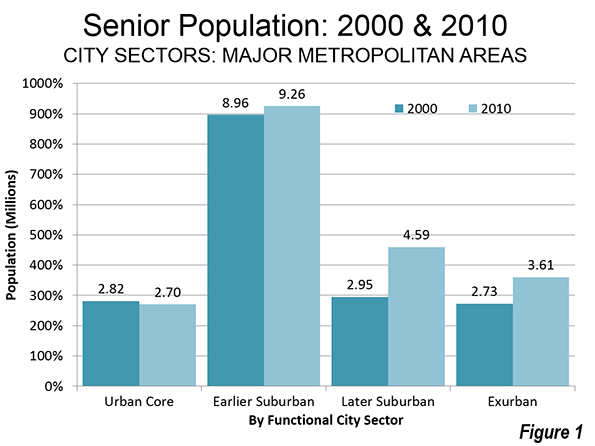
    The number of senior citizens living in suburbs and exurbs of major metropolitan areas (over 1,000,000 population) increased between 2000 and 2010, according to census data. The senior increases were strongly skewed away from the urban cores. Suburbs and exurbs gained 2.82 million senior residents over the period, while functional urban cores lost 112,000. The later suburbs added 1.64 million seniors. The second largest increase was in exurban areas, with a gain of 0.88 million seniors. The earlier suburbs (generally inner suburbs) added just under 300,000 seniors (Figure 1).

    During that period, the share of senior citizens living in the later suburbs increased 35 percent. The senior citizen population share in the exurbs rose nearly 15 percent. By contrast, the share of seniors living in the functional urban cores declined 17 percent. Their share in the earlier suburbs declined 11 percent.

    This is based on an analysis of small area data for major metropolitan areas using the City Sector Model.
    City Sector Model analysis avoids the exaggeration of urban core data that necessarily occurs from reliance on the municipal boundaries of core cities (which are themselves nearly 60 percent suburban or exurban, ranging from as little as three percent to virtually 100 percent). It also avoids the use of the newer "principal cities" designation of larger employment centers within metropolitan areas, nearly all of which are suburbs, but are inappropriately joined with core municipalities in some analyses. The City Sector Model" small area analysis method is described in greater detail in the Note below.

    Pervasive Suburban and Exurban Senior Gains

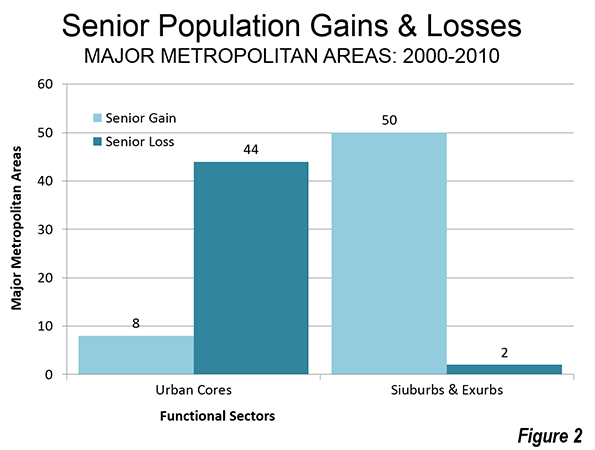
    The gains in functional suburban and exurban senior population were pervasive. Among the 52 major metropolitan areas, there were gains in 50. In two areas (New Orleans and Pittsburgh), there were losses. However, in each of these cases there was an even greater senior loss in the functional urban cores. In no case did urban cores gain more or lose fewer seniors than the suburbs and exurbs. Eight of the functional urban cores experienced gains in senior population, while 44 experienced losses (Figure 2)

    Largest Urban Cores

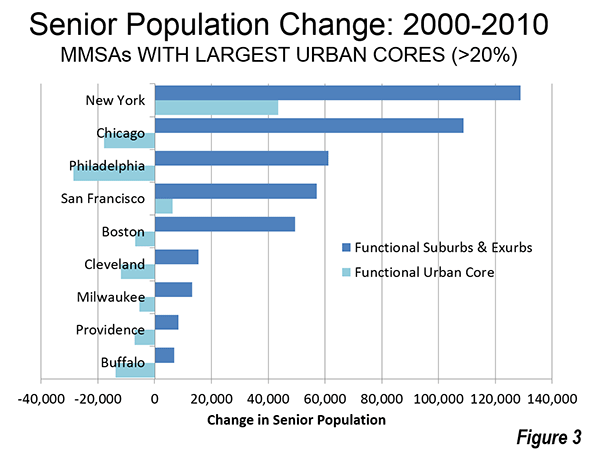
    The major metropolitan areas with the largest urban cores (more than 20 percent of the population in the functional urban cores),  would tend to be the most attractive to seniors seeking an urban core lifestyle. But they  still saw their seniors heading  to the suburbs and exurbs (Figure 3). Senior populations declined in the functional urban cores of all but two of these nine areas, New York and San Francisco. However, in both of these metropolitan areas, the increases in suburban and exurban senior populations overwhelmed the increases in the urban cores. All of these nine major metropolitan areas experienced increases in their suburban and exurban senior populations.

    Moreover, the Phoenix anecdote cited above is at odds with the reality that the later suburbs and exurbs gained 165,000 seniors between 2000 and 2010. The earlier suburbs lost 7,000 seniors (No part of Phoenix has sufficient density or transit market share to be classified as functional urban core).

    Consistency of Seniors Trend with Other Metropolitan Indicators

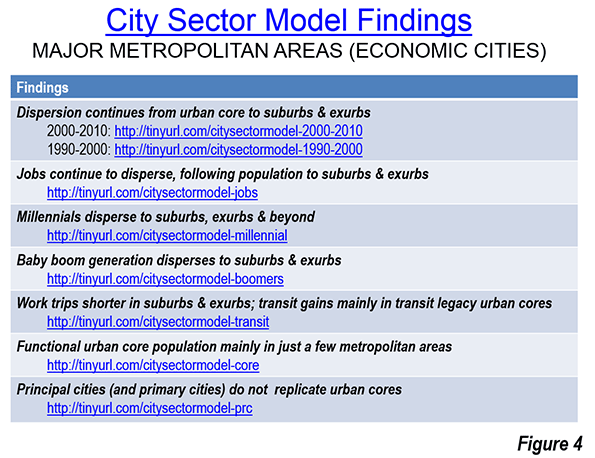
    As has been indicated in previous articles, there continues to be a trend toward dispersal and decentralization in US major metropolitan areas. There was an overall population dispersion from 1990 to 2000 and 2000 to 2010, which continued trends that have been evident since World War II and even before, as pre-automobile era urban cores have lost their dominance. Jobs continued to follow the suburbanization and exurbanization of the population over the past decade away as cities became less monocentric, less polycentric and more "non-centric." As a result, work trip travel times are generally shorter for residents where population densities are lower. Baby boomers and Millennials have been shown to be dispersing as well, despite anecdotes to the contrary (Figure 4). The same applies to seniors.

    Note: The City Sector Model allows a more representative functional analysis of urban core, suburban and exurban areas, by the use of smaller areas, rather than municipal boundaries. The more than 30,000 zip code tabulation areas (ZCTA) of major metropolitan areas and the rest of the nation are categorized by functional characteristics, including urban form, density and travel behavior. There are four functional classifications, the urban core, earlier suburban areas, later suburban areas and exurban areas. The urban cores have higher densities, older housing and substantially greater reliance on transit, similar to the urban cores that preceded the great automobile oriented suburbanization that followed World War II. Exurban areas are beyond the built up urban areas. The suburban areas constitute the balance of the major metropolitan areas. Earlier suburbs include areas with a median house construction date before 1980. Later suburban areas have later median house construction dates.

    Urban cores are defined as areas (ZCTAs) that have high population densities (7,500 or more per square mile or 2,900 per square kilometer or more) and high transit, walking and cycling work trip market shares (20 percent or more). Urban cores also include non-exurban sectors with median house construction dates of 1945 or before. All of these areas are defined at the zip code tabulation area (ZCTA) level.

    —-

    Wendell Cox is principal of Demographia, an international public policy and demographics firm. He is co-author of the "Demographia International Housing Affordability Survey" and author of "Demographia World Urban Areas" and "War on the Dream: How Anti-Sprawl Policy Threatens the Quality of Life." He was appointed to three terms on the Los Angeles County Transportation Commission, where he served with the leading city and county leadership as the only non-elected member. He was appointed to the Amtrak Reform Council to fill the unexpired term of Governor Christine Todd Whitman and has served as a visiting professor at the Conservatoire National des Arts et Metiers, a national university in Paris.

    Photo: Later Suburbs of Cincinnati (where most senior growth occurred from 2000 to 2010). By Author

  • The Death of Nassau Coliseum: A Harbinger of Suburban Decline?

    Nassau Veterans Memorial Coliseum is one of the last remaining old time hockey rinks. But this will be the last year that the New York Islanders play there. The old barn has long been slated for replacement. It is an old building that requires expensive repairs. Many attempts were made to reach an agreement for a new arena with Nassau County. Sadly, the team’s new location will be at the Barclay’s Center in Brooklyn; on Long Island physically, but not a part of the island’s suburban tradition. The team will retain the name, but Long Island effectively is losing its team.

    Suburban Decline, Urban Ascent?

    Some observers, like Mark Byrnes in CityLab, see this shift as further evidence of suburban life and the elevation of the urban core.1 But instead it is another frustrating case of a small, highly visible not in my backyard (NIMBY) movement in suburbia on one hand, and, on the other, an unwanted development foisted upon urban residents without due process through eminent domain.

    Two Arenas

    The New York Islanders haven’t been very newsworthy for the last decade – save for their volatile ownership situation, but their transition from one of the National Hockey League’s oldest buildings in Long Island to a new building in Brooklyn has been a very public ordeal. It’s a story that involves local politicians thwarting construction of a new arena that would have cost taxpayers nothing, a failed referendum to finance an alternative proposal that would have required public funding, and ends with the Islanders moving out of Long Island into the controversial Barclay Centre. Even if the Barclay Centre proves to be a viable and enjoyable venue for the Islanders, it will forever remain one of the most disastrous developments in the history of professional sports.

    The Old Barn

    Nassau Coliseum is the second oldest active building in the National Hockey League. The arena was built on the site of decommissioned Army/Air force base Mitchell Field.2 Nassau County acquired the land in 1960, a year after closure. Nassau Coliseum officially opened on February 11, 1972.3 The cost of the project was $32 million ($179 million, adjusted for inflation).4 The Coliseum sits on 5 acres of a 77-acre plot in Uniondale, the rest of which is mainly surface parking.5

    The site is intersected by two major roadways, and is across the street from Hofstra University and a golf course. It is right down the street from Levittown, the prototypical post-war American suburb. It is the type of place where one might assume that building large scale projects should be relatively simple.

    The Lighthouse Project

    In 2000, software billionaire Charles Wang bought the Islanders for $190 million.6  High end estimates suggest that Wang might have lost as much as $208 million between 2000 and 2009 on the team in large part due to   having one of the least favourable lease agreements in professional sports.7.8 “The need to refurbish the ageing building provided a perfect opportunity to put the team on a solid financial footing.

    Wang proposed a plan to develop the area surrounding the arena. The Lighthouse Project was expected to take 8-10 years to complete at a cost of roughly $3.74 billion.9 The plan included a renovation of the Coliseum, a 60-story tower designed to look like a lighthouse, housing, athletic facilities, a new minor league baseball stadium, restaurants, and a new hotel.10 The transformation of the Coliseum would have entailed lowering the floor of the ice rink to accommodate additional seats, increasing capacity from 16,300 to 17,500 during hockey games, 18,500 for basketball games and 20,000 for concerts, while adding 50 luxury boxes.11

    The proposal would also have brought a 125,000-square-foot athletic complex including two ice rinks (a practice rink for the Islanders, and another for the public), a basketball court, and a fitness club where the Islanders and the Arena Football League’s New York Dragons (also owned by Wang) would have trained.12

    The project would also have included moderately priced housing, which is lacking in Long Island. Long Island County was also exploring enhanced public transportation to the future development, including bus rapid transit.13

    Phase two of the project would have included a conference center, a sports technology building, residences, and the 60-story lighthouse (including a 500 room luxury hotel).14

    Building a new arena on such a large parcel of land surrounded by sparse, low density development should have theoretically faced few obstacles, given that the owner was willing to finance the entire project. Unfortunately, the project drew the ire of some local residents. Robert Zafonte, president of the 3500 member East Meadow Civic and Community Association, had this to say:

    ”The high-rise disturbs me,” he said. ”It seems to be totally out of character with the nature of the suburban area here. It is not consistent with what Long Island is all about – residential, small homes. I don’t think it belongs here.15

    The Lighthouse Project was approved by the county in 2006, but stalled when Wang was unable to secure zoning approvals from the Town of Hempstead.16 Republican Town of Hempstead Supervisor Kate Murray, lobbied intensely by a small group of local residents, decided that the project would result in too much traffic.

    Not in My Backyard

    In an attempt to salvage the project, Charles Wang and the Lighthouse Development Group partnered with Rexcorp to create a scaled down version of the project. The most notable change was that the Lighthouse would now be 30 stories, rather than 60.17

    But as Pearl M. Kamer, chief economist of the Long Island Association pointed out, “When you cut density on any project, you cut revenue.” He argued that under the proposal, scaled back to meet Murray’s demands, it would be difficult if not impossible to generate enough revenue to finance the project.18 This meant that the new proposal would likely require public funding, in contrast to the original proposal which would have been entirely privately funded.

    Wang eventually reached an agreement with Nassau County to build a scaled down version of the Lighthouse Project, pending an August 2011 referendum. Since the stripped down project would have yielded less revenue than the original proposal, the project would only have been viable with $400 million in public financing.19 The funding would have necessitated a 4 percent property tax increase. Voters rejected the proposal by a 57-43 margin.20

    The End of the Lighthouse Project

    With the end of the Lighthouse Project, Wang entered into a 25 year lease with the Barclay Centre soon after. The Islanders will begin playing at the building in 201521, though they already played their first exhibition game at the arena on September 21st, 2013.

    Losing the Islanders will result in significant economic losses to the county. Nassau County’s comptroller estimated that had last year’s NHL lockout lasted a full season, the county would have lost $62.2 million in economic activity, and the Nassau County treasury would have lost $1.1 million in  of ticket taxes, as well as a share of concessions and parking fees.22  Those are substantial loses for a county of less than 1.4 million residents.

    While Charles Wang has frequently been blamed for the relocation, NHL Commissioner Gary Bettman lays the blame squarely at the feet of local politicians.

    "This is a situation that is not of the Islanders’ making,” he said. “The responsibility for what’s happened really lies with Nassau County and the Town of Hempstead. For the fans in Nassau, not just of the Islanders, but of circuses and rock concerts and the like, it’s a shame.23

    The Uncertain Future of the Coliseum

    Though this seems like the end of the Nassau Coliseum saga, the future of the arena is still up for debate. Barclay Centre part-owner Bruce Ratner has proposed a $229 redevelopment plan for the arena. The project would include renovating the Coliseum, building restaurants, an ice rink, bowling alley, movie theater and other facilities.24  

    The Ratner proposal faces many hurdles, including luring an American Hockey League (NHL farm team) club to replace the Islanders. The Islanders AHL affiliate, the Bridgeport Sound Tigers (also owned by Wang), could potentially move from Connecticut to fill that void. Additionally, the Islanders are still slated to play 6 home games (out of 41) per year at the Coliseum.25 One columnist at Forbes has speculated that Ratner, who would own both the Nassau Coliseum and part of the Barclay Centre, might well decide to keep the Islanders in Long Island after all if he can secure approval for the new project.26  

    Imposing an Arena on Brooklyn

    The Barclay Centre differs dramatically from the failed Lighthouse Project. The Barclay Centre was part of the $4.9 billion Atlantic Yards project built in run down commercial area of Brooklyn, despite local opposition. Mayor Bloomberg used eminent domain to seize the “blighted” land to allow for construction.

    Brooklyn had been without a sports franchise since 1957, when the Brooklyn Dodgers moved to Los Angeles.  

    The Barclay Centre was initially proposed in 2004 when real estate developer Bruce Ratner purchased the New Jersey Nets for $300 million. Ratner planned to move the franchise out of New Jersey and into the lucrative Brooklyn market. The project was initially projected to open in 2006.

    The attempt to use eminent domain to seize the land was brought before the New York Supreme Court, delaying the process. The court eventually ruled in Ratner’s favour.

    Ratner’s years of frustration with the project lead him to sell a majority share of the Nets to Russian businessman Mikhail Prokhorov for $200 million.

    Due to construction delays, the Nets signed a deal to play in Newark at the Prudential Centre until the Barclay’s Centre was complete.

    Construction of the $1 billion arena began in January of 2010. The Barclay’s Centre was open to the public on September 21, 2012. Just over a month later, the Islanders announced their agreement to play at the Barclay’s Centre.

    The Barclay Compromise

    The Barclay’s Centre wasn’t a bad solution to the stalemate in Nassau County. The arena is new, and Brooklyn is a lucrative sports market. The Long Island Railroad provides direct service to Atlantic Terminal, meaning it will be more convenient for many Long Island residents to access the Barclay’s Centre than Nassau Coliseum. However, the 15,813 seating capacity is far short of most modern NHL arenas, and many seats have partially obstructed views.

    At the same time, the failed Lighthouse Project was a missed opportunity for Nassau County. The community still hasn’t rebounded to its 1970 population, which fell by 100,000 during the 1970s. Estimates suggest that the $4.4 billion of private investment into the Lighthouse project would have created 75,000 construction jobs and 19,000 permanent jobs thereafter.27 Moreover, it would have resulted in expanded public transit options on Long Island. Lawrence Levy, executive director of the National Centre for Suburban Studies at Hofstra University in a 2009 interview described the project as “potentially a game-changer.”

    Even ignoring the direct economic losses, the failure of the Lighthouse Project sent a clear message to businesses that Long Island will only accept investment on its own terms. The fallout is impossible to measure.

    Wither Suburbia?

    There is an ongoing dialogue between observers over whether suburbia is a “market outcome”, or whether it is an artificial creation of government policy. The truth is likely in the middle. Suburban communities are regulated, subsidized, and taxed in many different ways. Zoning restricts the ability to build corner stores and cafes in residential neighbourhoods. Wasteful road projects connect many uneconomic housing developments to cities. Land-use regulations drive up land prices, which are passed on to homebuyers. Suburbia is certainly a market outcome in the sense that decreased transportation costs, dispersed entertainment and communications options, and preferences for larger backyards mean that many people would happily pay the market cost of suburban housing. But its particular shape is not a market outcome. Neither, for that matter, is the shape of any geographical area.  

    There are good reasons for regulating land-use. Separating factories that emit noxious odours from residential communities makes sense. The trouble is that land-use planning has gone from a health and safety measure to an economic tool. In Uniondale it was used to ensure that additional traffic didn’t impose costs on drivers, who would prefer not to bear the costs of congestion. In Brooklyn, it was used to ensure that developers and the municipal government could extract value from property that wasn’t on the market. The market outcome would have been allowing the Lighthouse Project to proceed, and the New Jersey Nets to remain in New Jersey (or perhaps to move to Uniondale). The Barclay’s Centre doesn’t represent a triumph of the city. It is the net result of contrasting political meddling in two different jurisdictions.

    Perhaps There Are No Real Lessons Here

    While we shouldn’t read too much into isolated incidents, there does seem to be an increasing propensity for suburban communities to prevent dense development – from the Bay Area to suburban Toronto –  and for cities to use eminent domain to ram through those same types of developments.  

    This is a story about politics, not economics. And sometimes politics leads to some really bad outcomes. That may well be all there is to it. Either way, the Islanders will be moving to Brooklyn next year. Fans should enjoy the old barn while it lasts. It is the last of a dying breed.

    Steve Lafleur is a public policy analyst with the Frontier Centre for Public Policy, an independent think tank based in Winnipeg, Manitoba. His primary research interests are housing and land use policies, transportation and infrastructure, criminal justice policy, immigration, inter-governmental fiscal relations, and municipal finances. His work has been featured in most Canadian newspapers including the Toronto Star and the National Post.

    1 http://www.citylab.com/politics/2012/11/islanders-move-harbinger-suburban-decline/3826/

    2 http://nysea.bizland.com/nysea/publications/proceed/2012/Proceed_2012_p221.pdf

    3 http://nysea.bizland.com/nysea/publications/proceed/2012/Proceed_2012_p221.pdf

    4 http://nysea.bizland.com/nysea/publications/proceed/2012/Proceed_2012_p221.pdf

    5 http://query.nytimes.com/gst/fullpage.html?res=9D01E5DD1538F930A35753C1A9629C8B63

    6 http://nysea.bizland.com/nysea/publications/proceed/2012/Proceed_2012_p221.pdf

    7 http://nysea.bizland.com/nysea/publications/proceed/2012/Proceed_2012_p221.pdf

    8 http://sports.espn.go.com/nhl/news/story?id=4129484

    9 http://en.wikipedia.org/wiki/The_Lighthouse_Project

    10 http://en.wikipedia.org/wiki/The_Lighthouse_Project

    11 http://query.nytimes.com/gst/fullpage.html?res=9D01E5DD1538F930A35753C1A9629C8B63

    12 http://query.nytimes.com/gst/fullpage.html?res=9D01E5DD1538F930A35753C1A9629C8B63&pagewanted=2

    13 http://query.nytimes.com/gst/fullpage.html?res=9D01E5DD1538F930A35753C1A9629C8B63&pagewanted=2

    14 http://query.nytimes.com/gst/fullpage.html?res=9D01E5DD1538F930A35753C1A9629C8B63&pagewanted=2

    15 http://query.nytimes.com/gst/fullpage.html?res=9D01E5DD1538F930A35753C1A9629C8B63

    16 http://www.newsday.com/long-island/nassau/inside-the-deal-to-remake-nassau-coliseum-1.6115950?utm_medium=twitter&utm_source=twitterfeed

    17 http://en.wikipedia.org/wiki/The_Lighthouse_Project

    18 http://www.nytimes.com/2010/07/25/realestate/25lizo.html?adxnnl=1&adxnnlx=1379883639-wcQ7dfnu7u1PMJZCGW8k9g

    19 http://www.nytimes.com/2011/08/02/nyregion/nassau-voters-reject-proposal-to-overhaul-coliseum.html?_r=0

    20 http://www.nytimes.com/2011/08/02/nyregion/nassau-voters-reject-proposal-to-overhaul-coliseum.html?_r=0

    21 http://www.nydailynews.com/sports/hockey/ice-job-brooklyn-nhl-islanders-leave-15-article-1.1191783

    22 http://nysea.bizland.com/nysea/publications/proceed/2012/Proceed_2012_p221.pdf

    23 http://www.newsday.com/sports/hockey/islanders/gary-bettman-says-he-likes-future-islanders-owners-1.9230790

    24 http://www.newsday.com/long-island/nassau/inside-the-deal-to-remake-nassau-coliseum-1.6115950?utm_medium=twitter&utm_source=twitterfeed

    25 http://www.lighthousehockey.com/2013/5/2/4293850/ratner-brooklyn-islanders-games-nassau-coliseum

    26 http://www.forbes.com/sites/tomvanriper/2013/08/16/brooklyn-islanders-not-so-fast/

    27 http://www.nytimes.com/2009/06/18/nyregion/18towns.html?_r=0

  • Diverging Fortunes in Portland

    A recent New York Times Magazine had a story on Portland that featured Yours Truly. I recapitulated a few observations I’ve had over the years, including that it’s truly remarkable how a small city like Portland has captured so many people’s imagination, and also that “people move to Portland to move to Portland.”

    A Portland writer named Steve Duin appears to have had an aneurysm over the piece and, among other things, criticized my statement about why people move to Portland, saying:

    She quotes Aaron Renn, an urban-affairs analyst, who insists that while Los Angeles attracts starlets and New York the financiers, “People move to Portland to move to Portland,” as if the city is a space between Pacific Avenue and Park Place on the Monopoly board, not a vibrant, creative, accessible and accommodating urban scene.

    Which only proves that he completely missed the point. All I’m saying is what he’s saying in different words, namely that people move to Portland for its lifestyle and amenities. This is exactly what every Portland booster claims, namely that what they’ve created is attractional. I’m simply pointing out the obvious: people move to Portland primarily for lifestyle and leisure, not career or economic reasons. People move to Portland because they want to live there.

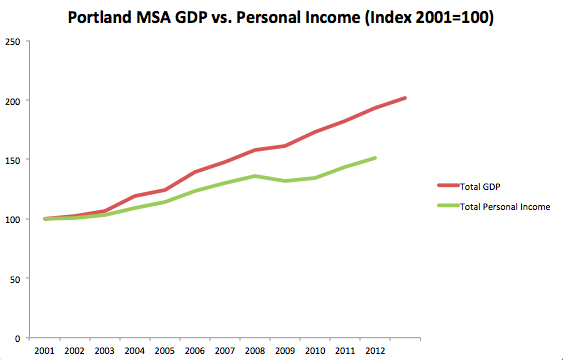
    Portland’s economy has actually picked up of late. Its unemployment fell below the national average in 2013 after having been above it for 14 straight years. But I want to highlight a disconnect between a couple measures of economic performance.

    I’ve written many times that Portland has done very well in terms of per capita GDP. In fact, from 2001 to 2013 (the maximum range of data available from the feds), Portland was #1 out of all 52 large metros in the US in its percentage increase in real per capita GDP.

    On the other hand, looking at how much of that economic value ends up in people’s pockets tells a different story. From 2001 to 2012 (I don’t think 2013 has been released yet), Portland only ranked 40th out of 52 in its percentage increase on this metric. Portland declined from a per capita income of 104.9% of the US average in 2001 to 98.6% in 2012.

    I threw this divergence into a quick chart:


    portland-gdp-vs-persinc

    It would be interesting to dig into these numbers. I did a quick back of the envelop calculation of total GDP growth by industry. Only a few industry totals are available, but the biggest gainer was Manufacturing, up 300%. Education, Health, and Social Assistance were #2, followed by Professional and Business Services. Natural Resources, Retail. Information, and FIRE were at the bottom.

    Speaking of San Jose, I see an even more remarkable divergence there. It was #2 in per capita GDP growth over the 2001-2013 time frame. Looking at the overall Bay Area total real GDP, it increased by 30.1% from 2001 to 2013. Keep in mind I’m using the inflation adjusted figured here, so there’s no inflation in that metric. But at the same time the Bay Area lost 2.4% of its jobs.

    The Bay Area grew its economy by almost a third while shedding over 75,000 jobs. Pretty remarkable.

    Aaron M. Renn is an independent writer on urban affairs and the founder of Telestrian, a data analysis and mapping tool. He writes at The Urbanophile, where this piece originally appeared.

    Portland Oregon” by Jamidwyer – Own work. Licensed under Public domain via Wikimedia Commons

  • When Patrimony Trumps Political Preference

    Jews, despite their above-average affluence and their entrepreneurial bent, have long been among the most loyal constituencies of the Democratic Party. Half of American Jews earn more than $100,000 annually, three times the national average and far more than typical members of mainline Protestant churches. The only real competition, economically, comes from another outsider group: Hindus.

    In 2008, President Obama received roughly 80 percent of the Jewish vote and, four years later, his percentage remained just under 70 percent, even though the alternative candidate was clearly more pro-Israel and enjoyed the support of some Jewish billionaires.

    Some Republicans point out that Mitt Romney’s show of support among Jews was the strongest since Ronald Reagan ran against Walter Mondale in 1984. They suggest that Jews may finally be shifting toward the center and even to the Right.

    Change on the left

    Changes in attitudes toward Israel, and Jews, could hasten this process. After all, it is painfully obvious that opposition to Israel has now shifted from the traditionally anti-Semitic Right to the multicultural Left, and its various offshoots in the media and on campuses. The growing disconnect between left-leaning Jews, such as Peter Beinart, Jon Stewart, Max Blumenthal and Ezra Klein, and Israel makes such a shift easier.

    This reflects a growing change in the nature of opposition to Israel, and anti-Semitism, in the West, from the old Right to the liberal-dominated media and the academy. Universities, for example, serve as ground zero for powerful boycott and divestment campaigns against Israel. The campaigns’ purpose is not only to hurt Israel’s economy, or protest its sometimes-unwise policies (such as expanding settlements), but also to cast her as a pariah state.

    This is intriguing, indeed, since there seems to be no academic campaign to rein in such huge human-rights abusers – whether against Christians, females, gays or other minorities – as Syria, Saudi Arabia, Iran or Egypt. Only crimes by the Jewish state seem to qualify.

    This clear inconsistency appears not to have slowed the divestment campaigns which, if not openly anti-Semitic, justify prejudice as a natural result of Israeli policies. Indeed, a Stanford professor writing in Salon placed responsibility for rising anti-Semitism on “the actions of the state of Israel in staging a brutal, prolonged attack on the Palestinian people.” This was echoed by another pro-divestment professor who suggested that “Zionists” were “transforming ‘anti-Semitism’ from something horrible into something honorable since 1948.”

    To be clear, there is nothing wrong with opposing specific Israeli policies, as we both do. But you also cannot ignore the fact that anti-Zionism often morphs into eliminationist anti-Semitism.

    “From the [Jordan] River to the [Mediterranean] Sea, Palestine will be free,” protesters chanted outside the U.S. Courthouse in Fort Lauderdale, Fla., during an event co-sponsored by, among others, the Council on American-Islamic Relations and the Broward Green Party.

    Only a fool would think that a Hamas takeover of all Palestine would result in anything other than a second Holocaust. But such associations don’t seem to embarrass many progressives, who write for such publications as the Daily Kos. With anti-Israel policies now an accepted part of the progressive agenda, some Democrats may be forced to gradually shift their views – as has occurred in issues from climate change to foreign policy – to conform to the new accepted line.

    Hostile Europe

    This is already happening across the Atlantic. The two dominant parties in Scotland, Labor and the Scottish Nationalists, notes the National Interest, “try to outdo each other in their radicalism” against Israel and Zionism. Some Labor MPs have even revived old notions of a “cabal of Jewish advisers” who determine British foreign policy. To many on the left of the Labor Party, it’s basically impossible to be both openly Jewish and in the “progressive movement.”

    This new attitude is, if anything, stronger throughout the rest of the European Union. Changing demographics explains part of this. France, long the home of Western Europe’s largest Jewish community, now has many times that number of Muslims. Much the same can be said of Germany, the Netherlands and other European countries. Parties on the left often covet these voters and play to their sympathies.

    This means an embrace of an increasingly harsh view of Jews, not only among Muslim extremists, but also well-placed non-Muslim leftists. The publisher of L’Express, France’s leading left-of-center magazine, recently attacked French Jews for their support of Israel and chastised them for forming self-defense organizations to protect their community from attack. Not surprisingly, many French Jews are considering an exodus to Israel, Canada, Australia or the United States.

    This process, thankfully, is only nascent in the United States, where Muslim and Jewish populations are roughly even. But racial divisions could speed up the dissolution of progressive support for Israel. Although perhaps less than one in five Americans hold strongly anti-Semitic views, that tendency is stronger among both African Americans and foreign-born Hispanics, two key and growing components of the Democratic coalition. This situation may worsen due to well-publicized efforts, particularly in the left-leaning media, to draw close comparison between the recent racial rioting in Ferguson, Mo., to Israel’s attacks on Hamas in Gaza.

    Given these pressures, it is certainly possible that, over time, more Jews may flee to the Right, following the path already trod by many Italians, Irish and other immigrant groups. Yet, if this happens, it won’t do so quickly. Historical inertia still favors the Democrats by a wide margin.

    Shifts among Jews

    What finally may drive this change, more than anything else, are evolving Jewish demographics. More American Jews – who left the former Soviet Union, Arab countries, Iran, even South America – do not share the old left-leaning narrative embraced by the bulk of Jews whose families left Europe before World War II. Among Americans who self-identify as Jews, roughly three-quarters, according to one survey, still consider Israel an important issue.

    Economics and local issues, like public safety and schools, could also accelerate this movement to the right. Jews have tended to support more centrist or conservative candidates, such as Mayors Rudy Giuliani in New York or Richard Riordan in Los Angeles. Take the social issues of the Right – abortion, opposition to gay rights, school prayer – out of the mix, and many Jews may, indeed, vote a bit more like mainline Protestants, or even Mormons.

    But at the same time, Jews’ electoral clout – whatever their party – seems certain to diminish. As more secular Jews intermarry and eschew child bearing, their ties to Judaism tend to fade and clearly will not be passed to nonexistent offspring. At the same time, solidly Jewish-identified communities, such as the Israelis, evidence little interest in local or American politics, outside of issues affecting their native country. Ironically, the Israeli immigrants reflect the old stereotypes of Jews as sojourners, people who are inward looking and not committed to their current place of residence.

    Jews of Iranian, Russian or Sephardic descent – who have chosen to settle here for the long term and are not likely to return “home” – may be more likely to engage for Israel and Jewish culture, but, so far, few have emerged politically. Orthodox Jews, another growing group, are very parochial, and hold social views at variance with the vast majority of their co-religionists. They are unlikely to lead mainstream Jews toward the center or right.

    All this suggests a difficult political future for Jews in America. As the old commonalities – memories of European repression, the Holocaust and Israel – continue to fray, the community’s political influence seems destined to weaken. Those who care about Israel, or traditional Jewish values, may find themselves forced to partner, often uncomfortably, with conservatives with whom they tend to have many disagreements.

    But this strategy of at least considering a conservative linkage could, at a minimum, compel liberals – particularly in heavily Jewish areas like New York or Southern California – to confront the consequences of their growing alliance with anti-Zionists, as well as with blatant anti-Semites. In the end, as the sage and scholar Hillel suggested 2,000 years ago, Jews need to be for themselves, ready to defend their culture and patrimony, as well as Israel. To do this they may find their best allies – at least for now – may be fellow Americans who stand somewhat to their right.

    This piece originally appeared at The Orange County Register.

    Joel Kotkin is executive editor of NewGeography.com and Roger Hobbs Distinguished Fellow in Urban Studies at Chapman University, and a member of the editorial board of the Orange County Register. His newest book, The New Class Conflict is now available at Amazon and Telos Press. He is author of The City: A Global History and The Next Hundred Million: America in 2050. His most recent study, The Rise of Postfamilialism, has been widely discussed and distributed internationally. He lives in Los Angeles, CA.

    Rory Cohen is assistant deputy editor of the Orange County Register’s Opinion pages.

  • New Commuting Data Shows Gain by Individual Modes

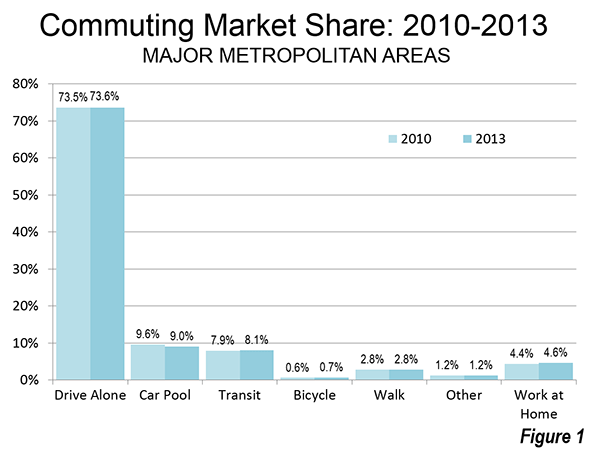
    The newly released American Community Survey data for 2013 indicates little change in commuting patterns since 2010, a result that is to be expected in a period as short as three years. Among the 52 major metropolitan areas (over 1 million population), driving alone increased to 73.6% of commuting (including all travel modes and working at home). The one mode that experienced the largest drop was carpools, where the share of commuting dropped from 9.6% in 2010 to 9.0% in 2013. Doubtless most of the carpool losses represented gains in driving alone and transit. Transit grew, increasing from a market share of 7.9% in 2010 to 8.1% in 2013 in major metropolitan areas; similarly working at home increased from 4.4% to 4.6%, an increase similar to that of transit (Figure 1). Bicycles increased from 0.6% to 0.7%, while walking remained constant at 2.8%.

    Transit: Historical Context

    Transit has always received considerable media attention in commuting analyses. Part of this is because of the comparative labor efficiency (not necessarily cost efficiency) of transit in high-volume corridors leading to the nation’s largest downtown areas. Part of the attention is also due to the "positive spin" that has accompanied transit ridership press releases. An American Public Transportation Association press release earlier in the year, which claimed record ridership, have evoked a surprisingly strong response from some quarters: For example, academics David King, Michael Manville and Michael Smart wrote in the Washington Post:"We are strong supporters of public transportation, but misguided optimism about transit’s resurgence helps neither transit users nor the larger traveling public." They concluded that transit trips per capita had actually declined in the past 5 years. 

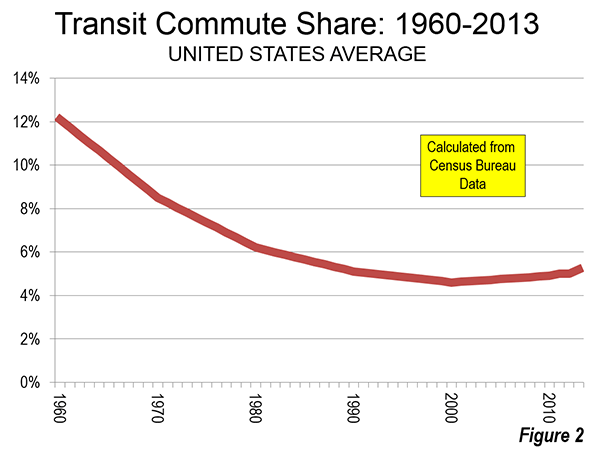
    Nonetheless, transit remains well below its historic norms. The first commute data was in the 1960 census and indicated a 12.6% national market share for transit for the entire U.S. population. By 1990, transit’s national market share had dropped to 5.1%. After dropping to 4.6% in 2000, transit recovered to 5.2% in 2012. But clearly the historical decline of transit’s market share has at least been halted (Figure 2).

    Even so, in a rapidly expanding market, many more people have begun driving alone than using transit. More than 47 million more commuters drive alone today than in 1980, while the transit increased about 1.4 million commuters over the same time period.

    The largest decline occurred before 1960. Transit’s work trip market share was probably much higher in 1940, but the necessary data was not collected in the census, just before World War II and the great automobile-oriented suburbanization. In 1940, overall urban transit travel (passenger miles all day, not just commutes) is estimated to have been twice that of 1960 and nearly 10 times that of today.

    Transit’s 2010-2013 Trend

    To a remarkable extent, transit continues to be a "New York story." Approximately 40% of all transit commuting is in the New York metropolitan area. New York’s 2.9 million transit commuters near six times that of second place Chicago. Transit accounts for 30.9% of commuting in New York. San Francisco ranks second at 16.1% and Washington third at 14.2%. Only three other cities, Boston (12.8%), Chicago (11.8), and Philadelphia (10.0%) have transit commute shares of 10% or more. 

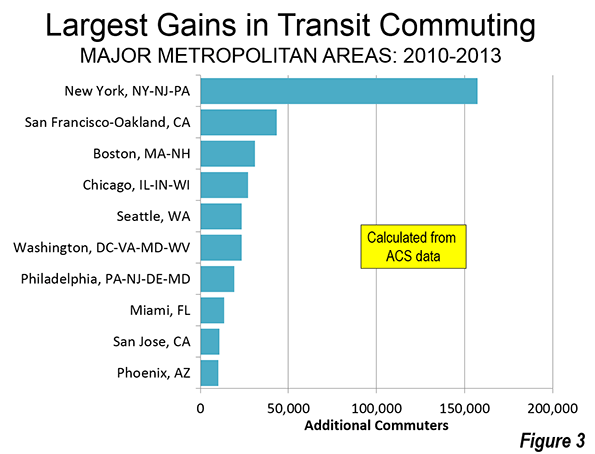
    From 2010 to 2013, transit added approximately 375,000 new commuters. Approximately 40% of the entire nation’s transit commuting increase occurred in the New York metropolitan area. This was included in the predictable concentration (80%) of ridership gains in the transit legacy metropolitan areas, which are the six with transit market shares of 10% or more. Combined, these cities added 300,000 commuters, 89%, on the large rail systems that feed the nation’s largest downtown areas.

    Perhaps surprisingly, Seattle broke into the top five, edging out legacy metropolitan areas (Figure 3) Philadelphia and Washington. Seattle has a newer light rail and commuter rail system. Even so, the bulk of the gain in Seattle was not on the rail system. Approximately 80% of its transit commuter growth was on non-rail modes. Seattle has three major public bus systems, a ferry system and the newer Microsoft private bus system that serves its employment centers throughout the metropolitan area. All of the new transit commuters in eighth ranked Miami were on non-rail modes, despite its large and relatively new rail system. New rail city Phoenix (10th) also experienced the bulk of its new commuting on non-rail modes (93%). Rail accounted for most of the gain in San Jose (9th), with a 58% of the total  The transit market shares in Miami, San Jose and Phoenix are all below the national average of 5.2%.

    Outside the six transit legacy metropolitan areas, gains were far more modest, at approximately 75,000. Seattle, Miami, San Jose, and Phoenix accounted for nearly 60,000 of this gain, leaving only 15,000 for the other 42 major metropolitan areas, including Los Angeles, which had a 5,000 loss. Los Angeles now has a transit work trip market share of 5.8%, below the 5.9% in 1980 when the Los Angeles County Transportation Commission approved the funding for its rail system (the result of my amendment, see "Transit in Los Angeles"). Los Angeles is falling far short of its Matt Yglesias characterization as the "next great mass-transit city."

    Since 2000, the national trend has been similar. Nearly 80% of the increase in transit commuting has been in the transit legacy metropolitan areas, where transit’s share has risen from 17% to 20%. These areas accounted for only 23% of the major metropolitan area growth since 2000. By contrast, 77% of the major metropolitan area growth has been in the 46 other metropolitan areas, where transit’s share of commuting has remained at 3.2% since 2000. There are limits to how far the legacy metropolitan areas can drive up transit’s national market share.

    Prospects for Commuting

    At a broader level, the new data shows the continuing trend toward individual mode commuting, as opposed to shared modes. Between 2010 and 2013, personal modes (driving alone, bicycles, walking and working at home) increased from 82.3% to 82.7% of all commuting. Shared modes (carpools and transit) declined from 17.7% of commuting to 17.3%. These data exclude the "other modes" category (1.2% of commuting) because it includes both personal and shared commuting. None of this should be surprising, since one of the best ways to improve productivity, both personal and in the economy, is to minimize travel time for necessary activities throughout the metropolitan area (labor market).

    Wendell Cox is principal of Demographia, an international public policy and demographics firm. He is co-author of the "Demographia International Housing Affordability Survey" and author of "Demographia World Urban Areas" and "War on the Dream: How Anti-Sprawl Policy Threatens the Quality of Life." He was appointed to three terms on the Los Angeles County Transportation Commission, where he served with the leading city and county leadership as the only non-elected member. He was appointed to the Amtrak Reform Council to fill the unexpired term of Governor Christine Todd Whitman and has served as a visiting professor at the Conservatoire National des Arts et Metiers, a national university in Paris.

    Photograph: DART light rail train in downtown Dallas (by author)