Blog

  • The Rise of Urban Riverfronts

    I recently moved from Cincinnati to Providence, Rhode Island, although I still think of the Detroit area as my hometown. All of these cities are based on their access to water. Providence, despite its location at the mouth of an Atlantic bay, is still a river-town at heart. Chicago mayor Rahm Emanuel has plans for a new and improved riverwalk, too. What can these cities learn from each other?

    In the ’80s, downtown Providence was a much less vibrant and destination-worthy place than it is now. Its urban rivers were buried beneath cement, rail-lines, and acres of concrete until a public-private revitalization effort gained enough traction. Today, in its place, the 11-acre Waterplace Park hosts numerous attractions, including the well-loved Waterfire events, and is a long, winding string of paths and bridges that sprawls through Providence’s downtown.

    What’s best about its place-making design is its versatility. The riverfront offers commutable routes between destinations, areas to picnic or socialize during lunch breaks, and event space throughout the seasons. Gondola rides, kayaking, and even viral pop-up installations all thrive here, making it multi-functional and inviting to a range of citizens.

    Chicago, much like Providence, has revealed renderings of parks that show multi-functional, inviting public spaces for rest, socializing, jogging, and enjoying attractive outdoor landscapes. Chicago is also poised to offer kayak rentals, which would allow visitors to interact with the water’s surface, rather than simply admire it. Mayor Emanuel has plans for the riverwalk to stretch “from Lake Michigan to the confluence of the three branches,” or about 1.3 miles.

    That would add a key element: in addition to being multi-functional and inviting, the riverwalk, at least within its blueprints, will be interconnected and able to serve as a pathway between all types of destinations within the city, much like Boston’s incredible Emerald Necklace. The Mayor also recognizes the huge potential for retail expansion along this stretch, something that Providence can certainly attest to.

    Detroit, too, has been actively improving its waterfront. The shores of the Detroit River now include a long, inviting path for walking, jogging, or biking, with parks and features along the way. The transformation from its earlier state is reminiscent of Providence’s overhaul efforts of the ’80s, pushing the space from neglected and utilitarian to a pedestrian-focused destination for anyone in the downtown area. A Great Lakes-themed waterpark has recently been put into place, making the riverfront even more attractive to families and young people. In addition to being a long-time hub for local fishermen, the riverfront is now a destination for joggers, dog-walkers, families, and those on their lunch break in a newly recovering downtown business district.

    What Chicago should strive to institute is a core of riverfront events and attractions. Like Providence’s Waterfire, Detroit hosts events on its riverfront during the summer — even given that it only uses one side of a river it shares with Windsor, Ontario — including the hugely popular River Days concert series and festival.

    Many cities have access to only one side of a major river, including Cincinnati. But Chicago, like Providence, has the full body of its rivers. This asset is huge, considering how big a draw water-based or focused events can clearly be for visitors, and how great a reason for locals to meet up and enjoy their city together. This is part of what Chicago can learn from Detroit and Providence.

    Still, Providence has a great deal of room for improvement. What Chicago and Detroit have realized is that a river’s waterfront isn’t exactly a connector for separate parks. It can be one space where different areas bloom larger than the others. That is, that the entire riverfront can be a destination, even between established attractions.

    Currently, Providence is preparing for the development of what’s being called The Link, an area of open land where I-195 used to cut through the downtown, Jewelry District, and Fox Point neighborhoods. Part of the grassy scar has been designated to become a riverfront park with a pedestrian bridge, and is expected to connect by bike/walk path to the nearby Roger Williams Park and Zoo. This is a big step toward a holistic riverfront that can be accessed from a several neighborhoods.

    Providence also offers the vaguely inviting Promenade, with a bike lanes on each side and a pedestrian bridge/plaza. But the Promenade is cut off from Waterplace Park by the mall and the interstate rumbling overhead. From there, looking west, the river is largely ignored before reemerging as the Woonasquatucket River Greenway, which offers a newly installed boat launch and a winding bike path. Utilizing the riverfront along this entire span, not just at certain hotspots, is a key task and goal for Providence and cities like it.

    During the blossoming years of metropolises, a river waterfront meant shipping and transportation opportunities. Today, with competition for dynamic downtown areas, the riverfront offers something else, too. Locals gain opportunities and reasons to come together as a community, and visitors, find places to enter and connect with a place… as long as riverfront cities use what they’ve got.

    Flickr photo by yuan2003: WaterFire Panorama1; Waterplace Park, Providence, Rhode Island, June, 2014.

    C.J. Opperthauser is a poet and urban thinker who blogs here.

  • Baby Boomtowns: The U.S. Cities Attracting The Most Families

    With the U.S. economy reviving, birth rates may be as well: the number of children born rose in 2013 by 4,700, the first annual increase since 2007. At the same time new household formation, after falling precipitously in the wake of the Great Recession, has begun to recover, up 100,000 this June from a year before.

    This impacts the economy strongly in such areas as single-family home construction, the supply of labor and consumer demand.

    For cities, being family friendly may become increasingly important as the large millennial generation starts entering their 30s, the primary years for raising children. In order to identify the parts of the country where new families are being formed most rapidly, we turned to demographer Wendell Cox. He crunched the data on the changes in the number of 5- to 14-year-olds since 2000 in the nation’s 52 largest metropolitan statistical areas.

    We picked this age range because it encompasses when parents often move due to such issues as school quality, the cost of housing and long-term economic security. A toddler can do quite well in a small apartment, but when it’s time to go to school, or if the parents decide to have a second or a third child, many parents are forced to make what are often difficult and long-lasting choices about where to live.

    Baby Boomtowns

    Virtually all the metro areas where there has been the strongest growth in families from 2000 to 2013 are highly suburban, highly affordable and located in the South and Intermountain West. If they also have a strong economy, like top-ranked Raleigh, N.C., they are even more attractive. In concert with strong net in-migration, the number of children in the Raleigh metro area between the ages of 5 and 14 grew by 63,600 from 2000-13, or 55.7%. That’s roughly 10 times the national growth rate of 0.5% for this demographic.

    The same combination of affordable housing and economic growth has helped No. 2 Austin, Texas, where there were 86,200 more children in 2013 than in 2000, growth of 49.3%, as well as  No. 4 Charlotte, N.C. (+82,100, 32.9%).

    Several of the high-ranked metro areas on our list are housing bubble hot spots that experienced rapid population growth in the first half of the last decade but then stalled out in the Recession.  No. 3 Las Vegas posted 35% growth among 5 to 14 year olds from 2000 to 2010. Since 2010 its child population has expanded at a modest 2.3% rate. A similar pattern can be observed in No. 5 Phoenix.

    In most of the top 10 metro areas on our list kids in the age range we looked at account for over 14% of the total population, compared to a national average of 13%. The city with the largest share of kids is No. 12 Salt Lake City, where 16.2% of the residents are between the ages of 5 and 14.

    The Great American Kiddie Desert

    The largest declines in the 5 to 14 cohort since 2000 have almost all occurred in the large coastal metropolitan centers, led by Los Angeles, 46th out of the 52 cities on our list, where the child population has dropped by 303,000, or 15.3%, since 2000. In the New York metro area (40th), the number of 5- to 14-year-olds fell by 238,000.

    Economics alone does not explain this. Some of these metro areas, notably New York and Boston (38th, -8%), have done fairly well in the aftermath of the Great Recession. Yet they are only doing marginally better in attracting families than the (mostly) hard-hit metro areas at the bottom of our list: Buffalo and Rochester, N.Y. , Pittsburgh and Detroit. (New Orleans actually ranked last behind Buffalo, but that’s a function of population flight due to Hurricane Katrina.)

    So why are otherwise thriving areas losing families? One possible explanation may come from cultural and political factors. As Austrian demographer Wolfgang Lutz has pointed out, an increasingly childless society creates “self reinforcing mechanisms” that make childlessness, singleness and one-child families increasingly predominant. In this process, which is further advanced in Japan, much of East Asia and throughout large parts of Europe, civic priorities often favor adult cultural amenities over things like parks and schools that are more important to families. Many areas that are increasingly child-free also often embrace density-oriented land use policies that lead to less affordable housing.

    Of course, there’s a steady drumbeat in the media proclaiming that families with children are returning to dense cities and expensive regions. In reality, the numbers don’t add up.  Among the 10 large metro areas with the lowest percentage of children are New York, Boston and San Francisco-Oakland, where the percentage of 5- to 14-year-olds is 11.5%, the lowest in the nation except for Pittsburgh (10.8%).

    All else being equal, high housing prices, particularly for single-family homes, drive people with young children away. Across the country, the biggest decline in child populations found in the 2010 Census took place in the urban core and close-in suburbs of expensive metro areas, while net increases were counted almost exclusively in further out suburbs. In Los Angeles, the central city and older suburbs have had large declines in children while almost all family growth has occurred in suburbs like the Inland Empire , Irvine , the Antelope Valley and Valencia.

    A Different Kind Of Divide?

    Much has been written about the various divides — political, racial, cultural, religious — afflicting the country. The geography of family formation poses yet another. In some parts of the country families appear to be proliferating, notably the Southeast and Intermountain West. In others, mostly in coastal California and the Northeast, they seem to be becoming rarer.

    To some extent, this parallels the “red” and “blue” divide, but not entirely. Some bluish regions have enjoyed growth in their 5 to 14 population, most notably No. 2 Austin, although this is helped largely by the booming Texas economy and liberal land regulation, particularly in the burgeoning suburban ring. Only three others slipped into the top 20 of our list: Denver (13th), greater Washington, D.C. (17th),  and Portland, Ore. (20th). Washington’s government driven job growth is doubtless a factor. Denver and Portland are more than 90% suburban and exurban, and boast housing that is relatively affordable compared to the Bay Area, Los Angeles or New York.

    Far more than politics, the interplay of economics and affordability tend to drive family migration. Take San Francisco-Oakland (33rd), which has had a robust economy over the past five years, but high housing prices have slowed the growth of families. Since 2000, the number of 5- to 14-year-olds in the metro area has dropped 2.7%.  A recent real estate survey showed a million dollars would buy only 1,500 square feet in San Francisco, 2,000 in Boston, 2,198 in Washington and roughly 2,300 in either New York or Los Angeles. In contrast, that amount of money could purchase over 10,000 square feet in Houston and 8,850 in Raleigh.

    Perhaps more important, high housing prices also make moving into a desirable area — particularly one with good schools — very difficult. In some core cities like Los Angeles, generally only the wealthiest areas have reliably decent public schools. In other parts of the country, you can still purchase a nice house for under $250,000 and be close to excellent schools. Unless the more expensive urban areas can expand their educational choices, many families will continue to look elsewhere for the critical combination of affordable housing and decent education for their children.

    Ultimately, these metro areas, so favored in the media, will face increased competition from those that can better attract young families. Even most hipsters eventually grow up, start a family, seek to buy a house and aspire to a middle-class life. Places that can attract young families will have several things going for them compared to their increasingly child-free rivals: a growing adult labor force, an expanding consumer market and a spur to the local construction industry. If demography is destiny, nowhere is this more likely the case.

    No. 1: Raleigh, N.C. MSA

    Rise In No. Of Children Aged 5-14, 2000-13: 55.7%
    No. Of Children Aged 5-14, 2013: 177,886
    Percentage Of Children Aged 5-14 In Total Population, 2013: 14.6%

    No. 2: Austin, Texas

    Rise In No. Of Children Aged 5-14, 2000-13: 49.3%
    No. Of Children Aged 5-14, 2013: 261,199
    Percentage Of Children Aged 5-14 In Total Population, 2013: 13.9%

    No. 3: Las Vegas

    Rise In No. Of Children Aged 5-14, 2000-13: 39.0%
    No. Of Children Aged 5-14, 2013: 275,663
    Percentage Of Children Aged 5-14 In Total Population, 2013: 13.6%

    No. 4: Charlotte, N.C.

    Rise In No. Of Children, 2000-13: 32.9%
    No. Of Children, 2013: 331,956
    Percentage Of Children In Total Population, 2013: 14.2%

    No. 5: Phoenix, Ariz.

    Rise In No. Of Children, 2000-13: 29.3%
    No. Of Children, 2013: 633,123
    Percentage Of Children In Total Population, 2013: 14.4%

    No. 6: Dallas-Ft. Worth, Texas

    Rise In No. Of Children, 2000-13: 28.2%
    No. Of Children, 2013: 1.05 million
    Percentage Of Children In Total Population, 2013: 15.4%

    No. 7: Atlanta, Ga.

    Rise In No. Of Children, 2000-13: 26.1%
    No. Of Children, 2013: 808,811
    Percentage Of Children In Total Population, 2013: 14.6%

    No. 8: Houston, Texas

    Rise In No. Of Children, 2000-13: 25.8%
    No. Of Children, 2013: 965,259
    Percentage Of Children In Total Population, 2013: 15.3%

    No. 9: Nashville, Tenn.

    Rise In No. Of Children, 2000-13: 22.7%
    No. Of Children, 2013: 237,119
    Percentage Of Children In Total Population, 2013: 13.5%

    No. 10: Orlando, Fla.

    Rise In No. Of Children, 2000-13: 22.6%
    No. Of Children, 2013: 288,091
    Percentage Of Children In Total Population, 2013: 12.7%

    This piece originally appeared at Forbes.

    Joel Kotkin is executive editor of NewGeography.com and Distinguished Presidential Fellow in Urban Futures at Chapman University, and a member of the editorial board of the Orange County Register. His newest book, The New Class Conflict is now available at Amazon and Telos Press. He is author of The City: A Global History and The Next Hundred Million: America in 2050. His most recent study, The Rise of Postfamilialism, has been widely discussed and distributed internationally. He lives in Los Angeles, CA.
  • Are Cool Downtowns the Solution to Suburban Ennui?

    Recently, former Nassau County Executive Tom Suozzi took a turn answering The Foggiest Five, a new segment that asks influential Long Islanders five questions regarding the future of the Nassau-Suffolk region. His answers gave an interesting look at our issues, and I appreciate the time he took answering the questions.

    Suozzi served Nassau’s County Executive from 2002 to 2009. Since Nassau is an older, first ring suburb, the County has limited opportunities for a complete overhaul of its physical imprint. In recent years, their redevelopment efforts have been skewed towards infill and revitalizing already-existing areas.

    His answers reflected Suozzi’s unique experience gained thanks to the years he ran Nassau County. When asked about the biggest change he’s witnessed on Long Island, Suozzi highlighted property taxes as a “root of all evil” of sorts concerning our regional problems. Suozzi gave five causes to our tax problem:
    1)Waste, Fraud and Abuse, 2) Long Island residents pay much more in income taxes to the federal and state governments that we get back in federal and state aid, 3) unfunded state mandates, 4) too many governments, and 5) lack of growth.

    It’s hard to argue with the realities Suozzi laid out. While we often squabble about our local land usage, the reality is that our costs are unsustainable. Further – we are getting diminishing return on our sky-high costs of living. Our infrastructure is still crumbling and inadequate, and our water quality is still being degraded.

    One possible solution, according to Suozzi, lies in his “cool downtowns” approach, building off  of the clusters, corridors and centers theory that has been mentioned for Long Island — and much of the nation — since the 1960s and early 70s. Suozzi writes:
    We have a few cool downtowns now but not enough. Rockville Centre, Garden City, Westbury and Great Neck have downtown rentals, offices, restaurants and shops that are all near train stations. Long Island residents flock to these parts for entertaining and relaxation. Mineola, Farmingdale, Glen Cove, Hempstead, Freeport and Long Beach are trying to create cool downtowns but to be successful, we need more of them. We need to create at least 20 cool downtowns so it will make sense to link them by bus and mass transit. 

    The planning theory behind Suozzi’s solution makes some sense, given the existence of numerous village-like nodes through the county. In Nassau, his vision for cool downtowns works easier than it does in neighboring Suffolk, mainly because of their limitations in infrastructure and generally later development. Further, economic and housing realities must be addressed.

    Simply put, Nassau is where the infrastructure is more conducive to mini-downtown intensification. However, what Suffolk lacks in infrastructure, it gains the advantage in sheer space. Suffolk’s developmental destiny isn’t fully charted yet as it is in Nassau. This means two things: it’s not too late to execute sound land use planning, and that we still have the opportunity to take action to reverse our fortunes, which would resonate across Route 110 into Nassau as well.

    It is important to realize that Suozzi’s downtown solution in of itself should not be an excuse to merely increase density on Long Island for the sake of increasing density. There will always be pressure from developers to densify well beyond local wishes, and seek subsidies to do so. These “cool downtowns” must mesh with comprehensive and regional strategies for attracting jobs to these targeted areas that take advantage of Long Island’s educated workforce.

    Also we should look at the quality of the density. Urban-like density alone does not create the atmosphere of a village; anyone who has spent time in the dense suburbs of cities like Seoul or even Los Angeles can tell you that. Tall structures and related commercial developments tend to be inhabited by generic stores with little resonance with the history and culture of their communities. Village systems work best when they develop organically, and grow, as much as possible, within the confines of already existing architecture or in new buildings that fit with local styles.

    Form also matters. There is a difference between the “little” downtown areas of Long Island that have charm, which is in a direct contrast to dense, almost urban centers. In our pursuit for suburban renewal, we cannot lose sight of what makes Long Island special, it terroir, if you will, of small communities that in many cases have been in existence for well over a century. Long Island may be expensive by national standards, but the staggering price increases in New York City for similarly appointed residential units, makes the Island comparatively affordable, and with excellent access to the city.

    While New York City has a variety of urban centers, Long Island’s approach to suburban revitalization should build off of Suozzi’s cool downtowns, but in a suburban manner. Part of the Island’s charm isn’t so much its Queens-like centers, but rather, villages such as Rockville Centre, Babylon and Patchogue – low slung, vibrant areas with good access to transit and the infrastructure needed to support their growth. By just blindly throwing density at Long Island’s regional issues, we are at risk of creating urban problems in a suburban environment.

    Long Island has other assets, particularly in terms of better schools. Many people who live in the city in their twenties and early thirties tend to look towards areas with good public schools, ample parks, and high levels of public safety. This is already leading to the much discussed growth of “hipsturbia” in the Hudson Valley river towns. Long Island could be a strong competitor for these people if it understands its’ primary appeal. 

    Finally for “cool downtowns” to work you must address the fundamental economic and demographic challenges facing the region. Although it can’t hope to compete head-to-heard with Manhattan for some very high end jobs, the area should be attractive to a lot of back office and specialized companies. If employment opportunities expand, then you might be able to more easily persuade younger workers to move to the Island, creating a consumer market for cool downtowns. Being “hip” isn’t enough, but getting more competitive and richer might work.

    Richard Murdocco writes regularly on land use, planning and development issues for various publications. He has his BA in both Political Science and Urban Studies from Fordham University, and his MA in Public Policy from Stony Brook University, and studied planning under Dr. Lee Koppelman, Long Island’s veteran planner. You can follow Murdocco on Twitter @TheFoggiestIdea, Like The Foggiest Idea on Facebook, and read his collection of work on urban planning at TheFoggiestIdea.org.

    "19 Main St Roslyn jeh" by Jim.henderson – Own work. Licensed under Creative Commons Zero, Public Domain Dedication via Wikimedia Commons

  • Wrong Way Cities

    In a New York Times column entitled "Wrong Way America," Nobel laureate Paul Krugman again reminds us of the high cost of overzealous land-use regulations. Krugman cites the work of Harvard economist Ed Glaeser and others in noting that "high housing prices in slow-growing states also owe a lot to policies that sharply limit construction." He observes that "looser regulation in the South has kept the supply of housing elastic and the cost of living low" (Note 1).

    Supply is the Issue

    Krugman specifically cites Houston, Atlanta and the Sunbelt for their lower house prices and less restrictive housing regulation. In contrast, he points to New York and California as having high house prices and greater housing regulation. Krugman further observes that the secret of growth is "not getting in the way of middle- and working-class housing supply." 

    This concern about housing supply is echoed by former World Bank principal planner Alain Bertaud who notes that the solution to the housing affordability problem "is to increase the supply of land" (Note 2). Bertaud further points out that "Restricting land supply and imposing too many controls also stifles business growth."

    Wrong Way Cities

    However, the real problem is not a "Wrong Way America" that "gets in the way of middle- and working-class housing supply, but "Wrong Way Cities" (metropolitan areas) that have adopted land use regulations severely restrict the supply of land for urban development. The price increasing policies are often referred to as "smart growth" or "urban containment" and routinely involve restricting the supply of land for development through urban growth boundaries, large lot suburban, and exurban zoning and other strategies.

    This destroys what Brookings Institution economist Anthony Downs (p. 36) calls the "competitive supply of land." The result is higher house prices, because, all things being equal, the price of a good or service is likely to increase if its supply is severely limited. Otherwise, OPEC oil supply restrictions would never have raised concern.

    Where more traditional, liberal land use policies remain, housing remains affordable. For example, during the housing bubble, an analysis by the Federal Reserve Bank of Dallas attributed the lower, and still affordable house prices in Atlanta, Dallas-Fort Worth, and Houston to avoiding more restrictive land use polices: "… these markets have weathered the increased demand largely with new construction rather than price appreciation because of the ease of building new homes."

    Housing and the Standard of Living

    Housing is the largest category of household expenditure. Moreover, housing costs vary far more between metropolitan areas than other expenditure categories, such as transportation, food and apparel. As a result, housing is the most important driver of the standard of living, especially for middle and lower income households. Where house prices are higher compared to incomes, households have less in discretionary income — the amount left over after taxes and necessities. With less left over, a lower standard of living and greater poverty is inevitable.

    The differences are even greater for young households moving to metropolitan areas with restrictive land use policies. These households must pay elevated house prices, not having benefited from the lower housing costs that longer-term residents were able to lock in by purchasing years ago.

    The higher housing costs prices can more than offset higher wages. Thus, a prospective domestic migrant may choose to move to Houston rather than New York, because Houston’s wages, although lower, translate into higher discretionary incomes and a higher standard of living.

    These price increases create a "double hit" to the standard of living. Not only do households have to pay higher house prices, but they usually get less, as house size and lots are reduced in size as a result of the more restrictive regulations. Indeed, regulations in California are being interpreted to make it difficult, if not impossible to build the detached housing most Americans prefer (See: California Declares War on Suburbia). The irony is that smart growth advocates claim this increases "housing choice," an Orwellian turn of phrase if there ever was one.

    It is no wonder that young and aspiring households are drawn to metropolitan areas where housing is more affordable. Meanwhile, house prices have escalated strongly in the restrictively regulated metropolitan areas of California and the Northeast despite low demand. This has much to do with the significant domestic migration loss, as Paul Ganong and Daniel Shoag of Harvard have indicated. Between 2000 and 2013, more than 4,000,000 loss in net domestic migrants between 2000 and 2013, according to Census Bureau data.

    The problem is acute for lower income households, which are disproportionately minority. The Thomas Rivera Institute, a Latino oriented research organization, found that California’s land regulations "are making it particularly difficult for Latino and African American households to own a home."

    The Consensus

    There is virtual agreement that more restrictive policies are associated with higher house prices. The only issue in dispute is the extent of the impact. But even seemingly small differences can be important. Downs (p. 36) characterizes a modest 10 percent differential to be socially significant, because of the number of households that the higher prices made ineligible for home purchase.

    In fact, the differences in house prices relative to incomes are substantial, ranging up to a nearly 250 percent difference between Atlanta and San Francisco. The differences are so significant as to attract the attention of economists like Krugman, Glaeser and others for their influence on domestic migration.  This is socially significant.

    The Risks

    No city in the United States can expect immunity from low housing affordability due to overly restrictive land use regulation, even in more depressed areas with lower housing demand. This is illustrated by Liverpool, in the United Kingdom, where smart growth policies are well entrenched. Liverpool has lost a larger percentage of its population since 1950 than any of the other 1,700 urban areas in the world with more than 300,000 population. Yet Liverpool has seen its housing affordability deteriorate to among the worst in the UK, US, Canada, Australia or New Zealand.

    The smart growth planning philosophy now pervades virtually all of the urban planning community, which seeks its spread to virtually everywhere (Note 3). Current targets include Minneapolis-St. Paul (see Thrive 2040: Toward a Less Competitive Minneapolis-St. Paul), and San Antonio and the rest are on the list. The research is clear, where there is more restrictive land use policy, house prices can be expected to rise relative to incomes.

    Cities for People

    Current urban policy is misdirected and needs correction. Fundamentally, urban policies should be aligned with the purpose of cities. Cities are for people. People have moved to cities principally for economic reasons, as they aspire to better standards of living. Public policies that raise the price of housing substantially interfere with the reason that cities exist.

    There is a need for a paradigm shift. Currently in-vogue urban policy focuses on tactics, such as urban form, legally mandated higher densities, mode of transport and urban design ("place-making"). Economist Glaeser writes that "Bad policy puts place-making above helping people…" Bad policy should be discarded. The focus should instead be on the fundamental objectives of improving the standard of living and reducing poverty. At a minimum, this requires housing that is affordable (See Toward More Prosperous Cities).

    —–

    Note 1: In the column, Krugman suggests that differences in housing regulation are more important than business regulation and taxation in explaining the migration patterns that have people generally moving from higher cost areas with higher housing costs to lower cost areas. There is strong research on both issues, and both issues are important.

    Note 2: Housing affordability refers to the price of houses across the entire spectrum of income, not just low income housing.

    Note 3: Perhaps the most frequently cited justification for restrictive land use policies is greenhouse gas (GHG) emission reduction. A growing body of research indicates that urban land use policies are a generally minor and expensive means to that objective and that technological improvements are far more effective. Smaller scale strategies are also better than "one-size-fits-all" land use regulation. It is notable that the most comprehensive US review (Jones and Kammen at the University of California, Berkeley) of GHG emissions at the local level (zip codes) found: "Generally … no evidence for net GHG benefits of population density in urban cores or suburbs when considering effects on entire metropolitan areas." They suggest "an entirely new approach of highly tailored community strategies."

    —-

    Wendell Cox is principal of Demographia, an international public policy and demographics firm. He is co-author of the "Demographia International Housing Affordability Survey" and author of "Demographia World Urban Areas" and "War on the Dream: How Anti-Sprawl Policy Threatens the Quality of Life." He was appointed to three terms on the Los Angeles County Transportation Commission, where he served with the leading city and county leadership as the only non-elected member. He was appointed to the Amtrak Reform Council to fill the unexpired term of Governor Christine Todd Whitman and has served as a visiting professor at the Conservatoire National des Arts et Metiers, a national university in Paris.

    Photo: Minneapolis-St. Paul, by author

  • Class Issues, Not Race, Will Likely Seal the Next Election

    Recent events in Ferguson, Missouri and along the U.S.-Mexico border may seem to suggest that race has returned as the signature issue in American politics. We can see this already in the pages of mainstream media, with increased calls for reparations for African-Americans, and expanded amnesties for the undocumented. Increasingly, any opposition to Obama’s policies is blamed ondeep-seated white racism.

    Yet in reality, race will not define the 2014 election, or likely those that follow. Instead the real defining issue—class—does not fit so easily into the current political calculus. In terms of racial justice, we have made real progress since the ’60s, when even successful educated minorities were discriminated against and the brightest minority students were often discouraged from attending college. Today an African-American holds the highest office in the land, and African Americans also fill the offices of U.S. attorney general and national security advisor. This makes the notion that race thwarts success increasingly outdated.

    But at the same time that formal racial barriers have been demolished, the class divide continues to grow steeper than in at any time in the nation’s recent history. Today America’s class structure is increasingly ossified, and this affects not only minorities, who are hit disproportionately, but also many whites, who constitute more than 40 percent of the nation’s poor. Upward mobility has stalled under both Bush and Obama, not only for minorities but for vast swaths of working class and middle class Americans. Increasingly, it’s not the color of one’s skin that determines one’s place in society, but access to education and capital, often the inherited variety.

    Worries about upward mobility have been mounting for a generation, and according to Pew, only one-third of Americans currently believe the next generation will do better than them. Indeed, in some surveys pessimism about the next generation stands at an all-time high.

    But race is not the main determinant in looking to the future. The greatest dismay, in fact, is felt among working class and middle class whites, who are generally much more pessimistic about the future for themselves than are either African-Americans or Hispanics.

    This pessimism—for all the discussion on campuses about “white privilege”—is even more deeply seated among young whites. According to a poll conducted by the left-leaning advocacy group Demos, only 12 percent of whites 18 to 34 believe they will do better than their parents, compared to 31 percent for African-Americans and 36 percent among young Hispanics.

    This suggests that the issue of restoring upward mobility has more widespread resonance than a more narrow race-based approach. The political party that best addresses this concern will be in the strongest position to dominate the political landscape not only in 2014, but well beyond.

    The problem for the Democrats in this regard: the record of the last six years. President Obama has presided over an economy that, even when healing, has done little to improve the economic conditions of most Americans. The incomes of middle class Americans have remained stagnant, or shrunk, even as we have seen record corporate profits, a soaring stock market, and huge run ups in elite property markets.

    This failure may explain why some Democrats and progressives feel tempted to go back to race-related issues—as well as social concerns such as gay and abortion rights—to stir their political base. The president’s suggestion of executive action on immigration would be in part to “galvanize” support among Latinos, many of whom can relate personally to the dilemma faced by the undocumented.

    The stirring of resentment among African-Americans has become the critical component of race-based Democratic strategy. The president’s embrace of hoary racial warlord Reverend Al Sharpton, a well-known charlatan and occasional anti-semite, as his “go to guy” demonstrates the administration’s willingness to use the tragedy of the Ferguson shooting case to rally African-American voters for the off-year election.

    These tactics may have some political efficacy, but it’s doubtful that ’60s progressive bromides of race-based politics or calls for redistribution can seriously address inequality or poverty. Certainly the idea that greater dependence on government handouts—the main social focus of modern progressives—has not aided minority uplift or promoted upward mobility. The Great Society may have reduced poverty initially, but in the past decade poverty rates have risen to the highest level since the ’60s.

    If anything, under the most progressive-dominated regime since at least the New Deal, things have gotten even worse. African-American youth unemployment is now twice that of whites while according to the Urban League, the black middle class, once rapidly expanding, has essentially lost the gains made over the past 30 years.

    In the same vein, Hispanic income also has declined relative to whites. Latino poverty rates now stand at 28 percent. The administration’s leniency that permits impoverished kids to flock here from Central America may make moral or political sense, but its actual impact on communities could prove problematical.

    Indeed one has to question the viability of new mass immigration of poor, poorly educated kids at a time when poverty among Latino children already here has risen since 2007, according to the American Community Survey, from 27.5 percent to 33.7 percent in 2012, an increase of 1.7 million. Given their own economic problems, and the vital need to improve their educational performance one has to wonder whether African-Americans or even many Latinos, as opposed to the activist base, actually would welcome a fresh infusion of impoverished refugee children from Central America into the country. A recent Pew survey found that not only half of all whites, but nearly two-fifths of African Americans and roughly a third of Hispanics approved of increased deportations of the undocumented.

    Some Latino and African-American Democrats have already departed from the party line on immigration. Texas Rep. Henry Cuellar, a moderate border district Democrat, has called “the border incursion” “Obama’s Katrina moment” and he is co-sponsoring legislation with Republican Sen. John Cornyn of Texas to speed up the deportation process for kids detained at the border.

    Perhaps even more serious are divisions among Democrats on key economic and regulatory issues. In California, for example, Latino Democrats, particularly from the hard hit interior, have revolted against their party’s “cap and trade” policies, which will lead to ever higher energy costs, and threaten industries that tend to employ working class Latinos. Similarly some unions in the interior, notably the Teamsters and Laborers, have taken strong positions favoring energy development, notably the Keystone pipeline, in sharp opposition to the president’s core supporters.

    And then there’s the reality that blue states—with all the usual progressive policies—suffer the widest gap between the classes. Indeed, notes demographer Wendell Cox, New York City now has an income distribution that approaches that of South Africa under apartheid.

    Similarly a recent Brookings report found the greatest income disparity in such bastions of progressivism as San Francisco, Miami, Boston, Washington D.C., New York, Oakland, Chicago and Los Angeles. Oddly enough, minorities seem to do better, relative to whites, in states that have had more conservative governance, in part because they also tend to have lower costs of living.

    This disconnect between progressive aims and reality stems from the shift in the Left’s class and geographic base. Once dependent on industrial and construction workers, many of them unionized, the party increasingly depends for support from green activists, urban land speculators, and “creative class” workers in expensive regions where regulatory constraints tend to discourage industrial and housing growth. In contrast many red state metros such as Houston, Oklahoma City, Salt Lake, and Dallas-Ft. Worth tend to produce more higher paid, blue collar growth.

    Given these realities, perhaps progressives need to move away from symbolic issues, such as reparations and racial name-calling, and instead directly address middle class and working class concerns. Yet this creates a potential for internecine conflict with other key party constituencies, which seem more interest in suppressing middle class aspirations than fulfilling them.

    It should be clear by now that regulatory and tax regimes imposed in blue states tend to stunt middle and working opportunities, with the worst effects on minorities and working class whites. Blue-state progressive can whine about race, inequality, and poverty with the best of them, but they would contribute far more if they started to address these issues with something other than well-rehearsed indignation and rhetoric.

    But while progressive attempts to address the class divide have been less than successful, can the Republicans fill the breach? Already working class whites are arguably the GOP’s strongest base and Republicans should be able to exploit class resentment toward the increasingly gentrified Democratic leadership. Yet to date, they have shown a remarkable inability to do so, in part due to the ideological constraints and racial baggage of the increasingly Southern-oriented GOP.

    Republicans, particularly those closest to Wall Street, also seem to have a problem even admitting the existence of the class issue. Conservatives economists repeatedly downplay ever greater insecurity about jobs, the affordability of decent housing and generally lower net worths for all but the highly affluent. Convinced that any discussion about these issues constitutes unseemly “class warfare,” the right’s intellectual leadership seems incapable of addressing these concerns.

    What would a policy that addresses inequality look like? Some steps would offend some Republicans, such as restarting a modern version of the Depression era Works Progress Administration. Instead of a stimulus directed at government workers and crony-capitalists, as Obama employed in 2009, a program that brought young people into the work force would help them gain needed practical skills while repairing our increasingly woeful infrastructure.

    Other reforms would include a major overhaul of the tax system, particularly equalizing capital gains and income taxes. Whatever the benefits we may have seen from lower capital gains rates in the past, the current, incredibly unequal recovery undermines the legitimacy of this approach. Rather than stir investment and create middle income jobs, capital gains have become a ruse for the rich to get even richer, largely through asset inflation. Companies, notes a new Harvard Business Review study, have used the low interest bonanza and access to cheap money to boost profits, not by expanding employment but by buying back their own stock.

    Ultimately, the best way to address class concerns, as well as those of minorities, would be to spark strong economic growth, particularly in the energy, manufacturing, and construction sectors, which tend to offer higher wage employment for them. Both Latinos and African-American made their biggest economic strides when the economy was booming under Presidents Reagan and Clinton, both of whom have been criticized for “trickle down” policies.

    A growth agenda is a winning one for the party that embraces and effectively advocates it. A recent analysis (PDF) of public opinion by the Global Strategy Group found that although roughly half of Americans believe inequality per se is a major issue, more than three-quarters believe that faster economic growth should be the main priority.

    In the old Democratic Party, from Truman to Clinton, this approach would be an easy sell. A policy that encouraged building new water facilities, expanding domestic energy , manufacturing and construction, particularly single family homes, would have widespread appeal to working and middle class voters. But a growth agenda likely would face much opposition from the president’s green gentry base, who seem perfectly content with an economy that rewards insiders, venture capitalists, and companies that employ few people, largely the best educated and positioned.

    Republicans could seize the momentum here, but to do so would require shedding some ideological baggage, as well standing up to some of their more ruthless backers on Wall Street and the corporate community. Similar a return to a more traditional growth oriented liberalism would help hard pressed Democrats, particularly in red states, who desperately need to recapture some of their traditional working class backers. It will be here, in the nexus of policy and class, not racial posturing, the political future of the country may well be determined.

    This piece originally appeared at The Daily Beast.

    Joel Kotkin is executive editor of NewGeography.com and Distinguished Presidential Fellow in Urban Futures at Chapman University, and a member of the editorial board of the Orange County Register. His newest book, The New Class Conflict is now available at Amazon and Telos Press. He is author of The City: A Global History and The Next Hundred Million: America in 2050. His most recent study, The Rise of Postfamilialism, has been widely discussed and distributed internationally. He lives in Los Angeles, CA.

  • On The Pitfalls of Urban Food Production

    In her August 21 pieces “Can Urban Agriculture Work on a Commercial Scale?” and “Five Urban Farms that are Growing Big” published in Citiscope, journalist Flavie Halais enthuses over the potential for  small scale urban agriculture, vertical farming, and innovative ways to connect producers and consumers. In doing so, she ignores some very real pitfalls that have long relegated urban food production to the realm of hobbyists.

    Pitfall #1: Urban land is too valuable to be devoted profitably to food production

    Until a century ago many foods that did not travel well, or benefitted from organic waste (primarily horse manure) generated in cities, were still produced in and around large urban agglomerations.

    For instance, in the late 19th century Parisian maraîchers grew more than 100,000 tons of produce annually by using about one-sixth of the city’s land area.1 Beginning in the 1820s with green asparagus, many of them managed to grow several things year round and a few even became pineapple producers. Unlike today’s locavores, who advocate eating locally-produced foods, they always sought the best customers and exported some of their harvests to   markets as distant as London. 

    In the absence of modern technologies such as electricity, refrigeration, and synthetic pesticides though, this de facto “organic” system required much human labor. Accounts describe how most Parisian producers worked between 18 and 20 hours a day during their busiest months and between 14 and 16 the rest of the year. Much of their time was spent in or around horse manure and was devoted to controlling pests and irrigating crops manually.  

    Urban agriculture in Paris and elsewhere quickly faded away at the turn of the twentieth century. The development of new technologies such as the railroad, refrigeration and improved fertilizers made it possible to grow food much more cheaply where nature provided more sunshine, heat, water and better soils. The movers and shakers in more profitable industries that benefitted from an urban location were willing and able to pay more for land while urban agricultural workers moved in ever-increasing numbers into more lucrative manufacturing operations. These realities haven’t changed. Urban farming simply does not create enough return on investment from scarce capital relative to other activities in cities.

    Pitfall #2: The productions costs of vertical farming are prohibitive

    The fundamental problem with growing food in high-rise buildings has always been that the additional costs (from building and powering to lighting and heating them) quickly negate any benefits attributable to an urban location. As the agricultural economist Dennis Avery observed a few years ago in a discussion of a 59-story proposal of this kind:2

    •    500,000 such skyscrapers would be needed to make up for the 400 million acres of American farmland;

    •    Buying a comparable amount of Iowa cropland would cost about $5 million, a sum that would at best buy about an acre of land in Manhattan, on top of which a very costly high rise structure would need to be built;

    •    Each floor of the vertical farm would have to support about 620,000 pounds of either water or water-soaked soil (by comparison, 200 people and their office furniture weigh about 40,000 pounds);

    •    Replacing sunlight with “grow lights” and heating the structure in winter would require gigawatts of power (ask the illegal marijuana growers about their need for a lot of electricity);

    •    Feeding livestock (typically chickens and pigs) in vertical farms requires trucking in large amounts of animal feeds (typically a four-to-one weight ratio in the case of pigs) while the current alternative is simply to transport pork chops into cities;

    •    City taxes and labor costs are always much higher than in the countryside.

    Other problems with vertical farms and rooftop operations include the facts that they can never be as convenient and generate the same economies of scale as large land-based operations (try using a tractor on a rooftop). They might also mandate the nearby construction of additional processing operations if these cannot be incorporated in the original structure. Imagine the impracticalities and the smell of a vertical slaughterhouse and the additional traffic problems that would result from moving livestock between buildings in a downtown area.  

    In the best case scenario, vertical farming can only ever hope to be profitable through the production of high-end/higher-margin plant items that cater to a wealthy customer base – typically one that believes in the alleged benefits of reducing food miles or the superior nutritional value of organic products, and can afford to pay the higher prices necessary for such productions.3 This is a far cry from the affordable and abundant food promised by local food activists.

    Pitfall #3: Undervaluing wholesalers and retailers  

    A foundational pillar of the local food creed, Halais reminds her readers, is the desire to “limit the number of intermediaries along the supply chain”. Unfortunately, many idealistic producers whose heart was in producing things rather than selling them quickly found themselves drowning “under marketing and distribution costs” and “struggling to find retail channels for their products.”  “Getting food to consumers,” Halais adds, typically turned into “a logistical nightmare.”

    There is another obvious question: How is it that wholesalers and retailers are now as important as ever when no producer is ever forced to deal with them?  In reality, the   benefits of intermediaries is so obvious that they were even noted in Plato’s Republic more than two millennia ago. As one philosopher observed to another, permanent salesmen used “money-token for purposes of exchange” to facilitate transactions between “those who desire to sell” and “those who desire to buy” when individuals could not meet in person.4

    Closer to us, in 1815 Benjamin Constant wrote approvingly of the middleman class found “between the grain producer and the consumer.” These people benefitted society, he argued, because they had “more funds than the producer and more resources for setting up warehouses.” Because they dealt “solely with this trade,” they could “study better the needs they undertake to meet” and “free the farmer from having to get involved in speculations which absorb his time, divert his resources, and drive him into the middle of towns.” While these middlemen had “to be paid for their trouble,” so did “the farmer himself” although “at greater cost” because he was not as effective and skillfull. “This extra expense,” Constant observes, “comes back to the consumer, whom [anti middlemen] people thought they were helping.”5

    Pitfall #4: An urban location does not keep agricultural pests at bay   

    Halais further tells us that the founders of Lufa Farms, a Montreal based urban agriculture firm, have developed an approach that “exclude pesticides, herbicides or fungicides” while using “biological pest control to get rid of harmful bugs.” Not surprisingly, the reader later learns that they had never worked on a farm or in the food industry before launching their business.

    Suffice it to say that insecticides, rodenticides, herbicides, fungicides and other pesticides were developed because of the very real shortcomings of biological methods. Although they are costly, all commercial agricultural operations (including organic ones) feel compelled to use some of them because they deliver value for money. Given enough time, agricultural pests will show up in Lufa Farms’s greenhouses and they will need to be dealt with quickly, cheaply and efficiently. After all, insects and plant diseases found their way in the Biosphere 2 project, a self-contained ecosystem in the middle of the Arizona desert, where they ruined the experiment.6 When this happens, these sustainability pioneers will understand why commercial producers use means they do not approve of.

    Pitfall #5: Failure to learn from failure

    Halais  doesn’t ask whether pretty much anything that can be achieved in an urban context could be done for much less money in rural areas. She  does not discuss the failure of past local food movements as well as more recent high tech urban farming operations.

    The history of all advanced economies over the last two centuries is replete with local food initiatives triggered by either economic recessions (to boost regional economic activity or as a form of protection against price inflation), wars or their threat (to increase local food security), romantic impulses during relatively prosperous times (for environmental and social considerations),  alleged excessive commodity travel (meaning too much transit between various points as opposed to a more straightforward distribution itinerary between producers and final consumers), and unnecessary handling by too many profit-seeking intermediaries.7 Yet, none of these ever survived the end of armed conflicts, economic recovery or competition from more efficient commercial operations.

    At the same time, projects similar to those described by Halais have already gone out of business. Indeed, had she written her report out of Vancouver instead of Montréal she would have had to mention and analyze the bankruptcy of the heavily subsidized parking lot rooftop greenhouse run by Alterrus Systems about a year after its launch.8

    Failure to analyze failures can only result in more failures. History may not repeat itself, but can be instructive as we learn from the failures of others.

    The More Things Change…

    What today’s enthusiastic locavores ultimately fail to understand is that their “innovative” ideas are not only up against the Monsantos of this world, but also in a direct collision course with regional advantages for certain types of food production, economies of scale of various kinds in all lines of work and the fact that pretty much anything they can achieve in urban environments can be replicated at lower costs in the countryside. These basic realities defeated sophisticated local food production systems in the past and will do so again in the foreseeable future.

    While no one argues against the notion that our modern food production system can be improved, and entrepreneurs are always searching how to do so, the desire to make urban agricultural a viable commercial reality distracts from more serious issues such as international trade barriers and counterproductive domestic agricultural subsidies. The sooner well-intentioned activists understand these realities, the better.  

    Pierre Desrochers Associate Professor of Geography at the University of Toronto and co-author of The Locavore’s Dilemma. In Praise of the 10,000-mile Diet, PublicAffairs, 2012.

    1 See, among others, G. Stanhill. 1977. “An Urban Agro-Ecosystem. The Example of Nineteenth Century Paris.” Agro-Ecosystems 3: 269–284.

    2 D. Avery. 2010. “City Farming – Pigs in the Sky” Center for Global Food Issues (October 19) http://www.cgfi.org/2010/10/city-farming%e2%80%94pigs-in-the-sky-by-dennis-t-avery/

    3 On why many customers are wrong on these topics, see among others G. Edwards-Jones. 2010. "Does Eating Local Food Reduce the Environmental Impact of Food Production and Enhance Consumer Health?" Proceedings of the Nutrition Society 69 (4): 582-591; P. Desrochers and H. Shimizu. 2012. The Locavore’s Dilemma. In Praise of the 10,000-mile Diet. http://www.globavore.org , Public Affairs; L. Bergström, H. Kirchmann and G. Thorvaldsson. 2008. "Widespread Opinions about Organic Agriculture – Are They Supported by Scientific Evidence?" In H. Kirchmann and L. Bergström (eds). Organic Crop Production – Ambitions and Limitations. Springer, pp. 1-12; and C. Smith-Spangler et al. 2012. "Are Organic Foods Safer or Healthier than Conventional Alternatives? A Systematic Review." Annals of Internal Medicine 157 (5): 348-366.

    4 Plato’s Republic was written around 360 BCE. The quotes can be found in the second book of Plato’s Republic written around 360 BCE http://classics.mit.edu/Plato/republic.3.ii.html

    5 B. Constant. 1815. Principles of Politics Applicable to all Governments, trans. Dennis O’Keeffe, (Indianapolis: Liberty Fund, 2003). Chapter Four: On Privileges and Prohibitions  http://oll.libertyfund.org/title/861/109045/2279752 on 2013-03-10

    6 D.V Marino, T. R. Mahato, J. W. Druitt, L. Leigh, G. Lin, R. M. Russell and F. N. Tubiello. 1999. “The Agricultural Biome of Biosphere 2: Structure, Composition and Function.” Ecological Engineering 13: 199-234

    7 For a discussion of such initiatives in the American context, see among others L. J. Lawson. 2005. City Bountiful: A Century of Community Gardening in America. University of California Press. For a few additional international cases, see P. Desrochers and H. Shimizu. 2012. The Locavore’s Dilemma. In Praise of the 10,000-mile Diet.  http://www.globavore.org, PublicAffairs.

    8 CBC News. 2014. “Parking Lot Greenhouse Goes Bankrupt in Vancouver. Alterrus Opened North America’s First ‘Vertical Farm’ Just over One Year Ago.” (January 24)  http://www.cbc.ca/news/canada/british-columbia/parking-lot-greenhouse-goes-bankrupt-in-vancouver-1.2510245

  • Traffic Congestion in the World: 10 Worst and Best Cities

    The continuing improvement in international traffic congestion data makes comparisons between different cities globally far easier. Annual reports (2013) by Tom Tom have been expanded to include China, adding the world’s second largest economy to previously produced array of reports on the Americas, Europe, South Africa and Australia/New Zealand. A total of 160 cities are now rated in these Tom Tom Traffic Index Reports. This provides an opportunity to provide world 10 most congested and 10 least congested cities lists among the rated cities.

    Tom Tom provides all day congestion indexes and indexes for peak hours (heaviest traffic peak morning and evening hour). The traffic indexes rate congestion based on the additional time necessary to make the trip compared to those under free flow conditions. For example, an index of 10 indicates that a 30 minute trip would take 10 percent longer, or 33 minutes. An index of 50 means that a 30 minute trip will, on average, take 45 minutes.

    Congestion in Peak Hours: 10 Most Congested Cities

    This article constructs an average peak hour index, using the morning and evening peak period Tom Tom Traffic Indexes for the 125 rated metropolitan areas with principal urban areas of more than 1,000,000 residents. The peak hour index is used because peak hour congestion is generally of more public policy concern than all day congestion. This congestion occurs because of the concentration of work trips in relatively short periods of time. Work trips are by no means the majority of trips, but it can be argued that they cause the most congestion. Many cities have relatively little off-peak traffic congestion.

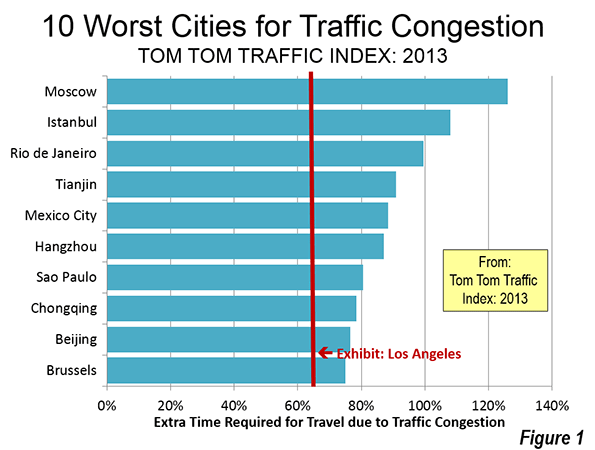
    The two most congested cities are in Eastern Europe, Moscow and Istanbul (which stretches across the Bosporus into Asia). Four of the most congested cities are in China, three in Latin America (including all that are rated) and one is in Western Europe (Figure 1).

    Moscow is the most congested city, with a peak hour index of 126. This means that the average 30 minute trip in free flow conditions will take 68 minutes during peak hours. Moscow has a limited freeway system, but its ambitious plans could relieve congestion. The city has undertaken a huge geographical expansion program, with the intention of relocating many jobs to outside the primary ring road. This dispersion of employment, if supported by sufficient road infrastructure could lead to improved traffic conditions.

    Istanbul is the second most congested city with a peak hour traffic index of 108. The average free flow 30 minute trip would take 62 minutes during peak hours.

    Rio de Janeiro is the third most congested city him with a peak hour traffic index of 99.5. The average free flow 30 minute trip takes 60 minutes due to congestion during peak hours.

    Tianjin, which will achieve megacity status in 2015, and which is adjacent to Beijing, is the fourth most congested city, with an index of 91. In Tianjin, the peak hour congestion extends a free flow 30 minute trip to 57 minutes.

    Mexico City is the fifth most congested city, with a peak hour traffic index of 88.5. The average free flow 30 minute trip takes 57 minutes due to congestion.

    Hangzhou (capital of Zhejiang, China), which is adjacent to Shanghai, has the sixth worst traffic congestion, with a peak period traffic index of 87. The average 30 minute trip in free flow takes 56 minutes during peak hours.

    Sao Paulo  has the seventh worst traffic congestion, with a peak hour index of 80.5. The average 30 minute trip in free flow takes 54 minutes during peak periods. Sao Paulo’s intense traffic congestion has long been exacerbated by truck traffic routed along the "Marginale" near the center of the city. A ring road now is mostly complete, but the section most critical to relieving traffic congestion from trucks is yet to be opened.

    Chongqing has the eighth worst traffic congestion, with a peak hour index of 78.5. As a result, a trip that would take 30 minutes in free flow conditions takes 54 minutes during peak hours.

    Beijing has the ninth worst traffic congestion, with a peak hour index of 76.5. As a result a trip that should take 30 minutes in free flow is likely to take 53 minutes during peak hour. In spite of recent reports of its intense traffic congestion, Beijing rates better than some other cities. There are likely two causes for this. With its seventh ring road now planned, Beijing has a top-flight freeway system. Its traffic is also aided by its dispersion of employment The lower density government oriented employment core , is flanked on both side by major business centers ("edge cities") on the Second and Third Ring Roads. This disperses traffic.

    Brussels has the 10th worst peak hour traffic congestion, with an index of 75. A trip that would take 30 minutes at free flow takes 53 minutes in peak hour congestion.

    Seven of the 10 most congested cities are megacities (urban areas with populations over 10 million). The exceptions are Hangzhou, Chongqing and Brussels. Brussels has by far the smallest population, at only 2.1 million residents, little more than one-third the size of second smallest city, Hangzhou.

    Most Congested Cities in the US and Canada

    The most congested US and Canadian cities rank far down the list. Los Angeles ranks in a tie with Paris, Marseille and Ningbo (China), at a peak hour congestion index of 65. It may be surprising that Los Angeles does rank much higher. Los Angeles has   been the most congested city in the United States, displacing Houston in the 1980s. The intensity of the Los Angeles traffic congestion is driven by its highest urban area density in the United States and important gaps in the planned freeway system that were canceled. Nonetheless, Los Angeles is aided by a strong dispersion of employment, which helps to make makes its overall work trip travel times the lowest among world megacities for which data is available). Part of the Los Angeles advantages is its high automobile usage, which shortens travel times relative to megacities with much larger transit market shares (such as Tokyo, New York, London and Paris).

    Vancouver is Canada’s most congested city, with a pea period index of 62.5 and has the 27th worst traffic congestion, in a tie with Stockholm. Vancouver had exceeded Los Angeles in traffic congestion in the 2013 mid-year Tom Tom Traffic Index report.

    Least Congested Cities

    All but one of the 10 least congested large cities in the Tom Tom report are in the United States. The least congested is Kansas City, with a peak period index of 19.5, indicating that a 30 minute trip in free flow is likely to take 36 minutes due to congestion. Kansas City has one of the most comprehensive freeway systems in the United States and has a highly dispersed employment base. US cities also occupy the second through the sixth least congested positions (Cleveland, Indianapolis, Memphis, Louisville and St. Louis). Spain’s Valencia is the seventh least congested city, while the eighth through 10th positions are taken by Salt Lake City, Las Vegas and Detroit.

    Cities Not Rated

    There are a number of other highly congested cities that are not yet included in international traffic congestion ratings. Data in the 1999 publication Cities and Automobile Dependence: A Sourcebook indicated that the greatest density of traffic among rated cities was in Seoul, Bangkok and Hong Kong. Singapore, Kuala Lumpur, Jakarta, Tokyo, Surabaya (Indonesia), while Zürich and Munich also had intense traffic congestion. Later data would doubtless add Manila to the list. The cities of the Indian subcontinent also experience extreme, but as yet unrated traffic congestion. It is hoped that traffic indexes will soon be available for these and other international cities.

    Determinants of Traffic Congestion

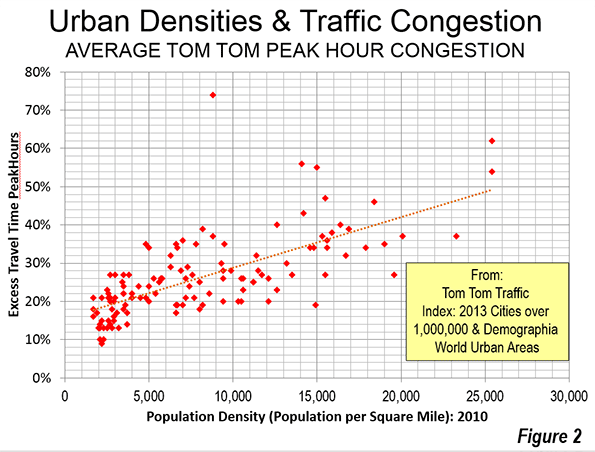
    An examination (regression analysis) of the peak period traffic indexes indicates an association between higher urban area population densities and greater traffic congestion, with a coefficient of determination (R2) of 0.48, which is significant at the one percent level of confidence (Figure 2). This is consistent with other research equating lower densities with faster travel times and an increasing automobile use in response to higher densities.

    At the regional level, a similar association is apparent. The United States, with the lowest urban population densities, has the least traffic congestion. Latin America, Eastern Europe and China, with higher urban densities, have worse traffic congestion. Density does not explain all the differences, however, especially among geographies outside the United States. Despite its high density, China’s traffic congestion is less intense than that of Eastern European and Latin American cities. It seems likely that this is, at least in part due to the better matching of roadway supply with demand in China, with its extensive urban freeway systems. Further, the cities of China often have a more polycentric employment distribution (Table).

    Traffic Congestion & Urban Population Density
    Urban Poulation Density
    Peak Hour Congestion Per Square Mile Per KM2
    Australia & New Zealand 49.2                4,600              1,800
    Canada 49.4                5,000              1,900
    China 64.9              15,700              6,100
    Eastern Europe 80.8              11,800              4,500
    Latin America 89.5              19,600              7,600
    United States 37.1                3,100              1,200
    Western Europe 47.4                8,700              3,400
    South Africa 52.4                8,300              3,200
    Peak Hour Congestion: Average of Tom Tom Peak Hour Congestion Indexes 2013
    Population Densities: Demographia World Urban Areas


    Both of these factors, high capacity roadways and dispersion of population as well as jobs are also important contributors to the lower congestion levels in the United States.

    Wendell Cox is principal of Demographia, an international public policy and demographics firm. He is co-author of the “Demographia International Housing Affordability Survey” and author of “Demographia World Urban Areas” and “War on the Dream: How Anti-Sprawl Policy Threatens the Quality of Life.” He was appointed to three terms on the Los Angeles County Transportation Commission, where he served with the leading city and county leadership as the only non-elected member. He was appointed to the Amtrak Reform Council to fill the unexpired term of Governor Christine Todd Whitman and has served as a visiting professor at the Conservatoire National des Arts et Metiers, a national university in Paris.

    Photo: On the Moscow MKAD Ring Road