Blog

  • America’s Fastest-Growing Small Cities

    Coverage of America’s changing urban scene tends to focus heavily on large metropolitan areas and the “megaregions” now often said to dominate the economic future. Often missed has been a slow, but inexorable, shift of migration and economic growth to smaller cities, a geography usually ignored or dismissed, with the exception of college towns, as doomed to lag behind by urban boosters.

    Part of the problem is that analysts often assume that the decline of small towns, which have been losing population, also means small cities are in trouble. Yet this is simply not true. Since 2000 small cities with between 100,000 and 250,000 residents have enjoyed a 13.6% population growth rate, more than twice that of New York, Los Angeles and Chicago, and roughly 10% faster than the national growth rate. The main driving force, notes demographer Wendell Cox, appears to be domestic migration, which is negative in the largest cities as well as in small towns. However the 167 metropolitan statistical areas with between 100,000 to 250,000 in population have added a net 675,000 people due to domestic migration since 2000.

    This performance is also seen in the economic sphere. All five of the nation’s fastest growing economies in 2013 were small cities, which, despite their smaller size, possess the basic infrastructure — hospitals, schools, airports, broadband — that are essential to economic growth.

    Of course, not all small cities are doing well. Many, particularly in the industrial heartland, continue to suffer; virtually all the bottom 10 small cities on our list are in old industrial areas in the Great Lakes, the Southeast and Massachusetts,  the birthplace of America’s first manufacturing boom.

    In order to determine which small metro areas are booming, and help us understand why, we asked Mark Schill at the Praxis Strategy Group to rank them based on four factors: population growth (2000-13), job growth (2001-14), real per capita personal income growth (2000-12), and growth of regional GDP per job (2001-12) — if GDP per job is increasing, it’s an indicator that the metro area is adding high-value, productive industries to its economy, as opposed to lower-wage jobs.

    Boomer Boomtowns

    Over the next decade, one major driver for growth in small cities may be demographic factors, notably the aging of the baby boom generation. Contrary to popular press accounts that suggest boomers are gravitating to big cities, demographic evidence suggests the opposite is the case. Demographer Cox says boomers appear to be, on net, leaving both big cities and older suburbs in favor either of exurbs or smaller cities.

    Some small cities already appear to benefiting from this trend, including the top-ranked city on our list: The Villages, Fla. This relatively new community, which focuses on “active” seniors has doubled in population since 2000, and last year was the nation’sfastest-growing metropolitan area. The area also has expanded its job base by 186% since 2001. Yet as much of the employment is in services, growth in economic productivity has been lackluster. Critically, this does not mean the area has been getting poorer. Personal income growth, largely from assets owned by seniors, has soared by some 60% since 2000, 10 times the national average growth rate of 6%.

    Thriving senior-oriented economies can be found throughout Florida, but they are also emerging elsewhere. St. George, Utah, which ranks 12th on our list, has long attracted downshifting boomers from the West Coast as well as the rest of the Intermountain West. This has helped to power its construction sector, a key element of the local economy. Another hot spot for boomers is No. 17 Bellingham, Wash., which is home to Western Washington University. In the coming decade, we can expect a growing competition among smaller towns for boomer residents, and their sometimes significant assets.

    Energy Towns

    The oil and gas industry doesn’t need bright lights, but sometimes its presence can create some. Of our top 10 fastest-growing small cities, five are energy-driven boom towns. This includes No. 2 Midland, Texas, which has logged 60% job growth since 2001 and 30% population growth since 2000. The west Texas  city, located in the heart of the booming Permian Basin is also getting richer, with personal income growth of over 96.7% since 2000, a rate well above the national average of 6% and the median for small cities of 10.2%. Last year, Midland led the nation in GDP growth at 14%.

    Other high-ranked energy cities include No. 3 Odessa, Texas,  and No. 8 Houma-Thibadaoux, La., which this February boasted the lowest unemployment rate in the nation at 2.8%.

    College Towns

    One would expect this list to be chock full of university towns, but to our surprise, only one made the top 10: Fargo, North Dakota-Minnesota. The metro area has caught our eye before. Fargo is far more than home to North Dakota State, with almost 15,000 students, but the school’s  expertise in engineering and energy dovetails perfectly with the state’s boom not only in energy but it’s rapidly growing tech and manufacturing sectors. Since 2010, manufacturing employment is up 18% in Fargo, to go along with 21% growth at corporate managing offices, 20% in wholesale trade, 17% in finance, and 14% in professional services.

    Perhaps a better example of a small city benefiting from university connections is  No. 12 Morgantown, W.V. The metro area of 135,000 is home to the nearly 30,000 people working or studying at the University of West Virginia. Other college towns that made it to the upper tier include No. 11 Hammond, home to Southeast Louisiana University , with 15,000 students; No. 13 Logan, Utah, which hosts Utah State’s 28,000 students; and No. 25 Auburn, Alabama, home to the 25,000-student university of the same name.

    Government Centers

    Throughout the Bush years and in the first years of the recession, government centers — such as greater Washington, D.C., Madison, Wisc., as well as towns with military bases — out-performed the overall economy. Today many of the small cities that are thriving remain largely dependent on government spending, including  No. 5 Jacksonville, N.C., home to the Marine Corps’ Camp Lejeune.

    Given the long-term fiscal crisis facing many communities, this dependence on government spending could prove problematic, leaving a metro area’s fate in the hands of others. Planned cuts in military spending could undermine growth in many of these communities and is already raising the hackles of some public sector unions.

    The Road Ahead

    These trends suggest that the future of small city America may be far brighter than suggested by many urban pundits. The movement of boomers and the growth of resource-based industries seem likely to accelerate this trend, although declines in government, and particularly military, spending may impact some communities negatively. Like big cities, their small brethren seem to be divided between those that are thriving and those that are not.

    Perhaps the biggest challenge facing small cities will be retaining or attracting enough young families. Already roughly two out of every five millennials lives in one of the country’s smaller communities, and proportionately this population grew faster in these small metro areas than in either core cities or suburbs. In the future the key question is how to get more of them, particularly the better educated, to stay.

    Economically, these areas also need to diversify, taking advantage of new technologies that allow many businesses to operate remotely. Too great dependence on government spending, or on boomer migration, tends to distort local economies by fostering too much dependence on Washington or  creates a labor market overly tilted towards low-paying service workers. These smaller places still have their work cut out from them, but their prospects may overall be brighter than many suspect.

    Fastest Growing Small Cities
    Rank Region (MSA) Score Growth GDP/Job, 2001-2012 Job Growth, 2001-2014 PCPI Growth, 2000-2012 Population Growth, 2000-2013
    1 The Villages, FL 76.4 2.0% 186.0% 59.2% 99.2%
    2 Midland, TX 60.4 15.8% 59.7% 96.7% 30.3%
    3 Odessa, TX 54.4 32.9% 45.0% 49.4% 23.8%
    4 Fargo, ND-MN 43.4 24.8% 28.4% 23.5% 27.7%
    5 Jacksonville, NC 41.8 15.3% 27.2% 42.2% 22.9%
    6 Longview, TX 41.1 29.7% 18.0% 25.0% 11.5%
    7 Bismarck, ND 41.0 15.2% 35.5% 34.9% 22.5%
    8 Houma-Thibodaux, LA 40.7 18.0% 22.0% 49.7% 7.9%
    9 Watertown-Fort Drum, NY 39.9 22.1% 19.8% 39.5% 6.9%
    10 Madera, CA 39.4 20.1% 25.6% 22.0% 23.3%
    11 Hammond, LA 39.1 18.6% 20.5% 25.2% 24.5%
    12 Morgantown, WV 39.1 19.8% 22.7% 23.9% 22.3%
    13 Logan, UT-ID 39.0 23.1% 23.8% 12.4% 25.7%
    14 Las Cruces, NM 38.7 20.0% 21.0% 23.2% 21.9%
    15 Elizabethtown-Fort Knox, KY 37.9 27.8% 9.9% 18.6% 12.6%
    16 St. George, UT 36.9 -2.0% 48.7% 6.4% 62.1%
    17 Bellingham, WA 35.2 15.8% 20.1% 15.7% 23.1%
    18 Rochester, MN 35.1 24.7% 7.0% 12.7% 14.2%
    19 Sioux Falls, SD 34.9 13.6% 19.7% 13.0% 29.3%
    20 California-Lexington Park, MD 34.7 12.6% 20.0% 17.0% 26.7%
    21 Hanford-Corcoran, CA 34.7 10.2% 12.0% 36.6% 16.3%
    22 Sherman-Denison, TX 34.4 27.7% 3.1% 9.4% 10.3%
    23 College Station-Bryan, TX 33.8 9.0% 26.1% 16.5% 27.5%
    24 Elkhart-Goshen, IN 33.4 31.9% 3.8% -3.1% 9.4%
    25 Auburn-Opelika, AL 33.3 8.7% 33.9% 7.3% 30.8%
    26 St. Joseph, MO-KS 33.1 24.8% 8.7% 14.4% 3.0%
    27 Tuscaloosa, AL 32.7 19.4% 11.0% 10.2% 15.2%
    28 Billings, MT 32.6 13.2% 16.1% 17.3% 18.0%
    29 Grand Forks, ND-MN 32.3 13.5% 8.6% 34.2% 3.4%
    30 Hattiesburg, MS 32.3 13.3% 13.7% 15.9% 19.0%
    31 Idaho Falls, ID 32.3 10.8% 12.0% 10.6% 30.5%
    32 Charlottesville, VA 31.6 12.8% 12.7% 16.0% 17.5%
    33 Lawton, OK 31.5 15.4% 7.1% 23.2% 7.7%
    34 Burlington-South Burlington, VT 31.4 20.0% 4.9% 14.2% 7.6%
    35 Coeur d’Alene, ID 31.3 6.9% 23.9% 7.1% 31.8%
    36 Alexandria, LA 31.2 16.6% 4.8% 21.8% 6.6%
    37 Daphne-Fairhope-Foley, AL 31.2 3.2% 27.3% 5.9% 38.3%
    38 Johnson City, TN 31.2 19.5% 1.6% 13.2% 10.5%
    39 Bend-Redmond, OR 30.6 2.4% 23.9% 2.6% 42.4%
    40 Yuma, AZ 30.4 8.7% 13.1% 11.4% 25.3%
    41 Waterloo-Cedar Falls, IA 30.0 15.2% 6.8% 21.6% 3.5%
    42 El Centro, CA 30.0 -0.2% 28.2% 21.9% 24.0%
    43 Binghamton, NY 30.0 27.1% -10.5% 11.1% -1.7%
    44 Grand Junction, CO 30.0 12.2% 13.7% 2.0% 25.4%
    45 Jonesboro, AR 29.9 9.8% 11.9% 17.0% 16.2%
    46 Eau Claire, WI 29.7 15.8% 9.3% 10.1% 10.7%
    47 Sierra Vista-Douglas, AZ 29.7 7.1% 8.2% 30.0% 9.6%
    48 State College, PA 29.6 10.6% 3.5% 20.2% 14.3%
    49 Iowa City, IA 29.6 6.3% 21.1% 12.4% 21.9%
    50 Winchester, VA-WV 29.6 9.7% 12.2% 4.3% 27.4%
    51 Greenville, NC 29.4 6.8% 13.6% 6.3% 29.8%
    52 Lafayette-West Lafayette, IN 29.0 17.6% 5.8% -0.9% 16.8%
    53 Tyler, TX 28.8 5.8% 16.4% 11.3% 23.0%
    54 Bowling Green, KY 28.4 9.2% 16.8% 4.5% 20.8%
    55 Bloomington, IN 28.2 15.0% 8.5% 2.5% 14.3%
    56 Champaign-Urbana, IL 28.2 17.5% -5.0% 6.9% 11.7%
    57 Yakima, WA 27.9 9.0% 12.9% 14.5% 11.0%
    58 Homosassa Springs, FL 27.9 8.7% 11.2% 9.5% 17.4%
    59 Carbondale-Marion, IL 27.8 13.7% 0.8% 16.9% 4.8%
    60 Rapid City, SD 27.8 4.9% 7.7% 19.0% 17.4%
    61 Panama City, FL 27.6 4.5% 15.7% 15.1% 17.1%
    62 Anniston-Oxford-Jacksonville, AL 27.5 17.7% -5.2% 10.0% 5.1%
    63 Columbia, MO 27.3 2.5% 20.8% 6.7% 25.6%
    64 La Crosse-Onalaska, WI-MN 27.3 11.9% 6.1% 13.8% 6.7%
    65 Chico, CA 27.2 10.5% 6.5% 13.6% 9.0%
    66 Abilene, TX 27.1 7.7% 10.2% 21.8% 4.5%
    67 Yuba City, CA 27.1 6.8% 4.4% 10.2% 20.9%
    68 Terre Haute, IN 27.0 18.8% -2.7% 8.7% 0.8%
    69 Kahului-Wailuku-Lahaina, HI 27.0 1.4% 13.0% 13.0% 24.2%
    70 St. Cloud, MN 26.9 8.0% 10.7% 10.8% 13.8%
    71 Chambersburg-Waynesboro, PA 26.9 7.5% 17.1% 4.7% 17.2%
    72 Oshkosh-Neenah, WI 26.8 15.4% 1.4% 5.3% 7.9%
    73 Dover, DE 26.6 -2.8% 23.0% 6.0% 33.2%
    74 Texarkana, TX-AR 26.6 12.4% -0.3% 15.1% 4.5%
    75 Dothan, AL 26.4 9.6% -2.5% 13.4% 12.7%
    76 Lake Havasu City-Kingman, AZ 26.3 2.8% 8.5% 3.9% 30.0%
    77 Lawrence, KS 26.3 10.2% 2.0% 7.9% 14.0%
    78 Fairbanks, AK 26.3 1.3% 8.5% 15.8% 21.0%
    79 Missoula, MT 26.3 5.4% 13.7% 9.4% 16.3%
    80 Joplin, MO 26.2 12.0% 2.0% 6.6% 11.1%
    81 Owensboro, KY 26.2 11.4% 5.2% 11.5% 5.8%
    82 Lake Charles, LA 26.2 6.8% 5.4% 22.4% 4.4%
    83 Williamsport, PA 26.2 12.5% 0.4% 20.0% -2.6%
    84 San Angelo, TX 26.1 5.0% 5.4% 20.1% 10.1%
    85 Flagstaff, AZ 26.0 6.2% 9.3% 8.3% 16.9%
    86 Glens Falls, NY 25.9 8.6% 3.7% 19.5% 3.4%
    87 Cumberland, MD-WV 25.8 9.6% 0.3% 22.4% -0.6%
    88 New Bern, NC 25.8 9.8% -1.1% 11.2% 10.9%
    89 Beckley, WV 25.7 6.2% 3.3% 28.7% -1.7%
    90 Bloomington, IL 25.5 9.5% -2.6% 8.4% 14.0%
    91 Longview, WA 25.4 12.2% -5.4% 8.2% 9.5%
    92 Kingston, NY 25.3 9.5% -4.7% 20.9% 1.8%
    93 Wheeling, WV-OH 25.3 14.2% 0.7% 14.7% -4.7%
    94 Florence-Muscle Shoals, AL 25.1 12.0% -0.7% 11.4% 3.0%
    95 Dalton, GA 25.1 19.3% -15.8% -10.6% 17.6%
    96 Sioux City, IA-NE-SD 25.1 10.5% 0.7% 16.2% 0.6%
    97 Sebastian-Vero Beach, FL 25.0 1.9% 12.8% 2.4% 25.3%
    98 Wenatchee, WA 24.8 1.3% 17.1% 11.5% 14.2%
    99 Blacksburg-Christiansburg-Radford, VA 24.8 6.9% 3.4% 12.4% 9.0%
    100 Harrisonburg, VA 24.7 3.8% 7.7% 6.2% 19.1%
    101 Albany, OR 24.5 9.8% 2.6% -0.8% 15.3%
    102 Battle Creek, MI 24.2 17.5% -9.7% 6.1% -2.2%
    103 Ithaca, NY 24.2 3.1% 5.9% 18.3% 7.3%
    104 Warner Robins, GA 24.1 -3.9% 13.5% 7.2% 28.6%
    105 Lebanon, PA 24.0 0.9% 13.0% 13.0% 12.6%
    106 Goldsboro, NC 23.9 7.8% -2.2% 9.2% 9.6%
    107 Monroe, LA 23.8 6.7% -2.5% 15.6% 5.0%
    108 Lewiston-Auburn, ME 23.7 9.1% 0.3% 9.9% 3.6%
    109 Sumter, SC 23.6 9.1% -9.1% 15.1% 3.2%
    110 Prescott, AZ 23.4 -3.7% 11.5% 5.4% 27.6%
    111 Vineland-Bridgeton, NJ 22.9 3.5% -0.4% 14.9% 7.6%
    112 Wichita Falls, TX 22.8 6.5% -9.7% 21.3% -0.4%
    113 Jackson, TN 22.8 6.5% 3.8% 6.6% 7.0%
    114 Decatur, AL 22.8 12.2% -7.7% 2.4% 5.0%
    115 Cleveland, TN 22.7 2.7% 7.5% 5.6% 13.6%
    116 Janesville-Beloit, WI 22.5 11.0% -3.7% 1.4% 5.4%
    117 Napa, CA 22.3 0.1% 15.0% 6.2% 12.7%
    118 Decatur, IL 22.3 11.6% -9.6% 12.2% -4.6%
    119 Sheboygan, WI 22.2 6.1% -3.1% 13.7% 1.9%
    120 Athens-Clarke County, GA 22.2 -3.3% 17.9% 5.3% 18.7%
    121 Kankakee, IL 21.9 7.1% -1.8% 3.2% 8.0%
    122 Morristown, TN 21.8 6.9% -4.8% 0.9% 12.1%
    123 Brunswick, GA 21.7 3.9% -4.9% -3.1% 21.9%
    124 Medford, OR 21.6 0.3% 7.9% 4.4% 14.7%
    125 Topeka, KS 21.4 6.4% -4.2% 7.7% 4.2%
    126 Wausau, WI 21.3 4.9% -1.6% 5.9% 7.5%
    127 Hilton Head Island-Bluffton-Beaufort, SC 21.3 -8.7% 8.4% -2.7% 38.8%
    128 Mount Vernon-Anacortes, WA 21.3 -1.3% 8.2% 6.0% 14.9%
    129 East Stroudsburg, PA 21.1 -0.3% 7.3% -1.1% 19.6%
    130 Bangor, ME 21.1 3.4% -0.9% 9.4% 5.8%
    131 Valdosta, GA 21.0 -6.2% 6.7% 11.6% 19.4%
    132 Gadsden, AL 20.9 5.1% -2.2% 11.0% 0.6%
    133 Jefferson City, MO 20.9 3.6% -1.4% 6.7% 7.3%
    134 Altoona, PA 20.8 6.7% -1.2% 9.2% -2.1%
    135 Appleton, WI 20.8 -0.6% 5.5% 5.2% 13.5%
    136 Gettysburg, PA 20.7 2.2% 6.3% 1.0% 11.0%
    137 Staunton-Waynesboro, VA 20.5 0.9% -3.2% 9.3% 9.5%
    138 Michigan City-La Porte, IN 20.3 11.8% -12.6% -0.8% 1.1%
    139 Lima, OH 19.9 12.6% -11.3% -0.6% -3.0%
    140 Springfield, IL 19.7 8.1% -12.6% 0.0% 5.0%
    141 Fond du Lac, WI 19.6 3.8% -1.5% 3.7% 4.5%
    142 Charleston, WV 19.5 3.4% -9.0% 16.9% -4.6%
    143 Redding, CA 19.0 -2.1% -1.6% 8.5% 9.4%
    144 Pueblo, CO 18.9 -4.2% 6.5% 3.6% 13.9%
    145 Farmington, NM 18.8 -15.5% 9.6% 28.5% 10.8%
    146 Gainesville, GA 18.8 -12.1% 13.9% -3.4% 33.2%
    147 Jackson, MI 18.3 7.8% -7.0% -4.0% 1.1%
    148 Monroe, MI 18.1 5.9% -5.8% -3.1% 2.7%
    149 Bay City, MI 18.1 9.4% -10.9% -2.1% -3.0%
    150 Florence, SC 18.0 -2.3% -3.4% 8.0% 6.7%
    151 Santa Fe, NM 17.9 -5.4% 4.5% 3.2% 13.7%
    152 Niles-Benton Harbor, MI 17.4 4.7% -9.0% 5.3% -4.4%
    153 Burlington, NC 17.3 -0.6% -6.2% -7.8% 17.5%
    154 Racine, WI 17.2 0.4% -5.4% 3.6% 3.2%
    155 Johnstown, PA 17.0 0.1% -6.0% 14.5% -7.6%
    156 Muncie, IN 16.7 7.2% -13.8% -4.1% -1.1%
    157 Punta Gorda, FL 16.3 -11.2% 12.9% 2.0% 15.8%
    158 Mansfield, OH 15.6 5.2% -16.6% 1.3% -5.5%
    159 Rocky Mount, NC 15.6 -0.1% -13.7% -0.1% 5.3%
    160 Pittsfield, MA 15.3 -5.7% -1.4% 13.2% -3.8%
    161 Barnstable Town, MA 15.3 -10.8% 3.2% 21.1% -3.6%
    162 Weirton-Steubenville, WV-OH 13.8 -1.6% -15.8% 9.0% -7.4%
    163 Albany, GA 13.7 -9.5% -5.7% 13.8% -1.2%
    164 Springfield, OH 13.1 -2.7% -10.4% 4.0% -5.8%
    165 Saginaw, MI 11.8 -1.3% -10.6% -4.0% -6.4%
    166 Muskegon, MI 10.8 -9.7% -4.1% -0.7% 0.4%
    167 Macon, GA 9.1 -18.3% -3.1% 5.6% 4.0%

    Analysis by Mark Schill, mark@praxissg.com. Measures are normalized and equally weighted. Sources: U.S. BEA (GDP/Job, PCPI growth), EMSI (employment growth), U.S. Census Population Estimates Program (population growth).

    This piece originally appeared at Forbes..

    Joel Kotkin is executive editor of NewGeography.com and Distinguished Presidential Fellow in Urban Futures at Chapman University, and a member of the editorial board of the Orange County Register. His newest book, The New Class Conflict is now available at Amazon and Telos Press. He is author of The City: A Global History and The Next Hundred Million: America in 2050. His most recent study, The Rise of Postfamilialism, has been widely discussed and distributed internationally. He lives in Los Angeles, CA.

    Fargo photo by David Kohlmeyer.

  • Chicago’s Planning Strategy: Hot or Not?

    The City of Broad Shoulders may have two faces, but how will it age?

    This was the essence of the question that the Chicago Tribune was asking in October of 2013 when it urged readers to re-envision the city’s original 1909 plan in a modern context. In the 115 years since, and especially recently, Chicago has become a glitzy glass and steel mecca for Midwest yuppies. It’s also become an unfortunate poster child for corruption, financial struggles, urban violence, and poor schools. It’s a city whose two reputations could hardly be more different.

    To many in the Windy City, the opportunity was a chance to envision a bold new future for the region. In their eyes, the future of Chicago today depends on it becoming a vibrant bastion of international excitement, with a growing population and tourism as key ingredients of new fiscal health.

    Their hopes are based on optimism garnered from a real estate scene in which Chicago’s north side has become one of the hottest locations in the country, and formerly blighted neighborhoods have turned into battlegrounds for gentrification.

    Along with that, through a variety of initiatives, the fiscally strapped city has invested in many white-collar neighborhoods and international attractions, which some have argued come at the expense of the city’s lower-income areas, as well as the city’s older industrial, manufacturing, and infrastructural assets. Arguably the most visible investment – Millennium Park – has been a story of success that is inspiring the subsequent transformation of the Chicago River from a primarily industrial channel into a tourist experience unto itself. It’s part of an approach by Mayor Rahm Emmanuel to up tourism and generate tourist industry jobs.

    The strategy of investing deeply in white-collar cultural successes with the hope that the resulting momentum will offset the city’s grimmer challenges is a daring game. There are some reasons to think that parts of it may be working. Over the last decade, for instance, Chicago attracted a rapid in-migration of new residents – by some estimates Cook county gained over 100,000 in-migrants per year.

    But the bigger demographic picture doesn’t inspire optimism. While Chicago gained a substantial numbers of Millennials in their 20s and folks in their 50s and 60s between 2000 and 2010, it was also the only one of the nation’s ten largest cities that lost population overall during the same time period.

    And between 2005 and 2010, despite substantial in-migration, Cook County lost as many as 185,000 residents a year to out-migration according to IRS data, including negative net-migration among nearly every age group, including 20-somethings, a statistic that is particularly eye-popping given the city’s perceived success at attracting people in exactly that age bracket.

    At the same time that Chicago’s Loop experienced a sudden burst as the hottest urban center in the US, the city as a whole still lost considerable ground to the nation’s growing cities. It’s been predicted that in another 30 years the Chicago region will be surpassed in size by at least two different metropolitan areas in the Texas triangle, and, nationally, possibly by more. That’s assuming that Chicago doesn’t lose ground faster than it already has. Moving forward, it may have a tougher time attracting large numbers of Midwestern Millennials, as Rust Belt cities like Cleveland work to keep their talent at home.

    There are additional reasons to doubt Chicago’s long-term ambitions to become a global mecca. For one, the city is a lonely snowman in the age of air conditioning. Between 2000 and 2012 nearly every city in the southern US grew its metropolitan region by at least 30 percent. Even hot growth cities in the North like Columbus and Indianapolis couldn’t match that pace. Since air conditioning became a norm rather than an exception, growth has overwhelmingly trended toward warmer climates. In the last 50 years, half of the population growth in the US went to the eight states with the warmest climates, while the eight coolest states attracted just 3% of that total.

    A second area of concern is that the exponential power of a centralized city has diminished. The city of Chicago is now home to just seven of the region’s 28 Fortune 500 companies. The city of a dominant core and residential periphery is being squashed by the realities of preferences.

    Rather than settle on being the bland and livable capital of the Midwest, Chicago has instead opted to try to wage battle with the likes of London and Rome, and it may have a tough time winning. It’s clear that such worldly ambitions are contingent on growing both residents and tourists.

    The city might do well to begin with a humbler approach that focuses on serving its current residents. The primary things Chicago has going for it are its comparative affordability to other large cities, and the perception that it’s composed of friendly people. These traits are largely antithetical to most megacities. Rather than pursue a path on which it could lose these unique assets, Chicago should capitalize on them.
    In addition to remaining affordable, the city should take easy steps to be more family friendly, a quality it currently lacks because of horrifically high crime and subpar schools.

    Of the city’s out-migration in the last decade, an overwhelming amount was by families, especially from its African American community. If Chicago invested in creating average schools out of its failing ones, rather than closing the bad ones while expanding the great ones, it might retain some of the people who are fleeing the city. Generating even passable middle and high schools alone might be enough to convince companies that adequate talent exists to launch the kinds of job training and manufacturing centers that could start to revitalize neighborhoods in the city’s job-depleted areas.

    It could also zone parts of the city with declining populations more in the way that suburbs do. High density development need not be the only considered path forward. Chicago’s geographic constraints already make it difficult to find spacious low-density housing within a reasonable distance of the center city, so it might help revitalize neighborhoods if low density development were permitted on the city’s struggling south and west sides.

    The city should also consider decentralizing its public transportation infrastructure. Chicago’s core transit system is designed around an outdated jobs model that focuses all lines toward the center of the city. The result is that while overall commute times are fairly low, just 6.3% of jobs can be reached within 45 minutes on public transit.

    Finally, the city shouldn’t lose sight of its manufacturing legacy just because yuppies are moving in. Chicago’s greatest assets include its positioning as an infrastructural crossroads, and this is of great value to industry.

    If it did these few things better, the city might find itself losing far fewer residents, and not relying so heavily on narrow groups of in-migrants. If not, existing preoccupations with international fame may cause Chicago to lose its appeal, while other American cities accelerate faster.

    Roger Weber is a city planner specializing in global urban and industrial strategy, urban design, zoning, and real estate. He holds a Master’s degree from the Harvard Graduate School of Design. Research interests include fiscal policy, demographics, architecture, housing, and land use.

    Flickr photo by Chris Smith: Pritzker Pavilion, Millennium Park

  • L.A. Hanging on as a Top Global City

    For more than a century, Southern Californians have dreamed of their region becoming host to a great global city. At the turn of the 20th century Henry Huntington, who built much of the area’s first mass-transit system, proclaimed that “Los Angeles is destined to become the most important city in the world.”

    Of course, builders of other cities – St. Louis, New Orleans, Chicago and even Cincinnati, Ohio – have made similar predictions. But L.A.’s claim, unlike the others, had a significant resonance. Not only was the region growing rapidly throughout the previous century, and now stands as North America’s second-largest population center, but it dominated a host of fields, notably entertainment and aerospace, and was highly influential in energy, fashion and manufacturing.

    But it was a connection to the Pacific Rim that made L.A.’s ascendency so global. This is something that Midwest rivals, such as Chicago, never enjoyed. By the 1980s, when I was writing my first book, “California Inc.,” faith in Southern California’s global ascendency was commonplace among its business leadership, who almost universally saw the city as rising above New York, London and Tokyo to become the new center of a Pacific-centered world economy.

    This notion, and the region’s huge economy, has sustained its status among global cities. The 2014 A.T. Kearney global cities index ranked Los Angeles sixth, behind New York, London, Paris, Tokyo and Hong Kong.

    However, a new study of global cities, just released by the Singapore Civil Service College and Chapman University, shifted ranking criteria away from the size of economies or number of business producer service firms and concentrated, instead, on unique factors such as industry domination, diversity and global connectivity.

    Hooray for Hollywood

    The good news: Los Angeles ranks 10th among global cities, using our new measurement. But L.A.’s also clearly not gaining ground on the top two global cities, New York and London, and now ranks below such rising competitors as Beijing and Dubai. L.A. also only shares 10th place, with its primary rival, the San Francisco Bay Area, as well as Toronto.

    What is keeping Los Angeles in the top 10? For the most part, the Hollywood connection makes Southern California a “necessary” place for global business. Hollywood is nearly synonymous with the American entertainment industry and is by far the world’s largest in terms of revenue and influence. Last year, the industry enjoyed exports of almost $15 billion. Every major global movie studio is located in Los Angeles.

    Yet this industry – growing both nationally and internationally – is also increasinglydispersing. Indeed, this region’s share of film and television production has been plummeting in recent years, according to the California Film Commission, largely the result of films and TV moving to Canada, Louisiana and other less-expensive locales.

    This is troubling. Before 1980, Southern California’s global emergence rested on more than merely being “Tinsel Town.” It was once the hub of the global aerospace industry, but this former linchpin has declined as both industry headquarters and production have moved away. More than 90,000 aerospace jobs have left Southern California since the end of the Cold War, about 25 years ago.

    The region also retains a foothold as the U.S. base in the global auto sector, particularly for design and marketing, for some Asian carmakers. However, Nissan, a few years back, relocated its U.S. headquarters to Nashville, Tenn., and Honda moved some of its top executives to Ohio in order to be nearer to its manufacturing plants.

    More devastating is the departure this year from Torrance of the U.S. headquarters for Toyota, the world’s largest automobile firm and a consistent technological innovator.

    Still, the picture is not totally bleak: Southern California remains the base for North American operations of the two fast-rising Korean firms, Hyundai and Kia, both in Orange County.

    One bright spot is technology. Somewhat surprisingly, the Startup Genome project ranked Los Angeles as having the second strongest startup ecosystem in the United States, ahead of Seattle, Boston and New York. The entrepreneurial spirit is still here, although there’s a lack of capital and support from government or nonprofits, elements seen in other regions.

    Overall, Southern California has been losing ground to other regions on employment. This was acknowledged even by a recent commission made up of many of the region’s top business and political leaders, which concluded that the region “is barely treading water while the rest of the world is moving forward.”

    And some of these competitors are thriving on what used to be key Southern California industries. Los Angeles was once a center of the energy industry, with several major oil companies – Arco, Union Oil, Getty Oil and Occidental – anchored here. Today, all these firms have either disappeared or moved away. The big winner: Houston, No. 14 on our list, which now dominates energy in the same way L.A. once dominated aerospace and entertainment. Altogether, more than 5,000 energy-related companies call Houston home.

    A more profound challenge comes from the Bay Area, which shares with Southern California both a Pacific Rim location and a pleasant climate. If Hollywood is synonymous with the global entertainment industry, Silicon Valley connotes the same for technology. It is home to companies that overwhelmingly dominate the list of technology leaders, including Intel, Apple, Oracle, Google and Facebook. Many firms, including some from Asia, come with an idea and, as one Malaysian entrepreneur put it, “source in Asia, incubate in the U.S.”

    The Bay Area hosts the North American headquarters of such global tech firms as Samsung and Nokia. Top technology firms in other cities often have their key R&D functions in the Bay Area. Even a penny-pinching firm like Wal-Mart is growing its Silicon Valley presence.

    Though Silicon Valley firms are growing their employment base in places like Salt Lake City and Austin, Texas, the Bay Area retains its dominance and control over the industry. This is similar to how the financial industry remains heavily centralized in New York despite the migration of many jobs elsewhere.

    As it shifts emphasis more to media, the Bay Area’s tech sector increasingly threatens L.A.-oriented industries such as advertising and entertainment. Google and Yahoo already are ranked among the world’s largest media companies. (Yahoo refers to itself as a digital media company, rather than a technology company.) With the ubiquity of its iTunes platform, Apple exercises ever-greater control over consumer distribution of entertainment products like music and video; Netflix, Hulu and YouTube could become the movie and television studios of the future. This could shift global media decision-making from its familiar New York-Los Angeles axis to one centered on the Bay Area.

    In the future, our region may face powerful competition from Washington, D.C., which has all but stolen the aerospace crown from Southern California. Further down the road, we may also face a challenge from Washington state. Never before a serious competitor, Seattle, with a strong technology sector and name-brand retailers such as Costco, Starbucks and Nordstrom, is growing its global footprint as Southern California’s appears to be shrinking. Its twin ports, Tacoma and Seattle, could present a long-term challenge to the still-dominant ports of Long Beach and Los Angeles.

    What should be done to retain and improve Southern California’s global status? Does anyone still care? The entrepreneurs and promotors who built this region would probably support new infrastructure and regulatory reforms that might bolster the industrial, entertainment and trade sectors.

    Sadly, it is dubious that the city’s current leadership – focused on trying to build a faux New York or an Ecotopia amid economic decline – even understands the nature of the challenge.

    But adopting solutions from the 20th century will not be enough. Los Angeles’ greatest resource – its diverse, motivated population – has to be allowed to flourish as part of our globalization strategy. Our entrepreneurial ties to Vietnam, China, Mexico, the former Soviet Union and other places could prove critical to restoring our international status.

    Great global cities, we need to remember, are created by the people who live there. What we need to do, more than anything, is show that Southern Californians can play a part in reigniting the momentum that once made this region the emerging superstar on the global stage.

    This piece originally appeared at The Orange County Register.

    Joel Kotkin is executive editor of NewGeography.com and Distinguished Presidential Fellow in Urban Futures at Chapman University, and a member of the editorial board of the Orange County Register. His newest book, The New Class Conflict is now available at Amazon and Telos Press. He is author of The City: A Global History and The Next Hundred Million: America in 2050. His most recent study, The Rise of Postfamilialism, has been widely discussed and distributed internationally. He lives in Los Angeles, CA.

  • Why Modern Architecture Struggles to Inspire Catholics

    Inspired by a recent visit to a Le Corbusier-designed Dominican monastery near the French city of Lyon, I’ve been thinking a lot about the interaction between Catholicism and modernist aesthetics.   It has little to do with whether the Church affects what designers create beyond filling the program.   Instead, I’ve tried to examine how the architect’s religion influences the Church’s own self-image.  I’ve concluded that the Church, an institution that has been the guardian tradition and the patron artistic and architectural development in the West for almost two millennia, never could reconcile itself comfortably with Modernism.

    I was reminded of this when I shared with my brother news on the opening of a new convent and Visitor Center buried into the hill on which sits Le Corbusier’s famous Notre Dame-du-Haut Chapel at Ronchamp.  The convent was but the latest creation of the contemporary master Renzo Piano, featuring architect’s trademark manipulation of natural light, spatial simplicity, open views of nature and elegant detailing.  My brother seemed to shrug at these qualities, writing:

    Seems more like a fish tank with Ikea finishes than a cloister. I know natural light, rectangles, and windows are nice, but its openness and simplicity feel like some vapid unbearable lightness than a place of spiritual reflection. Zen monks might appreciate it more.

    I replied that he seemed to have a very narrow idea of what constitutes a proper place for spiritual reflection, and that lightness and simplicity had a place Catholic doctrine.  I referred to him to a series of pictures  I had taken of Le Corbusier’s monastery, wondering what he thought of his more ‘Brutal’ approach.  My brother elaborated:

    Ugh, these architects have no god. That thing (by Corbu) is hideous. Look, meditation takes place in the mind, but more in the soul. Christianity places the priority on man’s soul transcending his surroundings, not blending with it (a la Zen). Man is large, not small. Churches should be ornamented and highly symbolic, teeming with life, not stark and barren. It all has to do with Being not Nonbeing. The church is a foundation, it’s heavy, it imitates the eternal. It’s not some flimsy plates of glass and concrete garnished with random primary colors here and there.


    Bedroom of Convent by Renzo Piano Workshop at Ronchamp, France

    Though there are indeed gaps in his argument that can be exploited, I think his overall opinion is respectable and shared by many of the Catholic faithful who possess a sophisticated understanding of their beliefs and how to translate them into sacred art.  Often such views completely contrast from many members of the clergy, who have more of an interest in revitalizing the church by embracing contemporary artistic trends than by responding to wishes of their flock.  The Dominican monastic order prizes scholasticism above all else, and finds it fully consistent to hire a leader at the forefront of architectural progress like Le Corbusier.  The nuns were probably thinking along the same lines, wondering less about how sacred life can transform architecture, but rather how architecture can transform sacred life.

    Outside a few rare examples such as Ronchamp,  I sense that Modernism has failed to deliver an architecture  that connects with most Catholics and other traditional Christians.  Much of this has to do with fact that Modernism as a cultural movement is inherently atheistic as it is based on a secular materialist philosophy.  Even Renzo Piano admits as much, describing his client from the convent: “She has a profound love of architecture, of landscape, of sacred space – and even of people without religion, like me.  She wanted a place of silence and prayer. I said: ‘I can’t help you with prayer, but perhaps I can help with silence and a little joy.”


    Chapel at Convent by Renzo Piano Workshop, Ronchamp, France

    And therein lies the crux of the problem: When one has done away with symbols, theology, and the act of worship, there’s little else to inspire a credible work of sacred art or architecture.  Piano, like any committed Modernist, is left with little more than a preference for abstraction, technology  and  some vague nostrums about nature and  space.  For a Modernist, the point of architecture is to convey an image of maximum clarity, in which all elements are related by function and little else.  As long as a space is adequately sheltered and functions for the use of its occupants, there is no need for decorative flourish.  Piano is reduced to checking off boxes for the client’s wish list, from the number of rooms, to furnishings, and to achieving a quality of ‘silence’.  There’s nothing all that particular about an architecture of silence–maybe  a dark room secluded from more socially active spaces.  Given the right palette of materials and details, any space can be turned into something contemplative.  But can this generic approach to design evoke much meaning beyond mere emotional states such as peace?

    Sacred spaces achieve much of its effect by emphasizing mystery. This is at the core of any religion, in which divine truth is revealed beyond any logical or rational framework.  As is often said, God is revealed in mysterious ways, and the purpose of any sacred space is to embody this reality.  It is inherent that a secular space is completely  counter to this and thus adopts an architectural language devoid of mystery or even ambiguity.   Secular spaces instead embrace the language of the engineer, someone who works outside the world of art, poetry, and indeed of mystery, by solving problems with the most rational tools of math and science.  There is a lot of work that goes into making successful settings for secular activities, much of it having to do with the science of building, such as lighting, acoustics, and visibility.  There is also a tendency for generating phenomenological effect through technology, such as making walls highly transparent or reflective, surfaces either smooth or deliberately rough.  To the Modernist who puts its faith in technological progress, the more an effect can exceed what can be done by the human hand, the better.


    La Tourette Monastery by Le Corbusier, Eveux, France

    Such attention to a material’s effects point to Modernism’s essentially materialist philosophy on architecture. In sacred architecture, the building and the spaces within serve  to connect users to a deeper reality that transcends its walls. They function as a gateway from the material world to a spiritual realm–the focus is on the eternal, not the object that portends to represent it.  In a secular context like Modernism, the object is the thing itself, and all meaning is tied directly to that object.   Walking into a exemplary Modernist space, one is supposed to marvel at its lightness, smoothness and simplicity, attributes that are commonly summarized as ‘machine-like’.  If one desires a more ‘humanist’ look and feel, the designer can instill a quality of ‘roughness’ by texturizing concrete, oxidizing steel,  and inserting warmth by using  natural materials such as wood and stone.  Industrialization gives us that much more control to generate a precise effect, and empowers the designers unlimited opportunities in experimenting.  At the same time, it diminishes the role of the craftsman, who throughout most of human history was the guardian in generating material effects, and in  many ways assumed the role of architectural detailing.  Machines take the human factor out of the art of making, thus producing something devoid of passion, feeling that imbues every man-made object.

    Piano singles himself better than most of his contemporaries by his ability to reinsert the human touch in his design process. His architectural details are truly works of art and are usually the result of a distinct craftsman-like approach in generating them.  The name of his firm, The Renzo Piano Workshop, harkens back to the time when architecture was realized by stone masons, who would accumulate specialized design knowledge in the development of style details and templates.  Where Piano departs is the end result of his craftsman-like approach: highly refined, ultra-precise, machine-polished building systems and parts.  The structural connections in his projects are beautiful  and poetic pieces of engineering, much like Apple products, but like most industrial artifacts, they cannot express the ancient, primordial aspects of our humanity.  Is that necessary to fully immerse oneself the Catholic experience?

    I believe so.  A fundamental assumption in Catholicism is that history is linear and that God was incarnated in the human form of Jesus Christ at a precise point in history to the point that the period before and after this event are neatly divided (BC vs. AD).  Its doctrines and liturgy are part of an evolutionary process that have taken place in the world for two thousand years, and followers actively partake in this history by participating in the mass.  For most Catholics, weekly mass is the only time that they are reminded that they are tied to humanity in throughout the ages, both in the past and the future.  This goes against ‘modernity’, or the idea that the times are so new and different that prior truths or solutions are irrelevant.  In Christianity, Truth is eternal, and the problems that afflict humanity are no different during the time of Christ than they do now. There is no ‘new and improved’. Rather, the ideal was was established two-thousand years ago (the life of Christ) and no amount of social or technological advance (or regression) can change this. 


    View of Crypt inside the La Tourette Monastery by Le Corbusier

    In addition, Christianity relies on communicating its ideas through allegories conveyed verbally in the Bible, musically in its music and visually illustrated in its art and architecture.  These are designed to make the message accessible to all people, as opposed to keeping revelations close to a self-selected elite.  The message has to be clear, the context must be provided and the characters believable.  Visually, this requires the use of lines and recognizable figures placed in a narrative relationship. These demands don’t lend themselves well to abstraction, the modus operandi of the Modernist.   Abstraction is by nature open to individual interpretation; Christian revelation is not.  Abstraction is deliberately exercised by an individual, driven by their own desire to create original content; Christian subjects and themes are the content, with the artist sharing his visceral imaginings of truths he does not question (like most European art before the 19th Century).

    This probably explains why many Catholics feel a certain frustration with the role played by modern music, art and design in today’s church.  The music uses irregular folk beats, vulgar melodies and harmonies, and seem composed to bring attention to the songs themselves rather than acquainting singers to a more transcendent reality.  In contemporary Christian art, Christ is portrayed as a non-descript figure, and often times and rendered in an abstracted archaic style that is flat and lacks feeling.  The cross is abstracted to emphasize its iconic nature as a symbol, detached from any literal representation of what actually happened on the cross.  In most modern churches, seating is arranged as a theater in the round, focusing the parishioners’ attention to the the priest, or the choir, rather than to God as manifested in an elaborately decorated apse wall or a ceiling pointed to heaven. This was vividly brought to my attention when watching the broadcast of Christmas mass from the Vatican–most of the camera shots showed details of the sanctuary’s glorious interior and symbolic art, with the occasional view of the Pope.  Catholic worship is not about the mere men (priests) who help conduct its rituals but is instead is about how God is revealed in them by means of humanity’s most outward expression of what lies within its soul: Art. When there is nothing meaningful or moving to look at, one is resigned to paying attention to a charismatic individual standing on a stage, transcendent beauty is loss, and the Christian message takes on a banal delivery.


    Chapelle Notre Dame du Haut by Le Corbusier, Ronchamp, France

    Architects, a growing number of whom fall into agnosticism and atheism, often seem to forget this when visiting sacred yet Modern masterpieces.  Just because Le Corbusier’s Ronchamp chapel makes some of my colleagues cry doesn’t mean it fulfills its ecclesiastical responsibilities particularly well.  They are likely overwhelmed by the chapel’s poetic mastery of form and light and how it provokes a profound yet undefinable emotional response.  I succumbed to this response myself when I went to Ronchamp as well when I toured  Le Corbusier’s monastery of La Tourette.  I was taken aback by his buildings’ abstract forms, its play with light, its vivid use of color, its sophisticated relationship to its site.  In the end, I didn’t develop a more profound appreciation of Christian revelation, but a greater respect for mathematical proportion, abstract formal metaphors, primary colors and geometries–transcendent things nonetheless, but a bit too esoteric for most people.  La Tourette was clearly a more regulated composition compared to Ronchamp, which is probably why is probably why the latter provokes a more emotional response.  In  a sense, the chapel is Le Corbusier at his least ‘modern’ and more archaic, while his monastery is likely intended to feel more academicized due to that typology’s tradition of being repositories for knowledge. Ronchamp’s form sweeps up to heaven, its dark sanctuary enclosed in thick walls reminds one of a cave evocative of early Christianity, while its rounded towers mimick Mary in her veil, sheltering the church below. Though these moves aren’t literal, there is just enough reference to the symbols and ideas of Catholic church that make this more approachable to average followers.


    Church on the Water by Tadao Ando, Tomamu, Japan

    This isn’t to suggest that modern architecture can’t achieve successful spaces for spriritual contemplation. Tadao Ando’s Church by the Water is especially powerful, manipulating natural light and framing views that heightens the senses and fuses nature into the act of worship. The church is stripped of traditional Christian decoration, illustrations of bibical stories or saints, or any other reference to the history of the church. It works for those who wish to understand God through nature’s primal elements and how they change through the passage of time. There is a sense of ignoring the human presence altogether, as it invites one to blend into the natural surrounding (as my brother’s comment on zen indicates), which may work in more minimalist strains of Christianity and even Catholicism, but will leave many believers hungering for a place rich in narrative objects and a more fully enclosed communal response among people.   There is no altar to focus on, only a highly abstracted cross standing in a reflecting pond, which could have all sorts of meanings, but not one that concentrates the mind of the believer on Christ and his passion.

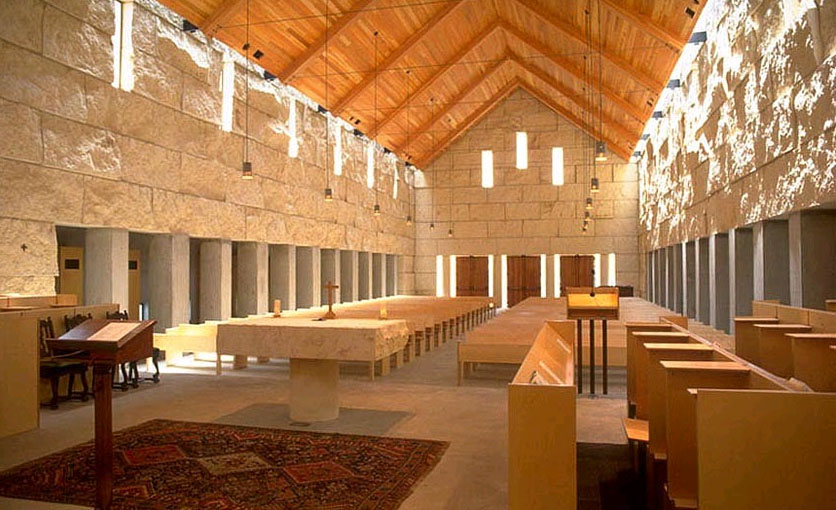
    A truly inspiring space that uses a modern architectural language for catholic worship is extremely difficult to find.  While many architects simply choose to employ a historicist style for even newest churches, it is possible to address the particular characteristics of a catholic church while maintaining a modernist sensibility.  I submit a Cistercian chapel located not far from where I live in Irving outside of Dallas designed by Gary Cunningham. Long an admired designer in the area, Cunningham’s work can be characterized as simple, straight-forward, and sensitive to materials. His award-winning residences follow a rather conventional contemporary style but he also is very accomplished in the art of adaptive reuse, in which he repurposes an existing building by carefully juxtaposing old and new elements.  This consciousness of how time plays a role in the way a building expresses itself is strongly manifested in the Cistercian chapel.  The space is enclosed in rough quaried limestone, cut in massive blocks and stacked in traditional running bond, which instantly strikes any visitor as reminiscent of the Catholic church’s earliest Romanesque sanctuaries with their thick walls and small windows. Its wood roof floating above the nave takes the shape of a traditional ceilings found in these churches, while also resembling the underside of a ship (which is where the word ‘nave’ comes from). Spans are short, further emphasizing the weight of the stone, even as they maintain familiar rhythm suggestive of the old ambulatory aisles with the repetitive row of vertical windows.  It follows more of a classic basilica typology than the popular theatre-in-the round, which indicates a desire to focus on the liturgy as opposed to the priest. But more than merely echoing the churches of the past, this chapel appears as a direct architectural metaphor for the creation of the church itself: “And I say also unto thee, That thou art Peter, and upon this rock I will build my church…(Matthew 16:18)”  While obviously an abstract design, Cunningham manages to endow the chapel with an important phrase from the Gospel and thus Christian revelation.  Sleek details and delicate connections between the roof and walls betray its contemporary origins, but the way it highlights the split-faced texture of the rock wed the chapel to the church’s long institutional history, and the countless number of people who dedicated their lives in building structures fitting to God’s glory.


    Cistercian Chapel by Gary Cunningham, Irving, Texas

    And that, to me, is what is necessary for a compelling Catholic worship space–a connection not only with the divine, but just as importantly with an institution comprised of people throughout the ages. Its walls should reveal human intent, either through a man-made texture or through an ornament that is the work of genuine human input. Machine-smooth de-personalizes this experience. As any human institution that is an essential part of catholic identity, it carries a rich artistic and architectural heritage that brings with it a kind of unassailable authority not found in Protestantism, which devalues the human institution in favor of interpreting directly from the Bible. The result of of relying on scripture, however justifiable from a theological standpoint, seems to lead towards a breaking down of a rich visual language and an embrace for abstraction. A small cultural vacuum subsequently takes root, which grows to consume what’s left of symbols, music, and eventually the walls. The ultimate result is either a television studio black-box with no windows preferred by evangelicals or a zen-like meditation space with no walls and a subtle symbolic indication that it’s even Christian (such as Ando’s church).

    I’m sure that Piano’s and Le Corbusier’s clerical clients were pleased with the result, and fans of high-design with no opinion on proper Catholic aesthetics are moved by their examples, too. But I wonder if these exercises in abstraction, lightness, and trying to stay relevant in fast-changing contemporary culture win much in the way of converts. People who seek the church want their souls nourished by the church’s message in as many forms as possible. When many of these forms are abstracted or simplified to an incomprehensible level, it leaves such people feeling unfulfilled, and causes many of them to leave the church for a place that offer a richer, more visually arresting environment of the older historic sanctuaries.  At least these modern ecclesiastical masterpieces continue to open their arms to the perennial pilgrimage of people most interested in them: architecture students.

    Julien Meyrat is an architect living in the Dallas area.

    Lead photo La Tourette Monastery by Le Corbusier in Eveux, France.

  • Urbanist Goals Will Mean Fewer Children, more Seniors Needing Government Help

    America’s cognitive elites and many media pundits believe high-density development will dominate the country’s future.

    That could be so, but, if it is the case, also expect far fewer Americans — and far more rapid aging of the population.

    This is a pattern seen throughout the world. In every major metropolitan area in the high-income world for which we found data — Tokyo, Seoul, London, Paris, Toronto, New York, Los Angeles, and the San Francisco Bay area — inner-core total fertility rates are much lower than those in outer areas.

    For example, inner London, notes demographer Wendell Cox, has a fertility rate of 1.6 children per female, which is well below the replacement rate of 2.1.

    The total fertility rate is the average number of children born to women between 15 and 44 years old. In the outer reaches of London, this rate hits 2.0, one-fourth higher.

    In Sydney, Australia, where increasing population density is a sworn goal of planners, the inner city now has a fertility rate of 0.76, compared to 2.0 or more in the outer suburbs.

    Nowhere is the confluence of high density and high prices more evident than East Asia. This region is now home to some of the lowest fertility rates on Earth.

    Take Seoul, South Korea, a paragon of high-density development where high-rise buildings dominate even on the periphery.

    Seoul’s fertility rate is about 1.2, similar to rates found in Tokyo, Singapore and Hong Kong. This is the kind of place urban planners often cite as a role model.

    A recent glowing report in Smithsonian Magazine heralded Seoul as “the city of the future.” Architects, naturally, join the chorus. In 2010, the International Council of Societies of Industrial Design named Seoul the “world design capital.”

    Yet the real frontier of ultra-low fertility may now be coastal China. Both Shanghai and Beijing have fertility rates of roughly 0.7, almost one-third of the replacement rate. Overall, China’s cities have a fertility rate under 0.9.

    Gavin Jones, a leading demographer of Asia, suggests that despite recent easing of China’s one-child policy, the world’s second leading economic power is experiencing a dramatic slowdown in its birthrate.

    In places such as Taiwan, Hong Kong, Tokyo and Singapore, more than one-quarter of women will never marry and even more will never have children.

    The result, Jones suggests, will be a society made up increasingly of single people, one-child families and very old people.

    In less than four decades, according to United Nations projections, Japan will have more people over 80 than under 15.

    This may present more of a challenge to Japan in the future, one professor suggests, than the rise of China. Indeed, over time, notes Jones, the same process will be seen across East Asia, as well as parts of Europe, as the anti-marriage and post-familial trends accelerate.

    “This won’t get better in the future,” he suggests. “The decline is just starting and it’s expanding to other areas, and the process seems inexorable.”

    For now, America, with a fertility rate of 1.89, stands in somewhat less distress, but that could be changed by increasing urban density — the very policy widely adopted by pundits and planners and broadly endorsed by urban developers.

    As Cox has shown, localities with higher densities and higher prices — the two are often coincident — have considerably lower birth rates than areas with lower prices.

    This becomes even more evident when one considers the segment of the population between 5 and 14 years old, when children enter school.

    In 2012, urban areas with the highest percentage of children are predominately lower density and lower cost, including Houston, Dallas-Fort Worth, Riverside-San Bernardino, Atlanta, and Phoenix.

    Urban areas with the lowest percentage of people in these age groups were also the New Urbanist exemplars, such as Boston, San Francisco, New York, and Seattle.

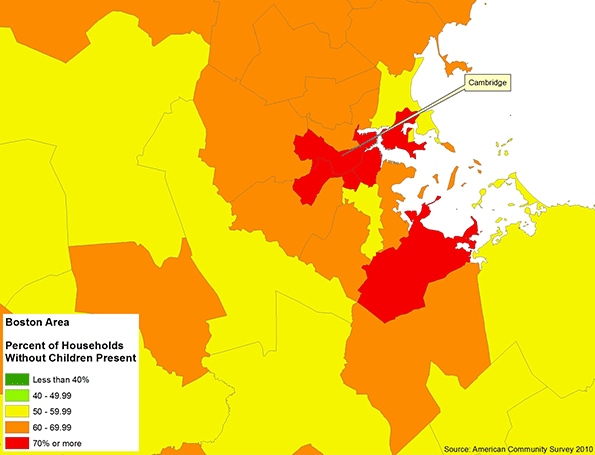
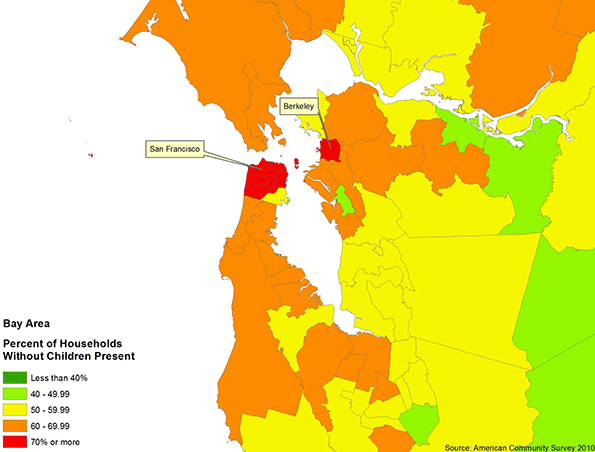
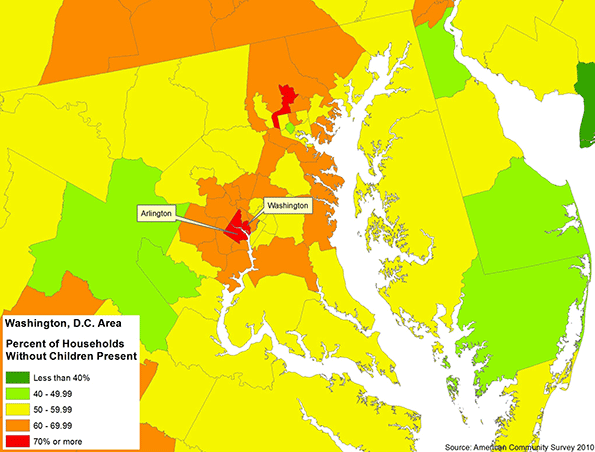
    The geographical nature of low fertility becomes even more clear in maps developed by demographer Ali Modarres.

    These maps show the percentage of households without children present. In regions such as New York, San Francisco, Seattle, D.C. and Chicago, the message is clear: much lower fertility rates in the denser urban cores.

    Maps Source: Demographer Ali Modarres, chair of urban studies at the University of Washington at Tacoma, using data from U.S. Census American Community Survey 2010

    In virtually every case, family size expands the closer one gets to the periphery; in contrast, some of the inner rings show fertility rates that approximate those seen in the hyper-dense Asian regions.

    What this suggests is that a continued focus on forcing Americans to abandon their suburban lifestyles will have a profound impact on the nation’s future competitiveness.

    An aging America will lose much of its current advantage in terms of vitality of our markets and labor force, and will be forced, like many East Asian and European countries, to invest ever more resources to take care of an aging population.

    Yet don’t expect this to affect the planners, environmentalists and their allies in real estate development, who hope to harvest windfall profits by urging and even forcing people to embrace high-density living.

    Their gain will not be to America’s advantage and will consign future generations to persistent slow growth, greater debt and a kind of societal malaise as the family fades in the face of ever greater emphasis on individualism.

    At the same time, an expanded state will be needed to keep the old folks alive in the absence of traditional networks of children and relatives.

    This piece originally appeared at The Washington Examiner.

    Joel Kotkin is executive editor of NewGeography.com and Distinguished Presidential Fellow in Urban Futures at Chapman University, and a member of the editorial board of the Orange County Register. His newest book, The New Class Conflict is now available for pre-order at Amazon and Telos Press. He is author of The City: A Global History and The Next Hundred Million: America in 2050. His most recent study, The Rise of Postfamilialism, has been widely discussed and distributed internationally. He lives in Los Angeles, CA.

    Crossing the street photo by Bigstock.

  • Ranking America’s Top Young Labor Forces: A Rust Belt Rising?

    This is a new report brief from the Center for Population Dynamics at Cleveland State University, download the pdf version here. The report was authored by Richey Piiparinen, Charlie Post, and Jim Russell

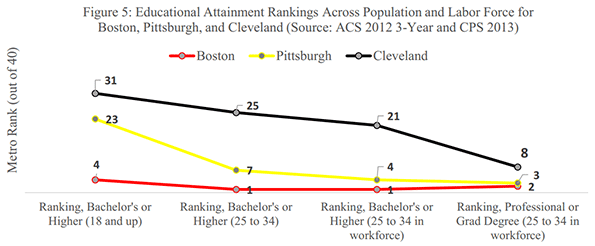
    Greater Cleveland ranks 8th nationally in the percentage of 25- to 34-year-olds in the labor force with a graduate or professional degree, ahead of such “brain hubs” as Chicago, Seattle, and Austin. The analysis speculates as to whether or not this is a leading indicator to broader economic growth. Comparisons are made with Boston and Pittsburgh—two metros further along in the economic restructuring process.

    Ranking America’s Young Adult Labor Forces

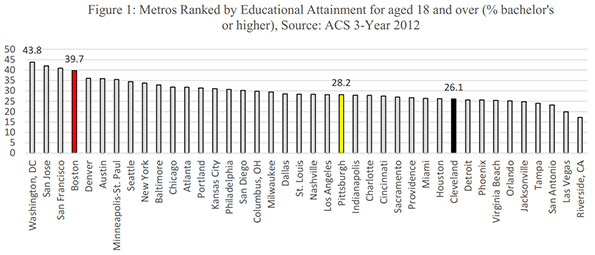
    A region’s economic prospects are tied to its levels of human capital. The most common proxy for human capital is the educational attainment rate, or the percent of a population that has completed a bachelor’s degree or higher. Figure 1 shows the nation’s largest 40 metros ranked by the percent of residents 18 and over who have completed at least a bachelor’s degree. The Rust Belt metros of Pittsburgh and Cleveland rank 23rd and 31st, respectively.

    But there are issues with measuring educational attainment this way. Metros such as Cleveland and Pittsburgh have larger aging populations due to their settlement histories, and this significantly affects regional educational attainment rates. Why does this matter? Notes Pittsburgh economist Chris Briem1: “I argue all the time that such a metric says little about how well we are doing in recent decades at either educating the population, or on how we are doing at both attracting and retaining folks with higher education.”

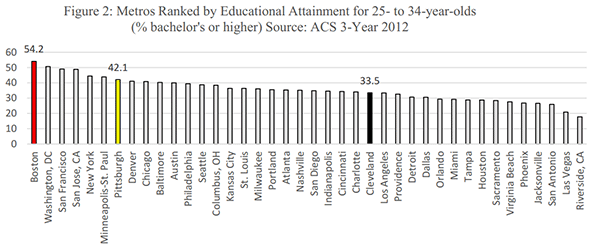
    A better way to analyze human capital is through age cohort. Measuring the educational attainment of a region’s 25- to 34-year-olds is a leading indicator when it comes to understanding where a region’s economy is headed. Figure 2 shows the educational attainment rates for the 25- to 34-year-old age cohort. Greater Pittsburgh ranks 7th, moving up 16 spots. Greater Cleveland moves up 6 spots to rank 25th.

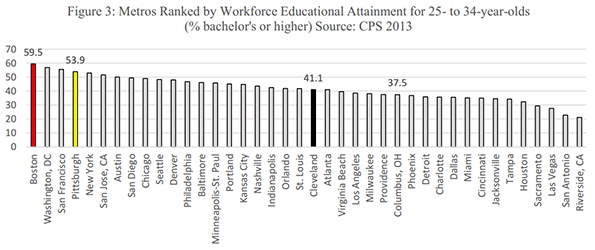
    An additional method of examining a region’s skill level is to look at the educational attainment within the labor force, as opposed to population. The rationale for doing so is simple. Regions with proportionally large student populations, like Columbus, Ohio, can have exaggerated talent pools, at least in terms of economic productivity. That is, a college student may live in a region to consume knowledge but not necessarily be employed to produce output.

    To calculate educational attainment in the labor force, data were analyzed for the 25- to 34-year-old cohort from 2013 Current Population Survey2. Figure 3 details the results of this analysis. Pittsburgh ranks 4th, whereas Greater Cleveland moves up to rank 21st. Conversely, Columbus, Ohio drops 13 spots to rank 27th, perhaps suggesting that the region’s large college enrollment isn’t effectively translating into the regional labor market.

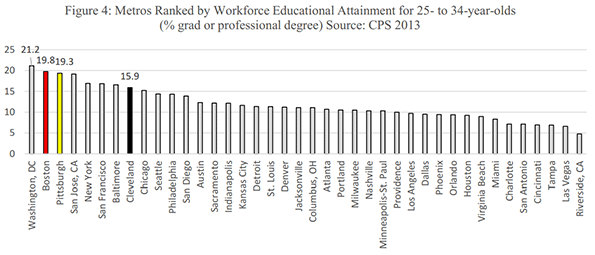
    A final analysis examines the percentage of a region’s young adult labor force that is highly skilled, or those with a graduate or professional degree. Slicing the labor force data this way is important in that a region’s highest-skilled workers are drivers of economic growth. Specifically, a metro’s top talent—think engineers, scientists, and doctors—are key agents of knowledge production and transference3, which— when translated into the marketplace—mean new firms and the evolution of existing firms. Those metros that have a high concentration of highly-skilled young adult workers have a head start in the race toward the “next” new economy.

    Figure 4 ranks the metros by the percentage of 25- to 34-year-olds in the labor force with a graduate or professional degree. Pittsburgh ranks 3rd nationally, whereas Greater Cleveland moves up 13 spots to rank 8th, ahead of Chicago, Seattle, and Austin. The implications of these findings are discussed below.

    A Rust Belt Rising?

    Economic restructuring from a labor- to a knowledge-based economy is no easy endeavor. Perhaps no other metro has made this transformation as successfully as Boston. What has driven the region’s evolution from a “dying factory town to a thriving information city”4 has been its gains in human capital. As shown in Figure 5, Boston ranks as an elite metro when it comes to educational attainment rates in both its population and labor force.

    What metro is the “next Boston”? Pittsburgh is a likely candidate. The “Steel City” region is increasingly marrying its legacies of manufacturing and knowledge production, with the evolution of new industries and products to show for it5. Enabling Pittsburgh’s ascent is a highly-skilled young adult workforce that’s rivaling Boston in terms of concentration of human capital (See Figure 5 below).

    here does that leave Cleveland? While the region is far from being the “next Boston”, one can make the case it is trending to be the “next Pittsburgh”. Specifically, a line of emerging thought—and one that will be developed by the Center for Population Dynamics in the coming months in two working papers—is that Cleveland’s 8th-placed ranking in its concentration of young workers with an advanced degree is a harbinger of broader economic growth. While this supposition is exactly that, there are several mechanisms by which this can occur.

    First, it is important to note that there is an industry demand for workers with advanced degrees in Greater Cleveland, else its 8th-place ranking wouldn’t occur. Termed a “magnet city”6, Cleveland’s knowledge economy is forming world-class clusters of expertise that are attracting top talent in key industry sectors, particularly life sciences and advanced manufacturing. In other words, if you want to act, you go to Hollywood. If you want to practice cardiac care or make medical devices you come to Cleveland. The next step for the region is to scale up its emerging economies so that the amassing of knowledge and investment becomes multiplied into the creation of a “thicker, stickier” regional economy.

    Part of this scaling up process relates to the effect that Cleveland’s concentration of highly-skilled workers can have on the local economic ecosystem. To wit, those with advanced degrees are most likely to migrate across state or international lines7. For instance, 29% of newly-arriving immigrants into Cleveland’s Cuyahoga County had a graduate or professional degree8. This means Cleveland’s burgeoning new economy demand is commonly fueled from outside the market. Why does this matter? For a historically insular region like Cleveland, this out-of-the-market knowledge migration brings a deepening of a region’s idea bank, as well as increasing global connectivity. The ability of a region to cross-pollinate ideas and get connected with global markets is crucial in the creation of new firms and emerging industries9.

    Now, what does, for example, a new biotech firm in Cleveland’s Health Tech Corridor mean for the local mechanic, bartender, lawyer, or accountant? A lot actually. Specifically, economist Enrico Moretti found that for every high-skilled job created, an additional 5 jobs are created in the professional or service sector10. What’s more, the job creation goes beyond the local services and taps into semi-skilled professions in emerging industries. For example, a recent Brookings study found that the Cleveland metro ranked 20th out of the nation’s largest 100 metros in the number of workers without bachelor’s degrees employed in pre-baccalaureate health care occupations11.

    Summary

    Perhaps Cleveland is the next Pittsburgh, and Pittsburgh the next Boston. Clarifying this entails analyzing how human capital development and economic restructuring takes place. Simply, is Cleveland’s talent profile today similar to Pittsburgh’s a decade ago, and to Boston’s twenty years prior? Moreover, what policies have been proven effective in translating knowledge production to regional economic growth?

    The Center for Population Dynamics is in the process of answering these questions. The information intends to help Cleveland speed up how quickly tomorrow gets here.

    This is a new report brief from the Center for Population Dynamics at Cleveland State University, download the pdf version here.

    Creative Commons photo “Cleveland Skyline from the Flats” by Flickr.com user Erik Drost.

    ———–

    2 The Current Population Survey (CPS) is a monthly survey of households conducted by the Bureau of Census for the Bureau of Labor Statistics. The monthly workforce educational attainment rate estimates were aggregated for a 2013 annual estimate.

    3 Waters, R. and Smith, H. 2013. High-technology local economies: Geographical mobility of the highly-skilled. In
    Networking Regionalised Innovative Labour Markets; Eds. Hilpert, U and Smith. H. Routledge: New York.
  • Welcome to the Billion-Man Slum

    When our urban pundit class speaks of the future of cities, we are offered glittering images of London, New York, Singapore, or Shanghai. In reality, the future for most of the world’s megacities—places with more than 10 million people—may look more like Dhaka, Mumbai, or Kinshasa: dirty, poverty- and disease-ridden, and environmentally disastrous.

    Harvard’s Ed Glaeser suggests that megacities grow because “globalization” and “technological change have increased the returns to being smart.” And to be sure, megacities such as Jakarta, Kolkata (in India), Mumbai, Manila, Karachi, and Lagos—all among the top 25 most populous cities in the world—present a great opportunity for large corporate development firms and thrilling treasure troves for both journalists and academic researchers. But surely there’s a better alternative to celebrating misery, as one prominent author did recently in aForeign Policy article bizarrely entitled “In Praise of Slums.”

    Bigger is no longer better.

    Let’s start with the idea that, in an urbanizing world, bigger is no longer necessarily better. In a recent study I conducted with Ali Modarres, Aaron Renn, and Wendell Cox for Singapore’s Civil Service College and Chapman University, we ranked cities by importance as global centers. Of the world’s estimated 29 megacities, only a handful made into the top 20. Most leading megacities were either long-established Western cities—Tokyo, New York, London, Los Angeles—or located in booming East Asia, including Beijing, Shanghai, and Seoul.

    Notably missing are fast-growing growing megacities such as Lagos, Karachi, and Dhaka, as well as the 16 additional megacities—mostly in developing countries in Africa and south Asia—that will pass the 10 million mark by 2030. Yet despite their girth, the majority of megacities are not particularly attractive for foreign investors or as locations for regional corporate offices. These firms tend to cluster instead in westernized cities such as Singapore, Hong Kong, or Dubai, and visit places like Jakarta, Manila, and Cairo only when necessary.

    History drives some of this. The great global cities rose as centers of industry and trade, while developing from there an excellence in related services. They created pockets of a more advanced economy to serve the predominately rural hinterland, or in some cases colonial possessions. This imperial relationship spurred the rise of London, Paris, and New York in the early 20th century, and also that of Tokyo, still the world’s biggest city.

    Some new megacities, some such as Guangzhou and Shenzhen (which in 1979 had roughly 30,000 people, compared to its 10.6 million today) have a real economic shot at becoming top global cities due to China’s emergence as the world’s workshop. But, as we explain in a recent paper from Chapman University, this is far less the case for most megacities in the developing world.

    Unlike their Chinese counterparts, these megacities’ expansion has not been driven by economic growth but more by bringing people from their own impoverished countryside into the city. Critically, in contrast to the peasants who came to Tokyo in the ’50s or Shanghai in the ’90s, there is no huge demand for an industrial workforce in cities in South Asia, Africa, or Latin America, where manufacturing is far less prevalent—manufacturing’s share of India’s GDP, for example, is half that of China.

    Here’s the difficult truth: Most emerging megacities, particularly outside of China, face bleak prospects. Emerging megacities like Kinshasa or Lima do not command important global niches. Their problems are often ignored or minimized by those who inhabit what commentator Rajiv Desai has described as “the VIP zone of cities,” where there is “reliable electric power, adequate water supply, and any sanitation at all.” Outside the zone, Desai notes, even much of the middle class have to “endure inhuman conditions” of congested, cratered roads, unreliable energy, and undrinkable water.

    The slums of Bangladesh’s capital, Dhaka, swell by as many as 400,000 new migrants each year. Some argue that these migrants are better off than previous slum dwellers since they ride motorcycles and have cellphones. Yet access to the wonders of transportation and “information technology” don’t compensate for physical conditions demonstrably worse than those endured even by Depression-era poor New Yorkers. My mother’s generation at least could drink water out of a tap and expect consistent electricity, if the bill was paid, something not taken for granted by their modern-day counterparts (PDF) in the developing world.

    More serious still, the slum dwellers face enormous risk from unsafely built environments. Traffic, as anyone who has spent time in these cities easily notices, poses particular threats to riders and pedestrian alike. According to researchers, developing countries now experience a “neglected epidemic” of road-related injuries accounting for 85 percent of the world’s traffic fatalities.

    And don’t drink the water, please. Nearly two-thirds of the sewage in the megacity of Dhaka, with 15 million people, is untreated. As Dr. Marc Reidl, a specialist in respiratory disease at UCLA, puts it, “Megacity life is an unprecedented insult to the immune system.”

    Cities of disappointment.

    Over these environmental problems loom arguably greater social ones. Many of the megacities—including the fastest growing, Dhaka—are essentially conurbations dominated by very-low-income people; roughly 70 percent of Dhaka households earn less than $170 (U.S.) a month, and many of them far less. “The megacity of the poor,” is how the urban geographer Nazrul Islam describes his hometown.

    Inequality is expanding in most of these places. A recent Euromonitor International study found that larger “city size remains the key explanatory factor for income inequalities across the world’s urban agglomerations.” Even megacities that we might refer to as “middle income,” such as Tehran and Istanbul, are becoming what geographer Ali Modarres calls “cities of disappointment.” In many cases, high housing prices and a lack of space have already reduced the birthrate to well below the replacement level. Increasingly, many women are choosing to remain single—heretofore something rare in these countries.

    One scholar, Jan Nijman, suggests that most gains in recent years have accrued to the upper echelons of the middle class in Indian cities while “the ranks of the lower middle income classes have shrunk, and the ranks of the poor have expanded rapidly.” Much of the growth in a perceived middle class, Nijman argues, is based not on income but on consumption driven by credit. The informal sector—drivers, stall-owners, repair-people, household industries—account for much of Mumbai’s employment growth.

    Housing costs are the key here. Researcher Vatsala Pant estimates a monthly total household “middle class income” in Mumbai at 40,000-50,000 rupees; equivalent to less than $1,000 U.S. dollars. Yet monthly salaries for teachers, police officers, and other mid-level jobs are often half that amount. Not surprisingly, even these workers often find themselves living in slum neighborhoods, which are also known as jhopad-patti, jhuggi-jhopadi or busties. “It’s the dream of an immigrant for a place in Mumbai … and ends up with a slum,” she notes.

    Is there a better alternative?

    Future urbanization does not need to pose a choice between rural hopelessness and urban despair. This is a critical issue, even for high-income countries. The rise of a mass of poor slum dwellers—estimated as high as 1 billion—threatens the social stability not only of the countries they inhabit, but the world, as they tend to generate high levels of both random violence and more organized forms ofthuggery, including terrorism.

    Fortunately, an alternative structure of urbanization is beginning to emerge that emphasizes a spreading diversity of cities as opposed to gigantic agglomerations. In the coming decade, McKinsey predicts megacities will underperform economically and demographically, as growth shifts to “fast growing middleweights,” many of them in China and India.

    There needs to be a far greater emphasis on these smaller cities, as well as working to develop a viable economy for the villages. In India, migration to large cities already is beginning to slow, as more potential migrants weigh the costs and opportunities of making such a move as opposed to staying closer to home. This phenomenon has been called “rurbanization” and was an important provision of the campaign of India’s new prime minister, Narendra Modi, who implemented such programs as chief minister of the state of Gujarat. Modi speaks of human settlements with the “heart of a village” and developing “the facilities of the city.”

    A growing array of critics understand the need to break with the megacity mantraAshok R. Datar, chairman of the Mumbai Environmental Social Network and a longtime adviser to the Ambani corporate group, says the emerging megacities of the developing world need to stop emulating the Western model of rapid, dense urbanization. “We are copying the Western experience in our own stupid and silly way,” Datar says.

    He suggests a policy focusing on more human-scale growth. One does not have to be a Gandhian idealist to suggest that Ebenezer Howard’s “garden city” concept—conceived as a response to miserable conditions in early 20th century urban Britain—may be a better guide to future urban growth than the current trend of relentless concentration.

    The “garden city” alternative could help ameliorate the downsides of  mass urbanization in China as well, where the government is seeking to move 250 million more people from the countryside to urban areas over the next decade. “There’s this feeling that we have to modernize, we have to urbanize, and this is our national-development strategy,” said Gao Yu, China country director for the Landesa Rural Development Institute, based in Seattle. Referring to the disastrous Maoist campaign to industrialize overnight, he added, “it’s almost like another Great Leap Forward.”

    As the world urbanizes, we need to start thinking about how to make cities better, not simply bigger. The primary goal of a city should not be to enrich already wealthy landlords and construction companies. It should not be to make politicians more powerful. And it certainly should not be mindless, pointless growth for its own sake. Urbanism should not be defined by the egos of planners, architects, politicians, or the über-rich but by what works best for the most people.

    This piece originally appeared at The Daily Beast.

    Joel Kotkin is executive editor of NewGeography.com and Distinguished Presidential Fellow in Urban Futures at Chapman University, and a member of the editorial board of the Orange County Register. His newest book, The New Class Conflict is now available for pre-order atAmazon and Telos Press. He is author of The City: A Global History and The Next Hundred Million: America in 2050. His most recent study, The Rise of Postfamilialism, has been widely discussed and distributed internationally. He lives in Los Angeles, CA.

    Dhaka photo by Wendell Cox.

  • A Typology of Gentrification

    Patterns of gentrification vary by city, and the spread of gentrified areas is partly determined by the city’s predominant development form and the historic levels of African-American populations within them. Gentrification is a nuanced phenomenon along these characteristics, but most people engaged in any gentrification fail to acknowledge the nuances.

    Spurred on by the recent debate on the impact of limited housing supply on home prices and rents, thereby “capping” gentrification, (taken on fantastically by geographer Jim Russell in posts like this), I decided to do a quick analysis of large cities and see how things added up. The analysis was premised on a couple observations of gentrification, one often spoken and one not. One, gentrification seems to be occurring most and most quickly in cities that have an older development form, offering the walkable orientation that is growing in favor. Two, gentrification seems to be occurring most and most quickly in areas that have lower levels of historic black populations. This less noted observation was the thrust of a study by Harvard sociology professor Robert Sampson and doctoral student Jackelyn Hwang, recently described here. Here’s what they said, after conducting an exhaustive study of gentrification patterns in Chicago:

    After controlling for a host of other factors, they found that neighborhoods an earlier study had identified as showing early signs of gentrification continued the process only if they were at least 35 percent white. In neighborhoods that were 40 percent or more black, the process slowed or stopped altogether.

    That prompted my quick study. I wanted to categorize cities by old and new development forms, and low and high historic levels of black population. To do that I came up with an arbitrary proxy for the age of development form. Using decennial Census data, if a city reached 50 percent of its peak population by 1940, it was deemed to have an old development form; if a city reached 50 percent of its peak population in 1950 or later, it was deemed to have a new development form. Here’s a quick example of how this works. Baltimore, currently with a population of a little over 600,000, reached its peak of 949,000 in 1950. Baltimore reached half its peak, or about 475,000, by 1890, a time at which it could be said that Baltimore’s form as a city had been firmly established. Similarly, Austin reached its peak of 790,000 in 2010. The fast-growing Texas city was half that size in only 1990, a year in which it could be said that its development form was established and the city began to see itself as a major city. Imprecise, yes, but a decent proxy for examining old and new city development forms.

    The second piece of analysis was gathering Census data on central city black populations in 1970. This decade was chosen largely because it represents the end of the Great Migration, when millions of African-Americans left the rural South for cities across the nation. By that time the cities which are generally recognized as having large black populations had already been identified, and it’s possible to explore the impact of the migration on them. I arbitrarily said cities with black populations lower than 25 percent of the total in 1970 had a low black population, and those above 25 percent had a high black population.

    Using those two factors, I put together this table of the 64 primary cities over 250,000 in the U.S.:


    There are more than a few cities that are exceptions, largely because recent consolidations or large-scale annexations have boosted them into more unfamiliar boxes. But some patterns are evident, and if you think of these in terms of gentrification, you might be able to make the following general assumptions:

    Old Form + Low Black Population = Expansive Gentrification (OFLB)
    Old Form + High Black Population = Concentrated Gentrification (OFHB)
    New Form + Low Black Population = Limited Gentrification (NFLB)
    New Form + High Black Population = Nascent Gentrification (NFHB)

    Identifying the examples might be the best way to explain what I mean. New York, San Francisco and Boston are the prototypical OFLB cities, and gentrification has made its widest impact in these three cities. Chicago, Washington and Atlanta are the classic OFHB cities, where gentrification is concentrated in certain areas of the city (or region), and eludes the heavily African-American parts of the city. Phoenix, San Diego and Las Vegas might be the prototypical NFLB cities, all of which came of age with the car as the dominant mode of transport and with few African-Americans. NFLB cities may also be the leaders and innovators in seeking ways to catalyze their inner cities, with greater tangible investments in public transit and mixed use development. The relatively few NFHB cities are a distinctly Southern phenomenon, and by all appearances gentrification activity lags behind other cities, with sprawl still the dominant development engine.


    Cities by gentrification type. Special thanks to Adam Carstens for producing this map.

    Why would any of this matter? Nationally, the gentrification debate is defined by the experiences of the OFLB types like New York, San Francisco and Boston. There, the issues are rapidly growing unaffordability, concerns with displacement and growing inequality. But the gentrification debate is quite different in OFHB cities like Philadelphia and Atlanta, where seeking ways to more equitably spread the positive benefits of revitalization might lead such discussions.

    In other words, it’s not exactly correct to look at what’s happening in Los Angeles or San Diego, or Baltimore or St. Louis, in the New York-San Francisco-Boston context. Different forces and different experiences are creating different outcomes in each city, and if we want to understand how to look at gentrification’s impact, we need to understand its foundations.

    This post originally appeared in Corner Side Yard on August 15, 2014.

    Pete Saunders is a Detroit native who has worked as a public and private sector urban planner in the Chicago area for more than twenty years.  He is also the author of “The Corner Side Yard,” an urban planning blog that focuses on the redevelopment and revitalization of Rust Belt cities.