Blog

  • What College Gowns Bring to Towns

    The college town, one of America’s most appealing and unique features, grew out of the Age of Reason, and the concept of a regional, liberal-arts college nurtured by a small town has been intertwined with American history. Today, with enrollment dropping, the small, private college seems to be going the same way as the typewriter, the newspaper and the independent bookstore. While some colleges struggle to survive, the institution of the college town lives in suspended animation, ready to support whatever form its major employer may take. One thing’s for sure: the reinvention of the post-college town is coming.

    Here in Central Florida, the tradition of a liberal-arts college entwined with a small or medium-sized municipality is alive and well, for the moment. But trouble is brewing. While private institutions in Central Florida may not advertise their funding problems, the truth is plain to see. Rapid expansion of athletic programs, sure-fire profit centers for most schools, is underway at Rollins College, Stetson, and University of Tampa, and all are exploring other ways to reach more students, as well.

    Florida’s public universities are not immune to budget problems, either. And their response to the financial crisis says much about the future of college towns everywhere.

    Reinvention of the liberal arts college itself has been a cottage industry for the last several years. Student body diversification into “lifelong learning” (read: the lucrative retiree demographic), extensions, outreach campuses, and summer programs for primary and secondary schools has surged, as colleges try to open new markets. Bloated administrative costs have given rise to urgent fundraising and athletic programs, while an army of poorly paid adjunct professors shoulder an increasing burden of responsibility for the actual work of teaching. But, as Moody’s analyst Susan Fitzgerald has said about small, tuition-dependent colleges, they are in “a death spiral – this continuing downward momentum for some institutions [means] we’ll see more closures than in the past.”

    The Economist magazine has compared colleges to newspapers. If their analogy were to hold true, of the 4,700 colleges and universities in the world, “more than 700 institutions would shut their doors.” Citing the rise of massive, open, online courses or MOOCS, the magazine suggested that the idea of a professor interacting face-to-face with students will become a luxury. Colleges seem destined to end up in the same tiresome boat as the rest of the digital world, where everything, ultimately, becomes a product on Amazon.

    Uncertainty about the future has hastened the liberal arts school’s demise. In the darkest days of the recession we were told there was a STEM crisis: science, technology, engineering and mathematics were the fields that would get you a job. People ditched their liberal arts pursuits for more practical, employable ones, swearing off the indulgent frivolity of a philosophy course for a computer programming class. Panicking parents and students stampeded out of the gothic halls of the English department as fast as they could.

    Here in Florida, to pay for a new state campus in Lakeland, the Governor gutted the operational budget of Florida’s 11 other institutions of higher education. The new campus, located on rural land adjacent to Interstate 4, is far from any sort of population center. It’s a soulless commuter school; any form of a college town to accompany it lies far, far in the future.

    USF Polytechnic is being billed as a “destination campus”. Its showy new structure nearly complete, it lies naked to the Florida scrub and Interstate 4, with a few lonely stucco buildings and portable classrooms marking a kind of desperate, treeless sense of place in the hot Florida sun. No flip-flop-shod students strumming guitars, debating the meaning of Proust or the relevance of Marx will ever be found under its oak trees or in front of its bohemian coffee shops, because there aren’t any. Instead, there’s a harsh, asphalt parking lot and a long, hot trudge to the endpoint, another signal that one’s college years are just like a shopping trip to Wal-mart.

    If the one-in-seven death rate holds true, then one of the seven college towns in Central Florida will not have a future either. Gainesville, DeLand, Winter Park, St. Augustine, Tampa, Lakeland, and St. Petersburg are seven places with streets, residences, and businesses that each have grown up around colleges, public and private, and that enjoy a thriving sidewalk life.

    Ironically, at least two of these colleges were born in another desperate time, the Great Depression. The University of Tampa, across the Hillsborough River from downtown Tampa, started in a failed hotel when the city took it over from owner Henry Plant’s railroad empire. Likewise, Flagler College in St. Augustine began in a resort hotel built by New York railroad magnate Henry Flagler. The small, private, liberal-arts college was a perfect solution. A grand old structure was re-inhabited, and a struggling city was bolstered.

    Towns that grew up around these places have different, more informal qualities than other towns. In Gainesville, for example, churches, temples, student centers, and other non-profit institutions occupy prominent positions within the urban core. There’s a diversity of old houses with garage apartments, lean-tos, and enclosed porches. Wood apartment buildings have side stairs, outdoor beer kegs, and bicycle racks. They sit under huge, mature trees, clad in subtropical philodendron vines, and are connected by narrow dirt pathways carved independent of sidewalks. A sense of grown-over-time pervades within and around campus, its boundaries softened by sneaker and bicycle traffic, concert posters and poetry reading notices.

    Gainesville, with nearly fifty thousand students, will probably survive, but other, smaller towns may struggle. As conversion to digital learning reduces costs, the college town may disappear. Anonymous reviews, posted online, replace conversations in bookstores. University Avenue may be deleted, just like yesterday’s term paper.

    Our bookshelves are crowded with titles about the urban future, but in all of this furious scribbling it seems no one has noticed that sidewalks have all but emptied out in many of our cities. Chicago, New York, San Francisco, and a few more still march to the pedestrian beat. But a fairly thorough survey of peninsular Florida yields few sidewalks with any kind of street life — and the few that still operate as shared, social space all belong to our college towns.

    Students, with one foot in childhood and one in adulthood, still walk on sidewalks. They shop online, too, but they still patronize businesses for the sake of the social interaction, and still have use for the physicality of the street… for a street life that seems to be endangered.

    College towns, living on today in a shadow of their former bohemian selves, will be reinvented, just as education systems will. But for now, deprived of street life, we breed a different sort of citizen and thinker than an old college town once did. This new digital citizen will construct social space in ways yet to be foreseen.

    Richard Reep is an architect with VOA Associates, Inc. who has designed award-winning urban mixed-use and hospitality projects. His work has been featured domestically and internationally for the last thirty years. An Adjunct Professor for the Environmental and Growth Studies Department at Rollins College, he teaches urban design and sustainable development; he is also president of the Orlando Foundation for Architecture. Reep resides in Winter Park, Florida with his family.

    Photo of downtown Gainesville by the author. This scene is typical of the streets surrounding the campus of the University of Florida.
  • Millennial Boomtowns: Where The Generation Is Clustering (It’s Not Downtown)

    Much has been written about the supposed preference of millennials to live in hip urban settings where cars are not necessary. Surveys of best cities for millennials invariably feature places like New York, San Francisco, Chicago and Boston, cities that often are also favorites of the authors.

    Yet there has been precious little support for such assertions. I asked demographer Wendell Cox to do a precise, up-to-date analysis of where this huge generation born between 1983 and 2003 actually resides. Using Census American Community Survey data, Cox has drawn an intriguing picture of millennial America, one that is often at odds with the conventional wisdom of many of their elders.

    The Hidden Millennials

    We focused on individuals aged 20 to 29, which represents most of the millennial generation that is finishing post-secondary education and getting established in the workforce. Much of the writing about millennials focuses on their impact on downtowns and urban cores. And to be sure, the numbers of millennials living in urban cores has grown, as downtowns and inner-city neighborhoods have gentrified, particularly in cities such as Boston, Seattle, San Francisco, New York and Chicago. Overall, from 2010 to 2013, the population of 20- to 29-year-olds in core counties (which in most cases are identical to the core city of the metropolitan area) rose by 407,400, or 3.2%.

    However, that must be put in the context of the overall increase nationwide of that age group in that time span: 4%. Despite the growth in raw numbers of 20- to 29-year-olds living in core counties, the share of the age group living in these areas actually declined slightly, by 0.78%, compared to 2010. Meanwhile, the share of the age group living in the less dense portions of metropolitan and micropolitan statistical areas  increased. Overall roughly 30% of all millennials live in core counties, which means 70% live somewhere else. In the last three years, the number of millennials outside core counties increased by 1.28 million. In 2010, the functional urban cores, characterized by higher density and higher reliance on transit, were home to 19% of the 20-29s in major metropolitan areas, down from 20% in 2000.

    In contrast to the constantly reported on urban hipsters, the vast majority of this generation, who get precious little attention from the media or marketing gurus, might be best described as “hidden millennials.” We have to assume some of these young people are still living, primarily in suburbia, with their parents; a recent Pew study put the percentage of people 18 to 31 living at home at 36%, up from 32% before the recession, as well as the 34% level registered in 2009.

    This constitutes a population of over 20 million and not all are hopeless slackers — the vast majority have at least some college education. But they are also disproportionately unemployed or out of the workforce, and, living in their parents’ homes, they are pretty much ignored by everyone except perhaps their friends and relatives. Other millennials may well be living in suburban apartments, which tend to be somewhat less expensive, and others, perhaps the oldest of the group, have begun to “launch” starting families and buying houses, which would tend to put them in the suburbs and smaller cities as well.

    Millennial Boomtowns

    Equally surprising are those cities that have seen the largest increases in their millennial population. It is dogma among greens, urban pundits, planners and developers that the under 30 crowd doesn’t like what Grist called “sprawling car dependent cities.” Too bad no one told most millennials. For the most part, looking at America’s largest metro areas (the 52 metropolitan statistical areas with populations over a million) the fastest growth in millennial populations tend to be in the Sun Belt and Intermountain West. Leading the way is, San Antonio, Texas, where the 20 to 29 population grew 9.2% from 2010-13, an increase of 28,600.

    Right behind it, also in the Sun Belt, are Riverside-San Bernardino, Calif. (8.3%); Orlando, Fla. (8.1%); and Miami (7.7%).

    Surprisingly Detroit, long considered a demographic basket case, comes in it at No. 5 in our study, with an impressive 6.8% increase. Given the implosion in the population in the city of Detroit, this growth is likely to have taken place almost entirely in the region’s suburbs, which have done far better both economically and demographically than the core.

    The Hipster Capitals Lag

    For the most part the “capitals of cool” allegedly so irresistible to millennials rank further down the list. The only two arguable hipster magnets to make the top ten were the Denver metro area (seventh) and  Seattle (ninth). The New York metro area ranks 39th with a 3.2% increase, lagging the national expansion in this age group of 4%. The San Francisco-Oakland region, despite the tech boom, places 37th, while the Portland area, renowned as a place where millennials supposedly “go to retire,” ranks 44th. The Chicago metro area’s 20-29 population was essentially unchanged, putting it 49th on our list.

    One reason may be that core urban areas are not experiencing the surge in millennials widely asserted. Indeed the millennial populations of the five core counties (or boroughs) of New York grew only 2%, half the national rate of increase and below that of the metro area as a whole.

    The same pattern can be seen in the cores of such attractive hipster magnets as San Francisco and Boston, both of which have seen negligible growth among millennials. It appears these areas always attract young people, but also lose them over time. Even more shocking, the 20-29 populations have actually declined since 2010 in the core areas of such much celebrated youth magnets as Chicago (-0.6%) and Portland(-2.5%). Besides Seattle and Denver, the only hip core city showing expanding appeal to millennials is the anomaly of resurgent New Orleans, where the ranks of 20-29 old has grown over 5% since 2010.

    The Future of Millennial America

    What emerges from this survey is a  picture of a millennial America that does not much mirror the one suggested in most media and pundit accounts. The metro areas with the highest percentages of millennials tend, for the most part, to be not dense big cities but either college towns — Austin, Texas; Columbus, Ohio, for example — or Sun Belt cities. Virginia Beach leads the pack, with 17% of its population aged 20 to 29, compared to 14% nationwide.

    But overall  the towns with the biggest share of millennials today are also those growing this population the fastest:  Southern or Intermountain West cities. One big contributing factor is their large Hispanic communities, which for the last three decades have had a far higher birthrate than whites. Latinos constitute 20% of all millennials. This may help explain the large presence of millennials in places like Orlando, Riverside-San Bernardino, and Los Angeles. Other factors may be places where there tend to be high numbers of children, such as Mormon-dominated Salt Lake City.

    What these results suggest is that marketers, homebuilders and politicians seeking to target the increasingly important millennial population need to look beyond urban cores. The vast majority of millennials do not live in dense inner city neighborhoods — in fact less than 12% of the nation’s 20-29s did in 2010. Rather than white hipsters, many millennials are working class and minority;  in 2012, Hispanics and African-Americans represented 34% of the 20-29 population. Presumably many of them are more concerned with making a living than looking out for “fair trade” coffee or urban authenticity.

    Like most of America, the millennials are far more suburban, more dispersed and less privileged than what one sees on shows such as “Girls” or read about in accounts in theNew York Times and the Wall Street Journal. Reality is often more complex, and less immediately compelling, than the preferred media narrative. But understanding the actual geography of this generation may provide a first step to gaining wisdom how to approach and understand this critically important generation.

    20-29 Population Change: Major Metropolitan Areas: 2010-2013
    Rank Major Metropolitan Area (MMSA) 2010 2013 Change
    1 San Antonio, TX         311        340 9.2%
    2 Riverside-San Bernardino, CA         605        655 8.3%
    3 Orlando, FL         322        348 8.1%
    4 Miami, FL         716        771 7.7%
    5 Detroit,  MI         506        541 6.8%
    6 Houston, TX         856        909 6.2%
    7 Denver, CO         357        378 6.0%
    8 Charlotte, NC-SC         288        304 5.8%
    9 Seattle, WA         499        528 5.7%
    10 Virginia Beach-Norfolk, VA-NC         274        290 5.6%
    11 Buffalo, NY         153        162 5.4%
    12 Jacksonville, FL         187        197 5.3%
    13 Grand Rapids, MI         141        148 5.2%
    14 Tampa-St. Petersburg, FL         341        359 5.1%
    15 Rochester, NY         146        153 4.8%
    16 Dallas-Fort Worth, TX         911        954 4.7%
    17 Raleigh, NC         154        161 4.7%
    18 Los Angeles, CA      1,941     2,032 4.7%
    19 Richmond, VA         167        174 4.6%
    20 Nashville, TN         242        253 4.6%
    21 Indianapolis. IN         253        264 4.5%
    22 Phoenix, AZ         592        618 4.3%
    23 Sacramento, CA         307        321 4.3%
    24 Cleveland, OH         242        252 4.3%
    25 Austin, TX         295        307 4.2%
    26 Boston, MA-NH         663        690 4.1%
    27 Memphis, TN-MS-AR         182        189 4.1%
    28 Oklahoma City, OK         195        203 4.0%
    29 Atlanta, GA         719        747 4.0%
    30 Hartford, CT         154        160 3.9%
    31 San Jose, CA         254        263 3.9%
    32 Pittsburgh, PA         293        305 3.8%
    33 Providence, RI-MA         217        224 3.6%
    34 San Diego, CA         521        540 3.5%
    35 Baltimore, MD         381        394 3.5%
    36 Washington, DC-VA-MD-WV         818        846 3.4%
    37 San Francisco-Oakland, CA         605        625 3.4%
    38 New Orleans. LA         176        181 3.3%
    39 New York, NY-NJ-PA      2,740     2,828 3.2%
    40 Columbus, OH         283        291 3.0%
    41 Louisville, KY-IN         159        164 3.0%
    42 Philadelphia, PA-NJ-DE-MD         823        848 3.0%
    43 Las Vegas, NV         277        285 2.9%
    44 Portland, OR-WA         306        311 1.8%
    45 Cincinnati, OH-KY-IN         280        285 1.7%
    46 Kansas City, MO-KS         263        267 1.3%
    47 St. Louis,, MO-IL         371        372 0.2%
    48 Chicago, IL-IN-WI      1,326     1,328 0.2%
    49 Minneapolis-St. Paul, MN-WI         470        471 0.2%
    50 Birmingham, AL         151        151 -0.4%
    51 Milwaukee,WI         216        215 -0.4%
    52 Salt Lake City, UT         178        177 -0.5%
    MMSAs    23,827   24,780 4.0%
    Outside MMSAs    18,862   19,595 3.9%
    United States    42,688   44,376 4.0%
    In thousands

    Analysis by Wendell Cox.

    This story originally appeared at Forbes.

    Joel Kotkin is executive editor of NewGeography.com and Distinguished Presidential Fellow in Urban Futures at Chapman University, and a member of the editorial board of the Orange County Register. He is author of The City: A Global History and The Next Hundred Million: America in 2050. His most recent study, The Rise of Postfamilialism, has been widely discussed and distributed internationally. He lives in Los Angeles, CA.

  • Democrats Risk Blue-collar Rebellion

    If California is to change course and again become a place of opportunity, the impetus is likely to come not from the perennially shrinking Republican Party but from working-class and middle-class Democrats.

    This group, long quiescent, has emerged most notably in opposition to the state’s anti-global warming cap-and-trade policies, which will force up energy prices. Recently, some 16 Democratic Assembly members, led by Fresno’s Henry Perea, asked the state to suspend the cap-and-trade program, which will add as much as a dollar to what already are among the highest gasoline prices in the nation.

    In some senses, this budding blue-collar rebellion exposes the essential contradiction between the party’s now-dominant gentry Left and its much larger and less well-off voting base. For the people who fund the party – public employee unions, Silicon Valley and Hollywood – higher energy prices are more than worth the advantages. Public unions get to administer the program and gain in power and employment while venture capitalists and firms, like Google, get to profit on mandated “green energy” schemes.

    What’s in it for Hollywood? Well, entertainment companies are shifting production elsewhere in response to subsidies offered by other states, localities and companies, so high energy costs and growing impoverishment across Southern California doesn’t figure to really hurt their businesses. Furthermore, by embracing “green” policies, the famously narcissistic Hollywood crowd also gets to feel good about themselves, a motivation not to be underestimated.

    This upside, however, does not cancel out hoary factors such as geography, race and class. One can expect lock-step support for any proposed shade of green from most coastal Democrats. Among lawmakers, the new Democratic dissenters don’t tend to come from Malibu or Portola Valley. They often represent heavily Latino areas of the Inland Empire and Central Valley, where people tend to have less money, longer drives to work and a harder time affording a decent home. Cap and trade’s impact on gasoline prices – which could approach an additional $2 a gallon by 2020 – is a very big deal in these regions.

    Many of these same people historically have worked in industries such as manufacturing and logistics, industries that rely on reasonable energy prices. Companies in these fields increasingly seek locations in lower-cost states, such as Washington, Oregon, Texas, Utah and Arizona, taking generally high-paying blue-collar jobs with them. It’s rare to find a manufacturer, for example, who would move to or expand in, California, outside of a handful of subsidized firms. Even ethnic-food companies are looking elsewhere, despite the fact that the raw materials and a large local market exist here.

    The dispute in California over cap and trade – where government limits businesses’ greenhouse gas emissions, and higher-emitting companies buy allowances to exceed their limits – may just be the harbinger of a wider conflict within the party nationally. In Washington, D.C., there is tension between East Coast and West Coast Democrats on one side and representatives from the Plains and the South on the other. Progressives shrug at the loss of these regions and the associated white working-class voters who, as the liberal website Daily Kos contended earlier this year, are just a bunch of racists, anyway.

    But, at least here in California, much of the working class is made up of minorities, who are increasingly the economic victims of the enlightened ones. One place to see this is in Richmond in Northern California, where a Green Party mayor and a similarly aligned planning department have tried to block the refurbishing of Chevron’s large refinery there, which is also the economic bulwark of the area.

    The dispute over the refinery suggests divisions that may become more commonplace. Essentially, you have on one side overwhelmingly white, often very-affluent greens, allied with powerful Democratic politicians, arrayed to obstruct the refinery. On the other side, you have minorities, many of them union members, whose livelihoods and high-paying jobs depend on the refinery.

    The incipient rift between such blue-collar workers and gentry Democrats is inevitable. The wealthy donors who dominate both local and national Democratic politics, like San Francisco hedge fund mogul Tom Steyer, may have made much of their fortunes in fossil fuels, as the New York Times, among others, have reported. But now, having embraced a stringent environmentalism, the gentry seek to impose their “green” agenda on the hoi polloi. If this hypocrisy isn’t disturbing enough, consider the increasingly top-down nature of environmentalist politics. In the past, conservationists focused on how to protect people from harm and preserve nature, in part, so people might enjoy it.

    Many of today’s progressives not only are determined to protect their privileges, but seek to limit the opportunities for pretty much everyone else. People like Steyer, for example, who is close to both the Obama White House and Senate Majority Leader Harry Reid, can enjoy their vast estates, while supporting policies that make it improbable for middle-class families to afford a home with a decent back yard.

    In many ways, their approach is reminiscent of the old British aristocracy, who combined a passion for preserving nature within their lands with a commitment to limiting its accessibility to the masses. People like billionaire venture capitalist Vinod Khosla are big on being green, but don’t want their less well-endowed neighbors to access the beach near their estates. It’s “Animal Farm” for the ecological age: Some animals, it seems, are more equal – and righteously green – than others.

    With virtual strangleholds on much of the media, academia and the punditry, the gentry and their allies may be able to limit coverage of this inherent conflict, but it will be difficult to suppress forever the essential contradictions between the gentry and everyone else.

    Democratic strategists hope that, by focusing on social issues – immigration, abortion and gay rights – they can keep the peasants in line. And to be sure, Republicans pushing nativism and social conservatism seem determined to distract Latinos, Asians, women and gays from focusing on the realities of an increasingly neofeudalist California. Political analyst Michael Lind contends this Democratic strategy may not succeed over time. For one thing, he notes, differences on many social issues are narrowing, in part, as more minorities, singles and gays move into suburban or exurban locales.

    As social issues become less heated, political divides figure to develop more along economic lines. This conflict may prove no easier to resolve than the GOP’s internal struggle between the Tea Party and corporatists. The Democratic divide will pit much of the party’s financial and media base, in Hollywood and Silicon Valley, against the interests and aspirations of middle- and working-class people who make up the vast majority of Democratic voters.

    For those who enjoy political combat, this schism guarantees more sharp divisions among the Democrats. More importantly, this conflict should generate greater debate about correcting our current course, which would be good news for the rest of us.

    This article first appeared in the Orange County Register.

    Joel Kotkin is executive editor of NewGeography.com and Distinguished Presidential Fellow in Urban Futures at Chapman University, and a member of the editorial board of the Orange County Register. He is author of The City: A Global History and The Next Hundred Million: America in 2050. His most recent study, The Rise of Postfamilialism, has been widely discussed and distributed internationally. He lives in Los Angeles, CA.

    Auto manufacturing photo by BigStockPhoto.com.

  • The Uniqueness of Detroit’s Housing Stock

    Last week, as part of my series on planning reasons behind Detroit’s decline, part 2 of the nine-part series was about the city’s poor housing stock.  I started to play with some numbers to see if there was any validity to my opinions about the city’s housing, and I found some very intriguing things.  Detroit’s housing stock is definitely unique among its Midwestern and Rust Belt peer cities, and perhaps among cities nationwide.  Let’s examine.

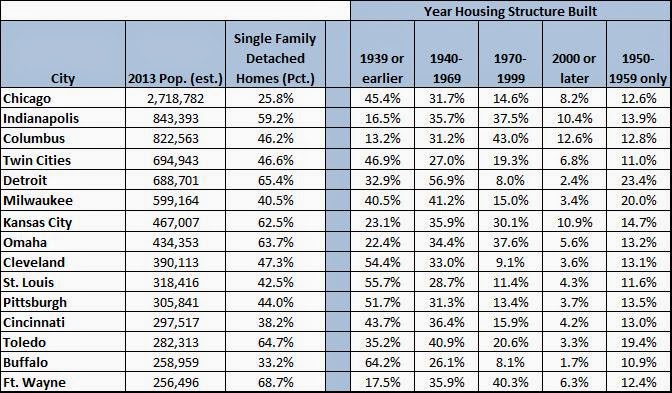
    Grouping the cities by population figures from the 2013 U.S. Census population estimates, and housing data from the 2008-2012 American Community Survey, I looked at housing age and single family detached housing data for 15 Midwest/Rust Belt cities with populations above 250,000.  One city I typically include in an analysis like this, Louisville, was not included due to a lack of ACS data.  Data for the Twin Cities of Minneapolis and St. Paul were aggregated into one (sorry, Minneapolis and St. Paul) because they jointly function as the core city for their region.  Here’s the big table with all the data:


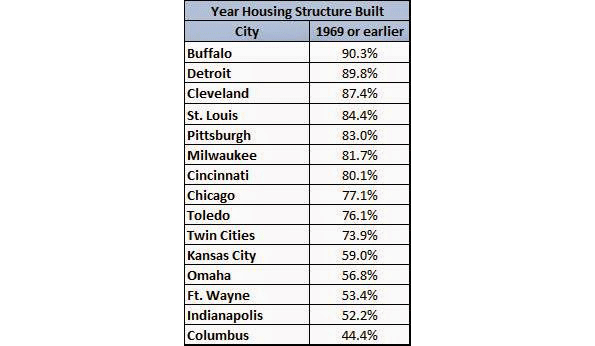
    That’s a lot to digest, so I’ll take the data piece by piece.  First, let’s look at the cities ranked by their percentage of housing units built in 1969 or earlier:

    You’ll see here that, perhaps following the general national perception of Detroit housing, the Motor City has an older housing stock.  Only Buffalo has a higher percentage of older housing. Generally speaking, the cities at the top half of this list have older housing because they lack redevelopment activity that replaces older housing, while cities at the bottom half consists of cities with decent levels of redevelopment activity, or more recently built housing that’s been annexed into the city in recent decades.  Here, Detroit does seem to fit the pattern.

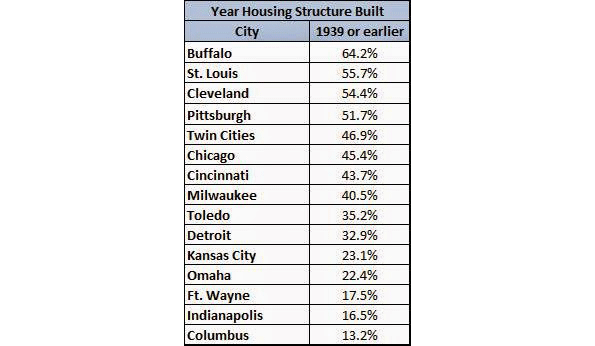
    But does it really?  If you look at the Census’ earliest category for age of structure, 1939 or earlier, Detroit drops considerably on the list:

    Instead of ranking second as in the earlier table, Detroit falls to tenth.  The rest generally hold the same spots they occupied from the previous table as well. The only ones ranking lower than Detroit here are smaller cities (Omaha, Ft. Wayne) and the cities that annexed large amounts of land post 1970 (Kansas City, Indianapolis, Columbus).

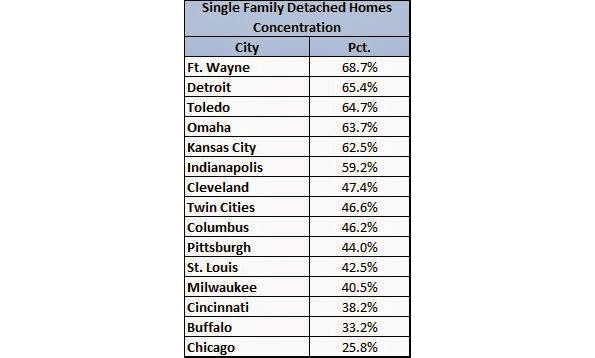
    Next, let’s look at how the cities rank in terms of their concentrations of single family detached homes:

    Detroit shows up here with the second highest percentage of single family detached homes, comprising nearly two-thirds of the city’s housing stock.  Once again, the only comparable cities are the smaller cities and the big annexers.

    Clearly, most observers believe Detroit has more in common with Buffalo, Cleveland and Pittsburgh than with Ft. Wayne, Kansas City and Indianapolis.  What happened to Detroit’s housing stock that gave it such an odd profile?

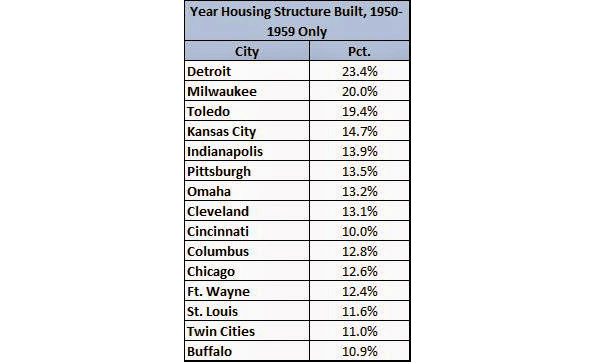
    To understand, let’s pull out a specific category on the age of structure table, the 1950-1959 category:

    Here, we find that Detroit has, by far, the highest concentration of housing units built between 1950-59 of all its peer cities.  Nearly one in four homes in Detroit were built during this period.  In fact, Detroit, along with Milwaukee and Toledo, occupies a strange space among Midwestern/Rust Belt cities.  (Side note: the more I study Detroit against other Midwestern cities, the more I find that Detroit and Milwaukee are virtually the same city.  And it doesn’t surprise me that Toledo, just 75 miles from Detroit, would share its characteristics as well).  Detroit, Milwaukee and Toledo all added their greatest numbers of housing at the outset of the modern suburban development period, what I’ve called the Levittown Period in my so-called Big Theory of American Urban Development.  This supports my thinking that if anyone was ever interested in establishing a Levittown-style national historic district, Detroit would be a good candidate.  The Motor City has perhaps more small Cape Cod-style, three-bedroom, one-bath single family homes than any city in the nation.

    How did Detroit get this way?  Housing demolition likely had some role in a city that lost so much.  Detroit likely lost older single family homes and multifamily buildings over the last few decades, leading to skewed numbers.  The same is also true of Indianapolis, Kansas City and Columbus, cities that annexed large undeveloped areas after 1970 and built new housing there.  Keep in mind, though, that Milwaukee and Toledo, Detroit’s comparables, may not have had the same level of demolition loss that Detroit had, yet they still match the Motor City well.

    That leads me to believe that a concentration of housing development at a unique time is a crucial piece in understanding Detroit’s housing stock.

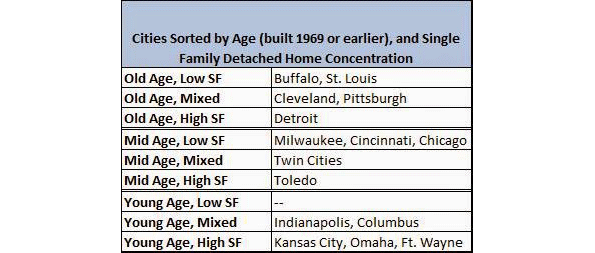
    Here’s another way of looking at this.  I grouped the cities by age and single family home concentration and came up with interesting groupings:

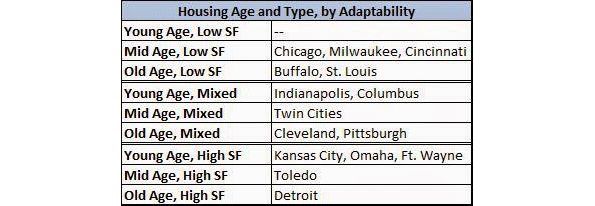
    Here it becomes clearer that Detroit and Toledo stand alone as locations for old or moderately old structures that are largely single family.  Also, Milwaukee’s greater mix of single family and multifamily units begins to set it apart from Detroit and Toledo, even when it has a similar concentration of Levittown-style housing.

    Finally, let’s consider housing adaptability as part of the housing stock analysis.  Chicago, the region’s largest city and lone “global city” member of the group, comfortably rests in the middle of all tables except for the single family detached table, where it shows the lowest concentration of single family homes.  My guess is that Chicago’s continued desirability means more newer housing has been built, and that its lower single family housing numbers mean that other housing types (lofts, condos and the ubiquitous 2-flat and 3-flat) created a more flexible and adaptable housing development landscape.

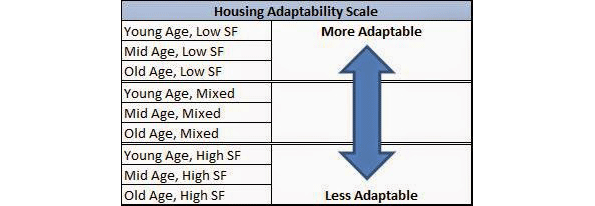
    Assuming that younger structures are more often suitable to renovation for adaptability, moderately old structures require more intense rehabs, and older types are more often subject to demolition and rebuilding, I reorganized the previous table in terms of housing adaptability:

    And if I put in the cities next to this adaptability scale, it’s easy to see the magnitude of Detroit’s housing challenges:

    Detroit is such a unique city in so many ways.  The Motor City needs more research and analysis that highlights its uniqueness and adds to our understanding of the what led to its downfall, and less of our ire and contempt.

    The more I study Detroit, the more I see the seeds of a similar downfall in other cities nationwide.

    This post originally appeared in Corner Side Yard on July 6, 2014.

    Pete Saunders is a Detroit native who has worked as a public and private sector urban planner in the Chicago area for more than twenty years.  He is also the author of “The Corner Side Yard,” an urban planning blog that focuses on the redevelopment and revitalization of Rust Belt cities.

    Lead photo: A scene from the Grixdale neighborhood on Detroit’s northeast side.  Source: Google Earth.

  • Urban Cores, Core Cities and Principal Cities

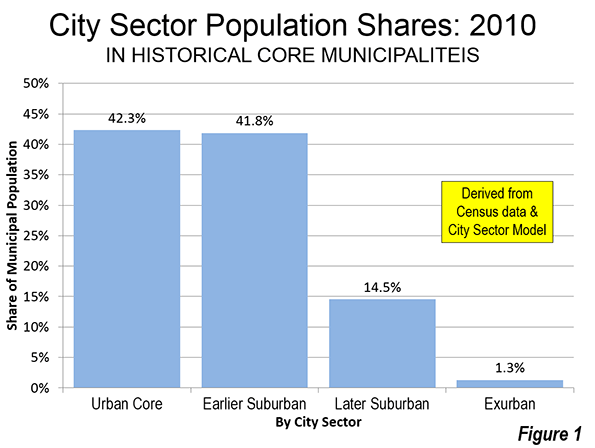
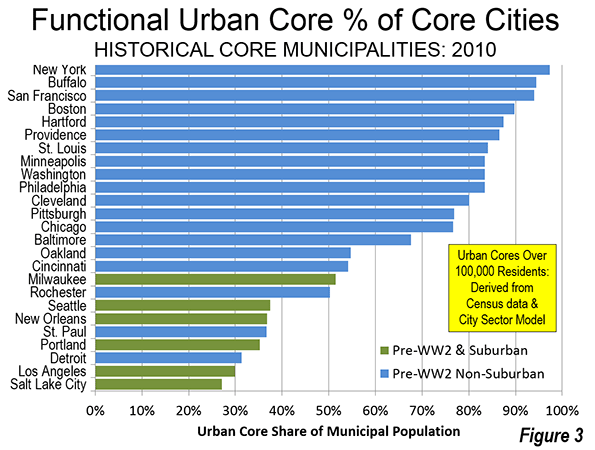
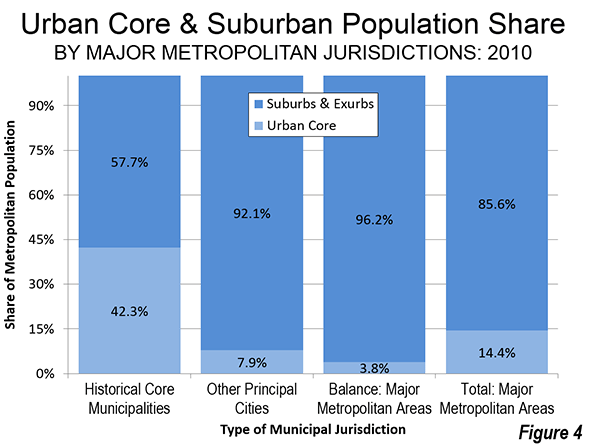
    Many American cities, described commonly as urban cores, are functionally more suburban and exurban, based on urban form, density, and travel behavior characteristics. Data from the 2010 census shows that 42.3 percent of the population of the historical core municipalities was functionally urban core (Figure 1). By comparison, 56.3 of the population lived in functional suburbs and another 1.3 percent in functionally exurban areas (generally outside the urban areas). Urban cores are defined as areas that have high population densities (7,500 or per square mile or 2,900 per square kilometer or more) and high transit, walking and cycling work trip market shares (20 percent or more). Urban cores also include non-exurban sectors with median house construction dates of 1945 or before. All of these areas are defined at the zip code tabulation area (ZCTA) level, rather than by municipal jurisdiction. This is described in further detail in the "City Sector Model" note below.

    The Varieties of Central Cities

    Of course the “urbaneness” of central cities vary greatly. Some, like New York, Boston, Chicago, and San Francisco experienced much of their growth before the 20th century, well before the great automobile oriented suburbanization that occurred after World War II. Others, that experienced early growth, such as Milwaukee and Seattle, annexed substantial areas of suburbanization after World War II, so that their comparatively large functional urban cores have been overwhelmed by suburbs within the city limits. Los Angeles, with a large functional urban core, annexed huge swaths of agricultural land that later became suburban. Finally, a number of other central cities, such as Phoenix and San Jose, have developed since World War II and are virtually all suburban,

    Moreover, central cities comprise very different proportions of their respective metropolitan areas (the functional or economic definition of "city"). For example, the central city of San Antonio comprises 62 percent of the San Antonio metropolitan area population. Conversely, the city of Atlanta comprises only 8 percent of the Atlanta metropolitan area population. Obviously, with such a large differential, the term central city describes jurisdictions that are radically different.

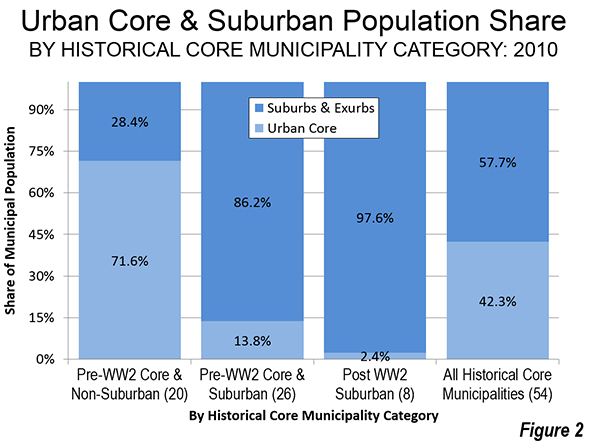
    This difference is caught by examining the functional urban cores by historical core municipality classifications. The Pre-World War II Core & Non-Suburban central cities have functional urban cores comprising 72 percent of their population. The Pre-World War II Core & Suburban central cities have functional urban cores that are only 14 percent of their populations. The Post-World War II Suburban central cities have very small urban cores, representing only 2 percent of their population (Figure 2).

    Among the 54 historical core municipalities, the share of central city population in the functional urban cores varies from a high of more than 97 percent (New York) to virtually zero (Birmingham, Charlotte, Dallas, Jacksonville, Orlando, Phoenix, Raleigh, San Bernardino, San Jose, and Tampa).

    Core Cities with the Strongest Urban Cores

    It is not surprising that the central cities with the largest share of their populations in the functional urban cores are in the older, established are concentrated in the Northeast Corridor (Washington to Boston) and the Midwest. Only one of the 14 central cities with the highest population share in functional urban cores is outside these areas is San Francisco, the first large city to be built on the American West Coast Among the 25 central cities with the highest functional urban core share, only seven are outside the Northeast Corridor or the Midwest (San Francisco, Oakland, Seattle, New Orleans, Portland, Los Angeles and Salt Lake City).

    It is not surprising that the city of New York has the largest function urban core population share, at 97.3 percent. Nearly one-third of the total urban core population in the 52 major metropolitan areas lives in the city of New York (nearly 8,000,000 residents).

    Two other central cities have functional urban core population percentages above 90 percent. Buffalo ranks second, at 94.5 percent. San Francisco is third at 94.0 percent.

    The next three highest ranking cities are in New England. Boston has an 89.7 percent functional urban core population, followed by Hartford (87.4 percent), and Providence (86.5 percent). These are all of the major metropolitan areas in New England.

    Three Midwestern central cities have more than 80 percent of their populations in functional urban cores, including St. Louis (84.1 percent), Minneapolis (83.5 percent), and Cleveland (80.1 percent). Washington (83.4 percent) and Philadelphia (83.4 percent), in the Northeast Corridor also have greater than 80 percent functional urban core shares.

    Pittsburgh (76.9 percent) and Chicago (76.6 percent) have functional urban core population shares between 70 percent and 80 percent. At 67.7 percent, Baltimore (67.7 percent) is the only central city in the Northeast Corridor that with less than 70 percent of its population in the functional urban core.

    Oakland (54.7 percent), at 15th, is the highest ranking central city outside the Northeast Corridor and the Midwest other than San Francisco. Cincinnati, Rochester, and Milwaukee also have more than 50 percent of their population in functional urban cores.

    The top 25 is rounded out by Seattle (37.5 percent), New Orleans (36.8 percent), St. Paul (36.7 percent), Portland (35.2 percent), Detroit (31.3 percent), Los Angeles (29.9 percent) and, somewhat unexpectedly, Salt Lake City (27.1 percent).

    The central cities with the largest functional urban core percentages have overwhelmingly suffered large population losses. Among the 25 with the largest urban core shares, only seven were at their peak populations at the 2010 census, and only two of the top 18 (New York and San Francisco). Overall the cities with large functional cores lost more than 35 percent of their population and 8 million residents.

    "Other" Principal Cities

    Starting in 2003, the Office of Management and Budget (OMB) retired the term "central city" and replaced it with "principal city," which includes the 54 former historical core municipalities and approximately 160 additional cities. The adoption of principal city terminology recognized as OMB described it, that metropolitan areas were no longer monocentric, but had become polycentric. OMB specifically rejected the use of geographical terms other than "principal city" within metropolitan areas, including "suburb." Indeed, the very employment of polycentricity that justified abandonment of the central city designation was the suburbanization of employment. Yet some popular usage (even in some Census Bureau documents), considers any area that is not a principal city as suburban. The more appropriate term would be "not principal city."

    Some principal cities that are not historical core municipalities ("other" principal cities) have strong urban cores, especially in metropolitan areas where the urban core stretches well beyond the core municipality’s city limits, especially in New York and Boston. Four such principal cities have urban cores larger than 100,000 and urban core population shares exceeding 90 percent, including Cambridge in the Boston area (97.0 percent, and the New York area’s Newark (94.7 percent) and Jersey City (100.0 percent), which is higher even than New York City itself. None of these cities was at its population peak in 2010.

    Even so the vast majority of the "other" principal cities are overwhelmingly suburban, comprising less of the functional urban core population than areas that are not principal cities (1.5 million compared to 4.1 million outside the principal cities). Overall, the other principal cities are 7.9 percent urban core (compared to 42.3 percent for the historical core municipalities). If the 11 municipalities with cores larger than 50,000 are excluded, the share living in functional urban cores for the remaining more than 150 cities is 1.5 percent. (Figure 4).

    Crude Measurement

    The perhaps stunning conclusion is that the average difference between the historical core municipality population and the functional urban core population is 73 percent. Core cities — themselves 57 percent suburban and exurban — are a crude basis for classifying urban cores and suburbs. Principal cities — 92 percent functionally suburban or exurban — are even worse. The bottom line: America is fundamentally more suburban in nature than commonly believed.

    —–

    City Sector Model Note: The City Sector Model allows a more representative functional analysis of urban core, suburban and exurban areas, by the use of smaller areas, rather than municipal boundaries. The nearly 9,000 zip code tabulation areas (ZCTA) of major metropolitan areas are categorized by functional characteristics, including urban form, density and travel behavior. There are four functional classifications, the urban core, earlier suburban areas, later suburban areas and exurban areas. The urban cores have higher densities, older housing and substantially greater reliance on transit, similar to the urban cores that preceded the great automobile oriented suburbanization that followed World War II. Exurban areas are beyond the built up urban areas. The suburban areas constitute the balance of the major metropolitan areas. Earlier suburbs include areas with a median house construction date before 1980. Later suburban areas have later median house construction dates.

    —–

    Wendell Cox is principal of Demographia, an international public policy and demographics firm. He is co-author of the "Demographia International Housing Affordability Survey" and author of "Demographia World Urban Areas" and "War on the Dream: How Anti-Sprawl Policy Threatens the Quality of Life." He was appointed to three terms on the Los Angeles County Transportation Commission, where he served with the leading city and county leadership as the only non-elected member. He was appointed to the Amtrak Reform Council to fill the unexpired term of Governor Christine Todd Whitman and has served as a visiting professor at the Conservatoire National des Arts et Metiers, a national university in Paris.

    Photo: Downtown Houston (by author)

  • Agrarianism Without Agriculture?

    The ever-surprising Ralph Nader has recently been reading some paleo-conservative sources, and has written a book entitled Unstoppable; the Emerging Left-Right Alliance to Dismantle the Corporate State. In the Acknowledgements at the end, he specifically thanks Intercollegiate Studies Institute, a conservative think tank, for keeping in print a tome from the 1930s called Who Owns America? A New Declaration of Independence. Nader devotes the seventh chapter of his book to a discussion of this volume. He quotes Edward Shapiro’s 1999 foreword at some length:

    In his 1999 foreword to the reissued edition, historian Edward S. Shapiro called Who Owns America? “one of the most significant conservative books published in the United States during the 1930s” for its “message of demographic, political, and economic decentralization and the widespread ownership of property” in opposition “to the growth of corporate farming, the decay of the small town, and the expansion of centralized political and economic authority.” ……

    In this mix, there was espoused a political economy for grass-roots America that neither Wall Street nor the socialists nor the New Dealers would find acceptable. It came largely out of the agrarian South, casting a baleful eye on both Wall Street and Washington, D. C. To these decentralists, the concentrated power of bigness would produce its plutocratic injustices whether regulated through the centralization of political authority in Washington or left to its own monopolistic and cyclical failures. They were quite aware of both the corporate state fast maturing in both Italy and Nazi Germany and the Marxists in the Soviet Union ……

    Nor did they believe that a federal government with sufficient political authority to modestly tame the plutocracy and what they called “monopoly capitalism” could work, because its struggle would end either in surrender or with the replacing of one set of autocrats with another. As Shapiro wrote in the foreward, “while the plutocrats wanted to shift control over property to themselves, the Marxists wanted to shift this control to government bureaucrats. Liberty would be sacrificed in either case. Only the restoration of the widespread ownership of property, Tate said, could ‘create a decent society in terms of American history.’”

    Although the decentralists were dismissed by their critics as impractical ….. their views have a remarkable contemporary resonance given today’s globalized gigantism, absentee control, and intricate corporate statism, which are undermining both economies and workers. They started with the effects of concentrated corporate power and its decades-long dispossession of farmers and small business. They rejected abstract theories by focusing instead on such intensifying trends as the separation of ownership from control; the real economy of production in contrast to the manipulative paper economy of finance; and the growth of “wage slavery,” farm tenancy, and corporate farming. One can only imagine what they would say today! (Nader, pp. 139-141.)

    I apologize for the long quote. These people advocated doing away with the “joint stock corporation” for the most part, to be replaced by cooperatives. I’m not sure about the liability of members of these cooperatives, but that’s a major issue. Without limited liability, I would hesitate to co-invest in any project unless all the partners were as liquid and wealthy as myself, otherwise guess who ends up holding the bag! And it is to be noted that many insurance companies, and some savings and loans, including, until the 1980s, all federally chartered ones, were in fact “mutual” and owned by their depositors or policy holders.

    They did not succeed as far as agricultural land was concerned. The concentration of agricultural land under fewer and fewer owners, and even more the oligopolies of processing food through such entities as Cargill, Tyson, and Archer Daniels Midland, proceeded apace. But “widely distributed property ownership” resurfaced on another front; the urban-suburban one. The New Deal first chartered the Federal Housing Administration to underwrite and guarantee loans for homes, and in Truman’s time the Veterans Administration and other reforms brought this regime into full flower. So instead of their forty acres and a mule, people got their ¼ acre and an automobile, the only practical way to travel from their ¼ acre to wherever they wanted to go.

    Eventually people came to see their ¼ acre with a house on it as an “investment,” and further, a “source of wealth.” But this was not a truly agrarian source of wealth. Farms depend for their value on the quality of their soil and their productivity as farms. They are truly commercial real estate. But residences depend for their value only to a minor degree on what is on the property itself, but rather on what is around it; and suburbanites demanded that covenants, or the Government in the form of City Hall or County Hall, control their neighbors and what is around them. Part of the reason for living in the suburbs, after all, is the presence of trees and green space. (The suburbanites have therefore been friendly to the environmental cause, as long as it did not touch their automobiles.) There was also the factor that just as printing money dilutes its value, “printing” a large number of houses in an area dilutes their value as well. And, the more development, the more traffic comes to resemble that of the centralized portion of the city and one’s automobile gets stuck in it. Fact: the borough of Irvine, where my office is, imposes a “cap and trade” system on those who would desire to build or repair commercial structures, and what one buys in this marketplace is not carbon or pollution, but potential car trips that one’s project might be potentially using. The suburban model, in the end, demanded that to preserve suburban values, that the building of suburbs be stopped! That’s the irony of the whole thing.

    Howard Ahmanson of Fieldstead and Company, a private management firm, has been interested in these issues for many years.

  • Cleveland, LeBron, and the Evolution of Collective Shame

    “Shame is fear of humiliation at one’s inferior status in the estimation of others.”—Lao Tzu.

    Sitting with fellow Clevelanders at a since-demolished bar, July 7th, 2010, LeBron James, local boy, uttered the words that hurt: “I am taking my talents to South Beach”. It was a shot heard around the world, but felt sharply inside the Rust Belt city’s heart.

    “He had before invoked all the connotations of home, only to leave it,” wrote Cleveland sports columnist Bill Livingston the next day, in a piece entitled “By rejecting his hometown team, LeBron James earns his slot on the [Art] Modell list of shame”. Livingston upbraided LeBron for scheduling a cable event to “exploit this city’s suffering”. His words were intent on shaming LeBron for leaving, yet in doing so reared Cleveland’s collective shame for having again been left.

    Collective shame is an underappreciated subject. But it, like other collective emotions—think fear and pride—run our societies as noted by the great sociologist Emile Durkheim.

    For decades, Cleveland has been held together by a solidarity in loss, especially the collective shame that came with it. Unlike guilt, which is about what one did, shame is an affront on the self, or what one is.
    And what was blue-collar Cleveland without a wealth of blue-collar jobs? It was a city of losses—be it of income, population, and a way of life.

    Walk down many Cleveland streets and you can see how this loss has played out in disinvestment. Often, the effect on the viewer is the same: status was here, but no longer. The constant reminders of loss give shame currency. Cleveland is not alone here. Cities the world over are afflicted with the hangovers of history. From the “Geography of Melancholy” in the American Reader, the author writes:

    Nearly every historic city has its brand of melancholy indelibly associated with it—each variety linked to the scars the city bears. Lisbon has its saudade: a feeling of aimless loss tied to the city’s legacy of vanishing seafarers, explorers shipwrecked in search of Western horizons. Istanbul has huzun: a religiously-tinged brand of melancholy rooted in the city’s nostalgia for its glorious past.

    Instead of seafarers, Cleveland had steelworkers, and others who’ve had their working-class status stripped. Yet while the loss was personal, it was the result of macro forces, leaving many feeling powerless and alone. This aloneness was tied up in the feeling of shared suffering. “The very fact that shame is an isolating experience,” notes the author of “Shame and the Social Bond”, “also means that if one can find ways of sharing and communicating it this communication can bring about particular closeness with other persons.”

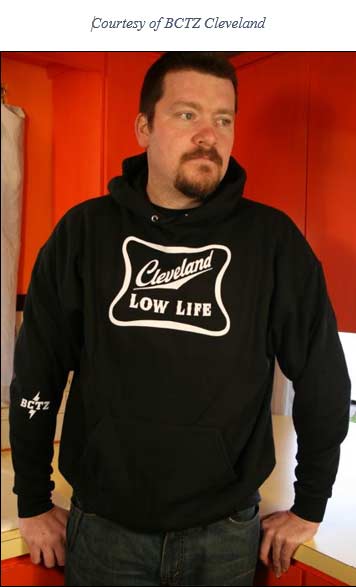
    There are many ways collective emotions are shared. Much of the vessels are informal. Think oral tradition and rumors. Fashion is another channel, like a city’s t-shirts. In fact perhaps nothing says implicit understanding between natives like city mottos emblazoned chest level. Cleveland’s most famous t-shirt said simply: “Cleveland—you’ve got to be tough”. It was made in 1977, in the heyday of the city’s decline. You had to be tough in the face of a post-industrial headwind. Today, iterations remain on this “the world is against us” mentality. “Defend Cleveland” and “Cleveland VS Everybody” t-shirts are worn liberally. Another favorite that tips more toward shame than to a defensiveness against judgment says: “Cleveland Low Life”—a play on “Miller High Life”.

    Is all this productive? No doubt, collective shame, according to scholars, can strengthen the bonds between members of a group which, in turn, can lead to a process of self-exploration and restoration of a social identity. Or it can be chronic. Cleveland is well-known for its self-flagellation. It’s especially obvious to folks who aren’t native Clevelanders.

    “I have, in fact, never lived in a place whose proud residents so consistently and gleefully disrespect their hometown as Cleveland,’ notes legendary Jeopardy champ Arthur Cho in his recent Daily Beast piece “Cleveland Comes Crawling Back to LeBron: The Masochism of Rust Belt Chic”. Cho, a Cleveland newcomer, goes on to write that though he hates to “engage in victim-blaming”, the reason “everyone dogs on Cleveland is that we ask for it”. Why? Cho concludes: “If we weren’t suffering, we wouldn’t be Cleveland anymore.”

    But this Cleveland mindset does little for opening the region up to new ideas. Just as the messages become defensive, so do the policies and politics. Nativist culture reigns. Nepotism and patronage become the grease that runs the status quo. And so the communal shrouding effectively disables the possibility of possibility. Hence, the region’s struggles in its economic restructuring in the era of global connectivity.

    In that sense, Cleveland’s collective shame can be a source of bad policies which ensure the collective shame. But why would a city want to do that, albeit implicitly, subconsciously?

    “Economic struggle can be a cultural unifier in a community that people tacitly want to hold onto in order to preserve civic cohesion,” writes urban theorist Aaron Renn in Governing. Beyond that, those with power can lose it with community change. Continues Renn:

    …[I]t isn’t hard to figure out that even in cities and states with serious problems, many people inside the system are benefiting from the status quo.

    They have political power, an inside track on government contracts, a nice gig at a civic organization or nonprofit, and so on. All of these people, who are disproportionately in the power broker class of most places, potentially stand to lose if economic decline is reversed. That’s not to say they are evil, but they all have an interest to protect.

    Does this mean Cleveland is doomed? Hardly. The region is experiencing a brain gain. It has incredible assets—namely, its educational, hospital, and cultural institutions—that have been dragging it along toward a point of turning the page. But more is needed. Specifically, more perspective—a perspective that the city’s inferiority complex isn’t about what others think of Cleveland, but about what Clevelanders are compelled to think about themselves.

    Which brings us back to LeBron. Soon after his announcement that he was leaving, The Onion wrote a satirical piece called “Despite Repeated Attempts To Tear It Down, Massive LeBron James Mural Keeps Reappearing”. In it, the iconic “We are All Witnesses” banner keeps hauntingly resurfacing. At one point in the piece, city workers removed it panel by panel, “only to find an identical mural hanging directly behind it”. The article ends, “As of press time, nobody outside the Cleveland area had seen the mural once since it was originally taken down…”

    The takeaway, then: When suffering has become your identity, you have clearly suffered long enough.

    Cleveland’s path to progress means letting go of that which has stubbornly remained. There’s hope that the change is coming, largely due to the presence of the new generation. 

    In many ways LeBron is an embodiment of the next generation of Cleveland and the Rust Belt. His return epitomizes possibility. No, I am not talking about championships here, nor the collective Prozac-effects that a parade down E. 9th St. would have on the region’s psyche. Instead it is about perspective.

    The day LeBron announced his decision he was leaving Cleveland, he was in Akron. According to an ESPN piece, he knew the decision would hurt people, and that nothing would ever be the same for him. “Somehow he got through the final day of his annual basketball camp in Akron without confessing,” the authors write. “By the time [former teammate] Damon Jones drove him to the airport, where he would fly to Connecticut and reveal his infamous decision to the world, there was a lump in his throat.”

    LeBron, like all sons and daughters of the Rust Belt, is a product of collective shame, and so his self-battle with leaving is no surprise. But sometimes leaving is the answer. No person should ever self-sacrifice out of a loyalty to place. And sometimes coming home is the next answer. If only because intermittent personal aspiration will often take a backseat to that evolutionary and endearingly human need to belong.

    The secret sauce, here, is the perspective gained in the journey. And then bringing it back to a community that could use more than its fair share.

    Richey Piiparinen is a Clevelander, writer, and Senior Research Associate heading the Center for Population Dynamics at Cleveland State University.

    Lead photo courtesy of Michael Lapidakis.

  • Don’t be so Dense About Housing

    Southern California faces a crisis of confidence. A region that once imagined itself as a new model of urbanity – what the early 20th century minister and writer Dana Bartlett called “the better city” – is increasingly being told that, to succeed, it must abandon its old model and become something more akin to dense Eastern cities, or to Portland or San Francisco.

    This has touched off a “density craze,” in which developers and regulators work overtime to create a future dramatically different from the region’s past. This kind of social engineering appeals to many pundits, planners and developers, but may scare the dickens out of many residents. They may also be concerned that the political class, rather than investing in improving our neighborhoods, seems determined to use our dollars to subsidize densification and support vanity projects, like a new Downtown Los Angeles football stadium. At same time, policymakers seek to all but ban suburban building, a misguided and extraordinarily costly extension of their climate-change agenda.

    This effort works against the region’s basic DNA. Our Downtown, for all its promotion, is not a dominant business or cultural center. It accounts for barely 1/10th the share of regional employment that Manhattan – at more than 20 percent – provides for its region and less than one-sixth the share of regional jobs accounted for by San Francisco, less than one-third that of much-maligned, spread-out Houston.

    Some people contend that, by investing heavily in mass transit, we can re-engineer our region towards a more-19th century model, which Los Angeles, as a 20th century city, never had. Some, like economics and political blogger Matt Yglesias, suggest Los Angeles’ $8 billion-plus investment in rail is making it the “the next great transit city.”

    Well, after 30 years of relentless spending on subways and light rail, the share of transit commuters in the region (comprising Los Angeles and Orange counties, the Inland Empire and Ventura County) is about where it was in 1980 – roughly 5 percent – compared with greater New York’s 27 percent or Chicago’s 11 percent.

    Village people

    Transit has limited effect in Southern California because this region functions best as a network of “villages,” some more urban than others, connected primarily by freeways and an enviable arterial street system. Inside our villages, we can find the human scale and comfort that can be so elusive in a megacity. This arrangement allows many Southern Californians to live in a quiet neighborhood that also is within one of the world’s most diverse – and important – cities.

    These villages span all the vast diversity of Southern California. Some areas, like Downtown Los Angeles, increasingly appeal to young professionals who seek a version of dense urban living. They share a universe with cohorts found in many older cities: young hipsters, a small sample of empty nesters and a sizable population of homeless who live on the edges of the gentrification zone.

    But Downtown hardly provides a template for the rest of the region. Mostly we live in lower-density villages, many of which – in the San Gabriel Valley, East Los Angeles, Santa Ana, Westminster and L.A.’s Leimart Park, for example – reflect largely ethnic cultures with deeply established roots.

    Even newer areas, like Irvine – which still ranks among America’s fastest-growing cities – are now majority Asian and Latino. Irvine’s appeal is largely the much- dissed suburban virtues of clean streets, good parks and excellent schools.

    Some areas are almost insanely eclectic. My neighborhood in the San Fernando Valley – sometimes referred to as Valley Village or Valley Glen – includes many people in the film and television business, but is increasingly dominated by Orthodox Jews, Armenians and Israelis. In summer, barely clad acting folk pass Orthodox haredim dressed in impossibly warm black suits and hats.

    Walk one direction from my house, and you run into Armenian businesses, including alavash bakery and several kabob restaurants. Walk the other direction, and you enter akashrut world, with signs in both English and Hebrew; you even can get panhandled by an odd Jewish beggar, something you encounter in Israel and parts of Brooklyn but not too often in California.

    Outdoor living

    What holds these neighborhoods together is a desire for a particular quality of life, usually associated with the single-family home. These, along with modestly sized garden apartments, long have been the primary choice of Southern Californians. Such housing facilitates enjoying this region’s arguably greatest asset: its weather. Residents value a place for backyard barbecues, swimming pools, small soccer pitches for the kids and an element of seclusion.

    Unable to afford the pricier L.A. or O.C. neighborhoods, many Southern Californians, to the consternation of the urban planners and some developers, head for a newer village on the regional periphery. Indeed, more than 99 percent of the region’s growth has taken place far from central L.A. For every yuppie who moves Downtown, or into now-fashionable closer-in neighborhoods, a hundred or more move out to Rancho Cucamonga, Valencia, Mission Viejo or scores of other outlying communities.

    This article first appeared in the Orange County Register.

    Joel Kotkin is executive editor of NewGeography.com and Distinguished Presidential Fellow in Urban Futures at Chapman University, and a member of the editorial board of the Orange County Register. He is author of The City: A Global History and The Next Hundred Million: America in 2050. His most recent study, The Rise of Postfamilialism, has been widely discussed and distributed internationally. He lives in Los Angeles, CA.

  • Germany Also Having Big Problems Building Infrastructure

    Der Spiegel had an interesting article recently called “Angry Germans: Big Projects Face Growing Resistance.” The article (linked version is English) talks about how it is increasingly difficult to get infrastructure projects built in Germany.

    Wherever ambitious construction ventures loom on the horizon in Germany — from the cities to the countryside, from the coastlines in the north to the Black Forest in the south — opponents are taking to the streets…. As the public’s enthusiasm for constant innovation has lessened, so has the appeal of these sorts of projects, and, as a result, they now inevitably come accompanied by picketers. Germany’s graying society, it seems, is so cozy and settled that it resists anything threatening to upset the status quo. In the process, it has lost sight of the bigger picture.

    There are a lot of key points in this article that immediately raised parallels to the United States, where infrastructure projects are also under increasing siege. In fact, some of this reminded me of elements of the Tea Party movement. The protestors are uninterested in compromise. They are devoted, full time activists who are unrelentingly opposed to the projects in question:

    [Hartmut] Binner’s form of protest has a radical undercurrent: Well-informed, confrontational and devoid of respect for authority, he is typical of the new grassroots activism spreading across Germany.
    ….
    Binner’s entire life revolves around the campaign. He monitors the routes of departing and landing planes. He plays his self-designed noise simulator on market squares. He kicks off his court appearances by singing the Bavarian national anthem. “If you want to be heard as a member of the public, you need to push the envelope,” he shrugs.

    These days, he sees grassroots protests, activism and political responsibility from a different perspective. “The typical protesters are gray-haired, know-it-alls and very networked,” [Freiburg Mayor Dieter Salomon] says. “But they’re not remotely interested in consensus-building, political processes and pluralism.”

    Grassroots groups have become so livid, intransigent and single-minded that even the most respected politician in the country, Angela Merkel, is feeling their sting. In early May, hundreds of furious residents had gathered in central Ingolstadt to protest against the construction of a power line from Bad Lauchstädt in Sachsen-Anhalt to Meitingen in Bavaria.

    This certainly reminds me of the no-compromises view of the Tea Party. Also, a number of early American Tea Party activists were unemployed, and thus able to basically be full time activists. Even the singing of national anthem has echoes of the Tea Party and their tricorn hats. I don’t want to claim there’s a philosophical or other link between the Tea Partiers and Germany, however.

    Not everything lines up with the Tea Party, however. In Germany it seems to be disproportionately retirees who are the most engaged and militant:

    Germany’s graying society, it seems, is so cozy and settled that it resists anything threatening to upset the status quo. In the process, it has lost sight of the bigger picture.

    Many of the protestors are pensioners with no vested interest in Germany’s future. “It’s striking that the leader of the protests against the Munich runway is a 75-year-old and not someone in the middle of his working life,” [Munich Airport CEO Michael Kerkloh] points out.

    Salomon’s nemesis is Gerlinde Schrempp, a determined and argumentative 67-year-old retired teacher with attitude to spare. She’s the leader of the Freiburg Lebenswert movement, which translates roughly to “make Freiburg worth living in. The movement just got elected on to the district council and is first and foremost opposed to any new building in the city.

    There’s a stereotype out there of the average Republican voter as an old white guy. But the average Tea Party activist I’ve seen tends to be working age. I look at this one a bit differently. We need to see these types of controversies against the substrate of an aging population. Aging populations are not noted for dynamism, and older people’s self-interest is better served by starving investment for the future in order to save money and avoid uncomfortable change in the present. As a country whose population is projected to decline into the future thanks to this demographic inversion, we are seeing in Germany what’s likely a preview of coming attractions elsewhere around the world.

    Indeed, I’m reminded of what one analyst friend of mine in Indiana has said about the property tax caps there. He sees the push to cap property taxes as driven by an aging population in a stagnant state. Old people generally aren’t earning a lot of taxable income nor are they buying huge amounts of stuff, so they are disproportionately less affected by income and sales tax hikes, whereas they often own homes and are hit hard by property taxes. Thus property tax caps serve as another income transfer mechanism from young to old, holding revenue constant. They are in part an artifact of an aging society. Disinvestment in infrastructure can be seen in the same light.

    But there’s another part of this that shines a light on yet another group of opponents, namely the intelligentsia.

    The term “Wutbürger” (“enraged citizen”) was coined during the Stuttgart 21 fiasco to describe people like Hartmut Binner, and much has been written about them since. They often aren’t the “common man.” According to the Göttingen Institute for Democracy Studies, they tend to be highly educated people with steady incomes and white collar jobs. And while protests movements of the past were often steered by sociologists, today their leaders are more likely to stem from the technical professions, the researchers found.

    When we look at opposition to infrastructure in the United States, at least certain types of infrastructure, we see a similar profile of people (though not necessarily technical) behind it. It’s the leftist intelligentsia that oppose the Keystone Pipeline, suburban highway projects, fracking, and many other types of things, often with a militant unwillingness to compromise similar to the Tea Party.

    As with Germany, this opposition is enabled by environmental reviews and public participation laws that, while they serve important public purposes, make it easy to delay projects for years through repeated objections and scorched earth litigation. Traditionally environmental lawsuits were associated with the left, but conservatives have started saying, why not us too? Hence litigation against San Francisco’s regional plan. The Hollywood densification plan was recently overturned by lawsuits, and lawsuits have plagued California’s proposed high speed rail line as well.

    Whatever the project, it’s sure that somebody on the left and/or the right hates it, and thus will do everything in their power to kill it, which probably means years of delays and untold millions in increased costs.

    Also as with the United States, German governments have shot themselves in the foot with a series of financial debacles:

    Political and bureaucratic bodies are partly to blame for their own diminished authority. Every major venture seems to entail spiraling costs. Berlin’s new airport was supposed to cost €1.7 billion, a price tag that has shot up to well over €5 billion. Meanwhile, the €187 million earmarked for the Elbphilharmonie concert hall under construction in Hamburg is expected to exceed €865 million by the time the project is completed. Albig is well aware how bad this looks. “People see us as financially incompetent,” he says.

    Until politicians can convince the public they have a handle on this, the taxpayer will remain rightly skeptical of many major megaprojects. This is doubly true since it’s very clear, as has been documented by folks like Oxford professor Bent Flyvbjerg, that in many of these cases the politicians were simply lying all along about the real costs.

    I’m not sure what all the takeaways are, but there are clearly many forces operating on a global basis to inhibit the development of infrastructure in the West.

    Aaron M. Renn is an independent writer on urban affairs and the founder of Telestrian, a data analysis and mapping tool. He writes at The Urbanophile, where this piece originally appeared.

    MittlererSchlossgartenKundgebung 2010-10-01” by MussklprozzOwn work. Licensed under CC BY-SA 3.0 via Wikimedia Commons.

  • To Fight Inequality, Blue States Need To Shift Focus To Blue-Collar Jobs

    In the coming election, we will hear much, particularly from progressives, about inequality, poverty and racism. We already can see this in the pages of mainstream media, with increased calls for reparations for African-Americans, legalizing undocumented immigrants and a higher minimum wage.

    There’s no question that minorities’ economic wellbeing has deteriorated since the economy cratered in 2007. African-America youth unemployment is now twice that of whites, while the black middle class, once rapidly expanding, has essentially lost the gains made over the past 30 years,  says the Urban League.

    Conservatives may not have the answers but it’s clear that a progressive regime has not worked either.

    The net worth of blacks and Hispanics has declined relative to whites. The black poverty rate stood at 27.2% in 2012, and for Hispanics, 25.6%. At the same time as poor kids are flocking here from Central America, child poverty among Latinos has risen sharply, from 27.5% in 2007 to 33.7% percent in 2012.

    One would think these statistics would make someone question at least somewhat boilerplate progressive polices, which certainly have not worked better than standard brand conservatism. But often the common answer to these trends has been a call for more “progressive” social policies that would seek to redistribute wealth and to enforce racial equity in everything from housing to university admission. Given Republican control of the House, these racial and class politics are increasingly most keenly felt in the states and cities.

    There are numerous signs of this, including Seattle’s $15 an hour minimum wage and similar proposals in other cities. The thrust of New York Mayor Bill De Blasio’s administration seems to be to provide ever more succor to the city’s large, heavily minority, poor and working-class population through early childhood education and more subsidized housing.

    As an old Democrat, I am sympathetic to the concerns. But it’s dubious the deep blue cities have found a solution. Let’s start with the gap between rich and poor. For the most part the regions and states with the widest gap between the classes are overwhelmingly dominated by modern progressivism.

    The capital of blue America, New York City, has easily the worst levels of inequality in the country, with an income distribution that approaches that of South Africa under apartheid, notes demographer Wendell Cox.

    But New York is hardly the only progressive stronghold  with searing inequality. A recent Brookings report  found that of the regions with the greatest income disparity only one, Atlanta, is located in a red-leaning state. These include San Francisco, Miami, Boston, Washington, D.C., New York, Oakland, Chicago and Los Angeles. The lowest degree of inequality was found generally historically more conservative cities like Ft. Worth, Texas; Oklahoma City; Raleigh, N.C.; and Mesa, Ariz. Income inequality has risen most rapidly in the probably the most left-leaning big American city of luxury progressivism, San Francisco, where the wages of the poorest 20% of all households have actually declined amid the dot-com billions.

     Since most of the urban poor are minorities, these disparities are also reflected in racial terms. Among the nation’s 15 largest metropolitan statistical areas, according to an analysis by Praxis Strategy Group’s Mark Schill, the biggest gap between black and white incomes as of 2012 was also in San Francisco, where African-Americans made 49% of whites’ income. Chicago, Detroit and Philadelphia are a shade behind at 50% to 51%.

    In contrast, African-Americans score better in comparison with whites in less expensive, more suburban areas. In Riverside, Calif., black incomes are over 81% of whites, highest among the nation’s 15 largest metro areas; in the Phoenix region, black income is 73% of whites; in Houston, 65%. This is not a case of Democratic rule being the problem; the real issue is what kind of  Democrat. In cities like Phoenix, Riverside and Houston, Democratic mayors are usually very pro-business, and rarely engage in the kind of rhetoric one hears in places like New York or Seattle.

    A somewhat similar pattern can be seen among Latinos. The worst disparities – 50% to 54% of white income – are in greater Boston, Philadelphia and New York. Again, the lowest disparity was in Riverside, where Hispanic incomes were 84% of whites, followed at 81% by Miami – a city that is neither cheap nor sprawling, but has a population of generally more prosperous Cuban-Americans. In third place is Phoenix, at 73%, a city, that ironically, has been castigated as a capital of anti-Latino sentiment.

    Part of the difference is the strong growth of higher-paid, blue-collar jobs in places like Houston, Oklahoma City, Salt Lake and Dallas compared to rapidly de-industrializing locales such as New York, San Francisco, Chicago and Los Angeles. Even Richard Florida the guru of the “creative class,” has admitted that the strongest growth in mid-income jobs has been concentrated in red-state metros such as Salt Lake City, Houston, Dallas, Austin and Nashville. Some of this reflects a history of later industrialization but other policies — often mandated by the state — encourage mid-income growth, for example, by not imposing high energy prices with subsidies for renewables, or restricting housing growth in the periphery. Cities like Houston may seem blue in many ways but follow local policies largely indistinguishable from mainsteam Republicans elsewhere.

    Nowhere is this relationship between job growth and racial disparities clearer than in California, where regulations have slowed construction and industrial growth even as Silicon Valley has enjoyed a giddy boom. In Silicon Valley, Hispanic and African-American incomes have sagged, as manufacturing and many middle management positions have been reduced. But the real problems for poorer and minority residents can be seen in the state’s interior regions, where many communities still suffer close to double digit unemployment or worse.

    Part of the problem also lies with costs, particularly for housing. Simply put most working Americans, and most minorities, cannot earn enough to maintain a decent quality of life in most of America’s biggest cities. This is particularly true of big, diverse blue cities like New York and Los Angeles, where the average paycheck, adjusted for cost, ranks worst among the major metropolitan regions.

    High housing prices, notes economist Jed Kolko, are a key reason why even with a boom, population growth remains slow in the Bay Area. In contrast, Houston, which also is booming, has seen rapid population growth and in-migration. Since 2000, Houston’s population has grown 30%, three times as rapid as the Bay Area.

    One boomtown epitomizes opportunity while in the other growth has largely benefited the well-educated and well-placed. Between 2000 and 2012 income growth in Houston has been 53% while in San Francisco — despite the tech boom — it has been 35%.

    Minorities and, particularly, immigrants have been drawn to these sprawling, growing regions as the best places to improve their life. Over the past decade, the foreign-born populations of Houston and Dallas expanded roughly 50%; Atlanta saw nearly 70% growth. In contrast, immigration growth in New York, Chicago and San Francisco was under 20%.

    Immigrants are coming to these areas, in many cases, in order to buy a house. In Houston, according an analysis by demographer Wendell Cox, 52% of African Americans and 42% of Hispanics own their own homes. In Los Angeles, this percentage is in the 30s, and in New York and Boston, minority ownership is even smaller. The Atlantic may say the Sun Belt is where the “American dream goes to die” but an examination of the statistics suggests, these critics may need their compasses readjusted.

    Much the same can be said about progressive policies. Unlike some on the party-line right, I do not think that concerns about inequality and stunted upward mobility are fabrications by left-wing academics.

    The question is how to address the issue. We should consider that last time African-Americans made big strides in income were when the economy was booming under Presidents Reagan and Clinton, both of whom have been criticized for “trickle down” policies. They have done far worse under the present more conventionally progressive region.

    If they are honest, it’s time for progressives to deal with these trends with some sense of realism; you don’t have to be a conservative to favor good blue-collar growth. All too often progressive mouthpieces like the New Republic, while admitting black inequality is at the highest level in decades, emphasize such symbolic (and political unlikely) steps, as reparations and and expansion of means-tested subsidies that would help minorities and poor but leave out the middle class, and mostly white, majority.

    Such approaches will do little effectively, except to make some progressives feel even more self-righteous. But real progress on race and poverty requires a growing economy that provides opportunities for the broadest part of population. Clearly the regulatory and tax regimes that stunt middle- and working-class opportunities does not help. Blue-state progressive can whine about race, inequality and poverty with the best of them, but they would contribute far more if they started to address these issues with something other than well-rehearsed indignation and rhetoric.

    This story originally appeared at Forbes.

    Joel Kotkin is executive editor of NewGeography.com and Distinguished Presidential Fellow in Urban Futures at Chapman University, and a member of the editorial board of the Orange County Register. He is author of The City: A Global History and The Next Hundred Million: America in 2050. His most recent study, The Rise of Postfamilialism, has been widely discussed and distributed internationally. He lives in Los Angeles, CA.

    Unemployed woman photo by BigStockPhoto.com.