Blog

  • The New Extraterrestrial Geography

    This month marks forty-five years since men first left planet earth and set foot on another world. The last man to walk on the moon did so in December, 1972, over four decades ago. It’s a good moment to ponder what we haven’t done since.

    There were six successful landings on the moon, and, almost literally, they barely scratched the surface of that body. The later astronauts had “golf carts” that allowed them to travel short distances, but only a fraction of a percent of the Africa-sized area was directly investigated by humans. To say, as some do, that we shouldn’t go back, and should instead go on to Mars, would be like saying that, having touched shore in a half dozen places in the Americas, we should have then ignored those continents and gone on to Asia.

    It’s a misnomer, of course, to call this a new “geography.” That word is derived from the Greek “ge,” for earth. We probably should use something like ‘selenography’ for the moon, ‘venerography’ for Venus, and for Mars, either ‘areography,’ or my preferred fanciful ‘barsoomography’ (with a nod to Edgar Rice Burroughs). Each of these “ographies” are vastly different from each other and from earth.

    There’s a lot of interesting real estate out there, and all we’ve done so far is to briefly poke around on our own moon a few times, only to abandon the effort after a few years.

    We stopped because we have never, as a nation, made it a serious goal to open up the new lands of the solar system. Apollo wasn’t about exploration or science. It was a soft battle in a cold war; a demonstration of our technological prowess versus that of a brutal adversary. In order to win, we set up a state-socialist enterprise to rival that of our opponent, except our enterprise was democratic, whereas theirs was totalitarian. We had aerospace contractors; they had design bureaus.

    We won even before Apollo 11, with the circumlunar mission of Apollo 8 the previous year, about the same time that the Soviets started to pretend they’d never been racing. The human space program devolved into one of national pride and white-collar welfare in the states and districts of those on the Hill who funded it.

    Had it been our intent to develop and settle these new worlds, we would have gone about it very differently. For instance, we might not have acquiesced to the Outer Space Treaty in 1967. The partial goal there was to end the space race by putting the entire solar system beyond the reach of claims of national sovereignty. This is one reason why the US didn’t claim the moon when we landed. Instead, we came “in peace for all mankind”.

    This had the effect of rendering extraterrestrial private property claims themselves as somewhat problematic, even though it didn’t go as far as the Soviets wanted. Private enterprise in space was permitted. Otherwise, the communications and remote-sensing satellite industries might have been stillborn.

    If we had followed the tradition of free-enterprise America, we wouldn’t have rushed to the moon with an expensive giant rocket. Rather, we would have more methodically developed affordable space transportation, and created a competitive industry to continually drive down costs, as has occurred in other fields of transportation. We’d have developed the infrastructure in space, such as assembly facilities and propellant storage depots — the equivalent of gas stations on the Interstate — that would allow full reusability of vehicles to and from various locations.

    We are only now starting to do so, in the face of strong resistance from Congress, primarily because small, private industry doesn’t allow sufficient opportunities for graft in the way that large, sole-source NASA contracts do. Congress currently seems determined to repeat Apollo, with its giant rocket and capsule, and its missions costing billions per flight. As a result, it is likely to continue to keep us trapped in low earth orbit for the next few decades.

    Fortunately, the government is no longer the only source for the funding of human spaceflight. Several billionaires have expressed interest, including Elon Musk of SpaceX, Jeff Bezos of Amazon, Las Vegas hotelier Bob Bigelow, Microsoft co-founders Paul Allen and Charles Simonyi, and others. Musk has repeatedly stated that the ultimate purpose of his space company is to colonize Mars – he believes it’s important that we become a multi-planet species. He has already disrupted the expensive dinosaurs of the space industry with his low-cost rockets, which will become even lower cost if he succeeds, as seems likely, in developing the ability to reuse them rather than to throw them away.

    Bezos has also declared his interest, ultimately, in space colonization, whether as an insurance policy against having all of humanity’s eggs in a single basket, or perhaps to allow new social experiments like the one our own founders created in their own New World almost two hundred and forty years ago. And Peter Diamandis, author of the book Abundance and co-founder of Planetary Resources, an asteroid-mining venture, notes that the vast majority of resources available to humanity lie not on this tiny planet, but in the rest of the solar system, and ultimately the galaxy and universe beyond.

    These entrepreneurs and visionaries hold these beliefs, despite the obstacles. Planets in our solar system have a wide variety of different atmospheres, including (as with our moon) essentially none. None of them are presently breathable by humans, and won’t become so absent massive terraforming and/or radical genetic engineering (which at some point begs the question of the meaning of the word “human”).

    As for Mars, its atmosphere is far too thin to breathe, even if there were oxygen in it (it’s mostly carbon dioxide). But there is water there, and plants in greenhouses could manufacture oxygen from the atmosphere, using sunlight dimmed by its distance from our star. Rocket fuel could be produced, as well, to make access to and from the planet easier. It is full of iron and other minerals, unfortunately including the very toxic hexavalent chromium.

    Those who are simultaneously competing and conspiring to open up the solar system, with all of its new lands, are doing so not just for a handful of government civil servants, but potentially for thousands or millions of private adventurers and explorers, in a way that government cannot, and likely will not, absent a sudden burst of vision rarely seen in politicians. But with or without the government, the new lands look increasingly likely to be privately explored, settled, developed, and even created, opening up vast new wealth to humanity, and perhaps giving us the first trillionaire.

    Many today lament that they didn’t live in the excitement of the sixties, when “we” went to the moon. But the coming decades of the new “solography” promise to be vastly more exciting — not just vicariously, as Apollo was, but with the participation of the new pioneers.

    Rand Simberg has had many years of experience in aerospace engineering and project management at the Aerospace Corporation and Rockwell International Corporation in Los Angeles, and has been recognized as an expert in space transportation by the Office of Technology Assessment. He is author of the new book, Safe Is Not An Option, on how our risk aversion holds us back in human spaceflight. He blogs at Transterrestrial Musings.

    SpaceX Dragon Cargo Transfer at the SpaceX facility in McGregor, Texas. NASA Administrator Charles Bolden, left, and SpaceX CEO and Chief Designer Elon Musk, view the historic Dragon capsule that returned to Earth following the first successful mission by a private company to carry supplies to the International Space Station. Photo: NASA/Bill Ingalls.

  • Showing the Flag: The Transit Policy Failure

    David King has a point. In an article entitled "Why Public Transit Is Not Living Up to Its Social Contract: Too many agencies favor suburban commuters over inner-city riders," King, an assistant professor of urban planning in the Graduate School of Architecture, Planning and Preservation at Columbia University notes that transit spends an inordinate share of its resources on suburban riders, short changing the core city riders who cost transit agencies far less to serve and are also far more numerous. He rightly attributes this to reliance on regional (metropolitan area) funding initiatives. Many in transit think it is necessary to run near empty buses in the suburbs to justify the use of transit taxes to suburban voters (what I would refer to as "showing the transit flag")

    King asks: "So does public transit serve its social obligations?" He answers: "Increasingly the answer is no." King is rightly concerned about the disproportionate growth in spending on commuter rail lines that carry transit’s most affluent riders from deep in the suburbs to downtown. Transit policy has long been skewed in favor of the more affluent suburban dwellers in the United States.

    My Experience in Los Angeles

    I saw this first-hand as a member of the Los Angeles County Transportation Commission (LACTC). When we placed what was to become the first regional transit tax on the ballot (Proposition A in 1980), the shortage of transit service was critical in the highest demand, largely low-income areas of Los Angeles such as Los Angeles and East Los Angeles. I described the situation in a presentation to the annual conference of the American Public Transportation Association: "Often waiting passengers are passed at bus stops by full buses" Approximately 40 percent of the local bus services between the Santa Monica Mountains, Inglewood, Compton, Montebello and Santa Monica reached peak loads of 70 passengers, well above seating capacity

    At the same time, suburban area buses were usually less than half-full. In connection with this concern, I produced a policy paper, Distribution of Public Transit Subsidies in Los Angeles County, which was published in by the Transportation Research Board. The abstract follows: 

    "Public transit today is faced with the challenge of serving its clientele while subsidies are failing to keep pace with increasing operating costs. In Los Angeles County, there are service distribution inequalities–overcrowding and unmet demand in some areas and, at the same time, surplus capacity in other areas. To use subsidy resources efficiently requires that the effects of present subsidy allocation practices be understood–that is, how subsidies are translated into consumed service, both by type of service and by geographic sector within the urban area. An attempt is made to provide a preliminary understanding of that distribution in Los Angeles County. It is postulated that significantly more passengers are carried per dollar of subsidy in the central Los Angeles area than in other areas and local services require a lower subsidy per passenger than do express services. A number of policy issues are raised, the most important being the very purpose of public transit subsidies."

    Generally, transit operating subsidies per passenger were far higher in the suburbs than in the central area (where incomes are the lowest, and poverty rates the highest), and subsidies were much higher for commuter express services than for local bus services.

    I attempted to address this problem by proposing a "Mobility Policy" that would have reallocated service based on customer needs, giving precedence to areas where mobility was restricted due to limited automobile availability and lower incomes. Some colleagues whose constituents were disadvantaged by this inequity objected,  feeling compelled, it appeared, to rally about the “transit flag”

    On a Siding: Transit Policy in Recent Decades

    Since that time, Los Angeles and other major metropolitan areas have built expensive rail and busway systems. Despite the promises of attracting people out of their cars (routinely invoked during election campaigns for higher taxes), the reality is that single occupant commuting has risen from 64 percent in  1980 to 76 percent in 2012. Over the same period, transit’s share of urban travel has fallen, though stabilized in recent years at very low levels in most metropolitan areas. Indeed, when New York, Chicago, Philadelphia, Washington, Boston, and San Francisco are excluded (with their "transit legacy cities"), the 46 major metropolitan areas have a transit commute share of just three percent. Overall, more people work at home than commute by transit in 38 of these metropolitan areas and more people walk or cycle to work in 27, according to American Community Survey 2012 data.

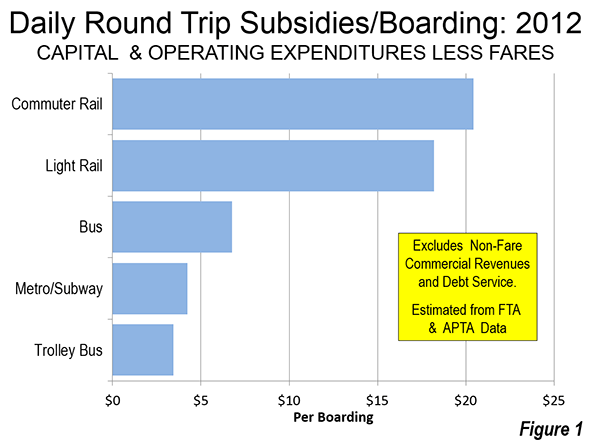
    Yet the politically driven inequality in transit spending continues. Transit subsidies continue to be far higher for services that are patronized by more affluent riders. For example, subsidies (operating and capital expenditures minus fares) are three times as high for the commuter rail services, with their higher income riders, than for buses, with their lower income riders (Figure).

    The difference can be stark, as an example from the New York area indicates. A Fairfield County, Connecticut commuter rail rider with the median family income of $102,000 would be subsidized to the extent of $4,500 per year (assuming the national subsidy figure). By comparison a worker from the Bronx or Hudson County, New Jersey, with a poverty level family income of $18,500 per year (or less) would be subsidized only $1,500 per year. In fact, the bus subsidy would likely be even lower, because transit in lower income areas is much better patronized and thus less costly for the public. My Los Angeles research found inner city services to be subsidized approximately half below the average of all bus services (Note).

    Where Transit Works

    The functional urban cores contain the nation’s largest downtowns (central business districts). Their population densities are nearly five times that of the older suburbs and nine times that of the newer suburbs. The functional urban cores have transit market shares six times that of the older suburbs and 15 times that of the newer suburbs. Yet, it is in these poorer, denser areas where overcrowding is most acute and the need for more service is most acute. In Los Angeles, for example, the greatest potential for increasing transit ridership is where ridership is already highest.

    The vast majority of suburban drivers are not plausible candidates for transit, simply because it cannot compete well with automobiles, except, for example, for some trips to the downtowns of the six transit legacy cities (which account only one of seven jobs in their respective metropolitan areas).

    Where transit makes sense, people ride. Where it doesn’t, they don’t. Allocating resources inconsistent with this reality impairs the mobility of lower income residents, wastes resources and relegates transit to an inferior role in the city. Charging the affluent fares well below the cost of service compromises opportunities to serve more people in the community.

    Better allocation of transit resources would likely improve core area unemployment rates by increasing the number of jobs that can be accessed by lower income workers. Further, because the better used services would require lower subsidies, there would be funding available for additional service expansions.

    The principal fault is not that of transit management. It’s the politics.

    —–

    Note: These data (expenditures per boarding) are estimated from Federal Transit Administration and American Public Transportation Association data for 2012. Commercial revenues other than fares are excluded (the most important such source is advertising). Debt service is also excluded because it is not reported in the annual reports of either organization. The subsidy ratios between lower income and more affluent riders would be changed by including transfers (though the subsidies would still be considerably higher for the more affluent). Some low income riders use more than one bus or rail vehicle for their trip, while some commuter rail riders transfer to bus or rail services at one or both ends of their trips. No readily available data is available to make such an adjustment. The New York area example assumes 225 round trips per year.

    —–

    Wendell Cox is principal of Demographia, an international public policy and demographics firm. He is co-author of the “Demographia International Housing Affordability Survey” and author of “Demographia World Urban Areas” and “War on the Dream: How Anti-Sprawl Policy Threatens the Quality of Life.” He was appointed to three terms on the Los Angeles County Transportation Commission, where he served with the leading city and county leadership as the only non-elected member. He was appointed to the Amtrak Reform Council to fill the unexpired term of Governor Christine Todd Whitman and has served as a visiting professor at the Conservatoire National des Arts et Metiers, a national university in Paris.

    Photo: Bart A car Oakland Coliseum Station

  • Long Island Needs Regionalism

    Eric Alexander, the Executive Director of Vision Long Island, seems to be popping up everywhere on Long Island these days. He was recently quoted in The Corridor Magazine’s transportation and infrastructure issue as saying: “Academic conversations about regionalism is a 90s thing.” Similar to his condemnation on “academic” commentary concerning the downtown redevelopment trend, Alexander made it clear in the piece that he feels a local, downtown-centric approach is the way to go.

    Whether we like it or not, Long Island is a singular region.

    If Long Island’s developmental future is divided and segmented municipality-by-municipality, we, as a collective whole, will fail. The Village of Rockville Centre, one of Long Island’s much-touted “cool” downtown areas, shares the same aquifer system as Rocky Point. If a company abandons their corporate headquarters in Lake Success, residents in Suffolk feel the economic blow. Despite claims to the contrary by special interests and stakeholders, we are one Island. Our social, economic and environmental policies must reflect that fact.

    It is in the interest of builders, developers and stakeholders for Long Island’s developmental future to remain both segmented and divided under the guise of “localism”. Divide, and conquer, as the saying goes. When projects are looked at a regional level, they are more heavily scrutinized, and their impacts are more thoroughly explored.

    Here is a scenario:  A small village on Long Island is welcoming the economic windfall a particular development is slated to bring, while five miles north to the village, an unincorporated area fears their shops will wither thanks to the influx of shops proposed.  The Village does as they please, approving the development.  Now, the businesses in the unincorporated area lay stagnant thanks to the over-saturation of retail usage that the new development brought to the area.

    It’s Urban Planning 101: You don’t build what you don’t need. Much of the debate concerning Heartland, whose future lays with the Town of Islip, is that its impacts will resonate far beyond Islip.

    That’s the trouble with localism – it only benefits the locality, and often at the cost of other areas. Unfortunately for Mr. Alexander, some of Long Island’s issues are too big for the “locals know best” model he advocates for. Our fragile aquifer system transcends all geo-political borders, with poor land use decisions in one town impacting water quality in the next.

    Our Island is small enough for economic development policies to resonate far beyond the Village or Town level. While the Town of Babylon IDA and Town of Islip IDA squabble over wooing a manufacturing business, a lucky county in North Caroline will reap the rewards when they eventually steal them away from Long Island.  It’s one thing for a village to build more housing options, but successfully raising a new multifamily development isn’t the same thing as quantifying and addressing our marked regional need for different types of housing.

    Is it too “academic” to quantify our problems before taking the steps of addressing them? Is a protected aquifer system which supplies our region’s drinking water outdated like Zach Morris’ blocky cellphone or the Macarena?

    Localism at its worst puts immediate needs first, and Long Islanders as a collective second. Part of the challenge we face as a region is the segmented and fractured governmental systems that prevent us from significantly making any progress. The biggest public works and sweeping acts of environmental preservation in this region’s history were executed thanks to a solid foundation of regional thought. The Long Island Parkway System, LIRR and LIE weren’t built on the local scale. The preservation of 100,000 acres of Pine Barrens forest needed state legislation that trumped local zoning to be adequately protected. Suffolk County’s open space, water protection and farmland preservation programs weren’t locally-sourced, homegrown policies, but rather models emulated nationally thanks to their breadth and regional scale. 

    Regionalism at its worst is characterized by monolithic bureaucrats making decisions without any local input. This is why a balance must be struck between both approaches that blend our local sensibilities with a comprehensive regional approach. The commonalities between Long Island’s various towns, villages and even counties warrant regionalism with a local twist. Our common aquifer is the largest common tie, while our surface bodies of water constrain our physical space. Economically, Long Islanders in both counties work and commute to the Island’s employment centers, which are concentrated in a few distinct locations, while all municipalities share neighborhoods that span the socio-economic spectrum. Given the common traits, a regional approach undertaken by municipalities, helmed by non-biased professional planners would serve both the local and regional good. For too long, Long Island’s development future has been staked out by stakeholders and policymakers with something to gain by swaying in one direction or another.

    The best community planning efforts stem from public input, assessment of public needs and ample participation by the people who live and work in the area. The best environmental planning efforts use data and scientific study to advance the goals selected. A regional approach takes the best of both these approaches, and balances the needs of a region in a comprehensive manner. A local approach works under certain circumstances. When a neighborhood needs a community center, or seeks to improve their quality of life, the approach to development should be local. However, if the locality proposes development whose impacts resonate far beyond their municipal borders, a regional approach must be taken.

    There is a reason why conversations concerning Long Island’s future must be academic Mr. Alexander. We all feel the impacts of poor development choices. Sound regional planning isn’t something to dismiss as a “90s thing”, but rather, should be embraced for the betterment of Long Island’s future.  

    Richard Murdocco writes regularly on land use, planning and development issues for various publications. He has his BA in both Political Science and Urban Studies from Fordham University, and his MA in Public Policy from Stony Brook University, and studied planning under Dr. Lee Koppelman, Long Island’s veteran planner. You can follow Murdocco on Twitter @TheFoggiestIdea, Like The Foggiest Idea on Facebook, and read his collection of work on urban planning at TheFoggiestIdea.org.

    Long Island illustration by Wiki commons user Duffman.

  • America Down But Not Out

    America, seen either from here or from abroad, doesn’t look so good these days. The country that maintained world peace for decades now “leads by behind,” or not at all. You don’t have to have nostalgia for George W. Bush’s foreign policy to wish for someone in the White House who at least belongs in the same room with the likes of Vladimir Putin. Some wags now suggest that President Barack Obama has exceeded Jimmy Carter in foreign policy incompetence – Carter certainly was more effective in the Middle East.

    What about space? Remember, we won the space race but now have to depend on Russian launch vehicles to do much of anything in orbit. President Obama thought we could rely on the Russians to provide us with cheap rides into orbit, but Putin squashed that notion after we objected to his actions in Ukraine. John Kennedy must be turning over in his grave.

    And as for our domestic economy, the best you can say is “It could be worse,” particularly if you look at what’s happening in torpid Europe. It’s a sign of our utter lack of confidence that the current administration, and much of the punditry, still thinks we should follow the Continent’s economic and social policies.

    Yet, despite all these challenges – and two presidencies the public ranks among the worst in history – it’s far too early to write off the United States. After all, no one else is doing very well. Even the widely touted BRICS countries – Brazil, Russia, India, China and South Africa – face slowing growth and mounting social problems.

    There are several factors that help explain why the USA’s long-term prospects are better than many Americans may assume.

    Entrepreneurial edge

    The essential strength of the U.S. economy has rested on having two things that rarely occur together – an innovative culture combined with massive natural resources. Whole industries, notably technology, years ago thought to be lost to Japanese and other Asian competitors, have recentralized in the United States. In 1990, six of the world’s top 10 semiconductor companies were Japanese; by 2011, five U.S. chip companies dominated the top 10, which included only two Japanese companies, Toshiba and Renesas. And their combined revenue in 2012 was less than half that of world leader Intel’s $49.7 billion.

    As of now, there’s not a key technology sector where the U.S. is not in the lead. We dominate social media, software and biotechnology. In fact, about the biggest technical threat we face is from the administration’s bizarre desire to surrender control of the Internet to foreign countries, many of whom, the president may acknowledge, do not share our values or relish our current predominance. Over time, to be sure, there will be challengers, notably China, South Korea and India, but none are likely to gain predominance in the near future. The same can be said in media; Hollywood still reigns supreme and U.S. dominance in fashion, lifestyle and music remains mostly in place.

    The advantage of size

    Other important countries are geographically large, but none – apart from Australia or Canada – is particularly rich. Russia is an oil plutocracy but beyond energy and weapons doesn’t export much else. China has a large land mass, but less resources, and its ability to feed itself will be increasingly constrained by pollution and diminishing water supplies. The country, by some estimates, has lost 28,000 rivers.

    In contrast, America has a huge agricultural base, spread across a vast continent. If California goes dry for a spell, for instance, there’s lots of water and fertile soil in the northern Plains, the Southeast, the Midwest and parts of the Northwest. Size is a form of arbitrage that allows production to move from one place to another. Others are investing heavily in farm land and other real estate, evidence not of American decline, but, instead, of the patterns of investment that led to the country’s great expansion in the 19th century.

    The energy revolution

    The United States could be on the cusp of another period of broad-based industrial expansion, spurred, in part, by its rapidly growing natural gas and oil production. The current energy and industrial boom, notes Joe Kaeser, president of the German multinational conglomerate Siemens, “is a once-in-a-lifetime moment.” Cheap and abundant natural gas is luring investment from manufacturers in Europe and Asia, who now must depend on often-insecure and more expensive sources of energy.

    The energy revolution has helped spark an industrial boom. There is already a shortfall, notes a recent Boston Consulting Group study, of some 100,000 skilled manufacturing positions in the U.S. By 2020, according to BCG and the government’s Bureau of Labor Statistics, the nation could face a shortfall of around 875,000 machinists, welders, industrial-machinery operators and other highly skilled manufacturing professionals.

    New capitalist revolution needed

    America’s capacity for perpetual renewal – what one Japanese scholar Fuji Kamiya calledsokojikara, a latent power to overcome seemingly insurmountable obstacles – persists but is limited by our political leadership in both parties as well as misguided economic policies. We need to alter contemporary capitalism’s tendency to favor and encourage transactions among investors and asset inflation, rather than fostering broad-based growth that rewards people adequately for their labor.

    Fortunately, the capitalist system, particularly one under democratic control, allows for the possibility of reform, as occurred in 19th century Britain and early 20th century America. What is needed now is structural reform that can shift priorities away from rent-seeking and towards true wealth creation.

    One clear priority is to reduce “financialization” of the economy. Over the past three decades, financial-services firms have doubled their share of the economy. The Obama recovery, with its bailouts of large banks and free-money policies for investors, has accelerated this trend, as companies have tended to be slow to reinvest profits in new products and innovations, preferring, instead, to engage in mergers or stock buybacks that raise share prices and reward investors, but do little for the overall economy.

    In contrast, financial institutions often regard productive industries – notably manufacturing – as hampering short-term financial gains. This has repeatedly pushed companies to strip their industrial assets, typically moving them overseas.

    Reforming capitalism toward a broader and more inclusive focus may not appeal to some – Wall Street investors, speculators in high-end real estate and tech oligarchs – who have done just fine the past five years. But, when asked what mattered more to them, most Americans preferred economic growth to redistribution, noted a 2014 studyconducted by the Global Strategy group, a Democratic consulting firm.

    Polls of popular opinion in the United States and the United Kingdom find key ecological concerns, such as climate change, well down the list, behind such issues as the economy, immigration, crime, unemployment and even the state of morality. What Americans want most, notes political commentator Mike Barone, is “an economic boom.”

    Such a broad-based economic boom is necessary if we are to restore America’s promise for this generation and, more importantly, the next. The country still has all the requisite advantages to lead in the next century and restore the middle class – if only the political leaders either rise to the occasion, or get thrown out.

    This article first appeared in the Orange County Register.

    Joel Kotkin is executive editor of NewGeography.com and Distinguished Presidential Fellow in Urban Futures at Chapman University, and a member of the editorial board of the Orange County Register. He is author of The City: A Global History and The Next Hundred Million: America in 2050. His most recent study, The Rise of Postfamilialism, has been widely discussed and distributed internationally. He lives in Los Angeles, CA.

    USA map image by BigStockPhoto.

  • A Tale of 273 Cities

    It was the best of times, it was the worst of times; it was the age of wisdom, it was the age of foolishness; it was the epoch of belief, it was the epoch of incredulity; it was the season of light, it was the season of darkness; it was the spring of hope, it was the winter of despair. 

    Charles Dickens, A Tale of Two Cities

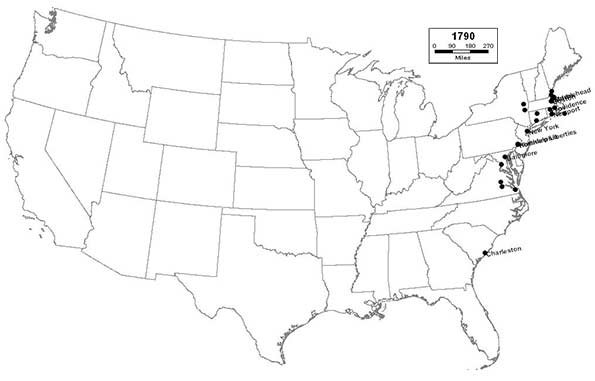
    Since 1790, 273 cities have made an appearance on the list of the nation’s 100 largest places.

    Cities of all shapes and sizes have made the list at one time or another – ranging from New York, which has held the top spot in every single census from the very beginning; to little Chillicothe, Ohio, which appeared once in 1830, at #87, and never made the list again.

    Examining this list decade-by-decade is instructive, for it largely tracks the entire history of the nation’s settlement patterns – from the initial cultural hearths of Yankee New England and Tidewater Virginia; through the river and canal era; the railroad era; the industrial era; the interstate highway and suburban era; to the decline of the Rust Belt, and the triumph (for the time being) of the Sunbelt – and beyond.

    The list tells the story of the relative decline of many cities – places like Providence (1790-1980); Dayton (1830-1990); and Des Moines (1880-2000), which were ranked in the top 100 for decades, have shrunk to one degree or another, and eventually fell off the list, but remain significant-sized urban centers today.

    It also tells the story of the absolute decline of many cities – places like St. Louis, Detroit, Buffalo, Pittsburgh, and Cleveland – formerly huge cities that all once ranked in the top 10, which have now lost over half of their population.  All five of these cities remain in the top 100, but they are all suffering from the seemingly intractable problems that come with massive abandonment and disinvestment – fiscal instability, poverty, inequality, and a frayed civic and social fabric.  Here in 2014, their collective future, especially in their current form, is increasingly uncertain.

    And that – looking toward the future – is why this topic is truly important. Examining this information is about far more than a trivial jaunt down memory lane.  What does it tell us about the future of our cities?

    For one, there is this question: Does any of this even matter?

    Is the size of our central cities even important? Aren’t city boundaries arbitrary and meaningless?  Isn’t it the surrounding metropolitan region that really counts?

    Well, it’s a complicated story.  For years, pundits, prognosticators, and policy wonks have been telling us that the age of the central city is over; that it is the region that is important.  Economies are based on regional job markets, they say, and improvements in transportation and communications are making local places (even large ones) increasingly irrelevant.

    The fact that economies are regional is true – as far as it goes.  But like anything viewed through one lens only, it does not tell the whole story.

    Are regions important? Of course. But so are places.  Like so many other things in the realm of urban public policy, this is not a binary, either/or, choice.

    Indeed, at the same time that we are being told by one set of pundits about the irrelevance of our cities, we have another set of pundits telling us that this is, in fact, a new golden age for our cities.

    Cities entered a long cyclical downturn following World War II, they tell us, but they are now on the rebound, and are experiencing an unparalleled renaissance. Property values are increasing, Millennials are moving to our downtowns, and previously declining neighborhoods are coming back to life, replete with upscale shops, bistros, and pubs. 

    But this doesn’t tell the whole story, either. For every gentrifying formerly shrinking city like New York, Washington, and San Francisco, and for every sprawling boom town like San Jose, Charlotte, or Columbus; there is a St. Louis, a Cleveland, and a Detroit; and there is a Gary, a Flint, and a Youngstown.

    What does the future hold for these cities?  What about the giant places full of the mind-boggling, post-apocalyptic decay and dysfunction that comes with literally losing one million residents, like Detroit?  

    And what about the mid-sized places, like Flint, that may not have the assets or the resources to ever turn the corner.  Will they continue to die a slow, agonizing death, and literally disappear?  Or will they continue on in a shadow-form, serving as a cautionary tale, and inhabiting some type of uniquely American, urban equivalent of purgatory?  

    Or can they be restored – if not, perhaps, to their former glory, to at least something that is stable, equitable, and workable for those that remain?

    This post is full of more questions than answers.  It is an inherently complicated topic.

    Big Questions for the Rust Belt

    While it is true that cities have grown and declined (and sometimes grown again) throughout American history, it is also true that we have never before experienced the unprecedented population decline that some of our largest cities have experienced over the past 60 years, especially those in the Rust Belt.

    Rust Belt cities have experienced the triple whammy of structural economic decline (the outsourcing of manufacturing); continued regional outmigration (to the Sunbelt); and continued suburbanization (in a region with a strong tradition of local government and a deep antipathy toward consolidation).  All three of these things make the shrinkage of its cities unique, from a historic standpoint.

    When a large city loses over half of its population, whether that equates to one million people (Detroit); 500,000 people (Cleveland); or 100,000 people (Youngstown), there are very real consequences for the very real residents that remain.  Even if these particular cities were experiencing widespread regional prosperity and economic growth (they are not), it would not fundamentally change the social and economic reality for city residents living with the consequences of widespread abandonment in these places.

    Regardless of what some advocates of regionalism might say, city boundaries are not arbitrary and meaningless.  Although some may claim that shrinking cities are no big deal as long as the metropolitan region overall is growing, central cities will continue to profoundly matter, especially to the people (often disproportionately poor) that remain.

    Municipal boundaries are not irrelevant, whatever the regionalists may tell you.  Economies may be regional, but in most of the nation’s fastest declining cities, government is not.  Municipal boundaries affect taxation, land use policy, public safety, education, public infrastructure, and the delivery of social services. 

    When a city’s population declines precipitously, the proportional demand for the public services that it provides shrinks less than its population, with the end result that its residents end up paying more in taxes, for less in services.  Even if this were not the case, it is expensive and (politically speaking) exceedingly difficult to scale-back and shrink long-term capital investments in public infrastructure – as “shrinking cities” like Detroit and Youngstown have discovered.  

    What goes on within a given city’s actual municipal boundaries has incredibly important ramifications for its tax base; its employment base; the performance of its schools; the distribution of everyday amenities like grocery stores, shops, and restaurants; the delivery of public services; and less tangible, but equally important things like its sense of place and its sense of itself.  As cities are abandoned, decline, and become hollowed out, access to social and economic opportunities diminishes along with the population:  the jobs disappear, the doctor’s offices disappear, the grocery stores disappear – relocated, often, to a distant and increasingly inaccessible locale.  To pretend as though the economic and social well being of city residents is not directly impacted by population decline is to turn a blind eye to reality itself.

    But it is not just city residents that are affected by decline.  The health of the entire region suffers as a result.  The shrinking tax and resource base of City “A”, is not simply counteracted by economic growth in nearby cities “B” and “C”.  In a region anchored by a declining central city surrounded by dozens of separate municipalities, the redundant duplication and proliferation of local government services (education, public safety, public utilities, transportation infrastructure, social services) ends up costing all taxpayers more. 

    The worst-case scenario is a shrinking central city and a shrinking region with an overall population decline, coupled with continued central city abandonment and continued outward expansion.  In a region like this, there is not only more costly “stuff” (redundant public services and physical infrastructure) than there needs to be, but there is more “stuff” with ever fewer taxpayers to pay for it.

    And while the conventional wisdom may be that regional, not local, economies are what matter, it is important to understand that regions comprised of dozens of separate local jurisdictions do not typically behave very effectively as “regions”.  It is not impossible for them to do so, but it is exceedingly difficult. 

    So why don’t we just go ahead and combine everything?  Problem solved, right?

    Not so fast. 

    It has always been interesting to me that the Sunbelt is the region of the country that tends to have the fewest number of local governments, the most liberal annexation laws, and is home to most of the cities that have undergone major city/county consolidations (such as Jacksonville, Nashville, Augusta, Lexington, and Louisville). 

    This wasn’t always the case.  Philadelphia consolidated with its neighboring suburbs (some of the largest cities in the country at the time) in 1854, and New York City did the same thing (merging with Brooklyn – then the nation’s 4th largest city, and the other three boroughs) in 1898.

    From a public policy standpoint, most of the South and the West is typically regarded as “conservative”; while much of the Northeast and Midwest is viewed as “liberal”.  In this stereotypical telling of the tale, conservatives are supposed to belaissez-faire in terms of urban planning and public policy and are supposed to reflexively favor the local over the regional.

    Yet it is precisely in the “conservative” South and West where the people have been most willing to change the model of government and public service delivery to align with modern social and economic realities.  Effective government and accountability is still viewed as extremely important, but voters have recognized the benefits of having less duplication and more efficient delivery of services, as well as the regional cohesion and political power that annexation and consolidation can bring with them.

    Urban development patterns and public policy decisions on infrastructure are often different in the Sunbelt as well – especially in the West.  New development tends to be denser and more compact than it does in the Rust Belt.  Not many people know that “car crazy” Los Angeles is actually the most densely populated urban area in the United States, or that “sprawling” Las Vegas ranks 10th.  The Los Angeles “suburb” of Santa Ana is twice as densely populated as the “city”of Cleveland.

    Some of this has to do with the fact that scarce water supplies don’t allow for scattershot suburban development, and some of it has to do with an increasingly urban ethos that has evolved, especially in California, over the past 50 years.  Cities and urban residents are not viewed with the same degree of mistrust, suspicion, and disdain that they are viewed with in the Rust Belt.

    So, the Sunbelt is usually posited as an economic success story, especially in comparison with the Rust Belt.

    But the questions remain:  Was it due to less duplication of local government?  Was it in spite of it?  Or did it have nothing to do with it one way or the other?

    No one really knows for sure.

    There is little doubt in my mind that some of the reason for the growth and economic prosperity of Sunbelt cities, and for the corresponding decline of Rust Belt cities, is the failure of most Rust Belt cities to adjust their local government paradigms to reflect modern economic realities. 

    One only need contrast Cleveland with Columbus, or Detroit with Indianapolis to at least get a general sense of the divergent paths that several pairs of Rust Belt cities have taken, and to make some general comparisons between their regional economic outcomes.

    But, these comparisons are not “apples to apples”, either, and it is extremely problematic to claim that the key to Columbus’ economic success (in comparison with, say, Cleveland) has solely been due to its aggressive annexation of nearby communities.

    But, with Columbus sitting as the 15th largest city in the U.S. today, and continuing to attract new residents, and with Cleveland dropping from 5th to 45th, and continuing to lose population, it is probably fair to say that it had something to do with it.

    If Rust Belt cities had annexed or consolidated with surrounding communities earlier, they would be larger and more cohesive today, and it is probably fair to say that they would have more political clout at the state and national level.  They also could have been better positioned to shape how their surrounding regions grew – into something denser, more compact, more cohesive, and less duplicative of public services and infrastructure.

    Could have, would have, should have. That horse has largely left the barn.

    Today, it is a fair question to wonder how effective (never mind politically feasible) it would actually be to retroactively superimpose the Sunbelt model upon Rust Belt cities.  Making Buffalo look and function like Charlotte, on paper, would be very different from making it look or function like Charlotte, in reality. 

    In most Rust Belt cities today, the fact of the matter is that the incoherent and incohesive development patterns have already occurred, the infrastructure has already been duplicated, and the social and economic mismatches and inequities already exist. 

    These problems need to be addressed, but clumsily imposing a model that has appeared to work throughout much of the Sunbelt, without taking the time to understand how it would work here, might not be the answer for our region.  It might just be trying to force a very ineffective square peg into a very politically infeasible round hole.

    So, what will the future hold for our cities?  How can we knit them and their surrounding regions together to create an effective, politically feasible, governing framework that works for all of our residents, rich and poor, black and white, urban and suburban? 

    I don’t know, but I know that it has to do with starting small, working on fundamentals, building trust, inspiring hope, and building authentic relationships between real people. 

    It is the urban policy question of the 21st Century in the Rust Belt, and it is something that urban advocates, political leaders, policy wonks, and everyday citizens will need to grapple with for the rest of my lifetime.

    Now, for the Maps…

    The maps below tell the story of how the 100 largest U.S. cities have changed decade-by-decade since the first census in 1790. Please note that only cities over 2,500 are included, so several of the maps from the earliest census years show less than 100 cities.  The 10 largest cities in each census year are labeled.  

    Due to the scale of these maps, Alaska and Hawaii are not shown (Honolulu and Anchorage both rank in the top 100 today).

    Below each map you will find a short description of some of the historic, demographic, economic, and transportation trends that were in play at the time of each census. I have also included a breakdown of how many cities in each region of the country ranked in the top 100.

    For more detailed information on the 100 largest cities, census-by-census, please click here

    1790 – Northeast (18); Midwest (0); South (6); West (0)

    In the immediate aftermath of the American Revolution, all of the the largest cities are concentrated along the eastern seaboard.  At the time of the first census, New York City ranked as the nation’s largest – a title that it will go on to hold for the next 220 years; and likely – in perpetuity.  Philadelphia, Boston, Charleston, and Baltimore round out the top five.
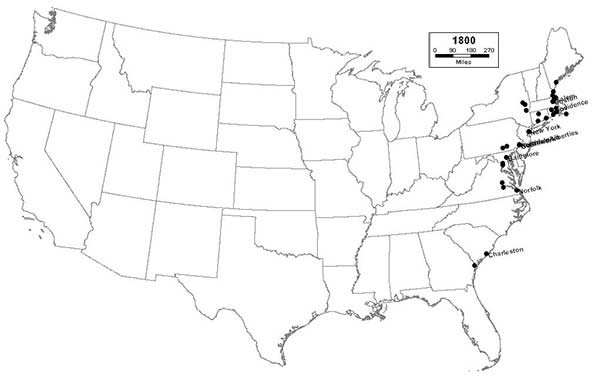
    1800 – Northeast (24); Midwest (0); South (9); West (0)

    As the 19th Century dawns, the largest cities continue to be clustered along the eastern seaboard as the brand-new nation begins to expand slowly inland. The nation’s new capital, Washington, D.C., joins the list, ranking 31st.  
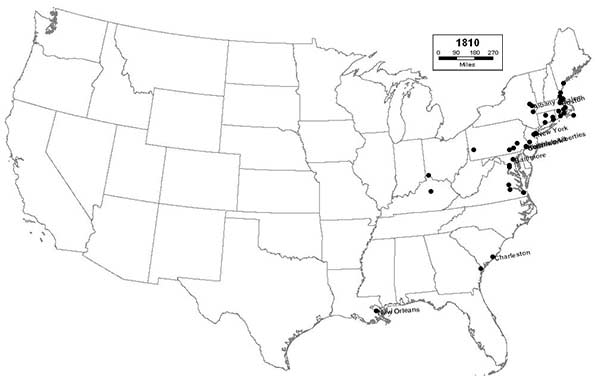
    1810 – Northeast (34); Midwest (1); South (11); West (0)

    This census marks the beginning of the era of ascendance for the great inland river cities, such as New Orleans, Pittsburgh, and Cincinnati.  These cities will serve as key centers of trade and commerce as the interior frontier of the new nation begins to be settled.
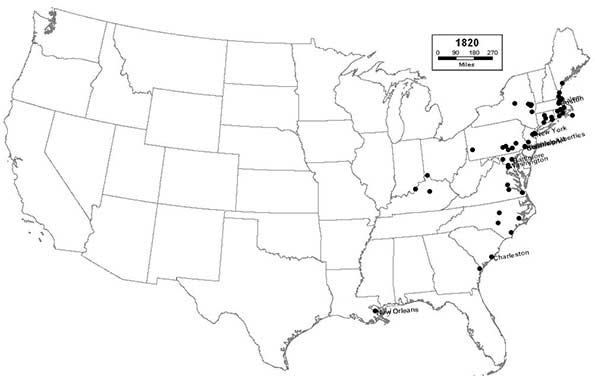
    1820 – Northeast (43); Midwest (1); South (17); West (0)

    The inland river cities, like Louisville, continue to grow and expand.  The importance of waterways increases further as the canal era dawns, literally putting places like Utica on the map.
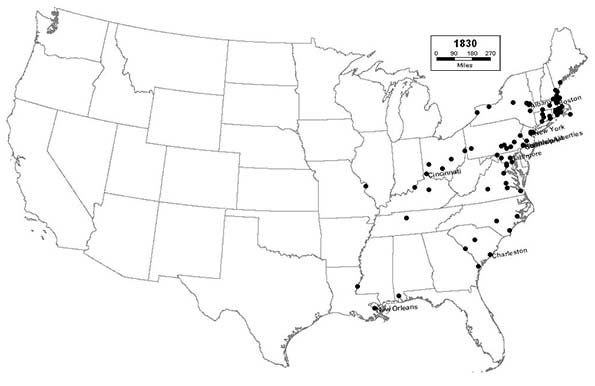
    1830 – Northeast (59); Midwest (6); South (25); West (0)

    Places throughout the industrial northeast, especially in New England, now firmly dominate the list of the nation’s largest cities. The canals throughout New York, Pennsylvania, and Ohio begin to spur new settlement and industry in places like Buffalo, Rochester, and other smaller cities immediately west and east of the Appalachians. The river cities continue to grow rapidly, as Cincinnati enters the top 10, and St. Louis joins the list.
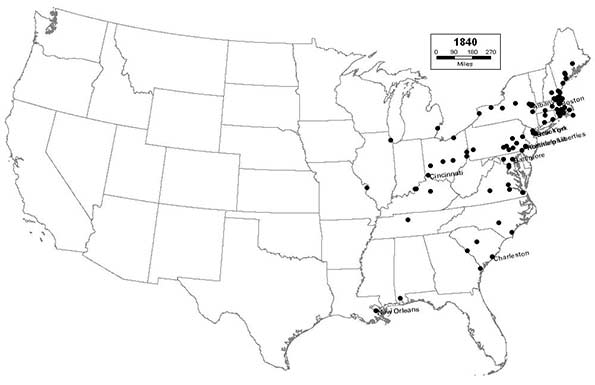
    1840 – Northeast (67); Midwest (10); South (23); West (0)

    The Great Lakes region begins to develop, thanks to the canals, as Detroit, Cleveland, and Chicago join the list. This region will begin to serve as a staging area for the people and goods needed to develop the areas west of the Mississippi.  The Northeast, bolstered by new immigrants from Ireland, remains the urban heart of the nation. 
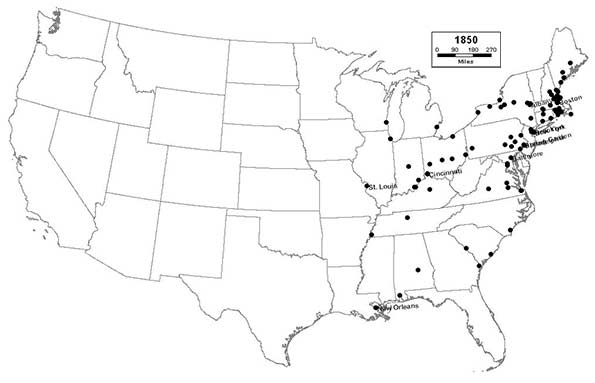
    1850 – Northeast (64); Midwest (12); South (24); West (0)

    The canal system reaches its mature peak, as strategic locations on the Great Lakes and inland rivers and canals, such as Milwaukee, Memphis, and Syracuse flourish. St. Louis enters the top 10.  The relative importance of the eastern seaboard begins to diminish, especially in the South, as the Ohio and Mississippi rivers begin to rival it in importance. Charleston drops out of the top 10 for the first time since 1790.
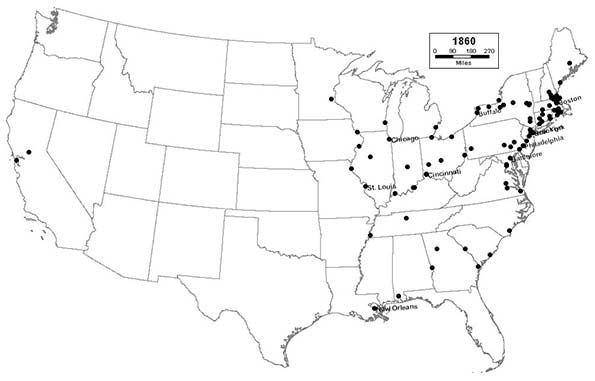
    1860 – Northeast (60); Midwest (17); South (21); West (2)

    As the Civil War dawns, railroads begin to surpass the canals in importance, as new cities like San Francisco, St. Paul, and Atlanta join the list.  The nation’s largest cities will become increasingly dependent upon the railroads for the next 100 years.  For the first time, Midwestern cities begin to rival eastern seaboard cities in importance, as Chicago enters the top 10, joining Cincinnati and St. Louis.  But the Northeast remains the nation’s urban powerhouse, as Philadelphia consolidates with its neighboring suburban towns to become the nation’s second largest city and New York’s closest, but still distant, rival. 
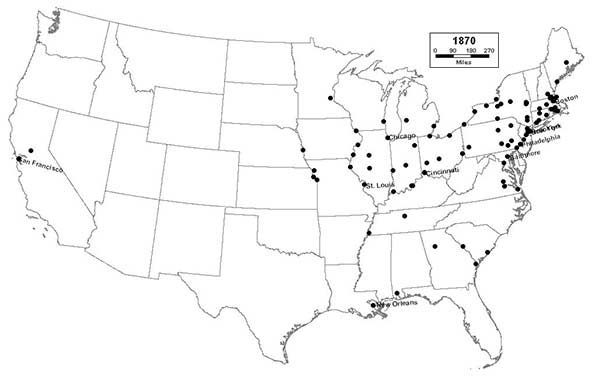
    1870 – Northeast (54); Midwest (26); South (18); West (2)

    New Midwestern cities like Kansas City, St. Joseph, and Omaha flourish as important gateway railroad terminals from which the Great Plains and the remainder of the West will eventually be settled. The South begins a long period of urban and economic decline following its defeat in the Civil War. The cities of the West Coast begin a period of rapid settlement, as San Francisco enters the top 10.
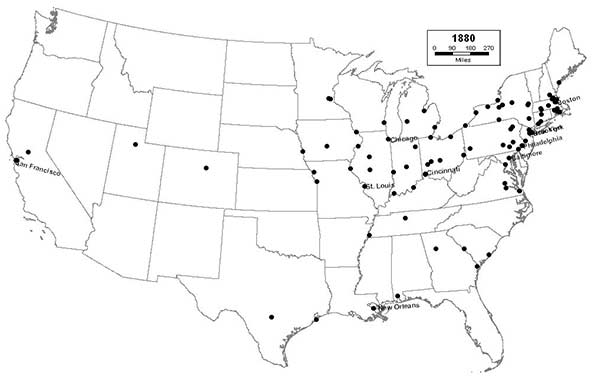
    1880 – Northeast (48); Midwest (27); South (20); West (5)

    Westward settlement spreads rapidly via railroad across the Great Plains, the West, and Texas, as new cities like Minneapolis, Des Moines, Denver, Salt Lake City, and San Antonio join the list.
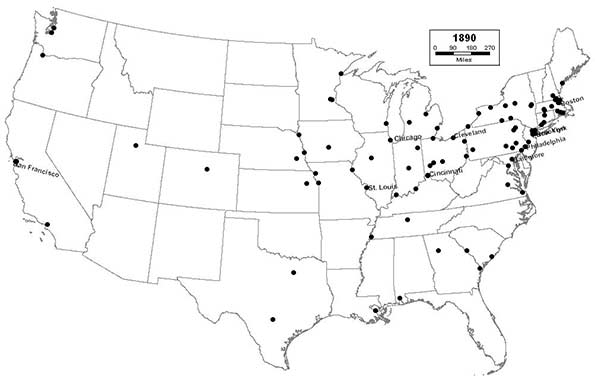
    1890 – Northeast (45); Midwest (29); South (18); West (8)

    The nation’s manufacturing heartland and industrial base begins to shift from New England to the Great Lakes, as Youngstown join the list, Cleveland enters the top 10, and Chicago surpasses Philadelphia as the nation’s second largest city. The West Coast begins to grow rapidly, as Los Angeles, Seattle, and Portland all join the list, along with Dallas; setting the stage for the eventual domination of the nation’s urban landscape by California and Texas.
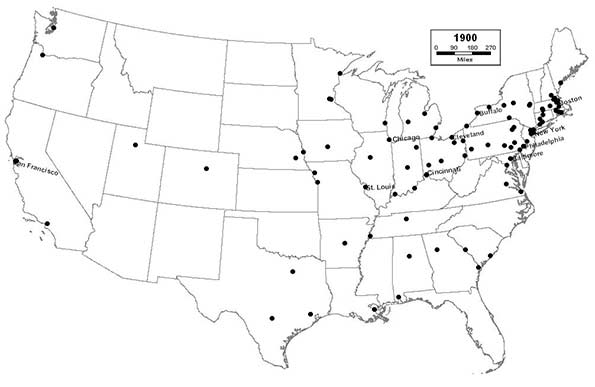
    1900 – Northeast (46); Midwest (26); South (21); West (7)

    As the 20th Century dawns, after nearly four decades of economic decline, the South turns the corner and begins its economic recovery as new industrial cities like Birmingham and Houston join the list.  Mid-sized cities in the Great Lakes region, like Akron, begin to grow rapidly, as a new wave of immigrants from southern and eastern Europe settles throughout this rapidly industrializing part of the country. With railroads now linking the nation from coast-to-coast in several different corridors, the American settlement frontier officially disappears. New York City consolidates with nearby towns and with cross-river rival, Brooklyn, the nation’s 4th largest city, to reach a population of 3.5 million, and achieves unparalleled domination of the nation’s urban hierarchy.
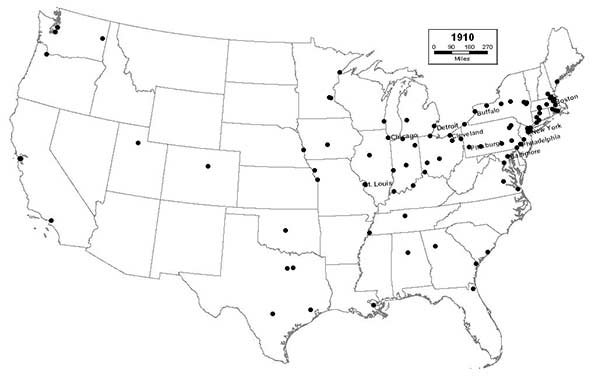
    1910 – Northeast (45); Midwest (27); South (19); West (9)

    The Great Lakes region continues to thrive as its cities grow larger and more prosperous, and Pittsburgh enters the top 10. Cincinnati drops out of the top 10, but remains a vibrant and expanding urban center. Southern cities, like Fort Worth, Oklahoma City, and Jacksonville join the list, giving Florida a top 100 city for the first time.
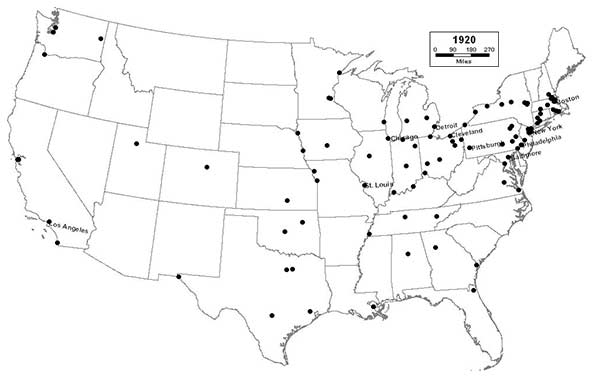
    1920 – Northeast (40); Midwest (29); South (21); West (10)

    Smaller industrial cities in the Great Lakes region, like Canton and Flint, thrive as the steel and automotive industries explode, and Detroit, “The Motor City”, enters the top 10. Charleston drops out of the top 100 for the first time since 1790. Southern California, poised to eventually become the nation’s prototypical urban region, begins its period of automobile-age ascendance as San Diego joins the list, and Los Angeles enters the top 10. 
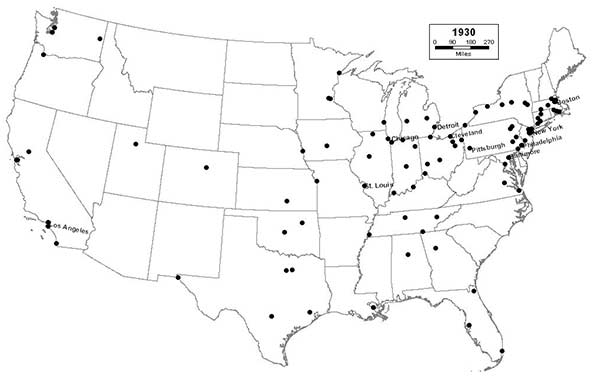
    1930 – Northeast (36); Midwest (29); South (23); West (12)

    Industrialization in the Great Lakes region reaches its apex in overnight boom towns like Gary, as the region becomes the manufacturing center not only of North America, but of the entire world. The Sunbelt’s period of growth begins in earnest, as cities in California and Florida, like Long Beach, Miami, and Tampa expand rapidly.  In contrast, a period of long, steady decline ensues in smaller industrial cities throughout the Northeast, in general, and New England, in particular.
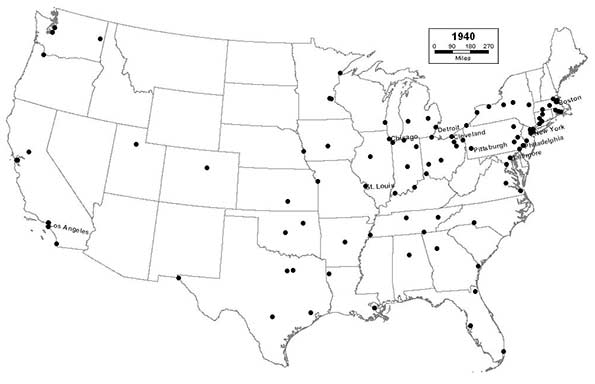
    1940 – Northeast (33); Midwest (28); South (27); West (12)

    The preceding decade is a difficult one for the nation’s cities.  Very few cities grow in the immediate aftermath of the Great Depression. Northern industrial cities are hit particularly hard, but some southern cities, like Charlotte, begin to flourish.
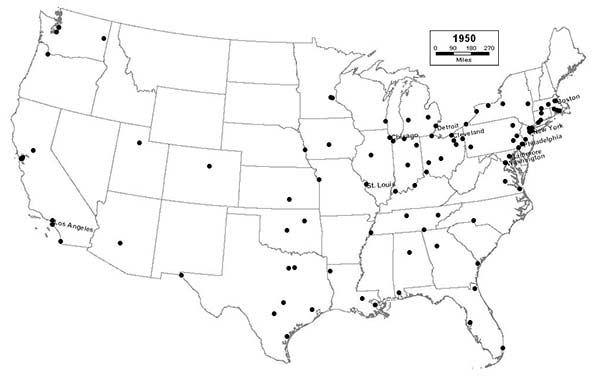
    1950 – Northeast (28); Midwest (27); South (31): West (14)

    For the first time, the South surpasses the Northeast as the region with the most cities in the top 100, as Austin and Baton Rouge join the list. Pittsburgh drops out of the top 10, as industrial decline in the Northeast accelerates after a brief uptick during the war. Washington, D.C. enters the top 10, due in large part to the expansion of the federal government during the Great Depression and World War II.  Phoenix joins the list at #99, presaging the rapid development of the desert Southwest in the coming decades; a small desert crossroads at the beginning of the 20th Century, it will end the century as the nation’s sixth largest city.
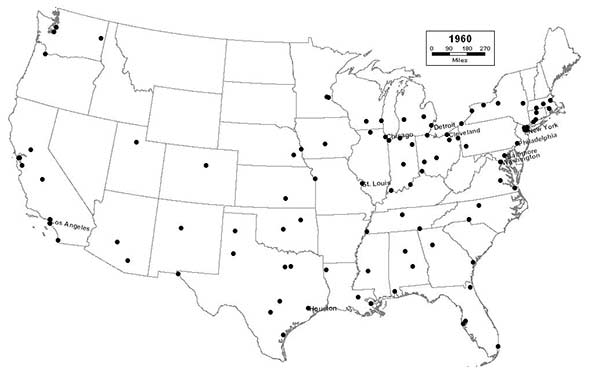
    1960 – Northeast (19); Midwest (28); South (35); West (18)

    Both suburbanization and deindustrialization become major factors in central city decline, especially in the North, where major cities are hemmed in by adjacent cities and towns, and are therefore unable to expand via annexation. The long tradition of town, borough, and township government throughout the entire North stymies efforts to consolidate governments into units that better reflect modern realities. Boston drops out of the top 10 for the first time since 1790. The expansion of the Interstate Highway System takes its toll, especially on mature Northern cities, by opening up outlying areas for suburban development, and by displacing business and residents in the urban core.  Most cities throughout the Midwest have now reached both the peak of their population and their industrial development.  In the coming years, they will increasingly follow the pattern established in the Northeast 30 years earlier, as the region begins to transition from the “Great American Manufacturing Belt” to the “Rust Belt”.  In contrast, the Sunbelt continues to enjoy explosive growth, as Houston enters the top 10, and San Jose, Tucson, Albuquerque, and Honolulu join the list. 
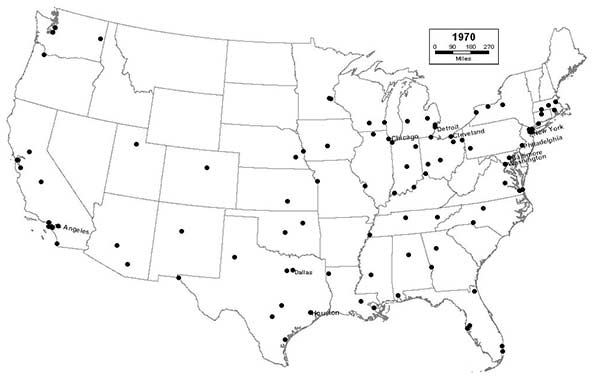
    1970 – Northeast (16); Midwest (28); South (35); West (21)

    Anaheim, Santa Ana, and Riverside join the list, as Southern California continues to attract new immigrants, both foreign and domestic, in record numbers.  The largest Southern and Western cities continue to grow even larger, as Dallas joins the top 10. The industrial Midwest begins to experience a period of rapid decline, as St. Louis drops out of the top 10. 
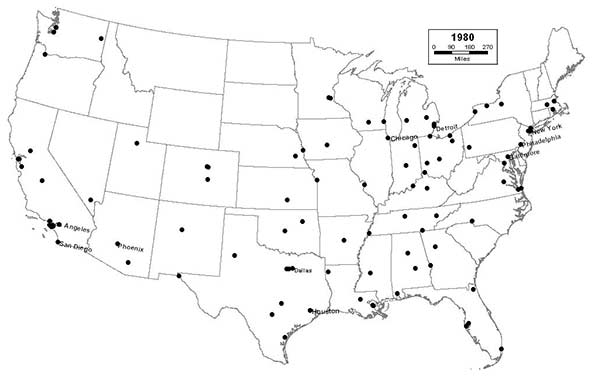
    1980 – Northeast (12); Midwest (24); South (38); West (26)

    Colorado Springs and Las Vegas join the list, as the interior West continues to grow rapidly.  The growth of the West extends to Alaska, as Anchorage makes the list for the first time.  Even the suburbs of sunbelt cities, like Arlington, Texas, and Aurora, Colorado begin to surpass established Northeastern and Midwestern central cities in population. San Diego and Phoenix join the top 10. Midwestern cities continue to deindustrialize rapidly, and begin losing population at a truly alarming rate. Suburbanization, white flight, and the inability to annex or consolidate with outlying areas make the problem of industrial decline even worse, as Cleveland drops out of the top 10. 
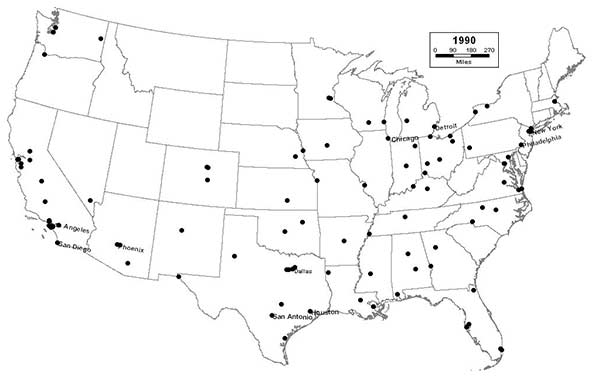
    1990 – Northeast (9); Midwest (21); South (40); West (30)

    Cities throughout the Sunbelt continue to grow in size, prominence, and influence, as Los Angeles surpasses Chicago as the nation’s second largest city.  Three of the nation’s 10 largest cities are now located in Texas, as San Antonio joins the top 10.  Sunbelt “boomburbs” continue to explode as cities like Mesa, Arizona; Garland, Texas; and Fremont, California join the list, displacing older eastern cities like Syracuse, Worcester, and Providence, which drops out the top 100 for the first time since 1790.
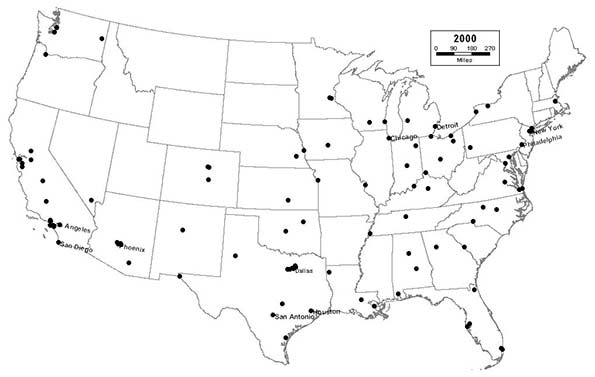
    2000 – Northeast (9); Midwest (20); South (40); West (31)

    The previously established patterns of Rust Belt decline and Sunbelt expansion begin to stabilize, although many Rust Belt cities continue to lose population at an alarming rate.  Dayton drops out of the top 100 for the first time since 1830. Sunbelt boomburbs continue to grow rapidly, as Plano, Texas; Glendale, Arizona; Scottsdale, Arizona; and Irving, Texas all reach the top 100.  
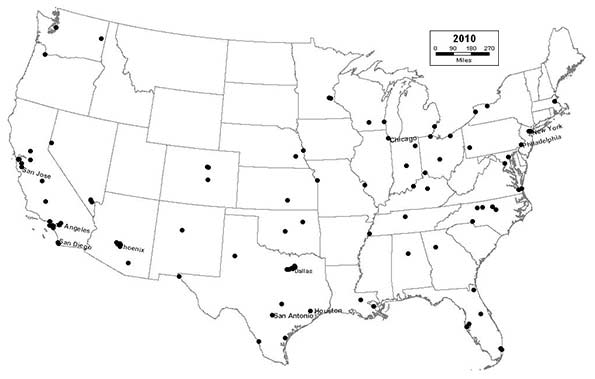
    2010 – Northeast (8); Midwest (17); South (39); West (36)

    The Sunbelt achieves complete dominance of America’s urban landscape, as 6 of the nation’s 10 largest cities are now located in California and Texas. Rust Belt cities like Cleveland, which experienced a slight respite from decline throughout the 1990s, begin a new period of free-fall, as the housing market collapses in the late 2000s.  Detroit drops out of the top 10.  Akron drops out of the top 100.  Sunbelt cities continue to eclipse their Rust Belt counterparts, as Reno, Orlando, Winston-Salem; Henderson, Nevada; Chula Vista, California; and Irvine, California all reach the top 100.

    This post originally appeared in Jason Segedy’s Notes From the Underground on April 14,, 2014.

    Segedy is the Director of the Akron Metropolitan Area Transportation Study, the Metropolitan Planning Organization serving Akron, Ohio.  As a native of Akron, and as an urban planner, he has a strong interest in the future of places throughout the Great Lakes region, and in the people that inhabit them.
  • Detroit: A Chip off the Old Bulb

    Seven months after the announcement, it still seems like the largest municipal bankruptcy filing (at least up to this point) is the stuff of legend—the culminating event, after successive blunders.  The apex.  Or the nadir. No doubt those of us living here are guilty of a degree of chauvinism as we experience how it plays out firsthand, but it’s easy for anyone with even moderate media curiosity to see how much the city has hogged the headlines.  It may be for all the wrong reasons, but Detroit is prominent once again.

    Yet it was only weeks—if not days—after the declaration made international news that, in order to convey to the world the magnitude of the city’s financial woes, journalists honed in on more mundane failures—failures that, by virtue of their banality, were all the more shocking.  Locals have known about them for ages.  A portfolio of abandoned public school real estate larger than many cities’ functional school systems.  An absence of snowplows, even after heavy storms.  A stonewall of silenced civil servants, hogtied from effectively carrying out duties by daily uncertainty about the security of those same jobs.  The virtual absence of any emergency response, resulting in two-hour waits for an ambulance or a police call.

    But the one that crowds out the rest, no doubt at least partially due to its ubiquity and ordinariness, is the persistent non-functionality of those streetlights.  One of the editorialists for the Free Press has branded it “the city’s deepest embarrassment”.  By most estimates, up to 40% are out on any given night.  Anyone passing through can tell when crossing into the city limits for this exact reason: even huge stretches of the interstates are black, although they’re state or federal highways.  It’s hard to determine if these shadowy streets originate from a cash-strapped DPW’s inability to replace the bulbs—which obviously require periodic maintenance—or an oversight that far precedes the checkered Kilpatrick administration, when the city’s fiscal woes first garnered national attention.  All it takes is a trip down Mack Avenue on the city’s east side to postulate that the problem is a half-century in the making.


    Silhouettes of streetlights punctuate the dusky penumbra, but even at a distance, the shape of these lights seems odd.  Antiquated?  Probably.  And a closer view confirms it.


    To be frank, I can’t recall seeing lights like this before anywhere else in the country, and I’m well-traveled across some of the more economically deprived pockets.  From the baroque iron filigree work of the stanchion to the acorn shape of the light itself, my guess is this streetlight comes from an inventory that most cities had fully retired over three decades ago.  And there’s probably good reason for that: this one is broken.


    And so is another one half a block away.


    About half of the lights along this stretch of Mack use this design, and most are cracked.  A big distended bulb offers more surface area encased in glass—more space for something to wrong.  Whether hit by flying debris hit or (my suspicion) deliberately smashed by a passer-by, this streetlight is almost definitely non-operational.  And the visible hardware is only half the problem: inside that quaint, clunky bulb (your grandmother’s streetlight) is—or was—a mercury vapor lamp. Detroit is one of the few cities that still depends heavily on this less efficient, increasingly obsolete method of illumination; most other large cities have replaced their inventory with superior metal halide lamps.   USA Today also noted that Detroit and Milwaukee share the dubious distinction of being the only large cities that still deploy series circuits for much of the streetlight network, meaning that if one transformer box breaks down, the whole strip of lights goes dark, like an old string of Christmas tree lights.  While the Mack Avenue streetlight featured above remains attached to a wood, other lights in the city append to metal poles, presumably the same age as the lights themselves, characterized by rust, peeling paint, and sometimes even open cavities at the base.  The whole contraption has seen better days.

    But viewing these cracked eggs through a cultural lens can help temper some of the scorn.  They might not work well as modern lamps and they’re much easier to vandalize, but they’re relics—they’re curiosity items.  And they’re particularly eye-catching along Mack Avenue because there are so many of them, yet they’re still interspersed with more contemporary designs.  This cool pic doesn’t win awards for clarity, but it still shows the juxtaposition of old and new streetlights, through their silhouettes.


    Or on opposite sides of the street.


    And on a depopulated residential street not so far from Mack, a different kind of lighting style emerges—perhaps not as old-fashioned but still an oddity.


    Perhaps a style and technology that never caught on?

    The irony of the 1950s-era (or maybe even 1940s) lighting that lingers on in Detroit is that, in a broader spatial context, it exemplifies technological advancements playfully defying shifts in taste culture for a particular design.  On Mack Avenue, ancient streetlights bespeak a broke, ineffective government.  And yet, elsewhere in the metro, they convey something else.


    Forgiving the quality of the photo, it’s still easy to see a similar style of lighting to the ones on Mack Avenue, but this time they’re impeccable.


    But this is the comfy suburb of Livonia, presumably part of a streetscape improvement along a thoroughly auto-oriented corridor of strip malls and big boxes.  And they no doubt were a deliberate choice from the Public Works Department because they look good—providing a vintage, old-timey feel.  Apparently they don’t worry in Livonia about ne’er-do-well pedestrians throwing rocks at these distended bulbs.  Maybe it’s because Livonia has few ne’er-do-wells….and even fewer pedestrians.  But even some of the economically healthier neighborhoods within Detroit have caught the bug, replacing older streetlights with a newly vintage design, like these twin lamps in Midtown, near Woodward Avenue.


    This inversion of taste cultures pervades streetscapes across the country, where everything old is new again, in order to exploit nostalgia among a generation that never really experienced a normative walkable environment—a landscape that was still the standard during the era when city crew first installed those acorn mercury vapor lamps.  We’re seduced by nostalgia and novelty; a hybrid of the two is doubly sweet.  Just go to the French Quarter in New Orleans, where a city equally negligent in modernizing its utilities now capitalizes on this same inertia—the flickery gas lanterns that once were a backwater embarrassment are now ambiance.  Detroit isn’t yet so lucky to take similar advantage of its obsolete lighting (and the fact that most streets like Mack are a hodgepodge of styles doesn’t help), but that doesn’t mean that an emergent cultural voice won’t someday call those lights “genuine retro”, and the preached-upon choir will be listening.

    The periodic “freshening” of basic urban infrastructure is only partly due to necessity, as it may very well be in Detroit.  But a great deal simply has to do with keeping up with the joneses, resulting in often needlessly costly capital investments.  For example, the standard for pedestrian signals at intersections now typically involves a “countdown” timer, telling pedestrians exactly how many seconds they have left to cross.  While useful, are these timer boxes essential?  Regardless, public works departments are rapidly phasing out the single-box approach for these new timer-boxes, with little evidence of public advocacy one way or another (despite the fact that the public inevitably is paying for most of these replacement costs).  From decorative viaducts to Day-Glo yellow road caution signs, jurisdictions hell-bent on an infrastructural one-upmanship should look to Detroit as an inverse exemplar—what might happen when profligacy goes perpetually unchecked.  Unless, of course, these granny-and-gramps streetlights become hip and cool again, in which case the Motor City might have the last laugh.

    This post originally appeared in American Dirt on February 27, 2014.

    Eric McAfee is an itinerant urban planner/emergency manager who fuses his cross county (and trans-national) travels and love of contemporary landscapes into his blog, American Dirt, where a different version of this article appeared.

  • Large Urban Cores: Products of History

    Urban cores are much celebrated but in reality most of the population living in functional urban cores is strongly concentrated in just a handful of major metropolitan areas in the United States. This conclusion is based on an analysis using the City Sector Model, which uses functional characteristics, rather than municipal jurisdictions, to analyze urban core and suburban components of metropolitan areas.

    Functional Classifications of Metropolitan Areas

    The City Sector Model allows a more representative functional analysis of urban core, suburban and exurban areas, by the use of smaller areas, rather than municipal boundaries.

    The nearly 9,000 zip code tabulation areas of major metropolitan areas are categorized by functional characteristics, including urban form, density, and travel behavior. There are four functional classifications, the urban core, earlier suburban areas, later suburban areas and exurban areas. The urban cores have higher densities, older housing and substantially greater reliance on transit, similar to urban cores that existed before the post-World War II automobile oriented suburbanization. Exurban areas are beyond the built up urban areas. The suburban areas constitute the balance of the major metropolitan areas. Earlier suburbs include areas with a median house construction date before 1980. Later suburban areas have later median house construction dates.

    Concentrating in New York and A Few Other Areas

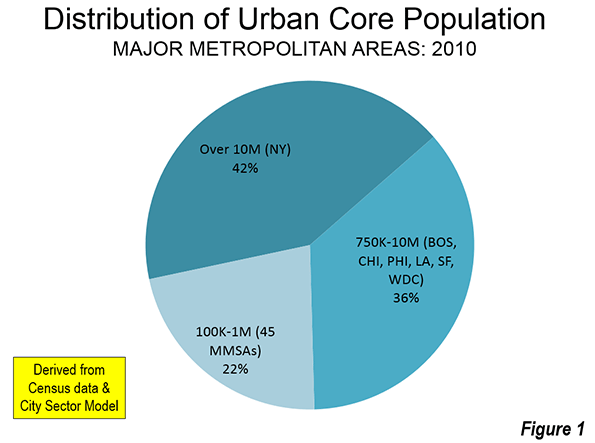
    As is so often the case on dense urbanization, the statistics are dominated by New York urban core which accounts for 42 percent of the total urban core population for the whole country. The New York metropolitan area, with 19.6 million people represents roughly six percent of the country’s population but its urban core –some 10.2 million strong – is larger than the total population of every metropolitan area in the nation other than Los Angeles (12.8 million).

    New York’s dominance is not surprising, reflecting its unique history and development.  Four of the core city’s five boroughs (Brooklyn, Queens, Manhattan, and the Bronx) have higher population densities than any municipality more than one-one hundredth its size in the United States. Significantly, unlike most major metropolitan areas, New York’s functional urban core stretches well beyond the core city, and includes more than 2,000,000 residents outside New York City.

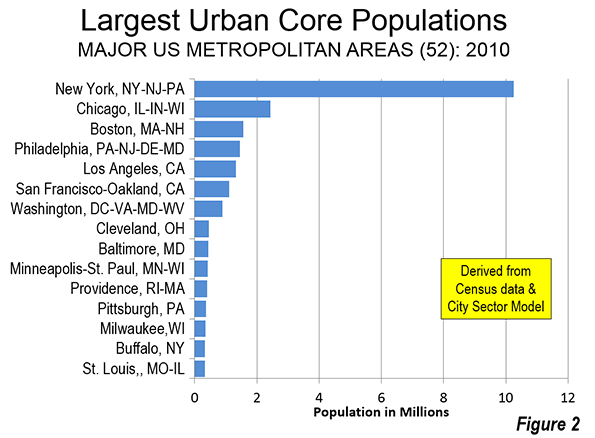
    Another 36 percent of the nation’s urban core population is in six metropolitan areas, though none reaches a population close to that of New York (Figure 1). Chicago is second, with an urban core population of 2.4 million. Four other urban cores exceed 1,000,000 population, including Boston (1.6 million), Philadelphia (1.5 million), Los Angeles (1.3 million) and San Francisco (1.1 million). The seventh largest urban core is in Washington, at 900,000. These seven metropolitan areas include the six transit legacy cities (municipalities), which account for 55 percent of the transit work trip destinations and 99 percent of the increase in urban core transit commuting in the United States over the past 10 years.(Los Angeles is not classified as a transit legacy city).

    After Washington, the size of urban cores drops off markedly with the next 45 largest metropolitan areas accounting for only 22 percent of the urban core population. Cleveland ranks eighth at 460,000, Baltimore is ninth at 440,000, and Minneapolis-St. Paul is 10th with 420,000 urban core residents. Perhaps surprisingly, Providence, which is the nation’s 38th largest metropolitan area, ranks 11th in urban core population, at 410,000 residents. Pittsburgh, Milwaukee, Buffalo, and St. Louis round out the top 15, with between 320,000 and 370,000 urban core residents (Figure 2).

    Another 9 metropolitan areas have urban core populations exceeding 100,000:Detroit, Seattle, Cincinnati, Portland, Hartford, New Orleans, Rochester, Kansas City, and Louisville.

    Urban Cores over 100,000 Population

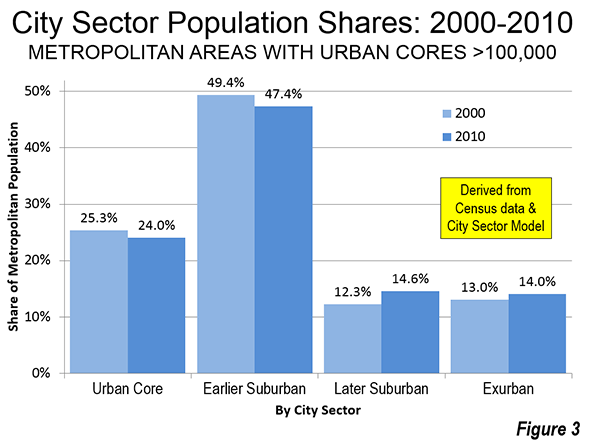
    Approximately 97 percent of the urban core population lives in the 24 major metropolitan areas with more than 100,000 urban core residents. Between 2000 and 2010, the urban core populations in these areas dropped from 25.3 percent to 24.0 percent of their respective metropolitan populations. The continued decentralization of these metropolitan areas is illustrated by a loss in the earlier suburban areas and gains in the later suburban areas and exurban areas (Figure 3).

    By comparison, only one percent of the population was in the urban cores of the other 28 major metropolitan areas (fewer than 100,000 residents in the urban core).

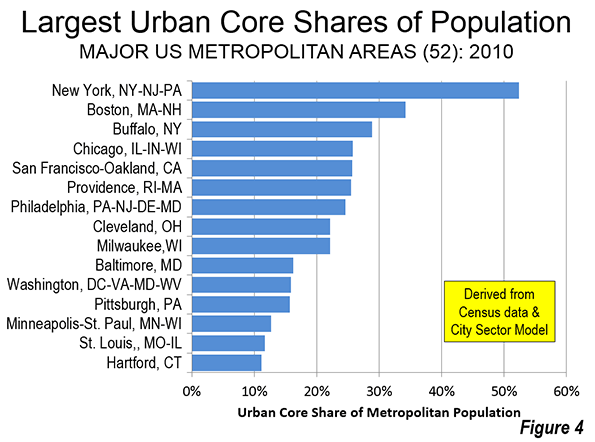
    New York had by far the largest percentage of its total metropolitan population in the urban core, at 52 percent. Boston ranked second, with 34 percent of its population in the urban core. Buffalo, which was ranked only 47th in metropolitan area population, was third in urban core population share (29 percent). Chicago and San Francisco had 26 percent of their population in the urban cores, followed by Providence and Philadelphia at 25 percent (Figure 4).

    Description of the Largest Urban Cores

    There is substantial variation in the geographical extent of the largest urban cores relative to their corresponding historical core municipalities. This is described below and illustrated in the just published Demographia City Sector Model Metropolitan Area Maps.

    As would be expected, New York’s urban core includes nearly all of the city of New York. Virtually all of Brooklyn, Manhattan, the Bronx, and Queens are in the urban core, though only parts of Staten Island are included. The urban core extends into New Jersey, with nearly all of Hudson County (including Jersey City) included, the core of Essex County (including Newark) and the city of Elizabeth (in Union County). The urban core and extends into Long Island’s Nassau County, including Hempstead, Valley Stream, Rockville Center and other areas. To the north, the urban core extends to parts of Westchester County (such as Yonkers, Pelham, Mount Vernon and New Rochelle). Interestingly, many of these areas, such as in western Nassau County, parts of Essex County and southern Westchester County are also suburban in form, but are classified as urban core because of high transit market shares, higher densities or pre-war development.

    Chicago’s urban core, the second largest, extends beyond but also excludes parts of the city of Chicago. The urban core extends into adjacent areas, such as older “suburban” Evanston, Oak Park and Cicero. There is also a significant urban core in northwestern Indiana, centered on East Chicago and Hammond.

    Boston’s urban core extends far outward from the city of Boston, including much of the area inside Route 128 (Interstate 95). This area also includes cities such as Cambridge, Everett, Somerville, Quincy, Medford, Waltham, and Lynn.

    Philadelphia’s urban core is largely confined to the city of Philadelphia, with extensions into Delaware County, Pennsylvania and Camden County, New Jersey.

    The urban core of Los Angeles is principally in the area extending from Hollywood to parts of East Los Angeles and south to the Interstate 105 freeway. However, much more of the city of Los Angeles is not in the urban core. The urban core also includes parts of Beverly Hills, West Los Angeles, Pasadena and Glendale.

    The urban core of San Francisco includes most of the cities of San Francisco and Oakland, as well as much of Berkeley, Albany, and Emeryville.

    Washington’s urban core includes most of Washington (the District of Columbia) and extends into Arlington and Alexandria in Virginia and has a large extension into Montgomery County, Maryland, including areas such as Bethesda and Silver Spring.

    Urban Cores Compared to Historical Core Municipalities

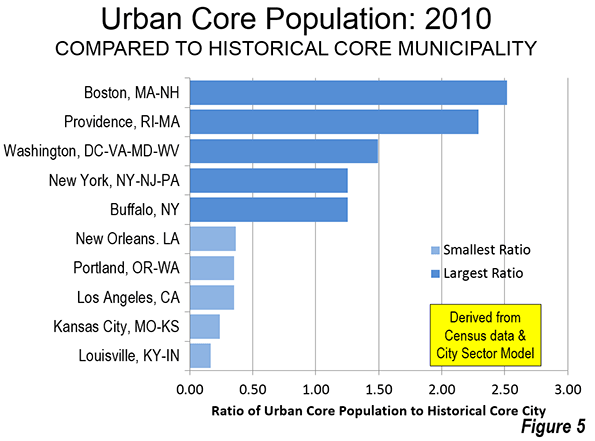
    A comparison of functional urban core populations to the populations of historical core municipalities indicates the problem of relying on jurisdictional (municipal) boundaries for urban core analysis. Functional urban core and historical core municipality populations vary significantly (Figure 5). The greatest differences are in Boston and Louisville. Boston’s functionalurban core population is 2.52 times that of the historical core municipality (Boston). Louisville’s functional urban core population is only one-sixth that of the historical core municipality (Louisville).

    Providence is second to Boston in its ratio of urban core population to that of historical core municipality at 2.29. The city of Providence had only 178,000 residents in 2010. (Among historical core municipalities, only Hartford was smaller at 125,000). Washington has an urban core population 1.49 times that of the historical core municipality, while New York and Buffalo had urban cores 1.25 times the population of their historical core municipalities.

    Among urban cores with more than 100,000 population Kansas City, Los Angeles, Portland, and New Orleans follow Louisville with the lowest ratios to historical core municipality populations (from 24 percent to 37 percent). In each of these cases, the urban core’s low ratio is the result of substantial annexations or large areas or the settling of large rural territories that had been previously included in the municipal limits (such as Los Angeles and New Orleans).

    Urban Cores: Products of History

    Indeed, nothing distinguishes the major metropolitan areas with larger urban core populations from the rest than history, In1940, just before the great mobility and suburbanization revolution, there were 23 metropolitan areas in the United States with wore than 500,000 population. The major metropolitan areas with the 19 largest urban cores in 1940 were all among the 23 with more than 500,000 population in 1940. Out of the 24 major metropolitan areas with more than 100,000 urban core residents in 2010, 21had more than 500,000 population in 1940 (only Hartford, Rochester and Louisville had smaller populations).

    Conversely, only two of the 28 major metropolitan areas in 2010 with fewer than 100,000 functional urban core residents had more than 500,000 residents in 1940, and they were among the smaller (Houston with 528,000 and Atlanta with 518,000).

    Urban cores were not planned, but rather were the result of consumer trendsin a time of much lower household incomes and much more restricted personal mobility. Many of the very centers of urban cores are reviving, but overall core growth continues to lag behind that of metropolitan areas. Moreover, there are no significant new ones.Urban cores, as much as anything, are a product of history.

    ————

    Wendell Cox is principal of Demographia, an international public policy and demographics firm. He is co-author of the "Demographia International Housing Affordability Survey" and author of "Demographia World Urban Areas" and "War on the Dream: How Anti-Sprawl Policy Threatens the Quality of Life." He was appointed to three terms on the Los Angeles County Transportation Commission, where he served with the leading city and county leadership as the only non-elected member. He was appointed to the Amtrak Reform Council to fill the unexpired term of Governor Christine Todd Whitman and has served as a visiting professor at the Conservatoire National des Arts et Metiers, a national university in Paris.

    ————

    Illustration: Core of the New York metropolitan area (City Sector Model map)

  • Demographia City Sector Maps Available

    Maps have been published illustrating the City Sector Model functional urban classifications for the 52 major metropolitan areas in the United States. The maps are available at Demographia City Sector Model Metropolitan Area Maps.

    Functional Classifications of Metropolitan Areas

    The City Sector Model allows a more representative functional analysis of urban core, suburban and exurban areas, by the use of smaller areas, rather than municipal boundaries.

    The nearly 9,000 zip code tabulation areas of major metropolitan areas are categorized by functional characteristics, including urban form, density and travel behavior. There are four functional classifications, the urban core, earlier suburban areas, later suburban areas and exurban areas. The urban cores have higher densities, older housing and substantially greater reliance on transit, similar to the urban cores that preceded the great automobile oriented suburbanization that followed World War II. Exurban areas are beyond the built up urban areas. The suburban areas constitute the balance of the major metropolitan areas. Earlier suburbs include areas with a median house construction date before 1980. Later suburban areas have later median house construction dates.

  • Success and the City: Houston’s Pro-growth Policies Producing an Urban Powerhouse

    David Wolff and David Hightower are driving down the partially completed Grand Parkway around Houston. The vast road, when completed, will add a third freeway loop around this booming, 600-square-mile Texas metropolis. Urban aesthetes on the ocean coasts tend to have a low opinion of the flat Texas landscape—and of Houston, in particular, which they see as a little slice of Hades: a hot, humid, and featureless expanse of flood-prone grassland, punctuated only by drab office towers and suburban tract houses. But Messrs. Wolff and Hightower, major land developers on Houston’s outskirts for four decades, have a different outlook.

    “We may not have all the scenery of a place like California,” notes the 73-year-old Mr. Wolff, who is also part owner of the San Francisco Giants. “But growth makes up for a lot of imperfections.”

    A host of newcomers—immigrants and transplants from around the United States—agree. The city’s low cost of living and high rate of job growth have made Houston and its surrounding metro region attractive to young families. According to Pitney Bowes,PBI +2.11% Houston will enjoy the highest growth in new households of any major city between 2014 and 2017. A recent U.S. Council of Mayors study predicted that the American urban order will become increasingly Texan, with Houston and Dallas-Fort Worth both growing larger than Chicago by 2050.

    Houston’s economic success over the past 20 years—and, more remarkably, since the Great Recession and the weak national recovery—rivals the performance of any large metropolitan region in the U.S. For nearly a decade and a half, the city has added jobs at a furious pace—more than 600,000 since early 2000, and 263,000 since early 2008.

    The much more populous greater New York City area has added 103,000 jobs since 2008, and Los Angeles, Chicago, Phoenix, Atlanta and Philadelphia remain well below their 2008 levels in total jobs. Los Angeles and Chicago, like Detroit, have fewer jobs today than they did at the turn of the millennium.

    Many of Houston’s jobs pay well, too. Using Praxis Strategy Group calculations that factor in the cost of living as well as salaries, Houston now has among the highest, if not the highest, standard of living of any large city in the U.S. The average cost-of-living-adjusted salary in Houston is about $75,000, compared with around $50,000 in New York and $46,000 in Los Angeles.

    Since 2001, the energy industry has been directly responsible for an increase of 67,000 jobs in Houston, and it now employs more than 240,000 people in the area. These include many technical positions, one reason the region now boasts the highest concentration of engineers outside Silicon Valley. The jobs should keep coming: University of Houston economist Bill Gilmer estimates that $25 billion to $40 billion in new petrochemical facilities is on its way to Greater Houston.

    Houston also has seen a surge in mid-skills jobs (usually requiring a certificate or a two-year degree) in fields such as manufacturing, logistics and construction, as well as energy. Many of these jobs pay more than $100,000 a year. And according to calculations derived from the Bureau of Labor Statistics by the Praxis Strategy Group’s Mark Schill, since 2007 Houston has led the 52 major metropolitan areas in creating these jobs, at a rate of 6.6% annually. In contrast, mid-skills jobs have declined by more than 10% in New York, Los Angeles, Chicago, and San Francisco, which have not been friendly to such industries.

    Houston’s growth is more than oil-industry luck; it reflects a unique policy environment. The city and its unincorporated areas have no formal zoning, so land use is flexible and can readily meet demand. Getting building permits is simple and quick, with no arbitrary approval boards making development an interminable process. Neighborhoods can protect themselves with voluntary, opt-in deed restrictions or minimum lot sizes.

    The flexible planning regime is also partly responsible for keeping Houston’s housing prices relatively low. On a square-foot basis, according to Knight Frank, a London-based real-estate consultancy, the same amount of money buys almost seven times as much space in Houston as it does in San Francisco and more than four times as much as in New York. Houston has built a new kind of “self-organizing” urban model, notes architect and author Lars Lerup, one that he calls “a creature of the market.”

    Housing-market flexibility has also benefited some of the city’s historically neglected areas. The once-depopulating Fifth Ward has seen a surge of new housing—much of it for middle-income African-Americans, attracted by the area’s long-standing black cultural vibe and close access to downtown as well as the Texas Medical Center. Rather than worry about gentrification, many locals support the change in fortunes. “In Houston, we don’t like the idea of keeping an image of poverty for our neighborhood,” explained Rev. Harvey Clemons, chairman of the Fifth Ward Community Redevelopment Corporation. “We welcome renewal.”

    Houston’s explosive economic growth has engendered another kind of boom: a human one. Between 2000 and 2013, Greater Houston’s population expanded by 35%—while New York, Los Angeles, Boston, Philadelphia, and Chicago grew by 4% to 7%. According to a 2012 Rice University study, Greater Houston is now the most ethnically diverse metro region in America, as measured by the balance between four major groups: African-American, white, Asian and Hispanic. “This place is as diverse as California,” notes David Yi, a Korean-American energy trader who moved to Houston from Los Angeles in 2013. “But it is affordable, with good schools.”

    The growth-friendly attitude is what holds everything together in Houston, and it will be crucial whenever the next slowdown comes—when oil prices could drop, say, to below $100 a barrel. It remains to be seen whether a large influx of newcomers to Greater Houston from the ocean coasts will clamor, as they have elsewhere—notably, in Colorado—for a more controlled, high-regulation urban environment. For now, though, most Houstonians see the city as a place that works—for minorities and immigrants, for suburbanites and city dwellers—and few want to fix what isn’t broken.

    This article first appeared in the Wall Street Journal.

    Joel Kotkin is executive editor of NewGeography.com and Distinguished Presidential Fellow in Urban Futures at Chapman University, and a member of the editorial board of the Orange County Register. He is author of The City: A Global History and The Next Hundred Million: America in 2050. His most recent study, The Rise of Postfamilialism, has been widely discussed and distributed internationally. He lives in Los Angeles, CA.

    Tory Gattis is a Social Systems Architect, consultant and entrepreneur with a genuine love of his hometown Houston and its people. He covers a wide range of Houston topics at Houston Strategies – including transportation, transit, quality-of-life, city identity, and development and land-use regulations – and have published numerous Houston Chronicle op-eds on these topics.

    Houston photo by BigStockPhoto.com.

  • Growth, Not Redistribution the Cure for Income Inequality

    Ever since the publication this spring of Thomas Piketty’s book “Capital in the 21st Century,” conservatives and much of the business press, such as the Financial Times, have been on a jihad to discredit the author and his findings about increased income inequality in Western societies. Some have even equated growing attacks on inequality with anti-Semitism, with at least one Silicon Valley venture capitalist, Tom Perkins, comparing anti-inequality campaigners to Nazis.

    For their part, progressives have taken to embracing the book like acolytes who have found a new gospel for their talking points. Paul Krugman predictably describes the bookas “the most important economics book of the year – and, maybe, the decade.”

    Piketty’s book is neither the Sermon on the Mount nor the “Communist Manifesto.” Its findings are, to be sure, far from conclusive, and may well have omitted some relevant points. The French economist’s solutions, as we will discuss, are also wanting. But conservatives, and business interests, should not see these shortcomings as a “get out of jail free” card on the pressing issues of class, inequality and reduced upward mobility.

    Conservatives, Businesses Need to Wake Up

    There are numerous measurements of reduced upward mobility from many other sources, notably the Federal Reserve, which are based on different data sets. Virtually all the conclusions are stark: The middle-class share of the economy is dropping as the vast majority of new dollars flow into the hands of a relative few.

    During the recovery from the Great Recession, income among the three middle quintilesdropped by 1.2 percent, while those of the top 5 percent of incomes grew by over 5 percent. This represents the acceleration of a long-term trend. Overall, the middle 60 percent of Americans have seen their share of the national pie fall from 53 percent in 1970 to barely 45 percent in 2012.

    More important, still, may be perceptions. Conservative economists can scoff at Piketty’s findings, but more and more Americans are alienated from the current economic system. For many, according to a 2013 Bloomberg poll, the American Dream seems increasingly out of reach. This opinion prevails by a 2-1 margin among Americans, rising to 3-1 among those making under $50,000 a year, but also is held by a majority earning over $100,000.

    At the same time, Americans, by more than 2-1, believe they enjoy fewer economic opportunities than did their parents and feel they will experience far less job security and disposable income. They also see growing ties between powerful business interests and government, with the vast majority feeling that government contracts go to the well-connected. Less than one-third believe the country operates under a free-market system.

    For business and for free-market conservatives these attitudes have consequences.Nearly 60 percent of the public, notes Gallup, favor some steps to increase the redistribution of wealth, almost twice as many who felt the current system was “fair.” Sentiments in this direction are even stronger among millennials, with some surveys suggesting that the majority are even sympathetic to socialism. Business needs to learn this lesson: Capitalism can only be sustained if it achieves a semblance of social democratic aims; without this, the system loses credibility and is seen as more oppressive than liberating.

    Good news for Democrats

    All this could be considered good news for Democrats, particularly the party’s left wing, which has gained growing sway over the party, particularly in urban areas. But there’s this problem with the Obama record: Rather than a shift to a more broad distribution of income, some 95 percent of the income gains during President Obama’s first term went to barely 1 percent of the population while incomes declined for the lower 93 percent of earners. As one writer at the left-leaning Huffington Post put it, “The rising tide has lifted fewer boats during the Obama years – and the ones it’s lifted have been mostly yachts.”

    Leftist reaction to this failure has been building in recent years, not only during the Occupy movement, but in the increasingly open criticism of the Obama approach by populist – as opposed to gentry – liberals. Progressives, such as Massachusetts U.S. Sen. Elizabeth Warren, have made it clear that, on this issue, at least, the administration has had few, if any, answers.

    Searching for Solutions

    This leads us into what could be “terra incognita.” Over the past several decades, we have seen two basic approaches to economic policy. One approach can be called “trickle down,” with tax cuts designed particularly to provide incentives for investors.

    Obama has tried a different approach, imposing higher taxes on upper-income professionals and small-business owners (while not touching the lower capital-gains rate for the very rich) as well as a regulatory regime particularly tough on firms without a strong lobbying presence.

    The failure of the Obama approach convinces some of the Left that the solution lies with the expanded “social state” advocated by their new guru, Piketty, steps which, they hope, will forcibly redistribute wealth. Like Piketty, they seem to feel that economic growth, traditionally a prime source of social uplift, is little more than an “illusory” solution.

    In reality, redistribution by the state would certainly help some, notably lower-income workers, but it’s doubtful it would improve material conditions for much of the middle class or the poor. Such a state is unlikely to increase upward mobility. The 50-year “war on poverty” in the United States, for example, initially helped reduce the percentage of the poor, but has achieved few gains since the 1960s.

    Despite $750 billion spent annually on welfare programs, up 30 percent since 2008, a record 46 million Americans were in poverty in 2012. Indeed, racial and ethnic economic disparities have grown under Obama.

    In much the same way, the European welfare state – held up as an exemplar by many progressives – has fallen on hard times, attracting the lowest levels of political support in several decades. Certainly, it holds little hope for young people, whose interests wane before a government increasingly focused on the growing ranks of pensioners. Overall unemployment rates in Europe are generally higher than in the U.S., and particularly for the young, where joblessness reaches 20 percent and higher in some countries. Indeed, much of the continent’s youth are widely described as “the lost generation.”

    Pervasive inequality and limited social mobility have been well-documented in larger European countries, including France, which has among the world’s most-evolved welfare states. The same is true in Scandinavia, often held up as the ultimate exemplar of egalitarianism. The Nordic countries have much to recommend them, but they, too, face rapidly growing inequality. Indeed, over the past 15 years, the gap between the wealthy and other classes has increased in Sweden four times more rapidly than in the United States.

    Ultimately, expanding welfare states, which can ameliorate class inequality, also depress economies and create the conditions for social stagnation. Indeed, as New Deal architect Franklin Roosevelt warned, a system of unearned payments, no matter how well-intended, can serve as “a narcotic, a subtle destroyer of the human spirit” by reducing people’s incentives to better their lives.

    In contrast, significant gains in poverty reduction, among those employed, at least, have come when both the economy and the job market expand, as occurred during both the Reagan and Clinton eras. Clearly, as both of these presidents recognized, the best antidote to poverty remains a robust job market. As Mike Barone has pointed out, the best economic results for the middle class have come under either free-market leaders like Reagan or Margaret Thatcher, or moderate liberals, like Clinton or Tony Blair.

    What we need, then, is a new focus on economic growth, accompanied by tax changes that both allow marginal rates to fall while equalizing capital gains with income taxes. This would lower the increasingly onerous burden on small businesses and middle-class families, and spark more grass-roots “up from the bottom” growth. It would also shift the economic paradigm away from speculative investment and toward rewarding work and enterprise. Critically, it could slow, perhaps reverse, the precipitous drop in labor force participation rates, particularly among young Americans, a harbinger of Europeanization in the worst sense.

    We should neither dismiss the issue of inequality, as many conservatives might wish to, or take the wrong steps to address it. Americans need to have a serious debate on how to confront the most important issue of our times – the growing class divide – with not just ceaseless rhetoric from the political class that, for the most part, to recall Shakespeare’s “MacBeth,” “is full of sound and fury, signifying nothing.”

    This article first appeared in the Orange County Register.

    Joel Kotkin is executive editor of NewGeography.com and Distinguished Presidential Fellow in Urban Futures at Chapman University, and a member of the editorial board of the Orange County Register. He is author of The City: A Global History and The Next Hundred Million: America in 2050. His most recent study, The Rise of Postfamilialism, has been widely discussed and distributed internationally. He lives in Los Angeles, CA.