Blog

  • Sterling, the Clippers, and $2B of Monopoly Money

    Is there a more crooked roulette wheel than the one that spins around in the circles of professional sports? I ask in the context of the punishment meted out to Donald Sterling, the in-limbo owner of the Los Angeles Clippers, who, for his commentaries about race in America, was banned from the league and might be “forced” to sell his team for $2 billion, about $1.5 billion more than it was worth before his girlfriend taped their tawdry talks.

    On paper, let alone on the basketball court, the Clippers should be close to worthless—an inept franchise that has yet to win a championship in the 44 years of its existence, which began in Buffalo.

    The magic of pro sports accounting, thanks to antitrust exemption from the US Congress, is that all team owners enjoy the perquisites of monopoly money, which entitles even the racist Sterling to billion-dollar pay days.

    It makes sense that Sterling’s wife is trying to sell the Clippers to Steve Ballmer, the former CEO of Microsoft, who ought to know a thing or two about oligopoly.

    Ballmer’s bet is that the NBA’s cartel pricing will allow the team more revenue sharing from television, while paying less to the players, so that instead of paying 133 times earnings for a team earning about $15 million a year, he can reduce his paid premium to, say, 40 times earnings if the Clippers start earning $50 million annually.

    Should the team acquisition simply be a rich man’s hobby, he can console himself for his losses by sitting court-side in Los Angeles with various starlets, although $2 billion is a lot to pay for a matchmaking subscription.

    Nor is Ballmer alone among executives in celebrating the un-level playing fields of monopoly. The owners of major league teams in football and basketball have long understood that the points on the scoreboards are incidental to their business of collecting money, paid out by the cable television industry (another oligopoly), and from treating the workers as if they were (high-end) strip miners.

    To be sure, many athletes in professional sports earn multimillion-dollar salaries. But they are paid as a coefficient of their ability to draw television ratings. Few other businesses in a country theoretically devoted to free enterprise are allowed to allot franchises as though they were noble fiefs, and to treat workers as indentured servants.

    Even now, it takes years for baseball and football players to become free agents, and leagues impose salary caps, in theory to equalize competition, although in practice to save money.

    If the movie or insurance businesses conducted a draft of prospective employees, Congress would cry foul and enforce an open and free labor market.

    Not only can the professional leagues allocate talent as if at a slave auction, but they enjoy the further subsidy that colleges and universities (in basketball and football) operate their minor leagues at no cost to the professional owners.

    On average, big-time universities earn about $50 to $100 million a year on their sports programs—much of that from basketball and football—but then become indignant when players, such as those at Northwestern University, suggest forming a union or ask for long-term healthcare benefits when they leave school programs with permanent injuries. Aren’t worthless degrees in something like social media enough reward?

    Best of all, few of the operating costs are passed on to the beneficiaries, the peers of Donald Sterling, who unwrap their golden tickets even if their teams are losing or they are degrading the fan base.

    With so much monopoly money to spread around among relatively few pro teams, owners can throw multimillion dollar, multiyear contracts blindly at athletes, who often look more like lottery winners than stars.

    In the last two years, for example, the bloated New York Yankees have lavished C.C. Sabathia, Mark Teixeira, Alex Rodriquez, Derek Jeter, Curtis Granderson, and others more than $100 million a year, even though they have played in only a fraction of the games, or poorly.

    During the last off-season, the Yankees committed another half a billion dollars to new free agents, including catcher Brian McCann, who as I write is batting an anemic .226.

    In 2013 the iconic team reported a loss of $9.1 million, although Forbes listed the worth of the franchise at $2.5 billion, with annual revenues of $431 million. A closer look at the numbers, however, suggests the Yankees are a cable network (jointly owned with FOX) with a team, not the other way around.

    Only monopoly economics allows the dimwitted Yankees to stay in business. Thanks to deductible ticket purchases by spendthrift corporate clients, the average seat at Yankee Stadium runs about $50, although the good seats cost over $200. The price of a monthly cable sports package in New York, at least for those that want a Yankees TV fix, can be another $1000 a year.

    Were pro sports in the interest of the community and worthy of an antitrust exemption, anyone with a video camera could broadcast the games as a news event. Instead, the games are the property of the major league cartels, whose officials, acting as though they were OPEC magnates, allocate the product.

    As if the pro sports honey pot needed anymore sweeteners, think, too, how easily many owners have extorted new stadiums from their home markets, in exchange only for agreeing to keep the team in the city. Or they skip town as soon as they’re promised millions elsewhere.

    According to several studies, some $17 billion in tax-exempt public funding has gone into stadium construction in recent years, another reason it’s impossible to lose as a team owner.

    For the fans, the new $1.5 billion Yankee Stadium feels the same as the old one. But owners lobby for new, tax-subsidized ballparks, especially in the NFL, so they can increase the number of skyboxes; that money drops straight to the owner’s bottom line, avoiding the pools of revenue sharing.

    Are there risks to owning these golden franchises? Pro football leagues will be hit with endless class-action lawsuits, until they can indemnify all current and past players with long-term disability in exchange for their primetime tackles and concussions. But I doubt these lawsuits will turn the NFL into flag football.

    Another threat to pro sports could come from an end to monopoly pricing in the cable television industry. Once every phone and iPad is a handheld TV, will customers really pay Time-Warner $90 every month for 500 channels? Will there be networks with enough subscribers to pay billions to the major leagues? Will audiences continue to watch baseball on television if the stadiums are empty, as many are now?

    Of course the best response to loutish team owners—among whom I suspect Donald Sterling is par for the course—would be to end the antitrust exemption and let the teams compete with other, newer teams and leagues. Why must pro sports be a regulated industry? Are they the equivalent of nuclear power?

    Why can’t even small and medium-sized cities have teams? The community-owned Packers have flourished in Green Bay, and the United States is a country of Green Bays. As in European soccer, the major leagues could simply be the most successful teams, with the poor performers each year getting relegated to lesser divisions. The University of Alabama would move up, and the Jacksonville Jaguars would go down.

    By those standards, the Los Angeles Clippers would long ago have been demoted to the California league, and their owner, one Donald Sterling, would not today be looking forward to a $2 billion check.

    Matthew Stevenson, a contributing editor of Harper’s Magazine, is the author of Remembering the Twentieth Century Limited, a collection of historical travel essays. His new book, Whistle-Stopping America, was recently published.

    Flickr photo by David Jones: The Los Angeles Staples Center on a good night for the Clippers; they beat the Miami Heat 111-105.
  • Urban Renewal Needs More than ‘Garden City’ Stamp to Take Root

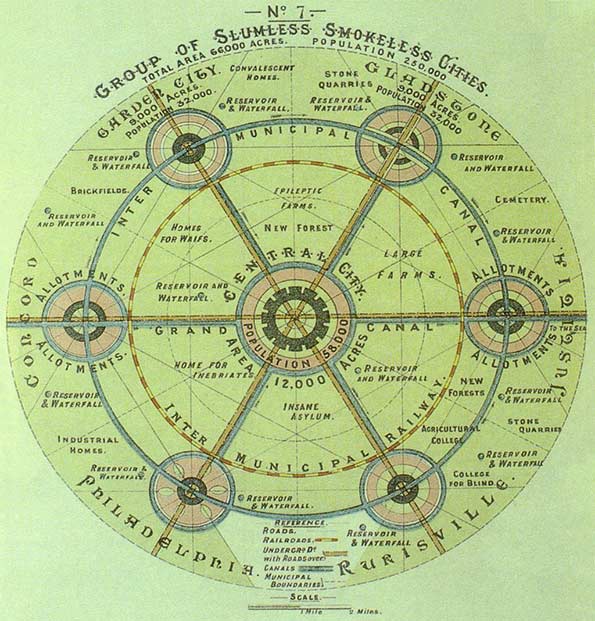
    Every few years the ideals of Ebenezer Howard’s garden city utopia are resurrected in an attempt by the UK government to create new communities, and address the country’s housing crisis. Sometimes this takes the form of new towns or eco-towns, and sometimes proposals for an actual garden city are put forward – as in the last budget.

    Rather than just rolling out this romantic terminology, we should take a closer look at garden city ideals and how they can be adopted to make the proposed Ebbsfleet development a success.

    Several years ago my colleague Michael Edwards presciently forecast the current problems in the Thames Gateway where Ebbsfleet falls, with a dominance of private development that does little to provide for local employment and walkable communities.


    Ebenezer Howard’s utopian vision

    He outlined the need to return to funding principles similar to the garden city model, where development trusts retain freeholds on the land. This model, based on investment in infrastructure and services, is a fundamental principle that shifts from short-term returns to a long-term relationship created between the collective or public landowner and local inhabitants.

    Lessons From History

    Despite the fact that the garden city was a highly influential model throughout the first half of the 20th century, ultimately leading to the establishment of some key settlements in the UK, US and elsewhere in the world, it has had few genuine successes. After World War II, similar utopian dreams of creating model communities, with decent housing surrounding a well-designed centre, met with the reality. British reformer William Beveridge famously summed them up for having “no gardens, few roads, no shops and a sea of mud”.

    You’d be forgiven for thinking that past lessons would be applied to the next generation of housing. But, even the post-war housing plans – though inspired by the garden city movement of the interwar periods – failed to plan the new housing in relation to transport, employment and public services such as shops and schools. While UK government reports have tried to draw lessons from both their positive and negative aspects, they have also been criticised in more recent reports, for lacking a sense of community – although it should also be said that “community” takes time to develop and cannot be “designed” as such.

    Many of the challenges of creating new communities are bound up in the spatial separation between newcomers and older inhabitants, a lack of social infrastructure, such as doctor’s surgeries and schools, and difficulties that stem from long commutes, such as lower net income and the strain this has on families. Ruth Durant found this in her 1939 study of Burnt Oak on the outskirts of London.

    Early post-war new towns were similarly criticised for their very slow build-up of health services, higher schooling, cultural facilities and decent shopping facilities, although some did better with the provision of local employment, due to many people moving to the towns with a local job linked to their housing. With shifts in the industrial economy, such beneficial connections between home and work (one of the tenets of the garden city) reduced over time.

    Modern Twist

    The challenges today are slightly different, however. People live more mobile and fragmented lives and are arguably less likely to be tied to place as was the case for the primarily working-class (and manual labouring) communities of the past. This poses the risk that community will be lost because of how transient people can be.

    But increased mobility and social interaction don’t have to be mutually exclusive. Indeed, a lack of mobility is the worst problem that can be imposed on a community: both work and leisure must be accessible to people. Plus, with the advent of the internet and grass-roots activism, connections can traverse space more easily. This has allowed movements such as the Transition Network, which brings communities together around sustainable issues, to blossom.

    Adapting to Change

    UCL’s EPSRC funded Adaptable Suburbs project has studied the evolution of London’s outer suburban towns over the past 150 years, providing some clues on what has made for the relative success of the original garden cities over other planned settlements. It is clear that their success has been dependent on excellent transport connections, coupled with the provision of local employment and access to employment at a commutable distance.

    Also important is the provision of a mixed-use town centre, giving a destination for a wide variety of activities in addition to retail: community activities, schools, leisure and cultural uses. Centres work well when connected to the street network, accessible by foot, bicycle, public and private transport. This multi-functional design has helped even the smallest of centres to sustain themselves through the most recent economic recession.

    A recent government report, “Understanding High Street Performance”, also found that successful town centres are “characterised by considerable diversity and complexity, in terms of scale, geography and catchment, function and form … [as] a result, the way in which they are affected by and respond to change is diverse and varied”.

    It is almost impossible to predict how society will change in the future, particularly as new technologies have the power to change how people connect and build community. But what is evident is that here lies another essential aspect of building successful communities: in allowing for places to adapt to change.

    This needs to be a foundational aspect of the government’s new cities – simply invoking the phrase “garden city” is not enough. By building places with sufficient flexibility of buildings, infrastructure and uses, coupled with links that allow for local and wider-scale trips to take place, with the necessary long-term financial investment, we can start to create places that will successfully weather the future.

    This article was originally published on The Conversation.

    Dr Laura Vaughan is Professor of Urban Form and Society at the Bartlett, University College London. She has been researching poverty and prosperity in cities, suburbs and the space between them for the past dozen years using space syntax – a mathematical method for modelling social and economic outcomes. Her edited book ‘Suburban Urbanities’ is due to come out in UCL Press in 2015.

    Photo: Which way are the flower beds? Matt BuckCC BY-SA

  • The Evolving Urban Form: Chongqing

    No city in the world is so misunderstood by analysts and the press. It is commonly asserted Chongqing is the largest city in the world. In reality it barely makes the top 50, ranking 47th.

    Cities (Shi) in China are Regions and Mostly Rural

    It is fundamentally a problem of semantics and a failure to comprehend the nuances of urban geography in China. The country is divided into provinces and their equivalents, which are in turn, divided into prefectures, most of which are "shi," "Shi" translates into English as "city." However, shi are completely different from any English conception of a city as "an inhabited place of greater size, population, or importance than or village" (per Merriam Webster).

    There approximately 300 shis and other prefectures (sub-provincial jurisdictions) in China. In contrast, there are approximately 10 times as many sub-state jurisdictions (counties) in United States, which has a land area slightly larger than that of China. China’s shi and other prefectures are thus very large. They are really more like regions in English. Virtually all shi are predominantly rural, rather than urban in their land use.

    Reporters often marvel at the many cities in China of more than 1,000,000 population. Yet many of these are nothing more than broad expanses of rural areas without large urban settlements. Take, for example, Bazhong, a "shi" of 3.3 million residents in Sichuan province. The largest urban settlement occupies just 5 square miles (13 square kilometers), roughly the same land area as Goodland, Kansas (a city of fewer than 5,000 residents). Bazhong shi’s population is spread across a virtually 100 percent rural landscape of 4,700 square miles (12,300 square kilometers).

    Chongqing in Context

    Chongqing is a shi, and is administered as a province by the national government, as also are Shanghai, Beijing and Tianjin. The province of Chongqing covers 32,000 square miles (82,500 square kilometers). This is nearly equal to the land area of Austria and more than the area of the state of Maine. No city in the world is as large as Austria.. The New York urban area comes the closest to Chongqing’s size at 4,500 square miles (11,600 square kilometers), one-seventh the land area of Chongqing.

    Not a Metropolitan Area

    Nor is it appropriate to consider the province of Chongqing as a metropolitan area (labor market). It is simply too large for that. Commuters from the Chongqing’s "Southeast Wing" would have to travel up to 5 hours, mainly on the China’s 75 mile per hour (120 kilometer per hour) freeway system to reach work in the Chongqing urban area. From the outer reaches of Chongqing’s "Northeast Wing," travel times could exceed 8 hours, again largely by 75 mile per hour freeway.

    A Largely Rural, Not Urban Province

    The province of Chongqing is predominantly rural yet The Guardian persists in telling us that "Chongqing is the fastest-growing urban centre on the planet. Its population is already bigger than that of Peru or Iraq." Not so. The 2010 Census of China placed the province of Chongqing’s population at 28.8 million, smaller than both Peru and Iraq and with fewer people than in 1990. The urban center (genuine city) of Chongqing does not reach a quarter the size of either Peru or Iraq.

    The Guardian is by no means alone. Time magazine cluelessly fawned "Virtually overnight, Chongqing has become the largest city not only in China, but in the world," Wired similarly misfired with indicating in a 2008 article that Chongqing (at 32 million population) was the "fastest-growing urban center on Earth." For all the supposed growth, not a soul was added to Chongqing province during the 2000s, as is described below.

    Not all media outlets, however, have been captured by the same fallacy as The Guardian, Time, Wired and many others. To its credit, the BBC went to considerable lengths to correct this and similar errors about the population of Chongqing. An Atlanticarticle also parsed the issue well.

    Losing Population

    In reality Chongqing lost 1.7 million people between 2000 and 2010, 5.5 percent of its population. This is significant. By contrast, the municipality of Chicago lost 6.9 percent over the same period, a loss that was considered devastating. It is not surprising that Chongqing is losing population, given its principally rural nature. Much of rural China is emptying out, as people migrate to the cities for economic opportunity (which is the very purpose of cities), just as they have done in previous decades and the last two century throughout higher income nations. Every year over the past decade, the province experienced an annual decline of 170,000, not the half-million increase reported by The Guardian. The actual urban center (not the imaginary urban center reported on by The Guardian) is gaining in population, but nothing like "half a million" per year.

    The Genuine City of Chongqing

    There is, however, a genuine city of Chongqing. Surprisingly reminiscent of Pittsburgh, Chongqing is it nestled among elongated folded mountains that are near duplicates of those near the Pennsylvania city. The city is at the confluence to two rivers, the Yangtze and the Jialing. Like the Pittsburgh’s Golden Triangle where the Allegheny and Monongahela Rivers meet, Chongqing’s has an attractive open space at Chaotianmin where the two rivers meet. Finally, as in Pittsburgh, there is an impressive, high rise central business district behind the open space. This is the best example in China of a monocentric central business district typical of many US cities (downtown Shanghai and Nanjing are similar, but more spread out).

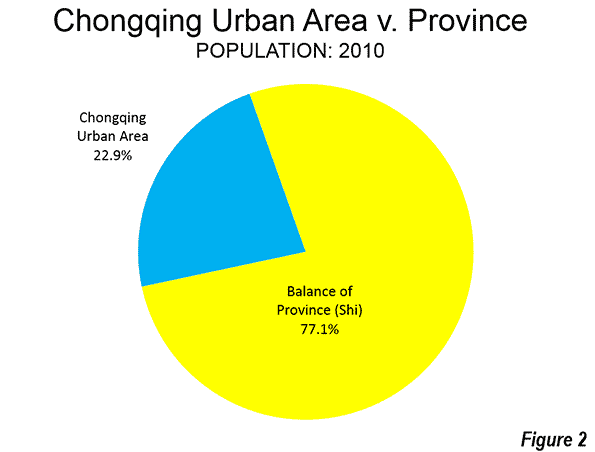
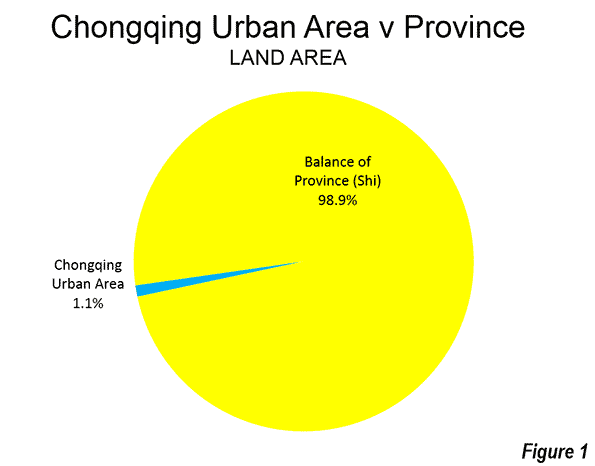
    The Chongqing urban area covers little more than 1/100th of the province’s land area (Figure 1) and contains less than one-quarter of the population (Figure 2). Yet the Chongqing urban area is still large. According to the 10th Annual Edition of Demographia Urban Areas, Chongqing has a 2014 population of 6.8 million living in a land area of 340 square miles (890 square kilometers). The urban population density is 19,600 per square mile (7,700 per square kilometer), which is about one third higher than the larger urban area average of 14,900 per square mile (5.700 per square kilometer) found across China. This is more than double the density of the Paris urban area, triple the density of the Los Angeles urban area and six times that of Portland.

    The "One Hour Economic Circle:" The Future Metropolitan Area

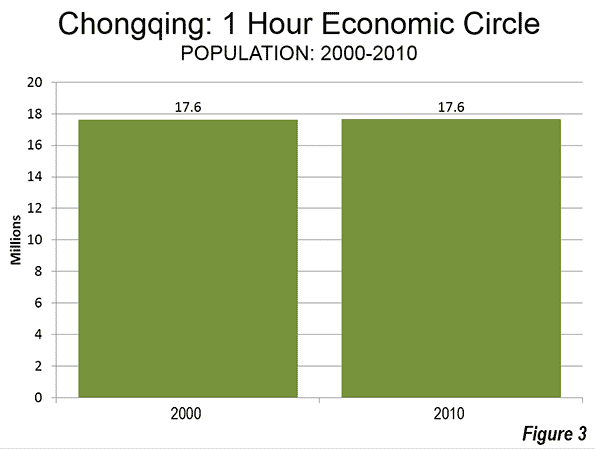
    Chongqing’s administration has a vision of a much larger city. The urban plan is concentrated on the "One Hour Economic Circle," defined as within "one hour’s driving distance." This area includes 23 of Chongqing’s 40 divisions (counties and urban districts, or qu’s), with a land area of 11,000 square miles (28,600 square kilometers), more than 1.5 times the size of the Paris metropolitan area (aire urbaine) and slightly larger than New York. The 2010 census counted a population of 17.6 million in the One Hour Economic Circle, but most of it still rural. Outside the One Hour Economic Circle, in what is called the "Northeast Wing" and the "Southeast Wing," the rural influence is even greater.

    The intent of the urban plan is to broaden the economic influence of the urban area. This would involve substantial increases in economic interchange (principally commuting) with the balance of the One Hour Economic Circle, now decidedly rural.

    Within the One Hour Economic Circle, the large rural population suggests the potential for in-situ urbanization could also contribute to economic growth as migration, as rural residents are afforded opportunities to adopt urban lifestyles (as has occurred in Quanzhou and other urban areas, especially in the province of Fuzhou).

    Population Trends 2000-2010

    The divisions (qu) that encompass the urban area are growing, even though the core is losing (Yuzhong qu). In contrast, the metropolitan area had a population of 8.0 million in 2010, up 19 percent from 2000. This is not particularly rapid growth for China. Nearly 20 metropolitan areas grew twice as fast from 2000 to 2010. Nearby Chengdu, the capital of Sichuan, grew 2.5 times as fast as Chongqing.

    Outside the metropolitan area, the One Hour Economic Circle experienced a population loss of 12 percent. As a result of this loss, the One Hour Economic Circle had only a negligible population increase of 0.1 percent between 2000 and 2010 (Figure 3).

    The Future

    At the presently projected United Nations growth rate, the Chongqing urban area would add nearly one quarter to its population by 2025. But under this pattern Chongqing will barely hold its own, but remain in the top 50 world urban areas. Yet, the city has grand plans. There are nationally and locally designated economic zones, and lower business costs encouraging commerce to move west in China. As a province and urban area directly administered by Beijing, Chongqing could be positioned for both strong population and economic growth. Yet, it remains an open question whether Chongqing will emerge as one of China’s major growth centers.

    —————-

    Note: Shi are divided into county level jurisdictions, such as qu (urban districts), counties (rural districts) and count level shi.

    ——-

    Wendell Cox is principal of Demographia, an international public policy and demographics firm. He is co-author of the “Demographia International Housing Affordability Survey” and author of “Demographia World Urban Areas” and “War on the Dream: How Anti-Sprawl Policy Threatens the Quality of Life.” He was appointed to three terms on the Los Angeles County Transportation Commission, where he served with the leading city and county leadership as the only non-elected member. He was appointed to the Amtrak Reform Council to fill the unexpired term of Governor Christine Todd Whitman and has served as a visiting professor at the Conservatoire National des Arts et Metiers, a national university in Paris.

    Photo: Downtown Chongqing (by author)

  • Beijing Gigacity to Cover Area of Cambodia or Oklahoma

    Today, there are about 30 megacities in the world, where more than 10 million residents live. The largest is Tokyo, at about 38 million. Recent announcements by the government of China could lead to the worlds’ first gigacity (for want of a better term, used here to denote a city of more than 100,000,000 population, see note). According to the Nanfang Insider, the economic integration of megacity Beijing, megacity Tianjin and eight cities (prefectures) in the province of Hebei would result in a city of 130 million. China Daily is a bit more circumspect, indicating that the Beijing supercity would have only 85 million.

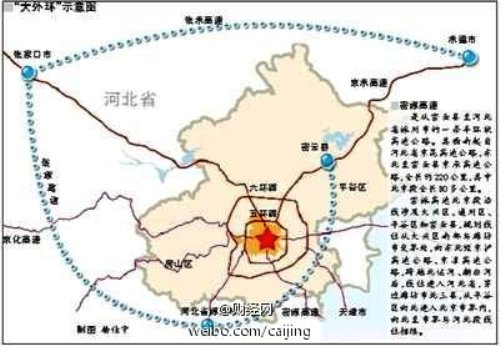
    The giga/super city would be tied together by new rapid transit lines and highways and surrounded by the 7th Ring Road, adding to the six that have already been built. The 7th Ring Road would consist of two roads, circling most of the area, and extending to a combined 850 miles (2,200 kilometers). By comparison, London’s M-25 is 117 miles long (188 kilometers), the Moscow MKAD 68 miles long (109 kilometers) and the Washington beltway is 64 miles long (103 kilometers)

    The giga or super city is not likely to really be a city, because it would be much larger than a labor market (this is why the near continuous urbanization from Boston to Washington or Tokyo to Osaka-Kobe-Kyoto is not a city). The estimated land area is 67,000 square miles (175,000 square kilometers). This is nearly as large as Cambodia or the state of Oklahoma. Providing the point to point daily commuting in such a large area is well beyond the capability of any affordable transportation system. Star Trek like teleportation could do the trick. Meanwhile, however, there is plenty to be gained from the economic integration of this large area.

    Graphic of the new 7th ring road from nanfang.com:


    Note: Technically, a gigacity would need 1 billion people (10 to the 9th power). However, megacities, with their 10 million minimum are also wrongly named. A city with a mega city would have 1,000,000 people (10 to the 6th power). Artistic license justifies the gigacity term under the circumstances. Besides, with the slowing growth of world population, it seems unlikely than any city will achieve a population of 1 trillion.

  • Energy Preferences to Play Big Role in November

    The November election will be played out along all the usual social memes – from gay marriage, racism and immigration to the “war against women.” But what may determine the outcome revolves around one key economic issue: energy. This has all come to a boil now as President Obama has backed an Environmental Protection Agency effort to accelerate tougher emissions standards, something that could shutter hundreds of coal-fired power plants and slow fossil fuel development across the country.

    The energy issue has become in our era what tariffs were in the 19th century: an increasingly insurmountable partition that separates Americans by region and class and which, ultimately, touches on the long-term economic trajectory of the country.

    Of course, we have always had politics over energy – given regional variations in sources and kinds of supplies – but, until recently, both parties generally favored developing more oil and natural gas, largely because of the associated high-wage employment growth and potential for reducing the nation’s trade deficit. Now, energy increasingly has become a deeply partisan issue, with Democrats largely in opposition to fossil-fuel development and Republicans, fairly predictably, in support.

    Reflecting this trend has been the rise of opposing sets of contributors whose primary concerns are wrapped around energy. On the Republican side, energy industry contributors, including the billionaire industrialist Koch brothers, have become increasingly dominant. More than 90 percent of campaign donations from the oil and gas industries in 2012 went to Republicans.

    At the same time, environmentally focused Democratic contributors, led by hedge-fund manager Tom Steyer, have made being anti-fossil-fuel de rigueur for most candidates in the party. Steyer and his allies have become the favorite place to go for cash for Senate Majority Leader Harry Reid of Nevada and other top Democrats.

    The Geography of Energy

    The most-evident division – and most politically relevant – is geographic. A huge swath of the country, mainly along the Gulf Coast, Texas and the Great Plains, where shale-oil production has grown fourfold since 2007, is enjoying an energy boom that has created a surge in other high-wage, blue-collar fields such as manufacturing and construction. With the delays in approving the Keystone XL oil pipeline and looming new EPA emissions standards, Democratic senators and candidates from these states are, understandably, trying to distance themselves from their party’s increasingly anti-fossil-fuel policies.

    More significant, over time, may be how energy plays out in the country’s major political battleground, the rust-belt states. Most of these states are highly dependent on coal for electricity, and some, such as Pennsylvania, Ohio and West Virginia, are seeking to develop new oil and gas finds. Policies that limit fossil-fuel development, may prove a tough sell in some districts and could cost the Democrats several additional Senate seats.

    In contrast, the most fervent support for strict climate-change legislation comes mostly from states – notably, the Northeast – that produce little in the way of energy and use relatively little carbon to power their economies. These states need less power than other areas as they already have deindustrialized and have very little population growth.

    Two other ultrablue bastions, California and the Pacific Northwest, also advocate a green energy position. The Northwest relies largely on hydro power for its robust industrial sector, lessening dependence on carbon-based energy for electricity. California, itself rich in fossil fuels, largely disdains its resources, and its leaders prefer, for ideological reasons, to subsidize expensive renewable energy. Roughly one-fourth of all energy used in California comes from out of state, much of it from coal. But since this “dirty” power comes from elsewhere, the progressives in places like Hollywood and Silicon Valley can still feel good about our state’s “enlightened” policies, whatever their real effect.

    The Class Divide

    Historically, Democrats have been big supporters of expanding the energy sector, which includes such things as dams, nuclear power plants and pipelines. But the growing influence of the green movement has reversed that. Green policies are widely embraced by largely Democratic crony capitalists in places like Silicon Valley. They also enjoy almost universal support in academia, where boycotts of fossil-fuel companies are increasingly common. The media, too, is an ally, as is the predictably progressive entertainment industry.

    Rest assured, we will never see an HBO series that celebrates George Mitchell, the entrepreneur most responsible for developing fracking. But campus-climate scientists who diverge in any way from the party line on global warming are routinely excoriated as“deniers” of “settled” science, even in the face of 15 years of relatively stable global temperatures. The media has also become a fierce defender of climate orthodoxy. TheLos Angeles Times, as well as the website Reddit, have chosen to exclude contributions from skeptics.

    Of course, many traditional Democrats, notably in the construction trades and manufacturing, oppose this drift. Construction unions are apoplectic about the president’s endless delays on Keystone XL, which has two-thirds support from the public. The United Mineworkers, not surprisingly, oppose the new EPA emissions limits, claiming they will cost upward of 75,000 mining jobs.

    Some Ohio construction unions, incensed by green opposition to both Keystone and fracking, have shifted support to prodevelopment GOP Gov. John Kasich, despite his conflict with public employee groups. The only prominent national Democrat to identify as pro-fossil-fuel is former Montana governor Brian Schweitzer whose possible run for the presidential nomination seems a bit quixotic in a party increasing dominated by environmental activists and their gentry allies.

    What Kind of America do we want?

    Ultimately, the energy debate reflects a larger discussion about the future of the country and the economy. This is not merely about emissions and climate change, per se. California’s Draconian laws, even supporters admit, will have no appreciable effect on a global basis, particularly given the state’s already relatively low carbon footprint (largely a factor of the mild climate and the slow growth in its interior in recent years). Indeed, virtually all the world’s significant increases in CO2 are coming from developing countries; since 1990, China has increased its emissions almost threefold, while America’s have dropped. China now emits roughly twice as much greenhouse gas as the U.S.

    Some of the steps taken by environmental and renewable-energy interests against natural gas development can even be seen as counterproductive. The U.S.’s better recordon reducing emissions reflects overwhelmingly the shift from coal to natural gas for generating electricity, which has helped the U.S. reduce its carbon emissions more than either Asia or Europe.

    Fracking, like any energy technology – including wind and solar – clearly creates environmental problems. There should be strong rules to regulate fracking to make it safer, as Colorado’s Democratic Gov. John Hickenlooper has worked to pass in his state. In addition, major reductions can be achieved through a shift away from oil and coal and toward natural gas, as well as conservation efforts.

    Progressives, in particular, need to focus far more on what effects an ultrahigh-cost energy economy would have on the middle and working class. More attention should be paid in accelerating the current spike in job-creating foreign investment into the country, attracted in large part by the development of low-cost, clean natural gas. In contrast, policies hostile to fossil fuels will drive industry to less-environmentally conscious countries, particularly in the developing world.

    Sadly, none of this is necessary. America’s economic future is best guaranteed by marrying the successes of Silicon Valley and Hollywood with a robust blue-collar sector that includes fossil fuels, manufacturing, logistics and construction. Emissions can be cut, for the time being, by such steps as replacing coal for generating electricity, improving efficiencies, promoting telework and boosting the use of natural gas for transportation.

    Dividing the country, and the electorate, into totally polarized camps over energy may benefit the consultants in both camps who feed off contentious and expensive election campaigns, but will do little to help the futures of most Americans.

    This article first appeared in the Orange County Register.

    Joel Kotkin is executive editor of NewGeography.com and Distinguished Presidential Fellow in Urban Futures at Chapman University, and a member of the editorial board of the Orange County Register. He is author of The City: A Global History and The Next Hundred Million: America in 2050. His most recent study, The Rise of Postfamilialism, has been widely discussed and distributed internationally. He lives in Los Angeles, CA.

    Photo by gfpeck