Blog

  • Dawn of the Age of Oligarchy: the Alliance between Government and the 1%

    When our current President was elected, many progressives saw the dawning of a new epoch, a more egalitarian and more just Age of Obama. Instead we have witnessed the emergence of the Age of Oligarchy.

    The outlines of this new epoch are clear in numerous ways. There is the diminished role for small business, greater concentration of financial assets, and a troubling decline in home ownership. On a cultural level, there is a general malaise about the prospect for upward mobility for future generations.

    Not everyone is suffering in this new age. For the entitled few, these have been the best of times. With ever more concentration of key industries, ever greater advantage of capital over labor, and soaring real estate values in swanky places such as Manhattan or San Francisco which , as one journalist put it, constitute “vast gated communities where the one percent reproduces itself.” The top hundred firms on the Fortune 500 list has revenues, in adjusted dollars, eight times those during the supposed big-business heyday of the 1960s.    

    This shift towards oligarchy well precedes President Obama’s tenure. It was born from a confluence of forces: globalization, the financialization of the economy, and the shift towards digital technology. Obama is not entirely to blame, it is more than a bit ironic that these measurements have worsened under an Administration that has proclaimed income inequality abhorrent.

    Obama’s Oligarchs

    Despite this administration’s occasional rhetorical flourishes against oligarchy, we have seen a rapid concentration of wealth and depressed conditions for the middle class under Obama. The stimulus, with its emphasis on public sector jobs, did little for Main Street. And under the banner of environmentalism, green cronyism has helped fatten the bank accounts of investment bankers and tech moguls at great public expense.

    Wall Street grandees, many of whom should have spent the past years studying the inside of jail cells for their misbehavior, are only bothered by how to spend their ill-gotten earnings, and how not to pay taxes on it. The Obama Administration in concert with the Congress , have consented to allow  the oligarchy to continue paying capital gains taxes well below the income tax rate paid by poor schmuck professionals, small business owners and high-skilled technical types. 

    In this, both political parties are to blame. Republican fealty to the interests of the investor class has been long-standing. But Obama and the Democrats are also increasingly backed in their “progressive” causes by the very people — Wall Street traders, venture capitalists and tech executives — who benefit most from the federal bailouts, cheap money, low interest rates, and low capital gains tax rates.   

    Large financial institutions also have benefited greatly from regulations that guaranteed their survival while allowing for increased concentration of financial assets. Indeed in the first five years of the Obama Administration the share of financial assets held by the top six “too big to fail” banks soared 37%, and now account for two-thirds of all bank assets.  

    “Quantitative easing,” the government’s purchase of financial assets from commercial banks, essentially constituted a “too big to fail” windfall to the largest Wall Street firms, notes one former high-level official. By 2011, pay for executives at the largest banking firms    hit new records, just three years after the financial “wizards” left the world economy on the brink of economic catastrophe. Meanwhile, as “too big to fail” banks received huge bailouts, the ranks of  community banks continues dropping to the lowest number since the 1930s, hurting, in particular, small businesspeople that depend on loans from these institutions.

    This tilt towards of the financial elites, as Elizabeth Warren has noted, occurred during both the Bush and Obama Administrations. “The government’s most important job,” she remarks, “was to provide a soft landing for the tender fannies of the banks.”

    Warren’s observation reflects the influence exercised by the oligarchs in both parties, a bipartisan alliance of the super-rich to buy government influence and protect theior wealth. A recent Mercatus Center report found that politically connected banks received larger bailouts from the Federal Reserve during the financial crisis than financial institutions that spent less or nothing on lobbyingand contributions to political campaigns. Another study by two University of Michigan economist found a strong correlation between receiving TARP assistance and a company’s degree of connectedness to members of congressional finance committees.

    As well as they have done lately, Wall Streeters have not been the only oligarchs to thrive under Obama. The tech industry, once an exemplar of dynamic capitalism, has become increasingly dominated by a handful of firms and their venture capital backers. These tech fortunes are greatly enhanced by monopolistic control of key markets, whether in search (Google); computer operating systems (Microsoft); internet retail sales (Amazon); or social media(Facebook). All of the tech giants are incessantly trying to extend their dominion into control of people’s lives, whether by tying them to a device, like the newAmazon phone, or by re-selling people’s data to advertising.

    These tech companies, which author Rebecca MacKinnon (labels) calls “the sovereigns of cyberspace,” all enjoy strong, even intimate, ties to the Obama Administration. They have little reason to fear anti-trust crackdowns or scrutiny of their increasingly gross violations of privacy from friendly government lawyers.

    Of course, if thing ever soured with the Democrats, the oligarchs can always look for benefactors among Republicans legislators, as Facebook and Google are already doing,. After all, most Republicans, particularly in the Senate, embraced the bailout of the large financial institutions — the very essence of the crony capitalism that favors large, well-connected institutions over smaller ones.

    For the most part, the oligarchs have lined up with Obama from the start. Indeed, at his first inaugural, notes one sympathetic chronicler, the biggest problem for donors was to find sufficient parking space for their private jets. As an observer at the left-leaning Huffington Post put it, “the rising tide has lifted fewer boats during the Obama years -and the ones it’s lifted have been mostly yachts.”      

    The War Against Small Business

    If Obama has proven a god-send for the oligarchs, he has been less solicitous of small business. Long a key source of new jobs, small business start-ups have declined as a portion of all business growth from 50 percent in the early 1980s to 35% in 2010. Indeed, a 2014 Brookings report, revealed small business “dynamism,” measured by the growth of new firms compared with the closing of older ones, has declined significantly over the past decade, with more firms closing than starting for the first time in a quarter century.

    There are many explanations for this decline, including the impact of offshoring, globalization and technology. But much can be traced to the expansion of regulatory power. Small firms, according to a 2010 report by the Small Business Administration, spend one-third more per employee than larger firms on staff  who can help them meet with federal dictats. The biggest hit to small business comes from environmental regulations, which cost 364% per employee more for small firms than large ones. Small business owners and self-employed professionals also have also been among those most impacted, through the cancellations of their health care policies, by the Affordable Care Act.

    The Politics of Oligarchy

    To be sure, every society has its Oligarchs, those who take leadership and lay foundations for the future. Economically, the oligarchs are necessary as creators and investors in new economic potential. The great 19th century robber barons, though often exceedingly ruthless in their practices, left an enormous legacy in the form of industries such as steel, utilities and railroads that underpinned the industrial era. But only later, due to reforms and the further expansion of the economy, did the oligarch’s work translate into mass affluence.

    The need to put limits on oligarchic power was clear to leaders such as Theodore Roosevelt who labeled his era’s moguls as “malefactors of great wealth.” In the early 20th century, many progressives and populists, as well as a growing socialist movement, rose to oppose oligarchy. But for most this was not so much an anti-capitalist, or even anti-market movement as a concern great power and wealth concentrated in the hands of the few. That seem fear of concentrated, anti-democratic power worried the founders, like Jefferson and Madison, who confronted a very different kind of oligarchy during the war for independence. 

    “We can have democracy in this country, or we can have great wealth concentrated in the hands of a few,” Supreme Court justice Louis Brandeis once noted, “but we can’t have both.”

    These sentiments are still valid. Many, if not most Americans, recognize that our political economy is not working for the majority of the country. The vast majority recognize the reality of crony capitalism and understand that government contracts go to the politically connected. More troubling still, less than one third believe the country even operates under a free market system. Most suspect that the American dream is falling increasingly out of reach. By margins of more than two to one, Americans say they enjoy fewer economic opportunities than their parents, and that their offspring will have far less job security and disposable income.     

    Today, Americans increasingly see the same threat Brandeis saw. American politics has ceased to function as a rising democracy and come to resemble an emerging plutocracy. These days, political choice is fought over by dueling groups of billionaires appealing to right and left to see who will best look after their interests. This can be seen in the emergence of conservative oligarchs like the energy billionaire Koch Brothers or the heirs to the Wal-mart fortune, who have emerged as the ultimate bêtes  noires for Democrats like Senate Majority Leader Harry Reid.

    Yet Reid and other Democrats have less problem with their own oligarchs. Among the .01 percent wealthiest Americans who increasingly dominate political giving, the largest contributions besides the conservative Club for Growth went to Democrat aligned groups such as Emily’s list, Act Blue and Moveon.org. Seven of the ten Congressional candidates most dependent on the money of the ultra-rich were Democrats. In 2012, President Obama won eight of the country’s ten wealthiest counties, sometimes by margins of two-to-one or better. He also triumphed easily in virtually all the top counties with the highest concentrations of millionaires and among wealthy hedge fund managers.  

    The Oligarchs pervasive influence buying from both parties undermines the very structure of the democratic system as well as a competitive economy. It allows specific interests -developers, Wall Street, Silicon Valley, renewable or fossil fuels producers – enormous  range to make or break candidates. As the powerful battle, the middle classes increasingly become spectators.  It’s not far off from the decadent phase at the end of Greek democracy or the late Roman Republic, examples that resonated with our classically educated founders.

    Many Americans today are alarmed, and rightfully so, by this concentration of wealth and power. But right now this grassroots reaction mainly finds its expression from the political fringes. The Tea Party, for example, had its origins in opposition to the bank bailouts that followed the financial crisis. This, not surprisingly, has made some large bank executives as wary of this right-wing movement as they were of Occupy Wall Street.

    In contrast, the oligarchs have little to fear from the mainstream of either party, though there are signs that smoke is wafting over the political horizon. The defeat of house majority leader Eric Cantor partly reflected concern over his incessant lobbying and cozying up to Wall Street. Similarly, nascent opposition to Hillary Clinton’s corporatist campaign is coming from at least some Democrats, notably Massachusetts Senator Elizabeth Warren. The recent shift leftwards of the Democratic Party, epitomized by New York’s Bill de Blasio but spreading nationwide testifies to growing unrest among the grassroots.

    These voices, both right and left, are still far from the main corridors of federal power but they are getting closer. The oligarchs should not rest too comfortably. An observer of gilded age America may have also assumed that the oligarchic power of the robber barons and industrial magnates would continue to wax inexorably. Yet, there comes a time — as occurred in the early years of the last century and again in the 1930s — when the political economy so poorly serves the vast majority that it ignites a political prairie fire. We are not there yet, in either party, but if the corrupt bargain between the oligarchs and the political class goes unbroken, the wait may not be long.

    This story originally appeared at The Daily Beast..

    Joel Kotkin is executive editor of NewGeography.com and Distinguished Presidential Fellow in Urban Futures at Chapman University, and a member of the editorial board of the Orange County Register. His next book The New Class Conflict is now available for pre-order. He is author of The City: A Global History and The Next Hundred Million: America in 2050. His most recent study, The Rise of Postfamilialism, has been widely discussed and distributed internationally. He lives in Los Angeles, CA.

    Barack Obama photo by Bigstock.

  • The Cities Stealing Jobs From Wall Street

    When we think about American finance, the default image is of a pinstriped banker on Wall Street. But increasingly financial services is shifting away from the traditional bastions of money.

    In an analysis of recent and longer-term employment trends, we have identified the large cities –those with over 450,000 jobs – that are gaining jobs in financial services, a sector that employs 7.9 million people nationwide.  Overwhelmingly, the fastest growth has been in cities not associated with high finance, but largely low-cost Sun Belt cities, which account for seven of the top 10 large metro areas on our list.

    View the Best Cities for Manufacturing Jobs 2014 List

    In first place: Phoenix-Mesa-Glendale, Ariz., where financial employment has expanded 12.3% since 2008 and a remarkable 7.2% last year. Close behind in second through fourth are San Antonio-New-Braunfels, Texas, Austin-Round Rock-San Marcos, Texas, and Nashville-Murfreesboro-Franklin, Tenn. These metro areas have advantages beyond just warmer weather; all are places with affordable housing and no state income taxes.

    The three metro areas outside the Sun Belt in our top 10 also enjoy lower levels of taxation and housing prices. St. Louis, Mo. (fifth), Salt Lake City (seventh), and Richmond, Va. (ninth), have begun to bulk up on financial jobs, largely to the detriment of the traditional money centers New York (44th), San Francisco (48th), Boston (55th), Los Angeles (57th) and Chicago (61st). Despite the current stock market boom, and good times for large banks, financial services employment in these cities has been stagnant in recent years. Since 2008, New York has lost 3.8% of all its finance-related jobs, while Los Angeles’ financial sector has shed 7% of its jobs and Chicago 6.7%.

    Why Financial Services  Are Moving

    Current financial trends—accelerated By TARP and “too big to fail” regulations—have ledto a growing concentration of banking and financial services in the six largest money-center banks.  In the first five years of the Obama administration the share of financial assets held by the top six banks soared 37% to account for two-thirds of all bank assets.

    But as we have seen in other industries, that domination of market share don’t necessarily drive employment growth where the big banks are headquartered. Increasingly we are seeing the rise of what urban analyst Aaron Renn describes as the “executive headquarters,” where only elite employees and their support staff remain while the vast majority of jobs migrate to lower-cost places.

    Given the advances in telecommunications technology, many of the core functions of banks can be conducted anywhere. Why have a midlevel salesperson or mortgage loan processor occupy expensive Manhattan office space when they could function as effectively from much cheaper space in Phoenix, Saint Louis or Richmond?

    Pundits like to speak about “face to face” contact as critical in financial services. This may be true for putting together mergers or IPOs, or to concoct the latest derivative, but it doesn’t matter in taking care of customer questions, monitoring credit cards or administering offices in suburban strip malls.

    The People Advantage

    These smaller cities have advantages for both the financial institutions and their employees. For one thing, the cost of employees is much lower. According to salary reporting website Payscale.com, the median financial manager in New York or San Francisco costs $90,724 to $98,783, respectively; while one in Phoenix costs only $77,467.

    But this is not just good for the companies. Employees who make less in St. Louis, Phoenix or Dallas often live far better than their counterparts who earn higher salaries in the traditional money centers. One big reason is housing costs, which are a third to half cheaper in the top cities on our list than in places like Boston (2013 median home price of $375,900) New York ($465,700), or San Francisco ($679,200).  Compare that to $183,600 in top-rated Phoenix or $171,000 in San Antonio-New Braunfels.  Even in Austin, with its surging growth in technology and its role as state capital and home to a huge public university, the median home costs a relatively affordable $222,900, according to the National Association of Realtors.

    Sometimes it‘s not just lower costs. If you are servicing Spanish-language customers, for example, a location in San Antonio, Phoenix or Austin with their large Spanish-speaking workforces might prove convenient. If you are interested in trade finance, Texas, now the leading export state, might prove attractive. Firms concentrating on mortgages might also see advantages in locating in places like Nashville, Phoenix, Austin, Dallas and San Antonio, which are all expected to add many more households, according to a recent Pitney Bowes  survey, than much slower-growing locales in California or the Northeastern seaboard.

    And then there is the unique case of Salt Lake, another emerging financial powerhouse. Mormons’ linguistic skills have attracted loads of big international companies, such as Goldman Sachs, who need people capable of conversing in Lithuanian, Chinese and Tongan. Goldman has 1,400 employees in Salt Lake City, making it the investment bank’s sixth largest location worldwide.

    Future Trends

    People tend to see the growth of the biggest banks as confirming the notion that economic opportunity will continue to be concentrated in our elite, expensive cities. Yet in reality urban growth patterns seem to suggest that these cities cannot easily accommodate mid-skill or middle-management jobs. So even as decision-making remains ensconced in New York,  Boston  or Chicago, the flow of the vast majority of financial jobs should continue to head outward.

    This competition may become all the greater if, as Deloitte predicts, financial service employment begins to spike with a long-term economic recovery. Nor will the emerging financial states be satisfied long-term with the bottom end of the financial employment pool. Palm Beach, Fla., for example, has set up an office to lure hedge funds out of the New York area, touting warm weather and much lower taxes.

    Increasingly, some New York financial institutions are starting movemore critical roles to lower-cost areas, like investment advisory and technology jobs. Places like St. Louis, where the industry has grownand approaches critical mass, seem to be in position to make a serious bid for higher-end  jobs.

    Although no one expects Phoenix or Salt Lake City to overtake Manhattan as the financial center of the world, over time we can expect these cities to develop into important banking centers. Just as the move of automakers to the Southeast and tech companies to Austin, Salt Lake City and Raleigh remade the economic map of those industries, the shift of financial services to the new centers might eventually do the same in that sector as well.

    View the Best Cities for Manufacturing Jobs 2014 List

    This story originally appeared at Forbes.

    Joel Kotkin is executive editor of NewGeography.com and Distinguished Presidential Fellow in Urban Futures at Chapman University, and a member of the editorial board of the Orange County Register. He is author of The City: A Global History and The Next Hundred Million: America in 2050. His most recent study, The Rise of Postfamilialism, has been widely discussed and distributed internationally. He lives in Los Angeles, CA.

    Michael Shires, Ph.D. is a professor at Pepperdine University School of Public Policy.

    Photo: robotography

  • All Cities Finance Jobs – 2014 Best Cities Rankings

    View the Best Cities for Manufacturing Jobs 2014 List

    2014 MSA Financial Activities Overall Ranking Area 2014 Financial Activities Weighted INDEX 2013 Financial Activities Emplymnt (1000s) 2012-2013 Financial Activities Sector Growth 2014 FA Ranking Change from 2013 –
    All MSAs
    1 Owensboro, KY 99.1         3.6 5.9% 0
    2 Ann Arbor, MI 99.1         8.3 7.4% 0
    3 Kennewick-Pasco-Richland, WA 97.2         4.4 7.3% 5
    4 Portsmouth, NH-ME NECTA 90.8         4.8 10.9% 40
    5 Odessa, TX 90.8         3.3 8.8% (2)
    6 Pensacola-Ferry Pass-Brent, FL 90.5         9.9 7.2% 29
    7 Midland, TX 89.9         4.3 5.7% (2)
    8 Holland-Grand Haven, MI 89.8         3.7 5.7% 20
    9 Victoria, TX 89.4         2.4 5.9% 3
    10 Fargo, ND-MN 89.1         9.8 6.5% 68
    11 Phoenix-Mesa-Glendale, AZ 88.6    165.1 7.2% 36
    12 Pocatello, ID 88.4         2.2 8.2% 84
    13 San Antonio-New Braunfels, TX 88.1       76.1 2.4% 17
    14 College Station-Bryan, TX 86.3         3.8 4.6% 69
    15 Killeen-Temple-Fort Hood, TX 86.3         6.3 3.9% 18
    16 Rapid City, SD 86.2         4.1 6.0% 110
    17 Austin-Round Rock-San Marcos, TX 85.3       49.1 4.1% 38
    18 Trenton-Ewing, NJ 85.3       18.0 3.3% 83
    19 Macon, GA 84.9         9.6 1.4% (12)
    20 Bellingham, WA 84.7         3.4 3.0% 1
    21 San Angelo, TX 84.7         2.3 7.8% 59
    22 Greenville, NC 83.5         2.9 6.1% 4
    23 Nashville-Davidson–Murfreesboro–Franklin, TN 83.3       50.9 1.9% 91
    24 Provo-Orem, UT 82.2         6.9 3.0% 1
    25 Framingham, MA  NECTA Div 82.1         5.5 2.5% 79
    26 Jackson, TN 81.8         1.8 5.9% 74
    27 Naples-Marco Island, FL 80.5         7.1 4.4% 171
    28 St. Louis, MO-IL 80.4       87.1 1.7% 18
    29 Orlando-Kissimmee-Sanford, FL 79.3       70.9 3.8% 109
    30 Ithaca, NY 79.0         1.7 6.2% 136
    31 Fort Collins-Loveland, CO 78.9         6.0 4.1% 105
    32 Salt Lake City, UT 78.8       51.8 4.4% 28
    33 Dallas-Plano-Irving, TX Metro Div 78.0    196.9 1.8% (1)
    34 Logan, UT-ID 77.8         1.8 12.5% 232
    35 Richmond, VA 77.6       48.4 2.3% (26)
    36 Tyler, TX 77.4         4.4 2.3% 25
    37 St. Cloud, MN 77.2         4.5 2.3% 0
    38 Savannah, GA 77.1         6.6 4.8% 102
    39 Clarksville, TN-KY 76.2         3.0 0.0% (33)
    40 Las Cruces, NM 76.1         2.6 4.0% 17
    41 Casper, WY 75.9         2.1 3.3% 52
    42 Lewiston-Auburn, ME NECTA 75.4         3.3 3.1% 39
    43 Spokane, WA 74.7       13.1 3.7% 94
    44 St. George, UT 74.3         2.0 5.3% 113
    45 Tampa-St. Petersburg-Clearwater, FL 74.2    100.6 2.9% 47
    46 Brownsville-Harlingen, TX 74.0         5.5 2.5% (1)
    47 Louisville-Jefferson County, KY-IN 74.0       43.8 3.0% 77
    48 Bloomington, IN 73.9         2.9 4.8% 220
    49 Miami-Miami Beach-Kendall, FL Metro Div 73.7       73.1 3.3% 14
    50 Wilmington, NC 73.6         6.6 8.2% 172
    51 Hagerstown-Martinsburg, MD-WV 73.5         8.5 -0.4% (28)
    52 McAllen-Edinburg-Mission, TX 73.4         8.9 1.9% (9)
    53 Columbia, SC 73.4       29.8 3.1% (15)
    54 Texarkana, TX-Texarkana, AR 73.3         2.7 2.5% 62
    55 Green Bay, WI 73.2       13.7 1.5% (38)
    56 Auburn-Opelika, AL 73.1         1.8 3.9% 107
    57 Northern Virginia, VA 73.0       68.7 2.0% (17)
    58 Lafayette, LA 72.5         9.0 1.9% (10)
    59 Yuma, AZ 71.9         1.7 0.0% 175
    60 Huntsville, AL 71.4         6.3 3.3% 110
    61 Wilmington, DE-MD-NJ Metro Div 71.3       40.8 2.9% 111
    62 Lake County-Kenosha County, IL-WI Metro Div 70.6       22.5 6.8% 57
    63 Greenville-Mauldin-Easley, SC 70.6       14.1 3.7% 111
    64 Sioux Falls, SD 70.3       16.5 2.5% (8)
    65 Kansas City, KS 70.0       33.9 2.2% 5
    66 Colorado Springs, CO 70.0       16.6 4.6% 174
    67 Charlotte-Gastonia-Rock Hill, NC-SC 69.9       75.2 2.5% 116
    68 New Orleans-Metairie-Kenner, LA 69.1       27.6 3.0% 39
    69 Boise City-Nampa, ID 68.8       14.7 0.5% (19)
    70 Lincoln, NE 68.4       14.3 0.5% (8)
    71 Bismarck, ND 68.4         3.5 0.0% (44)
    72 Reno-Sparks, NV 68.4         9.6 4.7% 174
    73 Abilene, TX 68.1         3.8 2.7% 25
    74 Cheyenne, WY 68.1         2.3 3.0% (55)
    75 Columbus, GA-AL 68.0       13.0 1.6% (22)
    76 Birmingham-Hoover, AL 68.0       42.0 2.7% 46
    77 Washington-Arlington-Alexandria, DC-VA-MD-WV Metro Div 67.9    112.5 2.2% (11)
    78 Tuscaloosa, AL 67.9         3.9 1.7% 76
    79 Deltona-Daytona Beach-Ormond Beach, FL 67.5         7.6 0.4% (5)
    80 Santa Cruz-Watsonville, CA 67.4         3.5 5.1% (12)
    81 Tacoma, WA Metro Div 67.2       13.6 1.2% (23)
    82 Cedar Rapids, IA 66.8       10.4 3.3% 71
    83 Charleston-North Charleston-Summerville, SC 66.6       12.8 0.5% (42)
    84 Grand Rapids-Wyoming, MI 66.1       21.4 0.2% (12)
    85 Corpus Christi, TX 65.6         7.9 4.0% 21
    86 Columbus, OH 65.5       74.9 0.7% (15)
    87 Lubbock, TX 65.4         7.1 4.4% 55
    88 Ogden-Clearfield, UT 64.5         8.3 3.7% 97
    89 Las Vegas-Paradise, NV 64.5       44.0 3.0% 57
    90 La Crosse, WI-MN 64.4         3.8 2.7% 42
    91 Raleigh-Cary, NC 64.2       26.9 1.1% 111
    92 Florence-Muscle Shoals, AL 64.2         2.2 0.0% 69
    93 Longview, TX 63.9         4.0 0.0% (57)
    94 San Luis Obispo-Paso Robles, CA 63.6         4.2 3.3% (74)
    95 Madera-Chowchilla, CA 63.6         0.8 0.0% (79)
    96 Wichita Falls, TX 63.6         2.8 2.5% (7)
    97 Rochester, MN 63.4         2.6 5.4% 190
    98 Canton-Massillon, OH 63.4         8.4 0.8% 46
    99 Cape Coral-Fort Myers, FL 63.0       11.5 5.5% 127
    100 Muskegon-Norton Shores, MI 63.0         1.9 5.6% 95
    101 Idaho Falls, ID 62.8         2.2 3.2% 48
    102 Bend, OR 62.8         4.3 3.2% 207
    103 Oklahoma City, OK 62.7       34.6 1.8% (17)
    104 Oshkosh-Neenah, WI 62.7         4.0 0.0% (70)
    105 Jackson, MI 62.6         1.9 5.6% 132
    106 Little Rock-North Little Rock-Conway, AR 62.0       20.2 2.0% 6
    107 Tucson, AZ 61.7       17.2 1.2% (16)
    108 Boulder, CO 61.6         7.5 2.8% 105
    109 Atlanta-Sandy Springs-Marietta, GA 61.5    158.0 2.4% 0
    110 Kankakee-Bradley, IL 61.4         2.0 1.7% (106)
    111 Baton Rouge, LA 61.4       17.8 2.5% 62
    112 Erie, PA 60.7         6.3 2.2% (27)
    113 Pittsburgh, PA 60.5       71.3 0.3% (102)
    114 Bakersfield-Delano, CA 60.4         8.8 0.8% (90)
    115 North Port-Bradenton-Sarasota, FL 60.4       14.7 1.8% 140
    116 Omaha-Council Bluffs, NE-IA 60.3       41.9 0.0% (13)
    117 Indianapolis-Carmel, IN 60.1       60.5 3.5% 102
    118 Des Moines-West Des Moines, IA 60.0       52.0 -0.5% (10)
    119 Yuba City, CA 59.7         1.4 7.7% 85
    120 Jacksonville, FL 59.6       60.6 -0.9% (89)
    121 Fort Worth-Arlington, TX Metro Div 59.1       53.6 -2.8% (107)
    122 Coeur d’Alene, ID 58.9         3.2 2.2% 55
    123 Denver-Aurora-Broomfield, CO 58.5       95.5 1.3% (69)
    124 Cincinnati-Middletown, OH-KY-IN 58.2       65.6 1.0% 55
    125 Detroit-Livonia-Dearborn, MI Metro Div 58.1       33.0 0.5% (35)
    126 Grand Forks, ND-MN 57.6         1.7 0.0% 4
    127 West Palm Beach-Boca Raton-Boynton Beach, FL Metro Div 56.9       37.8 0.3% 61
    128 Elmira, NY 56.5         1.5 0.0% (69)
    129 Santa Ana-Anaheim-Irvine, CA Metro Div 56.1    111.3 0.1% (64)
    130 Portland-South Portland-Biddeford, ME NECTA 55.9       15.4 2.0% 41
    131 Lansing-East Lansing, MI 55.7       14.0 1.9% 53
    132 Duluth, MN-WI 55.1         5.5 3.1% 54
    133 Durham-Chapel Hill, NC 55.1       12.8 -0.3% 17
    134 Albuquerque, NM 55.0       18.0 2.5% 82
    135 Bloomington-Normal, IL 54.4       12.5 -3.8% (120)
    136 Minneapolis-St. Paul-Bloomington, MN-WI 54.2    141.2 0.1% (31)
    137 Rochester, NY 54.2       21.4 0.8% (8)
    138 Houston-Sugar Land-Baytown, TX 54.1    141.0 -0.1% (18)
    139 Danville, IL 54.0         1.5 0.0% (97)
    140 Knoxville, TN 53.7       17.3 1.4% (29)
    141 Providence-Fall River-Warwick, RI-MA NECTA 53.4       34.8 1.3% (31)
    142 Laredo, TX 53.3         3.8 2.7% 50
    143 Leominster-Fitchburg-Gardner, MA NECTA 53.2         1.7 2.0% (94)
    144 Springfield, IL 52.4         7.5 -0.9% (92)
    145 Crestview-Fort Walton Beach-Destin, FL 52.1         4.9 3.5% (30)
    146 Topeka, KS 51.9         7.1 0.5% 45
    147 Albany-Schenectady-Troy, NY 51.6       25.3 0.1% (26)
    148 Putnam-Rockland-Westchester, NY 51.6       34.0 1.6% 112
    149 Kalamazoo-Portage, MI 51.5         8.0 -2.0% (85)
    150 Redding, CA 51.5         2.5 4.2% 70
    151 Lakeland-Winter Haven, FL 51.4       11.7 0.9% 64
    152 Sherman-Denison, TX 51.1         2.8 -3.4% (139)
    153 Gainesville, FL 51.0         6.2 0.0% (114)
    154 Rochester-Dover, NH-ME NECTA 50.7         4.3 -3.0% (132)
    155 Panama City-Lynn Haven-Panama City Beach, FL 50.1         4.0 5.3% 136
    156 Brockton-Bridgewater-Easton, MA  NECTA Div 50.0         3.0 0.0% 56
    157 Vallejo-Fairfield, CA 49.9         5.1 0.0% 42
    158 Asheville, NC 49.2         5.7 -1.2% 63
    159 Kansas City, MO 49.2       39.9 -2.5% (83)
    160 Fort Smith, AR-OK 49.1         4.2 0.0% (43)
    161 Niles-Benton Harbor, MI 49.0         2.3 -1.4% (2)
    162 Eau Claire, WI 48.5         4.4 -5.7% not rated
    163 Fort Lauderdale-Pompano Beach-Deerfield Beach, FL Metro Div 48.3       55.4 0.2% 42
    164 New Haven, CT NECTA 48.2       12.4 2.5% 99
    165 Riverside-San Bernardino-Ontario, CA 48.2       42.0 0.7% (14)
    166 Morristown, TN 48.1         1.2 0.0% (79)
    167 San Jose-Sunnyvale-Santa Clara, CA 47.9       33.2 -0.6% (40)
    168 Tallahassee, FL 47.7         7.3 2.8% 121
    169 San Diego-Carlsbad-San Marcos, CA 47.5       71.4 0.4% (2)
    170 Lafayette, IN 47.5         3.9 -2.5% (97)
    171 El Centro, CA 47.3         1.3 -4.8% (28)
    172 Punta Gorda, FL 47.3         1.9 3.7% 136
    173 Fort Wayne, IN 47.2       11.7 0.6% (13)
    174 Nashua, NH-MA  NECTA Div 47.0         7.9 -1.3% (107)
    175 Madison, WI 46.9       28.2 -1.9% (87)
    176 Greeley, CO 46.8         4.2 0.8% 20
    177 Barnstable Town, MA NECTA 46.6         3.7 3.8% (80)
    178 Seattle-Bellevue-Everett, WA Metro Div 46.6       83.2 2.0% 107
    179 Fayetteville-Springdale-Rogers, AR-MO 46.4         6.7 2.6% 115
    180 Dayton, OH 45.7       17.2 -0.6% (78)
    181 New York City, NY 45.7    438.3 0.3% 29
    182 Anchorage, AK 45.6         8.1 0.0% (35)
    183 Roanoke, VA 45.5         8.4 -0.8% (88)
    184 Beaumont-Port Arthur, TX 45.2         5.6 0.6% (59)
    185 Charleston, WV 45.0         8.1 0.0% (3)
    186 Salem, OR 44.9         7.1 1.0% 47
    187 Michigan City-La Porte, IN 44.9         1.2 -5.1% (169)
    188 El Paso, TX 44.4       12.1 -1.9% (159)
    189 Augusta-Richmond County, GA-SC 44.3         7.8 2.2% (8)
    190 Palm Coast, FL 44.2         0.8 0.0% (51)
    191 Medford, OR 44.1         3.7 4.8% 110
    192 New Bedford, MA NECTA 44.0         1.9 1.8% 92
    193 Evansville, IN-KY 44.0         5.7 0.6% 93
    194 Muncie, IN 43.9         2.5 1.4% (125)
    195 Worcester, MA-CT NECTA 43.9       13.5 -0.5% (64)
    196 Manchester, NH NECTA 43.4         7.2 1.9% 92
    197 Appleton, WI 43.2         7.2 -0.9% (32)
    198 Grand Junction, CO 43.2         3.0 1.1% 46
    199 Santa Fe, NM 43.1         2.7 -3.6% (41)
    200 Bergen-Hudson-Passaic, NJ 43.0       70.3 1.3% 73
    201 Fairbanks, AK 42.8         1.3 0.0% 68
    202 Bridgeport-Stamford-Norwalk, CT NECTA 42.5       41.9 0.5% 43
    203 Portland-Vancouver-Hillsboro, OR-WA 41.3       62.6 -0.3% 25
    204 Honolulu, HI 41.2       20.6 1.5% 13
    205 Tulsa, OK 41.0       22.9 1.3% 94
    206 San Francisco-San Mateo-Redwood City, CA Metro Div 40.9       76.2 0.8% (72)
    207 Harrisburg-Carlisle, PA 40.7       22.7 2.1% 45
    208 Sheboygan, WI 40.5         2.4 -1.4% (90)
    209 Utica-Rome, NY 40.5         7.3 0.5% 62
    210 Nassau-Suffolk, NY Metro Div 40.2       72.1 -0.2% (87)
    211 Oakland-Fremont-Hayward, CA Metro Div 40.2       49.2 0.3% 31
    212 Johnson City, TN 40.0         3.8 2.7% 101
    213 Norwich-New London, CT-RI NECTA 39.8         3.1 -2.1% (68)
    214 Springfield, MO 39.4       11.6 -1.7% (135)
    215 Wausau, WI 39.3         5.5 0.6% (8)
    216 Fond du Lac, WI 39.1         1.8 -3.5% (139)
    217 Champaign-Urbana, IL 38.0         4.3 0.0% (16)
    218 Corvallis, OR 37.6         1.3 0.0% 65
    219 Johnstown, PA 37.4         2.8 0.0% (19)
    220 Bethesda-Rockville-Frederick, MD Metro Div 36.9       39.7 0.5% 41
    221 Flint, MI 36.9         6.3 0.0% 14
    222 Shreveport-Bossier City, LA 36.6         7.1 -2.8% (67)
    223 Haverhill-North Andover-Amesbury, MA-NH  NECTA Div 36.3         2.6 -2.5% 8
    224 Allentown-Bethlehem-Easton, PA-NJ 36.2       14.9 0.4% (31)
    225 Davenport-Moline-Rock Island, IA-IL 35.9         8.0 0.4% (28)
    226 Palm Bay-Melbourne-Titusville, FL 35.8         7.5 -0.4% (17)
    227 Kingston, NY 35.5         2.2 4.8% 76
    228 Virginia Beach-Norfolk-Newport News, VA-NC 35.5       36.5 -2.6% (144)
    229 Eugene-Springfield, OR 35.4         7.2 -1.4% (5)
    230 Fresno, CA 34.8       12.8 -0.3% 13
    231 Terre Haute, IN 34.8         2.5 0.0% (156)
    232 Buffalo-Niagara Falls, NY 34.7       31.5 -2.3% (104)
    233 Wichita, KS 34.3       10.6 0.3% (71)
    234 Sacramento–Arden-Arcade–Roseville, CA 34.2       49.1 0.5% (26)
    235 Dover, DE 33.6         1.6 6.7% 69
    236 Dothan, AL 33.5         2.0 0.0% 38
    237 Boston-Cambridge-Quincy, MA NECTA Div 33.4    142.2 0.0% (59)
    238 Lancaster, PA 33.1         8.6 0.8% (35)
    239 Waterbury, CT NECTA 33.0         2.0 0.0% (71)
    240 Burlington-South Burlington, VT NECTA 32.8         4.6 0.7% 30
    241 Decatur, IL 32.7         1.9 0.0% 39
    242 Lawton, OK 32.0         2.3 1.5% 39
    243 Anniston-Oxford, AL 31.9         1.3 0.0% (63)
    244 Lake Havasu City-Kingman, AZ 31.6         1.6 -4.1% (103)
    245 Montgomery, AL 31.4         7.4 3.3% (4)
    246 Calvert-Charles-Prince George’s, MD 31.4       14.0 1.2% 2
    247 Camden, NJ Metro Div 31.3       29.9 -2.4% (165)
    248 Atlantic City-Hammonton, NJ 31.2         4.0 -1.7% 14
    249 Los Angeles-Long Beach-Glendale, CA Metro Div 31.0    210.5 -0.9% (62)
    250 Santa Rosa-Petaluma, CA 30.4         7.4 1.4% (3)
    251 Newark-Union, NJ-PA Metro Div 30.2       66.5 -0.2% (138)
    252 Bangor, ME NECTA 30.2         2.1 0.0% (96)
    253 Warren-Troy-Farmington Hills, MI Metro Div 30.1       66.5 -1.9% (77)
    254 Port St. Lucie, FL 30.1         5.4 0.6% 56
    255 Edison-New Brunswick, NJ Metro Div 30.0       55.3 -0.7% (41)
    256 Modesto, CA 29.7         5.4 0.0% (62)
    257 Chicago-Joliet-Naperville, IL Metro Div 29.7    257.5 0.0% (28)
    258 Mansfield, OH 29.5         1.6 0.0% 17
    259 Kingsport-Bristol-Bristol, TN-VA 29.4         3.8 0.0% (95)
    260 Scranton–Wilkes-Barre, PA 29.4       11.9 1.1% (3)
    261 Gadsden, AL 29.1         1.3 0.0% 15
    262 Gary, IN Metro Div 29.0         8.7 -0.4% (129)
    263 Waco, TX 28.7         6.0 -1.6% (73)
    264 York-Hanover, PA 28.6         5.1 0.0% (14)
    265 Saginaw-Saginaw Township North, MI 27.9         3.8 -1.7% (54)
    266 Decatur, AL 27.9         2.0 0.0% 29
    267 Ocala, FL 27.9         4.1 -2.4% 0
    268 Winston-Salem, NC 27.8       11.6 -0.3% 25
    269 Lexington-Fayette, KY 27.8         9.6 -1.0% (33)
    270 Memphis, TN-MS-AR 27.7       27.8 1.6% 49
    271 Janesville, WI 27.3         1.7 2.0% (44)
    272 Poughkeepsie-Newburgh-Middletown, NY 27.2         8.7 0.8% 25
    273 Glens Falls, NY 27.1         1.9 -1.8% (48)
    274 Merced, CA 27.0         1.5 0.0% (126)
    275 Hickory-Lenoir-Morganton, NC 26.8         3.1 -4.1% (21)
    276 Bay City, MI 26.5         1.4 -4.5% (37)
    277 Chico, CA 26.2         2.8 -1.2% (18)
    278 Burlington, NC 26.0         1.8 -1.8% (109)
    279 Philadelphia City, PA 25.3       41.0 0.7% (41)
    280 Cleveland-Elyria-Mentor, OH 24.7       62.1 -1.1% (105)
    281 Napa, CA 24.6         2.2 -1.5% (187)
    282 Akron, OH 24.5       12.9 -3.0% (147)
    283 Racine, WI 24.5         2.7 2.5% 37
    284 Baltimore City, MD 24.3       17.9 -0.7% (61)
    285 Jackson, MS 24.0       14.9 -1.1% (96)
    286 Sebastian-Vero Beach, FL 23.6         2.3 0.0% 4
    287 Santa Barbara-Santa Maria-Goleta, CA 23.3         6.5 -0.5% (38)
    288 Mobile, AL 23.0         8.6 -8.5% (237)
    289 Milwaukee-Waukesha-West Allis, WI 22.8       53.3 -1.8% (31)
    290 Pittsfield, MA NECTA 22.3         1.5 0.0% 6
    291 Prescott, AZ 22.1         1.7 0.0% 27
    292 Springfield, MA-CT NECTA 21.4       14.7 -0.2% 22
    293 Rockford, IL 21.3         5.5 2.5% 7
    294 Peoria, IL 20.4         7.3 0.5% 4
    295 Syracuse, NY 20.2       16.0 -3.8% (23)
    296 Lewiston, ID-WA 19.5         1.6 -5.9% (78)
    297 Stockton, CA 19.5         7.6 0.0% 9
    298 Amarillo, TX 18.9         5.9 -2.7% (20)
    299 Flagstaff, AZ 18.3         1.2 -7.9% 16
    300 Elkhart-Goshen, IN 18.1         2.8 -2.3% (201)
    301 Battle Creek, MI 17.9         1.3 -4.9% (149)
    302 Hartford-West Hartford-East Hartford, CT NECTA 17.1       58.6 -2.2% (37)
    303 Visalia-Porterville, CA 16.6         3.8 -1.7% (1)
    304 Pueblo, CO 16.4         1.8 0.0% (48)
    305 Cleveland, TN 16.3         1.4 -2.4% (26)
    306 Anderson, IN 16.1         1.4 -4.5% (42)
    307 Monroe, MI 14.7         1.2 -2.8% 10
    308 Oxnard-Thousand Oaks-Ventura, CA 14.1       18.6 -3.8% (3)
    309 Peabody, MA  NECTA Div 13.8         4.5 0.0% 12
    310 Columbus, IN 13.8         1.3 0.0% (3)
    311 Greensboro-High Point, NC 13.4       18.0 -3.4% 1
    312 Toledo, OH 12.8       10.3 -1.3% (20)
    313 Fayetteville, NC 12.1         3.7 -4.3% (62)
    314 Altoona, PA 10.0         1.5 0.0% 8
    315 Reading, PA 9.0         6.0 -1.1% 8
    316 Lowell-Billerica-Chelmsford, MA-NH  NECTA Div 8.7         3.3 -7.4% (86)
    317 Hanford-Corcoran, CA 8.0         0.9 -6.9% (307)
    318 Kokomo, IN 7.9         1.2 -7.7% (112)
    319 Salinas, CA 7.4         3.9 -2.5% (42)
    320 Binghamton, NY 5.9         3.7 -5.2% (4)
    321 Chattanooga, TN-GA 5.3       13.9 -0.7% (89)
    322 South Bend-Mishawaka, IN-MI 3.2         5.2 -3.1% (69)
    323 Youngstown-Warren-Boardman, OH-PA 3.1         7.4 -3.9% (12)
    324 Vineland-Millville-Bridgeton, NJ 2.7         1.4 -2.4% (42)
  • Large Cities Finance Jobs – 2014 Best Cities Rankings

    View the Best Cities for Manufacturing Jobs 2014 List

    2014 MSA Financial Activities  Ranking – LARGE MSAs Area 2014 Financial Activities Weighted INDEX 2013 Financial Activities Employment 2012-2013 Financial Activities Sector Growth 2014 FA Ranking Change from 2013 – Large MSAs
    1 Phoenix-Mesa-Glendale, AZ 88.6      165.1 7.2% 8
    2 San Antonio-New Braunfels, TX 88.1        76.1 2.4% 2
    3 Austin-Round Rock-San Marcos, TX 85.3        49.1 4.1% 8
    4 Nashville-Davidson–Murfreesboro–Franklin, TN 83.3        50.9 1.9% 25
    5 St. Louis, MO-IL 80.4        87.1 1.7% 3
    6 Orlando-Kissimmee-Sanford, FL 79.3        70.9 3.8% 32
    7 Salt Lake City, UT 78.8        51.8 4.4% 5
    8 Dallas-Plano-Irving, TX Metro Div 78.0      196.9 1.8% (2)
    9 Richmond, VA 77.6        48.4 2.3% (8)
    10 Tampa-St. Petersburg-Clearwater, FL 74.2      100.6 2.9% 12
    11 Louisville-Jefferson County, KY-IN 74.0        43.8 3.0% 22
    12 Miami-Miami Beach-Kendall, FL Metro Div 73.7        73.1 3.3% 1
    13 Northern Virginia, VA 73.0        68.7 2.0% (6)
    14 Charlotte-Gastonia-Rock Hill, NC-SC 69.9        75.2 2.5% 32
    15 New Orleans-Metairie-Kenner, LA 69.1        27.6 3.0% 10
    16 Birmingham-Hoover, AL 68.0        42.0 2.7% 15
    17 Washington-Arlington-Alexandria, DC-VA-MD-WV Metro Div 67.9      112.5 2.2% (2)
    18 Columbus, OH 65.5        74.9 0.7% (2)
    19 Las Vegas-Paradise, NV 64.5        44.0 3.0% 20
    20 Raleigh-Cary, NC 64.2        26.9 1.1% 29
    21 Oklahoma City, OK 62.7        34.6 1.8% (1)
    22 Atlanta-Sandy Springs-Marietta, GA 61.5      158.0 2.4% 4
    23 Pittsburgh, PA 60.5        71.3 0.3% (21)
    24 Omaha-Council Bluffs, NE-IA 60.3        41.9 0.0% (1)
    25 Indianapolis-Carmel, IN 60.1        60.5 3.5% 30
    26 Jacksonville, FL 59.6        60.6 -0.9% (21)
    27 Fort Worth-Arlington, TX Metro Div 59.1        53.6 -2.8% (24)
    28 Denver-Aurora-Broomfield, CO 58.5        95.5 1.3% (18)
    29 Cincinnati-Middletown, OH-KY-IN 58.2        65.6 1.0% 16
    30 Detroit-Livonia-Dearborn, MI Metro Div 58.1        33.0 0.5% (9)
    31 West Palm Beach-Boca Raton-Boynton Beach, FL Metro Div 56.9        37.8 0.3% 17
    32 Santa Ana-Anaheim-Irvine, CA Metro Div 56.1      111.3 0.1% (18)
    33 Minneapolis-St. Paul-Bloomington, MN-WI 54.2      141.2 0.1% (9)
    34 Rochester, NY 54.2        21.4 0.8% 2
    35 Houston-Sugar Land-Baytown, TX 54.1      141.0 -0.1% (5)
    36 Providence-Fall River-Warwick, RI-MA NECTA 53.4        34.8 1.3% (9)
    37 Putnam-Rockland-Westchester, NY 51.6        34.0 1.6% 24
    38 Kansas City, MO 49.2        39.9 -2.5% (21)
    39 Fort Lauderdale-Pompano Beach-Deerfield Beach, FL Metro Div 48.3        55.4 0.2% 11
    40 Riverside-San Bernardino-Ontario, CA 48.2        42.0 0.7% 0
    41 San Jose-Sunnyvale-Santa Clara, CA 47.9        33.2 -0.6% (7)
    42 San Diego-Carlsbad-San Marcos, CA 47.5        71.4 0.4% (1)
    43 Seattle-Bellevue-Everett, WA Metro Div 46.6        83.2 2.0% 22
    44 New York City, NY 45.7      438.3 0.3% 8
    45 Bergen-Hudson-Passaic, NJ 43.0        70.3 1.3% 19
    46 Portland-Vancouver-Hillsboro, OR-WA 41.3        62.6 -0.3% 10
    47 Honolulu, HI 41.2        20.6 1.5% 7
    48 San Francisco-San Mateo-Redwood City, CA Metro Div 40.9        76.2 0.8% (11)
    49 Nassau-Suffolk, NY Metro Div 40.2        72.1 -0.2% (17)
    50 Oakland-Fremont-Hayward, CA Metro Div 40.2        49.2 0.3% 9
    51 Bethesda-Rockville-Frederick, MD Metro Div 36.9        39.7 0.5% 11
    52 Virginia Beach-Norfolk-Newport News, VA-NC 35.5        36.5 -2.6% (33)
    53 Buffalo-Niagara Falls, NY 34.7        31.5 -2.3% (18)
    54 Sacramento–Arden-Arcade–Roseville, CA 34.2        49.1 0.5% (3)
    55 Boston-Cambridge-Quincy, MA NECTA Div 33.4      142.2 0.0% (11)
    56 Camden, NJ Metro Div 31.3        29.9 -2.4% (38)
    57 Los Angeles-Long Beach-Glendale, CA Metro Div 31.0      210.5 -0.9% (10)
    58 Newark-Union, NJ-PA Metro Div 30.2        66.5 -0.2% (30)
    59 Warren-Troy-Farmington Hills, MI Metro Div 30.1        66.5 -1.9% (16)
    60 Edison-New Brunswick, NJ Metro Div 30.0        55.3 -0.7% (7)
    61 Chicago-Joliet-Naperville, IL Metro Div 29.7      257.5 0.0% (4)
    62 Memphis, TN-MS-AR 27.7        27.8 1.6% 4
    63 Philadelphia City, PA 25.3        41.0 0.7% (5)
    64 Cleveland-Elyria-Mentor, OH 24.7        62.1 -1.1% (22)
    65 Milwaukee-Waukesha-West Allis, WI 22.8        53.3 -1.8% (5)
    66 Hartford-West Hartford-East Hartford, CT NECTA 17.1        58.6 -2.2% (3)
  • MidSized Cities Finance Jobs – 2014 Best Cities Rankings

    View the Best Cities for Manufacturing Jobs 2014 List

    2014 MSA Financial Activities  Ranking – Midsized MSAs Area 2014 Financial Activities Weighted INDEX 2013 Financial Activities Employment 2012-2013 Financial Activities Sector Growth 2014 FA Ranking Change from 2013 – Midsized MSAs
    1 Ann Arbor, MI 99.1            8.3 7.4% 0
    2 Pensacola-Ferry Pass-Brent, FL 90.5            9.9 7.2% 4
    3 Trenton-Ewing, NJ 85.3         18.0 3.3% 19
    4 Provo-Orem, UT 82.2            6.9 3.0% 0
    5 Framingham, MA  NECTA Div 82.1            5.5 2.5% 19
    6 Savannah, GA 77.1            6.6 4.8% 30
    7 Spokane, WA 74.7         13.1 3.7% 28
    8 McAllen-Edinburg-Mission, TX 73.4            8.9 1.9% 1
    9 Columbia, SC 73.4         29.8 3.1% (2)
    10 Green Bay, WI 73.2         13.7 1.5% (8)
    11 Lafayette, LA 72.5            9.0 1.9% (1)
    12 Huntsville, AL 71.4            6.3 3.3% 31
    13 Wilmington, DE-MD-NJ Metro Div 71.3         40.8 2.9% 32
    14 Lake County-Kenosha County, IL-WI Metro Div 70.6         22.5 6.8% 15
    15 Greenville-Mauldin-Easley, SC 70.6         14.1 3.7% 32
    16 Kansas City, KS 70.0         33.9 2.2% (1)
    17 Colorado Springs, CO 70.0         16.6 4.6% 47
    18 Boise City-Nampa, ID 68.8         14.7 0.5% (7)
    19 Lincoln, NE 68.4         14.3 0.5% (5)
    20 Reno-Sparks, NV 68.4            9.6 4.7% 48
    21 Deltona-Daytona Beach-Ormond Beach, FL 67.5            7.6 0.4% (4)
    22 Tacoma, WA Metro Div 67.2         13.6 1.2% (9)
    23 Charleston-North Charleston-Summerville, SC 66.6         12.8 0.5% (15)
    24 Grand Rapids-Wyoming, MI 66.1         21.4 0.2% (8)
    25 Corpus Christi, TX 65.6            7.9 4.0% 0
    26 Ogden-Clearfield, UT 64.5            8.3 3.7% 24
    27 Canton-Massillon, OH 63.4            8.4 0.8% 10
    28 Cape Coral-Fort Myers, FL 63.0         11.5 5.5% 33
    29 Little Rock-North Little Rock-Conway, AR 62.0         20.2 2.0% (1)
    30 Tucson, AZ 61.7         17.2 1.2% (10)
    31 Boulder, CO 61.6            7.5 2.8% 25
    32 Baton Rouge, LA 61.4         17.8 2.5% 14
    33 Bakersfield-Delano, CA 60.4            8.8 0.8% (30)
    34 North Port-Bradenton-Sarasota, FL 60.4         14.7 1.8% 40
    35 Des Moines-West Des Moines, IA 60.0         52.0 -0.5% (9)
    36 Portland-South Portland-Biddeford, ME NECTA 55.9         15.4 2.0% 8
    37 Lansing-East Lansing, MI 55.7         14.0 1.9% 12
    38 Durham-Chapel Hill, NC 55.1         12.8 -0.3% 1
    39 Albuquerque, NM 55.0         18.0 2.5% 19
    40 Knoxville, TN 53.7         17.3 1.4% (13)
    41 Albany-Schenectady-Troy, NY 51.6         25.3 0.1% (11)
    42 Lakeland-Winter Haven, FL 51.4         11.7 0.9% 15
    43 Asheville, NC 49.2            5.7 -1.2% 16
    44 New Haven, CT NECTA 48.2         12.4 2.5% 32
    45 Tallahassee, FL 47.7            7.3 2.8% 34
    46 Fort Wayne, IN 47.2         11.7 0.6% (5)
    47 Madison, WI 46.9         28.2 -1.9% (28)
    48 Fayetteville-Springdale-Rogers, AR-MO 46.4            6.7 2.6% 34
    49 Dayton, OH 45.7         17.2 -0.6% (26)
    50 Anchorage, AK 45.6            8.1 0.0% (12)
    51 Roanoke, VA 45.5            8.4 -0.8% (30)
    52 Beaumont-Port Arthur, TX 45.2            5.6 0.6% (21)
    53 El Paso, TX 44.4         12.1 -1.9% (48)
    54 Augusta-Richmond County, GA-SC 44.3            7.8 2.2% (6)
    55 Evansville, IN-KY 44.0            5.7 0.6% 23
    56 Worcester, MA-CT NECTA 43.9         13.5 -0.5% (24)
    57 Bridgeport-Stamford-Norwalk, CT NECTA 42.5         41.9 0.5% 10
    58 Tulsa, OK 41.0         22.9 1.3% 27
    59 Harrisburg-Carlisle, PA 40.7         22.7 2.1% 14
    60 Springfield, MO 39.4         11.6 -1.7% (42)
    61 Shreveport-Bossier City, LA 36.6            7.1 -2.8% (21)
    62 Allentown-Bethlehem-Easton, PA-NJ 36.2         14.9 0.4% (10)
    63 Davenport-Moline-Rock Island, IA-IL 35.9            8.0 0.4% (10)
    64 Palm Bay-Melbourne-Titusville, FL 35.8            7.5 -0.4% (9)
    65 Fresno, CA 34.8         12.8 -0.3% 1
    66 Wichita, KS 34.3         10.6 0.3% (24)
    67 Lancaster, PA 33.1            8.6 0.8% (13)
    68 Montgomery, AL 31.4            7.4 3.3% (3)
    69 Calvert-Charles-Prince George’s, MD 31.4         14.0 1.2% 1
    70 Santa Rosa-Petaluma, CA 30.4            7.4 1.4% (1)
    71 Modesto, CA 29.7            5.4 0.0% (18)
    72 Scranton–Wilkes-Barre, PA 29.4         11.9 1.1% 3
    73 Gary, IN Metro Div 29.0            8.7 -0.4% (40)
    74 York-Hanover, PA 28.6            5.1 0.0% (2)
    75 Winston-Salem, NC 27.8         11.6 -0.3% 6
    76 Lexington-Fayette, KY 27.8            9.6 -1.0% (13)
    77 Poughkeepsie-Newburgh-Middletown, NY 27.2            8.7 0.8% 6
    78 Akron, OH 24.5         12.9 -3.0% (44)
    79 Baltimore City, MD 24.3         17.9 -0.7% (19)
    80 Jackson, MS 24.0         14.9 -1.1% (29)
    81 Santa Barbara-Santa Maria-Goleta, CA 23.3            6.5 -0.5% (10)
    82 Mobile, AL 23.0            8.6 -8.5% (70)
    83 Springfield, MA-CT NECTA 21.4         14.7 -0.2% 7
    84 Peoria, IL 20.4            7.3 0.5% 0
    85 Syracuse, NY 20.2         16.0 -3.8% (8)
    86 Stockton, CA 19.5            7.6 0.0% 1
    87 Oxnard-Thousand Oaks-Ventura, CA 14.1         18.6 -3.8% (1)
    88 Greensboro-High Point, NC 13.4         18.0 -3.4% 1
    89 Toledo, OH 12.8         10.3 -1.3% (9)
    90 Reading, PA 9.0            6.0 -1.1% 1
    91 Chattanooga, TN-GA 5.3         13.9 -0.7% (29)
    92 Youngstown-Warren-Boardman, OH-PA 3.1            7.4 -3.9% (4)
  • Small Cities Finance Jobs – 2014 Best Cities Rankings

    View the Best Cities for Manufacturing Jobs 2014 List

    2014 MSA Financial Activities  Ranking – SMALL MSAs Area 2014 Financial Activities Weighted INDEX 2013 Financial Activities Employment 2012-2013 Financial Activities Sector Growth 2014 FA Ranking Change from 2013 – Small MSAs
    1 Owensboro, KY 99.1           3.6 5.9% 0
    2 Kennewick-Pasco-Richland, WA 97.2           4.4 7.3% 5
    3 Portsmouth, NH-ME NECTA 90.8           4.8 10.9% 25
    4 Odessa, TX 90.8           3.3 8.8% (2)
    5 Midland, TX 89.9           4.3 5.7% (1)
    6 Holland-Grand Haven, MI 89.8           3.7 5.7% 15
    7 Victoria, TX 89.4           2.4 5.9% 2
    8 Fargo, ND-MN 89.1           9.8 6.5% 36
    9 Pocatello, ID 88.4           2.2 8.2% 44
    10 College Station-Bryan, TX 86.3           3.8 4.6% 37
    11 Killeen-Temple-Fort Hood, TX 86.3           6.3 3.9% 11
    12 Rapid City, SD 86.2           4.1 6.0% 50
    13 Macon, GA 84.9           9.6 1.4% (7)
    14 Bellingham, WA 84.7           3.4 3.0% 2
    15 San Angelo, TX 84.7           2.3 7.8% 30
    16 Greenville, NC 83.5           2.9 6.1% 3
    17 Jackson, TN 81.8           1.8 5.9% 40
    18 Naples-Marco Island, FL 80.5           7.1 4.4% 79
    19 Ithaca, NY 79.0           1.7 6.2% 65
    20 Fort Collins-Loveland, CO 78.9           6.0 4.1% 45
    21 Logan, UT-ID 77.8           1.8 12.5% 106
    22 Tyler, TX 77.4           4.4 2.3% 14
    23 St. Cloud, MN 77.2           4.5 2.3% 2
    24 Clarksville, TN-KY 76.2           3.0 0.0% (19)
    25 Las Cruces, NM 76.1           2.6 4.0% 9
    26 Casper, WY 75.9           2.1 3.3% 25
    27 Lewiston-Auburn, ME NECTA 75.4           3.3 3.1% 19
    28 St. George, UT 74.3           2.0 5.3% 49
    29 Brownsville-Harlingen, TX 74.0           5.5 2.5% 0
    30 Bloomington, IN 73.9           2.9 4.8% 99
    31 Wilmington, NC 73.6           6.6 8.2% 77
    32 Hagerstown-Martinsburg, MD-WV 73.5           8.5 -0.4% (14)
    33 Texarkana, TX-Texarkana, AR 73.3           2.7 2.5% 26
    34 Auburn-Opelika, AL 73.1           1.8 3.9% 47
    35 Yuma, AZ 71.9           1.7 0.0% 80
    36 Sioux Falls, SD 70.3         16.5 2.5% (3)
    37 Bismarck, ND 68.4           3.5 0.0% (17)
    38 Abilene, TX 68.1           3.8 2.7% 17
    39 Cheyenne, WY 68.1           2.3 3.0% (25)
    40 Columbus, GA-AL 68.0         13.0 1.6% (8)
    41 Tuscaloosa, AL 67.9           3.9 1.7% 34
    42 Santa Cruz-Watsonville, CA 67.4           3.5 5.1% (3)
    43 Cedar Rapids, IA 66.8         10.4 3.3% 31
    44 Lubbock, TX 65.4           7.1 4.4% 24
    45 La Crosse, WI-MN 64.4           3.8 2.7% 19
    46 Florence-Muscle Shoals, AL 64.2           2.2 0.0% 34
    47 Longview, TX 63.9           4.0 0.0% (23)
    48 San Luis Obispo-Paso Robles, CA 63.6           4.2 3.3% (33)
    49 Madera-Chowchilla, CA 63.6           0.8 0.0% (37)
    50 Wichita Falls, TX 63.6           2.8 2.5% 0
    51 Rochester, MN 63.4           2.6 5.4% 93
    52 Muskegon-Norton Shores, MI 63.0           1.9 5.6% 43
    53 Idaho Falls, ID 62.8           2.2 3.2% 19
    54 Bend, OR 62.8           4.3 3.2% 103
    55 Oshkosh-Neenah, WI 62.7           4.0 0.0% (32)
    56 Jackson, MI 62.6           1.9 5.6% 61
    57 Kankakee-Bradley, IL 61.4           2.0 1.7% (54)
    58 Erie, PA 60.7           6.3 2.2% (10)
    59 Yuba City, CA 59.7           1.4 7.7% 42
    60 Coeur d’Alene, ID 58.9           3.2 2.2% 27
    61 Grand Forks, ND-MN 57.6           1.7 0.0% 2
    62 Elmira, NY 56.5           1.5 0.0% (27)
    63 Duluth, MN-WI 55.1           5.5 3.1% 27
    64 Bloomington-Normal, IL 54.4         12.5 -3.8% (53)
    65 Danville, IL 54.0           1.5 0.0% (38)
    66 Laredo, TX 53.3           3.8 2.7% 27
    67 Leominster-Fitchburg-Gardner, MA NECTA 53.2           1.7 2.0% (37)
    68 Springfield, IL 52.4           7.5 -0.9% (37)
    69 Crestview-Fort Walton Beach-Destin, FL 52.1           4.9 3.5% (11)
    70 Topeka, KS 51.9           7.1 0.5% 22
    71 Kalamazoo-Portage, MI 51.5           8.0 -2.0% (34)
    72 Redding, CA 51.5           2.5 4.2% 35
    73 Sherman-Denison, TX 51.1           2.8 -3.4% (63)
    74 Gainesville, FL 51.0           6.2 0.0% (48)
    75 Rochester-Dover, NH-ME NECTA 50.7           4.3 -3.0% (58)
    76 Panama City-Lynn Haven-Panama City Beach, FL 50.1           4.0 5.3% 71
    77 Brockton-Bridgewater-Easton, MA  NECTA Division 50.0           3.0 0.0% 28
    78 Vallejo-Fairfield, CA 49.9           5.1 0.0% 20
    79 Fort Smith, AR-OK 49.1           4.2 0.0% (19)
    80 Niles-Benton Harbor, MI 49.0           2.3 -1.4% (1)
    81 Eau Claire, WI 48.5           4.4 -5.7% not rated
    82 Morristown, TN 48.1           1.2 0.0% (33)
    83 Lafayette, IN 47.5           3.9 -2.5% (42)
    84 El Centro, CA 47.3           1.3 -4.8% (15)
    85 Punta Gorda, FL 47.3           1.9 3.7% 71
    86 Nashua, NH-MA  NECTA Division 47.0           7.9 -1.3% (48)
    87 Greeley, CO 46.8           4.2 0.8% 9
    88 Barnstable Town, MA NECTA 46.6           3.7 3.8% (34)
    89 Charleston, WV 45.0           8.1 0.0% 0
    90 Salem, OR 44.9           7.1 1.0% 24
    91 Michigan City-La Porte, IN 44.9           1.2 -5.1% (78)
    92 Palm Coast, FL 44.2           0.8 0.0% (26)
    93 Medford, OR 44.1           3.7 4.8% 58
    94 New Bedford, MA NECTA 44.0           1.9 1.8% 49
    95 Muncie, IN 43.9           2.5 1.4% (55)
    96 Manchester, NH NECTA 43.4           7.2 1.9% 49
    97 Appleton, WI 43.2           7.2 -0.9% (14)
    98 Grand Junction, CO 43.2           3.0 1.1% 21
    99 Santa Fe, NM 43.1           2.7 -3.6% (21)
    100 Fairbanks, AK 42.8           1.3 0.0% 30
    101 Sheboygan, WI 40.5           2.4 -1.4% (40)
    102 Utica-Rome, NY 40.5           7.3 0.5% 30
    103 Johnson City, TN 40.0           3.8 2.7% 56
    104 Norwich-New London, CT-RI NECTA 39.8           3.1 -2.1% (34)
    105 Wausau, WI 39.3           5.5 0.6% (2)
    106 Fond du Lac, WI 39.1           1.8 -3.5% (63)
    107 Champaign-Urbana, IL 38.0           4.3 0.0% (7)
    108 Corvallis, OR 37.6           1.3 0.0% 34
    109 Johnstown, PA 37.4           2.8 0.0% (10)
    110 Flint, MI 36.9           6.3 0.0% 6
    111 Haverhill-North Andover-Amesbury, MA-NH  NECTA Division 36.3           2.6 -2.5% 2
    112 Kingston, NY 35.5           2.2 4.8% 41
    113 Eugene-Springfield, OR 35.4           7.2 -1.4% (4)
    114 Terre Haute, IN 34.8           2.5 0.0% (72)
    115 Dover, DE 33.6           1.6 6.7% 39
    116 Dothan, AL 33.5           2.0 0.0% 17
    117 Waterbury, CT NECTA 33.0           2.0 0.0% (32)
    118 Burlington-South Burlington, VT NECTA 32.8           4.6 0.7% 13
    119 Decatur, IL 32.7           1.9 0.0% 20
    120 Lawton, OK 32.0           2.3 1.5% 20
    121 Anniston-Oxford, AL 31.9           1.3 0.0% (33)
    122 Lake Havasu City-Kingman, AZ 31.6           1.6 -4.1% (55)
    123 Atlantic City-Hammonton, NJ 31.2           4.0 -1.7% 2
    124 Bangor, ME NECTA 30.2           2.1 0.0% (48)
    125 Port St. Lucie, FL 30.1           5.4 0.6% 33
    126 Mansfield, OH 29.5           1.6 0.0% 8
    127 Kingsport-Bristol-Bristol, TN-VA 29.4           3.8 0.0% (45)
    128 Gadsden, AL 29.1           1.3 0.0% 7
    129 Waco, TX 28.7           6.0 -1.6% (38)
    130 Saginaw-Saginaw Township North, MI 27.9           3.8 -1.7% (26)
    131 Decatur, AL 27.9           2.0 0.0% 17
    132 Ocala, FL 27.9           4.1 -2.4% (4)
    133 Janesville, WI 27.3           1.7 2.0% (22)
    134 Glens Falls, NY 27.1           1.9 -1.8% (24)
    135 Merced, CA 27.0           1.5 0.0% (64)
    136 Hickory-Lenoir-Morganton, NC 26.8           3.1 -4.1% (14)
    137 Bay City, MI 26.5           1.4 -4.5% (19)
    138 Chico, CA 26.2           2.8 -1.2% (14)
    139 Burlington, NC 26.0           1.8 -1.8% (53)
    140 Napa, CA 24.6           2.2 -1.5% (88)
    141 Racine, WI 24.5           2.7 2.5% 23
    142 Sebastian-Vero Beach, FL 23.6           2.3 0.0% 4
    143 Pittsfield, MA NECTA 22.3           1.5 0.0% 6
    144 Prescott, AZ 22.1           1.7 0.0% 19
    145 Rockford, IL 21.3           5.5 2.5% 5
    146 Lewiston, ID-WA 19.5           1.6 -5.9% (40)
    147 Amarillo, TX 18.9           5.9 -2.7% (10)
    148 Flagstaff, AZ 18.3           1.2 -7.9% 12
    149 Elkhart-Goshen, IN 18.1           2.8 -2.3% (93)
    150 Battle Creek, MI 17.9           1.3 -4.9% (77)
    151 Visalia-Porterville, CA 16.6           3.8 -1.7% 1
    152 Pueblo, CO 16.4           1.8 0.0% (29)
    153 Cleveland, TN 16.3           1.4 -2.4% (15)
    154 Anderson, IN 16.1           1.4 -4.5% (28)
    155 Monroe, MI 14.7           1.2 -2.8% 7
    156 Peabody, MA  NECTA Division 13.8           4.5 0.0% 9
    158 Columbus, IN 13.8           1.3 0.0% (3)
    159 Fayetteville, NC 12.1           3.7 -4.3% (39)
    160 Altoona, PA 10.0           1.5 0.0% 6
    161 Lowell-Billerica-Chelmsford, MA-NH  NECTA Division 8.7           3.3 -7.4% (49)
    162 Hanford-Corcoran, CA 8.0           0.9 -6.9% (154)
    163 Kokomo, IN 7.9           1.2 -7.7% (61)
    164 Salinas, CA 7.4           3.9 -2.5% (28)
    165 Binghamton, NY 5.9           3.7 -5.2% (4)
    166 South Bend-Mishawaka, IN-MI 3.2           5.2 -3.1% (45)
    167 Vineland-Millville-Bridgeton, NJ 2.7           1.4 -2.4% (26)
  • Dallas: A City in Transition

    I was in Dallas this recently for the New Cities Summit, so it’s a good time to post an update on the city.

    I don’t think many of us realize the scale to which Sunbelt mega-boomtowns like Dallas have grown. The Dallas-Ft. Worth metro area is now the fourth largest in the United States with 6.8 million people, and it continues to pile on people and jobs at a fiendish clip.

    Many urbanists are not fans of DFW, and it’s easy to understand why. But I think it’s unfair to judge the quality of a city without considering where it is at in its lifecycle. Dallas has been around since the 1800s, but the metroplex is only just now starting to come into its own as a region. It is still in the hypergrowth and wealth building stage, similar to where a place like Chicago was back in the late 19th century. Unsurprisingly, filthy, crass, money-grubbing, unsophisticated Chicago did not appeal to the sophisticates of its day either. But once Chicago got rich, it decided to get classy. Its business booster class endowed first rate cultural institutions like the Art Institute, and tremendous efforts were made to upgrade the quality of the city and deal with the congestion, pollution, substandard housing, and fallout from rapid growth, which threatened to choke off the city’s future success. At some point in its journey, Chicago reached an inflection point where it transitioned to a more mature state. One can perhaps see the 1909 Burnham Plan as the best symbol of this. In addition to addressing practical concerns like street congestion, the Burnham Plan also sought to create a city that could hold its own among the world’s elite. And you’d have to argue the city largely succeeded in that vision.

    The DFW area is now at that transition point. They realize that as a city they need to be about more than just growth and money making. They need to have quality and they need to address issues in the system. Much like Burnham Plan era Chicago, this perhaps makes DFW a potentially very exciting place to be. It’s not everyday when you can be part of building a new aspirational future for a city that’s already been a successful boomtown. The locals I talked to were pretty pumped about their city and where it’s going.

    How true this is I don’t know, but some people have attributed a change in mindset to the loss in the competition to land Boeing’s headquarters. Boeing ended up choosing Chicago over Dallas. In part this was because Chicago bought the business with lavish subsidies that far outclassed what Dallas put on the table. But it was also because Boeing saw Chicago as a more congenial environment for global company C-suite and other top executives to be, both from a lifestyle perspective and that of access to other globally elite firms and workers available in Chicago.

    Meanwhile, the cracks in the DFW growth model were becoming apparent, especially in the core city of Dallas. Ten years ago the Dallas Morning News ran a series called “Dallas at a Tipping Point: A Roadmap For Renewal.” This series was underpinned by a report prepared by the consulting firm Booz Allen. This report is well worth reading by almost anyone today as it is a rare example of a city that was able to get insight and recommendations from the type of tier one strategy firm used by major corporations. Booz Allen was direct in their findings, though perhaps with a bit of hyperbole in the Detroit comparison:

    Dallas stands at the verge of entering a cycle of decline…On its current path, Dallas will, in the next 20 years, go the way of declining cities like Detroit – a hollow core abandoned by the middle class and surrounded by suburbs that outperform the city but inevitably are dragged down by it.
    ….
    If the City of Dallas were a corporate client, we would note that it has fallen significantly behind its competitors. We would warn that its product offering is becoming less and less compelling to its core group of target customers…We would further caution the management that they are in an especially dangerous position because overall growth in the market…is masking the depth of its underlying problems. We would explain that in our experience, companies in fast growing markets are often those most at risk because they frequently do not realize they are falling behind until the situation is irreversible.

    Put into the language of business, we would note that Dallas is under-investing in its core product, has not embraced best practices throughout its management or operations, and is fast becoming burdened by long term liabilities that could bankrupt the company if the market takes a downturn.

    The city responded in a number of ways, some of which were similar to Chicago at its inflection point. Many of these involve various urbanist “best practices” or conventional wisdom type trends.

    By far the most important of these was adopting modern statistically driven policing approaches. As crime plummeted in places like New York during the 1990s, Dallas did not see a decline of its own. But with the expansion of police headcount and adoption of new strategies by new police chief David Kunkle in 2004 – and no doubt some help from national trends – crime fell steeply during the 2000s. The Dallas Morning News says that the city’s violent and property crime rates fell by a greater percentage than any other city with over one million residents over the last decade. In 2013, Dallas had its overall lowest crime rate in 47 years.

    This is critical because nothing else matters without safe streets. I’ve had many a jousting match with other urbanists on discussion boards about where crime falls on the list of priorities. In my view it’s clearly #1 – even more so than education. It’s simply a prerequisite to almost any other systemic good happening in your cities. Students can’t learn effectively if they live and attend school in dangerous environments, for example. NYU economist Paul Romer made this point forcefully in his New Cities keynote, saying that fighting crime is the most important function of government and that if you don’t deliver on crime control your city will go into decline. Fortunately, Dallas seems to have gotten the message.

    But there’s been attention to physical infrastructure as well. The area has built America’s largest light rail system (which was in the works since the early 1980s).


    Dallas Area Rapid Transit (DART) light rail train. Source: Wikipedia

    Both the city and region remain fundamentally auto-centric, however, and this is unlikely to change.

    There’s been a significant investment in quality green spaces. A major initiative called theTrinity River Project is designed to reclaim the Trinity River corridor through the city as a recreational amenity. This is underway but proceeding slowing. Among the aspects of the project is a series of three planned signature bridges designed by Santiago Calatrava. The only one completed is the Margaret Hunt Hill Bridge.


    The Margaret Hunt Hill Bridge in Downtown Dallas. Designed by Santiago Calatrava. Source: Wikipedia

    The single bridge tower is quite an imposing presence on the skyline. However, the size of the bridge creates an awkward contrast with the glorified creek that is the Trinity River. It looks to me like they significantly over-engineered what should have been a fairly straightforward flood plain to span just so they could create a major structure.

    Another green space project – and the best thing I saw in my trip to Dallas – is Klyde Warren Park, which is built on a freeway cap. About half the cost came from $50 million donations. I’ll be going into more detail on this in my next installment, but here’s a teaser photo:


    Klyde Warren Park. Source: Wikipedia

    The Calatrava bridge shows that Dallas has embraced the starchitect trend. This was also on display in the creation of the Dallas Arts District. Complementing the Dallas Museum of Art are a billion dollars worth of starchitect designed facilities including Renzo Piano’s Nasher Sculpture Center, IM Pei’s symphony center, Norman Foster’s Winspear Opera House, and OMA’s Wyly Theatre.


    Dee and Charles Wyly Theatre. Designed by OMA’s Joshua Prince-Ramus (partner in charge) and Rem Koolhaas

    This arts district – which naturally Dallas boasts is the world’s largest – along with the other major investments that were funded with significant private contributions show a major advantage Texas metros like DFW and Houston have: philanthropy. These are new money towns on their way up and local billionaires are willing to open their wallets bigtime in an attempt to realize world class ambitions, exactly the way Chicago’s did all those decades back.

    By contrast many northern tier cities are dependent on legacy philanthropy, such as foundations set up in an era when they were industrial power houses. This is a dwindling inheritance. What’s more, what wealthy residents they do have are as likely to be taking money out of their cities through cash for cronies projects than they are to be putting it in. Thus they can be a negative not positive influence.

    This shows the importance of wealth building in cities. Commercial endeavors can appear crass or greedy at times, and deservedly so. But without wealth, you can’t afford to do anything. There’s a reason Dallas could build America’s largest light rail system – it had the money to do so. Similarly with this performing arts district. To be a city of ambition requires that a place also be an engine of wealth generation.

    I’m sure that Dallas’ moneyed elite are well taken care of locally and exert outsized influence on decision making. I don’t want to make them out to be puristic altruists. But they’ve shown they are willing to open their wallets in a serious way, something that’s not true everywhere.

    This is a flavor of what Dallas has been up to. It’s too early to say whether the city will make the same transition Chicago did. Its greatest challenge also awaits some time in the future. When DFW’s hypergrowth phase ends and the city must, like New York and Chicago before it, reinvent itself for a new age, that’s when we will find out if DFW has what it takes to join the world’s elite, or whether it will fade like a flower as Detroit and so many other places did.

    Toyota did just announce it’s moving 3,500 jobs to north suburban Plano. But corporations have long seen Dallas a place for large white collar operations. Boeing was what I call an “executive headquarters” – a fairly small operation consisting of only the most senior people. I haven’t seen Dallas win any of these as of yet.

    The Dallas Morning News takes a somewhat mixed view on the city itself. They just did a special section called “Future Dallas: Making Strides, Facing Challenges,” the title of which sums it up. Dallas has put a lot of pieces on the board and made major progress on areas like crime, but it’s failed to make a dent in others, such as Booz Allen’s call to make the city more attractive to middle class families. Poverty is actually up since then, and the city is increasingly unequal in its income distribution. Dallas is not unique in that, but that’s cold comfort.

    Despite gigantic regional growth, the city’s population has been nearly flat. Despite the vaunted Texas and DFW jobs engine, Dallas County has lost about 100,000 jobs since 2000. The core is clearly continuing in relative decline, and the Dallas County job losses are particularly troubling. I’m no believer in this idea that everybody is going to abandon the suburbs and head back to the city. But as former Indianapolis Mayor Bill Hudnut put it, you can’t be a suburb of nowhere. If the core loses economic vitality, the entire DFW regional will take a hit to its growth.

    Aaron M. Renn is an independent writer on urban affairs and the founder of Telestrian, a data analysis and mapping tool. He writes at The Urbanophile, where this piece originally appeared.

    Dallas photo by Bigstock.

  • New York, Legacy Cities Dominate Transit Urban Core Gains

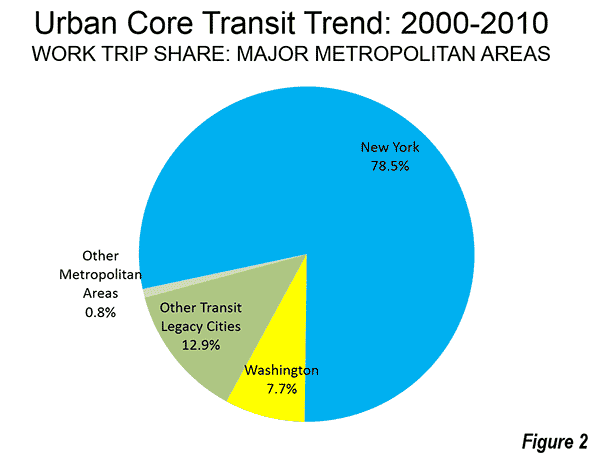
    Much attention has been given the increase in transit use in America. In context, the gains have been small, and very concentrated (see: No Fundamental Shift to Transit, Not Even a Shift). Much of the gain has been in the urban cores, which house only 14 percent of metropolitan area population. Virtually all of the urban core gain (99 percent) has been in the six metropolitan areas with transit legacy cities (New York, Chicago, Philadelphia, San Francisco, Boston, and Washington).

    In recent articles, I have detailed a finer grained, more representative picture of urban cores, suburbs and exurbs than is possible with conventional jurisdictional (core city versus suburban) analysis. The articles published so far are indicated in the "City Sector Articles Note," below.

    Transit Commuting in the Urban Core

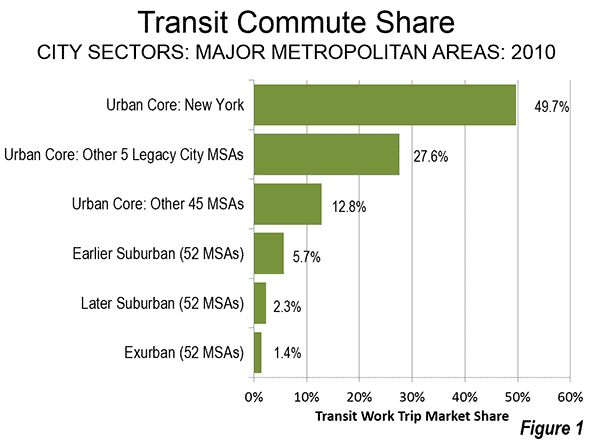
    As is so often the case with transit statistics, recent urban cores trends are largely a New York story. New York accounted for nearly 80 percent of the increase in urban core transit commuting. New York and the other five metropolitan areas with "transit legacy cities" represented more than 99 percent of the increase in urban core transit commuting (Figure 1). This is not surprising, because the urban cores of these metropolitan areas developed during the heyday of transit dominance, and before broad automobile availability. Indeed, urban core transit commuting became even more concentrated over the past decade. The 99 percent of new commuting (600,000 one-way trips) by transit in the legacy city metropolitan areas was as well above their 88 percent of urban core transit commuting in 2000.

    New York’s transit commute share was 49.7 percent in 2010, well above the 27.6 percent posted by the other five metropolitan areas with transit legacy cities. The urban cores of the remaining 45 major metropolitan areas (those over 1,000,000 population) had a much lower combined transit work trip market share, at 12.8 percent.

    The suburban and exurban areas, with 86 percent of the major metropolitan area population, had much lower transit commute shares. The Earlier Suburban areas (generally median house construction dates of 1946 to 1979, with significant automobile orientation) had a transit market share of 5.7 percent, the Later Suburban areas 2.3 percent and the Exurban areas 1.4 percent (Figure 2).

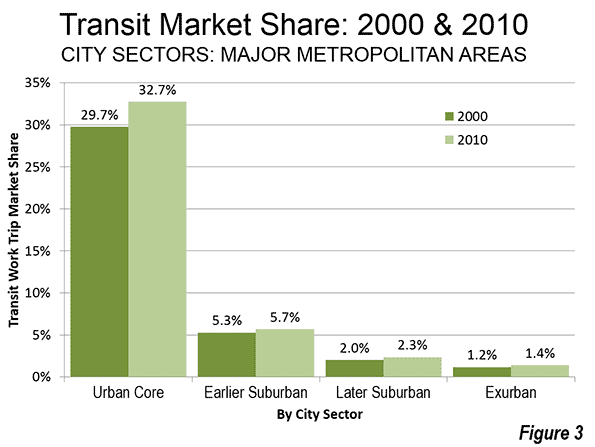
    The 2000s were indeed a relatively good decade for transit, after nearly 50 years that saw its ridership (passenger miles) drop by nearly three-quarters to its 1992 nadir. Since that time, transit has recovered 20 percent of its loss. Transit commuting has always been the strongest in urban cores, because the intense concentration of destinations in the larger downtown areas (central business districts) that can be effectively served by transit, unlike the dispersed patterns that exist in the much larger parts of metropolitan areas that are suburban or exurban. Transit’s share of work trips by urban core residents rose a full 10 percent, from 29.7 percent to 32.7 percent (Figure 3).

    There were also transit commuting gains in the suburbs and exurbs. However, similar gains over the next quarter century would leave transit’s share at below 5 percent in the suburbs and exurbs, because of its small base or ridership in these areas.

    Walking and Cycling

    The share of commuters walking and cycling (referred to as "active transportation" in the Queen’s University research on Canada’s metropolitan areas) rose 12 percent in the urban core (from 9.2 percent to 10.3 percent), even more than transit. This is considerably higher than in suburban and exurban areas, where walking and cycling remained at a 1.9 percent market share from 2000 to 2010.

    Working at Home

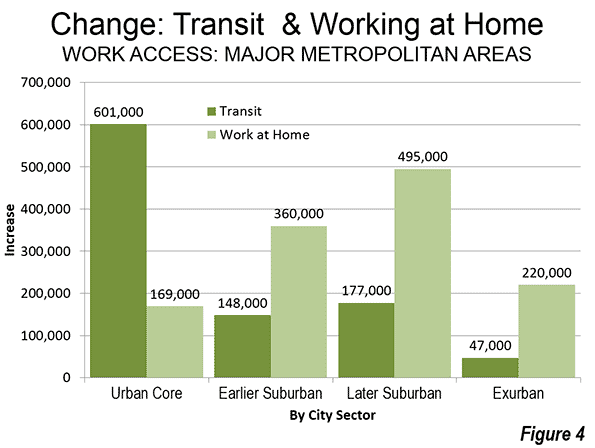
    Working at home (including telecommuting) continues to grow faster than any work access mode, though like transit, from a small base. Working at home experienced strong increases in each of the four metropolitan sectors, rising a full percentage point or more in each. At the beginning of the decade, working at home accounted for less work commutes than walking and cycling, and by 2010 was nearly 30 percent larger.

    The working at home largest gain was in the Earlier Suburban Areas, with a nearly 500,000 person increase. Unlike transit, working at home does not require concentrated destinations, effectively accessing employment throughout the metropolitan area, the nation and the world. As a result, working at home’s growth is fairly constant across the urban core, suburbs and exurbs (Figure 4). Working at home has a number of advantages. For example, working at home (1) eliminates the work trip, freeing additional leisure or work time for the employee, (2) eliminates greenhouse gas emissions from the work trip, (3) expands the geographical area and the efficiency of the labor market (important because larger labor markets tend to have greater economic growth and job creation, and it does all this without (4) requiring government expenditure.

    Driving Alone

    Despite empty premises about transit’s potential, driving remains the only mode of transport capable of comprehensively serving the modern metropolitan area. Driving alone has continued its domination, rising from 73.4 percent to 73.5 percent of major metropolitan area commuting and accounting for three quarters of new work trips. In the past decade, driving alone added 6.1 million commuters, nearly equal to the total of 6.3 million major metropolitan area transit commuters and more than the working at home figure of 3.5 million. To be sure, driving alone added commuters in the urban core, but lost share to transit, dropping from 45.2 percent to 43.4 percent. In suburban and exurban areas, driving alone continued to increase, from 78.2 percent to 78.5 percent of all commuting.).

    Density of Cars

    The urban cores have by far the highest car densities, despite their strong transit market shares. With a 4,200 household vehicles available per square mile (1,600 per square kilometer), the concentration of cars in urban cores was nearly three times that of the Earlier Suburban areas (1,550 per square mile or  600 per square kilometer) and five times that of the Later Suburban areas (950 per square kilometer). Exurban areas, with their largely rural densities had a car density of 100 per square mile (40 per square kilometer).

    Work Trip Travel Times

    Despite largely anecdotal stories about the super-long commutes of those living in suburbs and exurbs, the longest work trip travel times were in the urban cores, at 31.8 minutes one-way. The shortest travel times were in the Earlier Suburbs (26.3 minutes) and slightly longer in the Later Suburbs (27.7 minutes). Exurban travel times were 29.2 minutes. Work trip travel times declined slightly between 2000 and 2010, except in exurban areas, where they stayed the same. The shorter travel times are to be expected with the continuing evolution from monocentric to polycentric and even "non-centric" employment patterns and a stagnant job market (Figure 5).

    Contrasting Transportation in the City Sectors

    The examination of metropolitan transportation data by city sector highlights the huge differences that exist between urban cores and the much more extensive suburbs and exurbs. Overall the transit market share in the urban core approaches nine times the share in the suburbs and exurbs. The walking and cycling commute share in the urban core is more than five times that of the suburbs and exurbs. Moreover, the trends of the past 10 years indicate virtually no retrenchment in automobile orientation, as major metropolitan areas rose from 84 percent suburban and exurban in 2000 to 86 percent in 2010. This is despite unprecedented increases is gasoline prices and the disruption of the housing market during worst economic downturn since the Great Depression.

    —————————-

    Wendell Cox is principal of Demographia, an international public policy and demographics firm. He is co-author of the "Demographia International Housing Affordability Survey" and author of "Demographia World Urban Areas" and "War on the Dream: How Anti-Sprawl Policy Threatens the Quality of Life." He was appointed to three terms on the Los Angeles County Transportation Commission, where he served with the leading city and county leadership as the only non-elected member. He was appointed to the Amtrak Reform Council to fill the unexpired term of Governor Christine Todd Whitman and has served as a visiting professor at the Conservatoire National des Arts et Metiers, a national university in Paris.

    Photograph: DART light rail train in downtown Dallas (by author)

    —————————-

    City Sector Note: Previous articles in this series are listed below:
    From Jurisdictional to Functional Analyses of Urban Cores & Suburbs
    The Long Term: Metro American Goes from 82 percent to 86 percent Suburban Since 1990
    Functional v. Jurisdictional Analysis of Metropolitan Areas
    City Sector Model Small Area Criteria

  • Enterprising States 2014: Re-creating Equality of Opportunity

    This is the executive summary for the U.S. Chamber of Commerce Foundation’s 5th Annual Enterprising States report, authored annually by Praxis Strategy Group. View the interactive map with state-by-state data and download the full report here.

    The growing skills gap is one of the most persistent challenges affecting thriving and lagging state economies—the disparity between the skills companies need to drive growth and innovation versus the skills that actually exist within their organizations and in the labor market. This disconnect, expected to grow substantially as the boomer generation retires, causes workers and companies to miss out on realizing their full potential. A sizable skills gap impacts virtually every aspect of the economy, thereby affecting our national competitiveness and, in turn, causing the economy to fall short of its potential.

    The nature of the skills gap that employers face varies by geography. Each state has its own economic DNA with varying levels of growth and specialization for each industry. The energy-related skills gap in Texas or North Dakota, for example, is different from a manufacturing-driven gap in Michigan, aerospace in Washington, information technology in Utah, or the chemical industry in Louisiana.

    Businesses and the public sector must work side by side to identify where there is a deficit of talent, reskill incumbent workers, and skill new entrants into the workforce to close the gaps within their communities. This is not a problem that can be solved quickly, but it can be solved. Strengthening America’s science, technology, engineering, and mathematics (STEM) and middle-skills pipeline will require public-private partnerships as well as collaborations across federal, state, and local governments.

    States as a Focal Point for Action

    States and their governors play a pivotal role in filling the talent pipeline, providing critical leadership to link businesses with the education, workforce, and economic development systems. Solutions will vary by state of course, but there is an emerging framework built on a foundation of both basic education and an employer-responsive workforce pipeline.

    Economic development starts with strong schools focused on 21st century skills. For the past three decades, efforts by U.S. businesses, government, and educational organizations focused on retooling K–12 science, mathematics, and reading education and on addressing persistently high dropout rates in inner cities. Progress has been slow to remedy the looming skills shortage, but there is a growing sense of optimism that industry sector partnerships, greater attention to career pathways, and the implementation of integrated education and training will help to close the gap.

    An employer-responsive talent pipeline requires aligning education, workforce development, and economic development. Postsecondary education institutions now get a considerably lower percentage of their funding from state sources than just a decade ago, but states continue to make significant financial investments in higher education. Yet, a common refrain is that postsecondary offerings—at both two- and four-year institutions—are not sufficiently aligned with the skills needed in the workforce. For years, knowledge creation, research and development, and technology transfer have dominated higher education’s economic development role. However, higher education’s most important contribution to state economic competitiveness in the future might be teaching and talent production because states with the most high-level talent will have a leg up in the future economy of decentralized global networks.

    Investing in people is perhaps the most effective long-term economic growth strategy. Training and education offer the best chance for workers to find well-paying long-term employment, while providing businesses and employers in every sector with the talent they need to grow.

    Coordinating education, workforce development, and economic development has proven to be challenging among the states because the three fields are historically separate systems, with separate cultures and perspectives. States that are successful in navigating program integration and facilitating collaboration between these traditionally separate institutions will put themselves in the forefront of meeting one of the primary challenges to building a 21st century economy.

    Because of these complexities, a governor serves the issue best by playing a leadership role in forming partnerships – particularly between business and education – and creating the structure to ensure effectiveness and efficiency in a demand-driven education to workforce pipeline. Often this involves a decentralized approach so that more decisions can be made at the local level.

    Enterprising States 2014

    Now in its fifth edition, the Enterprising States study measures state performance overall and across five policy areas important for job growth and economic prosperity. Those five areas include:

    • Talent Pipeline
    • Exports and International Trade
    • Technology and Entrepreneurship
    • Business Climate
    • Infrastructure

    The 2014 report relates these policies and practices to the need for collaboration between education, workforce development, and economic development to positively combat the nation’s growing skills gap.  

    Top Performers

    Utah lands in the top 6 in each of the five policy categories and 3rd in overall economic performance. It is the only state to finish in the top 10 on all six lists.

    Colorado appears on 5 top 10 lists, Texas on 4, and Washington is in the top 15 of five lists.

    North Dakota is another strong performer, leading by a large margin in economic performance and ranking 1st in talent metrics and 9th in business climate.

    Florida and Nevada rank well on many policy measures, a sign that the economies of those states may be ripe for a turnaround.

    Virginia ranks 5th in technology and entrepreneurship, and talent metrics, helping it land just outside the top 10 in economic performance.

    Minnesota ranks 10th in economic performance, partly due to its second place in talent pipeline. 

    See how your state ranks by viewing our interactive map. Or view a PDF of the full report.

    Enterprising States is authored by Praxis Strategy Group along with Joel Kotkin. Praxis Strategy Group is an economic research, analysis, and strategic planning firmJoel Kotkin is executive editor of NewGeography.com and author of the forthcoming The New Class Conflict.