Blog

  • Composite Traffic Congestion Index Shows Richmond Best

    It is important that traffic congestion be controlled sufficiently to facilitate a more competitive metropolitan economy. Each year, three organizations produce traffic congestion reports, Tom Tom, INRIX and the Texas Transportation Institute of Texas A&M University (TTI). These reports use  different methods to estimate the excess time lost in traffic congestion during peak travel periods (morning and evening week day "rush hours").   

    The excess travel time is estimated relative to the travel time that would be expected if there were no congestion (if all traffic were free flowing). Economists caution that achieving free flow conditions at all times would require excessive investment. Yet, the standard metric used by the three indexes are useful for comparing the intensity of traffic congestion between metropolitan areas even without knowing the level at which economic efficiency is optimized.

    There is generally strong correlation between the three indexes, though there are important differences. For example, the TTI report uses data from INRIX, yet agrees with INRIX on only six of the most congested 11 US major metropolitan areas (over 1 million population). The most substantial difference is in San Francisco, which INRIX (and Tom Tom) ranked as the second most congested major metropolitan area, far worse than the TTI ranking of 20th.

    The findings from the three traffic congestion indexes are synthesized into a composite congestion index in this article. Because the TTI’s latest index is 2011, composite index covers 2011 through 2013 (for methodology, see Note 1).

    Worst Traffic Congestion in 2011-2013

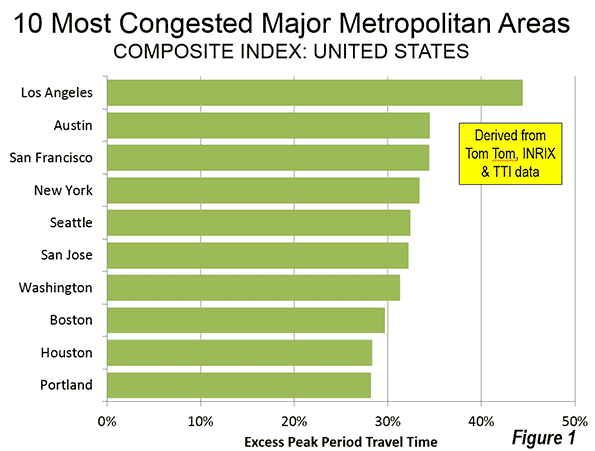
    The "10 worst traffic congestion" list includes some of the largest metropolitan areas, those with the highest urban population densities and a few smaller metropolitan areas with special traffic congestion inducing conditions (Figure 1).

    Los Angeles has the worst traffic congestion in each of the three indexes (44.4% excess travel time). This is consistent with the now 30 year history of TTI, which has typically shown Los Angeles to have the worst traffic congestion. This is not surprising, since Los Angeles is the densest urban area in the nation, ahead of second place San Francisco by 10 percent and New York by 30 percent. Traffic congestion has been made worse by cancellation of planned freeways and freeway segments in the Los Angeles area, such as the Beverly Hills Freeway, the Slauson Freeway, the Reseda Freeway, the La Cienega Route 170 freeway, the South Pasadena "missing link" and others (Note 2).

    Austin ranked second in traffic congestion (34.5%). This may be surprising, since Austin is not among the largest major metropolitan areas, though it is among the fastest growing. In the middle 1950s, when the final plans for the interstate freeway system were completed, Austin was much smaller and only a single interstate route was justified. Later, opposition to freeway development led to increased congestion. In more recent years the Austin freeway system has been augmented by new toll roads, though roadway improvements have not been sufficient to deal with the rapidly rising demand.

    Not surprisingly, San Francisco (34.4%), with the second highest urban density among major metropolitan areas, ranked third in traffic congestion. New York (33.4%), with its higher than average density and dense core area ranked fourth in traffic congestion. Seattle ranked fifth (32.4%), despite its somewhat lower urban density. Seattle’s long and relatively narrow north-south urban form and modest north-south freeway capacity is an important contributor to its intense traffic congestion. As in the case of Los Angeles, some planned freeways were canceled, which has also exacerbated traffic congestion.

    San Jose is a smaller major metropolitan area, yet has the sixth worst traffic congestion in the nation (32.2%). There are two principal contributing factors, its proximity to much larger San Francisco and the third highest urban density of the major metropolitan areas, 10 percent above New York.

    Washington (31.3%) and Boston (29.7%) have the seventh and eighth worst traffic congestion respectively. In each case, core areas have little freeway capacity (in part because of freeway cancellations in both cities).

    Houston, which had the worst traffic congestion the nation during the middle 1980s, now ranks much better, at ninth (28.3%). Houston’s improvement has occurred because of the roadway expansions opened concurrent with some of the fastest population growth in the high income world over the past three decades.

    Portland, like San Jose and Austin is not among the larger major metropolitan areas. Yet Portland ranked 10th in traffic congestion (28.2%). Portland’s policies, such as densification, have contributed to this; these include a cancelled freeway and a preference for light rail over highway capacity expansion. According to the TTI index, Portland has seen its peak period congestion ranking rise from 47th worst (out of 100) in the middle 1980s to 6th worst in 2011.
    Least Traffic Congestion in 2011-2013

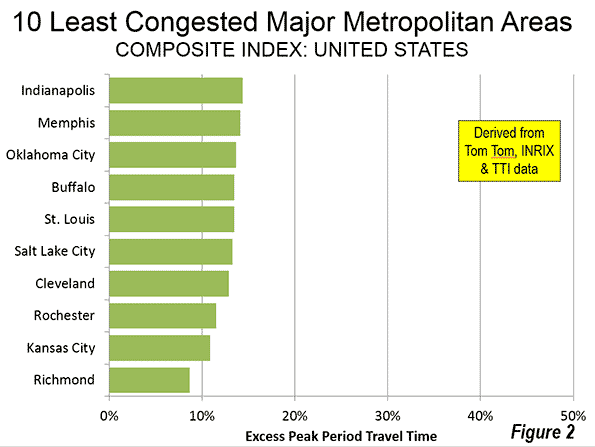
    The major metropolitan areas with lower levels of congestion tend generally to be smaller and to have lower urban population densities (Figure 2).

    Richmond is the least congested major metropolitan area in the nation (8.7%), and has experienced growth since 2000 that is greater than average. Kansas City had the second least traffic congestion (10.9%), while nearly stagnant growth Rochester (11.5%) and Cleveland (12.9%) ranked third and fourth. Faster growing Salt Lake City ranked fifth (13.3%). Population losing Buffalo ranked sixth (13.5%) edged out seventh ranked and slow growing St. Louis (13.5%). Faster growing Oklahoma City ranked eighth (13.7%), while slower growing Memphis ranked ninth (14.1%). Indianapolis (14.4%), one of the few Midwestern metropolitan areas growing faster than average, has the 10th lowest traffic congestion level.
    Traffic Congestion and Density

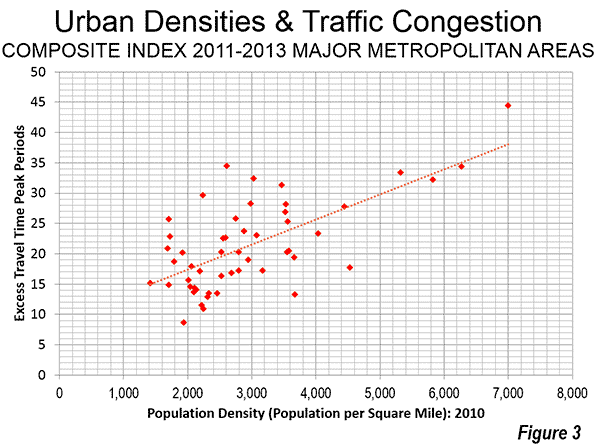
    The connection between higher levels of traffic congestion and higher urban population densities has been documented in various analyses (also here). The traffic congestion index confirms that metropolitan areas with higher urban densities generally have more intense traffic congestion (Figure 3). Obviously, there are other factors that contribute to traffic congestion, not least the insufficient provision of highway capacity. This is evidenced by growing Dallas-Fort Worth and Phoenix, where state and local officials have provided substantial increases in highway capacity. Traffic congestion index shows Dallas-Fort Worth to have only the 16th worst traffic congestion and Phoenix to have the 33rd worst traffic congestion (out of the 52 major metropolitan areas). Greater employment dispersion can also be an important factor. The data for each of the major metropolitan areas is in the Table.
    Composite Traffic Congestion Index: 2011-2013
    Excess Travel Time: Peak Periods
    Rank Metropolitan Areas Index
    1 Los Angeles 44.4
    2 Austin 34.5
    3 San Francisco 34.4
    4 New York 33.4
    5 Seattle 32.4
    6 San Jose 32.2
    7 Washington 31.3
    8 Boston 29.7
    9 Houston 28.3
    10 Portland 28.2
    11 Miami 27.8
    12 Chicago 26.9
    13 Philadelphia 25.8
    14 Atlanta 25.7
    15 Denver 25.3
    16 Dallas-Fort Worth 23.7
    17 San Diego 23.3
    18 Baltimore 23.1
    19 Nashville 22.9
    20 Minneapolis & St. Paul 22.7
    21 Tampa-St. Petersburg 22.6
    22 Charlotte 20.9
    23 New Orleans 20.5
    24 Orlando 20.3
    24 Virginia Beach 20.3
    24 Riverside-San Bernardino 20.3
    27 Pittsburgh 20.2
    28 Sacramento 19.4
    29 San Antonio 19.0
    30 Hartford 18.7
    31 Cincinnati 17.9
    32 Las Vegas 17.7
    33 Phoenix 17.2
    33 Detroit 17.2
    35 Providence 17.1
    36 Columbus 16.8
    37 Milwaukee 16.3
    38 Jacksonville 15.7
    39 Birmingham 15.2
    40 Raleigh 14.9
    41 Louisville 14.6
    42 Indianapolis 14.4
    43 Memphis 14.1
    44 Oklahoma City 13.7
    45 St. Louis 13.5
    45 Buffalo 13.5
    47 Salt Lake City 13.3
    48 Cleveland 12.9
    49 Rochester 11.5
    50 Kansas City 10.9
    51 Richmond 8.7
    Derived from Tom Tom, INRIX and Texas Transportation Institute data


    Traffic Congestion and Economic Growth

    While there are different interpretations of the appropriate standard for traffic congestion, there is no question but that less traffic congestion benefits a metropolitan area’s competitiveness. Because traffic congestion increases travel times, it necessarily reduces the share of a metropolitan area’s (labor market) jobs that can be reached by the average employee. A considerable body of research associates greater access (measured in time) with improved economic performance and job creation.

    —–

    Note 1: The 2011 – 2013 index represents the average excess travel time estimate of the three sources. For each source, each metropolitan area’s excess travel time is converted to a percentage of the metropolitan area with the worst excess travel time. These percentages are then averaged and the final excess travel time estimate is calculated by applying this percentage to the average worst excess travel time for the three sources. But these estimates are based on the TTI travel time index, and the peak hour excess travel time percentages from INRIX and Tom Tom (the Tom Tom figure is obtained by averaging data from the morning and evening peak period).

    Note 2: I have a personal attachment to the Long Beach Freeway "missing link" in South Pasadena. In the early 1960s my great aunt and her husband were forced to sell their home taken to the California Highway Department for the imminent construction of the roadway. This was the beginning of a decades-long fight to keep the freeway from splitting the city of South Pasadena. In the early 1980s, as a member of the Los Angeles County Transportation Commission I was appointed to a special committee chaired by County Supervisor Peter F. Schabarum to make a final route selection between the Caltrans "Meridian" route and the South Pasadena preferred "Westerly Route." Our decision, the result of submittals and hearings, confirmed the Caltrans route, but did nothing to alleviate the South Pasadena opposition. Now, there is the possibility of building a tunnel, which would minimize surface disruption.

    —-

    Wendell Cox is principal of Demographia, an international public policy and demographics firm. He is co-author of the "Demographia International Housing Affordability Survey" and author of "Demographia World Urban Areas" and "War on the Dream: How Anti-Sprawl Policy Threatens the Quality of Life." He was appointed to three terms on the Los Angeles County Transportation Commission, where he served with the leading city and county leadership as the only non-elected member. He was appointed to the Amtrak Reform Council to fill the unexpired term of Governor Christine Todd Whitman and has served as a visiting professor at the Conservatoire National des Arts et Metiers, a national university in Paris.

    Photo: Richmond (major metropolitan area with the least traffic congestion) by CoredestayChiKai
  • Let’s Make Kalamazoo’s Promise America’s Promise

    In 2005, in order to boost their city’s economy, a small group of donors in the city Glenn Miller made famous created the Kalamazoo Promise. It  offered any graduate of the city’s public schools a four-year scholarship covering all tuition and mandatory fees at any of Michigan’s public colleges or universities, provided those students maintained a 2.0 grade average in college and made regular progress toward a degree.

    The offer had an immediate and noticeable effect on public school enrollments and home construction within the city as families moved back in to take advantage of the chance to boost their children’s higher education opportunity. Enrollments in the public schools rose initially by 17.6% even as high school dropout rates fell by half. Residential construction permits within the district rose from 30% within the overall metropolitan area to 50%.  The program’s success caused other cities across the country as disparate as El Dorado, Arkansas and Tulsa, Oklahoma to adopt similar programs.

    Now a recent national study of the results of such initiative has documented the positive impact such promise programs can have on increasing educational attainment, while encouraging more students to attend a wide range of colleges.  University of Pittsburgh professors, LeGower and Walsh found that programs offering scholarships to all students regardless of merit, and to the widest range of two and four year colleges and universities, saw the biggest gains in enrollment. Their research published in a National Bureau of Economic Research working paper, documented enrollment gains in Kalamazoo and other identical programs.

    With these compelling results in hand, it’s time to make Kalamazoo’s promise America’s promise. A bi-partisan proposal from the non-profit Redeeming America’s Promise seeks to do just that by creating a federal American Promise Scholarship program that would pay the cost of tuition for every academically capable and personally determined high school student in America from families earning $180,000 or less. The plan would offer two year scholarships for high school graduates of $2500 per year, and four year scholarships worth on average $8500 per year to students graduating with a 2.75 GPA. These rates represent the current average cost of in state resident tuition at our public community colleges and universities. States would need to agree to accept such scholarships in lieu of any tuition payments from the families of APS students and at a minimum maintain their current level of support for their institutions. Additional incentives would be provided to encourage them to do even more to make sure a college education is both accessible and affordable for their residents. According to the Bipartisan Policy Center, there is $52 billion in current expenditures which can be used to fund the American Promise Scholarships by redirecting the money the federal government currently spends on tuition tax credits as well as by integrating the Pell Grant program into this new form of support.

    Other parts of the plan, which can be downloaded in its entirety at redeemingamericaspromise.org, would provide additional support for students who are the first in their family to attend college and reward college completion as well as post-graduation service to community or country. Money for these programs can be found by reducing the level of profits the government currently makes on student loans and ending other college support programs which have not proven their effectiveness.  

    The current system of financing higher education is unsustainable.  Student loan debt, which is not dischargeable in bankruptcy, now exceeds one trillion dollars—more than all the credit card debt in the country. The burden is felt disproportionately by lower and middle income families and is a severe drag on the desire of members of the Millennial Generation (born 1982-2003) to start a family, buy a house and have children. Furthermore, there is no historical precedent for placing such a burden on our youngest citizens.

    Since the country’s founding, education has been a key component of the promise of upward economic mobility. This has been true in every era, beginning with the Northwest Ordinance setting aside land for one room schoolhouses to the institution of mandatory, free primary education in all states at the time of the Civil War. The expansion of educational opportunities continued in the 20th Century as our growing Industrial Age economy required workers with a high school education for our factories and offices. Government funds in every state and community were set aside to provide a free, public high school education for boys and girls to respond to these new demands. Later in the century, after WWII, the GI Bill of Rights and then the Higher Education Act 0f 1965 were enacted to further encourage college enrollment, thereby establishing the educational foundation for our rapidly expanding middle class. It is only in this century that we have asked a generation, Millennials, to self-finance the education they need, and our country needs, to be economically successful.

    This wrong-headed inter-generational and economically disastrous policy needs to end before America loses its global competitive edge for good. The current system is creating a skills gap.

    America needs to make Kalamazoo’s Promise a promise every American can count on and that can address the growing skills gap in many parts of the occupational spectrum.  By joining with the Democrats and Republicans, young and old, who are already supporting Redeeming America’s Promise’s plan to make college tuition free we can ensure that day arrives sooner rather than later.

    Morley Winograd is co-author of the newly published Millennial Momentum: How a New Generation is Remaking America and Millennial Makeover: MySpace, YouTube, and the Future of American Politics and fellow of NDN and the New Policy Institute.

    Graduation photo by Bigstock.

  • The Ugly City Beautiful: A Policy Analysis

    When it comes to the future, Detroit and San Francisco act as poles in the continuum of American consciousness. Detroit is dead and will continue dying. San Francisco is the region sipping heartily from the fountain of youth. Such trajectories, according to experts, will go on indefinitely.

    Harvard economist Ed Glaeser has a grim outlook for the Rust Belt. “[P]eople and firms are leaving Buffalo for the Sunbelt because the Sunbelt is a warmer, more pleasant, and more productive area to live,” he writes in City Journal.

    Glaeser echoes this sentiment in a recent interview with International Business Times, saying “[s]mart people want to be around other smart people”, and the Rust Belt has a long slog ahead given that “post-industrial city migration is dominated by people moving to warmer climes”.

    But is this true? Is there a “brain drain” from the Rust Belt to the Sun Belt and Coasts? In a word: no. But Rust Belt leaders have bought this narrative hook line and sinker, and the subsequent hand-wringing has led to wasteful public investment.

    “Michigan’s cities must retain and attract more people, including young knowledge workers, to its cities by making them attractive, vibrant, and diverse places,” reads a 2003 memo from the National Governor’s Association about Michigan’s “Cool Cities” campaign.

    But the campaign struggled. “Government can’t mandate cool,” reflected Karen Gagnon, the former Cool Cities director. “As soon as government says something is cool, it’s not.”

    What’s worse, “cooling you city” with talent attraction expenditures can exacerbate economic disparities on the ground. Cities, like Chicago, are increasingly becoming bifurcated cities based on faulty assumptions that “trickle down urbanism” works. That said, the challenge of the day—for not only Rust Belt cities, but all cities—is not “brain drain”, but “brain waste”. Those cities who can best rebuild middle class communities tied to emerging markets will be the future of investment, like they were in the past.

    Through Rust-Colored Glasses

    When a people fall from grace, the sentiment of decline tends to stick. The Rust Belt’s demise is cemented. Meanwhile, the future is elsewhere. Like toward the sun. For instance, from 2000 to 2010, the Sun Belt metros of Houston, Dallas, Atlanta, Riverside, Las Vegas, Miami, Orlando, and Phoenix experienced the largest population growth. The biggest losers? It’s a “who’s who” of Rust Belt metros, led by Detroit, Cleveland, Pittsburgh, and Buffalo.

    America is a country governed by growth: big cars, big belt buckles, big houses, and big populations. Shrinkage is weakness. It is a sign of place failure. The problem here is that population growth is an ineffective, broad-brush measure when trying to understand regional underlying dynamics. A new study by Jessie Poon and Wei Yin in the journal Geography Compass called “Human Capital: A Comparison of Rustbelt and Sunbelt Cities” details exactly that.

    In it, the authors compare human capital levels between the Sunbelt metros in California (including San Francisco and L.A.), Nevada, New Mexico, and Arizona with Rust Belt metros in Michigan, Ohio, Indiana, Pennsylvania, and upstate New York. When it comes to share of population with a college degree, the authors find that the Rust Belt is experiencing a brain gain equal to their Sun Belt peers from 1980 to 2010. Poon and Wei also found that skill ratios of immigrants is higher in the Rust Belt than Sunbelt. The authors note that despite population decline, the Rust Belt continues “to be important sites of human capital accumulation”.

    The study coincides with recent work out of the Center for Population Dynamics that shows Greater Cleveland’s number of 25- to 34-year olds with a bachelor’s or higher increased by 23% from 2006 to 2012, as well as Pittsburgh economist Chris Briem’s work that shows the metros of Pittsburgh, Detroit, and Cleveland rank 1st,, 6th, 7th in the country respectively when it comes to the number of young adults in the labor force with a graduate or professional degree.

    Beyond human capital, the Rust Belt continues to produce and export wealth at a massive pace. The “Chi-Pitts” mega-region, which mirrors the Rust Belt boundaries with the addition of Minneapolis, generates $2.3 billion in economic output, second only to the “Bos-Wash” mega-region that makes up the Northeast Corridor.

    Also, using IRS migration data from the 2009-2010 period, a team of researchers led by Michal Migurski showed that Los Angeles County, New York County, and Cook County sent the most people and money to the rest of the United States. Detroit’s Wayne County was fourth. Cleveland’s Cuyahoga County was 9th, one spot ahead of San Francisco County. Speaking to Esquire, which published the work in a visual called “Where Does the Money Go”, Migurski explains the findings:

    "We realized that if you look at the biggest ‘losers,’ essentially what you’re looking at are the biggest cities in the U.S.," Migurski says. One of those losers: New York County, which lost $1,306,548,000 and 15,100 people. "But does that actually mean New York is a big loser?" Migurski asks. "One of our ideas was that, you’re not a loser if you’re losing money. You’re an exporter." The sort of exporter, he says, that boosts the rest of the U.S. economy. Traditional Sun Belt retirement areas comprise the gainers; areas like South Florida and Southern California in particular, create what Migurski calls "money sinks."

    Still, the notion of “loser” for Wayne and Cuyahoga County sticks, despite evidence to the contrary. But why? Why the constant “poor post-industrial people” sentiment, if not a low-grade captivation that comes with “ruin porn” rubbernecking?

    Well, if an ideal exists—you know, the experts beckon: be the “new” city, the “hot” city, the “creative” city—then a study in contrasts is necessary. The Rust Belt, with its connotations of smoke stacks and demographic decline, fits the bill.

    “[Richard] Florida suggests that Rustbelt cities’ high concentration of less creative blue-collar workers also produces unhappy residents,”Poon and Wei conclude in their Rust Belt/Sun Belt study. “We suggest that such a doom and gloom picture of urban and regional development for the uncool industrial Rustbelt needs to be tempered with a trend of brain gain that is growing across cities in the region.”

    But for this tempering to happen a clearer understanding of the importance of accumulating human capital needs to be ascertained. More exactly: Is it to put your city to work, or to “live-work-play”?

    Build it and they will…what?

    In his 1921 work Economy and Society, social scientist Max Weber details a city’s raison d’etre. Cities can be producer cities, wherein importance is derived from industries that demand national and international trade. Think Detroit and cars. Additionally, cities are consumer cities, in which growth is tied to how much is spent consuming goods and services in the local economy. Think eating, drinking, and buying houses.

    The cities that are the most economically robust have wealth generated from global production, which in turn enables local consumption. San Francisco’s tech economy drives it real estate market and artisanal toast scene. That is, if the question was “What came first, the farm-to-table chicken or the egghead?” The answer is “the egghead”, hands down.

    But this logic—i.e., in order to go to a restaurant, you need a job, and your job prospects are tied to the viability of your region’s global industries—is often turned on its head in economic development. Here, the goal is growth, no matter the rhyme or reason.

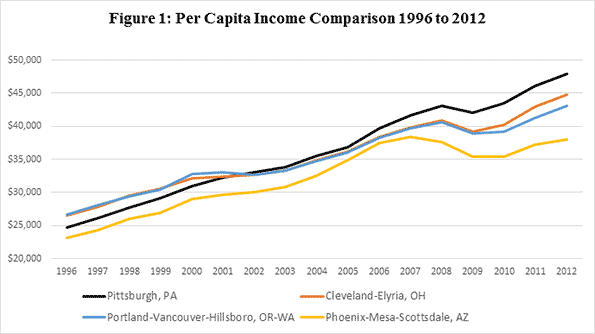
    “Like in many Sun Belt cities,” writes a Seattle Times columnist and Sun Belt expat, “Phoenix’s economic plan devolved into merely adding people, no matter the enormous long-term costs”. The columnist goes on to note that while the population has boomed, the city lags on most measures, such as per capita income (see Figure 1 below).

    Moreover, the Phoenixes of the world exist partly because of retired Baby Boomers and the disposable income that comes with it. The Sun Belt feeds off the legacy of production in the Northeast and Midwest. Other cities, like Portland, are fed by a not dissimilar dynamic. But it’s not the retired who come, rather the pre-retired.

    “The Portland metro area’s young college-educated white men are slackers when it comes to logging hours on the job,” lead’s a piece in the Oregonian about a study conducted last year, “and that’s one reason people here collectively earn $2.8 billion less a year than the national average.” Figure 1 demonstrates Portland’s sluggish income gains compared to Rust Belt peers Pittsburgh and Cleveland.

    Similarly, in a paper circulated by the Federal Reserve Bank of Atlanta, the author analyzed the top 86 “brain gain” metros in the nation to determine whether or not a region’s increase in human capital was paying off in terms of per capita income, labor force participation, poverty rate, and unemployment. The author found Portland was one of twelve metros that experienced zero economic outcomes. Pittsburgh scored 4 for 4. The authors suggest that talent attraction and retention—when untethered to production capacity—“may be largely inefficient, a kind of traditional economic development ‘buffalo hunting’”.

    Portland is perhaps America’s consummate lifestyle city. No doubt, the city has experienced a significant brain gain over the last decade. Portland is a talent attraction model. But it is not a talent producing or refining model. Rather, Portland is producing a scene that is run by the consumption of the scene’s aesthetic. Writes one young worker who left:

    “I can’t stay too long because I know if I stayed a day too long in Portland, I’d suddenly be happy to embrace the slow pace of the city and stop working… I’d end up getting sleeping real late every day, drink some coffee, maybe write some poetry on my porch (or not), and then find a part time job selling cigars like I had in college.”

    The lesson is that accumulating talent is not enough. There has to be something for the talent to do, or a context that fosters “doing”. It is also a warning for cities investing in the lifestyle game. Spending on creative class amenities ensures nothing. Creating a field of dreams won’t pay the bills. But it will run up the tab.

    The Ugly City Beautiful

    In 1998, the Chicago Sun-Times ran a piece called “Building the City Beautiful”. “The mayor of the city of Chicago, Richard M. Daley, is a big admirer of Martha Stewart,” it begins, before describing Daley’s plans to begin the "Martha Stewart-izing" of Chicago. The article goes on to quote a University of Illinois at Chicago professor who said Chicago is turning from a producer city to a consumer city. "The producer city was the industrial city — the smoke and the noise and the industrial jobs,” noted the professor. “The consumer city is the city of Starbucks, boutiques and so forth.”

    The professor was only partly right. By the 1990s, Chicago was indeed becoming brainier. But its emerging knowledge economy was an outgrowth of its “big shouldered” manufacturing base. Columbia University professor Saskia Sassen recently noted that pundits overlook this when examining the city’s transformation, with the bias being that “Chicago had to overcome its agro-industrial past, [and] that its economic history put it at a disadvantage”. Notes Sassen:

    [I]n my research I found that its past was not a disadvantage. In fact, it was one key source of its competitive advantage. The particular specialized corporate services that had to be developed to handle the needs of its agro-industrial regional economy gave Chicago a key component of its current specialized advantage in the global economy.

    Similar economic transformations from legacy cost to legacy asset are found throughout the whole of the Rust Belt. Pittsburgh, for instance, no longer provides the muscle for steel making, but it does act as the “brain center” for the world’s steel frame. How this came about is detailed in the article “Pittsburgh’s evolving steel legacy and the steel technology cluster”.

    With the arrival of the new economy also came “new economy” tastes. Sassen noted that when she arrived in to study in Chicago in the 90s she was greeted by “old lofts transformed into beautiful restaurants catering to a whole new type of high-income worker—hip, excited, alive.”

    In other words, local consumption patterns began setting up around the emergent worker demand. Going was the Italian Beef and arriving was pickled beets. This demand also impacted housing, with the attraction to urban living setting the stage for gentrification. This, in a nutshell, is the dynamic driving the transformation of urban neighborhoods nationwide: a new economy demands new workers which in turn demand a new kind of lifestyle. The problem, though, is that leaders have the causality backward, or that creating a new lifestyle will incur new worker supply and then poof: new industries. But as we see with Portland, it is not that easy. The industrial DNA and social history of your city matters more than the cosmetics atop the topography.

    Still, from a policy and strategy standpoint, it is easier just to make your city “cool”. And that’s exactly what Chicago has been doing at a significant pace. In a recent piece entitled “Well-healed in the Windy City”, author Aaron Renn details Mayor Rahm Emanuel’s policy of using tax-increment financing (TIF) to create geographic “winners” and “losers” across Chicagoland. “The true purpose of Chicago’s TIF districts—which now take in about $500 million per year,” writes Renn, “appears to be tending to high-end residents, businesses, and tourists, while insulating them from the poorer segments of the city.”

    The strategy was spelled out explicitly by Mayor Emanuel during a recent ribbon cutting for a bike path in Chicago’s Loop. Said Emanuel: “I expect not only to take all of their [Seattle and Portland’s] bikers but I also want all the jobs that come with this, all the economic growth that comes with this, all the opportunities of the future that come with this.”

    Notwithstanding the faulty logic in the strategy—e.g., if Portland lacks the jobs for its residents, how can it supply jobs for Chicagoans—the real problem is the costs associated with such bifurcated investment. In West and South Chicago, the byproducts of the City Beautiful approach are downright ugly. But they are not unexpected. They are the long-documented economic and social effects of concentrated poverty and segregation. Continues Renn:

    Safety levels in Chicago can no longer be plotted on a single bell-shaped curve for the entire city. Today, that curve is split into two—one distribution for the wealthy neighborhoods and one for the poor ones. A lack of resources is part of the problem: the police department is understaffed… While the city budget is tight, failing to increase police strength during a murder epidemic is a profound statement of civic priorities.

    Urban priorities flow from a perception of what is at stake. For long, the push for human capital accumulation has pitted city versus city amidst the backdrop of an urban popularity contest in which the “winner” is assured nothing outside of popularity. But victory in the vanity game is fleeting. The young and the restless are exactly that, and many people who come to New York or San Francisco, or for that matter Portland, leave as they get older and seek out affordable places to raise a family. What remains on the ground is the reality of brain waste. Without the prioritization of equitable, integrated middle-class neighborhoods a city’s progress will be always be disparate, if not illusory. Talent attraction is but part of a redevelopment process. So is talent refinement for those arriving and talent production for those in place. After all, neighborhoods are factories of human capital. Building people, not places, is what a successful city is all about.

    But to know this is to “know thyself”. The Rust Belt has been dying for some time now, so say the experts. The region has absorbed the projections, and given that desperate times call for desperate measures investment has been wasted. “[Creative class theory] is bad because it distracts from what’s important,” says Sean Stafford, author of Why the Garden Club Couldn’t Save Youngstown.

    Regaining focus entails removing the rust-colored glasses. Rust Belt leaders will see there are assets to work with, not to mention feel the freedom that comes with no longer being a study in contrast for those touting a future that really isn’t.

    Richey Piiparinen is Senior Research Associate at the Center for Population Dynamics at the Maxine Goodman Levin College of Urban Affairs at Cleveland State University. The Center for Population Dynamics at Cleveland State University’s Maxine Goodman Levin College of Urban Affairs aims to help partner organizations competitively position the region for economic and community development. It will do so through the lens of migration, applied demography, and culture.

    Lead photo courtesy of bctz Cleveland

  • California’s Choice – Growth or Decline

    I’ve been friends with Charlie Sena for almost two decades. Charlie, a longtime entrepreneur, Democratic political operative and fundraiser for former Gov. Gray Davis, recently chided me about what he sees as my “negativity” about California and its future. My response was that, given its natural advantages, this region should not be in such a weakened condition. Decline, I suggest, is not an imperative here, but largely a choice.

    Last week, I decided to confront this issue over lunch at Citrus Grille in Orange, just down the block from Chapman University, where I teach. Charlie noted that the negative points I was making were correct, but I owed it to the readers to “write a piece on why California can be, and should be, a state with the right climate for business growth.”

    So, we sat in the restaurant, working on a list of positive things for California to build on. We centered on working with our population, including many immigrants and entrepreneurs, reinforcing our connections to Asia and Mexico and, finally, taking advantage of our climate. “The great strength of California,” Charlie suggests, “is people – people who go out and make it on their own.”

    Immigrant Edge

    The first group Charlie pointed to are immigrants, a group for which California long has been a lure. Twenty percent of Californians are foreign-born, and one of four immigrants nationally lives in our state. Amidst a general downturn in overall entrepreneurial activities, notes a recent study, the foreign-born have continued to expand their business footprint. In 2011, notes the Kaufmann Foundation, immigrant start-up rates were twice those of the native-born.

    Attitudes are important here. To succeed in a highly regulated, expensive state like California, you need to have more than usual perseverance.

    Asians, for example, according to the Pew Research Center, are far more likely than other Americans to believe that “hard work” pays off. Not surprisingly, they also tend to have higher levels of education, income and business success than other Americans.

    But equally important has been the entrepreneurial growth among Latinos, who became the state’s largest ethnic group in 2014, according to demographers, and could be close to 50 percent of the population by 2050. Indeed, a recent study of Latino business found that Hispanic entrepreneurs have more than tripled since 1990, from 577,000 to more than 2 million. Not only did this growth outpace that of the overall population increase among Hispanics, but at a rate of increase far above the national average.

    Anyone who drives out into the vast expanses of the state can see these businesses – new markets, countless restaurants, small factories, farms, local banks and scores of smaller service firms. California’s new commercial signature is not the traditional mall or luxury shopping street, but, rather, multiethnic commercial areas, like the Diamond Jamboree center in Irvine.

    Rise of Self-employed

    But there’s also signs of greater growth in the ranks of self-employed people across the population. The self-employed proprietor is the one entrepreneurial category that has grown since the recession. This may well represent a pragmatic choice by business people who wish to make money, but avoid the ever-increasing regulations here that make having employees increasingly difficult.

    This growth is particularly vibrant in the Riverside-San Bernardino area, notes a recent study by the economic modeling firm EMSI Inc. The inland region expanded its sole-proprietor ranks by 11.8 percent since 2008, second to booming Houston and more than twice the growth rate of either the Bay Area or Los Angeles-Long Beach. All these key California areas greatly outperformed such competitors as Denver, Greater Washington, D.C., Chicago or Atlanta.

    Foreign connections

    California also has enjoyed a unique connection to the fast-growing economies of the Pacific Rim and Mexico. Texas succeeded in luring Toyota, as Tennessee did with Nissan, but neither state possesses the intense cultural and historic ties California enjoys with Japan and other Pacific Rim countries. To be sure, places like Plano, outside Dallas, and around Houston’s Bellaire Road look increasingly like the San Gabriel Valley or Garden Grove in their ethnic flavor, but they are at least a generation – and an order magnitude – behind.

    Where Texas eats our lunch, says Charlie, who lived in Houston years ago, is in forging ties with Mexico. Many Californians – particularly on the right but also on the “green” left – tend to regard Mexico as something of a threat to our social and ecological order. But supposedly less-enlightened Texas, where business is king, has developed a powerful passion for closer ties to Mexico, with a growing partnership between the Lone Star State and Mexico, which, for example, is already Houston’s foremost trading partner.

    Political dilemma

    So, why is California not taking advantage of these assets? One main reason lies with the regulatory and tax agendas of Charlie’s own party, something he is quick to acknowledge. “The Democratic Party,” he suggests, “is on a collision course with reality. They don’t realize that you need a broadly growing economy to support or expand social services.”

    This is the dilemma that progressives need to confront in California. An over-regulated, overtaxed economy slows business growth and forces companies to look elsewhere to expand, particularly outside of very high-end functions. Superhigh income tax rates deprive small-business owners of the capital they need to reinvest and grow their enterprises. Under the current regime, many of them, particularly the young, may find starting a business in Colorado, Nevada, Utah or Texas easier and more financially rewarding.

    Back to Pat?

    Like Charlie, I admire many of the things we created during the great expansion of the Gov. Pat Brown era, a half-century ago – the higher education system, the freeways, the water projects, to name three. All these were paid for by broad-based economic growth, and contributed to accelerating that growth over time. Our success made California a model for other states – including Texas and North Carolina – which wanted to leave behind their feudal, and deeply racist, pasts.

    Now, these people are essentially beating us at our own game, and unless we respond, they will continue to attract not only large businesses, such as Toyota and Occidental, but also talented people critical to the grass-roots economy.

    Politicians in Sacramento, and many city halls across this state, seem to have little notion of, or even interest in, economic growth beyond serving the interests of public employees and crony capitalists, whether in subsidized “green energy” boondoggles or among rent-seeking developers. These kind of policies are simply transfers of resources from neighborhoods, suburban or urban, to the well-placed; they have not been significant economic drivers.

    Charlie’s last point – climate – remains critical. This region is never going to become Detroit, no matter how misguided is our political class, simply because of its weather and topography. People and businesses will want to come here if they can make a decent living and enjoy the option of housing, largely single-family homes, that remains the ultimate goal of most upwardly mobile people, particularly immigrants.

    So, if maybe sometimes I get too negative about California, it’s in large part because we squander opportunities and seem determined to ignore all the basic economic data. In this shortcoming, the media, notably the Los Angeles Times, has been particularly gratuitous, acting as if the loss of key companies, such as Occidental and Toyota, was largely irrelevant and, indeed, inevitable.

    This is not, in my mind, the California I moved to four decades ago. That we do things differently here is not a negative – it’s why many of us are here – but we need to recognize that you cannot support an ever-expanding welfare state or do much of anything about climate change simply by chasing people and individuals elsewhere. We need to start developing policies that exploit our advantages and not rest on our glorious past. We need to see, as Charlie would say, that decline is not inevitable, but only a choice that too many in the state seem determined to embrace.

    This article first appeared in the Orange County Register.

    Joel Kotkin is executive editor of NewGeography.com and Distinguished Presidential Fellow in Urban Futures at Chapman University, and a member of the editorial board of the Orange County Register. He is author of The City: A Global History and The Next Hundred Million: America in 2050. His most recent study, The Rise of Postfamilialism, has been widely discussed and distributed internationally. He lives in Los Angeles, CA.

    Photo illustration by krazydad/jbum.

  • Bulgari to Taco Bell: Across China, Buyers Are the Target

    I work for myself, and when I travel to China on business I have the “luxury” of sleeping on trains and in hostels, and getting around during the day by bicycle. This spring I made a circuit from Beijing to Chengdu (in western China), to Wuhan (right in the middle), and to Shanghai (east coast), before heading back to Beijing. Ostensibly I was there to hunt down consumer trends.

    What I saw was:

    • Cars and smog are killing off the grace of the old cities
    • High-rise apartment towers have doomed more village markets than collectivization did
    • Much of China’s continuing economic boom is a currency sleight-of-hand, and
    • Chinese consumers are a lot less interested in Western brands than CEOs of multinationals would have us believe in their upbeat annual reports

    Herewith, notes from the lower berth on many sleepers and the saddle of whatever Giant bicycle I could rent, by which means I covered 3,134 miles in less than two weeks:

    Beijing: For grace and charm, nothing in China beats central Beijing. At night, the lights around Tiananmen Square glow like those along the grand canals of Venice. During the day, Beijing suffers from a carbon dioxide whiteout, China’s equivalent of London fog that has made the city a respiratory health disaster.

    Beijing is also at the uncomfortable crossroads of a political system struggling to accommodate dialectical materialism with emerging consumer pleasures. But the means of production are distant from Beijing power brokers, a reminder of how Marx railed against absentee landlords.

    The biggest contribution that the central bureaucracy has made to the Chinese economic miracle is to depreciate the renminbi to subsidize exports. With an exchange rate of ¥6.25 (yuan) to the US dollar, things that cost $150 in the West, such as a hotel room, are $24 in China.

    That accounts for an economic boom on the export side, but limits the demand for imported western products. If you are a Chinese worker who earns, on average, $900 a month, are you going to spend $150 on imported Air Jordans?

    The currency mismatch feeds the thriving market in Western knockoffs, but another reason for rip-off branding, I suspect, is that the idea of personal space is alien to Chinese daily life. Translated into consumer speak, that may explain why no one cares a fig about copyright laws, patents or trademarks.

    Across China: My train ride to western China lasted more than 24 hours. From my window, beyond the miasma that is Chinese air, were countless high-rise towers, many forty or fifty stories high, where rural residents have been resettled. Someday, China will be the people’s republic of tenement housing. The next revolution will begin when enough elevators are out-of-order.

    In the meantime, local shopping has become as centralized as once was the communist party. Big box stores — from Home Depot to the French supermarket Carrefour — are betting the ranch on making it alongside these brave new world housing complexes.

    The do-it-yourself corporate entities — a big fixture of malldom — have not yet figured out that Chinese women, not men, drive the Saturday afternoon purchases, and that few Chinese have SUVs to haul the stuff home.

    Chengdu: Yet another faceless city of the Asian miracle, Chengdu is clogged with late-model cars in traffic, and dotted with western boutiques and high-rise buildings.

    Cartier and Bulgari are on the best corners, but what attracts local crowds is American fast food, the ideal combination of Asian, on-the-go convenience and international branding, held together with US trans fats. Shares in YUM! Brands — the Chinese franchise owners of KFC, Pizza Hut, and Taco Bell — are up 600% since 1999.

    South of center city, I biked past the world’s largest building, the New Century Global Centre, about the size of four Astrodomes with the façade of an airport terminal. Part mall, part exhibition center, water park, university, iMax cinema, hotel, restaurant, and office complex, it’s a consumption monolith. Still, it has the feel of an enormous recycling center where government money is, so to speak, washed (maybe at the artificial beach?) into the accounts of the new class. So much for the Chinese economy prospering only as the result of long work hours.

    Wuhan: East of Chengdu, this Yangtze River city is a conglomeration of three Qing Dynasty districts into a modern juggernaut. It saw the first outbreak of the 1911 Revolution, remembered with a few Sun Yat-sen statues and museums (although he was in Hawaii when the first shots were fired).

    Crossing the Yangtze on a ferry — new China as a slow passage through the heart of darkness — the river water was the consistency of crankcase oil, and smog obscured the far shores, no doubt the byproduct of all that Appalachian coal that gets exported to China on Warren Buffet’s trains and bulk carriers.

    Doing my field research on Chinese consumerism in several superstores, including Walmart, and at Starbucks, I was fascinated at how little Western companies cater to Chinese tastes. It’s not only that there’s no Dragon Latte at Starbucks. One of the sins of branding is to add Chinese characters to Western labels, so French supermarkets in China look just like those in Paris.

    Maybe the centrally planned economy is alive and well, but it’s living in exile in places like Arkansas or Seattle? At least I didn’t hear anyone in Wuhan complaining about aisles full of junk made in China.

    Shanghai: Its new reputation is as China’s New York City, a blend of high-rise glitz and coastal sophistication. But that’s if you are in expense-account Shanghai, eating in all those revolving restaurants. I got around on long marches to metro stops and by bus and taxis— China on five traffic-jams-a-day.

    At a food services convention that I had travelled to attend, huge exposition halls were devoted to things like espresso machines and Italian gelato, the budding tastes of modern China.

    From the view at the convention hall, China looks like a treaty port of Western desires, with Mao’s capitalist road running through it. I wonder, though, if shoppers will ever make the switch from street vendors to the Great Mall.

    On the outskirts of Shanghai, a colonial-style shopping center had everything from Pizza Hut to Ben and Jerry’s ice cream. It was awash with French wines, English clothing, American cosmetics, Spanish fashions, and Swiss pharmaceuticals, but, when I was there, few customers. It felt like an ultra-upscale military PX, although the shoppers were as listless as terra cotta warriors. Build it and they will come?

    Wandering the aisles of China’s consumption centers, I came to the conclusion that Western sales representatives (with their sample bags) are the new missionaries. They’ve come to the East to preach salvation, based on new packaging for old products, but they’re as rigid in sticking to the gospels of Home Depot as they once were about peddling the Book of Mormon.

    As André Malraux wrote in 1933, as prescient about the Chinese revolution as he was about 2014 consumers, “Europeans never understand anything of China that does not resemble themselves.”

    Matthew Stevenson, a contributing editor of Harper’s Magazine, is the author of Remembering the Twentieth Century Limited, a collection of historical travel essays. His new book, Whistle-Stopping America, was recently published.

    Flickr photo, in Beijing’s Oriental Plaza shopping mall, & caption by Ming Xia, The Coca Cola Store: “China is a very receptive market to brand extension programs – Playboy clothing and Pepsi sneakers are ubiquitous in the PRC… this looks to me as if it is a test unit.”

  • Circling the Brain Drain

    It seems that Destination LI, “a nonprofit community building and educational organization dedicated to helping people create and sustain vibrant centers” on Long Island, has been quietly busy in recent months.

    Recently, the group released a survey, which, to nobody’s surprise, shows that millennials are not exactly thrilled with Long Island’s housing options.

    The solution? Those “vibrant” walkable communities that have been pitched so many times before. The survey also touched upon Long Island’s need for jobs that match millennial skillsets and salary expectations, two critical issues that policymakers must address.

    In a nutshell, “the survey, conducted on social media web forums between Feb. 27 and March 24, drew 413 respondents.” To solicit responses, the group used sites such as Facebook, Twitter, LinkedIn, Reddit and others. Seventy-five percent of those who participated said that they either “agree” or “strongly agree” that Long Island’s housing options limit their ability to stay, with 58.7 percent saying they currently live with parents or relatives.

    For perspective, consider this: According to U.S. Census data from 2010, there were 478,988 millennials in the Nassau-Suffolk region. Destination LI’s survey of 413 represents 0.08 percent of the sample size – far from a representative sample of that segment of population. Given the large gap between population and those surveyed online (which, by surveying standards, is a poor solicitation method), it’s important to take the results for what they are – anecdotal, but still an important commentary. Long Island clearly has issues with providing housing, but we’re going about it the wrong way.

    The survey brings to light significant questions concerning Long Island. Is regional housing availability holding millennials back, or is it Long Island’s stagnant economy? The survey infers that walkable apartments keep millennials here, but what about affordable single-family homes? Are apartments the only housing option for this age group? Is more development the answer to our regional woes? Are the survey’s findings legitimate given the methodology?
    Finally, the big question remains: Should developers be driving the regional conversation on housing needs?

    The answer to any of these questions is up for debate, but the last one should resonate. Have Long Islanders become so apathetic that they now are reliant upon stakeholders to conduct surveys that not only get ample press coverage, but are sure to influence policy decisions on the regional level? Shouldn’t planners be conducting these studies, with their recommendations being based off appropriate methodology and professionalism?

    Our policy solutions are only as good as the data that informs them. With land-use, the cost of failure is too expensive and repercussions too severe and far reaching to rely on stakeholder-driven solutions. We all are leaders in that we have the power to collectively shape our community. Let’s take back the reins and give our problems the thoughtful analysis they deserve.

  • Florida: When Density is Destructive

    Brick streets, mature old oaks, and a sense of history imbue Winter Park, Florida with a sense of place that is the envy of many small cities and towns. The tony Park Avenue brings shoppers and visitors, who soak up its ambience and enjoy the street life of this quaint southern town. On the east side, bounded by blue lakes, lie gentrified historical mansions, while the west side is a neighborhood of smaller, affordable homes with multigenerational Winter Parkers. This community of little single-family homes is now endangered by developers that are gobbling up parcels two and three at a time, increasing the density threefold, and squeezing out residents in a new, “zoning for dollars” economic climate.

    Affluence and affordability have always maintained an uneasy truce, and the balance between them has historically been protected by cities through planning policies and an understanding that the mission of a city is to be workable for all of its residents, not just the wealthiest. Unfortunately, this balance tilts when the density imperative drives land values up, and tips the scales in favor of half-million dollar townhomes. High density has become fashionable in Winter Park these days, as it has in many cities, and there are some benefits to this new style. The costs? Well, those will be counted later.

    Density’s benefits look great on paper: a higher tax base, expensive new housing, walkable urbanity. When implemented well, these can make for positive changes. Advocates preach careful, sensitive ways to develop: don’t smash large and small buildings together; don’t mix uses on a street, and ramp up from low to high density across a gradient of a block or two. Advocates also preach a consensus-building process to avoid neighborhood clashes over growth issues. In places where this has happened, like Coral Gables in Miami, the story has mostly been a good one.

    The west side of Winter Park, with its cottages and modest residences for families, dates back to the 1920s. Within the neighborhood are many small churches to which residents walk on Sundays. Playgrounds, parks, and a community center characterize the West Side’s tree-shaded streets, and its proximity to the downtown area means jobs for many of its residents. For the last ninety years, the city has evolved around this neighborhood, and many families go back several generations. Its diversity includes many African American families, mixing with whites. It carved out a niche in the city.

    Today, the West Side is an older and less affluent neighborhood that happens to be close to a desirable address. The West Siders have already chosen their preferred building pattern and rhythm, infilling their blocks with new homes of similar size and scale, enlarging the tax base. They already live a walkable urban lifestyle, use mass transit, and evolve with slow and organic growth. In short, every urbanist’s dream.

    Like many cities that have a working class enclave that butts up against a newly trendy one, Winter Park has encouraged dense, mixed-use development, while nominally protecting its existing neighborhoods. And this is where the density equation seems to fall apart. The residents who leave the area will no longer participate in the economy of Winter Park. The new residents of half-million-dollar townhomes probably won’t ride the bus, walk to the churches, or otherwise activate the local streets. So a natural piece of the city is lost forever. Urbanism, for all that has been written in favor of this ideology, is diminished for the sake of density.

    West Siders protested in City Hall, asking the city not to upzone their neighborhood. While City Hall nodded to its citizens, it had already quietly allowed upzoning to take place, taking advantage of tired homeowners who decided to cash in. Half-million-dollar townhomes, which could be built in other areas, are instead being built here, to take advantage of low land values. Parking garages and midrise apartments now cast shadows on the adjacent small houses. Land values may rise on those parcels with new townhomes and midrise apartments, but immediately next door, the remaining adjacent little one-story cottages become particularly undesirable; the value of those homes becomes depressed. The owners’ only hope is to sell off to a high-density developer. Step by step, high density becomes more and more inevitable as the only solution left.

    The market forces at work in Winter Park have played out elsewhere across the country, with old neighborhoods eroding. This time around, with density all but institutionalized as the only acceptable way to grow, the deck seems to be stacked against entrenched locals. Cities are re-writing their development codes in favor of shiny new mid-rises and high-rises, ignoring existing residents who won’t be missed till they are gone.

    When the market, an amoral institution without sentiment, threatens neighborhoods, it is the job of City Hall to provide a hedge that ensures balance and fair play. But citizens have to shout over the money in order to be heard, so local groups like the Friends of Casa Feliz have stepped in on their side. If “zoning for dollars” can work against this section of the city, groups fear, then no one is safe, and people are reminding City Hall of its duty as a guardian of its residents.

    Density, on its own, is neither a good nor a bad thing. It can make a city more efficient and connected, and proponents tout its reputed health benefits and contribution to a thriving social life. When, in the process of allowing density, a city destroys the very values that it is supposed to promote, then the city ends up cannibalizing its neighborhoods for little benefit other than the one-time gain that the developers will realize from the sale of these newly built products. Income streams are put into mortgage-holders’ pockets, and, bit by bit, one more highly localized economy disintegrates.

    City halls, so obsessed with petty regulations, would do well to recall their basic functions as protectors of their residents. If there were a “back to basics” movement for government, many ordinances written to benefit the few would be shed, and there would be a refocus of attention back to the public good. The current infatuation with density, like many fashionable ideas, may come and go, but if a multigenerational neighborhood goes, it won’t be replaced in our lifetime.

    Richard Reep is an architect with VOA Associates, Inc. who has designed award-winning urban mixed-use and hospitality projects. His work has been featured domestically and internationally for the last thirty years. An Adjunct Professor for the Environmental and Growth Studies Department at Rollins College, he teaches urban design and sustainable development; he is also president of the Orlando Foundation for Architecture. Reep resides in Winter Park, Florida with his family.

    Photo by Betsy Owens of the Friends of Casa Feliz: “Preserved 1920s Cottage on Lyman Street”, Winter Park, Florida.