Blog

  • The Long Term: Metro America Goes From 82% to 86% Suburban Since 1990

    The major metropolitan areas of the United States experienced virtually all of their overall growth in suburban and exurban areas between 2000 and 2010. This is the conclusion of an analysis of the functional Pre-Auto Urban Cores and functional suburban and exurban areas using the Demographia City Sector Model.

    The City Sector Model
    The City Sector Model classifies zip code areas in the major metropolitan areas based on urban form (Note 1). These include four classifications, one of which replicates the urban form and travel behavior typical of the pre-World War II urban cores. These areas were typically higher density and dependent on transit and walking. The City Sector Model has three other classifications, Pre-Auto Urban Core, Auto-Suburban: Earlier, Auto-Suburban: Later and Auto-Exurban.

    For simplicity the City Sector categories are referred to as urban core, earlier suburban, later suburban and exurban. The City Sector Model is described in a previous article, and illustrated in Figure 1, which is also posted to the internet.
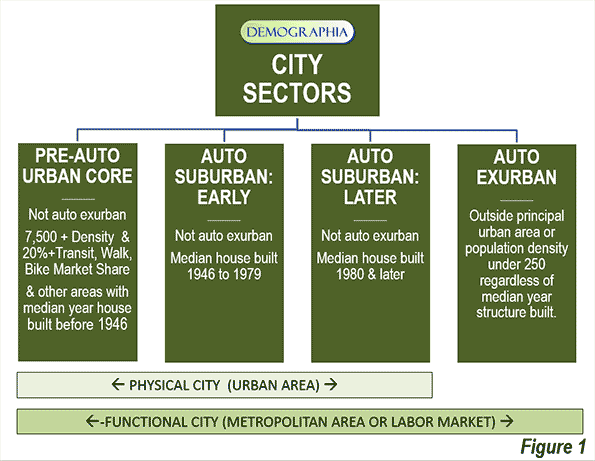
    The model makes it possible to analyze metropolitan areas based on smaller area functional classifications, rather than on jurisdictional (historical core municipality) borders, which among other things, mask as core large areas of suburbanization.

    Suburbanized Core Municipality Examples: San Jose and Charlotte

    This suburbanization in the historical core municipalities is illustrated by examples like San Jose and Charlotte. The City Sector Model indicates that neither of these metropolitan areas has a pre-auto urban core. This is because neither metropolitan area has a large enough concentration of houses with a median construction date of 1945 or before or sufficient area of 7,500 population density per square mile (2,900 per square kilometer) with a transit, walking and cycling work trip market share of at least 20 percent. As a result, virtually all of both metropolitan areas is automobile oriented suburban, including virtually all of the core municipalities.

    This is true in Charlotte despite its development of one of the most impressive new central business districts in the nation, with high employment densities. Yet at the same time the  core city of Charlotte itself is very low density (2010), at 2,500 per square mile (950 per square kilometer), less than the suburban area average for large US urban areas (2,600 per square mile or 1,000 per square kilometer). Charlotte, however, could develop the equivalent of a pre-auto urban core if its central population density rises enough and enough commuters use transit, walking and cycling.

    The core city of San Jose is far more dense than Charlotte, at 5,800 per square mile (2,200 per square kilometer). However, it is less dense than the suburbs of Los Angeles (6,400 per square mile or 2,500 per square mile). Like Charlotte, the core city of San Jose is virtually all automobile oriented suburban and has a transit work trip market share a full third below the major metropolitan area average.

    Overall Population Trend: 2000-2010

    These phenomena reflect national trends, All major metropolitan area growth between 2000 and 2010 (100.9 percent) was in the functional suburbs and exurbs.

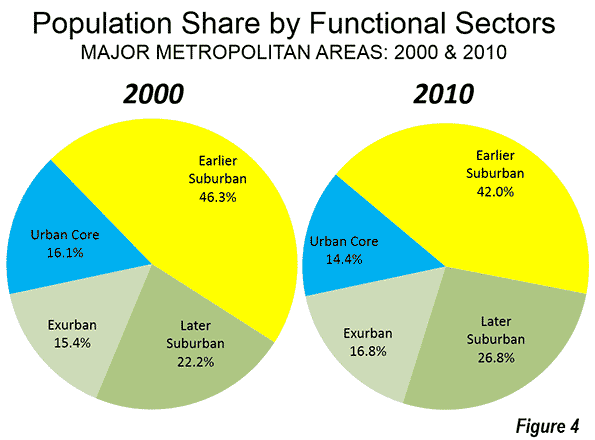
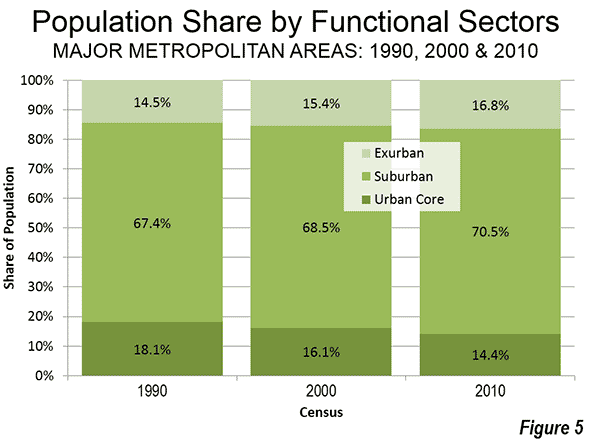
    Between 2000 and 2010, the percentage of major metropolitan area population in the urban cores declined from 16.1 percent to 14.4 percent. The urban cores lost approximately 140,000 residents (a loss of 0.6 percent), despite strong gains very close to the centers of the historical core municipalities. Consistent with these findings, Census Bureau analysis showed that the focused gains in the cores of the urban cores were more than negated by losses in surrounding urban core areas (described in: Flocking Elsewhere: The Downtown Growth Story).

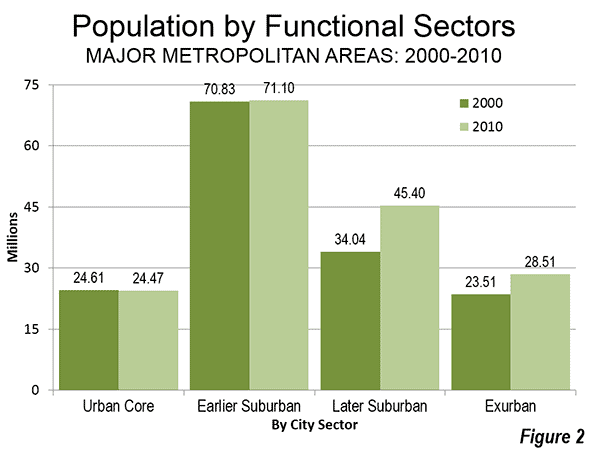
    The earlier suburban areas gained only modestly, adding 280,000 new residents, for a 0.4 percent increase. These areas have median house construction dates between 1946 and 1979. The largest increase was in the later suburban areas, which added the most new residents, 11.4 million, for a gain of 33.4 percent. The later suburban areas have median house constructions of 1980 or later. Exurban areas added 5.0 million residents, for a gain of 21.3 percent. Exurban areas are located outside the principal urban areas (Figure 2).

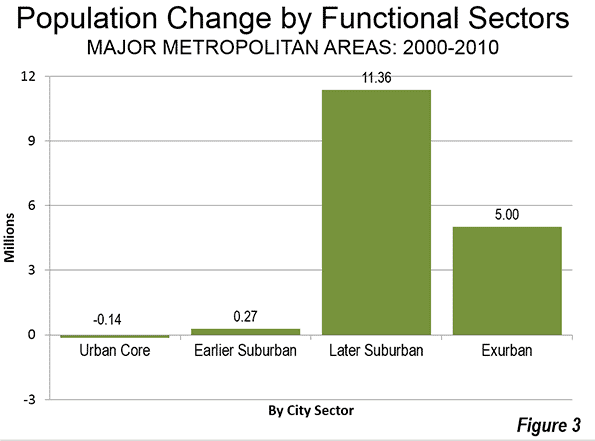
    Overall, the later suburban and exurban areas gained 16.4 million residents, compared to the combined gain of 130,000 in the urban cores and earlier suburban areas. Thus, more than 99 percent of the population growth in the major metropolitan areas was in the later suburban and exurban areas (Figure 3).

    During the decade, the exurban areas overtook the urban cores in population, rising from 15.4 percent of the major metropolitan area population to 16.8 percent (Figure 4).
    Contrast with 1990-2000 Population Trend

    Despite all of the talk of an urban core renaissance, the 2000 to 2010 decade was less favorable for urban cores than the 1990 to 2000 decade. In the earlier decade, the urban cores (as defined in 2010) added 960,000 residents, for a growth rate of 4.0 percent. This compares to the 140,000 urban core loss between 2000 and 2010 (Note 2).

    Virtually all of the difference was attributable to urban core population trend reversals in New York, Boston and Chicago, which combined experienced a drop in growth of 1.1 million. Between 1990 and 2000, the urban core of New York added 779,000 residents, far more than the 190,000 added between 2000 and 2010. Boston’s 1990-2000 urban core growth was 296,000, but fell to 27,000 in the last decade. Chicago’s urban core dropped from a gain of 139,000 to a loss of 175,000.

    Over the past twenty years, the population of urban cores has diminished relative to that of major metropolitan areas. In 1990, the urban cores represented 18.1 percent of the population, but fell to 14.1 percent in 2010. Auto-oriented areas (suburban and exurban) have increased their combined share from 81.9 percent of the major metropolitan area population in 1990 to 85.6 percent in 2010 (Figure $$$).
    Summary of Individual Metropolitan areas

    In 30 of the 52 major metropolitan areas, all or more of the population growth was in suburban and exurban areas between 2000 and 2010. This includes the metropolitan areas that do not have Pre-Auto Urban Cores.

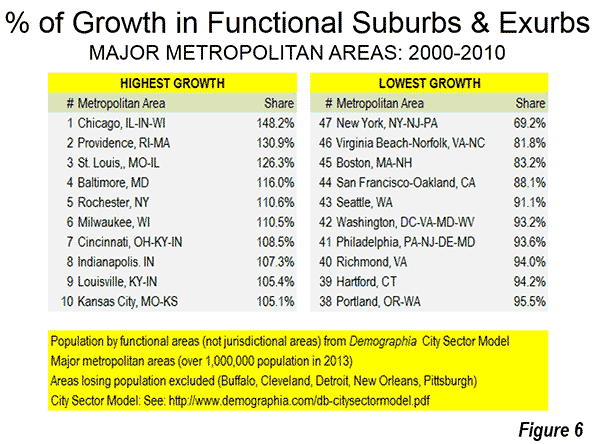
    Chicago had the largest share of suburban and exurban population growth, at 148 percent. This occurred because of the substantial urban core population losses. The suburbs and exurbs of Providence captured 131 percent of its growth, slightly more than the 126 percent suburban and exurban share in St. Louis. Baltimore, Rochester and Milwaukee had more than 110 percent of their growth in the suburbs and exurbs. Cincinnati, Indianapolis, Louisville, and Kansas City rounded out the largest suburban and exurban growth shares, all over 105 percent.

    Despite the substantial decline in its urban core growth in the last decade, New York had the lowest share of population growth in the suburbs and exurbs (meaning that it had the highest share of population growth in the urban core). The suburbs and exurbs of New York captured only 69 percent of the metropolitan area growth, well below second place, Virginia Beach – Norfolk (81 percent). Boston was next at 83 percent, followed by San Francisco – Oakland, at 88 percent. The bottom 10 in suburban and exurban growth share also included Seattle, Washington, Philadelphia, Richmond, Hartford and Portland. Even so, each of these six metropolitan areas had more than 90 percent of their growth in suburban and exurban areas (Figure 6).
    Jurisdictional Analyses: Suburbs Masquerading in Cities

    The functional analysis based on urban form and behavior reveals substantially different trends compared to the conventional jurisdictional analysis that compares historical core municipalities, principal cities or primary cities to the balance of metropolitan areas. For example a jurisdictional analysis shows that core municipalities added 1,290,000 residents between 2000 and 2010. In contrast, the urban cores, as indicated in the functional analysis, lost 140,000 residents. This indicates the extent of to which municipal boundaries can mislead in the analysis of urban form within metropolitan areas. The expansive city limits of most core cities masks the substantial automobile oriented suburbanization within their own borders.

    —-

    Note 1: The City Sector Model is generally similar to the groundbreaking research published by David L. A. Gordon and Mark Janzen at Queen’s University in Kingston Ontario (Suburban Nation: Estimating the Size of Canada’s Suburban Population) with regard to the metropolitan areas of Canada. Gordon and Janzen concluded that the metropolitan areas of Canada are largely suburban. Among the major metropolitan areas of Canada, the Auto Suburbs and Exurbs combined contain 76 percent of the population, somewhat less than the 86 percent found in the United States.

    Note 2: Changes in zip code definitions and boundaries could result in minor differences in comparability between the three censuses.

    —-

    Wendell Cox is principal of Demographia, an international public policy and demographics firm. He is co-author of the "Demographia International Housing Affordability Survey" and author of "Demographia World Urban Areas" and "War on the Dream: How Anti-Sprawl Policy Threatens the Quality of Life." He was appointed to three terms on the Los Angeles County Transportation Commission, where he served with the leading city and county leadership as the only non-elected member. He was appointed to the Amtrak Reform Council to fill the unexpired term of Governor Christine Todd Whitman and has served as a visiting professor at the Conservatoire National des Arts et Metiers, a national university in Paris.

    Photo:  Later Suburbs in New York Urban Area (Morris County, New Jersey), by author
  • Columbus, Know Thyself

    What Is Your Ambition?

    Columbus doesn’t have a powerful brand in the market outside of Ohio. Having said that, the city is growing rapidly in population and jobs, is extremely livable and improving day by day, and seems to make its residents very happy. Is there any reason the city has to be better nationally known in order to be complete or something?

    I say No.  It’s a valid choice to simply stay with the status quo.

    Many citizens may indeed feel that way, but much of the city’s leadership doesn’t. This was hammered home in a 2010 New York Times piece on the city’s rebranding efforts. That desire to be seen as a high caliber city at the national level clearly came through in my most recent trip, even from Mayor Coleman himself.

    I also tend to be personally biased towards high ambition, particularly in a place where it’s obvious that the ambition can be realized.  Columbus is that place, in contrast to long troubled regions  like Detroit and Cleveland are really struggling to rebound from severe problems. And no matter what they do, they will never recover the national stature they once enjoyed.   

    Columbus is both operating from a baseline of strength, and also at a point where it is still on the way up as a city.   Columbus has never been a larger, more important, more prominent city in the world than it is right now – and it has the potential to reach still higher  Not every city and not every generation is granted the opportunity that Columbus has right now.  

    Finding Columbus’ Mojo

    But assuming the answer is go for it, then what needs to be done? There is a need to go beyond the checklist.

    The first thing  is to really be committed to change and going after the brass ring. This is not an easy journey to make. Some of the things you are going to have to do are really, really hard because they involve looking  closely at civic insecurities, and also questioning perhaps your most fundamental and cherished truths, especially the truth about what you’re best at.

    It’s very hard for cities to admit where they are weak, but it can actually be even harder for them to admit where they are strong.

    One of the sayings of the Greek oracle was “Know Thyself.” Sage wisdom, indeed. Knowledge of yourself is often the most difficult to come by but valuable of commodities. Because as the saying goes, “Without awareness there is no choice.”

    Where does a city get knowledge of itself that’s useful for branding? I argue it very often comes from the past. Cities didn’t just take their present form overnight. They are the process of a long process of growth and change. In particular, the founding ethos of a place profoundly stamps its character, usually in a permanent way. The Dutch trading culture and spirit of openness of New Amsterdam is still present in contemporary New York, for example.

    When a new creative director comes in to revive a failing fashion house, what’s the first thing he does? He goes to the archives. He investigates the history of the house. What does this brand stand for? Who were the people who founded it? How did they become who they were? What happened along the journey of that house?

    To use a hackneyed phrase, that new creative director wants to understanding the “Brand DNA,” and the key to the brand DNA is in the past.

    I think that’s as true of Columbus as anyplace. Columbus certainly had good luck in getting where it is today, but I’d argue there’s more to it. One of their historical keys to success was a fateful decision in the 1950s to pursue an aggressive annexation strategy. You can say that was one mayor’s choice, but I believe the fact that it happened in Columbus and not elsewhere in Ohio signaled  that there was something different about the city. What is it?
    You need to start with an anthropological, archeological, historical deep dive into a city, its people and its culture. I’d suggest tapping into Ohio State’s cultural anthropology resources. There might even be a dissertation in it for someone.

    Aspirational Narrative

    One you have the mojo, you not only use it to build the future reality, you also sell it by telling the story of Columbus to the world. You need to create an aspirational narrative of the city that people can imagine themselves being a part of.

    Think of the story of New York. TV shows like Friends, Sienfield, and Sex and the City have created a contemporary positive narrative of life in New York. People know what it’s about. If you can make it there, etc. (This wasn’t always the case. Escape from New York, Death Wish, and Fort Apache the Bronx told quite a different narrative in a previous era). Portlandia tells a story about the place where young people go to retire. Think about the Bay Area, LA, Miami, etc. and the stories come to our heads without much thinking.

    What’s that story of life in Columbus? You create that story around the authentic mojo of the city.

    What’s on your rap sheet?

    Beyond finding the mojo, there’s another key task that goes along with the investigation. That’s finding the missing or defective genes in the civic DNA that could sabotage the city’s ambitions.

    Everybody’s got a rap sheet. The only question is whether or not we know what’s on ours. When I was working in corporate America I knew if I was getting nothing but glowing feedback from my boss, if Ihad nothing I need to get better at, I was dangerously blind. If not, why was I not the CEO of the company? Clearly, there’s a reason why I am where I am and not the President of the United States.

    So Columbus needs to understand not just checklist items it is missing like a major transit investment, but also cultural items that are holding the city back and what they are rooted in. Then it can attack them with a change program that can hopefully work, like the civic equivalent of therapy.

    On a related note though methodologically different, the city needs to be willing to take a hard look in the mirror and realistic assess its assets and accomplishments and how compelling they are in the market. The cold reality is that while Columbus is a great city in many ways and has lots of great stuff, what it has doesn’t add up to a nationally or globally compelling story. You need to take the marketing glasses off and ask how people who aren’t in or from the city   see things.

    That doesn’t necessarily mean you recategorize your assets as bad. But you have to understand that checklist items that lots of other cities are doing (e.g., bike infrastructure) are probably not going to set the city apart in the marketplace. If you don’t have it, you’re in trouble. But if you do, it doesn’t win the game. These things are just the new urban ante.

    Illustrative Applied Examples

    I want to give a quick examples – and let me stress this is provisional and speculative to some extent – illustrating these three points.

    On the mojo front, the city’s previous branding effort that identified “smart” and “open” as two key civic attributes is right on in my view. It’s a good start. But why is Columbus open? That is, why is it easier for newcomers to acclimate, penetrate networks, accomplish things, etc. in Columbus than in many other places?

    I speculate it’s rooted in being the state capital. I’ve seen a similar trait in other capitals. I speculate that because people from all over the state are coming to Columbus on political business, and because there’s always churn in elected office, civic networks don’t become closed and calcify in a sort of “Why the Garden Club Couldn’t Save Youngstown” effect.

    For the missing gene example, I think it’s very possible that one reason Columbus didn’t create a compelling, unique product in the market is that it it’s just not in the civic DNA. One local leader I talked to speculated that the city’s values were shaped by those of Ohio State football and Woody Hayes. That is, the secret to success is to work relentlessly at the fundamentals and always be pounding the ball ahead with the running game – “three yards and a cloud of dust.” Not exactly the West Coast Offense. This may be too facile, but it is clear that Columbus excels at the fundamentals, the blocking and tackling of city stuff, but hasn’t thrown the civic equivalent of the long bomb.  

    For the asset evaluation example, I think Columbus needs to be realistic about Ohio State’s stature. Ohio State is a great school, but it’s not Harvard or Stanford. I went to Indiana University and I’d say the same about them. Now, obviously you’d never come out in public and downplay Ohio State, which legitimately is a power house for the city. But you don’t want to mistakenly believe it’s doing to spawn the next Cambridge or Palo Alto without some major change either.

    It’s Cow Town, Jake

    To truly discover the secret of its mojo, Columbus needs to be willing to stare into the abyss of cow town.

    Talk to people in Columbus and you’ll hear them claim that they are not a “cow town” anymore or how people used to refer to them as a “cow town.” I have seen this as an analogy to the case of Indianapolis and “naptown.” I’ve always doubted that hardly anyone outside of Indianapolis itself ever used the term Naptown historically as an insult. No one would ever have cared enough about the city to even bother insulting it.

    Similarly, I’d never heard the term cow town until somebody from Columbus told me about it. I strongly doubt it’s ever really been a term of derision nationally, at least not outside Ohio. I know there’s a strain of Cincinnatian who loves heaping abuse on places like Columbus and Indy. As Columbus has grown while other cities in Ohio wandered in the wilderness, it’s easy for me to believe there’s been a lot of sniping. So while the market would never think of Columbus as cow town, there may be some legitimate in state reasons for them to be sensitive to the term.

    The impression I get, again provisional based on my limited experience, is that in an attempt to rid itself of the stigma of being a cow town, Columbus has sheared off its past, in effect repudiating everything that happened before 1990 or 2000.

    I observed to Mayor Coleman that Indianapolis in recent years has downplayed the 500 Mile Race. I asked him whether or not Columbus was similarly neglecting its greatest brand asset in the market by downplaying Ohio State football. He said, “No. There was a time in the 60s and 70s and the 80s, and even the 90s, where Columbus was nothing but Ohio State football. And I love the Buckeyes; I love the football team. It’s better than any professional team in the state of Ohio. And they’re still amateurs. That’s good. But having said that, Columbus is no longer just the Ohio State football team. We don’t view ourselves that way anymore [emphasis added].”

    This seems consistent with what I hear from other people. There’s an embedded idea here that there’s little to nothing of value in the city’s past and in fact that past is something to be embarrassed about or outgrown. I have never heard anyone from Columbus brag about their city for anything related to the past, apart from historic architecture.   For example, the mayor went on to talk about the importance of Ohio State in terms of its contemporary research impact. I’m not sure I’ve ever heard a city talk less about its heritage.  That lack of historic rooting may be one reason why the city can come across as somewhat generic.

    As I’ve noted before, this is normal for us to go through. When we go off to college, Mom puts our high school letter jacket up in the attic. We try as hard as we can to fit in at the new level, and treat the stuff we left behind as little kids stuff.

    But eventually we become comfortable in our own skin. We learn who we are and what we stand for, and we stop becoming so concerned about what other people think of us. Of course we are social creatures and will never stop caring about others’ perceptions of us. We find a healthier balance.

    The same is true of cities. Columbus is far enough along in its growth path to really be comfortable being itself, and acknowledging and embracing its past.

    This doesn’t mean Columbus should be or ever was a cow town. What it does mean is that things from its past that Columbus   are actually its strongest brand assets and things to be proud of and build its future on.

    Let’s give some examples. The Midwest has a history of local, low grade lager brands. Virtually all of these were abandoned and ceased production. The hip, cool thing to do was to drink microbrews, not even Bud or Miller Lite, to say nothing of Sterling (my dad’s brand).

    Then one day the hipsters on the coasts started drinking Pabst Blue Ribbon, and all of a sudden back in the Midwest, we started drinking it too and now are re-launching or re-embracing all those old blue collar brands (including Sterling). The same thing happened with workwear clothing, which is now selling for quite a premium in some places and very popular among the Bearded Ones.

    In effect, we had to re-import our own heritage after a bunch of other people elsewhere saw the value in it – the same heritage we rejected as “cow town.”

    The clearest example of this is agriculture. The Midwest is all about ag. Ohio State is a huge ag power house. Columbus could have owned urban agriculture, farm to table, organics, etc. But it didn’t. And now it’s doing them, but it’s doing them as the follower, not the leader.   

    This is one of the tragedies of the Midwest. We turned away from our heritage and a bunch of guys in Brooklyn bought it from a thrift store for a song.

    The South avoided this. Look at Nashville. Did they turn their back on country music as “cow town”? No, they embraced it as central to their identity past, present, and future. Of course they are more than country. But they kept it front and center. But they also updated it. It’s not the old AM radio country. It’s not Hee Haw. They respect those people and institutions and see them as in continuity with today, but they have evolved. Today’s it’s glitzier, “Nashvegas.” Think Carrie Underwood, not Minnie Pearl.

    This is what it means to know thyself and build the future out of the authentic mojo of the past. Columbus surely has many things in its past and in its historic civic character   of immense value. The question and the challenge to the city is being willing to find out what those are and own and embrace them and champion them as a key part of the mojo on which it will build its future reality and aspirational civic narrative.

    I believe the potential is right there. The question is whether the city is ready and willing to step up and grab it.

    Aaron M. Renn is an independent writer on urban affairs and the founder of Telestrian, a data analysis and mapping tool. He writes at The Urbanophile, where this piece originally appeared.

  • Inland California Needs to Get in the Zone

    California’s dream is shrinking inexorably, and only radical steps can prevent the condition from becoming permanent. Compared with previous economic expansions, fewer state residents and communities are benefiting from this recovery, which has largely been restricted to the small coastal zone surrounding the Bay Area, as well as certain parts of western Los Angeles, Orange and San Diego counties.

    As the economy has strengthened, what is called a “boom” in the mainstream media is really a story of one region. Some 300,000 jobs have been created as the recovery has strengthened over the past 15 months,but three-quarters of them have been concentrated along the coast, mostly in the San Francisco-San Jose corridor.

    In contrast, much of the interior of the state, from the Inland Empire, where the poverty rate has doubled since 1990, to the Central Valley, is doing far less well. Unemployment has dropped to near 5 percent in the Bay Area, but remains above 8 percent in the Inland Empire, and above 10 percent in many interior communities, from Fresno and Modesto to Bakersfield. Viewed in the national media as some sort of permanent basket case, the inland regionbooming a decade ago, was recently compared by a UCLA economist to Appalachia.

    Get in the ‘zone

    California’s interior clearly needs a form of new deal that will allow it to participate in the state’s recovery. This plan starts with declaring the entire area an “enterprise zone” that allows communities to opt out from some of the harshest, coastally driven regulations.

    Enterprise zones typically refer to economically ailing portions of cities where policies to encourage economic growth and development are implemented for businesses in the designated area. Such policies, on a regional scale, are needed in inland California.

    Extraordinary controls on development, expensive “green energy” policies and high taxes on small enterprises may seem reasonable, or at least bearable, in a coastal economy fueled by soaring capital gains, with the prospect that the gentry rich can supply trickle-down service jobs to the hoi polloi.

    But such policies are often disastrous for the state’s interior, which lacks the resources or appeal of the coastal havens. Take the issue of electricity prices, which have soared, in large part, because of the green-energy policies favored by influential residents along the coast. Energy costs for many California businesses are roughly twice those for consumers in the Pacific Northwest, Salt Lake City or Denver. Yet here’s the rub: The climate along the coastal strip requires less air conditioning or heating, unlike that of the interior regions, where temperatures rise and fall more severely.

    Worse yet, there’s more pain to come: California’s recently enacted carbon “cap and trade” system could boost gasoline prices, already 55 cents per gallon above the national average, another dollar.

    Unaffordable Coast

    Many wealthier coastal residents can afford housing close to major job centers and, for that matter, more expensive gasoline. But the same pump prices are a dagger aimed at the finances of many middle- and working-class people who live in the interior and have to commute to employment. The gentry retort – that such people should move to the city – ignores the fact that most middle- and working-class people can’t afford to live decently in places like Los Angeles, much less San Francisco, given current prices.

    People in recent decades have moved to the interior largely to improve conditions for their families, not to lower their quality of life. Rising gas prices won’t lead them “back to the city” but, more likely, will force many to cut back further, or consider moving elsewhere. There’s no discernible movement of people to the coastal counties from the interior; if anything, the pattern, although less marked than a decade ago, remains quite the opposite.

    Despite a growing population, the long-term sustainability of the interior’s economy now is questionable. High energy costs, onerous regulatory burdens and land-use constraints imposed by Sacramento are systematically undermining industries that have traditionally driven growth in the state’s interior. These include construction, manufacturing, ranching and farming, along with logistics and business services, all of them employers of middle- and working-class Californians.

    Creating an expansive enterprise zone would allow these businesses to compete more successfully with other states. It might encourage, for example, manufacturers leaving or expanding away from the coast to head to inland California instead of to another state, or propel builders to construct affordable housing, including single-family homes, in places like the Inland Empire, as opposed to in Texas or Arizona.

    Why should the Bay Area oligarchy agree to such a step? One reason may be to avoid the soaring cost of supporting so many poor and needy people in the interior. When the tech bubble bursts, the state will face another cash crunch. Having a vast impoverished population then will mean even higher taxes and worse services, something that will affect all but the most high-end businesses.

    Dreams, green or otherwise, take money, but our bifurcated economy relies increasingly on the fortunes of the few. California’s top 1 percent of earners paid 50 percent of state income taxes in 2012, up from 40 percent the year earlier. This is not surprising since so much of the state is either impoverished or stagnating. Once aspirational regions, proud contributors to the Golden State’s economic diversity, increasingly resemble dependent countries in the Third World.

    Modern-day progressives respond to these realities by pushing for such things as raising the minimum wage, or imposing even more Draconian labor regulations. This may help some low-income workers, but it’s hard to see how it would boost the interior’s competitiveness. In contrast, the creation of an enterprise zone would give these areas at least a fighting chance.

    Ultimately, what kind of California do we want for our children? Right now, the state is evolving into something of a neofeudalist society, consisting of an affluent few, concentrated in the coastal belt, a large and expanding poverty class and a struggling, shrinking middle class. There’s the California of the oligarchs with 111 billionaires, by far the most of any state, with personally held assets worth $485 billion. Together, they own more than the GDP of all but 24 countries in the world. At the other end of the scale is a state with the nation’s highest poverty rate (adjusted for housing costs) – above 23 percent – and roughly one-third of the nation’s welfare recipients.

    This condition has been aptly labeled by one Central Valley writer as “liberal apartheid.”The well-heeled, largely white and Asian coastal denizens live in an economically inaccessible bubble – due to extremely high housing prices – while the largely poor, working class, heavily Latino communities eke out a meager existence in the state’s eastern interior.

    To be sure, many forces beyond Sacramento’s control – globalization, immigration, the asset-oriented nature of the recovery – have contributed to this growing wealth gap. But gentry-led pubic policies have exacerbated the refeudalization. Young Californians, notes one study, already are now less likely to graduate from college than were their parents.

    A Shrinking middle

    Meanwhile, the middle class, the social and economic linchpin of the state, continues to decline, with a far more dramatic drop in state households earning $35,000 to $75,000, according to research from the California Lutheran University forecast project, than the national average. As late as the 1980s, the Golden State was about as egalitarian as the rest of the country, and roughly 60 percent of its population was middle class. But now, for the first time in decades, the middle class is a minority in California.

    In fact, many Californians face a future as modern-day land serfs, renting and paying someone else’s mortgage. If they choose to start a family, they increasingly look to settle elsewhere, ironically, some to locations like Oklahoma and Texas, places that historically sent eager migrants to the Golden State, whose appeal combined economic opportunity, its milder climate and spectacular scenery.

    The prospect facing California is not unlike that seen in other Democratic-dominated regions, such as New York, where a well-organized and savvy, affluent, urban minority can impose ever-greater restrictions on the relatively unorganized, inarticulate exurban populations. Like New York’s Appalachia-like upstate regions, interior California faces a dismal future that, over time, will lead to increasing demands on the middle and upper classes. Only by allowing the interior a decent chance can California truthfully claim that its economy has, indeed, turned around.

    This article first appeared in the Orange County Register.

    Joel Kotkin is executive editor of NewGeography.com and Distinguished Presidential Fellow in Urban Futures at Chapman University, and a member of the editorial board of the Orange County Register. He is author of The City: A Global History and The Next Hundred Million: America in 2050. His most recent study, The Rise of Postfamilialism, has been widely discussed and distributed internationally. He lives in Los Angeles, CA.

    Photo by Altus via Flickr

  • IMF’s Lagarde: Build on Greenfield Land

    Christine Lagarde, the Managing Director of the International Monetary Fund cited the need for housing market reform at the conclusion of discussions with the government of the United Kingdom on Friday, June 6.

    The housing market in the United Kingdom has experienced a long and continuing escalation in prices relative to incomes, largely due to the nation’s strict urban containment policies that date from the 1947 Town and Country Planning Act, and significant further restrictions put in place during the Blair government.

    According to Ms. Lagarde:

    "But rising house prices fundamentally reflect demand that greatly exceeds supply. Addressing imbalances in the housing market by alleviating supply-side constraints will require further measures to increase the availability of land for development and to remove unnecessary constraints on land use."

    The Daily Mail further reported that Ms. Lagarde "called for ‘unnecessary’ restrictions on building on greenfield sites to be lifted, so the supply of houses can be increased. This, she said, would help stabilise prices.

    The United Kingdom’s restrictive land use regulations have been a model for restrictive land use regimes from Sydney to Vancouver, Auckland, Portland and California. They have been responsible for driving up house prices relative to incomes, which reduces household discretionary incomes. The result is lower standards of living and higher rates of poverty. London School of Economics professor Paul Cheshire has concluded that urban containment policy is irreconcilable with housing affordability.

  • Watch What You Say, The New Liberal Power Elite Won’t Tolerate Dissent

    In ways not seen since at least the McCarthy era, Americans are finding themselves increasingly constrained by a rising class—what I call the progressive Clerisy—that accepts no dissent from its basic tenets. Like the First Estate in pre-revolutionary France, the Clerisy increasingly exercises its power to constrain dissenting views, whether on politics, social attitudes or science.

    An alliance of upper level bureaucrats and cultural elites, the Clerisy, for for all their concerns about inequality, have thrived, unlike most Americans, in recent years. They also enjoy strong relations with the power structure in Washington, Silicon Valley, Hollywood and Wall Street.

    As the modern clerisy has seen its own power grow, even while the middle class shrinks, it has used its influence to enforce a prescribed set of acceptable ideas. On everything from gender and sexual preference to climate change, those who dissent from the official pieties risk punishment.

    This power has been seen recently in a host of cancellations of commencement speakers. Just in the past few months Ayaan Hirsi Ali, former Secretary of State Condoleezza Rice, International Monetary Fund managing director Christine Lagarde, and former UC Berkeley Chancellor Robert Birgeneau, have been prevented from speaking by campus virtue squads whose sensibilities they had offended.

    The spate of recent cancellation reflect an increasingly overbearing academic culture that promotes speech codes on what is permissible to say and even seeks to provide “trigger warnings” to warn students about the presence of nominally troubling subject matter in readings and discussions so they can avoid the elements of reality they find offensive. 

    The very term Clerisy first appeared in 1830 in the work of Samuel Coleridge to described the bearers society’s highest ideals: the intellectuals, pastors, scientists charged with transmitting their privileged knowledge them to the less enlightened orders.  

    The rise of today’s Clerisy stems from the growing power and influence of its three main constituent parts: the creative elite of media and entertainment, the academic community, and the high-level government bureaucracy.

    The Clerisy operates on very different principles than its rival power brokers, the oligarchs of finance, technology or energy. The power of the knowledge elite does not stem primarily from money, but in persuading, instructing and regulating the rest of society. Like the British Clerisy or the old church-centered French First Estate, the contemporary Clerisy increasingly promotes a single increasingly parochial ideology and, when necessary, has the power to marginalize, or excommunicate, miscreants from the public sphere.

    Of course, every society needs a clerical class, to instruct the young and maintain cultural standards. But in the past, at least in modern America, they tended to be a tolerance for fairly disparate views. Today’s Clerisy, by contrast, is increasingly homogeneous in its beliefs- despite pockets of conservative power such as the Heritage Foundation and most notably the media empire controlled by the Murdoch family.

    The modern Clerisy’s homogeneity springs from their social conditioning. Educated along similar ideological lines at major universities, they tend to be geographically concentrated in wealthy, “progressive” places, where few dissent from the prevailing worldview. As such they breathe, as analyst Walter Russell Mead suggests, “within a cocoon.” Inside their urban cocoons they operate from a thoroughly internalized set of progressive tropes on such issues as the environment, urbanism, gender and race. In practical terms, such as in their support of President Obama and the Democratic Party, they are both broadly allied with centers of power and influence, much as the clergy was in Medieval and early modern times.

    America’s Nomenklatura

    The Clerisy has thrived during these hard times. Since 1990, the number of government workers has expanded by some five million to some twenty million. That’s four times the number who were employed by the government at the end of the Second World War, a growth rate roughly twice that of the population as a whole.

    The upper bureaucracy have been among the greatest beneficiaries—along with Wall Street and the green crony capitalists —of the Obama Administration’s economic policy. The number of workers, particularly at the federal level, continued to rise even at the height of the great recession. Between late 2007 and mid-2009, the number of U.S. federal workers earning at least $150,000 more than doubled. The ranks of federal nomenklatura—combined with a host of related private contractors —- have swelled so much that Washington DC by 2012 replaced New York as the wealthiest region in the country .

    The upper bureaucracy has evolved into a privileged and cossetted caste. In California, state workers are allowed such special privileges as having their Department of Motor Vehicle records kept confidential; a sensible precaution for those, like police, who deal with criminals but now expanded to cover a vast array of public servants, including social workers. Naturally, as beneficiaries of an expanded government, public sector unions have been among the strongest backers of regulatory growth and ever increased social services. Their political power has also been on the rise; since 1989, public sector unions accounted for two of the top three top ten donors to political candidates.  

    More important still is the bureaucracy’s ability to control society through unelected agencies, something that grew even during Republican administrations, but has achieved unprecedented scale under President Obama. Increasingly, agencies such as the EPA and HUD, seek to shape community development patterns—for example on land use policies —- that traditionally fell under local control. With their power, the agencies have harassed unfriendly conservative organizations, as seen by the IRS, and monitored the populace’s private conversations, seen in the case of the NSA. But to some prominent members of the Clerisy, these power grabs haven’t gone far enough.

    Leading figures of the Clerisy, like former Obama budget advisor Peter Orszag and Thomas Friedman, argue that power should shift from naturally contentious elected bodies—subject to pressure from the lower orders—to credentialed “experts” operating in Washington, Brussels or the United Nations. The popular will, according to the Clerisy and its allies, lacks the scientific judgment and societal wisdom to be trusted with power.

    The Real College of Cardinals.

    Like the upper bureaucracy, academia has also expanded rapidly in recent decades. In 1958 universities and colleges employed under 370,000 people; by 2014 that number had expanded to roughly 1.7 million. With universities now serving roughly twenty million full and part time students, academics have never exercise more influence over young Americans.

    Ironically, despite its patina of egalitarian beliefs, the academic world now epitomizes the new hierarchical class order as much as any major institution. The roughly 1.4 million instructors in the University system, have experienced what one writer calls “the great stratification” between roughly 500,000 largely older tenured “alpha” Professors and a vast “beta” of low-paid teaching assistants, contingent faculty and those working in extension programs.

    At the same time, the bureaucracy of the University, like that of the government, has exploded, even more at elite (and tax-favored) private schools than among public ones. Whereas there were about 250,000 administrators and professional staff members in 1975, about half the number of professors, by 2005 there were over 750,000, easily outnumbering tenure-tracked professors. As the University has gained in power, those in control have taken on ever more the trappings of an aristocracy whose primary mission is self-preservation—not unlike the Medieval European clergy.

    The Creative Elite

    The final element of the Clerisy’s triumvirate is the culture-based industries and their upper middle classes participants. Arnold Toynbee identified the “creative genius” as the historic leader and savior of society—an apt description of the self image held by many of the new tech and media elites.

    Today, this “creative” element has grown ever more pervasive. Artists, writers, fashion designers and actors have achieved enormous status in our society; and a handful has become very wealthy. More important still has been the rise of media oligarchs, some tied to the tech establishment, who now rank among the wealthiest Americans. Indeed of the world’s 25 richest people, a majority come from either the information sector, the fashion industry or media. These new media elites, combined with the tech oligarchy, could well emerge as the dominant economic force of the 21st Century, surpassing fortunes made in energy, manufacturing, or housing.

    The media itself is increasingly populated by the children of prominent politicians and by those who come from the ranks of the plutocracy. These include the offspring of the Reagans, GOP stand-bearer John McCain, various Kennedys, and Nancy Pelosi. In Hollywood, meanwhile, some of the new powerful producers come from the ranks of the ultra-rich, including heirs to the Pritzker fortune and the daughter of Oracle Founder Larry Ellison, one of the world’s ten richest men.

    The Clerical Consensus

    Today’s Clerisy attempts to distill today’s distinctly secular “truths”—on issues ranging from the nature of justice, race and gender to the environment—and decide what is acceptable and that which is not. Those who dissent from the accepted point of view can expect their work to be simply ignored, or in some cases vilified. In the Clerical bastion of San Francisco, an actress with heretical views, in this case supporting a Tea Party candidate, who was pilloried, and lost work for her offense.

    The pattern of intolerance has been particularly notable in the area of climate change, where serious debate would seem prudent not only on the root causes and effects, but also what may present the best solutions. Climate scientists who diverge from the warming party line, even in a matter of degree, are routinely excoriated by the Clerisy as “deniers” of “settled” science even in the face of 15 years of relatively stable temperatures. The media also participates in this defense of orthodoxy. The Los Angeles Timesas well as the website Reddit have chosen to exclude contributions from skeptics.

    The stifling orthodoxy from the technocrats and media elite is benign compared to the inquisitional behavior can be seen in institutions of higher education. It is nothing short of tragic, notes civil libertarian Nat Hentoff, that a 2010 survey of 24,000 college students found that barely a third thought it “safe to hold unpopular views on campus.”

    Such attitudes seem natural in an environment where, according to various studies, liberals outnumber conservatives by between eight and fourteen to one. Whether this reflects natural preferences among the well-educated or is partially due to institutional discrimination remains arguable. But consider that 96 percent of all Presidential donations from the nation’s Ivy League schools went to Barack Obama, something more reminiscent of Soviet Russia than a properly functioning pluralistic academy. Nor is there any sign that this trend is slowing. Between 2007 and 2010, a University of California study revealed that “far left” and liberal views grew from 55 percent to almost 63 percent of full-time faculty while the conservative segment dropped from roughly 16 % to less than 12%. If the academic left simply waits long enough, it could look forward to a conservative-free faculty on many campuses.

    A similar, if less uniform, clerical consensus suffuses the media culture, led by the television networks and the leading newspapers. In fact nearly half of all Americans consider the media too liberal, more than three times as many who see it as too conservative. Overall, reports Pew, the percentage who feel news is tilted to one side has grown dramatically from 53 percent in 1985 to 77 percent in 2011.

    To be sure, there remain important exceptions to this rule, notably Fox News and talk radio, and the editorial pages of the Wall Street Journal. Yet the right’s hold on the major media is demonstrably weak, and likely to decline further once Murdoch himself is no longer on the scene. A detailed ++UCLA study found that of the twenty leading news outlets in the country, eighteen were left of center.

    Despite the journalistic embrace of the idea of diversity, a recent Indiana University Study notes that journalists themselves have become increasingly homogeneous.  Journalists are far more likely to be college educated than they were in 1970, and less likely to be a racial minority than just a decade ago. But the biggest change has been an ideological one; barely seven percent in 2013 were Republican, compared to nearly a quarter in 1971.

    Even Arnold Brisbane, the former ombundsman of the The New York Times, has noted the group-think that now overshadows objectivity, long cherished by that most important of America media outlets. Brisbane observed that, “so many share a kind of political and cultural progressivism—for lack of a better term—that this worldview virtually bleeds through the fabric of The Times.”

    These positions are all reflected in almost lock-step media support for President Obama. Over sixteen prominent journalists joined the Obama administration, which was something of a record; in 2012 employees at the major networks sent President Obama almost eight times as much in contributions as they did his Republican opponent.

    This consensus of views prevails as well in the electronic media. As the liberal author Jonathan Chait suggests, the media increasingly reflects not just commercial values, but “a vast left-wing conspirary.” He adds: “You don’t have to be an especially devoted consumer of film or television (I’m not) to detect a pervasive, if not total, liberalism.”

    Will the Clerisy rule after Obama?

    The fact that Republicans continue to maintain considerable power in both Washington and the states suggests that the Clerisy’s power is not yet determinative. And indeed after President Obama leaves office, the Clerisy’s reach may be temporarily diminished, but its ability to set the social and political agenda will likely persist and even grow given their influence to shape perceptions, particularly among the young.

    The current atmosphere of ideological unanimity—in academia, the arts and much of the government bureaucracy—set the stage for the outrages of this commencement season, making painfully palpable the growing authoritarian spirit in so many of our leading institutions. They often see themselves as a liberating force in our society, but in their dislike of conflicting ideas and open debate, today’s  Clerisy increasingly resembles the closed-minded dogmatists of the Medieval church.

    This article first appeared at The Daily Beast.

    Joel Kotkin is executive editor of NewGeography.com and Distinguished Presidential Fellow in Urban Futures at Chapman University, and a member of the editorial board of the Orange County Register. He is author of The City: A Global History and The Next Hundred Million: America in 2050. His most recent study, The Rise of Postfamilialism, has been widely discussed and distributed internationally. He lives in Los Angeles, CA.

  • What We Earn

    Discussions about housing affordability focus almost exclusively on the price of the real estate, movements in which are monitored by multiple organisations on a seemingly daily basis. There is comparatively little discussion about people’s incomes, which are equally as important as prices in determining what can and can’t be reasonably afforded. The income profile of what most Australian’s actually earn paints a sobering picture which could more often be taken into account in debates about housing and affordability.

    It’s becoming fashionable again for business lobbies to complain about Australia’s high wage structure. It explains, they’ll argue, why we lost Holden, Ford, Toyota, and (almost) Qantas, among other things. And yes, Australia’s wages are high by competitor standards – but so are our costs. One of the most fundamental of needs, along with food and clothing, is shelter. And it’s the cost of shelter relative to incomes which has been stretched to beyond reach for a large proportion of young Australians.

    Reducing minimum wages or reducing wage growth further, if at the same time allowing housing costs to further escalate, will only make this situation worse. Arguably, if we could substantially reduce the cost of supplying new housing, this would relieve upward pressure on wages and work towards improving our global competitiveness – along with repairing living standards for working and middle class families, rather than eroding them.

    First, here are some of the facts on the infrequently discussed income side of the equation. (I am again indebted to the team at Urban Economics for making these available. These are top line numbers only: if you want more detailed analysis, please contact Kerrianne Bonwick).

    Nearly two in three of all Australians earn less than $52,000 per annum. It doesn’t much matter whether it’s Brisbane, Sydney or Melbourne; the proportion is roughly the same.  It’s not much. Slightly more than another one in every eight earn from $52,000 to $78,000 per annum. Roughly eight in ten Australians earn less than $78,000 per annum.

    Personal Incomes

    Brisbane

    Sydney

    Melbourne

    < $52,000

    64.4%

    62.8%

    65.4%

    $52,000-$78,000

    15.0%

    13.8%

    14.1%

    $78,000 to $104,000

    7.0%

    7.2%

    6.4%

    > $104,000

    6.3%

    8.2%

    6.5%

    Not Stated

    7.2%

    8.1%

    7.7%

    Source: Urban Economics

    Problem? It is if you’re trying to buy into the housing market. Take a modest house of say $400,000 (very modest depending on location). A worker on $50,000 – and these represent nearly two thirds of all workers remember – is facing a price multiple which is 8 times their gross pre-tax income.  Basically, two thirds of us are stuffed in terms of affording even a modest $400,000 property if we weren’t already in the market. A more reasonable price multiple of say 5 times income would require an income of $80,000 per annum or more. But there are less than 15% of Australians who fit this category.

    But wait, shouldn’t we count household, as opposed to personal, incomes? A good point, particularly for younger families and young couples, where dual incomes are the norm due to necessity.

    But even based on combined household incomes, a third of all households earn less than $52,000 per annum. Another 14% to 15% earn between $52,000 and $78,000 and another 11% or 12% earn between $78,000 and $104,000. A reasonably healthy 30% of all households bring in a combined $104,000 per annum or more, but seven in ten bring in less than that.

    Taking our modest $400,000 home again, and  roughly half of all household incomes fall short of the $80,000 mark required for a price-to-income multiple of five. For one in three of every households, their combined income means a price to income multiple of eight times. They are pretty much stuffed, still.

    Household Incomes

    Brisbane

    Sydney

    Melbourne

    < $52,000

    32.8%

    32.2%

    34.3%

    $52,000-$78,000

    15.5%

    14.1%

    15.5%

    $78,000 to $104,000

    12.3%

    11.3%

    11.8%

    $104,000 – $156,000

    18.1%

    18.0%

    17.1%

    $156,000 – $208,000

    7.7%

    8.7%

    7.3%

    > $208,000

    3.6%

    5.5%

    3.8%

    Not Stated

    10.1%

    10.3%

    10.4%

    Source: Urban Economics

    Hang on, isn’t it more relevant to focus on the demographic that’s more likely to be trying to get into the property market, because older people and retirees, who already own or are paying off homes, may skew the figures? Absolutely: this is the key demographic, especially if you’re a developer of new detached housing product – which is what this cohort mainly wants to buy to raise a family in (as opposed to the apartment they might rent while pre-children).

    Personal income profiles of the 25-34 year old age group are pretty much in line with the Australia wide picture. More than half earn less than $52,000 and roughly eight in ten earn less than $78,000 per annum, which means eight in ten of this age group – who are at the peak of their family formation potential – would be faced with a price multiple of more than 5 times incomes on a $400,000 property, and more than half would be faced with a price multiple which is eight times their income, or more.

    Personal Incomes 25-34 year olds

    25-34year olds

    Brisbane

    Sydney

    Melbourne

    < $52,000

    55.2%

    52.9%

    56.2%

    $52,000-$78,000

    23.1%

    21.7%

    22.9%

    $78,000 to $104,000

    9.3%

    10.0%

    8.4%

    > $104,000

    5.6%

    7.4%

    5.4%

    Not Stated

    6.8%

    8.0%

    7.0%

    Source: Urban Economics

    None of this is great news. For developers trying to provide affordable new housing in new greenfield estates in urban fringe locations, the reality of these income profiles can’t be escaped. I had the privilege of visiting one such estate in south east Queensland recently and what I saw was absolutely first class product at very good entry level prices in a very well designed environment. No ‘McMansions’ here – just quality new detached three and four bedroom homes, on small lots, priced from around $350,000 – and in some cases less.

    But even at $350,000, only around 15% or so of the target 25 to 34 year old demographic could afford to get in with a price multiple of less than 5 times an individual’s income. That proportion would rise taking into account combined incomes for this age group, but it won’t rise beyond around a quarter or a third.  The reality is that more than half this age group would find an entry level $350,000 home would be six times their combined incomes or more. It would be tough going.

    Granted, interest rates are currently very low and some governments are offering stamp duty and other concessions to first time buyers. But these are having next to no impact on this market. Rates of first home buyer activity are at generational lows.  And interest rates won’t stay this low forever. A significant rise in variable home loan rates could tip a substantial number of families in this age group from the ‘just making it’ basket into the ‘we’re stuffed’ basket.

    Since the ‘do nothing’ policy approach doesn’t seem to be working, what could be done to turn the situation around? Basically, it’s a simple formula between incomes and prices. You either increase incomes or reduce prices. The first probably isn’t an option unless incomes can gradually creep up with inflation and with productivity gains over time.

    But what could also happen is the cost of supplying new housing (not referring to existing stock) could be reduced. New housing is heavily taxed and over regulated (the same cannot be said of existing stock). Something like a quarter to a third of the cost of the new home in an urban fringe location is due entirely to various taxes, charges and compliance costs (which do not apply to existing stock). It is also affected by the rapid escalation in land costs due to policy induced supply constraints in areas of ample available land (the same can’t be said of existing stock in mostly built-out inner or middle ring areas). Most of these additional costs of supply owe themselves to policy changes made since the early 2000s – precisely the time when the affordability gap began to widen.

    It does seem a compelling place to start.

    We should aspire to a more competitive Australia but this policy effort cannot just focus on labour costs because our incomes, while high by competitor standards, are now generally insufficient to cover one of the basic necessities of life: shelter. We have made this happen because policy makers have deliberately increased the cost of delivering new housing with new taxes, charges and compliance costs, all justified on esoteric planning or sustainability principles but impossible to justify on social equity or economic grounds.

    These policy changes were made to suit political agendas at the time: they were not needs-based or market-based policy changes. (It also has to be said the political agendas at the time were in the hands of Labor State governments, starting with Bob Carr in NSW but which spread rapidly to other jurisdictions. Why Labor Governments introduced policies which hurt people on working wages is as mystifying to me as to why Liberal Governments have continued to maintain the same policy positions, with minimal amendment).

    The gap between the cost of supplying even relatively basic housing on the urban fringe, and the incomes of the people who in past generations could afford it, will continue to widen unless regulators and policy makers begin to grasp the wider economic consequences of policy-inflated costs for new housing supply.

    Footnote: why a five times multiple? There is no strong reason. The authors of the global housing affordability report Demographia will argue that affordable housing should be around three times incomes. Moderately unaffordable they define as between 3 and 4, and between 4 and 5 is defined as ‘seriously unaffordable.’ The multiples of 7 or 8 times incomes, which we’re seeing in Australia, are off the scale. But for the purpose of argument, if even relatively high (by international standards) multiples of 5 times incomes seems like a utopian dream, it illustrates how far incomes need to rise or costs of new supply should fall before we get even close to the situation that prevailed for most of our history. It’s a big challenge.

    Ross Elliott has more than 20 years experience in property and public policy. His past roles have included stints in urban economics, national and state roles with the Property Council, and in destination marketing. He has written extensively on a range of public policy issues centering around urban issues, and continues to maintain his recreational interest in public policy through ongoing contributions such as this or via his monthly blog The Pulse.

  • Shaking Off The Rust: Cleveland Workforce Gets Younger And Smarter

    In virtually every regional economic or demographic analysis that I conduct for Forbes, Rust Belt metro areas tend to do very poorly. But there’s a way that they could improve, based in large part on the soaring cost of living in the elite regions of California and the Northeast. And one of the rustiest of them appears to be capitalizing on the opportunity already: that perpetual media punching bag, Cleveland.

    Between 2000 and 2012, the Cleveland metro area logged a net gain of about 60,000 people 25 and over with a college degree while losing a net 70,000 of those without a bachelor’s, according to a recent report from Cleveland State University. The number of newcomers aged 25 to 34 increased by 23 percent from 2006 to 2012, with an 11 percent increase from 2011 to 2012 alone. Most revealingly, half of these people came from other states. When it comes to net migration, Atlanta, Detroit, and Pittsburgh were the biggest feeders for those arriving with a bachelor’s degree, while Chicago, Manhattan, Brooklyn and Pittsburgh sent the most net migrants with a graduate or professional degree.

    The picture of Cleveland that emerges from the Cleveland State University study is a very different one from that to which we are accustomed. Rather than a metro area left behind by the information revolution, Cleveland boasts an increasingly youthful workforce that is among the better educated in the nation. In 2009. notes University of Pittsburgh economist Chris Briem, some 15% of Cleveland’s workforce between 25 and 34 has a graduate degree, ranking the area seventh in the nation, ahead of such “brain centers” as Chicago, Austin and Seattle. Old Clevelanders as a whole will remain undereducated, but likely not the next generation.

    What is driving this migration? Some of it has to do with a 25% expansion of STEM employment from 2003-13, much of it in health care tied to the region’s prestigious hospitals. This has helped spark a healthy increase in per capita income, from $33,359 in 2003 to $44,775 in 2012, a gain of 34%.

    This growth has animated many neighborhoods, not only in the “cool” central cores but in a host of inner and outer ring neighborhoods. This process, note researchers Richey Piiparinen and Jim Russell, is even more evolved in a Rust Belt city that has been on the rise for some time now, Pittsburgh. Migration trends there first turned favorable in 2007 after decades of decline, and have remained positive.

    The cost of living in Cleveland is considerably below the national average, not to mention that of the ultra-expensive coastal regions. Indeed, when cost of living is taken into account, per capita income in both Cleveland and Pittsburgh are now well above the national average.

    Piiparinen and Russell also see a gradual movement of educated young people to other lower-cost, family-friendly places in the Rust Belt, including Indianapolis, St. Louis and Minneapolis.

    These phenomena suggest that Rust Belt cities need to adopt new approaches to economic development. For years, civic boosters in places such as Cleveland fixed hopes on attracting the much ballyhooed “creative class” by building such things as the Rock and Roll Hall of Fame, art galleries, trendy restaurant and even a massive downtown chandelier. This tactic recalls the old lite beer commercials: everything you want in a city, but less.

    Yet, as Piiparinen and Russell point out, this approach simply expands consumption opportunities, and when it comes to consumption, Cleveland, Detroit and Pittsburgh can never top the U.S. capitals of excess: Manhattan, San Francisco, Los Angeles, or even Seattle. It’s hard to see hipsters moving en masse to any of these places without some degree of economic opportunity.

    Piiparinen sees the current migration trends as reflecting “the Rust Belt’s productive economy versus its consumptive economy.” He proposes the focus should be to accelerate talent migration based on economic advantages natural to the region, such as medical services, advanced manufacturing and logistics.

    These industries have high economic impact. Manufacturing, he traditional core of the local economy, adds 50 cents of GDP for every dollar in output, considerably more than information employment and almost three times the multiplier for retail jobs.

    Despite the hopes to emulate post-industrial Boston, New York or San Francisco, Rust Belt states remain dependent on manufacturing; it accounts for 18 percent of Ohio’s GDP and 14 percent of Pennsylvania’s, more than twice as much as in New York and well above that in California. Increasingly, manufacturing will not provide many jobs for unskilled workers, but rather for trained technicians, certified crafts workers as well as highly educated college graduates. Ohio has established an extensive network of skilled training facilities to fill this need.

    Critical to the process are the current manufacturing rebound, in which Ohio has added 50,000 industrial jobs since 2009, and the energy boom tied to the development of shale in both Ohio and Pennsylvania. Since 2001, energy employment in Pennsylvania has more than doubled, with much of the action in western part of the state abutting Pittsburgh.

    Does that mean that Cleveland, or Pittsburgh, are about to experience Houston-like growth? Don’t hold your breath. The weather is too harsh, and the cities too small to compete with the vast opportunities presented by the burgeoning Sun Belt economies. Nor do they rank high as destinations for foreign immigrants, who have provided a boost to many larger local economies but as of yet have not “discovered” the Rust Belt in large numbers.

    Yet not achieving hyper-growth does not mean continued decline. As older, less educated workers retire or leave the region, often for warmer climes, there is an opportunity for the Rust Belt to replace its current labor pool with one more attuned to the emerging economy and enjoy strong boosts in GDP growth.

    The key here is melding the “legacy” strengths of these regions with shifting demographic and economic forces. The region is not only home to abandoned steel mills, but also six of the country’s top top 20 graduate engineering programs, according to U.S. News & World Report. The intellectual capital is there.

    And economic forces could soon make these cities more attractive to newcomers from the rest of the country and abroad. The “spiky” cities embraced by urban boosters such as Richard Florida – who famously dissed Pittsburgh on his way out of town — increasingly are too expensive for even the educated middle class. This is why we are seeing young people who flocked to the Bay Area leave in their 30s or 40s. Places like San Francisco and Manhattan are great to the well-educated (and well-heeled), but as you get older, and look to buy a house or start a family, they are not ideal, unless you are extraordinary successful or have the right parents.

    In contrast, the Rust Belt offers a vastly better value proposition. Housing in Cleveland is about one-fourth the cost, based on income, as in San Francisco. Not only that, but the choices are fairly broad, from new and old suburban to charming, single-family dominated urban neighborhoods.

    These choices are encapsulated by the turn of phrase “Pittsburgh rich,” which essentially means that people settling there simply have better options than in places like New York or San Francisco. “We have an old housing stock that is very affordable,” notes University of Pittsburgh’s Briem. “Places like Pittsburgh and Cleveland offer a lot of areas that are very attractive at a low cost.”

    Of course, such a transition will require some major rethinking among regional leaders and the abandonment of their traditional wannabe approach. Rather than apologizing for not being San Francisco, they should look at the prospects for a revival of energy and manufacturing. It’s working out for Pennsylvania and Ohio, which were among the largest recipients of new investment in 2012, ranking third and fourth among U.S. states. They were behind Texas and Louisiana, but well ahead of both California and New York.

    Over time, this transition in the Rust Belt could prove a boon for the entire country. It does little good for either the resurgent Sun Belt or the sophisto havens on the coasts to have to subsidize a region along the Great Lakes in permanent decline. The Rust Belt retains many natural resources — oil, gas and, perhaps most importantly, water — that position it to be a major contributor to national growth. If the opportunity is recognized by a new generation, the future could prove surprising bright in what has long been seen as a fading region.

    This article first appeared at Forbes.com.

    Joel Kotkin is executive editor of NewGeography.com and Distinguished Presidential Fellow in Urban Futures at Chapman University, and a member of the editorial board of the Orange County Register. He is author of The City: A Global History and The Next Hundred Million: America in 2050. His most recent study, The Rise of Postfamilialism, has been widely discussed and distributed internationally. He lives in Los Angeles, CA.

    Creative Commons photo “Cleveland Skyline from the Flats” by Flickr.com user Erik Drost.

  • Will the World’s Emerging Megacities Turn the Corner? For Most of Them, Probably Not

    Two distinct expressions of urbanism, the global city and the mega city, are often conflated in the public’s mind. This can lead people to implicitly link the future fortunes of megacities (urban regions of more than 10 million people) with the success of global cities (defined roughly as a very important node at the high end of the global economy), especially as there’s overlap between the two types. They can then assume that the world’s emerging megacities will ultimately be successful, maybe even very successful. Places like São Paulo and Istanbul are held up as global cities in the making. Even more clearly struggling megacities like Jakarta and Lagos are sometimes portrayed as up and coming hip.

    But in reality most emerging megacities likely will never turn the corner to developed status and achieve a decent standard of living and quality of life for their residents. They may be important national centers of aspiration, but most of them will never become influential global cities.  Their huge size and vast problems will leave them with perpetual entrenched poverty, poor infrastructure and public services, and low quality of life by global standards.

    The general rule seems to be that a megacity can only achieve escape pervasive dysfunction if they are a major city in a country that is the world’s current rising economic (or historically imperial) power.

    Rank

    City

    Population

    1

    Tokyo-Yokohama, Japan

    37,555,000

    2

    Jakarta, Indonesia

    29,959,000

    3

    Delhi, India

    24,134,000

    4

    Seoul-Incheon, South Korea

    22,992,000

    5

    Manila, Philippines

    22,710,000

    6

    Shanghai, China

    22,650,000

    7

    Karachi, Pakistan

    21,585,000

    8

    New York, USA

    20,661,000

    9

    Mexico City, Mexico

    20,300,000

    10

    São Paulo, Brazil

    20,273,000

    11

    Beijing, China

    19,277,000

    12

    Guangzhou, China

    18,316,000

    13

    Mumbai, India

    17,672,000

    14

    Osaka-Kobe-Kyoto, Japan

    17,234,000

    15

    Moscow, Russia

    15,885,000

    16

    Los Angeles, USA

    15,250,000

    17

    Cairo, Egypt

    15,206,000

    18

    Bangkok, Thailand

    14,910,000

    19

    Kolkata, India

    14,896,000

    20

    Dhaka, Bangladesh

    14,816,000

    21

    Buenos Aires, Argentina

    13,913,000

    22

    Tehran, Iran

    13,429,000

    23

    Istanbul, Turkey

    13,187,000

    24

    Shenzhen, China

    12,860,000

    25

    Lagos, Nigeria

    12,549,000

    26

    Rio de Janeiro, Brazil

    11,723,000

    27

    Paris, France

    10,975,000

    28

    Nagoya, Japan

    10,238,000

    29

    London, United Kingdom

    10,149,000

    Table 1: World’s Megacities, 2010, based on urban agglomeration size. Source: Demographia World Urban Areas, 10th Edition (May 2014)

    This is the case with most developed world megacities. Moscow was the capital of the Soviet Empire. New York and Los Angeles came of age when America was the rising, and ultimately dominant, economic colossus. It’s the same for Paris and London, two borderline megacities, which rose as imperial capitals. London remains arguably the premier global city in the world.

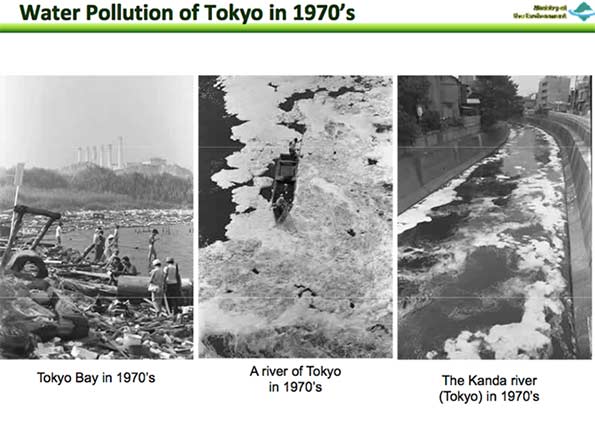
    But it’s also true of other megacities you might not consider. Tokyo only achieved its fully developed state when Japan was the rising power. Until fairly recently, much of Japan’s capital was backwards by developed world standards. For example, despite Japan’s famously high tech toilets, even in the inner 23 wards of Tokyo it was only in 1995 that 100% sewer service was achieved. In the second edition of Peter Hall’s landmark book The World Cities, he describes a 1970s Tokyo in which the night soil pickup industry was alive and well.  Only in an era of national economic hyper growth – culminating in the 1980s – was Japan able to fully modernize its urban infrastructure and clean up the massive environmental problems resulting from its rapid industrialization and urbanization. This was the time when Japan seemed destined to become the world’s leading economic power, and America was fretting as Japanese investors bought trophy assets ranging from Columbia Pictures to Rockefeller Center.


    Image from 2011 presentation by Takatoshi Wako, “Night Soil Management and Decentralized Wastewater Treatment Systems in Japan”

    We are witnessing the same today in China. It’s no accident that cities like Beijing and Shanghai are becoming fully modernized at the same time that China is the world’s rising economic power.  Even there, serious problems with social integration, pollution, and low quality development remain. China had best hope its economic growth continues until such time as it’s rich enough to solve those problems too.

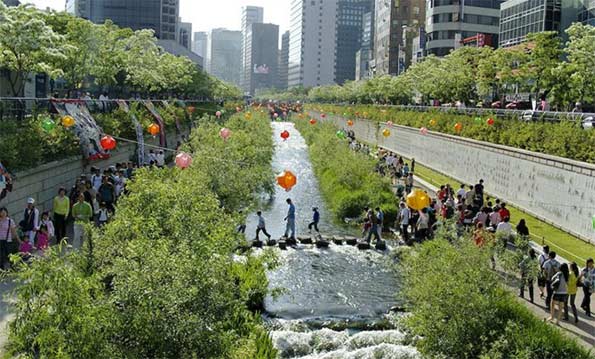
    Apart from the developed West, Japan, and China, only one world megacity has ever pulled off the transition to full modernity is Seoul. Seoul, however, followed a similar trajectory to Tokyo. Destroyed in the Korean War, it was rebuilt with the help of massive foreign aid. As dictatorship gave way to democracy, South Korea emerged as the leading “Asian Tiger” economy, a sort of mini-Japan. Yet it’s only recently that Seoul has begun to transcend its soulless apartment towers and focus on building a quality of life to match its advanced subways and broadband networks, for example, by uncovering a stream previously channeled underground into storm sewers to create an attractive greenway.


    Cheonggyecheon stream in Seoul, daylighted in 2005. Image: Wikipedia

    The world’s other megacities, sadly, are located in countries on a less positive trajectory.  Many of them are in impoverished developing countries in South and Southeast Asia and Africa. Others are in economies like the BRICs once touted as emerging powers, but many of which , have badly stumbled.  India and Brazil are not following the path of Japan and South Korea – not even that of China. Their economies are large and in a sense important, but face massive structural challenges.


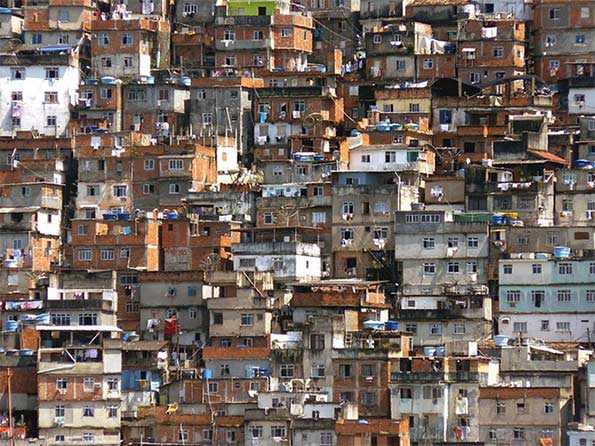
    Pavãozinho favela, Rio de Janeiro. Photo: Wikipedia

    Brazil is planning a coming out party with the World Cup and Olympics. The city of São Paulo has even established its own foreign ministry to develop direct diplomatic and other ties with countries overseas to flex its global muscles.  Yet the social reality is less impressive: Paulistanos rioted last year in response to transit fare increases. Income inequality in São Paulo is stark, and public safety very questionable.  Rio has numerous favelas where military style units are trying to establish basic security, albeit with heavy handed tactics.  Rowers training for the Olympics have described Rio’s waterways as the most polluted they’ve ever seen, with one of them telling the New York Times, “I’ve never seen anything like this before.” In next door Argentina, once wealthy Buenos Aires continues to decay along with the nation, the consequences of lengthy misrule.


    Dharavi slum, Mumbia. Photo: Wikipedia

    But problems in Latin America’s megacities pale next to those elsewhere. In India’s financial and commercial capita of Mumbai, over half the population lives in slums. Delhi was recently noted as having the world’s worst air pollution. Dhaka, Bangladesh is both impoverished and has extreme flooding problems. Karachi, Manila, and Jakarta suffer severe poverty and infrastructure problems.  Large African cities like Lagos can’t overcome the basic development problems of the continent.


    Shantytown in Manila. Photo: Wikipedia

    Some argue that these megacities are actually opportunities zones for their country and even that their slums should be praised – or might eventually, as one article claimed, save the planet. After all, people are voting with their feet to move there. Perhaps that’s true in some sense, though some of the advantage of cities stems from a decline in the viability of rural life. 

    But the problem is that there’s no clear path to prosperous maturity for these megacities.  They are so huge, and their problems so immense that they are difficult to even conceptualize, much less do something about.  The amount of needed infrastructure provision alone – water, sanitation, drainage, transport, telecom, electricity, parks, schools, etc. – is staggering. And that doesn’t even touch arguably more difficult problems like corruption and good governance. Absent national hyper growth – a la Japan or Korea – of a level that creates a plausible claim to being the world’s rising economic power, or the proceeds of empire, it seems unlikely any of these cities will ever succeed. By contrast, smaller cities have a much more addressable problem space.

    Megacities may have their virtues and short term advantages, but unlike yesterday’s imperial or economic capitals like New York and Tokyo, today’s emerging world megacities will have a hard time even achieving the basics of urban quality of life, much less succeed in rising to join the world’s elite.

    Aaron M. Renn is an independent writer on urban affairs and the founder of Telestrian, a data analysis and mapping tool. He writes at The Urbanophile.

    Lead Photo: São Paulo City by Julio Boaro