Blog

  • From Jurisdictional to Functional Analysis of Urban Cores & Suburbs

    The 52 major metropolitan areas of the United States are, in aggregate, approximately 86 percent suburban or exurban in function. This is the conclusion from our new City Sector Model, which divides all major metropolitan zip codes into four functional categories, based on urban form, population density and urban travel behavior. The categories are (1) Pre-Auto Urban Core, (2) Auto Suburban: Earlier, (3) Auto Suburban: Later and (4) Auto Exurban. It is recognized that automobile-oriented suburbanization was underway before World War II, but it was interrupted by the Great Depression during the 1930s and was small compared to the democratization of personal mobility and home ownership that has occurred since that time.

    For decades there has been considerable analysis of urban core versus suburban trends. However, for the most part, analysts have been jurisdictional, comparing historical core municipalities to the expanse that constitutes the rest of the metropolitan area. Most core municipalities are themselves substantially suburban, which can mask (and exaggerate) the size of urban cores.

    The Queen’s University Research

    The City Sector Model is generally similar to the groundbreaking research published by David L. A. Gordon and Mark Janzen at Queen’s University in Kingston Ontario (Suburban Nation: Estimating the Size of Canada’s Suburban Population) with regard to the metropolitan areas of Canada. Researchers used travel behavior (journey to work data from the 2006 census) and density for classifying metropolitan areas into four sectors, (1) Active Core, (2) Transit Suburbs, (3) Auto Suburbs, and (4) Exurbs. The active core was that portion of metropolitan areas with a high share of work trip travel by walking and cycling. I covered the research in a newgeography.com article last autumn.

    Gordon and Janzen concluded that the metropolitan areas of Canada are largely suburban. Among the major metropolitan areas of Canada, the Auto Suburbs and Exurbs combined contain 76 percent of the population, somewhat less than the 86 percent we found in the United States.

    The City Sector Model follows the same general approach as the Queens University research, although there are important differences. For example, the City Sector Model is principally aimed at identifying the Pre-Auto Urban Core component of the modern metropolitan area and does not identify an active core.

    All US Major Metropolitan Area Growth Has Been Suburban and Exurban

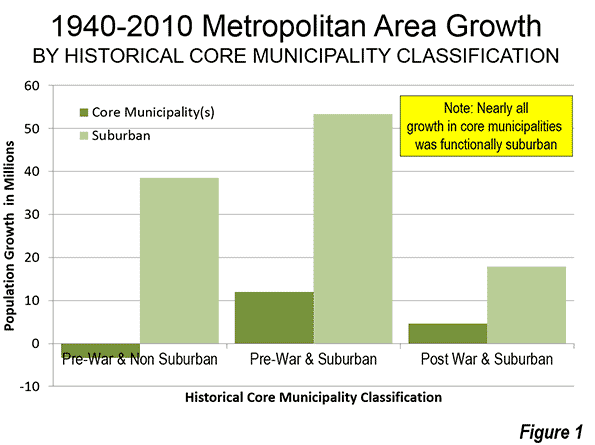
    Virtually all population growth in US metropolitan areas (as currently defined) has been suburban or exurban since before World War II (the 1940 census). The historical core municipalities that have not annexed materially and were largely developed by 1940 have lost population. As a result, approximately 110 percent of their metropolitan area growth has occurred in suburbs and exurbs. Further, among the other core municipalities, virtually all of the population growth that has occurred in annexed areas or greenfield areas that were undeveloped in 1940 (Figure 1).
    Identifying the Pre-Auto Urban Core

    The City Sector Model is not dependent upon municipal boundaries (the term "city" is generic, and refers to cities in their functional sense, metropolitan areas, or in their physical sense, urban areas). Not being constrained by municipal boundaries is important because core municipalities vary substantially. For example, the core municipality represents less than 10 percent of the population of Atlanta, while the core municipality represents more than 60 percent of the population of San Antonio. The City Sector Model applies data available from the US Census Bureau to estimate the population and distribution of Pre-Auto Urban Cores in a consistent manner.

    At the same time, the approach is materially different from the Office of Management and Budget (OMB) classification of "principal cities." It also differs from the Brookings Institution "primary cities," which is based on the OMB approach. The OMB-based classifications classify municipalities using employment data, without regard to urban form, density or other variables that are associated with the urban core. These classifications are useful and acknowledge that the monocentric nature of US metropolitan areas has evolved to polycentricity. However, non-urban-core principal cities and primary cities are themselves, with few exceptions, functionally suburban.

    The City Sector Model Criteria

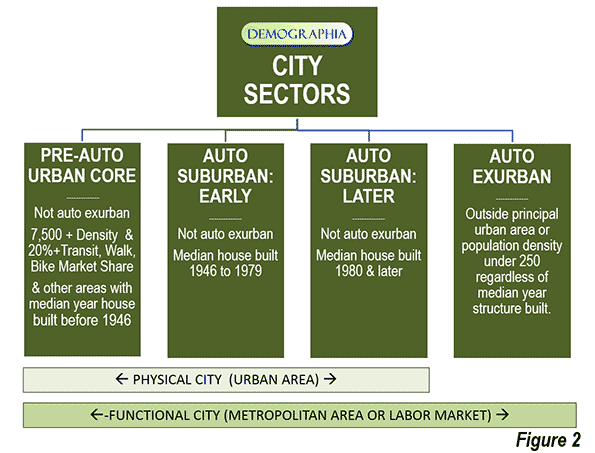
    Due to media and academic interest in the Pre-Auto Urban Core, a number of data combinations were used to best fit the modeled population to that of the core municipalities that have virtually the same boundaries as in 1940 and that were virtually fully developed by that time (the Pre-War & Non-Suburban classification in historical core municipalities). A number of potential criteria were examined, and the following were accepted (Figure 2).

    The Auto Exurban category includes any area outside a principal urban area.

    The Pre-Auto Urban Core category includes any non-exurban with a median house construction date of 1945 or before and also included areas with a population density of 7,500 per square mile (2,900 per square kilometer) or more and with a transit, walk and cycling journey to work market share of 20 percent or more.

    The Auto Suburban Earlier category included the balance of areas with a median house construction date of 1979 or before.

    The Auto Suburban Later category later included the balance of areas with a median house construction date of 1980 or later.

    Additional details on the criteria are in Note 1
    Results: 2010 Census

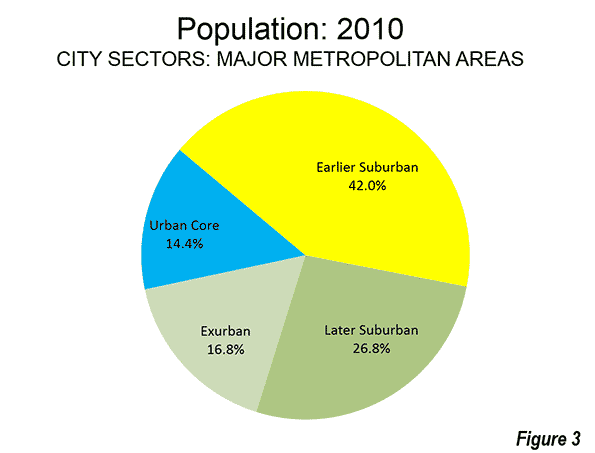
    The combined Pre-Auto Urban Core areas represented 14.4 percent of the population of the major metropolitan areas in 2010 (2013 geographical definition). This compares to the 26.4 percent that the core municipalities themselves represented of the metropolitan areas, indicating nearly half of their population was essentially suburban.

    The Auto Suburban: Earlier areas accounted for 42.0 percent of the population, while the Auto Suburban: Later areas had 26.8 percent of the population. The Auto Exurban areas had 16.8 percent of the population (Figure 3).
    The substantial difference between US and Canadian urbanization is illustrated by applying an approximation of the Gordon-Janzen criteria, which yielded an 8.4 percent Pre-Auto Urban Core population. The corresponding figure for the six major metropolitan areas of Canada was 24.0 percent. This difference is not surprising, since major Canadian urban areas have generally higher densities and much more robust transit, walking and cycling market shares. Yet, the Gordon-Janzen research shows Canada still to be overwhelmingly suburban (Note 2).

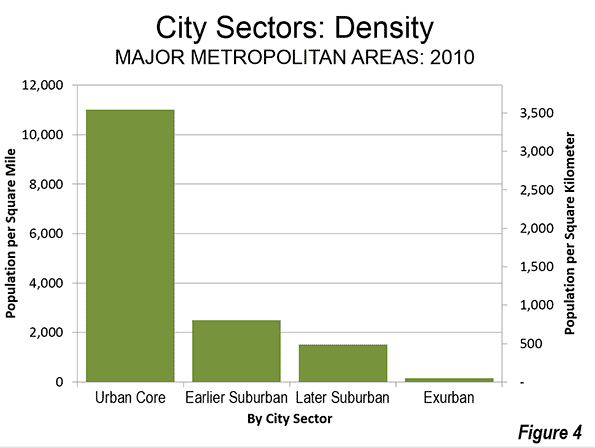
    Population Density: As would be expected, the Pre-Auto Urban Core areas had the highest densities (Figure 4), at 11,000 per square mile (4,250 per square kilometer). The Auto Suburban: Earlier areas had a density of 2,500 per square mile (1,000 per square kilometer), while the Auto Suburban: Later had a population density of 1,300 per square mile (500 per square kilometer), while the Auto Exurban areas had a population density of 150 per square mile (60 per square kilometer)).
    Individual Metropolitan Areas (Cities)

    The metropolitan areas with the highest proportion of Pre-Auto Urban Core population are New York (more than 50 percent), and Boston (nearly 35 percent), followed by Buffalo, Chicago, San Francisco-Oakland, and Providence, all with more than 25 percent (Table).

    Table
    City Sectors: 2010
    Major Metropolitan Areas
    City (Metropolitan Area) Pre-Auto Urban Core Auto Suburban: Earlier Auto Suburban: Later Auto Exurban
    Atlanta, GA 0.5% 14.9% 70.7% 13.8%
    Austin, TX 1.8% 15.7% 62.5% 20.0%
    Baltimore, MD 16.2% 41.8% 19.9% 22.0%
    Birmingham, AL 0.0% 42.1% 24.6% 33.3%
    Boston, MA-NH 34.2% 49.7% 3.2% 12.9%
    Buffalo, NY 28.8% 51.6% 3.1% 16.5%
    Charlotte, NC-SC 0.0% 10.0% 38.4% 51.6%
    Chicago, IL-IN-WI 25.8% 45.0% 18.3% 10.9%
    Cincinnati, OH-KY-IN 10.1% 38.8% 24.3% 26.8%
    Cleveland, OH 22.2% 46.8% 10.5% 20.6%
    Columbus, OH 5.0% 28.7% 37.5% 28.9%
    Dallas-Fort Worth, TX 0.3% 34.4% 43.0% 22.4%
    Denver, CO 3.1% 42.9% 42.4% 11.6%
    Detroit,  MI 6.3% 60.6% 16.1% 16.9%
    Grand Rapids 3.8% 32.9% 15.3% 48.1%
    Hartford, CT 11.1% 58.6% 1.1% 29.2%
    Houston, TX 0.3% 34.2% 48.9% 16.6%
    Indianapolis. IN 4.6% 28.0% 41.8% 25.6%
    Jacksonville, FL 0.0% 26.4% 48.2% 25.4%
    Kansas City, MO-KS 5.4% 37.6% 26.3% 30.6%
    Las Vegas, NV 2.4% 17.5% 76.7% 3.5%
    Los Angeles, CA 10.4% 76.4% 5.2% 8.0%
    Louisville, KY-IN 8.1% 45.4% 25.6% 20.8%
    Memphis, TN-MS-AR 1.8% 40.6% 34.3% 23.3%
    Miami, FL 1.4% 51.4% 44.8% 2.4%
    Milwaukee,WI 22.1% 52.0% 10.4% 15.5%
    Minneapolis-St. Paul, MN-WI 12.7% 31.6% 33.8% 22.0%
    Nashville, TN 0.0% 25.0% 36.1% 38.9%
    New Orleans. LA 10.6% 49.9% 7.0% 32.4%
    New York, NY-NJ-PA 52.4% 35.3% 5.6% 6.7%
    Oklahoma City, OK 2.5% 35.1% 31.6% 30.8%
    Orlando, FL 0.0% 16.1% 50.5% 33.4%
    Philadelphia, PA-NJ-DE-MD 24.6% 51.1% 15.1% 9.2%
    Phoenix, AZ 0.0% 29.4% 51.7% 18.8%
    Pittsburgh, PA 15.7% 56.1% 4.8% 23.4%
    Portland, OR-WA 9.3% 36.7% 39.5% 14.6%
    Providence, RI-MA 25.5% 47.7% 2.8% 24.0%
    Raleigh, NC 0.0% 7.5% 54.4% 38.1%
    Richmond, VA 4.5% 38.8% 38.0% 18.8%
    Riverside-San Bernardino, CA 0.0% 29.1% 29.4% 41.4%
    Rochester, NY 11.1% 46.9% 7.7% 34.3%
    Sacramento, CA 1.6% 38.0% 40.2% 20.1%
    St. Louis,, MO-IL 11.7% 39.9% 25.7% 22.8%
    Salt Lake City, UT 4.6% 47.9% 38.4% 9.1%
    San Antonio, TX 0.1% 39.7% 42.6% 17.6%
    San Diego, CA 1.2% 61.6% 30.3% 6.9%
    San Francisco-Oakland, CA 25.7% 55.5% 7.6% 11.2%
    San Jose, CA 0.1% 77.7% 9.1% 13.1%
    Seattle, WA 7.8% 38.9% 40.2% 13.0%
    Tampa-St. Petersburg, FL 0.0% 44.8% 39.7% 15.5%
    Virginia Beach-Norfolk, VA-NC 1.5% 44.4% 37.7% 16.4%
    Washington, DC-VA-MD-WV 15.9% 29.2% 36.2% 18.7%
    Overall 14.4% 42.0% 26.8% 16.8%


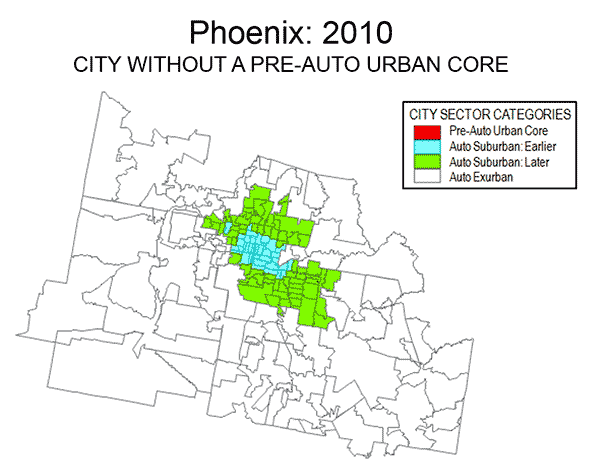
    It may be surprising that many of the major metropolitan areas are shown with little or no Pre-Auto Urban Core population. For example, five metropolitan areas have virtually no Pre-Auto Urban Core population, including Phoenix, Riverside-San Bernardino, Tampa-St. Petersburg, Orlando, Jacksonville, and Birmingham. By the Census Bureau criteria of 1940, two of these areas were not yet metropolitan and only Birmingham (400,000) had more than 250,000 residents.  Many of the newer and fastest growing metropolitan areas were too small, too sparsely settled or insufficiently dense to have strong urban cores before the great automobile suburbanization that followed World War II. Further, many of the Pre-Auto Urban Cores have experienced significant population loss and some of their neighborhoods have become more suburban (automobile oriented). Virtually no urban cores have been developed since World War II meeting the criteria.

    Thus, no part of Phoenix, San Jose, Charlotte and a host of other newer metropolitan areas functionally resembles the Pre-Auto Urban Core areas of metropolitan areas like Chicago, Cincinnati, or Milwaukee. However, new or expanded urban cores are possible, if built at high enough population density and with high enough transit, walking, and cycling use. 

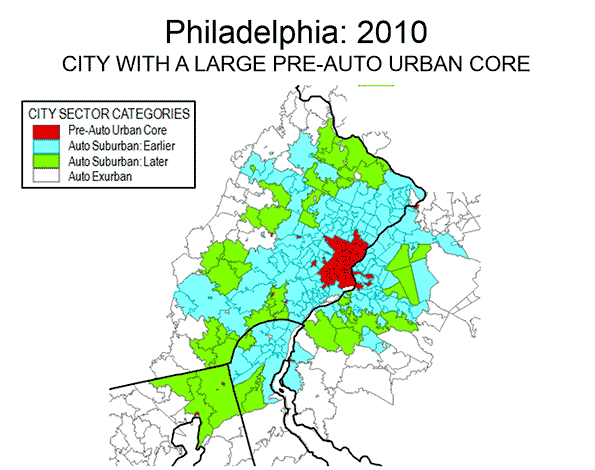
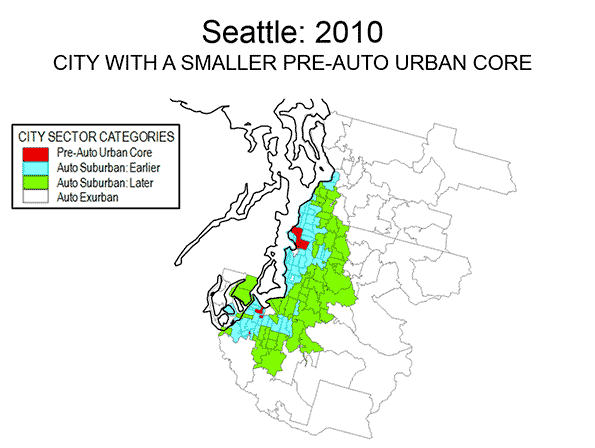
    Examples of three differing metropolitan areas are provided. Philadelphia (Figure 5) is a metropolitan area with a strong Pre-Auto Urban Core, which is indicative of an older metropolitan area that has been among the largest in the nation since its inception, Seattle (Figure 6) is a much newer metropolitan area, yet exhibits a larger Pre-Auto Urban Core than most. Phoenix (Figure 7) may be the best example of a post-War metropolitan area, with virtually no Pre-Auto Urban Core. In 1940, the Phoenix metropolitan area had only 120,000 residents and could be 40 times that large by 2020. Virtually all of Phoenix is automobile-oriented. Even three years after opening its light rail line, 88 percent of Phoenix commuters go to work by car and only two percent by transit, virtually the same as in 2000.
    Despite the comparatively small share of the modern metropolitan area represented by the Pre-Auto Urban Core in the City Core Model, the definition is broad and, if anything over-estimates the size of urban core city sectors. The population density of Pre-Auto Urban Core areas is below that of the historical core municipalities before the great auto oriented urbanization (11,000 compared to 12,100 in 1940) and well above their 2010 density (8,400), even when New York is excluded. The minimum density requirement of 7,500 per square mile (not applied to analysis zones with a median house construction data of 1945 or earlier) is slightly less than the density of Paris suburbs (7,800 per square mile or 3,000 per square kilometer) and only 20 percent more dense than the jurisdictional suburbs (suburbs outside the historical core municipality) of Los Angeles (6,400 per square mile or 2,500 per square kilometer). Some urban containment plans require higher minimum densities, not only in urban cores but also in the suburbs.

    In describing the Canadian results, Professor Gordon noted that there is a tendency to “overestimate the importance of the highly visible downtown cores and underestimate the vast growth happening in the suburban edges.” That is true to an even greater degree in the United States. 

    —–

    Note 1:

    The City Sector Model is applied to the 52 major metropolitan areas in the United States (over 1 million population). The metropolitan areas are broken into principal urban areas, with all other areas considered to be exurban. The principal urban areas also include the Concord urban area and the Mission Viejo urban area, which are adjacent to and included in the San Francisco and Los Angeles urban areas respectively. As a result, some smaller urban areas, such as Palm Springs (Riverside-San Bernardino metropolitan area), Lancaster (Los Angeles metropolitan area) and Poughkeepsie (New York metropolitan area) are considered exurban. Areas with less than 250 residents per square mile (100 per square kilometer) are also considered exurban, principally for classification of large areas on the urban fringe that have a substantial rural element.

    The Pre-Auto Urban Core includes all non-– exurban areas in which is the median house (single-family or multi-family) was built is 1945 or before. Three density levels were considered, 10,000, 7,500 and 5,000 per square mile (4,000, 2,900 and 2,000 per square kilometer). The lower 5,000 per square mile was examined to test the extent to which such a low density would increase the urban core population. This density, less than the entire urban area (urban core and suburban) of the Los Angeles, San Francisco, San Jose and New York urban areas would have, at the most raised the urban core population to 21.5 percent of the metropolitan population, even with a modest 10 percent transit, walking and cycling market share (Figure 8)
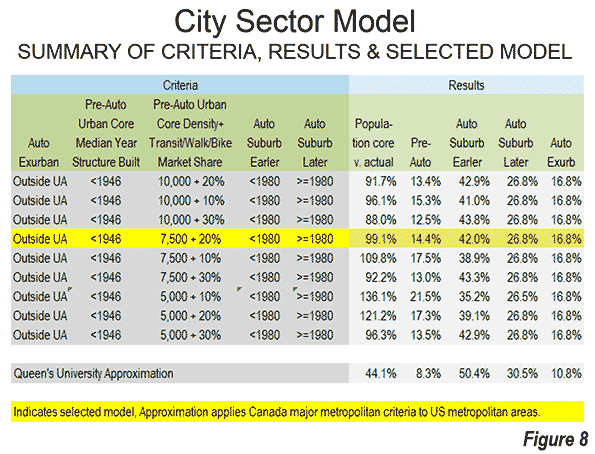
    The pre-auto urban core specification results in a 2010 population for the metropolitan areas with Pre-war and non-suburban historical core municipalities within one percentage point of the actual total, excluding the far higher density case of New York.

    The analysis showed that a lower transit, walking and cycling market share at a 7,500 per square mile floor (2,900 per square kilometer) would substantially increase the Pre-Auto Urban Core category population, while diluting its urban core nature. More than one-half of the increase would be in Los Angeles which has added literally millions of residents in high density suburban areas that are as automobile oriented as suburbs elsewhere.

    The analysis zones (zip codes) have an average population of 19,000, with from as many as 1,000 zones in New York to 50 in Raleigh.

    Note 2:

    An approximation based on the Gordon and Janzen approach would indicate an urban core population of only 8 percent in the major metropolitan areas of the United States. This approximation results in a modeled population for the metropolitan areas with pre-war and non-suburban historical core municipalities of less than one-half the actual 2010 population.

    This Queen’s University research comparison in Figure 8 is referred to as an approximation, since it applies an overall transit, walking, and cycling market share for the six major metropolitan areas, instead of a factor corresponding to each metropolitan area (the Gordon and Janzen approach).

    The differences in transit market share relative to the US are substantial. This may be best shown by considering Calgary, which with a population of 1.2 million in 2011 would have ranked as the 47th largest metropolitan area if it were in the United States. Yet, Calgary would rank second only to the New York metropolitan area in transit market share if it were in the United States. Even so, Calgary is found to be the most suburban of Canada’s major metropolitan areas in the Queen’s University research and Statistics Canada data from 2011 indicates strong domination of urban travel by the automobile.

    Wendell Cox is principal of Demographia, an international public policy and demographics firm. He is co-author of the “Demographia International Housing Affordability Survey” and author of “Demographia World Urban Areas” and “War on the Dream: How Anti-Sprawl Policy Threatens the Quality of Life.” He was appointed to three terms on the Los Angeles County Transportation Commission, where he served with the leading city and county leadership as the only non-elected member. He was appointed to the Amtrak Reform Council to fill the unexpired term of Governor Christine Todd Whitman and has served as a visiting professor at the Conservatoire National des Arts et Metiers, a national university in Paris.

    Photo: Los Angeles
  • Are Law School Grads the Future’s Paralegals?

    According to recent figures, in the United Kingdom paralegals already make up (as a mean average) 44 percent of all fee earners in solicitors firms, and are on track to outnumber solicitors in firms within a decade. In the US, the Bureau of Labor Statistics projects a 16.7 percent growth in paralegal jobs between 2012 and 2022, adding 46,200 positions. Jobs for attorneys are expected to grow only about 10 percent during that period.

    Before the recent economic downturn, paralegals were either employees looking for further work experience, recent graduates working as paralegals for a short period of time to improve their expertise, or those who specifically wished to pursue a long-term careers as paralegals. Now, a new type of candidate is beginning to emerge: that of the accomplished law graduate who cannot secure a permanent job as a lawyer due to the vast number of suitable candidates. Legal firms are motivated to employ these academically gifted candidates as paralegals, because it means they can get employees who will work diligently for a much lower rate than young lawyers.

    Employment vacancies at legal firms are scarce in today’s economic climate. A vast number of UK legal graduates now leave university without training contracts. These graduates often seek alternative jobs within the legal profession, such as paralegal work. The situation of US law school graduates improved in 2013, but not by much, says The Wall Street Journal, which reports that things are looking up for the class of 2014, too, though finding full-time work remains a challenge.

    Many law school graduates have found themselves in this unfortunate employment predicament. For instance, Bar Professional Training Course graduate Georgina Blower described to The Guardian how “After finishing bar school without a pupillage in 2009, I got a paralegal job with a car manufacturer in a town outside London. I was one of the lucky ones, with most people on my course struggling to get any sort of legal-related work”. Despite being unable to acquire a training contract, Blower highlighted the benefits of working as a paralegal, describing it as “… good general experience… All you can do is keep stacking things in your favour and hope it all pays off.”

    Fellow graduate Charlotte Dalley offers a similar viewpoint. She graduated from the University of Chester with a 2.1 Law (LLB) degree and since 2013 has been working as a Trainee Solicitor for Gillhams Solicitors. The position has enabled Dalley to assist seasoned partners and more senior associates “with all aspects of private client work including the preparation of wills, probate and the administration of estates,” as well as gain “some valuable experience in dealing with residential and commercial property transactions”. In this way, paralegal work offers graduates the opportunity to acquire beneficial legal skills from which they can profit in the future.

    Even graduates who are fortunate enough to have secure routes to jobs as lawyers can see the benefits of paralegal work for boosting their long term career prospects. Leontia McArdle started working as a paralegal at international firm DLA Piper, despite having already secured a training contract at the firm. She found that; “When I was doing my application forms for training contracts, I thought it would really help if I had more experience in a law firm… I started applying for paralegal positions to confirm my interest and to show it was definitely the career I wanted”.

    By drawing on examples such as these, The Institute of Paralegals has been eager to demonstrate the benefits of working as a paralegal for law graduates. Legal firms, they say, prefer training contract candidates who have prior experience, “because the world of full-time, permanent work in a professional environment is something that most trainee solicitors have not previously experienced. They therefore sometimes need a “settling in” as they adjust to life as a worker and not a student. Paralegals have already had gone through that process – at somebody else’s expense!”.

    Ultimately, due to these trends, more legal graduates are seeking paralegal work. So much so that research suggests the number of people working as paralegals may continue to increase in the UK by over 20 percent in the next four years. This is predominantly due to the fact that legal firms are reluctant to hire more junior lawyers, yet the number of law graduates seeking employment continues to increase. In these circumstances, gaining employment as a paralegal permits graduates to work within their chosen field, develop professional relationships with employers and clients, and consolidate their knowledge of various aspects of legal work. All of this can prove beneficial not just while entry-level recruitment is flat, but throughout their long term legal careers.

    Bradley Taylor is a freelance writer from Derby, England. He enjoys writing across a variety of topics including law, travel and food. Follow Bradley on Twitter @BradleyTaylor84.

    Flickr photo by Stephanie Pakrul.

  • Pandering to the Minority Vote

    As they approach what could be a troublesome election season, Democratic party strategists have targeted two issues – inequality and race – as their primary means to prevent another shellacking in the mid-terms.

    But given the growing dominance of wealthy and overwhelmingly white gentry liberals, the class issue could prove troublesome, particularly given the tepid performance of the economy.

    In contrast, race appears to be the gift that keeps on giving. For Democrats, every day recalls the early civil rights struggle. Racially-tinged outbursts by people like Clippers owner Donald Sterling and Nevada rancher Cliven Bundy allow the progressives and the media to play the race card – a convenient way to boost minority turnout.

    Clearly, any sizeable drop- off in minority turnout would benefit the Republicans, who, to date, have been largely unsuccessful in appealing to non-white voters.

    A more relevant concern may be whether the overwhelming commitment minorities have to the Democratic Party actually works in their favor.

    To be sure, under the current regime, well-educated, affluent and well-connected minorities stand at the pinnacle of power, including the presidency and attorney general’s office.

    Culturally, the impact of African Americans and, increasingly, Hispanics has arguably never been greater.

    But beyond the symbolic level, the picture is considerably less inspirational. However much some historically neglected minorities have thrived and excelled, the overall economic and social gains for most minorities have been paltry at best.

    Despite the benefits of government programs such as affirmative action – something opposed by some other minorities, notably Asian Americans – African Americans have not expanded their share of the middle class in recent decades. Indeed, racial economic disparities are growing, with black unemployment more than double the white jobless rate and reaching 40 percent among youths.

    Even more revealing, many of those areas under the most complete progressive control – New York, San Francisco and Chicago – also have among the worst disparities between black and white incomes, notes a recent National Urban League study.

    It may well be that hyper-regulatory regimes in the left-leaning cities tend to chase away blue collar jobs and raise the price of housing so high that minorities simply leave. Many of those who stay pay an inordinate share of their income, often upwards of 50 percent, just to keep a roof over their head.

    As Thomas Sowell has observed, the black population of San Francisco, the ultimate gentry city, is now half of what it was in 1970, even as the city has experienced an overall demographic resurgence.

    To be sure, a primarily redistributionist approach may improve some material conditions, but it also seems to foster a permanent underclass of dependents.

    This can be seen in the ability of the 50-year war on poverty to reduce levels considerably after the initial gains of the 1960s.

    The biggest reductions in poverty have taken place not during periods of higher welfare spending, but during economic expansions such as those that occurred under Presidents Reagan and Clinton, both of whom, in different ways, opposed the expansion of traditional welfare programs.

    This article first appeared in the Orange County Register.

    Joel Kotkin is executive editor of NewGeography.com and Distinguished Presidential Fellow in Urban Futures at Chapman University, and a member of the editorial board of the Orange County Register. He is author of The City: A Global History and The Next Hundred Million: America in 2050. His most recent study, The Rise of Postfamilialism, has been widely discussed and distributed internationally. He lives in Los Angeles, CA.

    Voter sign photo by Bigstock.

  • Are America’s Rich More Generous?

    In 2009, the two richest men in America organized a confidential dinner meeting of billionaires in New York City, hosted by David Rockefeller. Guests included George Soros, Michael Bloomberg, Ted Turner, and Oprah Winfrey. The topic of discussion was philanthropy. Each billionaire was asked to describe his philosophy of giving. CNN-founder Ted Turner told the story tale of how he had made a spur-of-the-moment decision to donate $1 billion, most of his future, to the United Nations. During this dinner, Bill Gates and Warren Buffet started the biggest fundraising drive in history. Setting examples though their own charity, Gates and Buffet initiated “The Giving Pledge”, a campaign encouraging billionaires to commit the majority of their wealth to philanthropic causes. So far around 113 billionaires have agreed to the pledge.

    Billionaires are targeted because Gates and Buffet believe that only they have sufficient funds to make a dent into the world’s major problems. The United States was initially chosen in part because the nation has a stronger culture of donating. The social contract in the United States puts stronger emphasize on giving back something to society by those fortunate enough to have acquired wealth. Bill Gates has already donated close to $30 billion dollars of his own wealth. He has further pledged to donate his remaining wealth of about $60 billion (leaving his three children $10 million each). Omaha billionaire Warren Buffett was inspired by his friend Gates’ example and also pledged all of wealth to charity. Leaving only a small endowment to his children, Buffet stating “I want to give my kids just enough so that they would feel that they could do anything, but not so much that they would feel like doing nothing”.

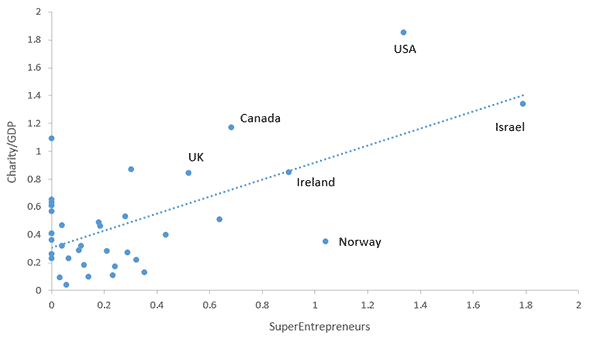
    On average, the wealthy in the United States tend to donate a higher share of assets to charity than those in other countries. There also appears to exist an international correlation between charitable donations and billionaire entrepreneurship. The Johns Hopkins Comparative Nonprofit Sector Project cites data about cross-country differences in charitable donations. The 2004 book “Global Civil Society: Dimensions of the Nonprofit Sector” contains charitable donations as a share of GDP in 36 countries. According to this source Americans donated 1.9% of GDP to charity, compared to 0.3% of GDP in continental Europe.

    In the publication “SuperEntrepreneurs – and how your country can get them” we recently examined the circa 1000 self-made men and women who have earned at least $1 billion dollars and who have appeared in Forbes magazine’s list of the world’s richest people between 1996 and 2010. There is a very strong correlation between the per capita number of SuperEntreprenures in different countries and donations to charity as a share of GDP. This relationship holds also when controlling for per capita GDP and tax rates. Other than the United States, countries with a high count of SuperEntreprenures and high charity as a share of GDP includes Israel (1.3 percent of GDP), Canada (1.2 percent) and the United Kingdom (0.8 percent). Several British Superentreprenurs have joined the Gates and Buffet Giving Pledge to donate half their wealth to charity, including Michael Anthony and Richard Branson.

    It may be that the strong correlation between charity and the number of SuperEntreprenurs is not causal and reflects cultural differences, such as Anglo-Saxon countries donating more to charity and having more entrepreneurship. To some extent, there may be an interplay between Anglo-Saxon capitalist culture and Anglo-Saxon prescription for charity, especially for the fortunate. Tocqueville has argued that Protestant norms such as industry, frugality, charity and humility were important for American development. The Calvinist Puritan settlers brought with them strong norms of charity from England, which also influenced Canada and Australia. Interestingly, a similar norm towards expectations of charity from the wealthy exists in Jewish culture, which may in part account for the high rate of charity in Israel. The lower rates of charitable giving is found in poorer countries such as Mexico (0.04 percent of GDP) and India (0.09 percent) but also in Germany (0.13 percent) Austria (0.17 percent), Korea (0.18 percent) and Japan (0.22 percent).

    American capitalism differs from other societies in its historical focus on both the creation of wealth and the reconstitution of wealth through philanthropy. In 1957, Historician Merle Curti argued that “philanthropy has been one of the major aspects of and keys to American social and cultural development”. The implicit social contract allows rich Americans to retain most of their wealth from taxation. In return, they voluntarily give much of it back to society, in projects of their choosing. The notion exists that wealth beyond a certain point should be invested back in society to expand opportunity for future generations. In this way John D. Rockefeller, the richest man in American history, gave back 95 percent of his wealth before he died.

    The legitimacy of American capitalism has in part been upheld through voluntary donations from the rich. Social norms regulating donations differ markedly between Europe and the United States, not only for the rich. In the United States, around 2 percent of GDP is donated to charity each year; about ten times higher the ratio of European countries. Based on tax data, Fortune Magazine estimates that the 400 highest earning Americans donate $15 billion to charity each year, or around ten percent of their annual income. Compared to other donors, wealthy Americans are more likely to donate to education and the arts but less likely to donate to religion.

    Much of the new wealth created historically has thus been given back to society. This has had several feed-back effects on capitalism. For one, the practice has limited the rise of new dynasties. Another positive feed-back mechanism is that the donations to research and higher education in particular has allowed new generations to become wealthy. In his lifetime, Rockefeller alone established many important institutions, including the University of Chicago, Spelman College, The General Education Board, National Bureau of Economic Research, Brookings Institution, and the Rockefeller Foundation. The University of Chicago is not the only great private research universities created through individual philanthropy. The same is true for Stanford, MIT, Johns Hopkins, Carnegie-Mellon, and Duke.

    Lastly the practice of philanthropy creates legitimacy for capitalism among the public. Bill Gates, the richest man in America, accumulated his wealth using famously sharp elbows. Yet his is one of the most popular people in the country. In one public Pew poll, he was viewed favorably by 69 percent and unfavorably by only 15 percent of the public, the best numbers of any public person polled. Similarly according to Gallup Bill Gates in the most admired man in America who is not a current or former President.

    Scholars Asc and Phillips have disused the “entrepreneurship-philanthropy nexus” at length, arguing that “[m]uch of the new wealth created historically has been given back to the community, to build up the great social institutions that have a positive feedback on future economic growth.” Asc and Phillips describe the importance of these norms in American economic history: “For Carnegie, the question was not only, ‘How to gain wealth?’ but, importantly, ‘What to do with it?’ The Gospel of Wealth suggested that millionaires, instead of bequeathing vast fortunes to heirs or making benevolent grants by will, should administer their wealth as a public trust during life”. Charitable instincts amongst highly successful entrepreneurs is relevant for economic development, in a time where there is global concern that rich dynasties will dominate capital ownership by investing inherited wealth. The combination of opportunities to create new wealth and philanthropy has so far ensured that Anglo-Saxon societies are characterized by new wealth, compared to countries such as France where inherited wealth plays an increasingly important part in the economy.

    Dr. Nima sanandaji is a frequent writer for the New Geography. Dr. Tino Sanandaji is a full-time researcher at the Research Institute of Industrial Economics (IFN) in Stockholm. They have co-authored “SuperEntrepreneurs – and how your country can get them” (Center for Policy Studies) which has received considerable media impact during recent weeks.

    Bill Gates photo by PauloHenrique. 


    Acs, Z.J., and R.J. Phillips (2002). “Entrepreneurship and philanthropy in American capitalism”. Small Business Economics, 19;3:189-204.

    Curti, M. (1957). "The History of American Philantropy as a Field of Research", The American Historical Review, 62;2:352-363. De Tocqueville, A. (1966), reprint from original 1835 publication. “Democracy in America”, New York, NY: HarperCollings.

    Fortune Magazine and CNN Money (2010). "The $600 billion challenge", 2010-06-16. Blog post availiable on http://features.blogs.fortune.cnn.com/2010/06/16/gates-buffett-600-billion-dollar-philanthropy-challenge/ when last checked 2013-12-31.

    Lester, S., W. Sokolowski and Associates (2004). “Global Civil Society: Dimensions of the Nonprofit Sector, Volume Two”, Bloomfield, CT: Kumarian Press.

  • California’s Green Bantustans

    One of the core barriers to economic prosperity in California is the price of housing. But it doesn’t have to be this way. Policies designed to stifle the ability to develop land are based on flawed premises. These policies prevail because they are backed by environmentalists, and, most importantly, because they have played into the agenda of crony capitalists, Wall Street financiers, and public sector unions. But while the elites have benefit, ordinary working families have been condemned to pay extreme prices in mortgages, property taxes, or rents, to live in confined, unhealthy, ultra high-density neighborhoods. It is reminiscent of apartheid South Africa, but instead of racial superiority as the supposed moral justification, environmentalism is the religion of the day. The result is identical.

    Earlier this month an economist writing for the American Enterprise Institute, Mark J. Perry, published a chart proving that over the past four years, more new homes were built in one city, Houston Texas, than in the entire state of California. We republished Perry’s article earlier this week, “California vs. Texas in one chart.” The population of greater Houston is 6.3 million people. The population of California is 38.4 million people. California, with six times as many people as Houston, built fewer homes.

    And when there’s a shortage, prices rise. The median home price in Houston is $184,000. The median price of a home in Los Angeles is $530,000, nearly three times as much as a home in Houston. The median price of a home in San Francisco is $843,000, nearly five times as much as home in Houston. What is the reason for this? There may be a shortage of homes, but there is no shortage of land in California, a state of 163,000 square miles containing vast expanses of open space. What happened?

    You can argue that San Francisco and Los Angeles are hemmed in by ocean and mountains, respectively, but that really doesn’t answer the question. In most cases, these cities can expand along endless freeway corridors to the north, south, and east, if not west, and new urban centers can arise along these corridors to attract jobs. But they don’t, and the reason for this are the so-called “smart growth” policies. In an interesting report entitled “America’s Emerging Housing Crisis,” Joel Kotkin calls this policy “urban containment.” And along with urban containment, comes downsizing. From another critic of smart growth/urban containment, economist Thomas Sowell, here’s a description of what downsizing means in the San Francisco Bay Area suburb Palo Alto:

    “The house is for sale at $1,498,000. It is a 1,010 square foot bungalow with two bedrooms, one bath and a garage. Although the announcement does not mention it, this bungalow is located near a commuter railroad line, with trains passing regularly throughout the day. The second house has 1,200 square feet and was listed for $1.3 million. Intense competition for the house drove the sale price to $1.7 million. The third, with 1,292 square feet (120 square meters) and built in 1895 is on the market for $2.3 million.”

    And as Sowell points out, there are vast rolling foothills immediately west of Palo Alto that are completely empty – the beneficiaries of urban containment.

    The reason for all of this ostensibly is to preserve open space. This is a worthy goal when kept in perspective. But in California, NO open space is considered immediately acceptable for development. There are hundreds of square miles of rolling foothills on the east slopes of the Mt. Hamilton range that are virtually empty. With reasonable freeway improvements, residents there could commute to points throughout the Silicon Valley in 30-60 minutes. But entrepreneurs have spent millions of dollars and decades of efforts to develop this land, and there is always a reason their projects are held up.

    The misanthropic cruelty of these polices can be illustrated by the following two photographs. The first one is from Soweto, a notorious shantytown that was once one of the most chilling warehouses for human beings in the world, during the era of apartheid in South Africa. The second one is from a suburb in North Sacramento. The scale is identical. Needless to say, the quality of the homes in Sacramento is better, but isn’t it telling that the environmentally enlightened planners in this California city didn’t think a homeowner needed any more dirt to call their own than the Afrikaners deigned to allocate to the oppressed blacks of South Africa?

    The Racist Bantustan

    201402_Soweto-500px


    Soweto, South Africa  –  40′ x 80′ lots, single family dwellings

    When you view these two studies in urban containment, consider what a person who wants to install a toilet, or add a window, or remodel their kitchen may have to go through, today in South Africa, vs. today in Sacramento. Rest assured the ability to improve one’s circumstances in Soweto would be a lot easier than in Sacramento. In Sacramento, just acquiring the permits would probably cost more time and money than doing the entire job in Soweto. And the price of these lovely, environmentally correct, smart-growth havens in Sacramento? According to Zillow, they are currently selling for right around $250,000, more than five times the median household income in that city.

    The Environmentalist Bantustan

    201402_Sacramento-500px


    Sacramento, California  –  40′ x 80′ lots, single family dwellings

    When you increase supply you lower prices, and homes are no exception. The idea that there isn’t enough land in California to develop abundant and competitively priced housing is preposterous. According to the American Farmland Trust, of California’s 163,000 square miles, there are 25,000 square miles of grazing land and 42,000 square miles of agricultural land; of that, 14,000 square miles are prime agricultural land. Think about this. You could put 10 million new residents into homes, four per household, on half-acre lots, and you would only consume 1,953 square miles. If you built those homes on the best prime agricultural land California’s got, you would only use up 14% of it. If you scattered those homes among all of California’s farmland and grazing land – which is far more likely – you would only use up 3% of it. Three percent loss of agricultural land, to allow ten million people to live on half-acre lots!

    And what of these lots in North Sacramento? What of these homes that cost a quarter-million each, five times the median household income? They sit thirteen per acre. Not even enough room in the yard for a trampoline.

    There is a reason to belabor these points, this simple algebra. Because the notion that we have to engage in urban containment is a cruel, entirely unfounded, self-serving lie. You may examine this question of development in any context you wish, and the lie remains intact. If there is an energy shortage, then develop California’s shale reserves. If fracking shale is unacceptable, then drill for natural gas in the Santa Barbara channel. If all fossil fuel is unacceptable, then build nuclear power stations in the geologically stable areas in California’s interior. If there is a water shortage, than build high dams. If high dams are forbidden, then develop aquifer storage to collect runoff. Or desalinate seawater off the Southern California coast. Or recycle sewage. Or let rice farmers sell their allotments. There are answers to every question.

    Environmentalists generate an avalanche of studies, however, that in effect demonize all development, everywhere. The values of environmentalism are important, but if it weren’t for the trillions to be made by trial lawyers, academic careerists, government bureaucrats and their union patrons, crony green capitalist oligarchs, and government pension fund managers and their partners in the hedge funds whose portfolio asset appreciation depends on artificially elevated prices, environmentalism would be reined in. If it weren’t for opportunists following this trillion dollar opportunity, environmentalist values would be kept in their proper perspective.

    The Californians who are hurt by urban containment are not the wealthy elites who find it comforting to believe and lucrative to propagate the enabling big lie. The victims are the underprivileged, the immigrants, the minority communities, retirees who collect Social Security, low wage earners and the disappearing middle class. Anyone who aspires to improve their circumstances can move to Houston and buy a home with relative ease, but in California, they have to struggle for shelter, endlessly, needlessly – contained and allegedly environmentally correct.

    Ed Ring is the executive director of the California Policy Center.