Blog

  • Three-headed Democratic Party

    As they face the midterm elections with the wind in their faces, Democrats increasingly stake their collective political future on the issue of inequality. The topic has great resonance, given the economy’s vast preponderance of benefits to the very rich and the almost obsessive focus on the issue by the mainstream media.

    But if raising the class-warfare flag gives Democrats at least hope for avoiding a 2010-style shellacking, it also threatens to open up huge, and potentially irreconcilable, differences within the party. Unlike with social issues, where the party is relatively united, class divides threaten party unity by pitting its different constituencies against each other.

    Today we can speak really of three Democratic parties, each with a separate class interest. Their divisions are as deep, perhaps more so, as that between the mainstream Republican Party and the Tea Party. As the Republicans are divided between Main Street grass-roots activists and the corporate “moderate” wing, the Democrats face potential schisms over a whole series of policies, from policing Wall Street to the environment, monetary policy and energy.

    The Gentry Liberals

    This group currently dominates the party, and have the least reason to object to the current administration’s performance. All in all, the gentry have generally done well in the recovery, benefiting from generally higher stock and real estate prices. They tend to reside in the affluent parts of coastal metropolitan areas, where Democrats now dominate.

    The liberal gentry have been prime beneficiaries of key Obama policies, including ultra-low interest rates, the bailout of the largest financial institutions and its subsidization of “green” energy. Wall Street Democrats also profit from the expansion of government since, as Walter Russell Mead points out, so many make money from ever-expanding public debt.

    What most marks the gentry, particularly in California, is their insensitivity to the impact of their policies on working-class and middle-class voters. They may support special breaks for the poor, but are in deep denial about how high energy and housing prices – in part due to “green” policies – are driving companies and decent-paying jobs from the state. The new “cap and trade” regime about to be implemented figures to push up gasoline and electricity prices for middle-income consumers, who, unlike the poor, have little chance of getting subsidies from Sacramento. High energy prices, one assumes, have less impact on the Bay Area or West Los Angeles Tesla- and BMW-driving oligarchy than to people living in the more extreme climate and spread-out interior regions.

    The gentry liberals’ power stems from their dominion over most of the key institutions – the media, the universities, academia and high-tech – that provide both cash and credibility to the current administration. The gentry impact is epitomized by hedge-fund billionaire and environmentalist Tom Steyer, an increasingly influential figure in Democratic circles, as well as nanny-state billionaire Michael Bloomberg and financier George Soros. It is largely the gentry who are pushing climate change as the party’s big issue, even though the voters, notes Gallup, rank it as among the least-important issues.

    The Populist Progressives

    Many more traditional left-leaning members of the Democratic Party – whom I would call the populist progressives – recognize that the Obama years have been a disaster for much of the party’s traditional constituencies, notably, minorities. Although the nation’s increasingly wide class divides and stunted upward mobility has been developing for years, they have widened ever more under Obama, as the wealthy and large corporations have enjoyed record prosperity.

    Although too loyal to openly abandon the first black president, and perhaps too terrified of the Republicans, the populist Left sees Barack Obama as unnecessarily timid in pursuing the war against the hated “1 percent.”

    As Massachussetts U.S. Sen. Elizabeth Warren has noted, the priorities in both Congress and the administration after the financial crisis was not to help the millions damaged by the Great Recession. “The government’s most important job,” she remarks, “was to provide a soft landing for the tender fannies of the banks.”

    In the future, particularly as President Obama fades from view, the new populists will inevitably have conflicts with their party’s key gentry backers. The campaign by Minnesota U.S. Sen. Al Franken against the Comcast merger with Time Warner – uniting two huge firms tied to the gentry – could prove a harbinger of this evolving tension.

    Standing up to the oligarchs could make Warren, as the New Republic noted recently, a potential “nightmare” for the expected presidential run of Hillary Clinton and Clinton’s phalanx of insiders, Wall Streeters and 1 percenters. But the populists’ often-blunderbuss redistributionist tendencies – seen most notably in deep blue big cities – could alienate many middle-class voters who, for good reasons, suspect that this redistribution will come largely at their expense.

    The Old Social Democrats

    Ironically, the weakest part of the Democratic Party is also the last bastion of traditional American liberalism. The old Democrats are the remnants of the great political party that produced the likes of Andrew Jackson, Harry Truman, and, to some extent, even Bill Clinton. Unlike the other party factions, this group can appeal consistently to the middle and working classes, including the famous “Bubba” vote. Unlike the gentry, or the coastal new populists, they tend to be relatively moderate on social issues.

    This group is the most closely associated with private-sector labor, manufacturing and areas dependent on fossil-fuel production. Long dependent on white working-class voters, they are the most threatened by the increasingly hostile attitudes among them to President Obama and his gentry liberal regime. Already, some building trade unions in Ohio, angry about delays on the Keystone XL pipeline and other infrastructure projects, have even shifted toward the GOP.

    These shifts directly threaten the last redoubts of the Old Democrats in such conservative states as Louisiana, Arkansas, Montana, Alaska, West Virginia and even purplish Colorado. Although Old Social Democrat senators tend to support fossil fuel development, they and their private-sector union backers increasingly find themselves outbid by green gentry Democrats. Steyer has pledged more money to the party this year than Keystone backers, such as the Laborers Union, have given since 1989.

    How these divides can play themselves out

    Clearly, there’s potential for some serious class warfare here. A party that represents both the tech oligarchs and the environmental lobby does not share the same concerns of, say, aspiring suburban homeowners or unionized energy workers. Steyer and Co. may not be able to remove the Old Democrats through primaries yet, but their approach is helping to erode working-class support, which could cost them both House and Senate seats.

    As the prime beneficiaries of the economic recovery, the gentry are vulnerable to attacks from the populists, who, rightly, see the wealthy’s outsized gains as anathema in an economy that has done precious little for the working and middle class.

    Here, the old Democrats would tend to make common cause with the new populists. But such a shift to the economic left, as opposed to the green or cultural left, risks support over time from companies like Google, who may be encouraged further to step up their efforts to gain influence among conservatives.

    To win nationally, the party needs to make room for all three kinds of Democrats. But the issues of class and inequality threaten to undermine any hope for comity.

    Just as it has increasingly become the case with the GOP, the most vicious Democratic struggles won’t be against their political opposition, but between each other.

    This article first appeared in the Orange County Register.

    Joel Kotkin is executive editor of NewGeography.com and Distinguished Presidential Fellow in Urban Futures at Chapman University, and a member of the editorial board of the Orange County Register. He is author of The City: A Global History and The Next Hundred Million: America in 2050. His most recent study, The Rise of Postfamilialism, has been widely discussed and distributed internationally. He lives in Los Angeles, CA.
  • From Anecdotes to Data: Core & Suburban Growth Trends 2010-2013

    According to the Wall Street Journal, there are "Signs of a Suburban Comeback." This is a turnaround from the typical media coverage of US population estimates in recent years, which have more often than not heralded a "return to the cities" generally more rooted in anecdote than data.

    There were always at least two problems with the "return to the city" thesis. First of all, most people who live in the suburbs came from areas outside metropolitan areas and they couldn’t return to where they had never lived (see Cities and Suburbs: The Unexpected Truth). More importantly, in every year for which there is data, the net inward migration to suburbs has been far greater than to the core counties, which have nearly always had net outward migration (see Special Report: 2013 Metropolitan Area Population Estimates. Under these conditions, there could not have been net migration from the suburbs to the core municipalities.

    Historical Core Municipalities: The Differences

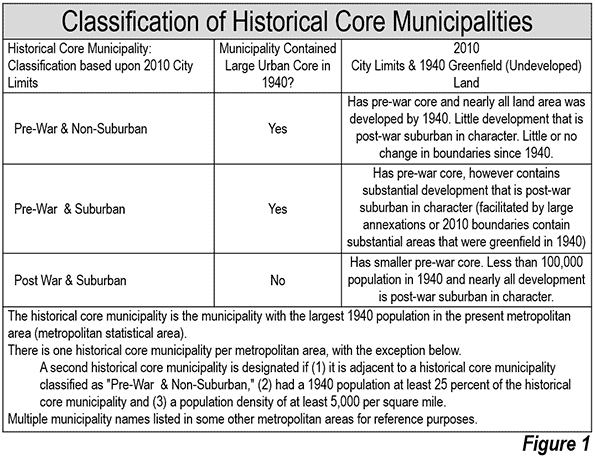
    I have classified historical core municipalities based on their extent of automobile oriented suburbanization (Figure 1). The break point is World War II, after which the great automobile suburbanization occurred in the United States. There had been automobile oriented suburbanization before 1940. During the 1920s, annual rates of suburban growth exceeded five percent in the 14 metropolitan areas with more than 500,000 population. The decade of the Great Depression (1930 to 1940) saw annual growth rates drop three quarters (Note). By the end of World War II, transit had seen its motorized urban travel market share restored to 35 percent, equal to early 1920s levels, a figure that has since fallen to under two percent. 

    Historical Core Municipalities: Improving Trends

    Even so, in recent years, the core municipalities have done better than in the past. The nightmare that occurred between 1970 and 1990 seems to be over in many places. This has made it feasible for an increase in core living by many Millennials and singles. However, even this has been exaggerated by anecdotal research that dominates the media. More than 80 percent of Millennials live outside the core municipalities, where they are less visible to the anecdote-driven media.

    On a percentage basis, the historical core municipalities of the 52 major metropolitan areas (more than 1,000,000 population) managed to grow 3.4 percent between 2010 and 2013, more than the suburban rate of 3.1 percent. This is probably the first time this has occurred in any three year period since the end of World War II.

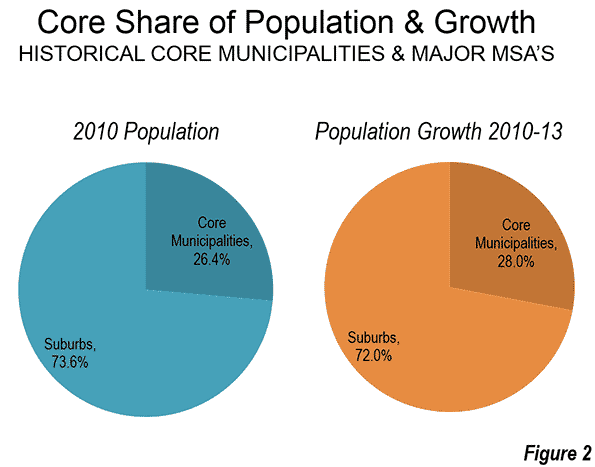
    But the core municipalities now contain such a small share of major metropolitan area population that the suburbs have continued to add population at about three times the numbers of the core municipalities (Figure 2). Indeed, if the respective 2010-2013 annual growth rates were to prevail for the next century,  the core municipalities would house only 28.0 percent of the major metropolitan area population in 2113 (up from 26.4 percent in 2013).

    Despite the publicity to the contrary, only six core municipalities added more population than suburbs in the same metropolitan areas between 2010 and 2013. These were New York, San Antonio, Columbus, San Jose, Austin, and New Orleans, all except New York with substantial suburbanization within their city limits. The core municipalities did better in percentage gains, with 19 gaining faster than the suburbs, compared to 33 suburban areas growing faster than the core municipalities.

    Core Municipality Growth

    Most of the 2010 to 2013 core growth occurred in municipalities with a larger suburban component. The core municipalities that have little suburban development ("Pre-War & Non-Suburban") had 43 percent of the core population in 2010. Yet they attracted only 27 percent of the growth (Figure 3). The two other categories, which include large areas of functional suburbanization (low density and strong automobile orientation) attracted 73 percent of the core population (Figure 3). These include suburbanized pre-War core municipalities, such as Los Angeles, Seattle, and Atlanta. They also include cores that are nearly all suburban, with nearly all of their population growth having occurred during the great automobile suburbanization (such as Austin, Sacramento, Phoenix, and San Jose).

    Core Municipalities: Top Gainers

    New York led the core municipalities by adding 230,000 new residents between 2010 and 2013. This was 56 percent of the population growth among the "Pre-War & Non-Suburban” core municipalities. The core municipality accounted for 60 percent of the population growth in the metropolitan area. However, domestic migrants continued to move away from New York City. Core municipality losses were 215,000 from 2010 to 2013, while the suburbs, with more than 55 percent of the population, lost less than a third as many (70,000).

    Houston gained 96,000 new residents between 2010 and 2013, followed by Austin (95,000), Los Angeles (92,000), and San Antonio (82,000).  Houston, Los Angeles, and San Antonio each have large suburban areas within their city limits, while the core municipality of Austin is virtually all automobile-oriented. The sixth through 10th positions were taken by Phoenix, Dallas, San Jose, Denver, and San Diego, all with substantial suburbanization.

    The largest core municipality population gains were in Austin (12.0 percent), still recovering New Orleans (10.1 percent), Denver (8.3 percent), Washington (7.4 percent), and Orlando (6.1 percent). Seattle, Raleigh, Atlanta, San Antonio and San Jose rounded out the top ten. Among the 10 fastest growing core municipalities, all but Washington have large automobile-oriented suburban components.

    There was also bad news. Detroit continued its population slide, now down to 689,000 from its 1950 peak of 1,850,000. This 62.76 percent loss, however, is not the worst among major US core municipalities. St. Louis still holds that title, having fallen from 857,000 in 1950 to 318,000 in 2013, a loss of 62.84 percent. However, one more year of losses at the 2010-2013 rates will transfer this dubious title to Detroit.

    Suburban Areas: Top Gainers

    The largest suburban gains were in Dallas-Fort Worth (325,000), Houston (296,000), Washington (269,000), Miami (245,000) and Los Angeles (211,000). Atlanta, which had virtually set the world standard for suburbanization before the Great Financial Crisis, managed to re-emerge with the sixth fastest largest suburban increase (208,000).

    Measured on a percentage basis, Texas dominated the suburban gains. The suburbs of Houston added 7.8 percent to their population between 2010 and 2013. Austin added 7.7 percent, San Antonio added 6.6 percent, and Dallas-Fort Worth 6.2 percent. The only non-Texas entry in the top five was Raleigh, which, like Austin, posted a 7.7 percent increase.

    The metropolitan area and historical core municipality data is summarized in the Table.

    Table: Metropolitan Area & Historical Core Municipality Population: 2010-2013
    Metropolitan Area Historical Core Municipality
    Rank Metropolitan Area 2010 2013 % Change 2010 2013 % Change
    1 New York, NY-NJ-PA 19.566 19.950 2.0% 8.175 8.406 2.8%
    2 Los Angeles, CA 12.829 13.131 2.4% 3.793 3.884 2.4%
    3 Chicago, IL-IN-WI 9.461 9.537 0.8% 2.696 2.719 0.9%
    4 Dallas-Fort Worth, TX 6.426 6.811 6.0% 1.198 1.258 5.0%
    5 Houston, TX 5.920 6.313 6.6% 2.099 2.196 4.6%
    6 Philadelphia, PA-NJ-DE-MD 5.965 6.035 1.2% 1.526 1.553 1.8%
    7 Washington, DC-VA-MD-WV 5.636 5.950 5.6% 0.602 0.646 7.4%
    8 Miami, FL 5.565 5.828 4.7% 0.399 0.418 4.6%
    9 Atlanta, GA 5.287 5.523 4.5% 0.420 0.448 6.6%
    10 Boston, MA-NH 4.552 4.684 2.9% 0.618 0.646 4.6%
    11 San Francisco-Oakland, CA 4.335 4.516 4.2% 1.196 1.244 4.0%
    12 Phoenix, AZ 4.193 4.399 4.9% 1.446 1.513 4.7%
    13 Riverside-San Bernardino, CA 4.225 4.381 3.7% 0.210 0.214 1.8%
    14 Detroit,  MI 4.296 4.295 0.0% 0.714 0.689 -3.5%
    15 Seattle, WA 3.440 3.610 5.0% 0.609 0.652 7.2%
    16 Minneapolis-St. Paul, MN-WI 3.349 3.459 3.3% 0.668 0.695 4.1%
    17 San Diego, CA 3.095 3.211 3.7% 1.307 1.356 3.7%
    18 Tampa-St. Petersburg, FL 2.783 2.871 3.1% 0.336 0.353 5.1%
    19 St. Louis,, MO-IL 2.788 2.801 0.5% 0.319 0.318 -0.3%
    20 Baltimore, MD 2.711 2.771 2.2% 0.621 0.622 0.2%
    21 Denver, CO 2.543 2.697 6.1% 0.600 0.649 8.2%
    22 Pittsburgh, PA 2.356 2.361 0.2% 0.306 0.306 0.0%
    23 Charlotte, NC-SC 2.217 2.335 5.3% 0.787 0.823 4.5%
    24 Portland, OR-WA 2.226 2.315 4.0% 0.584 0.609 4.4%
    25 San Antonio, TX 2.143 2.278 6.3% 1.327 1.409 6.1%
    26 Orlando, FL 2.134 2.268 6.3% 0.238 0.255 7.2%
    27 Sacramento, CA 2.149 2.216 3.1% 0.466 0.480 2.8%
    28 Cincinnati, OH-KY-IN 2.115 2.137 1.1% 0.297 0.298 0.2%
    29 Cleveland, OH 2.077 2.065 -0.6% 0.397 0.390 -1.7%
    30 Kansas City, MO-KS 2.009 2.054 2.2% 0.460 0.467 1.6%
    31 Las Vegas, NV 1.951 2.028 3.9% 0.584 0.603 3.4%
    32 Columbus, OH 1.902 1.967 3.4% 0.787 0.823 4.5%
    33 Indianapolis. IN 1.888 1.954 3.5% 0.820 0.843 2.8%
    34 San Jose, CA 1.837 1.920 4.5% 0.946 0.999 5.6%
    35 Austin, TX 1.716 1.883 9.7% 0.790 0.885 12.0%
    36 Nashville, TN 1.671 1.758 5.2% 0.601 0.634 5.5%
    37 Virginia Beach-Norfolk, VA-NC 1.677 1.707 1.8% 0.243 0.246 1.4%
    38 Providence, RI-MA 1.601 1.604 0.2% 0.178 0.178 0.0%
    39 Milwaukee,WI 1.556 1.570 0.9% 0.595 0.599 0.7%
    40 Jacksonville, FL 1.346 1.395 3.6% 0.822 0.843 2.5%
    41 Memphis, TN-MS-AR 1.325 1.342 1.3% 0.647 0.653 1.0%
    42 Oklahoma City, OK 1.253 1.320 5.3% 0.580 0.611 5.3%
    43 Louisville, KY-IN 1.236 1.262 2.1% 0.597 0.610 2.1%
    44 Richmond, VA 1.208 1.246 3.1% 0.204 0.214 4.8%
    45 New Orleans. LA 1.190 1.241 4.3% 0.344 0.379 10.1%
    46 Hartford, CT 1.212 1.215 0.2% 0.125 0.125 0.2%
    47 Raleigh, NC 1.130 1.215 7.4% 0.404 0.432 6.9%
    48 Salt Lake City, UT 1.088 1.140 4.8% 0.186 0.191 2.5%
    49 Birmingham, AL 1.128 1.140 1.1% 0.212 0.212 -0.1%
    50 Buffalo, NY 1.136 1.134 -0.1% 0.261 0.259 -0.9%
    51 Rochester, NY 1.080 1.083 0.3% 0.211 0.210 -0.1%
    52 Grand Rapids, MI 0.989 1.017 2.8% 0.188 0.192 2.3%
    Total 169.512 174.942 3.2% 44.739 46.258 3.4%
    In Millions: Data from US Census Bureau


    Normalcy Knocks?

    Ken Johnson, the frequently quoted University of New Hampshire demographer told the Wall Street Journal, "The slowing growth in these urban cores and the increasing gains in the suburbs may be the first indication of a return to more traditional patterns of city-suburban growth." These patterns are of long standing. Nearly all urban population growth since World War II has been suburban, whether within or outside the core municipalities. It should not be surprising that suburban growth dropped during the second greatest economic decline in a century and has been slow to recover during the Great Recession and the Great Malaise that has followed. The one-quarter suburban growth rate drop was more modest than during the Great Depression, but still substantial. Should genuine prosperity return, it will likely be accompanied by a renewal of more robust suburban growth.

    Note: Core municipality growth also dropped in the 1930s, as the high rate of migration from rural to urban areas in the 1920s was interrupted due to the economic reversal.

    Wendell Cox is principal of Demographia, an international public policy and demographics firm. He is co-author of the “Demographia International Housing Affordability Survey” and author of “Demographia World Urban Areas” and “War on the Dream: How Anti-Sprawl Policy Threatens the Quality of Life.” He was appointed to three terms on the Los Angeles County Transportation Commission, where he served with the leading city and county leadership as the only non-elected member. He was appointed to the Amtrak Reform Council to fill the unexpired term of Governor Christine Todd Whitman and has served as a visiting professor at the Conservatoire National des Arts et Metiers, a national university in Paris.

  • Is Something Wrong With Chicago’s Suburbs?

    I previously talked about Connecticut becoming a suburban corporate wasteland as well as the rise of the executive headquarters in major global city downtowns. What we see is that high end functions have shown anecdotal signs of re-centralizing, while the more bread and butter – though still often well-paying – jobs are heading to less expensive suburban locales in places like Austin, Charlotte, and Salt Lake City. These leaves expensive and business hostile suburbs around global cities, like most of those in Connecticut, in a tough spot.

    Suburban Chicago isn’t as expensive or business hostile as say Connecticut or New Jersey, but there are so many stories about businesses leaving it that I can’t help but wonder if something is seriously wrong there.

    First, downtown Chicago has attracted a number of marquee executive headquarters locations like Boeing, MillerCoors, and now ADM. The suburbs have only picked up a handful of smaller operations, like Mead Johnson Nutritionals.

    Second, a number of suburban companies have relocated (or announced relocations of) headquarters to downtown. This includes a Sara Lee spinoff, the old Motorola cell phone division, United Airlines, and Gogo Internet. What distinguishes this from the executive headquarters relocations is that some of these involved big numbers of jobs. I believe there were about 3,000 United Airlines employees and about 2,500 Motorola ones.

    Third, even companies that haven’t moved their headquarters have opened downtown offices or relocated operations there. Walgreens moved its e-Commerce operations to the Loop and BP relocated some employees, for example.

    Fourth, some suburban based companies have simply abandoned the Chicagoland area outright. Office Max comes to mind, which is moving 1,600 jobs to Boca Raton. Sears is having a slow-motion going out of business sale.

    Two recent news articles this week reinforce to me the lack of competitiveness of Chicago’s suburbs. First, when Toyota announced it was relocating its headquarters from Los Angeles and Cincinnati to suburban Dallas, Greg Hinz at Crain’s Chicago Business asked why Chicago wasn’t even on the list of candidate cities for this operation.

    I believe Toyota wanted to be in the South. But if you look at where they located, namely the suburb of Plano, you’ll see that this is why Chicago is off the list. Chicago’s suburbs have been losing these types of corporations, not gaining them. If you’re going to choose a suburban location, why would you pick Schaumburg over Plano? You probably wouldn’t unless you had a major reason to be in Chicagoland, such as having a primarily Midwest presence or if your company was founded in the area.

    What this shows is that while Chicago’s stellar Loop environment is great for executive headquarters type operations, the suburbs lack appeal to people looking to build a greenfield operation from out of town. This hurts the region’s ability to attract large scale employers like Toyota.

    Then yesterday Crain’s reported that Walgreens is looking at relocating its entire headquarters downtown in the old Main Post Office building. This isn’t a done deal by any means, but the fact that a company I’d always considered dyed-in-the-wool suburban would consider this is incredible. (Investors have been pressuring Walgreens to move its HQ overseas, but like Aon’s re-domicle to London, even if it happened it might not involve many jobs, especially since the pharmacy business in the United States is so radically different from that in the rest of the world).

    So unlike in even other global cities, Chicago’s suburbs can’t even seem to hang on to large scale employers within the region. I don’t want to overstate a trend here, but this would be at least the third company moving thousands of jobs downtown. That’s huge and I don’t see it happening anywhere else at this scale.

    Which raises the question of what might be wrong with Chicago’s suburbs. They can’t seem to be competitive for greenfield operations like Toyota, and they are losing some marquee established employers. I took a quick peek at suburban vacancy rates, and it looks like at first glance every major sub-market is over 20% and there was net negative absorption last year (do some further research before quoting me on that). Is there a big problem going on out there?

    I’ve long observed that while Chicago has some great residential suburbs, its business suburbs are weak. Places like Schaumburg and Oak Brook are just generic, unattractive edge cities of a typology that, like the enclosed mall, appears falling out of favor. Chicago seems to lack the kind of suburb that combines residential appeal with a strong business presence and a significant regional amenity draw. Only Naperville would seem to fit the bill here.

    So while Chicago’s suburbs are not super-high cost by global city standards, and Illinois isn’t the worst when it comes to taxes and a poor business climate by any means, those suburbs appear to have a serious competitiveness issue. It’s a major concern that regional suburban business centers should look to address. As other edge city environments around the country like Stamford (one part of Connecticut I would say has significant strengths) and Tyson’s Corner upgrade themselves, Chicago’s suburbs are only going to fall further behind.

    Aaron M. Renn is an independent writer on urban affairs and the founder of Telestrian, a data analysis and mapping tool. He writes at The Urbanophile, where this piece originally appeared.

    Photograph: Outer suburbs of Chicago (by Wendell Cox)

  • China’s Ascent in World Transport

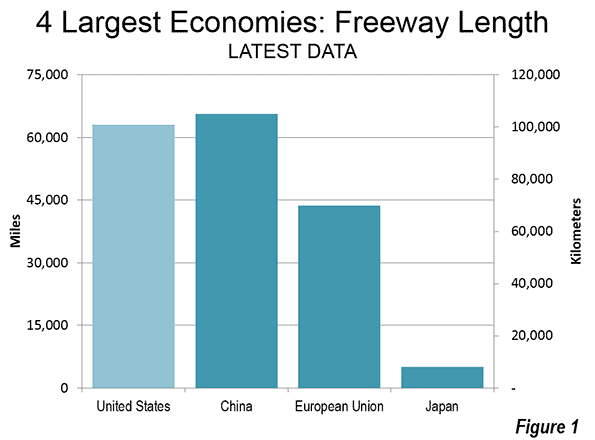
    After years of closing the gap with the United States, China built enough freeways in 2013 to amass the greatest length of freeways in the world. Between 2003 and 2013, China expanded its national expressway system, with interstate (motorway in Europe) standard roadways from 30,000 to 105,000 kilometers (18,000 to 65,000 miles). This compares to the 101,000 kilometers (63,000 miles) in the United States in 2012. China’s freeway system is also longer than that of the European Union, which was 70,000 kilometers in 2010 (43,000 miles) and Japan (8,000 kilometers or 5,000 miles) as is indicated in Figure 1 (Note 1). The ascent of China is evident across the spectrum of transport data, both passenger and freight.

    A review of transport statistics in the four largest world economies (nominal gross domestic product) shows considerable variation in both passenger and freight flows. It also reflects the rapid growth of China. Generally comparable and complete data is available for the European Union, the United States, China and Japan.

    Passenger Travel

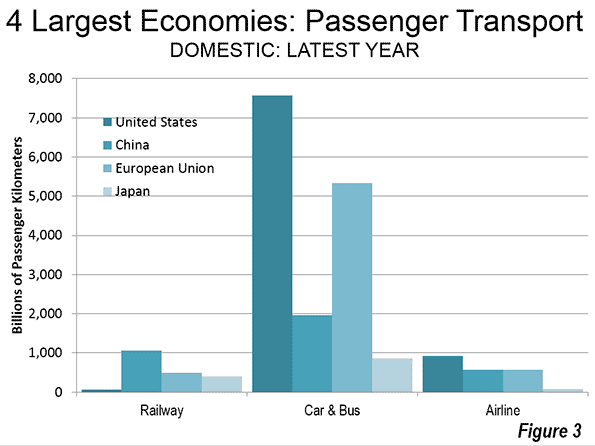
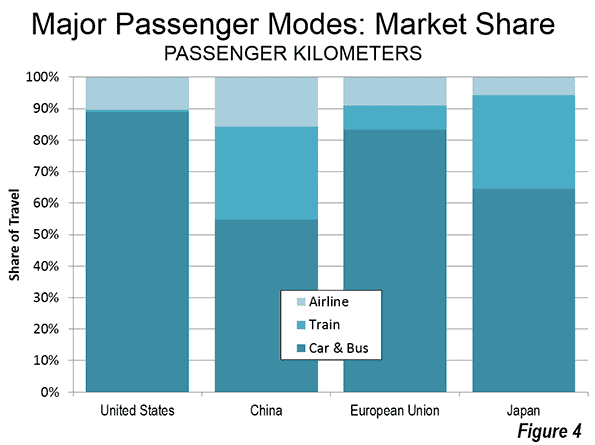
    All four of the world’s largest economies rely principally on roads for their passenger transport. The United States continues to lead in road volume (in passenger kilometers, see Note 2) by a substantial margin, followed by the European Union. In the United States, automobiles account for 83 percent of domestic passenger travel, which compares to 76 percent in the European Union and 58 percent in Japan. China’s combines automobile and bus data, which makes it impossible to obtain automobile comparisons with the other three economies.

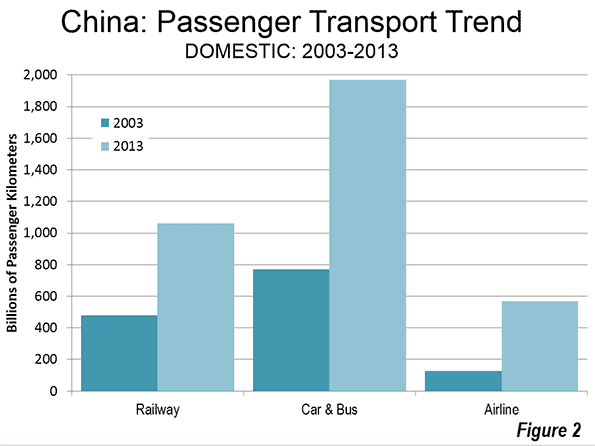
    Road travel increased more than 150 percent between 2003 and 2013 in China. Yet roads have barely held their market share as China has built new world-class airports, such as Capital City in Beijing, Baiyun in Guangzhou and many others. Over the same 10 years air travel has increased 350 percent. Meanwhile, China has built the world’s most extensive high-speed rail system and has experienced healthy rail travel growth. Yet, despite this, passenger rail’s market share has dropped from 35 percent to 29 percent over the period (Figure 2).

    China is dominant among the four economies in passenger rail volumes, with its 1.05 trillion annual passenger kilometers (0.65 trillion passenger miles) accounting for more than 2.5 times the rail travel in both the European Union and Japan. US rail travel is no more than 1/20th that of China (equal to the road travel volume in the state of Arkansas).

    The United States continues to lead in a domestic airline travel, with a volume approximately 60 percent greater than those of the European Union and China. China trails the European Union by only two percent and with its growth rate seems likely to assume the second position before long (Figure 3).

    Passenger travel market shares are indicated in Figure 4.

    Freight Transport

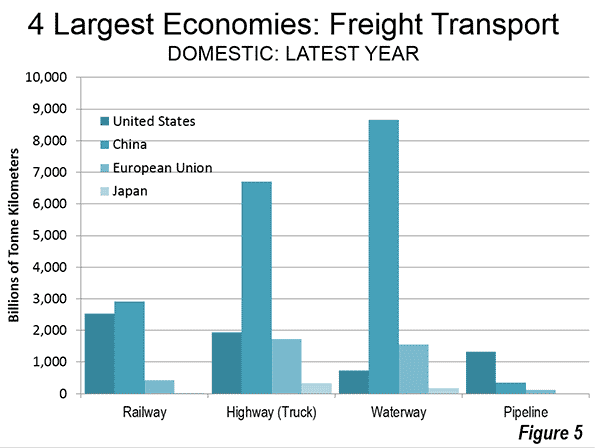
    After having led the world in rail freight volumes in recent decades, the United States has recently yielded the title to China. In 2013, China moved nearly 3 trillion tonne kilometers (Note 3) of freight by rail, compared to the US total of 2.5 trillion (2012). It may be surprising to find out that Europe, with its extensive passenger train system moves so little of its freight by rail. However, the European Union moved approximately 60 percent less of its freight by rail. However, much of the capacity of the EU’s rail system is consumed by passenger trains, leaving little for freight.  This is despite a policy commitment in the EU to substantially increase the rail freight market share relative to trucks. As a result, in Europe, the freight trains are "on the highway" (see Photo below). China has been uniquely successful among the world’s economies in developing both a world class freight rail system and a world class passenger rail system. One of China’s early objectives in developing its high speed rail program was to free space for its large freight train volumes.


    Caption: Trucks on the A7, north of Barcelona (by author)

    Among other nations, only Russia can compete with China and the United States in rail freight, having moved approximately 2.2 trillion tonne kilometers in 2012.

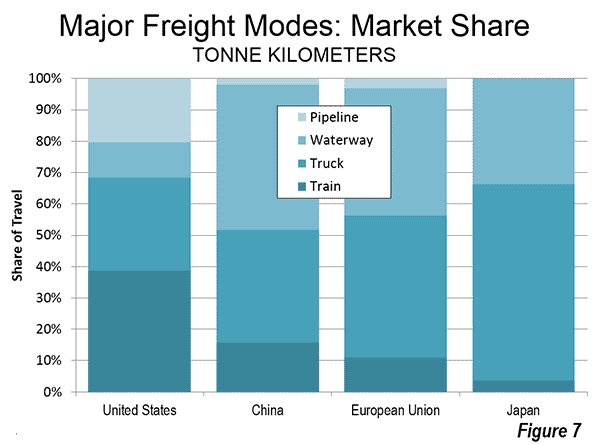
    Rail freight remains by far the most important in the United States compared to the other three largest economies. Rail freight continues to carry more tonne kilometers in the United States than trucks. The situation is much different in Europe, where trucks carried four times the volume of freight rail. Rail freight is even less significant in Japan, where trucks carry more than 15 times the volume of rail freight.

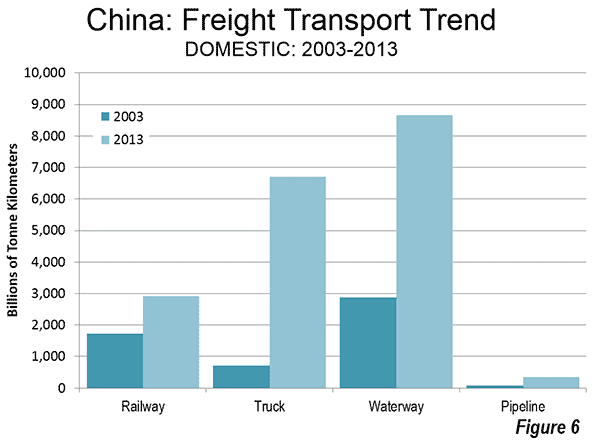
    One possibly surprising fact lies with the substantial increase in China’s truck volumes over the last decade. China now has a volume of truck traffic that is four times that of trucks in either the European Union or the United States.

    In 2003, trucks carried 60 percent less of the nation’s metric tonne mileage than freight rail. By 2013, that had been reversed with tracks carrying 130 percent more volume than freight rail.

    However China’s dominance is even greater in water borne freight, at nearly 6 times the European Union volume and more than 10 times the volume of the United States (Figure 5). Even so, China’s largest freight volumes are carried on waterways, such as the Yangtze River. Over the past 10 years waterway volumes tripled. It is even expected that there will be a significant increase in shipping on the ancient Grand Canal (Figure 6).

    Freight market shares among the major modes are shown in Figure 7.

    India

    Another of the world’s largest economies, India, also relies heavily on roads. According to the World Bank 65 percent of the freight and nearly 90 percent of passengers are carried by roads in India, though late detailed data is not available. Yet India also has the largest passenger rail usage in the world. Only China is close, and the two nations have been near equal, at least over the last decade. In 2003, China trailed India by seven percent in passenger kilometers by train. Complete Indian Railway data for 2013 is not yet available. However, if the average trip length in 2013 was the same as in 2012, China will have moved to within two percent of India’s passenger rail volume. Both nations are far above Japan and the European Union, ranked third and fourth, and almost 90 percent above Russia, which has a reputation for high passenger rail volumes.

    The Future

    With economic growth in China slowing (though still at rates that would satisfy virtually any other nation) its transport growth of the past decade seems likely to moderate. On the other hand, the other large emerging economy, India, which has substantially trailed China, could assume a Chinese trajectory. The newly elected Bharatiya Janata Party (BJP) government is committed to economic advance and infrastructure development. Market facilitating policies like those that have propelled China (see the late Noble Laureate Ronald Coase and Ning Wang, How China Became Capitalist), could lead to a similar story about India in a decade or two.

    ——

    Note 1: The latest data on international transport varies by year, even within nations (such as the United States). This analysis compares the latest data, which is 2012 (Europe and Japan), 2013 (China) and the United States (2011, with some 2009). This latest years available permit comparing the general scale of differences and, particularly in the United States, changes from the earlier data are likely to have been modest, as a result of the Great Financial Crisis and the great economic malaise that has followed. The principal data sources are the Bureau of Transportation Statistics in the United States, the National Bureau of Statistics in China and Eurostat for the European Union and Japan.

    Note 2: A passenger kilometer (or passenger mile) is the distance traveled times the number of passengers. Thus, a car going 5 kilometers with one passenger produces 5 passenger kilometers. With two passengers, there are 10 passenger kilometers.

    Note 3: A tonne kilometer is a metric tonne (2.204 pounds or 1,000 kilograms) of freight times the number of kilometers traveled. The US ton (short ton) has 2,000 pounds or 907 kilograms.

    —-

    Wendell Cox is principal of Demographia, an international public policy and demographics firm. He is co-author of the "Demographia International Housing Affordability Survey" and author of "Demographia World Urban Areas" and "War on the Dream: How Anti-Sprawl Policy Threatens the Quality of Life." He was appointed to three terms on the Los Angeles County Transportation Commission, where he served with the leading city and county leadership as the only non-elected member. He was appointed to the Amtrak Reform Council to fill the unexpired term of Governor Christine Todd Whitman and has served as a visiting professor at the Conservatoire National des Arts et Metiers, a national university in Paris.

    Photograph: Grand Canal in Suzhou (by author)

  • Thrive 2040: Toward a Less Competitive Minneapolis-St. Paul

    In a Wall Street Journal commentary entitled Turning the Twin Cities Into Sim City, Katherine Kersten of the Center of the American Experiment describes how "a handful of unelected bureaucrats are gearing up to impose their vision of the ideal society on the nearly three million residents of the Minneapolis-St. Paul metro region." She notes that the Metropolitan Council (the "handful of unelected bureaucrats") intend for "all future housing and economic development within "easy walking distance" (one-half mile) of major transit stops—primarily in the urban core and inner-ring suburbs.” This would lead to "tax dollars (mostly from people who live elsewhere) will be lavished on high-density housing, bike and pedestrian amenities and subsidized retail shops." She equates the plan with playing the computer game "Sim City with residents’ lives."

    Kersten also notes the all-too predictable distortion of future transportation funding to support transit, rather than highway congestion relief.  The ("Thrive 2040") "plan also will pour public funds into mass transit while virtually ignoring congestion relief on highways. The Twin Cities region is projected to have just $52 million available annually from 2014 to 2022 for highway congestion relief, according to the Minnesota Department of Transportation. Yet the Met Council intends to spend at least $1.7 billion on a single light-rail project, with more rail transit to follow."

    This imbalance of funding is despite the fact that less than two percent of travel in the Twin Cities is by transit. In the longer run, Minneapolis-St. Paul, which has been by far the most successful metropolitan area in the Midwest since World War II, will become less competitive if it fails to take steps to improve traffic congestion (and it is nothing short of folly to expect that transit can substitute for driving in the modern metropolitan area, see The Transit-Density Disconnect).

    Kersten also characterizes as the "most radical element," of the Metropolitan Council plan as its greenhouse gas emission reduction component, and for good reason. The urban containment policies of densification and transit are far more expensive than other strategies for reducing greenhouse gas emissions (see questioning the Messianic Conception of Smart Growth and Enough "Cowboy" Greenhouse Gas Emissions Reduction Policies). At the same time, there are a myriad of strategies that are more cost effective, such as improved fuel economy (see Obama Fuel Economy Rules Trump Smart Growth). Cost-effectiveness is important, because if more than necessary is spent to reach greenhouse gas emission goals, there will be an economic cost in fewer jobs created, a lower standard of living and greater poverty (see Toward More Prosperous Cities).

  • Taking a Back Seat to Texas

    The most important news recently to hit Southern California did not involve the heinous Donald Sterling, but Toyota’s decision to pull its U.S. headquarters out of the Los Angeles region in favor of greater Dallas. This is part of an ongoing process of disinvestment in the L.A. region, particularly among industrially related companies, that could presage a further weakening of the state’s middle class economy.

    The Toyota decision also reflects the continued erosion of California’s historic economic diversity, which provided both stability and a wide variety of jobs to the state’s workers. We have seen this in the collapse of our once-burgeoning fossil-fuel energy industry, capped this year by the announced departure from Los Angeles of the headquarters of Occidental Petroleum. Blessed with huge fossil fuel reserves, California once stood as one of the global centers of the energy industry. Now, with the exception of Chevron, which is shifting more operations out of state, all the major oil companies are gone, converting California from a state of energy producers to energy consumers, and, in the process, sending billions of dollars to Texas, Canada and elsewhere for natural gas and oil that could have been produced here.

    As did the oil industry, the auto industry, and, particularly, its Asian contingent, came to Southern California for good reasons. Some had to do with proximity to the largest port complex in North America, as well as the cultural comfort associated with the large Asian communities here. Back in the 1980s, the expansion of firms like Honda, Toyota and Nissan seemed to epitomize the unique appeal of the L.A. region – and California – to Asian companies. Today, only Honda retains its headquarters in Los Angeles (Nissan left in 2005), while Korean carmakers Hyundai and Kia make their U.S. homes in Orange County.

    Retaining these last outposts will be critical, as Southern California struggles to retain its once-promising role as a true global city. With the exception of the entertainment industry – itself shifting more production out of town – our region is devolving toward marginality, largely as a tourist and celebrity haven.

    Still, I’m concerned less about the region’s reputation than about the economic trajectory of its middle and working classes. The Toyota relocation from Torrance will eliminate 3,000 or more generally high-wage jobs, something that usually accompanies the presence of headquarters operations. It will cost the region, most particularly, the South Bay, an important corporate citizen, as, over time, the carmaker will likely shift its philanthropic emphasis toward Texas and its various manufacturing sectors.

    Perhaps more disturbing are the fundamental reasons behind the Toyota move. According to Toyota’s U.S. chief, James Lentz, they weren’t even courted by Texas, which has fattened itself on California’s less-competitive business climate.

    Some of Toyota’s reasoning is geographical. The port link is less essential now since close to three-quarters of Toyota’s vehicles sold in the U.S. are built here, up from 58 percent in 2008. At the same time, the growth of the “Third Coast” ports – Houston, Mobile, Ala., New Orleans and Tampa, Fla. – buoyed by the widening of the Panama Canal, makes it increasingly easy to ship components or cars in and out of the central U.S.

    More troubling still is the logic, both on the part of Nissan and Toyota, linking headquarters operations – with their marketing, design and tech-oriented jobs – closer to their industrial facilities in the south and Midwest. Toyota, for example, has a large truck plant in San Antonio as well as auto assembly plants throughout the mid-South. Honda, now the last major Japanese carmaker with a Southern California headquarters, last year also moved a number of executives from Torrance to Columbus, Ohio, closer to the company’s prime Marysville, Ohio, production hub.

    This pattern contradicts the notion, popular in both the Jerry Brown and Arnold Schwarzenegger administrations, that California’s massive loss of industrial jobs over the past decade can be offset by the creative industries, notably Hollywood and Silicon Valley. Since 2010, California has managed to miss out on a considerable industrial boom that has boosted economies from the Rust Belt states to the Great Plains and the Southeast. Los Angeles and Orange counties, the epicenter of the state’s industrial economy, have actually lost jobs. Since 2000, one-third of the state’s industrial employment base, 600,000 jobs, has disappeared, a rate of loss 13 percent worse than the rest of the country.

    But, the prevailing notion in California’s ruling circles seems to be, if you have Google and Facebook, who needs dirty, energy-consuming factories or corporate operations filled with middle managers? Silicon Valley crony capitalists and urban developers who support our political class, and are willing participants in various subsidized green energyschemes, have little interest in traditional manufacturing, regardless the damage inflicted on blue-collar workers, whom progressives are happy to subsidize (and thus gain their unending support) outside the labor force or keep severely underemployed.

    The deindustrialization of California was one reason behind the withdrawal of both Nissan and Toyota. Each automaker has established strong manufacturing operations in the mid-South and wanted to integrate technology, production, sales, marketing and design as a way to keep an edge in the competitive global industry. An area that seems determined to let its industrial base wither is not likely to attract companies whose basic business is building things.

    What is too rarely understood is the link between production skills and high-end jobs. The Toyota jobs that are leaving L.A. County are largely white-collar and skilled. Toyota engineers will be headed to Texas, and many also to Michigan, where, despite the travails of the past few decades, the engineering base is already very deep – roughly twice as strong per capita as formerly engineer-rich Los Angeles.

    This link between manufacturing and higher-end technical jobs is rarely appreciated among our political class. As President Clinton’s Board of Economic Advisors Chairman Laura D’Andrea Tyson points out, manufacturing is only about 11 percent of gross domestic product, but it employs the majority of the nation’s scientists and engineers, and accounts for 68 percent of business research and development spending, which, in turn, accounts for about 70 percent of total R&D spending.

    Of course, neither Jerry Brown nor any other reigning political figure would cavalierly dismiss manufacturing jobs, or even those at a major port. Yet, as we move toward ever-higher energy prices – likely aggravated by California’s “cap and trade” regime against global warming – industrial firms seem increasingly reluctant, at least without massive subsidies, to move to or expand in California. And, contrary to arguments offered in Sacramento, and reflected in much of the media, there are never going to be enough “green” jobs to make up the difference.

    Indeed, even Elon Musk, head of electric-car maker Tesla, though a primary beneficiary of California crony capitalism, is not considering the state for a proposed $5 billion battery plant, which would employ upward of 6,500.

    In its nonresponse to the Toyota move, the Governor’s Office stressed the state’s role as the epicenter of the “new electric, zero-emission and self-driving” vehicle industry. Nevertheless, even as devout a “green” company as Tesla will likely locate its battery factory in Nevada, Arizona, New Mexico or Texas. California, reportsgreentechmedia.com “didn’t make the short list because of the potential for regulatory and environmental delays.”

    For a state that has built its future vision on “green” industry, this is both ironic and tragic. It may not bother the Legislature, whose welfare state is now being propped up by windfall tech profits, but it leaves many localities outside the Silicon Valley exposed to more job and company losses. Think of Torrance Mayor Frank Scotto, who concedes the struggle to keep companies around is becoming ever more difficult. “A company can easily see where it would benefit by relocating someplace else,” Scotto said.

    Even so, it is unlikely that Toyota’s leaving will impact the state’s leftward political trajectory. After all, if the New York Times regularly describes the California economy – fattened by stock market and real estate gains of the very rich – as “booming,” why should Gov. Brown, about to run for re-election, say otherwise, proclaiming to anyone who will listen that “California is back.”

    True, California may not be in a Depression, as some conservatives contend, but it’s hardly accurate to proclaim the Golden State as back from the brink. But, if having among the country’s highest unemployment rates, the worst poverty levels, based on living costs, and being home to one-third of all U.S. welfare recipients can’t persuade the gentry about California’s true condition, Toyota’s move certainly won’t.

    This article first appeared in the Orange County Register.

    Joel Kotkin is executive editor of NewGeography.com and Distinguished Presidential Fellow in Urban Futures at Chapman University, and a member of the editorial board of the Orange County Register. He is author of The City: A Global History and The Next Hundred Million: America in 2050. His most recent study, The Rise of Postfamilialism, has been widely discussed and distributed internationally. He lives in Los Angeles, CA.
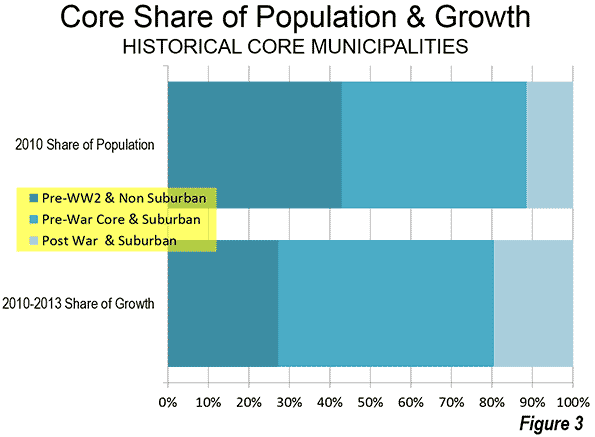
    Photo: Toyota Corolla by Paulo Keller

  • Reversing American Decline

    Across broad ideological lines, Americans now foresee a dismal, downwardly mobile future for the country’s middle and working classes. While previous generations generally did far better than their predecessors, those in the current one, outside the very rich, are locked in a struggle to carve out the economic opportunities and access to property that had become accepted norms here over the past century.

    This deep-seated social change raises a profound dilemma for business: Either the private sector must find a way to boost economic opportunity, or political pressure seems likely to impose policies that will order redistribution from above. It is doubtful the majority of Americans will continue to support an economic system that seems to benefit only a relative few. Looking at our unequal landscape, one journalist recently asked: “Are the bread riots finally coming?”

    By 2020, according to the Economic Policy Institute, almost 30% of American workers are expected to hold low-wage jobs, with earnings that would put them below the poverty line to support a family of four. The combination of high debt and low wages has some projections suggesting millennials may have to work until their early 70s.

    But our new pessimism and widening class divide stems not only from the concentration of wealth and power, but from the persistence of weak economic growth.

    Neo-populist groups on the left and the right have risen to employ political pressure to try and assure a decent quality of life. Ideologically robust liberals, like New York Mayor Bill de Blasio, have emerged as national symbols of a movement in which cities have pushed strong moves like a $15 minimum wage (Seattle) and benefits for workers. Ironically, these are often the same places where wealth is most intensely concentrated and where the middle class has shrunk as a newly dominant, Obama-aligned Clerisy of public employee unions, government officials, academics and artists has gained the preponderance of political power.

    The same sense of limited opportunity that drives the new progressives also motivates the popularity of libertarian and Tea Party activism on the right. Instead of state intervention, these groups have been attracted to the notion that removing barriers to economic growth will increase social mobility more effectively than redistribution by political fiat.

    But these economic arguments that could generate more widespread support have been married with increasingly unpopular, often backward-looking social agendas that have allowed the Clerisy to portray them as fringe movements.

    This has allowed Obama, de Blasio and others shape a new conversation centered on inequality, rather than growth. Oddly enough, it’s a model that relies on Europe’s example even as the continent’s own economic prospects appear dismal, and mainstream political parties there are registering their lowest levels of popular support in decades.

    Though it can help some in the short run, there is little reason to think that more redistribution by the state would improve material conditions over the long term for our working and middle classes, let alone expand them. Rather, it might end up expanding our underclass of technological obsolete and economically superfluous dependents. The 50-year War on Poverty, for example, has achieved few gains since the 1960s despite fortunes spent. Instead, the only significant gains in poverty reduction, at least among those working, have come when both the economy and the job market expand, as they did during the Reagan and Clinton eras.

    Clearly, as both those Presidents recognized, the best antidote to poverty remains a robust job market.

    Yet even this progress has not helped the poorest of the poor, many of whom are marginally, if at all, connected to the workplace. Since 1980, the percentage of people living in “deep poverty”-with an income 50% below the official poverty line — has expanded dramatically. Despite now spending $750 billion annually on welfare programs, up 30% since 2008, a record 46 million Americans were in poverty in 2012.

    It is possible that, as Franklin Roosevelt warned, a system of unearned payments, no matter how well intended, can serve as “a narcotic, a subtle destroyer of the human spirit” and reduce incentives for recipients to better their own lives.

    The activist welfare-based philosophy, following the European model, would likely include not only historically poor populations, but part-time workers, perpetual students, and service employees living hand to mouth, who can make ends meet largely only if taxpayers underwrite their housing, transportation and other necessities. This trend towards an expansive welfare regime could be bolstered by our falling rates of labor participation — now at its lowest level in at least 25 years, and showing no signs of an immediate turnaround.

    And the European model shows little evidence of the benefits of redistribution given the persistently high rates of unemployment, particularly among the young, across most of the EU; indeed much of the continent’s youth are widely described as a “lost generation.” Pervasive inequality and limited social mobility have been well-documented in larger European countries, including France, which has one of the world’s most evolved welfare states. It is even true in Scandinavia, often held up as the ultimate exemplar of egalitarianism, but where the gap between the wealthy and other classes have increased in Sweden four times more rapidly than in the United States over the past 15 years.

    To be sure, progressive, or even ostensibly socialist approaches can ameliorate the worst impact of economic decline on lower-income people. But under left-wing governments — Socialists in France, New Labour in Britain and the Obama Administration in the U.S. — class chasms have increased markedly under leaders who insist their policies will reduce inequality. Much the same has occurred in countries with more conservative approaches.

    In the absence of a focus on growing economies more rapidly and broadly, both political philosophies fall short.

    But maintaining the prospect of upward mobility is central to the very idea of America. For generations, the surplus working class populations of the world have flocked here in search of opportunities unavailable in their home countries. In contrast, there remain few places for America’s aspirational classes to go.

    Fortunately, the capitalist system, particularly under democratic control, allows for the possibility of reform. Take Great Britain, the homeland of the industrial revolution. In response to mass poverty and serious public health challenges during the 19th century, social reform movements led by the clergy and a rising professional class organized to address the most obvious defects caused by economic change. It is one of history’s great ironies that at the very time that Karl Marx was composing Das Kapital in the library at the British museum, life was rapidly improving for the British working class. Far from having “exhausted its resources” and precipitating all-out class war, the inequality so evident in mid-19th Century Britain began to narrow through natural economic forces and the growing power of working-class organizations. The working-class revolution in Britain, which Friedrich Engels insisted “must come,” never did.

    Similarly, the Depression, brought on by what Keynes called “a crisis of abundance,” was addressed more by measures to spur mass demand than relying on redistribution. The New Deal, and then the Second World War, expanded government support for public works, education and housing, as well as infrastructure and research and development. Programs enacted then and after the war also encouraged widespread property ownership.

    This state expansion was generally aimed at increasing economic opportunity-for example, by developing technologies that could stimulate new industrial sectors, new firms, and create new wealth. Today’s, on the other hand, is simply transferring income from one group to another.

    Whatever criticisms can be made of mid-century America, during this period the nation transformed what had been a strongly unequal country into one where the blessings of prosperity were more broadly shared. In the 1950s, the bottom 90% held two-thirds of the wealth here. Today they barely claim half.

    Sparking beneficial economic growth requires a shift in priorities, and thus presents a challenge to the new class order dominated by Wall Street, the tech oligarchy and their partners in the Clerisy. It is not enough merely to blame the so-called 1%, but to shift the benefits of growth away from the current hegemons, notably in the very narrow finance and high-tech sectors, and towards those involved in a broad array of productive enterprise.

    The American economy’s capacity for renewal remains much greater than widely believed. Rather than a permanent condition of slow growth, the United States could be on the cusp of another period of broad-based expansion, spurred in part by its rapidly growing natural gas and oil production — a once-in-a-lifetime opportunity as cheap and abundant natural gas is luring investment from manufacturers from Europe and Asia, and providing good-paying American jobs.

    This, along with growth in manufacturing, could spark better times for the middle class, as would the re-igniting of single-family home construction.

    If America really wants to confront its growing class divide, it needs to spark such broad-based economic growth, rather than simply feathering the nests of the already rich, privileged and well-connected.

    This story originally appeared at New York Daily News..

    Joel Kotkin is executive editor of NewGeography.com and Distinguished Presidential Fellow in Urban Futures at Chapman University, and a member of the editorial board of the Orange County Register. He is author of The City: A Global History and The Next Hundred Million: America in 2050. His most recent study, The Rise of Postfamilialism, has been widely discussed and distributed internationally. He lives in Los Angeles, CA.
    Unemployed photo by BigStockPhoto.com.