Blog

  • Thomas Sowell Explains the Economics of Urban Containment (Smart Growth)

    Economist Thomas Sowell, who has taught at Cornell University and UCLA and has worked at the Urban Institute and the Hoover Institution at Stanford University summarizes the economics of the housing market in a recent article:

    "Anyone who has taken Economics 1 knows that preventing the supply from rising to meet the demand means that prices are going to rise. Housing is no exception."

    Sowell’s cites the high prices houses for sale in the San Francisco Bay area suburb of Palo Alto. Three catch his eye:

    About the first house, he says: “The house is for sale at $1,498,000. It is a 1,010 square foot (94 square meters, added by author) bungalow with two bedrooms, one bath and a garage. Although the announcement does not mention it, this bungalow is located near a commuter railroad line, with trains passing regularly throughout the day."

    The second house has 1,200 square feet (111 square meters) and was listed for $1.3 million. Intense competition for the house drove the sale price to $1.7 million.

    The third, with 1,292 square feet (120 square meters) and built in 1895 is on the market for $2.3 million.

    Sowell continues: "There are people who claim that astronomical housing prices in places like Palo Alto and San Francisco are due to a scarcity of land. But there is enough vacant land ("open space") on the other side of the 280 Freeway that goes past Palo Alto to build another Palo Alto or two — except for laws and policies that make that impossible. As in San Francisco and other parts of the country where housing prices skyrocketed after building homes was prohibited or severely restricted, this began in Palo Alto in the 1970s."

    As in Palo Alto, outrageous price increases began in the San Francisco Bay Area in the 1970s, and were the predictable outcome of urban containment policies (smart growth policies) that rationed land for development.

    House prices are three times as high relative to incomes in the Bay Area than they were before urban containment regulation began in the early 1970s. Among New World (US, Canada, Australia and New Zealand) major metropolitan areas, only Vancouver has higher house prices relative to incomes.

  • Urban Core Jurisdictions: Similar in Label Only

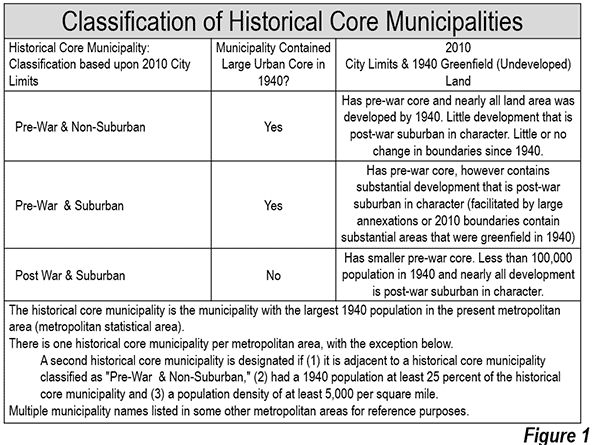
    The fortunes of U.S. core cities (municipalities) have varied greatly in the period of automobile domination that accelerated strongly at the end of World War II. This is illustrated by examining trends between the three categories of "historical core municipalities" (Figure 1). Since that time, nearly all metropolitan area (the functional or economic definition of the city) growth has been suburban, outside core municipality limits, or in the outer rings of existing, core municipalities.   

    Approximately 26 percent of major metropolitan area population is located in the core municipalities. Yet, many of these municipalities include large areas of automobile orientation that are anything but urban core in their urban form. Most housing is single-detached, as opposed to the much higher share of multi-family in the urban cores, and transit use is just a fraction of in the urban cores.

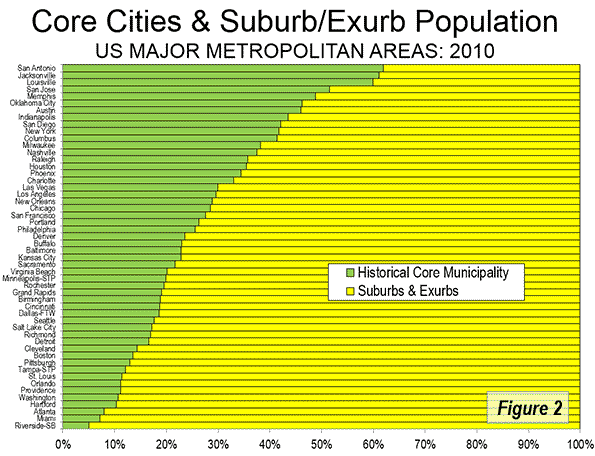
    Even counting their essentially suburban populations, today’s core municipalities represent, with a few exceptions, a minority of their metropolitan area population. The exceptions (San Antonio, Jacksonville, Louisville, and San Jose) are all highly suburbanized and have annexed land area at a substantially greater rate than they have increased their population.

    According to the 2010 census, using the 2013 geographic definitions, core cities accounted for from five percent of the metropolitan area population in Riverside-San Bernardino to 62 percent in San Antonio (Figure 2).

    International Parallels

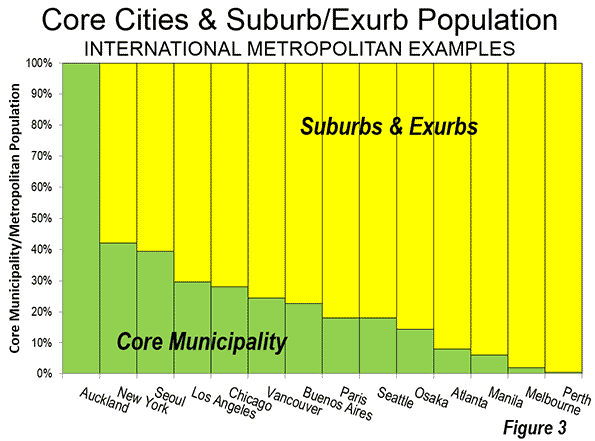
    These kinds of differences are not limited to the United States. For example, the city (municipality) of Melbourne, Australia has little more than two percent of the Melbourne metropolitan area population. Indeed, the city of Melbourne is only the 23rd largest municipality in the Melbourne metropolitan area and has a population smaller than a single city council district in Columbus, Ohio.

    These virtually random variations in core city sizes lead to misleading characterizations. For example, locals sometimes point out that San Antonio is the 6th largest city in the United States. True, San Antonio is the 6th largest municipality in the United States, but the genuine, classically defined city – the broader metropolitan area that is the urban organism – ranked only 26th in size in 2010. The suburbs and exurbs, as defined by municipal jurisdictions, are smaller than average in San Antonio, but the city itself stretches in a suburban landscape up to more than 15 miles (24 kilometers) beyond its 1950 borders.

    Core municipality mayors have been known to travel around the as representatives of their metropolitan areas. In some cases core municipality mayors represent constituencies encompassing the entire metropolitan area (such as Auckland or soon to be major metropolitan Honolulu). Others have comparatively small constituencies. For example, the mayor of Paris presides over only 18 percent of the metropolitan area population, the mayor of Atlanta 8 percent, the mayor of Manila 6 percent, Melbourne 2 percent and Perth, Australia just 0.5 percent (Figure 3).

    Core Municipalities in the United States

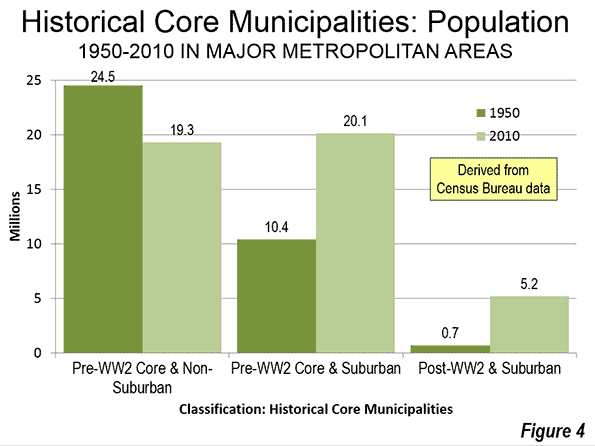
    A remnant of U.S. core urbanization is evident within the city limits of municipalities that were already largely developed in 1940 and have not materially expanded their boundaries. These are the Pre-World War II Core & Non Suburban category of core municipalities. Between 1950 and 2010 these core municipalities lost a quarter of their population, dropping from 24.5 million residents to 19.3 million (Figure 4). All but Miami lost population. Despite improved downtown population fortunes, the last decade saw a small further decline of 0.2 percent overall. Only two legacy cities, New York and San Francisco, now exceed their peak populations of the mid-20th Century.

    Again, this is the typical pattern internationally. Throughout the high-income world, the urban cores that have not expanded their boundaries and had little greenfield space for suburban development have had declining in population for years. My review of 74 high income world core municipalities that were fully developed in the 1950s and have not annexed materially showed that only one had increased in population by 2000 (Vancouver). Since that time, a few that had experienced more modest declines have recovered to record levels, such as Munich and Stockholm. Most others, such as London, Paris, Milan, Copenhagen and Zurich remain below their peak populations.

    In the United States, most of the strong growth has taken place in the "Pre-World War II & Suburban" classification, doubling from 10.1 million residents to 20.4 million since 1950. These include core cities with strong pre-war cores, but which have either annexed large areas or already contained large swaths of rural territory at that time (like Los Angeles, with its San Fernando Valley, which was largely agricultural) that later became heavily populated.

    Many of these core cities experienced population declines within their 1950 boundaries (such as Portland, Seattle and Nashville between 1950 and 1990). Los Angeles, however, has been the exception. The more highly developed central area (as defined by the city Planning Department) within the city limits has increased in population by one-third since 1950. The continuing suburbanization of the city of Los Angeles, however, is indicated by the fact that the central area’s share of city population has fallen from 68 percent to 47 percent.

    The "Post-World War II & Suburban" core cities are much smaller and their metropolitan areas are nearly all suburban. These include metropolitan areas like Phoenix and San Jose. The population of these metropolitan areas has increased more than seven fold, from 700,000 to 5.2 million.

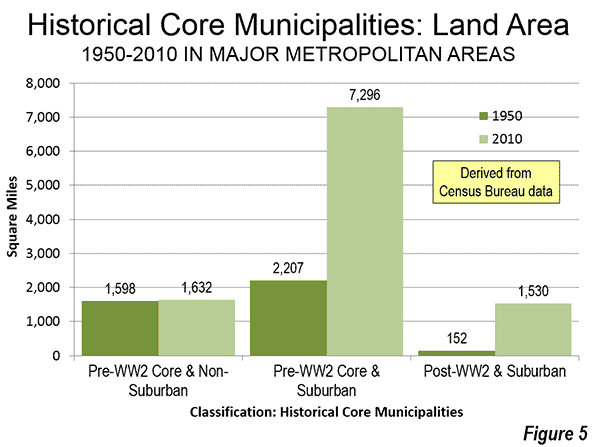
    Land Area: The differences between the three historical core municipality classifications are most evident in land area. Among the "Pre-World War II & Non-Suburban" cores, land areas were almost unchanged from 1950, with much of the difference reflected in Chicago’s O’Hare International Airport annexation. In contrast, the "Pre-World War II & Suburban" cores more than tripled in size, adding an area larger than Connecticut to their city limits. The percentage increase was even larger in the "Post-World War II & Suburban" cores which covered 10 times as much land in 2010 as in 1950 (Figure 5).

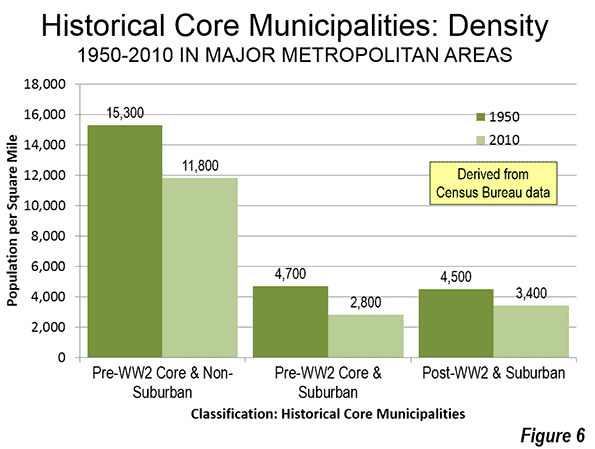
    Population Density: Over the 60 year period, the population density of the "Pre-World War II & Non-Suburban" cores dropped from 15,300 per square mile to 11,400 (5,900 per square kilometer to 4,400). The "Pre-World War II & Suburban" and "post-World War II & Suburban" cores started with much lower densities and then fell farther. The core city densities in these municipalities are approximately one-half the population densities of Los Angeles suburbs (Figure 6).

    The Need for Caution

    All of this indicates the importance of caution with respect to core versus suburban and exurban comparisons. For example, Atlanta, which represents only 8 percent of the urban organism (metropolitan area) in which it is located is not comparable to San Antonio, with its 62 percent of the metropolitan population. These distinctions are important when we talk about different regions.

    Wendell Cox is principal of Demographia, an international public policy and demographics firm. He is co-author of the "Demographia International Housing Affordability Survey" and author of "Demographia World Urban Areas" and "War on the Dream: How Anti-Sprawl Policy Threatens the Quality of Life." He was appointed to three terms on the Los Angeles County Transportation Commission, where he served with the leading city and county leadership as the only non-elected member. He was appointed to the Amtrak Reform Council to fill the unexpired term of Governor Christine Todd Whitman and has served as a visiting professor at the Conservatoire National des Arts et Metiers, a national university in Paris.

    Chicago photo by Bigstock.

  • Ukraine Watch: Kiev in the Media Center Spotlight

    This spring I traveled from St. Petersburg to Kiev, by way of southern Russian and eastern Ukraine. The newspapers were filled with reports of American policymakers gushing over how mobs in Kiev deserved the inalienable rights of freedom fighters and self-determination. Mobs of Russian mercenaries in Eastern Ukraine, who set up automobile tire and sandbag roadblocks, were condemned for threatening world peace.

    I took trains and mini-vans, and crossed the Russian-Ukrainian border between Belgorod (Russia) and Kharkiv (Ukraine), where, at least in the Western press, there are large concentrations of Russian forces getting ready to pounce on Ukrainian independence (I did not see any).

    As I travelled (with my 18-year-old son), I came to view the crisis less in geopolitical terms and more as opportunities for what the Soviets used to call agitprop, from “agitation and propaganda.” Like the agitprop theatricals of the 1920s, this war serves as the extension of public relations by other means.

    Ukraine is tailor-made for show business: it’s a folk opera, one of those performances in native dress you have to endure on package tours around Europe. The storyboards of an evil Vladimir Putin play well, even to an American electorate unsure if Donbas is a region or a dress designer.

    From any microphone in the world, President Obama can threaten “additional sanctions” against the Russian oligarchy. Vice President Biden can jet into Kiev with messages about how “the American people stand with the people of Ukraine, ” while Secretary of State John Kerry intones high moral dudgeon.

    For Putin, saber-rattling over Ukraine is a better media opportunity than even the winter games. It’s a chance to dominate the world stage and be taken seriously without having to put up another Olympic village for $51 billion.

    Day-to-day in the Kremlin, Putin presides over an empire in decline. For Russian men — awash in tobacco and vodka — the average life expectancy is about 64, and Potemkin’s village is now the glitter around Moscow, covering up the grim reality of the provincial cities.

    Economically, Russia’s trade zone with Belarus and Kazakhstan cannot compete with Europe, and China’s economic boom makes Russia, by comparison, look like a collective farm. For that reason, it’s doubtful that Putin needs to annex another coal region with high unemployment, although he’s happy to claim it if local militants drop it in his sphere of influence.

    As the avenger of the 1854 Crimean War, Putin can, at least, lay claim to Empress Catherine-like greatness, although the word on the Moscow street is that he took Yalta and Sebastopol so that Russian oligarchs can cash in on the bourgeois pursuits of gambling and casinos.

    Even the provisional government in Kiev has an interest in using the crisis to promote its competency. It came to power not through elections, but from street demonstrations, which were funded by sources as diverse as local oligarchs, nascent political parties, foreign intelligence agencies, the Catholic church, and neo-fascist elements. Each tent represents a marker in the great game.

    The freedom fighters still encamped around Kiev’s main city square, Maidan, look less like Jeffersonian democrats exchanging copies of Montesquieu’s treatises and more like those second-amendment militias in Montana, to whom all governments are evil.

    Dozens of tents are pitched in the square. The occupants, many dressed in thrift shop army fatigues, have the angry, down-and-out look of the 1890s Coxey’s Army of the unemployed, rather than of delegates to the Continental Congress.

    The Kiev protesters overthrew one government and are standing by—chopping wood, grilling sausages, listening to music, stacking bricks—to see what happens in the May 25 presidential election. To be clear, the February martyrs of the Maidan (about 110 were killed), whose pictures line makeshift altars around the square, were not paid to give their lives in political opposition.

    They took to the streets against the government of Viktor Yanukovych, which they saw as corrupt, dictatorial and ready to consign Ukraine to a Putin revival of the Warsaw Pact and Comecon. But in the chess culture of Ukraine, knights and bishops go forward with different goals than pawns.

    The Kiev government is struggling and divided. About 20 candidates have declared for the presidency, and at least eight parties are represented in the parliament. What could be more uplifting for them than solidarity phone calls from President Obama or pep talks from the US vice-president?

    The problem with the American embrace is that it validates the Russian belief that NATO, the EU, and the United States want Ukraine in their sphere of influence. Otherwise, why would the director of the CIA have come to Kiev during the recent crisis? Imagine the American reaction if an interim government in, say, Quebec welcomed the head of the Russian secret service, the FSB.

    The extent to which the crisis is being waged by the media can be seen in Kiev’s Hotel Ukraine, a dreary Intourist relic of the Soviet era overlooking the Maidan that, during the street demonstrations, allegedly rented out rooms to government snipers. Now that tourists rarely visit Kiev, the hotel is headquarters for something called Ukraine Crisis Media Center, a slick public relations operation where journalists can stop by for a quick coffee and a quote.

    On paper, the group is staffed with patriotic volunteers, there to keep alive the martyrdom of the Maidan and to warn about the evils of Russian aggression. In practice, the “media center” has the look of serious American front money.

    The day I was there it featured short, introductory remarks by the US ambassador to Ukraine and a press conference from the ranking minority member of the Senate Committee on Foreign Relations, Bob Corker (R-Tennessee).

    For these thirty minutes, Ukrainians, like homespun Tennessee constituents, were simple, hardworking folks who needed American support to throw off the Russian yoke. Yes, there was the local problem of corruption, but that was “a remnant of the Soviet-era,” much like the plumbing, I guess.

    Corker explained that he had come to Kiev to “show support for the people of Ukraine” and to applaud their courageous right to “self-determination”. For its aggression, he said, Russia and its president needed to “pay a price.”

    At no point was any mention made of other causes of the current crisis: NATO designs to push its military frontiers to Ukraine and Georgia, despite earlier assurances from President Bush (Sr.) not to advance NATO east of a reunited Germany; the US seeing Ukraine as a fertile market, not just for its intelligence services, but for its gas exports and energy companies; Ukraine’s kleptocracy that has left the post-Soviet economy stillborn since 1991; and elements of the non-elected government having spoken with the same reverence about fascism that earlier citizens accorded their Nazi liberators in 1941.

    In Washington’s press releases, the masked men in the East are Russian proxies in a renewed Cold War. To Moscow, the encampments around the Maidan are the spiritual heirs of the army of the Bay of Pigs.

    My own view is that that the liberators of Eastern and Western Ukraine, despite having different ideological mentors, are the homegrown dissidents of a failing state, one with high employment, cornered markets, governments with Italian-like instabilities, and few profits that have trickled down to ordinary citizens.

    Before leaving Kiev, we thought about visiting the vacated house of the former President Yanukovych, who departed in a hurry for his Russian exile, leaving behind his gilded furniture and private zoo. We were told the house is being transformed into a Museum of Corruption. Admission costs 20 Ukrainian hryvnia, although you can also get in by paying 10 hryvnia to one of the guards.

    Matthew Stevenson, a contributing editor of Harper’s Magazine, is the author of Remembering the Twentieth Century Limited, a collection of historical travel essays. His new book, Whistle-Stopping America, was recently published. He first traveled to the former Soviet Union in 1975, and over the years has been to many of its then-constituent parts.

    Photo by the author: Tents in the Maidan.

  • Are States an Anachronism?

    Obviously states aren’t going anywhere anytime soon, but a number of folks have suggested that state’s aren’t just obsolete, they are downright pernicious in their effects on local economies.

    One principal exponent of this point of view is Richard Longworth, who has written about it extensively in his book “Caught in the Middle” and elsewhere. Here’s what he has to say on the topic:

    In the global era, states are simply too weak and too divided to provide for the welfare of their citizens…The reason is a deep, intractable problem. Midwestern states make no sense as units of government. Most Midwestern states don’t really hang together – politically, economically, or socially. In truth, these states and their governments are incompetent to deal with twenty-first century problems because of their history, rooted in the eighteenth and nineteenth centuries.

    Longworth expounds upon this to identify a series of specific issues, which I’ll put into my own terms.

    1. States do not represent communities of interest. With some exceptions, states consist of cities, rural areas, and regions that have very distinct histories, geographies, economies, and and event cultures. As a result, it is incredibly difficult for legislators and leaders from various parts of the state to find common cause.

    Here’s how Longworth describes Illinois:

    Illinois, like Indiana, is three states, and for the same reasons. The southern third, again south of I-70, is a satellite of the South – more give to conservative religions, gun racks in pickup trucks, and a deeply conservative Republicanism….Most of the rest of the state is called Downstate to differentiate it from Chicago, even though some of it, such as Rockford, is actually north of the city. It is an unfocused place…what unites this heterogeneous region is a dislike of the third region, Chicago. Chicago dominates Illinois – politically and economically…If the rest of Illinois obsesses about Chicago, Chicago gives the impression – an accurate one, in fact – of never thinking about the rest of Illinois.

    Additionally, I might add my observation that this creates a situation where the policies which are right for one area may be wrong for another. Since it is the nature of governments to promote uniform rules, this often leaves one or even all regions of a state with suboptimal rules. In fairness, there are are often some types of flexibility, such as that provided by different classes of cities. But important macro policies remain one size fits all.

    Consider Illinois. It’s a combination of a global city core in Chicago, a Rust Belt hinterland, and a southern fringe region. State policy is set by the Chicago elite as a general rule, and predictably it follows a big city, global city favorable model: strong home rule powers for large municipalities, a high tax/high service type model, strong public sector unions, etc. This pretty much works for Chicago, but for downstate it puts their communities in a major economic vice since they don’t benefit from global city friendly policies and are competing against other places that have optimized in other ways.

    Indiana being one example. It is pretty much the opposite. Its largest city region is only about 25% of the state’s population, meaning Indiana is dominated by rural and small city constituencies. As a result, Indiana has optimized for a “Wal-Mart” strategy such as through its low-service/low-tax approach, weak environmental rules, and very weak (I’d argue nearly non-existent) home rule powers for even its largest municipalities. This is great if you are a small manufacturing city trying to beat out Ohio, Michigan, and Illinois for low wage manufacturing and distribution jobs (which sounds bad but is realistically the best short term play these places have). But it’s pretty terrible if you are Indianapolis and trying to fight to have a place in the global economy, attract choice talent, build biotech and high tech business clusters, etc.

    2. Arbitrary state lines encourage senseless border wars. With limited exceptions, the major cities of the Midwest (and often elsewhere around the country) were founded on major bodies of water like rivers, lakes, or an ocean. These were often boundaries of states, thus major cities are frequently at the edge, not the center of states. This means not infrequently you find multi-state metro areas, which creates structural conflicts of interest. The logical economic unit is the metro area, but it matters from a local fiscal point of view (i.e., the ability to collect income, sales, and property taxes) where particular businesses locate. Thus we frequently see the case where localities spend tons of money on incentives simply to get businesses to relocate within the same metro area. You can have bidding wars without multiple states (such as neighboring suburbs competing over a Wal-Mart), but these seldom involve major state level incentives.

    Longworth again summed this up masterfully in a recent blog post called “The Wars Between the States” where he documents the incentives being doled out to convince companies to move back and forth across the state border in the Kansas City metro area:

    It would seem impossible for Midwestern states to get any sillier and more irrelevant, but they’re trying. In a time of continuing recession and joblessness, with crunching budget problems, failing schools, crumbling infrastructure and no real future in sight, these states have decided to solve their problems by stealing jobs from each other.

    The most recent example is the so-called “border war” between Kansas and Missouri, as the two states compete to see how much money they can throw at businesses to move from one state to the other. The focus of this war is Kansas City — both the Kansas one and the Missouri one, basically a single urban area divided not only by an invisible line down the middle of a street but by a mindless hostility that keeps its two parts from working together.

    Competition with “Europe, India, China and the rest of the world” has nothing to do with this juvenile job-raiding. In fact, this “border war” keeps Missouri and Kansas from competing globally — indeed, robs them of the tools they need to compete globally. Some rational thought shows why. It’s precisely these states’ inability to compete globally that causes them to declare war on the folks next door. In a global economy, Kansas and Missouri aren’t competing with each other, any more than Illinois, Indiana and Wisconsin are competing with each other. The real competition is 10,000 miles away and all Midwesterners know that we’re losing it.

    [ Update 5/5/2014: It looks like Missouri and Kansas may be about to declare a truce in their border war ]

    3. Many state capitals are small, isolated, and cut off from knowledge about the global 21st century economy. In some states the state capital is a large city that is well-connected to the global economy – Atlanta, Indianapolis, St. Paul, and Nashville come to mind. But often state capitals were selected because they were in the geographic center of the state, not because they were major centers in their own right. Some, like Indianapolis, managed to grow into major cities. But many others did not. Think Springfield, Jefferson City, Frankfort, etc. This means that the state capital of many states is not very large, and often not very plugged into the global conversation. Longworth again captures the implications of this:

    There is another reason why state governments are botching the economic needs of their states. Some 150 to 200 years ago, state capitals were picked not for economic reasons, but for geographic ones. Many of them remain in this isolated irrelevance today, far from the real action of any of the territories they are meant to govern…In this era of globalization, with overnight shipping and instant communications, this shouldn’t make any difference. In fact, it does. Global cities such as Chicago depend on face-to-face contact, and isolated state capitals live out of earshot of this conversation. The winds of globalization are transforming state economies and generating new thinking about state futures, but the news takes a long time to get to the state houses and legislatures.

    4. Metro areas are the engines of the modern economy, but the rules for municipal and regional governance are set by states, and often in a manner that is directly contrary to urban interests. In this Longworth channels the Brookings Institution, which has tirelessly documented the importance of metro area economies to the nation as well as all the ways states, frequently controlled by non-urban legislators who are actively fearful of cities, have often imposed enormous burdens on those metro areas by tying them down with a morass of Lilliputian rules. Again Longworth:

    States set the boundaries of urban jurisdictions and decide whether or how they can merge. They tell cities who they can tax and how, whether this helps cities or not. State governments help finance local infrastructure and dictate, from miles away, how that money is spent. State priorities on education and workforce programs leave city residents incompetent to deal with the global job market. Highway funds go to rural areas, not to cities that need them more; job creation money goes to wealthy areas, not to the core of battered cities.

    Some urban regions have more or less given up any hope that their state will ever change or be a positive partner, such as Kansas City, as Longworth notes:

    When the Greater Kansas City Community Foundation issued a report on the city’s future, it pretty much told the state to get out of the way. “Nations and states still matter,” it said. “They particularly can do their cities harm. But cities have to take the lead. San Diego did not become San Diego by looking to Sacramento, not Seattle to Olympia.” When the authors talked about Sacramento and Olympia, one felt their really meant Jefferson City.

    I’d probably go even further than Longworth. I think that historically states imposed rules on cities deliberately designed to hobble their growth. For example, the laws that restricted branch banking in most states until recently had the effect of keeping big city banks from buying up rural and small town banks around the state. The end game of course is that when deregulation occurred, the banks in most big cities were so small because of these rules, they were easy prey to out of state acquirers. Thus most states saw basically their entire indigenous banking industry swallowed up.

    Also, states seem to more or less treat their urban regions like ATM machines. Every study I’ve seen documents how, contrary to popular belief, cities actually are net exporters of tax dollars to their state government. Marion County, Indiana for example (Indianapolis), sends a net of about $400 million a year to the state – enough to cover the entire public safety budget of the city.

    I actually don’t have a problem with some redistribution as cities are generally economic engines and more efficient to boot, so they should be expected to be donors at some level. On the other hand, when states proceed to starve those cities of the critical funds they need stay healthy and strip them of the powers they need to manage their own affairs, this is like sticking a knife in the golden goose.

    Again I can use Indianapolis as an example. As part of a tax reform package the state took over all operating educational funding for K-12. So far so good. But they also imposed a funding formula that severely disadvantaged growing suburban districts by denying them equal per pupil funding. The net result was a major funding problem for the best suburban Indianapolis districts like Carmel, Fishers, etc. Many of these districts had to go to referendums to raise local taxes to make up the difference (which was no doubt the state’s plan all along – it simply outsourced the unpleasantries of a tax increase to localities). Here is a state that claims it wants to be in the biotech business, the high tech business, etc, yet it singles out the school districts where the labor force you are trying to attract for those industries is likely to live for outsized cuts. That hardly seems like a winning strategy.

    Indiana also keeps its cities on a tight leash, with some of the weakest home rule powers around. Indianapolis basically can’t do much without legislative approval (a transit referendum, for example, will require specific legislative authorization). And the legislature seems to like it that way. Indiana’s property tax caps, which I support generally from a percentage of assessment perspective, include a lot of poorly advertised gotchas. For example, regardless of assessed value, the total tax levy can only grow at a rate equal to the average personal income growth over the last six years. I’ll caveat this by saying I haven’t studied this in detail and thus may be a bit off base, but the levy cap appears to be a de facto spending cap at current levels regardless in growth of tax base. This may be ok for some, but not others that are growing say their commercial office space base at a rapid clip and need to expand infrastructure and services to support it.

    Clearly many of these policies have no real benefit to the Indianapolis region, which is more or less being asked to be the economic engine of the state and finance state government without being given the tools to do that job property.

    The list goes on but that should give you a flavor. Similar things occur around the country.

    To this list I’ll add one of my own, which has also been richly illustrated by Jim Russell. Namely,

    5. States can’t to much to help, but they can do a lot to hurt. A lot of the national debate seems to center on whether the “red state” or “blue state” model makes the most sense. But to a great extent, policy almost doesn’t matter. In Ohio, with one set of state policies, Columbus thrives while Cleveland struggles. Tennessee is a right to work state with no income tax, but Nashville booms while Memphis stagnates. Texas is doing great with its red state model, but Mississippi and Alabama not so much. And even within Texas, there are plenty of places that are hurting badly.

    While good policy can set the stage for growth, it can’t guarantee local economies will prosper. But bad policies can hurt regions that otherwise would thrive. Extremes of either the blue or red model seem to lead to problems. Witness California, for example, which seems to be holding up a sign to business saying, “Get lost.”

    This puts states in the difficult position of being almost being able to aspire at best to being a neutral influence on their own economy. But it’s easy for them to screw things up.

    This piece first appeared at The Urbanopihle on July 11, 2011.

    Aaron M. Renn is an independent writer on urban affairs and the founder of Telestrian, a data analysis and mapping tool. He writes at The Urbanophile, where this piece originally appeared.

    States map image by Bigstock.
  • Tambora vs. Krakatoa: Which was Worse?

    An April 27 Wall Street Journal book review by Simon Winchester descends into a petty squabble about whether the volcanic eruptions on Mount Tambora (1815) and Krakatoa (1883), both located in Indonesia, was more significant. After a few positive paragraphs reviewing Gillen D’Arcy Wood’s Tambora: The Eruption That Changed the World, Winchester takes exception to Wood’s comparison of the Tambora eruption with that of Krakatoa. Winchester writes:

    "I have one argument. Mr. Wood’s intention in writing the story of Tambora, in time for its bicentenary, is to stake the eruption’s claim for global primacy—to knock Krakatoa off its long-held pedestal. The celebrity of [Krakatoa’s] more modest eruption in 1883 seems undeserved,’ he writes. ‘Only the historical accident of the telegraph’s invention allowed news of it to travel instantly across the world.’"

    Which is the More Significant?

    Winchester introduces his defense of Krakatoa, admitting that he has a "dog in the fight," as author ofKrakatoa: The Day the World Exploded: August 27, 1883. He claims that Krakatoa "was the biggest volcanic explosion in what one may call fully recorded human history." He then spends a third of the article seeking to prove that the Krakatoa eruption was the more significant than that of Tambora.

    Winchester describes the Krakatoa eruption and how the rapid communications that had recently become available amplified its significance in  the decades that followed. He points out that there were more than 40,000 fatalities and that Krakatoa generated the most extensive tsunami ever generated by a volcano. Finally, he claims that Krakatoa "contributed to the creation of the Republic of Indonesia."

    I have long asked the same question that Woods poses and concluded that history had slighted Tambora. So, I spent some time the other evening reacquainting myself with the subject, using Internet sources (such as Wikipedia), which do not rise to academic standards, but certainly paint a picture supporting Woods’ position.

    As for the 40,000 fatalities, there appears to be no question but that fatalities from Tambora were nearly twice as great. It is not really surprising that Krakatoa is a more extensive tsunami than Tambora, since Krakatoa was a fairly modest mountain (less than 3,000 feet or 1,000 meters) sitting in the Sunda Strait between Java and Sumatra. Much of the volcano collapsed into the sea, which will obviously produce a larger tsunami than when the mountain is at least 10 miles (16 kilometers) from the sea and principally collapsed upon itself, rather than the sea.

    The claim that the Krakatoa eruption was instrumental in creating the Republic of Indonesia is bizarre. Krakatoa surely did not provide any incentive to the Dutch to rule longer, or for the Indonesians to extend colonial rule. Indonesia was among the first to shake off colonialism following World War II (1945). Nor is it likely that an unexploded Krakatoa would have advanced independence to before the War.

    Fully Recorded History as of 1981: St. Helen’s Exceeds Krakatoa

    Winchester overreaches in noting that Krakatoa was the "biggest volcanic explosion "in fully recorded human history." Fully recorded human history is in the eye of the beholder. Yet, the Krakatoa eruption was not recorded by motion pictures or video, which were not yet invented and did not thus occur in "fully recorded history" as we know it.

    For example, in 1981, a few months after Washington’s Mount St. Helen’s blew its side out, it would have been fair to characterize its 1980 eruption as being more significant than Krakatoa, by virtue of having been captured on video (and thus in "fully recorded history” at them time). Certainly, scientists have learned much from Mount St. Helens. However, its greater significance due to its capture on video was a function of technology, not volcanism.

    Tambora’s Significance

    By any measure, Tambora was a substantially larger volcanic eruption that Krakatoa. Its Volcanic Explosive Index (VEI) was 7, the only confirmed rating of that intensity since the Lake Taupo eruption in New Zealand 1,600 years before. By comparison, Krakatoa earned a VEI of only 6. Further, Tambora spewed a far greater volume, at 38 cubic miles (160 cubic kilometers). By comparison, Krakatoa’s volume was less than one-third that of Tambora, at 11 cubic miles (45 cubic kilometers). Both ejected far greater volumes than the 1980 eruption of Mount Saint Helens (less than one quarter cubic mile or one cubic kilometer), which had a VEI of 5.

    Moreover, Tambora set off the "year without summer" in 1816, when a June snow storm dumped six to twelve inches (15 to 30 centimeters) on northern New England and snow drifts of two feet (60 centimeters) in the ville de Quebec.

    Indonesia’s Disasters

    Interestingly, neither the Tambora nor the Krakatoa eruption ranks as the largest in Indonesian history (or perhaps more properly, pre-history). The Lake Toba eruption on Sumatra occurred 75,000 years ago and is reputed to have been the most intensive in the world in the last 2 million years. Lake Toba ejected approximately 675 cubic miles (2,800 cubic kilometers) of material. This is 17 times the Tambora volume and more than 60 times the Krakatoa volume. But none of the three killed as many people (230,000) as the Boxing Day tsunami (December 26, 2004), which was set off by a 9.0 earthquake off Sumatra. Population had exploded between 1883 and 2004, which drove the Boxing Day tsunami fatalities far above those of the Krakatoa tsunami.

    Tambora v. Krakatoa: Volcanism v. Telecommunications

    Winchester confuses technology with history. Woods is exactly right. But for the historical accident of the telegraph, Krakatoa might have been as largely forgotten, not unlike another VEI-6 event — the 1912 Novarupta volcanic eruption in Alaska. Had the telecommunications of 1815 been equal to those of 1883, no one would remember Krakatoa. Telecommunications explains its prominence, not volcanism.
    —————–
    Wendell Cox is principal of Demographia, an international public policy and demographics firm. He is co-author of the "Demographia International Housing Affordability Survey" and author of "Demographia World Urban Areas" and "War on the Dream: How Anti-Sprawl Policy Threatens the Quality of Life." He was appointed to three terms on the Los Angeles County Transportation Commission, where he served with the leading city and county leadership as the only non-elected member. He was appointed to the Amtrak Reform Council to fill the unexpired term of Governor Christine Todd Whitman and has served as a visiting professor at the Conservatoire National des Arts et Metiers, a national university in Paris.

    Photo: Tambora: Depiction of 1815 Eruption (from http://cdn-2.vivalascuola.it/o/orig/scienze-classificazione-vulcanica_b2a5e9a592a9ff2585850e6b6006f595.jpg

  • Stop Favoring Investors, Speculators over Middle Class

    I, like most members of the middle class, particularly in California, just paid a tax bill that seemed less like my fair share than a shakedown by the Mafia. Increasingly, for people who run small businesses or earn a decent income, the tax bite is becoming ever more like in Europe, with total bills in high-tax states like ours reaching upward of 40 percent. It’s like paying the bill for a big dinner without eating the food – we get hammered like Swedes but without the free education, health care and other benefits of a more conventional welfare state.

    Most galling is that, while the middle class has endured ever-higher taxes, those who have benefited most from the Bernanke-Obama “recovery” continue to get the biggest tax breaks. This is largely the investor class, who have been able to reap the benefits of the stock-market boom and, in some areas, including coastal California, the steep rise in real estate prices.

    Of course, the rich and corporations have all sorts of ways to avoid taxation – like offshore accounts – but the real class divider is capital gains. Today, long-term capital gains are taxed at the federal level at a maximum 20 percent, while the small-business owner, writer, consultant or professional, if they do relatively well, are stuck with income tax rates up to 39.6 percent, approaching twice that level.

    Generation gap

    Overall, you don’t have to be super-rich to be hit. The portion of the tax burden absorbed by the top 20 percent of earners has grown – a California family with an income of $150,000 would qualify – from 65 percent to 90 percent. Even worse off are younger families, which generally have less to invest and have been stuck with a tepid job market; from 2007-10, households of people under age 40 have seen their net worth drop, while older Americans have now recovered most of their losses from the economic downturn.

    In the past, this differential in tax rates often was furiously justified – usually by conservatives – as sparking investment and job creation that would benefit younger and poorer Americans. This argument is increasingly specious; the recent massive stock-market boom has been characterized by relatively low investment in plant and equipment, meager job growth and, by the way, ever-increasing inequality. In 2009, due largely to lower taxes on capital gains, the 400 highest-earners, with gross incomes above $200 million, paid an effective tax rate well below even those in the top 1 percent, which includes many small-business owners and professionals.

    Defenders of the tax break will also cite “democratic capitalism” and point out the fact that so many people depend on the stock market. But, in reality, stock market capitalism is becoming less democratic: Stock ownership has become more concentrated, with the percentage of adults Americans owning stock the lowest since 1999 and a full 13 points lower than in 2007.

    Depression-era inequality

    As the hard-pressed middle class has withdrawn from the market, due to mistrust or lack of resources, the very rich have been having a veritable feast. To be sure, the top 10 percent gained half of all reported income, but the top 1 percent accounted alone for halfof that. This is one reason why inequality is now greater than at any time since the Great Depression.

    Increasingly, then, the benefits of the plutocratic tax break are ever more thinly shared. I am sure we all are happy that when the 50 or so lucky insiders at WhatsApp collect their $19 billion from Facebook, they will pay taxes on that windfall at well below the rates paid by the salaried upper-middle class professional or small-business owner. Yet their product, although no doubt cool, is unlikely to produce many jobs, or even boost productivity.

    The biggest beneficiaries, besides the insiders, will be sellers of luxury homes and vehicles, and the high-end restaurants and shops in the already saturated, overpriced Silicon Valley market.

    Where’s the left?

    Clearly, something needs to change, and, ironically, one wonders where the class warriors of the Left are on this. They have become increasingly bold (or honest) in stating that we should continue raising taxes on the middle and upper-middle classes, as a recent New Republic piece suggests, but seem less than vehement about equalizing taxes on capital gains and other income.

    This may have something to do with the shift in backing for “progressive” causes coming from the very people – Wall Street traders, venture capitalists and tech executives – who benefit most from the capital gains scam. The confluence of big money and populist rhetoric is epitomized by New York’s powerful senior senator, Charles Schumer, who has made a career of both raising money from Wall Street financiers and defending preferential treatment for their outsized profits. Their growing power over the party of ever-expanding government leaves only one place to finance Democrats’ ambitious plans – the middle and upper-middle classes.

    I don’t hold all that much hope that reform will be pushed by most Republicans either, since they for far longer have been the party of accumulated wealth. But, as far as I can see, it is mainly conservatives, such as retiring Congressman Dave Camp, who seem ready to embrace the notion that taxes should be equalized between income and investment within the context of a flatter revenue system.

    SPotty support

    But too many Republicans remain in love with lower taxes on investment, with some conservatives placing a similar faith in the positive effects of low capital gains as progressives do on the need don hair shirts to reverse global warming. Rand Paul’s proposal for a flat tax addresses some of these ideas, although Paul still seems to think capital gains should be taxed at a lower rate than normal income. This proposal may be better than the current system, but progressives rightly predict it would not address the fundamental inequality in the tax code.

    All this is distressing, given that it is clearly time to reform the tax code to stop favoring investors and speculators over middle-income earners. This may prove the best way to slow the dangerous accumulation of financial assets by the few, notes author Charles Morris. He also adds that such reform could have many positive effects on the economy. Cutting the top 1 percent’s share of Americans’ total income to 14 percent or 15 percent, still higher than the pre-1980 norm, he calculates, could allow us to spend about $1 trillion for middle-class tax relief, relief for the poor, health care, education and infrastructure.

    The need to jettison the capital-gains advantage has also been endorsed by Larry Summers, former Treasury Secretary under President Clinton and a former Obama adviser. Even Bill Gross, the head of Newport Beach-based bond giant Pimco, has suggested that, given the perverse effects of the tax system, that capital gains income should now be taxed at the same rate as regular income. Gross admits his investors did not like the idea since such changes are not in their immediate financial interest.

    With some leading conservatives, business leaders and liberal economists on board, perhaps this is still an idea whose time has come. Clearly, the current tax regime is not working, having just created a shallow “recovery” largely enjoyed primarily by the very richest members of society. It is time for people on both right and left to admit that such a recovery is not socially sustainable or congruent with the fundamental notion of democracy. It is time to reform the tax code, so that it works not only for the rich and well-placed, but the rest of us, as well.

    This article first appeared in the Orange County Register.

    Joel Kotkin is executive editor of NewGeography.com and Distinguished Presidential Fellow in Urban Futures at Chapman University, and a member of the editorial board of the Orange County Register. He is author of The City: A Global History and The Next Hundred Million: America in 2050. His most recent study, The Rise of Postfamilialism, has been widely discussed and distributed internationally. He lives in Los Angeles, CA.

    Wall Street bull photo by Bigstockphoto.com.