Blog

  • Special Report: America’s Emerging Housing Crisis

    This is the executive summary from a new report, America’s Emerging Housing Crisis, published by National Community Renaissance, and authored by Joel Kotkin and Wendell Cox. Download the report and the supplement report below.

    From the earliest settlement of the country, Americans have looked at their homes and apartments as critical elements of their own aspirations for a better life. In good times, when construction is strong, the opportunities for better, more spacious and congenial housing—whether for buyers or renters—tends to increase. But in harsher conditions, when there has been less new construction, people have been forced to accept overcrowded, overpriced and less desirable accommodations.

    Today, more than any time, arguably, since the Great Depression, the prospects for improved housing outcomes are dimming for both the American middle and working classes. Not only is ownership dropping to twenty-year lows, there is a growing gap between the amount of new housing being built and the growth of demand.

    Our still-youthful demographics are catching up with us. After a recession generated drought, household formation is again on the rise, notes a recent study by the Harvard Joint Center for Housing Studies. In some markets, there isn’t an adequate supply of affordable housing for the working and middle classes. Overall, according to the research firm Zelman and Associates, the country is building barely one-third the number needed to meet the growth in households. Overall inventories of homes for sale are at the lowest level in eight years.

    The groups most likely to be hurt by the shortfall in housing include young families, the poor and renters. These groups include a disproportionate share of minorities, who are more likely to have lower incomes than the population in general. This situation is particularly dire in those parts of the country, such as California, that have imposed strong restrictions on home construction. California’s elaborate regulatory framework and high fees imposed on both single- and multi-family `housing have made much of the state prohibitively expensive. Not surprisingly, the state leads the nation in people who` spend above 30 percent, as well as above 50 percent, of their income on rent.

    Sadly, the nascent recovery in housing could make this situation even more dire. California housing prices are already climbing far faster than the national average, despite little in the way of income growth. This situation could also affect the market for residential housing in other parts of the country, where supply and demand are increasingly out of whack.

    Ultimately, we need to develop a sense of urgency about the growing problem of providing adequate shelter. As a people we have done this many times — with the Homestead Act, and again, after the Second World War, with the creation of affordable “start-up” middle- and working class housing in places like Levittown (Long Island), Lakewood (Los Angeles), the Woodlands (Houston) and smaller subdivisions, as well as large scale cooperative apartment development in places like New York. Government policy should look at opportunities to create housing attractive to young families, which includes some intelligent planning around open space, parks and schools. It is important to ensure that a sufficient supply of affordable housing is allowed throughout metropolitan areas, for all income groups.

    Nothing speaks to the nature of the American future more than housing. If we fail to adequately house the current and future generations, we will be shortchanging our people, and creating the basis for growing impoverishment and poor social outcomes across the country.

    Joel Kotkin is executive editor of NewGeography.com and Distinguished Presidential Fellow in Urban Futures at Chapman University, and a member of the editorial board of the Orange County Register. He is author of The City: A Global History and The Next Hundred Million: America in 2050. His most recent study, The Rise of Postfamilialism, has been widely discussed and distributed internationally. He lives in Los Angeles, CA.

    Wendell Cox is principal of Demographia, an international public policy and demographics firm. He is co-author of the “Demographia International Housing Affordability Survey” and author of “Demographia World Urban Areas” and “War on the Dream: How Anti-Sprawl Policy Threatens the Quality of Life.” He was appointed to three terms on the Los Angeles County Transportation Commission, where he served with the leading city and county leadership as the only non-elected member. He was appointed to the Amtrak Reform Council to fill the unexpired term of Governor Christine Todd Whitman and has served as a visiting professor at the Conservatoire National des Arts et Metiers, a national university in Paris.

  • Florida: How Fine Art Became Local

    Fine art resides not only in the cosmopolitan cities. It lived, as we saw in the recent movie “The Monument Men”, in the many villages of Europe. Right now, we are seeing it living on the periphery of Orlando, Florida.

    Home to Stetson University, DeLand is forty minutes north of the regional core of downtown Orlando. It is one of those delightful, off-the-beaten-path towns that tourists love to stumble upon and explore; the largely intact, century-old strip along Woodland Boulevard is vibrant, bohemian, and alive. Florida’s archipelago of cities compete for the hip and the cool, and it is easy to dismiss places like DeLand. Cities and towns in this state have, for the most part, yet to grow the kind of institutions that speak of maturity, sophistication, and worldliness. The draw of DeLand is not sidewalk urban hipsters sipping lattes; instead, it speaks of a new age of curiosity, individuality, and appreciation for experience outside of the roaring din of the city. The newly re-named Museum of Art – DeLand signifies a powerful future for this part of Central Florida.

    Formerly called the Museum of Florida Art, the museum’s new name – no qualifiers, no excuses – befits a mission that brings world-class art to its patrons. “First and foremost, we serve our community,” said George Bolge, the Museum of Art – DeLand’s Chief Executive Officer. Bolge, retired from the Boca Raton Museum of Art, was asked to head up this museum and expand its scope and its reach. “At the same time, we are participating in the broader conversation about what art is, and where it is going. Our voice is being heard loud enough that people in New York are talking about what we are doing.”

    In the first half of 2014, Bolge’s exhibition run includes veteran Florida artist Jill Cannady, whose evolving career has stayed one step ahead of her critics. “This is important for people to see, and she is right here under our noses in DeLand, Florida,” said Bolge. Recent exhibitions like “Forging an Identity: Contemporary Latin American Art” drew patrons to exciting international artists who have helped shape Florida’s cultural and social ideas.

    In the official story of urban triumphalism, a museum executive should take his victory lap in Manhattan or Paris. Bolge, however, chose not to follow the herd. He was beckoned to DeLand by the opportunity to take an arts institution from good to great. The museum has its own building, a tan, prismatic form just north of downtown. Its exterior is a windowless enigma which belies a wonderful, light-filled volume within, one suited for showing world-class art. Its multifunction lower level has an atrium space and gallery, and an upper level gallery and classrooms. It’s a flexible facility that does its job by putting the art first, staying in the background, and being accessible to all.

    Even more interesting is the Museum of Art – DeLand’s downtown satellite, at the corner of Woodland and New York, six blocks south of the main gallery. This space, with a wood-floor and the rough-brick feel of a Chelsea loft gallery, recently exhibited “Small Masterworks” borrowed from the Butler Institute of American Art. Ascending the stairs, one is greeted by a free-flowing series of galleries which take you from a sunlit-filled reception area to a deep, introspective space that cleverly maximizes the art viewing experience. From Benjamin West, an American-born colonial artist, to Warhol, Lichtenstein, Motherwell, and others in the late 20th century, “Small Masterworks” provides sensitive and moving documentation of the evolving American art scene. DeLand, the quintessential American town, seems to be a perfect setting for it.

    This is the new story of Florida which is just now being written. While local art lovers are enriched by such an institution, it is drawing more and more attention from the surrounding metropolitan areas. With this museum, DeLand is now exporting culture to the city, in a reversal of the trend, signifying a maturation of the Florida arts scene.

    The Butler, in Ohio, is another example of this reversal. Nearly a century old with multiple locations today, The Butler is a solid institution with an international reputation. Something interesting is happening. As we have become used to mobility and flexibility, our world is no longer limited to where we live and work. With the internet, we are becoming increasingly connected. This favors DeLand, and places like it, with a new equity of distance – cutting-edge ideas are now a few clicks away. People in far-flung areas are less isolated.

    DeLand has a college vibe — a built-in art appreciation population — and with the rise of retiree enrollment, expect this population to go up. It’s affordable, walkable, and fun, with few of the big-city evils like crime and congestion that can scare away newcomers. No longer a tropical wilderness out of which man once carved a crude existence, Florida may now be settling down and becoming a more civil and aesthetic experience for its citizens. Towns like DeLand offer something that big cities like Orlando and Miami cannot: a high quality, human-scale lifestyle.

    “In DeLand,” Bolge stated, ”I’ve noticed that people have a pretty high opinion of their town… there is a spirited investment into making its art museum into a great institution.” Bolge sees this museum is a conduit to channel the story of Florida art into the broader flow national artistic energy. “We’re going to be showing what the Florida art patron likes, too,” he said, “so later this year, you will have a chance to see what a Floridian does with a world-class collection of artists.” “We are here for the local community,” says Bolge, “but it doesn’t hurt that we have a profile outside the community as well.”

    Richard Reep is an architect with VOA Associates, Inc., and an artist who has been designing award-winning urban mixed-use and hospitality projects, domestically and internationally, for the last thirty years. He is Adjunct Professor for the Environmental and Growth Studies Department at Rollins College, teaching urban design and sustainable development, and is president of the Orlando Foundation for Architecture. He resides in Winter Park, Florida with his family.

    Photo by Lisa Habermehl: Downtown satellite location of The Museum of Art – DeLand

  • The Hyping of “Big Data”

    Worship at the altar of what is labelled big data is rampant in both corporate and large not-for-profit settings. And while there is some general sense that big data arrives at warp-speed and involves huge datasets from very diverse sources and methodologies, there is no consensus and little discussion of what comprises meaningful and valid “big” datasets.

    It is part of the American DNA that that bigger means better, so the alchemy of big data can appear enticing. Moreover, big data naturally appeals to many data geeks, high-priced consulting firms, and IT professionals. These are the very people who have a vested interest in proffering big data solutions – even if they only have a shallow understanding of what the data represent. In those circles there is a tendency to think that if the data sets are large enough, sophisticated algorithms can somehow smooth out flaws in the data. Yet the old truism still holds: garbage in garbage out.

    Huge numbers, per se, may awe the innumerate and methodologically challenged, but honest social scientists have long recognized that quality and critical understanding are what really counts. For example, a relatively small scientific survey, a tight, well-designed experimental design, or a rigorous, clearly defined accounting process provide validity that a conglomeration of user reviews and click data cannot deliver. Why so?

    Let’s first look at what much of big data is based on. For sure, some data are obtained via valid techniques with clearly defined outcomes and caveats. Unfortunately, those methodologies can be expensive, so they are often supplanted by cheaper, less rigorous approaches. One such approach is what is known as a convenience or opt-in survey. Typically conducted online, these surveys appear in the form of a pop-up or as an embedding link.1

    These unscientific approaches typically lack basic validity. Rather, the findings reflect an amorphous aggregation of people who happen to be visiting a given web page at a particular time. Google surveys, for one, are very quick, inexpensive and beloved by techno geeks, but, in the end, you get what you pay. A legitimate sample should represent a given population based on sampling frame and response rate, which opt-in surveys cannot provide.

    The key here is to sample a representative audience, rather than people who happen to be on-line, or like to air their opinions or have an ax to grind. In addition, the response rates for pop-up surveys are absurdly low, so it’s hard to evaluate how representative their findings may be. As Butch said to Sundance, the client should ask their consultants, “Who ARE those guys?” Opt-in surveys, at best, may crudely identify major trends – providing that the client is willing to foot the bill for a tracking study – and also can also suggest there is a major issue worth exploring more rigorously.

    How about user reviews? Note that they are usually based on customer ratings elicited right after purchase. The most relevant issues of usability and product reliability are not even factored into the equation. The purchaser also is typically comparing a brand new product with a much older and often poorly performing model. (My new 42” Sanyo TV may seem great compared to my old six year old 34” Toshiba.) That is why product user reviews tend to be so positively skewed.  Finally, and this no small problem, many reviews are bogus, provided by outside firms for a fee. Vendors claim to scrutinize these reviews, but, like NSA’s protocols, one ultimately needs to take them at their word. User reviews sometimes provide the best data one can find (e.g., Trip Advisor for non-chain hotels or restaurant), but one may be safer viewing them for specific comments rather than for their summary ratings.

    Other metrics involve click data on a website, which may be more indicative of placement on a web site than anything else. If a link is prominently and explicitly featured, it will get more page hits. If a page requires complex navigation to reach, it will garner fewer hits, especially if the search tool is flawed. Here’s a real life example from my experience at Consumer Reports. Many non-product ratings (supermarkets, airlines, insurance, etc.) attained exceptionally high readership scores. On the website, ConsumerReports.org, these stories are buried and invisible to many potential readers. Note that when those stories briefly appeared on the home page they were extremely popular. Rather than look at the pattern analytically, the big data decision was to focus on IT-based metrics such as click data, which were seen as both “objective” and “real time” despite their obvious flaws.

    Another popular yet overrated methodology is the focus group, a moderated discussion among selected participants on a particular topic. Focus groups are usually comprised of people selected for some basic demographics and a roughly defined unifying theme such as in the market to buy a car or does online research on health care. Note that these are people have both the time and inclination to spend a couple of hours on a topic for a small fee and a meal. Second, unless the moderator is very adept, the prejudices of the moderator or highly opinionated participants often exercise undue influence. Clients often latch onto the opinions of participants with whom they agreed, thereby drawing suspect conclusions.2 One valid use of focus groups is to help clarify issues for later quantitative work. Another valid use of focus groups is when the participants possess true expertise or other qualifications. For example, I conducted a focus group with electric engineers on microchips and another among senior directors and VPs at commercial banks on issues involving online banking.

    Number crunching – a la big data – without appropriate history or solid methodology has very limited utility. Human behavior is not akin to physics, and numerical positivism is often fatally flawed. Too much analysis is largely ahistorical. “Real time data” is another data cliché much lauded today as the holy grail of research. Yes, up-to-date data are invaluable, but good data analysis requires thought and perspective. What does one make of the number of tweets or Face Book posts for Justin Bieber in March 2014?

    Even scientific survey research needs to acknowledge historical precedents. I recall an ongoing Gallup survey that asked were the biggest concerns Americans were facing.  Most of the time various economic issues were volunteered; however, when issues like drugs, HIV, or crime dominated the news, those issues which seemed paramount at the time quickly faded in the public’s eye. Thus “real time data” without context can be both shallow and misleading.   

    Another key point: Watch for bias. One reason that people highly rate expensive new purchases is that they don’t want to admit that they may have made a mistake (cognitive dissonance in social science parlance). Sometimes ideology obscures opinion. Careful question creation will avoid many of the pitfalls. Questions posed in terms of “consumer protection” will tell a different story than questions framed as “government regulation”. It is often assumed that “anyone can write a survey”, but such naiveté will provide bad results.

    Different data tell different stories. What are the strength and limitations of each dataset? Blind number crunching obscures reality, and no amount of sophisticated statistical techniques can produce valid conclusions unless the data collection methods are evaluated and found sound. If two different analyses tell different stories, the object is to see why. Are they measuring the same thing?

    At Consumer Reports we found sometimes a car model’s rating from lab tests did not jibe with the survey results. Both methods are valid, but the former are predicated on measurement of performance based on lab test while the survey reliability is based on respondents reporting that product broke within a given time frame. Both measures had strength and weaknesses. A product can perform very well, yet have undistinguished reliability, and vice versa. Both sets of data are presented, but not aggregated. Doing so may delight the wonks by providing a “simple” measure, to do so will obscure reality and will do the client/audience a major disservice.

    Another example: A number of years ago I was asked to represent Consumer Reports at a health care conference sponsored by Kaiser Family Foundation.  Most of the major health care research firms as well as several major employers attended. One of the goals was to ascertain whether a basic metric evaluating health care would be possible. The general consensus was that goal was illusory because the data were far too complex and multivariate to do so. In the most simplistic terms, you can’t have red and blue and say the answer is purple.  So while big data may contain reams of information, it cannot be boiled down to simplistic conclusions.

    So here’s my advice. All datasets, large and small, have strengths and limitations.  Bigger does not necessarily mean better. You will learn more from a well-constructed small set of data than from a less robust but large one. And while sloppy data analysis can obscure the value of even the best data, even the most sophisticated data analysis cannot rescue meaningless data. Statisticians and web wonks are not members of a priesthood. Don’t assume they have all the answers. Like the patient who is told that surgery is necessary, you may want to get a second opinion. After all, it’s your business and you should not hand over key decisions to number-crunchers who might have little understanding of your industry, its dynamics, or your customers.

    Mark Kotkin, PhD, retired from Consumer Reports after 27 years. He worked in their survey division, most recently as Director. He was responsible for all published survey-based content and served as a methodologist on several organizational teams. He managed the Annual Questionnaire, the largest US survey outside the Census.  Previously he had conducted market research on major corporations for a major research firm based in NYC. He currently consults for private clients.

    Photo by Fernanda B. Viégas

    1 Note that scientific surveys can be done online provided there is an appropriate methodology.  Consumer Reports and GfK are two organizations who have done so. 

    2 A related approach—in-depth interviews—avoids some of those pitfalls, but not the issue of representativeness.

  • The Evolving Urban Form: Philadelphia

    Philadelphia was America’s first large city and served as the nation’s capital for all but nine months between the inauguration of George Washington is the first president in 1789 and the capital transferred to Washington, DC in 1800.

    Before the early 1900s, the United States Census Bureau had not developed a metropolitan area (labor market area) concept. However, the website peakbagger.com has attempted to define earlier metropolitan areas based on concepts similar to those used today. In the case of Philadelphia, this is important, because it was somewhat unique in having virtually adjacent, highly populated suburbs that make comparisons of municipal populations (the only population data available) misleading.

    The Nation’s Largest City

    According to municipal population data, New York had become the largest municipality in the United States by the time of the first census, in 1790. Philadelphia was ranked second. However, a list of the top 24 urban places in 1790 shows two Philadelphia suburbs, Northern Liberties and the Southwark district. When peakbagger.com includes these suburbs, Philadelphia rises as the largest city (metropolitan area) in the nation in the 1790 and 1800 censuses. The New York metropolitan area is shown as rising to number one in 1810, a position it is held for 200 years and may last for much longer in light of the much slower growth rate recently for Los Angeles.

    Soon the Nation’s 9th Largest City?

    Those were the glory days. In the years since 1800, Philadelphia has been falling in population rank. The Philadelphia metropolitan area was displaced first by Chicago in 1900, according to the metropolitan district estimates of the US Census Bureau. In 1940, Philadelphia was demoted to fourth place by Los Angeles. Philadelphia held fourth position until 2006, when Dallas-Fort Worth raced past it. Then just a few years later (2010), Houston knocked Philadelphia down to 6th place. The downward trend could accelerate rather quickly. At current growth rates (2010 to 2013), Philadelphia would be passed by Washington and Miami by the time of the 2020 census. The Atlanta metropolitan area would also pass Philadelphia if its population growth rate is restored to pre-Great Recession rates. Philadelphia should start the next decade as either the 9th or 10th largest metropolitan area in the nation.

    Population Growth in the Philadelphia Metropolitan Area

    The Philadelphia metropolitan area is unusual in being divided between four states. The core city of Philadelphia is located in Pennsylvania. Directly across the Delaware River are the suburban counties of New Jersey. Wilmington, formerly the largest metropolitan area in Delaware has been incorporated into the Philadelphia metropolitan area (New Castle County). Maryland’s Cecil County is also included in the metropolitan area.

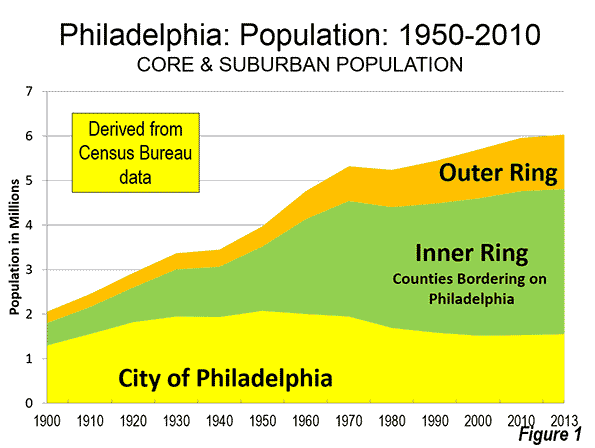
    All of Philadelphia’s population growth since 1950 has been in the suburbs. In that year, the city of Philadelphia peaked at 2,072,000 residents. This was a healthy increase from the 1,930,000 in the 1940 census. However, this represented a decline from 1,951,000 in 1930 and shadowed massive population losses that would follow after 1950 (Cleveland and St. Louis also lost population between 1930 and 1940).

    By 2000, the city’s population had dropped 27 percent to 1,518,000. This could prove its modern low, as the population recovered to 1,526,000 in the 2010 census and was estimated by the Census Bureau at 1,553,000 in 2013.

    The suburbs of the metropolitan area as presently defined added nearly 2.6 million residents between 1950 and 2013. However, the metropolitan area only grew by 2.1 million residents because of the more than 500,000 loss in the city of Philadelphia. The inner ring suburbs, counties abutting Philadelphia County in Pennsylvania and New Jersey gained 1.8 million residents, while the outer suburbs gained nearly 800,000 residents (Figure 1).

    Domestic Migration

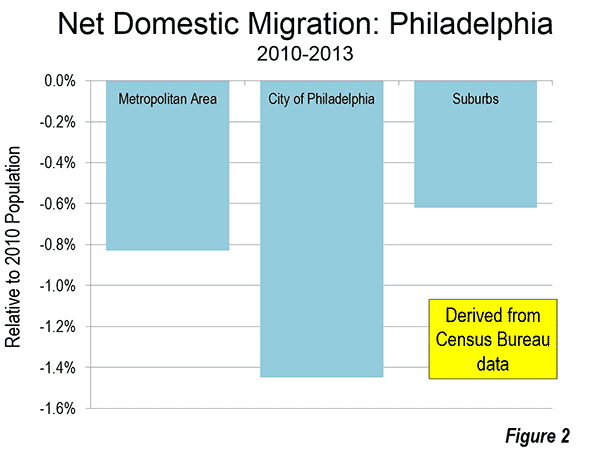
    Philadelphia has continued to lose domestic migrants to other areas of the country. Between 2010 and 2013, approximately 50,000 net domestic migrants left the Philadelphia area. Of this, 22,000 left the city of Philadelphia and 28,000 left the suburbs. The rate of domestic migration loss was 0.8 percent in the metropolitan area, 1.4 percent in the city of Philadelphia and 0.6 percent in the suburbs (Figure 2).

    Employment

    Within the metropolitan area, the commercial primacy of the core city of Philadelphia also has been reduced. Philadelphia has long been known for having one of the largest central business districts in the United States. The most recent census tract data from the CTPP indicates that Philadelphia has the sixth largest business district in the United States, with approximately 240,000 jobs. This represents only 8.7 percent of the metropolitan area employment, a figure slightly above the 8.4 percent average of the 52 major metropolitan areas (those with more than 1 million residents).

    The development of Philadelphia’s "center city" business district may have been stunted by city regulations that prohibited buildings to exceed the height of City Hall, topped off by a statue of city founder William Penn. At nine floors and approximately 550 feet (165 meters), City Hall was briefly the tallest building in the world in the early 1900s. City Hall remained a dominant feature of the skyline until the late 1980s, when One Liberty Place, with its 61 floors rose to 945 feet (290 meters). There are now 8 buildings taller than City Hall. Construction will soon begin on a new office and hotel tower , which at 1,120 foot tall (340 meters), 59 floor building would be the tallest building in the United States outside New York and Chicago (and taller, by 20 feet than Wilshire Grand now under construction in Los Angeles).

    Transportation

    I have described the city of Philadelphia as a "transit legacy city," which along with New York, Chicago, San Francisco, Boston, and Washington account for 55 percent of all the transit commuting destinations in the United States. This is nearly 10 times the share of jobs that are located in these six municipalities (not metropolitan areas).

    Philadelphia, like the other five other transit legacy cities has an extensive urban rail system. Philadelphia has commuter rail lines extending outward to suburban locations in Pennsylvania, New Jersey and Delaware. There are also two Metro lines (subway lines) and electric trolley lines. This transit system delivers 44 percent of commuters to "center city" jobs. This represents more than 40 percent of the transit commuting in the Philadelphia metropolitan area. Transit’s market share to work locations outside downtown is relatively small at 6.0 percent.

    The nation’s first long intercity tollway (the Pennsylvania Turnpike) passes through the Philadelphia metropolitan area. This route, in connection with the New Jersey Turnpike, the Ohio Turnpike, the Indiana Toll Road and the Chicago Skyway provided freeway equivalent access between the New York, Philadelphia, Pittsburgh, Cleveland and Chicago metropolitan areas in the middle 1950s, before the interstate highway system was authorized.

    Philadelphia’s stagnant population growth is typical for the Northeast, which continues to lose domestic migrants to the rest of the nation. It seems likely to continue. In the two decades following 2020, Phoenix and Riverside-San Bernardino are projected by the US Conference of Mayors to pass Philadelphia. This would push Philadelphia down to 12th place, compared to the 4th ranking it had at the beginning of the 21st century. Quite a ride down for the City of Brotherly Love, and its surrounding region.

    Wendell Cox is principal of Demographia, an international public policy and demographics firm. He is co-author of the "Demographia International Housing Affordability Survey" and author of "Demographia World Urban Areas" and "War on the Dream: How Anti-Sprawl Policy Threatens the Quality of Life." He was appointed to three terms on the Los Angeles County Transportation Commission, where he served with the leading city and county leadership as the only non-elected member. He was appointed to the Amtrak Reform Council to fill the unexpired term of Governor Christine Todd Whitman and has served as a visiting professor at the Conservatoire National des Arts et Metiers, a national university in Paris.

    Photo: Philadelphia City Hall by Max Binder

  • The Monuments of Gentry Liberals in Chicago: White Students Dominate the Test-Admittance Public Schools

    According to the U.S. Census Bureau, Chicago’s population peaked a long time ago.  In 1950, Chicago had 3. 6 million people. Recent estimates put Chicago’s population at 2.7 million. With the growth of American suburbs, many Chicago families have fled to public schools in the suburbs. Chicago’s horrible public schools have been an embarrassment for Chicago’s elite. A recent Chicago Tribune editorial estimated that only “only 8 of 100 freshmen who enter Chicago public high schools manage to get a college diploma.”  

    In an attempt to keep white families from fleeing Chicago, the second Mayor Daley came up with a plan:  test-admittance-only public high schools. This was a reasonable solution for gentry liberals who pay high property taxes but didn’t want to leave the city or couldn’t afford to send their children to private schools. These select public high schools produce college bound students while “limiting” gentry liberal’s children from being exposed to children from “troubled backgrounds”. This is a sensitive subject because Chicago’s Public School System is only 9.2% white, while being 39.7% African-American.

    Being admitted to these select magnet schools can often determine whether a family stays in Chicago or moves elsewhere. Recently, Daniel Hertz made news by graphically showing how Chicago’s middle class has being largely eliminated since 1970. The new Chicago is still a one-party town, but is now a coalition of rich and poor with a residual government worker middle class. White children have left Chicago’s Public School system leaving minorities as the majority. But, who gets into the selective public high schools?  The Chicago Sun-Times reports:

    More white students are walking the halls at Chicago’s top four public high schools.

    At Walter Payton College Prep on the Near North Side, more than 41 percent of freshmen admitted the past four years have been white, compared to 29 percent in 2009, a Chicago Sun-Times analysis of Chicago Public Schools data has found.

    At Jones College Prep in the South Loop, 38 percent of this year’s freshman class is white, compared to 29 percent four years ago.

    In 2010 — the first year race was no longer used to determine the makeup of Chicago schools — the percentage of white freshmen at Northside College Prep in North Park rose from 37 percent to 48 percent.
    And at Whitney Young College Prep on the Near West Side, the percentage of black freshmen has steadily declined in the past three years, while the percentage of whites has risen.

    As these schools attract white students, Mayor Rahm Emanuel had to shut down 50 public schools which according to Democracy Now affected” 30,000 students, around 90 percent of them African American.” While Chicago is closing public schools, it is getting ready to build a new school. Not just any public school, but an expensive test only admittance high school named after Chicago’s glorious leader who went far. The new high school will be named Barack Obama College Preparatory High School.

    Gentry liberals leaders have told us with enormous conviction that public education is an “investment”. Yet, President Barack Obama and Mayor Rahm Emanuel send their children to elite private schools. What’s interesting in Rahm Emanuel’s case is he couldn’t find one public school in all of Chicago good enough to send his children. Mayor Rahm Emanuel is so committed to public education that he sends his children to a private school 15 miles away from where his children live.

  • The New Brooklyn: Girls Vs Ebbets Field?

    So much spit has flown on the topic of gentrification in New York City that it seemed at best superfluous and at worst suspicious for New York Times chief film critic A.O. Scott to say anything at all about the subject. But Scott couldn’t resist. In “Whose Brooklyn Is It, Anyway?” last month, Scott stuck a toehold into the debate sparked by film director Spike Lee, whose 7-minute rant against gentrification recently went viral. Lee compared the influx of white New Yorkers into the south Bronx, Harlem, Bedford-Stuyvesant, and Crown Heights to “motherfuckin’ Christopher Columbus,” and decried the pricing out of renters and the wholesale takeover of neighborhoods, whose schools and streets, he claimed, received few resources before the white interlopers arrived.

    Among the responders to Lee’s tirade was journalist Errol Louis, who accused Lee of hypocrisy. The filmmaker may have grown up in Fort Greene, Brooklyn, but the $32 million Upper East Side brownstone he just sold (or, as Louis argues, “flipped”), marked him as merely confused.

    Scott gets a lot wrong in his attempt to wade into this discussion, but he gets one thing right: “culture, rather than politics,” can be a fruitful area of investigation if “labor, wealth and power” are your lenses of choice. There is, of course, ample research on economic restructuring and gentrification, real estate and global capital, and spatial injustices in the history of the city. But sticking with culture—including popular culture—is also important. Scott’s headline indicated that he was “tracing urban change,” from Welcome Back Kotter to Girls. In his analysis, as waves of demographic changes occur television representations shift.

    He complicates this a touch by introducing the global branding of Brooklyn, but it isn’t quite clear how that branding is actually deployed. Through the ubiquity of artisanal shops? Scott’s partial answer is that this “New Brooklyn” found in “restaurants, real estate, and retail” is, in turn, seen—glorified? exaggerated? — on TV shows like Girls and 2 Broke Girls. In these shows, the borough “figures as a playground for the ambitious but not quite disciplined, broke but not really poor, mostly white, college-educated young.”

    But while Scott seems somewhat dubious of the images of Brooklyn represented by these shows, he ultimately writes as if he believes that TV or film can perfectly double reality, and, further, be trusted: “Girls” reflects a reality, but also popularizes a small sliver of experience as a global brand, and—here’s the nasty part—even is reality. Things have changed, he writes, as one can see in the development battles over Atlantic Yards: “the old Brooklyn mourned the loss of Ebbets Field, historic home of the Dodgers; the new Brooklyn reacted with ambivalence to the construction of Barclay’s Center, where the Nets now play.”

    Scott isn’t interested in how a show like Girls might change, absorb, or reinforce communities and/or realities. And he isn’t so much interested in what it might leave out. For Scott, the relationship between television shows and gentrification is fairly pat. This pits the “Old Brooklyn” against the new, as Scott trots out well-worn examples like the Honeymooners and Saturday Night Fever and The Squid and the Whale. Never mind that he could have easily chosen very different movies and TV shows—The Warriors or The Jeffersons or Willie Dynamite— but then the relationship would have been considerably less pat; the images and representations might have complicated his understanding of New York at a certain time, his simplistic vision of the Old Brooklyn of working-class aspiration and the New Brooklyn of handlebar moustaches.

    When we think of certain films or TV shows as “capturing” their time, we usually mean that they tap into an anxiety, a flavor, an aesthetic. TV shows, in their goofy approximations of urban life — think here the fake skyline of Friends—clearly remind us that cultural producers pick and choose symbols that they use to construct — represent, if you will — a certain reality. To what end? Pleasure, entertainment, authentication, maybe documentation. But these can be contested, too, and Scott’s insistence on ignoring the cultural sphere as its own field in which struggles for power take place (the power conferred by image and by representation) is troubling.

    In his tepid response via Twitter to Lee’s grouchy self-defense, Scott described his article as “reportage.” He identifies a correlation between a cheese store on his block and a cheese store in Girls and understands one as reflecting the other, yet longs for artists and writers to “discover” another Brooklyn, one that looks more like it did in Lee’s film Crooklyn, or Jonathan Letham’s novel Fortress of Solitude, when residents lived in “close, sometimes uncomfortable proximity to people in very different circumstances.” But he’s gotten himself into a pretzel here. Discontent with the world outside his window, he’s also vaguely discontent with the world on his TV.

    Coincidence? Like any representation, Girls might help us recognize something about ourselves; might deliver a particular kind of pleasure to a particular kind of audience. But there are brutalities and deceptions to be found in any artistic or cultural representation of a city, and Scott’s decision to switch hats from critic to commentator suggested something a little provocative: the potential for actual public debate related to representation and power and wealth.

    There’s a long history of artists protesting the way the Times evaluates and represents the outer borough neighborhoods of New York. In 1971, Robert Macbeth of the New Lafayette Theater in Harlem chided Times theater critic Mel Gussow for referring to a production at his theater as “defiantly parochial.” Although Gussow penned a glowing review, Macbeth took exception to the suggestion that the theatre company

    should have been something other than what they were…. Gussow, it seems, is saying that Black artists can and will and should only achieve full presence in his view when they are performing in his theatre, for him and his audience, like it was during slavery time…. Then he would be spared the long journey to the “narrow province” of Harlem. Harlem would come to him. And the artists of the province would insure that a transistorized translator would interpret their petty offerings for his “more universal” intelligence.

    In 2014, many critics still long for universal intelligence; it’s much easier than thinking about the particular, or what actual reportage on wealth, labor, and power in the Arts & Leisure section might be. All of the cultural elements at play here called for a rough and tumble sociology of culture approach, but in the end, we were left with a battle of wills (and egos). Lee and Scott engaged in a duel of authenticity: can Lee really speak as a victim of gentrification, or has the great leveler of wealth rendered him a gentrifier, in spite of his own self-identifications? Today’s duel of choice rages on at the expense of other questions: the lived experience of neighborhood in relation to cultural access, and the actual reach of cultural products.

    Rather than reflect on Girls as a true “copy” of the city, it would behoove Scott to demystify it. Why this curious game of pretending Girls is not the fruit of creative and commercial choices made in order to shape a particular urban experience? Why ignore labor issues and embedded assumptions about wealth and representation, in an article that purports to look at “labor, wealth, and power”? Perhaps the terrifying thing for Scott would be to question where the pleasure in watching Girls comes from– for him, and for audiences.

    Hillary Miller is Lecturer in the Program in Writing and Rhetoric at Stanford University, where she teaches in the Immersion in the Arts: Living in Culture program. Her current book project, “Drop Dead: Crisis and Performance in 1970s New York City,” looks at theater and community identity during the 1975 fiscal crisis.

    The “new” Brooklyn: Flickr photo by Matthew D. Britt, Barclays Center, Brooklyn, New York.

  • The Best Cities For Jobs 2014

    As the recovery from the Great Recession stretches into its fifth year, the locus of economic momentum has shifted. In the early years of the recession, the cities that created the most jobs — sometimes the only ones — were either government- or military-dominated (Washington, D.C.;  Kileen-Temple-Fort Hood, Texas), or were powered by the energy boom in Texas, Oklahoma and the northern Great Plains.

    Now the recovery has shifted to a new group of cities that have benefited from the boom on Wall Street and the parallel IPO surge in Silicon Valley — call them asset inflation cities. Last year the S&P 500 clocked its biggest rise since 1997, helped by aggressive monetary easing by the Federal Reserve and a return to the stock market by investors who had retreated to the sidelines after the financial crisis. The high times have brought on a surge in IPOs: 2013 was the busiest year for public offerings in over a decade, and the pace has if anything quickened this year, with healthcare and technology offerings leading the way. M&A has also surged, with some very impressive valuations in the tech sector, such as Facebook’s $19 billion purchase of 50-person What’s App. The biggest beneficiaries employment-wise: the Bay Area, Silicon Valley and New York City.

    View the Best Cities for Jobs 2014 List

    Our rankings are based on short-, medium- and long-term job creation, going back to 2002, and factor in momentum — whether growth is slowing or accelerating. So the top of our list includes both cities that have had the most striking comebacks since the Great Recession as well as those that have consistently created jobs over the long haul. We have compiled separate rankings for large cities (nonfarm employment over 450,000), which are our focus this week, as well as medium-size cities (between 150,000 and 450,000 nonfarm jobs) and small cities (less than 150,000 nonfarm jobs) in order to make the comparisons more relevant to each category. (For a detailed description of our methodology, click here.) Small cities, as a rule, show more volatility than their larger counterparts since the decision of one major business to expand or contract can have an enormous effect on a relatively tiny employment base. (Check back next week for our ranking of mid-size and small cities).

    Big Money, Big Gains

    Yet even among the largest metropolitan areas, shifts in the economy can have a dramatic impact. This is clearly the case with the two metro areas that top our list this year, first-place San Jose-Sunnyvale-Santa Clara, Calif. (aka Silicon Valley), where the number of jobs surged 4.3% last year, and San Francisco-San Mateo-Redwood City, where employment expanded 3.6%. Before the current tech boom, largely centered on social media companies, these metro areas were lagging badly. In 2010, San Jose ranked 47th on this list out of the 66 metro areas with more than 450,000 nonfarm jobs and San Francisco was 42nd.

    The information sector has driven this remarkable change in fortunes. Since 2008, the number of information jobs in the San Jose area has risen 37% to 60,800, while in San Francisco, employment in that category has grown 28% to 52,300 jobs. This has been accompanied by strong increases in such high-wage fields as professional and business services, where Silicon Valley has clocked 10% growth, and San Francisco twice that, adding 42,500 jobs, since 2008.

    The housing bubble helped to launch New York City from its doldrums a decade ago (it rose from 54th on our list of the Best Cities For Jobs in 2005 to 22th in 2008). In recent years, New York has been well served by Washington’s bailout of the financial sector, which accounts for roughly 15% of the metro area GDP — the Big Apple climbed to 10th place in our ranking in 2010 and to seventh this year. This is in good part a result of asset inflation; the number of finance jobs in New York has actually declined in recent years, but with a lot of extra spending money in the pockets of the city’s relatively high concentration of wealthy people, some jobs are being created. Most of the growth has been in hospitality, health and education and retail, fields that do not generally offer top salaries. New York City has also seen steady growth in information jobs — although at only a third the rate of Silicon Valley — as well as professional and business services.

    Bring On The Usual Suspects

    Many of the other metro areas at the top of our 2014 list have been adding jobs consistently over the past decade. Some are also beneficiaries of the high-tech boom, though mostly as a result of big West Coast companies deciding to site new offices in these attractive locations. In third place is perennial high-flyer Austin-Round Rock-San Marcos, Texas, where the number of jobs grew 4.1% last year, and 13.7% since 2008. Raleigh-Cary N.C. places fourth (3.9%/7.2% over the same time spans). These metro areas routinely attract people and companies from California and the Northeast with lower taxes and real estate costs that, on an income basis, are as much as half those in the asset-rich areas.

    Unlike the asset-based economies, which ebb and flow with the markets, these and the other usual suspects have a record of consistent growth not only in jobs but also population. This reflects the more blue-collar economic foundation of many of these cities, based on energy, manufacturing and logistics — sectors that tend to create higher-paid blue- and white-collar jobs. Growth has continued in these areas throughout all the changes in the economy, which has encouraged long-term migration and investment.

    Viewed over the last five years, for example, fifth-place Houston has expanded its total employment by 218,000 jobs, growing at the same rate as both the San Francisco and San Jose metro areas—an impressive feat given that it is almost 20 percent larger than the two Silicon Valley cities combined. But an arguably bigger difference can be seen in demographics. The Houston metro area’s population has grown over 50% faster since 2010 than the Bay Area regions, and roughly twice as fast as New York. Houston is on track this year to build more new housing units than the entire state of California. This combination of rapid population and job growth – the former itself a major source of jobs in construction and services — can be seen in places such as No. 6 Nashville-Franklin-Murfreesboro, Tenn.; No. 10 Denver-Aurora-Broomfield, Colo.; and No. 14 Charlotte-Gastonia-Round Hill, N.C.

    The Sun Belt Bounces Back

    Perhaps the biggest surprise on this year’s list is the resurgence of the Sun Belt metro areas that were hardest hit by the housing bust. Ever since, the Northeast-centric pundit class has been giddily predicting these cities’ demise. Strangled by high energy prices, cooked by record droughts, rejected by a new generation of urban-centric millennials, the Atlantic proclaimed this vast southern region to be where the American dream has gone to die.

    But the data show that many of these metro areas are in the midst of a powerful comeback. Take Orlando-Kissimmee, Fla., ranked eighth this year, up 23 places from last year. Similarly Phoenix has risen 17 places from last year to 22nd and is way up from its 51st place ranking in 2010.

    Perhaps even more surprising  is the resurgence of 17th-place Riverside-San Bernardino, Calif., which ranked near the bottom of the big city table at 63rd in 2010. Now foreclosures have dropped and job growth has picked up. In fact, the Inland Empire is now doing considerably better in job creation than Southern California’s older urban regions, including Los Angeles-Long Beach (37th), Santa Ana-Anaheim-Irvine (34th) and San Diego-Carlsbad-San Marcos (32nd).

    Bringing Up The Rear

    Many large cities continue to lag. Philadelphia, despite being close to New York and its considerable urban amenities, ranks 51st, with paltry 0.9% job growth since 2008. Not much better off, despite its connections to the Obama White House, is Chicago, which places 47th. Not only is the Windy City not adding many jobs (0.5% growth since 2008) but every county in the area, according to recent Census numbers, is losing migrants to other parts of the country.

    But Chicago is certainly doing better than the host of old industrial cities that continue to dominate the nether reaches of our survey. These include last-place Camden, N.J.; second to last Detroit-Livonia-Dearborn, Mich.; Cleveland-Elyria- Mentor, Ohio (62nd), Kansas City, Mo. (61st), Newark-Union, N.J. (60th), and St. Louis (59th). All these cities, apart from Kansas City, have occupied the bottom of our list for nearly a decade now, and seem unlikely to move up in the immediate future.

    View the Best Cities for Jobs 2014 List

    What’s Next

    It seems clear that as long as the tech and financial sectors retain their momentum, New York and the Bay Area should continue to fare well. But if asset growth slows, these areas could slip quickly.

    The Texas cities and the other usual suspects are probably a better bet to continue to generate new jobs, but they too face challenges. If the economy slows down energy prices will follow, hampering growth in energy meccas like Houston, Dallas and San Antonio. A surge in interest rates could undermine the comeback of the Sun Belt cities, which remain highly dependent on housing and construction-related economic activity.

    But overall, for reasons ranging from housing costs to business climate, we expect the usual suspects to remain high on our list of the best cities for jobs for years to come, in part due to their growing populations. What remains unknown is how the evolving industrial structure of the economy will affect the slower-growing cities along the coasts whose fortunes have tended to ebb and flow in recent years.

    This story originally appeared at Forbes.

    Joel Kotkin is executive editor of NewGeography.com and Distinguished Presidential Fellow in Urban Futures at Chapman University, and a member of the editorial board of the Orange County Register. He is author of The City: A Global History and The Next Hundred Million: America in 2050. His most recent study, The Rise of Postfamilialism, has been widely discussed and distributed internationally. He lives in Los Angeles, CA.

    Michael Shires, Ph.D. is a professor at Pepperdine University School of Public Policy.

    Photo: Market Street, San Francisco by Wendell Cox.