Blog

  • Largest World Cities: 2014

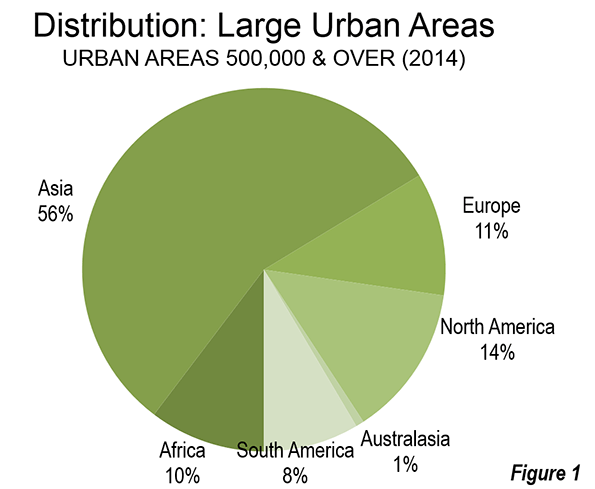
    The recently released 10th edition of Demographia World Urban Areas provides estimated population, land area and population density for the 922 identified urban areas with more than 500,000 population. With a total population of 1.92 billion residents, these cities comprise approximately 51 percent of the world urban population. The world’s largest cities are increasingly concentrated in Asia, where 56 percent are located. North America ranks second to Asia, with only 14 percent of the largest cities (Figure 1). Only three high income world cities are ranked in the top ten (Tokyo, Seoul and New York) and with present growth rates, Tokyo will be the lone high-income representative by the middle 2020s.

    Demographia World Urban Areas is the only regularly published compendium of urban population, land area and density data for cities of more than 500,000 population. Moreover, the populations are matched to the urban land areas where sufficient data is available from national census authorities.
    The City

    The term "city" has two principal meanings. One is the "built-up urban area," which is the city in its physical form, encompassing virtually all of the land area encircled by rural land or bodies of water. Demographia World Urban Areas reports on cities as built-up urban areas, using the following definition (Note 1).

    An urban area is a continuously built up land mass of urban development that is within a labor market (metropolitan area or metropolitan region). As a part of a labor market, an urban area cannot cross customs controlled boundaries unless the virtually free movement of labor is permitted. An urban area contains no rural land (all land in the world is either urban or rural).

    The other principal definition is the labor market, or metropolitan area, which is the city as the functional (economic) entity. The metropolitan area includes economically connected rural land to the outside of the built-up up urban area (and may include smaller urban areas). The third use, to denote a municipal corporation (such as the city of New York or the city of Toronto) does not correspond to the city as a built-up urban area or metropolitan area. This can – all too often does –   cause confusion among analysts and reporters who sometimes compare municipalities to metropolitan areas or to built-up urban areas.

    A Not Particularly Dense Urban World

    Much has been made of the fact that more than one-half of humanity lives in urban areas, for the first time in history. Yet much of that urbanization is not of the high densities associated with cities like Dhaka, New York, or even Atlanta.

    The half of the world’s urban population not included in Demographia World Areas lives in cities ranging in population from the hundreds to the hundreds of thousands (see: What is a Half-Urban World). In the high income world, residents of large urban areas principally live at relatively low densities, with automobile oriented suburbanization accounting for much of the urbanization in Western Europe, North America, Japan and Australasia. This point was well illustrated in research by David L. A. Gordon et al at Queen’s University (Kingston, Ontario), released last year which concluded that the metropolitan areas of Canada are approximately 80 percent suburban.

    Population

    There are now 29 megacities, with the addition in the last year of London. London might be thought of as having been a megacity for decades, however the imposition of its greenbelt forced virtually all growth since 1939 to exurban areas that are not a part of the urban area, keeping its population below the 10 million threshold until this year (Demographia World Urban Areas Table 1).

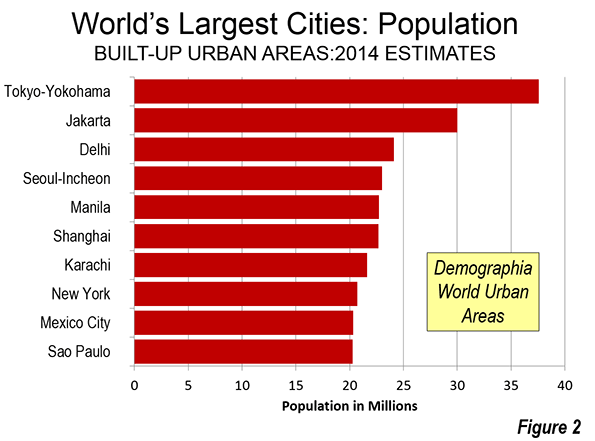
    The largest 10 contain the same cities as last year, though there have been ranking changes. Tokyo, with 37.6 million residents, continues its half century domination, though its margin over growing developing world cities is narrowing, especially Jakarta. Manila became the fifth largest urban area in the world, displacing Shanghai, while Mexico City moved up to 9th, displacing Sao Paulo (Figure 2).
    Land Area

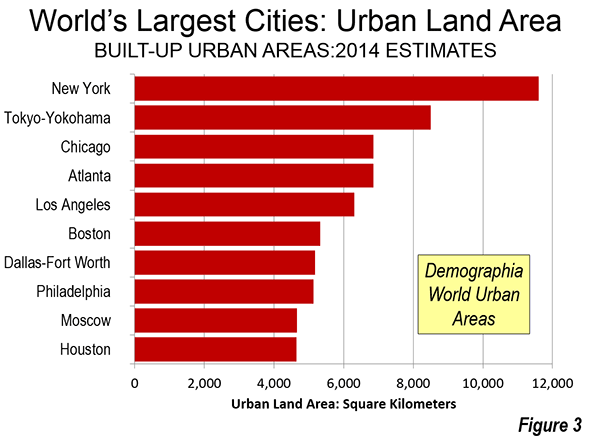
    Often seen as the epitome of urban density, the urban area of New York continues to cover, by far, the most land area of any city in the world. Its land area of nearly 4,500 square miles (11,600 square kilometers) is one-third higher than Tokyo’s 3,300 (8,500 square kilometers). Los Angeles, which is often thought of as defining low-density territorial expansion ranks only fifth, following Chicago and Atlanta, with their substantially smaller populations (Figure 3). Perhaps more surprisingly is the fact that Boston has the sixth largest land area of any city in the world. Boston’s strong downtown (central business district) and relatively dense core can result in a misleading perception of high urban density. In fact, Boston’s post-World War II suburbanization is at urban densities little different than that of Atlanta, which is the world’s least dense built-up urban area with more than 3 million population. Now, 29 cities cover land areas of more than 1,000 square miles or 2,500 square kilometers (Demographia World Urban Areas Table 3).
    Urban Density

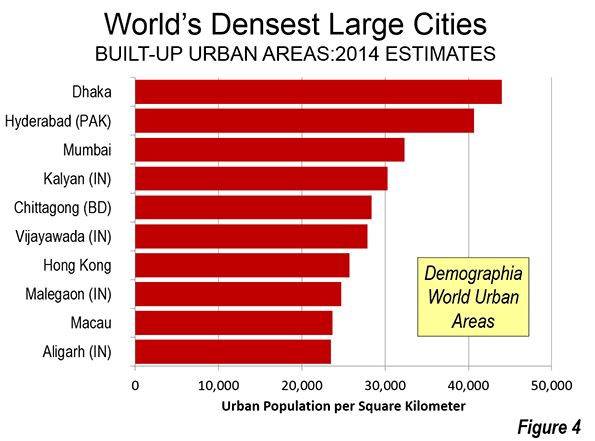
    All but two of the 10 densest cities are on the Indian subcontinent. Dhaka continues to lead in density, with 114,000 residents per square mile (44,000 per square kilometer).  Hyderabad (Pakistan, not India) ranks a close second. Mumbai and nearby Kalyan (Maharashtra) are the third and fourth densest cities. Hong Kong and Macau are the only cities ranking in the densest ten outside the subcontinent (Figure 4). Despite its reputation for high urban densities, the highest ranking city in China (Henyang, Hunan) is only 39th (Demographia World Urban Areas Table 4).
    Smaller Urban Areas

    Demographia World Urban Areas Table 2 includes more than 700 additional cities with fewer than 500,000 residents, mainly in the high income world. Unlike the main listing of urban areas over 500,000 population, the smaller cities do not represent a representative sample, and are shown only for information.

    Density by Geography

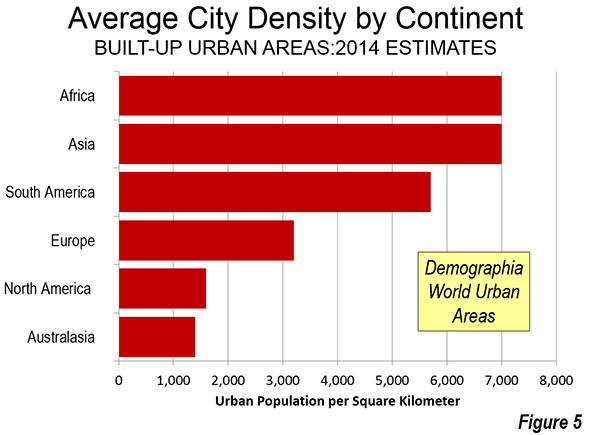
    Demographia World Urban Areas also provides an average built-up urban area density for a number of the geographical areas. Africa and Asia had the highest average city densities, at 18,000 per square mile (7,000 per square kilometer), followed by South America. Europe was in the middle, while North America and Oceania have the lowest average city densities (Figure 5).
    Some geographies, however, had much higher average urban densities. Bangladesh was highest, at 86,800 per square mile (33,000 per square kilometer), nearly five times the Asian average. Other geographies above 30,000 per square mile (11,500 per square kilometer) included Pakistan, the Democratic Republic of the Congo, the Philippines, India and Colombia, the only representative from the Western Hemisphere (Demographia World Urban Areas Table 5).

    Wendell Cox is principal of Demographia, an international public policy and demographics firm. He is co-author of the "Demographia International Housing Affordability Survey" and author of "Demographia World Urban Areas" and "War on the Dream: How Anti-Sprawl Policy Threatens the Quality of Life." He was appointed to three terms on the Los Angeles County Transportation Commission, where he served with the leading city and county leadership as the only non-elected member. He was appointed to the Amtrak Reform Council to fill the unexpired term of Governor Christine Todd Whitman and has served as a visiting professor at the Conservatoire National des Arts et Metiers, a national university in Paris.

    ———————-

    Note 1: Urban areas are called also called "population centres" (Canada), "built-up urban areas" (United Kingdom, "urbanized areas’ (United States), "unités urbaines" (France)  and "urban centres" (Australia). The "urban areas" of New Zealand include rural areas, as do many of the areas designated "urban" in the People’s Republic of China, and, as a result, do not meet the definition of urban areas above.

    Note 2: Demographia World Urban Areas is a continuing project. Revisions are made as more accurate satellite photographs and population estimates become available. As a result, the data in Demographia World Urban Areas is not intended for comparison to prior years, but is intended to be the latest data based upon the best data sources available at publication.

    Photograph: Slum, Valenzuela City, Manila (by Author)
  • Turn Of The Screwed: Does The GOP Have A Shot At Wooing Disgruntled Millennials?

    Over the past five years, the millennial generation (born after 1983) has been exercising greater influence over the economy, society and politics of the country, a trend that will only grow in the coming years. So far, they’ve leaned Democratic in the voting booth, but could the lousy economic fate of what I’ve dubbed “the screwed generation” lead to a change?

    Just look at these numbers. Since 2008, the percentage of the workforce under 25 has dropped by 13.2%, according to the Bureau of Labor Statistics, while that of people over 55 has risen by 7.6%. Among high school graduates who left school in 2009-11, only 16% had full-time work in 2012, and 22% worked part time although most sought a full-time job.

    These trends are likely to continue and could worsen, according to the U.S. Department of Labor, particularly for workers between 20 and 24. Today even a college degree guarantees increasingly little in terms of social uplift. Tuition debt is nearing $1 trillion; the percentage of 25-year-olds with school debt has risen from 25% in 2004 to close 40% in 2012. Average indebtedness amongst borrowers has grown 70% from $15,000 to nearly $25,000.

    A record one in 10 recent college borrowers has defaulted on their debt, the highest level in a decade. With wages for college graduates on a downward slope, one has to wonder how many more will join them.

    Over 43% of recent graduates who are employed are working at jobs that don’t require a college education, according to a recent report by the Heldrich Center for Workforce Development. Some 16% of bartenders and almost the same percentage of parking attendants had a bachelor’s degree or higher, notes Ohio State economics professor Richard Vedder.

    Besides a tepid economy, the millennials confront paying off huge public debts, much of it due to the generous pensions of boomer public employees. This constitutes what economist Robert Samuelson has labeled “a generational war” in which the young are destined to be losers in the “withering of the affluent society.” As he puts it: “For millions of younger Americans—say, those 40 and under—living better than their parents is a pipe dream. They won’t.”

    Not surprisingly, the young, who are traditionally optimists, are becoming far less so. According to a Rutgers study, 56% of recent high school graduates feel they would not be financially more successful than their parents; only 14% thought they’d do better. College education doesn’t seem to make a difference: 58% of recent graduates feel they won’t do as well as the previous generation. Only 16% thought they’d do better.

    According to Pew Research, up to half of millennials lean Democratic, compared to barely a third who favor the Republicans. The actue generational chronciclers Morley Winograd and Mike Hais suggest that this will continue and that hard times may even strengthen millennial support for what they describe as “economically activist government.” They cite a 2011 Pew poll that found millennials preferred a larger government that provided more services over a smaller one by a 54% to 35% margin. By contrast, 54% of boomers (born 1946-1964) and 59% of the silent generation (born 1925-1945) favored a smaller government.

    Critically, they maintain, these political views are likely to remain in place throughout their lifespans. The “Greatest Generation,” those born before 1925 who grew up during the Depression, never lost their enthusiasm for government.

    But it may be premature for Democrats to presume they have a lock on millennials’ loyalty.

    In 2008, twice as many millennials identified as Democrats or leaned Democratic (58%) as identified with the GOP or leaned Republican (29%), according to Pew. Cut to 2014, and the Democrats’ advantage among millennials has narrowed to 16 percentage points (50% to 34%).

    Although barely a a quarter of those under 35 said they had positive feelings toward the Republican Party in the last Wall Street Journal/NBC News poll, in a poll earlier this year, support for the Democrats has also dropped from roughly half to barely a third. Last year, a majority of 18- to 29-year-olds polled in a Harvard study no longer approved of the president’s performance.

    This suggest that like boomers under Jimmy Carter, who then shifted to Reagan, the millennials are not to be taken for granted. To attract them, though, Republicans will need to change many of their positions.

    Millennials, for example, are far more heavily minority, and descended from recent immigrants; they are likely to be far more permissive on immigration reform than earlier generation. At the same time, they embrace significantly more liberal views on issues like gay marriage and legalization of marijuana than older generations. Republicans right now are not competitive on these issues.

    Some conservatives rest their hopes not on attracting millennial voters but on the possibility that they’ll stay home during the mid-term elections. In 2010, 18- to 24-year-olds turned out at half the rate of the rest of electorate. But this can’t go on forever; the millennial share of the vote, even with poor turnouts, will continue to go up and will eventually overwhelm a party that depends on older voters to prop them up. In 2012 millennials accounted for roughly a quarter of the electorate; by 2020 they will be about 36%.

    Simply put, Republicans have no choice but to engage this population. To do so, they must focus primarily on economic growth, where the Democrats don’t have much to recommend themselves. Issues where the GOP could make up ground include reform for boomer pensions, as well as policies to spark job and income growth.

    To win over a significant share of millennials, Republicans don’t so much need a new Reagan as a program that inspires more confidence in the economic future.

    Although I am not fond of either party, a more competitive political environment among millennials would be useful, not only for conservatives also for the generation itself. As African Americans should have learned by now, being taken for granted does not guarantee better service from the political class. Under the country’s first black president, conditions for African Americans have declined rapidly.

    The evolution of the boomer generation suggests that such a change of fortune could happen. Between 1990 and today, the percentage of boomers identifying with the Democratic Party has dropped from 31% in 1990 to 25%. Much of this stemmed from reaction to the failures of the Carter presidency.

    This suggests that, although the formative years are critical, people do change their views as they age, experience life as adults and, most importantly, become parents. Many may not become Republicans, but could easily shift towards independent status. It may not happen this year, but perhaps later in the decade.

    Over time, even the self-absorbed boomers will have to give way to the needs of the new generation. The challenge for both parties is to develop policies that will allow the millennials to rise as have previous American generations. Whether these ideas come from the right or left seems less important than that the debate be engaged, open and focused more on the future than the past.

    This piece originally appeared in Forbes.

    Joel Kotkin is executive editor of NewGeography.com and Distinguished Presidential Fellow in Urban Futures at Chapman University, and a member of the editorial board of the Orange County Register. He is author of The City: A Global History and The Next Hundred Million: America in 2050. His most recent study, The Rise of Postfamilia

    Unemployed photo by BigStockPhoto.com.

  • The Spread of ‘Debate is Over’ Syndrome

    The ongoing trial involving journalist Mark Steyn – accused of defaming climate change theorist Michael Mann – reflects an increasingly dangerous tendency among our intellectual classes to embrace homogeneity of viewpoint. Steyn, whose column has appeared for years on these pages, may be alternatingly entertaining or over-the-top obnoxious, but the slander lawsuit against him marks a milestone in what has become a dangerously authoritarian worldview being adopted in academia, the media and large sections of the government bureaucracy.

    Let’s call it “the debate is over” syndrome, referring to a term used most often in relationship with climate change but also by President Barack Obama last week in reference to what remains his contentious, and theoretically reformable, health care plan. Ironically, this shift to certainty now comes increasingly from what passes for the Left in America.

    These are the same people who historically have identified themselves with open-mindedness and the defense of free speech, while conservatives, with some justification, were associated more often with such traits as criminalizing unpopular views – as seen in the 1950s McCarthy era – and embracing canonical bans on all sorts of personal behavior, a tendency still more evident than necessary among some socially minded conservatives.

    But when it comes to authoritarian expression of “true” beliefs, it’s the progressive Left that increasingly seeks to impose orthodoxy. In this rising intellectual order, those who dissent on everything from climate change, the causes of poverty and the definition of marriage, to opposition to abortion are increasingly marginalized and, in some cases, as in the Steyn trial, legally attacked.

    A few days ago, Brendan Eich, CEO of the web browser company Mozilla, resigned under pressure from gay rights groups. Why? Because it was revealed he donated $1,000 to the campaign to pass Proposition 8, California’s since-overturned ballot measure defining marriage as between one man and one woman.

    In many cases, I might agree with some leftist views, say, on gay marriage or the critical nature of income inequality, but liberals should find these intolerant tendencies terrifying and dangerous in a democracy dependent on the free interchange of ideas.

    This shift has been building for decades and follows the increasingly uniform capture of key institutions – universities, the mass media and the bureaucracy – by people holding a set of “acceptable” viewpoints. Ironically, the shift toward a uniform worldview started in the 1960s, in part as a reaction to the excesses of Sen. Joseph McCarthy and the oppressive conformity of the 1950s.

    But what started as liberation and openness has now engendered an ever-more powerful clerisy – an educated class – that seeks to impose particular viewpoints while marginalizing and, in the most-extreme cases, criminalizing, divergent views.

    Today’s clerisy in some ways resembles the clerical First Estate in pre-revolutionary France, which, in the words of the historian Georges Lefebvre, “possessed a control over thought in the interests of the Church and king.” With today’s clerisy, notes essayist Joseph Bottum, “social and political ideas [are] elevated to the status of strange divinities … born of the ancient religious hunger to perceive more in the world than just the give and take of ordinary human beings, but adapted to an age that piously congratulates itself on its escape from many of the strictures of ancient religion.”

    To be sure, there remains a still-potent camp of conservative ideologues, many associated with think tanks, such as the Heritage Foundation, and a host of publications, most notably the media empire controlled by the Murdoch family. But, for the most part, today’s clerisy in media and academia tilts in one basic direction, embracing a fairly uniform set of secular “truths” on issues ranging from the nature of justice, race and gender, to the environment.

    Those who dissent from the “accepted” point of view may not suffer excommunication, burning at the stake or other public rituals of penance, but can expect their work to be vilified or simply ignored. In some bastions of the new clerisy, such as San Francisco, an actress with unsuitable views can be pilloried, and a campaign launched to remove her from a production for supporting a Tea Party candidate.

    Nowhere is this shift more evident than in academia, as evidenced in Mann’s civil action against Steyn. The climate change issue, one of great import and worthy of serious consideration, is now being buried by the seemingly unscientific notion that everyone needs to follow orthodoxy on an issue that – like the nature of God in the Middle Ages – is considered “settled,” and those who do not agree deserve to be pilloried.

    But climate change is just one manifestation of the new authoritarian view in academia. On many college campuses, “speech codes” have become an increasingly popular way to control thought at many campuses. Like medieval dons, our academic worthies concentrate their fire on those whose views – say on social issues – offend the new canon. No surprise, then, as civil libertarian Nat Hentoff notes, that a 2010 survey of 24,000 college students found that barely a third of them thought it “safe to hold unpopular views on campus.”

    This is not terribly surprising, given the lack of intellectual diversity on many campuses. Various studies of political orientation of academics have found liberals outnumber conservatives, from 8-to-1 to 14-to-1. Whether this is a reflection of simply natural preferences of the well-educated or partially blatant discrimination remains arguable,but some research suggests that roughly two of five professors would be less inclined to hire an evangelical or conservative colleague than one more conventionally liberal.

    Political uniformity is certainly in vogue. A remarkable 96 percent of presidential campaign donations from the nation’s Ivy League faculty and staff in 2012 went to Obama, a margin more reminiscent of Soviet Russia than a properly functioning pluralistic academy.

    This story originally appeared at The Orange County Register.

    Joel Kotkin is executive editor of NewGeography.com and Distinguished Presidential Fellow in Urban Futures at Chapman University, and a member of the editorial board of the Orange County Register. He is author of The City: A Global History and The Next Hundred Million: America in 2050. His most recent study, The Rise of Postfamilialism, has been widely discussed and distributed internationally. He lives in Los Angeles, CA.

  • The Economist Indicts Urban Containment “Fat Cats”

    "Free Exchange" in The Economist has come down strongly on the side of economics in a review of housing affordability.

    According to The Economist, the unusually high cost of housing in San Francisco (and other places) is principally the result of tight land use regulation, which makes it expensive or impossible to build. If "local regulations did not do much to discourage creation of new housing supply, then the market for San Francisco would be pretty competitive." Add to that Vancouver, Sydney, Melbourne, Toronto, Portland and a host of additional metropolitan areas, where urban containment policy has driven house prices well above the 3.0 median multiple indicated by historic market fundamentals.

    The Economist explains the issue in greater detail: "We therefore get highly restrictive building regulations. Tight supply limits mean that the gap between the marginal cost of a unit of San Francisco and the value to the marginal resident of San Francisco (and the market price of the unit) is enormous. That difference is pocketed by the rent-seeking NIMBYs of San Francisco. However altruistic they perceive their mission to be, the result is similar to what you’d get if fat cat industrialists lobbied the government to drive their competition out of business." (Our emphasis).

    Of course urban planning interests have long denied that that rationing land is associated with higher housing prices (read greater poverty and a lower standard of living). Nonetheless urban containment policies not only drive up the price of land, but do so even as they reduce the amount of land used for each new residence, driving prices per square foot of land up as well.

    The Economist notes that unless the direction is changed, housing policy will continue to be "an instrument of oligarchy. Who knows. But however one imagines this playing out, we should be clear about what is happening, and what its effects have been."

  • Fracking, Youngstown and The Right to the City

    What happens when the Chamber of Commerce, labor leaders, and government officials, most of whom live outside the city, are pitted against a small yet influential group of community and university activists? That’s what’s going on right now in a debate over a ballot initiative that would prevent gas extraction by hydraulic fracturing — fracking — in Youngstown, Ohio. The proposed ordinance, Community Bill of Rights (CBR), is modeled on similar anti-drilling legislation in other Ohio communities that would largely block drilling, as well as shale gas extraction and injection wells, especially in urban areas.

    This is the third attempt during the last two years to pass such legislation in Youngstown, and the vote has become closer each time. In the most recent try, 45 per cent supported the ordinance and 55 per cent opposed it. Supporters hope to shift the balance this time.

    The underlying legal issue is whether local community restrictions can preempt Ohio’s legal framework for gas and oil drilling. Ohio is a home rule state where municipalities have authority “to exercise all powers of local self-government and to adopt and enforce within their limits such local police, sanitary and other similar regulations, as are not in conflict with general laws”. As proponents of the Youngstown ordinance point out, there is no exception in the Constitution for the oil and gas industry.

    The Constitution would seem to give Youngstown the right to regulate fracking on the local level, but in 2004, the Ohio legislature passed a bill HB 278 explicitly denying that right. The bill was largely written by the oil and gas industry, which recruited support for it by flooding both Republicans and Democrats with campaign contributions, according to former Ohio Attorney General Marc Dann. This happened before the industry expanded drilling in the Marcellus and Utica Shale regions of Eastern Ohio, suggesting that the industry knew it would encounter local resistance.

    Resistance to fracking reflects concerns about the well-documented relationship between fracking and earthquakes, both nationally and in Youngstown, and related health concerns. But what makes the Youngstown fight so remarkable is the setting: a community with a long history of economic struggle.

    Youngstown has been the poster child for deindustrialization and disinvestment since 1977. The city has lost over 30 per cent of its population in the last quarter century, and it has demolished over 3000 properties in the last five years. The average sale price for a home is $21,327. Other challenges include a median household income of $24,880 and a 36 per cent poverty rate. It’s also home to several prisons; one of every 20 residents is a prisoner. Alan Mallach, an urbanist and senior fellow of the National Housing Institute, notes that economic development efforts have not sufficiently addressed these problems, pointing out that “… factories or warehouses that the city has attracted usually move to the nearby suburbs, and four out of five jobs in the city are filled by people who commute from out of town.”

    Those opposing the Community Bill of Rights capitalize on these difficulties. They have spent large sums to set up phone banks in black urban churches, promoting the idea that fracking will create jobs. Yet there is very little evidence that African Americans have benefited from the fracking industry, except as precarious laborers.

    Many of those who are pushing for fracking don’t live in the city, and won’t have to live with its problems. These include Chamber members, labor unionists (especially the skilled trades), and city government employees who are exempted from local city residency requirements – a policy that contributed to the flight of middle-class white residents and the hollowing out of the city.

    The difference between the influence of these non-residents and the less well-financed voices of those who live in the city has not been lost on Community Bill of Rights supporters. CBR leaders Ray and Susie Beiersdorfer, city residents and Youngstown State University geologists, recognize that the blitz of advertising by the oil and natural gas industry, promising future jobs, appeals to the largely working-class, mostly black residents who are most affected by the city’s high levels of poverty and unemployment. But as a group of YSU academics noted in a letter to a Youngstown newspaper, “The same can be said for the manufacturing of cigarettes, alcohol, drones, high-range missiles, and nuclear warheads.”

    Youngstown, of course, is especially susceptible to the promise of jobs, even at the expense of the environment and health, and that has led some on the political left to either stay out of the fight or to oppose the CBR. Younger, environmentally-conscious city residents, including proponents of urban farming and sustainability, support the CBR. Other community groups think that the ban is too localized, and want to work on statewide fights. They argue that, because of the 2004 legislation, the local CBR is unenforceable and largely symbolic. Many local Democratic Party leaders also are visibly and vocally opposing the CBR. Democratic voters see their local leadership standing arm and arm with the many of same people who have attempted to undermine unionism and voting rights in Ohio.

    The proponents of the ban have been particularly troubled by the role of the city’s largest institution, Youngstown State University, and the resources it has accepted from the oil and gas industry. The impact of the university’s support of fracking has been powerful. YSU has downsized or abolished Humanities and Arts programs, while expanding its STEM (science, tech, engineering and math) college and trumpeting its training programs for promised oil and gas industry jobs that have yet to materialize in any significant degree. Some educators, like Deborah Mower, have argued that this should not be the role of the University: “Instead of merely responding to the industry need and ignoring the problems of fracking that have plagued the industry for decades, the university could create an epicenter for redressing their problems…. Perhaps lost in this discussion is the nature of education.”

    CBR proponents agree with that sentiment, but they might also point out that what is really at stake is, as the organizers of an upcoming international conference phrase it, the “right to the city” versus the influence of non-residents (disclosure: I’ll be speaking in May on so-called “smart shrinkage” at The Right to the City in an Era of Austerity (1973-2014) .

    The oil and gas industry has spent over $100,000 to defeat the CBR, and proponents have been sued to keep it off the ballot. Meanwhile, the Beiersdofers and other CBR organizers increasingly believe that public health, science and the ballot box are being overpowered by money. But they won’t let that happen in Youngstown without a fight.

    John Russo is a visiting research fellow at the Metropolitan Institute of Virginia Tech, and former co-director of the Center for Working-Class Studies / professor (emeritus) in the Williamson College of Business Administration at Youngstown State University. He is a board member of the Mahoning Valley Organizing Collaborative (MVOC) (Youngstown-Warren), and the co-author, with Sherry Linkon, of Steeltown U.S.A.: Work and Memory in Youngstown.

    Flickr photo by Don O’Brien, Red, White and Blue: In Ohio, 100-barrel tanks used to contain crude oil from gas wells.

  • The New Downtown Los Angeles

    There was a time when downtown Los Angeles was the commercial center of Southern California. According to Robert Fogelson, writing in his classic Downtown: Its Rise and Fall (1880-1950)"nearly half" of Los Angeles residents went downtown every day in the middle 1920s. A time traveler from 1925 might think that to still be the case, with the concentration of tall buildings, and the frequent press reports about downtown’s resurgence.  

    Downtown LA got a late start with high-rises. Until the middle 1960s, there were few buildings exceeding the 13 story height limit repealed in 1958 by city of Los Angeles. The most important exception is City Hall, opened in 1928, which is 454 feet tall (137 meters). By 1989, the city’s tallest building, Library Tower (First Interstate Tower), had been opened, topping out at 1,018 feet (310 meters). The under-construction Wilshire-Grand Tower will soon rise 80 feet (25 meters) above Library Tower. From the flight path to Los Angeles International Airport (above) and many ground vistas, the vertical profile of downtown Los Angeles will continue to stand tall over the city.

    Yet, far less understood is that downtown has declined in metropolitan importance for decades. Now, downtown has only 2.4 percent of employment the metropolitan area (Los Angeles and Orange Counties).  Between the 2000 Census and the 2006-2010 American Community Survey, employment in the central business district dropped approximately five percent. At least four other employment areas, all freeway oriented with lower employment density, equal or exceed downtown’s employment (these include the Airport-El Segundo area and nameless employment areas straddling the Santa Ana Freeway in Los Angeles County, the Harbor and San Diego Freeways in the South Bay and the Costa Mesa Freeway in Orange County). More important still, approximately two-thirds the metropolitan area’s employment is not in a large employment area at all. This dispersion of employment is one reason why Los Angeles –despite its reputation for horrendous traffic – has the shortest one-way commute time of any world megacity for which there is data.

    Shifting Downtown

    Following World War II, the heart of downtown Los Angeles shifted west from Broadway, Hill and Spring Streets, leaving a large stock of quality commercial buildings vacant. This was well before the end of their useful lives, yet decades of disuse followed. Most of these buildings rose to the 13 floors height limit, though one, the 18 story United California Bank headquarters at 6th and Spring, was completed not long before its competitors hired moving vans to move west. Soon after, the United California Bank built the UCB Tower (now Aon Tower) on Hope Street, with 62 floors (1973), which at the time was the tallest building in the world outside New York and Chicago.

    Adaptive Reuse

    The UCB Building and many more on the now more residential east side of downtown been converted to apartments and condominiums under the city’s creative "adaptive reuse" ordinance, which facilitates conversions from office to residential use. According to the city of Los Angeles, the ordinance has facilitated conversion of downtown commercial space into more than 3,000 residential units. Another 7,000 are either under construction or being considered.  

    The conversion of office buildings to residential has spread to post war structures, such as the Mobil Oil Building (now the Pegasus Apartments). This building, on Flower Street, was one of the earliest examples of the more modern styles that were to proliferate throughout the downtown areas of the nation. The Signal Oil Building, also one of the first to exceed the 13 story limit has also become residential (1010 Wilshire). This building had been the subject of an unusual 1980s remodeling that enlarged the footprint and the floors, while materially changing the outside angles and the decor. Another nearby office building (1100 Wilshire) sat empty for two decades after construction, before being converted to residential use.

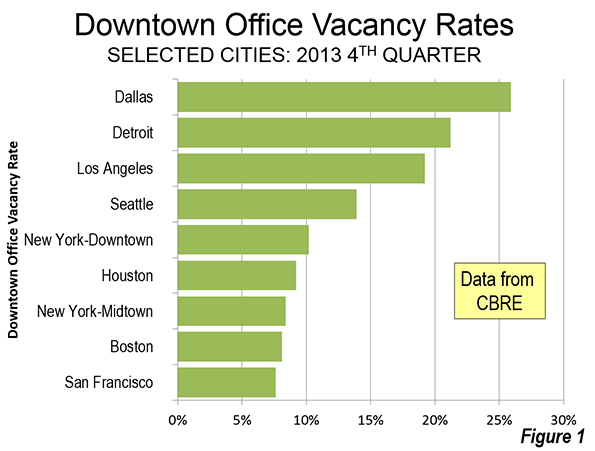
    The shift to residential makes sense given that most downtown office buildings are having difficulty filling their space. Downtown’s glutted office market is indicated by a 19.2 percent vacancy rate in the fourth quarter of 2013. This is better than such market laggards as downtown Detroit or downtown Dallas, both over 20 percent, but higher than the Los Angeles suburban office vacancy rate, at 15.9 percent. Downtown’s vacancy rate is also approximately double or more those of dynamic downtowns such as San Francisco, Boston, New York, and Houston, which are all under 10 percent (Figure 1).

    It appears likely that the Crocker Citizens Plaza, opened as the city’s tallest building in 1969 (42 floors), is slated for conversion to residential. After Crocker Bank moved to its new Crocker Center (now Wells Fargo Center) on Bunker Hill, Crocker Citizens Plaza became the AT&T Building. AT&T vacated the building and moved to the earlier 1960s Transamerica Building, which urban legend indicates was built well south of downtown because consultants convinced the developers that this would be the center of an even larger downtown. The Transamerica, now AT&T, is even more divorced from the commercial core than when it was built. By the time Crocker Citizens Plaza (now "611 Place") is converted to residential, it could be the third tallest mixed use building in downtown.

    The second tallest mixed use tower could well be the prestigious Library Tower, which stands half-empty. There are rumors that the new owners may convert a large part of the structure to condominiums and a hotel. No major office skyscraper has opened in downtown Los Angeles in the last 20 years. Nor will that change when the Wilshire Grand Tower is completed. Wilshire-Grand will only be partially an office tower and will include a hotel. Only 30 of the 73 floors will be offices. This is a climb-down from the original design, which included two buildings – a 60 story office tower and a 40 floor hotel and condominium project. The new building is little of an endorsement of downtown’s office demand.

    Transitioning from Adaptive Reuse?

    This conversions may be the tail end of trend. DT News reports that it has become more economical for many developers to construct new residential buildings, rather than to convert empty commercial buildings. As demand has increased, so have prices of existing buildings, which makes adaptive reuse   less attractive. Further, many of the structures on Broadway, which casual observation might indicate have potential for conversion, but the density of development may make offering enough natural light difficult for residences.

    Ups and Downs of Downtowns

    As employment has dispersed throughout the Los Angeles area, there has been less of a need for a central business district. Among the nation’s larger downtowns, only downtown Los Angeles has undertaken wholesale abandonment of its commercial core and built a new one. Perhaps this is, in part, because the 13-story height limit rendered the older buildings uneconomic for the second half of the 20th century.

    New York (Manhattan), south of 59th Street also has seen its ups and downs. But New York did not abandon large swaths of development, only to move elsewhere. Downtown Chicago expanded northward along Michigan Avenue, but little if any of the Loop was ever abandoned and it has undergone continuous renewal. The West Coast’s premium downtown areas, San Francisco and Seattle, have interspersed new development along with the old, and remain more important to their metropolitan areas than downtown Los Angeles, accounting for from four to six times its employment share (though still less than 15 percent). Even Houston, which most resembles Los Angeles in its post war downtown rebuild, managed its transformation without abandoning the historic core. And, at the same time, all are enjoying increasing residential demand, like downtown Los Angeles.

    Rising Demand

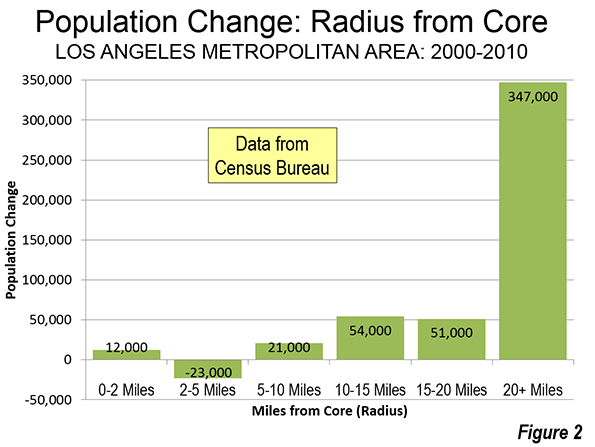
    Downtown interests are rightly proud of the rising residential population. This has occurred in many downtowns across the nation. Between 2000 and 2010, areas within 2 miles of City Hall gained 206,000 residents in the major metropolitan areas (over 1 million population). However, within in the next ring, from 2 to 5 miles from City Hall the decline in population more than compensated for the core gains (minus 272,000).

    The situation was the same in Los Angeles, where the Census Bureau reports that population within 2 miles of City Hall rose 12,000, while it declined 23,000 between 2 and 5 miles. The growth of downtown Los Angeles is impressive in part because it was stagnant for so many decades. In context, however, it is no "game-changer." Overall in the last decade all growth in the Los Angeles metropolitan area was outside the 5 mile ring, and 75 percent of that was more than 20 miles from City Hall (Figure 2).

    A New Species is Born

    It would be a mistake to characterize the emerging downtown Los Angeles as reasserting any economic primacy. Its former function is beyond revival. This was indicated by UCLA Anderson Forecast economist David Shulman, who indicated that he was "not bullish on Downtown Los Angeles." The report by public radio station KPCC continued:

    "That view runs counter to the impression that downtown L.A. is staging an urban comeback. But the resurgence is more about sports and entertainment venues, restaurants and bars, loft conversions, and hotels than it is about companies that need a lot of floors in tall buildings. Nightlife and streetscapes trump florescent light and cubicles."

    This refers to the new entertainment venues, such as the Staples Center, the Walt Disney Concert Hall and "LA Live," which may be joined by a new football stadium for a proposed National Football League franchise.

    The transformation of downtown Los Angeles is not so much a renaissance of a business core, but a shift into a new, and different, function. The new downtown serves a function similar to that of Wilshire Boulevard’s more heavily residential high-rise district. But it’s not likely to ever resemble the Upper East Side or Upper West Side in New York, not only because its residential base will remain  small, but because downtown is hardly an ascendant business center. Downtown’s recovery as a residential district – with a population roughly equivalent to the suburb of Diamond Bar – is indeed impressive, but its role as a vital urban economic center remains relatively small. 

    ——-

    Photo: Downtown Los Angeles toward the Hollywood Hills and the San Fernando Valley (by author)

    Wendell Cox is principal of Demographia, an international public policy and demographics firm. He is co-author of the "Demographia International Housing Affordability Survey" and author of "Demographia World Urban Areas" and "War on the Dream: How Anti-Sprawl Policy Threatens the Quality of Life." He was appointed to three terms on the Los Angeles County Transportation Commission, where he served with the leading city and county leadership as the only non-elected member. He was appointed to the Amtrak Reform Council to fill the unexpired term of Governor Christine Todd Whitman and has served as a visiting professor at the Conservatoire National des Arts et Metiers, a national university in Paris.

  • Why Some Nations Succeed

    Why is it that some nations, such as Switzerland, respond quickly to the need for reform – improving railroads, health care systems and schooling – even before the systems break down? And why do other nations, such as Italy and France, wait until major crises are upon them before introducing institutional change? Some, such as Daron Acemoglu and James Robinson, take a deterministic stance. The acclaimed writers of  Why Nations Fail  believe that cultural and geographical differences, or even historical accidents, put countries on to different trajectories of institutional development which are more or less conducive to growth. Although clearly relevant, this view is incomplete. There are often courageous individual leaders launch far reaching reforms that are initially unpopular, and gain acceptance first after they yield visible results.

    Take Canada as an example. The country was in very bad shape when a new left-liberal government took over power in 1993. Newly appointed Prime Minister Jean Chrétien and minister of finance Paul Martin worked on introducing an ambitious reform agenda. The administration made the difficult choice of market reforms, focusing on liberalizations and reduced spending through action such as abolishing transport subsidies for farmers. These measures were not popular amongst interest groups, the general public, or within the liberal party itself. The new government even introduced higher taxation initially, in order to deal with the deficit and massive public debt. Although each of these steps on their own were anything but popular, voters acknowledges that they would together benefit the country in the long term. The Liberal party was re-elected, and continued with reformist policies. In the coming years, reductions in government spending were used both to deal with the debt and to reduce the tax burden. After yet another successful re-election, Paul Martin took over the reins and won a fourth consecutive term. Later conservative governments have built upon the same policies. Canada is now North America’s new free market role model, but combines this with more generous and effective social policies than its larger neighbor country.

    In spite of ideological differences, experts often roughly agree on what reforms are needed to move forward. In Canada during the early 1990s, it was rather clear that a move towards more limited government and better business climate could boost job creation and entrepreneurship. At the same time it was also clear that similar changes were needed in countries such as Italy, France and Greece. Yet, only many years later, after experiencing stagnant growth and deep recessions, are the latter three countries grudgingly moving in this direction. One explanation might be that market reforms are less appealing in some nations than others due to ideological differences. Another is that structural changes overall are more difficult to introduce in some parts of the world. Jean-Claude Juncker, a likely candidate for the EU-presidency after two decades as Luxemburg’s Prime Minister, famously lamented “We all know what to do, we just don’t know how to get re-elected after we’ve done it.” What does it take for the general public to accept structural reforms, or even demand them?

    In our new book “Renaissance for Reforms” we discuss the concept of “reform threshold”, the point at which a people demand change in response to a perceived problem or challenge. Switzerland is clearly a country with a low reform threshold. Swiss governments have reformed continuously without the catalyst effect of deep crises. According to the reform barometer compiled by the think tank Avenir Suisse, Switzerland has reformed slightly more deeply than Germany since the turn of the century. Germany reformed extensively for a few years between 2002 and 2005 as a response to high unemployment, Switzerland, without such an outside stimulus, has reformed steadily and slowly, and always from a position of economic success.

    One example is that the Swiss made the unemployment insurance system stricter in order to incentivize people to find a new job. The reform in itself is not uncommon amongst developed countries. What sets Switzerland apart is that the change was introduced before dependency of unemployment insurance had reached high levels. In countries with a higher threshold for reforms, it would have been difficult to pass new rules in absence of an unemployment crisis. We believe that gradual and continuous reforms are in many ways a more advantageous approach, both from an economic and a social perspective, than major reforms following downturns. If the Swiss had opted to retain the previous system, a future crisis may have forced sudden and dramatic cut backs.

    Canadians, much like the Swiss, have shown an interest in reforms that can boost growth, although the two nations already have amongst the best business climates in the world. One explanation is that previous positive experience has raised the appetite for change. Focus is more on how to expand economic and social opportunities in society overall, compared to France, Italy and Greece where the debate centers on how existing resources can be distributed.

    Reducing the resistance to reform is easier said than done in most countries. What is needed is long-term commitment to change combined with an evidence-based approach where each reform is objectively studied by researchers in order to map its effects. Institutional competition is another key element. The Swiss test many ideas in their Cantons before introducing them on federal level. If the general public believes that changes are not introduces on a whim, but rather can be shown to have certain effects, support for change will likely increase. In the long-run, we believe that the low threshold for gradual institutional change that exists in Switzerland and Canada is a key for good governance. Perfect political systems are impossible to achieve, but it is still possible to adapt routinely to a changing world. And for each good policy, hopefully the threshold for introducing the next one can be lowered. 

    Dr. Nima Sanandaji is a frequent writer for the New Geography. Stefan Fölster is Professor of economics at the Royal Institute of Technology in Sweden and director of the Reform Institute. The authors are upcoming with the book ”Renaissance for Reforms” which is co-published by Timbro and the Institute of Economic Affairs.

  • The Rise of the Executive Headquarters

    Headquarters were once a defining characteristic of urban economic power, and indeed today cities that can still brag of the number of entries they boast on the Fortune 500 list of largest American firms. Yet as urban centers increasingly lost headquarters, boosters started to downplay them as a metric, particularly with the rise of the so-called “global city” concept. Today the HQ is back into the urban mix, but increasingly as what I would call the “executive headquarters” which brings bragging rights to a city but not much in terms of middle class jobs.

    The corporate headquarters in a downtown skyscraper took a beating during the 70s, 80s, and 90s as America’s inner cities went into decline. Why locate in a decaying, lawless, dysfunctional urban setting that seemed destined for the scrap heap when the shiny suburbs beckoned?  Indeed, companies increasingly vacated downtowns for massive suburban office campuses, frequently in idyllic, pastoral settings where employees would exist in a cocooned bubble without any but approved distractions such as on site gyms, dry cleaning, cafeterias, and daycare.

    Tom Wolfe, writing of the early 90s recession in New York, presciently pointed out the one thing that continued to hold urban allure for many CEOs, namely the lavish lunch:

    Eight years before 9/11, financial services and commercial real estate were superseded as driving forces in the New York economy by the restaurants appearing in boldface in Zagat’s. The exodus of corporations from New York during the near-depression of 1992-95 was stanched by a single thing: lunch. The C.E.O.’s would do anything rather than give up the daily celebrations of their eminence at eateries in the town where the wining and dining were as good azagats. (I know, I know; just read it out loud.) The case could be made that any post-9/11 federal appropriations to prop up business in New York should go first to the places where you can get Chilean sea bass with a Georgia plum marmalade glaze on a bed of mashed Hayman potatoes laced with leeks, broccoli rabe and emulsion of braised Vidalia onions infused with Marsala vinegar.

    Many CEOs might prefer to be close to home, but others enjoyed hobnobbing with their peers and getting treated like royalty at the Four Seasons.

    Yet even as many corporate headquarters were leaving and as Time magazine published its “Rotting of the Big Apple” cover in 1990, it was clear major change was already afoot. The cleanup had begun in the mid-1980s and by the 90s Americas biggest cities were on the way back.

    How could the urban center be coming back while headquarters bled away? The answer was the rise of the global economy and the services based “global city”. Saskia Sassen and other writers pioneered the analysis of this new entity.  In this world the complexities of the global economy generated demand for new forms of financial and producer services needed to manage and control the far flung networks of the global corporation. These highly specialized services providers were subject to clustering economics and concentrated in large urban centers like New York, London, and Chicago where they provided a new type of urban economic vitality.

    Sassen specifically says, “The key sector specifying the distinctive production advantages of global cities is the highly specialized and networked intermediate economy rather than corporate headquarters. In developing this argument, I am responding to a very common notion that the number of headquarters is what specifies a global city.”

    This not only provided an explanation for why urban centers could economically rebound while simultaneously losing headquarters, but from a civic marketing perspective it provided a justification for pooh-poohing the loss of HQs as much ado about nothing.  Headquarters were yesterday’s news anyway.

    Except that they weren’t. In recent years we’ve seen increasing evidence of the return of the corporate headquarters to the global city, a phenomenon I identified in 2008.  Today the “back to the city” theme for corporations is much written about, and the headquarters is once again conveniently seen as a signifier of urban strength.

    But in most cases this is not the old monolithic headquarters of yore, with their thousands of employees. Rather this takes the form of an “executive headquarters.” That is, a headquarters consisting largely of the C-suite and a small number of other very senior leaders and support staff.

    These have been around for a while, but traditionally existing to serve the desire of the CEO to live in a particular city. Men’s Wearhouse established headquarters in Fremont, CA for example, but most of the corporate employees are located in Houston. Lincoln National moved its executive headquarters to Philadelphia from Ft. Wayne, IN but the distribution of employment was barely affected. Both were CEO living preference driven.

    The people in “executive headquarters” are precisely those who most need proximity to the global city service providers that increasingly form a key part of company operations. Also, recruiting executive talent and proximity to airports play a role. And when companies want to think in a totally global manner, they can want to have their main office physically separate from any particular operating location.

    There are numerous examples. In Chicago alone, MillerCoors moved its top staff from Milwaukee. Mead Johnson Nutrionals established an executive headquarters in the suburbs away from its main Evansville, IN base. Boeing’s move to Chicago from Seattle can be seen in the same light. And just recently agribusiness giant ADM announced it was moving its HQ from Decatur, IL to Chicago.

    The Mead Johnson case is instructional. According to press reports at the time:

    Working in a large city will make it easier to conduct business throughout the world. Mead Johnson makes Enfamil and similar products and about half of its sales come from overseas. Having offices near Chicago, for instance, will place executives in close proximity to global-business consultants, leaders in the field of nutrition and an international airport.

    Between 40 and 60 people will work in the corporate offices, most of them in new positions. Evansville will retain the company’s operations in research and development, U.S. sales and marketing and information management, as well as a bulk of the finance and human-resources departments, Paradossi said. Mead Johnson’s liquid products will continue to be made in Evansville, he said.

    Note the stated reasons for the move, as well as the small number of people involved.  The ADM move is similar, with only about 100 jobs initially. This suggests that while headquarters are in some cases coming back to the global city, they aren’t brining many jobs.  Also, many second tier business centers like Indianapolis continue to see their downtown job base hollowed out apart from hot sectors like technology.

    The executive headquarters is one more example of the increasing bifurcation of America’s elite cities. A handful of top executives gather in America’s capitals of capitalism while the good paying core of the old headquarters – including many upper middle class positions – remain in more workaday cities. This but one example of the “growth without growth” model in which cities dispense with “old fashioned” notions like population and job growth in favor of higher per capita GDP and income in which parts of cities thrive by becoming downtown versions of the exclusive gated subdivision.

    A few cases have gone beyond this, with even more wholesale moves back to the core. United Airlines moved 3,000 to the Chicago Loop from Elk Grove Village. And Google is moving 2,500 people from Libertyville as a result of the Motorola Mobility purchase. (This unit is already being sold to Lenovo, however). These more substantial moves could bring more bread and butter jobs.

    But as a recent column in the Economist noted, investors are putting huge pressures on companies to slim down bloated overheads. This does not bode well for bringing middle-skilled jobs to expensive headquarters locations. Additionally, the rise of telecommuting the and 1099 economy, just in time offices, co-working spaces, etc. are transforming the way people work and putting further pressure on the traditional HQ.  Office floor plates are expensive, and increasing numbers of people no longer want to spend their days toiling away in the salt mines of cubicle farms anyway.

    Where does this lead?  If there’s one thing the last few decades have shown it’s that the only constant is constant change.  With unpredictable market dynamics and various iterations of the cycle of reincarnation (centralizing vs. decentralizing, etc), even the shift to selected downtowns may bring fewer benefits to the urban economy than imagined, and could ultimately accelerate the bifurcation between a small elite population and largely poor communities around them.

    Aaron M. Renn is an independent writer on urban affairs and the founder of Telestrian, a data analysis and mapping tool. He writes at The Urbanophile.

    Boeing Chicago photo by J. Crocker.