Blog

  • City of Villages

    Los Angeles is unique among the big, world-class American cities. Unlike New York, Boston, or Chicago, L.A. lacks a clearly defined core. It is instead a sprawling region made up of numerous poly-ethnic neighborhoods, few exhibiting the style and grace of a Paris arrondissement, Greenwich Village, or southwest London. In the 1920s, the region’s huge dispersion was contemptuously described—in a quotation alternately attributed to Dorothy Parker, Aldous Huxley, or H. L. Mencken—as “72 suburbs in search of a city.” Los Angeles’s lack of urbane charm led William Faulkner to dub it “the plastic asshole of the world.” But to those of us who inhabit this expansive and varied place, the lack of conventional urbanity is exactly what makes Los Angeles so interesting. My adopted hometown is the exemplar of the modern multipolar metropolis: less a conscious city than a series of alternatives created by its climate, its diversity, and a congested but still-functional system of freeways that historian Kevin Starr calls “absolute masterpieces of engineering.”

    PHOTOGRAPHS BY TED SOQUI


    Transplants from the East Coast make great sport of belittling Los Angeles as an adolescent New York or a second-rate Chicago. Developers and city boosters, eager to counter that image, placed their hopes on big projects such as the region’s ultraexpensive rail system. Yet billions of investment dollars have done almost nothing to increase the L.A. Metro’s ridership, which remains stuck at 6 percent of city population. By contrast, a majority of New Yorkers and about a quarter of Chicagoans use their cities’ public transportation. Critics also (rightly) depict the downtown residential revival as a misguided attempt to create a mini-Manhattan. That’s not in the cards: downtown L.A.’s 50,000 or so residents—about on par with San Fernando Valley neighborhoods such as Sherman Oaks and suburban areas such as San Bernardino County’s Eastvale—are a drop in the bucket for a region of some 18 million people. And despite billions in direct and indirect public subsidies, downtown boasts barely 3 percent of the region’s jobs. In the minds of most Angelenos, the only reason to go downtown is for jury duty or the occasional sporting or cultural event.


    626 Night Market, at the Santa Anita track

    The “real” L.A., as experienced by most residents, exists at the neighborhood level. Spread across the region, a multiplicity of neighborhoods offers an unusual variety of housing options in a great global city. Gardener Aurelio Rodriguez and his family choose to live in Sylmar, where he keeps a lush half-acre filled with fruit trees, tropical plants, and aging farm equipment, while remaining within the Los Angeles city limits. It’s the kind of place where pedestrians need to keep an eye out for more than just cars. Like Juan, some residents amble through the narrow streets on horseback.


    Juan on horseback in Sylmar

    Los Angeles’s myriad little villages are enjoying a new surge of interest. City politics are at a low ebb—with voter turnout in 2013 the tiniest ever for a contested citywide election—yet neighborhood groups proliferate, including some 90 neighborhood councils. People may not be passionate about what goes on at City Hall, but they care deeply about where they live.

    I live in Valley Village, a tree-lined corner of Los Angeles made up of single-family houses built on lots that range from 5,000 to 20,000 square feet. Enclosed between four major thoroughfares, my part of Valley Village manages to be both diverse and highly cohesive—a city within a city. Crime tends to be limited to petty thefts from cars. Monthly neighborhood-watch meetings draw middle-class families as well as gay and childless couples. Armenians and orthodox Jews live side by side. The local markets have an ethnic flavor. At the Cambridge Farms supermarket on Burbank Boulevard, signs are posted in English and in Hebrew. Oxnard Boulevard has an Armenian feel, with a functioning lavash bakery and restaurants selling kabobs.

    “We fell in love with the neighborhood once we got settled in,” says Grettel Cortes, who lives in a modest house several doors down with her husband, Efraim, and her three young children, Gaea, Eva, and Benjamin. “There’s a great family feeling here. If I need something, I ask Patty across the street. It’s a great place for kids to grow up.” Cortes manages the neighborhood’s heavily trafficked Shutterfly site. A recent article about a coyote devouring a local cat was big news for weeks.

    The hot topic in Valley Village these days is the rise of the McMansions. New homes are going up on a scale that feels out of sync with the neighborhood’s low-rise character. One of the larger parcels has sprouted a gigantic, two-and-a-half-story monstrosity that neighbors have christened “the hotel.” During construction, the property’s owner chopped down several trees, some of which may have been protected by city ordinances. Only relentless protests from the locals kept him from further destruction.

    “We love the neighborhood but hate the mansionization,” notes Tim Coffey, a 30-year resident whose wife, Chary, led the fight to save the trees. “To us, chopping down trees ruins what this place is all about.”

    Despite the McMansions, Valley Village has remained mostly unchanged since I moved here over a decade ago. The area’s appeal lies in the quality of its private spaces—backyards, front yards, gardens—and its neighborliness: people actually say hello to strangers on the street. The many trees also provide an ecosystem for a vast array of birds, from hawks to hummingbirds, as well as various mammals, including raccoons, opossums, and, as we now know, the occasional coyote.

    As neighbors, we share a fierce determination to protect and preserve our shaded enclave. Yet the people here are not your stereotypical suburbanites. Chary, for example, sells her own line of lingerie. Grettel is a website developer. Many others work in the entertainment industry. Studios such as Disney, CBS Radford (where Seinfeld was produced), NBC, Universal, and Warner Brothers are all a ten- to 15-minute drive away. Many of my neighbors work from home, including a voice-over artist, a scriptwriter, several actors and musicians, and even a magician. It turns out that Hollywood people want many of the same things from a neighborhood that the rest of us do.


    Grettel Cortes’s neighbor Patty


    Blind Melon guitarist Brad Smith


    Native Mississippian Brad Smith, a successful songwriter and performer with the band Blind Melon, sees Valley Village as a refuge from the insanity of the entertainment business. Brad and his wife, Kim, a Michigan native, like the homey and familiar feel. They have lived here since 2000 and are raising a young daughter, Frankie. They have a dog and a trampoline out back. “In L.A., a lot of places seem like you can live there but never leave the car,” he says as he strums a tune in his backyard. “But here, it’s different. You come home from tour, and you come to a neighborhood with dogs, cats, and kids. It makes living in the big city far more palatable, even for someone from a small town.” This is one of L.A.’s enduring charms: the option to live in a quiet neighborhood in the heart of an important city.

    Los Angeles is constantly reinventing itself, combining and recombining people and neighborhoods from the ground up. Out of its crazy quilt of ethnic enclaves, new districts arise all the time, often spontaneously, notes Thomas Tseng, a native of the suburban San Gabriel Valley and a student of urban planning. Take the neighborhood now known as “Little Osaka,” which follows along Sawtelle Boulevard in West Los Angeles. Forty years ago, when I lived there, the area was home mostly to working-class Japanese and Mexican families. The few modest restaurants were far from fashionable, mostly offering ethnic home-style cuisine. But over the past few years, Tseng says, many of the old families—as well as investors from Korea, Taiwan, and China—have opened new restaurants, bars, and clubs in the neighborhood. Far from the downtown hotspots and the Hollywood scene, Little Osaka’s streets bustle with young people, a majority of them Asian. Many live in the area or attend nearby UCLA. “There was nothing planned,” says Tseng, who has been getting his hair cut and belly filled in the area for years. “It just happened.”


    Little Osaka


    Little Osaka


    Even more impressive is the 626 Night Market in the parking lot of the Santa Anita Track. Every month, some 160 food vendors descend on the place. You can get everything from preserved fertilized eggs to sea-urchin rice balls (my favorite), lamb skewers, stinky tofu, and grilled squid. Up to 40,000 people gather in this monthly celebration of L.A.’s entrepreneurial grassroots food scene. After all, Los Angeles invented the food truck—the perfect analogy for a city perpetually on the road and spanning hundreds of neighborhoods.

    Los Angeles may lack the kind of dynamic urban core that we associate with traditional great cities. But to most of its residents, the city is an urban feast on a gourmet scale. We wouldn’t trade it for the world.

    This story originally appeared at The City Journal.

    Joel Kotkin is executive editor of NewGeography.com and Distinguished Presidential Fellow in Urban Futures at Chapman University, and a member of the editorial board of the Orange County Register. He is author of The City: A Global History and The Next Hundred Million: America in 2050. His most recent study, The Rise of Postfamilialism, has been widely discussed and distributed internationally. He lives in Los Angeles, CA.
  • The Reinvention of Sanford, Florida

    Sanford, Florida was in the midst of reinventing itself. Then the calamity of Trayvon Martin’s violent death turned this sleepy Florida town into a poster child for everything that’s wrong with the state. Now that the media frenzy has moved on to other troughs, the residents must sweep up the mess. As is often the case, compassion and healing have been operating quietly in the background. Two years after the tragedy, this healing process is being highlighted through a grant by Ashoka University to document the lives and faces of the people of this small, historical town. The Sanford Project was begun by a group of students and artists to capture the unique culture and character of the city, and to turn around perceptions of Sanford.

    Led by Olivia Zuk, a recent graduate of nearby Rollins College, The Sanford Project recently exhibited its results at ‘Say It Loud’, a pop-up gallery space in nearby Orlando. “The media willfully misinterpreted Sanford,” she said, “and we decided that it was critical to overcome the passing controversy and focus on the true nature of this Central Florida town”. During an internship last summer in New York City, total strangers, Europeans as well as Americans, approached her about its lurid reputation. Ms. Zuk’s eyes flashed as she added, “I had had enough. This is my backyard and it needs to be properly defined, and this ugliness put behind us.” When she returned from New York, she received a grant to create a media circus, this time of her own design.

    The Sanford Project quickly attracted eight other students. A startling photographic odyssey captured humanistic portraits of the town’s residents, overcoming its caricature status and reminding viewers of Sanford’s real people. Seeking to go out of their comfort zone, the collaborators accepted invitations into churches homes, businesses and communities, gathering intimate stories and the personal reflections of Sanford’s residents, including memories of the celery-farming days of the 1940s and before.

    While the individual stories and images are remarkable, what is more remarkable is that these students, on their own, chose to reach out to collaborate with Sanford’s residents. And even more remarkable than this gesture is the fact that they were most often greeted with pride and acceptance. “We did not force it,” explained participant Destiny Deming, “but as the project progressed we all felt more at home in a city that several of us aren’t even natives of.”

    Lauren Cooper, another participant, said, “I didn’t get turned down to speak with a single person, or hear any outcry to critique our cause. That silence, ironically, speaks.” The quality of this small town is probably not unique, and belies the illusion that our big cities are our greatest triumph. Olivia Zuk and her students found, instead, a triumph in the humanity that came out of this effort to re-connect with the small town.

    The project’s images, video, and documentary will be coming home to Sanford later this spring. Building solidarity built between the city and the small, peripheral town must be done to rebuild a state of compassion and shared ownership out of the ashes of our greed-driven, cynical culture. The Sanford Project takes the necessary first step, and although the pathway is long, the first step is the hardest.

    Participant Aaron Harriss described The Sanford Project as “suburban white kids from Orlando interested in historic African American communities”. The sardonic, self-deprecating comment belies his generation’s interest in localized connectivity over and above the “official” storyline of a community. Rocked by charges of racism, and guilty by association, Central Floridians were stung by the Trayvon Martin publicity. Few rose to speak, or set the story straight, however, until Olivia Zuk and her Sanford Project team stepped in.

    “Being from the millennial generation, most of us working on the project learned about the segregation of white people and black people pretty early on,” reflected Ms. Zuk after interviewing a Sanford resident. Segregation was a story told like a history lesson, at arm’s length, and for many suburban white kids this might be close enough. But Zuk took with her a multiracial team of Lauren Cooper, Destiny Deming, Christopher Garcia, Leila Gray, Aaron Harriss, Angelica Milan, Victor Rollins and Lauren Silvestri.

    They sat with African-Americans, heard stories of racism, participated in the African-American culture of Sanford, and supported the local Martin Luther King Day parade. They learned more about the city than many of the region’s occupants knew: Sanford’s history, like that of many small towns, conceals some darker episodes, such as the story of Goldsboro, an African-American town that was forcibly incorporated into the larger town of Sanford in 1911. But it has many joyful tales, also, stories of beating the odds. The surrounding celery and orange fields have been eclipsed by the theme parks, but Sanford sustains itself as a town with a desirable quality of life.

    Lingering in the twilight of its agricultural boom, Sanford today is off Central Florida’s beaten path; it’s about a 40 minute ride from downtown Orlando. Its historic downtown and surrounding residential community is beautiful, but its population has struggled to grow.

    A reinvention was long overdue. Then, in stepped the media, reinventing Sanford in the wake of young Martin’s tragic death: small southern town, fill in the rest of the blank. This condemnation, inevitable in today’s city-worshipping culture, seems all too pat. Caught off guard, perhaps, Sanford was unable to push back at a media framework in which you are either a darling or a pariah, but never anything in between.

    The millennial generation’s nonhierarchical view of society, symbolized by The Sanford Project, is a pathway out of the good-or-evil, red-and-blue polarization that we continually encounter. Increasingly, however, these black-and-white cartoons ring hollow and empty, unable to withstand scrutiny.

    Is this cycle unbreakable? The students and artists who have captured Sanford’s character through images and stories have started the hard work to do just that. Millennials, like the generations that preceded them, may someday come to accept this either/or view of the world. For now, however, efforts like the Sanford Project — efforts that are not profit-driven, but rather socially driven — are rebuilding our squandered moral capital.

    Richard Reep is an architect with VOA Associates, Inc., and an artist who has been designing award-winning urban mixed-use and hospitality projects, domestically and internationally, for the last thirty years. He is Adjunct Professor for the Environmental and Growth Studies Department at Rollins College, teaching urban design and sustainable development, and is president of the Orlando Foundation for Architecture. He resides in Winter Park, Florida with his family.

    Photo by Destiny Deming of children outside of their Sanford home.

  • Taking the Main Street Off-ramp

    To some, the $19 billion paid by Facebook for the Silicon Valley start-up What’s App represents the ultimate confirmation of the capitalist dream. After all, these riches are going first and foremost to plucky engineers whose goals are simply to make life better for the public. Got a problem with that?

    Yes, actually. Sure, people should be rewarded, even lavishly, for their innovations. But $19 billion for 50-something people in a company with no profits and no prospects of having any, at least in the short term? Is this app worth more than Southwest Airlines, or Sony, or scores of other companies with thousands of employees and decades’ worth of profits? Put another way, the $19 billion makes Vladimir Putin’s now-defunct bailout of Ukraine seem puny. Ukraine, the homeland of What’s App’s CEO, if you don’t remember, is a country of 46 million people.

    Yet, this is the form of capitalism that we now have, one tilted so heavily to the few well-connected souls, whether on Wall Street or among the chummy “directors club” keiretsu of Silicon Valley. But the heart and soul of free enterprise – small and medium-size companies – remain in the doldrums. They are producing jobs at rates lower than those before the most-recent recession. According to the Bureau of Labor Statistics, firms with less than 50 employees are adding jobs at rates well below 2007 levels. Drivers of the recovery early in the prior decade, they have become laggards as larger firms have expanded modestly.

    Indeed, by 2013, smaller firms, those with less than 100 employees, added far fewer jobs than in the decade before. In previous recoveries, small firms led the way, but in the post-2007 recovery, these grass-roots companies continued to lose ground. In 1977, Small Business Administration figures show, Americans started 563,325 businesses with employees. In 2009, they started barely 400,000.

    This is not just a story of clueless mom-and-pops left behind by progress. Business start-ups, long a key source of new jobs – as a portion of all businesses – have declined from 50 percent in the early 1980s to 35 percent in 2010.

    Many people who once had decent incomes and may have owned, or hoped to start, a business have slipped to the economic lower rungs. Their decline is not widely mourned in the academic, financial or media worlds. Last year, one Financial Times columnist contended that the middle class, “after a good run” of some two centuries, now faces “relative decline” and even extinction. Not that this trend disturbed the author, who noted that “classes come and classes go” and that, when the middle orders disappear, about the only ones sorry to see them go might be the “middle classes themselves. Boo hoo.”

    Like the yeoman farmer, the artisan and the shopkeeper during the 19th century’s Gilded Age or in Victorian England, millions of smaller business entrepreneurs are threatened with what I call “proleterianization,” that is, a descent from the relatively secure, property-owning class to the permanently insecure masses, living paycheck to paycheck. This process is driven largely by powerful economic forces, such as technological change and globalization, but has been exacerbated by the actions of the political class.

    Much of the blame starts with Federal Reserve policy, which has been totally designed to favor high-risk investments – like What’s App – at the expense of the more modest savers along Main Street. The winners in the era of low interest rates and the Fed’s bond-buying binge have been venture capital firms, hedge funds and Wall Street investment banks. Capital has not been flowing to consumers, or smaller firms, noted one top former manager. The Fed has lost “any remaining ability to think independently from Wall Street,” asserts Andrew Huszar, who managed the Federal Reserve’s $1.25 trillion agency mortgage-backed security purchase program.

    Fed policy, through TARP, bailed out the big banks, which generally are loath to loan money to small businesses, but has done little for smaller banks, who generally do make such loans, and which have continued to contract. The rapid decline of community banks, for example, down by half since 1990, has hit small-business people most directly, as those institutions have been a traditional source of small-business loans.

    All these problems have been made worse by a tide of new regulations, notably the Affordable Care Act, which, like most top-down systems, most hurts the middle class. When Obamacare took effect in 2013, it was the small-business owners and the self-employed who suffered the brunt of health insurance cancellations and higher premiums. In addition, the ever-growing net of regulations, covering everything from labor to the environment, has placed a far greater burden on smaller firms than their larger counterparts.

    2010 SBA report found that federal regulations cost firms with less than 20 employees more than $10,000 a year per employee, while bigger firms paid roughly $7,500 per employee. The biggest hit to small business is environmental regulations, which cost small firms 364 more percent than large ones. Small companies spend an average $4,101 per employee on such regulations, compared with $1,294 at medium-size companies (20 to 499 employees) and $883 at the largest companies. This has come over a period when many of the key costs faced by the business-owning middle class – house prices, health insurance, utilities and college tuition – have all soared.

    Given these conditions, it’s not surprising that small-firm owners are about the most alienated large constituency in America, according to Gallup. Yet, their once-considerable clout has faded, particularly among Democrats, who have found new allies within Silicon Valley, much of Wall Street and, most of all, a growing, connected clerisy of government workers, academics, high-end professionals and much of the media.

    Progressive theorists, such as Ruy Teixeira, have suggested that, in the evolving class structure, the rise of a mass “upper-middle class” consisting largely of professionals, tech workers, academics and high-end government bureaucrats, allows Democrats to win without the support of shopkeepers or even industrial workers.

    Such people may turn to the GOP, or elements of the Tea Party, but neither of those groups really addresses their needs. Mainstream Republicans remain fundamentally loyal to those big-business and the money powers that still tolerate them. The Tea Party, sadly, now captive to the well-financed hard Right, has diverted its attention from crony capitalism to tired social issues like gay marriage and immigration. In doing so, the Tea Party has unwittingly alienated many small businesses, notably those owned by minorities, women and gays.

    This political calculus is devastating to the interests of smaller firms. Main Street may remain the symbol of the American Dream, and it represents “the human face” of capitalism. It is roughly three times as popular as unions, big business, banks and, of course, the political class itself.

    Yet, for all its popularity, Main Street increasingly is in danger of becoming an off-ramp from the American Dream. It may be celebrated in countless political speeches, but, for the most part, gets ignored in the legislative process, being unable to compete against better-organized, and better-funded, business, labor and issue-oriented lobbies.

    Main Streeters, to preserve themselves and provide for their children, need to develop, for lack of a better word, a kind of class consciousness. They must understand that, in today’s world, what’s good for Facebook, Google or General Electric may not necessarily be good for them. Indeed, policies that encourage shoving billions into the hands of the few – whether pinstriped Wall Street sharpies or hoodie-wearing techies – will not leave much on the table for those small-scale entrepreneurs now finding themselves increasingly on the fringe of American capitalism, looking in.

    This story originally appeared at The Orange County Register.

    Joel Kotkin is executive editor of NewGeography.com and Distinguished Presidential Fellow in Urban Futures at Chapman University, and a member of the editorial board of the Orange County Register. He is author of The City: A Global History and The Next Hundred Million: America in 2050. His most recent study, The Rise of Postfamilialism, has been widely discussed and distributed internationally. He lives in Los Angeles, CA.
    Facebook photo by BigStockPhoto.com.

  • East of Egan: Success in California is Not Evenly Distributed

    The New York Times ran a Timothy Egan editorial on California on March 6.  The essay entitled Jerry Brown’s Revenge was reverential towards our venerable Governor.  It did, however, fall short of declaring Brown a miracle worker, as the Rolling Stone did last August.  These and other articles are part of an adoring press’s celebratory spasm occasioned by the facts that California has a budget surplus and has had a run of strong job growth.

    Egan at least pauses in his panegyrical prose to mention that all is not perfect in California:

    Without doubt, California has serious structural problems, well beyond the byzantine hydraulic system that allows the state to flourish. For all the job growth, the unemployment rate is one of the highest in the nation. It has unsustainable pension obligations, a bloated public-employee sector led by the prison guard union. And it is so expensive to live here that clashes over the class divide are threatening to get nasty.

    That’s not the worst of it.  Before going there, though, let’s consider Brown’s most celebrated achievement, a budget surplus. 

    California has a budget surplus because of a temporary income tax on its highest earning citizens and because of large capital gains reaped during an amazing year for stocks.  The S&P 500 was up almost 30 percent last year, an event unlikely to be repeated.  California’s tax revenues are excessively dependent on a relatively few wealthy tax payers.  This makes revenues extremely volatile.  When these tax payers do well, Sacramento is flush with cash.  When the high end tax payers don’t do well, Sacramento has very serious problems.

    By increasing California’s reliance on a few wealthy tax payers, Brown’s tax increase made California’s revenues more volatile.  The ongoing bull stock market would have generated higher tax revenues for California without the tax increase.  It generated even more with the tax increase.  When a bear market comes, the state will again face deficits.  This is one reason that Standard and Poors ranks California’s credit as second worst in the country, only above Illinois.

    So far, to his credit and in stark contrast to what we saw in the dot-com boom under Gray Davis, Jerry Brown has, with the exception of his pet project, the high-speed train, effectively resisted the legislature’s knee-jerk impulse to increase long-term spending commitments.  What he has not done is perhaps more important: addressing California’s other financial issues, the ones that are contributing to California’s dismal credit rating.

    California has had several quarters of stronger-than-the-nation job growth, but is still 113,500 jobs below the level in 2007; in contrast Texas is 844,300 jobs above that number.  

    Nor can it be sure that growth will continue. Unfortunately, the day after Egan’s celebratory essay, California’s Economic Development Department announced that the state had lost 31,600 jobs in January.  That’s an initial estimate, and it will be changed, but it’s hard to tell which direction.  The data released with that estimate appear to be a bit of a mess and are internally inconsistent.  We’ve asked for some clarification.

    Regardless of the most recent data point, California’s job performance has been better than expected, and we should all be thankful for that.  However, comparison with the United States average is not the only metric.  Comparison with California’s potential is the correct metric, and there California is underperforming in a big way.  Given all of its advantages, California should be leading the nation in job creation and opportunity.

    California has been averaging about 27,000 new jobs a month over the most recent 12 months for which we have data.  It should be averaging at least 40,000.  This would be slightly more than Texas’ average of 33,900,.  But, it still represents only 3.2 percent job growth, well below Texas’ 3.7 percent job growth rate.

    The state is sitting over estimated oil reserves that are about four times as large as the Bakken Shield, a major contributor to North Dakota’s boom.  Any serious effort to tap that resource would generate huge numbers of jobs.  Many of those jobs would be high wage positions for less educated workers who were hurt the most by the recession.

    California has many advantages over North Dakota, or Texas for that matter, besides oil.  These are well known and include location between Pacific Rim producers and the world’s largest consumer market, ports, workforce, and climate.  Even without oil, we should be doing better.  Policy though, particularly environmental policy, is restraining the state’s job creation.

    Egan makes a big deal of migration.  Here is his first paragraph (emphasis is his):

    Let’s review. Just a few years ago California was a punching bag for conservative scolds — a failed state, profligate with its spending and promiscuous with its ambition. Ungovernable. And everybody’s leaving.

    Later, he returned to the topic:

    Third, the great exodus never happened. Since the dawn of the recession, the state has added about 1.5 million people — almost three Wyomings. And yes, 67,702 people moved from California to Texas in 2012. But 43,005 people moved from Texas to California. (Population growth is not necessarily a good thing, especially in this overstuffed state, but that’s another topic).

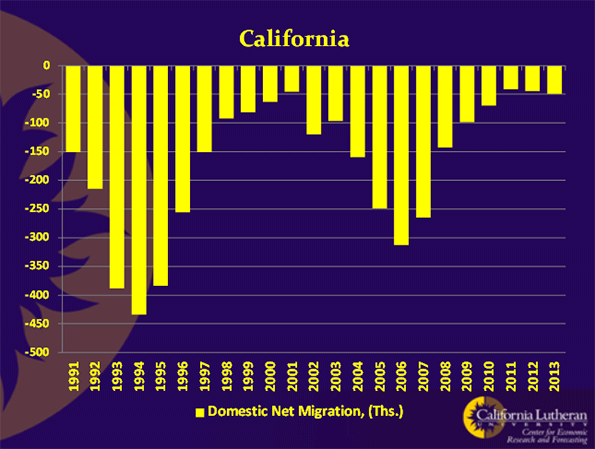
    This is really curious.  A whopping 57 percent more people moved from California to Texas than moved from Texas to California, which was the case for decades.  This is an argument that people aren’t leaving California?  California’s population is up 1.5 million?  California’s population growth is mostly a result of California’s fertile young people.  Census data show that California’s domestic migration has been negative for over 20 consecutive years.   It may not be The Great Exodus, but it’s a reversal of about a 150 year of migratory trend.

    Then there is poverty and unemployment.  Poverty, unemployment and lack of opportunity are why California’s domestic migration data is negative.  Lack of opportunity may be hard to measure, but we have lots of data on unemployment and poverty.   Some examples:

    • San Bernardino has the second highest poverty rate of any major U.S. metropolitan areas.  Only Detroit is worse.
    • California, with about 12 percent of the U.S. population, has 34 percent of U.S. welfare recipients.
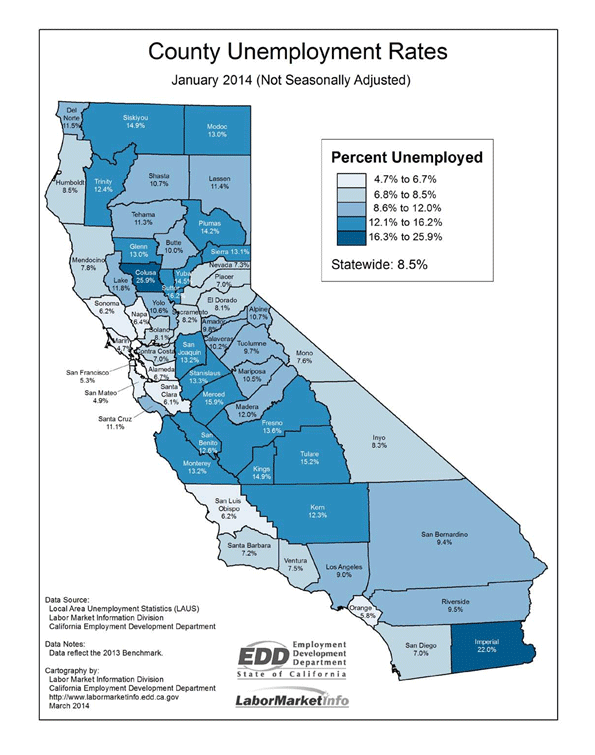
    • Two California counties, the geographically separated Colusa and Imperial, have unemployment rates over 20 percent.
    • Thirty-one of California’s 58 counties have unemployment rates in double digits.

    The geographic distribution of California’s poverty is one reason many people fail to understand California.  Most of California’s poverty is concentrated in regions where the political class —or wayfaring editorialists — seldom venture.  It’s mostly inland, not where most of California’s elite live or travel.  If you stay on the 101 corridor, or hug scenic Route 1, it’s easy to avoid.  You can find it, but you have to have eyes that are open to it, and it helps if you get off the beaten path. 

    Egan wrote his piece in Santa Barbara, where life can be as good as it gets, particularly for the affluent and boomers who bought their homes decades ago.  But, the city of Guadalupe in Santa Barbara County could give him a taste of how the other half lives. Just take a look sometime: it’s about as hardscrabble a town as the Texas town in the movie “The Last Picture Show”.

    California’s poverty is harder to ignore along the 99, but is even more evident in roads like 33 which winds along the eastern side of the coastal range.  Go there, and you will find it hard to believe that you are still in the United States, much less California.  There you will find grinding, hopeless poverty more reminiscent of the Third World than the center of the economic jobs.

    A high speed train won’t help these people.  Neither will Silicon Valley tech jobs, even if they don’t shrink in the inevitable social media shakeout.  Neither will Sacramento, apparently.  Until we start doing something for the state’s huge and struggling working and middle class, and that means creating opportunity for them, we should refrain from congratulating ourselves and each other for our good work.

    Bill Watkins is a professor at California Lutheran University and runs the Center for Economic Research and Forecasting, which can be found at clucerf.org. A slightly different version of this story appeared in CLU Center for Economic Research and Forecasting’s September, 2013 California Economic Forecast.

  • Work Access in the Non-centered San Francisco Bay Area

    The San Francisco Bay Area (San Jose-San Francisco combined statistical area or CSA) has a superior access to work systems, including its important work at home element. The freeway system provides primary access between all points, importantly supplemented by arterial streets, and accounts for nearly 70 percent of all work trips. There are more types of transit than in other metropolitan regions (metro, street car, commuter rail, light rail, ferry, and cable car) and generally with a higher level of service. The Silicon Valley virtually defines information technology and is behind the huge increase in working at home, much of it telecommuting.

    The recently released American Community Survey five-year file provides the opportunity to examine state of employment access in all Bay Area municipalities

    Employment Access by Car

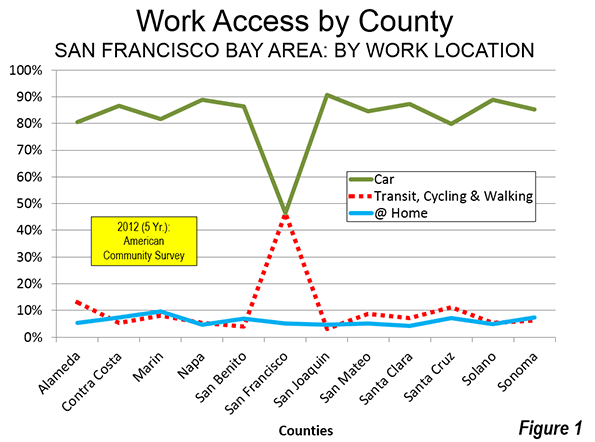
    Like every major metropolitan area in the United States, more people use cars or light trucks (for simplicity called "cars" in this article) to get to work than any other mode of transport. In the Bay Area, 68 percent of commuting is by car. Cars provide the overwhelming majority of work access to jobs in 11 of the Bay Area’s 12 counties. This ranges from 80 percent in Alameda County (secondary core municipality Oakland is the county seat) to 91 percent in San Joaquin County, which was recently added to the San Jose-San Francisco CSA (Figure 1). In the 12th county, San Francisco, cars provide work access for nearly equal to that of transit, walking and cycling combined (both approximately 46 percent).

    Employment Access from Home

    Working at home continues to grow and, to an even greater extent than car travel, is relatively evenly distributed throughout the 12 Bay Area counties. The highest percentage is in Marin County, at 9.6 percent. The combination of a technology friendly regional environment and horrific traffic on the primary commuting routes to most of the Bay Area (US-101 and the Golden Gate Bridge) probably drive this figure higher. Contra Costa County and Santa Cruz County also have a high work at home shares, at 7.3 percent and 7.1 percent respectively. This is than 50 percent above the national rate.

    Most surprisingly, however, the lowest work at home share in the Bay Area is in Santa Clara County, the very heart of Silicon Valley. This is slightly less than the national average. Another surprise is counties on the periphery of the Bay Area also have small work at home shares. Sonoma, Napa and San Joaquin counties have work at home shares of under 5.0 percent.

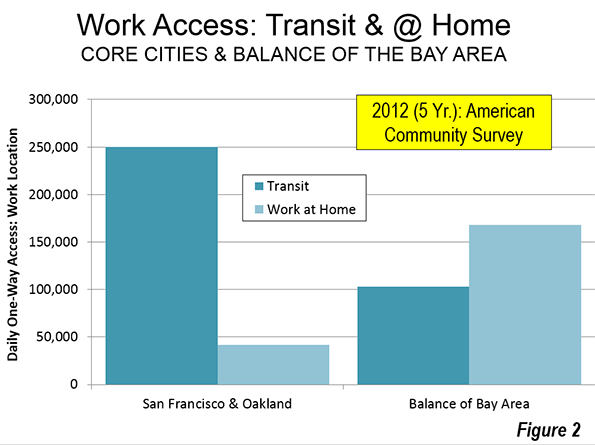
    Outside the core cities of San Francisco and Oakland, more than 1.5 times as many employees work at home (including telecommuting) than access work by transit (Figure 2).

    Employment Access by Transit

    The Bay Area remains monocentric only in aerial photographs and transit market share. San Francisco is served by one of the nation’s busiest metro (subway or underground) systems in the nation, Bay Area Rapid Transit (BART), which carries over 400,000 one-way rides daily. BART was the first of the major post-World War II rapid transit systems in the United States and was followed by other fully grade separated Metro systems in Washington and Atlanta and individual lines in Los Angeles.

    As we indicated in Transit Legacy Cities, most of the transit commuting (55 percent) in the United States is to just six core municipalities, New York, Chicago, Philadelphia, Boston, Washington, and San Francisco. Approximately 60 percent of commuting to those cities is to the downtown areas, which are also the largest in the United States. Yet these legacy cities, with a majority of the nation’s transit commuting, account for only six percent of the nation’s employment.

    Nearly two-thirds of Bay Area transit commuters work in the city of San Francisco and that figure rises to more than 70 percent, including the city of Oakland, with its strong downtown. Yet, these two core cities have only 21 percent of employment in the Bay Area. The downtowns of both core cities are well served by transit, including BART and radial surface transit systems. Buses serve downtown Oakland, while buses, trolley buses (electric buses), street cars and cable cars are focused on downtown San Francisco.

    The Non-Centered Metropolis

    Even with a regional Metro system, the Bay Area has developed in a strongly dispersed and polycentric form. Polycentricity is represented by edge cities (suburban office centers) such as Walnut Creek (with a BART station), the San Francisco Airport office area (not generally walkable from any rapid transit) and in the Silicon Valley (San Mateo and Santa Clara counties). Even more, however, employment is dispersed well beyond even these nodes.  Authors Robert Lang and Jennifer LeFurg have called this phenomenon "edgeless cities," though their other term, the "non-centered metropolis," says it better.

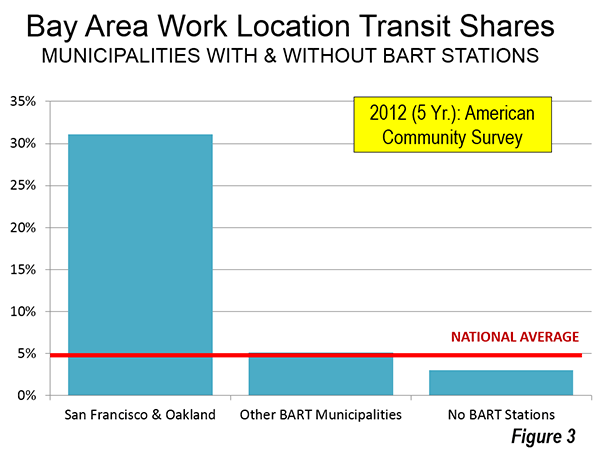
    Outside the San Francisco-Oakland core, the commuting pattern in the Bay Area is little different than in the rest of the nation (as is also the case in New York, outside the urban core). Nearly 80 percent of the Bay Area’s jobs are outside the cities of San Francisco and Oakland, however only 4.0 percent of commuters use transit to jobs located outside these cores. Among municipalities other than San Francisco and Oakland with BART stations, work access by transit is 5.1 percent, only slightly higher than the national average (which includes all urban and rural areas). Commuting by transit is even lower (3.0 percent) to jobs in outside municipalities with BART stations (Figure 3).

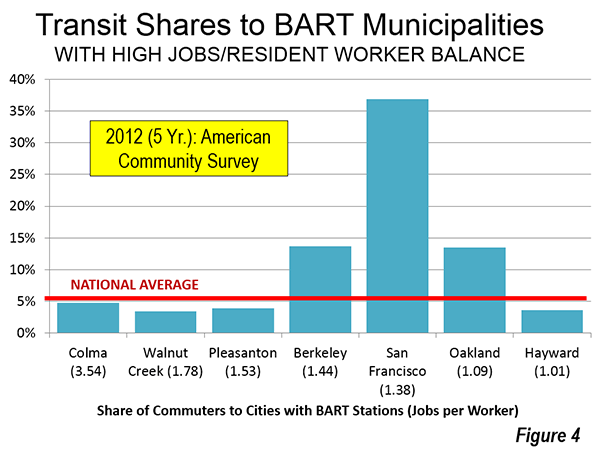
    Among the municipalities with BART stations and favorable "jobs-housing balances," only San Francisco, Oakland and Berkeley (home of the University of California) attract more transit commuters than the national average. Walnut Creek illustrates the problem of regional transit commuting to suburban locations. Walnut Creek has a strong suburban office center and a stronger jobs-housing balance than all BART municipalities but much smaller Colma. Yet, only 3.5 percent of commuters who work in Walnut Creek used transit to get to work (Figure 4).

    Overall, outside the core cities of San Francisco and Oakland, approximately 20 times as many people commute to jobs by car as by transit.

    The Illusion of Monocentricity

    With transit’s failure to carry large numbers of workers to jobs throughout the Bay Area (not just to the two older core municipalities), planners have switched strategies. Now the focus is on urban villages (transit oriented development), by which people and jobs will be located close together, reducing the need for long automobile commutes. The adopted regional plan, "Plan Bay Area" imagines people living in transit oriented developments and walking, cycling or using transit to get to employment. However, former principal planner of the World Bank Alain Bertaud says that this "urban village model exists only in the mind of urban planners" and worse, that "it contradicts the economic justification of large cities:  the efficiency of large labor markets." (see: Urban Planning 101) That means a lower standard of living and more poverty.

    The reality for the Bay Area and for metropolitan areas around the world is that transit is structurally incapable of replacing the automobile for the bulk of the workforce. The fundamental problem is that no transit system can attract drivers to jobs by offering travel times competitive with the automobile (Note). Transit can compete to some downtowns, but downtowns have only a small minority of employment. Outside of those, trip patterns are simply too dispersed for transit to serve as well as cars. Monocentric cities, to duplicate Bertaud’s logic, exist "only in the mind of urban planners."

    Wendell Cox is principal of Demographia, an international public policy and demographics firm. He is co-author of the "Demographia International Housing Affordability Survey" and author of "Demographia World Urban Areas" and "War on the Dream: How Anti-Sprawl Policy Threatens the Quality of Life." He was appointed to three terms on the Los Angeles County Transportation Commission, where he served with the leading city and county leadership as the only non-elected member. He was appointed to the Amtrak Reform Council to fill the unexpired term of Governor Christine Todd Whitman and has served as a visiting professor at the Conservatoire National des Arts et Metiers, a national university in Paris.

    ————–

    Note: In 2003, I issued a challenge to identify an existing or proposed transit system design that would achieve automobile competitiveness throughout a metropolitan area of more than 1,000,000 in Western Europe or the United States (see: Smart Growth Challenge: Transportation Choice for All, Not Just a Few [Automobile Competitiveness]). No complete responses were received. This is not surprising. In 2007, Professor Jean-Claude Ziv and I authored a paper for the 11th World Conference on Transport Research (2007 WCTRS) that estimated such a system could cost as much as the total gross domestic product of any such metropolitan area each year).

    Photo: Bart A car Oakland Coliseum Station

  • The U.S. Cities Profiting The Most In The Stock Market And Housing Boom

    If anything positive can be said for the current tepid economic recovery, it has been very good to those who invest in the stock market or own real estate.

    Property owners have been able to reap higher rents and sale prices, and the stock market has soared while the overall economy has registered only modest gains. However, only a precious few have benefited from the bull market on Wall Street. According to Pew Research, only 47% of American households own some stock, down from nearly two-thirds in 2007.

    And of those who do own equities, the upper crust control the lion’s share. As of 2010, the wealthiest 20% of U.S. households held 91.7% of all U.S. stock; the top 5%, a shade over two-thirds; and the top 1% controlled 35%.

    While incomes for the middle and working class have stagnated in the recovery, the booming stock market helped swell the income of the top 1% by 31.4% through 2012. Overall, the rich now account for 50% of the country’s wealth, more than at any time since 1917, when the income tax was introduced, and well above the level in 1928, at the end of the Roaring Twenties stock boom.

    Just as the current asset-driven recovery has had disparate impacts depending on social class, it has affected different regions in divergent ways. To gauge which areas have benefited the most from asset inflation, Mark Schill, head of research at Praxis Strategy Group, looked at the percentage of income derived from rents, dividends and interest in the nation’s 52 largest metropolitan areas and 100 most populous counties.

    The Codger Economy

    The top of our list is dominated by areas where retirees and aging boomers, particularly the more affluent, are concentrated. Some 57% of Americans aged 50 to 64 own stock, according to Pew, twice as high a percentage as those under 30. People over 55 control well over half the nation’s wealth.

    Also as they reach retirement, seniors are less likely to be earning income from wage and salary work, further driving up the share of income from rents, interest and dividends in retirement hot spots. The most well-to-do retirees are the most likely to become migratory snow birds, clustering in the nation’s warmest climes.

    This includes the top five metro areas on our list, led by the Miami-Fort Lauderdale-West Palm Beach Metropolitan Statistical Area, where roughly 26.5% percent of income was earned this way in 2012, compared to a national average of 18.2%.

    It’s followed by Tampa-St. Petersburg-Clearwater, Fla., and San Diego-Carlsbad, Calif.

    These trends are even more evident when we look at the nation’s 100 largest counties. The top of the list is dominated by wealthy retirement counties, led by Palm Beach, Fla., where a remarkable 39.8% of income comes from stocks, rents and interest payments. It’s followed by two other affluent Florida counties: Lee (39.6%), whose largest city is Cape Coral, and Pinellas (29.1%), which is the home county for both St. Petersburg and Clearwater. Other retirement counties at the top of the list include No. 7 Broward (Ft. Lauderdale) and Pima, Ariz., which contains the city of Tucson.

    Superstar Cities

    The surge of profits for investors also boosts incomes in some of the metro areas whose economies have done the best overall in the asset-driven recovery. This is most marked in the San Francisco Bay area, which added more billionaires  last year than anyplace else in the country.

    San Francisco-Oakland-Hayward ranks sixth on our metro area list, with 20.7% of residents’ income coming from rents, dividends and interest, and San Jose-Sunnyvale-Santa Clara comes in seventh (19.3%). This places them well ahead of traditional centers for plutocrats, such as Boston-Cambridge-Newton (16th) and, remarkably, the home of Wall Street, the primary beneficiary of asset inflation, New York-Newark-Jersey City (23rd).

    Our counties list offers a more precise map of where asset-driven wealth is, showing that much of it is concentrated in the suburban reaches. Although much of the hype about new billionaires revolves around San Francisco, the real star in the Bay Area is somewhat more prosaic San Mateo County (fifth on our county list), home to tech giants such as Genentech and Oracle , and seven of the 10 largest venture capital firms in the Bay Area. In contrast, San Francisco County ranks 36th.

    This diversion in the patterns of where investors and rentiers congregate can also be seen in the sprawling metropolitan area that contains the nation’s financial capital, the 19 million-person New York region. Greater Gotham is home to a remarkable four of the top 15 counties on our list, starting with No. 4 Fairfield County, Conn., a major center for the hedge fund and private equity industries, followed by two affluent suburban counties, Westchester (ninth) and Nassau (13th).

    Among the five boroughs only one, No. 14 Manhattan (New York County) ranks in the upper echelon, while three outer boroughs — Queens, Brooklyn (Kings County) and the Bronx — are in the bottom 15 of the 100 largest counties. The heavily minority and poor Bronx ranks last.

    Strongest Economies At The Bottom

    Not surprisingly, many of the metropolitan areas at the bottom of our ranking are older Rust Belt towns, such as Cleveland-Elyria (44th) and Detroit (46th). These are places where poverty is more concentrated and much of the money has moved away, often to Sun Belt locales such as Florida.

    However, the bottom of our list also features many of the nation’s most dynamic economies, including Raleigh, N.C. (43rd); Dallas-Ft. Worth-Arlington, (45th); Charlotte-Concord-Gastonia, N.C. (47th); Columbus, Ohio, (49th); and third to last and second to last among the 52 biggest metro areas, Houston-The Woodlands-Sugar Land, Texas, and Nashville-Davidson–Murfreesboro-Franklin, Tenn.

    This appears to be largely a function of age. All these fast-growing areas are also thosemost attractive to young families  with children. These people are drawn primarily by the good prospects for wage employment — needed to support their families and buy houses — and are less likely to depend on rentier profits. Clipping bond coupons may play a big role in some economies, largely on the East and West Coasts, and notably Florida, but far less in those areas that are growing the old-fashioned way, by working for a paycheck.

    Income from Interest, Dividends, and Rent
    52 Largest U.S. Metropolitan Areas
    Rank Area Population 2012 Share of Income from interest, dividends, & rent
    United States (Metropolitan Portion) 267,664,440 18.2%
    1 Miami-Fort Lauderdale-West Palm Beach, FL 5,762,717 26.5%
    2 Tampa-St. Petersburg-Clearwater, FL 2,842,878 24.6%
    3 San Diego-Carlsbad, CA 3,177,063 21.9%
    4 Jacksonville, FL 1,377,850 21.5%
    5 Virginia Beach-Norfolk-Newport News, VA-NC 1,699,925 21.3%
    6 San Francisco-Oakland-Hayward, CA 4,455,560 20.7%
    7 San Jose-Sunnyvale-Santa Clara, CA 1,894,388 19.3%
    8 Richmond, VA 1,231,980 19.2%
    9 San Antonio-New Braunfels, TX 2,234,003 19.0%
    10 Las Vegas-Henderson-Paradise, NV 2,000,759 19.0%
    11 Los Angeles-Long Beach-Anaheim, CA 13,052,921 18.8%
    12 St. Louis, MO-IL 2,795,794 18.6%
    13 Sacramento–Roseville–Arden-Arcade, CA 2,196,482 18.6%
    14 Washington-Arlington-Alexandria, DC-VA-MD-WV 5,860,342 18.5%
    15 Orlando-Kissimmee-Sanford, FL 2,223,674 18.5%
    16 Boston-Cambridge-Newton, MA-NH 4,640,802 18.5%
    17 Hartford-West Hartford-East Hartford, CT 1,214,400 18.4%
    18 Austin-Round Rock, TX 1,834,303 18.4%
    19 Seattle-Tacoma-Bellevue, WA 3,552,157 18.2%
    20 Rochester, NY 1,082,284 18.1%
    21 Denver-Aurora-Lakewood, CO 2,645,209 18.1%
    22 Portland-Vancouver-Hillsboro, OR-WA 2,289,800 18.1%
    23 New York-Newark-Jersey City, NY-NJ-PA 19,831,858 17.9%
    24 Baltimore-Columbia-Towson, MD 2,753,149 17.9%
    25 Chicago-Naperville-Elgin, IL-IN-WI 9,522,434 17.4%
    26 New Orleans-Metairie, LA 1,227,096 17.4%
    27 Milwaukee-Waukesha-West Allis, WI 1,566,981 17.3%
    28 Salt Lake City, UT 1,123,712 17.1%
    29 Buffalo-Cheektowaga-Niagara Falls, NY 1,134,210 17.0%
    30 Minneapolis-St. Paul-Bloomington, MN-WI 3,422,264 16.7%
    31 Providence-Warwick, RI-MA 1,601,374 16.7%
    32 Oklahoma City, OK 1,296,565 16.6%
    33 Kansas City, MO-KS 2,038,724 16.6%
    34 Phoenix-Mesa-Scottsdale, AZ 4,329,534 16.4%
    35 Philadelphia-Camden-Wilmington, PA-NJ-DE-MD 6,018,800 16.2%
    36 Riverside-San Bernardino-Ontario, CA 4,350,096 16.2%
    37 Atlanta-Sandy Springs-Roswell, GA 5,457,831 16.2%
    38 Birmingham-Hoover, AL 1,136,650 16.2%
    39 Grand Rapids-Wyoming, MI 1,005,648 16.0%
    40 Cincinnati, OH-KY-IN 2,128,603 15.9%
    41 Pittsburgh, PA 2,360,733 15.8%
    42 Louisville/Jefferson County, KY-IN 1,251,351 15.7%
    43 Raleigh, NC 1,188,564 15.7%
    44 Cleveland-Elyria, OH 2,063,535 15.4%
    45 Dallas-Fort Worth-Arlington, TX 6,700,991 15.2%
    46 Detroit-Warren-Dearborn, MI 4,292,060 14.8%
    47 Charlotte-Concord-Gastonia, NC-SC 2,296,569 14.4%
    48 Indianapolis-Carmel-Anderson, IN 1,928,982 14.3%
    49 Columbus, OH 1,944,002 13.3%
    50 Houston-The Woodlands-Sugar Land, TX 6,177,035 13.3%
    51 Nashville-Davidson–Murfreesboro–Franklin, TN 1,726,693 12.8%
    52 Memphis, TN-MS-AR 1,341,690 12.7%
    Source: Bureau of Economic Analysis
    Analysis by Mark Schill, Praxis Strategy Group
    Income from Interest, Dividends, and Rent
    Top & Bottom 25 Among the 100 Largest U.S. Counties
    Rank County Population 2012 Share of Income from interest, dividends, & rent
    1 Palm Beach, FL 1,356,545 39.8%
    2 Lee, FL 645,293 39.6%
    3 Pinellas, FL 921,319 29.1%
    4 Fairfield, CT 933,835 25.4%
    5 San Mateo, CA 739,311 24.4%
    6 Lake, IL 702,120 23.8%
    7 Broward, FL 1,815,137 23.0%
    8 St. Louis, MO 1,000,438 22.8%
    9 Westchester, NY 961,670 22.5%
    10 Pima, AZ 992,394 22.0%
    11 Hillsborough, FL 1,277,746 21.9%
    12 San Diego, CA 3,177,063 21.9%
    13 Nassau, NY 1,349,233 21.7%
    14 New York, NY 1,619,090 21.7%
    15 Honolulu, HI 976,372 21.4%
    16 El Paso, CO 644,964 21.3%
    17 Montgomery, MD 1,004,709 20.9%
    18 Norfolk, MA 681,845 20.5%
    19 Ventura, CA 835,981 20.3%
    20 Travis, TX 1,095,584 20.2%
    21 Bergen, NJ 918,888 20.2%
    22 Middlesex, MA 1,537,215 20.1%
    23 Fairfax, Fairfax City + Falls Church, VA 1,155,292 20.0%
    24 Orange, CA 3,090,132 19.7%
    25 Baltimore, MD 817,455 19.7%
    76 Snohomish, WA 733,036 14.8%
    77 Mecklenburg, NC 969,031 14.8%
    78 Worcester, MA 806,163 14.7%
    79 Suffolk, MA 744,426 14.6%
    80 Collin, TX 834,642 14.5%
    81 San Bernardino, CA 2,081,313 14.5%
    82 Gwinnett, GA 842,046 14.4%
    83 Marion, IN 918,977 14.2%
    84 Jackson, MO 677,377 14.2%
    85 Kern, CA 856,158 14.1%
    86 Queens, NY 2,272,771 14.0%
    87 Tarrant, TX 1,880,153 14.0%
    88 Franklin, OH 1,195,537 13.9%
    89 Wayne, MI 1,792,365 13.8%
    90 Macomb, MI 847,383 13.7%
    91 Shelby, TN 940,764 13.6%
    92 Harris, TX 4,253,700 13.2%
    93 Denton, TX 707,304 13.2%
    94 Davidson, TN 648,295 12.8%
    95 Kings, NY 2,565,635 12.8%
    96 Will, IL 682,518 12.8%
    97 Hudson, NJ 652,302 12.7%
    98 Philadelphia, PA 1,547,607 12.5%
    99 Hidalgo, TX 806,552 11.1%
    100 Bronx, NY 1,408,473 11.1%
    Source: Bureau of Economic Analysis
    Analysis by Mark Schill, Praxis Strategy Group


    This story originally appeared at Forbes.com.

    Joel Kotkin is executive editor of NewGeography.com and Distinguished Presidential Fellow in Urban Futures at Chapman University, and a member of the editorial board of the Orange County Register. He is author of The City: A Global History and The Next Hundred Million: America in 2050. His most recent study, The Rise of Postfamilialism, has been widely discussed and distributed internationally. He lives in Los Angeles, CA.
    Miami photo by Wiki Commons user Comayagua.

  • Deutschland on the Pacific?

    California and Germany may not immediately come to mind as a doppelganger, but they do share several characteristics, particularly when it comes to their attitudes toward energy production and consumption.

    Both “States” have large populations which seem to agree that the world will be a better place if renewable sources of energy are given precedence over hydrocarbon based options in powering their economies.

    For both, this translates into an emphasis on preferentially using wind and photovoltaic sources. Initiatives include 1) the use of state and federal financial support for building and operating renewable generation and 2) preferential access to the grid for exporting the net power produced.

    On the “regulation” side the two “States” differ substantially.     

    California is relatively tough on coal based generation – long a major source of power to Los Angeles through Utah – while encouraging additional load following natural gas powered generation. Despite the shutdown of the nuclear plant at San Onofre, California is also viewed as being relatively tolerant of nuclear generation which does provide copious quantities of “base load” electric power without measurable amounts of air pollution. Of course California also likes hydropower when – during wet years – they can get it.

    Germany also likes wind, solar and hydro generation, but nuclear power units? Not so much. The draconian nuclear shutdown is a reaction Japan’s Fukushima disaster. However, the unrelated shutdown of natural gas plants in favor of coal based generation is a big surprise. By comparison, Japan, which really has a nuclear generation problem, is running their gas plants hard while trying to restart at least some of their existing nuclear units.

    The German natural gas plant cutbacks stem from the relatively high price of Russian sourced natural gas under long term contract. Such gas is simply unaffordable given the mandated subsidies charged to utilities. Ironically, Germany’s political and regulatory priorities have had the unintended consequence of encouraging the use of older coal based generation. Germany does have access to affordable coal as well as to existing power infrastructure that can use it. Due to the lack of politically viable alternatives, Germany is relying on their least attractive option.

    Power supply and demand is not created equal

    Residential power consumption varies significantly over the typical 24 hour day as people wake up, take showers, eat breakfast, go to work, return home, watch TV or play with their computers, and then go to bed. This is overlaid by seasonal needs for electrically powered air conditioning or heating units as well as by demand from industrial consumers. Output needs to vary directly with consumption.

    They do this by dispatching power from two different classes of equipment, “base load” and “load following”. (Think fixed and variable output). The time of daily peaks and troughs vary for each utility, but peaks generally occur in the late afternoon with troughs are observed in the late evening or early morning hours. The difference between the peak and trough can vary by a factor of three. Because electric power can’t be stored, utilities need the capability to follow the demand load by using generators capable of changing output quickly, hence “load following generation”. Gas turbines and hydropower are both good examples of load following generators. The other category “base load” is typically provided by nuclear and coal fired units. These power plants run 24/7 and cannot alter their output in the short term. They are capital intensive but can produce power at relatively low unit costs as long as they maintain full output. Because of pollution issues, coal powered generation is least welcome in California.

    Industrial power clients tend to be major consumers of base load power as their manufacturing plants run “24/7” and their need for variable power is much lower than that of the residential sector. Adding together industrial, residential, and commercial minimum demand defines the capacity need for base load generation. Adding together the maximum needs for all categories of load following capacity provides the utility’s total capacity requirement. The difference between the maximum and the minimum defines the need for load following capacity.

    California Dreaming

    There is at least one other category of power generation. We call it “intermittent”. By that, we mean a power source whose output cannot be predicted, such as wind and solar. Adding socially desirable, but intermittent, renewable power generation to a utility’s supply mix requires that the utility also acquire more predictable supplies, as the utility now needs to react to uncertainty of supply as well as to uncertainty of demand. As a state, California has been able to add new renewable sources, albeit with the result of higher residential rates.

    Germany has also added significant amounts of intermittent power to the supply mix, with wind turbines in the North and solar panels in the South. However, the economic impact of these additions has been much more severe for residential rate payers. Germany’s “Energiewende” policy has resulted in multiyear, double digit increases in power prices as the residential sector as well as the “non-energy intensive” industrial sector bear the cost of the experiment.

    Because Germany is, uber alles an export led economy, with exports representing 24% of GDP, the planners of the renewables initiative initially exempted large, energy intensive industry from paying the higher rates. Logically enough, they concluded that high power prices would compromise Germany’s ability to compete internationally. More recently, a new coalition government has proposed that, in the interest of “political peace in the family”, these previously exempt energy intensive industrial consumers must now bear part of the high costs of the energy transition. The industrial reaction has been to vote with their feet. BASF announced a multiyear investment program that assume the majority of new capital spending will occur outside of Germany, indeed outside of Europe.

    Physician, Heal Thyself

    Some economists have argued that Germany should simply purchase additional load following power from better-endowed neighbors. In fact, to some extent, that has occurred with Germany purchasing spot power from France and other neighboring countries. However, Germany’s attempts to sell surplus renewable power back to these same neighbors has been less than successful. This is because intermittent renewables are only available when the wind blows or when sunlight is available, not when the neighbors actually need the power. Germany’s neighbors, who have not yet bought in entirely to the new religion, do not have the ability to rapidly reduce their own domestic production in order to accommodate unpredictable foreign (German) surpluses. As a result, the Germans are exporting grid instability to their neighbors.

    With no other options, German utilities have resorted to using coal in order to create power to compensate for the variability in renewable output. American hands are not exactly “clean” as we have become a major supplier of steam coal to Germany, coal we no longer need to burn in US based power plants.

    Bipolar personalities and orphan power

    “Energiewende”, a national policy intended to accelerate the use of renewables and to reduce both CO2 emissions and particulate air pollution, has instead produced the unintended consequence of multiyear increases in pollution levels. It has caused higher prices to be paid for power in order to accomplish this dubious result. At the same time the policy has irritated Germany’s partners on the European Grid by producing intermittent power when it isn’t needed. I have to believe that Germany’s engineering class foretold this result…Too bad the politicians weren’t listening.

    Power to the People

    Back in California, the state government has been figuratively wringing its hands over the potential for the development of shale gas. Californians like to use natural gas, most of it imported from other western states and Canada. Ordinarily they would love to have a new local source of supply. However, the problem for California is that much of the state is dry during the best of times and, from a water standpoint, this is not the best of times.

    Low snow and rain levels are producing a “double whammy” for the state’s economy. While the legislature passed laws that legalize fracking, the implementation of enabling regulations has run afoul of the incremental need for water, either surface or subterranean, to support the fracking process. In a state renowned for its water wars between urban and rural interests, a new incremental need for water, even with the benefit of additional gas supply, is not good news.  

    For Germany, the solution is a bit more intractable. The energy intensive manufacturers in Germany   are now being threatened by a political compromise that has them also paying for the higher costs of renewable penetration of the German power market. The government has now recognized that the residential polity can no longer bare the “unsustainable” higher costs of Energiewende without help from heavy industry.

    The result is that their export oriented manufacturing economy is about to export itself to areas with a more welcoming attitude to affordable and sustainable energy supply.  Here on the US Gulf Coast the response is “Y’all come on down!”

    German companies as diverse as BASF and Volkswagen have announced new and expanded production facilities along the US Gulf Coast (also known as “The American Ruhr”). As long as German political authorities continue to pander to their fantasies, they will have no choice. Of course we will continue to ship them all the coal they can buy. The Germans have a word for political fantasy that grounds on economic reality. They call it “Realpolitik”.

    Eric Smith is a Professor of Practice at the A.B. Freeman School of Business at Tulane University. He serves as the Associate Director of the Tulane Energy Institute. He is a Chemical Engineer and has an MBA from the A. B. Freeman School at Tulane University. 

    Renewable energy photo from BigStockPhoto.com

  • Portland Light Rail Revolt Continues

    In a hard fought election campaign, voters in the city of Tigard appear to have narrowly enacted another barrier to light rail expansion in suburban Portland. The Washington County Elections Division reported that with 100 percent of precincts counted, Charter Amendment 34-210 had obtained 51 percent of the vote, compared to 49 percent opposed.

    The Charter Amendment establishes as city policy that no transit high capacity corridor can be developed within the city without first having been approved by a vote of the people. High capacity transit in Portland has virtually always meant light rail.

    In a previous ballot issue, Tigard voters had enacted an ordinance requiring voter approval of any city funding for light rail. Similar measures were enacted in Clackamas County as well as King City in Washington County. Across the Columbia River in Clark County (county seat: Vancouver), voters rejected funding for connecting to the Portland light rail system. After the Clackamas County Commission rushed through a $20 million loan for light rail (just days before the anti-light rail vote), two county commissioners were defeated by candidates opposed to light rail, with a commission majority now in opposition.

    Further, a Columbia River Crossing, which would have included light rail to Vancouver was cancelled after the Washington legislature declined funding. In a surreal aftermath, interests in Oregon seriously proposed virtually forcing the bridge on Washington, fully funding the project itself. A just adjourned session of the Oregon legislature failed to act on the proposal, which now (like Rasputin) appears to be dead.

    At the same time, Portland’s transit agency faces financial difficulty and has been seriously criticized in a report by Secretary of State. The agency has more than $1 billion in unfunded liabilities and carries a smaller share of commuters than before the first of its six light rail and commuter rail lines was opened. Moreover, the latest American Community Survey data indicates that 3,000 more people work at home than ride transit (including light rail and commuter rail) to work in the Portland metropolitan area. Before light rail (1980), transit commuters numbered 35,000 more than people working at home. Over the period, transit’s market share has dropped one-quarter.