Blog

  • What’s the Matter With Kansas – and Connecticut?

    In 2012, the state of Kansas under Gov. Sam Brownback passed a large tax cut. Despite this massive fiscal stimulus, the state’s economy actually underperformed the nation during much of the subsequent period and the cuts blew a gigantic $900 million hole in the state’s budget.

    Finally the legislature cried uncle. It passed a $1.2 billion tax hike. Brownback vetoed it but the Republican dominated legislature overrode the veto.

    Not only did the tax cuts fail to grow the economy, one of the state’s major metro regions, Kansas City, received a gigantic free broadband investment in the form of Google Fiber. Spanning Kansas and Missouri, this investment also failed to produce significant tech growth.

    Meanwhile in Connecticut, the state twice raised taxes to address a budget deficit. Unfortunately, these tax hikes did not create long term revenue growth. What’s more, after the most recent rounds of tax hikes, the state experienced a corporate exodus highlighted by GE and Aetna. The state capital of Hartford is also flirting with bankruptcy. Gov. Dannel Malley now admits the state is tapped out on tax increases.

    There are a lot of claims one can make out of these situations. I’m only going to point out that both Kansas and Connecticut are out of favor in the marketplace right now. For example, while the suburban office park may not be extinct, it’s certainly facing challenges in high tax settings like New Jersey and Connecticut. Companies like GE are in fact increasingly looking to global city centers for their highest level executives. Connecticut doesn’t have that product on offer and can’t create it. Regarding Kansas, it was likely a low tax state even before the cuts, which did not materially improve its competitive position or instrinsic attractiveness.

    It’s simply very difficult to counter these macro forces. When cities were out of favor, even NYC was en route to oblivion. Trying to push on a string often only creates as many problems as solutions.

  • Las Vegas Lessons, Part II

    A couple weeks ago I wrote some thoughts after a recent visit to Las Vegas. Most of what I wrote about concerned the Strip and downtown areas of the city, without question the two most recognizable and most frequently visited parts of the region. But in a rapidly growing region of nearly 2.2 million people (the Las Vegas Valley held only 273,000 residents in 1970, meaning it has increased its population by 8 times since then), clearly there’s much more to the region than its most iconic and visible parts. Here I’ll offer some thoughts on the broader region, its built environment, its economy, and thoughts on its future.

    First, for those tl;dr readers who won’t click through to read Part I, here’s a quick summary of it:

    • The Strip and Las Vegas are two entirely different entities.
    • Strip is a great pedestrian experience.
    • The Strip is an exclusively private space.
    • Downtown Las Vegas is quite different from the Strip.
    • There are poor linkages between Downtown Las Vegas and the Strip.
    • The north end of the Strip is plagued with high-profile failed projects.

    Again, as someone who’s “part urbanist, part sociologist, and part economist,” I offer some observations and thoughts on the rest of the city and region.

    The balance of the city and region consists of unremarkable suburbia. This is probably evident to anyone who puts any amount of thought into it, but it does bear repeating. Step away from the Strip and downtown, and Las Vegas’s built environment is amazingly consistent: according to the U.S. Census Bureau American Community Survey in 2015, the metro area is about 60% single family detached homes, with about 4,000-6,000 people per square mile throughout. There’s no sudden or even slight gradation in density as one commonly finds in many eastern cities; the city quickly establishes its suburban character and spits it out relentlessly. And, I’ve been struck on this visit and previous ones at how similar Vegas looks to suburbia in other places. Yes, there are newer, upscale areas that stand out (Summerlin comes to mind), but if you replace Vegas’s palm trees with oaks and elms, it looks a lot like suburbia anywhere else in America, except with Spanish tile roofs. Similarly…

    Nothing in the region is old; the region will have to learn the art and skills of redevelopment. Fifteen years ago when I did some consulting work in Las Vegas, I thought it was weird when city officials referred to West Las Vegas, just northwest of downtown, as “historic”. Most of the homes and businesses there were built in the ’50s and through the ’70s, and in my mind they were the kind of structures that were just beginning to establish some character. But when the median year of structure built in the region is 1995 (the same for Chicago’s metro is 1967), you simply won’t find the pre-WWII type of development that is called historic in other places. There will come a time when the structures of the Las Vegas Valley will be viewed as obsolete and inconsistent with modern living (whatever that is), and the region will have to undergo one of the more difficult transitions for municipalities — shifting from easy greenfield development to complex redevelopment.

    Low wage and low skill jobs proliferate in the region. Like the unremarkable nature of the suburban pattern, here’s another conventional observation that bears repeating. As one would expect, the accommodations/food services employment sector dominates in Las Vegas — nearly one-third of all Las Vegas workers work in hospitality. Those have traditionally been low-paying jobs, and that’s true of the region today. Overall, 44% of Vegas workers earn less than $40,000 a year. Contrast that with Austin, a similarly-sized and similarly-fast-growth metro, where only 9% of workers are employed in accommodations/food services, and just 34% of workers earn less than $40,000 a year (and consider that Austin is a college town that has many recent grads, possibly pushing incomes downward). My concern for Vegas in this regard is that there is growing research that suggests that the kind of work automation that decimated much of the Rust Belt’s manufacturing jobs may now enter a phase that targets food services, administration and office support, sales and even retail jobs — precisely the kinds of jobs that many new Las Vegas residents moved there to occupy. Las Vegas workers could be quite vulnerable to the kinds of challenges that reshaped the Rust Belt.

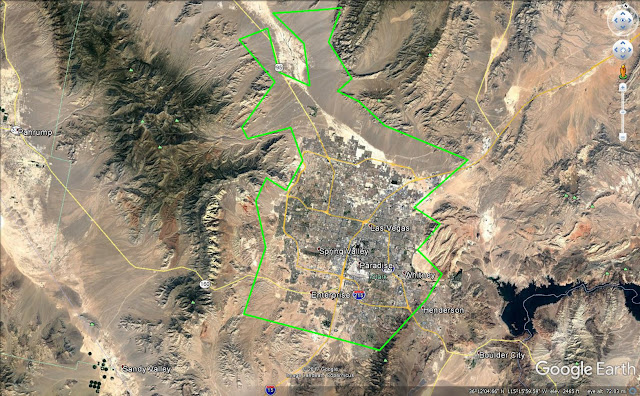
    The Las Vegas Valley is nearing its physical limits. According to Wikipedia, the Las Vegas Valley is a 600 sq. mi. basin surrounded on all sides by mountains. I don’t know the precise delineations between flat and inclined topography, but a look at Google Earth tells me the region is near its limit:

    I could be wrong, but it looks as if Vegas has available land to the north and southwest, and the Valley might be approaching 90% developed. It could be that the region hits the wall (literally) within the next 10 years. What will that mean for a region that is as low-density suburban as this one? Will the Valley’s communities have the ability to shift their focus inward? Time will tell.

    What happens to the region if tourism… changes? Wikipedia’s Atlantic City page has a good explanation for the decline of tourism there after World War II. It connects its decline with the car; prior to the war, people generally traveled to Atlantic City by train and stayed for a week or two. Cars made people more mobile and they made shorter visits. Suburbanization and its creature comforts, like backyards and air conditioning, also took visitors away from AC. The final nail in the coffin was affordable jet service, opening up vacation spots like Miami, Havana, and the Bahamas (and Vegas) in the 50’s and onward. I don’t know what challenge is out there for Vegas now, but what will be crucial to the region’s survival is how it responds.

    What impact will climate change have on a desert resort city? When flying into Las Vegas I couldn’t help but notice the low level of Lake Mead, just southeast of the city. It was clear from the air; bleached rock that had once been under water now exposed. Las Vegas is blessed to have one of the largest reservoirs in the nation at its back door, but could continued drought and increased demand for water undermine everything? The Strip’s casinos tout themselves as leaders in water conservation, but whether their efforts will be enough as conditions worsen is an open question.

    Las Vegas is truly a unique place. It’s a place that seems to serve a certain time and space, and is concerned about now more than its future. But I’m sure if the region squints its eyes and looks, it will see the future is getting closer. It will need to figure out how it will be sustainable as that future approaches.

    This piece originally appeared on The Corner Side Yard.

    Pete Saunders is a Detroit native who has worked as a public and private sector urban planner in the Chicago area for more than twenty years.  He is also the author of “The Corner Side Yard,” an urban planning blog that focuses on the redevelopment and revitalization of Rust Belt cities.

    Photo by Stan Shebs [GFDL, CC BY-SA 3.0 or CC BY-SA 2.5], via Wikimedia Commons

  • California’s Global Warming High-Speed Train

    The California High-Speed Rail Authority promises to “achieve net zero greenhouse gas (GHG) emissions in construction” and is committed to operate the system on “100% renewable energy” by contracting for “400 to 600 megawatts of renewable power”. These promises may please environmentalists, but they cannot be kept.

    Construction Emissions

    The Authority has provided only limited information regarding GHG construction emissions. Its 2013 Emissions Report estimated 30,107 metric tons in GHG “direct emissions” for the first 29 miles of construction. “Indirect emissions” associated with the manufacture and transport of materials, primarily concrete, steel, and ballast were not reported because, according to the Authority, precise quantities, sources, and suppliers were not known. A more plausible reason is the their desire to hide from the public more than 90% of GHG emissions associated with their project. Regardless, recent testimony by the Authority’s CEO clearly indicates that indirect emissions can now be tallied.

    Speaking before the Assembly High-Speed Rail Oversight Committee on January 27, 2016, CEO Jeff Morales, spoke at length on how costs were estimated. He described the assemblage of 200,000 individual line items including concrete, steel, dirt, electrical, etc. and said each includes a unit cost which is multiplied by the units required to build the system.

    Total GHG construction emissions would still be unknown today were it not for the work of professors Mikhail V. Chester and Arpad Horvath working in UC Berkeley’s Department of Civil and Environmental Engineering. They studied this issue, published their findings in 2010, and estimated that 9.7 million metric tons of GHG would be emitted during the construction of the statewide system; primarily because of the production of massive amounts of concrete and steel. Using mid-level occupancy for the three competing modes of travel (high-speed train, auto, and airplane) the authors estimated it would take 71 years of train operation to mitigate the project’s construction emissions. California’s Legislative Analyst Office came to a similar conclusion in a 2012 report critical of using GHG reduction funds to pay for Phase 1 (Los Angeles to San Francisco) of the statewide system because “if the high-speed rail system met its ridership targets and renewable electricity commitments, construction and operation of the system would emit more GHG emissions than it would reduce for approximately the first 30 years”. Here, the LAO appears to be citing an updated Chester and Horvath study, published in July 2012, which focused on only Phase 1 of the high-speed rail project, as outlined in the Authority’s Revised 2012 Business Plan. They took into account additional highway infrastructure that could be avoided as well as claims that “a future CAHSR system will likely see improved train performance and an opportunity for increased renewable electricity usage”.

    However, the Authority promised “zero net greenhouse gas emissions in construction”. A reduction in California’s GHG emissions due to the trains’ operations was to help reduce the state’s future GHG emissions, not merely mitigate construction releases. The Authority’s zero construction emissions promise relies heavily on a tree planting program. More than 5 million trees, each more than 50 feet tall, would need to be grown and perpetually maintained to recapture the 9.7 million tons of GHG construction emission. However, one year into construction, the Authority’s CEO admitted that not a single tree had been planted. Worse, as part of their project, the Authority plans to cut down thousands of trees south of San Francisco to electrify Caltrain trackage.

    Emissions from Operation

    Chester and Horvath generously assumed the trains would run on a power mix relatively high in renewable sources. However, high-speed electric trains would replace fossil fueled propelled automobiles and airplanes. When Phase 1 is completed, the trains will place a new demand on the electric grid that must be met immediately by starting up an idle generator capacity. It may be a peaking unit in California powered by natural gas or a coal burning plant in Utah. The exact source is unknowable, but it will not be a wind or solar powered electric plant. These sources will already be generating all the power they can produce when the first trains require additional power.

    The Authority’s business plans are constantly changing as are their assumptions on energy consumption and energy cost. The 2012 Business Plan is cited, a plan that referred to paying 15.2 cents/kWh for electrical energy, inclusive of a 3 cent premium for renewable energy. Energy consumption was established at 63 kWh/mile. Train miles traveled between 2022 and 2030 was projected to be 99 million, resulting in an energy use of 6,300 million kWh. In order to make good on their claim that they will power the trains with 100% renewable energy the Authority needs to fund the construction of the necessary renewable power plants.

    California Valley Solar Ranch, a 250MW facility producing 650 million kWh/year recently built at a cost of a $1.6 billion ($1.2 billion financed at a 3.5% interest rate using a federal loan guarantee coupled with a check from the U.S. Treasury for $430 million), serves as a proxy for the needed capital. The Authority’s trains would consume 1,200 million kWh in 2030 and need the output of 1.85 Solar Ranches; 460MW of capacity costing $3.0 billion. A premium of 42 cent/kWh, fourteen times the Authority’s offer, would be needed to raise the necessary capital by 2030. More than 20% of this capacity, costing half a billion dollars, must be constructed before the first trains run. Otherwise, those trains will be totally powered by fossil fuels, meaning the GHG emissions per passenger mile will be no better than for two passengers traveling in an automobile which meets the federal fuel efficiency standards scheduled to be in place in 2022.

    The issue of global warming needs to be addressed. However, the planting of millions of trees and the spending of billions of dollars on a fossil fuel propelled train is not a practical or cost effective way to address the problem. From the climate point of view, the Authority’s project is detrimental because of its massive construction GHG emissions and because it diverts funds from other actions, such as providing financial incentives for ride-sharing and for the purchase of zero emission or low emission vehicles that could really help address the serious problem of global warming.

    Michael J. Brady has been a litigator and appellate lawyer for 50 years; he has worked on opposing California’s high speed rail for 10 years.

    Mark Powell has been assisting Mike Brady for seven years; he is a retired chemist for Union Oil Co.

    Photo by California High-Speed Rail Authority [Public domain], via Wikimedia Commons

  • Grenfell External Fire Erupts After Flat Fire Extinguished?

    The Daily Telegraph reported (June 20) that:

    "Crews believed they had put out the fire at the London high-rise and were astonished to see flames rising up the side of the building, new reports have claimed."

    "But, soon after, the 24-storey building was consumed by flames in one of Britain’s biggest ever tower block fires that left at least 79 people dead."

    The paper continued that: " Those reports will add weight to claims that it was the cladding on the exterior of Grenfell Tower that caused the fire to spread so rapidly."

    The entire Telegraph article can be read at: http://www.telegraph.co.uk/news/2017/06/20/grenfell-tower-firefighters-put-fridge-blaze-just-leaving-flats/

    The fire’s death toll is now at 79. Newgeography.com covered the fire ("The Grenfell Fire: A Litany of Failures?").

  • Amazon Eats Up Whole Foods as the New Masters of the Universe Plunder America

    “We must make our choice. We may have democracy, or we may have wealth concentrated in the hands of a few, but we can’t have both.” —Justice Louis Brandeis

    With his $13.7 billion acquisition of Whole Foods, Amazon’s Jeff Bezos has made clear his determination to dominate every facet of mass retailing, likely at the cost of massive layoffs in the $800 billion supermarket sector.

    But this, if anything, understates the ambitions of America’s new ruling class, almost entirely based in San Francisco and Seattle, as it moves to take over industries from entertainment and transportation to energy and space exploration that once thrived and competed outside the reach of the oligarchy.

    Brandeis posed his choice at a time when industrial moguls and allied Wall Street financiers dominated the American economy. Like the oligarchs of the past, today’s new Masters of the Universe are reshaping our society in ways that could, if unchallenged, undermine the foundations of our middle-class republic. This new oligarchy has amassed wealth that would impress the likes of J.P. Morgan. Bezos’ net worth is a remarkable $84.7 billion; the Whole Foods acquisition makes him the world’s second richest man, up from the third richest last year. His $600 million gain in Amazon stock from the purchase is more than the combined winnings of Whole Foods’ 10 top shareholders.

    The Emergence of Oligarchic America

    Founded two decades ago, Amazon revenue has grown eightfold in the last decade. Bezos now wants to “reorganize the world,” as one tech writer put it, “as an Amazon storefront.” He has done this by convincing investors that despite scant profits, the ample rewards of monopoly await. Kroger, or the corner-food store, enjoys no such luxury. With a seemingly endless supply of capital and the prospect of never-ending expansion, the Silicon Valley-Puget Sound oligarchy now accounts for six of the world’s 13 richest people, and virtually all billionaires who are not either very old or merely inheritors.

    Apple, even as it it evades American taxes, enjoys a $250 billion cash reserve that surpass that of the United Kingdom and Canada combined. Their new $5 billion headquarters in Cupertino—like those of firms such as Facebook, Alphabet, and Salesforce.com—reflect the kind of heady excess that earlier generations of moguls might have admired. The peculiar nature of the tech economy rewards even to failures, like Yahoo’s Marissa Mayer, who earned $239 million, almost a million a week, as she drove one of the net’s earliest stars toward oblivion.

    The tech booms of the 1980s and 1990s rode on a wave of entrepreneurialism that provided enormous opportunities for millions of Americans, the current wave is characterized by stagnant productivity, consolidation, and disparities in wealth not seen since the mogul era. As one recent paper demonstrates, the “super platforms” of the so-called Big Five depress competition, squeeze suppliers, and drive down earnings, much as the monopolists of the late 19th century did.

    Indeed for most Americans the once-promising new economy has meant a descent, as one MIT economist recently put it, toward a precarious position usually associated with Third World countries. Even Silicon Valley, the epicenter of the oligarch universe, has gone from one of the most egalitarian places in America to a highly unequal one where the working and middle class have, if anything, done worse, in terms of income, than before the boom.

    The Oligarchs Outsmart the Political Class

    In the past, progressive political thinkers like Brandeis sought to curb over-concentrated wealth and power. In contrast, today’s Democratic establishment rarely addresses such issues. That’s no wonder given that the party is now financed in large part by the tech giants, which have backed in almost lock-step the environmental, social, and cultural agenda that dominates today’s left. In exchange, they have bought political cover for things such as misogyny, lack of ethnic diversity, and of unions and fair labor practices that old-line companies like Walmart, Exxon, or General Motors could never enjoy.

    Hillary Clinton made clear that she would, at best, tinker at the edges of the so-called sharing economy. That after President Obama’s Justice Department did virtually nothing to employ antitrust to block the tech oligarchs’ domination of key markets like search, social media, computer, and smartphone operating systems. Nor did they pressure them to stop avoiding taxes that burden most other businesses.

    Nor can we expect the Republicans, with their instinctive worship of great wealth, to stand up against monopoly and abuse of power. A White House run by Donald Trump, whose true religion seems to be that of the Golden Calf, and his Goldman Sachs economic henchmen are inherently unable to oppose ever greater concentration of money in the hands of a select few. It’s no surprise that so far, in terms of stocks, the tech giants have been among the biggest winners under Trump.

    Controlling the Means of Information

    The Masters’ ascendency has been enhanced by their growing control of the means of communications. Facebook is already the largest source of news for Americans, particularly the young. They, along with Google, seem capable of shaping information flows to suit their particular world view, one increasingly hostile to any dissenting opinions from the right. (One key to understanding post-election concerns about “fake news” is to realize that a staggering 99 percent of growth in digital advertising in 2016 went to Google and Facebook.) At the same time, those two, along with Apple and Amazon, increasingly shape the national culture, essentially turning Hollywood into glitzy contract laborers.

    But no one practices the politics of oligarchy better than Bezos. Under his ownership The Washington Post has been transformed into the Pravda of the gentry left. Last year, for example, they worked overtime to undermine Bernie Sanders’ campaign, whose victory might have led to stronger antitrust enforcement and the confiscation of some of their unprecedented wealth. Once Sanders was dispatched, Bezos, fearing the rise of uncontrollable Trumpian populism, sank his editorial resources into supporting the big money favorite, Hillary Clinton.

    The New Political Agenda

    Populism, left or right, represents the only viable threat to oligarchic ambitions. Bank of America’s Michael Harnett recently warned that if the growth of stock market wealth continues to be concentrated in a handful of tech stocks, that “could ultimately lead to populist calls for redistribution of the increasingly concentrated wealth of Silicon Valley.”

    Deflecting populism is the central imperative of an oligarchy. They feel their dominance as evidence of their superior intellect and foresight, not the result of such things as political influence, or easy access to capital. They embrace, as former TechCrunch reporter Greg Ferenstein put it, the notion of “a two-class society of extremely wealthy workaholics who create technologies that allow the rest of society to enjoy leisurely prosperity. The cost for this prosperity will be inequality of influence.”

    What Google’s Eric Schmidt calls the Valley’s “religion in-of-itself” has little in common with resuscitating grassroots Democratic capitalism, the old dream of libertarians, or empowering the working class, that of old leftists. The founders of the big tech firms may embrace progressive ideas on the environment, free trade, and immigration, but have little use for unions or raising capital gains rates.

    Overall, notes Ferenstein, they eschew nationalism, favoring global governance, want more immigration and embrace the notion of a government nanny state to tell the masses how to live. They also prefer highly unequal conditions of urban density over the more traditionally egalitarian suburbs. Largely childless San Francisco, impossibly expensive and deeply divided by class, is the preferred model of the future.

    The Problem is People

    People, little or otherwise, now constitute the Masters’ biggest problem. Unlike the old moguls like Andrew Carnegie or Henry Ford, the new Masters do not promise greater prosperity, or even decent jobs for the middle or working class. Their vision, increasingly, seems to be a world where most people’s labor is largely superfluous, and will need to be satiated with regular basic income from the state, a position now widely embraced by such luminaries as Mark Zuckerberg and Elon Musk, supplemented by occasional “gig” work.

    They imagine a future where few will ever own homes or control any real assets. Rather than being parts of a geography or even a country, the increasingly socially isolated masses can be part of Zuckerberg’s “global community” while ordering food from Amazon, delivered by a drone from an automated warehouse, employing social media and virtual reality to fill their long periods of idleness.

    As Brandeis warned, this vision—dominated by the interests and influence of the few who possess the bulk of the wealth—is incompatible with the democracy that we have known.

    This piece originally appeared on The Daily Beast.

    Joel Kotkin is executive editor of NewGeography.com. He is the Roger Hobbs Distinguished Fellow in Urban Studies at Chapman University and executive director of the Houston-based Center for Opportunity Urbanism. His newest book is The Human City: Urbanism for the rest of us. He is also author of The New Class ConflictThe City: A Global History, and The Next Hundred Million: America in 2050. He lives in Orange County, CA.

    Photo by National Museum of American History, via Flickr, using CC License.
  • Is America Now Second-Rate?

    President Donald Trump’s recent renunciation of the Paris climate change accords has spurred “the international community” to pronounce America’s sudden exit from global leadership. Now you read in the media aspirations to look instead to Europe, Canada, or even China, to dominate the world. Some American intellectuals, viewing Trump, even wish we had lost our struggle for independence.

    Yet, perhaps it’s time to unpack these claims, which turn out to be based largely on inaccurate assumptions or simply wishful thinking. In reality, these countries are hardly exemplars, as suggested by the American intellectual and pundit class, but rather are flawed places unlikely to displace America’s global leadership, even under the artless Trump.

    We’ll always have Paris, or is it Beijing?

    California Gov. Jerry Brown’s recent trip to China reflects the massive disconnect inherent in the progressive establishment worldview. The notion that the country that is the world’s largest emitter of carbon dioxide, emitting nearly twice as much as the United States, and is generating coal energy at record levels, should lead the climate jihad is so laughable as to make its critics, including Trump, seem reasonable. All this, despite the fact that the U.S., largely due to the shift from coal to natural gas, is clearly leading the world in greenhouse gas reductions.

    Paris is good for China in that it gets it off the hook for reducing its emissions until 2030, while the gullible West allows its economies to be buried by ever-cascading regulations. The accords could have cost U.S. manufacturers as many as 6.5 million industrial jobs, while China gets a basically free pass. President Xi Jinping also appeals to the increasingly popular notion among progressives that an autocracy like China is better suited to address climate change than our sometimes chaotic democratic system.

    Xi has played the gullible West with a skill that would have delighted his fellow autocrat, Joseph Stalin, who did much the same in the 1930s. (“Purges? What purges?”) Of course, Xi does not have to worry much about criticism from the media — or anywhere else. Trump may tweet insanely and seek needless fights with the media, but critics of the Chinese Communist Party end up in prison — or worse. To accuse Trump of loving dictators and then embrace Xi seems a trifle dishonest.

    Ultimately, the Paris accords are much ado about nothing. The goals will have such little impact, according to both rational skeptics like Bjorn Lomborg and true believers like NASA’s James Hanson, as to make no discernible difference in the climate catastrophe predicted by many greens. In reality, Paris is all about positioning and posturing, a game at which both Brown and Xi are far more adept than the ham-handed Trump.

    Read the entire piece at The Orange County Register.

    Joel Kotkin is executive editor of NewGeography.com. He is the Roger Hobbs Distinguished Fellow in Urban Studies at Chapman University and executive director of the Houston-based Center for Opportunity Urbanism. His newest book is The Human City: Urbanism for the rest of us. He is also author of The New Class ConflictThe City: A Global History, and The Next Hundred Million: America in 2050. He lives in Orange County, CA.

    Photo by Michael Temer via Flickr, using CC License.

  • The Grenfell High-Rise Fire: A Litany of Failures?

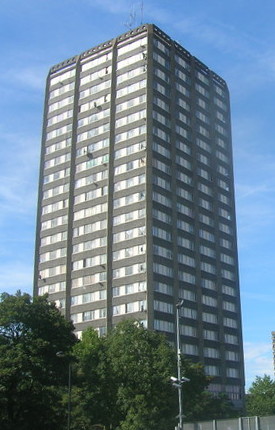
    At this writing, the London (Kensington) Grenfell high-rise fire has taken a confirmed 58 lives, with an unknown number missing and many more sent to hospitals. The 24 story low income housing tower block caught fire on Wednesday, June 14. It was virtually all consumed, as shown in the photograph above.

    There is much to be concerned about here. This building was not owned by any of those private developers who politicians seem to blame for every all that’s wrong with housing in severely unaffordable Britain. The building, now a burned out shell, is owned by the affluent Royal Borough of Kensington and Chelsea (a local government unit within the Greater London Authority).

    This is how the structure appeared before the recent refurbishment (photo by R Sones).

    Government Failure?

    It is not as if the council had not been warned. The Grenfell Action Group has been monitoring problems at Grenfell Tower on behalf of tenants for years. On June 15, they published a blog with links to their previously expressed concerns about fire safety in the building, including one entitled KCTMCO Playing with Fire that details the frustrations of dealing with the Council’s tenant manager. The post, from last November included called the conditions, including the management of the KCTMO (Royal Borough of Kensington and Chelsea Tenant Management Organisation) and the Borough "a recipe for a future major disaster." Of course, that’s how it turned out.

    There is talk of criminal proceedings, and doubtless the private contractor who installed the cladding (exterior building facing) currently thought to have spread the fire quickly will be at greatest risk. However, the installation was procured by the KCTMO, the agent of the RBKC Borough Council, including an approved award to the contractor. Further, all of this was related to a refurbishment of the building, in which the RBKC did not require include installation of sprinklers, which would have "prevented the fire from developing." The Royal Borough of Kensington and Chelsea council is being barraged with criticisms, including from members of Parliament, for its administration of the Grenfell Tower over recent years.

    A Great Planning Disaster?

    Worse, in a larger sense, the Grenfell fire may turn out to be one of the world’s great planning disasters. One headline put it this way: "Report: Grenfell Tower Fire May Have Been Caused By Panelling Installed To Make Rich Neighbors Happy." Only slightly less incendiary was The Independent headline, which read "Grenfell Tower cladding that may have led to fire was chosen to improve appearance of Kensington block of flats."

    According to planning documents obtained by The Independent:

    “Due to its height the tower is visible from the adjacent Avondale Conservation Area to the south and the Ladbroke Conservation Area to the east,” … “The changes to the existing tower will improve its appearance especially when viewed from the surrounding area.”

    The Independent also reported that the planning document made repeated references to the "appearance of the area" and that this was the "justification for the material used on the outside of the building, which has since been claimed to have contributed to the horror." The materials were chosen, according to the planning document "to accord with the development plan (our emphasis added) by ensuring that the character and appearance of the area are preserved and living conditions of those living near the development suitably protected,”

    One expert indicated apparent frustration at the use of flammable cladding materials: "We are still wrapping postwar high-rise buildings in highly flammable materials and leaving them without sprinkler systems installed, then being surprised when they burn down."

    The extent and spread of the fire was unusual for a high rise building. London Fire Commissioner Dany Cotton told The Engineer: “This is an unprecedented situation, with a major fire that has affected all floors of this 24 storey building, from the second floor up. In my 29 years with London Fire Brigade I have never seen a fire of this nature.” According to the Evening Standard: "…flames engulfed the block from the second floor upwards “within seconds”

    Concern in Australia

    While the Grenfell fire’s severity has been attributed to the flammable cladding installed during renovation, similar cladding is being used on new high rise buildings elsewhere. For example, according to The Age the Melbourne Fire Brigade found that the fire at the contemporary LaCrosse building ignited external wall cladding, which quickly spread to the top of the building through the "combustible material located in the wall structure." Two days after the Grenfell fire, The Guardian ("Former fire chief says Melbourne’s Lacrosse Tower still poses risk") reported that the cladding had still not been replaced, though the building has been reoccupied. Peter Rau, a former Melbourne Fire Brigade Chief told The Guardian that "he would not allow his children to live there."

    Australians may have plenty of reason to be concerned. Planning policies throughout Australia have sought to convince households to live in central city high-rises, seeking to entice them from their preferred suburban detached housing. In a June 15 story, The Age ("London tower fire could happen here: Australian buildings cloaked in flammable cladding") reported that Australian buildings are clad in "millions of square meters" of flammable cladding. This is not a new problem. According to The Age building code authorities were advised of the problem seven years ago.

    Tony Recsei, President of Save Our Suburbs in Sydney expressed concern in a  Sydney Morning Herald letter. Referring to the New South Wales government policy that seeks to increase high rise living, Recsei said "But this calamity starkly reveals there can be long-term consequences. It is to be hoped that the Greater Sydney Commission will seriously consider all the implications of its current strategy of imposing density quotas onto local neighborhoods."

    The extent of the concern in Australia is indicated in this video and article from news.com.au.

    New Zealand and the United States

    Even in New Zealand, where officials recently strengthened external materials fire regulations, the government asked local authorities to check buildings constructed before the regulatory reform to see if there are any with combustible cladding.

    According to the Times of London, the cladding used on Grenfell Tower has been illegal in the United States for five years.

    Further Developments in London

    Meanwhile, back in London, there remains considerable anger. London Mayor Sadiq Kahn visited the site on June 16 was questioned and heckled by survivors. On the same day, Prime Minister Theresa May also visited the scene and was criticized for meeting only with emergency services personnel, but not with any residents.

    The fatality count could go much higher. Fears of a building collapse are slowing inspection efforts. Metropolitan Police Commander Stuart Cundy told The Independentthat "he hoped the death toll would not be in “triple figures”.

    No Clean Hands?

    Of course, final assessments will have to await more formal inquiries. But there is plenty of reason to be concerned. Save the fire brigade, which has been roundly praised for its work, including being on the scene within six minutes, there may be no clean hands. Cities, from the days of ancient Rome, have been vulnerable to fiery disasters like this one; policies that encourage densification while failing to provide adequate safety procedures are creating the potential for more such disasters.

    Grenfell fire photo by Natalie Oxford.

    Wendell Cox is principal of Demographia, an international public policy and demographics firm. He is a Senior Fellow of the Center for Opportunity Urbanism (US), Senior Fellow for Housing Affordability and Municipal Policy for the Frontier Centre for Public Policy (Canada), and a member of the Board of Advisors of the Center for Demographics and Policy at Chapman University (California). He is co-author of the "Demographia International Housing Affordability Survey" and author of "Demographia World Urban Areas" and "War on the Dream: How Anti-Sprawl Policy Threatens the Quality of Life." He was appointed to three terms on the Los Angeles County Transportation Commission, where he served with the leading city and county leadership as the only non-elected member. He served as a visiting professor at the Conservatoire National des Arts et Metiers, a national university in Paris.

  • Connecticut’s Future is Suburban, Not Urban

    Connecticut is now grappling with a fiscal and economic crisis that, according to some leading Democrats, has been caused by ineffective urban policy. In late May, Hartford-based insurer Aetna confirmed long-discussed rumors that it will be moving its headquarters from Connecticut. General Electric announced plans to move from Fairfield, Connecticut to Boston in January 2016. Though the Great Recession officially ended eight years ago, state budget forecasters are projecting a $2 billion deficit for next fiscal year, or 11 percent of the budget. One policy report published in March, when rosier estimates pegged Connecticut’s deficit at only 9 percent, ranked Connecticut as having the 8th largest shortfall among American states. Hartford, the state capital, is on the verge of bankruptcy.

    What course should Connecticut take to stabilize government budgets and stimulate the economy? Gov. Dannel Malloy and Hartford mayor Luke Bronin believe that stronger cities are the answer. As Malloy said recently, explaining why his budget increases state aid for cities, “I think there is a body of people who don’t understand urban environments, and I think Connecticut has too long pursued a public policy of insufficient support for our urban environments.”

    But there are many questions to raise about just how vital urban Connecticut is to the state’s future. Connecticut’s major cities have their charms, especially Hartford and New Haven. But in terms of meeting the enormous fiscal and economic challenges with which the state is now faced, they are and will remain less important than its suburban regions.

    With all due respect to Gov. Malloy and Mayor Bronin, there’s a certain glibness in how they presume that Connecticut’s poor urban areas can be revitalized. It’s not as if their predecessors haven’t been trying. Any visitor to downtown Hartford and New Haven will be struck by several imposing works of mid-20th century modern architecture. Examples include Constitution and Bushnell plazas in Hartford and New Haven’s Temple Street Garage. These projects date back to the “urban renewal” era of the 1950s and 1960s, when massive government resources were devoted towards breathing new life into tired central cities.

    New Haven was nationally-renowned for its urban renewal efforts, both because it focused just as much on rehabbing old buildings as demolishing them . Mayor Richard Lee’s “human renewal” social service programs anticipated criticisms that poverty can’t be cured through real estate development alone. But the widely celebrated Mayor Lee failed to hit the mark. New Haven, the “Model City,” was rocked by a race riot in 1967, as was Hartford in 1969.

    Despite growing evidence that Connecticut cities were not coming back, urban renewal in modified forms would continue throughout the decades. In 1974, Hartford gained the “Hartford Civic Center,” (now known as the XL Center), a sports and entertainment venue where the NHL’s Hartford Whalers played from 1980 to 1997. The state’s convention center opened in Hartford in 2005, and a minor league baseball park just came online in April. And yet, among American cities with a population above 100,000, Hartford’s poverty rate is 8th highest in the nation. Mayor Bronin himself describes the current fiscal state of affairs in Hartford as “the largest budget crisis in our city’s history.”

    State government is not much better off. Connecticut’s budget deficit is driven by escalating costs for public pensions, which powerful government unions have balked at reforming, and weak tax receipts despite—or perhaps because of—a series of recent income tax hikes. Gov. Malloy, a progressive Democrat, has recently taken the position that trying to further increase the tax burden on the state’s 1 percent would be counterproductive.

    Urban revitalization is an unsound strategy for addressing budget deficits because creating strong cities is the work of generations. The secret of Boston’s success is reflected in a famous saying attributed to Daniel Patrick Moynihan: “If you want to build a world-class city, build a great university and wait 200 years.” Cities like New York that are now envied as talent magnets have had that reputation going back many years. Even in the 1970s, when New York was plagued by high crime and the threat of insolvency, it was still a national leader in finance, media and the arts.

    Bronin and Malloy have said that they understand Hartford can’t become New York or Boston. But among Hartford’s true peers—formerly industrial small and mid-sized cities throughout the northeast and Midwest—it is very difficult to find any examples of an authentic comeback city. In an analysis I recently wrote about Hartford, New Haven, Waterbury and Bridgeport, I found that, since 1970, the number of poor people living in these cities had increased by 56.1%, 40.8%, 153.6% and 86.3%, respectively. Over the same span, all have seen their total populations decline with the exception of Waterbury, which has grown by 1.7%.

    Despite all the hype over America’s urban renaissance, cities remain a tough sell for the middle class. However magnetic a city may be in attracting young millennials, as studies by William Sander of DePaul University and William Testa of the Chicago Fed have demonstrated, the more educated you are, the more likely you are to opt for suburbs when you settle down. If, 20 years ago, a given city had an underperforming school system that was unattractive to middle class families, it most likely remains unattractive to them now. According to the most up-to-date Census data we have, within most major metros, suburban areas are growing more rapidly than central cities.

    Connecticut is often associated with suburban blandness. But it happens to boast one of the most talented labor forces in the nation. A 2016 McKinsey report ranked Connecticut second among states in productivity (GDP per worker). Statewide, 16.6 percent of adults have advanced degrees, a rate which trails only Massachusetts and Maryland. (Only 6.7 percent of adults in Hartford have advanced degrees.) In coming years, the high levels of productivity and educational attainment among Connecticut’s suburban residents will be essential to any growth the state manages to achieve. Fairfield County Connecticut boasts some of the strongest public schools in the nation, whereas the state’s urban school districts remain troubled.

    As Connecticut officials contemplate a policy response to Aetna’s exit, it is crucial that they not lose sight of the following. We don’t know how to revitalize poor old industrial cities, especially small and mid-sized ones. Middle class families with children are opting for the suburbs just as reliably as in prior generations. One of the soundest economic development strategies is for a state to offer potential employers a productive and educated workforce, which Connecticut plainly does. State officials should build on current virtues, avoid chasing fads, focus more on budget discipline, and by all means stop trying to make Connecticut into something it’s not.

    Stephen Eide is a Senior Fellow at the Manhattan Institute.

    Photo by Doug Kerr, via Flickr, using CC License.

  • The Superstar Gap

    The biggest challenge facing many cities in transitioning to the knowledge economy is a shortage of “A” talent, especially true superstars.

    All “talent” isn’t created equal. Crude measures such as the percentage of a region with college degrees, or even graduate degrees, don’t fully capture this. It is disproporationately the top performers, the “A” players and superstars that make things happen.

    Sections of the knowledge economy have long been geared to superstars. Economist Enrico Moretti cites research on biotech hubs, in which he notes that it is not just having a top university nearby that mattered in establishing biotech clusters, but having the true handful of academic superstars researchers. In The New Geography of Jobs, he writes:

    In a fascinating and now classic article and in a series of subsequent studies, they argued that what really explains the location and success of biotech companies is the presence of academic stars – researchers who have published the most articles reporting specific gene sequencing discoveries. Among top universities, some institutions happened to have on their faculties stars in the particular subfield of biology that matters for biotech; others had comparable research but did not have stars in that specific subfield. The former group created a local cluster of biotech firms while the latter did not.

    Richard Florida devotes a significant amount of his latest book The New Urban Crisis discussing the rise of the superstar phenomenon, which he also links to specific superstar cities.

    Superstars are important in tech because of the 10x principle I mentioned in my recent post on the Silicon Valley mindset. The best coders are 10x as productive as the merely very good coder. The top entrepreneurs are probably 100x or or more. The presence of superstars, along with some amount of good fortune, can transform the economy of a city or region.

    Jeff Bezos is a superstar. Mark Zuckerberg is a superstar. Michael Bloomberg is a superstar.

    These superstars are disproporationately located in only a handful of regions.

    To see this effect, just look at Austin vs. Seattle. Austin is a booming, prosperous city with a major tech industry. Yet Seattle is generating significantly greater value. Seattle’s real per capita GDP is $75,960 vs. only $55,323 in Austin. Seattle’s per capita income is $61,021 vs. $51,014 in Austin.

    Austin had some good entrepreneurs like Michael Dell, but not superstars in industries that would create massive platforms like Microsoft and Amazon. Austin has a lot of quantity, but it looks to me like there’s a big quality gap vs. Seattle.

    And it’s not just that superstars create things, they act like a magnet attracting others. As economic development consultant Kevin Hively once told me, “When you’re the best in the world, people beat a path to your door.”

    To see this in action, just look at Carnegie Mellon University in Pittsburgh. CMU has the #1 ranked computer science program in the country. And companies like Google (600 employees), Uber (500 employees), Apple (500 employees), Intel, and Amazon been drawn there and set up shops around it. Ford is investing a billion dollars into autonomous vehicle ventures there. And GM also has a presence.

    It’s interesting to contrast with the University of Illinois’ program. U of I is ranked 5th in computer science. My impression is that from a commercial impact, they used to be bigger time than they are now. The web browser as we know it was invented there, but that was a long time ago. They have a research park designed for companies wanting to take advantage of proxmity of U of I. There are a lot of companies there, but the tech roster isn’t as marquee as Pittsburgh’s and my impression is that the scale is smaller.

    There’s a big differnce between being number one and number five, particularly when something like ownership of the driverless car market is at stake. Maybe that’s why former GE CEO Jack Welch said he only wanted to be in a business if he could be number one or number two.

    Cities and states in the Midwest and elsewhere in the interior like to boast of their assets, which include many great schools, but very few world dominating number ones in important fields. This is a big challenge for them.

    Superstars aren’t the entire world. The presence of superstar businesses also creates problems as well as wealth. But if these places want to not only thrive but perhaps for some of them even just survive in the knowledge economy world, they need to look at their attractiveness to the truly top tier talent (I will address “A” caliber but not superstar talent in a future post). I don’t often see this talked about.

    For example, one thing I don’t see in most discussion of Chicago is its lack of superstar talent. Chicago is very good but not the best in a lot of things. Where they do have arguably world beating talent, such as in their culinary industry, they shine. (I know people in New York who happily admit Chicago has better restaurants).

    If I were that city, I’d be looking to see how to create a world’s best talent pool in additional particular high impact industries. Maybe the state should consider some radical type action, such as relocating U of I’s entire computer science and select engineering programs to Chicago as part of UI Labs, and putting serious muscle behind getting at least some critical subspecialities with high commerical potential to be clear #1’s in the world.

    This is actually a scenario I plan to study in the future. Right now I’m not sure it’s necessary and some of my initial thoughts are impressionistic. So this post is in part a honeypot to try to lure in those who might react to this or even help flesh out the facts (which might augur against it).

    Regardless, this lack of superstar/number one type talent in the interior is a big handicap in the world we live in now. For example, just look back at a 2010 analysis Carl Wohlt did of where the people on Fast Company’s “100 Most Creative People in Business” list lived. Only six in the Midwest and seven in the South vs. 35 in the West and 32 in the Northeast (with 20 international). This isn’t a scientific survey but illustrates the scope of the problem.

    Cities and states need to take a more finer grained view of talent, and understand the criticality of having at least some of the absolute best talent to kicking a region’s knowledge economy into high gear. Too many places have a superstar gap.

    This piece originally appeared on Urbanophile.

    Aaron M. Renn is a senior fellow at the Manhattan Institute, a contributing editor of City Journal, and an economic development columnist for Governing magazine. He focuses on ways to help America’s cities thrive in an ever more complex, competitive, globalized, and diverse twenty-first century. During Renn’s 15-year career in management and technology consulting, he was a partner at Accenture and held several technology strategy roles and directed multimillion-dollar global technology implementations. He has contributed to The Guardian, Forbes.com, and numerous other publications. Renn holds a B.S. from Indiana University, where he coauthored an early social-networking platform in 1991.

    Photo by John Picken (Flickr: Chicago River ferry) [CC BY 2.0], via Wikimedia Commons

  • Dispersed Cities: Starting the 3rd Decade

    Cities (urban areas or settlements) have been around for millennia. Over that time, cities have changed in form and function. But the way that people move around the city has materially changed only twice. Walking was predominant until less than 200 years ago, then came mass transit, the automobile and now autonomous cars and some substitution for driving by online technology.

    The Walking City

    When walking predominated, cities had to be very dense, because things had to be close enough for pedestrian access. Walking Paris reached approximately 250,000 persons per square mile and London over 100,000 in the 17th century. The US also had dense walking cities, but they were smaller , emerged much later and never reached the highest densities of old-world cities. By 1820, New York had an estimated 50,000 residents per square mile, but a population of less than 150,000.

    Indeed in 1820 urban travel was little different than in for the average resident than in the pre-urban temple center of Gobekli Tepe (Turkey) 11,000 years ago, the Caral (Peru) of 4,500 years ago or the Wangchenggang (China) of 4,000 years ago.

    The Transit City

    However, the second quarter of the 19th century saw the emergence of the mass transit revolution. The new the horse drawn omnibuses were affordable to many people, unlike individual horses and horse drawn carriages. Over nearly all of the next century, transit shaped the city. Services were expanded and improved. Electric streetcars and interurbans appeared. If the Census Bureau had asked a “journey to work” question in the 1900 census, the answers would have shown transit’s share of mechanized to be virtually 100 percent.

    During this period, transit shaped the dominant downtowns (central business districts or CBDs), as is chronicled by Robert Fogelson in Downtown: Its Rise and Fall: 1880-1950. Transit lines converged on the CBD, which was the key to its emergence as the central point of a monocentric city. Transit retained its primacy through much of the 1910s, as people who worked downtown were able to move further away.

    The Automobile City

    But, just as the transit city was peaking, the car began its ascent, with automobile ownership expanding rapidly in the 1920s. By 1929, 90 percent of the world’s car registrations were in the United States, according to Northwestern University economist Robert Gordon. All of this made it possible to travel farther in urban areas and to live even farther from the urban core.

    After the Great Depression and World War II, which slowed growth, automobile ownership expanded even more. By 1950, New York region’s urban density had dropped below 10,000 per square mile and the average density among the principal urban areas in today’s 53 major metropolitan areas (more than 1,000,000 population) was approximately 6,000 per square mile. By 2010, New York’s urban density had dropped to 5,300, and Los Angeles had become the densest at 7,000. The average of the principal urban areas to 3,100.

    Polycentricity’s Short Interlude

    The dominance of the automobile ended much of the need for a CBD. As people moved farther away (suburbanized), employment and commercial development also suburbanized. Large retail shopping centers appeared throughout the suburbs. Soon after, large employment centers developed outside the downtowns, such as Bellevue (Seattle), Uptown (Houston), Century City (Los Angeles) and Research Triangle (Raleigh-Durham). In 1991 Joel Garreau first brought centers like this to public attention, coining the term “edge city” in his book Edge Cities: Life on the New Frontier. It had become clear to those who were paying attention that the monocentric, CBD oriented US city was a thing of the past. There were still CBDs, of course, but most were shadows of their former selves in employment and shopping shares. American cities were increasingly referred to as “polycentric.”

    Dispersion: The New Urban Form

    But polycentricity did not last very long. In 1997, University of Southern California economists Peter Gordon and Harry W. Richardson noted the trend toward dispersion in Beyond Polycentricity: The Dispersed Metropolis, Los Angeles, 1970-1990. In a 1998 Brookings Institution paper, they highlighted one of the most important advantages of dispersion. Traffic “doomsday” forecasts, for example, have gone the way of most other dire predictions. Why? Because suburbanization has turned out to be the traffic safety valve. Increasingly footloose industry has followed workers into the suburbs and exurban areas and most commuting now takes place suburb-to-suburb on faster, less crowded roads.”

    Further evidence came in 2003 from University of Nevada Las Vegas Professor Robert Lang who documented the dispersion of office space outside the CBDs in Edgeless Cities: Exploring the Elusive Metropolis.

    Finally, Bumsoo Lee (now at the University of Illinois, Champaign-Urbana) and Peter Gordon published Urban Spatial Structure and Economic Growth in US Metropolitan Areas which looked at 2000 census tract data and classified employment based on job density into three categories, CBDs, subcenters and dispersed.

    Among metropolitan areas with more than 500,000 population, all had most of their employment outside CBDs and subcenters. In other words, all metropolitan areas were more dispersed than polycentric or monocentric. Further, in the largest metropolitan areas, more than twice as many jobs were in subcenters as the CBDs (Figure 1).

    • Among metropolitan areas with more than 3,000,000 residents, 77.9 percent of employment was dispersed, 15.0 percent in subcenters and 7.1 percent in CBDs.

    • Among metropolitan areas with from 1,000,000 to 3,000,000 residents, 82.2 percent of employment was dispersed, 7.0 percent in subcenters and 10.8 percent in CBDs.

    • Among metropolitan areas with from 500,000 to 1,000,000 residents, 82.6 percent of employment was dispersed, 5.6 percent in subcenters and 12.2 percent in CBDs.

    Unfortunately, this research has not been updated with the results of the 2010 census. But, there is every reason to believe that the dispersion continued. A City Sector Model (Figure 2) analysis of County Business Pattern data suggests that the dispersion has continued (Figure 3). Between 2000 and 2015, 90 percent of new jobs were in the suburbs and exurbs. The largest gains were in the Later Suburbs and Exurbs, while there were losses in the Urban Core Inner Ring and the Earlier Suburbs. While there was an increase in CBD employment, exurban job growth was nearly twice as great.

    This reality of the dispersed city, however, does not get in the way of media and others who talk as if the city remains monocentric. Yet in an era of new possibilities unleashed by technology — Uber, Lyft, autonomous vehicles — the likely trajectory is for more dispersion not less.

    Wendell Cox is principal of Demographia, an international public policy and demographics firm. He is a Senior Fellow of the Center for Opportunity Urbanism (US), Senior Fellow for Housing Affordability and Municipal Policy for the Frontier Centre for Public Policy (Canada), and a member of the Board of Advisors of the Center for Demographics and Policy at Chapman University (California). He is co-author of the “Demographia International Housing Affordability Survey” and author of “Demographia World Urban Areas” and “War on the Dream: How Anti-Sprawl Policy Threatens the Quality of Life.” He was appointed to three terms on the Los Angeles County Transportation Commission, where he served with the leading city and county leadership as the only non-elected member. He served as a visiting professor at the Conservatoire National des Arts et Metiers, a national university in Paris.

    Top photo: Los Angeles, CBD, polycentric (Wilshire district, Hollywood and Glendale) and dispersed (the rest), by author.