Blog

  • Oregon’s Sad Focus on ‘Happiness’

    Oregon is a beautiful place, and, for many of the state’s well-heeled residents, including many refugees from equally beautiful but overpriced California, economic growth not only is unimportant but is even a negative. Rather than create opportunity, the real issue, according to Gov. John Kitzhaber, is making sure the state ranks high on “the happiness index.” Forget sweating the hard stuff, and cozy up with a hot soy latte.

    There’s a problem with this. Oregon’s unemployment rate remains above the national average and underemployment – the measure of people working part-time or well below their skill level – stands at nearly 17 percent, behind only Nevada and California. Since 2007, the state has lost over 3.4 percent of its jobs, a performance much worse than the national average and even California.

    “You have to wonder about the rhetoric of happiness,” suggests economist Bill Watkins, who predicts the state won’t be back to 2007 employment levels till next year. “You need jobs for people to be happy, you would think.”

    This dearth of opportunity extends even into Portland, the state’s dominant city. One recent study showed that earnings for educated male in the city are among the worst in the country. Portland, the land of Ph.D.’s driving cabs and working in coffee shops, notes geographer Jim Russell, “attracts talent for the sake of attracting talent” but does little with them once they arrive. No surprise then that the place has become widely described the “slacker capital of the world.”

    Indeed, notes economist Bill Watkins, Oregon over the past five years has lagged in job growth behind not only the nation, but, in particular, its demographic twin, Washington state. Seattle has emerged as the most potent competitor to Silicon Valley, while Oregon’s tech sector is largely propped up by Intel’s plant in suburban Hillsboro, itself a byproduct of California’s regulatory over-reach. There has been no widespread stirring of tech, or for that matter, any strong industry in Oregon.

    “The good news is all Intel,” said Watkins, who has studied the state’s economy for a decade. “The place is run by the complacent and the comfortable. It’s a place of consumption, not production. It’s a great place, though, to relax.”

    ‘small is beautiful’

    Oregon’s parallel-universe approach to economics persisted even during the worst of the 2007-09 recession, with the state tightening its regulatory vise while raising income taxes to the highest levels outside California and Hawaii. It seems hard to imagine why a tech entrepreneur from California or Taiwan would choose a hyper-regulated, high-tax home in Oregon when they can establish themselves in Washington state, which has no income tax but many of the same physical amenities, and access to Seattle’s world-class airport.

    Perhaps I am missing the point. Growth these days is for Neanderthals and conservatives. In the past, social democrats like the great auto union leader Walter Reuther, after World War II favored economic growth as a way to create “a whole new middle class.” Many of today’s progressives actually seem to want a quainter economy, dominated by homey small farms, trendy farm-to-table restaurants and artisan cheese stores.

    Although this approach is now cloaked in progressivism, it also mirrors the biases of traditional Tories, who were fierce opponents to suburban development and utterly dedicated to the preservation of the countryside. Old conservatives in Britain generally favor strict controls on suburban and new town development, which, notes film-maker Martin Durkin, have made British housing prices among the highest and least-affordable in the world. Keep the peasants, that thinking may go, in the apartment blocks, so the gentry can better enjoy the pleasures of the countryside.

    In his influential “Small is Beautiful” (1973), the British author E.F. Schumacher opposed economic growth and favored returning to “the good qualities of an earlier civilization.” This mantra has been increasingly adopted by what is considered the left side of the political spectrum, largely due to the rise of environmentalism. Indeed, there’s a growing movement, and not just in the United States and Britain, to embrace what some call“eco-economics,” which essentially favors steady state, “sustainable” slow growth that focuses on the metric of “happiness.”

    Bhutan, a small Himalayan kingdom of less than a million people and the site of a recent Kitzhaber pilgrimage, has emerged as the “happiness” poster child. And what a fine role model this country makes for Oregon and the rest of us. One Asian development expertrecently described the country as “still mired by extreme poverty, chronic unemployment and economic stupor that paints a glaring irony of the ‘happiness’ the government wants to portray.”

    In this other “happiest place on Earth” one in four people lives in poverty, nearly 40 percent of the population is illiterate, and the infant mortality rate is five times higher than in the United States. Bhutan also has a nasty civil-rights record from expelling members of its Nepalese minority from the country.

    Bhutan, of course, is a pastoral country, but progressive urbanists also increasingly apply their “happiness” ideal to cities. Canadian academic Charles Montgomery, for example, celebrates what he sees as high levels of happiness in the city slums of developing countries. Montgomery points to impoverished Bogota, Colombia, for example, as “a happy city” that shows the way to urban development. If we can’t do a Bhutanese village, we can all aspire to life in a favela.

    These ideas have gained currency among some climate-change campaigners, such as the Guardian’s George Monbiot, who acknowledges that his goal is nothing less than “a battle to redefine humanity” and replace the notion of growth with what is commonly referred to now as “degrowth” – a planned, ratcheting down of mass material prosperity.

    Not yet widely accepted in America, at least outside Oregon, Northern California, New York City’s upper West Side and, perhaps, Vermont, this approach is all the rage in slow-growing Europe. It already has its fans on college campuses and in the media.

    ‘Happiness’ Game winners, losers

    In every case of advocacy, however well-intentioned, there are clearly winners and losers. The “politics of happiness,” as one British author puts it, have proven a boon both for the public sector and those parts of the private sector that profit from work with government. Other beneficiaries include tech oligarchs, and other connected investors, who profit from renewables with the guarantee of public subsidies, and what can be called the Trustifarians, who promote anti-growth policies through their foundations and, as a bonus, get to feel very good about themselves.

    Other winners include the media clerisy, notably in Hollywood, who propagandize against economic growth while living in unimaginable luxury, as well as academics, notably politically compliant scientists, who can win grants to promote this ideology.

    So, who loses in the “politics of happiness”? Certainly, large parts of the working class – farm workers, lumberjacks, factory operatives, and their families – who don’t have much of a role in an economy divided between service providers and the wealthy. Also left out of the equation are young families, who, perhaps forsaking the “slacker” life, now find their aspirations for a house and decent job blocked by the generally older, and better off, advocates for “happiness.”

    Probably worst off are the poor, which in predominantly white (86 percent) Oregon are more likely not to be minorities. This is particularly true in the countryside, where economic conditions, according to one top state official, are “dire” and may be close to irreversibleUnemployment and underemployment in many rural Oregon counties reaches well into the double digits. People in the interior regions of the state, much like their counterparts in California, complain that Portland’s green obsessions over such things as energy and land-use policies makes economic development all but impossible.

    In the coming years, this conflict over economics, and the perceived politics of “happiness,” is likely to grow. Unable to prove that their policies have promoted growth, today’s progressives have found a way to deal with the economy – ignore it.

    This story originally appeared at The Orange County Register.

    Joel Kotkin is executive editor of NewGeography.com and Distinguished Presidential Fellow in Urban Futures at Chapman University, and a member of the editorial board of the Orange County Register. He is author of The City: A Global History and The Next Hundred Million: America in 2050. His most recent study, The Rise of Postfamilialism, has been widely discussed and distributed internationally. He lives in Los Angeles, CA.

    John Kitzhaber photo by S.MiRK
  • The Sea of Japan: Wading Into the Name-Game Waters

    Call it ‘Nomenclature Nationalism’, or ‘The Tyranny of Also Known As’. The Virginia state legislature ventured into unfamiliar foreign policy waters earlier this month when it passed a law that requires school text book publishers to add six little words in reference to the body of water usually known as the Sea of Japan: “also known as the East Sea”. New York and New Jersey have now also placed the item on their state agendas. The moves reflect a trend: Geographic nomenclature is becoming a frontline in nationalism, particularly in Asia.

    The legislation in Virginia would seem to be a rather small bore triumph of South Korean sentiments and organization by Korean voters in local U.S. elections. But it is being treated as a major victory in Seoul, and as a defeat for Japan, which went out of its way to try to forestall the legislation, even hinting that the language might jeopardize Japanese investment in the state.

    For the past twenty years, South Korea has been laboring mightily to persuade the rest of the world to use its designation for the body of water that separates it from Japan, or, if not, to at least acknowledge an alternative designation.

    Until recently, those efforts have not met with much success. In 2012, South Korea officially asked the International Hydrographic Organization to use the term ‘East Sea’ for the Sea of Japan. It turned down the request after Washington officially advised the organization against it.

    The U.S. Board of Geographic Names, which guides the government on nomenclature issues, also uses Sea of Japan alone, and China and Russia, two countries contiguous to the waters, use variations of the words Sea of Japan in their own languages. The Google Maps search bar brings up ‘also known as the East Sea’ in Sea of Japan searches, but designates the waters as Sea of Japan on its map.

    The number of “also known as…” constructions are proliferating in Asia, clogging up prose and imposing a kind of political correctness on international publications. When writing about Asian issues, journalists and other writers now routinely struggle to appear even-handed.

    It has become, of course, common place to now refer to the uninhabited rocks in the East China Sea — the area that is bringing China and Japan closer to war — as ‘Senkaku, also known as Diaoyu’. Never mind that the English language publications in China, such as South China Morning Post, don’t bother with such even-handedness, simply calling them ‘the Diaoyu’.

    Similarly, the disputed islands in the Sea of Japan are usually described as ‘Dokdo, also known as Takeshima’, though there is, in this case, a third neutral term. The U.S. officially calls them the Lioncourt Rocks, after the French vessel that “discovered” them.

    How far down this road must we travel? A half a dozen countries border on the body of water commonly known in English as the South China Sea, each one with its own geographic name for it. So must we, in total neutrality, of course, write ‘South China Sea – also known as Nan Hai (Chinese), Bien Dong (Vietnamese) or the West Philippine Sea’?

    Manila was perfectly content to refer to the waters in question as the South Sea, until several atolls became objects of disputed ownership. Beginning in 2012, it decided to call the waters ‘the West Philippine Sea,’ to reinforce its claims to these atolls and islands. The ocean to the east of the Philippines is still known simply as the Philippine Sea.

    Issues on dry land include ‘Myanmar, also known as Burma’, as many publications now refer to the Southeast Asian country. Both words approximate what Burmese call their country, but Myanmar has an unsavory pedigree. In 1989 the military junta known as the State Law and Order Council (SLORC) decreed that Burma was a colonial-era name, and that henceforth it would like to be called Myanmar.

    Coming only a year after the bloody suppression of pro-democracy protests in Rangoon (Yangon), there were grounds to question the legitimacy of the name change. The SLORC has passed into history, and Myanmar has gained acceptance almost everywhere except, significantly, the U.S. State Department and among some dissident publications based in Thailand.

    A similar situation arose in India when the Shiv Sena, an unsavory, right-wing nationalist party, won control of Maharashita State and declared that the name of its capital, Bombay, was also a colonial relic and would henceforth be known as Mumbai. The Shiv Sena are long out of power, but Mumbai has out-grown its origins and gained international acceptance — along with Chennia (Madras) and Kolkata (Calcutta).

    One should probably be grateful that other Asian countries haven’t yet joined the nationalist nomenclature bandwagon to dump “colonial era” names. The Thais don’t insist that we call their capital city Krungthep instead of Bangkok. Beijing doesn’t insist that we exchange ‘China’ for the tongue twister Zhonggou, and Tokyo doesn’t insist we use Nippon – also known as Japan.

    Todd Crowell is author of the forthcoming The Dictionary of the Asian Language. He is based in Tokyo.

    Flickr photo by paukrus: Sea of Japan near Nahodka

  • Where New Yorkers are Moving

    The American Community Survey has released domestic migration data that was collected over a five year period (2007 to 2011).  There is newer domestic migration data available, such as is annually provided by the Census Bureau’s population estimates program, but not in the detail that the latest data provides.

    The new release is significant because domestic migration data is provided between each of the nation’s more than 3,100 counties. Because the survey was taken over a five-year period, the data represents, in effect, a one-fifth snapshot of domestic migration for each of the years from 2007 to 2011. Each year respondents are asked where they lived a year ago. It is thus a rolling annual figure, rather than a picture of a single year.

    The Uniqueness of New York City

    The city of New York provides an interesting case for many reasons. The city is by far the largest municipality in the United States and the only municipality composed of at least two complete counties. New York is coterminous with five counties. New York also has by far the greatest extent of high density in the United States, comprising more than 85 percent population of zip codes with greater than 25,000 per square mile density (10,000 per square kilometer).

    Finally, New York is at the center of the largest metropolitan area in the United States, which in its expanded, combined form (combined statistical area) has a population of 23.1 million, most of which (20.7 million) is in a built-up urban area that covers the largest land area in the world (has the largest urban footprint). This is more than a third larger than Tokyo, the world’s largest urban area by population, with an 80 percent higher population. It is surprising to many that New York’s urban area covers nearly twice the land area of Los Angeles and is nearly one-quarter less dense.

    Domestic Migration and New York City

    New York’s broad suburban expanse generally resembles the suburbs of Dallas-Fort Worth, Seattle or Toronto and much of its Staten Island borough (county of Richmond) looks more like suburban New Jersey than New York, most of its urban core – the city of New York – is unique.

    And the city continues to export large numbers of people – 90,000 more than arrived in the rolling year represented by the latest ACS data. This is a big number, representing 1.1 percent of the city’s 2010 population. This is a larger loss than Philadelphia (0.5 percent), but smaller than Washington (1.4 percent).

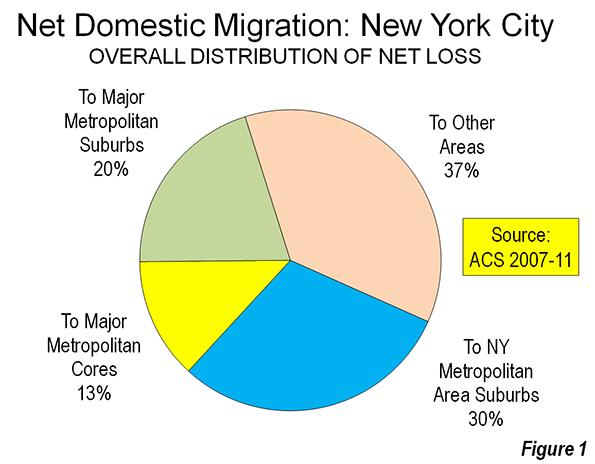
    This has been evident in the large numbers net domestic migrants reported each year in the Census Bureau estimates. The data shows that people are leaving not only the city of New York not only for the suburbs, but moving in even greater numbers to beyond the metropolitan area. Approximately 27,000 more New Yorkers moved to the suburbs than to the city of New York over the period. However, an even larger 63,000 net domestic migrants left the city of New York for areas outside the metropolitan area.

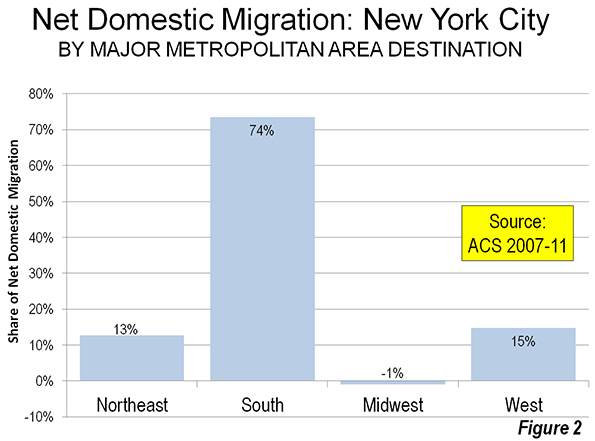
    Approximately 30,000 of these inter-regional migrants moved to other major metropolitan areas (those with more than 1 million population). By far the largest share – 74 percent – of the city’s net domestic migrants to other major metropolitan areas moved to the South. Four of the five largest major metropolitan gainers at the city’s expense were Miami (net 5,600) and Atlanta (net 4,300), followed by Tampa-St. Petersburg, and Dallas-Fort Worth.

    Another 13 percent of the city’s net domestic migrants moved to other major metropolitan areas in the Northeast. Rochester was the largest gainer with nearly 1000 net domestic migrants from the city of New York, followed by Philadelphia. The city gained more than 250 residents from Boston.

    Approximately 9 percent of the city’s net domestic migrants moved to major metropolitan areas in the West. Los Angeles led in the West, gaining 1,800 net migrants from the city. The outlier was the Midwest, which sent more than 300 net migrants to the city (Figure 1).

    City residents tended to move to the suburbs of the major metropolitan areas, which attracted 60 percent, while the core cities received 40 percent of the net migrants.

    Dispersing Beyond the Larger Metropolitan Areas

    However, the most striking trend is that most of the net domestic migrants who left the city of New York to move outside the New York metropolitan area moved to areas outside the major metropolitan areas. In this regard, New Yorkers who move seem to be more inclined toward the greater dispersion of the nation’s smaller metropolitan areas and micropolitan areas.

    Over the period, approximately 32,500 net domestic migrants left the city for areas outside major metropolitan areas. This is more than moved to the other major metropolitan areas or to the New York metropolitan area suburbs (Figure 2).

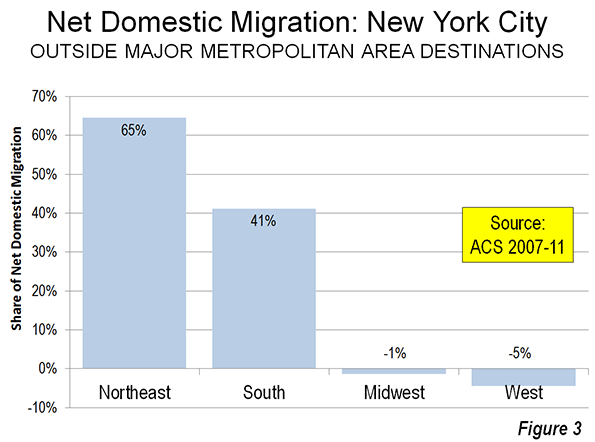
    The most surprising finding is that the majority (65 percent) of net domestic migrants from the city who moved to outside the major metropolitan areas settled in the Northeast. Most of these 23,000 residents moved to smaller areas in Upstate New York and Pennsylvania. Virtually all of the other migrants not moving to major metropolitan areas moved to states in the South (41 percent). In contrast, there was a small amount of migration to New York from the West and Midwest totaling less than 2,000 (Figure 3).

    Outside New York and New Jersey, which contain nearly all of the New York metropolitan area, Florida received the largest number of net migrants from the city (11,000), followed by Pennsylvania (8,000). Only 100 of the Pennsylvania migrants were to Pike County, which is in the New York metropolitan area. Georgia, Texas and North Carolina all received approximately 5,000 net migrants from the city. The top ten destinations were rounded out by Virginia, Connecticut and South Carolina. A total of 37 states received net domestic migrants from the city. Only Alaska and the District of Columbia sent more than 1,000 net domestic migrants to New York City.

    Conclusion

    The New York City migration data indicates continuing dispersion of the population. People are moving from the core to the periphery in New York, and many going beyond to less urban areas in the Northeast. More are moving to other major metropolitan and other smaller areas, located for the most part in the South. This year’s brutal winter could make the South look even better to New Yorkers.

    Wendell Cox is a Visiting Professor, Conservatoire National des Arts et Metiers, Paris and the author of “War on the Dream: How Anti-Sprawl Policy Threatens the Quality of Life.

    Photo: Leaving New York City via the Holland Tunnel (by author)

  • Post-Nagin, New Orleans Is On Way To Becoming A Model City

    Last week’s conviction of former New Orleans Mayor Ray Nagin on 20 charges of bribery and fraud marks the end of a tumultuous era in the city’s history, and perhaps also the beginning of a new era in American urban politics. Perhaps most remarkable was the almost total lack of protest in New Orleans over the downfall of Nagin, who had relied heavily on polarizing racial politics in his last five years in office.

    This is among the many hopeful signs in the Crescent City and its environs. Over the past year as I’ve put together a report on the future of New Orleans, I have seen a city once described by Joel Garreau in his Nine Nations of North America (1981)as a “marvelous collection of sleaziness and peeling paint,” clean up its politics, restart and diversify its economy, and begin the slow process of reducing its deep-seated crime problem.

    In the past, the “pay to play” politics and corruption epitomized by Nagin and former congressman William Jefferson were widely winked at in New Orleans as if it were just local color. “We like our politics like our rice — dirty,” a Katrina evacuee in Houston once told me with a knowing smile.

    Katrina changed that. The natural disaster was made far worse by the corruption and incompetence of virtually every key institution, starting with police and the levee boards. With the city largely underwater and much of its population forced to flee, some urban experts, such as Harvard’s Ed Glaeser, wondered if we would be better off to encourage people to leave the area permanently, perhaps with vouchers, to seek a better life elsewhere.

    Yet it is here that the real turnaround began. Business leaders, who had seen Nagin as an ally during his first term, realized he was not up to the extraordinary challenges posed by the disaster. The man who some called “Ray Reagan” for his business-friendly policies was morphing into the worst kind of racial demagogue, a kind of bayou version of Coleman Young or Sharpe James. His appeal to keep New Orleans a “chocolate city” and his now well-documented graft frustrated those who wanted to revive the city and its surrounding region.

    “When Nagin came in, he was seen as a reformer,” recalls Greg Rusovich, former chairman of the New Orleans Business Council, which includes 70 of the Crescent City’s largest businesses. “But after Katrina he really turned into a racial politician and surrounded himself with incompetents.”

    This incompetence, Rusovich suggests, slowed New Orleans’ recovery as Nagin proved unable to help direct the massive federal aid, and the many private donations, that came into the city. Eventually, voters tired of poor public services and began to demand a more competent regime.

    The current mayor, Mitch Landrieu, first elected in 2010 and easily re-electedwith strong black support this month, has brought a climate of technocratic competence to the city. With the active backing of business leaders, the city has attracted large-scale corporate investment, including a 300-person General Electric software development center, as well as a surge of videogame and entertainment companies.

    This growth was in large part sparked by a steady movement of young, educated people into the city. For decades, New Orleans’ “best and brightest” tended to move elsewhere; now the flows for the Crescent City have turned positive, including from the West Coast and the Northeast. By last year, theAtlantic Cities, the leading mouthpiece for “hip” urbanism, proclaimed New Orleans potentially the nation’s “next great innovation hub.”

    Yet for all the hoopla surrounding the growth in the information sector, it is unlikely to be enough to sustain the New Orleans region’s recovery. Not only are the total numbers of such jobs still small, in the realm of 2,600 for entertainment, STEM employment is lower than a decade ago due to cutbacks at the NASA facilities at Michoud as well as in aerospace. More important, the growth of tech and entertainment jobs will likely be insufficient to address the fundamental issues of race and poverty that have bedeviled the city throughout much of its history.

    Today, in part due to the return of evacuees, the poverty rate for the metro area stands at 19%, close to the pre-Katrina level and well above the national average of 15%. The differential between white and black incomes is some $6,000 per household above the national average and some observers, including many African-Americans, fear that the gentrification of parts of the city is reinforcing the class and racial divides that existed before the flood.

    Many African-Americans, notes city employee Lydia Cutrer, have “trust issues after many broken promises, and feel like outsiders are taking over.” Or, as Sherby Guillory, a health care worker who now lives in Houston, described the recovery efforts: “They want to build a shining city on a hill, but without the people.”

    Ultimately, to deal with these concerns, New Orleans needs to focus on the industries that drove its economy for much of its history: energy and trade. These are the primary providers of high-wage jobs, many of which are blue collar. The New Orleans area lost energy jobs from 2007-12, in part due to the Gulf drilling moratorium in the wake of the BP disaster, but activity is rising again and low natural gas prices have prompted a surge in chemical and refinery investment in south Louisiana.

    recent report by the Greater New Orleans Community Data Center concluded that over 10,000 energy, petrochemical and related advanced manufacturing jobs could be added in the region by 2020; in contrast the digital media sector was projected to expand by roughly 2,200 positions. Finding ways to accelerate this development, while using new revenues to shore up the fragile ecosystem, needs to become the primary focus of new development efforts.

    This vision for post-Katrina New Orleans will no doubt meet opposition from those who would like the city to evolve into a humid, southern version of San Francisco. Yet this makes little sense for a place whose history, location and ethnic heritage suggest a more economically diverse future. Having survived Katrina and Ray Nagin, the next task should be to see how to make sure that the recovery reaches into those neighborhoods that have historically been left behind. Rather than stand only as a charming artifact of its past, New Orleans can become a role model in showing how cities can not only survive, but create a prosperous future.

    This piece originally appeared at Forbes.

    Joel Kotkin is executive editor of NewGeography.com and Distinguished Presidential Fellow in Urban Futures at Chapman University, and a member of the editorial board of the Orange County Register. He is author of The City: A Global History and The Next Hundred Million: America in 2050. His most recent study, The Rise of Postfamilialism, has been widely discussed and distributed internationally. He lives in Los Angeles, CA.

    New Orleans photo courtesy of Jon Sullivan.

  • Sustaining Prosperity: A Long Term Vision for the New Orleans Region

    This is the executive summary from a new report Sustaining Prosperity: A Long Term Vision for the New Orleans Region, authored by Joel Kotkin for Greater New Orleans, Inc. Download the full report from GNO, Inc. here: gnoinc.org/sustainingprosperity

    The recovery of greater New Orleans represents one of the great urban achievements of our era. After decades of slow economic, political and social decline, hurricane Katrina seemed a kind of coup de grâce, smothering the last embers of the region’s vitality. In the fall of 2005 it was entirely logical to see New Orleans as just a potential exemplar of failed urbanization, much as we might see in Detroit1, Cleveland, and a host of other once great cities – for example Naples, Lisbon, Antwerp and Osaka – that have tumbled from their once great importance.2

    Yet in New Orleans’ case, disaster engendered not continued decline, but the revival of the en­tire region, its economy, and social and political institutions. Like Chicago after the great fire of 1871, San Francisco in the wake of the 1906 earthquake and fire, or New York following 9-ll, New Orleans has rebounded in ways that have defied expectations.

    Critical to making New Orleans a resilient city has been the transformation of the civic culture. This has much to do with the commitment of New Orleanians to their city – like Chicagoans, New Yorkers and San Franciscans in the past. “A city,” notes urban historian Kevin Lynch,” is hard to kill if it possesses unique cultural appeal, geographic assets and people who are determined to save the city they love.”3

    New Orleans resiliency since Katrina constitutes much more than improved levees or better evacuation procedures; more than new brick and mortar applied to what had been an aging, deterio­rating region. New Orleans has made enormous progress in cleaning up its famously corrupt political system, and also made huge strides in improving its educational infrastructure. Once considered one of the worst places to do business, the region, and the state of Louisiana, has undergone a marked improvement to its reputation. It has emerged as a good place for commerce – something of a “Cin­derella” in economic development terms.4 Allison Plyer of the Greater New Orleans Community Data Center put it, “Greater New Orleans is in some ways rebuilding better than before”.5

    Our analysis shows this progress in a host of indicators. Once a below-average job producer, the region has expanded its employment since the 2007 recession far faster than the national average. It recovered all the jobs lost in the recession by 2012 – and then some – while the nation remained three percent below its pre-recession level. Entrepreneurial activity also has grown faster than the national average by a wide margin.6

    More important still, the region finally began to reverse a demographic decline that, for a gen­eration or more, saw young, educated people and families depart for other locales to seek out a better life. The concentration of 25 to 35 year olds has increased far more quickly in the region than it has in the nation as a whole. Indeed since 2007, New Orleans region has experienced the fastest growth in educated population in the nation.7

    Many economic trends favor the region’s continued ascendency. These include the still nascent US energy boom, which represents arguably the greatest shift in global economic power since the end of the Cold War and the rise of China; the massive flow of investment, domestic and foreign, into lower-cost locales and most particularly into the Third Coast, the burgeoning region around the Gulf of Mexico; and finally the expansion of US trade with Latin America and the Caribbean basin.

    To these powerful forces we can also add demographic and social factors that work to the region’s advantage. One key is a relatively low cost of living, which, in effect, gives area residents and businesses a leg up on their East and West coast rivals. This is critical in attracting net migration from those regions, with their storehouse of educated residents and skilled workers.8 Another force is the breadth of skills that can be easily found in the region, including higher paid skilled professionals ex­perienced in transportation and material moving, installation, maintenance and repair, construction, manufacturing and energy.

    A future scenario can be constructed where greater New Orleans emerges as one of the bright­est spots in the North American economy. Not only does the region have natural advantages in terms of energy resources and transportation, it can claim primary sources of higher-wage employment. It also possesses a cultural cachet that attracts educated workers, but in a cost and regulatory environ­ment that appeals to business investors.

    This is most notable in the growth of the region’s rapidly evolving information industry, in­cluding software, videogames and an expanding film/television industry. Over the past five years, New Orleans has come to enjoy a locational concentration equal to that of New York, and has emerged as a major player in this sector.

    Challenges Ahead: Economic, Social and Environmental

    As the region moves further from the immediate post-Katrina crisis, the great momentum of the last five years is clearly slowing down. Job creation remains positive, but has gradually fallen towards national norms. Indeed, since 2010, after years of running ahead, the region’s job growth rate actually trailed the national average. This could be simply a sign that, after recovering more slowly, the rest of the country is now catching up. But the slowdown relative to other cities should be taken seriously, as it could represent a loss of critical momentum.

    “Concert Of Economic Forces” That Can Make Recovery Permanent

    To overcome its legacy of poverty and inequality, the New Orleans region needs to focus not on just one sector but on five critical ones. In a highly competitive national and global economy, re­gions need to work on their unique strengths, establishing advantages that can lead to more, and bet­ter, job creation. Most particularly, the region needs to develop a broad, but still highly selective, base of industries that can create the higher-wage jobs necessary for the uplift not of a few New Orleani­ans, but for the many.

    1. The first, and most evident, is the region’s cultural legacy, which serves as a major source of jobs for local people as well as a lure for talented people from elsewhere. This, of course, includes the still very important tourism industry, but also encompasses generally higher-wage professions in film, television, video game software and even medical research.

    The growth in information sector employment, something relatively new to the region, rep­resents a clear breakthrough. It allows the region to take advantage of its essential cultural assets, by attracting companies and highly skilled workers. Although it is unlikely that the New Orleans region will ever become as tech-dependent as, say, Silicon Valley — which may prove a good thing, given that industry’s volatility — New Orleans can look forward to a sustained increase in high-paying, and high-visibility, employment. Perhaps most critically, it has an excellent opportunity to make itself the cultural capital of the Third Coast, the burgeoning region around the Gulf, something the region desperately needs and a role that New Orleans is uniquely positioned to fulfill.

    Yet although these industries are important, they alone cannot sustain a long-term, broad recovery. Wages in the tourism industry and the arts tend to be low – one reason for the city’s per­sistently poor income distribution in the past – and higher-wage jobs, except in engineering services and entertainment, remain below national norms in total jobs and will take many years to reach true critical mass. Perhaps most critically, these industries alone cannot produce enough high-wage skilled jobs for the region’s working class population.9

    2. The river system. Its location at the shipping terminus of the Mississippi River, across the regions the region’s ports – New Orleans, South Louisiana, St. Bernard, Manchac, Plaquemines and Grand Isle Port – is the historic reason for the region’s existence and one of the key factors in its future success. The region needs to work to compete successfully with its Third Coast rivals, notably Houston, as well as Mobile and Tampa. Growing trade with the Caribbean and the completion of the Panama Canal expansion project increase the opportunities for expanded logistics and cargo han­dling. In addition, the river provides an ideal spur to new industrial production, such as the Nucor Steel plant in St. James Parish, which some see as the precursor of a new zone, akin to Germany’s Ruhr Valley, that could emerge between New Orleans and Baton Rouge.

    Given the devastation of the region’s unique ecological environment, the river presents unique challenges to be addressed. At the same time, the river offers the region new opportunities to develop yet another nascent sector: environmental remediation. The RESTORE Act funds will bring billions to the Gulf help alleviate the region’s own environmental issues, but could also support the unique expertise and skills related to the profound challenges of maintaining coastal regions. This can be seen already in the over $210 million that has flowed to expert Louisiana companies as a result of Hurricane Sandy.10

    3. The energy revolution. Perhaps no sector has more potential to generate higher wage jobs across the region, particularly for working class residents, than the current energy revolution. This is rapidly shifting economic power to North America, and it’s a shift for which the region has a front row seat. Louisiana and the greater New Orleans area boast enormous oil and gas reserves, but the region has not kept up with Houston or even smaller cities in terms of energy-related jobs. Yet there has been continued growth in many upstream services, such as petro-industrial development and exploration, even if headquarters employment has dropped. With the resolution of the BP disaster, it is hoped that the region will recover more employment in this high-wage sector.

    4. Environmental remediation. This is both a major challenge and an opportunity for economic development. Simply put, there is no long-term future for the region if the environment that sup­ports it collapses. Katrina, after all, was not the first ecological disaster to hit the region, and it won’t be the last. Finding ways to restore coastal wetlands and manage the river and other water resources in a sustainable manner not only preserves the environment that New Orleanians cherish, but could also create significant business opportunities down the road; More than 4% of Dutch GDP is related to water management, and more than 50% of that is related to international projects and the export of water expertise and services.11

    The region has already received $1.3 billion from various BP criminal settlements that will be applied to river diversion and barrier island restoration projects. Over $600 million is already budget­ed for projects being let in 2014 alone, signifying great potential to expand the region’s expertise and capacity in this sector.12

    5. The construction of infrastructure. New industries require new or improved roads, better freight and harbor access, reliable, inexpensive electricity, and improved air service. The region is moving ahead on many of these fronts, from the expansion of the airport to major port improvements and the development of a new biomedical district along the Canal Street corridor. A region that has historically lagged in forward-looking improvements is showing clear signs of determination to catch up with competitors in the country and around the world.13

    Yet all these efforts must be done in conjunction with a long-term commitment to preserve the very environment that New Orleanians treasure. This is the ultimate challenge to sustaining and expanding regional prosperity in the era ahead.

    This concert of economic forces is critical to driving down poverty rates and raising incomes across class and racial lines. This can only be realized if there is a conscious effort to promote broad-based, sustainable growth in a diversity of industries. This requires placing a greater emphasis, among other things, on higher education, particularly on engineering and the biosciences, and, per­haps even more, on community colleges, technical schools and certificate training. The area may now be attracting more college-educated workers, but it still lags behind the national average, reflecting a legacy of out-migration of skilled workers over the past few decades.14

    This is the executive summary from a new report Sustaining Prosperity: A Long Term Vision for the New Orleans Region, authored by Joel Kotkin for Greater New Orleans, Inc. Download the full report from GNO, Inc. here: gnoinc.org/sustainingprosperity

    Joel Kotkin is executive editor of NewGeography.com and Distinguished Presidential Fellow in Urban Futures at Chapman University, and a member of the editorial board of the Orange County Register. He is author of The City: A Global History and The Next Hundred Million: America in 2050. His most recent study, The Rise of Postfamilialism, has been widely discussed and distributed internationally. He lives in Los Angeles, CA.

    Endnotes
    1 http://www.newgeography.com/content/003897-root-causes-detroit-s-decline-should-not-go-ignored
    2 http://www.theatlantic.com/business/archive/2012/01/the-10-fastest-growing-and-fastest-declining-cities-in-the-world/251602/#slide16
    3 Lawrence J. Vale and Thomas J. Campanella, “Conclusion: Axioms of Resilience”, in The Resilient City, editors, Lawrence J. Vale and Thomas J. Campanella, Oxford University Press, (New York: 2005), pp.335-353
    4 http://chiefexecutive.net/best-worst-states-for-business-2012
    5 The New Orleans Index, by Allison Player, 2013
    6 Allison Plyer, Elaine Ortiz, Ben Horwitz and George Hobor, The New Orleans Index at Eight: Measuring Greater New Orleans Progress Towards Prosperity, Greater New Orleans Community Data Center August 13, 2013, p.6-7
    7 newgeography.com/content/002044-americas-biggest-brain-magnets
    8 http://www.newgeography.com/content/002950-the-cities-where-a-paycheck-stretches-the-furthest
    9 Author’s analysis of data from EMSI, Inc.
    10 http://www.bp.com/en/global/corporate/sustainability/environment/managing-our-impact-on-the-environ­ment/complying-with-regulations/clean-water-act-provision.html; http://www.restorethegulf.gov/council/about-gulf-coast-ecosystem-restoration-council
    11 Dale Morris, Senior Economist, Royal Netherlands Embassy
    12 http://www.nfwf.org/gulf/Pages/home.aspx;
    13 http://biodistrictneworleans.org/
    14 Plyer, etal, op. cit., p.12

  • Southern California has Aging Issues

    Back in the 1960s, and for well into the 1980s, California stood at the cutting edge of youth culture, the place where trends started and young people clustered. “The California teen, a white, middle-class version of the American dream” raised in a world of “suburbs, cars, and beaches,” notes historian Kirse Granat May, literally shaped the national image of youth, from the Beach Boys and Barbie to Gidget.

    In those times, California, particularly the Southland, was literally becoming ever younger, as more families and migrating 20-somethings moved in. The beaches of Southern California, so attractive to youth, evoked a care-free, athletic, somewhat hedonistic culture; California also was the place where young people, free from the traditional constraints of places East, felt free to innovate, in everything from music and board shorts to the earliest PCs.

    Yet today, you increasingly have to color California, particularly Orange and Los Angeles counties, a pale grey. Once evocative of youth, almost mythically so, these counties are aging far faster than the national average. From 2000-12, notes demographer Wendell Cox (www.demographia.com), the average median age of Los Angeles and Orange County residents rose by 10 percent, almost twice the national rate and well above the 6.6 percent rise for the state overall.

    This aging trend will continue, if current conditions remain in place. One recent USC study predicts that the Los Angeles area, due in large part to declining immigration, will continue aging rapidly. In the next two decades, the study projects, Los Angeles County will gain 867,000 senior citizens and have 630,000 fewer residents younger than 25.

    In contrast, the Bay Area – even rapidly aging Marin County – has been graying more gradually. In part, the Bay Area’s slower aging is less a reflection of rising birth rates, as was the case in California’s youthful heyday, than the movement of 20-somethings, particularly since 2007. Since then, the San Francisco area has led the nation in migration by the 20-34 age group. It does far worse as people get into prime child-bearing years, ranking 30th in migration among the 52 largest U.S. metropolitan areas.

    Not surprisingly, San Francisco – with 80,000 more dogs than kids – has the lowestpercentage of youngsters of any major American city. Even when more-suburban San Mateo County is added, the Bay Area ranks 40th in growth among people under age 4. San Jose-Santa Clara shows a very similar pattern, with people arriving in their 20s and leaving in their child-bearing years.

    Southern California right now is not experiencing much youth migration. Hollywood, great weather and the beaches are still all here – in a climate enhanced by a greater cultural diversity – but young people still are not moving here in droves. From 2007-12, this region ranked a mediocre 31st in migration by 20-somethings. Overall, we are losing millennials, while other regions, such as Washington, D.C., Houston, Denver and Austin, Texas, are luring them.

    Perhaps even more troubling, the region also ranks 47th for migrants in their prime child-bearing years and 32nd in terms of newborns. If not for the Inland Empire, which does markedly better with the 30- and 40-something groups, Southern California would be starting to look like a multicultural version of supergrey Japan. A recent report for theU.S. Conference of Mayors projected that, by 2042, Los Angeles will rank 58th of 70 U.S. regions for population growth, with the slowest growth of any major city in the South or West.

    This low youth migration combined with a steady erosion of the key parental cohorts, suggests that rapid aging could soon replace rambunctious youth as the region’s greatest demographic challenge. An ever-shrinking percentage of families and young workers is not good for the local economy. It deprives local companies of both new employees and an expanding customer base. Older people may be great for lower crime rates and filling hospitals, but not so much for the overall economy, as they often do not work and tend to consume less than younger people.

    Why is this occurring, and can anything be done to address this descent into regional senility? One answer lies in the region’s high housing prices. The L.A. area’s median multiple – the ratio of home price to a homeowner’s annual income – is now more thantwice that of more economically dynamic regions like Houston, Austin, Dallas, Atlanta, Nashville, Tenn., and Phoenix.

    This price pressure has sharply reduced opportunities for young couples to buy houses, while older residents, often working into their sixties, seventies or even eighties, stay in their homes, further reducing opportunities for the next generation. Mortgage applications have fallen dramatically in recent months, after some signs of resurgence. It’s now largely investors who are holding the market up.

    In Southern California, the combination of inflated house prices and weak job growth means not only that fewer young people are coming but, once here, they are having fewer babies, or will move once they take that plunge. This trend is spreading to the Inland Empire, the region’s primary nursery, where declining incomes and higher rents are making family formation an ever-more dicey proposition.

    Once a major lure for the parental age groups, the Inland area has dropped to 26th in attracting people in their 30s. This is not surprising given the toxic combination of a weak economy and rising costs; the percentage of Inland Empire households paying at least half their incomes in rent has risen from 20 percent to 30 percent since 2007, a reflection of rising rents amidst shrinking salaries. In Los Angeles, roughly a third of households see half their earnings go to rent.

    How can we address this decline? The response of many homebuilders, spurred by the planning agencies, is to reduce the size of houses, even in far-flung suburban areas. This may solve some problems in the eyes of density-obsessed planners but, is not likely to be attractive to families at a time when American house sizes, after a short period of contraction, are expanding again. Less space at higher prices in Southern California may not be so appealing to families who can get more, at lower cost, in a host of markets across the country.

    This leaves the Southland with the alternative, seen in the Bay Area, of attracting younger professionals who eventually may leave. But a torpid economy does not help in luring ambitious millennials, and building high-density housing in the absence of expanding incomes and opportunities seems something of a fool’s errand. If they can’t afford the urban-hipster enclaves of New York or San Francisco, the coveted member of the “creative class” may find themselves better off settling first in the burgeoning urban districts of less-expensive cities like Houston, Dallas or Nashville, places where they also can eventually hope to get a decent job and buy a home.

    Clearly, this region, with its still-impressive assets, should be attracting both new families as well as younger singles. But this cannot reliably be done unless we begin looking at ways to encourage older people to move out of their homes, perhaps by reforming Proposition 13 and providing other incentives. We could also start allowing builders again to construct the kind of housing families need and clearly want – detached homes where land is affordable. As for the 20-somethings, what they need most is not forced density or transit-oriented development but the whiff of opportunity, something a “smart” policy agenda seems best-suited to stifle.

    The premature aging of this region represents an existential challenge, a harbinger of further, long-term decline. Unless addressed by policies that reignite economic growth and expand opportunities, the youthfulness of this region will exist merely a cherished myth, seen in old sitcoms on Nickelodeon but increasingly not in our neighborhoods.

    This story originally appeared at The Orange County Register.

    Joel Kotkin is executive editor of NewGeography.com and Distinguished Presidential Fellow in Urban Futures at Chapman University, and a member of the editorial board of the Orange County Register. He is author of The City: A Global History and The Next Hundred Million: America in 2050. His most recent study, The Rise of Postfamilialism, has been widely discussed and distributed internationally. He lives in Los Angeles, CA.

  • Business Insider: “Americans are Still Moving to the Suburbs”

    Andy Kiersz’s article in the Business Insider  (see Americans are Still Moving to the Suburbs) summarizes data from the US Census Bureau’s American Community Survey (ACS) to conclude that "Americans still love the suburbs, and are still moving there from big cities."

    This has long been and continues to be indicated in the data, even as major media rely on anecdotes are to suggest that large numbers of people are leaving the suburbs to "return" to the core cities (from which, by the way, most never moved). There is no doubt that the core cities are doing much better than before, and that is a good thing. Much of this is because the cities are safer than in the 1970s and 1980s. The historic urban core has been restored as an integral part of the modern urban area. However, promoting the health of core cities does not require demeaning or dismissing the suburbs, which are just as integral to modern urbanism as core cities.

    Kiersz refers to a list of the 25 largest met migration movements between counties as reported by the ACS for 2007 to 2011. In every case, the 25 largest net domestic migration movements are from more highly urban core environments to more suburban environments (domestic migration is measured only at the county level).

    The list shows that even within the nation’s largest core city, New York, people are moving to more dispersed areas. This includes net migration from Manhattan to the Bronx and Brooklyn to Queens. Then there is the suburban movement, with a stream of migrants from Queens, in the city to adjacent, suburban Nassau County. Migration from Nassau County even further out, to Suffolk County also made the top 25.

    The outward movement is not limited to New York. A net 50,000 people left the Los Angeles metropolitan area than arrived, just among the 25 largest county migration pairs. Most went to the Riverside-San Bernardino area (which depending on the definition can be called "exurban") and a large number to the Bakersfield metropolitan area. Within the metropolitan area, 10,000 moved from Los Angeles County to Orange County.

    The city (also a county) of San Francisco, which has had the strongest growth of any fully developed major US municipality that has not annexed since 1950, lost 5,000 people to nearby suburban San Mateo County.

    The top 25 also includes nearly 20,000 people moving from Chicago’s core Cook County to three suburban counties.

    It will probably be quite a long time, if ever, before the top 25 migration list has meaningful representation showing movement from suburban counties to core counties. Yet, today’s more healthy cities will do better if they genuinely tackle their remaining challenges. Most important are their education systems that send a disproportionate share of young families to the suburbs. However, from the United States to Europe, Japan, and China, the natural order is that cities (metropolitan areas with their core cities, suburbs, and exurbs) tend to disperse as they add population. That reality is again confirmed by the new data.