Blog

  • The U.S. Middle Class Is Turning Proletarian

    The biggest issue facing the American economy, and our political system, is the gradual descent of the middle class into proletarian status. This process, which has been going on intermittently since the 1970s, has worsened considerably over the past five years, and threatens to turn this century into one marked by downward mobility.

    The decline has less to do with the power of the “one percent” per se than with the drying up of opportunity amid what is seen on Wall Street and in the White House as a sustained recovery. Despite President Obama’s rhetorical devotion to reducing inequality, it has widened significantly under his watch. Not only did the income of the middle 60% of households drop between 2010 and 2012 while that of the top 20% rose, the income of the middle 60% declined by a greater percentage than the poorest quintile. The middle 60% of earners’ share of the national pie has fallen from 53% in 1970 to 45% in 2012.

    This group, what I call the yeoman class — the small business owners, the suburban homeowners , the family farmers or skilled construction tradespeople– is increasingly endangered. Once the dominant class in America, it is clearly shrinking: In the four decades since 1971 the percentage of Americans earning between two-thirds and twice the national median income has dropped from 61% to 51% of the population, according to Pew.

    Roughly one in three people born into middle class-households , those between the 30th and 70th percentiles of income, now fall out of that status as adults.

    Neither party has a reasonable program to halt the decline of the middle class. Previous generations of liberals — say Walter Reuther, Hubert Humphrey, Harry Truman, Pat Brown — recognized broad-based economic growth was a necessary precursor to upward mobility and social justice. However, many in the new wave of progressives engage in fantastical economics built around such things as “urban density” and “green jobs,”  while adopting policies that restrict growth in manufacturing, energy and housing. When all else fails, some, like Oregon’s John Kitzhaber, try to change the topic by advocating shifting emphasis from measures of economic growth to “happiness.”

    Other more ideologically robust liberals, like New York Mayor Bill de Blasio, call for a strong policy of redistribution, something with particular appeal in a city with one of the highest levels of income inequality in the country. Over time a primarily redistributionist approach may improve some material conditions, but is likely to help create a permanent underclass of dependents, including part-time workers, perpetual students, and service employees living hand to mouth, who can make ends meet only if taxpayers subsidize their housing, transportation and other necessities.

    Given the challenge being mounted by de Blasio and hard left Democrats, one would imagine that business and conservative leaders would try to concoct a response. But for the most part, particularly at the national level, they offer little more than bromides about low taxes, particularly for the well-heeled investor and rentier classes, while some still bank on largely irrelevant positions on key social issues to divert the middle class from their worsening economic plight.

    The country’s rise to world preeminence and admiration stemmed from the fact that its prosperity was widely shared. In the first decades after the Second World War, when the percentage of households earning middle incomes doubled to 60%, it was no mirage, but a fundamental accomplishment of enlightened capitalism.

    In contrast, the current downgrading of the middle class undermines the appeal of the “democratic capitalism” that so many conservative intellectuals espouse. In reality, capitalism is becoming less democratic: stock ownership has become more concentrated, with the percentage of adult Americans owning stock the lowest since 1999 and a full 13 points less than 2007. The fact that poverty — reflected in such things as an expansion of food stamp use — has now spread beyond the cities to the suburbs, something much celebrated among urban-centric pundits, is further confirmation of the yeomanry’s stark decline.

    How our political leaders respond to this challenge of downward mobility will define the future of our Republic. Some see a future shaped by automation that would “permanently end” what one author calls “the age of mass human labor,” allowing productivity to rise without significant increases in wages. In this world, the current American middle and working class would be economically passé.

    One would hope business would have a better option that would restart upward mobility. Lower taxes on the investor class, less regulation of Wall Street, and the mass immigration of cheap workers — all the rage among investment bankers, tech oligarchs and those with inherited wealth — does not constitute a compelling program of middle-class uplift. Nor does resistance, particularly among the Tea Party, to make the human and physical infrastructure investment that could help restore strong economic growth.

    Fortunately history gives us hope that this decline can be turned around. The early decades of the Industrial Revolution saw a similar societal decline, as once independent artisans and farmers became fodder for the factory lines. Divorce and drunkenness grew as religious attendance failed. But a pattern of reform, in Britain, America and even Germany, helped restore labor’s place in the economy, and rapid growth provided the basis not only for the expansion of the middle class, but remarkably improvements in its well-being.

    A pro-growth program today could take several forms that defy the narrow logic of both left and right.  We can encourage the growth of high-wage, blue-collar industries such as construction, energy and manufacturing. We can also reform taxes so that the burdens fall less on employers and employees, as opposed to those who simply profit from asset inflation. And rather than impose huge tuitions on students who might not  finish with a degree that offers employment opportunities, let’s place new emphasis on practical skills training for both the new generation and those being left behind in this “recovery.” Most importantly, the benefits of capitalism need be more widely shared if business hopes to gain support from the middle class for their agenda.

    This story originally appeared at Forbes.com.

    Joel Kotkin is executive editor of NewGeography.com and Distinguished Presidential Fellow in Urban Futures at Chapman University, and a member of the editorial board of the Orange County Register. He is author of The City: A Global History and The Next Hundred Million: America in 2050. His most recent study, The Rise of Postfamilialism, has been widely discussed and distributed internationally. He lives in Los Angeles, CA.
  • The Evolving Urban Form: Suburbanizing Mexico

    There is an increasing recognition – at least outside the academy, planning organization and urban core developer groups – that the spatial expansion of cities or suburbanization represents the evolving urban form of not only the United States and virtually all of the high income world but also across the developing world, whether middle income or third world.

    In recent years, Mexico has made substantial economic progress. Per capita income (purchasing power parity) in Mexico exceeds that of all the "BRIC" nations (Brazil, Russia, India, and China) except resource-rich Russia.

    In Mexico, as almost everywhere, cities continue to expand to provide more living space for an emerging suburban middle-class. This is obvious in the new townhouse (attached house) and detached house developments that ring the urban areas (photograph above). Some of the best evidence of this can be observed on and beyond the southern edge of the nation’s second-largest urban area, Guadalajara (for example on Google Earth).

    The Valley of Mexico

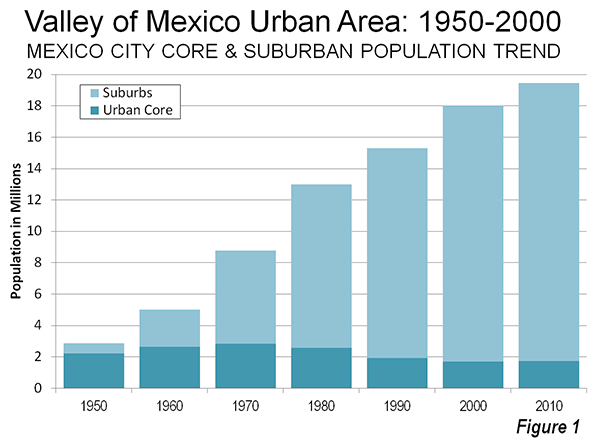
    Nearly 3 years ago, one of the first Evolving Urban Form articles highlighted the Valley of Mexico metropolitan area, which is Mexico City in its functional (economic) manifestation. That article noted that the core municipality of Mexico City in 1950 had 2.23 million residents out of the urban area’s fewer than 3 million and comprised only 54 square miles (139 square kilometers). By 1970, the city’s population had risen to 2.85 million. However, as has happened in Paris, Copenhagen, Milan, Osaka, Glasgow, Detroit, and many others, the urban core population plummeted. By 2000, the former city had a population of only 1.69 million, a 40 percent loss from 1970. There was a modest population increase between the 2000 and 2010 censuses, but its population seems unlikely to ever be restored to near their previous peak, which mirrors the experience of Paris and Copenhagen.

    Instead all population growth in the Valley of Mexico metropolitan area has been outside the 1950 area of Mexico City and in the post-World War II suburbs. While comparable metropolitan area data is not available, the Mexico City urban area added more than 10 million residents between 1970 and 2010. The same period, the suburban areas added more than 11 million residents (Figure 1). The Valley of Mexico metropolitan area is located not only in the Distrito Federal, but also in the states of Mexico and Hidalgo.

    The Other Major Metropolitan Areas

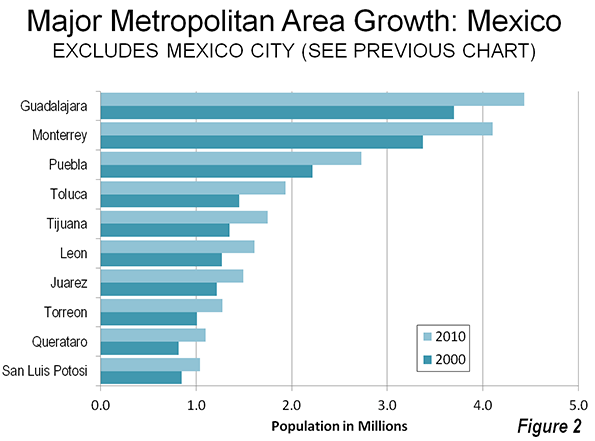
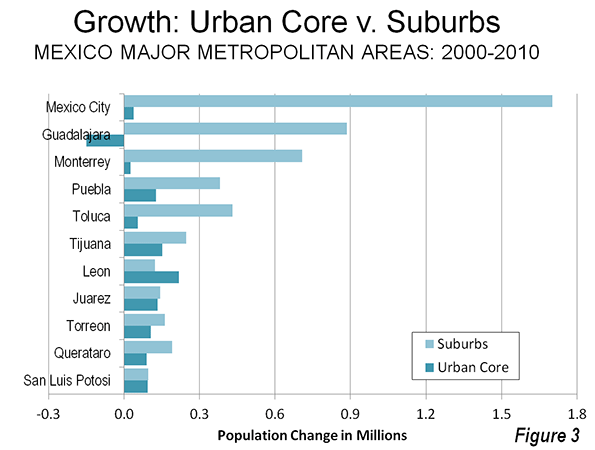
    While the scale of urbanization in the Valley of Mexico dwarfs that of the rest of the nation, similar dispersion is evident in the nation’s other 11 metropolitan areas with more than 1,000,000 population (Figures 2 and 3).

    Guadalajara

    Guadalajara, capital of state of Jalisco, is Mexico’s second largest metropolitan area. Between 2000 and 2010, the metropolitan area grew nearly 20 per cent, from 3.7 million residents to 4.4 million. The core city (locality) of Guadalajara lost 150,000 residents, registering a population of just under 1.5 million in 2010. Suburbs accounted for approximately all the metropolitan area’s population growth.

    Monterey

    Monterey, capital of the state of Nuevo Leon, is currently the third largest metropolitan area in Mexico and is growing slightly more rapidly than Guadalajara. Between 2000 and 2010, Monterey added 22 per cent to its population, which increased from 3.4 million residents to 4.1 million. The central locality grew modestly, but 97 per cent of the metropolitan area growth was in the suburbs.

    Central Mexico

    The Valley of Mexico metropolitan area is encircled by smaller, but major metropolitan areas that are among the fastest-growing in the nation.

    Queretaro, the capital of the state of Queretaro, is located 130 miles (220 kilometers) north of Mexico City by freeway. Queretaro is the fastest-growing major metropolitan area in Mexico, having added 34 per cent to its population over the last census period, to reach 1.1 million. More than two thirds of the growth was in the suburbs.

    Toluca, capital of the state of Mexico (Note), is located across a mountain range only 40 miles (65 kilometers) west of Mexico City. Toluca grew 33 percent to 1.9 million residents in 2010. Nearly 90 per cent of Toluca’s population growth was in the suburbs between 2000 and 2010.

    Pueblo, capital of the state of Puebla, is located across mountain range 130 miles (80 kilometers) to the east of Mexico City. Puebla is located in a valley surrounded by some of the most spectacular volcanoes in the world, including Popocateptl and Iztaccihuatl (both more than 17,000 feet, or 5,100 meters), toward Mexico City, La Malinche (14,600 feet or 4,500 meters), only 17 miles from the city center and Orizaba (18,500 feet or 5,600 meters). The three tallest of these reach elevations higher than any in North America outside of the Yukon and Alaska. Puebla was the slowest growing of the Central Mexico metropolitan areas, adding 23 percent to its population, and reaching 2.9 million residents in 2010. Three quarters of Puebla’s growth was in the suburbs. The Puebla metropolitan area extends into the state of Tlaxcala.

    Border Metropolitan Areas

    In comparison,   the large metropolitan areas on the United States border expanded outwards but not as rapidly. Tijuana, which is adjacent to the San Diego metropolitan area now has 1.75 million residents. More than 60 percent of its growth over the preceding 10 years was suburban. Juarez (located in the state of Chihuahua), is across the border from the El Paso metropolitan area and reached a population of 1.5 million, with slightly more than one half of its growth being in the suburbs. Neither San Diego-Tijuana area nor Juarez -El Paso qualify as metropolitan areas because they are not labor markets – there are significant limitations on the movement of labor (employees).

    Other Interior Metropolitan Areas

    Three other major metropolitan areas are located in the interior. In Torreon (states of Coahuila and Durango), more than 60 percent of the population growth was in the suburbs. A smaller 51 percent of the growth in San Luis Potosi (state of San Luis Potosi) was in the suburbs. The significant exception was Leon (state of Guanajuato), where only 36 percent of the growth was outside the core urban core.

    Continuing Dispersion

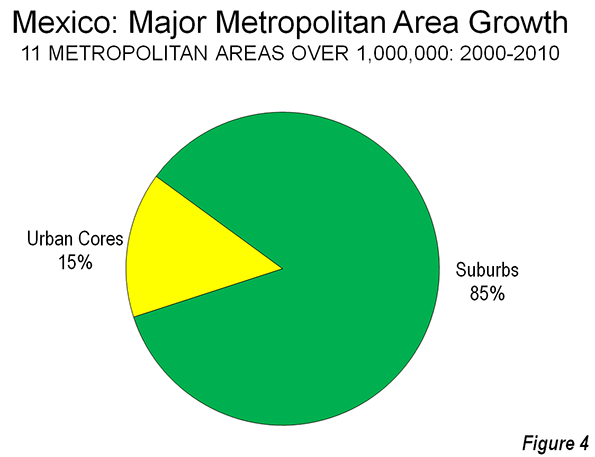
    Overall, 5.1 million of the 6.0 residents added to Mexico’s major metropolitan areas between 2000 and 2010 were outside the urban cores (Figure 4). Most of the growth was in the three largest metropolitan areas (Mexico City, Guadalajara and Monterrey), which added 3.2 million residents. The urban cores of these three metropolitan areas together declined approximately 100,000, while the suburbs attracted more than all of the metropolitan area growth. Mexico seems well positioned for continued economic growth and a populace that seeks better standards of living, more often than not in dispersed settings.

    Wendell Cox is a Visiting Professor, Conservatoire National des Arts et Metiers, Paris and the author of “War on the Dream: How Anti-Sprawl Policy Threatens the Quality of Life.

    —————-

    Note: The state of Mexico has the largest population in the nation, at 15.2 million (2010). This is 70 percent more than the second largest federal division, the Distrito Federal. This state of Mexico borders the Distrito Federal (Mexico City) on three sides and it outer suburban areas constitute more than one-half of the Valley of Mexico metropolitan area population (11 million of 21 million). Another 2 million are located in the even more distant state of Hidalgo. This state of Mexico also includes Toluca, another major metropolitan area (see above).

    ————

    Photograph: Southern suburbs of Guadalajara (by author)

    Correction: This version removes reference to Tijuana as the capital of Baja California. Mexicali is the state capital.

  • Searching Out The Half-Full Glass

    There is a shiny, brittle skin to the economic recovery that conceals an unhealthy flesh underneath. It is tempting to call this condition a glass half empty. But seeking the healthy and the fit in nontraditional places has become a quest for more and more Americans who are leading us down a pathway that diverges, from the mainstream towards a new future. Out of earshot of the mainstream media and off of Main Street, there is a glass half full.

    The official storyline of the economic recovery began in 2009 almost as soon as the stock market lost half its value, and masses of unemployed people listened to cheery reports that the recession was over, even as unemployment surged to 10%. With waning confidence in our institutions and leaders to guide us, people seemed genuinely at a loss to define a shared future of abundance and beauty. Since then, insidious corrosion has eaten away our traditional sources of optimism. In a sea change, the focus of many people is slowly shifting away from that glossy promotional veneer back towards person-to-person relationships and rebuilding moral capital one transaction at a time.

    For many employees, a fulfilling career is a lost dream, traded instead for salary and benefits. In this phase of the curve it is still an employer’s market, and most employers manipulate the terror over loss of job to their advantage. Working hours are now pretty much 24/7 for many people, taking work home on weekends; answering business emails and phone calls at all hours of the day and night.

    Today’s workers are jumpy and work far harder, for less than they had made in the before-times.
    Many employers, starved for profit in recent years, finally took what little profit they had in 2013, sharing little or none with the hardworking employees who had helped them to regain their economic footing. Those workers at the top who sweated the worst of it divided meager earnings among themselves, leaving little for the rest of the workforce.

    Mainstream America bravely soldiers on, making 2004 wages, but with 2014 expenses. We are presented with more stuff to buy, more media to consume, and more gadgets to worship. Experiences that were once fundamentally outside of the mainstream economy – one’s college years, for example – are now a big business. There seems to be no refuge from the insistent, shrill attempts to monetize everything. It is easy to feel pessimistic and just a little debased, and to begin feeling dissident urges. Under our noses, however, another America lurks.

    This is an America which hasn’t bought into the “too big to fail” system, and it has at least two demographic bases. The first is the portion of the millennial generation that has seen the damage done to their elders, and is now waiting it out, sneering at “suits” and instead creating its own economy out of localized, small moves. It operates with a healthy disregard for the establishment system. This group is in its first historical phase of creating its own food and shelter, carefully selecting strains of sustenance from local sources and operating a kind of “starting over” effort at the basic need level of the Maslow hierarchy. Food and shelter first, they reason; rebuilding a new system will come later.

    It’s a generation that has suffered from what philosopher Henri Lefebvre called the reproduction of the space of production in their youth. This somewhat laborious phrase cites the space of production – the factory floor – as the model upon which all the rest of our space has been molded. School, said Lefebvre, is molded upon the factory floor, where students are taught to memorize and obediently regurgitate facts to their teacher/boss. Business leaders, anxious to produce workers, insist upon teaching to standardized tests, to reproduce the results they expect upon graduation. Education is replaced with being taught the business culture.

    What Millennials reject is not so much the establishment itself, but rather the manager-worker relationship that has seeped into every corner of daily life, driven by the pressure for higher profits and faster throughput. What looks to boomers as sloth (because we are conditioned to respect this pace of production) is to them a form of dissent.

    It’s too soon to tell whether the millennial generation, like the boomers before it, will eventually succumb to the corporate world. Allied with them, however, are the new, immigrant Americans; people who have come to our shores to seek a new place to live and work. To the rest of the world, America is still the land of the free. People are escaping terrible conditions in cities like Cairo, Rio and Istanbul, and even more frustrating powerlessness in cities all around the world. To these new arrivals, many from non-OECD countries, America still represents opportunity.

    New arrivals are treated with suspicion by a xenophobic, fear mongering media precisely because they are correctly viewed as not-yet properly conditioned. Those immigrants who buy into the promise of wealth may perpetuate a realm that is corporate-dominated, but many others may not. Our genius is our open borders, and as a nation of immigrants America has always renewed itself with their diversity.

    A future of abundance and beauty must begin with small moves: a foundation upon which moral capital can be rebuilt. If integrity and trust can be found in simple transactions between individuals, then progress can indeed be made. It is here that a glass half full can be found, and it is here that the social space of America is being re-made. Dying strip malls are being replaced by farmer’s markets; vacant glass towers are being replaced by warehouse-based laboratory startups and home offices, just to name a few examples. This new generation, and these new immigrants, are proving that America is all right after all, and can rebuild itself without the worst trappings of the 20th century corporate world.

    These are small, unglamorous trends. If they occur without “help” from Wall Street or without government regulation, are they dissent? Then so be it. Good people can bring to society a sense of uncorrupted – dare one say humanistic? – values. Our half-full glass should include a re-creation of space on a new model: space modeled not on production, but rather upon a shared and positive vision of the future.

    Richard Reep is an architect and artist who has been designing award-winning urban mixed-use and hospitality projects, domestically and internationally, for the last thirty years . He is Adjunct Professor for the Environmental and Growth Studies Department at Rollins College, teaching urban design and sustainable development, and is president of the Orlando Foundation for Architecture. He resides in Winter Park, Florida with his family.

    Flickr photo by khersee: Warehouse — waiting to be repurposed?

  • Has Scott Walker Really Turned Around Wisconsin?

    I’ve seen a few pieces in the conservative press lately boasting about Scott Walker’s performance as governor of Wisconsin. For example, the American Spectator ran an article called “Wisconsin Thrives Under Scott Walker“:

    In 2011, Wisconsin had a whopping deficit of $3.6 billion dollars. But a cooperate tax cut and collective bargaining reforms invigorated the state economy. Now, the state is boasting a $911 million surplus, credited to “good stewardship of the taxpayers’ money.”

    And what will Walker do? Buy his wife a $19,000 dress? Increase his paycheck? Go on vacation? Nope. He’s proposing $800 million in tax cuts. “What do you do with a surplus? Give it back to the people who earned it. It’s your money,” Walker said.

    I find these articles revealing because they show how the Tea Party mindset has affected the definition of success in Republican circles generally. Why has Scott Walker been a success in their view? Because Wisconsin’s state government is financially healthy. The actual people of Wisconsin take a back seat to that. A friend of mine in Indiana summed up the mindset when she noted that many people today equate the financial health of government with the well-being of the people in the state.

    This I think is the Tea Party mindset writ large. As I’ve noted before, under Tea Party influence, Republicans have come to see government as purely a fiscal machine in which nearly the entirety of good policy consists in reducing the amount of money flowing through it. This is rooted in a single factor determinism view of economics. Much like Marxism, it has a base and a superstructure. The base in Tea Party thinking is government. If you shrink it, the theory goes, prosperity must inevitably follow.

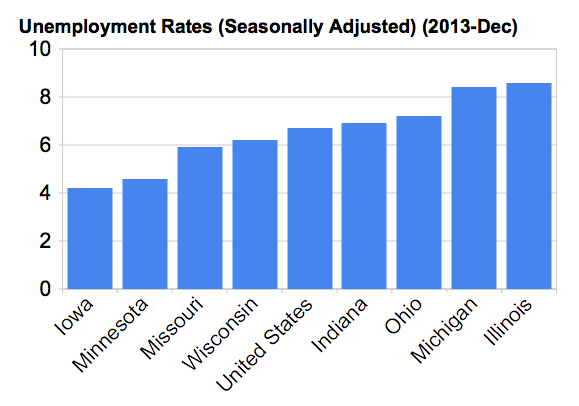
    The fiscal health of government is no doubt important. But to determine if Wisconsin is actually “thriving” you need to look at statistics that actually affect people. So let’s do that. Scott Walker took office in January 2011. So here is the percentage change in jobs in Midwest states between December 2010 and December 2013 from the Bureau of Labor Statistics:


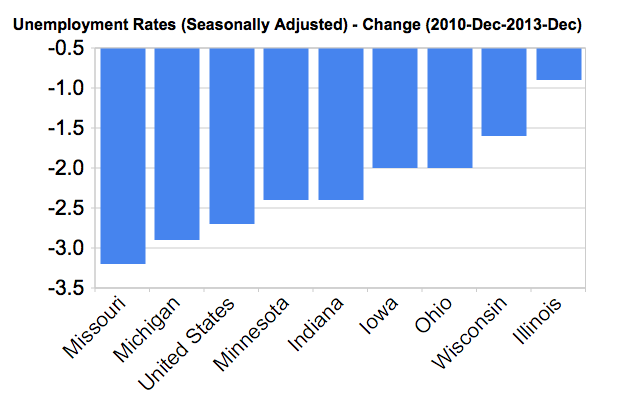
    Wisconsin actually doesn’t rank that well in job growth during Scott Walker’s administration, barely beating fiscal basket case Illinois. The state looks better in its unemployment rate:


    However, in part that’s because Wisconsin’s unemployment rate was already low on a relative basis when Walker took over. It ranks near the bottom in reducing its unemployment rate, though obviously reductions are harder to come by when you’re already lower. Michigan had nowhere to go but down.


    I actually support many of Scott Walker’s reforms. Public sector unions clearly need to be reigned in or even eliminated as they are a huge barrier to rational fiscal management and effective service delivery in addition to being an inherently corrupting political force. Items like allowing unions to force localities to buy health insurance through union affiliated firms at inflated rate were clearly abusive.

    It’s also early to judge, and this is monthly data that is fairly volatile, even though it’s seasonably adjusted and with a same month comparison. There just isn’t that much other data available.

    What I object to is declaring victory when the budget is balanced. The attitude exposed by this is profoundly revealing and shows everything that’s wrong with Tea Party type thinking. It’s obvious that people claiming Wisconsin has thrived under Walker didn’t even take a cursory look at the actual economic performance of the state.

    Wisconsin balanced its budget? Big deal. You’re supposed to balance the budget. That’s just doing your job. It shows how far we’ve come that you can receive plaudits simply for meeting what should have been the baseline expectation.

    The charts above should also cause a reconsideration of the notion that government finances are the primary determinant of business climate and economic growth. There are states on both the left and right of that issue that are both thriving and struggling. Part of it is that states have limited power in the modern economy. There’s only a limited amount they can do to make things better, whereas they can definitely screw it up.

    Also, the natural condition of a participant in a marketplace is failure. The vast majority of new businesses fail. Similarly, places can fail too, and having a budget surplus can’t necessarily stave that off.

    My view is that while state governments are weak actors and there’s a risk of screwing it up, the likelihood of failure in the marketplace is high enough that government does actually have to try to do things. By all means prudent finances and a good regulatory climate need to be maintained, but if you think that’s enough to save you, you’ve got another thing coming. Now that Scott Walker has repaired the budget, what’s his actual plan moving forward to try to build actual personal and marketplace success for Wisconsin residents and businesses? That’s what will determine his actual legacy. It’s in whether he boosts the fortunes of the state’s residents over the longer term, and manages to bend the curve of progress in a positive direction over time.

    Aaron M. Renn is an independent writer on urban affairs and the founder of Telestrian, a data analysis and mapping tool. He writes at The Urbanophile, where this piece originally appeared.

    Scott Walker photo by AndyLindgren.

  • Life as a Second City

    Imagine someone writes a newspaper story about you and prints the picture of your older, well-known sibling next to the column. It is clear to you why this was done: your sibling is more famous and recognizable. But how does that make you feel?

    Following the January 28th State of the Union address, PBS interviewed a number of civic leaders. One of those interviewed was the mayor of Tacoma, a city with many of the challenges and attributes of a second child.

    The older sibling (that is, Seattle) has a nationally recognizable architectural landmark and a larger economy, and there is a higher likelihood that people around the country have heard its name rather than Tacoma’s.  Should we be surprised, therefore, that when Mayor Marilyn Strickland was being interviewed, “(D) Tacoma Washington,” was written at the bottom of the screen, but behind her was an image of Seattle’s skyline? The Tacoma Dome, Downtown Tacoma, the Museum of Glass, and other Tacoma landmarks were notably absent on the screen. Instead of using the Seattle image and perhaps to suggest where the program was being taped, PBS had an opportunity to educate the public (and to be factually correct) by showing a picture of Ms. Strickland’s town, Tacoma. Instead, PBS reinforced Tacoma’s “second city” image by visually identifying it with a picture of its more famous sibling. You cannot imagine how bothersome this is to people who live in Tacoma. A local columnist lamented that with Seattle’s picture as the backdrop, it was hard to focus on what the mayor was saying.

    The “second city” phenomenon is not exclusively a Tacoma issue. Glasgow, Melbourne, Milan, Montreal, St. Paul, Long Beach, California and many other cities around the globe face a similar challenge. Either their identity has not been well-articulated, or it has not been understood by external observers. This is not a logo problem. It is not about a catchy phrase, and it is not about another cultural event. Unique architectural landmarks can create memorable identities, but these phallic symbols already dot cities the world over. Whether in Dubai, Barcelona, or Beijing, starchitects would be happy to add the next jaw-dropper to any city willing to deposit a large sum of public funds at their altars.

    But for smaller cities, this level of economic competition is not affordable. This is where the notion of “urban branding” comes in. Cities need an internally generated and well-articulated narrative of identity before they can be recognized externally. At the beginning of the twenty first century, many cities, including Tacoma, are finding themselves struggling with this notion at local, regional, and international scales. How does a city get out of the shadow of another city? How do you broadcast who you are? Creating hipster colonies or 24 hour entertainment districts does not always work. Cities like Tacoma already house museums, artist colonies, hip hangouts, and, yes, waterfront condos with killer views. Nevertheless, the glitzy brother 20 miles north casts a long shadow that may stunt growth and contribute to a feeling of self-doubt.

    To get out of this position, cities like Tacoma need more than cultural fairs and gimmicky tourist attractions. They need an inclusively created branding strategy. It is important that they know what works and what doesn’t, but strategies need to be based on a vision that gives the city the self-confidence it needs to move forward. Tacoma cannot be and should not be Seattle, in the same way that Long Beach is not and should not be Los Angeles. The identity of a city does not arise out of a formula calculated by the latest intellectual fashion, but from an inclusively-created vision that seeks input from the public, and asks help from experts, not the other way around. Perhaps one the worst ideas of the last twenty years has been an excessive reliance on “best practices” and “experts.” We need to learn about each other, but we need to do it our way and articulate a clear vision of who we are. The second child can also succeed.

    Table: Tacoma is about a third of Seattle in population. With a lower density, less expensive housing and a more affordable cost of living, its households are on average slightly larger than those living in Seattle. Its small city charm, stunning views and history rival any urban area in the nation.

    Tacoma & Seattle Quick Facts Seattle Tacoma Washington
    Population, 2012 estimate     634,535 202,010 6,895,318
    Population, 2010 (April 1) estimates base     608,660 198,397 6,724,543
    Population, percent change, April 1, 2010 to July 1, 2012     4.30% 1.80% 2.50%
    Persons under 5 years, percent, 2010     5.30% 7.00% 6.50%
    Persons under 18 years, percent, 2010     15.40% 23.00% 23.50%
    Persons 65 years and over, percent,  2010     10.80% 11.30% 12.30%
           
    White alone, percent, 2010  69.50% 64.90% 77.30%
    Black or African American alone, percent, 2010  7.90% 11.20% 3.60%
    American Indian and Alaska Native alone, percent, 2010      0.80% 1.80% 1.50%
    Asian alone, percent, 2010      13.80% 8.20% 7.20%
    Native Hawaiian and Other Pacific Islander alone, percent, 2010      0.40% 1.20% 0.60%
    Two or More Races, percent, 2010     5.10% 8.10% 4.70%
    Hispanic or Latino, percent, 2010      6.60% 11.30% 11.20%
    White alone, not Hispanic or Latino, percent, 2010     66.30% 60.50% 72.50%
           
    Foreign born persons, percent, 2008-2012     17.50% 13.50% 13.00%
    High school graduate or higher, percent of persons age 25+, 2008-2012     92.90% 88.00% 90.00%
    Bachelor’s degree or higher, percent of persons age 25+, 2008-2012     56.50% 24.70% 31.60%
           
    Housing units, 2010     308,516 85,786 2,885,677
    Homeownership rate, 2008-2012     47.30% 52.80% 63.80%
    Housing units in multi-unit structures, percent, 2008-2012     50.50% 35.00% 25.70%
    Median value of owner-occupied housing units, 2008-2012     $441,000 $230,100 $272,900
           
    Households, 2008-2012     285,476 78,447 2,619,995
    Persons per household, 2008-2012     2.06 2.46 2.52
    Per capita money income in past 12 months (2012 dollars), 2008-2012     $42,369 $25,990 $30,661
    Median household income, 2008-2012     $63,470 $50,439 $59,374
    Persons below poverty level, percent, 2008-2012     13.20% 17.60% 12.90%
           
    Land area in square miles, 2010     83.94 49.72 66,455.52
    Persons per square mile, 2010     7,250.90 3,990.20 101.2
    Source: US Census Bureau State & County QuickFacts
    Downloaded: February 8, 2014

    None of this, however, diminishes the responsibility of media outlets. Tacoma is not Seattle. A major news outlet should educate itself and the public by using accurate images. The next time a TV station invites the mayor of Tacoma to participate in a program, here’s hoping they don’t show the Space Needle in the background. 

    For now, people will be sleepless in Tacoma until they figure out their way out of being the second city.

    Ali Modarres is the Director of Urban Studies at University of Washington Tacoma.  He is a geographer and landscape architect, specializing in urban planning and policy. He has written extensively about social geography, transportation planning, and urban development issues in American cities.

    Tacoma photo by Flickr user Michael D. Martin.

  • Possible Sign of Trouble for Los Angeles

    A quarter century ago, the Los Angeles-Orange County area seemed on the verge of joining the first tier of global cities. As late as 2009, the veteran journalist James Flanigan could pen a quasiserious book, “Smile Southern California: You’re the Center of the Universe,” which maintained that L.A.’s port, diversity and creativity made it the natural center of the 21st century.

    A very different impression comes from a newer report, The Los Angeles 2020 Commission, which points out that, in reality, the region “is barely treading water while the rest of the world is moving forward.” The report, which focuses on the city of Los Angeles, points to many of the problems – growing poverty, a shrinking middle class, an unbalanced city budget, an underachieving economic and educational system – that have been building for decades.

    Sadly, “the 2020” report more accurately reflects L.A.’s current situation than Flanigan’s more optimistic view. All the more remarkable – and, perhaps, ironic – is that the signatures on the report come from many of the same political figures, union leaders and political advocates who have done so much to create this very sad situation. Disappointingly, the L.A. City Council already has started making its excuses, while the report’s authors, as the Daily News’ Rick Orlov notes, have already started “softening” their sometimes-harsh assessment.

    It is difficult, for example, to take seriously a report that, on the one hand, worries over pension costs but is signed, and supported, by the likes of County Labor Federation boss Maria Elena Durazo and L.A. Department of Water and Power union head Brian D’Arcy. For the most part, the commission was made up of lawyers and others who feed off the very pattern of insider deals and misdirected investment strategies that have so humbled a great city, and region. No surprise, then, that their biggest concrete recommendations were to speed up the pouring of concrete for their various pet projects, some of which make sense, while other don’t.

    Nevertheless, the report suggests that, perhaps, at last, even the most comfortably entrenched leaders are finally waking up to the predicament they and their colleagues have helped create. What they need now is a strategy that restores to Los Angeles the global status that is a prerequisite for progress.

    Why does being a global city matter so much? In large part, it is the best way to compete in a globalizing economy where the successful cities are defined not by size or population, but by the unique services they offer the world. In an ongoing study I am directing for the Chapman University Center for Demographics and Policy, with the assistance of the Singapore Civil Service College, we identified the leading world cities. We focused on such things as financial services, industrial specialization, media and culture.

    Size doesn’t always matter

    In the business of global cities, many of the biggest urban areas – in fact, all the largest ones, excluding Tokyo – failed to make the top 30. Instead, New York and London did best, along with such Asian cities as Tokyo, Hong Kong and Singapore. Perhaps our most surprising finding was that California’s two great metropolitan areas, the San Francisco Bay Area and Los Angeles, ranked sixth and seventh, respectively.

    Why, despite all its problems, is Southern California ranked so high? This is largely a reflection of several factors – notably, a still-sizeable tech sector, a huge port and strong cultural diversity – but, most importantly, because of Hollywood. Great global cities, by our calculations, are often what can be seen as “necessary cities.” They dominate economic niches to an extent that someone from outside the region is compelled to do business there.

    Hooray for Hollywood

    This is true, for example, for finance and media in New York and London, while the Bay Area dominates tech. Similarly, Hollywood is nearly synonymous with the American entertainment industry, which is by far the largest in terms of revenue and influence in the world. Last year, the industry enjoyed a trade surplus of roughly $12 billion; film and television industry exports totaled nearly $15 billion. Every major global movie studio in the world is located in Los Angeles, which is also a key hub of the music industry.

    So dominant is Los Angeles’ entertainment industry that many countries, trying to preserve their own cultural industries, have placed strict quotas on the number of English-language films that can be shown and songs that can be played on the radio. Los Angeles-Orange County once also enjoyed a dominant position in aerospace, but this industry has dramatically faltered, as the sector shrank by some 240,000 jobs as companies moved elsewhere, taking with them much of the region’s technical talent.

    The port of Los Angeles, another economic linchpin, remains somewhat dominant but the trade sector faces growing competition and suffers from the kind of institutional malaise that affects so much of business here. The region retains a foothold in the auto sector as the U.S. base for some Asian makers. Even here, however, there are clouds, as Nissan relocated to Nashville, Tenn., and Honda moved top executives to Ohio in order to be nearer to its manufacturing. More promising, the new Hyundai U.S. headquarters in Fountain Valley signals that global carmakers still see L.A.-Orange County as a “necessary” place.

    The region has held on to a leading, if somewhat smaller, share of entertainment, but L.A.’s other traditional industrial strengths, such as aerospace and defense, have badly eroded. One bright spot is technology. Somewhat surprisingly, the Startup Genome project ranked Los Angeles as having the second-strongest startup ecosystem in the United States. Yet, overall, L.A. has been losing ground in terms of employment, technology employment and net migration to other ascendant regions.

    Tech titans

    Perhaps the most critical factor affecting L.A.’s global status revolves around technology. It was shocking to me, at least, with L.A.’s focus on global ties, that the Bay Area has now slightly nosed out Southern California in our study’s rankings, largely due to that region’s technological preeminence. The region hosts the largest concentration of cutting-edge tech firms in the world. This fact alone allows the Bay Area to play a profound role in how globalization works, notes analyst Aaron Renn (www.urbanophile.com), particularly since innovations coming from that region arguably are a more primal enabler than advanced producer services. Indeed, according to one study, three Bay Area counties – San Francisco, San Mateo and Santa Clara – rank as the top three for concentration of tech jobs, and are among the leaders in growth.

    More serious still, Silicon Valley’s technological push is threatening to upend the structure of Hollywood and media. Over the past decade, Internet and software publishing, which are heavily centered in the Bay Area, have added close to 100,000 new jobs, while traditional media – based largely in New York and Los Angeles – have lost almost three times as many jobs.

    Google and Yahoo already are ranked among the largest media companies in the world. (Yahoo refers to itself as a digital media, rather than a technology, company.) Apple now has a great deal of control over consumer distribution of entertainment products like music and video. The entrance of Netflix, and other tech firms, into the television production business could further undermine L.A.’s entertainment dominance. To the new-tech oligarchs, older industries are prisoners to what one venture capitalist derisively called “the paper economy,” soon to be swept aside by the rising digital aristocracy.

    These issues, and challenges, are what the 2020 Commission people should be addressing in their search for solutions to the L.A. region’s relative decline. As our research indicates, Los Angeles-Orange County remains a major world city, but its upward trajectory is threatened by changes in technology and the rise of other regions in the U.S. and abroad. Now that members of the L.A. establishment have acknowledged “the truth,” perhaps it’s time for them to come up with ideas that can make the truth more pleasant.

    This story originally appeared at The Orange County Register.

    Joel Kotkin is executive editor of NewGeography.com and Distinguished Presidential Fellow in Urban Futures at Chapman University, and a member of the editorial board of the Orange County Register. He is author of The City: A Global History and The Next Hundred Million: America in 2050. His most recent study, The Rise of Postfamilialism, has been widely discussed and distributed internationally. He lives in Los Angeles, CA.
    Photograph: Downtown Los Angeles from Echo Park (by Wendell Cox)

  • How a Few Monster Tech Firms are Taking Over Everything from Media to Space Travel and What it Means for the Rest of Us

    The iconic view of tech companies almost invariably stress their roots in people’s garages, plucky individual entrepreneurs ready to challenge all comers. Yet increasingly the leading tech firms – Amazon, Apple, Facebook, Amazon and especially Google – have morphed into vast tech conglomerates, with hands in ever more numerous, and sometimes not obvious, fields of endeavor.

    Ironically, the very entrepreneurial form that defeated Japan’s bid for global technological dominance is morphing into an American version of the famed keiretsu that have long dominated the Japanese economy. The keiretsu,epitomized by such sprawling groups as Mitsubishi, Sumitomo and even Toyota, spread across a vast field of activities, leveraging their access to finance as a means to expand into an ever-increasing number of fields. The can best be understood, notes veteran Japan-based journalist Karel van Wolferen, as a series of “intertwined hierarchies.”

    Increasingly, American technology is dominated by a handful of companies allied to a small but powerful group of investors and serial entrepreneurs. These firms and individuals certainly compete but largely only with other members of their elite club. And while top executives and investors move from one firm to another, the big companies have constrained competition for those below the executive tier with gentleman’s agreements not to recruit each other’s top employees.

    At the top of the American keiretsu system stands a remarkably small group whose fortunes depend in part on monetizing invasions of privacy to use the Internet as a vehicle for advertising. These are not warm and cuddly competitors. Both Google and Microsoft have been accused of using anti-competitive practices to keep out rivals, in part by refusing to license technology acquiring of potential competitors.

    “Tech is something like the new Wall Street,” notes economist Umair Haque,“Mostly white mostly dudes getting rich by making stuff of limited social purpose and impact.”  

    Like their soul brothers on Wall Street , America’s elite tech firms – and their owners – have become fantastically cash rich.  Besides GE, a classic conglomerate, the largest cash hordes now belong to Apple, Microsoft, Cisco, Oracle and Google, all of whom sometimes have more dollars on hand than the US government.  Seven of the eight biggest individual winners from stock gains in 2013 were tech entrepreneurs, led by Jeff Bezos who added $12 billion to his paper wealth, Mark Zuckerberg who ranked in an additional $11.9 billion while Google founders, Sergey Brin and Larry Page, had their wallets expanded by roughly $9 billion.

    This wealth reflects in large part the oligopolistic nature of many key tech sectors, for example, the Apple-Google duopoly on mobile phone software, Microsoft’s dominant position in operating systems for PCs, Google’s utter control of search, and Facebook’s domination of social media. In most cases, these fields are controlled at levels of eighty percent or more.    

    America’s new gilded age giants are similar to Japan’s keiretsu but they also share a lineage with the early 20th Century trusts that controlled railroads, cotton, silver and other commodities. Those early fortunes helped provide the foundation for such banking firms as J.P. Morgan, Goldman Sachs, Oppenheimer, and Lehman Brothers, as well as the basis for the Rockefeller and Hearst empires. Their wealth, in the era before income taxes, was immense; by the 1880s the revenues of Cornelius Vanderbilt’s railroad empire were greater than those of the federal government.

    The control of immense resources by a small group of tech firms, like the oligopolies of the earlier industrial magnates, produces a steady cash-flow them to look further afield for new opportunities and expand into potentially huge new markets. But even more importantly, it gives them the opportunity to fail and still live to acquire another day.

    Google’s recent sale of Motorola’s mobile division, at a paper loss of nearly $10 billion, would have led to bankruptcy head-rolling at many firms but for Google it hardly left a scratch. A $10 billion failure barely threaten a company whose last quarterly revenues neared $17 billion, has cash on hand of over $56.5 billion and whose market cap is now nearly $380 billion.

    Indeed, if any of the tech powers on track to become a full-fledged keiretsu, it’s likely to be Google. Over the past year the company has ventured into a host of fields, such as robotics, energy, mapping, and driverless cars – fields that have great potential but are only tangentially related to their core business. The recentacquisition of Nest, a company founded by Apple alum Tony Fadell , brings Google into the “smart home” marketplace, part of the so-called “internet of things”. This gives these firms a new capacity to harvest ever greater information hauls from your once “dumb,” but at least private, household appliances.

    These investments and cross-industry ties are changing firms like Google in fundamental ways.  As industry veteran Michael Mace observes, Google has stopped being a “unified product company” and is turning instead into what he calls “a post-modern conglomerate.” Its goal, he notes, is no longer to dominate search, or even the internet, but to invest, and hopefully, control anything that uses information technology, including everything from logistics and medical devices to the most mundane household devices.

    By investing widely and eating up developing markets, the “the Gang of Four” internet companies—Microsoft, Apple, Facebook and Google—have two key advantages: almost unlimited capital resources, and tech expertise and credibility. Allied with venture firms, and a vast reservoir of technical experts, the tech oligarchies, for example, already  dominate such promising fields robotics, with Silicon Valley home to half of all venture invested in the field, over 70 percent of employees, and a whopping 90 percent of market cap.  

    Others are turning to space, a field once dominated by NASA, once a key contractor for the Valley. Headquartered in the old aerospace center of Los Angeles, Space X, the largest of the space startups, was founded by billionaire Elon Musk, who previously founded PayPal and Tesla. By 2013, Space’s X’s total employment, including contractors, topped 3800.

    Musk is not alone in the space game. Amazon CEO Jeff Bezos founded his own private space exploration company, Blue Origin, which has launched two vehicles into space, Charon and Goddard. It intends to build orbital space stations, and serves as a contractor for NASA. Like the nascent space industry’s third new player, Richard Branson’s ‘Virgin Galactic,’ these firms are all the pet projects of billionaires fascinated by space. If NASA continues to retreat from many areas of space exploration, it is likely that in the future the heavens too may end up belonging to the oligarchs.

    The Media power-shift

    A Google or Amazon space-ship may still be in the distant future, but we can already see the impact of the new keiretsu on information and culture. In the past, more hardware-oriented companies provided the “pipelines” through which traditional media disseminated their product. But increasingly, it’s the tech oligarchs who control the news and information industry.

    Google, by some estimates, already enjoys more advertising revenues than either the newspaper or magazine industry. And they’re positioned to take over the the hardware side by supplanting the traditional telecommunications companies with their own series of global pipelines.

    This big tech takeover also previews a geographic shift from traditional centers of power like New York and Los Angeles to the new seats of influence, most notably Silicon Valley, San Francisco and the Puget Sound area.

    The transitions of power and influence have come at heavy costs. 

    As the new software-based media expanded over the last decade, massive losses have pummeled newspapers, music, book and magazine publishing Since 200. The paper publishing industry, traditionally concentrated in the New York area, has lost some 250,000 jobs, while internet publishing and portals generated some 70,000 new positions, many in the Bay Area or Seattle.

    To the new oligarchs, the old media are just part of what one venture capitalist derisively called “the paper economy” destined to be swept away by the new digital aristocracy. As relatively young people who have already amassed fortunes, the tech giants have the time to disseminate their views to the public, both the mass and the influential higher echelons. Another $200 million new venture with a mission to support largely left of center investigative reporting, is being backed by eBay founder Pierre Omidyar.

    Buying up prestigious media outlets, an old tactic for consolidating influence that was previously used by gilded age moguls like William Randolph Hearst, has surfaced among the new tech giants, exemplified in the recent purchase of the venerable New Republic by Facebook co-founder, and Obama tech guru, Chris Hughes, who is reportedly worth $850 million.

    But perhaps more critical than buying old outlets will be the growth of their own oligarch controlled news media. Yahoo is now the #1 news sites in the U.S. with 110,000,000 monthly viewers, and Google News isn’t far behind at #4 with 65,000,000 users. The Valleyites are also moving into the culture business with both YouTube (owned by Google) and Netflix now creating original entertainment content.

    The tech firms control over media is likely to become even more pervasive as the millennial generation grows and the older cohorts begin to die off. Among those over 50 only 15 percent, according to a Pew report get their news over the internet; among those under 30, the number rises to 65 percent.   

    Impact on Innovation

    Is this concentration of tech power a good thing? To some extent, the country benefits from having a Google, Amazon, Microsoft or Apple at the forefront of such fields as healthcare, robotics and space. They possess the resources and the technical know-how to develop and market new product lines that smaller, more specialized start-ups might lack.

    Indeed the shift of resources from social media and advertising to robotics or space travel has to be considered a basically positive development. Unlike the social media revolution, which appears to have done relatively little to benefit the overall economy, the developments in space travel or driverless cars, may provide advantages that are more widely shared.

    Yet, there is also a major problem with over-rich and over-confident oligopolies. It’s a lesson demonstrated by Japan’s arc over the past two decades and in the story of the big three US automakers and their era of domination – both examples show how concentration of power can stifle innovation and positive growth. Already some economists see a slowing in the pace of technical breakthroughs. In the 1980s personal computer boom, scores of companies competing across a broad array of tech sectors resulted in few long-term winners but a rapid evolution of technology. In contrast, it is not easy to argue that Google’s search function or Microsoft’s code are any better today than they were three or even five years ago.

    As the tech firms move further from their entrepreneurial roots, one critic notes,many take on “a timid, bureaucratic spirit” that responds to the needs of investors and focuses on preserving already established business lines.

    Would we be better off with say, a garage-bound Steve Jobs developing the software for robotics, rather than having development managed in a corporate structure that answers the demands of Wall Street analysts? Trusting a small, often closely knit group of investors, to oversee critical industries of the future, does not seem to be the best strategy to maintain and deepen our technological lead.

    Digital innovation should be spurring the creation of new competitive companies. Yet,  instead it is fostering an American version of the Japanese keiretsu, where firms like Amazon, Google, Apple and Microsoft try to use their unfathomable riches to dominate the entire technological future. This is not a step forward but one that can limit Americans’ ability to renew the entrepreneurial genius at the heart of our national character.

    This story originally appeared at The Daily Beast.

    Joel Kotkin is executive editor of NewGeography.com and Distinguished Presidential Fellow in Urban Futures at Chapman University, and a member of the editorial board of the Orange County Register. He is author of The City: A Global History and The Next Hundred Million: America in 2050. His most recent study, The Rise of Postfamilialism, has been widely discussed and distributed internationally. He lives in Los Angeles, CA.
    Facebook photo by BigStockPhoto.com.