Blog

  • San Francisco Photo Essay: I Used to Live Here

    This is my old apartment in SF’s Mission District from way back when Mrs. UpintheValley and I were just dating.  My waystation before cohabitation and matrimony. I notice the curtains haven’t changed.  Flea market bedspreads and pillowcases were the order of the day then, and apparently still are.  Which means P. has kept the lease on the place and presumably lived in uninterrupted squalor with a revolving cast of characters from Roommate Finders all these years.  At the prices we were paying then, why would you ever leave?  The rest of the neighborhood has…evolved, beginning with the ground floor. Man, has it ever.

    DSCN2226

    For example, the launderia, where I once had a load of jeans stolen, is now a yoga studio…

    DSCN2227

    …and is buttressed by a vegan restaurant.  The corner liquor store beneath my old bedroom is now a supper club with gilt lettering in the window.  The dive bar at the other corner, where day laborers used to drink their wages beneath the deathly pallor of fluorescent tube lighting and stagger out to the alley to relieve themselves against the wall, is now a pretentious cocktail lounge with velvet curtains.

    DSCN2228

    The New Mission:  High end condos where the old $1 dollar movie palace used to be, but the marquee remains to satisfy the historic preservationists.

    DSCN2261

    Dogs and bikes are ubiquitous in the new SF.

    DSCN2267

    Unlike LA, the bike is king in the new social arrangement.  Bike lanes are everywhere.  Bicyclists are entitled to use the full lane if they choose, and they do so. You may not squeeze them to the side as you pass.   There are reasons for this. One of them is: people who write programming code like to ride bikes, and the people who write code are making it rain in San Francisco.

    DSCN2331

    Construction is everywhere….

    DSCN2346

    They’ve just built the two tallest apartment buildings on the West Coast.

    DSCN2315

    Way out in the Avenues, 3BR starter homes sell for $1 million+ sight unseen, all cash, to Chinese investors, the other group making it rain. No one in the neighborhood seems to know who the buyers are, but everything goes in multiple offers.  You see a guy like this at a cake shop on Taraval, yakking away in Mandarin, and you find yourself inordinately interested in someone else’s mundane conversation.   I’ll say this for the Asians: not a spec of trash or tagging to be found West of Twin Peaks and I only saw one house in disrepair in three days of strenuous walking.

    DSCN2317

    Trails, trails, trails, everywhere…with plenty of parking.   For a city drowning in New Money, San Francisco, unlike LA, has managed to retain at least one bedrock principle of the social contract.

    DSCN2253

    But back to the Mission.  One still encounters the old army of derelicts and panhandlers, but you just don’t find as many Latinos there anymore. Its identity as a landing place for working class immigrants to get a toehold in the economy is rapidly being eclipsed by the brute facts of New Money.  If people of the Twitterverse are willing to spend a million dollars to share a block with schizophrenic crack addicts then there is a diminished geography remaining for line cooks and seamstresses to occupy.   Or drywall installers. Or yoga instructors.   Or maintenance men.  The Latino working class is abundant in Van Nuys.  In San Francisco, it is memorialized in murals.

    DSCN2255


    DSCN2338

    Last image on the way out of town….a concise acknowledgement of the obvious:  the laptop has replaced the pickaxe in the digital Gold Rush.  Unlike their 19th century counterparts, the gold miners are actually making the money.  The dry goods dealers and shopkeepers work for them.  How long can this last? What happens when Apple stops selling 400, 000 iPhones a day?  Social media and gaming and on-line retail are built on code.  Code can be written anywhere. Angry Birds was designed in Finland.  Tell me how this movie ends.

    Andreas Samson lives and works in Van Nuys and blogs about the San Fernando Valley at upinthevalley.org.

  • America’s Future Cities: Where The Youth Population Is Booming

    To identify economic hot spots in the making, we often look for where immigrants, young people or entrepreneurs are clustering. But perhaps nothing is a better indicator than those who truly make up generation next — America’s children.

    Several major factors determine where the most children are being born, and more importantly, raised, says demographer Wendell Cox. Three key ones are economic growth, affordability and lower population densities.

    Using the Census Bureau’s 2012 American Community Survey, Cox looked at the under 14 populations of the nation’s 51 metropolitan statistical areas with over a million residents, and also traced the changing numbers in this age group since the onset of the Great Recession in 2007. Finally he broke down each of these metro areas between their core cities and suburbs to determine where within the region children are the most predominant.

    Thesuburbs have sometimes been described as the nurseries of the nation, but surprisingly the outer rings generally did not outperform core cities in terms of births over the period we examined. In the core cities of our 51 largest MSAs, newborns to 4-year-olds made up 6.9% of the population in 2012, compared to 6.3% in the suburbs. But even here, it’s not the “hip and cool” cities leading the way – San Francisco, Seattle and Boston were all well below the average. Generally the highest proportions of young children were in lower-density cores of such cities as Oklahoma City, Dallas, Charlotte, N.C., and Houston. (Two metro areas with denser urban cores, Milwaukee and Hartford, also made the top  10.)

    But something dramatic happens as children age: They and their parents start moving to the suburbs in massive numbers. In both the 5-to-9 and 10-to-14 cohorts, suburbs easily surpass core cities in virtually every major metropolitan area. So while the popular perception that many downtowns are now overrun by baby strollers is not necessarily an urban myth, it ignores what happens to families as children get older and ambulatory, requiring more space, needing to go to school and more susceptible to getting into trouble.

    In addition, Cox notes, not only are there higher concentrations of children in suburbs in the vast majority of metro areas, the overall greater population on the periphery makes the suburbs home to the preponderance of families. This is one reason that most of the fastest-growing counties in the U.S. are either suburbs or exurbs. Roughly 23.9 million children below the age of 14 live in the suburbs of our 51 largest metro areas compared to 8.6 million in the core cities.

    Families and Opportunity

    Perhaps nothing attracts families on the move more than economic opportunity. The old adage “the rich get richer and the poor have babies” may no longer fit in the United States. In fact, in most high-income societies, the birth rate is shaped increasingly by economic conditions. The Great Recession, for example, reduced fertility in most major countries, including the United States, which traditionally has enjoyed somewhat higher birth rates than its high-income competitors in East Asia and Europe.

    But with the gradual economic recovery in the United States, the decline in birthrates has endedand could return to the levels of the more prosperous 1990s and early 2000s.  This dynamic plays out as well on the local level. Birthrates tend to have remained stable in metro areas with stronger economies during the recession. In booming North Dakota, births actually increased.

    Not surprisingly, metropolitan areas with the consistently strongest economies in terms of job creation and income growth dominate our list of the cities with the highest share of children under 14 in their populations. In our top-ranked metro area, Salt Lake City, children make up 24.7% of the population, and in second place Houston, they account for 23.0%.

    Affordability

    The second major factor driving child demography is the cost of housing, which is the principal driver of the cost of living. Virtually all the areas with high proportions of children have median home price to annual income ratios of three to four. In some cases, low home prices seem to trump economic malaise. This may help explain the relatively high under 14 population in No. 4 Riverside-San Bernardino, Calif.

    Conversely high housing prices can also limit the ability of even prospering areas to grow families. This is most obvious in the relatively low ranking of the New York metro area (41st), with a median home price to income multiple of 6.2.  San Francisco-Oakland, home to the highest housing prices in the nation with a median multiple rapidly approaching 9, ranks 45th place. Pricey Boston ranks 46th. Policies designed to prevent the construction of single-family homes, particularly in the Bay Area, all but guarantee that housing prices will remain high, and toxic for all but wealthy households.

    Density

    Despite the hopes of some urbanists, most families prefer lower-density living, particularly single-family houses. Between 2000 and 2011, detached house accounted for 83% of the net additions to the occupied housing stock in the United States. A survey sponsored by the National Association of Realtors suggests that roughly 80% of Americans prefer a single-family house to either an apartment or townhouse.

    Correspondingly, expansion in the number of families and children has been occurring overwhelmingly in less dense areas. The fastest growth in the under 14 population since 2007 has been almost entirely in what can be described as heavily suburbanized low-density areas, led by greater New Orleans, Raleigh, San Antonio, Charlotte, Nashville, and Houston. In contrast, the biggest drop off in the number of children has been in metropolitan areas with higher urban densities, with the most dense, Los Angeles, also suffering the largest decline. The 10 metropolitan areas with the largest declines in their youth populations had urban densities averaging 45 percent more than the 10 with the greatest gains.

    The Urban Future and Fertility

    What does this tell us about the future of our urban regions? Since families are a critical component of growth in any metropolitan areas, those with higher percentages of children are likely to grow far faster than those that are made up increasingly of childless households. This trend should accelerate as the millennials, now entering their 30s, begin to form families. Children boost the demand for certain goods, notably houses and certain kinds of retail, and also increase demand for many services, notably schools.

    Given the current economy, most of our top metropolitan areas can be expected to continue growing, particularly those, like Houston and Dallas, that have become increasingly hospitable to immigrants; the foreign-born account for one out of every four women giving birth in the country. Minorities overall are the ones driving population growth; last year  there weremore white deaths than births.

    But some traditionally fertile metropolitan areas might see a real slowdown, notably Riverside-San Bernardino, where income and job growth is lagging well behind housing costs.  At the same time, we can expect continued slow growth in the populations in those areas towards the bottom of the list. To be sure, migration of older people from cold climates will keep Miami (47th on our list) and Tampa-St. Petersburg (second from last) growing, particularly as the boomers age. Such a movement can not anticipated in many other low-ranked cities ranging from relatively prosperous Pittsburgh (last place) to less affluent Buffalo, Providence and Cleveland.

    We can also anticipate the evolution of some metropolitan areas with low percentages of children — such as Boston, San Francisco, New York and Los Angeles — will slow not just demographically, but also economically as younger workers look to establish families elsewhere.  This may be somewhat counterbalanced by foreign immigration, but these newcomers, particularly those without huge financial resources, are also increasingly migrating to lower-density cities.

    Having children in your region certainly does not guarantee success, but without them, metro areas will face a more rapid aging of their populations and workforces, something that historically does not produce robust economies but gradual decline.

    YOUNG POPULATION: MAJOR METROPOLITAN AREAS: 2012
    Ages 0-14
    MMSA MMSA% Core City % Suburban %
    Atlanta, GA 21.6% 15.9% 22.1%
    Austin, TX 21.2% 18.9% 23.1%
    Baltimore, MD 18.6% 18.3% 18.8%
    Birmingham, AL 19.7% 19.0% 19.9%
    Boston, MA-NH 17.3% 14.4% 17.7%
    Buffalo, NY 17.1% 19.5% 16.4%
    Charlotte, NC-SC 21.4% 19.6% 22.8%
    Chicago, IL-IN-WI 20.2% 19.0% 20.6%
    Cincinnati, OH-KY-IN 20.3% 19.5% 20.5%
    Cleveland, OH 18.3% 19.4% 18.0%
    Columbus, OH 20.4% 19.6% 21.1%
    Dallas-Fort Worth, TX 22.9% 22.0% 23.1%
    Denver, CO 20.5% 19.0% 21.0%
    Detroit,  MI 19.1% 20.7% 18.8%
    Hartford, CT 17.4% 21.1% 17.0%
    Houston, TX 23.0% 21.8% 23.6%
    Indianapolis. IN 21.6% 21.2% 22.0%
    Jacksonville, FL 19.3% 19.7% 18.6%
    Kansas City, MO-KS 21.1% 20.8% 21.2%
    Las Vegas, NV 20.4% 20.1% 20.6%
    Los Angeles, CA 19.4% 18.7% 19.7%
    Louisville, KY-IN 19.5% 19.3% 19.7%
    Memphis, TN-MS-AR 21.6% 20.9% 22.2%
    Miami, FL 17.3% 16.2% 17.4%
    Milwaukee,WI 20.1% 22.9% 18.4%
    Minneapolis-St. Paul, MN-WI 20.4% 19.5% 20.7%
    Nashville, TN 20.1% 18.7% 20.9%
    New Orleans. LA 19.2% 18.3% 19.6%
    New York, NY-NJ-PA 18.4% 17.9% 18.9%
    Oklahoma City, OK 21.0% 22.1% 20.1%
    Orlando, FL 18.8% 20.2% 18.6%
    Philadelphia, PA-NJ-DE-MD 18.8% 18.9% 18.7%
    Phoenix, AZ 21.4% 22.9% 20.7%
    Pittsburgh, PA 16.0% 12.9% 16.5%
    Portland, OR-WA 19.2% 16.5% 20.2%
    Providence, RI-MA 17.2% 18.3% 17.0%
    Raleigh, NC 21.6% 19.8% 22.7%
    Richmond, VA 18.8% 17.0% 19.2%
    Riverside-San Bernardino, CA 22.8% 23.9% 22.7%
    Rochester, NY 17.6% 19.2% 17.3%
    Sacramento, CA 19.9% 19.9% 19.8%
    Salt Lake City, UT 24.7% 18.5% 25.9%
    San Antonio, TX 21.7% 21.8% 21.6%
    San Diego, CA 19.0% 17.1% 20.3%
    San Francisco-Oakland, CA 17.4% 13.6% 18.8%
    San Jose, CA 20.0% 20.5% 19.4%
    Seattle, WA 18.7% 13.4% 19.8%
    St. Louis,, MO-IL 19.2% 17.9% 19.3%
    Tampa-St. Petersburg, FL 17.1% 18.7% 16.8%
    Virginia Beach-Norfolk, VA-NC 19.1% 18.0% 19.3%
    Washington, DC-VA-MD-WV 19.5% 14.8% 20.1%
    Calculated from American Community Survey Data

    This story originally appeared at Forbes.com.

    Joel Kotkin is executive editor of NewGeography.com and Distinguished Presidential Fellow in Urban Futures at Chapman University, and a member of the editorial board of the Orange County Register. He is author of The City: A Global History and The Next Hundred Million: America in 2050. His most recent study, The Rise of Postfamilialism, has been widely discussed and distributed internationally. He lives in Los Angeles, CA.

    Crossing the street photo by Bigstock.

  • The Illusions of Charles Montgomery’s Happy City (Part 2)

    This is the second of a two-part series discussing Charles Mongomery’s Happy City. Read part one here.

    ‘The system that built sprawl’

    Montgomery faces the hurdle of explaining why, if low-density suburbs cause unhappiness, so many millions of people, over so many decades, across several countries, flocked to that way of life. As he writes, ‘since 1940, almost all urban growth has actually been suburban.’ He must account for this fact, even though it means little to him personally. For the green-tinged intelligentsia, working and middle-class people are pawns who rarely think for themselves.      

    Still, in Montgomery’s case the hurdle is high, since his objections to dispersion go much further than conventional gripes about fragile economic foundations. Happy City does peddle the myth, in passing, that the financial crisis brought suburbanisation to a crashing halt. There’s an assertion that ‘census data in 2010/2011 showed that major American cities showed more growth than their suburbs’, and a hope this points to forces ‘systemic and powerful enough to permanently alter the course of urban history’. Montgomery even compares buying a detached home on the urban edge to ‘gambling on oil futures and global geopolitics’. As it turns out, he misconstrues the available data. Suburbanisation barely missed a beat in the United States and continues in earnest. 

    Montgomery’s essential point, though, is that suburban life is contrary to deep-seated human yearnings. This endows him with an even more patronising attitude to working people than his forerunners Richard Florida – who endorses the book – and Edward Glaeser. One line of argument in Happy City, which also features in Glaeser’s Triumph of the City, claims dispersion was forced on people by greedy land owners and property developers in cahoots with weak-kneed or compromised politicians and officials.

    He puts it his way: ‘sprawl, as an urban form, was laid-out, massively subsidized and legally mandated long before anyone actually decided to buy a house there … it is as much the result of zoning, legislation and lobbying as a crowded city block.’ In another chapter, Montgomery warns of the challenge for pro-density New Urbanism: ‘the system that built sprawl – huge state subsidies, financial incentives and powerful laws – is still in place.’ Popular preferences don’t even rate a mention. Similar comments appear throughout the book, adding up to an audacious feat of historical revisionism.

    The standard interpretation of urban evolution, from the walking city to the monocentric and then polycentric metropolis, places breakthroughs in transport technologies first, most notably railways, streetcars (trams) and affordable motor vehicles, followed by mass shifts in transportation modes and population movements second, with land owners and politicians ready to exploit the new conditions. Of course, transportation technologies have such a powerful impact because of pent up demand for space and lower densities.

    Essentially, Montgomery reverses the causative sequence, claiming government and business interests dragged people to the fringes and this induced a transformation of transportation modes, which may or may not have been viable under prevailing technologies. This anomalous theory puts him at odds with some of the most recognised urban thinkers:  

    • Lewis Mumford in The City in History: ‘what has happened to the suburb is now a matter of historic record … as soon as the motor car became common, the pedestrian scale of the suburb disappeared …’
    • Peter Hall in Cities in Civilization, discussing Los Angeles: ‘the car was doing more than decentralize; it was decentralizing in a new way’.
    • Robert Bruegmann in Sprawl: A Compact History: ‘families wishing to live at lower densities could be seen as the primary cause of the growth in … the railroad, public transportation and finally the automobile industry … each of these means of transportation did, in fact, give families increased mobility.’
    • Joel Kotkin in The City: A Global History: ‘as automobile registrations soared in the 1920s, suburbanization across the rest of [the United States] also picked up speed, with suburbs growing at twice the rate of cities.’
    • Shlomo Angel in Planet of Cities: ‘a third and more radical transformation, from the monocentric to the polycentric city, began in the middle decades of the twentieth century with the rapid increase in the use of cars, buses, and trucks.’

    Such quotes can be piled up all day long.    

    Happy City is open to the same criticism as Glaeser’s book, namely that as a matter of chronology, urban dispersion took off before the interstate highway system, tax deductibility of home mortgage interest, the relative decline of inner-city schools, many development controls, and other factors cited by both as having pushed Americans to the periphery. In Downtown: Its Rise and Fall 1880-1950, Robert Fogelson explains that ‘by the mid and late 1920s, however, some Americans had come to the conclusion that the centrifugal forces were beginning to overpower the centripetal forces – or, in other words, that the dispersal of residences might well lead in time to the decentralization of business.’ And suburbs have been popular in countries other than the US, like Australia, where these sorts of factors are absent.

    Blinded by science

    For his part, Montgomery envisages an alternative past, in which demands for space and mobility hardly figure. ‘Well, the path that led … to today’s sprawl was not straight’, he writes, ‘it meandered back and forth between pragmatism, greed, racism and fear.’ Rewriting history may be audacious, but that’s just the beginning. The book doesn’t stop at denouncing suburbanisation as a form of organised compulsion. Montgomery’s ultimate purpose, drawing on ‘happiness science’, is to expose suburban life as a mass delusion. ‘We need to identify the unseen systems that influence our health and control our behaviour’, he writes.     

    Much of Happy City is devoted to a succession of studies and experiments by a range of neuroscientists, psychologists and behavioural economists on the conditions that stimulate feelings of well-being and contentment. Montgomery focuses on research into different spatial environments: densely or sparsely populated, high-rise or street-level, crowded or uncrowded, mixed-use or homogenous, auto-dependent or walkable, near or far from nature, and so on.

    Many people have no clue that their deeper inclinations are out of synch with their surroundings, he maintains, painting a less than flattering portrait of human nature. ‘The more psychologists and [behavioural] economists examine the relationship between decision-making and happiness,’ he repeats in various ways, ‘the more they realize … we make bad choices all the time … in fact we screw up so systematically …’

    Building a case that most of us are hobbled by delusions, Montgomery delights in claiming ‘we are far less rational in our decisions than we sometimes like to believe …’, and ‘we regularly respond to our environment in ways that seem to bear little relation to conscious thought or logic.’ Personal motives can be reduced to a stew of physiological and chemical stimuli, all summed up in a single paragraph:  

    Neuroscientists have found that environmental cues trigger immediate responses in the human brain even before we are aware of them. As you move into a space, the hippocampus, the brain’s memory librarian, is put to work immediately … it also sends messages to the brain’s fear and reward centres … it’s neighbour, the hypothalamus, pumps out a hormonal response … before most of us have decided if a place is safe or dangerous … places that seem too sterile or too confusing can trigger the release of adrenaline and cortisol, the hormones associated with fear and anxiety … places that seem familiar … are more likely to activate hits of feel-good serotonin, as well as the hormone that … promotes feelings of interpersonal trust: oxytocin.

    Nowhere is it acknowledged that if rational choice is devalued, people might end up being treated less like autonomous citizens and more like laboratory rats. Happiness ‘can’t be summed up by the number of things we produce or buy’, the book insists, ‘but the firing synapses of our brains, the chemistry of our blood …’

    Montgomery proceeds to grab hold of anything that discredits the real-life choices of suburbia’s teeming millions. One of many concepts he takes from neuroscience is ‘information propagation’. By operation of the hippocampus and other parts of the brain, we are told, our ‘concept of the right house, car or neighbourhood might be as much a result of happy moments from our past or images that flood us in popular media as of any rational analysis.’ From psychology he borrows the concept of ‘adaptation’, described as a ‘characteristic that exacerbates such bad decision-making [namely] the uneven process by which we get used to things.’

    He considers these important explanations for the appeal of suburban lifestyles when denser neighbourhoods are better for physical and mental health, at least according to his interpretation of studies and experiments on walking, cycling, social encounters, community activities, public space, streetscapes, grid planning, on-street parking and traffic velocity.  

    But his method of selecting a body of research, cobbling the results together, and equating this to the preconditions for a happy life, suffers from a fallacy of composition ─ the error of inferring that something is true of the whole from the fact that it is true of some part of the whole. Although Montgomery claims ‘most people, in most places, have the same basic needs and most of the same desires’, it doesn’t follow that research findings on parts of life should add up to a real whole life.

    Kirk Schneider, a prominent American psychologist, writes in Psychology Today that ‘prevailing studies of happiness … represent but a circumscribed range of how such phenomena are actually experienced on the ground, so to speak, in people’s everyday worlds.’ Schneider cautions that ‘those things represent only slices of life, not life itself.’

    There’s no reason why urban planning should start from abstract assumptions drawn from a bunch of controlled experiments, rather than from masses of people weighing up their full, lived experience.   

    In this and other ways, the book succumbs to a disturbing strain of authoritarianism. History teaches us to beware a state that deals with people through the prism of theories which second-guess their inner thoughts and feelings, rather than according to their outward conduct. Freedoms are at risk whenever powerful functionaries claim to know what people are thinking, because of ‘false consciousness,’ ethnic stereotypes, biological determinism, or whatever. And Montgomery is no freedom-fighter: ‘we are pushed and pulled according to the systems in which we find ourselves, and certain geometries ensure that none of us are as free as we might think.’  

    ‘Make them feel rich’

    In the end, Happy City fails to prove the assertions trumpeted in its opening pages. It fails to produce any direct evidence connecting flatlining assessments of well-being or rising rates of depressive illness to ‘sprawl’. Nor is there any indirect evidence from which a connection can be inferred. Just as research on parts of life don’t add up to a whole real life, neither can studies and experiments finding discontent in particular conditions translate to generalised disenchantment with a whole way of life.

    Montgomery’s style is to fill the gaps with a series of conveniently chosen anecdotes and vignettes, some designed to trash suburbia and others to wrap a glowing aura around transit-oriented density. Randy Straussner’s super-commuting horror story, which never goes away, is an example of the former. But the star of the book, and prominent case of the latter, is ‘The Mayor of Happy’.

    At the helm of impoverished Bogota between 1998 and 2001, Enrique Penalosa cancelled a highway expansion plan, used the funds for hundreds of miles of cycle paths, hiked fuel taxes by 40 per cent, banned drivers from commuting by car more than three times a week, introduced car-free days, dedicated a new chain of parks and pedestrian plazas, and built the city’s first rapid transit system. This made him a guru to green urbanists like Montgomery, who was inspired to write Happy City.

    ‘We might not be able to fix the economy’, Penalosa is quoted as saying in the book, ‘we might not be able to make everyone as rich as Americans … but we can design the city to give people dignity, to make them feel rich.’ Confronting an unemployment rate of 18 per cent when Penalosa left office, however, many Bogotans would have longed for the real thing. 

    John Muscat is a co-editor of The New City, where this piece first appeared.

  • The Evolving Urban Form: The San Francisco Bay Area

    Despite planning efforts to restrict it, the Bay Area  continues to disperse. For decades, nearly all population and employment growth in the San Jose-San Francisco Combined Statistical Area has been in the suburbs, rather than in the core cities of San Francisco and Oakland. The CSA (Note) is composed of seven adjacent metropolitan areas (San Francisco, San Jose, Santa Cruz, Santa Rosa, Vallejo, Napa, and Stockton). A similar expansion also occurred in the New York CSA.

    The San Francisco Bay Area is home to two of the three most dense built-up urban areas in the United States, the San Francisco urban area, (6,266 residents per square mile or 2,419 per square kilometer) with the core cities of San Francisco and Oakland and the all-suburban San Jose urban area (5,820 residents per square mile or 2,247 per square kilometer), according to US Census 2010 data. Only the Los Angeles urban area is denser (6,999 per square mile or 2.702 per square kilometer). The more spread out New York urban area trails at 5,319 per square mile (2,054 per square kilometer).

    The San Francisco Bay & Central Valley Area

    The continuing dispersion was reflected in commuting patterns that developed between 2000 and 2010, with the addition of the Stockton metropolitan area, which is composed of San Joaquin County, with more than 700,000 residents. San Joaquin County is located in the Central Valley and is so far removed from San Francisco Bay that it may be appropriate in the long run to think of the area as the "San Francisco Bay & Central Valley Area." The distance from Stockton to the closest point shore of San Francisco Bay is 60 miles, and it is nearly another 25 miles to the city of San Francisco.

    Ironically, this continued dispersion of jobs and residences is, at least in part, driven by the San Francisco Bay Area’s urban containment land use policies designed to prevent it. What the planners have ignored is the impact on house prices associated with highly restrictive land use planning. The San Francisco metropolitan area and the San Jose metropolitan area are the third and fourth most unaffordable major housing markets out of 85 rated in the recent 10th Annual Demographia International Housing Affordability Survey, trailing only Hong Kong and Vancouver.

    Historical Core Cities: San Francisco and Oakland

    The historical core municipalities (cities) of the San Francisco Bay Area, San Francisco and Oakland have held their population very well. Each essentially retains it 1950 borders. Among the 40 US cities with more than 250,000 residents in 1950, only San Francisco and Oakland managed population increases by 2000 without substantial annexations and substantial non-urban (rural) territory within their city limits. For example, New York and Los Angeles, both of which have grown, have nearly the same city limits as in 1950 and 2000, yet much of New York’s Staten Island was rural in 1950 as was much of the San Fernando Valley in Los Angeles.

    Yet both San Francisco and Oakland have had difficult times. Between 1950 and 1980, both San Francisco and Oakland suffered 12 percent population losses, which were followed by recoveries. The losses were modest compared to the emptying out of municipalities like St. Louis. Detroit, Chicago, Copenhagen, and Paris, which remain one quarter to nearly two-thirds below their 1950s figures. Further, population gains from annexations masked losses within the 1950 boundaries of many cities, such as Portland, Seattle, and Indianapolis, etc.

    San Jose: Now the Largest City

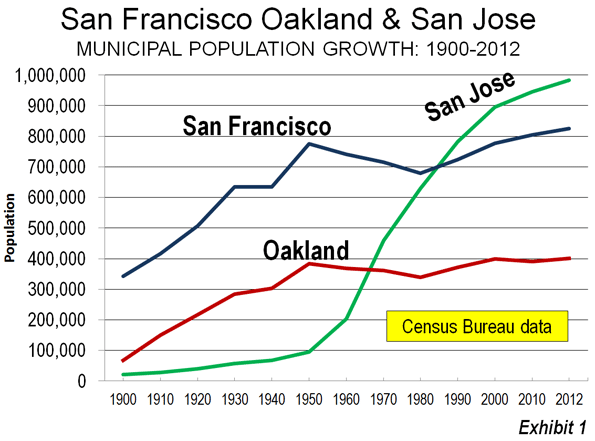
    San Jose is now the Bay Area’s largest city. San Jose has grown spectacularly, from a population of 95,000 in 1950 to nearly 1,000,000 today. San Jose passed San Francisco by the 1990 census and Oakland by the 1970 census (Figure 1). Virtually all of San Jose’s population growth has occurred during the postwar period of automobile suburbanization. The pre-automobile urban form familiar in San Francisco and central Oakland simply does not exist in San Jose. Even attempts to pretend the pre-war urban form has returned have been famously unsuccessful. Even after building an extensive light rail system, San Jose’s transit work trip market share is barely one quarter that of the adjacent San Francisco metropolitan area.

    Nonetheless, suburban San Jose has become a dominant force in the "Silicon Valley", which stretches through San Mateo County in the San Francisco metropolitan area and into Santa Clara County, which includes San Jose. The Silicon Valley has been the capital of the international information technology business for at least a half century. The highly suburbanized region has done more than its share to elevate the San Francisco Bay Area to its high standard of living (According to Brookings Institution data), a phenomenon that has spread also the urban core of San Francisco. At the same time, San Jose is the second most affluent major metropolitan in the world and San Francisco ranks seventh. The Silicon Valley, which includes much of San Mateo County (adjacent to Santa Clara County in the San Francisco metropolitan area), is clearly the economic engine of the region with twice as many jobs as San Francisco (which is both a city and a county).

    Metropolitan Growth

    Overall, the San Francisco Bay Area has grown approximately 180 percent since 1950, considerably more than the national average from 1950 to 2012 of 107 percent. The Bay Area’s growth was strong, but well behind the 280 percent growth achieved in the Los Angeles CSA (Los Angeles, Riverside-San Bernardino, and Oxnard MSAs).

    However, growth has since moderated substantially. Between 1950 and 2000, the Bay Area grew at an annual rate of 1.9 percent but since 2000, the annual growth rate has dropped to 0.7 percent annually. Even so, in recent years, the Bay Area has nearly equaled the much slowed growth of the Los Angeles CSA, adding 23.6 percent to its population since 1990, compared to 25.5 percent in Los Angeles. Both areas, however, grew at less than the national population increase rate (25.8 percent), and slowing, in the 2000s to the slowest growth rates since California became a state in 1850.

    Suburban Growth

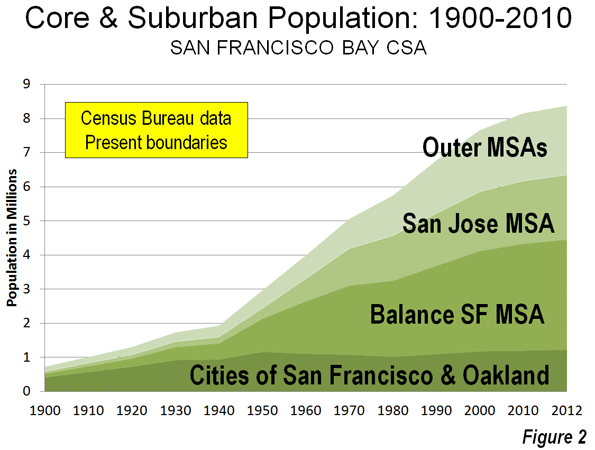
    Despite the decent demographic performance of the cities of San Francisco and Oakland since 1950, nearly all Bay Area growth occurred in the suburbs. Between 1950 and 2012, only one percent of population growth in the CSA occurred in the two historical core municipalities and 99 percent in suburban areas. Things have been somewhat better for the two cities since 2000, with seven percent of the growth in the historical core municipalities and 93 percent of the growth in suburban areas (Figure 2).

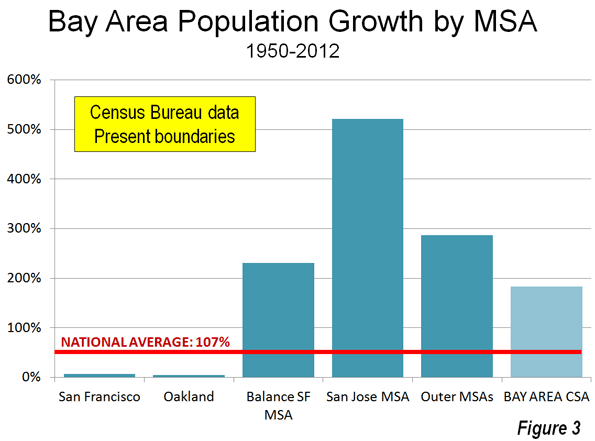
    Since 1950, the San Jose metropolitan area has grown by far the fastest in the CSA, with the more than 500 percent increase in population. The outer metropolitan areas (Santa Cruz, Santa Rosa, Vallejo, Napa, and Stockton) have grown nearly 300 percent, while the parts of the San Francisco metropolitan area outside the two core cities grew more than 200 percent. San Francisco and Oakland grew approximately 5 percent (Figure 3).

    Domestic Migration

    As house prices increased before the subprime crisis, the Bay Area lost more than 600,000 domestic migrants, a rate of more than 85,000 per year. Since 2008, however, with substantially lower house prices, and a renewed tech boom, there has been an annual gain of approximately 4,000 to the Bay Area in domestic migration. However, if the substantial house price increases since 2012 continue, the area could again become a net exporter of people.

    Future Urban Evolution

    Like much of California, San Francisco Bay CSA exhibits much slower population growth than before. How much of this is tied to the regional and state policies constricting suburban housing remains an open question, but it seems much growth that might have occurred in the original San Francisco metropolitan area or the later developing San Jose metropolitan area will instead occur in the Vallejo or Stockton metropolitan areas, where housing prices  tend to be much lower, particularly for larger homes that are increasingly unaffordable closer to the urban core. Indeed, it is not impossible that Modesto (Stanislaus County) could be added  to the San Francisco Bay CSA by 2020, which is even farther away from the historical core than the Stockton metropolitan area.

    At the same time, many potential new residents may find either the high prices near the core nor the long commutes associated with Central Valley residence unappealing. Many households may instead seek their aspirations in Utah, Colorado, Texas, and even Oklahoma, not least because the "California Dream" has been made affordable.

    Wendell Cox is a Visiting Professor, Conservatoire National des Arts et Metiers, Paris and the author of “War on the Dream: How Anti-Sprawl Policy Threatens the Quality of Life.

    —–

    Note: Metropolitan areas are labor markets. Their building blocks in the United States are complete counties. Metropolitan statistical areas are organized around built up urban areas with counties reaching a threshold of the urban area population being considered central counties and included in the metropolitan area. In addition, any county with an employment interchange of 25 percent or more with the core counties is also included in the metropolitan area. Adjacent metropolitan areas are added together to form Combined Statistical Areas if there is a 15 percent or more employment interchange. This is a simplified definition. Complete details are available from the US Office of Management and the Budget.

    Photo: Market Street, San Francisco (by author)

  • City-Specific Immigration Visas Would Be a Modern Day Indentured Servitude

    An idea that’s been kicked around by many is to help turn around struggling cities like Detroit by offering geographically limited immigrations visas. That is, to allow foreigners get their green card if they agree to live in a particular city for a certain number of years.

    Michigan Gov. Rick Snyder has now officially endorsed the concept, calling for Detroit to be awarded 50,000 city-specific immigration visas for skilled workers over five years. As the NYT put it:

    Under the plan, which is expected to be formally submitted to federal authorities soon, immigrants would be required to live and work in Detroit, a city that has fallen to 700,000 residents from 1.8 million in the 1950s.

    “Isn’t that how we made our country great, through immigrants?” said Mr. Snyder, a Republican, who last year authorized the state’s largest city to seek bankruptcy protection and recently announced plans to open a state office focused on new Americans.

    Later, he added, “Think about the power and the size of this program, what it could do to bring back Detroit, even faster and better.”

    The appeal of the idea is obvious. I’ve probably said positive things about it myself in the past. But examine it more closely and it’s clear this is an idea that’s fatally flawed. By requiring immigrants to live and work in the city of Detroit for a period of time, this program would effectively bring back indentured servitude, only instead of having to work for the people who paid for their trip to America, these immigrants would have to work for Detroit.

    I’ve got to believe that the courts would look skeptically at such a scheme that so radically restricts geographic mobility and opportunity. What’s more, I think it’s plain wrong to invite people into our country with the idea that they are de facto restricted to one municipality.

    L. Brooks Patterson, county executive of wealthy Oakland County in suburban Detroit, took huge heat again this week when he was quoted in the New Yorker saying “I made a prediction a long time ago, and it’s come to pass. I said, ‘What we’re gonna do is turn Detroit into an Indian reservation, where we herd all the Indians into the city, build a fence around it, and then throw in the blankets and the corn.’” Yet isn’t this idea of city specific visas almost literally treating Detroit like a reservation, only for immigrants instead of Indians?

    Some have likened this to programs to entice doctors to rural areas by paying for medical school. I’m not sure how all of those are structured, but they may have questionable elements as well. But more importantly, my understanding is that they are purely financial, where medical school loans are paid off in return for a certain number of years of service. If a doctor elects to leave the program, they are in no worse shape than someone who didn’t sign up would be. They are still licensed to practice medicine and have to repay their loans just like every other doctor.

    I don’t think Gov. Snyder is motivated by any ill will in this. I think he’s genuinely looking for creative solutions to the formidable problems Detroit faces. He’s taken huge heat for finally facing up to the legacy of problems there, and hasn’t shied way from making tough calls. He’s even willing to call for some bailout money, which many in his own party don’t like. But this idea is a bad one. He should withdraw it, and the federal government should by no means open to the door to these types of arrangements.

    Immigrants remain a great way to pursue a civic turnaround, however. Detroit just needs to lure them on the open market the same way Dayton, Ohio and others are trying to do.

    Aaron M. Renn is an independent writer on urban affairs and the founder of Telestrian, a data analysis and mapping tool. He writes at The Urbanophile, where this piece originally appeared.

    Photo by telwink

  • Commuter tax on Suburbanites Working in Indianapolis?

    According to the Indianapolis Star, Mayor Greg Ballard of Indianapolis is poised to improve the slowing growing city’s competitive position relative to the suburbs.  The Star  noted:

    "Indianapolis may be a bigger draw than surrounding areas in attracting young residents, but it’s got a problem."

    "Right as they begin raising families, many in their 30s split for the suburbs — taking their growing incomes, and the local taxes they pay, to bedroom communities in Hamilton, Johnson, Hendricks and other counties."

    Mayoral Chief of Staff Ryan Vaughn told The Star that initiatives would include a focus on improving schools, and public safety, both of which had much to do with the decades long declines of US central cities. Vaughn told the newspaper that "Ballard wants to focus on strategies to compete more fiercely with suburban counties that draw — and keep — middle- and higher-income residents."

    Certainly, the fact that central cities are far safer today than they were when New York’s Mayor Rudolph Giuliani implemented his much copied policy of intolerance toward crime in the early 1990s. Even so, Mayor Ballard has it right. Long term, sustainable recovery of cities as livable environments within the metropolitan economy requires both good public schools and an environment in which parents feel that they and their children are safe.

    There is a cautionary note however. While the Mayor’s office is on the right track in wanting to solve the endemic problems that have so weakened core cities such as Indianapolis, he has yet to take a position on a proposed commuter tax that would be levied against employees who live in suburban counties and work in the city. This would make the suburbs more attractive for employers who are presently located in the city. Further, it would make the suburbs more competitive to businesses that choose the Indianapolis area for relocation. Trying to attract and keep middle income households, while repelling business makes little sense.

  • America’s Glass Half-empty, or Half-full?

    The stock market is high, real estate prices have resurged, even the unemployment rate is dropping, yet Americans still feel pretty down about the future. A survey released in January by the AP-NORC Center for Public Affairs Research had 54 percent of respondents expecting American life to go downhill over the coming decades. In a December survey, 23 percent of respondents said things will improve over time.

    Yet, in reality, there are several huge trends – economic, environmental, demographic – working in favor of the United States. Despite 13 straight years of underwhelming leadership, the U.S. can emerge extraordinarily blessed from the Great Recession and lackluster recovery, if Americans take advantage of our current situation.

    Why, then, so glum? One explanation clearly is the shape of the economic recovery, which, due in part to Federal Reserve monetary policy, has favored the rich by primarily promoting stock market and other asset growth. “Qualitative easing,” notes one former high-level Fed official, essentially constituted a “too big to fail” windfall for the largest Wall Street firms. Executives at these same firms set new compensation records in 2011, just three years after the financial “wizards” left the world economy on the brink of economic catastrophe.

    As people on Wall Street, and their hipper counterparts in Silicon Valley, celebrate their good fortune, most people are not doing well, and they know it. Unemployment may have dropped officially, but the percentage of Americans in the workforce is now at the lowest level since December 1977. Huge parts of our society now face long-term unemployment or, at best, a marginal existence at the low end of the job market.

    This trend is most disturbing because it has been going on for a long time and, generally, has been getting worse. Since 1973, for example, the rate of growth of the “typical family’s income” in the United States has slowed dramatically; for males, it has actually gone backward when adjusted for inflation, at least until the early 1980s. In contrast, in 2012, the top 1 percent of earners accounted for one-quarter of all American income, the highest percentage in the past century.

    So, given these problems, why should anyone be optimistic? After all, by 2020, the CIA suggested in 2005, the U.S. world position will have eroded because of the rise, most notably, of India and China; many business leaders share this assessment.

    Nevertheless, here are five reasons for optimism.

    Everyone else is in worse shape

    Looking for a global hot spot that’s doing better? Look again. Virtually all America’s much-vaunted competitors of yesterday – notably, Japan and the European Union – have suffered slow economic and demographic growth. The much-ballyhooed winner of tomorrow, China, also appears to be slowing. Political corruption, soaring local debt and massive levels of pollution are creating a crisis of confidence, reflected by the growing exodus of the educated and affluent from China and Hong Kong , with many ending up in the United States.

    The other members of the so-called BRIC countries – a term coined by one of the geniuses at Goldman Sachs – also are stagnating. Brazil’s successful bids to host the 2016 Summer Olympics and this summer’s soccer World Cup have made ever more obvious the country’s massive poverty and political incompetence, made all the worse by a slowing economy. India, too, is experiencing weak growth and increased political instability. Russia’s uncrowned czar, Vladimir Putin, may be outmaneuvering our gullible, indecisive president but the country Putin controls is going nowhere, with the population stagnating and its weakening economy utterly dependent on extractive resources. Turkey, another favorite of the investment banks, is also showing signs of distress and instability.

    Energy revolution

    Barack Obama has tried to take credit for America’s huge shift toward self-sufficiency in oil and gas, a movement driven largely by wildcatters and independents. Of course, it would have never happened if he had his druthers; under his administration, energy production on federal lands has dropped steadily. Nevertheless, the president seems smart enough not to shut off this amazing development on private and state lands, despite incessant pressure from his environmentalist supporters.

    The energy revolution, notably in natural gas, changes everything. It allows us to tell many of the world’s leading malefactors – Russia, Venezuela, Iran and Saudi Arabia – to keep their oil. It also is driving continued improvement in air quality and reduced levels of greenhouse gases. American natural gas, rapidly replacing coal as an energy source, has turned this country into what one green think tank, the Breakthrough Institute, called “the global climate leader.” We are lowering our emissions far more rapidly than are the Europeans, people widely praised by some U.S. greens for having superior policies.

    Manufacturing resurgence

    For all the concern expressed about the “end of the car era,” the U.S. auto industry is doing pretty well, in fact, selling vehicles at about the levels experienced before the Great Recession. General Motors, nearly dead five years ago, is now investing $1.3 billion to upgrade five Midwest factories. New auto plants, particularly those of European and Asian carmakers, are being erected across the South. But the resurgence of U.S. manufacturing is about more than cars; there also is huge investment in other industries, notably in pharmaceuticals and refining, notably tied to the energy revolution.

    Critically, the vast supplies of oil and, most importantly, natural gas, are pushing down manufacturing costs well below those imposed on Asian and European firms. This is where industrial jobs have been growing the fastest, and are likely to expand in years ahead. In fact, U.S. industrial and energy production has driven U.S. exports to a record level, one clear sign that the nation’s competitiveness is beginning to move beyond our traditional strengths in entertainment, services and agriculture.

    Demographic advantages

    As in other countries, The U.S. birth rate fell during the recession, but this decline has now stopped as the economy has crawled back. Over the past decade, the U.S., through somewhat high birth rates and immigration, has avoided the kind of demographic implosions that afflict most of our key competitors. In the next few decades, the working population of Americans is expected to grow substantially, while those in Japan, Korea, Europe and China all taper off.

    America’s relative youth helps not only fiscally – with more young people to carry the burden of a swelling retiree population – but also culturally. Despite the rise of entertainment and media in other countries (for example, Bollywood films or Korean pop music), the domination of new culture remains overwhelmingly American. Critically, this applies not only to Hollywood but even more so to digital media, where U.S. domination is both overwhelming and terrifying our competitors, particularly the autocrats in Moscow and Beijing.

    Blessings of federalism

    Perhaps America’s greatest strength lies in its constitutional order. Unlike other countries, the U.S. was defined by a separation of powers that accommodates regional differences. The calls from Washington by both Left and Right for more national solutions is misplaced; whether used to promote conservative or liberal policies, one size does not fit nearly all in a country as diverse and differentiated as the United States.

    Instead, we need to let our states and regions seek out the approaches that work best for them. If Ohio and Pennsylvania allow fracking, and it creates significantly better results than those in anti-fossil-fuel states like New York and California, that would send a message to other states, but does not have to reflect a national policy.

    America’s regions have enormous assets and advantages in the global economy. If we allow them to exploit what they have, there may be more hope for the future than many now believe.

    This story originally appeared at The Orange County Register.

    Joel Kotkin is executive editor of NewGeography.com and Distinguished Presidential Fellow in Urban Futures at Chapman University, and a member of the editorial board of the Orange County Register. He is author of The City: A Global History and The Next Hundred Million: America in 2050. His most recent study, The Rise of Postfamilialism, has been widely discussed and distributed internationally. He lives in Los Angeles, CA.

    USA map image by BigStockPhoto.