Blog

  • Blue-Collar Hot Spots: The Cities Creating The Most High-Paying Working-Class Jobs

    It’s a common notion nowadays that American blue-collar workers are doomed to live out their lives on the low-paid margins of the economy. They’ve been described as “bitter,” psychologically scarred and even an “endangered species.”  Americans, noted one economist, suffered a “recession” but those with blue collars endured a “depression.”

    Yet in recent years, according to research by Mark Schill of the Praxis Strategy Group, there’s been a strong revival in higher-paid blue-collar industries in many of our largest metropolitan areas, and the momentum is, if anything, building. Schill analyzed employment changes from 2007 to 2013  among a group of higher-paying blue-collar industries: oil and gas and mining; construction; manufacturing; and wholesale trade, transportation, warehousing and waste handling. Compensation in these sectors average $58,000 a year; in oil and gas, pay tops $100,000. In any case, these fields pay far better than alternative sources of employment for people without college degrees, such as retailing ($27,500), food service ($16,000), hospitality, or the arts ($31,000). Nationally, this cross section of higher-value blue-collar industries employs 31.3 million people, just more than a fifth of the nation’s workforce, up 1.3 million jobs since 2010.

    This blue-collar resurgence seems likely to be  more than a merely cyclical phenomenon. The U.S. edge in energy and manufacturing, increasingly linked, has sparked major new investments by both domestic and foreign producers. The new energy finds have created employment in the construction and operation of such things as pipelines and refineries, and have also led manufacturers to plan new factories here due to electricity and feedstock costs that are now well below those in Europe or East Asia.

    The Boston Consulting Group suggests other factors sparking this revival. This includes  rising wages in China as well as sometimes unpredictable business conditions that are leading some large U.S. companies to move some production to America from China.

    Overall, since 2010 the number of high-value manufacturing jobs is up 167,000 in the 52 largest metropolitan areas while energy extraction added 50,000 positions. (Heavily subsidized renewables enjoyed a much smaller increase.) The wholesale trade and material handling sectors have added almost 300,000 jobs in  that time. And as the economy has recovered somewhat, demand for housing, including in some once distressed exurban areas, has sparked a nascent revival in higher-paying construction employment. This key blue-collar sector, devastated by the recession, has gained roughly 200,000 jobs since 2010.

    This revival is not evenly spread. The big winner is the Houston metro area, in large part due to the energy industry, which has added 23,000 jobs since 2010. It also reflects local growth in the high-wage manufacturing (up 30,000 jobs) and trade and transport sectors (up 26,000), while construction employment has surged nearly 20,000, a number matched only by the much larger New York metro area. Houston tops our list of the cities creating the most good blue-collar jobs. (Our ranking is based 50-50 on growth from 2007-13 and 2010-13.) Not far behind in second place is Oklahoma City, which has clocked a similarly broad increase, led by 28% growth in energy employment, 6% in construction and 15% in manufacturing.

    Many of the other metro areas in our top 10 fit the same mold — traditionally business-friendly Sun Belt locales with strong energy sectors, and expanding manufacturing.

    A Surge In The West

    The Intermountain West also continues to create manufacturing and trade jobs at a rapid rate. This region’s blue-collar star is Salt Lake City, which places seventh on our list, led by a strong expansion in energy sector employment and trade and transport, with decent growth in manufacturing.

    It’s not merely a “red state” phenomena. Progressive-dominated Denver places 11th on our list, with 32% growth in energy jobs as well as a 10% increase in construction employment. Similarly Portland (9th) and Seattle (10th) have produced more opportunities for blue-collar workers. This has been paced largely by strong growth in manufacturing, aided by low energy costs from hydro. Intel INTC +0.2% is building a large new factory near Portland, while Boeing BA -2.5% has continued to add jobs in the Seattle area – its headcount in Washington State is up 17% since 2010. Construction has also been healthy, in part due to migration from more expensive California, as well as trade, which ties into the region’s close ties to the Pacific Rim.

    In contrast the “big enchilada” economies of California have lagged, and overall employment in high-paying blue collar sectors remains well below 2007 levels. But since 2010, there has been a modest uptick in manufacturing and construction in San Jose/Silicon Valley, which ranks 13th on our list, while San Francisco (16th) has seen some recovery in the transportation and trade sectors.

    The Revival Of The Rust Belt

    No part of the country is more associated with high-paid blue-collar work, and its decline, than the Rust Belt. Employment in most Rust Belt cities is well below 2007 levels, but since 2010 there has been a resurgence in high-paying manufacturing industries, led by the third-ranked Detroit area, which added 37,000 jobs.

    This is clearly tied to the recovery of the U.S. auto industry. The East and West Coast media love to yammer about the demise of the car, but the industry’s production has returned to 2007 levels and automakers are investing in the region. GM has committed to spend over $1.3 billion to upgrade five factories in Ohio, Indiana, Detroit and the nearby Michigan cities of Flint and Romulus.

    It’s more than an autos story in the region. Grand Rapids, which has a highly diverse manufacturing sector, including many furniture companies,  has increased industrial employment 16% since 2010, putting it fourth on our list. Other Rust Belt metro areas making a blue-collar comeback  are Louisville, Ky. (12th), Minneapolis (15th), Columbus, Ohio (18th), and Pittsburgh (19th).

    The Laggards

    Some metro areas have continued to lose high-wage blue-collar jobs, led by Las Vegas (down 4.2% since 2010), Orlando (-13.6% since 2007), Providence, Rochester and Philadelphia. Our two largest industrial metro areas, Chicago and Los Angeles, have seen slow growth, ranking 25th and 28th, respectively. Rapidly de-industrializing New York ranks 35th, despite the metro area’s surge in construction employment.

    Yet overall, demand is rising for highly skilled workers at U.S. industrial and energy companies.

    At a time when the wages of college graduates have been falling, it might behoove more young people to realize that, in many cases, a degree in art is not worth as much as a certificate for machining, welding, plant management or plumbing. Some metro areas are bolstering their efforts in this area, notably New Orleans, Columbus, Nashville and even creative class-oriented Portland.

    To be sure, the golden days for working-class employment are over, but the future may prove to be a lot less dismal, particularly in some regions, than generally proclaimed by those who have rarely seen in the inside of factory or a refinery.

    Blue Collar Industry Growth Index
    Rank Region (MSA) Score Growth, 2010-2013 Growth, 2007-2013 2013 Avg Earnings Concentration, 2013
    1 Houston 97.3 12.6% 6.6% $102,726 1.41
    2 Oklahoma City 95.2 12.6% 4.4% $68,526 1.00
    3 Detroit 80.5 13.5% -12.3% $80,964 1.10
    4 Grand Rapids 80.2 11.3% -6.5% $66,157 1.30
    5 Nashville 80.1 12.1% -8.7% $64,217 1.01
    6 Austin 78.6 10.0% -4.7% $84,780 0.88
    7 Salt Lake City 71.7 8.3% -6.5% $67,794 1.09
    8 Dallas 70.3 7.2% -5.2% $79,645 1.15
    9 Portland 68.8 8.4% -9.7% $78,439 1.13
    10 Seattle 66.7 7.6% -9.5% $84,921 1.06
    11 Denver 66.1 6.9% -8.3% $77,652 0.94
    12 Louisville 64.4 6.3% -8.3% $66,783 1.26
    13 San Jose 62.2 5.4% -8.1% $148,369 1.20
    14 Charlotte 61.7 7.2% -13.5% $67,555 1.05
    15 Minneapolis 61.4 6.0% -10.2% $80,834 0.99
    16 San Francisco 60.2 6.3% -12.3% $96,017 0.82
    17 San Antonio 60.1 3.8% -5.7% $57,763 0.80
    18 Columbus 59.7 5.9% -11.7% $67,612 0.91
    19 Pittsburgh 59.0 4.0% -7.4% $70,676 0.96
    20 Phoenix 58.5 8.7% -20.3% $73,253 0.95
    21 Birmingham 57.4 5.6% -13.2% $68,810 1.08
    22 Milwaukee 54.5 4.1% -11.9% $74,417 1.18
    23 Virginia Beach 53.8 3.4% -10.9% $64,353 0.79
    24 Indianapolis 52.2 2.7% -10.5% $72,993 1.13
    25 Chicago 51.8 3.6% -13.3% $81,077 1.06
    26 Kansas City 51.4 2.7% -11.3% $67,777 0.98
    27 Baltimore 51.3 2.6% -11.1% $75,899 0.77
    28 Los Angeles 51.1 3.5% -13.8% $73,019 0.98
    29 New Orleans 50.4 1.0% -7.7% $78,854 1.06
    30 Raleigh 50.1 3.9% -15.8% $71,675 0.83
    31 Memphis 49.9 2.0% -10.8% $74,353 1.24
    32 Boston 49.1 1.9% -11.3% $91,328 0.78
    33 Miami 49.0 4.5% -18.3% $60,559 0.82
    34 San Diego 47.7 2.7% -14.6% $79,572 0.77
    35 New York 47.5 1.5% -11.7% $83,900 0.73
    36 Atlanta 47.4 2.6% -14.9% $73,156 1.01
    37 Cincinnati 47.1 1.8% -13.0% $71,311 1.12
    38 Tampa 46.9 4.5% -20.4% $60,296 0.76
    39 Buffalo 46.3 1.3% -12.4% $68,672 0.90
    40 St. Louis 46.1 2.5% -15.8% $72,353 0.96
    41 Hartford 44.5 0.6% -12.3% $82,968 0.96
    42 Richmond 44.4 2.4% -17.1% $66,079 0.85
    43 Riverside 44.4 4.0% -21.6% $56,220 1.06
    44 Cleveland 43.9 1.7% -15.7% $70,419 1.09
    45 Jacksonville 38.7 2.0% -21.6% $64,006 0.85
    46 Sacramento 37.9 2.3% -23.2% $68,535 0.69
    47 Washington 37.5 -0.4% -16.2% $75,597 0.50
    48 Philadelphia 37.2 -1.1% -14.7% $81,843 0.83
    49 Rochester 35.1 -1.6% -15.3% $70,776 0.96
    50 Providence 32.8 -1.2% -18.6% $68,235 0.91
    51 Orlando 31.7 0.3% -23.7% $60,493 0.70
    52 Las Vegas 1.0 -4.2% -41.1% $66,445 0.60

    Data source: QCEW Employees, Non-QCEW Employees & Self-Employed – EMSI 2013.4 Class of Worker. Analysis by Mark Schill, Praxis Strategy Group, mark@praxissg.com. The analysis covers 37 "blue collar" industry sectors at the 3-digit NAICS classification level, each averaging at least $40,000 in average annual pay (including benefits). Industries include oil and gas extraction, utilities, heavy and specialty construction, most manufacturing, merchant wholesale industries, most transportation sectors, warehousing and storage, and waste management.

    This story originally appeared at Forbes.com.

    Joel Kotkin is executive editor of NewGeography.com and Distinguished Presidential Fellow in Urban Futures at Chapman University, and a member of the editorial board of the Orange County Register. He is author of The City: A Global History and The Next Hundred Million: America in 2050. His most recent study, The Rise of Postfamilialism, has been widely discussed and distributed internationally. He lives in Los Angeles, CA.
    Auto manufacturing photo by BigStockPhoto.com.

  • Rich, Poor, and Unequal Zip Codes

    Income inequality is an increasingly dominant theme in American culture and politics. Data from the IRS covering mean and median income of filing households for 2012 by zipcode allow us to map and interpret the fascinating geography of income differences. Where are the richest areas, the poorest and the most unequal?

    The IRS data do not give us the distributions of incomes, so this report does not tell us where the largest numbers of rich or poor populations will be found; this can be done from the American Community Survey for large enough units of geography. With the IRS data, the median is the income of the household halfway between poorest to richest after all are ranked by income. The mean, or average income, is the aggregate income of all households divided by the number of households filing a return. 

    Most of the over 44,000 US zip codes have a sufficient mix of lower to higher income households that they do not stand out as extremely rich or poor. Even many zips with very low mean or median incomes are not so extreme since most of the poor population actually lives in more mixed income areas. Very unequal areas are defined here as having a far higher mean than median income, indicating an imbalance of incomes, e.g. a few very high income households inflate the average over the more typical, median income.

    The Richest Zip Codes

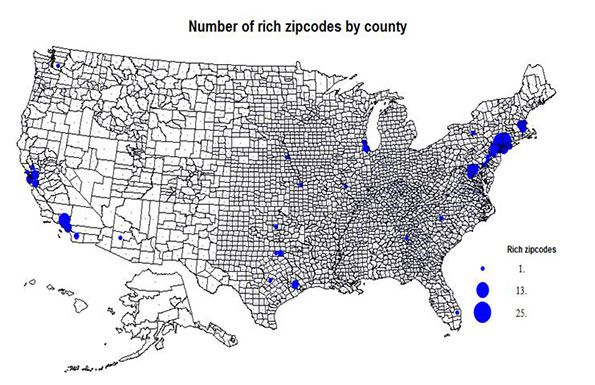
    Figure 1 maps the 170 zip codes with more than 1000 people and median incomes over $150,000 or mean incomes over $200,000. The most astounding thing about the map (which shows the number of rich zip codes by the county they are part of) is their  concentration  in a few areas, led by the country’s premier global city, greater New York city, with 75 of the 170. New York is followed by Washington DC with 23, another sign of the growing wealth of the national capital.  Boston follows with 10, Los Angeles, 18, San Francisco (14), and Chicago (6) and then a scattering in other leading metropolitan areas. There is no such concentration of the super-rich in any rural or small town area. But many are quasi-rural suburban and exurban.

    Richest Zip Codes
    State County Place Zipcode Mean (thousands)
    NY Westchester Purchase 10577 363
    NY Nassau Westbury 11568 351
    IL Cook Kenilworth 60043 342
    NY Westchester Pound Ridge 10576 338
    CA San Mateo Atherton 94027 337
    PA Montgomery Gladwyne 19035 333
    CA Los Angeles Bel Air 90077 327
    NJ Essex Short Hills 07078 322
    NY Nassau Glen Head 11548 316
    CT Fairfield Weston 06883 286
    CT Fairfield New Canaan 06840 308
    IL Cook Glencoe 60022 297


    But, the reader will protest, there are huge numbers of rich folk in Texas, Florida, Ohio, Pennsylvania, and other states. The reason is that these many rich households are “diluted” in impact because the zip codes are more variable in income. There really is something remarkable about the overwhelming affluence of the key suburban areas of Westchester and Nassau, New York; Fairfield, CT; Fairfax, VA; and Howard and Montgomery, MD. But I believe the map is telling and accurate at highlighting the utter dominance of the economic power of New York and then Washington. Boston retains power beyond its size, while Los Angeles, Chicago, San Francisco, and upstarts in the South scramble for a place.

    The Richest Areas

    The zip code with the highest and the 4th highest incomes are in Westchester County, close to the Connecticut border. The second richest, Westbury, is in Nassau county, New York, which also has the 9th richest. Also in the NYC suburbs are the 8th, in New Jersey just 20 miles west of New York, while 10th and 11th richest are both located  in Fairfield County, CT.

    Chicago’s north Cook county has the 3rd (Kenilworth) and 12th (Glencoe) richest areas.  Los Angeles is home to the 7th richest, Bel Air (northwest of Beverly Hills), Atherton, in San Mateo county, is the 5th richest, and Gladwyne in Montgomery County, PA is the 6th richest.  Greater New York then is home to 7 of the 12 richest, followed by Chicago with 2.  Quite a concentration. 

    The Poorest Zip Codes

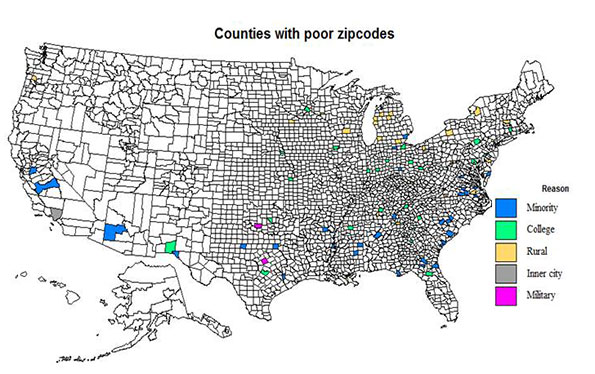
    The list and map (Figure 2) of counties with poor zip codes may surprise the reader more. I divide the 94 poorest areas into five types:

    • minority population domination, 35 areas,
    • college or university student majorities, with 25 places,
    • rural (in the sense of small communities in these counties having been left behind or declined) some 25 areas,
    • five inner city areas dominated by single men, 5, and
    • two areas dominated by a large military base.

    The poor college areas are zip codes for student dormitory housing, people who are temporarily poor; some military base areas are similarly poor because of barrack housing of single people.

    The poorest minority dominated areas are mainly Black and in the rural to small city South, except for a few Hispanic dominated areas in the west. The college poor areas are scattered across the country, especially in the East, the military base communities in Texas and Oklahoma. The rural set is surprisingly concentrated mainly in the north, especially in Michigan. The few inner city poor areas are in Los Angeles, Waterbury, CT: Portland, OR; Youngstown and Canton, OH; an odd set. A few of the rural areas also have correctional institutions.

    Poorest Zip Codes
    State County Place Zipcode Median
    NE Douglas Omaha 68178 $2,499
    KY Elliott Burke 41171 $3,494
    GA Clinch Cogdell 31634 $3,886
    FL Gulf Wawahitchka 32465 $4,481
    CT Tolland Storrs 06269 $6,124
    WI Dane Madison 53706 $6,359
    VA Nottoway Blackstone 23824 $6,421
    MI Clare LeRoy 49665 $6,639
    TN Rutherford Murfreesboro 37132 $7,125
    IN Delaware Muncie 47306 $6,750
    NY Cattaraugus Salamanca 14779 $7,395


    If I had relaxed limit by including more smaller population areas, or not quite such low incomes, many more college, military base, minority majority counties would appear on the map. But as noted up front, virtually none of these poorest zip codes are in big cities or their metropolitan areas, where millions of poor households live, simply because these metro zip codes tend to be large and more heterogeneous. This also does not factor in the cost of living, which can be high in some regions, particularly on the east and west coasts.

    The Poorest Areas

    The 12 poorest zip codes are different and quite varied in character. Five of the zip codes are essentially college or university student housing, and thus not indicative of an adult working population. Three areas are in part poor because of the presence of correctional institutions or adult care institutions. Two of these also have a significant minority (Black) population. Two rural areas, in GA and VA have high Black shares. This leaves two northern rural areas in Michigan (high seasonal dependency) and in New York, Salamanca, also a seasonal resort, as well as an Indian reservation.

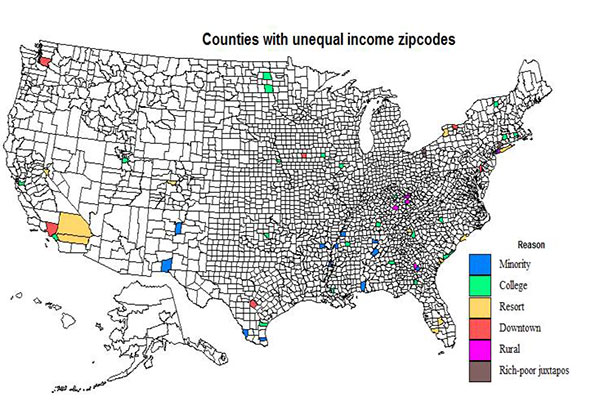
    Unequal Zip Code

    The unequal zip codes (67) are mainly areas where the mean is at least twice the median, showing the disproportionate effect of a few very wealthy households. One critical area for high inequality are primarily beach or mountain communities with richer retirees serviced by lower-paid workers; these include 13 areas in California, South Carolina, Florida, New York, Nevada, North Carolina, and Colorado. Downtowns (8 areas) include a few actual downtown CBD zip codes with an older poor population and newer rich folk. Rural here identifies mainly small Kentucky zip codes with a very imbalanced income pattern (7 areas). Finally I note a few zip codes in exurban areas where there appears to be a juxtaposition of an older resident population, and newer wealthier households (3 areas). This pattern may become more common in both exurban and rural small-town environmental amenity areas.

    Most Unequal Zip Codes
    State County Place Zipcode Median Mean
    CA Alameda Berkeley 94720 $16,192 $79,238
    SC Pickens Clemson 29634 $12,159 $51,444
    LA E Carroll Transylvania 71286 $28,961 $96,377
    TX Starr 3 zips 78536etc $29,722 $98,048
    KY Elliott Ezel 41425 $29,980 $65,676
    TN Rutherford Murfreesboro 37132 $7,125 $21,863
    MA Suffolk Boston 02111 $31,442 $62,087
    VA Radford Radford 24142 $15,931 $46,860
    ND Cass Fargo 58105 $24,750 $70,633
    DC DC WashingtonDC 20006 $12,103 $32,155
    TX Bexar San Antonio 78205 $25,779 $69,628
    NC New Hanover WrightsvilleBch 28480 $70,375 $184,658
    NV Douglas Glenbrook 89413 $68,512 $172,004


    The Most Unequal Areas

    Of the 13 most unequal areas, 6 are college or university zip codes, areas with poor students and much higher income professionals. Two are downtown zip codes, Boston and San Antonio, two are minority population areas, Louisiana and Texas. Two are resort areas, in Nevada and North Carolina, but several similar areas are not far down on the list. One Kentucky area is classed as just rural, but again other similar counties are on the fuller list.

    Several zip codes are on both the poorest and the unequal zip code lists, most commonly the college and the minority-dominated areas. Rich suburban and exurban areas tend to be fairly consistently rich, resort areas tend to be more unequal.

    Conclusion

    The zip code data provide a partial, highly localized look at the geography of inequality. If American society continues to accept extreme income, the geography of inequality will only become not only more extreme, but more pronounced in a diverse set of locations.

    Richard Morrill is Professor Emeritus of Geography and Environmental Studies, University of Washington. His research interests include: political geography (voting behavior, redistricting, local governance), population/demography/settlement/migration, urban geography and planning, urban transportation (i.e., old fashioned generalist).

  • Moving South and West? Metropolitan America in 2042

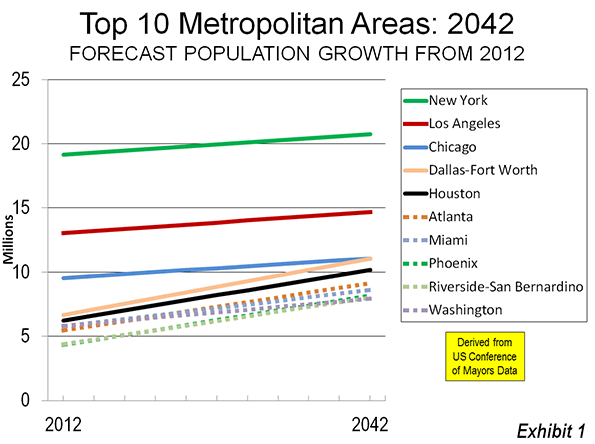
    The United States could have three more megacities (metropolitan areas over 10 million) by 2042, according to population projections released by the United States Conference of Mayors (USCM). Chicago, Dallas-Fort Worth, and Houston  are projected to join megacities New York and Los Angeles as their metropolitan area populations rise above 10 million. At the projected growth rates, Atlanta, Miami, Phoenix, and Riverside-San Bernardino could pass the threshold by 2060. The population projections were prepared for USCM by Global Insight IHS.

    USCM anticipates that the number of major metropolitan areas – those over 1,000,000 population –- will rise from 51 in 2012 to 70 in 2042 (Note). The additional 19 major metropolitan areas range from Honolulu, which should exceed the million threshold next year, to Colorado Springs. California would add four new major metropolitan areas, including Fresno, Bakersfield, and Stockton from the San Joaquin Valley and Oxnard, which is adjacent to Los Angeles. Texas would add two, McAllen and El Paso, as would Florida (Cape Coral and Sarasota) and South Carolina (Columbia and Charleston).

    The Top 10 in 2042

    The top ten rankings would change relatively little. The top five would continue to be (in order), New York, Los Angeles, Chicago, Dallas-Fort Worth, and Houston. But the relationships would change materially. Dallas-Fort Worth would trail Chicago by only 30,000, much reduced from the 2012 gap of 2.9 million. If the annual projected growth rate were to continue another year (to 2043), Dallas-Fort Worth would take third position from Chicago, ending more than eight decades in that position. Houston also is forecast to gain substantially on Chicago, from a deficit of 3.3 million in 2012 to only 900,000 in 2042. If the respective annual growth rates were to continue, Houston would bump Chicago to fifth place by 2050.

    Atlanta would move up three positions to number 6, and could be the nation’s 6th megacity before 2050. Miami would move from 8th to 7th. There would be two new entrants to the top ten: Phoenix and Riverside-San Bernardino, ranked 8th and 9th. These two, along with Miami could become megacities before 2060. The tenth position would be held by fast growing Washington, which would remain the only non megacity in the top ten.

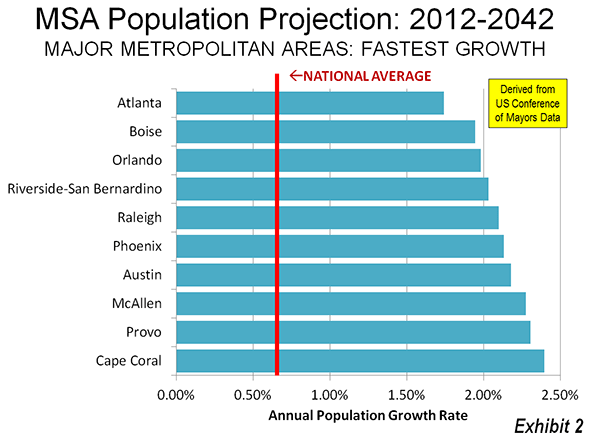
    Seven of the top ten metropolitan areas in 2042 are forecast to grow very rapidly. Phoenix and Riverside-San Bernardino are projected to grow at annual rates of 2.1 percent and 2.0 percent respectively, approximately three times the 2012-2042 national growth rate projected by the US Census Bureau (0.7 percent). Atlanta, Dallas-Fort Worth and Houston would grow at 2.5 times the national rate (1.7 percent), Miami nearly double (1.3 percent) and Washington at 1.5 times the national rate (1.0 percent).

    Washington is technically in the South, which according to the US Census Bureau begins at the Mason-Dixon line, or the Pennsylvania-Maryland border. This means that all of the fast growing top 10 metropolitan areas are in the South or West, a pervasive trend discussed later in this article.

    Meanwhile, the three largest metropolitan areas would have well below average growth. New York would grow the slowest, at 0.3 percent. Chicago would grow at 0.5 percent annually, faster than Los Angeles, a national growth leader for a century, which would grow at only a 0.4 percent annual rate (Figure 1).

    Fastest Growth Major Metropolitan Areas

    Among the 70 major metropolitan areas, the fastest growing would be Cape Coral, Florida, with an annual growth rate of 2.4 percent. Provo, Utah and McAllen, Texas would grow at 2.3 percent. Six of the ten fastest growing metropolitan areas already have more than 1,000,000 population, including Austin, Phoenix, Raleigh, Riverside-San Bernardino, and Atlanta (10th). Boise would be the 9th fastest growing (Figure 2)

    Slowest Growth Major Metropolitan Areas

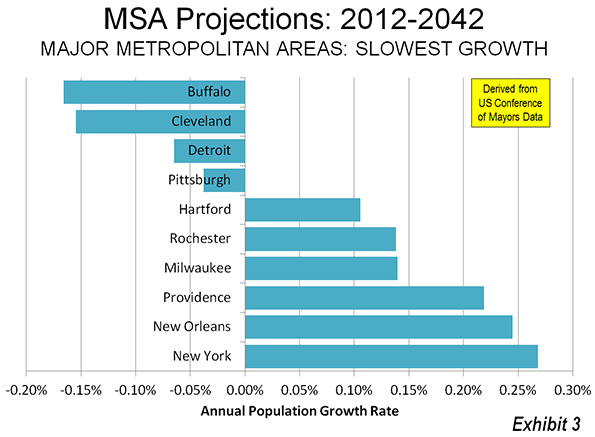
    Four of 2042’s major metropolitan areas would lose population from 2012, including Buffalo, Cleveland, Detroit, and Pittsburgh. Hartford, Rochester, Milwaukee, and Providence would grow at less than one-third the national population growth rate. New Orleans and New York would round out the bottom ten, growing at an annual rate of approximately 0.25 percent (Figure 3).

    Though Los Angeles is not among the bottom ten (it would #13), it is notable that its growth rate is projected to be slightly less than St. Louis, long a laggard, and only slightly better than Philadelphia. Philadelphia has been losing position regularly since it was the nation’s largest city, before the first US census (1790).

    Regional Distribution of Growth

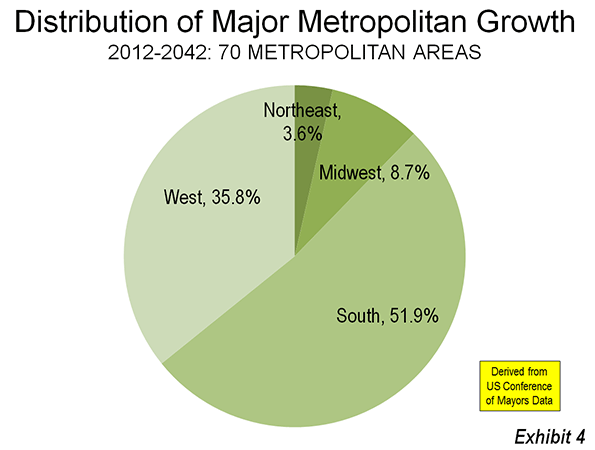
    According to the USCM projections, the overwhelming majority of major metropolitan area population growth (70 areas) will occur in the South and West. Approximately 51 percent of the major metropolitan growth is expected in the South, which would add 33 million residents. The West would capture 36 percent of the growth, while adding 22 million residents. The Midwest would capture only 9 percent of the growth, adding 8 million residents, while the Northeast would take 4 percent of the growth, while adding only 2 million residents (Figure 4).

    The South would grow at an annual rate double that of the national 0.7 percent rate (1.4 percent). The West would be close behind (1.2 percent). However, if the major metropolitan areas of coastal California were excluded from the West (Los Angeles, San Francisco, San Diego, and San Jose), the West would grow even faster than the South (1.6 percent). Coastal California’s annual growth rate is projected at 0.6 percent, below the national average of 0.7 percent.

    The Northeast and the Midwest would both grow at less than the national growth rate (0.2 percent and 0.5 percent respectively). The fastest growing metropolitan area in the Midwest is projected to be Indianapolis, at a respectable 1.2 percent growth rate (ranking 32 out of 70). Midwestern Omaha, Kansas City, and Columbus would also grow faster than the nation.

    The fastest growing major metropolitan area in the Northeast would be Philadelphia, which would add only 0.3 percent to its population annually (ranking 59th). Philadelphia would add only slightly more residents than Provo, Utah, despite being more than 10 times as large in 2012.

    Projections are Projections

    Projecting anything can be risky. Unforeseen circumstances could result in a materially different future than forecasts suggest. No reputable forecaster, for example would have predicted during the 20th century that North Dakota would become the nation’s fastest growing state in the early 2010s. Upstate New York, for example, could experience an economic turnaround if state allows them to take advantage of hydraulic fracking. The long-suffering Buffalo and Rochester metropolitan areas could rise well above current expectations. It is probably far too much to expect any major material progress in California, with a business climate so colorfully dismissed by The Economist in its current edition (see The Not So Golden State).

    The USCM projections to 2042 indicate a continuation of geographical trends that have been strengthening virtually every decade since the middle of the last century. Barring any sea-changes, they are more likely to be more right than wrong.

    ————————

    Note: The USCM projections were prepared before the revision of metropolitan area boundaries in 2013. This revision added Grand Rapids as the 52nd major metropolitan area. Had the new definitions been available, Grand Rapids would have been the 71st major metropolitan area. Generally, there were only minor changes in the major metropolitan area definitions, the most significant being New York, Charlotte, Grand Rapids, and Indianapolis.

    ————–

    Wendell Cox is a Visiting Professor, Conservatoire National des Arts et Metiers, Paris and the author of “War on the Dream: How Anti-Sprawl Policy Threatens the Quality of Life.

    Photo: Cape Coral, Florida: Projected Fastest Growing Major Metropolitan Area: 2012-2042 (by author)

  • St. Louis: Salvage City

    A three installment start at a potential Discovery Channel “reality” program called Salvage City has created a minor kerfuffle in some local quarters. I haven’t seen the show, but it appears to feature a group of the Beautiful and the Bearded who break into buildings, ostensibly illegally, on architectural salvage missions one step ahead of the wrecking ball, all for fun and profit. Here’s the trailer. (If the video doesn’t display for you, click here).

    Not everybody is happy with the “Rust Belt boneyard” take on the city. Michael Allen at Next City says this is an example of the Rust Belt frontier myth:

    The term “Rust Belt” itself exaggerates the physical decay and isolates the identity of many cities in static matter. Advocates, journalists and scholars have popularized the term, often endearingly, while perpetuating the emphasis on what makes these places frontiers of decline. Narratives of the Rust Belt are still focused on loss, rife with a cynical nostalgia and a nagging refusal to cast in with wealthier and less damaged cities. The singularity of the conditions of places like St. Louis and Detroit remains mythic fodder for would-be heroes of public policy, architectural design and public art. There are many Daniel Boones of the legacy cities.

    Allen, however, isn’t writing just to cast stones at the show. Chris Haxel at the Riverfront Times is more emphatic, saying St. Louis deserves better:

    Where the producers really stumble is their characterization of St. Louis as a foe on the level of alligators or hurricanes. Salvage City is rife with images of decay or ruin porn, a style that fails to tiptoe the line between appreciation and exploitation. The salvage scenes are ostensibly about rescuing doomed valuables, but in reality glorify theft, plunder and trespassing.

    What he and the show’s producers have done — exploit the city in exchange for personal gain — is the definition of selling out. Not the artistic selling out that is inevitable when a band or artist enjoys mainstream success, but the kind that constitutes betrayal….Here they are on national television, selling the city as an “urban wasteland…ripe for plunder.” Ultimately, Salvage City disappoints because St. Louis deserves better.

    I post this because I always find it interesting to see the reactions people have when their city is supposedly mischaracterized for the worst in contrast to the crickets when locals use whitewash and marketroid materials to promote their city to the world. Want to see a real myth? Check out “Here Is St. Louis” (if the video doesn’t display for you, click here).


    There’s nothing per se wrong with this. It’s a classic city video that portrays St. Louis as an amalgam of family friendly fun and Portland-style hipness, with a dollop of local flavor a multi-culti thrown in. But is it a full and inclusive portrayal of the reality of St. Louis? I don’t think so. In effect, videos like this are the flip side of Salvage City, but few people ever think to critique them.

    I don’t want to suggest too much collective outrage, however. The response to Salvage City is a bit muted from what I can tell. And Alderman Olgilvie strikes a better tone in telling folks totake a chill pill:

    Our mini freak-out over Salvage City comes on the heels of several media panic attacks in 2013. Other examples include reactions to a New York Times look at crime and murder in St. Louis, and a humorous Art Forum takedown of an overwrought guided bus tour of St. Louis art venues that culminated with a violet-hour visit to SLAM’s expansion grand opening. The story, and the predictable freak-out. (See RFT‘s “Snobby New York Art Critic Scowls on St. Louis.”) Writers snapped our photo when the light wasn’t flattering, and we didn’t like it one bit.

    What it boils down to is a little hypersensitivity about how St. Louis is portrayed in national media, positive or negative. It is this nagging worry that folks on one coast or the other will write us off the same way one of Kendzior’s article headlines refers to us, as flyover country.

    Perhaps our New Year’s resolution should be a little bit thicker skin, and a renewed confidence in telling, and hearing, all the stories about our city: good, bad and indifferent. Rather than make one story carry the burden of representing all the facets of our city, let a thousand voices rise in song or storytelling, each with its own particular perspective.

    The challenge for St. Louis and other such place is to develop a maturing sense of confidence about who they are. One that accepts the vicissitudes of the media, isn’t afraid to acknowledge legitimate faults, isn’t dependent on the approval of others for a sense of self-worth, and is willing to go its own way into the future.

    Aaron M. Renn is an independent writer on urban affairs and the founder of Telestrian, a data analysis and mapping tool. He writes at The Urbanophile, where this piece originally appeared.

    St. Louis Skyline photo by Wendell Cox.

  • Selfies Replace Focus on Big Picture

    Maybe it’s my age, but, somehow, the future does not seem to be turning out the way I once imagined. It’s not just the absence of flying cars, but also the lack of significant progress in big things, like toward space colonization, or smaller ones, like the speed for most air travel or the persistence of poverty.

    Indeed, despite the incessant media obsession with technology as the driver of society, it seems we are a long way from the kind of dramatic change that, say, my parents’ generation experienced. Born at the end of the horse-and-buggy age, they witnessed amazing changes – from the development of nuclear power and the jet engine to the first moon landing.

    In contrast, my children’s experience with technological change is largely incremental – a shifting of digital platforms, from desktops to laptops to tablets and iPhones. The new raft of minidevices are ingenious and much more powerful than even the high-end desktop computers of a decade ago. But this wave of technology is not doing much except, perhaps, to make us ever more distracted, disconnected and obsessed with trivia.

    As one former Facebook employee put it succinctly: “The best minds of my generation are thinking about how to make people click ads. That sucks.”

    One clear sign of our technological fail: the stagnant, or even declining, living standards for most Americans. New technology is not creating much-cheaper and better housing, nor is it reducing poverty or creating a new wave of opportunity for grass-roots businesses. In fact, the current “tech boom” has done little to improve incomes much outside a few stretches of the Bay Area, a handful of college towns, and overhyped city media districts.

    Even Silicon Valley’s proud tradition of truly ground-breaking innovation in engineering has slowed as the tech hub has become dominated by media and advertising-driven software companies. The prospect of the easy score in social media, notes longtime entrepreneur Steven Blank, “marks the beginning of the end of the era of venture capital-backed big ideas in science and technology.”

    Worse of all, the stagnating tech world is steadily reducing our own dreamscape. Zohar Liebermensch, a student from my “history of the future” class at Chapman University, compared the initial visions of Disneyland’s Tomorrowland with later concepts. Over each generation since the park opened in 1955, she found, designers had to ratchet down the more ambitious projections – such as a manned mission to Mars – as the prospects dropped for their actually occurring.

    Disneyland, she noted, also cut back on refurbishment in the “Carousel of Progress” exhibit, focused on the future “typical” American family. In the early years of the park, updates were needed every three years. That became six years, then nine. The attraction now hasn’t been significantly modified in 18 years. “This increased changeless period,” she notes, “waves another flag of concern, as it demonstrates Disney’s view that there has been no noteworthy progress in almost two decades.”

    Science fiction testifies most strongly about our technological underachievement. Stanley Kubrick’s “2001: A Space Odyssey,” notes author David Graeber, assumed that a 1968 movie audience would find it “perfectly natural” that, by 2001 – now, more than a decade ago – there would be regular commercial flights to the moon, advanced space stations and hyperadvanced computers with human personalities.

    Essentially, our new tech doesn’t offer anything like the revolutionary and broadly felt changes brought about by electricity, jet travel or, for that matter, indoor plumbing. Meanwhile, the major productivity enhancements spawned by the computer and Internet revolutions, notes Northwestern University economist Robert J. Gordon, have already taken place, while the new social-media technology has done very little for productivity.

    This trend has long-term implications for our society and economy. Increasingly, economists, such as Tyler Cowen, suggest that are we seeing a slowing of breakthroughs, with benefits increasingly accruing to a relative handful. We may hope to create a terrestrial “Star Trek” reality, but the society we are creating looks increasingly more like something out of the Middle Ages.

    Can this decline in our dreamscape somehow be reversed? First, we need to look at the basic causes for our current narrow-casted view of technology. One is a relative lack of competition. In the 1980s personal computer boom, there were scores of companies competing across a broad array of tech sectors, resulting in a few winners, but a rapid evolution of technology.

    Today most of the large new niches – mobile software, Web search, social media – are dominated by a handful of companies. The model has shifted from fierce competition to what might be seen as a series of oligopolies dominated by a handful of sometimes shifting companies, largely controlled by a small but powerful group of investors and entrepreneurs. Job creation, even in the boom, has been much slower than in previous booms as tens of thousands of the people engaged in building the backbone of the information age – telecom, semiconductor and computer product firms – are being replaced by numbers of younger, cheaper and often foreign workers.

    At the top of this system stands a remarkably small group whose fortunes depend largely on using the Internet as a vehicle for advertising, often based on gross invasion of privacy. “Tech is something like the new Wall Street,” notes economist Umair Haque, “Mostly white, mostly dudes, getting rich by making stuff of limited social purpose and impact.”

    Perhaps the biggest loss here may be psychological, the decline of what historian Frederick Jackson Turner called “the expansive character of American life.” Instead of exploring new frontiers, we now obsess over mobile apps, and our Big Picture has devolved into a procession of “selfies.” If anything, in most critical areas, such as housing and transport, we seem to be looking backward, to the days of small apartments, trolley cars or trains. A crowded, poorer future, not a tech nirvana, beckons.

    If it’s not prosperity for more people, what is the end game of the new tech model? Much of it is profoundly narcissistic, seeking to replace the physical world with a digital one and making most of humanity superfluous. Inventor Ray Kurzweil, now director of engineering at Google, advocates a path to “transhumanism,” with the ultimate aim of creating a kind of immortality by imprinting our brain patterns as software. This “transhumanist” vision also reflects an almost obsessive concern of the 65-year-old inventor, who takes about 150 vitamin supplements a day in hopes of delaying his own demise.

    The potential class implications of Kurzweil’s transhumanist agenda are particularly troubling. It is likely that much of the new biological technology for many years, perhaps for decades, will not be easily accessed except by the very rich. Those left behind, Kurzweil believes, will end up as what he dubbed MOSHs – Mostly Original Substrate Humans. “Humans who do not utilize such implants are unable to meaningfully participate in dialogues with those who do,” he writes.

    Sun Microsystems co-founder Bill Joy suggests that the focus on human-machine interface will end up with “the elite” having greater control over the masses. And, because human work no longer will be necessary, most of us will become superfluous, a useless burden on the system. “If the elite consists of softhearted liberals,” he suggests, they may play the role of “good shepherds to the rest of the human race.” But, under any circumstances, he predicts, the mass of humanity “will have been reduced to the status of domestic animals.”

    Clearly, as a society, we need to start thinking about how technology can serve broader human purposes. This is not an impingement on private enterprise: The Internet, and the microprocessor, were developed largely at taxpayer expense, notably through the Defense Department and NASA. Digital technology should be spurring the creation of new competitive companies, not, as we see now, fostering an American version of the Japanese cartels called keiretsu, where firms like Amazon, Google, Apple and Microsoft use their unfathomable riches to dominate a host of fields, from robotics and space travel to health care, even publishing.

    Instead of allowing technology to promote oligopoly, we need to spark competition to speed up innovation that could benefit the majority of people, as opposed to creating a class of fabulously rich superhumans. We also need again to expand our physical frontiers – both in space and, with intelligence, on Earth – so more people can live comfortably, with privacy and maximum freedom of action. Let’s make Tomorrowland again a place we would like to have our children inhabit.

    This story originally appeared at The Orange County Register.

    Joel Kotkin is executive editor of NewGeography.com and Distinguished Presidential Fellow in Urban Futures at Chapman University, and a member of the editorial board of the Orange County Register. He is author of The City: A Global History and The Next Hundred Million: America in 2050. His most recent study, The Rise of Postfamilialism, has been widely discussed and distributed internationally. He lives in Los Angeles, CA.
    Creative Commons photo "Engineers" by Flickr user ensign_beedrill

  • The Illusions of Charles Montgomery’s Happy City

    This is part one of a two-part series. Read part two here.

    Striking a pose of defiance, contemporary urbanists see themselves as the last champions of happiness in a world plunged into quiet despair, and Canadian writer and journalist Charles Montgomery is no exception. Drawing on the emerging ‘science of happiness’, his new book Happy City, subtitled ‘transforming our lives through urban design’, joins a wave of anti-suburban literature spurred on by climate fears and the financial crisis. ‘As a system’, writes Montgomery, the dispersed city ‘has begun to endanger both the health of the planet and the well-being of our descendants.’   

    Happy are the poor

    Repeating the fashionable wisdom, he says ‘cities must be regarded as more than engines of wealth; they must be viewed as systems that should be shaped to improve human well-being.’ Soon enough it’s apparent that to this way of thinking, well-being and poverty are by no means incompatible. ‘If a poor and broken city such as Bogota can be reconfigured to produce more joy’, he writes, ‘then surely it’s possible to apply happy city principles to the wounds of wealthy places.’    

    Montgomery starts off with ‘the happiness paradox’, arguing that ‘if one was to judge by sheer wealth, the last half century should have been a happy time for people in the United States and other rich nations … More people than ever got to live the dream of having their own detached home … The stock of cars far surpassed the number of humans who used them’. But, he is eager to explain, ‘the boom decades of the late twentieth century were not accompanied by a boom of happiness.’

    For evidence, he refers to ‘surveys’ showing that ‘people’s assessment of their own well-being’ had ‘flatlined’, and cites a few others reporting rising rates of mental conditions related to depression. None of these inculpate suburban affluence, however, or suggest people yearn to turn the clock back to before they acquired it. And nor does he explore the problems surrounding measurement of these trends.

    Moreover, such direct evidence as exists points in the opposite direction. A Pew Research Center survey, for example, found that far higher percentages of suburbanites than inner-city dwellers rated their communities as ‘excellent’ (Montgomery does concede that ‘residents in America’s central cities report being even less satisfied and even less socially connected than people in suburbia’, but does his best to explain it away).   

    The book openly admits that the idea of a link between unhappiness in the affluent west and urban form came from the rhetoric of Enrique Penalosa, former mayor of ‘poor and broken’ Bogota. Mr Penalosa declares that the unhappiest cities are not ‘the seething metropolises of Africa or South America’, but places like Atlanta, Phoenix and Miami in the US, ‘the most miserable cities of all’. Montgomery acknowledges this ‘is not science’, and ‘does not constitute proof’, but still sets out to show that ‘the decades-long expansion in the American [and Australian] economy’ and sagging levels of mental well-being aren’t just simultaneous developments, but connected, especially on the plane of ‘migration … from cities to the in-between world of sprawl.’ 

    Suburban Straw Man

    Before such a connection is anywhere near proven, though, Montgomery rushes in to assume it exists. Early in the first chapter, he is already asking ‘everything … would suggest that this suburban boom was good for happiness. Why didn’t it work?’ The habit of asserting yet-to-be or never-to-be established conclusions is commonplace throughout the book, and shapes the structure of his argument. Opening chapters set the scene with a case study of outer-suburban life which turns out to be a terrestrial version of Dante’s inferno.

    We’re introduced to the hapless Randy Straussner, a ‘super-commuter’ who drives 4 hours each workday on a round trip between his home in exurban Mountain House, California and his job 60 miles away in the San Francisco Bay Area. Most days he hits the road at 4:15 am to avoid the rush, putting off breakfast until he gets to work, and makes it back home at around 7:30 pm if ‘he was lucky.’ We’re told Randy won’t drink coffee or listen to talk radio, since ‘those just made him angry’ and aggravated ‘the pressures of the freeway.’ On arriving home, he would sometimes ‘grab a hose and water the garden until he calmed down’. Often he would hop ‘onto the elliptical trainer to straighten out his aching back’. When ‘the drive calcified his fatigue and frustration’, he drove to the gym where he could ‘sweat out his aggression.’

    Further, Randy ‘did not know, like or particularly trust his neighbours’ who ‘didn’t get to know one another’, so ‘he disliked his neighbourhood intensely.’ Montgomery adds that Randy felt ‘his own family paid the price for his stretched life’. His first marriage failed and his son ‘slid off the rails’, ending up in the county jail.

    Assuming this accurately accounts for Randy’s circumstances, just how representative is he of the typical outer-suburbanite? Peter Gordon, an urban economist at the University of Southern California, refers to empirical studies showing that ‘dispersed spatial structure was associated with shorter commute times’, suggesting “many individual households and firms ‘co-locate’ to reduce commute time [which] can be more easily [done] in dispersed metropolitan space …’

    This is borne out by the surprising stability of commute times over extended periods. According to the US Nationwide Household Travel Survey, explains Gordon, the average metropolitan commute time was 25 minutes 2009, just one minute more than in 2001, despite relevant population growth of 12 per cent. The averages for sub-area types described as ‘suburban’ and ‘second city’ were actually lower than for the ‘urban’ or core sub-area. Analysing the INRIX Traffic Congestion Scorecard and urban density data, demographer Wendell Cox also finds support for links between higher population densities and longer commute times.

    What about Randy’s other travails, are most suburbanites so estranged from their neighbours? A study cited by geographer Joel Kotkin found that for every 10 per cent drop in population density, the likelihood of people talking to their neighbours once a week rose 10 per cent. What about marital failure? Writing in the mid-2000s, Sue Shellenberger noted that ‘couples from central cities are 9 per cent more likely to crash and burn than couples from the suburbs, according to the National Center for Health Statistics.’ How about the prospect of winding up behind bars? On the basis of Brookings Institution research, Kotkin and Cox say suburban areas generally have substantially lower crime rates than ‘core cities.’

    (With their painstaking attention to statistics, Kotkin and Cox are the bêtes noires of pro-density urbanists, who tend to fall back on anecdotal evidence).

    ‘The masses will still need suburbia’  

    Use of Randy Straussner’s plight to discredit life on the urban fringe constitutes a classic Straw Man fallacy.

    From there, Montgomery proceeds to zig-zag between the fictional extremes of super-commuting hell and an opposite notion of high-rise ‘verticalism’, which he claims to reject. This dialectical type of approach has the advantage of inoculating him against the charge of ignoring inconvenient facts. In coming out for ‘a hybrid, somewhere between the vertical and horizontal city’, he gets to concede many pro-suburban realities, while clinging to his firmly anti-suburban conclusions.

    Concessions to suburbia on job location, home ownership and affordability, the popularity of driving, and economic dynamism are scattered throughout the book, intermixed with the general tone of disapproval.

    After many pages railing against ‘super-commuting’ and ‘detached houses with modest lawns … far from employment’, for instance, Montgomery is ready to admit that: ‘the US population is projected to grow by 120 million by 2050. Where will those people live? Downtowns and first-ring, streetcar-style suburbs will be able to accommodate only a fraction of the new demographic tidal wave. Most jobs have already moved out beyond city limits anyway.’ Then, quoting, he writes ‘the masses will still need suburbia.’

    This is noteworthy, since other green urbanists hold fast to the myth that jobs are concentrated in the urban core. Data in the 2011 American Community survey suggests that the ‘job-housing balance’, measuring the number of jobs per resident employee in a geographic area, is ‘nearing parity’ in suburban areas of US metropolitan regions with more than a million people. This isn’t dramatically different from the position in Australia’s 6 major cities, which have some of the world’s most dispersed patterns of employment (and will share an estimated 20 million more people by 2050). It’s all consistent with Gordon’s co-location thesis.

    In one chapter, Montgomery applauds his home town of Vancouver, which ‘has spent the past thirty years drawing people into density in a way that radically reversed a half century of suburban retreat.’ But he is forced to admit that ‘in 2012 Vancouver won the dubious honour of becoming the most expensive city for housing in North America. This means many people who work in the city … can’t afford to live there … ‘

    More generally, he says ‘the forces of supply and demand have helped make housing in some of the world’s most liveable cities’ –  for which read dense cities – ‘the least affordable.’ Again: ‘as the wealthy recolonize downtowns and inner suburbs, and property values rise accordingly, millions of people are simply being excluded.’ (Always dialectical, Montgomery mostly heaps praise on dense places like Vancouver and Portland, usually rated severely or seriously ‘unaffordable’ in the Demographia International Housing Affordability Survey, while singling out dispersed Atlanta for rebuke, despite a consistent rating of ‘affordable’.)

    And noting the influence of Vancouver’s high-rise density, spawning the label ‘Vancouverism’, Montgomery feels compelled to mention that ‘people living in towers consistently reported feeling more lonely and less connected than people living in detached homes.’ Later he writes that ‘most of us also want to live in a detached home with plenty of privacy and space.’

    On driving, the book is full of complaints that ‘governments have continued the decades-old practice of pouring tax dollars into highways … while spending a tiny fraction of that amount on urban rail and other transit service.’ Yet there is also the qualification that: ‘drivers experience plenty of emotional dividends. When the road is clear, driving your own car embodies the psychological state known as mastery: drivers report feeling much more in charge of their lives than transit users or even their own passengers.’ Montgomery lets slip the truth on popular preferences with the comment, ‘roads left to the open market – in other words, dominated by private cars.’

    Accordingly, the American Community Survey reports that between 2007 and 2012, ‘driving alone’ increased as the dominant mode of commuting in the United States, rising from 76.1 to 76.3 per cent of work trips. This bears some relation to the co-location of suburban residents and businesses.

    ‘A marvellous thing’

    Amidst his oscillations, Montgomery sketches an overview that reads like an encomium to the blessings of suburbia:

    The rapid, uniform and seemingly endless replication of this dispersal system was, for many people and for many years, a marvellous thing. It helped fuel an age of unprecedented wealth. It created sustained demand for the cars, appliances and furniture that fuelled the North American [and Australian] manufacturing economy. It provided millions of jobs in construction and massive profits for land developers. It gave more people than ever before the chance to purchase their own homes on their own land, far from the noise and haste and pollution of downtown.

    Having acknowledged the housing, transportation, employment and wider economic advantages of dispersion and suburbanisation, Montgomery could have come to the conclusion that they offer opportunities for a better life to millions of people, and should be embraced as a legitimate option by officials and planners. But that’s not where he ends up. Insisting that the dispersed city is now ‘inherently dangerous’, he signs on for pro-density ‘new urbanism’, calling for an overhaul of zoning codes, approval processes, infrastructure planning, tax incentives and funding practices to stimulate denser and less car-dependent redevelopment, aiming for transit-friendly, walkable, mixed-use, town centres and clusters of attached town-houses and low-rise apartments.

    While ‘new urbanism’ sweeps aside the advantages of dispersion, Montgomery’s misconceived ideas show that it offers nothing better. Take housing affordability. At first he toys with the faddish notion of ‘a by-law stating that 15 per cent of dwellings in every new subdivision … must be suitable for people of low or moderate income’, a costly burden on new construction for developers and the majority of home buyers. As the Australian experience attests, this type of planning fails to offset the spike in land values which accompanies density.

    Then, sensing this is far from enough, his demands escalate to the socialisation of housing supply: ‘it’s not enough to nudge the market towards equity … Governments must step in with subsidized social housing, rent controls, initiatives for housing co-operatives, or other policy measures.’ The destructive impacts of these sorts of measures on investment, market efficiency, public finances, and freedom of choice are passed over.

    Later in the book, Montgomery discusses ways to draw developers into density and social housing, including changes to ‘infrastructure-funding rules, tax incentives and permit requirements.’ He contends that ‘if this sounds like a big fat bonus for property developers well it is … but the truth is, as long as we inhabit a capitalist system, the future of suburbia depends on them.’

    It’s just that this isn’t capitalism as much as rent-seeking at the expense of consumers and other businesses, suppressing economic growth, opportunities and living standards. But that’s not a bad outcome for someone who extols the joys of poverty.

    John Muscat is a co-editor of The New City, where this piece first appeared.

    This is part one of a two-part series. Read part two here.