Blog

  • How Houston’s Missing Media Gene Hobbles Its Global City Ambitions

    In an upcoming study I am working on with Chapman University’s Center for Demographics and Policy, we show that San Francisco and Houston are North America’s “emerging” global cities. They are also rival representative champions and exemplars of two models of civic development. San Francisco is the world’s technology capital; focused on the highest levels of the economic food chain; paragon of the new, intangible economy; and promoter environmental values and compact development.  Houston is the closest thing to American laissez-faire; unabashed embracer of the old economy of tangible stuff, including unfashionable, but highly profitable, industries like oil, chemicals, and shipping.

    San Francisco embraces development restrictions that it sees as environmentally sustainable — and not coincidentally produced the highest housing costs compared to income in the nation, rendering the region unaffordable to all but the elite — whereas Houston has risen as an “opportunity city” for the non-elite; and the land of no-zoning and unrestricted development.  Somewhat unexpectedly, both cities are remarkably socially tolerant. Houston has an openly lesbian Democratic mayor and is extremely diverse, and while San Francisco may be a bit more free wheeling with its Folsom Street Fair and such, it’s also more strictly enforces its intellectual and political orthodoxy.

    Yet to date the competition between these two emerging models has been non-existent, at least from Houston’s perspective. Simply put, the Bay Area has played its hand brilliantly, and is lavished with praise in the media. In contrast Houston seems to be missing the self-promotion gene, at least outside what it has to pay for with advertising. The Bay Area has built its own image, often with the avid support of journalists who grant tech moguls demi-god status, and understandably prefer San Francisco’s spectacular scenery, mild weather and world-class restaurants to flat, steamy Houston, whose exciting food scene is typically housed in nondescript strip malls.

    In conventional (that is New York or London) terms it’s easy to see San Francisco as a global capital. It has long been established as an elite national center, the financial capital of the West Coast, as well as the traditional center, along with parts of New York, of the American counter-culture. With the comparative decline of Los Angeles, the Bay Area reigns supreme on the west coast. Its technology industry strides the globe like a colossus, its tech titans have managed, at least to date, to play simultaneously the roles of both modern day robber barons and populist heroes.

    Houston is less obvious. Though the energy capital of the world, Houston is still emerging as a prominent national and global city. It’s less mature, and was a small, obscure city when San Francisco was already emerging as the uncontested capital of the west coast.  And unlike San Francisco, whose only real rival is much smaller Seattle, Houston competes with an equally large, and in many ways also rising rival in Dallas-Ft. Worth.

    Unlike tech, energy has produced few rockstars, but many who are castigated as demons. Although there are 5,000 energy companies and 26 Fortune 500 headquarters in Houston, few of its leaders have achieved public prominence apart from Dick Cheney and Enron’s Jeff Skilling and Ken Lay — not exactly folk heroes.

    This is not to say some energy people don’t deserve celebration. For example, few Americans noticed the recent death of George Mitchell, the father of the fracking revolution that has driven America’s greenhouse gas emissions down at the fastest rate in the world, and one of America’s premier developers of master planned developments in the form of The Woodlands near Houston. The Economist said of this son of poor Greek immigrants, “Few businesspeople have done as much to change the world as George Mitchell.”  (Most people hearing the name would probably think of former Maine Senator George Mitchell).

    The maturity curve alone isn’t enough to account for the difference. Two additional factors are at work. First, the Bay Area self-consciously sees itself as a leader and moral exemplar. It wants to world to follow where it leads. Houston it seems, perhaps in line with its laissez-faire approach, wants to leave others alone, and be left to its own.  It may boast of having a great model, but whether others adopt has been of no particularly great local concern.

    The second big divergence relates to media. After all, the media, understood broadly, is how we come to have knowledge about or opinions of many things. Simply put, San Francisco and the tech industry get the power of media, while Houston doesn’t.

    The content creators may still prefer a New York, LA, or DC but the tech moguls are circling the last redoubts of entertainment and information.   Apple now has a dominant position in content distribution for music and is expanding in other areas.  Google generates huge advertising revenues that are greater than the entire newspaper and magazine industry.  Despite its many troubles, Yahoo remains one of the most-visited news sites. Meanwhile in just last year or two, Facebook co-founder Chris Hughes has bought the venerable New Republic while Seattle’s Jeff Bezos  recently bought the Washington Post. Pierre Omidyar, founder of Ebay, recently announced a $250 million new media venture featuring Glenn Greenwald and other well-known leftist media types.

    This isn’t just hubris, it’s good business. With Silicon Valley magnates starting to come under the same scrutiny as their 1% peers in other industries, it pays to have the means to control the narrative. Glenn Greenwald helped break the story on NSA snooping, but now that he’s on Silicon Valley’s payroll, how likely is it that he’ll take a similarly tough line on tech company privacy matters?  Give the Bay Area/tech crowd their due – they know what they are doing.

    Houston, by contrast, has close to zero media influence or impact and seems not to care. It’s much less an influencer of media than one whose reputation has been shaped by it, and often not in a good way. Though there are many sprawl dominated metropolises in America, it’s Houston that has become the bête noire of urbanists.

    It’s easy to understand historically why Houston has so little media influence, but harder to understand why the city is so blasé about it.  Tory Gattis, a former McKinsey consultant and local Houston blogger, suggests that it has to do with the DNA of the energy industry.  Most energy companies in Houston are B2B operations, so have little need for mass media. Energy has always been a political game and the industry’s approach has been a fairly direct one: employ a phalanx of lobbyists and former politicians around the world to help secure deals.  Also, unlike with the latest smart phone or social media app, you don’t need to convince anybody to fill up his gas tank or turn on his furnace in the winter.  The product is already completely understood by the end customer and literally sells itself.

    This mindset explains why the city has a blind spot, a missing gene if you will, that keeps it from understanding the necessity of having a robust media presence as part of its ambition to become a true global city. The Bay Area tech community may have been slow to the party when it comes to lobbying, but they are spending big to catch up fast and many of their executives have political as well as media aspirations. But despite its incredible wealth and surfeit of billionaires, Houston is absolute nowhere when it comes to media or thought leadership, and seems indifferent to the fact.

    Beyond merely asserting a role on the stage, getting in the media game is critical to the survival of Houston and its model.  The Bay Area sees itself as a model for a future America and world. It is spending big, lobbying big, and invading politics to create the kind of future it wants to see. Its mindset is to dominate.

    Houston may be content to let San Francisco go its own way but the reverse does not hold.  Silicon Valley has its sights set on overturning the fossil fuel industry through big investments (and good ol’ government pork) in green tech companies. Legal mandates that favor their investments are popular. It should be no surprise that folks like Bay Area billionaire Thomas Steyer have been vocal opponents of the KeystoneXL pipeline. (Such opposition is not uniform. Mark Zuckerberg’s Fwd.us organization supports KeystoneXL. But there’s clearly a lot of Silicon Valley support for policies that aren’t great for the Houston model).

    Houston can brag all its wants about its legitimate accomplishments in important areas like job and population growth and in providing middle-class opportunity. But if it wants to claim the mantle of global city, or even just head off threats to its way of doing business, it needs, like the Bay Area, to self-consciously stake out the role of leader.  For starters, that means putting its bigtime financial and intellectual muscle behind getting its message out. That means, like it or not, investing not only in oil wells, but inkwells.

    Aaron M. Renn is an independent writer on urban affairs and the founder of Telestrian, a data analysis and mapping tool. He writes at The Urbanophile.
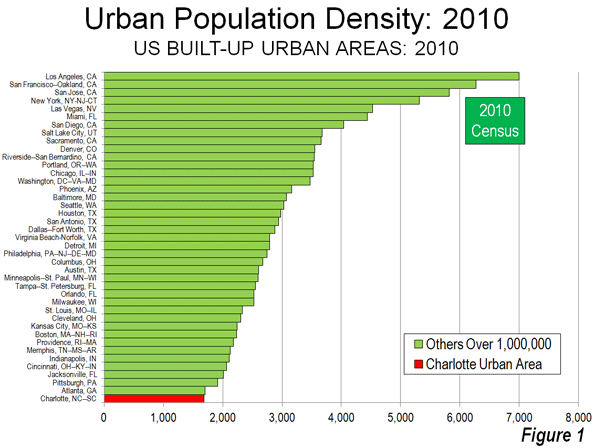
    Photo by telwink.

  • Build It, Even Though They Won’t Come

    The recent decision by Los Angeles County Superior Court Judge Allan J. Goodman to reject as “fatally flawed” the densification plans for downtown Hollywood could shake the foundations of California’s “smart growth” planning clerisy. By dismissing Los Angeles’ Hollywood plan, the judge also assaulted the logic behind plans throughout the region to construct substantial high-rise development in “transit-oriented developments” adjacent to rail stations.

    In particular, the judge excoriated the buoyant population-growth projections used to justify the plan, a rationalization for major densification elsewhere in the state. The mythology is that people are still flocking to Los Angeles, and particularly, to dense urban areas, creating a demand for high-end, high-rise housing.

    The Hollywood plan rested on city estimates provided by the Southern California Association of Governments, which estimated that Hollywood’s population was 200,000 in 2000 and 224,000 in 2005, and would thus rise to 250,000 by 2030. All this despite the fact that, according to the census, Hollywood’s population over the past decade has actually declined, from 213,000 in 1990 to 198,000 today. Not one to mince words, Judge Goodman described SCAG’s estimates as “entirely discredited.”

    This discrepancy is not just a problem in the case of Hollywood; SCAG has been producing fanciful figures for years. In 1993, SCAG projected that the city of Los Angeles would reach a population of 4.3 million by 2010. SCAG’s predicted increase of more than 800,000 residents materialized as a little more than 300,000. For the entire region, the 2008 estimates were off by an astounding 1.4 million people.

    Similar erroneous estimates run through the state planning process. In 2007, California’s official population projection agency, the Department of Finance, forecast that Los Angeles County would reach 10.5 million residents in just three years. But the 2010 U.S. Census counted 9.8 million residents.

    Such inflated estimates, however, do serve as the basis for pushing through densification strategies favored by planners and their developer allies. In fact, SCAG’s brethren at the Association of Bay Area Governments, seeking to justify their ultradense development plan, recently went beyond even population estimates issued by the Department of Finance.

    The problem here is not that some developers may lose money on projects for which there is inadequate demand, but that this densification approach has replaced business development as an economic strategy. Equally bad, these policies often threaten the character of classic, already-dense urban neighborhoods, like Hollywood. Indeed, the Los Angeles urban area is already the densest in the United States, and a major increase in density is sure to further worsen congestion.

    Not surprisingly, some 40 neighborhood associations and six neighborhood councils organized against the city’s Hollywood plan. Their case against the preoccupation with “transit-oriented development” rests solidly on historical patterns. Unlike in New York City, much of which was built primarily before the automobile age, Los Angeles has remained a car-dominated city, with roughly one-fifth Gotham’s level of mass-transit use. Despite $8 billion invested in rail lines the past two decades, there has been no significant increase in L.A.’s transit ridership share since before the rail expansion began.

    The Hollywood plan is part of yet another effort to reshape Los Angeles into a West Coast version of New York, replacing a largely low-rise environment with something former Mayor Antonio Villaraigosa liked to call “elegant density.” As a councilman, new Mayor Eric Garcetti proclaimed a high-rise Hollywood as “a template for a new Los Angeles,” even if many Angelenos, as evidenced by the opposition of the neighborhood councils, seem less than thrilled with the prospect.

    If the “smart growth” advocates get their way, Hollywood’s predicament will become a citywide, even regional, norm. The city has unveiled plans to strip many single-family districts of their present zoning status, as part of “a wholesale revision” of the city’s planning code. Newly proposed regulations may allow construction of rental units in what are now back yards and high-density housing close to what are now quiet residential neighborhoods.

    “They want to turn this into something like East Germany; it has nothing to do with the market,” suggests Richard Abrams, a 40-year resident of Hollywood and a leader of Savehollywood.org. “This is all part of an attempt to worsen the quality of life – to leave us without back yards and with monumental traffic.”

    Of course, it is easy to dismiss community groups as NIMBYs, particularly when it’s not your neighborhood being affected. But here, the economics, too, make little sense. New, massive “luxury” high-rise residential buildings were not a material factor in the huge density increases that made the Los Angeles urban area more dense than anywhere else in the nation during the second half of the 20th century. Even in New York City, the high-rise residential buildings where the most affluent live are concentrated in the lower half of Manhattan; they house not even 20 percent of the city’s population.

    Under any circumstances, the era of rapid growth is well behind us. In the 1980s, the population of Los Angeles grew by 18 percent; in the past decade, growth was only one-fifth as high. Growth in the core areas, including downtown, overall was barely 0.7 percent, while the population continued to expand more rapidly on the city’s periphery. Overall, the city of Los Angeles grew during the past decade at one-third the national rate. This stems both from sustained domestic outmigration losses of 1.1 million in Los Angeles County and immigration rates that have fallen from roughly 70,000 annually in the previous decade to 40,000 a year at present.

    Nor can L.A. expect much of a huge infusion of the urban young talent, a cohort said to prefer high-density locales. In a recent study of demographic trends since 2007, L.A. ranked 31st as a place for people aged 20-34, behind such hot spots as Milwaukee, Oklahoma City and Philadelphia. It does even worse, 47th among metro areas, with people ages 35-49, the group with the highest earnings.

    In reality, there is no crying need for more ultradense luxury housing – what this area needs more is housing for its huge poor and working-class populations. More important, we should look, instead, at why our demographics are sagging so badly. The answer here, to borrow the famous Clinton campaign slogan: It’s the economy, stupid. In contrast with areas like Houston, where dense development is flourishing along with that on the city’s periphery, Southern California consistently lands near the bottom of the list for GDP, income and job growth, barely above places like Detroit, Cleveland or, for that matter, Las Vegas.

    Despite many assertions to the contrary, densification alone does not solve these fundamental problems. The heavily subsidized resurgence of downtown Los Angeles, for example, has hardly stemmed the region’s relative decline.

    Instead of pushing dense housing as an economic panacea, perhaps Mayor Garcetti should focus on why the regional economy is steadily falling so far behind other parts of the nation. One place to start that examination would be with removing the regulatory restraints that chase potential jobs and businesses – particularly better-paying, middle class ones – out of the region. It should also reconsider how the “smart growth” planning policies have helped increase the price of housing, particularly for single-family homes, preferred by most families.

    At the same time, the mayor and other regional leaders should realize that L.A.’s revival depends on retaining the very attributes – trees, low-rise density, sunshine, as well as entrepreneurial opportunity – that long have attracted people. People generally do not migrate to Los Angeles to live as they would in New York or Chicago. Indeed, Illinois’ Cook County (Chicago) and three New York City boroughs – Manhattan, Queens and Brooklyn – are among the few areas from which L.A. County is gaining population. Where are Angelinos headed? To relatively lower-density places, such as Riverside-San Bernardino, Phoenix and Houston.

    Under these circumstances, pushing for more luxury high-rises seems akin to creating structures for which there is little discernible market. Once demographic and economic growth has been restored broadly, it is possible that a stronger demand for higher-density housing may emerge naturally. Until then, the higher density associated with “smart growth” neither addresses our fundamental problems, nor turns out to be very smart at all.

    This story originally appeared at The Orange County Register.

    Joel Kotkin is executive editor of NewGeography.com and Distinguished Presidential Fellow in Urban Futures at Chapman University, and a member of the editorial board of the Orange County Register. He is author of The City: A Global History and The Next Hundred Million: America in 2050. His most recent study, The Rise of Postfamilialism, has been widely discussed and distributed internationally. He lives in Los Angeles, CA.

  • The New Geography of Apartment Rentals

    “Supply and demand” describes the interaction between the available amount of a resource and the need for it by consumers. In the world of community development, nowhere is this dynamic more pronounced than in the rental housing market.

    Recessionary times have combined with barriers to homeowner financing to spark a surge in rental demand within many U.S. cities and regions. At the same time, erosion in worker salaries over the past decade has led to a record number of households devoting a disproportionate amount of their income towards rental payments. An uptick to increase the supply of rental units and keep pace with an escalating demand needs to occur, but instead, there’s been slow movement in rental housing construction. Where are we seeing the most profound results of this combination of factors – and how can communities best accommodate the new flood of renters?

    According to a study conducted by the Harvard Joint Center for Housing Studies in conjunction with the MacArthur Foundation, participation in the home rental market is at its highest level in more than a decade for all age groups. The US now has 43 million renter households, representing 35 percent of all households. This report also found that housing affordability issues have soared, since nearly half of renters possess annual incomes below $30,000, including 22 percent with incomes below $15,000. More than half of all renters — 21 million households — dole out more than 30 percent of their income for housing. These figures represent the greatest number of cost-burdened renters on record.

    The Colorado Front Range and the Bakken Region of North Dakota and Montana are examples of areas where high levels of population growth have led to meteoric shifts in the rental housing markets. Over the last three years or so, the influx of new residents has driven monthly rates to unprecedented heights.

    The Front Range refers to the most populous areas of Colorado: cities like Boulder, Fort Collins, Castle Rock, Colorado Springs, and Denver, which have become the primary hotspots for new resident growth. Much of the development there is a result of incoming highly educated workers, who are arriving in droves from California, Ohio, Texas, Florida, and the Dakotas. Denver has had the distinction of being ranked first among U.S. metros for total population gain in the 25-34 age range between 2008 and 2010, and the Census Bureau estimates that by 2020 Metro Denver’s population will soar from 2.9 to 3.2 million.

    Northeast of Colorado is a region that has seen explosive growth due to an oil boom, with a population that now includes thousands of migrated workers filling the numerous jobs. This sudden movement to lucrative location is reminiscent of the California gold rush era. According to the U.S. Energy Information Association, oil production in this region is expected to top one million barrels a day by year-end 2013.

    The black gold hotspot is the Bakken Region, which extends from parts of North Dakota into Montana, encompassing 12 counties. The Bakken Region has seen its working population swell by 70% since 2010. While the economic trend has been a boost to fortunes, a chronic shortage of living accommodations for transient workers has led to a serious imbalance in the housing supply/demand equilibrium. The result: home and rental housing costs that boggle the mind and terrify the wallet, sending many arriving workers into hysterics as they try to find a place to rest their heads at night. There is frequent talk of workers that are forced to live in their cars while earning $100,000 a year. Trailer parking spots can be found for rates that have escalated to $800 a month, and hotel prices are even higher; a one-night stay can be $300, or even more.

    The operative question for city leaders and planners in these regions is how to build large swaths of new housing without the supporting infrastructure to accommodate the expansion. Michael Leccese, Executive director of Urban Land Institute Colorado (ULI), notes that during the recession the area’s boom in apartment living has played a crucial role in keeping real estate development afloat. “The pace of apartment construction has provided needed housing for the region’s growing population of Millennials, as well as for empty nesters and those shut out of the for-sale market for whatever reason,” says Leccese. “Many of these apartments have been constructed in walkable, urban infill and transit-accessible locations, and often feature innovative, green building designs.”

    The massive push to expand housing supply has raised the question of whether the market is being overcorrected to the point that supply will exceed demand. As construction begins on more and yet more new apartment buildings, will the Front Range and the Bakken Region continue to see the massive growth that has characterized the last few years?

    Leccese asserts, “There is no doubt that we are seeing some concern on the part of our ULI members in terms of this overbuilding, as well as the lack of diversity in product type and price point. Some are, in fact, wondering whether this might be the new housing bubble.” If growth does slow, this will mean good news for renters, who will likely see more affordable rental rates. For rental housing companies, however, it would not be a call for celebration.

    Along with the Colorado Front Range and the Bakken Region, cities throughout the nation with growing populations will be facing similar challenges as they strive to insure an appropriate supply of reasonably priced rentals to accommodate regional housing needs. The issue shows no sign of abating in cities and regions possessing rich harvests of jobs that attract new entrants to their area.

    Age and cultural demographics also factor in. It’s estimated that the number of renters 65 and older will increase by 2.2 million between 2013 and 2023. Hispanics are also projected to account for a substantial share of renter growth over this period.

    Addressing this issue will require thoughtful decision-making based on sound information about demographic shifts and job availability — and a firm understanding of trends in regional supply and demand.

    Michael Scott is a writer, speaker and researcher specializing on the interconnection between people and their community environments. He can be reached at urbanvisionary@gmail.com

    Flickr Photo by Sam Mooney – Rental Sign: Are cheap rents soon to be history?

  • How Silicon Valley Could Destabilize The Democratic Party

    Much has been written, often with considerable glee, about the worsening divide in the Republican Party between its corporate and Tea Party wings. Yet Democrats may soon face their own schism as a result of the growing power in the party of high-tech business interests.

    Gaining the support of tech moguls is a huge win for the Democrats — at least initially. They are not only a huge source of money, they also can provide critical expertise that the Republicans have been far slower to employ. There have always been affluent individuals who backed liberal or Democratic causes, either out of conviction or self-interest, but the tech moguls may be the first large capitalist constituency outside Hollywood to identify almost entirely with the progressives.

    This alliance of high tech and Democrats is relatively new. In the 1970s and 1980s the politics of Silicon Valley’s leaders tended more to middle-of-the-road Republican. But the new generation oligarchs are very different from the traditional “propeller heads” who once populated the Valley. More media savvy and less dependent on manufacturing, the new leaders have less interest in the kind of infrastructure and business policies generally favored by more traditional businesses. They also tend to have progressive views on gay marriage and climate change that align with the gospel of the Obama Democratic Party.

    In the process, the Bay Area, particularly the Silicon Valley – San Francisco corridor, has become one of the most solidly liberal regions in the country. The leading tech companies, mostly based in the area, send over four-fifths of their contributions to Democratic candidates.

    This tech alliance is creating a pool of potential business-tested candidates for the party, including Twitter co-founder Jack Dorsey, who has said he wants to run for mayor of New York someday, even if he now resides in San Francisco.

    The tech oligarchs are also poised to reinforce the media dominance enjoyed by the Democrats. Over the past two years we have seen one tech entrepreneur and Obama ally, Chris Hughes, take over the venerable New Republic, while another, Amazon’s Jeff Bezos, bought the Washington Post.More important, pro-Democratic tech firms such as Microsoft, Yahoo and Google now dominate the online news business, while others, such as Netflix and Amazon, are moving aggressively into music, film and television.

    Yet for all the advantages of this burgeoning alliance with tech interests, it threatens to create tensions with the party’s traditional base — minorities, labor unions and the public sector — as the party tries accommodate a constituency that combines social liberalism and environmentalist sentiments withvaguely libertarian instincts. The fact that this industry has a pretty awful record on labor and equity issues is something that could prove inconvenient to Democrats seeking to adopt class warfare as their primary tactic.

    Indeed, despite its counter-cultural trappings and fashionably progressive leanings, Silicon Valley has turned out to be every bit as cutthroat and greedy as any gaggle of capitalists. Leftist journalists like John Judis may rethink their support for the Valley agenda once they realize that they have become poster children for overweening elite power and outrageous inequality.

    Privacy is one issue that should divide liberals from the tech oligarchs. Historically liberals have been on the front line of the battle to protect personal information. But now tech interests have worked hard, with considerable Democratic support, to block privacy protections that would damage their profits in Europe, and closer to home.

    Another inevitable flashpoint regards unions, a core progressive constituency. Venture capitalist Mark Andreesen recently declared that “there doesn’t seem to be a role” for unions in the modern economy because people are “marketing themselves and their skills.” Amazon has battled unions not only in the United States, but in more union-friendly Europe as well.

    Avatars of equality? Valley boosters speak of the “glorious cocktail of prosperity” they have concocted, but have been very slow to address, or even seek to ameliorate, the vast social chasm that exists under their feet.

    Many core employees at firms like Facebook and Google enjoy gourmet meals, childcare services, even complimentary house-cleaning in an effort to create, as one Google executive put it, “the happiest most productive workplace in the world.”  Yet the reality is less pleasant for other workers in customer support or retail, like the Apple stores, and even more so for contracted laborers in security, maintenance and food service jobs.

    Indeed over the past decade the Valley itself has grown almost entirely in ways that have benefited the affluent, largely white and Asian professional population. Large tech firms are notoriously skittish about revealing their diversity data, but one recent report found the share of Hispanics and African-Americans, already far below their percentage in the population, declined in the last decade; Hispanics, roughly one quarter of the local workforce, held 5.2% of the jobs at 10 of the Valley’s largest companies in 2008, down from 6.8% in 1999, according to the San Jose Mercury News. The share of women in management also has declined, despite the headlines generated by the rise of high-profile figures like Yahoo’s Marissa Mayer and Facebook’s Sheryl Sandberg.

    The mostly male white and Asian top geeks in Palo Alto or San Francisco should celebrate their IPO windfalls, but wages for the region’s African-Americans and Latinos, roughly a third of the local population, have dropped, down 18% for blacks and 5% for Latinos between 2009 and 2011, according to a 2013 Joint Venture Silicon Valley report. Indeed as the Valley has de-industrialized, losing over 80,000 jobs in manufacturing since 2000, some parts of the Valley, notably San Jose, where manufacturing firms were clustered, look more like a Rust Belt city than an exemplar of tech prosperity.

    Overall, most new jobs in the Valley pay less than $50,000 annually, according to an analysis by the liberal Center for American Progress, far below what is needed to live a decent life in this ultra-high cost area. Part-time security workers often have no health or retirement benefits, no paid sick leave and no vacation. Much the same applies to janitors, who clean up behind the tech elites.

    The poverty rate in Santa Clara County has climbed from 8% in 2001 to 14%, despite the current tech boom; today one out of four people in the San Jose area is underemployed, up from 5% a decade ago. The food stamp population in Santa Clara County has mushroomed from 25,000 a decade ago to almost 125,000. San Jose is also home to the largest homeless camp in the continental U.S., known as “the Jungle.” As Russell Hancock, president of Joint Venture Silicon Valley, admitted: “Silicon Valley is two valleys. There is a valley of haves, and a valley of have-nots.”

    These realities suggest that the tech oligarchs, despite their liberal social views, are creating an environment for the “one percent” every bit as stratified as that associated with Wall Street. Google maintains a fleet of private jets at San Jose airport, making enough of a racket to become a nuisance to their working-class neighbors. Google executives tout its green agenda but have burned the equivalent of upwards of tens of millions of gallons of crude oil, which seems somewhat less than consistent.

    At the same time, the moguls have a record of tax evasion — a persistent progressive issue — that would turn castigated plutocrats like Mitt Romney green with envy. Individuals like Bill Gates have voiced public support for higher taxes on the rich, yet Microsoft, Facebook and Apple have all saved billions by exploiting the tax code to shelter profits offshoreTwitter’s founders creatively exploited various arcane loopholes to avoid paying taxes on some of the proceeds of their IPO that they set aside for heirs.

    The set of differing rules for oligarchs and everyone else extends even to the most personal issues. Yahoo’s Mayer, a former Google executive, banned telecommuting for employees — particularly critical for those unable to house their families anywhere close to ultra-pricey Palo Alto. Yet Mayer, herself pregnant at the time, saw no contradiction in building a nursery in her own office.

    This model of economic development seems it would be more appealing to those who believe in “the survival of the fittest” than people with more traditional liberal values. The alliance with tech may well be a critical boon to the progressive cause and its champions for the time being, but at some time even the most deluded progressives will begin to realize with whom they have chosen to share their bed.

    This story originally appeared at Forbes.

    Joel Kotkin is executive editor of NewGeography.com and Distinguished Presidential Fellow in Urban Futures at Chapman University, and a member of the editorial board of the Orange County Register. He is author of The City: A Global History and The Next Hundred Million: America in 2050. His most recent study, The Rise of Postfamilialism, has been widely discussed and distributed internationally. He lives in Los Angeles, CA.

    Official White House Photo by Pete Souza.

  • Highway Eye-4, Revisited

    Interstate 4. It is a unique highway which is cursed by many drivers in Central Florida, and many more who come here in search of rest and relaxation. While Californians raise all highways to royal status — Interstate 5, for one, is referred to as “the five”, as if it were some kind of important personage — Floridians just call their central artery I-four. My decision to chronicle I-4 was sparked by a recent experience. Along with my family, I was caught in a traffic jam as we headed east on I-4 outside of Disney World. I have been stuck on this very spot many times. But on this trip, as we sat listening to Janis Joplin, something new happened.

    Along this stretch, one can take an off-ramp that runs parallel to the interstate, linking it to one of Central Florida’s toll roads. It travels for a couple miles in close proximity, and is elevated along a ridge of grass about 10 feet above the surface of I-4.

    A ditch and a grassy embankment separate the off ramp and the interstate. As we watched, a driver in the right lane of I-4 turned off of the interstate, crossed the shoulder, went down into the ditch, and climbed up onto the parallel road, speeding away and out of the traffic jam. At first, one person did it, and then others followed. And then, about 500 feet ahead, we saw another stream of cars doing the exact same thing. And then, ahead of that stream, yet another stream of drivers drove over the embankment. It wasn’t one or two cars, it was dozens and dozens; an en masse sheet flow ripping up the grass. People, fed up with the traffic mess, had taken matters into their own hands. And they were speeding away.

    That is a phenomenon I haven’t seen before: collective abandonment of a pathway, even one that is highly discouraging. But then, maybe it’s nothing new. I-4 has inspired bizarre and unusual behavior for years.

    Back in 2012, I shared some highlights of this unique roadbed. For example, a haunted part lies, perhaps not coincidentally, close to the Cassadaga Spiritualist Camp. Just a couple of weeks ago, a section of the underbrush along the highway’s edge was cleared, revealing a hillside cemetery. At the fence line there was newly painted stucco. In this area, I-4 is rumored to have a ghost or two from an early pioneer family that walks along the side of the road. Whether the highway was paved over part of the cemetery or the high-speed rumblings awakened the dead remains to be investigated.

    In the 1980s and 1990s, living in Tampa, I actually kept an I-4 log book in the car. Occasionally an incident was worth writing down, but it ended up mostly as an inventory of objects encountered along the interstate:

    • About 300 feet ahead of me a cardboard box tumbled off the rear bed of a pickup truck. The rolling, disintegrating contents included a boat chair on a 2 foot tall post and a light with wires flying off of it. I drove right over them. The chair made a very loud clunk.

    • In Lakeland, a road crosses over I-4, with a ramp that goes down the embankment and turns abruptly onto I-4, sort of like a driveway. There is no acceleration lane because a railroad bridge abutment is immediately ahead. At this entrance ramp, one late afternoon I was behind a pickup truck without a gate that rolled down the ramp and accelerated quickly to merge into traffic. As it did, a huge, greasy black transmission fell off of the back. The ground shook when it hit, and I heard the thud.

    • Malfunction Junction is the intersection of I-4 and I-275 in Tampa. I was travelling south on I-275 heading underneath I-4, driving my parents’ 1972 Ford Torino station wagon. This is a tank of a car, all steel with a 302 V-8 engine. I still have dreams about it. I was going perhaps 50 early on a Sunday morning into downtown. Ahead of me by about 6 car lengths was a rusty pickup truck stacked with bales of hay. As the highway ducks under the I-4 bridge, it curves right and it slopes. The pickup was just under the bridge when a bale of hay fell off of it. With no possible reaction time, I plowed right into the hay. The nose of a Torino actually comes to a point, which sliced into the bale of hay, and blew it apart as I drove through, leaving behind a huge, golden-tan cloud. It didn’t leave a scratch on the car — only a single hay straw was stuck in the windshield wiper. What stands out about this incident, even today, was that the hay gave no resistance whatsoever: when the car hit it did not shudder or make any noise at all. It was like driving through smoke. Such was the power of the Torino.

    These incidents now seem almost archaic; circus sideshows from a bygone era. They are great Florida folk tales, stories of bubbas for after dinner entertainment. The events are faraway both in time and in spirit from the darker forces that haunt our population on the road today.

    Those who are here on vacation, trying to relax and enjoy some family time, are tormented by a solid, stopped-up traffic-choked road full of millions of others who have come here to do the exact same thing. People reached a threshold of pain and crossed it, taking matters into their own hands and seeking stress relief during a vacation that was planned as stress relief in the first place. I-4 has become a metaphor for our times.

    2009 and 2010 were years that really beat people up. By 2011 and 2012, many had adjusted their expectations and gotten really cynical about the future. Last year, things changed again. For some, the world has gotten worse. For those who were so swiftly unemployed and have become re-employed, the new working conditions are different. They work much harder, for less than before. They face uncertainty every single day, a holdover from the white-knuckled years. The stress wears on the inner compass, and the temptation to cut corners gets greater and greater.

    When brazen self-interest spreads like wildfire, a sort of highway mob rule, if you will, I think that we as a society may be on the edge of something new and wild, as if the guardrails of rationality have weakened.

    This little incident on Interstate 4 may be isolated, or it might be a symptom of a sea change. People who have been patient and docile have taken a beating over the last several years. We have put up with mental and emotional abuse as we’ve tried to make the world better for our children. In doing so, we’ve — mostly — stayed grimly entrenched in the collective good; the shared social values and the rule of law over men.

    But when one or two people break off and steer their own course, how quickly many others follow. These are dangerous times, and our inner moral compasses are more important than ever before. We didn’t preserve our collective sanity through all of the wicked and sorrowful events of the recent past, only to lose it all now. In the coming year, we must hold on for a little longer, and rebuild moral capital for future generations.

    Richard Reep is an architect and artist who has been designing award-winning urban mixed-use and hospitality projects, domestically and internationally, for the last thirty years . He is Adjunct Professor for the Environmental and Growth Studies Department at Rollins College, teaching urban design and sustainable development. His writing has focused on art and architectural criticism, and on localism and its importance in establishing sense of place. He resides in Winter Park, Florida with his family.

    Flickr photo by Dean Shareski: Traffic on I-4, Orlando.

  • The Evolving Urban Form: Charlotte

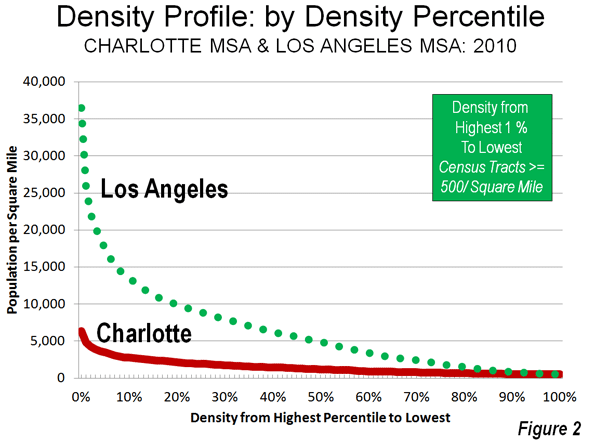
    There may be no better example of the post World War II urban form than Charlotte, North Carolina (a metropolitan area and urban area that stretches into South Carolina). Indeed, among the approximately 470 urban areas with more than 1 million population, Charlotte ranks last in urban population density in the United States (Figure 1) and last in the world. According to the United States Census Bureau, Charlotte’s built-up urban area population density was 1685 per square mile (650 per square kilometer) in 2010. Charlotte is not only less dense than Atlanta, the world’s least dense urban area with more than 4,000,000 residents, but it is only one-quarter the density of the supposed  “sprawl capital” of Los Angeles (Figure 2).

    Over the last seven decades, Charlotte also has been among the fastest growing metropolitan areas in the United States. Charlotte is the county seat of Mecklenburg County, and as recently 1940 as was home to 101,000 residents while with its suburbs in Mecklenburgh County was barely 150,000.

    Declining Densities in the Core City

    Charlotte is also in example of the difficulty of using the core municipality data for comparisons to the suburban balance of metropolitan areas. With North Carolina’s liberal annexation laws, Charlotte has pursued a program of nearly continuous annexation such that in every 10 years since 1940, the city has added substantial new territory.

    In 1940, the city of Charlotte covered a land area of 19 square miles (50 square kilometers) and had a population density of 5200 per square mile (2,000 per square kilometer). For a prewar core municipality, this was not at all dense. For example, Evansville Indiana, which had approximately the same population at the time, had a population density nearly twice that of Charlotte. Other larger core municipalities approached triple or more Charlotte’s population density, such as Trenton, Buffalo, Providence, and Milwaukee.

    Over the last seven decades, the city’s population has risen by 6.2 times, while its land area has increased by 14.4 times (Table $$$). The result is a 53% decline in the city of Charlotte’s population density, to 2456 per square mile (948 per square kilometer). This is only slightly above average density of the US built-up urban area – which includes the smallest towns and suburbs of every size – of 2,343 per square mile (1,455 per square kilometer). Indeed, the average far flung suburbs (30 miles distant) of Los Angeles, such as Pomona and Tustin, are more than 2.5 times as dense.

    City of Charlotte (Municipality)
    Population & Land Area: 1940-2010
    Census Population Area: Square Miles Area: Square KM Density (Sq. Mile) Density (KM)
    1940           100,899 19.3 50.0          5,228          2,019
    1950           134,042 40.0 103.6          3,351          1,294
    1960           201,564 64.8 167.8          3,111          1,201
    1970           241,178 76.0 196.8          3,173          1,225
    1980           314,447 139.7 361.8          2,251             869
    1990           395,934 174.3 451.4          2,272             877
    2000           567,943 242.3 627.6          2,344             905
    2010           731,424 297.8 771.3          2,456             948
    Change 625% 1443% 1443% -53.0% -53.0%


    Growth by Geography

    The core city of Charlotte’s ever-fluctuating boundaries make it necessary to use smaller area measures to estimate the distribution of population growth. This can be accomplished using zip code data from the 2000 and 2010 censuses.

    Inner Charlotte, for the purposes of this analysis (zip codes 28202 through 28208) covers approximately 28 square miles (73 square kilometers) and had a population of approximately 92,000 in 2010 . This is a larger area than the city of Charlotte in 1940, which covered only two thirds as much land area and had more people. Between 2000 and 2010, this inner area population rose by 6,200 residents. All the gain was in the central zip code that comprises the downtown area (central business district), which in Charlotte is called "Uptown." Outside this small 1.8 square mile area (4.7 square kilometers), the inner area actually lost 1,400 residents.

    Overall, the inner area of Charlotte – which has somewhat an obsessive hold on many city leaders – accounted for 1.0% of the metropolitan area growth from 2000 to 2010. This is not unlike other major metropolitan areas, which have experienced slow growth, particularly in areas adjacent to the downtown cores. Among the 51 US metropolitan areas with more than 1,000,000 population in 2010, net gain occurred within two miles of city hall, while this gain was erased by a loss of 272,000 between two and five miles of city hall.

    Another 13% (64,000) of the 2000-2010 growth occurred in the middle Mecklenburg County zip codes (28209 to 28217), virtually all of which is in the city of Charlotte. This 185 square mile area, combined with the inner area, exceeds the land area of the city in 1990.

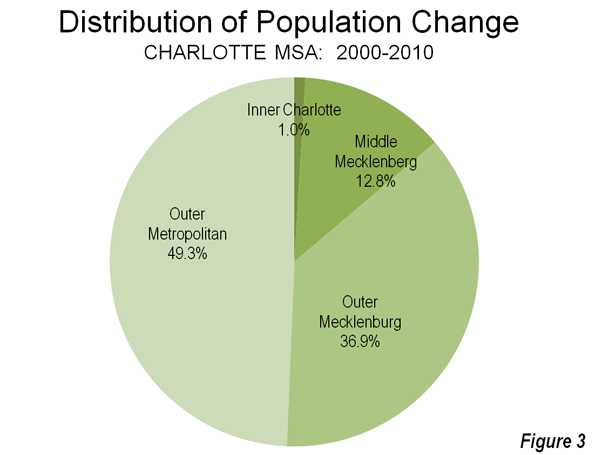
    Mecklenburg County’s outer zip codes, many of which are in the city, captured 37% of the metropolitan area’s growth (184,000). The remaining 49% (247,000) of growth in the Charlotte metropolitan area was outside Mecklenburg County (Figure 3).

    From 1990 to 2010, Charlotte was the seventh fastest growing metropolitan area out of the 51 with a population exceeding 1 million. Early data for the present decade shows Charlotte to have slipped to ninth fastest growing; however during this period, Charlotte has displaced Portland, Oregon as the nation’s 23rd largest metropolitan area. Between 1990 and 2012, Charlotte added nearly 1,000,000 residents and now has 2.4 million residents.

    Uptown: The Commercial Story

    Unlike other post-World War II metropolitan areas (such as Phoenix, San Jose, and Riverside-San Bernardino), Charlotte has developed a concentrated, high rise downtown area." Part of this is due to the city’s strong financial sector. Charlotte is the home to Bank of America, the nation’s second largest bank and the successor to the San Francisco-based California bank of the same name that was the largest bank in the world for decades. Nation’s Bank, the predecessor to Bank of America, erected a 60 story tower in 1992 that was among the tallest in the United States.

    Charlotte was also home to Wachovia Bank, which built its 42 floor headquarters before, and nearby the Bank of America Tower. Wachovia had intended to move to a larger, 50 story building. However, the time it was completed, Wachovia had been sold to Wells Fargo Bank, a casualty of the US financial crisis. The new building was renamed the Duke Energy Center.

    Thus, Charlotte consumed one San Francisco bank, and lost another to San Francisco. Now Uptown Charlotte has six buildings more than 500 feet in height (152 meters). With six buildings of this height,  Charlotte has developed by far the concentrated central business district among the newer metropolitan areas.

    However, the high employment density has not converted into a transit oriented business district, as some might have predicted. American Community Survey (CTPP) data indicates that approximately 87% of uptown employees use cars to get to work. Further, more than 90% of the jobs in the metropolitan area are outside Uptown.

    Uptown: The High Rise Condominium Story

    Uptown’s commercial progress has not been replicated in the residential market, as overzealous high rise condominium developers apparently may have confused Charlotte for Manhattan or Hong Kong. One of the more recent 500 foot plus towers was The Vue, a 50 story condominium tower. Too few condominiums were sold, and a foreclosure auction followed. The new owner has converted the condominiums to rental units. A 40 story condominium project ("One Charlotte") was to feature units priced from $1.5 million to $10 million, but was cancelled. Another condominium building, the 32 story 300 South Tryon was also cancelled. A tower base was prepared for a 50 plus story condominium monolith, but this was never built, while depositors were claiming they could not find the developer to get their deposits back. It was also reported that legendary developer Donald Trump had plans for the tallest building in town, a 72 story condominium tower, which would have been joined by another tower. These have also been cancelled (for artists renderings, click here).

    Charlotte’s Continuing Dispersion

    While Uptown condominium developers were unable to sell many units, Charlotte’s labor market dispersed so much between 2000 and 2010 that the Office of Management and Budget expanded the metropolitan area by four counties. The net addition to the population of this revision was approximately 460,000.  This is by far the largest percentage increase to a metropolitan area over the period, though much larger New York added counties with 660,000 residents.

    Charlotte seems to say it all with respect to the ill-named "back to the city movement" (ill named, because most suburbanites did not come from the city to begin with). Yes, there is growth downtown and yes, it is important and yes, it is healthy. But, in the overall scheme of things, it is small, and relative to the rest of the thriving region, likely to remain less important in the years ahead.

    Wendell Cox is a Visiting Professor, Conservatoire National des Arts et Metiers, Paris and the author of “War on the Dream: How Anti-Sprawl Policy Threatens the Quality of Life.

    Photo: Uptown Charlotte courtesy of Wiki Commons user Bz3rk

  • Some Implications of Detroit’s Bankruptcy

    There’s been so much ink spilled over Detroit’s bankruptcy that I haven’t felt the need to add much to it. But this week the judge overseeing the case ruled that the city of Detroit is eligible for bankruptcy. He also went ahead and ruled that pensions can be cut for the city’s retirees. Meanwhile, the city has received an appraisal of less than $2 billion for the most famous paintings in the Detroit Institute of the Arts.

    A couple of thoughts on this:

    First, every city in America should be doing a strategic review of its assets, and moving everything it doesn’t want turned into de facto debt collateral into entities that can’t be touched by the courts. In the case of the DIA, the city owns the museum and the collection. Hence the question of whether or not art should be sold to satisfy debts. If it were typical separately chartered non-profit institution, this wouldn’t even be a question.

    At this point, I’d suggest cities ought to be taking a hard look at whether they own assets like museums, zoos, etc. that should be spun off into a separate non-profit entity. Keep in mind, the tax dollars that support the institutions can continue flowing to it. But this does protect the assets in the event of a bankruptcy.

    In the case of Detroit, it seems inevitable that at least some art work will be sold. Given that worker pensions are going to be cut, it would be pretty tough to say no to selling art. Assuming this is the case, post-sale the museum should be spun off as a separate entity to hopefully reboot its standing the museum world. As the trustees of the group that operates it have been adamantly opposed to any sale, one would hope other museums would not hold any violations of industry standards against them for, particularly if they acquire ownership of the building and artwork away from the city afterward. The city of Detroit doesn’t need to be in the museum business anyway. It has bigger fish to fry.

    Secondly, public sector employees will have to start rethinking their approach to retirement benefits. The current mindset has been to grab as much as you can anytime you can because the taxpayer will always be forced to cover the promises no matter what. As the actual results in Central Falls, RI and now this show, that’s no longer a good assumption.

    Detroit’s workers don’t have lavish pensions as these things go. But they weren’t shy about abusing the system either. They in effect looted their own pensions by taking out extra, unearned “13th checks”. They also used pensions funds to give a guaranteed 7.9% annual rate of return on supplemental savings accounts workers were allowed to establish. All told these “extra” payments drained about $2 billion out of the pension system.

    This was not something the city did through an arm’s length transaction. As the Detroit Free Press reported, Mayor Dennis Archer was alarmed by the practice and wanted to stop it. But “the city doesn’t control its pension funds, which have been largely administered by union officials serving on two independent pension boards.” So he tried to amend the city’s charter to stop the practice. According the Free Press, “Archer backed an effort to block the payments through a proposed new city charter, which actually passed in August 1996. Enraged, several city unions and a retiree group sued and won. Archer tried again to block payments through a ballot initiative, called Proposal T, but it failed.”

    The unions could brazenly loot their own pension plan because they felt rock-solid assurance that the taxpayers would ultimately be required to make them whole. This bankruptcy is showing that may not be the case after all. It should serve as a warning to unions everywhere not to get too aggressive with their shenanigans.

    They’ll of course appeal the judge’s ruling and may win. But the Michigan constitution says pensions are a contract right. The very definition of bankruptcy is that you can’t pay what you’re contractually obligated to. Bankruptcy is all about breaking contracts. The bondholders have contracts that are not supposed to be impaired too, after all. I’m a fan of local government autonomy as you know, but as Steve Eide rightly points out, any freedom worth its name is freedom to fail. If cities and their various constituencies don’t suffer the consequences of their mistakes, they should be heavily micromanaged from on high.

    When individuals fail, we have a safety net (unemployment insurance, for example). Plus we have personal bankruptcy to give people a fresh start. We don’t even worry about whether the person is at fault for their own position or not. We provide that backstop regardless. But that backstop doesn’t allow people to go on living like they did before as if nothing happened. Similarly, cities in trouble shouldn’t be abandoned, but they need to realize that there are genuine consequences for failure. A realization that failure has consequences for pension holders as well as the taxpayer should hopefully promote healthier decisions about how retirement benefits should be offered, funded, and administered.

    Aaron M. Renn is an independent writer on urban affairs and the founder of Telestrian, a data analysis and mapping tool. He writes at The Urbanophile, where this piece originally appeared.