Blog

  • Political, Economic Power Grow More Concentrated

    Generally speaking, we associate the quest for central government control to be very much a product of the extremes of left and right. But increasingly, the lobby for ever-greater concentration of power – both economically and politically – comes not from the fringes, but from established centers of both parties and media power.

    Recently, for example, an article by Francis Fukuyama, a conservative-leaning intellectual, called for greater consolidation of federal power, most particularly, the Executive Branch. Ironically, Fukuyama’s call for greater central power follows a line most often adopted by “progressive” Democrats, who seek to use federal power to enforce their views on a host of environmental, economic and social issues even on reluctant parts of the country.

    This rush to concentrate powers in Washington seems odd, given the awful rollout of the Affordable Care Act, which seems almost like a parody of a government-managed big program, overly complex and almost impossible to implement. ACA has led even some honest liberals, like the New York Times Tom Edsall, to wonder if “the federal government is capable of managing the provision of a fundamental service through an extraordinarily complex system?”

    To give the Left credit, many liberals would have preferred something less complex, perhaps like the single-payer system, that perhaps would be less amenable to confusion, and exemptions for privileged groups, like congressional staffs. But President Obama and his Democratic allies chose to work with many powerful interests, notably pharmaceutical companies and health insurers, who are in position to capitalize on this bizarre and, in many ways, inexplicably complicated, health care “reform.”

    Other cautionary tales of overcentralization of federal power abound. Recent scandals like NSA eavesdropping and IRS political targeting, would have offended progressive defenders of civil liberties. However, with a favorite Democrat in the Oval Office, and conservatives the primary victims of abuse, their response has been far more muted than if, say, Mitt Romney was president.

    Top-down economy

    Equally critically, many progressives also increasing favor a more centralized economy. With a few brave exceptions, notably Vermont’s feisty socialist Sen. Bernard Sanders and incorrigibles such as Ralph Nader, there have been too-few voices willing to challenge the growing corporatization of the Democratic Party and the ongoing concentration of power in ever-fewer hands.

    Historically, progressives made much about their objections to both government abuse and unrestrained corporate power. After all, progressives (as well as populists) pushed the earliest restraints on trusts and other large corporate combinations. But, now, the very people Theodore Roosevelt defined more than a century ago as the “malefactors of great wealth” have won powerful friends in the progressive camp.

    Take, for instance the growing concentration of banking assets. Over the past 40 years, the asset share of the top five banks has grown from 17 percent to more than 50 percent of the total. This, however, is not enough for some progressive thinkers. Liberal pundits, like Matt Yglesias and Steve Rattner, in fact, think it would be better if we got rid of most smaller financial institutions.

    Some of this is Washington-New York “we know best” elitism at its worst. These are the institutions and individuals that a studied corporatist and influence peddler like Rattnerwould identify with, naturally. Yglesias, for his part doesn’t like small banks in part because they are run by “less-bright and not-as-good guys” as the benevolent geniuses on Wall Street, who almost cracked up the world economy.

    This confluence of large government and big business can be seen in the flow of funds to the Center for American Progress, the Obama-friendly think tank whose head, John Podesta, was just named the president’s latest chief of staff. The center’s primary funders include a who’s who of big corporations, including Apple, AT&T, Bank of America, BMW of North America, Citigroup, Coca-Cola, Discovery, GE, Facebook, Google, Goldman Sachs, PepsiCo, PG&E, the Motion Picture Association of America, Samsung, Time Warner, T-Mobile, Toyota, Visa, Wal-Mart and Wells Fargo.

    These donations reflect a growing lurch of bigger businesses toward the corporatist Democrats; this is particularly true in such fields as media, telecommunications, high technology and health care, where looming environmental and labor reforms are perceived as less a threat than among smaller firms.

    Rise of regulators

    Most worrisome, the increased focus on bigness has engendered growing support for what amounts to government by administrative diktat. As Fukuyama and others argue, our present messy system, particularly Congress, seems incapable of meeting challenges facing the country. This leads to a notion that we need a new “top down” solution through the exercise of greater executive power.

    As is increasingly the case, any attempt to push back against centralization elicits a torrent of name-calling. Objecting to a more expansive federal government, suggests some, smacks of “neo-Confederate” ideology, a charge particularly loaded when the agglomeration of power in Washington is being led by our first African-American president.

    These assaults mask a more dangerous reality: a dismissal of democracy and embrace of authoritarian solutions. Former Obama budget adviser Peter Orszag and the New York Times’ Thomas Friedman have argued that power should shift from contentious, ideologically diverse elected bodies – subject to pressure from the lower orders – toward credentialed “experts” operating in Washington, Brussels or the United Nations. These worthies regard popular will as lacking in scientific judgment and societal wisdom.

    There is no adequate political response to this dangerous tendency. Republicans talk about abuse of power, but, when in office, seem more than willing to indulge in it (with the run-up to the Iraq war and with the Patriot Act). Similarly, few Republicans seem to understand that economic concentration – favored by their remaining friends on Wall Street and the corporate community – tends inevitably to lead to the political variety.

    So far, Republicans have been forced to choose between their own corporatists, who simply favor shifting government largesse to their favorite causes, such as defense or farm subsidies, and the Tea Party movement, whose members often oppose virtually any government initiative, for example, infrastructure improvement, even at the local level, something sure to limit their appeal to a wider electorate.

    Growing distrust

    Yet the situation is far from hopeless. Obama’s ineffective rule has done little to vouch for centralized government. Trust in governmental institutions – the White House, Congress, the courts – is at the lowest ebb in decades. The percentage of people who see the federal government as being too powerful, notes Galluphas surged from barely 50 percent, when President Obama took power, to well over 60 percent today, the highest level ever recorded.

    In such a climate, some thoughtful liberals, such as Yale’s Jacob Hacker, suggest that progressives should avoid embracing an authoritarian, top-down ruling philosophy. “The Democrats have the presidency now,” he suggests, “[but] they won’t hold it forever.” They are essentially “feeding a beast” that, at some date, may turn against them with a vengeance.

    This suspicion of “top down” solutions also extends even to one of the most critical parts of the Democratic base: the millennial generation. Although they have been a core constituency for Barack Obama, they appear to be drifting somewhat away from their lock-step support, with the presidential approval level, according to a recent study by the Harvard Institute of Politics, now under 50 percent.

    Much of the problem, notes generational chronicler Morley Winograd, lies with millennials’ experience with government, which to them often seems clunky and ineffective. The experience with the ACA is not likely to enhance this view, Winograd suspects. “Millennials,” he notes, “have come to expect the speed and responsiveness from any organization they interact with that today’s high tech makes possible. Government, on the other hand, is handcuffed by procurement rules and layers of decision-making, from deploying much of this technology to serve citizens. The result is experiences with government, from long lines at the DMV office to the botched website rollout for Obamacare, causes millennials to be suspicious of, if not downright hostile to, government bureaucracies.”

    It may be here, in the meshing of technology and public purpose, that we may find a new focus that is neither reflexively hostile (as some Tea Partiers appear) to government per se or simply interested in expanding the list of self-interested political clients. The key to future effective government lies not so much in its radical downsizing as in dispersing power to the local level, something that fits both into the mentality of the new generation and the decentralist traditions that have animated our history.

    This story originally appeared at The Orange County Register.

    Joel Kotkin is executive editor of NewGeography.com and Distinguished Presidential Fellow in Urban Futures at Chapman University, and a member of the editorial board of the Orange County Register. He is author of The City: A Global History and The Next Hundred Million: America in 2050. His most recent study, The Rise of Postfamilialism, has been widely discussed and distributed internationally. He lives in Los Angeles, CA.

    Barack Obama photo by Bigstock.

  • The Abuse of Art in Economic Development

    City building is an imperfect process. Poverty, segregation, and income disparities persist, or worsen, despite longstanding efforts to affect change. The unsightliness of these social failures are called “blight”. Blight is commonly thought to be the antithesis to beauty.

    Urban revitalization efforts have been infatuated with idea that removing blight creates the conditions for community good. Specifically, the field of aesthetics—or that branch of philosophy that deals with the principles of beauty and artistic taste—has for long been held up as a lens through which society can be ordered, with the thinking that beautification can “rehab” the masses.

    For instance, the early 20th-century upper crust framed the conditions of poverty this way: the deprived were laggards on the evolution toward modernity, and they needed aesthetic inspiration. So arose the City Beautiful Movement, whose premise, according to Julie Rose at the University of Virginia, “was the idea that beauty could be an effective social control device”.

    Put simply, outside pretty would arouse inside pretty, inspiring civic loyalty and morality in the impoverished.

    A line in the 1904 classic “Modern Civic Art, or The City Made Beautiful” puts it frankly: “[M]odern civic art can now hope to banish the slum thus to redeem the tenement and to make its own conquests thorough.”

    Cleveland tried its hand with this approach. Back in the early 1900s the city’s elites commissioned then-starchitect Daniel Burnham to create the Group Plan. The Plan called for a City Beautiful civic center, which involved demolishing downtown housing tenements and commercial structures deemed expendable, with a series of elegant Beaux Arts-style buildings eventually being constructed around a plaza-like green space, now known as the “Mall”. It was believed such a central source of civic beauty would radiate out into the city, curing ills of all types. The beauty would be timeless, without half-life—always anchoring Cleveland’s progression, like a compass of godliness.

    Courtesy of groupplan.dhellison.com

    It didn’t work. Today, Cleveland is wayward, with a poverty rate of over 30 percent, and more vacant houses than perhaps ever before. Such failures made plain the fact that impoverishment cannot be “prettied” out of the city.

    The use of aestheticism in city building has not gone away. In fact efforts have redoubled over the last decade. The idea is no longer about flushing impoverishment out of the city system, but rather using art—particularly the romanticization of the artist and the act of creation—to spark economic growth.

    In the article “Artists, Aestheticisation and the Field of Gentrification”, scholar David Ley discusses this strategy, whereby a neighborhood moves from “from junk to art and then on to commodity”, or form poor to reinvested in. The gist of the process—one with roots in 1960s France to present-day everywhere—goes something like this:

    Artists, as members of the bohemian vanguard, historically seek affordable, gritty locations. They do this out of necessity—most of the creative class is paid pittance—but also for creativeness.

    “Hardship was the price one paid for being in the thick of it,” wrote artist David Byrne in the article “Will Work for Inspiration”.

    Where artists cluster, so does the concept of anti-conformity and “cool”. Here, according to Ley, the space of the artist and the space of middle class youth overlap, bringing an era’s hipsters into a neighborhood’s fold. Things can turn quickly after that. Developers and entrepreneurs constantly sniff out the next big thing so as to buy lower and rent higher, with the scent pegged to “what the kids like”, hence the incessant “Millennial” fixation. Eventually, as gentrification continues, the artists and hipsters give way to professionals, until a landscape of wealth and conformity fills in the “starving artist” romanticism that greased its path.

    Notwithstanding which side of the gentrification debate one falls on, the fact of the matter is that this form of city revitalization—from junk, to art, to commodity—is rampant, becoming defacto neighborhood development. In Cleveland, the arts-fueled districts of Tremont, Detroit Shoreway, Collinwood, and St. Clair-Superior speaks to the popularity of this approach.

    This isn’t to say it inevitably works. There are only so many artists and hipsters to go around, and not everywhere is Portland, Austin, or Brooklyn. And so when Anywhere, USA does the art-as-development approach, things do not always go as planned.

    In the recent piece called the “Best of All Possible Worlds”, writer Mark Lane travels to Evansville, Indiana, where a public art contest sparked “a debate over class, race, and good taste”. The story details how the town’s arts district plan devolved into land-grabbing by a quasi-governmental agency whose attempt at subsidizing housing for artist attraction often turned into the demolition of stately structures, if only because getting artists to move to small town Indiana is hard.

    Courtesy of The Believer

    Courtesy of The Believer

    Beyond the wisdom of such a strategy, the piece examines the role of art as an aesthetic discipline, noting that the use of art in city revitalization is commonly not art for art’s sake, but is rather employed as a means to “fertilize” low-income neighborhoods for the arrival of the creative class.

    “It’s not about the art,” noted an Evansville city planner to Lane. “Art is just another tool for economic sustainability.”

    Such is a far cry from Picasso’s purpose of art, which is “washing the dust of daily life off our souls”.

    Curiously, you don’t hear much from the mouthpieces of the art establishment as to the way the discipline is being used: as a means to create commercial order. Historically, the beauty and need of civic art has been about allowing the brokenness of life to enter into the artist’s realm so that the pain and suffering of humanity could be recast through the value of creation. Here, the soul is the audience, with the ovation meant to reverberate into how we “do” community.

    But civic art as “junk, to art, to commodity” achieves something else. It turns the act of creation into the act of “creative classification”. And given our current economic inequalities and the erosion of the middle class, it is fair to wonder why a field that can heal the soul is being used to patch a system that adds dust to our daily living by the day.

    Richey Piiparinen is a writer and policy researcher based in Cleveland. He is co-editor of Rust Belt Chic: The Cleveland Anthology. Read more from him at his blog and at Rust Belt Chic.

    Top photo courtesy of aaronacker.com

  • The Geography of Cultural Attitudes

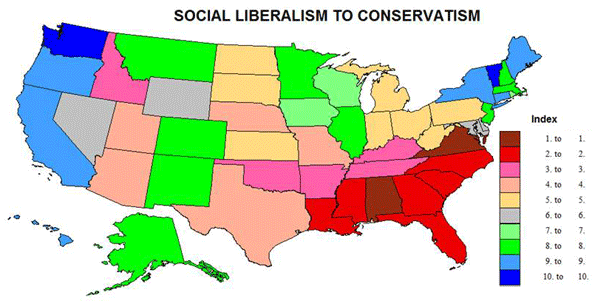
    The cultural and political division of America, the gap between “red” and ”blue” with respect to economic and social liberalism or conservatism is a constant and dominant theme in American discourse. Here’s some narrowly specific measures of social liberalism based on actual votes by citizens or legislatures, not polls or broader indices available.   

    We would have liked to use more measures, but data problems restricted us to only 8 measures: women’s suffrage and state votes on the ERA (Equal Rights Amendment), the right to die, the legalization of marijuana, gay sex (sodomy laws), same sex marriage, racial intermarriage, contraception, and abortion (current state).  Data for religion-state separation were inadequate, although we include some extra data on religiosity.

    For women’s suffrage our index notes when suffrage was granted (states which did not until after the 19th Amendment get the lowest score).  Similarly for the ERA, we give high scores to states which early granted rights to women, with low scores for states which did not pass the ERA, or rescinded an earlier yes vote. For racial intermarriage, scores were based on when intermarriage became legal, with the lowest scores for those states where it was still illegal before the 1967 Supreme Court decision. Gay sex similarly gives lowest scores with anti-sodomy laws still in force at the time of the Lawrence vs Texas case in 2003. The same sex marriage measure gives high scores to states which now accept same sex marriage. The contraception measure is based on current restrictions on emergency contraception, as data on earlier history were poor. The “right to die” or “death with dignity” cause is more recent. The abortion measure is based on a state by state analysis of when and if it was accepted by states before Roe, and the degree of current constraints. Finally the marijuana measure considers the vote in CO and WA, and also states with medical marijuana provisions. 

    These nine values are summed to give a score to the states (listed in table 1 below). The table is arranged in order from the lowest total (most conservative) to the highest (most liberal).

    This scaling is compared to the right in the table with a measure of religiosity, two indices of social liberalism from the web (also published) and the Gallup poll. Since the data on the 9 measures and for the other indices were in varying units, I converted all to a simple scale from 1 (extremely conservative) to 10 (extremely liberal).  The Gallup poll was for 2010-2012 surveys, the “religiosity” ranking on a separate Gallup poll on the “importance of religion,” the “Free state liberal” index is from the Free State Project Forum, State Policy Liberalism Rankings,  by Jason Sorens , the social science model rankings from Andrew Gelman , Statistical modeling, causal inference and social science statistics, and based on the 2000 Annenberg Survey.

    Since our analysis was based on varying measures, some quite recent and others quite old, our numbers are rather different from most of the other comparison indices. These are broadly similar to contemporary rankings of conservatism or liberalism, with some intriguing differences, which reflect our choice of measures.

    Consider our low ranking of Virginia and Florida, which actually voted for Obama in 2008 and 2012! The reason is not that there is a dearth of liberals, but that they have not been very effective.  If the state legislatures and courts don’t pass “liberal” measures because they are consistently controlled by conservative tradition and majorities, then many liberal voters are ineffective and irrelevant, except for statewide votes for senate or governor or president. The same principle applies to a lesser extent to Pennsylvania, Ohio, Michigan, and perhaps even Wisconsin. At the opposite end, there are many conservative voters in states like Washington, Oregon, Maine, California, New York and Vermont, but their effectiveness is low, since the governor and legislatures are often controlled by more liberal majorities. Washington may be the extreme in this respect, where the voters themselves, not the legislatures, twice affirmed  abortion rights, then the right to same sex marriage, death with dignity (right to die), and the legalization of marijuana.  Maine and Minnesota affirmed same sex marriage, and Oregon the right to die.    

    The relatively low ranking for the District of Columbia, often the most liberal in other surveys, probably reflects the fact that it was part of the South culturally and perhaps more importantly subject to congressional oversight.

    The story is different for the states which are widely proclaimed to be conservative, but are in the lower “liberal” part of my table.  Most noteworthy is Montana, but also Arkansas, Iowa, New Mexico, and Wyoming, noted among the most conservative in polls and other rankings. The reason again is my particular choice of measures.  Western conservative states tend to embrace a libertarian point of view which can translate into social liberalism despite economic conservatism. Wyoming and then Montana were the first to give women the right to vote, and supported the ERA early on. Montana was the 3rd state to recognize a right to die; it also tried to defy the Supreme Court with respect to corporate political contributions (Citizens United).

    The other main reason for difference is that my ranking is based solely on social issues, while the other ranking all have some degree of economic liberalism affecting their results. This is why many Northeastern states are lower in my more strictly social liberalism ranking. The data show that some states have become more liberal over time while some states in the wide open west have become more conservative (WY, NV, ID AZ).

    The social geography of American states is a fascinating story of tradition and consistency, selective change.  The deeper South (not DE and MD) remains astoundingly monolithic. It is hard to escape the conclusion that to many the Civil War is not over, that race still rules, but also that for less obvious reasons, more fundamentalist religious denominations dominate, while in much of the country, religious adherence has diminished.

    At the other extreme, the “Left coast” and the Megalopolitan Northeast, (except for Pennsylvania!) exhibit a remarkable social liberalism. While the root may lie in a New England moralist or ethical tradition of tolerance, associated with the Congregational and Episcopal churches, this somehow became amplified in the 1960s and since through rising levels of education, professional occupations, and societal experimentation.  To some degree this relatively liberal ideology moved westward across the “northern tier” to the rise of a “progressive” movement in the Great Lakes states, and on to Iowa and Minnesota, (still  apparent!) and even on to Washington and Oregon.

    The Mountain states, including probably Alaska, are more complex, with increasing conservatism, especially in the “Mormon realm” – Utah, Idaho, Arizona, and Wyoming, while New Mexico and Colorado have even become more liberal. Education?  I’ll leave the explanation to the readers!

    This leaves the great Midwestern heartland – the Great Lakes, the northern Plains, and Appalachia. Appalachia was Democratic, a legacy of mining and unions, but social change seemed to pass the region by, as historic forces of fundamentalist religion and traditional values and small-townness, resisted the social change associated with the large metropolis.

    The Great Lakes states (MI, OH, IN, WI, IL) are remarkably alike in the middle ground between liberal and conservative on the social dimension, and seem to defy any simple understanding. They are metropolitan, and historically industrially vibrant, but also retain extensive small-town and farming areas, with a stronger religious tradition than the Left Coast or the megalopolitan realm. Thus they are resistant to the more ‘radical’ social changes, like same sex marriage. And Illinois just changed on same sex marriage! Other states may soon follow.

    The northern Plains, the region from MO and KS to the Dakotas and Minnesota, is more socially diverse, with Minnesota and Iowa far more socially liberal than the other states, especially the less metropolitan western area from Kansas through the Dakotas.

    I would conclude with a warning that this ranking is social, and ignores economic values and votes. Thus while WA maybe the most socially liberal, it is much lower on economic measures. While WA does have the highest minimum wage, it is 50th, yes last, in its regressive tax structure.

    Table 1: Index of Social Liberalism by State
    State Women Vote Equal Rights Act Racial Intermarry Gay Sex Same Sex Marriage Contraception Right to Die Abortion Marijuana Total Score
    AL 1 1 1 1 1 1 1 1 1 9
    VA 1 1 1 1 1 1 1 1 1 9
    MS 3 1 1 1 2 1 1 1 1 12
    FL 2 4 1 1 1 1 1 1 1 13
    GA 2 1 1 3 1 1 1 3 1 14
    LA 3 4 1 1 1 1 1 1 1 14
    NC 1 4 1 1 1 1 1 4 1 15
    SC 1 4 1 1 1 8 1 1 1 19
    OK 9 4 1 1 1 1 1 1 1 20
    AR 5 1 1 3 1 7 1 1 1 21
    KY 6 4 1 5 1 1 1 1 1 21
    ID 9 4 4 1 1 1 1 1 1 23
    TN 5 4 1 5 2 1 1 3 1 23
    MO 6 9 1 2 2 1 1 1 1 24
    NE 5 4 4 8 1 1 1 1 1 26
    UT 9 1 4 1 1 8 1 1 1 27
    TX 5 9 1 1 1 7 1 1 1 27
    AZ 9 1 4 3 2 1 1 3 5 29
    SD 9 4 4 8 1 1 1 1 1 30
    KS 9 9 7 1 1 1 1 1 1 31
    ND 5 9 4 8 1 1 1 1 1 31
    WV 1 9 1 8 4 1 1 7 1 33
    IN 6 9 4 8 3 1 1 1 1 34
    MI 9 9 7 1 1 1 1 1 5 35
    PA 1 9 7 6 3 7 1 1 1 36
    OH 4 9 7 8 1 7 1 1 1 39
    WY 10 9 4 8 3 1 1 4 1 41
    DC 5 9 4 6 9 7 1 1 1 43
    DE 3 9 1 8 9 1 1 6 5 43
    MD 1 9 4 4 10 1 1 9 4 43
    NV 9 4 4 5 5 1 1 9 5 43
    RI 6 9 7 5 9 1 1 4 5 47
    WI 6 10 9 6 3 8 1 4 1 48
    IA 6 9 7 8 9 1 1 6 1 48
    MT 10 9 4 4 2 1 8 9 5 52
    IL 5 4 7 10 9 8 1 7 1 52
    MA 3 9 7 7 9 9 1 7 1 53
    NH 3 9 9 8 9 9 1 7 1 56
    MN 6 9 9 3 9 8 1 6 5 56
    NM 3 9 7 8 7 9 1 9 5 58
    AK 9 9 9 6 2 9 1 9 5 59
    NJ 3 9 9 8 7 8 1 9 5 59
    CO 9 9 4 8 5 7 1 6 10 59
    CT 3 9 9 8 9 8 1 8 5 60
    HI 5 9 9 8 5 9 1 10 5 61
    NY 9 9 9 6 9 8 1 9 1 61
    CA 9 9 4 8 9 9 1 9 5 63
    ME 6 9 7 8 10 9 1 9 5 64
    OR 9 9 4 8 5 8 10 9 5 67
    VT 3 9 9 8 9 9 9 9 5 70
    WA 9 9 7 8 10 9 9 10 10 81


    Table 2: Comparison to Other Indexes
    State Religious Separation Freestate Liberal Socsci model rank Gallup My Ranking
    AL 1 1 3 1 1
    VA 3 3 5 5 1
    MS 1 1 1 1 2
    FL 4 6 4 5 2
    GA 2 2 3 3 2
    LA 1 3 2 2 2
    NC 2 4 4 4 2
    SC 1 2 3 3 2
    OK 1 1 2 2 3
    AR 1 1 1 2 2
    KY 2 2 1 4 3
    ID 8 2 2 2 3
    TN 2 1 2 3 3
    MO 3 2 3 4 4
    NE 4 3 3 2 4
    UT 3 2 3 1 4
    TX 2 1 3 4 4
    AZ 7 4 4 4 4
    SD 3 2 2 4 5
    KS 3 2 4 4 5
    ND 3 1 3 1 5
    WV 3 4 1 3 5
    IN 3 2 3 3 5
    MI 5 6 5 7 5
    PA 4 5 5 6.7 5
    OH 4 7 4 5 5
    WY 7 1 3 1 6
    DC 6 5 9 10 6
    DE 6 7 7 9 6
    MD 4 9 7 6 6
    NV 9 5 4 7 6
    RI 9 8 10 9 7
    WI 3 5 5 4 7
    IA 5 4 5 4 7
    MT 6 5 3 3 8
    IL 6 7 6 6 8
    MA 9 10 10 9 8
    NH 10 6 7 7.8 8
    MN 5 6 6 6 8
    NM 4 4 4 7 8
    AK 9 5 6 1 8
    NJ 7 10 8 6 8
    CO 7 6 5 7 8
    CT 9 8 9 9 9
    HI 8 8 7 8 9
    NY 8 10 9 8 9
    CA 8 9 7 6 9
    ME 10 7 6 7.5 9
    OR 9 7 7 9 9
    VT 10 7 10 9 9
    WA 9 7 6 5 10
    Correlation with My Ranking 0.83 0.74 0.68 0.66

    Richard Morrill is Professor Emeritus of Geography and Environmental Studies, University of Washington. His research interests include: political geography (voting behavior, redistricting, local governance), population/demography/settlement/migration, urban geography and planning, urban transportation (i.e., old fashioned generalist).

  • Urban Planning For People

    The recent publication of the United States Department of Energy, Energy Information Administration’s (EIA) 2014 Annual Energy Outlook provides a good backdrop for examining the importance of current information in transportation and land-use planning. I have written about two recent cases in which urban plans were fatally flawed due to their reliance on outdated information. In one case, San Francisco’s Plan Bay Area, the planners are ignoring reality, and a court challenge is underway. In the other, a court invalidated the city of Los Angeles Hollywood Plan.

    Progress In Automobile CO2 Emissions

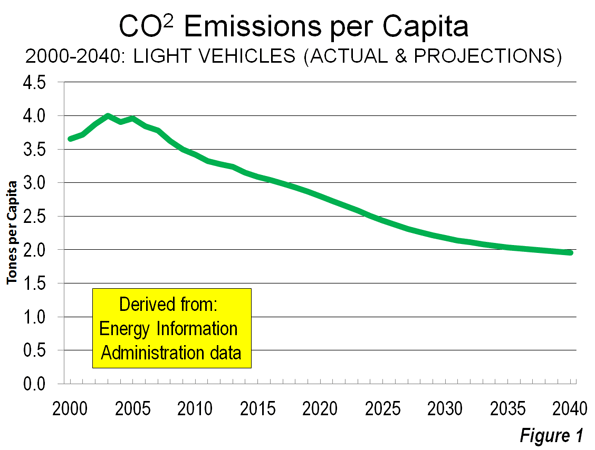
    The new Annual Energy Outlook forecasts continuing and material progress in improving energy efficiency, reducing fossil fuel consumption and reducing carbon dioxide emissions from cars and light trucks (light vehicles). Per capita carbon dioxide emissions from light vehicles are projected by EIA to fall to 51 percent below the peak year of 2003 (Figure 1).

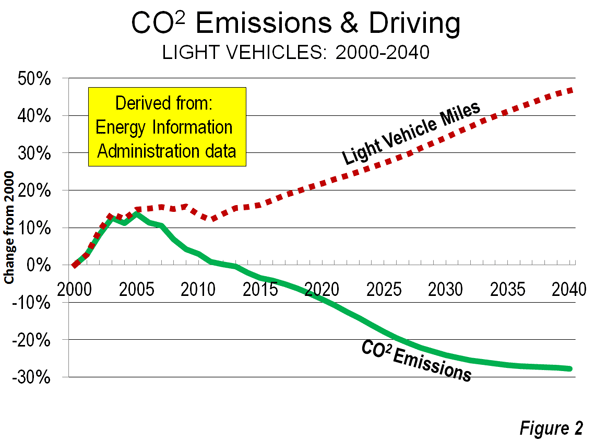
    The gross (not per capita) 2040 carbon dioxide reduction from light vehicles is projected to decline 28 percent in 2040 from 2003. Most significantly, the reduction is to occur as gross driving miles increases 29 percent (Figure 2). The actual 2040 emissions are likely to be even lower, because the 2014 Annual Energy Outlook assumes no vehicle fuel economy improvements after 2025. Improvements in vehicle technologies and cars using alternative fuels, and under government incentives, seem likely.

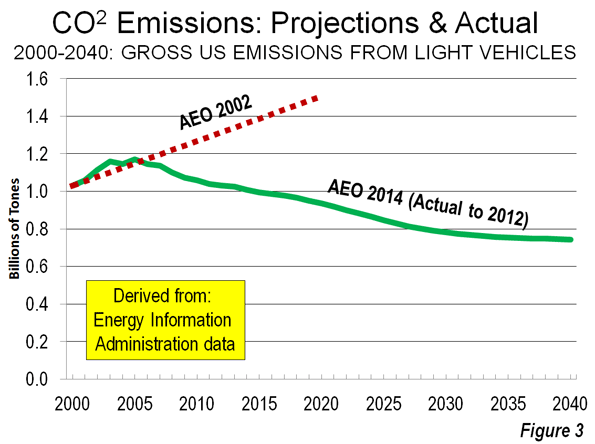
    The emissions forecast improvements have been stunning, to say the least. The 2002 Annual Energy Outlook had expected a 46 percent increase in carbon dioxide emissions from light vehicles between 2000 and 2020. The revised forecast – which takes into account what actually has occurred – says there will be a 9 percent decrease.

    This is the result of multiple factors. In 2002, EIA predicted a 55 percent increase in driving between 2000 and 2020. The 2014 Annual Energy Outlook revises that figure to 22 percent (Figure 3). Fuel economy is improving, which is being driven by stronger regulations as well as technological advances.  

    Driving is Down

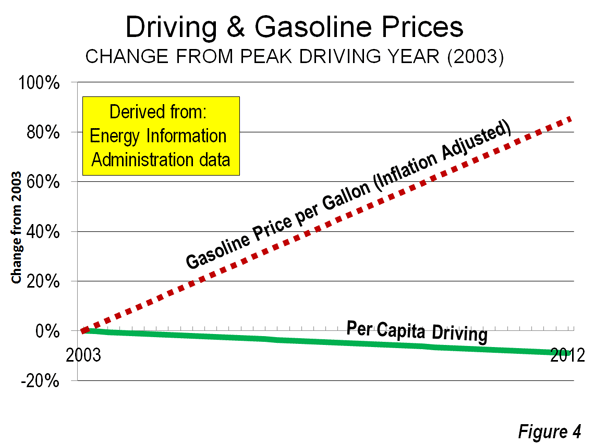
    Driving per capita fell nine percent from the peak year of 2003 to 2012. This decline is not surprising given the sorry state of the economy and high unemployment. Gas prices have risen 85 percent (inflation adjusted) over the same period. The decline in driving is modest compared to the increase in gas prices – a 0.9 percent reduction in driving per capita for each 10 percent increase in gasoline (Figure 4), inflation adjusted. This is half or less the reduction in transit ridership that would be expected if fares were raised by the same percentage.  

    Meanwhile, little of this reduction in driving has been transferred to transit. The increase in transit per passenger miles per capita captured less than one percent of the driving decline. Indeed, the daily increase in per capita transit use is less than the perimeter of a 20-to-the-acre townhouse lot.

    With fewer jobs, higher gas prices and the new reliance on social media, as well as a rise in people working at home, people may have become more efficient and selective in their driving patterns (such as by consolidating shopping trips). Certainly those with jobs use their cars for those trips above as much as before.

    Meanwhile, the EIA forecasts that driving per capita will rise gain, once the economy is released from intensive care. However, with the near universality of automobile ownership, the potential for substantial increases is very limited.

    Hiding Success?

    It might be thought that the planning community, with its emphasis on reducing greenhouse gas emissions, would be rushing to incorporate these into their plans and even to herald the improvements.

    Yet, this is not the case. San Francisco Bay Area planners hid behind over-reaching state directives to "pretend-it-was yesterday" and employed out of date forecasts for vehicle emissions. Data in Plan Bay Area documentation shows that 95 percent of the projected improvement in greenhouse gas emissions would be from energy efficiency improvements. These have nothing whatever to do with its intrusive land use and transport strategies. The additional five percent requires social engineering residents into "pack and stack" high density developments, virtually outlaw detached housing on plentiful urban fringe land and will likely cause even more intense traffic congestion.

    California’s high speed rail planners have made the same kind of mistake, using out-dated fuel economy data in their excessively optimistic greenhouse gas emissions reductions.

    The Illusion of Transit Mobility

    Part of the problem is an illusion that people in the modern metropolitan area can be forced out of their cars into transit, walking, and biking, without serious economic impacts (such as a lower standard of living and greater poverty).

    Transit is structurally incapable of providing automobile competitive mobility throughout the metropolitan area without consuming much or all of its personal income (of course, a practical impossibility). But there is no doubt of transit effectiveness and importance in providing mobility to the largest central business districts (downtowns) with their astronomic employment densities (Note 1). Yet, outside the relatively small dense cores, automobile use is dominant, whether in the United States, Canada, Australia, or Western Europe. The transit legacy cities (municipalities) of New York, Chicago, Philadelphia, San Francisco, Boston, and Washington, with the six largest downtown areas account for 55 percent of all transit commuting in the United States.

    The Delusion of Walking and Cycling as Substitutes for Driving

    Illusion becomes delusion when it comes to cycling and walking. Walking and cycling work well for some people for short single purpose trips, especially in agreeable weather. However, walking and cycling are inherently unable to provide the geographical mobility on which large metropolitan areas rely to produce economic growth. True, cycling does approximate transit commute shares in smaller metropolitan areas, like Amsterdam, Rotterdam, and Bremen, but still accounts for barely a third of commuting by car according to Eurostat data. Prud’homme and Lee at the University of Paris and others have shown in their research that the economic performance of metropolitan areas is better where more of an area’s employment can be reached within a specific period of time (such as 30 minutes). That leaves only a limited role for walking and cycling.

    Toward an A Non-Existent Nirvana?

    The "Nirvana" of a transit-, walking-, and cycling-oriented metropolitan area proves to be no Nirvana at all. We don’t need theory to prove this point. Take Hong Kong, for example, with its urban population density six times that of Paris, nine times that of Toronto, 10 times Los Angeles, 12 times New York nearly 20 times Portland, and nearly 40 times that of Atlanta.

    This vibrant, exciting metropolitan area cannot deliver on a standard of living that competes with Western Europe, much less the United States. Despite the high density, the overwhelming dominance of transit, walking, and cycling, Hong Kongers spend much longer traveling to and from work each day than their counterparts in all large US metropolitan areas, including New York and in most cases the difference is from more than 50 percent (as in Los Angeles) to nearly 100 percent.

    The problem goes beyond the time that could be used for more productive for rewarding activities. Housing costs are the highest among the major metropolitan areas in the eight nations covered by the Demographia International Housing Affordability Survey. Hong Kong’s housing costs relative to incomes are more than 1.5 times as high as in the San Francisco metropolitan area and almost five times as high as Dallas-Fort Worth. Meanwhile, the average new house in Hong Kong is less approximately 485 square feet (45 square meters), less than one-fifth the size of a new single family US American house (2,500 square feet or 230 square meters), though Hong Kong households, are larger (Note 2).

    When households are required to spend more of their income for housing, they have less discretionary income and necessarily a lower standard of living. This loss of discretionary income trickles down to people in poverty, whose numbers are swelled by higher than necessary housing costs.

    Planning is for People

    Contrary to the current conventional wisdom, the prime goal of planning should not be to achieve any particular urban form. What should matter most is the extent to which a metropolitan area facilitates a higher standard of living and less poverty.

    ——————

    Note 1: In 2000, employment densities in the nation’s six largest downtown areas (New York, Chicago, Washington, Boston, San Francisco and Philadelphia) was three times that of the downtowns in the balance of the 50 largest urban areas, and 14 times as dense as outside the downtown areas.

    Note 2: According to the 2011 census, the average household size in Hong Kong was 2.9 persons. This is more than 10 percent larger than the US figure of 2.6 from the 2010 census.

    ——-

    Wendell Cox is a Visiting Professor, Conservatoire National des Arts et Metiers, Paris and the author of “War on the Dream: How Anti-Sprawl Policy Threatens the Quality of Life.

    Photo: Prius photo by Bigstock.

  • NewGeography’s Top Stories of 2013

    A new year is upon us, here’s a look back at a handful of the most popular pieces on NewGeography from 2013. Thanks for reading, and happy New Year.

    12. Gentrification as an End Game, and the Rise of “Sub-Urbanity” In January Richey Piiparinen points out that gentrification driven by affluent young people moving back to the city might be creating “a ‘sub-urbanity’ that is emerging when the generalization of gentrification meets the gentrification of the mind.”

    11. The Cities Winning the Battle for the Biggest Growth Sector in the U.S. Joel and I put this index together to measure growth and concentration of the professional, technical, and scientific services sector among the nation’s largest metropolitan areas. As high-end services become easier to export, this sector is becoming a critical region-sustaining sector in many parts of the country. This piece also ran at Forbes.com.

    10. A Map of America’s Future: Where Growth will be Over the Next Decade Working with Forbes Magazine in September, Joel and I laid out seven regions and three city-states across the nation. Regional economic diversity is one of America’s most critical attributes.

    9.  The Dutch Rethink the Welfare State Nima Sanandaji outlines the trajectory of the social services culture in the Netherlands.

    8.  Suburb Hating is Anti-Child In this provocative, widely-discussed piece, Mike Lanza takes it to politicians and commentators who advocate against suburbs, pointing out that “we need to fix suburbs and the way families utilize them,” but “what we shouldn’t do is try to force families to live in dense city centers.”

    7.  Fixing California: The Green Gentry’s Class Warfare Joel Kotkin points out that many green policies are pro-gentry and anti-middle class, particularly in California. This piece originally appeared at U-T San Diego.

    6.  How Can We Be So Dense? Anti-Sprawl Policies Threaten America’s Future In this piece from Forbes, Joel Kotkin argues that high-density housing advocates should be open to a broader range of housing options because policies pushing high density often favor real estate investors over the middle class and the concept of upward mobility.

    5.  Class Warfare for Republicans Joel takes the Republican Party to task for ignoring the issue of class and small business growth in favor of rhetoric about social conservatism, gun control, and free market idealism. This piece originally ran in the Orange County Register.

    4.  Houston Rising: Why the Next Great American Cities Aren’t What you Think In this piece from The Daily Beast, Joel argues that a city’s most important quality is its ability to foster upward mobility and to sustain a middle class, not its urban form.

    3.  The New Power Class Who Will Profit from Obama’s Second Term Who stands to benefit most from the second Obama administration? Joel argues that it’s the plutocrats of Silicon Valley and new media industries and the clerisy of academia. This piece originally appeared at Forbes.com.

    2.  Why are there so Many Murders in Chicago? Aaron Renn lays out seven possible reasons contributing to violent crime in Chicago and calls for an adjustment in strategy to fight it.

    1.  Gentrification and its Discontents: Notes from New Orleans The most read piece of the year is this excellent expose of gentrification and its impact on the culture and age demographics of New Orleans by local geographer Richard Campanella.

    Mark Schill is a community strategist and analyst with Praxis Strategy Group and New Geography’s Managing Editor.

  • North Dakota Leads Population Growth Again

    New US Census Bureau state level estimates have just been released. Repeating the pattern similar to that developing since 2010, North Dakota, the District of Columbia, Texas, Utah and Colorado have posted the strongest percentage gains.  North Dakota added 3.1 percent to its population between 2012 and 2013 and 7.6 percent since the 2010 Census. Close behind was the District of Columbia, which added 7.4 percent since 2010, though its growth over the past year has been at a lower 2.1 percent rate.

    Texas added the most residents of any other state over the last three years (1.3 million), a fifth more than 22nd ranked California, which is nearly 50 percent larger. Texas has added 5.2 percent to its population since 2010, while California has added 2.9 percent.

    Utah grew 5.0 percent, followed closely by Colorado, at 4.8 percent.

    Former perennial growth leader Florida continues to recover, placing 6th, with a three year growth rate of 4.0 percent. At its present growth rate, Florida should pass New York by 2014, to become the fourth largest state. South Dakota, Washington, Arizona and Alaska rounded out the top ten.

    The slowest growing states were Rhode Island (the only state to lose population since 2010), Maine, West Virginia, Michigan and Vermont. A table is attached with the data.

    States Ranked by 2010-2013 Population Change
    Rank   2010 Census 2012 2013 Pop. Change 2010-2013 % Change 2012-2013 % Change 2010-2013
    1  North Dakota           672,591        701,345        723,393         50,802 3.1% 7.6%
    2  District of Columbia           601,723        633,427        646,449         44,726 2.1% 7.4%
    3  Texas      25,145,561   26,060,796   26,448,193    1,302,632 1.5% 5.2%
    4  Utah        2,763,885     2,854,871     2,900,872       136,987 1.6% 5.0%
    5  Colorado        5,029,196     5,189,458     5,268,367       239,171 1.5% 4.8%
    6  Florida      18,801,310   19,320,749   19,552,860       751,550 1.2% 4.0%
    7  South Dakota           814,180        834,047        844,877         30,697 1.3% 3.8%
    8  Washington        6,724,540     6,895,318     6,971,406       246,866 1.1% 3.7%
    9  Arizona        6,392,017     6,551,149     6,626,624       234,607 1.2% 3.7%
    10  Alaska           710,231        730,307        735,132         24,901 0.7% 3.5%
    11  Wyoming           563,626        576,626        582,658         19,032 1.0% 3.4%
    12  Nevada        2,700,551     2,754,354     2,790,136         89,585 1.3% 3.3%
    13  North Carolina        9,535,483     9,748,364     9,848,060       312,577 1.0% 3.3%
    14  Virginia        8,001,024     8,186,628     8,260,405       259,381 0.9% 3.2%
    15  South Carolina        4,625,364     4,723,417     4,774,839       149,475 1.1% 3.2%
    16  Hawaii        1,360,301     1,390,090     1,404,054         43,753 1.0% 3.2%
    17  Georgia        9,687,653     9,915,646     9,992,167       304,514 0.8% 3.1%
    18  Delaware           897,934        917,053        925,749         27,815 0.9% 3.1%
    19  California      37,253,956   37,999,878   38,332,521    1,078,565 0.9% 2.9%
    20  Idaho        1,567,582     1,595,590     1,612,136         44,554 1.0% 2.8%
    21  Maryland        5,773,552     5,884,868     5,928,814       155,262 0.7% 2.7%
    22  Oklahoma        3,751,351     3,815,780     3,850,568         99,217 0.9% 2.6%
    23  Montana           989,415     1,005,494     1,015,165         25,750 1.0% 2.6%
    24  Oregon        3,831,074     3,899,801     3,930,065         98,991 0.8% 2.6%
    25  Tennessee        6,346,105     6,454,914     6,495,978       149,873 0.6% 2.4%
    26  Nebraska        1,826,341     1,855,350     1,868,516         42,175 0.7% 2.3%
    27  Massachusetts        6,547,629     6,645,303     6,692,824       145,195 0.7% 2.2%
    28  Minnesota        5,303,925     5,379,646     5,420,380       116,455 0.8% 2.2%
    29  Louisiana        4,533,372     4,602,134     4,625,470         92,098 0.5% 2.0%
    30  Arkansas        2,915,918     2,949,828     2,959,373         43,455 0.3% 1.5%
    31  Iowa        3,046,355     3,075,039     3,090,416         44,061 0.5% 1.4%
    32  Kansas        2,853,118     2,885,398     2,893,957         40,839 0.3% 1.4%
    33  New York      19,378,102   19,576,125   19,651,127       273,025 0.4% 1.4%
    34  Indiana        6,483,802     6,537,782     6,570,902         87,100 0.5% 1.3%
    35  Kentucky        4,339,367     4,379,730     4,395,295         55,928 0.4% 1.3%
    36  New Mexico        2,059,179     2,083,540     2,085,287         26,108 0.1% 1.3%
    37  New Jersey        8,791,894     8,867,749     8,899,339       107,445 0.4% 1.2%
    38  Alabama        4,779,736     4,817,528     4,833,722         53,986 0.3% 1.1%
    39  Wisconsin        5,686,986     5,724,554     5,742,713         55,727 0.3% 1.0%
    40  Missouri        5,988,927     6,024,522     6,044,171         55,244 0.3% 0.9%
    41  Mississippi        2,967,297     2,986,450     2,991,207         23,910 0.2% 0.8%
    42  Connecticut        3,574,097     3,591,765     3,596,080         21,983 0.1% 0.6%
    43  Pennsylvania      12,702,379   12,764,475   12,773,801         71,422 0.1% 0.6%
    44  New Hampshire        1,316,470     1,321,617     1,323,459           6,989 0.1% 0.5%
    45  Illinois      12,830,632   12,868,192   12,882,135         51,503 0.1% 0.4%
    46  Ohio      11,536,504   11,553,031   11,570,808         34,304 0.2% 0.3%
    47  Vermont           625,741        625,953        626,630              889 0.1% 0.1%
    48  Michigan        9,883,640     9,882,519     9,895,622         11,982 0.1% 0.1%
    49  West Virginia        1,852,994     1,856,680     1,854,304           1,310 -0.1% 0.1%
    50  Maine        1,328,361     1,328,501     1,328,302              (59) 0.0% 0.0%
    51  Rhode Island        1,052,567     1,050,304     1,051,511         (1,056) 0.1% -0.1%
     United States  308,745,538 313,873,685 316,128,839    7,383,301 0.7% 2.4%


  • Neither Party Dealing with More-Rigid Class Structure

    President Obama’s most-recent pivot toward the issue of “inequality” and saving the middle class might be seen as something of an attempt to change the subject after the health care reform disaster. As the Washington Post’s reliably liberal Greg Sargent explains, this latest bit of foot work back to the “old standby” issues provides “a template for the upcoming elections, one that allows Dems to shift from the grinding war of attrition over Obamacare that Republicans want to the bigger economic themes Dems believe give them the upper hand.”

    True, there’s something mildly risible about appeals to populism offered by a president whose economic record looks more like Herbert Hoover than Franklin Roosevelt. Some 95 percent of the income gains during President Obama’s first term flowed to barely 1 percent of the population, while incomes have declined for 93 percent of Americans. As one writer at the left-leaning Huffington Post put it, “[T]he rising tide has lifted fewer boats during the Obama years – and the ones it’s lifted have been mostly yachts.”

    Diminished prospects – what some describe as the “new normal” – now confront a vast proportion of the population, with wages falling not only for noncollege graduates but also for those with four-year degrees. Overall, median incomes for Americans fell 7 percent in the decade following 2000 and are not expected to recover, according to some economic models, until 2021.

    This decline has infected the national mood. Today, more middle- and working-class Americans predict that their children will not do better than they have done.Overall, almost one-third of the public, according to Pew, consider themselves “lower” class, as opposed the middle class, up from barely one-quarter who thought so in 2008.

    It’s not surprising, then, that the vast majority of Americans believe the president’s economic policy has been a dismal failure, at least for the middle and working classes. Federal Reserve monetary policy, in particular, appeared to favor the interests of the wealthy over those of the middle, yeoman class. “Quantitative easing,” notes one former high-level official, essentially constituted a “too big to fail” windfall for the largest Wall Street firms, and did little for anyone else. Faith in the economy, despite the soaring stock market and increased price of assets, has remained weak. Americans by a 2-1 margin rate the economy negatively.

    These realities helped spark both the Tea Party and the Occupy movements and underpin the support for such disparate figures as Sarah Palin and Elizabeth Warren. At the same time, outrage at our current economy has undermined public esteem for almost every institution of power – from government and large corporations to banks and Wall Street – to the lowest point ever recorded.

    Money goes to money

    This repudiation reflects the fact that neither major political party seems ready to address the emergence, over time, of a class structure more rigid, and arguably less-penetrable, than in the past. Increasingly, wealth adheres to those who are best-positioned, by hereditary wealth and education, to take advantage in the evolving economy. In contrast, those born with fewer resources, even if they work hard, find moving up in society increasingly difficult.

    To be fair, this problem well predates Barack Obama or the current Congress. Middle-class incomes have been declining, particularly compared with those of the wealthy, since the 1970s, with the decline persisting even in the relatively prosperous 1990s, with young workers starting out at incomes one-fourth lower than those of their parents.

    Yet, solutions proposed to date by Obama and his fellow Democrats have done little to reverse this trend, in fact, worsening it. Whatever suffering they ameliorate, a growing reliance on food stamps and extended unemployment insurance, as Walter Mead points out, often ends up creating an unhealthy dependence on the state and fails to address the cultural issues associated with long-term poverty.

    Some Obama proposals, like increasingly affirmative action, seem more like a nod to favored party constituencies than an elixir for the economy. Others, such as an increased minimum wage, promise benefits for some, but could also dry up sources of employment, particularly for part-time and new market entrants, particularly young workers.

    Overall, “blue” policies, as currently constituted, have not been notably effective in reducing poverty or increasing upward mobility. Locales with the nation’s greatest levels of inequality, and the most rapid decline of the middle classes, are generally found in progressive bastions,such as New York and California.

    Capitalism undercut

    But let’s be clear: There is not much here that the Right should be giddy about. The inability of market capitalism to provide more people with a higher standard of living, and increased opportunity, undermines the fundamental promise of free markets. The spread of prosperity from 1950-2000, bolstered conservative, even libertarian, perspectives as the middle class and property ownership expanded. Now, with homeownership in decline and middle-class incomes stagnating, the appeal of “democratic capitalism” marketed by the Right has been somewhat diminished.

    To address this challenge, conservatives need to acknowledge that economic inequality and rising class divisions stand as our nation’s existential political issue. Yet for the most part, their response has been largely to cut benefits to the poor amid hard times. Perhaps since they do not acknowledge the emerging credibility crisis facing capitalism, they feel little reason to address it.

    This story originally appeared at The Orange County Register.

    Joel Kotkin is executive editor of NewGeography.com and Distinguished Presidential Fellow in Urban Futures at Chapman University, and a member of the editorial board of the Orange County Register. He is author of The City: A Global History and The Next Hundred Million: America in 2050. His most recent study, The Rise of Postfamilialism, has been widely discussed and distributed internationally. He lives in Los Angeles, CA.

  • Street Furniture for ‘Sitable’ Cities

    How can street furniture improve not only the walkability, but the sustainability of a city?

    The completely self-sustaining city may seem like a pipe-dream to some, but as with all outwardly impossible tasks, it all starts with the first step. Urban planners have focused on making communities more walkable by improving public spaces and sidewalks. Large, pedestrian-only areas inspire people to shop, interact with others, and simply enjoy spending time in their community. Wider, safer sidewalks encourage pedestrians to walk, rather than drive from place to place.

    The walkability of city can be largely impacted by street furniture. If you’ve just envisioned a living room set sitting haphazardly in the middle of a sidewalk, you’re actually not that far off. Street furniture is a broad term that encompasses everything from benches to traffic signals, and you’ve likely encountered many examples without even realizing it.

    Seating placed in prime locations – where people work, shop, and eat – encourages pedestrians to linger, benefitting both the economics and the feeling of community. “Sitting, in order to rest, converse, beg and sell is what people have always done, and captures a major part of urban life. Sitting with style, grace, safety and reflection is a major element of “place capital”—an increasing buzzword for urban success,” points out Chuck Wolfe, who has written about “sit-able” cities.

    Building benches and other public seating out of green resources such as rapidly renewable plant material (bamboo and straw), recycled materials, and other reusable products adds to sustainability goals.

    Both walkability and ‘sitability’ are dependent on a safe atmosphere. If a sidewalk isn’t safe, pedestrians aren’t going to use it. Proper maintenance and lighting are incredibly important. Sidewalk safety features include curb extensions, striped crosswalks, and pedestrian rails.

    Also helpful: planting strips, areas of grass or vegetation between the street and the sidewalk that make pedestrians feel less exposed. Besides being a sustainable safety feature, planting strips benefit the environment by absorbing carbon dioxide from automobile emissions. They also assist with water drainage, helping both overtaxed storm drains and the natural aquifer.

    Bollards direct foot traffic and maintain a barrier between pedestrians and motorized vehicles. Sustainable metal bollards — like the ones we create at Reliance Foundry — are designed using an environmentally safe powder-coating that reduces peeling and chipping. Sustainable bollards can also be made from wood or recycled plastics. Bollards are commonly used in community areas to create pedestrian only zones, limiting vehicle use and carbon emissions.

    Streets that foster relaxation also benefit from recycling. Many large cities have implemented curbside recycling services, making it easier for householders to reduce their ecological footprint. The same progress that led to curbside recycling is now leading to recycling bins in public areas. The purpose is to reduce street and sidewalk litter, and to help people recycle when they’re out on the town.

    Street furniture is a funny thing; sometimes you only notice it by its absence.

    Robert Dalton is a writer and green-freak from Portland, Oregon (go Ducks!). He writes on behalf of Reliance Foundry, a supplier of innovative bollards and other site furnishings.

    Flickr photo by Diane Duane: Longhorn Bench, Freiburg-in-Breisgau, Germany

  • The Metro Areas With The Most Economic Momentum Going Into 2014

    America’s economy may be picking up steam, but it remains a story of parts, with the various regions of the country performing in often radically divergent ways.

    To identify the regions with the most momentum coming out of the recession, we turned to Mark Schill, research director for the Praxis Strategy Group, who crunched a range of indicative data from 2007 to today for the nation’s 52 largest metropolitan statistical areas. To gauge economic vitality, we used four metrics: GDP growth, job growth, real median household income growth and current unemployment. To measure demographic strength we looked at population growth, birth rate, domestic migration and the change in educational attainment. All factors were weighted equally.

    Our assumption is that strong local economies attract the most people and create the best conditions for family formation, which in turn generates new demand. Strong productive industries drive demand for such things as heath care, business services and retail, as well as single-family houses, a critical component of local growth and still the aspirational goal of the vast majority of Americans. This, of course, depends on economic factors, which drive perceptions of better times and provide the income necessary to qualify for a mortgage.

    Our results are based on metrics often overlooked in assessments that are focused primarily on either asset inflation — stocks or out-of-control housing prices — or are built around anecdotal, cherry-picked data from, for example, just one part of a metropolitan region. Despite all the attention lavished on places like Manhattan or Chicago’s central core, virtually all the fastest-emerging economies coming out of the recession are either in the Southeast, Texas, the Great Plains or the Intermountain West. Of our top 10 metro areas, only one is on the east or west coast: 10th-ranked San Jose/Silicon Valley.

    Most of the strongest local economies combine the positive characteristics associated with blue states — educated people, tech-oriented industries, racial diversity — with largely red, pro-business administrations. This is epitomized by our top-ranked metro area, Austin, Texas, which has enjoyed double-digit growth in GDP, jobs, population and birthrate since 2007. The Texas capital has a very strong hipster reputation, attracting many of the same people who might otherwise end up in Silicon Valley or San Francisco, but it also boasts the low taxes, light regulation and reasonable housing prices that keep migrants there well past their 30s.

    As has been the case for most of the past five years, Texas cities are clearly the place to be in terms of job creation, wealth formation and overall growth. All the other major Lone Star cities place highly on our list, including second-place San Antonio and Houston (fourth). Clearly many parts of the Sun Belt have not died off, as many Eastern pundits gleefully predicted during the recession. The migration of Americans southward, thought by the Eastern press to have petered out, has resumed, particularly to Texas and Sun Belt cities with strong economies.

    One critical factor propelling growth has been the energy revolution, which is rapidly transforming big swathes of middle America into a production hub for fossil fuels and the best place to secure cheap electric power. Besides the Texas cities, other energy capitals doing well including Salt Lake City (No. 3) and Denver (No. 7) — both of which also boast burgeoning tech sectors — as well as Oklahoma City (No. 8).

    One canary in the coalmine suggesting future dynamism is a rising share of highly educated people in the population. Places like Nashville, Denver and Salt Lake are all getting smarter faster, increasing their numbers of educated people faster than “brain” regions such as Seattle (14th), San Francisco (22nd), Boston (26th), New York (31st), Chicago (40th) and Los Angeles (44th). Another survey looking at areas that have gained the most young college graduates since 2006 found similar trends, with Nashville, New Orleans, Dallas, Austin, San Antonio and Houston among the leaders. More important still, in these high- growth cities, educated labor is not tethered to the current social media bubble, but to more diverse industries such as medical services, energy, manufacturing and business services.

    Other evidence of these areas’ dynamism includes high rates of birth and family formation. After several years of declines, the nation’s fertility rate now appears to be rebounding somewhat, with some demographers predicting we may on the cusp of a “birth bounce,” in part as millennials start entering their 30s. Certainly this welcome trend will accelerate if the economy continues to gain strength.

    So where will these new families likely settle? With the exception of  Washington D.C. (12th), virtually all the areas with the fastest projected rates of household formation are in the Sun Belt, led by Houston, which is expected to add 140,000 new households by 2017, the largest increase in the nation, nearly twice as many as much larger New York. Indeed despite some of the most active homebuilding in the nation, the energy capital clearly needs more homes; sales have been so strong that it has now reached the lowest inventory in recent history.

    Critically, most of these cities embrace growth, whether in their urban cores or suburban peripheries. In contrast, some strong economies, such as San Jose and San Francisco, are also among the most restrictive in terms of new construction, leading to ever escalating prices that tends to force 30-somethings and families out of the region. High housing costs also play a depressing role in always hyped New York, as well as Los Angeles and Chicago; all suffer high rates of domestic out-migration and depressed household formation. Chicago is now projected to have virtually no job growth next year, not a good sign in an economy that remains well below its 2007 employment level.

    What other regions are likely to lag, even amid a strengthening recovery? The list includes Sun Belt metro areas where the housing bubble hit hardest and job growth has not revived, such as Las Vegas (51st) and Riverside-San Bernardino, Calif. (49th). In these cities real per capita household income remains almost 20% below 2007 levels. With fewer people able to afford new homes, these areas have roughly 8% fewer jobs than five years ago.

    Other bottom-dwellers include several industrial cities where even a resurgence in manufacturing has failed to erase the catastrophic losses suffered in the recession. Detroit ranks dead last at 52nd; Providence, R.I., 50th; and Cleveland 48th. All three have fewer people than in 2007 and at least 5% fewer jobs than.

    These differentials between regions could widen further in the future, as the impact of the energy revolution deepens and the current social media craze begins to die down. This happened after the first dot-com bust at the beginning of the last decade, sending roughly half of California’s tech workers out of the industry or out of the state.

    Sky-high housing costs, coupled with stricter mortgage restrictions, could accelerate the development of new, less pricey tech centers, including Seattle, New Orleans (16th) and Pittsburgh (19th). Once the venture capital punch bowl is removed, it is likely the surviving social media firms will need to find more affordable places to locate, if not their leading researchers, at least much of their marketing and administration.

    Looking across the board, it seems likely that the best places to look for work, or invest, will be those that have diversified their economies, kept costs down and attracted a broad cross-section of migrants from other parts of the country. These may not all be the favored cities of the media, or the pundit class, but they are the places offering a variety of positives to residents at every stage of life. These balanced regions are the places employers and families are most likely to flock to. Such places have not only transcended the worst effects of the recession, but seem primed to take advantage of a nascent expansion that could redraw the map of the country.

    2014 Regions to Watch Index
    Rank Region (MSA) Score GDP Growth, 2007-2012 Job Growth, Aug-Oct 07-13 Population Change, 07-12 Unemplymt Rate 2013 Median Real Hshld Inc Growth, 07-12 Dommestic Mig Rate 10-12 Birth rate, 10-12 Pt Change in Educ. Attain Rate, 07-12
    1 Austin 82.8 21.7% 11.8% 16.3% 5.4% -5.4% 17.0 14.2 2.2%
    2 San Antonio 69.7 11.2% 6.2% 11.1% 6.2% 0.4% 9.2 14.2 2.2%
    3 Salt Lake City 69.4 10.7% 3.7% 8.3% 4.4% -5.3% 0.8 17.0 3.0%
    4 Houston 67.7 12.3% 9.2% 11.5% 6.3% -4.7% 5.2 15.3 1.9%
    5 Nashville 64.4 11.5% 6.5% 8.4% 6.7% -8.4% 7.0 13.3 4.0%
    6 Dallas 62.9 9.3% 6.4% 10.2% 6.2% -6.0% 6.9 14.7 1.7%
    7 Denver 62.1 6.6% 3.4% 9.4% 6.6% -5.7% 8.2 13.4 3.4%
    8 Oklahoma City 61.4 9.2% 5.3% 8.1% 5.1% -3.1% 7.1 14.3 0.7%
    9 Raleigh 58.8 8.9% 2.9% 14.9% 6.8% -6.3% 10.9 13.2 0.6%
    10 San Jose 58.2 15.3% 2.6% 7.3% 6.7% -2.2% -1.3 13.4 2.7%
    11 Portland 55.9 23.6% -0.7% 7.1% 7.1% -7.1% 4.8 12.2 2.5%
    12 Washington 55.3 8.0% 2.9% 9.1% 5.6% -4.2% 2.3 13.8 0.9%
    13 Minneapolis 54.0 6.1% 1.2% 4.7% 4.7% -6.3% 0.0 13.0 2.6%
    14 Seattle 52.3 9.0% 0.8% 7.5% 5.8% -7.2% 3.9 12.6 1.6%
    15 Columbus 49.6 2.2% 2.5% 5.6% 6.2% -6.2% 1.4 13.5 1.7%
    16 New Orleans 49.2 8.6% 3.7% 11.9% 7.1% -16.7% 6.1 13.2 1.1%
    17 Baltimore 49.2 8.2% 1.9% 3.2% 7.2% -5.1% 0.1 12.2 3.0%
    18 Louisville 48.4 5.6% 0.7% 4.0% 7.9% -3.4% 0.2 12.7 2.9%
    19 Pittsburgh 46.7 4.6% 2.6% 0.1% 6.7% -0.1% 1.4 10.0 2.9%
    20 Richmond 46.7 4.8% -0.2% 4.9% 6.0% -9.7% 2.4 12.0 2.4%
    21 San Francisco 46.3 3.7% -1.0% 6.5% 6.4% -8.1% 2.3 11.9 2.2%
    22 Indianapolis 45.9 3.3% 1.5% 5.6% 7.1% -11.9% 1.1 14.2 1.9%
    23 Charlotte 45.6 4.5% 1.9% 10.1% 8.5% -11.0% 7.8 13.0 0.9%
    24 Grand Rapids 45.0 -2.4% 3.6% 2.4% 6.6% -6.7% 0.9 13.3 1.9%
    25 Kansas City 44.9 3.9% -1.1% 4.3% 6.5% -8.0% -1.1 13.6 1.9%
    26 Boston 44.9 7.6% 3.0% 4.3% 6.4% -4.9% -0.1 11.2 1.1%
    27 Virginia Beach 42.0 2.2% -1.5% 2.2% 6.0% -7.8% -3.4 13.4 1.8%
    28 Phoenix 41.7 -4.8% -6.3% 7.8% 7.0% -14.5% 4.8 13.7 2.6%
    29 Birmingham 41.4 0.7% -6.5% 2.7% 5.8% -10.5% -1.7 13.7 2.6%
    30 Buffalo 41.4 2.0% 1.0% -0.3% 7.3% 1.2% -2.5 10.5 2.5%
    31 San Diego 40.6 -1.0% -1.9% 6.8% 7.3% -11.8% 0.2 14.3 1.3%
    32 Philadelphia 39.1 1.9% -1.9% 2.3% 8.1% -6.9% -2.4 12.3 2.8%
    33 Atlanta 38.9 -0.5% -1.5% 7.7% 8.1% -13.7% 3.2 13.6 1.2%
    34 New York 38.9 1.9% 1.6% 3.1% 7.9% -6.1% -5.8 12.7 1.9%
    35 Milwaukee 37.6 0.3% -3.8% 2.4% 7.1% -8.6% -2.9 13.1 2.0%
    36 Jacksonville 37.6 -5.4% -3.3% 5.4% 6.6% -16.2% 3.5 12.8 2.1%
    37 St. Louis 35.8 0.2% -3.6% 1.5% 7.2% -10.1% -3.7 12.3 2.6%
    38 Cincinnati 35.6 1.3% -3.4% 2.1% 7.0% -9.0% -3.0 12.9 1.4%
    39 Tampa 33.5 -3.4% -2.4% 4.3% 6.9% -14.0% 5.9 10.9 1.0%
    40 Chicago 33.0 0.2% -2.5% 2.0% 9.1% -9.7% -5.9 13.2 2.5%
    41 Orlando 32.9 -5.7% -2.0% 8.1% 6.6% -18.3% 7.4 12.0 -0.2%
    42 Rochester 32.8 -2.2% 0.2% 1.0% 6.9% -9.3% -3.2 11.0 1.6%
    43 Miami 32.3 -4.3% -3.9% 6.3% 7.4% -14.4% 3.8 11.6 0.9%
    44 Memphis 31.2 -4.0% -5.8% 3.0% 9.6% -9.8% -1.7 14.5 1.7%
    45 Los Angeles 31.1 -2.5% -4.6% 3.3% 8.9% -10.9% -3.2 13.5 1.8%
    46 Hartford 29.1 -6.9% -1.0% 1.3% 8.0% -6.4% -5.0 10.0 2.2%
    47 Sacramento 26.4 -6.0% -7.9% 5.5% 8.3% -14.1% 0.8 12.9 0.5%
    48 Cleveland 25.1 -1.9% -5.5% -1.3% 7.0% -12.1% -5.8 11.0 1.7%
    49 Riverside 23.6 -9.0% -8.1% 7.0% 10.1% -18.5% 2.3 14.9 0.4%
    50 Providence 23.4 -0.4% -4.2% -0.1% 9.1% -9.4% -4.3 10.5 1.4%
    51 Las Vegas 21.6 -10.4% -8.6% 7.1% 9.6% -20.1% 1.5 13.8 0.7%
    52 Detroit 18.3 -6.0% -5.6% -1.9% 9.7% -13.5% -4.7 11.5 1.8%

    Analysis by Mark Schill, Praxis Strategy Group, mark@praxissg.com
    Data Sources: Bureau of Economic Analysis, Bureau of Labor Statistics, U.S. Census Population Estimates Program, U.S. Census American Community Survey

    This story originally appeared at Forbes.

    Joel Kotkin is executive editor of NewGeography.com and Distinguished Presidential Fellow in Urban Futures at Chapman University, and a member of the editorial board of the Orange County Register. He is author of The City: A Global History and The Next Hundred Million: America in 2050. His most recent study, The Rise of Postfamilialism, has been widely discussed and distributed internationally. He lives in Los Angeles, CA.