Blog

  • Public Engagement Miracle on 24th Street

    Confrontation and conflict are the favorite dispute resolution tools of Baby Boomers, who were born in the aftermath of WWII and grew up in the rebellious ‘60s. In stark contrast, members of the Millennial generation, born 1982-2003, bring a spirit of collaboration and consensus to solving any problem they encounter. A great example of the difference this generational distinction can be seen in the parents at the LA Unified School District’s 24th Street school, most of whom are Millennials in their twenties or early thirties, in how they resolved  the dispute over the school’s future.

    Located near the 10 freeway and Western Avenue in a predominantly Hispanic, hardscrabble neighborhood, the school appeared regularly on the District’s list of academic underperformers. Beyond poor learning outcomes, the parents at the school were upset by LAUSD’s apparent unwillingness to address their complaints about cleanliness and health issues in the schools including non-functioning bathrooms and dead animals on the premises.  They also felt the principal had a tendency  to use suspensions and a police presence as the way to enforce discipline. Before California’s Parent Trigger law gave parents the legal status to challenge incumbent administrators, the parents had organized a protest designed to remove the principal, but LAUSD failed to respond to their request.  

    So when organizers for the Parent Revolution non-profit that originally conceived of the Parent Trigger law contacted the school’s parents in May  2012, they found a group that was  prepared to spend long hours in the grinding work of organizing their peers into a cohesive and unified force that LAUSD would have to deal with. The parents knocked on doors and handed out flyers at the school inviting mothers to come to a nearby park where they met every Thursday after dropping off their kids at school. The “parent union” leaders surveyed all the other parents to determine what they liked or didn’t like about the school and encouraged those interested to attend the Public School Choice programs LAUSD ran to learn more about school reform options. Dissatisfied with what the District’s processes, the parents who came to the park elected a steering committee that met every Monday morning to organize the Thursday discussions.

    The discussions led to an emerging consensus on the changes the parents wanted to see at the school site.  They wanted to make sure that children with special needs had the right level of support services and the restoration of the preschool Early Education Center the district had eliminated due to budget cuts.  They demanded that dead animals, including gogs and rats, and other health hazards be addressed immediately. But the demand that brought about a real transformation of the conflict at the school and changed its culture in the most fundamental way was their insistence that everyone “play nice” together. They wanted LAUSD’s K-5 24th St. school and the Crown Prep charter school that ran a somewhat competing 5-8 charter school at the same site to embrace a spirit of collaboration addressing  the needs of the children, not necessarily their individual institutional interests.

    On January 17, 2013, about nine months after they were first contacted by Parent Revolution, the parents submitted a “parent trigger” petition to LAUSD, asking that the school be reconstituted under the federal No School Left Behind law’s guidelines for underperforming schools. Unlike other instances in California when such a petition has been presented to a school district’s board, LAUSD, under the guidance of its reform minded superintendent, John Deasy, responded positively to their request.  Eight Letters of Intent were presented to the parents from entities that wanted to take over its operations, including ones from Crown Prep and LAUSD.

    The parents formed a committee, which met every day from 8:30 AM until 2:30 PM, to review these proposals. They presented all the ideas to the parents at the weekly Thursday meetings and asked each bidder to come to the park and talk to them. On the day of LAUSD’s presentation it rained continuously, but Superintendent John Deasy stayed to talk to the parents about how to find common ground.

    Finally, the parents reached a consensus on how to restructure the school. They wanted to retain the college prep focus of the existing charter school, but they didn’t want an organization with little expertise in elementary education taking over K-4. So they asked LAUSD and Crown Prep to establish a collaboration on behalf of their children. If both entities would agree, a brand new LAUSD school with a new principal and new teachers would have responsibility for kindergarten through fourth grade on the campus and Crown Prep would have uncontested responsibility for grades 5-8.  Parents wanted both organizations to agree in writing that children would be on a college readiness track when they went to high school and that both organizations would share professional development of the 24th St. School teachers to ensure a seamless environment on the two school campus, including coordination of schedules. 

    Then a miracle happened. The two competing bidders found a way to agree with the parent’s unprecedented request. They signed an addendum to their bids acceding to the parents’ wishes. The parents voted their approval on April 10, 2013, just about one year after their organizing activities had begun.  A newly responsive LAUSD school board approved this innovative new concept one week later and parents became part of the committees that interviewed prospective principals and teachers for their school. The newly reconstituted school opened in the fall of 2013, with a new principal and a new set of teachers who, in the words of one of the parents, “have lots of new ideas and a strong desire to work on behalf of los niños.”   The early education center is scheduled to reopen in January, 2015.  

    When it came time for LAUSD to decide whether to retain the services of Superintendent Deasy, one of the most eloquent speeches on his behalf was delivered by a parent from the 24th St. School who recalled that day in the rain in the park as evidence of Deasy’s commitment to the children of Los Angeles. A school board riven by differences in personality and policy was taught a lesson about how to work in a more collaborative way by the Millennial parents who had embodied this new spirit in everything they did. As Boomers age and fade from their current leadership roles, perhaps more institutions will find a way to embrace Millennial values and behaviors that have already brought “a smile instead of tears” to the faces of the children of the 24th St. school in the City of Angels.

    Morley Winograd and Michael D. Hais are co-authors of the newly published Millennial Momentum: How a New Generation is Remaking America and Millennial Makeover: MySpace, YouTube, and the Future of American Politics and fellows of NDN and the New Policy Institute.
  • The Law’s No Ass: Rejecting Hollywood Densification

    The city of Los Angeles received a stunning rebuke, when California Superior Court Judge Alan J. Goodman invalidated the Hollywood Community Plan. The Hollywood district, well known for its entertainment focus, contains approximately 5% of the city of Los Angeles’ population. The Hollywood Plan was the basis of the city’s vision for a far more dense Hollywood, with substantial high rise development in "transit oriented developments" adjacent to transit rail stations (Note 1).

    The Hollywood Plan had been challenged by three community groups (Savehollywood.org, La Mirada Avenue Neighborhood Association of Hollywood, and Fix the City), which argued that the approval process had violated provisions of California law, and most particularly had relied on population projections that were both obsolete and inaccurate.

    Judge Goodman called the Hollywood Plan "fatally flawed," and noted that it relied on errors of both "fact and law." He ordered the City to:

    (1) Rescind, set aside and vacate all actions approving the Hollywood Plan and prepare a replacement that is lawful and consistent with the City’s general plan.

    (2) Grant no permits or entitlements from the Hollywood Plan until it has been replaced with a lawful substitute.

    An "Entirely Discredited" Population Baseline

    The principal issue in the case revolved around out-of-date and erroneous population estimates (Note 2). The city based its densification plan on an assumption that the population of Hollywood would rise from 200,000 in 2000 to 224,000 in
    2005. This estimate was produced by the Southern California Association of Governments (SCAG), which is the metropolitan planning organization for all of Southern California outside San Diego County. SCAG had further projected that Hollywood’s population would rise to 250,000 by 2030.

    To house these additional residents, the city reasoned that higher density development was necessary. In a related matter, the Los Angeles City Council approved Millennium Hollywood, a pair of 35 and 39 story mixed use towers. This was in spite of warnings from the State Geologist that the property was bisected by a dangerous earthquake "rupture" fault (Note 3). Litigation is pending.

    But there’s a fly in this planning ointment, rather than gaining population, Hollywood is losing people.   Before the Hollywood Plan was finally approved, 2010 United States Census data was released that indicated the population had dropped to 198,000. This revealed both the SCAG estimate of the actual population and its 2030 projection to be highly inaccurate. Judge Goodman referred to the SCAG 2005 estimate as "entirely discredited."

    Elementary Questions Raised

    Nonetheless, the city proceeded based upon the incorrect population data. This led the Judge to raise elementary questions about the process (paraphrased below).

    (1) Why was the SCAG population estimate used as a baseline by the city of Los Angeles if the US Census count, readily available before the environmental process was completed, had shown a significantly smaller population?

    (2) Why was the 2030 projection (from SCAG) not adjusted in the Plan based on the new, lower 2010 US Census population count?

    The City defended using the stale and erroneous population data. Judge Goodman commented: "That clearly is a post-hoc rationalization of City’s failure to recognize that the HCPU (Hollywood Plan) was unsupported by anything other than wishful thinking" (parentheses and emphasis by author). The Judge continued that this resulted in a "manifest failure to comply with statutory requirements."

    The Judge set out the burden faced by the City to achieve a legal (and rational outcome):

    …if the population estimate for 2030 were to be adjusted based on what the 2010 Census data had shown, then all of the several  analyses which are based on population would need to be adjusted, such as housing, commercial building, traffic, water demand, waste produced -as well as all other factors analyzed in these key planning documents.

    To its discredit, the city incredibly argued that "it was entitled by law to rely on the SCAG 2005 population estimate." The Judge disagreed. Any other conclusion would have proven "the law to be an ass" (Note 4).

    Abuse of Discretion

    The La Mirada Avenue Neighborhood Association argued that the city of Los Angeles had failed to exercise "good faith effort at full disclosure," contrary to the requirements of California environmental law. Judge Goodman appeared to agree, finding that the city of Los Angeles had abused its discretion, noting "A prejudicial abuse of discretion occurs if the failure to include relevant information precludes informed decision-making and informed public participation, thereby thwarting the goals of" the environmental process.

    Inaccurate Population Estimates and Projections

    This is not the first time that Southern California population projections have been so wrong. With more than a century of explosive population growth, more recent trends may have eluded some of the planning agencies. In 1993, SCAG projected that the city of Los Angeles would reach a population of 4.3 million by 2010. SCAG’s predicted increase of more than 800,000 materialized into little more than 300,000. This is not to suggest that projecting population is an exact science, nor that SCAG has been alone in its inaccuracy.

    In 2007, the state’s official population projection agency, the Department of Finance projected that Los Angeles County would reach 10.5 million residents in just three years. But the 2010 US Census counted only 9.8 million residents (See 60 Million Californians? Don’t Bet on It). In contrast with the previously accustomed growth from other parts of the country, Los Angeles County lost a net 1.2 million residents to other parts of the nation while the rate of immigration fell.  

    Not a Unique Problem

    This instance of overinflated and inaccurate projections is not unique to Los Angeles. The use of out-of-date or erroneous information is increasingly being used in regional planning. Recently, the Association of Bay Area Governments and the Metropolitan Transportation Commission approved the San Francisco Plan Area Plan, which used population projections substantially higher even than those of the Department of Finance (despite that agency’s previous over-optimism).

    As in Los Angeles, Plan Bay Area also used outdated data for automobile greenhouse gas emission factors that have long since been rendered obsolete by technological advancements. Other planning agencies around the nation have engaged in similar practices.

    Planners in the Bay Area, SCAG and elsewhere in California are using similarly flawed projections that presume a substantial change in housing preferences toward multifamily and smaller lots. Yet, years later, the projected trends have not emerged in any significant way (See: A Housing Preference Sea-Change: Not in California).

    Wishful Thinking: No Basis for Action

    Judge Goodman’s decision could have relevance well beyond Los Angeles and the state of California. Regional plans must be based upon current and reliable data, no matter how late received.  To proceed based on faulty data is no different than not changing course when an iceberg appears in the navigation path. Wishful thinking has no place in rational planning.

    ——–

    Note 1: The Hollywood rail stations are on the Red Line subway, which was projected to carry 300,000 daily riders by 2000. The Red Line is carrying approximately 170,000 daily riders and would need three-quarters more to reach the projection for more than a decade ago (see: Report on Funding Levels and Allocations of Funds, Urban Mass Transportation Administration, 1991, page B-49)

    Note 2: The plaintiffs also argued that the Hollywood Plan’s densification would result in additional traffic congestion. This is a serious concern, given Hollywood’s central location in the second most congested metropolitan area in North America (following Vancouver, which recently ended the decades long reign of Los Angeles). Greater traffic congestion is associated with higher population densities.

    Note 3: LA Weekly said that the fault might be capable "of opening the Earth, splitting buildings in half" (See: How the Hollywood Fault Made Millennium’s Future Uncertain, and L.A. a Laughingstock).

    Note 4:  "The law is an ass" (as in a donkey) refers to cases in which the law is at odds with common sense. This phrase was used by Charles Dickens, but appears to have first been used in a play as early as 1620.

    Wendell Cox is a Visiting Professor, Conservatoire National des Arts et Metiers, Paris and the author of “War on the Dream: How Anti-Sprawl Policy Threatens the Quality of Life.

    Photograph: Los Angeles City Hall (by author)

  • Srirachagate Gives a Window Into California’s Business Climate Problem

    I love Huy Fong Foods’ Sriracha sauce as much as the next guy, which is to say a lot. The red hot sauce with the rooster on the bottle has a cult following across the nation. So unsurprisingly it made national news when the city of Irwindale, CA sued to shut down production at the company’s processing plant there. The processing of the hot peppers, done during only a limited time of year because Huy Fong only uses fresh peppers, was alleged to be causing a noxious odor in the town.

    This looks like a pretty garden variety dispute between neighbors and an industrial business. Clearly industrial odors can be a problem. I don’t know how long they’ve been in Irwindale, but Sriracha has been around a long time so I’m a bit skeptical something changed just this year. Regardless, I don’t think odor complaints are necessarily evidence of a bad business climate as there could be a legitimate problem.

    Then came the state order to stop shipping the product for 30 days. The state of California decided that to reduce the risk of food borne illnesses, the sauce had to sit for 30 days before it can be shipped. Keep in mind, this is for a product that has never had a complaint against it for making someone sick.

    How many businesses can afford to halt shipments for a month and survive? Sriracha has a cult following and so they’ll likely overcome it. But many businesses wouldn’t have this luxury. When their customers can’t get product, they lose the business. Indeed, I wouldn’t be surprised if restaurants do turn to alternative suppliers. At a minimum, Huy Fong is going to lose a lot of sales.

    Who in their right mind would want to do business in a state like this? And this is far from the worst case. It just so happens that because this is such a popular consumer product, it’s visible. If even these types of companies get shut down, how much more so a firm where this wouldn’t create an avalanche of bad publicity?

    Urbanists put way too little thought into business climate, which can sound like such a shady way of saying cut services and taxes. But taxes are often the least part of it. It’s the regulatory apparatus that makes doing business in many places too painful to contemplate. This even affects city-suburb investment patterns. I’ve observed that in many places, the urban core is a flat out terrible place to do business, unless you’re very politically wired up.

    This doesn’t usually bother urbanists all that much until a trendy business they like gets affected. For example, an urban farming supply shop in Providence called Cluck got sued when they tried to open. The beautiful and the bearded were outraged and the shop was ultimately approved. But there’s no similar visibility or outrage when a Latino immigrant runs into the red-tape buzzsaw when he tries to open a muffler shop.

    If we want to promote investments in our cities and states, we need to be focused on basics like an objective, predictable regulatory framework that operates in the timely fashion and in which arbitrary denials, rule changes, and such are minimized. This is way more important to attracting capital investment than sexier items like streetcar lines.

    This piece first appeared at The Urbanophile.

  • The Blue-Collar Heroes of the Inland Empire

    The late comedian Rodney Dangerfield (nee Jacob Cohen), whose signature complaint was that he “can’t get no respect,” would have fit right in, in the Inland Empire. The vast expanse east of greater Los Angeles has long been castigated as a sprawling, environmental trash heap by planners and pundits, and its largely blue-collar denizens denigrated by some coast-dwellers, including in Orange County, who fret about “909s” – a reference to the IE’s area code – crowding their beaches.

    The Urban Dictionary typically defines the region as “a great place to live between Los Angeles and Las Vegas if you don’t mind the meth labs, cows and dirt people.” Or, as another entry put it, a collection of “worthless idiots, pure and simple.” Nice.

    In reality, the people who live along the coast should appreciate the “909ers” since they constitute the future – if there is much of one – for Southern California’s middle class. The region has suffered considerably since the Great Recession, in part because of a high concentration of subprime loans taken out on new houses. Yet, for all its problems, the Inland Empire has remained the one place in Southern California where working-class and middle-class people can afford to own a home. With a median multiple (median house price divided by household income) of roughly 3.7, the area is at least 40 percent less expensive than Los Angeles and Orange County, making it the region’s last redoubt for the American dream.

    Without the 909ers, Southern California would be demographically stagnant. From 2000-10, according to the census, San Bernardino and Riverside counties added more than 1 million people, compared with barely 200,000 combined for Los Angeles and Orange counties. And, despite the downturn that impacted the Inland Empire severely and slowed its growth, the area since 2010 has continued to grow more quickly, according to census estimates, than the coastal counties.

    Families & foreign-born

    Perhaps nothing illustrates the appeal of the region better than the influx of the foreign-born. In the past decade, Riverside and San Bernardino counties grew their foreign-born population by more than 300,000. In contrast, Los Angeles and Orange added barely one third as many. The rate of foreign-born growth in the Inland Empire, notes demographer Wendell Cox, was roughly 50 percent, while Los Angeles and Orange counties managed 2.6 percent growth. The region, once largely white, now has a population that’s 40 percent Latino, the single largest ethnic group.

    And then there’s families. As demographer Ali Modarres has pointed out, the populations of Los Angeles, as well as Orange County, are aging rapidly while the numbers of children have dropped. In contrast, families continue to move into the Inland Empire, one reason for its relatively vibrant demography. Over the past decade, while Orange County and Los Angeles experienced a combined loss of 215,000 people under age 14 – among the highest rates in the U.S. of a shrinking population of children – the Inland Empire gained more than 20,000 under-14s.

    For these basic demographic reasons, the Inland Empire remains critical to Southern California’s success. And there are some signs of progress. Unemployment has plummeted from more than 13 percent to 9.6 percent, higher than in Orange County but considerably better than Los Angeles’ 10.2 percent. There are also some signs of growth, as signaled by some new residential development, and interest in the area from overseas investors.

    Coastals call shots

    The long-term outlook, however, remains clouded, in large part, because of state and regional economic policies that undermine the very nature of the predominately blue-collar 909 economy. This reflects in part the domination of the state by the coastal political class, concentrated in the Bay Area but with strong support in many Southern California coastal communities. The Inland Empire, where almost half the population has earned a high school degree or less, compared with a third of residents in Orange County, is particularly dependent on the blue-collar employment undermined by the gentry-oriented direction of state regulatory policy.

    Losses of jobs in these blue-collar fields, notes economist John Husing, have helped swell the ranks of poor people in the area, from roughly 12 percent of the population to 18 percent over the past 20 years. Part of the problem lies in a determination by the state to discourage precisely the kind of single-family-oriented suburban development that has attracted so many to the region. The decline of construction jobs – some 54,000 during the recession – hit the region hard, particularly its heavily immigrant, blue-collar workforce. This sector has made only a slight recovery in recent months. Ironically, the nascent housing recovery could short-circuit further gains by boosting housing prices and squashing any potential longer-term recovery.

    Other state policies – such as cascading electricity prices – also hit the Inland Empire’s once-promising industrial economy. With California electricity prices as much as two times higher than those in rival states, energy-consuming industries are looking further east, beyond state lines.

    Indeed, according to recent economic trends, job growth is now occurring fastest in places like Arizona, Texas, even Nevada, all of which compete directly with the Inland Empire. As the nation has gained a half-million manufacturing jobs since 2010, such jobs have continued to leave the region. Had the regulatory environment been more favorable, notes economist John Husing, the Inland Empire, with industrial space half as expensive that in Los Angeles and Orange, would have been a major beneficiary.

    Finally, there is a major threat to the logistics industry, which has grown rapidly over 20 years, adding 71,900 jobs from 1990-2012, a yearly average of 3,268. The potential threat is posed by the expansion of the Panama Canal, and the resulting expansion of Gulf Coast ports, all of which could reduce these positions dramatically in coming decades. Husing suggests that attempts by the regional Air Quality Management District to slow this industry’s expansion is a “a fundamental attack on the area’s economic health.”

    Keys to rebound

    Can the Inland Empire still make another turnaround, as it did after the previous deep regional recession 20 years ago? Some, such as the Los Angeles Times, see the key to a rebound in boosting transit, something that, despite huge investment, accounts for barely 1.5 percent of the IE’s work trips, even less than the 7 percent in Los Angeles or 3 percent in Orange County.

    This “smart growth” solution remains oddly detached from economic or geographic reality; more transit usage may be preferable in some ways but can only constitute a marginal factor in the near or midterm future. What the Inland Empire needs, more than anything, is an economic environment that spurs middle-class jobs, notably in logistics, manufacturing and construction.

    Equally important, the area needs to focus more on quality-of-life issues that may attract younger, educated workers, increasingly priced out of the coastal areas. This means a commitment to better parks and schools, attractive particularly to families. This approach has helped a few communities, such as Eastvale, near Ontario, become new bastions of the middle class.

    Without a resurgence in the Inland Empire, all of Southern California can expect, at best, to see the area age and lose its last claim to vitality. This should matter to everyone in Southern California whether they live there or not. Without the 909ers, we are not only without the butt of jokes from self-styled sophisticates, we will have lost touch with the very aspirational dynamic that has forged this region throughout its history. It’s time maybe to give them some respect.

    This story originally appeared at The Orange County Register.

    Joel Kotkin is executive editor of NewGeography.com and Distinguished Presidential Fellow in Urban Futures at Chapman University, and a member of the editorial board of the Orange County Register. He is author of The City: A Global History and The Next Hundred Million: America in 2050. His most recent study, The Rise of Postfamilialism, has been widely discussed and distributed internationally. He lives in Los Angeles, CA.

  • What is a City For?

    The attached report is derived from a speech given last spring in Singapore at the Singapore University of Technology and Design. The notion here is to lay out a new, more humanistic urban future, not one shaped primarily by large developers, speculators and transient global workers. Singapore was a particularly difficult case to look at since it has no room to spread out, something we still have in much of the rest of the world. Yet the city has been very innovative in the development of open space, and its public housing agency, the Housing Development Board, has worked hard to accommodate the needs of families. I have been struck by how people in different countries want the same things: safety, space, privacy, convenience, and affordable housing. The speech is a call to reconsider our urban priorities and make the city responsive to its denizens.

    Download the full .pdf document.

    Introduction

    What is a city for? In this urban age, it’s a question of crucial importance but one not often asked. Long ago, Aristotle reminded us that the city was a place where people came to live, and they remained there in order to live better, “a city comes into being for the sake of life, but exists for the sake of living well” (Mawr, 2013).

    However, what does “living well” mean? Is it about working 24/7? Is it about consuming amenities and collecting the most unique experiences? Is the city a way to reduce the impact of human beings on the environment? Is it to position the polis — the city — as an engine in the world economy, even if at the expense of the quality of life, most particularly for families?

    I start at a different place. I view “living well” as addressing the needs of future generations, as sustainability advocates rightfully state. This starts with focusing on those areas where new generations are likely to be raised rather than the current almost exclusive fixation on the individual. We must not forget that without families, children, and the neighbourhoods that sustain them, it would be impossible to imagine how we, as a society, would “live well.” This is the essence of what my colleague, Ali Modarres and I call the ‘Human City’.

    Living well should not be about where one lives, but how one lives, and for whom. Families can thrive in many places, but these bearers of the next generation are not the primary focus of much of the urbanist community. I am referring here to urban neighbourhoods like in Singapore or in the great American cities, as well as the country’s vast suburbs. These are not necessarily the abodes of the glittering rich, or the transitory urban nomadic class, who dominate our urban dialogue, but a vast swath of aspiring middle- and working- class people. They are not necessarily the places that hipsters gravitate to, or lure people thinking of a second or third house.

    Download the full .pdf document.

    Published by the Lee Kuan Yew Centre For Innovative Cities

    Joel Kotkin is executive editor of NewGeography.com and Distinguished Presidential Fellow in Urban Futures at Chapman University, and a member of the editorial board of the Orange County Register. He is author of The City: A Global History and The Next Hundred Million: America in 2050. His most recent study, The Rise of Postfamilialism, has been widely discussed and distributed internationally. He lives in Los Angeles, CA.

  • Where Working-Age Americans Are Moving

    Barrels of ink and money have been devoted to predictions of where Americans will migrate, particularly younger ones. If you listen to big developer front groups such as the Urban Land Institute or pundits like Richard Florida, you would believe that smart companies that want to improve their chances of cadging skilled workers should head to such places as downtown Chicago, Manhattan and San Francisco, leaving their suburban office parks deserted like relics of a bygone era.

    A close look at recent migration data shows that a significant number of younger people do indeed prefer urban life and can endure, temporarily at least, the high housing costs that go with it. However, the data also show that as they age, Americans continue, in general, to shift to suburbs, and later smaller communities, looking to buy homes and start families. Last week we explored an expert analysis of these trends by demographer Wendell Cox that showed distinctly different migration patterns from 2007 to 2012 among different age groups. (See: “The Geography Of Aging: Why Millennials Are Headed To The Suburbs“) In this article we will look at the metro areas that they went to.

    Our analysis is based on 15-year age cohorts of the working-age population: people who in 2007 were 15-29, 30-44 and 45-59. We looked at the changes in the population numbers of these cohorts five years later in 2012 in the 51 U.S. metropolitan statistical areas with a population over 1 million.

    Youth Magnet Cities

    Most attention tends to go to the youngest of these cohorts, which aged from 15-29 in 2007 to 20-34 in 2012. It includes students, the unmarried and childless — people in the earliest stages of their careers. This is historically the age group most likely to move from one region to another. Although the vast majority of this cohort live in suburbs or smaller towns, our research does show sizable increases in their numbers in many of the larger, expensive cities, particularly those with strong economies.

    From 2007 to 2012, tech-heavy cities generally saw the biggest growth in numbers in this age group. The San Francisco metro area placed first among the largest U.S. metro areas with a 20.7% increase in its population in this age group. Young people, it should be expected, tend to be less sensitive to ultra-high rents (particularly if they work for a successful company or their parents subsidize them). It was followed by Seattle (20.3% growth), Washington, D.C. (18.1%), and Austin, Texas (18.1%).

    But tech centers were not the only gainers. Some up-and-coming metro areas, notably Orlando, Las Vegas and New Orleans, also registered high levels of youth migration.

    In contrast many of the country’s large “hip and cool” cities did not fare nearly as well. Despite its endless self-promotion as a youth magnet, New York placed 19th (8.6% growth, though in absolute numbers in gained the most in this demographic, 323,000), while Los Angeles was 31st and Boston 22nd. Chicago, the much hyped (and hoped for) magnet for the young promoted by the Urban Land Institute in a recent Wall Street Journal article, places 41st – its population in this demographic actually dropped 0.6%. The lowest rungs are dominated by the traditional Rust Belt hard-luck cases: Cleveland (47th), Buffalo (48th), Rochester (49th), Detroit (50th) and last-place Riverside-San Bernardino, which lost 9.4% of its population in this age cohort from 2007 to 2012.

    View Full List Gallery at Forbes: The Cities Where Working-Age Americans Are Moving

    But Where Do They Go After 35?

    As we explained in the last article, perhaps the most important group to watch is the one that aged from 30-44 in 2007 to 35-49 in 2012. This is the group just ahead of the millennials, and the one most likely to provide hints of where the millennials will move as 20 million enter their 30s over the next decade: the dreaded (at least for some) age of marriage, settling down and, in most cases, starting families. This group has shown remarkably different proclivities than the younger cohort. For one thing, they are not going to San Francisco, which drops to 30th place in this cohort – the city lost a net 0.7% of the age group from 2007 to 2012. Other high-cost urban areas also did very poorly with this demographic, including Boston (40th, -2.3%), New York (45th, losing a net 3.9%, or 161,000 people), San Jose (46th), Los Angeles (47th) and Chicago (49th, -5.2%).

    Who wins this group may be critical, since these are people entering their prime who earn more than younger cohorts, particularly in this economy. Census Bureau data indicates that average household incomes are 28% higher where heads of households are 35-45 years old than those in the 25-34 cohort. The gap grows to 34% against householders who are 45 to 54. This group seems very sensitive to both job markets and housing prices. With the exception of the Washington, D.C., area (No. 6), whose government-driven economy continues to flourish, virtually all the top 10 cities enjoy strengthening private-sector economies and relatively low housing prices. At the top of the list is the New Orleans area, whose population in this age group rose 19.3% from 2007 to 2012. The Big Easy’s gains are related, at least in part, to the return of people who fled after Katrina, but it also reflects a newfound demographic vitality backed by substantial economic improvements. It is followed by Miami, San Antonio and Raleigh. Houston and Oklahoma City also did well.

    These are the cities that will appeal most to aging millennials, suggests generational chronicler Morley Winograd. Older millennials, he notes, tend to be very interested in home ownership, family and being good parents. The tough economic times they face, plus often crushing college debt, will force many of them to move not to “luxury cities” where they could never afford a home suitable for child-raising, but to places that are, as he puts it, “less expensive and certainly downscale from the places where they grew up.”

    Mature Adult Markets

    The migration patterns are similar, although not uniformly so, in the next cohort, aged between 50 and 64 in 2012. Mostly still working, and earning close to peak wages, this generation tended to move to less expensive cities as well. New Orleans also ranks first, with a 7.9% gain in this cohort from 2007 to 2012. Low housing costs are another factor in New Orleans’ rebound. You can say much the same for other Sun Belt metro areas, such as San Antonio (third in this demographic with a 7.3% gain), No. 4 Tampa-St. Petersburg (5.0%), No. 5 Austin and No. 7 Oklahoma City.

    Interestingly, the California rankings in this cohort are almost the mirror image of the youth brigade. Riverside-San Bernardino, last in the youth list, for example, ranked second, while Sacramento, 43rd on the youth list, seems to get more appealing as people age. In the 30something group, the area rises to 32nd, and boasts a strong ninth place ranking in growth in the 50-64 cohort (+2.0%).

    Editorialists at local papers, such as the Sacramento Bee, are obsessed with increasing density and luring hipsters. Yet the California capital region, while not drawing many younger people, does very well in luring adult migrants from the far more expensive, and denser, Bay Area and Los Angeles-Orange County. In contrast, in this cohort, San Francisco ranks 40th with a 4.4% decline in population, Los Angeles-Orange County 44th (-5.6%), and San Jose 49th (-7.3%).

    The Upshot For Investors And Companies

    A look at these three working-age cohorts suggests a far more complex, and possibly perplexing, challenge to both companies and regions. our demographic analysis suggests the movement of the youngest workers to “hip, cool”cities that is so celebrated by ULI and other professional urban boosters faces some serious time constraints, particularly as workers age.

    High-profile companies such as Google (itself located in very suburban Mountain View) seek outposts in places like downtown Chicago or New York, where youthful labor, often less expensive, is readily available. But most companies in technology — particularly those with an engineering focus as opposed to social media — depend heavily on older, skilled workers, most of whom live in suburbs. Much the same can be said of professional services, and finance and industrial companies.

    This may explain in part why, despite the claims made by urban boosters, office space construction and absorption is currently considerably stronger in suburbs than in the core cities. A recent Costar report says suburban San Jose, Sacramento, San Jose, Austin, Kansas City and Charlotte are enjoying particularly strong net office absorption. This trend, largely ignored in the media, may accelerate in the future.

    The key again is millennials as they enter their 30s. Like previous generations, many will end up either living in suburbs, or moving to less expensive cities as they get ready to buy homes and start families. The notion that “everyone” wants to move, and more importantly stay, in expensive core cities no doubt appeals to journalists based in places like Washington, D.C., San Francisco or Manhattan. But the actual reality is far more complex and more favorable to the continued dispersion of the workforce. Banking on the shifting tastes of 20somethings only works for so long; in the end, only a minority of workers remain Peter Pans, living their youthful urban dreams well into their 40s and 50s.

    View Full List Gallery at Forbes: The Cities Where Working-Age Americans Are Moving

    This story originally appeared at Forbes.

    Joel Kotkin is executive editor of NewGeography.com and Distinguished Presidential Fellow in Urban Futures at Chapman University, and a member of the editorial board of the Orange County Register. He is author of The City: A Global History and The Next Hundred Million: America in 2050. His most recent study, The Rise of Postfamilialism, has been widely discussed and distributed internationally. He lives in Los Angeles, CA.

    Unemployed woman photo by BigStockPhoto.com.

  • The Evolving Urban Form: Greater New York Expands

    The term “Greater New York” was applied, unofficially, to the 1898 consolidation that produced the present city of New York, which brought together the present five boroughs (counties). The term “Greater” did not stick, at least for the city. When consolidated, much of the city of New York was agricultural. As time went on, the term "Greater" came to apply to virtually any large city and its environs, not just New York and implied a metropolitan area or an urban area extending beyond city limits. By 2010, Greater New York had expanded to somewhere between 19 million and 23 million residents, depending on the definition.

    Greater New York’s population growth has been impressive. Just after consolidation, in 1900, the city and its environs had 4.2 million residents, according to Census historian Tertius Chandler. Well before all of the city’s farmland had been developed, New York, including its environs, had become the world’s largest urban area by the 1920s, displacing London from its 100 year predominance. Yet, even when Tokyo displaced New York in the early 1960s, there was still farmland on Staten Island. 

    New York became even larger in two dimensions, as a result of geographic redefinitions arising from the 2010 census.

    The Expanding New York Metropolitan Area

    The New York metropolitan area grew by enough land area to add more than 700,000 residents between 2000 and 2010, even after the decentralization reported upon in the metropolitan area as defined in 2000. The expansion of the metropolitan area occurred because the employment interchange between the central counties and counties outside the metropolitan area in 2000 became sufficient to expand the boundaries by more than 1,000 square miles (2,500 square kilometers).

    Summarized, metropolitan areas are developed by identifying the largest urban area (area of continuous urban development with 50,000 or more population) and then designating the counties that contain this urban area as “central counties.” Additional (“outlying”) counties are included in a metropolitan area if 25 percent or more of their resident workers have jobs in the central counties, or if 25 percent or more of the employees in the outlying county live in the central counties (There are additional criteria, which can be reviewed at 2010 Office of Management and Budget metropolitan area standards). In addition, adjacent metropolitan areas can be merged into a combined statistical area at a lower level of employment interchange (see below).

    For example, one of the counties added to the New York metropolitan area in the 2010 redefinition was Dutchess (home of the Franklin Delano Roosevelt Presidential Library). A resident of Dutchess County who works across the county line in Putnam County (a central county) would count toward the 25 percent employment interchange with the central counties of the New York metropolitan area. Contrary to some perceptions, metropolitan areas do not denote an employment interchange between suburban areas and a central city, even as major an employment destination as the city of New York.

    The OMB concept of “central” counties is in contrast to the more popular view that would consider the central counties to be Manhattan (New York County) or the five boroughs of New York City. In fact, out of the New York metropolitan area’s 25 counties, all but three (Dutchess and Orange in New York and Pike in Pennsylvania) are central counties. Sufficient parts of the urban area are in the other 22 counties, which makes them central.

    The Expanding New York Combined Statistical Area

    OMB has a larger metropolitan concept called the "combined statistical area." The combined statistical area is composed of metropolitan and micropolitan areas that have a high degree of economic integration with the larger metropolitan area. Essentially, adjacent areas are merged into a combined statistical area if there is an employment interchange of 15 percent. This occurs where the sum of the following two factors is 15 percent or more: (1) The percentage of resident workers in the smaller area employed in the larger area (not just central counties) and (2) The percentage of workers employed in the smaller area who reside in the larger area.

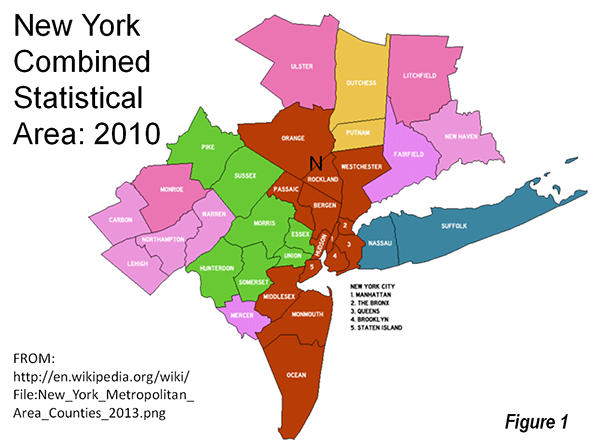
    On this measure, New York became greater by more 1 million residents as a result of the changes in commuting patterns. The addition of Allentown (Pennsylvania – New Jersey) and the East Stroudsburg, Pennsylvania metropolitan areas expanded the New York combined statistical area by another 2,700 square miles (7,000 square miles), bringing the population to 23.1 million. Altogether, the metropolitan area and combined area land area increases added up to 3,700 square miles (9,700 square kilometers). The 35 county New York combined statistical area is illustrated in the map (Figure 1).

    Organized Around the World’s Largest Urban Area (in Land Area)

    The New York combined statistical area is very large. It covers approximately 14,500 square miles (37,600 square kilometers). From north to south, it measures 235 miles (375 kilometers) from the Massachusetts border of Litchfield County, Connecticut to Beach Haven, in Ocean County, New Jersey. It is an even further east to west, at more than 250 miles (400 kilometers) from Montauk State Park in Suffolk County, New York to the western border of Carbon County in Pennsylvania (Note 2). Despite containing the largest urban area  in the world, at 4,500 square miles (11,600 square kilometers), more than 60 percent of the combined statistical area is rural (see Rural Character in America’s Metropolitan Areas).

    Dispersion of Jobs and Residences

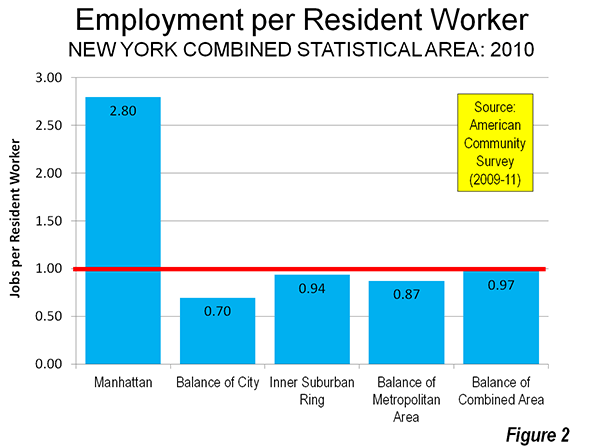
    The dispersion characteristic of modern metropolitan regions is illustrated by the extent to which jobs have followed the population in the New York combined statistical area. In all “rings” outside the city of New York, there is near parity between resident workers and jobs. The greatest employment to worker parity (0.97) is in the metropolitan and micropolitan areas outside the New York metropolitan area (Allentown, PA-NY; Bridgeport, CT; East Stroudsburg, PA; New Haven, CT; Torrington, CT; and Trenton, NJ). There is 0.94 parity in the inner ring suburban counties, which include Nassau and Westchester in New York as well as Bergen, Essex, Hudson, Middlesex, Passaic and Union in New Jersey. The outer balance of the New York metropolitan area has slightly lower employment to worker parity, at 0.87 (Figure 2).

    The lowest employment to worker parity in the New York combined statistical area is in the four boroughs of New York City outside Manhattan, at 0.70. The greatest disparity is in Manhattan, where there are 2.80 jobs for every resident worker. Combining all of New York’s five boroughs yields a much more balanced 1.17 jobs per resident worker.

    Example: Commuting from Hunterdon County

    Hunterdon County, New Jersey provides an example of the dispersion of employment in the New York area. Hunterdon County is located at the edge of the New York metropolitan area. It is well served by the commuter rail services of New Jersey Transit. With a line that reaches Penn Station in New York City, approximately 55 miles (35 kilometers) away. Yet, the world’s second largest employment center (after Tokyo’s Yamanote Loop), Manhattan south of 59th Street, draws relatively few from Hunterdon County to fill its jobs.

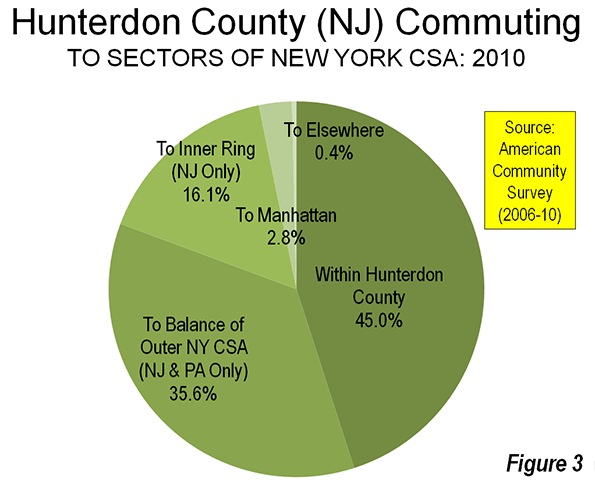
    Among resident workers, 45 percent have jobs in Hunterdon County. Another 36 percent work in other outer counties of the combined statistical area. This leaves only 19 percent of workers who commute to the rest of the combined statistical area. The New Jersey inner suburban counties attract 16 percent of Hunterdon’s commuters and Manhattan employs just three percent of Hunterdon’s resident workers (Figure 3). Fewer than 0.5 percent of Hunterdon’s commuters work in the balance of the CSA, including the outer boroughs of New York, the other New York counties and Connecticut). The detailed area definitions are included in the Table.

    DISTRIBUTION OF COMMUTING FROM HUNTERDON COUNTY, NEW JERSEY
    To Locations in the New York Combined Statistical Area (2006-2010)
    NY CSA Sector Commuting from Hunterdon County Areas Included
    Hunterdon County 45.0% Hunterdon County, NJ
    Outer Combined Statistical Area 35.6% Monmouth County, NJ
    Morris County, NJ
    Ocean County, NJ
    Pike County, PA
    Somerset County, NJ
    Sussex County, NJ
    Allentown metropolitan area, PA-NJ
    East Stroundsburg metropolitan area, PA
    Trenton metropolitan area, NJ
    Inner Ring (New Jersey only) 16.1% Bergen County, NJ
    Essex County, NJ
    Hudson County, NJ
    Middlesex County, NJ
    Passaic County, NJ
    Union County, NJ
    Manhattan 2.8% New York County, NY
    Elsewhere 0.4% Bronx
    Brooklyn
    Queens
    Staten Island
    Dutchess County, NY
    Nassua County, NY
    Orange County, NY
    Putnam County, NY
    Rockland County, NY
    Suffolk County, NY
    Westchester County, NY
    Bridgeport metropolitan area, CT
    Kingston metropolitan area, NY
    New Haven metropolitan area, CT
    Torrington metropolitan area, CT


    From Commuter Belts and Concentricity to Dispersion

    Metropolitan areas are labor markets, as OMB reminds in its 2010 metropolitan standards, which refer to metropolitan areas, micropolitan areas, and combined statistical areas as geographic entities associated with at least one core plus “adjacent territory that has a high degree of social and economic integration with the core as measured by commuting ties. ”

    Yet metropolitan areas have changed a great deal. Through the middle of the last century, metropolitan areas were perceived as monocentric with core cities and a surrounding “commuter belt” from which the city drew workers to fill its jobs. However, metropolitan areas have become more polycentric, as Joel Garreau showed in his book Edge City: Life on the New Frontier. In more recent years, metropolitan areas have become even more dispersed, with most employment located in areas that are hardly centers at all. Of course, some people still commute to downtown and edge cities. Others work even further away, but most find their employment much closer to home. That is the story of New York and, which has just become greater, and other metropolitan areas as well.

    ——

    Note 1: OMB revised its metropolitan terms in 2000. The term “core based statistical area” (CBSA) is used to denote metropolitan areas (organized about urban areas of 50,000 population or more) and micropolitan areas (organized around urban areas of 10,000 to 50,000 population). The former “consolidated metropolitan statistical area,” was replaced by the combined statistical area, which is a combination of core based statistical areas. OMB also notes that the term “urban area” includes “urbanized areas” (50,000 population or more) and “urban clusters (10,000 to 50,000 population).

    Note 2: Part of the reason for this large geographic expanse is the use of counties as building blocks of core based statistical areas. If the smaller geographic units were used (such as census blocks, as in the delineation of urban areas), the geographies would be smaller, though populations would be similar.

    ——-

    Wendell Cox is a Visiting Professor, Conservatoire National des Arts et Metiers, Paris and the author of “War on the Dream: How Anti-Sprawl Policy Threatens the Quality of Life.

    Photograph: 59th Street, Manhattan (by author).

  • Suburban Corporate Wasteland

    I was a guest on the show “Where We Live” on WNPR radio in Connecticut this week. The theme was “Suburban Corporate Wasteland” – the increasing numbers of white elephant office campuses in suburbs. Apparently Connecticut has several of these and some buildings are actually being demolished because there’s no demand for them.

    The entire program is worth a listen, particularly if you are someone trying to figure out how to redevelop one of these things. Several local officials join to talk about efforts to do that in their towns. If you want to just hear Yours Truly, I’m on for about 10 minutes starting at 38:30. Follow this link to listen to the show.

    There are a number of challenges converging to put pressure on suburban office campuses in some places:

    1. Decentralization has run its course. There was a massive wave of suburbanization in the post-War era that has finished. That’s not to say things are going to be re-centralizing. Rather, the massive move from the core to the periphery is largely complete. The development pattern of the United States will continue to be decentralized, but it will largely be driven by organic growth rather than relocations. I think something similar happened with driving. The factors driving VMT growth above the rate of inflation – more cars per household, women entering the workforce, and such – are pretty much played out in terms of driving huge additional travel miles.

    2. Corporate M&A and industry restructurings have dampened demand in some areas. In Connecticut specifically, a number of the complexes in question were from pharmaceutical and insurance companies. There has been a lot of consolidation in the pharma industry, for example. And with a challenging environment for new drug development, pharma companies are now really focusing on cost cutting and reducing overhead, not building massive new office parks.

    3. The nature of work is changing. There was a popular trend for a while towards massive suburban office HQ campuses. For example, Sears moved from its namesake tower in downtown Chicago to a big campus in Hoffman Estates. These campuses had tons of free parking and lots of onsite amenities like gyms, dry cleaners, cafeterias, day care, etc. They also offered an idyllic, almost pastoral setting in some respects. Workers could spend their days cocooned inside the campus. Today’s firms are less vertical integrated and more networked. They are heavily globalized and collaborative. They’ve also figured out that people who don’t get out and engage with the world around them end up cut off from information flows, leaving them a step behind. Workers are also demanding more flexible working conditions. And of course there’s cost cutting pressures. This leads to things like hoteling, co-working, and telecommuting – no massive suburban office park needed.

    4. In select industries and cities, there has been a resurgence in the fortunes of downtown offices. This has particularly been the case in high tech. Google’s second largest office is in Manhattan. Salesforce.com’s Exact Target unit employs a thousand people in downtown Indianapolis. Amazon is building a large urban campus is Seattle. Many companies in Chicago have relocated downtown from the suburbs. I’ve probably seen more announcement of these types of moves in Chicago than anywhere else. I’d caution that in most downtowns the trends in private sector employment have remained negative. But in select locales and industries, things have been looking up. In industries where there’s a need for proximity to high end business services or where there are unique clustering or labor force issues, downtowns will retain an appeal.

    Put it all together and it’s clear office space demand is weaker than it used to be. Joel Kotkin recently surveyed the same trends and suggests that the US may have hit “peak office”. The idea is not that office space will actually decline, rather that it won’t be growing at the same rates as in the past. This will affect both urban and suburban markets.

    It’s easy to see how these trends combined to pound a place like Connecticut. It’s next to NYC, the premier central business district zone in America. But it is also far enough to make commuting to most of it a pain (even the express train to Stamford takes about an hour). And it’s an expensive and business hostile environment to boot. Large scale employers who want a suburban footprint can find many better places.

    We are in fact seeing this happen in finance. Goldman Sachs is booming in Manhattan, but has what I believe is their second largest US office in Salt Lake City, presumably housing back office functions. Deutsche Bank is building a big facility in Jacksonville. JP Morgan Chase has a huge presence in Columbus, Ohio, where its former Bank One unit was based. A place like Connecticut is the odd man out. Suburban Chicago is probably set to be another loser. But in smaller cities the suburbs will do much better.

    Also, don’t be too quick to write the eulogy for the suburban office campus, even in the tech industry. A recent article in Der Spiegel featured Silicon Valley’s new “monuments to digital domination” – including Apple’s $5 billion Norman Foster designed campus, Frank Gehry’s campus for Facebook, and others for Google, NVidia, and Samsung. In Houston, Exxon Mobil is putting the finishing touches on a three million square foot campus that will employ 10,000 people. But unlike Google moving 2,500 people to downtown Chicago, projects like that don’t make national headlines.

    I don’t think there will be a massive back to downtown wave, and the suburban office park is not dead. But there are headwinds facing suburban office space, particularly in expensive, mature markets.

    Aaron M. Renn is an independent writer on urban affairs and the founder of Telestrian, a data analysis and mapping tool. He writes at The Urbanophile, where this piece originally appeared.

  • Downsizing the American Dream

    At this time of year, with Thanksgiving, Hanukkah and Christmas, there’s a tendency to look back at our lives and those of our families. We should be thankful for the blessings of living in an America where small dreams could be fulfilled.

    For many, this promise has been epitomized by owning a house, with a touch of green in the back and a taste of private paradise. Those most grateful for this opportunity were my mother’s generation, which grew up in the Great Depression. In her life, she was able to make the move from the tenements of Brownsville, Brooklyn, first to the garden apartments of Coney Island and Sheepshead Bay, and, eventually, to a mass-produced suburban house on Long Island.

    This basic American dream of upward mobility may not, according to the pundit class, planners and many developers, be readily available for my children. Indeed, in the years since the 2007 housing bust, there’s been a steady stream of commentary suggesting a future that resembles the past, where most people were renters and, in urban centers, lived chock-a-block in crowded apartment buildings.

    The advocates for a return to this not-so-great past are a diverse lot, spanning the ideological spectrum from the free-market Right to the green, regulation-loving Left. Many on the right, such as economist Tyler Cowen, suggest that the era of the “average” American is now past, and that most of us will have to dial down our expectations about how we live, particularly in costly places such as California. The blessed 15 percent might aspire to live high on the hog, and even in luxury, but for the rest of us it’s eating rice and beans, and living small. Goodbye, Levittown, and back to Brownsville.

    Some in the financial community also salivate at the possibilities contained in downgrading the American dream. The very people who rode the mortgage boom and left millions of homeowners to deal with the consequences, now hail the ushering of what Morgan Stanley’s Oliver Chang has dubbed a “rentership society.” Rather than purchasing a home, the middle class is now being downgraded into either renting a foreclosed home snatched by the Wall Street sharpies or being stuffed into small, multifamily housing.

    In either case, the financial hegemons win, since they, essentially, get to have someone else to pay their mortgages. As for society, it’s a losing proposition. Rather than the yeoman with his own place, and the social commitment that comes with it, we now have the prospect of a vast lower class permanently forced to tip its hat to – and empty its wallet for – its economic betters. This is the fate ardently hoped for by many urbanists, who see a generation of permanent renters as part of their dream of a denser America.

    One would expect that this diminution of the middle class would offend liberals, who historically supported both the expansion of ownership and the creation of a better life for the middle class. But today’s liberals – or progressives – share Wall Street’s enthusiasm, albeit for different reasons, for renting and ever-greater densities.

    This reverses the policies of the New Deal and its successors. Half of postwar suburban housing, notes historian Alan Wolfe, depended on some form of federal financing. In fact, the progressive position increasingly is worse than that of free-market conservatives and their Wall Street allies. The Right sees profit in densification and renting, but would likely support other options if they seemed advantageous. In contrast, the progressive Left increasingly sees the single-family home and ownership – what made middle-class people like my mother lifelong Democrats – as outdated, even destructive.

    This can be seen in the writings of progressive thinkers like Richard Florida, who, in the midst of the mortgage crisis, proclaimed homeownership as “overrated” and urged Americans to give up the dream of owning their own digs, particularly in the much-disrespected suburbs. In Florida’s “creative age,” the proper aspiration is to live in a dense, expensive city, such as San Francisco or Manhattan, where only a fraction of the population can conceivably own their residence.

    To accommodate this vision, we inevitably get back to a world that looks similar to that of the tenement era. Already, in part due to regulatory policies making new construction prohibitively expensive, there is severe overcrowding in New York, the Bay Area and throughout Southern California. According to the Center for Housing Policy and National Housing Conference, 39 percent of working households in the Los Angeles metropolitan area spend more than half their incomes on housing, along with 35 percent in the San Francisco metro area and 31 percent in the New York City area. The national rate is 24 percent, itself far from tolerable.

    What we are witnessing today is oddly reminiscent of the Brooklyn of my mother’s childhood. She and her four siblings generally lived in three or fewer rooms, sharing her bed with her sisters until she got married. Yet, over time my mother’s generation did well, and all my relatives were able to ascend into the middle class, or even better, by the late 1950s. Most bought homes on Long Island, although one purchased a co-op in Brooklyn.

    Today, our cognitive betters embrace a more déclassé vision, with fewer families, more singles and less focus on upward mobility. Indeed, some, particularly among the environmental community, actually embrace downward mobility. Millennials, by not buying homes and cars, and perhaps also not growing into family life, are portrayed by the green magazine Grist as “a hero generation” – one that will march willingly, even enthusiastically, to a downscale future.

    How will we live in this brave new America? It won’t be exactly a return to the tenements that housed Depression era families, but will involve much smaller, less-communal arrangements. To serve the hip and cool youthful urban crowd, planners embrace microunits of 200-300 square feet. These are either being built or planned in such cities as Seattle, New York, San Francisco, Santa Monica and Portland. Soon, they will become something every second-tier wannabe burg will want to duplicate in their often madcap drive to ape cool cities’ hip urbanism.

    Such units may make developers’ mouths water with anticipation of ever more profitable cramming. But in the process, they will be further encouraging the shift away from housing for married couples, not to mention, children. Families do not make up the prime market for dense housing; married couples with children constitute barely 10 percent of apartment residents, less than half the percentage for the overall population.

    And what if you can’t afford a trendy “pad” in a hip downtown? The urban advocates embrace another dismal back-to-the-future solution: the boarding house. It’s time, argues the Atlantic recently, to jettison our “middle-class norms of decency” governing housing and bring back the boarding house of the 19th and early 20th centuries.

    All said, this is a dismal future being dialed up for the next generation, largely by boomer ideologues and their developer allies. It’s not clear, fortunately, that the millennials will willingly go along. This gives us hope that, when families celebrate the holidays decades from now, they still will have as much to be thankful for as did my mother’s generation, or for that matter, my own.

    This story originally appeared at The Orange County Register.

    Joel Kotkin is executive editor of NewGeography.com and Distinguished Presidential Fellow in Urban Futures at Chapman University, and a member of the editorial board of the Orange County Register. He is author of The City: A Global History and The Next Hundred Million: America in 2050. His most recent study, The Rise of Postfamilialism, has been widely discussed and distributed internationally. He lives in Los Angeles, CA.