Blog

  • Derailing Europe’s Bike Trains

    In a fit of what now appears to have been madness, over the last ten days I attempted to live the life of a small plastic figure in an architect’s model community. I wheeled my bike through railroad stations, and took eco-friendly cycle lanes. The goal was to use only a combination of trains and my bicycle to attend a series of meetings in France, Belgium, and the Netherlands. I hoped that the harmonious state of the European Union, not to mention the environmental friendliness of both trains and bikes, would allow me to whiz between Bordeaux, Paris, Brussels, and Amsterdam and then pedal the last kilometers to my hotels. Is this not the dream of European planners who have banned cars from many historic downtowns, and annually vote some €40 billion a year in railroad subsidies?

    Like many utopian schemes, my model week of travels worked better on paper than in practice. I made a large loop from Geneva to Bordeaux, Paris, and Amsterdam, and stopped long enough in many other cities to ride around the “centreville”. When it was over, I came to the conclusions that European rail transport, and perhaps even the larger European Union, remain Balkanized, and that taking a bicycle on a business trip involves the same logistical planning as departing on a Crusade.

    While getting on and off thirty trains (on the weekends I made detours to historic sites), I learned that many European railroad companies hate bicycles, especially on crack express trains, and that bikes are largely exiled to insignificant “milk” trains that go nowhere at slow speeds.

    More distressing, national borders — largely in disuse on auto routes across Europe — are alive and well whenever you attempt to bring a bicycle across state lines on a train, as that opens up the possibilities of more fees for rail companies, or at least the chance for conductors to deliver nationalistic rants.

    Between Amsterdam, Brussels, Lille and Geneva, for example, I paid out more than $60 just to bring along a bike, although on many trains I had to stand with it in the vestibule. The EU’s motto, “Unity in Diversity,” might as well read, “What makes you think you can put your bike there?”

    Herewith is a not-at-all comprehensive guide to bike-training around Europe. Be particularly mindful if you believe the Community is a happy jamboree of continentals singing hymns to Brussels:

    France: Bikes are allowed on some high speed TGV trains (Train à Grande Vitesse), but only after a passenger has physically gone to a station and paid for a reservation. Online bike reservations are not possible (that would make it too easy).

    Local TER trains (Transport Express Régional) welcome bikes aboard at no extra charge and have convenient hooks and bike carriages. Except for a few long distance “Intercités” trains, TER is local, which is why it took twelve hours and numerous train changes to travel with a bike from Geneva to Bordeaux, the first leg of my journey.

    I changed in Bellegarde, Lyon, and Saint-Pierre-des-Corps before heading to Bordeaux. Later, I made whistle stops in La Rochelle, Poitiers and Tours. Nearly all the cities on my route were a delight to see on a bike, as, of course, was Paris, which is as bike-friendly as any large city, although Parisian cyclists ride as though they inhabit some wild Expressionist painting.

    Belgium: I went from Paris to Lille and then across Belgium on several trains, all of which took my bike, but few of which had any place to store it.

    Nor is the French fee paid to transport a bike recognized in Belgium. So much for the common market. Belgium imposes its own set of arcane rules for passengers trying to sneak a bicycle across the border.

    Even though I had passes for the trains and my bike, there was always some reason I ran afoul of the Belgian conductors, who in torrents of Flemish, French, or English would berate me for the temerity of traveling in their country.

    Mao would have called these encounters “struggle sessions,” and I grew to dread being asked for “self-criticism” every time I boarded a Belgian train. A few of the conductors were kindly, but some in Flanders were so bitter over what appeared to be nothing that I wondered if their rage wasn’t part of a larger crackup, maybe one involving the entire country?

    I did love my rides around Brussels, Antwerp and Ypres, but was shocked at the contrast between wealthy (Germanic) Flanders and depressed (French-speaking) Wallonia.

    Flanders has wealthy farms, an industrial base, global trade via the Rhine, inflowing tourist dollars from Bruges and Ghent, and the European Union in Brussels.

    Wallonia is the dowager of a forgotten Belgian empire (maybe lost in the Congo?) — with abandoned coal mines, lots of subsidies from the north, lazy union work rules, and a sense that the future isn’t what it used to be. It does not even have Brussels, which floats along the uneasy divide: linguistically part of Wallonia; legally attached to Flanders.

    If the Flemish politicians are anything like their train conductors, I can easily imagine them throwing the Walloons off at the next station, with a long lecture about their failures as an economic entity or their lack of sufficient documentation.

    The Netherlands: The Low Countries are celebrated for their bicycle culture; bikes in Amsterdam careen like split atoms. That affection ends at the doors of the train, on which bikes are a regulated industry.

    I loved biking across the bridges over Amsterdam canals, especially at night when the Christmas lights were lit and the city had the feel of a Venetian carnival. Nevertheless, on the rails, a bike became an albatross, subject to myriad rules about the difference between a “national” and “international” bike pass, and regulations that prohibit bikes on certain trains during rush hours.

    Because of a tunnel fire, my bike and I were waylaid in the Hague’s damp air for more than an hour. When finally rerouted to Gouda and Rotterdam, I was told in a scolding manner that I would have to get off the trains for another two hours during peak travel times, even though the cars were empty. So much for those newspaper articles about modest Dutch royalty tooling around the country on their bikes.

    It took almost eight hours to travel with the bike from Amsterdam to Lille, France. These cities are three hours apart on high-speed trains, although none of those trains allow bicycles.

    ***

    The answer to these frustrations, of course, is for me to buy a folding bicycle — although a good one costs more than $1500 — if I wish to persist in the dream of getting around Europe by train with a bike.

    A “folder” may be worth it, however, because European cities are best seen over handlebars. Sadly, while a folding bike can be snuck aboard fast trains as “normal luggage,” the other, perhaps larger problem of the European bike-train dream is that international train journeys have become the travel choice largely of the expense-account crowd.

    For example, one-way train fare from Geneva to London is $350, but don’t even think about taking along a bicycle. Or, you might get it from Geneva to Paris on a TGV (add $15 more to the ticket), but Eurostar’s bike policies (add another $35) are more arcane than the Treaty of Westphalia: Bikes over a certain size go as registered luggage, but sometimes travel on different trains, making connections convoluted.

    So fly, rent a car, sit in traffic, and sleep in motels near auto route interchanges. In other words, so long as you don’t try to see the continent with a bike and by train on the same trip, or on a budget, the state of the European empire is fine.

    Matthew Stevenson, a contributing editor of Harper’s Magazine, is the author of Remembering the Twentieth Century Limited, a collection of historical travel essays. His new book, Whistle-Stopping America, was recently published.

    Flickr photo by K Paulinka: Bike Storage at Leiden train station parking lot, Netherlands.
  • Suburban End Games

    Are America’s suburbs facing end times? That’s what a host of recent authors would have you believe.  The declaration comes in variety of guises, from Alan Ehrenhalt’s The Great Inversion (2012), to “the peaking of sprawl” pronounced by urban planner  Christopher Leinberger to, most recently, to Leigh Gallagher’s The End of Suburbs(2013).  Suburbs and sprawl have joined the ranks of “history” and “nature” as fixtures of our lives that teeter on the verge of demise—if we’re to lend credence to this latest clamor from journalists, planners, and academics. 

    When you declare the “ending” of a place where you acknowledge over half of Americans now live, just what does that mean?  One sure bet is that their demise won’t prove nearly as definitive or thorough-going as advertised. Looking around the Long Island neighborhood and town where I’ve lived for the last twenty years, I don’t see them vanishing any time soon. Moreover, from my own perspective as a long-time resident as well as historian of such places, the particulars grounding this narrative point to something very different: the rise of conditions, as yet only starting to be realized, for a new suburban progressivism. 

    This media wave of talk about suburbs or sprawl “ending” mirrors an earlier one in the decades after World War II, which fleshed out a rise of “mass suburbia.” That earlier wave turned out to be well-nigh mythological in its selectivity, its choice of emphases and its silences.  Embellishing the idea of suburbs as more than just a place, as an entire, distinctive way of life, it built upon age-old notions of suburbs as simply the edges of cities, also a change commencing over two hundred years ago among cities in the industrial West.  Cities began to grow less through the spread of a discrete and distinct rim than via a widening transition zone between city and countryside.  But only after World War II did the idea of “suburbia” congeal into a solid stereotype: those subdivisions of lawns and single family homes occupied by a white middle class.    

    Among the earliest discoverers was 1950s Fortune correspondent William Whyte, who found in the suburbs an entire generation of upwardly mobile, affluent, younger families, in search of the American dream.  Journalists concentrated mainly on places that fit this story line, the very largest and newest housing developments around the very largest of cities.   Early coverage celebrating these suburbs classless-ness was quickly followed by more critical accounts.  Commentators such as Whyte and Frederick L. Allen distinguished this “new suburbia” from an older one they preferred, quieter and smaller and more securely elitist.  Sociologists taking a more even-handed approach, such as Herbert Gans and Bennett Berger, also questioned the “myth” of these places’ classlessness, by highlighting more working class homeowners and communities.  The great majority of those moving into such places had also been white, and as the racial imagery of a white “donut” surrounding a black core consolidated with the urban and busing crises over the 1960s and 70s, an ambivalent imagery of postwar “suburbia” stuck.  At once affluent, middle class, and white, but also vaguely declassé, suburbs were self-satisfied and reactionary places that deserved the progressive city-dweller’s disdain. 

    As current-day Fortune correspondent and professed “city girl” Leigh Gallagher, makes clear, such attitudes are alive and well, for instance, at cocktail parties where those hearing her book title offer “high fives and hurrahs.”   Today’s literature on suburbia’s end has the distinct ring of wish fulfillment for a long tradition of city-bound suburb-bashers, of a piece with their eagerness finally to declare downtowns “resurgent [as] centers of wealth and culture.”  But just as most characterizations of “suburbia” in the 1950s ignored the pockets of poverty and minority enclaves in its midst, so even the most balanced of today’s expositors of suburbs’ end can be quite selective.  For instance, even though the Charlotte metro area’s 42% growth between 2000 and 2013 came through a momentous build-out of subdivisions and malls, even though the city itself has eagerly annexed nearly 25% more suburban land since 2000, Ehrenhalt dwells solely upon its reconstruction of the downtown.  We hear nothing about how, even with its expanded limits, this city still contains only 31% of the population of this urban region.

    While these authors do leaven their arguments with a lot more demographic yeast than their 1950s predecessors, they still leap to generalizations that, in an era of soaring income inequality, bear more scrutiny than they get.   When Gallagher refers to how “we rebuild once or twice a century in this country,” just who is this “we” she means? It is not hard to draw some unsettling answers. As an editor at Fortune, as avowed resident of Greenwich Village, whose one-bedroom rentals are the most expensive in Manhattan, she seems heavily identified with affluent, especially the movers and shakers in the development community.  Whether singling out recent failures of building projects in outer suburbs or exurbs, concentrating on suburban malls that have been abandoned or are being retrofitted, or homing in on downtown reconstructions, “end of suburbs” authors often tacitly adopt a financial standard for future promise: where the most real-estate money is to be made. 

    By the same token, this literature of suburbia’s end offers astonishing little reflection on the implications of its favored trends for the ways in which our cities divide the wealthy from the rest.   Today’s declarations of an “end of suburbs” come just as rents in places like Manhattan are hiking out of reach of the merely middle class, generating anxieties tilled, most recently, by Bill de Blasio’s successful campaign for mayor. Yet when Gallagher sweepingly contends that “millenials hate the suburbs,” she doesn’t even ask how many young people are actually going to be able to afford living in cities. And at this point, as well, her definition of “suburbs” itself suddenly narrows: just the subdivisions and malls, not the new “planned community” or the “urbanized small town or suburb” that may lie nearby.

    The trend of urbanizing suburbs offers the most compelling angle of this reputed “end” for us actual suburbanites. For a good while in suburbs like my own Long Island, proponents of smart growth and the New Urbanism have pushed for multiuse, for bringing apartments into old town centers, for recreating walkability there.  Having watched and participated in the political rows stirred by such projects, like Avalon Bay’s plan to build an apartment complex near the Huntington train station, I can say this: those people most likely to see these projects as an “end of suburbs” are their opponents.  For the rest of us, their supporters, they look more like diversifying: taking us away from the old “suburbia” stereotypes, but not by leaving subdivisions behind.  All those stores, restaurants, and events available in walkable downtowns have the virtue of enhancing the suburban experience for those of us who remain homeowners, even as they furnish living quarters for renters who might otherwise leave: twenty-somethings, singles, and the elderly.  

    That suburbs are also becoming societal repositories for newly arriving immigrants, blacks and other minorities, as well as poverty, does undermine that old “suburbia” imagery, but in ways that stir hopes for suburbs’ future. Largely because of these trends, indexes measuring metropolitan segregation have been gradually declining—and that’s a good thing.  Of course, suburbanites’ reputation for racial animosity is still plenty justified:  just look at Atlanta’s Gwinnett County as depicted by Ehrenhalt, or the hostility found on Long Island to undocumented immigrants. But there’s an as yet little-told story of how suburban opposition to these attitudes has also emerged. When a homeless camp of mostly immigrant workers was discovered in Huntington Station in the early 2000s, a remarkable coalition of social service agencies and churches cobbled together a program for housing and feeding them over the winter that involved over a thousand volunteers. This outpouring crossed lines of class and race, drawing many from the suburban church I attend, which itself is pretty evenly split between blacks and whites.  I don’t think my fellow travelers there, or in pro-immigrant groups like Long Island Wins, would surmise as Gallagher does that ours is some “suburban experiment” that has “failed.”

    “The end of suburbs”—it’s a dramatic claim, and as mythological as that old “myth of suburbia,” especially for those of us living in the places that are supposed to be ending. I prefer another narrative, with a more positive spin. The demographic and other changes underway in our suburbs may well wind up breaking the old stereotype in another way, by building the basis for a newly inclusive and forward-looking politics in the suburbs. 

    Christopher Sellers is a Professor of History at Stony Brook University and author of Crabgrass Crucible; Suburban Nature and the Rise of Environmentalism in Twentieth-Century America (2012), He is now writing on, among other things, the historical relationship between suburbanizing, race, and environmentalism around Atlanta. 

    Home illustration by Bigstock.

  • Rural Character in America’s Metropolitan Areas

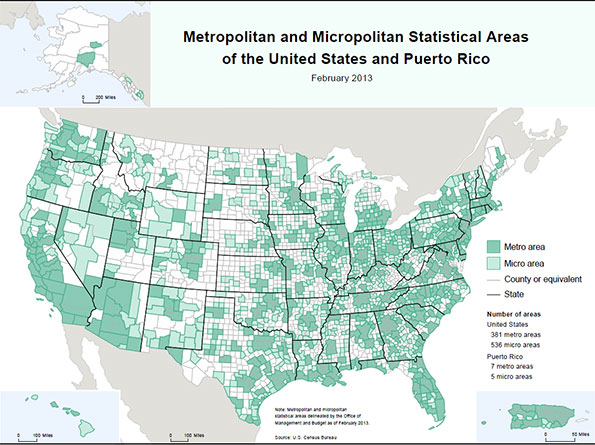
    Looking at a map of the metropolitan areas of the United States, it would be easy to get the impression that “urban sprawl” had consumed most of the nation. Indeed, as Figure 1 indicates, one could drive from Santa Rosa, north of San Francisco to the Arizona-New Mexico border without ever leaving a metropolitan area. This more than 1,000 mile trip (1,600 kilometers) would take nearly 15 hours, according to Google Maps. New Jersey is shown as all-metropolitan, as well as Delaware. But looks can be deceiving. According to US Census data from 2010, the land area of New Jersey is 60 percent rural, while Delaware is 80 percent rural.

    Given the multiple terms used to describe urban and rural geography, confusion is not uncommon. It begins with the fundamental matter of terms. For starters, “metropolitan” is not the same thing as “urban,” and “rural” does not mean non-metropolitan. In fact, most rural residents in the United States live in metropolitan areas. 

    Urban Areas

    All land within the United States is either urban or rural, without respect to whether it is in metropolitan areas. The Census Bureau defines urban areas using “census blocks” to which minimum population density criteria are applied. Census blocks are very small neighborhood units, which are far smaller than virtually all municipalities. This approach produces an urban area defined by land use characteristics, without regard to jurisdictional (city or county) boundaries. Urban areas contain no rural land.

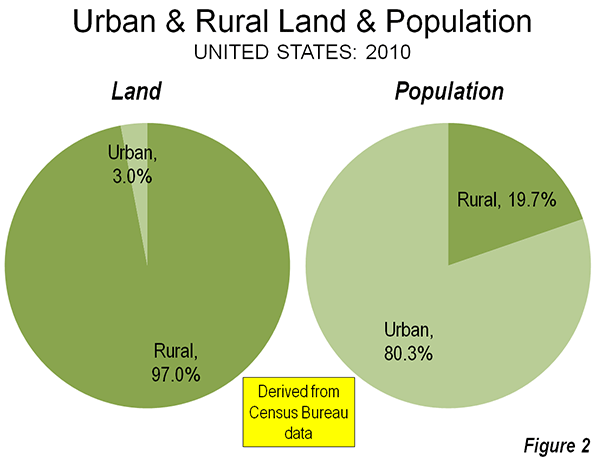
    In 2010, 19.3 percent of the US population was in rural areas, which covered 97.0 percent of all land. The other 80.7 percent of the population was urban and lived in only 3.0 percent of land area (Figure 2)

    Rural Population of Metropolitan Areas

    Metropolitan areas always have large areas of rural land. This is due to the very nature of metropolitan areas, which are designated by the US Office of Management and Budget (OMB). Metropolitan areas are labor markets, defined by commuting patterns. People commute to jobs in metropolitan areas both from within the core urban area (such as the New York urban area) and from areas outside the core urban area that remain in the metropolitan area, such as the non-urban parts of the New York metropolitan area (examples are much of Orange and Dutchess counties in New York as well as Sussex and Hunterdon counties in New Jersey).  

    Each metropolitan area is organized around “central counties” that include a core urban area (area of continuous urban development). The core urban area must have at least 50,000 residents for an area to qualify as metropolitan. “Outlying counties” are also included in metropolitan areas if 25 percent or more of their resident workers commute to the central counties. This central counties and core urban area approach reflects the evolution of US metropolitan areas to the more dispersed employment and residential patters that have materially reduced the influence of the historical core municipalities (sometimes called “central cities”). On average, only about 10 percent of employment in the 50 largest urban areas was in the formerly more dominant downtowns in 2000 (central business districts).

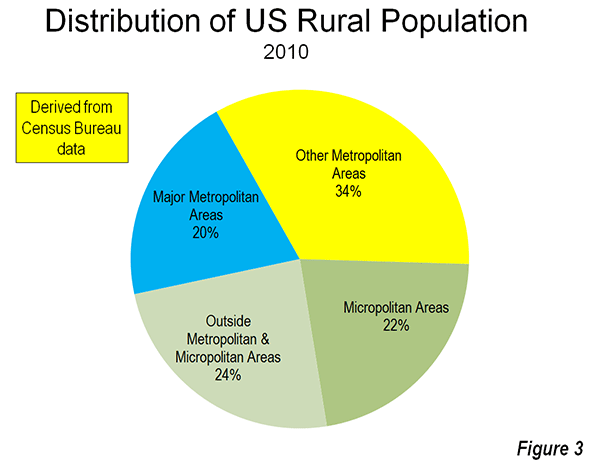
    The land area in America’s metropolitan areas is much more rural than urban. More than 90 percent of metropolitan area land is rural. In 2010, 28 percent of the nation’s land area was metropolitan, but the urbanization in metropolitan areas accounted for only 2.6 percent of US land area. In 2010, 32 million of the nation’s 60 million rural residents lived in metropolitan areas (Figure 3).

    Major Metropolitan Areas

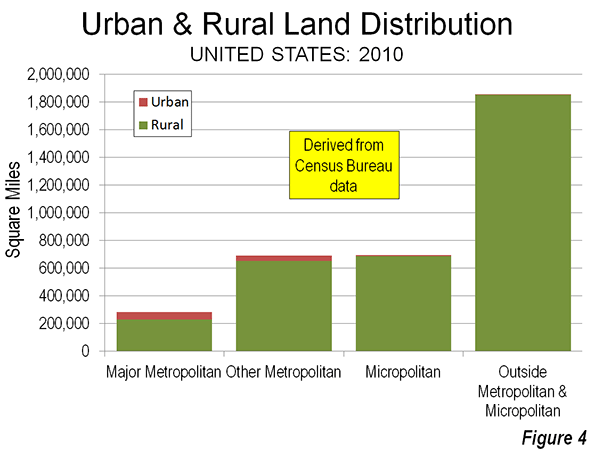
    On average, 81 percent of the land area in major metropolitan areas (0ver 1,000,000 population) is rural, not urban (Figure 4). There is a wide variation among the major metropolitan areas. All but one of the major metropolitan areas has more rural land than urban land. Boston has smallest rural land area share at 43 percent. The New York metropolitan area clocks in at 52 percent rural, Philadelphia at 54 percent rural and Tampa-St. Petersburg stands at 55 percent rural. At the other end of the scale, the Salt Lake City metropolitan area is 96 percent rural, followed by Riverside-San Bernardino at 95 percent, Las Vegas 94 percent and Denver 92 percent (Table).

    Table
    Rural Population & Land Area in Metropolitan Areas
      2010 Rural Population 2010 Rural Land Area # of Counties
    Atlanta, GA 11.1% 67.4% 29
    Austin, TX 12.8% 85.6% 5
    Baltimore, MD 9.0% 64.8% 7
    Birmingham, AL 28.8% 88.7% 7
    Boston, MA-NH 5.5% 42.6% 7
    Buffalo, NY 11.9% 73.0% 2
    Charlotte, NC-SC 18.5% 75.8% 10
    Chicago, IL-IN-WI 2.6% 61.9% 14
    Cincinnati, OH-KY-IN 14.1% 78.2% 15
    Cleveland, OH 8.1% 58.7% 5
    Columbus, OH 16.5% 86.9% 10
    Dallas-Fort Worth, TX 7.4% 76.1% 13
    Denver, CO 5.7% 91.8% 10
    Detroit,  MI 6.8% 60.0% 6
    Grand Rapids, MI 25.0% 85.4% 4
    Hartford, CT 12.2% 56.8% 3
    Houston, TX 6.5% 75.5% 9
    Indianapolis. IN 12.4% 81.2% 11
    Jacksonville, FL 11.2% 80.1% 5
    Kansas City, MO-KS 12.3% 88.9% 14
    Las Vegas, NV 1.3% 94.4% 1
    Los Angeles, CA 0.5% 59.8% 2
    Louisville, KY-IN 17.1% 85.8% 12
    Memphis, TN-MS-AR 15.3% 89.0% 9
    Miami, FL 0.4% 75.2% 3
    Milwaukee,WI 6.6% 59.2% 4
    Minneapolis-St. Paul, MN-WI 12.4% 84.4% 16
    Nashville, TN 24.1% 87.6% 14
    New Orleans. LA 7.2% 87.3% 8
    New York, NY-NJ-PA 2.7% 52.4% 25
    Oklahoma City, OK 18.3% 91.0% 7
    Orlando, FL 5.4% 74.4% 4
    Philadelphia, PA-NJ-DE-MD 5.1% 53.7% 11
    Phoenix, AZ 4.1% 91.0% 2
    Pittsburgh, PA 17.8% 80.1% 7
    Portland, OR-WA 9.9% 91.1% 7
    Providence, RI-MA 9.5% 56.9% 6
    Raleigh, NC 17.2% 73.1% 3
    Richmond, VA 20.3% 89.1% 17
    Riverside-San Bernardino, CA 4.7% 95.1% 2
    Rochester, NY 21.9% 87.8% 6
    Sacramento, CA 7.2% 88.3% 4
    St. Louis,, MO-IL 13.2% 86.0% 15
    Salt Lake City, UT 1.8% 96.1% 2
    San Antonio, TX 13.8% 91.0% 8
    San Diego, CA 3.3% 81.9% 1
    San Francisco-Oakland, CA 1.0% 65.8% 5
    San Jose, CA 1.8% 87.2% 2
    Seattle, WA 5.6% 81.0% 3
    Tampa-St. Petersburg, FL 4.4% 55.5% 4
    Virginia Beach-Norfolk, VA-NC 8.7% 78.2% 16
    Washington, DC-VA-MD-WV 7.8% 73.1% 24
    Major Metropolitan Areas 7.1% 81.0% 436


    The most important reason for the difference in rural area size within the major metropolitan areas is the differing sizes of counties. In the East, Midwest and South, counties tend to be much smaller than in the West. For example, the New York metropolitan area has nearly 20 million residents, distributed among 25 counties. In contrast, the Los Angeles metropolitan area, with 13 million residents, is composed of only two counties.

    The metropolitan areas with the most rural area are largely desert and mountains (see top illustration of the Riverside-San Bernardino metropolitan area). Large counties in Utah extend the Salt Lake City metropolitan area 100 miles westward to the Nevada border. Riverside-San Bernardino’s two large counties include a land area nearly equal to that of Ireland, stretching more than 200 miles to the Nevada and Arizona borders and including part of Death Valley National Park. In both cases (and a number of others), large counties require metropolitan areas to be far larger than any reasonable commuting shed. This size variation renders population density figures for metropolitan areas nonsensical (building blocks would need to be small, such as the census blocks used by the Census Bureau to define urban areas).

    The major metropolitan areas of over 1 million contain nearly 12 million rural residents, or 20 percent of the nation’s rural population. While this is a large number, their urban populations are much greater, at 158 million, or 63 percent of the US urban population of nearly 250 million. These urban residents live in a smaller proportional area, constituting of only one-half of all urban land area (and 1.5 percent of all US land area).

    Other Metropolitan Areas

    The rural portions of metropolitan areas with fewer than 1,000,000 residents cover 94 percent of their land areas. These areas include approximately 20 million residents, or 34 percent of the nation’s rural population. Only six percent of the land area in these metropolitan areas is urban.

    Outside Metropolitan Areas

    This leaves a minority of 27.5 million rural residents living outside the metropolitan areas.

    Micropolitan areas are defined by OMB as labor markets with core urban areas between 10,000 and 50,000, and are not considered metropolitan. Approximately 98.5 percent of the land in micropolitan areas is rural. The rural population of micropolitan areas is 13 million.

    The other 14 million rural residents live outside the micropolitan areas. However, there are still 4.7 million urban residents outside both metropolitan and micropolitan areas, with each of these urban areas having fewer than 10,000 residents.

    Rural Land in Metropolitan America

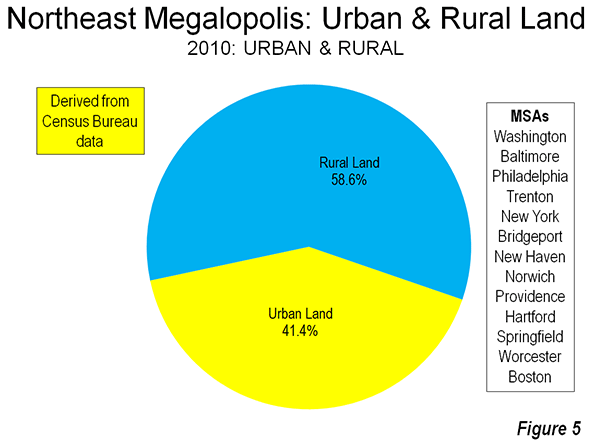
    Even where America is most urban, a strong rural element remains. This is illustrated in the Northeast Corridor, the “megalopolis” defined by Jean Gottman more than a half-century ago. The urbanization he identified is still short of continuous along the corridor. Rural areas interfere with urbanization in parts of Maryland, New Jersey, Connecticut and Massachusetts. Nearly 60 percent of the land area in these adjacent metropolitan areas remains rural (Figure 5). The numbers are even smaller elsewhere. Between Dallas-Fort Worth and Houston, 80 percent of the corridor is rural. Between Seattle and Portland nearly 90 percent of the corridor is rural. These are among the busiest corridors in the United States, and many more are far more rural. Up close and in context, the spatial urbanization of America, including its metropolitan areas is not pervasive.

    Wendell Cox is a Visiting Professor, Conservatoire National des Arts et Metiers, Paris and the author of “War on the Dream: How Anti-Sprawl Policy Threatens the Quality of Life.

    Illustration: San Bernardino Mountains and Mojave Desert in the Riverside-San Bernardino metropolitan area (by author)

  • The Private Business of Public Art

    Like many cities coming out of the downturn, Orlando is jonesing for a recovery. To promote a sense of new prosperity, City Hall leaders recently added eight works of art to its downtown core, amidst much fanfare. Before we start whistling “Happy Days Are Here Again,” however, we would do well to examine the circumstances of this renewed interest in public art. Its surprising return was trumpeted as a new way to enrich the city and benefit its residents; many, including this author, applauded the effort. This has certainly happened. But has the result been a barrier, as much as a connection, to its citizenry?

    Public art, always controversial, became a battleground in the sixties and seventies, with cries of “waste of taxpayer money” heard in cities across the land. Artists, always exploring new frontiers, were victims of decency committees and moralizing mayors when their visions strayed much beyond a famous figure astride a horse. Public art placed politicians in yet one more hot seat they didn’t especially need. Yet these programs brought us great beauty, as well. Anish Kapoor’s Cloud Gate in Chicago’s Millennium Park, and Maya Lin’s Vietnam War Memorial in Washington, DC, for example, have proved to be enduring. In the right hands, art creates wondrous public space. Battlegrounds, yes; but many battles are worth fighting.

    Private sponsorship, too, has had a place in the city: corporations, and sometimes even individuals, have commissioned works for their prominent institutions. While the state usually plays it safe with taxpayer money, the private commission was a place where an artist could dare. Good cities have a combination of both. Here in Orlando, the combination was alive and well, until spending on art ceased sometime early in the downturn.

    Public investment in art is suddenly in vogue, and while City Hall takes the kudos for the $1.5 million that has been spent in Orlando, a careful reading of the script shows that no taxpayer money was actually used. Private donors commissioned the art; City Hall merely placed it, mostly on public property. The public/ private partnership seems to have resulted in a collaboration, and a sense of unity between the corporate world, high net worth individuals, and the state, with the public getting the spillover effect of some new art to view.

    All seems to be great, suddenly, in our newfound prosperous era. The state and its richest citizens so often are adversaries who struggle over tax policy, and find little common ground over something as uneconomical as art. But out of nowhere, a collegial atmosphere has sprung forth, with participants rallying around ethereal values such as aesthetics and an inspiring sidewalk. Private interests and public officials are now holding hands round their new treasures, exhorting the public to share in this festival of new art. We seem to be awash in original works of great creative import, thanks to our visionary politicians and our benevolent corporate chieftains.

    And now, a closer look. Of the eight pieces chosen by a jury that reviewed many entries, nearly all are modifications of public art pieces installed elsewhere. Kentucky-based artist Meg White’s “Muse of Discovery” is very similar to her “Awaking Muse” in Schaumburg, Illinois, for example, and others follow suit. There is nothing wrong with this, and the works are all quite good. Yet taken together, the multiple pieces speak of safety and security. Sure-fire crowd pleasers similar to those that already adorn malls and parks in other cities were chosen here. Orlando, where the current t-shirt slogan sadly seems to be Orlando Doesn’t Suck, did not merit much originality , judging by the artworks chosen by a volunteer jury.

    Public art programs were born in an era when public works brought us bland, uninspiring buildings and infrastructure, and the intent was to force cities to inject some originality and creativity into government projects. Today, the municipal art budget has been turned over to private donors, and City Hall has successfully escaped its obligation to pay its percent – a parsimonious proportion to begin with – and zeroed out its budget for creativity and originality. Other people’s art and other people’s money are cleverly passed off as an enhancement to the city’s public realm, with politicians taking credit for this coup.

    Orlando’s current public art situation is emblematic of our new era of the blurred lines between public and private interests. Pre-recession, a few individuals and a few corporations placed art of their own choosing in the public realm as an expression of taste. Today, they are reticent to do so, except through a complicated nonprofit agency. Are our high net worth individuals and our corporate citizens so afraid of their capitalist peers that they can no longer put public art on their own property at their own discretion, without being accused of soft-hearted sentimentality and a lack of interest in profit?

    And are politicians so battle-scarred that they no longer wish to suggest that the taxpayer deserves to have his or her money spent on art? The original motive to elevate the public realm and visibly set a level of taste and sophistication is no longer sufficient for state-sponsored art. Neither does this new private sponsorship seem to rely much on site-specific commissions, preferring to adapt art that has been focus-group tested elsewhere, like any good consumer product.

    Studies that correlate a rich public realm with cities that are chosen for corporate relocations seem to justify the move into art by Orlando, a city desperate for more jobs. So, in the end, it is about money after all. In Florida, home to Art Basel Miami, we may be experiencing an arms race of sorts, as cities compete for the hip and the cool on an absurd stage to win over the creative class. This should be no surprise to anyone who is involved in the arts, a group that has become increasingly cynical about diminished funding from public and private donors alike. Artists, of course, lose out; as craftsmen who labor for the sake of attracting more jobs to the region, they have less and less impact on the city’s public face.

    The result is a public/private partnership that is carefully orchestrated to eliminate controversy, squelch accusations of taxpayer waste, and to provide a safe and secure support group for those rare capitalists who are still soft-hearted enough to care about arts funding. These motives insulate the city from its people, damping down all but a sure-fire applause reaction. In this twilight of public art, the face of the city is painted in a perfunctory way to please everyone yet no one, leaving a hollow and unsatisfying result. Of the new pieces selected by a committee, only Jacob Harmeling of Orlando created an original work, “The Cedar of Lebanon”. Artists who come anywhere from Zurich to Oregon have installed other magnificent pieces, and even if they reference other art, these beautiful works can be considered in a new context. Central Florida, home to the great pool of creative talent, including many who service world-class theme parks, will appreciate the gesture regardless of the mechanics behind it.

    This new era, like other times, will ultimately be judged by the quality of the stuff that it leaves behind. Timeless art that says something specific and intense will ultimately contribute to Orlando’s place in the future of the city as a global entity. Let’s hope the new artwork is respected and honored, that it takes on its own sense of place, and that it revives a conversation about what our cities mean to us.

    Richard Reep is an architect and artist who lives in Winter Park, Florida. His practice has centered around hospitality-driven mixed use, and he has contributed in various capacities to urban mixed-use projects, both nationally and internationally, for the last 25 years.

    Photo by Richard Reep: “Cedar of Lebanon” by Jacob Harmeling

  • The Geography Of Aging: Why Millennials Are Headed To The Suburbs

    One supposed trend, much celebrated in the media, is that younger people are moving back to the city, and plan to stay there for the rest of their lives. Retirees are reportedly following suit.

    Urban theorists such as Peter Katz have maintained that millennials (the generation born after 1983) show little interest in “returning to the cul-de-sacs of their teenage years.” Manhattanite Leigh Gallagher, author of the dismally predictable book The Death of Suburbs, asserts with certitude that “millennials hate the suburbs” and prefer more eco-friendly, singleton-dominated urban environments.

    Green activists hope this parting of the ways between the new generation and the preferences of their parents will prove permanent. The environmental magazine Grist even envisions “a hero generation” that will escape the material trap of suburban living and work that engulfed their parents.

    Less idealistic types, notably on Wall Street, see profit in this new order, hoping to capitalize on what Morgan Stanley’s Oliver Chang dubs a “rentership society”; in this scenario millennials remain serfs paying rent permanently to the investor class.

    But a close look at migration data reveals that the reality is much more complex. The millennial “flight” from suburbia has not only been vastly overexaggerated, it fails to deal with what may best be seen as differences in preferences correlated with life stages.

    We can tell this because we can follow the first group of millennials who are now entering their 30s, and it turns out that they are beginning, like preceding generations, to move to the suburbs.

    We asked demographer Wendell Cox to crunch the latest demographic data for us to determine where people have moved by age cohort from 2007 to 2012. The data reveals the obvious: People do not maintain the same preferences all their lives; their needs change as they get older, have children and, finally, retire. Each stage leads them toward somewhat different geographies.

    As it turns out, the vast majority of young people in their late teens and 20s – over 80 percent — live outside core cities. Roughly 38 percent of young Americans live in suburban areas, while another 45 percent live outside the largest metropolitan areas, mostly in smaller metro areas.

    To be sure, core urban areas do attract the young more than other age cohorts. Among people aged 15 to 29 in 2007, there is a clear movement to the core cities five years later in 2012 — roughly a net gain of 2 million. However, that’s only 3 percent of the more than 60 million people in this age group.

    Surprisingly, most of this movement to the urban centers comes not from suburbs, but from outside the largest metro areas, reflecting the movement of people from areas with perhaps lower economic opportunity. It also is likely reflective of the intrinsic appeal of metro areas to younger, single people, as well as the presence of many major universities and colleges in older “legacy cities.”

    Here’s how the geography of aging works. People are most likely to move to the core cities in their early 20s, but this migration peters out as people enter the end of that often tumultuous decade. By their 30s, they move increasingly to the suburbs, as well as outside the major metropolitan areas (the 52 metropolitan areas with a population over 1,000,000 in 2010).

    This pattern breaks with the conventional wisdom but dovetails with research conducted by Frank Magid and Associates that finds that millennials prefer suburbs long-term as “their ideal place to live” by a margin of 2 to 1 over cities.

    Based on past patterns, by the time people enter their 50s, the entire gain to the core cities that builds up in the 20s all but dissipates, as more people move to suburbs and to outside the largest metropolitan areas.

    Similarly millennials have not, as some hope, given up on home ownership, something closely associated with suburbia. Magid’s surveys of older, married millennials found their desire to own a home was actually stronger than in previous generations. Another survey by the online banking company TD Bank found that 84 percent of renters aged 18 to 34 intend to purchase a home in the future, while another, by Better Homes and Gardens, found that three in four identified homeownership as “a key indicator of success.”

    These attitudes, particularly among the older edge of the millennials, is particularly critical, as these are the first of this largest generation in American history to enter full adulthood. Indeed the peak of the millennial generation is already in their mid-20s, and by the end of the decade, the vast majority of the roughly 42 million millennials will be entering their 30s, with some approaching their 40s. This group of mature millennials (adding in the 20-24 cohort) is expected to expand by 22.5 million in the next 10 years. They are likely to prove wrong the argument that, with boomers entering their sunset years, there will be no one to buy their houses.

    In contrast, the next wave of young people — now under 10 — will be about 1.7 million less numerous. These “plurals” are likely to stay in the suburbs for the next five to 10 years, and some wil start moving into core cities as they enter their 20s, but in decidedly fewer numbers.

    Perhaps the most salient fact driving these migratory patterns is family formation. Our analyses of cities around the world have shown definitively that people with children tend to avoid urban cores, even in the most gentrified environments. Manhattan, Washington, D.C., San Francisco and Seattle tend to have the lowest numbers of children per capita.

    These trends can be seen on a nationwide basis. Among the cohort of children under 10 in 2007, the number who lived in core cities as of 2012, when they were 5 to 14 years of age, was down by 550,000. Families are the group most likely to move either to the suburbs or smaller towns. This movement, plus the high degree of childlessness in large urban cores, suggests that many of those who are leaving the core cities in their early 30s are parents with young children.

    And what about the older cohorts, notably the baby boomers, who, along with millennials, dominate the nation’s demography? The shift out to the suburbs and to outside the larger metropolitan areas does not stop with the child-bearing years but gains more traction with age, peaking in the early 60s. At this stage, only half as many seniors, on a percentage basis, live in core cities compared to people in their early 20s. Overall, the core cities are home to approximately 15% of the U.S. population, but that falls to under 12% of the population in the 64- to 79-year-old demographic.

    This is not to say that most older people leave the suburbs. Almost 40 percent of seniors remain in suburban areas. Nevertheless there is some movement among the senior population, and among aging boomers, not “back to the city” as common alleged but actually towards the non-metropolitan areas, where costs are often lower and the pace of life slower. Among those now in their 60s, nearly half live outside the major metropolitan areas, four times as many as live in the urban core.

    What do these finding suggest about the geography of aging? First, it makes clear that many people’s preferences change as they age: In aggregate there is a slight tendency toward core cities in the late teens and 20s, and then, to suburbs and outside the major metropolitan after that. Second, it seems clear that older Americans leave core cities all the way to their 70s rather than cluster there, as is often maintained in the media.

    The demographic picture that emerges is complex, but suggests the best way for metropolitan areas to “lure” people — and companies — may be to encourage a wide range of housing lifestyles, ranging from inner city to suburban and exurban/rural. The urban pundit class may never change their preferences or abandon their claims of a secular “back to the city” trend, but in aggregate, people, it appears, do tend to change preferences as they age, something rarely acknowledged but certain to shape our geography for decades to come.

    This story originally appeared at The Orange County Register.

    Joel Kotkin is executive editor of NewGeography.com and Distinguished Presidential Fellow in Urban Futures at Chapman University, and a member of the editorial board of the Orange County Register. He is author of The City: A Global History and The Next Hundred Million: America in 2050. His most recent study, The Rise of Postfamilialism, has been widely discussed and distributed internationally. He lives in Los Angeles, CA.

  • China Failing its Families

    China’s recent decision to reverse – at least in part – its policy limiting most couples to one child marks a watershed in thinking about demographics. Yet, this reversal of the 30-year policy may prove unavailing due to reasons – notably dense urbanization and high property prices – that work against people having more children.

    China already faces a demographic crisis unprecedented for a still-poor country. By 2050, China will have 60 million fewer people under 15 years of age, while the over-65 population grows by 190 million, approximately the population of Pakistan, the world’s sixth-most populous country. The U.S. Census Bureau estimates that China’s population will peak in 2026, and then will age faster than any country besides Japan; most of the world’s decline in children and workers ages 15-19 over the next two decades will take place in China.

    The shift in family-size policy acknowledges these looming demographic changes but may not be sufficient to address them. After all, similar problems have cropped up in other Asian countries, including such successful nations as Japan, Singapore, Taiwan and South Korea. All face tremendous fiscal crises from the prospect of a diminishing workforce insufficient to support swelling numbers of seniors. This “burden of support” crisis applies even in rich, thrifty countries like Singapore or Japan, but is potentially far more destabilizing in much poorer China.

    Perhaps the biggest force undermining both marriage and family – the core institutions of all Confucian societies – can be traced, at least in part, to changes in attitudes associated with urban life. Gavin Jones, a demographer at the National University of Singapore, estimates that up to a quarter of all East Asian women, following the example of women in Japan, will remain single by age 50, and up to a third will remain childless.

    “People’s lifestyles are more important, and their personal networks mean more than family,” notes Japanese sociologist Mika Toyota. “It’s now a choice. You can be single, self-satisfied and well. So why have kids? It’s better to go on great holidays, eat good food and have your hobbies. A family is no longer the key to the city life.”

    Urbanization threat

    Nowhere are these effects more profound, or important, as in China, where 270 million migrants, mostly from the countryside, have moved to the cities – nearly as many people as lived in the United States a decade ago. But once they arrive, many newcomers often live in poor, crowded conditions, that, along with lacking access to schooling, discourage child-rearing.

    The detrimental impact of dense urbanization on family formation is not limited to China, but is especially prevalent in East Asia, where Gavin Jones, Paulin Tay Straughan and Angelique Chan of the National University of Singapore report that “a housing and urban environment unfriendly to children” was a chief reason for women’s reluctance to have children (or more children).

    As China has urbanized, its fertility rate – the average number of births for each woman of childbearing age – has fallen to 1.55, considerably below the 2.1 “replacement rate” required to maintain the population level. But in the rest of East Asia, fertility rates are even lower. For example, Singapore’s fertility rate is 0.79, Taiwan’s is 1.11, and South Korea’s is 1.24 – even without one-child policies. Moreover, China’s fertility rate is elevated because of its higher share of rural population and can be expected to fall as rapid urbanization continues. The depressed urban fertility rates are epitomized by Beijing, at less than 1, and Shanghai, 0.70.

    Reforming the one-child policy alone won’t much change this reality. A host of pro-natalist policies in countries, including Japan and Singapore, have failed to boost birthrates. China-controlled Hong Kong, which now suffers one of the lowest fertility rates on the planet, was never subject to the one-child policy and has tried to encourage procreation, raising tax breaks to $100,000 per child. Yet these steps hardly off-set the high costs of raising childrenin this dense, bustling and expensive city. A recent Hang Seng Bank study estimates the cost of raising a child in Hong Kong at $515,000 U.S. dollars.

    Most damaging, East Asian cities have adopted an urban form almost guaranteed to suppress fertility. Most are usually dominated by skyscraping tower residential blocks and lower-rise residential buildings in which most units have no direct ground access. A 20th-floor balcony is not a substitute for a private yard to play in. Even in Western countries, where cities are usually less-dense, fertility rates are far lower in the urban cores than in the suburbs. Similarly, the birthrates in the urban core of Tokyo are well below those in the suburbs, where yards, though small by Western standards, often are available.

    Then there is the problem of affordability. Housing units in the tall residential blocks cost much more to build than ground-oriented dwellings. High costs, particularly for housing, are one reason nearly two in five Chinese, according to Weibo Sina, the country’s top social media site, feel the law change will not encourage them to consider having more children.

    Child-friendly zones?

    The Chinese government could take steps making it easier for people to have children. One would be to drive growth to less-expensive areas in the country’s vast interior. New government policy reforms have reinforced the commitment for development outside the East Coast, to the center, West and Northeast. Already, interior cities have been made more competitive for manufacturing by connection to the world’s longest interstate-type highway system, as well as the highest-volume trucking and freight rail systems.

    Spreading out development may help, but only if the form of the new housing shifts to a more family-friendly pattern. Building high-density areas, even in second-tier cities – a major source of wealth for local governments as well as developers – essentially exports Shanghai’s child-unfriendly environment to the interior. Instead, a new housing policy that stresses lower densities, more space and greater affordability is a prerequisite for encouraging new families.

    The solution could draw on some of China’s own marked policy successes. Under Deng Xiaoping, China established special economic zones, such as Shenzhen, to test liberal economic policies. Shenzhen’s reforms spread around China and have, literally, transformed the country . More recently, China embarked on a similar program to test financial liberalization, with the establishment of its first financial-services trade zone in Shanghai, and a recent announcement indicates that there will be more.

    These innovative policies could be adapted to address China’s demographic crisis. It could take the form of a few “special child-friendly zones,” established around midsize and large cities. These zones would allow for development of ground-oriented dwellings with yards and could include housing from single-family detached to multistory townhomes. New residents and existing residents could move to these dwellings, attracted by the improved environment for raising the second child.

    For its pilot program, the government could designate suburbs of Chongqing, an interior municipality directly governed from Beijing, as special child-friendly zones. Other interior cities such as Zhengzhou (Henan), Changsha (Hunan), or Xi’an (Shaanxi) could also accommodate similarly designated areas. In the West, including the United States and Northern Europe, birth rates are considerably higher – sometimes by as much as 50 percent – in the suburban periphery than in the city core.

    Some in the West may denounce this as a plan for sprawl, but these more humane, ground-oriented residences would not require substantial additional land. Well-designed neighborhoods of single-family houses on small lots and townhouses can be built at high densities. Further, these residential units are usually less-costly. In the United States, high-rise residential construction can cost more than double per square foot as ground-oriented housing.

    After initial success, child-friendly zones could be extended to other cities, just as the successful Shenzhen economic reforms gradually swept the nation. Of course, such an approach violates current Western doctrine on urban planning, which is obsessively focused on encouraging people to live in ever-higher densities. Yet these doctrines turn out to be expensive and unwise, and undermine the prospects for families. Reforming the one-child policy is a good first step, but China’s best chance to solve its demographic problem lies in developing policies that put families and children first.

    This story originally appeared at The Orange County Register.

    Joel Kotkin is executive editor of NewGeography.com and Distinguished Presidential Fellow in Urban Futures at Chapman University, and a member of the editorial board of the Orange County Register. He is author of The City: A Global History and The Next Hundred Million: America in 2050. His most recent study, The Rise of Postfamilialism, has been widely discussed and distributed internationally. He lives in Los Angeles, CA.

    Wendell Cox is a Visiting Professor, Conservatoire National des Arts et Metiers, Paris and the author of “War on the Dream: How Anti-Sprawl Policy Threatens the Quality of Life.

    Photo: Steve Webel

  • Manufacturing, Exports, and the R&D X-Factor

    A recent visit by President Obama to an Ohio steel mill underscored his promise to create 1 million manufacturing jobs. On the same day, Commerce Secretary Penny Pritzker announced her department’s commitment to exports, saying “Trade must become a bigger part of the DNA of our economy.”

    These two impulses — to reinvigorate manufacturing and to emphasize exports — are, or should be, joined at the hip. The U.S. needs an export strategy led by research and development, and it needs it now. A serious federal commitment to R&D would help arrest the long-term decline in manufacturing, and return America to its preeminent and competitive positions in high tech. At the same time, increasing sales of these once-key exports abroad would improve our also-declining balance of trade.

    It’s the best shot the U.S. has to energize its weak economic recovery. R&D investment in products sold in foreign markets would yield a greater contribution to economic growth than any other feasible approach today. It would raise GDP, lower unemployment, and rehabilitate production operations in ways that would reverberate worldwide.

    The Obama administration is proud of the 2012 increase of 4.4 percent in overall exports over 2011. But that rise hasn’t provided a major jolt to employment and growth rates, because our net exports — that is, exports minus imports — are languishing. Significantly, the U.S. is losing ground in the job-rich arena of exported manufactured goods with high-technology content. Once the world leader, we’ve now been surpassed by Germany.

    America’s economic health won’t be strong while its trade deficit stands close to a problematically high 3 percent of GDP (and widening). Up until the Reagan administration, we ran trade surpluses. Then, manufacturing and net exports began to shrink almost in tandem.

    Our past performance proves that we have plenty of room to grow crucial manufacturing exports, and even eliminate the trade gap. The rehabilitation should begin with a national commitment to basic research, which in turn boosts private sector technology investment. The resulting rise in GDP would be an important counterbalance to a slightly higher federal deficit.

    Just-completed Levy Economics Institute simulations measured how a change in the target of government spending could influence its effectiveness. The best outcomes came about when funds were used to stoke innovation specifically in those export-oriented industries that might yield new products or cost-saving production techniques. When a relatively small stimulus was directed towards, for example, R&D at high tech manufacturing exporters, its effects multiplied. The gains were even better than the projections for a lift to badly needed infrastructure, which was also considered.

    Economists haven’t yet pinpointed a percentage figure that reflects the added value of R&D, but there’s a strong consensus that it is significant. Despite the riskiness of each research-inspired experiment, R&D overall has proven to be a safe bet. Government-supported research tends to be pure rather than applied, but, even so, when aimed to complement manufacturing advances, small doses have a good track record.

    Recognition that R&D outlays bring quantifiable returns partly explains why the federal National Income and Product Accounts have recently been altered to conform with international standards. NIPA will now treat R&D spending as a form of fixed investment. This will be a powerful tool to help reliably gauge its aftermath.

    Private sector-based innovation has also proved to be far more likely to occur when it is catalyzed by a high level of public finance. (For amazing examples, check out this just-released Science Coalition report.) Contractors spend more once government has kicked in; productivity rises and prices drop.

    The prospect of a worldwide positive-sum game is far more realistic than the “currency wars” dynamic so often raised by the media. Overseas buyers experience lower prices and the advantages of novel products. Domestic consumers, meanwhile, enjoy higher incomes and more employment, with some of the earnings spent on imports.

    An export-oriented approach faces multiple barriers. Anemic economies across the globe could spell insufficient demand. Another challenge lies in the small absolute size of the America’s export sector.

    But the range of strategic policy options for the U.S. is limited. A rapid increase in research-based exports is the only way we see to simultaneously comply with today’s politically imposed budget restrictions and still promote strong job and GDP growth.

    Instead of stimulating tech-dependent producers, though, we’ve been allowing manufacturing to stagnate and competitiveness to erode. Public R&D spending as a percentage of GDP has dropped, and is scheduled for drastic cuts under the sequester.

    Sticking with the current plan means being caught up in weak growth and low employment for years. Jobs are being created at a snail’s pace, with falling unemployment rates largely a reflection of a shrinking workforce.

    For our R&D/export model, we posited a modest infusion of $160 billion per year — about 1 percent of GDP — until 2016. We saw unemployment fall to less than 5 percent by 2016, compared with CBO forecasts that unemployment will remain over 7 percent. Real GDP growth — instead of hovering around 3.5 percent, by CBO estimates, on the current path — gradually rose to near 5.5 percent by the end of the period.

    We need this boost. It’s urgent that we bring down joblessness and grow the economy. A change in fiscal policy biased towards R&D shows real promise as a viable way to help rescue the recovery.

    Dimitri Papadimitriou is president of the Levy Economics Institute of Bard College, a professor at Bard, and a widely published economist. His policy positions include a past vice-chairmanship of the Trade Deficit Review Commission of the U.S. Congress. This article originally appeared under the title “The U.S. Economy Needs an Exports-Led Boost,” at Reuters.Com.

    Photo by Lawrence Jackson: President Obama at the ArcelorMittal Steel factory in Cleveland, Ohio; November 2013.

  • Affordable Housing in Suburbia

    Like many older suburbs in high priced regions, Long Island faces two great crises: a loss of younger residents and a lack of affordable housing for the local workforce, including those employed as nurses, teachers and other professionals.

    Often, proposed developments on Long Island are tailored to be geared towards “luxury” or are age-restricted for residents 55 or older. These proposals serve to almost completely ignore the middle class or the region’s young professionals. While the depth of the "Brain Drain", or flight of the young from Nassau and Suffolk Counties is debatable, the fact remains that housing stock for the area’s younger families is woefully deficient. Thanks to limited job opportunities and affordable housing, Long Island isn’t the attractive bedroom to Manhattan that it once was.  

    Long Island’s housing woes have been in the public eye for the last few months and it’s critical for residents and policymakers alike to understand the issues. The Town of Huntington recently issued a press release announcing that applications are being accepted for 43 affordable rental apartments that are part of the 379-unit Avalon at Huntington Station development. The rents range from $932 a month for a one-bedroom to $1,148 for a two-bedroom to $1,646 for a three-bedroom.

    “Affordable” vs. “Attainable”

    For once, the rents being billed as “affordable” seem aligned with the term. Hypothetically, a Young Islander making $45,000 and renting the single-bedroom option would pay roughly 24.8 percent of his or her salary toward housing, far less than the 35 percent threshold that is considered by the Long Island Index as a “high housing cost burden.”

    Compare these rents to the “attainable” 300- to 400-square-foot micro-unit options that were presented by a group recently, which, when rented at $1,400 a month, would account for about 37 percent of someone’s $45,000 salary (both examples are calculated without utilities, Internet, cable, etc.).

    The Avalon project contains a total of 303 rentals and 76 for-sale townhouses. Forty-three apartments and 11 townhouses will be affordable, while the remaining 260 apartments and 65 townhouses will be market-rate. The project site is a 26.6-acre parcel roughly half a mile from the Huntington Long Island Rail Road station.

    A drop in the bucket

    The Avalon Huntington Station project has rents that seem affordable, but the total amount of units are a drop in the larger bucket when it comes to addressing the Long Island’s greater affordable housing need of 41,429 units. After Avalon is constructed, there will be 41,375 units to go. Is that progress?

    Compare both projects: The microunit approach is “attainable” at $1,400 a month, while Avalon is “affordable” at $932-$1,646 a month. Both terms lack the standardization and definite boundaries necessary to legitimize them in the minds of the public. Is attainable really worth $500 more than the term affordable? Where does “workforce” fall into this ever-sliding scale?

    Our patchwork approach to affordable housing needs to change. For every press release issued touting two affordable units here or 11 workforce homes shoehorned there, the elephant in the room is tackling the monumental demand in the face of our paltry, undefined supply.

    Some big questions

    The issue of overall demand is a very big question that our region has faced for the last 50 years and will continue to face in the immediate future. What Long Islanders must move toward is first quantifying the issue. How many truly affordable units do we have? How many can we reasonably build? What is the true market demand for housing in Nassau and Suffolk counties? Are municipalities able to successfully increase density while preserving land elsewhere?

    Countless times, important planning terms like “sustainable,” “smart growth,” “walkable,” “green” and now “affordable” and “attainable” are cheapened by misuse. These terms once represented important and innovative planning techniques that were once progressive tools in crafting a better community. When the terms are misused by stakeholders and industry insiders the result is a volatile cocktail of higher density suburban sprawl and poor urban design that further leads to suburban blight, and the public’s broken faith in the system.

    A democracy gets the policy it deserves. Currently, Long Islanders are disengaged with the land-use process, and have allowed it to become dominated by biased stakeholders who have much to gain by allowing those important terms to become shallow. It’s easy to sell a project as “green” or “smart” when few, if any, people know what the term means.

    The beauty of it all is that a democracy also can create the policy it needs. This is why it’s so important to take the time to give these critical issues the attention they deserve, and work towards a better Long Island.

    Why do we issue press releases celebrating the creation of 54 affordable units, or 0.13 percent of our regional need? It is because, at this point, not much else is or can be done to tackle this massive problem until we fully understand it.

    Richard Murdocco is a digital marketing analyst for Teachers Federal Credit Union, although the views expressed in this post are Murdocco’s alone and not shared by TFCU. Follow him on Twitter @TheFoggiestIdea, visit thefoggiestidea.org or email him at Rich@TheFoggiestIdea.org.

    Photo from Avalon Communities