Blog

  • Are Special Service Districts a Boon or a Bane?

    America’s cities have been under fiscal pressure for an extended period of time. To cope with this, and better manage assets, they’ve increasingly turned to various forms of special purpose districts or entities for service delivery. Traditional independent service districts such as sewer districts or transit districts were often designed to circumvent bonding limits or to deliver services regionally, so were larger in scale. These newer service districts are much smaller in scope. They consist of two basic components:

    1. A private sector, usually non-profit management agency that operates a public asset or delivers services under contract to the city in a form of public-private partnership.
    2. Special purpose funding sources to finance this entity’s activities. These funds can include private donations, proceeds raised from Tax Increment Financing (usually for capital purposes), and taxes raised from so-called Business Improvement Districts (or BIDs, with special property taxes collected from businesses in a given area on a semi-voluntary basis, generally after a super-majority of property owners vote to agree to impose the tax).

    Examples of these special service districts abound. One of the most famous is the Central Park Conservancy, which manages Central Park in New York under contract to the city.  The conservancy was founded in 1980 to raise funds to restore Central Park.  It received funds from the city budget, but also does significant private fundraising as well, for both capital and operating purposes.

    Another well-known example in New York is the Bryant Park Corporation, which runs Bryant Park in Manhattan.  Once known as “Needle Park” because it was taken over by drug users and deals, today Bryant Park is a lavish showplace right down to fresh cut flowers in its marble restrooms.  Bryant Park is only 9.6 acres, but has an annual budget of $7 million. As Bryant Park Corporation CEO Dan Biederman once noted, that is more than the entire $4.3 million parks budget of the city of Pittsburgh.  This cash is raised from a BID, sponsorships, and commercial concessions in the district.

    A different type of entity is the Chicago Loop Alliance.  As with similar groups in many cities, Chicago uses the Alliance as a downtown management agency, responsible for marketing, beautification, public art, events, etc. in downtown Chicago. It’s backed by local businesses, especially retailers, but also receives funding from a BID (known as a Special Service Area (SSA) in Chicago).

    As a final example, when the city of Indianapolis built the eight mile downtown Indy Cultural Trail, a non-profit called Indianapolis Cultural Trail, Inc. was created maintain and promote it. The trail was the brainchild of Central Indiana Community Foundation President Brian Payne. To ensure that the trail would be well maintained over the long term in an era of tight budgets, he included a maintenance endowment in the original private fundraising to build it.  Additionally, ICT, Inc. raises private funding to supplement this.

    These four examples are different in various ways, but something they obviously all have in common is that they serve prosperous areas or are focused on showplace type amenities. While not all such districts around the country are quite so upscale, in general they tend to be most prominent and effective in central business districts or wealthier neighborhoods.

    These special service districts are part of a trend towards privatized government in America. Given the state of Central and Bryant Parks when their respective organizations where formed, obviously those two have been a success. Many of these districts are very well run because they depend at least in part on private sector cash raising and because as private entities they are free from many cumbersome government rules.

    On the other hand, it’s not hard to see these as perpetuating the move towards two-tier municipal services, in which wealthier areas receive higher services levels than elsewhere. In effect, techniques like BIDs enable relatively thriving areas to purchase better levels of service for themselves without having to help finance similar services elsewhere.  That’s not necessarily a good thing.  For example, New York City has been criticized in some quarters for a lack of investment in outer borough parks.  State Senator Daniel Squadron of Brooklyn said in AM New York, “Large conservancies get millions every year from private donors. But the parks that find it hardest to get that support are the ones that need it the most.” He wants to force the Central Park Conservancy to pass long 20% of its donations to smaller parks.

    However, it isn’t always bad if a central business district, clearly a unique area in a city, has different services delivered there. Its dense concentration of employment and visitors almost necessitates it.  The same is true for special regional attractions. Central Park truly is unique.

    In fact, the move towards privatized services in wealthier areas could be a good thing for the rest of the city if it is used to free up funds for use where there isn’t as much private capital available.  In this case a city could look to move parks, street cleaning, and other items “off the books” via special service districts in areas that can afford to fund such services largely by themselves. The city would then concentrate public funds in poorer or middle class areas. The tradeoff would be that the wealthier areas might be allowed to purchase higher quality services for themselves, but that would be structured in a way that let service quality be raised for others.

    On the other hand, it’s not hard to see how this could evolve as a mechanism for “strategic abandonment” as well.  In this case the city would cut general service levels then allowing wealthier areas to buy them back.  Critics have charged that special service districts are exactly the legal mechanism that will be used to implement planned shrinkage in Detroit.

    In short, how this plays out will depend greatly on the strategic intent (or neglect) of city leaders. But regardless, in an era of financial extremis for cities, the trend towards more privatized government and special service districts is sure to continue.  The key is for the public to demand that these deals be structured as win-wins that don’t just benefit the already thriving areas of the city, but enable investments in struggling areas that are often overlooked.

    Aaron M. Renn is an independent writer on urban affairs and the founder of Telestrian, a data analysis and mapping tool. He writes at The Urbanophile.

    Bryant Park photo by Jean-Christophe BENOIST

  • High Speed Rail Decision: Victory for Rule of Law

    California Judge Michael Kenny has barred state bond funding for the California high speed rail system, finding that “the state’s High-Speed Rail Authority failed to follow voter-approved requirements designed to prevent reckless spending on the $68 billion project.” These protections had been an important in securing voter approval of a $10 billion bond issue in 2008. Sacramento Bee columnist Dan Walters suggested that without the protections in Proposition 1A, the measure “probably would have failed” to obtain voter approval.

    According to the court decision, the California High Speed Rail Authority (CHSRA) had failed to identify $25 billion of the funding that would be necessary to complete the first 300 mile segment. This was required by the terms of Proposition 1A as enacted by the legislature and approved by the voters. Yet, without a legally valid business plan, CHSRA was steaming ahead, at least until the court decision.

    The principal longer-term significance of the ruling is that “rule of law” remains in effect in California. Elizabeth Alexis, co-founder of Californians for Responsible Rail Design (CARRD), a group opposed to the project,  told the Los Angeles Times that CHSRA had been conducting itself as if it were “above the law” (Note 1).

    Judge Kenny’s decision means that the state of California cannot ignore its laws, even when its leadership finds them politically inexpedient. Just like the businesses from the largest companies to the smallest used car lot, the law forbids the state from making legally binding promises and then casting them aside arbitrarily.

    The Court Decision

    The San Diego Union-Tribune summarized the court decision as follows:

    Superior Court Judge Michael Kenny ruled that the California High-Speed Rail Authority could not proceed with using billions of dollars in bond funds to begin construction because it had not credibly identified funding sources for the entire $31 billion it will take to finish the 300-mile initial segment, nor had it completed necessary environmental reviews for the segment. These requirements were among the taxpayer protections written into law by California voters in November 2008, when they voted narrowly for Proposition 1A to allow the state to issue $9.95 billion in bonds as seed money for the project. Kenny said the state must develop a plan that comports with these requirements.

    The Union Tribune further reported that Judge Kenny rejected arguments by the state Attorney General that state the legislature, rather than Proposition 1A (now state law which has not been repealed) was the final authority on how the bonds are used.

    The Los Angeles Daily Newsindicated that the decision left the high speed rail project without either a funding plan or the ability to borrow money. The only remaining source of construction funding is a federal grant, which requires a match of state funding.

    Background

    Proposition 1A and the high speed rail project have had a difficult history.

    A $10 billion high speed rail bond issue to support the project (then called Proposition 1) was scheduled for 2008, after having been postponed twice. There was concern, however, in the state legislature that Proposition 1 had insufficient fiscal, environmental and management guarantees to attract a majority vote of the electorate. As a result, legislature enacted and Gov. Arnold Schwarzenegger signed Assembly Bill 3034, which added substantial protections and recast the ballot measure as Proposition 1A. Assemblywoman Catherine Gagliani, the author, said that the legislation “establishes additional fiscal controls on the expenditure of state bond funds to ensure that they are directed to construction activities in the most cost-effective and efficient way.”

    Leading high speed rail proponent and then CHSRA Chairman Quentin Kopp (Note 2), applauded Assembly Bill 3034 indicating that “Californians will now be able to vote on a high-speed train system grounded in public-private financing and guided by fiscal accountability with the guarantee of no new taxes to fund the system,"

    The Promised System

    In the voter ballot pamphlet, proponents told voters that the proposed system would operate from San Francisco to Los Angeles and Anaheim, as well as through the Inland Empire (Riverside-San Bernardino) to San Diego and to Sacramento. This complete system was to cost $45 billion, according to the proponents (a figure that had already risen substantially).

    Like many other large infrastructure projects, costs were soon to explode. By 2011, the cost had escalated to a range of almost $100 billion to more than $115 billion. Further, the promised extensions to Sacramento and the Inland Empire and San Diego were not included in that price (Note 3).

    From High Speed Rail to “Blended” System

    The political reaction to the cost escalation was negative, leading the CHSRA to radically revise the remaining San Francisco to Los Angeles and Anaheim line. CHSRA removed exclusive high-speed rail tracks in the San Francisco-San Jose and Los Angeles metropolitan areas. The cost of this "blended" system was estimated at $68 billion. CHSRA maintained its claim that the legislatively required travel time of 2:40 could be achieved without the genuine high speed rail configurations in the two metropolitan areas. Sacramento Beecolumnist Walters characterized this expectation as based on “assumptions that defy common sense.”

    Former CHSRA Chair Quentin Kopp withdrew his support at this point, referring to the “blended system” as “the great train robbery.” Kopp also raised the possibility that the new plan could violate Proposition 1A, a judgment that Judge Kenny’s decision confirmed.

    Kevin Drum, of Mother Jones may have provided the best summary of situation as it stands today:

    Its numbers never added up, its projections were woefully rose-colored, and it was fanciful to think it would ever provide the performance necessary to compete against air and highway travel. Since then, things have only gotten worse as cost projections have gone up, ridership projections have gone down, and travel time estimates have struggled to stay under three hours.

    Drum had previously characterized CHSRA claims as “jaw-droppingly shameless,”adding that “A high school sophomore who turned in work like this would get an F.”

    Where From Here?

    Proponents have not given up. As The Economistreported, proponents took comfort in the fact that “Judge Kenny did not cancel the project altogether.” The Economist continued “But if that is a victory, it is not clear how many more wins California high-speed rail can handle.”

    The stalwart supporter San Francisco Chronicle editorialized that the court decision was a “bump” in the path for the project. Yet even the Chronicle conceded that: “The court results are a serious warning sign that the financial fundamentals need work.” 

    Too Big to Fail?

    Columnist Columnist Dan Walters fears that to make the financial fundamentals work would require making the project “too big to fail:”

    As near as I can tell, the HSR authority’s plan all along has been to simply ignore the law and spend the bond money on a few initial miles of track. Once that was done, no one would ever have the guts to halt the project because it would already have $9 billion sunk into it. So one way or another, the legislature would keep it on a funding drip.

    Such a strategy would force California taxpayers to fill the gargantuan funding gap, which for the entire Los Angeles to San Francisco line now stands at approximately $65 billion. With the federal funding of approximately $3 billion, the state is 95 percent short of the $68 billion it needs.

    California taxpayers may not be so accommodating. Even before Judge Kenny’s decision, LA Weekly reports that a USC/Los Angeles Times poll shows statewide opposition now to have risen to 53 percent of voters, while 70 percent would like to have a new vote on Proposition 1A (see “Californians Turn Against LA to SF Bullet Train”).

    Even the federal funding is being questioned.  California Congressman Jeff  Denham, also a former supporter of the project, joined with Congressman Tom Latham to ask (link to letter) the United States Government Accountability Office if  further federal disbursements could be illegal, given the uncertainty of the state funding needed to “match” the federal grant.

    Congressman Kevin McCarthy, the majority whip in the US House of Representatives has indicated that he will work with others in Congress to deny further federal funding to the project.

    The San Jose Mercury-News, which like the Chronicle had been a strong supporter of Proposition 1A in 2008 has long since climbed off the train. In an editorial following Judge Kenny’s decision, the Mercury-News decried the project’s “bait and switch,” tactics and called for “an end to this fraud.”

    The Winners: California Citizens

    At this point, the words of legendary New York Yankees catcher Yogi Berra seem appropriate: “It ain’t over till it’s over.” However, Judge Kenny has rewarded California citizens with something that never should have been taken away from them – a government that follows its laws.

    —-

    Note 1: This is not the first time that the state has run afoul of the law on the high speed rail project. According to the Sacramento Bee:

    The Howard Jarvis Taxpayers Association had challenged the ballot language for Proposition 1A, arguing the Legislature used its pen to “lavish praise on its measure in language that virtually mirrored the argument in favor of the proposition.” The appeals court sided with HJTA [stating], “the Legislature cannot dictate the ballot label, title and official summary for a statewide measure unless the Legislature obtains approval of the electorate to do so prior to placement of the measure on the ballot.”

    Unlike the present decision, the state suffered no consequences for its violation and Proposition 1A was not invalidated.

    Note 2: Chairman Kopp is a retired judge, former state Senator and former member of the San Francisco Board of Supervisors.

    Note 3: Joseph Vranich and I have authored two reports questioning the ability of the California high speed rail system to meet its objectives (financial, environmental, ridership, and operations). The first, The California High Speed Rail Proposal: A Due Diligence Report, was published by the Reason Foundation, Citizens Against Government Waste and the Howard Jarvis Taxpayers Association in 2008. The second, California High Speed Rail: An Updated Due Diligence Report, was published by the Reason Foundation in 2012.

    —-

    Wendell Cox is a Visiting Professor, Conservatoire National des Arts et Metiers, Paris and the author of “War on the Dream: How Anti-Sprawl Policy Threatens the Quality of Life.

    Photo: US Constitution (from National Archives)

  • Silicon Valley is No Model for America

    Its image further enhanced by the recent IPO of Twitter, Silicon Valley now stands in many minds as the cutting edge of the American future. Some, on both right and left, believe that the Valley’s geeks should reform the nation, and the government, in their image.

    Increasingly, the basic meme out of the Valley, and its boosters, is that, as one venture capitalist put it: “We need to run the experiment, to show what a society run by Silicon Valley looks like.” The rest of the country, that venture capitalist, Chamath Palihapitiya, recently argued, needs to recognize that “it’s becoming excruciatingly, obviously clear to everyone else, that where value is created is no longer in New York, it’s no longer in Washington, it’s no longer in L.A. It’s in San Francisco and the Bay Area.”

    But do we really want these people in control? Not if we care at all about privacy, social justice, upward mobility and the future of our democracy.

    In control

    Let’s start with the Valley’s political agenda, which is increasingly enmeshed with that of the Obama-led Democratic Party. The scary thing about the Valley’s political push is not its ideology, which is not particularly coherent, but its unparalleled potential to dominate the national political agenda.

    Joe Green, a former roommate of Facebook founder Mark Zuckerberg and head of the Valley lobbying group FWD.us, made this clear in a memo leaked to the political site Politico. Green contended that “people in tech” can become “one of the most powerful political forces” since they increasingly “control” what he labeled “the avenues of distribution.”

    Some liberals might be thrilled by the prospect of having such powerful allies, but not if they retain any concern, for example, for civil liberties. This is not merely a matter of informing people, as traditional media does, but using technology to penetrate the private lives of every individual consumer, largely for the economic gain of those “people in tech.”

    There certainly seems no desire to curtail their ongoing invasion of people’s privacy. Facebook, for example, recently disabled a key feature in its website to guarantee privacy. The Huffington Post has already constructed a long list of Google’s more-egregious violations. No surprise, then, that Silicon Valley firms have been prominent in trying the quell bills addressing Internet privacy, in both Europe and closer to home.

    Increasingly, the oligarchs see invasive technology as something of their divine right, as well as a source of unlimited profits. As Google boss Eric Schmidt put it: “We know where you are. We know where you’ve been. We can more or less know what you’re thinking about.”

    Tax avoiders

    Perhaps more shocking for many liberal friends of the Valley folks is their attitude toward paying taxes. Here, the tech firms appear to have developed at least as much skill at manipulating the political system as the financial system. The New York Times recently described Apple as “a pioneer in tactics to avoid taxes,” while Facebook paid no taxes last year, despite making a profit of over $1 billion. For its part, Google avoided paying $2 billion by putting its revenue in a shell company in Bermuda.

    OK, you can argue that the Valley tech types are a bit arrogant, dismissive of privacy rights and greedy. But is all that offset by their benefit to the economy? Tech industry boosters, such as UC Berkeley’s Enrico Moretti, extol the virtues of the “technigentsia,” claiming they constitute the key to a growing economy. This is also the conventional wisdom in both parties, among both Left and Right and throughout the media.

    Yet, over the past decade, the Valley’s record on job creation is far from superlative. From 2000-12, Valley tech companies lost well over 80,000 jobs in high-tech manufacturing. Even with the current surge in hiring, Silicon Valley’s employment in fields related to science, technology, engineering and mathematics has still not recovered all the earlier losses, according to estimates by Economic Modeling Specialists Inc.

    You hope your kid may get a good job at Facebook or Google. Well, increasingly those being sought by Valley employers are not the sons and daughters of the American middle – much less, working – class. A recent study by the left-leaning Economic Policy Institute points out that many Valley tech firms would rather hire “guest workers” – now accounting for one-third to one half of all new IT job holders. These workers are valued partly because they will work for less, and do not mind living in crowded, overpriced apartments as much as do native-born Americans.

    The Valley defends its expanding the ranks of what Indians often refer to as “technocoolies,” based on an alleged critical shortage of skilled workers in the STEM fields. But, as EPI demonstrates, this country is producing 50 percent more information-technology graduates each year than are being employed, so the preference for foreign guest workers seems more tied to finding cheaper, more-pliable workers.

    Even worse, those kinds of tech jobs being created in the Valley produce opportunities only for a narrow subset of highly skilled, or well-connected, employees. As industrial jobs – the mainstay of the Valley’s heavily minority working and middle classes – have cratered, most new jobs in the Valley, according to an analysis by the liberal Center for American Progress, earn less than $50,000 annually, far below what is needed to live a decent life in this ultrahigh-cost area.

    New Feudalism

    Rather than a beacon for upward mobility, the Valley increasingly represents a high-tech version of a feudal society, where the vast majority of the economic gains go to a very select few. The mostly white and Asian tech types in Palo Alto or San Francisco may celebrate their IPO windfalls, but wages for the region’s African American and large Latino populations, roughly on third of the total, have actually dropped, notes a recent Joint Venture Silicon Valley report, down 18 percent for blacks and 5 percent for Latinos, from 2009-11.

    Meanwhile, the poverty rate in Santa Clara County since 2001 has soared from 8 percent to 14 percent; today one of four people in the San Jose area is underemployed, up from a mere 5 percent just a decade ago. The food-stamp population in Santa Clara County, meanwhile, has mushroomed from 25,000 a decade ago to almost 125,000 last year. San Jose, the Santa Clara County seat, is also home to North America’s largest homeless encampment, known as “the Jungle.”

    What the Valley increasingly offers America is an economic model dominated by the ultrarich, and generally well-educated, with few opportunities for working-class people, women and minorities. As Russell Hancock, president of Joint Venture Silicon Valley, recently acknowledged, “Silicon Valley is two valleys. There is a valley of haves, and a valley of have-nots.”

    This is a far cry from the kind of aspirational place for middle- and working-class people that the Valley represented just a decade or so ago. Instead, the Valley, and its urban annex San Francisco, increasingly resemble a “gated” community, where those without the proper academic credentials, and without access to venture funding, live a kind of marginal existence in crowded housing, or are forced to commute to distant jobs as servants to the Valley’s upper crust.

    This exclusive future is being further enhanced by gentry liberal policies – as opposed to traditional social democratic policies – widely embraced by the Valley leadership. Instead of looking to spark growth in construction, logistics, manufacturing and other traditional sources of middle-class employment, the Valley’s leadership generally embrace “green” policies that limit suburban homebuilding, drive up energy prices and otherwise make it impossible for businesses capable of offering better paying blue-collar, or even middle-management work.

    None of this suggests that the Valley does not have a critical role to play in the recovery of the American economy. Just like Wall Street, Beverly Hills or, for that matter, Newport Beach, clusters of well-connected and well-educated people play a critical role in taking risks in investment and innovation, whether it involves technology, finance, fashion or media. Yet given their dangerous hubris, disdain for privacy rights, lower rates of tax compliance and minimal ability to create middle-class jobs, the Valley’s elite should not be held up as supreme role models, much less the hegemons, of the Republic. That is, unless we have decided that we wish to live in a high-tech, 21st century version of a highly ossified, feudal society.

    This story originally appeared at The Orange County Register.

    Joel Kotkin is executive editor of NewGeography.com and Distinguished Presidential Fellow in Urban Futures at Chapman University, and a member of the editorial board of the Orange County Register. He is author of The City: A Global History and The Next Hundred Million: America in 2050. His most recent study, The Rise of Postfamilialism, has been widely discussed and distributed internationally. He lives in Los Angeles, CA.

  • The Revolt Against Urban Gentry

    The imminent departure of New York’s Mayor Michael Bloomberg, and his replacement by leftist Bill DeBlasio, represents an urban uprising against the Bloombergian  “luxury city” and the growing income inequality it represents. Bloomberg epitomized an approach that sought to cater  to the rich—most prominently Wall Street—as a means to both finance development growth and collect enough shekels to pay for services needed by the poor.

    This approach to urbanism draws some of its inspiration from the likes of Richard Florida, whose “creative class” theories posit the brightest future for “spiky” high cost cities like New York.  But even Florida now admits that what he calls  “America’s new economic geography” provides “ little in the way of trickle-down benefits” to the middle and working classes.    

    Some other urbanists don’t even really see this as a problem. Harvard’s Ed Glaeser, a favorite of urban developers, believes De Blasio should celebrate the huge gaps between New York residents as evidence of the city’s appeal; a similar argument was made recently about California by an urban Liberal (and former Oakland Mayor) Jerry Brown, who claimed the state’s highest in the nation poverty rate reflected its “incredible attractiveness”.

    Couched in progressive rhetoric, the gentry urbanists embrace an essentially neo-feudalist view that society is divided between “the creative class” and the rest of us. Liberal analyst Thomas Frank suggests that  Florida’s “creative class” is numerically small, unrepresentative and self—referential; he describes them as  “members of the professional-managerial class—each of whom harbors a powerful suspicion that he or she is pretty brilliant as well.”

    The Voters rebel.

    The revolt against this mentality surfaced first in New York perhaps because the gaps there are so extreme. Wall Streeters partied under Bloomberg, but not everyone fared so well. The once proudly egalitarian city has become the most unequal place in the country, worse even than the most racially divided, backward regions of the southeast.  In New York, the top 1 percent earn roughly twice as much of the local GDP than is earned in the rest of country. The middle class in the city is rapidly becoming vestigial; according to Brookings its share of the city’s population has fallen from 25 percent in 1970s to barely sixteen percent today.   

    De Blasio rode this chasm between “the two cities” to Gracie Mansion, but his triumph represents just part of a growing urban lurch to the left. Voters in Seattle, for example, just elected an outright Socialist who promptly called on Boeing workers to take over their factory. More reasonably, she is also campaigning for a $15 an hour minimum wage, a reaction against the surging inequalities in that   historically egalitarian Northwest city.

    Similarly  San Franciscans turned down a new luxury condo development along their waterfront, in large part because it was perceived as yet another intrusion of the ultra-rich. Even as the city enjoys its most recent tech bubble, resentment grows between the tech elites, including those traveling on private buses to Silicon Valley, and ordinary San Franciscans, struggling to cope with soaring housing costs.

    The New Urban Demography

    Bloomberg’s “luxury city” was ultimately undermined by its own demographic logic. Bloomberg’s gentry urbanist policies have undermined New York’s private sector middle class, a group that was critical to his own early rise to power and even more decisive in electing his predecessor, Rudy Giuliani. This same group of middle class voters, largely clustered in the San Fernando Valley, also drove the election of Richard Riordan in Los Angeles in 1993 and his comfortable re-election four years later. But the private sector middle class

    The fading of the old middle class came with the rapid decline of industries, like manufacturing and logistics that once employed them.  Since 2000, the New York metropolitan region has lost some 1.9 million net domestic migrants, the most of any  in the country. $50 billion in lost revenue has bled out of the city along with the people departing. Florida alone, the largest destination has gained almost $15 billion in income. Other major cities, notably Los Angeles and Chicago, have suffered similar losses since the 1970s, notes Brookings, as middle income neighborhoods have declined while both poor and very affluent areas have grown.    

    Becoming the ultimate playground to the rich made things worse for most middle class New Yorkers by imposing higher costs, particularly for rents. In fact, controlling for costs the average New York paycheck (costs) is among the lowest in the nation’s 51 largest metro areas, behind not only San Jose, but Houston, Raleigh, and a host of less celebrated burgs. A big part of this is the cost of rents. According to the Center for Housing Policy and National Housing Conference , 31 percent of New York’s working families pay over 50% of their income in rent, well above   the national rate of 24 percent, which itself is far from tolerable.

    Conditions for those further down the economic scale, of course, are even worse. The urban poor in New York, Chicago, Los Angeles or Philadelphia , notes analyst Sam Hersh, find their meager resources strained by high prices not  common in less fashionable cities like Buffalo or Dallas. “In some ways,” he notes, “ the low cost of living in “unsuccessful” legacy cities means that quality of life is in many cases better than in those cities widely regarded as a success.”

    The dirty little secret here is the persistence of urban poverty. Despite the hype over gentrification, urban economies—including that of New York—still underperform their periphery. Nearly half of New York’s residents, notes the Nation are either below the poverty line or just above it. Just look at the penultimate symbol of urban renaissance, Brooklyn. The county (home to most of my family till the 1950s) suffers a median per capita income in 2009 of just under $23,000, almost $10,000 below the national average (PDF).

    Marquee cities haven’t “cured poverty” or exported it largely to the suburbs, as is regularly claimed. Cities still suffer a poverty rate twice as high as in the suburbs. Demographer Wendell Cox notes that  some 80% of the population growth over the past decade in the nation’s 51 largest cities came from the ranks of those with lower incomes, most likely the children of the entrenched poor as well as immigrants.

    The resilience of poor populations has occurred even as there has been a much ballyhooed surge into some cities of younger people, primarily single, often well-educated, childless and less traditional in their values. This demographic shift has further pushed urban politics to the left as singles, particularly women, have become, next to African-Americans, the most reliable Democratic constituency.

    By the time these young people get older and develop more interest in issues like schools, parks and public safety, Census data suggest they leave in cities large numbers, depriving them of a critical source of political, social and economic stability. By the age of 40, according to the most recent data, going up to 2012, more desert the core city than ever came there in the first place.   

    Urban Politics Left Turn

    This new demography—essentially a marriage of rich, young singles and the poor—has created an urban electorate increasingly one-dimensional, and less middle class, not only in economic status, but also, perhaps more importantly, in attitude. This can be seen in the very low participation rates in de Blasio’s victory in New York, where under one quarter of the electorate voted in the election compared to some 57 percent in the 1993 Giuliani vs Dinkins race. Historically, middle class voters were the most reliable voters and their decline has led to record low participation not only in New York, but also in Los Angeles, where new Mayor Eric Garcetti was elected with the lowest turnout, barely twenty percent, in a contested election in recent memory.

    The decline in voter participation occurs as cities are becoming ever more one-party constituencies. Two decades ago a large chunk of the top twelve cities were run by Republicans, but today none are. America’s cities have evolved into a political monoculture, with the Democratic share growing by 20 percent or more in most of the largest urban counties.

    Under such circumstances the worst miscues by liberals are largely ignored or excused as politics and media take place in a kind of left-wing echo chamber. Even the meltdown of the healthcare law, which has hurt the president’s approval rating in national polls, seems to have not impacted his popularity in urban areas.  

    In New York and other cities this shift leftward, ironically, has been enabled by the successes of Bloomberg and other pro-business pragmatists whose successful policies on issues like crime have shifted the political agenda to other matters. “This election is not going to be about crime, as some previous elections were,” de Blasio told National Journal last month. “It used to be in New York you worried about getting mugged. But today’s mugging is economic. Can you afford your rent?”

    Policy Directions.

    With crime a less urgent issue and no sizable right or even centrist voting blocs, urban leaders can now push a set of initiatives—for example on policing—that would have been unthinkable in the New York of Rudy Giuliani or Los Angeles under Riordan. There are also likely to be fewer pushes for education reform, a critical issue for retaining the middle class, since most left-wingers, like de Blasio, largely follow the union party line.

    This is not to suggest that we should long for a return to the Bloombergian  “luxury city.” The gentrification-oriented policies did indeed foster the evolution of  two cities, one preserved by tax increment funding and donations by wealthy and businesses and another, heavily minority city, notes analyst Aaron Renn facing budget constraints, the closing of schools, parks and other facilities  

    But revoking these policies alone does little to expand the middle class and diminish social inequality. A more direct step would be to boost the minimum wage in cities—as suggested by Seattle’s firebrand socialist council member and endorsed by the new Mayor— for the vast numbers of working poor who labor in hotels, fast food restaurants and other service businesses.  This, to his credit, is what Richard Florida suggests as part of his proposed “creative compact” to boost the pay workers who work in service jobs for his dominant “creatives.”

    This policy does address inequities but it may also have the effect of reducing overall employment as companies seek to downsize and automate their operations. Although conceived to help the working poor, it could further reduce job opportunities for those most in need of work.

    Can Social Media Save New York?

    The key issue is how to expand high wage jobs in cities with high rents and costs of living. One approach, embraced by many urban boosters, is to lure social media firms. Tech companies tend to concentrate in denser urban areas and are also a good fit with urban left-wing politics as they tend to be dominated by young, alternative lifestyle types.

    However, this is a risky proposition, given the historic volatility of these companies. After the last bubble, Silicon Alley suffered a downward trajectory, losing 15,000 of its 50,000 information jobs in the first five years of the decade.

    Although some claim, in a fit of delusion, that the city is now second to the Silicon Valley in tech this ignores the long-term trends. In fact, since, since 2001, Gotham’s overall tech industry growth has been a paltry 6% while the number of science, technology, engineering, and math related jobs has fallen 4%. This performance pales compared not only to  the Bay Area, but a host of other cities ranging from Austin and Houston to Raleigh, Salt Lake and Nashville.

    The chances of Gotham becoming a major tech center are further handicapped   by a severe lack of engineering talent. On a per capita basis, the New York area ranks 78th out of the nation’s 85 largest metro areas, with a miniscule 6.1 engineers per 1,000 workers, one seventh the concentration in the Valley and well below that of many other regions, including both Houston and Los Angeles.

    Finally for most cities, and particularly in New York, Los Angeles and Chicago, the rise of social media has been a mixed blessing. Whatever employment is gained in social media has been more than lost by declines in book publishing, videos, magazines and newspapers—all industries historically concentrated in big cities. Since 2001 newspaper publishing has lost almost 200,000 jobs nationwide, or 45% of its total, while employment at periodicals has dropped 51,000,or 30%, and book publishing, an industry overwhelmingly concentrated in New York, lost 17,000 jobs, or 20% of its total.

    Restoring the Aspirational City

    Instead of waiting for the social media Mr. Goodbars to save the day, or try to force up wages by edict, cities may do better to focus on preserving and even bolstering existing middle-income jobs. In New York, for example, more emphasis needs to be placed on retaining mid-tier white collar jobs, which have been fleeing the city for more affordable regions, including the much dissed suburbs.    

    New York’s middle class has been a primary victim of the wholesale desertion of the city by large firms.  In 1960 New York City boasted one out of every four Fortune 500  firms; today it hovers around 46. And even among those keeping their headquarters in Gotham,  many have shipped most of their back office operations elsewhere. Amidst a record run on Wall Street, the financial sector’s employment has fallen by 7.4 percent since 2007. The city’s big employment gains have been mostly concentrated in low-wage hospitality and retail sectors—service jobs that often don’t provide benefits and are vulnerable to fluctuations in the market.

    Other potential sources of higher wage jobs include those tied to   international trade, logistics and, in some areas, manufacturing. Many progressive theorists denigrate these very industries, which tend to pay higher than average wages across the board. Traditional employment sectors like these  have   bolstered urban economies in Houston, Oklahoma City, Dallas-Ft. Worth and Charlotte.  

    Equally important, cities need to shift away from the gentry urbanist fixation on the dense urban core and focus on more diverse neighborhoods. As more workers labor from home, and make their locational decisions based on factors like flexible hours and time with family, cities need to stop viewing neighborhoods as bedrooms for downtown, and begin to envision them as their own generators of wealth and value. The era of the office building has already peaked, and increasingly employment, even in cities, will become dispersed away from the cores.

    Sadly, it’s doubtful the new left-wing urban leaders will embrace these ideas, in some part due to pressure from the “green” lobby. Though he was elected based on a message that assailed the city’s structural inequality, ulitimately de Blasio   may end up more dependent on Wall Street than even his predecessor since his plans to fund expanded social and educational programs depend squarely on extractions from the hated “one percent.”

    What our cities need is not a return to theatrical leftism or hard left redistributive policies, but a new focus on improving the long-term economic prospects of the middle and aspirational working class. Without this shift, the new leftist approach will fail our cities as much, if not more so, than the rightfully discredited gentry urbanism it seeks to supplant.

    This story originally appeared at The Daily Beast.

    Joel Kotkin is executive editor of NewGeography.com and Distinguished Presidential Fellow in Urban Futures at Chapman University, and a member of the editorial board of the Orange County Register. He is author of The City: A Global History and The Next Hundred Million: America in 2050. His most recent study, The Rise of Postfamilialism, has been widely discussed and distributed internationally. He lives in Los Angeles, CA.

    Photo by Mike Lee
  • Moving to the Heart of Europe

    Europe’s demographic dilemma is well known. Like East Asia and to a lesser degree most of the Western Hemisphere, Europe’s birth rates have fallen so far that the population is becoming unable to replenish itself. At the same time, longer  life spans have undermined the poulation’s ability to withstand a growing  old age dependency ratio, challenging the financial ability (and perhaps even willingness) of a smaller relative workforce in the decades to come. The EU-27 (excluding Croatia) over 65 population is projected by Eurostat to increase 75 percent relative to its working age population (15-64) between 2015 and 2050, more than either the 60 percent increase the UN projects in the United States and Japan (though Japan’s current ratio is much higher than the EU or the US).

    This problem could be partially addressed by international migration, which could increase the size of labor force required to support expensive social welfare commitments. Our analysis of available Eurostat data (European Commission) data indicates that international migration to the European Union (EU) is strong. Further, migration has been shifting with the changing economic fortunes of EU nations, led by strong growth in the “heart of Europe” but slowing growth along much of the periphery of the former EU-15.This suggests that strong economic growth may be the key to solving, or at least ameliorating,  Europe’s looming demographic crisis.

    All EU-15 Nations have Attracted Migrants

    Since the 2004 enlargement of the European Union, now at 28, with the recent addition of Croatia, the former EU-15 has attracted millions of international migrants, including many from the newer entrants to the original fifteen memnbers. Eurostat data indicates that nearly 11 million people more people moved to these nations between 2005 and 2012 than moved away.

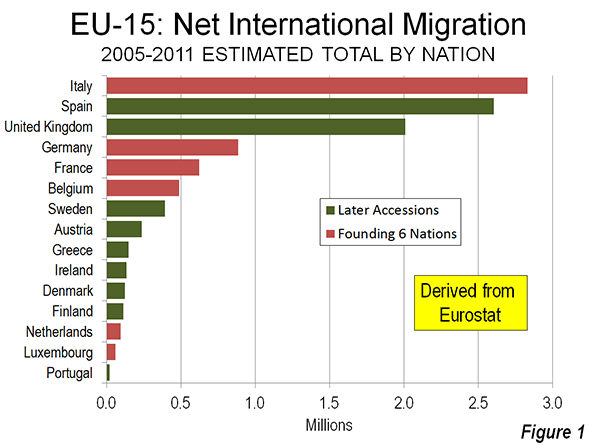
    The changes are stunning. All 15 nations have had net international migration gains since 2005. The leader is Italy, which has added a net 2.8 million international migrants, the equivalent of 4.7 percent of its population. This is more than Italy’s total population gain between 1975 and 2000. Spain has added 2.6 million net international migrants, the equivalent of 5.6 percent of its population. The United Kingdom added 2.0 million international migrants, the equivalent of 3.2 percent of its population.  

    Deep in the Heart of Europe

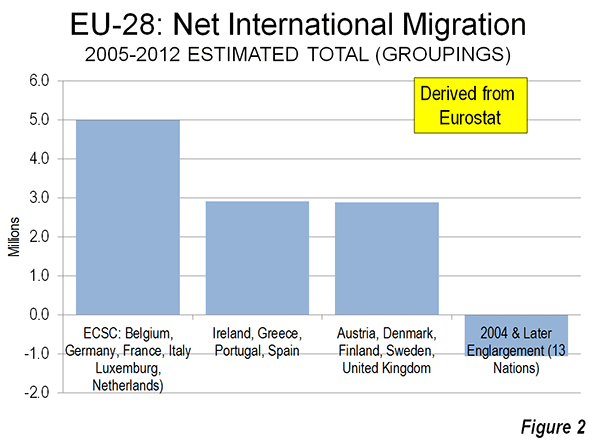
    Perhaps most surprising are that gains the heart of Europe, six nations that established the European Coal and Steel Community in the early 1950s, which was to become today’s European Union (Belgium, France, Germany, Luxembourg, Italy, and the Netherlands) (Figure 1).

    Germany and France had net international migration of 885,000 and 625,000 respectively. In both countries this was equal to one percent of the population. However, Belgium had the largest relative addition of international migrants. Its 490,000 net increase was equal to four percent of its population.

    Overall, the six founding nations of the European Union attracted a net 5.0 million international migrants 2005 to 2012. This is more than the population of all urban areas in the six nations except for Paris, Milan and the Rhine-Ruhr.

    Five additional economies, the United Kingdom, Austria, Sweden, Denmark and Finland added a net 2.8 million international migrants. Even Portugal, Ireland, Greece and Spain, despite their fragile economies, posted substantial gains, adding 2.8 net international migrants (Figure 2).

    The PIIGS Minus Italy

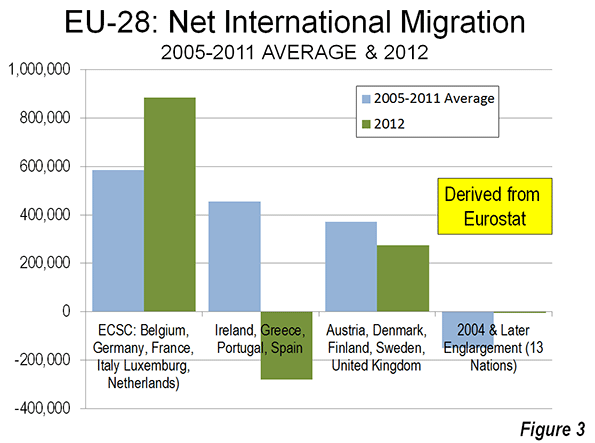
    Five nations have been designated the PIIGS by the international financial community, due to their financial reverses. These include Portugal, Ireland, Italy, Greece and Spain. All, except Italy, have seen their international migration rates fall precipitously. Between 2005 and 2011, these four nations combined added an average of 450,000 net international migrants. By 2012, they lost more than 275,000 net international migrants. In contrast, Italy, one of the EU founders, continued its strong trend, adding approximately 365,000 net international migrants in 2012, up from its 2005 to 2011 average of 350,000.

    The six founding members picked up some of the “PIIGS minus Italy” losses. In 2012, these nations added nearly 885,000 net international migrants, which is well above their 585,000 average for 2005 to 2011. The other five nations (United Kingdom, Austria, Sweden, Denmark and Finland) fell to a 275,000 net international migration gain in 2012, compared to their 2005-2011 average of 370,000.

    The new 13 members did much better than before, losing only 5,000 net international migrants in 2012. Their average from 2005 to 2011 was a 150,000 loss (Figure 3).

    Ireland and Spain

    Spain and Ireland illustrate the connection between declining economies and declining international migration.

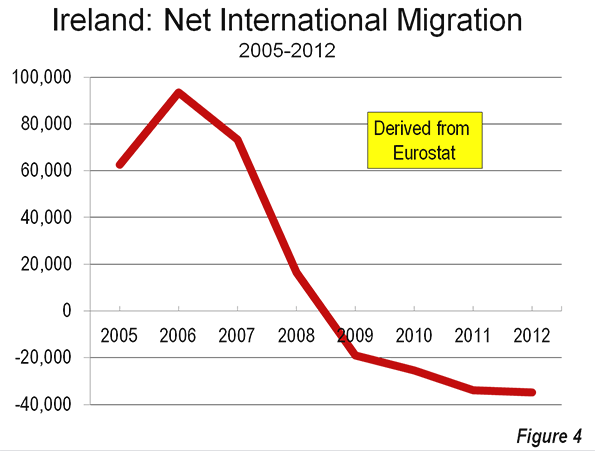
    The Irish Times noted in a recent article that the latest data from the European commission indicates that Ireland now has the worst net international outmigration rate in the European Union. Just six years ago, the Times reports, Ireland’s net international in migration rate was the highest in Europe. Over the past four years (Figure 4), Ireland has lost approximately 35,000 net international migrants annually (Ireland’s housing bubble and the resulting national financial crisis are described in Urban Containment and the Housing Bubble in Ireland).

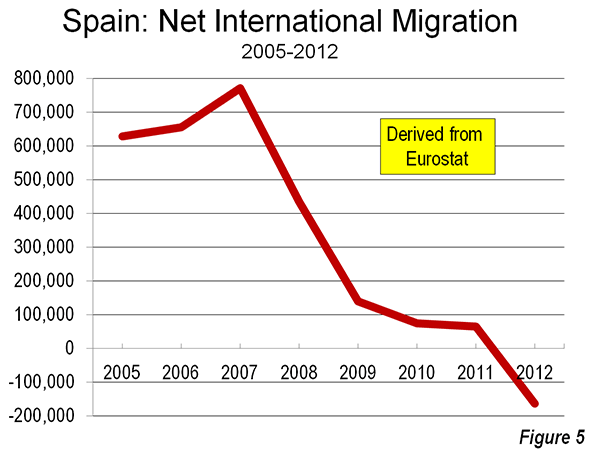
    Spain’s decline in net international migration has been every bit as spectacular. At its peak, Spain was attracting a net international migration approaching 800,000. Last year, Spain lost 165,000 international migrants (Figure 5).

    The 13 New Members

    The net international migration gains in Europe’s heart have not been good news for Eastern Europe, where the newer European Union members are located. Overall, these nations lost approximately 1,050,000 international migrants between 2005 and 2012, though as noted above, the loss was minimal in 2012. This more recent improvement may be the result of weak economic conditions in many western and southern European countries.

    Romania and Lithuania were the biggest losers. Romania lost nearly a net 1,000,000 international migrants, equal to nearly five percent of its population. Lithuania did even more poorly, losing 300,000 international migrants, nearly 10 percent of its population. Both nations lost overall population.

    Migration and Economic Growth

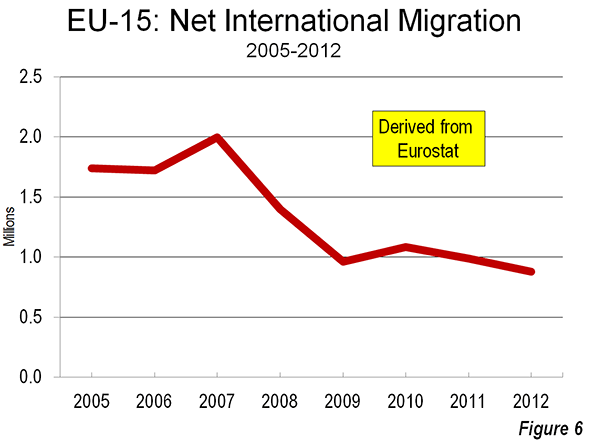
    Despite the resurgence of growth in the heart of Europe, the financial crisis has taken a toll. As in the United States, migration has fallen significantly, as many of the economic opportunities have dried up. By 2012, the net international migration to the EU-15 had been reduced to 900,000 from approximately 2 million in 2007. As throughout history, the demand for international migration is driven principally by the aspirations for a better quality of life. As a result, migration will tend to be greater where there is a wider gulf between the employment and economic opportunities in receiving countries than in countries that lose migrants.

    Wendell Cox is a Visiting Professor, Conservatoire National des Arts et Metiers, Paris and the author of “War on the Dream: How Anti-Sprawl Policy Threatens the Quality of Life.

    Photo: Genoa, Italy (by author)

  • Los Angeles: Will The City Of The Future Make It There?

    When I arrived in Los Angeles almost 40 years ago, there was a palpable sense that here, for better or worse, lay the future of America, and even the world. Los Angeles dominated so many areas — film, international trade, fashion, manufacturing, aerospace — that its ascendency seemed assured. Even in terms of the urban form, L.A.’s car-dominated, multipolar configuration was being imitated almost everywhere; it was becoming, as one writer noted, “the original in the Xerox” machine.

    Yet today the nation’s second-largest city seems to have fallen off the map of ascendant urban areas. Today’s dynamic cities in terms of job and population growth are the “new Los Angeleses,” such as Houston, Dallas, Phoenix or Charlotte; at the same time L.A. lags many more traditional “legacy” cities in job creation and growth, notably New York, Boston and Seattle. Worst of all, L.A. has lost its status as the dominant city on the West Coast; that title, in terms of both economic and political power, has shifted to the tech-heavy Bay Area.

    With a weak economy and little media outside Hollywood, the city has lost much of its cachet. A Businessweek survey last year ranked San Francisco asAmerica’s best city to live in. Los Angeles was 50th, behind such unlikely competitors as Cleveland, Omaha, Tulsa, Indianapolis and Phoenix. In another survey that purported to identify the top 10 cities for millennials, Seattle ranked first, followed by Houston, Minneapolis, Dallas, Washington, Boston and New York. Neither L.A. nor Orange County made the cut.

    L.A.’s relative decline reflects a collective inability to readjust to changing economic conditions. Some of this has to do with the end of the Cold War, but also with the loss of the headquarters of many of the area’s top defense contractors, such as Lockheed and, most recently, Northrop Grumman. In 1990, the county had 130,100 aerospace workers. A decade later, that number dropped by more than half to 52,400. By 2010, the county’s aerospace jobs numbered 39,100.

    With the exception of drone technology, the region’s aerospace industry, as one analyst put it, has become “dormant,” a victim of a talent drain and a difficult business environment. This decline has weakened the metro area’s standing as an industrial center — L.A. has lost almost 20% of its manufacturing jobs since 2007. Meanwhile STEM employment in the Los Angeles-Santa Ana area is still stuck below its 2002 levels; once arguably the world’s largest agglomeration of scientists and engineers, the region has now dipped below the national average in the proportion of STEM jobs in the local economy.

    In contrast to the Bay Area, whose tech community also was largely nurtured by defense contracts and NASA, L.A.’s defense and aerospace industries never pivoted into the vast civilian market. Capital, too, has played a role. The L.A. area has lots of rich people, but a relatively weak venture capital community. For example, the Bay Area was a recipient of roughly 45% of U.S. venture capital investment in the third quarter of 2013, while far more populous Los Angeles-Orange County took in under 6.5%.

    The growth of VC-financed companies is one reason why L.A. has been less able to produce high wage jobs than its northern rival. According to a recent projection by Economic Modeling Specialists Inc., high-wage jobs will account for only 28% of L.A.’s job growth from 2013 through 2017 compared to 45% in the Bay Area.

    Far greater problems can be seen further down the economic food chain. The state’s heavy industry — traditionally the source of higher-paid blue-collar employment — entirely missed the nation’s broad manufacturing resurgence. In the first decade of the 2000s, according to an analysis by the Praxis Strategy Group, L.A. lagged all but 10 of the nation’s 51 large metro areas in creating manufacturing jobs.

    Two other once-unassailable economic niches in L.A., its port and entertainment, also are under assault. The expansion of the Panama Canal has increased the appeal of the Gulf ports, as do plans for expanded port facilities in Baja, California.  These shifts threaten many of the roughly 500,000 generally well-paid blue-collar jobs in the local logistics industry.

    Then there’s the slow but steady erosion of L.A.’s dominance in its signature industry, entertainment. Motion picture employment is down 11,000 since 2001. In the same period New York has notched modest gains alongside growth in New Orleans and Toronto. New announcements of industry expansions and an uptick in production in L.A. show that Tinseltown is far from dead, but challenges continue to mount from overseas and domestic competitors.

    Perhaps most shocking has been the tepid response to this relative decline among L.A.’s business and political leaders. Once local entrepreneurs imagined great things, like massive water and port systems, dominated the race for space and planned out the suburban dreamscapes of Lakewood, Valencia and the Irvine Ranch.

    Arguably the signature achievement of this past decade, and the one getting the most attention in the media, has been the revival of downtown as a residential and cultural hub. Having essentially abandoned the model of a multipolar city, L.A. has poured billions in infrastructure and subsidies into a half-baked attempt to turn Los Angeles into a faux New York. This is something of a fool’s errand since barely 3% of area residents work downtown, and most cultural consumers live far away on the westside or in the San Fernando Valley.

    New Mayor Eric Garcetti is also a density advocate, and is placing huge bets on the massive building of high-end high-rise housing, all this despite weak job and population growth. In his campaign he emerged as the candidate of developers who want to densify the city, including Hollywood, over sometimes fierce grassroots opposition.

    Compared to his inept and economically clueless predecessor, Antonio Villaraigosa, Garcetti represents something of an upgrade. He at least knows jobs matter at least as much as development deals for contributors. Yet he remains pretty much a creature of the failed leadership culture of L.A., which is dominated by public employee unions, subsidy-seeking developers and greens, largely from the city’s affluent westside.

    Can L.A. turn itself around? The essential ingredients that drove the city’s ascendency remain: its location on the Pacific, its near-perfect climate and spectacular topography. The key now is for the region to build an economic strategy that allows it to use its assets, and build around its increasingly immigrant-dominated grassroots economy. Innovation in music, fashion and food continue at the grassroots level, with much of the inspiration coming from the city’s increasingly racially diverse mestizo culture.

    What L.A. needs now is not a slick media campaign, but a concerted effort to tap this neighborhood-centered energy. The city of the future needs to reinvent itself quickly, before it fades further behind its competitors on the coasts and in Texas. Successful cities such as  Boston, San Francisco, Seattle  and Houston all managed to find ways to nurture new industries to supplement their traditional ones. Los Angeles should be able to do the same, but only if it seizes on its fundamental assets can it again become a city with a future.

    This story originally appeared at Forbes.com.

    Joel Kotkin is executive editor of NewGeography.com and Distinguished Presidential Fellow in Urban Futures at Chapman University, and a member of the editorial board of the Orange County Register. He is author of The City: A Global History and The Next Hundred Million: America in 2050. His most recent study, The Rise of Postfamilialism, has been widely discussed and distributed internationally. He lives in Los Angeles, CA.

  • From Balkanized Cleveland to Global Cleveland: A Theory of Change for Legacy Cities

    Legacy cities have legacy costs, including disinvestment from the inner city, as well as regional economic decline. The spiral has been ongoing for decades. The new white paper by consultants Richey Piiparinen and Jim Russell entitled “From Balkanized Cleveland to Global Cleveland”, funded by the Cleveland-based neighborhood non-profit Ohio City Inc., examines the systemic reasons behind legacy city decline, all the while charting a path to possible solutions.

    Shrinking city theorists say the problem with the legacy city is that people leave. But urban powerhouses such as New York lose more people in a day than the Clevelands of the world do in a month. The real problem with legacy cities is an absence of newcomers, as it is this lack of “demographic dynamism”, or “churn,” which has inhibited economic evolution.

    To arrest economic decline, cities commonly undertake a patchwork of strategies. These include retention strategies that supposedly “plug” the brain drain; attraction strategies that emphasize placemaking, residential density, and urban amenities; or “big ticket” developments such as convention centers and casinos. The authors take another stance, theorizing that migration is the key to economic development. Cities that lack churn need churn. Without it, legacy cities can act as echo chambers of patronage and provincial thinking.

    But churn in itself is not enough. Often, the importance of inmigrants equates to filling condos or restaurant booths. Take the case of Ohio City, an inner city neighborhood bordering Cleveland’s central business district. The neighborhood, home to the iconic West Side Market, has made strides in its recovery. Investment is coming in. Condos are being built. Restaurants are opening. But this is not enough.

    In fact the mistake cities make when it comes to reinvestment is to settle with the low-hanging fruit of gentrification. Here, the neighborhood is seen as a center of consumption, with trickle-down effects from increased commerce said to reach low-income residents living in gentrifying, or potentially gentrifying, neighborhoods. This does not happen.

    This does not mean the reinvestment going on in neighborhoods such as Ohio City is unwelcome. It is only to say something else is needed. Ohio City needs to be made into a neighborhood that produces, not simply one that consumes.

    One way to do this is to ensure that the diversity of race, class, and businesses that currently exist in the neighborhood continue in the face of increasing market demand. For instance, Ohio City is 36% Black, 20% Hispanic, and 54% White. The neighborhood’s race and class mixing has increased over the last decade. Ensuring such heterogeneity can remain in the face of market demand is the challenge of the day. To date, no city has systematically ensured a process of policies that prioritizes the long-term benefits of integrated communities over the short-term benefits of consumer-driven gentrification.

    The benefits include increased economic mobility for individuals who grow up in integrated neighborhoods. For instance, a new study called “The Equality of Opportunity Project” found that Cleveland ranked 45th out of 50 metro areas in terms of upward mobility. A child in Cleveland raised in the bottom fifth of an income class only has a five percent chance of rising to the top fifth in her lifetime. The study, however, concludes that “upward mobility tended to be higher in metropolitan areas where poor families were more dispersed among mixed-income neighborhoods”.

    Cleveland is at a threshold. The re-investment is coming, and the importance of this infill as a means to arrest its economic and demographic decline cannot be overstated. Yet this will only occur if re-investment is leveraged so as to develop real economic growth. In other words, simply developing “creative class” enclaves in the likes of Ohio City and Tremont will do nothing to transition Cleveland from a segregated, siloed city with high rates of poverty into a globalized, integrated city comprised of neighborhoods that produce human capacity.

    Where people live informs them no less than where they work or go to school. Neighborhoods are factories of human capital. Equitable, integrated environments maximize potential. America needs to go past the gentrification model of revitalization. The cities that still have a fighting chance, like Cleveland, should lead.

    Read the white paper here.

  • Court Rules Against California High Speed Rail

    California Superior Court Judge Michael Kenny ruled against the California High Speed Rail Authority in two decisions announced on November 25. In the first, Judge Kenny ruled that the Business Plan failed to meet the requirements of the voter approved referendum under California Assembly Bill 3034 (2008), in not identifying sufficient capital funding for the first segment. As a result, the Business Plan needs to be redrafted. In the second decision, Judge Kenny declined to issue a conformity ruling that would have paved the way for $8 billion in bonds that had been approved by voters, which were also subject to same Assembly Bill 3034.

    Judge Kenny declined to stop construction of the project, which is scheduled to start in the Spring. However, the Authority only has federal funds for that segment, and which would require, in the longer run, matching state funds (which were to have been from the bonds).

    According to the San Francisco Chronicle , Kenny’s found that the California High Speed Rail Authority "abused its discretion by approving a funding plan that did not comply with the requirements of law."

  • Is Economic Development Dead?

    When Bill De Blasio won New York’s mayoral election a few weeks ago, it came as no surprise to anyone. His impassioned analogies to New York’s “Tale of Two Cities” and his call for a city that provided not just for the wealthiest one or two percent, but for all, appealed to the growing sense that New York is an increasingly unfair and unequal place.

    The angst felt by New Yorkers is not contained only to that city. In Chicago, real estate companies have poured investment into the Loop and a handful of adjacent residential and mixed-use neighborhoods. Yet, whole swaths of the city’s south and southwest side have remained in a state that would rival war-zones and have earned the city a reputation as America’s murder and gang capital du jour. San Francisco’s recent transit strikes, and the ensuing scandal that followed a Silicon Valley tycoon’s less than empathetic statements on Facebook have highlighted that city’s class tensions.

    Saskia Sassen pointed out in her 1991 book The Global City that globalization and modern technologies should push wealth and geopolitical power to a small number of globally connected and powerful metropolises. And in many ways, this thesis has born itself out as financial centers in New York and, to a lesser extent, Chicago and Boston as well as technology in San Francisco and “Eds and Meds” in Philadelphia, Pittsburgh and Boston have all “revitalized” these legacy cities that only thirty years ago would have been widely assumed to be dead. Meanwhile, smaller, less connected legacy cities have shrunk in global importance.

    Left out of many people’s analysis of Sassen’s writings – an analysis that equates geopolitical power with urban success – is the simple fact that a geopolitically powerful city does not always mean a city of evenly distributed wealth or equality. The urban poor in New York, Chicago, or Philadelphia are not necessarily better off than those in Buffalo, St. Louis, or Detroit. In some ways, the low cost of living in “unsuccessful” legacy cities means that quality of life is in many cases better than in those cities widely regarded as a success.

    Given our assumptions about urban success – that it should involve a thriving private sector, a critical mass of wealthy taxpayers, and a sustainable level of investment (as an aside, I know few people who would describe investment in New York as “sustainable” at this point) – it should come as no surprise that the method most commonly employed to realize these goals, economic development, would fail so spectacularly to deliver positive changes in the lives of the urban poor.

    While a thriving private sector, a critical mass of wealthy taxpayers, and a sustainable level of investment certainly register among the necessary descriptions of a successful city, urban economic development too often equates better cities with attracting better people at the cost of dealing with the populations already residing within a city. While the last few decades have seen the resurgence of once decrepit metropolises through TIFs and BIDs and tax breaks aimed at capturing employers of what Richard Florida would describe as “the creative class” – engineers, lawyers, artists, and bankers – De Blasio’s win, along with political movements like Occupy Wall Street augur a shift in focus from the technocratic priorities of Giuliani or Daley to a De Blasio-style redistributive view of urban justice.

    So far I have ignored a bit of nuance between Bloomberg’s market-oriented (some might say neoliberal) focus on growth in “creative class” (high skill and high pay) sectors, and his classically progressive restraints in other initiatives (smoking, trans fat) and the degree to which other mayors have followed New York’s lead in this type of leadership. While I tend to hope that a market-oriented solution to urban problems can be found, the vehicle for urban revitalization seems almost irrelevant when we consider the degree to which it has benefitted the urban wealthy at the exclusion, and occasionally cost, of the urban poor.

    Obviously, inequities in quality of life have been most pronounced in New York where wealth is profligate and new construction has been tightly regulated, pushing cost of living ever upward. Yet, the De Blasio election means less for New York’s poor than it does for the country as a whole. Whether the Rahm Emanuels and Michael Nutters of America’s cities are replaced by De Blasio democrats in the next election will mean a lot for the priorities of development in our cities.

    It’s easy to dismiss the De Blasio win as an event isolated to the confines of New York as the logical end to both Bloomberg’s overreaching policies and “quality of life” initiatives which arguably placed a premium on attracting and retaining the wealthy. But, we should not ignore the very real possibility that De Blasio’s win, and the disdain growing for economic development-focused politicians, may lead to a spiral of urban disinvestment wherein wealthier taxpayers leave cities, making cities ever less attractive places to live, thereby further escalating the effects repelling the middle and upper classes from urban cores. The reason we should not ignore this possibility, though it may seem inflammatory at first consideration, is simple: we are still recovering from its effects throughout the last half of the previous century.

    Yet, De Blasio is probably not as leftist as right-leaning pundits have bombastically proclaimed in the wake of his election. Hopefully, De Blasio and the growing urban left can pull off a type of development that prioritizes development for all, not just for the wealthiest residents, without falling into the traps of the union-entrenched Democrat machines that oversaw the urban perdition of the last half century. The death of urban economic development may well be upon us, but hopefully if it is, something that provides for the development of the whole city will emerge.

    Sam Hersh is currently a student of urban studies at Haverford College in Pennsylvania hoping to use the worlds’ cities to more effectively catalyze human opportunity when he graduates. He can be reached at shershey1@gmail.com.

    Photo courtesy of Bill de Blasio.

  • Progressive Policies Burden the Yeoman Class

    Obamacare’s first set of victims was predictable: the self-employed and owners of small businesses. Since the bungled launch of the health insurance enrollment system, hundreds of thousands of self-insured people have either had their policies revoked or may find themselves in that situation in the coming months. More than 10 million self-insured people, many of them self-employed, could meet a similar fate.

    Unlike large companies or labor unions, which have sought to delay or duck implementing the Affordable Care Act, what could be called the yeoman class lacks the political might to make much of a dent in Washington policies. Indeed, in the Obama era, with its emphasis on top-down solutions and Chicago-style brokering, Americans who work for themselves probably are more marginalized today than at any time in recent memory.

    Virtually every major initiative of this administration – from taxation and regulation to monetary policy and Obamacare – has been promulgated with little concern for the self-employed. Many feel themselves subject to an apparent attempt to transfer middle class incomes to the poor just as ever more wealth concentrates in the “1 percent.” Not surprisingly, 60 percent of business owners surveyed by Gallup expressed opposition to the administration.

    The divide between the yeoman and the political community marks a major departure from the norms of American history. After all, people came to America in large part to secure “a piece of the pie,” whether through owning a small business or a farm, goals often unattainable in Europe. Thomas Jefferson, notes historian Kenneth Jackson, “dreamed of the U.S. as a nation of small yeoman farmers who would own their own land and cultivate it.”

    The rural yeoman ascendency lasted well into the late 19th century, when the populist movement fell to triumphant industrial capitalism. Yet the drive to disperse property did not end there, but resurfaced in the expansion of urban homeownership, something strongly supported by the New Deal administration. “A nation of homeowners,” President Franklin Roosevelt believed, “of people who own a real share in their land, is unconquerable.” From 1940-60, nonfarm homeownership rose from 43 percent of Americans to more than 58 percent.

    Early on, some progressives, particularly among intellectuals, recoiled against the rise of a class of petty landowners. Some of them, historian Christopher Lasch observed, saw “a republic of producers” as necessarily “narrow, provincial and reactionary.” This view is echoed today by Democrats such as former Clinton administration adviser Bill Galston, who dismisses small business as “a building block of the Republican base.” Democrats, he suggests, should instead seek a reconciliation with Big Business and its powerful cadre of lobbyists.

    An expanding cohort

    Yet, Democrats someday may rue tossing off the yeoman class. Unlike such groups as white racists, defense hawks and social conservatives, all of whose ranks are thinning, the numbers of the self-employed are growing. Independent contractors, according to Jeffrey Eisenach, an economist at George Mason University, have increased by 1 million since 2005; one in five works in such fields as management, business services or finance, where the percentage of people working for themselves rose from 28 percent to 40 percent from 2005-10. Many others work in fields like energy, mining, real estate or construction. Altogether, there are as many as 10 million such independent workers, constituting upward of 7.6 percent of the U.S. labor force and earning more than $626 billion.

    This shift to self-employment is occurring even in heavily regulated states like California. Since 2001, the number of self-employed people in the Golden State grew by 15.6 percent, versus a gain of 9.4 percent for the nation. In terms of states’ share of self-employed in the workplace, California ranks in the top five; three of the others, Vermont, Maine and Oregon also are blue states.

    Why is this the case? Ironically, this may be a reaction to expansive regulatory regimes that tend to both reduce corporate employment and also encourage some individuals “to take their talents” solo into the marketplace without having to deal with, for example, labor laws and environmental regulations.

    At the same time, technology allows people to work in an increasingly dispersed manor. The number of telecommuters has soared by 1.7 million workers over the past decade, a 31 percent increase in market share, and now accounts for 4.3 percent of all employment.

    Obamacare is only one aspect of government’s assault on the yeoman class. Attempts to regulate housing and encourage denser, usually rental, units ultimately works against the interests of home-based small businesses by raising house prices. The extra bedroom that becomes the home office now can be seen as “wasteful” even if – in terms of generating greenhouse gases – working at home is far more efficient than commuting, even by mass transit.

    Alienating allies

    Over time, these conflicts could threaten the interests of some groups that now reside firmly in the Obama majority coalition. This reflects the changing demographics of small enterprise; the yeomanry is slowly becoming far more diverse. From 1982-2007, for example, African American-owned businesses increased by 523 percent; Asian American-owned businesses grew by 545 percent; Hispanic American-owned businesses by 696 percent; businesses owned by whites increased by 81 percent. Today, minority-owned firms make up 21 percent of the nation’s 27 million small businesses.

    Immigrants, a largely Democratic-leaning constituency, constitute a growing part of the entrepreneurial landscape. The immigrant share of all new businesses, notes the Kauffman Foundation, grew from 13.4 percent in 1996 to 29.5 percent in 2010. They also constitute roughly a quarter of founders of high-tech start ups, and have done so for most of the past generation.

    Women, another Obama-leaning group, have also expanded their footprint; over the past 15 years, the number of women-owned firms has grown by one and a half times the rate of other small enterprises. These companies account for almost 30 percent of all enterprises; from 1997-2012, the number of women-owned U.S. firms increased by 54 percent, versus an overall growth rate for all firms of 37 percent.

    Eventually, the potential yeoman backlash may also spill over to millennials, another key Obama constituency. As a generation, their desire for homeownership and economic self-reliance runs headlong into both the tepid economic recovery and regulatory policies. Over time, as they age, their interests could diverge from the expanding welfare state, whose primary mission appears to be to transfer wealth not only from the middle class to the poor but from younger to older Americans.

    As millennials age, many will seek to buy homes, start businesses and families. In contrast to their common, often-naïve embrace of the idea of bigger government, developed in their student years, experiences as potential homeowners and parents, as well as business owners, might make them skeptical of “top down” solutions imposed by largely baby boomer ideologues.

    Reply from the Right?

    Yet, this will be no cakewalk for conservatives. It is not enough to simply dismiss Obamacare, or other regulations, without endorsing some of the measures’ positive attributes, such as assuring one’s children or protecting the rights of those with “pre-existing conditions.” The yeomanry may want less-Draconian legislation, but they may not be so anxious to leave their health care utterly exposed to unfettered market forces.

    Democrats, in fact, could make a run at this constituency, particularly if the Republicans continue a political approach that alienates, in particular, a more diverse yeomanry – gays, many women and ethnic minorities, immigrants and creative professionals. Here, in fact, it might be better to be more radical than less, proposing something more like a Canadian “single payer” health system that would separate employment status from health care. Democrats also could also support some form of minimum coverage designed for the growing numbers of Americans who work for themselves.

    Ultimately, over time, the yeoman constituency, although poorly organized and without a programmatic agenda, is one that needs to be addressed, if for no other reason than they constitute a growing portion of the workforce. The party, or movement, that successfully does this will have a great opportunity to seize the political future.

    This story originally appeared at The Orange County Register.

    Joel Kotkin is executive editor of NewGeography.com and Distinguished Presidential Fellow in Urban Futures at Chapman University, and a member of the editorial board of the Orange County Register. He is author of The City: A Global History and The Next Hundred Million: America in 2050. His most recent study, The Rise of Postfamilialism, has been widely discussed and distributed internationally. He lives in Los Angeles, CA.

    Official White House Photo