Blog

  • Biking New York City: The Handlebar Tour

    In case it has been a while since you have ridden a bicycle around Manhattan, the Bronx, Brooklyn or Queens — as I have in recent weeks — here is a shortlist of some developments around New York City: midtown sidewalks are overflowing with tourists and too narrow for the pedestrian flow (especially around the many Elmos posing in Times Square); the South Bronx, while still very poor, has an emerging middle class; cruise ships dock in Red Hook, Brooklyn, on the same piers that were once the provenance of gangland; potholes and deteriorating asphalt are everywhere, despite Mayor Michael Bloomberg’s reputation for elevating the city’s infrastructure; and Queens is still struggling with all the Robert Moses expressways and bridges that make traffic patterns there a maze of dead ends, even on a bike.

    Here are some observations from my handlebar social survey:

    Uptown: The nicest neighborhood I discovered is what realtors now call South Harlem, from about 145th Street south to Central Park. The crime rates are down, the bistros are up, and the wide sidewalks and relatively quiet streets make for lovely strolling or, in my case, bike riding.

    Because the scale of the neighborhood is often limited to four-story brownstones (East Harlem has more projects, but also a Target and a PetSmart), gentrification has spread like a wildfire. A mansion on Strivers Row, the once and future dream of Harlem homeowners, costs about $1.8 million. One-bedroom apartments on West 116th Street and Lennox go for about $350,000.

    On the Waterfront: It’s sixty years since unionism, pilferage, and mob violence killed off New York’s ports, eventually sending cargo ships and containers to Baltimore, Norfolk, Newark, and Boston. The city has now reclaimed its rotting piers and empty warehouses with waterside parks, ferry stops, exhibition centers, and cruise terminals, including the one in Brooklyn that’s large enough to tie up the Queen Mary.

    Especially on the West Side of Manhattan — with fewer mobsters gasping at the ice picks in their backs — the piers are part of an expanding and vibrant dockland scene, complete with picnic tables, skateboard jumps, arboretums, and restaurants, all of which have splendid views of the Hudson River.

    Gridlock: One of the downsides of New York’s continuing prosperity is that it risks becoming a gridlocked city of Asian proportions. One Sunday I biked the length of Fifth Avenue, stunned at the number of cars clogging the streets and the bad quality of the pavement.

    Coming into Manhattan across the East River bridges is free, and New Yorkers love their cars with a demolition-derby passion. I even saw motorcyclists popping wheelies down Fifth Avenue, to the indifference of the police, who clearly weren’t in the mood to confront biker rebels without much of a cause.

    The Freedom Tower: The new One World Trade Center looks like the cookie-cutter office buildings in Shanghai and Hong Kong, or perhaps an enormous shower stall. It is long on defiance but short on urban grace.

    The city would have done more for downtown if it had returned the blocks and cross streets lost to the footprint of the first World Trade Center development, improved the rail network, and allowed the Battery Park and Wall Street areas to flow together into a vibrant neighborhood.

    The Freedom Tower is more a symbol than a practical city project. Four billion dollars (with myriad subsidies loaded into the budget) will be spent essentially for a large, mostly public, office building at a time when everyone prefers to work from home.

    The Mayoral Race: In the November election to replace Michael Bloomberg, the Democrat Bill de Blasio (public activism) defeated the Republican Joe Lhota (Harvard MBA). Neither had a large political base before the primaries, although both have been active in city politics for the last generation.

    Lhota was a disciple of former mayor Rudi Giuliani and ran the Metropolitan Transportation Authority for Bloomberg, but despite managerial competence had no chance of winning. New Yorkers want it all: neither higher crime or taxes, nor stop-and-frisk and budget cuts (“fuhgeddaboudit”).

    Critics of de Blasio say his feel-good liberalism will set New York’s clock back to 1977, when television announcer Howard Cosell told America from Yankee Stadium: “Ladies and gentlemen, the Bronx is burning,” which is also the title of a book on the low water mark of New York’s urban decline. His supporters say he will bring a degree of social justice to what is otherwise a capital intensive city.

    The Bronx: Also in 1977, President Jimmy Carter went to the smoldering South Bronx, to publicize the extent of New York’s decay. Ronald Reagan went during the 1980 campaign, to highlight that Carter had not done anything to haul away the rubble and fill in the vacant lots.

    By the time Bill Clinton got there in 1997, the heavy slum lifting had been done (thanks to New York city and state officials), and all he could do was bask in the success. Despite or because of the presidential grandstanding, Charlotte Street, which became the South Bronx’s signature photo op, is now a suburban enclave, with 89 single-family houses and graceful fenced lawns.

    More than anything else, however, what brought back the Bronx was a wave of immigrants in the final decades of the 20th century. They came to wealthy New York looking for jobs, and needed affordable neighborhoods where they could raise their families.

    Queens for a Day: I rode from Randall’s Island, a splendid oasis in the East River, through Astoria and Flushing to College Point and Whitestone. Even with some new bike paths, Queens suffers from too many highways cutting across its underbelly. I got lost near Citi Field and rode 500 yards on the Van Wyck Expressway.

    My destination was the old army base at Fort Totten, once the Gibraltar of Long Island Sound (built to keep Confederates out of New York harbor), now a forlorn park and reserve training center, although with stunning views of the water and the New York skyline.

    The future of Fort Totten could be another bellwether of New York City. Should its dilapidated historic houses — from the genteel, 1930s U.S. Army base — be renovated and sold off, part of a mixed-use plan to get more families into the lovely park and historic base? The same decisions need to be made about Governors Island and parts of Ellis Island. Or should all private development in historic areas be banned, even if the parks remain shabby without enough public money for renovation?

    Because I grew up in and around the New York City that for much of my life was deteriorating, I view most recent development around New York (except for the ugly destruction of Pennsylvania Station) as positive. To me, Fort Totten should be both a park and a place for families to live. Why leave a waterfront partly in ruins?

    Will it happen when Bill de Blasio is mayor? Somehow I doubt it. I wouldn’t think a mayor could win reelection with privatization projects in a faraway Queens park — although I never thought that the Bronx would again be thriving, South Harlem or Red Hook would be safe, or the West Side piers would become part of a stunning city revival. All of this has been accomplished with a blend of private and public money.

    Conclusions? As Woody Allen said, “There is no question that there is an unseen world. The problem is, how far is it from midtown and how late is it open?”

    Matthew Stevenson, a contributing editor of Harper’s Magazine, is the author of Remembering the Twentieth Century Limited, a collection of historical travel essays. His new book, Whistle-Stopping America, was recently published.

    Flickr photo by Charles16e: East River Bicycle with Fishing Rod Attachment
  • Fighting the Vacant Property Plague

    The term ‘walking away from the property’ usually refers to owners who leave a home when they can’t make the mortgage payments. In Youngstown, Ohio, it may gain a new meaning: to describe banks that abandon a vacant property in foreclosure, and leave neighbors to cope with the blight. Now banks that walk away from their properties are being reigned in by a local community organization. This year, thanks to the efforts of the Mahoning Valley Organizing Collaborative (MVOC), Youngstown, Ohio became the first city in the nation to require banks to pay a $10,000 cash bond to the city when a house is both vacant and foreclosed.

    As a result of the code’s passage in January, the city now has a bond fund of over $870,000. Youngstown can use the funds for upkeep of the vacant properties.

    MVOC organizer Gary Davenport has said of the code, “It’s preventative and not punitive…the goal is to make banks recognize that it’s their responsibility to maintain vacant properties in foreclosure.” More strongly, Claudia Sturtz, a member of the Rocky Ridge Neighborhood Association commented, “I spent over 20 hours a month fighting an imminent foreclosure that boiled down to Chase being irresponsible, losing paperwork, and being inflexible. Big banks abuse foreclosure and destroy lives and communities. We need accountability and education for foreclosure.”

    The innovative move by a shrinking city to help keep neighborhoods livable may end up serving as a model for industrial cities across the nation that are faced with smaller populations and high foreclosure and vacancy rates. In Ohio, nearby Warren is now following a similar path.

    Because of the increased number of abandoned properties across the country, many cities are now seeing widespread demolitions. One result has been a vacant property movement by community organizations to build political pressure and stabilize neighborhoods, especially in shrinking cities.

    In the deindustrialized Youngstown-Warren area, vacant and foreclosed housing is now an MVOC priority. For MVOC Executive Director Heather McMahon, this was a no-brainer. “It’s almost anti-American to say our city is shrinking. But with 62,000 residents living in a city built for 250,000, a declining tax base, and approximately 5,000 blighted vacant structures in need of demolition, we were in desperate need of serious, proactive remediation that addresses vacancy before it begins. If Youngstown is going to survive as a city and not go bankrupt like Detroit, we’re going to have to figure something out.”

    The MVOC developed a “listening campaign,” and started walking the neighborhoods to identify vacant properties. MVOC also began working with the Youngstown State University Center for Urban and Regional Studies to develop surveys and analyze and map results. The new data and new public involvement made visible how bad the situation had become. Since 2004, 5,186 properties have been foreclosed on in Youngstown.

    The community group also pressured Youngstown to hire a city official to oversee the largely independent and dysfunctional municipal departments concerned with vacant properties. It pushed the city to set up plans, timelines, and commitments for implementation of new legislation through a series of “public engagements” with a new mayor.

    To assure city accountability, it created a “Demolition Team” composed of local residents that demanded demolition contractors post start and stop dates at job sites. The transparency helped residents to understand demolition workflow and code enforcement more clearly. Because of these efforts, thousands of rental and vacant properties have been inspected and registered, a property maintenance appeals board has been created, and the city prosecutor has held appeal hearings.

    On a state level, vacant property campaigns have pressured the Ohio Attorney General Michael DeWine to develop Moving Ohio Forward, which established a demolition grant program to remove blighted residential structures. DeWine became the only Attorney General in the country to set aside funding ($75 million) from the banks’ robo-signing settlement for needed demolition in disinvested communities.

    Most recently, the MVOC is now trying to introduce statewide legislation that would protect neighbors who seek access to vacant properties without fear of trespass. It is also working with local legislators to introduce a new statewide homeowner’s Bill of Rights. Although neither of these initiatives will easily pass in the Republican-dominated Ohio legislature, they may end up providing a model for communities elsewhere.

    As Joseph Schilling, Director of the Metropolitan Institute and founder of the Vacant Properties Research Network at Virginia Tech says, “Recent case study research by the VPRN shows that community based organizations, such as MVOC in Youngstown, NPI in Cleveland or PACDC in Philadelphia, are often the major catalysts in making vacant property reclamation a top policy priority for local communities.”

    John Russo is a visiting research fellow at the Metropolitan Institute of Virginia Tech, a former co-director of the Center for Working-Class Studies, and professor (emeritus) in the Williamson College of Business Administration at Youngstown State University. He is a board member of the Mahoning Valley Organizing Collaborative (MVOC) (Youngstown-Warren), and the co-author, with Sherry Linkon, of Steeltown U.S.A.: Work and Memory in Youngstown.

    Flickr photo by Jinjian Liang of a vacant house near Columbus, Ohio.

  • The Surprising Cities Creating The Most Tech Jobs

    With the social media frenzy at a fever pitch, people may be excused for thinking that Silicon Valley is still the main engine for growth in the technology sector. But a close look at employment data over time shows that tech jobs are dispersing beyond the Valley and its much-celebrated urban annex of San Francisco.

    We turned to Mark Schill, research director at Praxis Strategy Group, to analyze job creation trends in the nation’s 52 largest metropolitan areas from 2001 to 2013, a period that extends from the bust of the last tech expansion to the flowering of the current one. He looked at employment in the industries we normally associate with technology, such as software, engineering and computer programming services. He also analyzed the numbers of workers in other industries who are classified as being in STEM occupations (science, technology, engineering and mathematics-related jobs). This captures the many tech workers who are employed in businesses that at first glance may not seem to have anything to do with technology at all. For instance just 8% of the nation’s 620,000 software application developers work at software firms — the vast majority are employed in industries as disparate as manufacturing, finance, and business services.

    The four metro areas that have generated tech jobs at the fastest pace over the past 12 years are far outside the Bay Area, in the southern half of the country, in places with lower costs of living and generally friendly business climates. In first place: Austin-Round Rock-San Marcos, Texas, where tech companies have expanded employment by 41% since 2001 and the number of STEM workers has risen by 17% over the same period. Looking at the near-term, 2010-13, the Austin metro area also ranks first in the nation.

    The keys to Austin’s success lies largely in its affordability and high quality of life, both in its small urban core and rapidly expanding suburbs. Best known as the hometown of Dell, a host of West Coast tech titans have set up shop there in recent years, including AMD, Cisco, Hewlett-Packard, Intel and Oracle.

    Much the same can be said about Austin’s East Coast doppelganger, Raleigh-Cary, N.C., which ranks second on our list. Like Austin, Raleigh-Cary is a big college metro area, and also hosts the state capital, something that tends to lessen wild swings during industry downturns. Like Austin, Raleigh is not a primary center of the social media boom, but it has registered a 54.7% increase in tech sector employment since 2001 and an impressive 24.6% rise in STEM jobs. Much of the growth comes from global companies such as IBM,GSK, Syngenta, RTI International, Credit Suisse, and Cisco.

    The next two spots go to two surprising metro areas with a less than stellar degree of tech cred: Houston-Sugarland-Baytown, Texas, and Nashville-Franklin-Murfreesboro, Tenn. Not much of a role for social media here, but STEM employment has expanded 24% in Houston since 2001 thanks to boom times for the increasingly technology-intensive energy industry. The Houston metro area ranks second only to Silicon Valley in the proportion of engineers in its workforce.

    In Nashville, tech employment is up 65.8%, largely due to the area’s rise as a hospital management and healthcare IT hub, with a 160% spike in jobs in computer systems design services.

    The Strange Case of Silicon Valley

    How about the Bay Area, the legendary center of the tech industry? There has certainly been considerable growth in the San Francisco-Oakland-Fremont MSA, which has logged a 28% expansion of tech company jobs. The region is unique as a beneficiary of the social media boom: Twitter and other tech darlings are concentrated in the area, with many others in adjacent San Mateo County. Tech employment in San Francisco  plunged by nearly half between 2000 and 2004, but now appears back to the levels experienced in the first dot-com boom.

    In contrast, San Jose-Sunnyvale-Santa Clara — home to roughly 40% of the nation’s venture capital— clocks in at a mediocre 25th on our list. How could this be, giving the presence of such iconic companies as Google, Intel, Facebook and Apple? After all, the area has gained 20,000 jobs in Internet publishing and web search since 2001. However that pales next to the decline in high-tech manufacturing, where the area has lost an estimated 80,000 jobs. This may be one key reason why STEM employment has dropped 12% in the San Jose area over the past 12 years despite the success of so many tech firms over that period. In San Francisco, STEM employment is up, but only a tepid 5.5%.

    This disappointing trend also extends to some other historically strong tech areas, most of which have grown recently but are still struggling with losses over a decade ago. This includes Boston-Cambridge-Quincy (26th) and San Diego-Carlsbad-San Marcos (28th), both of which were early tech high-fliers. Boston-area tech companies have expanded employment by 16% since 2001, but the number of STEM jobs is down 1.6%. The San Diego area registered strong growth in tech and STEM employment in the first years of the millennium, but since 2010 gains have been few. Being first may earn a region kudos, but does not seem to guarantee continued rapid growth.

    But not all of the early high-fliers are underperforming. The Seattle-Tacoma-Bellevue area has remained a consistent tech performer, ranking 7th on our list with 45.5% growth in tech company employment and a 19.5% jump in STEM jobs. One reason for this may lie in the diversity of companies in the region, from software giant Microsoft to dominate etailer Amazon as well as Boeing, a long-time massive employer of technical workers. Seattle’s success, like that of Houston and Nashville, has much to do with both manufacturing and trade as well as an associated rising demand for software services; it is often forgotten that a majority of the country’s scientists and engineers work for manufacturers, and that industrial companies account for 68% of business R&D spending, which in turn accounts for about 70% of total R&D spending.

    Is Tech Moving Downtown?

    Perhaps nothing has captured the imagination of the media and professional urban boosters as much as the notion that tech jobs are moving from the suburbs to the inner core. Although there is some evidence of growth in social media jobs in some central business districts, notably San Francisco, most large urban centers have not done particularly well in technology over the past decade.

    In some ways, this reflects the extreme volatility of Internet-based software and marketing firms, which, unlike tech hardware or customer support services, have shown a notable tendency to concentrate in urban cores. In some places, notably New York, these sectors have grown at the expense of traditional media and advertising employment, which have fallen off dramatically in recent years. None of the three largest metro areas in the country — New York, Los Angeles and Chicago — made it into the top half of our rankings. New York, where any two nerds in a room can expect gushing media attention, clocks in at 36th. Some locals claim the city is now second to the Silicon Valley in tech, but that is widely off the mark. Since 2001, Gotham’s tech industry growth has been a paltry 6% while the number of STEM related jobs has fallen 4%.

    The chances of Gotham becoming a major tech center are handicapped not only by high costs and taxes, but a distinct lack of engineering talent. On a per capita basis, the New York area ranks 78th out of the nation’s 85 largest metro areas, with a miniscule 6.1 engineers per 1,000 workers, one seventh the concentration in the Valley.

    This means that tech growth is likely to be limited largely to areas like new media, which will be hard-pressed to replace jobs lost in more traditional information industries. Since 2001 newspaper publishing has lost almost 200,000 jobs nationwide, or 45% of its total, while employment at periodicals has dropped 51,000,or 30%, and book publishing, an industry overwhelmingly concentrated in New York, has lost 17,000 jobs, or 20% of its total.

    The prospects for Los Angeles-Long Beach-Santa Ana (38th) and Chicago-Joliet-Naperville (42nd) seem no better. Due in large part to the continuing shrinkage of its aerospace sector, the number of STEM jobs in the L.A. area is down 6.3% since 2001though tech industry employment has grown a modest 12%. For its part, Chicago has experience significant decline in both tech employment and STEM jobs over the past 12 years.

    On the positive side of the ledger, L.A. at least still boasts the largest number of engineers in the country. Chicago, in comparison, has barely half as many engineers per capita as L.A. This suggests that Los Angeles may prove better positioned in terms of developing tech-related jobs than its Midwestern rival.

    Look To The Hinterland

    Where should we look for future tech growth? Certainly long-term you can’t count out Silicon Valley and its enormous, and uniquely deep reservoir of engineering expertise. Seattle also seems a safe bet, in part due to its lower energy and housing costs, at least compared to San Francisco and the Valley.

    But perhaps the biggest trend over time will be dispersion. After the top five on our list come a series of less-celebrated metro areas, including Salt Lake City, Indianapolis, Baltimore, Jacksonville, Kansas City and Denver. These areas are generally less expensive than the trendier cities, and could attract more tech investment once the current bubble conditions die down.

    The future of tech may be best represented not by the fresh-faced 20something social media CEOs lionized by the media but by the huge tech corridor along I-15 between Salt Lake and Provo, now filling up with offices of such tech titans as Intel, Adobe and eBay. In recent years the University of Utah has led all universities in fostering startups; it may not have the cachet of Stanford yet, but the trend lines are encouraging. A critical factor here may be the cost of living, particularly for over-30 engineers who can never really hope to buy a house in San Francisco or Silicon Valley but can find housing prices 50% or less than what they would pay on the coast.

    Further out expect other, often smaller communities to emerge as tech hot spots. One recent report from the Progressive Policy Institute spotlighted fast high-tech growth in such places as Madison County, Ala., exurbs like Virginia’s Loudon County, as well as resurgent Orleans parish, Louisiana. Another study, this one by the Bay Area Council, found that of the 10 fastest-growing tech centers in America, seven have populations around or under 150,000.

    This suggests that, contrary to the conventional wisdom, tech employment is likely not to grow fastest in our biggest and most expensive urban cores, but spread out across an ever-widening geography. None will likely rival Silicon Valley, with its enormous resources and powerful inertia, but they will make themselves heard in the marketplace.

    Tech-STEM Metropolitan Growth Rankings, 2001-2013
      Rank Score Tech Industry 2001-2013 growth Tech Industry 2010-2013 Growth STEM Occupation 2001-2013 growth STEM Occupation 2010-2013 Growth
    Austin-Round Rock-San Marcos, TX 1 82.8 41.4% 24.1% 17.1% 15.7%
    Raleigh-Cary, NC 2 82.3 54.7% 18.5% 24.6% 12.3%
    Houston-Sugar Land-Baytown, TX 3 74.0 18.6% 15.2% 24.1% 14.4%
    Nashville-Davidson–Murfreesboro–Franklin, TN 4 72.4 65.8% 20.5% 12.3% 8.0%
    San Francisco-Oakland-Fremont, CA 5 70.1 28.0% 25.0% 5.5% 13.8%
    Salt Lake City, UT 6 69.7 38.0% 15.0% 19.2% 10.4%
    Seattle-Tacoma-Bellevue, WA 7 69.0 45.5% 11.2% 19.5% 10.1%
    San Antonio-New Braunfels, TX 8 67.4 45.1% 12.7% 21.9% 7.4%
    Indianapolis-Carmel, IN 9 67.2 50.4% 21.3% 10.6% 7.5%
    Baltimore-Towson, MD 10 64.1 50.7% 9.8% 19.6% 6.4%
    Jacksonville, FL 11 63.7 83.5% 6.4% 14.3% 4.4%
    Dallas-Fort Worth-Arlington, TX 12 63.5 20.5% 19.6% 8.3% 11.7%
    Kansas City, MO-KS 13 60.1 30.0% 18.5% 7.1% 8.8%
    Phoenix-Mesa-Glendale, AZ 14 56.6 29.7% 17.4% 4.8% 7.9%
    Denver-Aurora-Broomfield, CO 15 54.8 5.7% 17.6% 5.7% 10.2%
    Pittsburgh, PA 16 52.5 14.8% 14.0% 8.2% 7.6%
    Detroit-Warren-Livonia, MI 17 52.2 -3.5% 21.5% -13.8% 16.8%
    Las Vegas-Paradise, NV 18 51.9 34.3% 3.3% 19.0% 4.0%
    Oklahoma City, OK 19 49.8 22.9% 4.3% 8.4% 8.6%
    Riverside-San Bernardino-Ontario, CA 20 49.2 31.5% 8.5% 16.8% 1.3%
    Grand Rapids-Wyoming, MI 21 48.2 -5.1% 6.8% 0.9% 14.4%
    Charlotte-Gastonia-Rock Hill, NC-SC 22 48.2 13.4% 7.7% 6.4% 8.5%
    Portland-Vancouver-Hillsboro, OR-WA 23 47.6 14.4% 9.5% 4.4% 7.9%
    Cincinnati-Middletown, OH-KY-IN 24 47.5 14.1% 14.7% 2.6% 6.5%
    San Jose-Sunnyvale-Santa Clara, CA 25 47.2 18.0% 17.0% -11.9% 10.9%
    Boston-Cambridge-Quincy, MA-NH 26 45.4 16.2% 13.3% -1.6% 7.1%
    Sacramento–Arden-Arcade–Roseville, CA 27 44.4 40.8% 3.6% 7.8% 2.4%
    San Diego-Carlsbad-San Marcos, CA 28 43.6 30.2% 1.5% 11.3% 3.0%
    Atlanta-Sandy Springs-Marietta, GA 29 43.5 3.3% 13.0% -0.9% 7.8%
    Washington-Arlington-Alexandria, DC-VA-MD-WV 30 43.3 18.1% 1.3% 17.6% 2.2%
    Orlando-Kissimmee-Sanford, FL 31 41.7 22.4% 1.5% 11.7% 2.9%
    Louisville/Jefferson County, KY-IN 32 41.2 -17.0% 13.1% 1.5% 8.6%
    Minneapolis-St. Paul-Bloomington, MN-WI 33 40.5 -0.6% 9.0% 2.4% 6.7%
    Milwaukee-Waukesha-West Allis, WI 34 39.9 -3.1% 14.4% -3.8% 7.0%
    Tampa-St. Petersburg-Clearwater, FL 35 39.6 19.8% 10.9% -4.5% 4.8%
    New York-Northern New Jersey-Long Island, NY-NJ-PA 36 36.7 5.9% 12.2% -4.1% 4.3%
    Virginia Beach-Norfolk-Newport News, VA-NC 37 36.3 15.8% 0.7% 6.2% 3.0%
    Los Angeles-Long Beach-Santa Ana, CA 38 33.1 12.0% 6.9% -6.3% 4.1%
    Richmond, VA 39 33.0 25.7% -1.0% 1.4% 1.9%
    St. Louis, MO-IL 40 33.0 22.9% 5.1% -4.1% 2.0%
    Providence-New Bedford-Fall River, RI-MA 41 32.3 23.7% 2.7% -2.1% 1.6%
    Chicago-Joliet-Naperville, IL-IN-WI 42 31.6 -7.5% 12.1% -9.3% 5.5%
    Buffalo-Niagara Falls, NY 43 29.3 17.8% 0.3% -0.1% 0.8%
    Cleveland-Elyria-Mentor, OH 44 28.3 3.7% 6.4% -9.1% 3.7%
    Rochester, NY 45 28.2 -7.5% 17.5% -13.6% 2.6%
    Memphis, TN-MS-AR 46 27.6 -9.7% 5.1% -4.3% 4.0%
    Philadelphia-Camden-Wilmington, PA-NJ-DE-MD 47 26.4 5.1% 2.8% -3.5% 1.3%
    Birmingham-Hoover, AL 48 25.1 -15.3% 7.1% -6.5% 3.3%
    Hartford-West Hartford-East Hartford, CT 49 23.9 6.9% 2.6% -5.8% 0.4%
    Miami-Fort Lauderdale-Pompano Beach, FL 50 20.9 2.6% 0.5% -7.3% 0.6%
    New Orleans-Metairie-Kenner, LA 51 20.9 12.6% 5.9% -14.7% -0.3%
    Analysis by Mark Schill, Praxis Strategy Group, mark@praxissg.com
    Data Source: EMSI Class of Worker, 2013.4 – QCEW, Non-QCEW, and self-employed
    Note: The Columbus MSA is excluded from this analysis because tech job shifts in that region appear to be due to firms changing industrial classifications.

    This story originally appeared at Forbes.

    Joel Kotkin is executive editor of NewGeography.com and Distinguished Presidential Fellow in Urban Futures at Chapman University, and a member of the editorial board of the Orange County Register. He is author of The City: A Global History and The Next Hundred Million: America in 2050. His most recent study, The Rise of Postfamilialism, has been widely discussed and distributed internationally. He lives in Los Angeles, CA.

    Computer engineer photo by BigStockPhoto.com.

  • Shareable Cities: Blurring the Lines


    “We believed then as we do now, that the sharing economy can democratize access to goods, services, and capital – in fact all the essentials that make for vibrant markets, commons, and neighborhoods. It’s an epoch shaping opportunity for sustainable urban development that can complement the legacy economy. Resource sharing, peer production, and the free market can empower people to self-provision locally much of what they need to thrive. Yet we’ve learned that current U.S. policies often block resource sharing and peer production. – From the report “Policies for Shareable Cities”


    “Digital information technology contributes to the world by making it easier to copy and modify information. Computers promise to make this easier for all of us. Not everyone wants it to be easier.” – Richard Stallman, “Why Software Should Not Have Owners”

    Not long ago there were pretty clear boundaries between the personal sphere and the commercial one, as well as more clear boundaries between public and private space. What’s more, most things, both personal and commercial, were heavily based on a model of exclusive use. Today these lines are increasingly dissolving in ways that upset current business models and lifestyles. It portends a present and a future in which property is increasingly shared, not exclusive, and where there are a mixture of public, private, personal, and commercial entities intersecting in the same spaces. The key driver of this is technology, which has reduced barriers and transaction costs in a way that enables things like car sharing that would have been impossible not long ago. However, our legal frameworks have often not kept up with this. Some people who benefit from the current models would like to keep it that way. But if we let the marketplace evolve, then institute good rules to fit this new reality, it promises to hold huge benefits to the public.

    First an example that’s by now old hat. In an age before cell phones and personal computers, there was a more rigorous separation of work and personal life. People need to be physically co-located in a office. They commuted there every day, worked in a dedicated personal office or cubicle, then went home where work as a rule did not intrude. Today’s workers are checking email every waking hour (and even being interrupted during the night), while also spending much more time on personal things (online banking, fantasy football, or random web surfing) while in the office. The internet has enabled distributed work environments, in which teams collaborate from offices, airports, and homes around the world. Companies increasingly have turned to “hoteling” or other shared space concepts in the office on the assumption employees no longer need dedicated space. Many people have flexible work arrangements or otherwise telecommute. In the latter case, home and office have literally merged.

    This has had huge benefits across the board. Companies love it because they can access cheap labor pools overseas, effectively recruit people with a need for workplace flexibility, and reduce their office space needs. Joel Kotkin has said the latter trend may mean America has hit “peak office.” Workers get the flexibility they like, can save on commuting costs, access geographically remote clients, etc. The environment benefits from reduced commuting. The ultimate green commute is one you don’t have to make. I would say that the balance of the benefits here has accrued to business, while workers have sometimes had arrangements they don’t like forced on them. Still, on the whole this shows great promise of being a win, win, win.

    The “hoteling” concept and “just in time” delivery aren’t limited to corporate uses. Things like car share are bringing them to the household market. The average personal car is supposedly idle 90% of the time. When you factor in all the additional infrastructure costs needed to support a one person, one car model (e.g., parking), the deadweight loss from all that idle capacity is stunning. Imagine factories that sat idle 90% of the time doing nothing. If a corporate manager had this low a rate of asset utilization, he’d be in deep trouble.

    When you sign up for Zipcar or another service, you avoid some of this deadweight loss. By effectively sharing a fleet of vehicles with others, a relatively small number of cars can serve a large number of people, greatly improving asset utilization rates and delivering big value to consumers, even when they are paying a business to manage the fleet for them. It’s a huge form of productivity gain. This also has the effect of converting transportation from a largely fixed cost to a mostly variable one, with signficiant impacts on the decision making process for everything that involves transportation (mostly positive, I believe).

    Though having a limited addressable market at present, obviously car sharing in the Zipcar style poses a threat to the entire US car industry, arguably one of the most important employers in the country and one President Obama himself personally intervened to save during the meltdown. Clearly the highest levels of politics in America will defend the car industry, though to date there’s been very little complaint from them about car sharing.

    Things have been different when it’s transport service providers who are threatened. Public transit agencies have long been unrelentingly hostile to jitney services. Today car service booking tool Uber and ride sharing company Lyft have experienced an all out regulatory assault from entrenched interests. Lyft is a particularly interesting case. It’s a peer to peer ride sharing platform. Just as 90% of the time a private car is unused, when it is used, 80% of the available seat capacity goes vacant. Again, this is a massive deadweight loss. (The amount of theoretically wasted capacity in the world of private cars is stunning). Imagine an airline trying to make a business out of 20% load factors. It just doesn’t work, yet we as individuals run a “business” like that every time we drive our cars solo. Lyft helps fill up those empty seats, and even get some money – “donations” – in the process.

    In other words, Lyft is a business that effectively turns your personal vehicle into a pseudo-livery vehicle. I’ve long argued that we should have “every car a jitney” by legalizing it and having personal auto polices cover ancillary commercial use as a matter of course. Lyft is trying to solve that problem and make it happen. Obviously the traditional “commercial” sector (e.g., taxis), which is highly regulated and subject to many taxes and fees hates this. They feel, rightly to some extent, that there’s a double standard. This is the type of conflict and legal uncertainty are spurred when the boundaries between personal and business, and between exclusive and shared use, start breaking down.

    The big kahuna in provoking outrage of late has been AirBnB, an application that lets people rent out rooms in their homes as de facto hotel spaces. Again, the same principle applies. An empty bedroom is deadweight loss just like an empty office or an idle factory. It makes sense to put those spaces to work where feasible. This had been done previously in the form of house swaps and couch surfing. But the rise of commercially oriented AirBnB has raised hackles, especially in governments that have strict rules and high taxes on hotels. There have been a number of media articles of late taking note of or weighing in on the controversy. For example, in the New York Times piece, “The Airbnb Economy in New York: Lucrative but Often Illegal.”

    Again, the benefits are clear in the improved utilization of space which is a pure efficiency gain. What’s more, AirBnB was even used by the government during Hurricane Sandy to find temporary free housing for those displaced by the storm. Peter Hirshberg noted that this type of distributed app might be the real killer app for smart cities, and will play an increasingly important role in urban resiliency. But it legitimately does create a set of parallel environments and rule sets, and exposes a world in which ancillary commercial activity at a residence is something that doesn’t really fit into our existing categories.

    The list of situations like this are endless. Many zoning laws don’t appropriately allow home based businesses. Fund raising bake sales have been banned because it’s not legal to sell products prepared at home. In some places there have been issues with selling vegetables from home gardens.

    Then there’s the disputes arising from the increasing use of public space for commercial purposes, whether that be curb side intercity bus service or food trucks. Pushcart style food vendors, often ethnic, are also often technically illegal (e.g., rogue elotes stands).

    In short, traditional barriers are falling and boundaries are dissolving, especially when it comes to those key dimensions of personal-commercial, exclusive-shared, and public-private.

    I don’t want to suggest all of the complaints about these are unfounded, though many of them are pure rent seeking. From the standpoint of someone running a fully commercial operation, who complies with massive amounts of costly red tape, it certainly seems unfair that others are allowed to operate what are basically businesses under a lighter tough regulatory scheme. The status quo isn’t necessarily where we need to be.

    But let’s take a step back and look at the big picture. Our economy is in huge need of a massive injection of dynamism and new value creation. Many observers have said we need a completely new economic model. Walter Russell Mead has called this “beyond blue”. Richard Florida styles it the “great reset”. But clearly the old ways of doing things aren’t working and we need change.

    This new style “shareable” economy based on peer to peer production in a distributed, small scale form is one that promises to provide at least part of the answer. It also renders addressable a huge amount of previously trapped value. Companies reaped huge amounts of gains by eschewing vertical integration in favor of more networked relationships. That’s corporate-speak for peer to peer sourcing. Similarly, things like hoteling, just in time delivery, etc. have let to much greater and more effective asset utilization. The amount of under-utilized assets in the household sector is stunning. This is about bringing to that household sector the same types of efficiency boosting and value creating techniques previously employed only by traditional businesses.

    But beyond the sheer efficiency gains, I think it’s under appreciated in developed countries how economic informality can create economic dynamism. Peruvian economist Hernando de Soto noted that lack of property titles and difficulties of the formal economy perpetuated poverty because people in developing countries couldn’t access the system for credit to fuel business, etc. In the developed world we’ve got a similar problem brewing. Our economy has been largely entirely formalized to the point where we are choking in red tape that has produced an economic system that has failed too many of its residents and leading to the creation of these informal economies as a safety valve. And our societies are very ill equipped to deal with that as we’ve become excessively formalized.

    We don’t need to establish property titles as we already have them, but we do need regulatory systems that enable entrepreneurship and new business models like peer to peer to thrive. What’s more, I think enabling some level of an informal sector to flourish is actually a good thing, as it’s a de facto “incubator” for new ideas that can later be developed into a more officialized system. Without a toleration of informality, these would never get off the ground. I’ve highlighted how this worked with regards to uncertain property titles on abandoned buildings in Berlin that helped launch the creative scene there. I also highlighted similar trends in Detroit. Those again were born of desperation, but we’re starting to get there in our economy more broadly.

    It seems hypocritical to me for businesses to suggest that consumers be prohibited from doing exactly what business does every single day to improve productivity and generate more value. (It would hardly be the first time though. Business love globalization – for themselves. They can buy raw materials in Brazil, manufacture in China, do their IT in India, etc. But you try applying “consumer direct globalization” by purchasing your drugs from Canada or buying an out of region DVD and see how far you get. It’s a completely two tier system designed to free corporations while trapping the consumer in hyper-segregated markets).

    This would seem to be one area where the left and right could agree. Free marketers should love light-touch regulation and lower taxes in the new peer to peer economy. The left should like the way it frees consumers from dependency on big business/neoliberalism, sustainability, etc.

    Adjusting our rules to make this happen is an imperative. A non-profit called Shareable and the Sustainable Economies Law Center recently issued a report called “Policies for Shareable Cities” that talk about what a lot of places have been doing to make this happen. For example, they explained how Portland updated its zoning code to allow “food distribution” an accessory use in all zones in order to facilitate the development of the Community Supported Agriculture Model. Similarly, Marcus Westbury has talked about the need to update the software of cities in order to help redevelopment, as he helped with in the Renew Newcastle project.

    But beyond new rules, maybe we should just go along with no rules for a while, and let this sector develop. After all, that’s what we did with tech. The government took a hands off approach and the feds even prohibited levying taxes. This helped the United States build a massive industry off internet technology, one that has continued to thrive even with the rise of offshoring. We should do the same here to see if we can replicate that success with peer to peer shared production in the household/personal sector.

    Aaron M. Renn is an independent writer on urban affairs and the founder of Telestrian, a data analysis and mapping tool. He writes at The Urbanophile, where this piece originally appeared.

    Tapei bike share photo by Richard Masoner.

  • Urban Containment and the Housing Bubble in Ireland

    Economist Colm McCarthy says that urban containment policy played a major role in the formation of the housing bubble. In a commentary in the Sunday Independent, Ireland’s leading weekend newspaper, McCarthy relates how urban planning regulations led to higher house prices in the Dublin area (Note 1).

    “Ireland passed its first major piece of land-use planning legislation in 1963, modelled on the UK’s Town and Country Planning Act of 1947. The intentions were laudable, to restrict the construction of unwelcome developments and to empower local authorities to take a more active role in shaping the built environment. There was no desire to screw up the residential housing market, but that is eventually what happened.”

    The Great Financial Crisis in Ireland

    The bursting of the housing bubble led to an economic decline in Ireland that was among the most devastating of any nation during the Great Financial Crisis. Household incomes dropped, unemployment rose to above 15 percent and Ireland was eventually forced into a bailout loan of €67.5 billion (approximately $90 billion) from the European Union and the International Monetary Fund. Ireland’s economy (gross domestic product) declined nine percent, nearly four times the decline suffered by the United States, according to World Bank data.

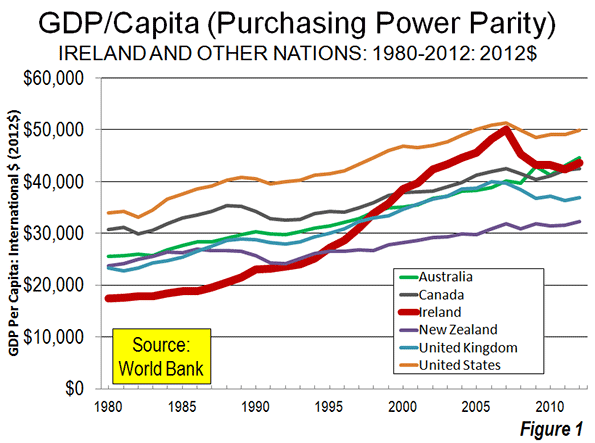
    This is a sharp contrast to Ireland’s image as the “Celtic tiger”. In 1980, Ireland’s gross domestic product per capita (purchasing power adjusted) trailed those of the United Kingdom and the four strong new world economies (United States, Canada, Australia and New Zealand) by approximately 25 percent to 50 percent. By its 2007 peak, Ireland had passed all but the United States, which it nearly caught. By 2012, however, Ireland’s GDP per capita had fallen behind that of Australia (Figure 1).

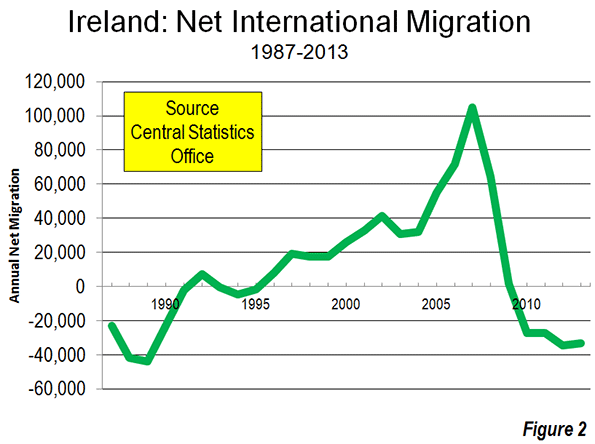
    Migration trends reflect the result of this decline. Net in-migration reached 105,000 in 2007, when the economy peaked when, a notable number for a nation with only 4.5 million residents with a long history of sending its denizens out to the rest of the world (Note 2). In the less robust economy of the last four years, a net 125,000 migrants have left Ireland (Figure 2).

    McCarthy, of University College, Dublin and one of the nation’s most respected economists was called in by the government to lead the “Special Group on Public Service Numbers and Expenditure Programs,” which published the McCarthy Report, detailing recommendations for public expenditure reductions to help Ireland “weather” the financial storm.

    The Housing Bubble in the Dublin Area

    As in the United States, a housing price bubble (centered in the Dublin area) precipitated an economic downturn, which was the greatest since the Great Depression. Our annual Demographia International Housing Affordability Surveys had shown house prices in the Dublin area to peak at a “severely unaffordable” median multiple (median house price divided by median household income) of 6.0, well above the normal 3.0 relationship between prices and incomes. Paying more for housing reduces household discretionary incomes and lowers the standard of living.

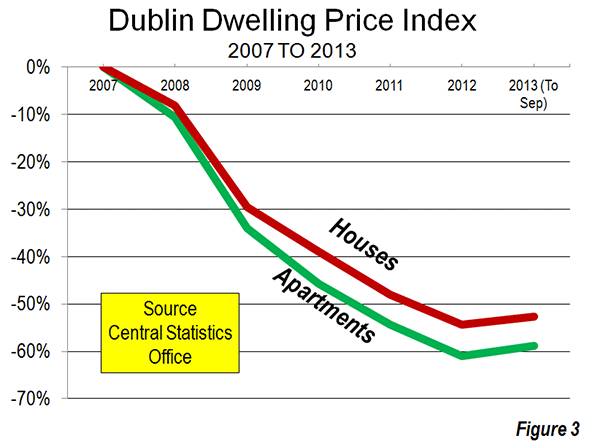
    After peaking in 2007, Dublin house prices plummeted. Single family house prices fell 53 percent from 2007 to 2012, while apartment prices dropped 61 percent, according to the Central Statistics Office property price index (Figure 3). This year, finally, prices have begun to trend upward.

    Decoupling from the Fundamentals

    Like in Dublin, this decoupling of housing from the fundamentals occurred not only in Dublin, but also in both vibrant other markets   such as Sydney, Vancouver, and the San Francisco Bay area, as well as severely depressed markets like Liverpool, Glasgow. In each case, the decoupling has been accompanied by strictly enforced enforcement urban containment policies that prohibit development on considerable suburban and exurban land, through the use of such devices as urban growth boundaries and the priority growth areas (a euphemism for the only places that development is permitted).  As is commonly the case, with these strategies upset the balance between the demand and supply for land, forcing house costs up substantially, just as oil embargoes lead to higher prices at the gas pump.

    McCarthy places the blame squarely on urban containment policies.

    “…there was and still is no shortage of land in the greater Dublin area, one of the lowest-density urban areas in Europe. There is, however, a shortage of planning permission – an entirely man-made creature of the planning legislation and its restrictive implementation by the Dublin-area councillors and planning officials.”

    He describes how artificial scarcity raises prices (other things being equal), a process anyone who listened in Economics 101 would understand. McCarthy says:

    “Before land-use zoning came along, house-builders extended the city by buying up farms on the city’s edge and building at whatever densities the market would support. But as more and more lands were withdrawn from the buildable stock by the planners, prices began to rise and the house-builders moved further away from the city proper.”

    With new house building consents so rigidly controlled, a Dublin area house prices escalated well beyond incomes and prices in the rest of the nation. As McCarthy puts it:

    “In the principal residential suburbs of Dublin an artificial scarcity (of planning permission, not of buildable land) was allowed to develop and prices rose, from the mid-Seventies onwards, to a 50 per cent or 60 per cent premium over comparable homes outside Dublin.”

    In addition to the houses for commuters that were further from Dublin, a government encouraged rural building boom led to over-building in more remote areas (Note 3).

    Economics and Urban Containment

    The consequences of urban containment policy have been known for a long time. More than four decades ago, Sir Peter Hall and his colleagues documented the extent to which house prices have been driven upward in England as a result of the land-use policies that have been copied in Ireland and elsewhere (See: The Costs of Smart Growth: A 40-Year Perspective).

    More recently, Brian N. Jansen and urban economist Edwin S. Mills (Northwestern University) took the argument further (See: The Consequences of Urban Containment) and tied the Great Recession directly at the foot of smart growth policies. They noted that “…. it is difficult to imagine another plausible cause of the 2008–2009 financial crisis,” and concluded:  “In the absence of excessive controls, housing construction would quickly deflate a speculative housing price bubble.”

    My analysis of metropolitan markets for the National Center for Policy Analysis showed that 73 percent of the house price value losses from the peak of the US housing bubble to the housing bust precipitated Lehman Brothers bankruptcy occurred in just 11 markets in California, Florida, Arizona and Nevada, all of them with severe land restrictions (see The Housing Crash and Smart Growth). Had those losses been smaller (as they would have been if prices had not risen so high), the Great Financial Crisis might have been less severe or even avoided.

    Ireland’s Challenge

    More recently, there is good news out of Ireland. The government has announced that it will no longer need the EU/IMF line of credit and will exit the bailout program. The 2012 gross domestic product nudged above the 2007 peak. But that does not mean that those who suffered economic losses during the downturn were made whole. Economic downturns massively redistribute wealth, and there is good reason to not repeat history on this score.

    McCarthy comments that: “It is quite remarkable that the contribution of restrictive zoning to the house price bubble has been so little acknowledged.” He stresses the importance of avoiding “Bubble Mark II,” and urges planning system reform:

    “The key policy measure required is the zoning for residential development of the very large volume of derelict and undeveloped land in the Dublin area.”

    Failing that, a another shock to the standard of living could face the Irish, who have already suffered one, at least partly due to urban containment policy. It could be time, again, for the government to follow Colm McCarthy’s advice. The only housing bubble that cannot burst is one that never forms.

    Wendell Cox is a Visiting Professor, Conservatoire National des Arts et Metiers, Paris and the author of “War on the Dream: How Anti-Sprawl Policy Threatens the Quality of Life.

    Dublin Bay photo by Colm MacCárthaigh.

    —-

    Note 1: Leith van Onselen of Macrobusinessprovides additional analysis on the Irish housing bubble in How Planning Exacerbated Ireland’s Housing Bust.

    Note 2: President John F. Kennedy referred to people as Ireland’s only export as people, on an Irish visit in 1963. The 1961 census had shown a population of 2.8 million, down from an 1841 6.5 million in the present area of the Republic of Ireland (before the pre-potato famine). This loss of 57 percent may be unprecedented in recent world history.

    Note 3: This was due to the combination of “easy money” for building from the financial sector and generous central government tax credits for building in remote Ireland (since repealed). Nearly all of this vacant housing is beyond commuting distance from Dublin, according to the 2011 census (much of it in the northwest and in the counties the west coast). This also fed into the Irish financial reversals.

  • The Undead Suburban Office Market

    The restoration of central city living and working environments has been one of the more important developments in the nation’s metropolitan areas over the past two decades. Regrettably, a good story has been exaggerated out of all proportion in the print, electronic and online media.  

    Exaggerating Core Population Increases: The rise of population in urban cores has been important, but it has too often been used to suggest the apparent, but fallacious opposite, suburban decline. In fact, the suburbs are hardly in decline, with 93.5 percent of major metropolitan area growth outside a 10 mile radius from city hall between the 2000 and 2010 censuses (See: Flocking Elsewhere: The Downtown Growth Story).

    Exaggerating CBD Office Space Gains: Similar misinformation had been circulating about office space outside the nation’s CBDs (central business districts, or “downtowns”). Commercial real estate information company Costar’s Randyl Drummer recently described suburbia’s improving fortunes (See: Once Left for Dead, Suburban Office Making a Comeback).

    “Some analysts wrote the obituary of the suburban office campus as downsizing companies shed millions of square feet, in many cases consolidating into buildings closer to public transit in urban centers.” 

    It’s just not happening, according to Costar research:

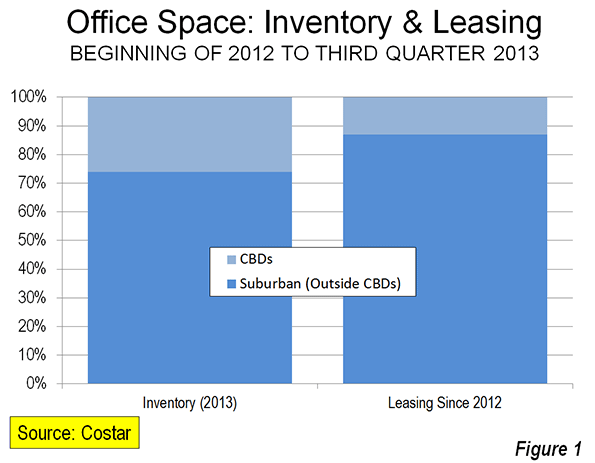
    “Overall, the suburbs have garnered more than their usual share of leasing demand over the past two years, according to an analysis by CoStar real estate economists. Since the beginning of 2012, suburban markets have accounted for a whopping 87% of office demand — which is 13% more than their ‘fair share’ based on the total market size compared with CBD office markets, according to data presented at CoStar’s recent third-quarter office review and forecast.” 

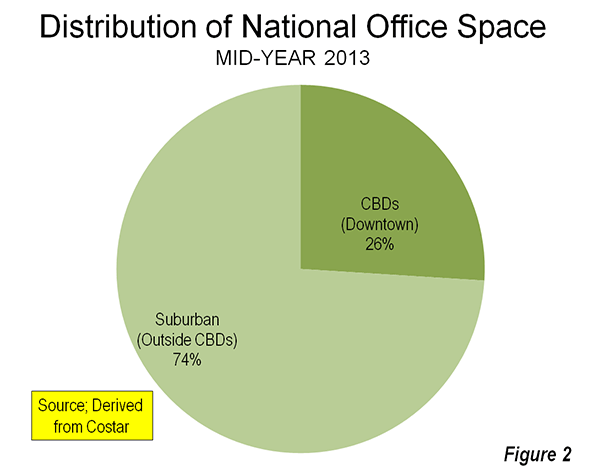
    Indeed, CBD leasing, at 13 percent of the total, is a full 50 percent below their current share of inventory (Figure 1). As of mid-2013, the suburbs accounted for nearly three quarters of the nation’s office inventory (Figure 2).

    Costar cites strong suburban development in Raleigh’s Research Triangle, and further notes that:

    A diverse set of markets that include Sacramento, San Jose, Austin, Kansas City and Charlotte have posted some of the strongest net office absorption among suburban markets.

    This is despite the glowing publicity being given to core area development, especially in places like Charlotte and Austin.

    The reality is that the monumental CBD towers dominating metropolitan skylines do not indicate downtown dominance. In fact, throughout the high income world, most metropolitan employment is outside CBDs. In the United States, typically 90 percent of employment is outside the CBDs. The suburban employment (outside the CBD) share is a bit smaller in Western Europe, Canada and Australia, but still averages approximately 80 percent or more.

    The good news is that neither suburbia nor downtown is dead.

  • The ‘Great State’ of San Francisco

    The public stock offering by Twitter reflects not only the current bubble in social media stocks, but also the continuing shift in both economic and political power away from Southern California to the San Francisco Bay Area, home to less than one in five state residents. Not since the late 19th century, when San Francisco and its environs dominated the state, has influence been so lopsidedly concentrated in just one region.

    The implications of this shift are profound not only for the ascendant northerners, but also for the increasingly powerless, rudderless regions that are home to the vast majority of Californians. With some 16 million residents by far the state’s largest region, Southern California long dominated both state politics and the economy. Today it, along with virtually all interior parts of the state, is effectively ruled by the Bay Area’s admixture of venture capitalists, tech moguls, political and environmental activists.

    This is very bad news, not just for conservatives and Republicans, a species close to extinction in the Bay Area, but for many working and middle-class Democrats. The Bay Area ideological grip – fiercely green and politically correct to a fault – has separated California from its historic commitment to economic diversity and into a one-size-fits-all approach.

    The current shift of political power has been building for the last decade, and has put to an end a Southern California ascendency that ran from the days of Richard Nixon and Ronald Reagan to Pete Wilson, Gray Davis and Arnold Schwarzenegger. Today, there is not one Southland politician with any true state-wide influence. Indeed, the only politicians of any influence from Southern California have been a steady procession of union-influenced politicians: Fabian Nunez, Herb Wesson, Karen Bass and John Perez – all who have served as State Assembly speakers. And all of them will eventually fade into well-deserved obscurity.

    In contrast, notes long-time analyst Dan Walters, the Bay Area has established a “near-hegemony in California politics.” Home to both of the state’s U.S. Senators, San Francisco’s Dianne Feinstein and Marin’s Barbara Boxer, it also domiciles the state’s most important House leader, Nancy Pelosi, again of San Francisco. But the real domination is at the state-wide level where Bay Area residents control virtually every key political office, including Lt. Gov. Gavin Newsom, former mayor of San Francisco and Attorney Gen. Kamala Harris, San Francisco’s former district attorney.

    Astute observers of state politics, such as Joe Matthews, note that the “machine” nature of Bay Area politics, most epitomized by former San Francisco Congressman Phil Burton and his brother, John, has shaped a political class with sharper elbows. Urban San Francisco, in particular, he suggests, has a rough-and-tumble aspect missing from Southern California’s more dispersed and largely indifferent variety.

    This bizarrely lopsided configuration could prove a temporary and random phenomena, but the long-term economic and demographic trends favor a growing Bay Area ascendency. The current boom in Silicon Valley is minting billions in new riches for denizens of high-tech companies and their financiers at a time when office parks across most of the state, including Los Angeles and Orange Counties, are suffering significant vacancies. In contrast, those in Palo Alto and San Francisco are filling up even at ever-rising prices.

    This reflects in large part the secular decline of Southern California, which has never fully recovered from the loss of its landmark aerospace industry as well as the Los Angeles riots. The area’s dependence on manufacturing, where it remains the nation’s largest center, has suffered huge damage – down 18 percent just since 2007. Some of this can be terraced to the very regulatory policies backed by Bay Area politicos and pundits.

    Race is a factor here, too. For its part, the Bay Area’s population is increasingly dominated by well-educated Anglos and Asians – while historically underperforming African Americans and Latinos, largely immigrants, are concentrated in southern California. San Francisco, for example, is only 22 percent black or Hispanic; in Los Angeles, this percentage approaches 60 percent.

    There is also a vast chasm which has developed in terms of both job creation and unemployment rates. Over the past six years San Francisco and Silicon Valley, after losing many jobs in the 2000-2001 tech bust, have created 44,000 new jobs and now have recovered their losses from 2007. In contrast, Los Angeles and Orange counties, even after some recent growth, are stuck almost 300,000 below their 2007 levels. Not surprisingly unemployment in Santa Clara county sits around 7 percent while San Francisco county and San Mateo county unemployment numbers are under 6 percent. In contrast Los Angeles, the state’s largest county, stays at roughly 10.8 percent.

    Even worse off are places like the Central Valley and the Inland Empire, that have large numbers of under-educated people, and have long depended on such basic industries as construction, agriculture, manufacturing and logistics. Riverside-San Bernardino counties and Sacramento county together are still almost 200,000 jobs below their 2007 levels. Some of the rural counties in the Central Valley still suffer double-digit unemployment rates and staggering levels of poverty even as mid-twenties Bay Area nerds – often heads of companies with no history of profit – engage millions, and even billions, in IPO wealth.

    The confluence of Bay Area political and economic power is not coincidental. Increasingly the Silicon Valley oligarchs are rapidly replacing Hollywood as the primary source of cash for Democratic politicians.

    Energy provides the clearest example of the Bay Area’s ability to determine policy. Many major tech firms and venture capitalists have made millions backing renewable energy ventures made profitable by state mandates and subsidies. With the high energy-consuming industrial part of the Silicon Valley increasingly eclipsed by social media and software segments, high-priced electricity matters less and less to tech oligarchs who can easily place their servers in lower-cost states. Opposition to oil and gas development, which could resuscitate some of the state’s hard-hit quarters, is predictably strongest in the Bay Area.

    Similarly, strict controls over water use, although expensive for the Bay Area, hit agricultural and industrial users mostly located in the interior the hardest. These, measures do not much impact the ultra-rich buyers in places like Palo Alto, much less in lawn-less San Francisco.

    Is this reconfiguration a permanent one? Certainly the Bay Area’s swagger will decline once the current tech bubble, as is inevitable, implodes, likely within a year or two. The “tech glitz” around concentrations of start-up companies is a movie we have seen before. Back in the early years of the decade, similar firms fell victim to flawed business models and rapid industry consolidation. In San Francisco, for example, tech employment crashed from a high of 34,000 in 2000 to barely 18,000 four years later.

    But even if the Bay Area’s economic edge recedes, its political influence is unlikely to be challenged in the near future given the dearth of talented politicians. Indeed the only possible governor candidate from south of San Jose, Antonio Villaraigosa, is lightly regarded for his less-than-successful term as mayor of Los Angeles; his only hope in a primary lies in bloc voting by his fellow Latinos.

    Instead, most likely, our next governor will be either Gavin Newsom or state Attorney General Kamala Harris, progressives from San Francisco. Until Southern California can develop new leaders to replace today’s mediocrities, and starts to push an agenda appropriate to our poorer and more diverse population, we better get used to living in what has become the Great State of San Francisco.

    This story originally appeared at The Orange County Register.

    Joel Kotkin is executive editor of NewGeography.com and Distinguished Presidential Fellow in Urban Futures at Chapman University, and a member of the editorial board of the Orange County Register. He is author of The City: A Global History and The Next Hundred Million: America in 2050. His most recent study, The Rise of Postfamilialism, has been widely discussed and distributed internationally. He lives in Los Angeles, CA.

  • Affordability: Seattle’s Ace in Becoming the Next Tech Capital

    Silicon Valley has been well recognized as the nation’s hub of technology, having easily surpassed both Southern California and Massachusetts, but it’s now Seattle that may emerge as its greatest rival. Home to tech giants such as Microsoft and Amazon, Seattle has attracted creative and entrepreneurial talent, which has been the foundation to its low unemployment rate of 5.9% and continuous economic growth. Many former employees from Microsoft and Amazon have founded startups and small businesses in Seattle.

    The primary reason for Seattle’s continuous expansion: the metro beats Silicon Valley in affordability on many different avenues. For instance, one of Silicon Valley’s major turnoffs for up and coming entrepreneurs has been its unaffordable housing.

    Increasing wages in Silicon Valley have been matched with skyrocketing housing prices in the Bay area, which has become one of the most expensive places to live in the nation. Due to the low number of homes available, bidding wars have become a common problem when buying a home in the area. As a result, San Francisco has witnessed 20+% increases in median home prices over the past year. In May, San Francisco’s median home price was $1 million, a 32% jump from the previous year. Average listing prices in cities such as Los Gatos, San Francisco, Cupertino, Redwood City, San Mateo, and Sunnyvale are anywhere between $1.1 and $1.4 million. To illustrate what this means to a young entrepreneur or skilled technologist looking for a home, the median price to buy a 2-bedroom home in San Francisco would cost $880,000, whereas in Seattle it would cost $385,000.

    Seattle’s lower office rent and expanding office space development also have made Seattle become an appealing alternative to Silicon Valley. Jones Lang LaSalle reported this year that Seattle’s average office rental rate is $20.86 with a 0.2% annual rent growth, as opposed to San Francisco’s average office rental rate, which is $25.80, with a 0.9% annual rent growth rate. The Seattle-Bellevue area also has the second highest number of office leases in the country, behind Houston. This is one reason why so many tech companies have moved or expanded its office space in Seattle. For example, Facebook recently doubled its current rental space and Zynga, an online gaming company, rented space in downtown Seattle as well. Google also has created two centers in Seattle and its suburbs, bringing in a total of over 900 employees.  

    Washington also bests California in tax incentives, a large factor in attracting tech companies and keeping existing ones at home. California has the second highest individual capital gains tax in the nation, while Washington has none. Recently, a judge ruled California’s Qualified Small Business tax bill to be unconstitutional; the policy used to give tech companies a deduction that reduced the state’s capital gains tax rate from 9% to 4.5%. The state’s tax board is estimated to retroactively collect about $128 million from 2,500 entrepreneurs (amounting to about $50,000 per person).

    Washington also has no income tax and offers a plethora of tax incentives to high tech companies. The state gives a good number of sales tax deferrals, waivers, and business tax credits to the high tech sector, particularly for research and development spending. The business and occupation tax credit also saved $50 million to almost 1,700 high tech-firms in 2010. Computer software companies accounted for the $12 million property-tax break in the same year. Tech companies, especially Microsoft, have been able to avoid sales tax on construction costs, materials, and new equipment because Washington gives deferrals for the construction of buildings for high-tech projects dedicated to research and development. Evidently, the growth in the tech sector has contributed to Seattle’s expansion in office space development.

    This year, there is a developing  36-acre office and apartment development and a grocery distribution center one mile from Bellevue’s downtown area that is slated to be converted into a $2.3 billion district of stores, apartments, and office buildings, two of which will have 490,000 square feet. Expansions of Microsoft and Amazon are expected to fill the office space. Research firm Reis Inc. estimates about 30 million square feet of office buildings, apartments, and stores will be completed in 2013, according to the Wall Street Journal.

    But perhaps most of all, Seattle could be highly appealing for tech companies and individual entrepreneurs simply because the cost of living is cheaper. Providing much of the high tech environment of  Silicon Valley   Seattle also gives a greater bang for your buck than San Francisco. The Department of Housing and Urban Development estimates that San Francisco County’s median income is $99,400 and King County’s median income is $85,600. However, $100,000 salary in San Francisco is comparable to living on roughly a $70,000 salary in Seattle, according to CNN’s Cost of Living Calculator. Keeping these comparisons in mind, housing costs about 53% less in Seattle and groceries costs about 13% less. Utilities, transportation, and health care costs are roughly the same.

    In addition, Washington also has the fourth lowest electricity prices in the nation, another major incentive for tech companies. This reflects the region’s huge hydroelectric generating capacity. In contrast California’s electricity prices — driven up by mandates for renewable energy sources like solar and wind — are now almost double that of Washington.

    One final notable difference is that unlike Silicon Valley, Seattle’s economy also rests on a healthy composition of many different established industries. The strong mix of the tech, retail, and manufacturing have been the key factor in Seattle’s staggering job growth, which has grown four times faster than the rest of the country; retail and manufacturing jobs have increased twice as fast. Boat building companies such as Kvichak Marine Industries, retail companies such as Nordstrom, Nike, and Costco, and travel companies like Expedia Inc., Boeing, and Alaska Airlines create Seattle’s diverse portfolio.

    Despite its well-recognized reputation and sophisticated style, Silicon Valley ultimately may lose its edge largely on this issue of affordability. When it comes down to it, a sustainable and cost-friendly environment is what makes a desirable destination for tech companies and entrepreneurs. Lower housing prices, lower office rent, numerous tax incentives, and lower costs of living could very well be the pivotal determinants in taking Silicon Valley’s place as the next tech capital.

    Tina Kim is an undergraduate at UCLA majoring in Communications and minoring in Urban Planning. 

    Photo by Wendell Cox.

  • Orlando, Florida: East End Market & the New Localism

    Getting meat and potatoes from the farm to the table depends upon a smooth, even flow. The smaller farmers’ markets are mostly absent in the city these days, with a few vestigial exceptions: Reading Market in Philadelphia, Pike Place in Seattle, and Greenmarket in Manhattan, to name a few. Now, East End Market on Corrine Drive in Orlando has taken its place alongside these venerable exchanges. Owner John Rife hopes this new access to locally grown food will meet the rising demand for an alternative to the large corporate stores and the markets that dot the city’s parking lots and green parks on the weekends.

    “We are blessed with many alternatives already,” Rife said to me in a recent interview, “with several large-scale supermarket choices nearby. East End Market fits into a niche that is not served by these chains, and offers a vibrant food culture to the community.” Rife gutted and re-opened an old, two-story private school building in the suburbs, bringing in multiple vendors offering meat, produce, seafood, bread, cheese and a variety of other food that is ready-to-eat, in addition to ready-to-cook offerings. And between the building and the street, Rife converted a large, suburban-sized front yard into a raised-bed planter community garden.

    The new East End Market will be open 6 days a week, staying closed on Mondays so as not to compete with a nearby Monday evening market that has already gained a loyal following. Rife is delicately fitting into an ongoing local neighborhood scene, something rare in today’s cutthroat retail world.

    The accent is on quality, not quantity, and for some Orlandoans, it smacks of elitism. “A food court for yuppie hipsters,” sniffed one blogger. In an uncertain economy and a struggling job market, the focus on quality seems counterintuitive. Couple this with the backlash against those urban hipsters too smug for their own good, and there could be trouble down the road.

    Orlando’s rural and agricultural areas are surprisingly far from the center of the city; one must travel at least a half hour from East End to see the first farm fields come into view in nearby Chuluota or Oveido. Central Florida’s farmers have little to do with this city, so the notion of a “transect,” where food production crosses progressively denser zones to feed hungry urbanites, is largely a myth. In the commercial food stores, Orlandoans find strawberries from California, Mexican mangos, and seafood from South Africa. Urbanites sacrifice freshness and seasonality for the benefit of a broad range and large quantity, and are reassured by the popular press that this is a favorable tradeoff.

    Instead, Rife and his vendors seek to re-establish links with local farmers and ranchers, in a move that is more populist than elitist. Saturday markets make a gesture towards this, but do not suit many hyperactive schedules. The notion of East End is simply to bring food into the city from local regional producers. It is not intended, said Rife, to displace the other stores.

    Rife is doing something more subtle, as well. His vendors are local entrepreneurs. Many of them built their own booths, or hired local craftsmen to do it. Entrepreneurs that have a small foothold in the marketplace are likely to innovate and stay flexible, adapting to the changing needs of consumers. They have a vested interest in making their ideas work, and while they may sacrifice income in the short term, they’re seeking a long-term return. The energy and motivation are thus slightly different than what one typically finds in a commercial supermarket. East End is a visible experiment in the rising trend towards social businesses, where the capitalist driving force is coupled with social improvement.

    It’s sometimes said that the sidewalks of a city are about the people. Rife is placing people on the sidewalks that are not the hourly, minimum-wage clerks that our cities are used to. A real estate developer and manager, as well as an entrepreneur, Rife has noted that he could have “set up East End, leased it to big chains, sat back, and let the rents roll in.” The employees would have had no stakes in the outcome, no ties to the neighborhood, and no motivation to make an active sidewalk scene out of the marketplace. Instead, East End is a very management-intensive operation, where employees often have a stake in the business. This changes the game of the city. People here are involved.

    In the community around East End Market, many of the faces are already tied into the neighborhood somehow: friends, relatives, colleagues and co-workers. There aren’t any name brands between the customer and the sidewalk. In the rising millennial generation name brand loyalty is fading, anyway. Many people prefer to swap real time information on Facebook and tweet about their dining and shopping experiences, rather than to rely on a billboard or television ad. For those comforted by big brands, East End probably won’t be a sell, but for those exhausted by the relentless presentation of logos in every new commercial construction, whether urban or rural, the hand-crafted quality of this effort is a welcome relief.

    East End Market isn’t creating much wealth for people outside of Central Florida, for the rent is not going to a third-party investor, all too rare in a state where outside forces have typically acted for their own benefit first, using Florida as a vehicle for profit. Beachfront and theme park real estate has created great wealth, but in Florida it has largely resulted in a service class without much upward mobility. This food market, and the producers who supply it, are regional, and represent a shift in the economy towards local job creation.

    Rife could have chosen anywhere to do East End, but chose this specific building because, like any savvy real estate developer, he was looking for traffic counts, ample parking, and a demographic that would range from moderate income to upper-income households. “And,” he adds, “the building was already there. It was cheap, had good bones, and was straightforward to convert.”

    Rife and others like him are creating a recovery with their own vehicles. East End Market takes an existing niche, a once-a-week farmer’s market, and develops around it to fill the other six days. The incremental costs are that of converting a building, but the incremental benefits are potentially great, as neighbors find it easy to stop in, entrepreneurs hone business skills, and profits stay in town for a change.

    East End Market builds upon an existing destination, rather than creating one from scratch. The farmers’ market is an old idea, and here it is used as a vehicle to rejoin the links between producer and consumer that have been stressed by globalism. This kind of microscale, grassroots capitalism is not limited to tomatoes and cheese. It’s one way to counter the erosion of middle-class jobs, and the rise of class divisions. It’s a bet on the new localism.

    Photo by the author: East End Market

    Richard Reep is an architect and artist who lives in Winter Park, Florida. His practice has centered around hospitality-driven mixed use, and he has contributed in various capacities to urban mixed-use projects, both nationally and internationally, for the last 25 years.