Blog

  • Suburban & Urban Core Poverty: 2012: Special Report

    The US Census Bureau recently released poverty rate data by state, county and metropolitan area for 2012. As has been the case for decades, urban core poverty rates dwarf those of suburban areas in the nation’s 52 major metropolitan areas (those with more than 1 million population).

    Urban Core & Suburban Poverty Rates

    The average poverty rate in the 52 urban cores – the historical core municipalities – was 24.1 percent, more than double the 11.7 percent rate in suburban areas (Figure 1). These high poverty rates have continued despite the best decade in more than one-half century for the urban cores which have experienced net population increases in the neighborhoods within two miles of downtown. The heavy urban core losses of the 1960s through the 1980s are generally no longer occurring. Yet, between 2000 and 2010, more than 80 percent of the population growth in the urban cores was below the poverty line (See City Growth Mainly Below Poverty Line). By contrast, less than one third of the suburban population increase was below the poverty line.
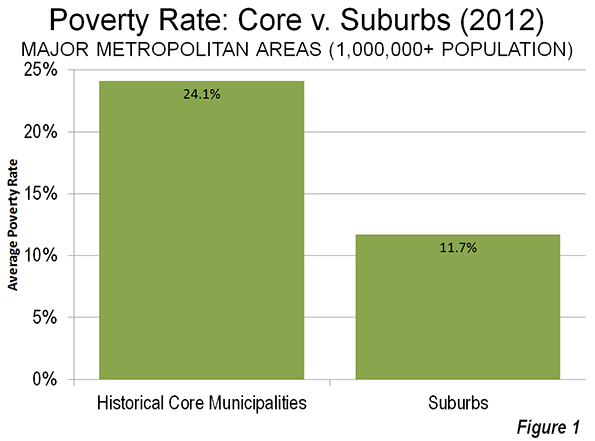
    Table 1
    Major Metropolitan Areas: Summary of Poverty Status: 2012
      Historical Core Municipalities (HCM) Suburbs Metropolitan Area
    Population (Poverty Status Determined)     44,730,920    123,763,495   168,494,415
    Above Poverty Level     34,613,515    108,917,367   143,530,882
    Below Poverty Level     10,117,405      14,846,128     24,963,533
    Major Metropolitan Areas 22.6% 12.0% 14.8%
    Data from American Community Survey, 2012


    Detailed Metropolitan Data

    The lowest historical core municipality poverty rate was in San Jose, at 13.0 percent. Seattle, San Diego, Raleigh and San Francisco rounded out the five urban cores with the lowest poverty rates. The highest urban core poverty rate was in Detroit, at 42.8 percent, followed by Hartford, Cleveland, Cincinnati and Miami.

    The lowest suburban poverty rate was in the Washington metropolitan area at 7.2 percent. Milwaukee, Baltimore, Indianapolis and Minneapolis-St. Paul followed. The highest suburban poverty rate was in the Riverside San Bernardino, 18.4 percent, followed by Orlando, Miami, Las Vegas and Atlanta. Only 15 of the major metropolitan areas had suburban poverty rates that were higher than the best historical core municipality rate of 13.0 percent (San Jose).

    Taking a look over the regions of the country, the five lowest major metropolitan poverty rates were in Washington (8.4 percent), Boston, Minneapolis-St. Paul, San Jose, and Hartford. The highest major metropolitan area poverty rates were in Memphis (19.9 percent), New Orleans, Riverside San Bernardino, Los Angeles, and Miami (Table 2).

    A caveat is in order, however. The official poverty rate does not take into consideration the cost of living differences between states and metropolitan areas. These differences can be large. According to the latest Bureau of Economic Analysis (US Department of Commerce) data, there can be an up to 35 percent difference in the cost of living between major metropolitan areas (the high being San Francisco and the lowest being St. Louis). The new Census Bureau supplemental poverty measure takes housing costs into consideration, but provides only state data. The differences can be substantial. For example, California’s supplemental poverty rate is the highest in the nation, and nearly one-half higher than its unadjusted poverty rate. California’s housing adjusted poverty rate is approximately double that of West Virginia, which is normally considered to be one of the nation’s highest poverty states.

    Table 2
    Major Metropolitan Areas: Poverty Status: 2012
    Metropolitan Area Historical Core Municipalities (HCM) Rank Suburbs Rank Metropolitan Area Rank Core Rate/ Suburban Ratio Rank
    Atlanta, GA 25.8%          35 15.8%        48 16.6%        41 1.63         14
    Austin, TX 20.3%          14 11.5%        28 15.5%        31 1.77         19
    Baltimore, MD 24.8%          34 7.4%          3 11.3%          6 3.34         49
    Birmingham, AL 31.2%          46 13.5%        41 16.8%        42 2.31         34
    Boston, MA-NH 21.6%          21 9.0%          9 10.7%          2 2.40         38
    Buffalo, NY 30.9%          44 9.4%        11 14.2%        19 3.30         47
    Charlotte, NC-SC 21.8%          23 9.9%        14 15.1%        30 2.22         33
    Chicago, IL-IN-WI 23.9%          30 10.8%        22 14.5%        24 2.20         32
    Cincinnati, OH-KY-IN 34.1%          49 11.9%        32 14.9%        26 2.86         41
    Cleveland, OH 36.1%          50 10.8%        21 15.6%        32 3.33         48
    Columbus, OH 21.8%          23 9.9%        15 15.1%        29 2.20         31
    Dallas-Fort Worth, TX 23.9%          31 13.0%        38 15.0%        27 1.85         22
    Denver, CO 19.2%          10 10.7%        19 12.7%        12 1.80         21
    Detroit,  MI 42.3%          52 12.6%        35 17.4%        47 3.36         50
    Grand Rapids 29.4%          42 12.4%        34 16.5%        40 2.37         36
    Hartford, CT 38.0%          51 7.9%          6 10.9%          5 4.83         52
    Houston, TX 23.5%          29 12.6%        36 16.4%        39 1.87         24
    Indianapolis. IN 22.2%          25 7.6%          4 14.4%        22 2.92         43
    Jacksonville, FL 18.5%            9 11.4%        27 15.7%        33 1.61         13
    Kansas City, MO-KS 20.7%          15 10.6%        18 12.9%        14 1.94         28
    Las Vegas, NV 17.6%            6 15.8%        49 16.4%        37 1.11           2
    Los Angeles, CA 23.3%          27 15.3%        45 17.6%        49 1.53           9
    Louisville, KY-IN 19.5%          12 13.1%        40 16.1%        35 1.49           6
    Memphis, TN-MS-AR 28.3%          38 11.8%        31 19.9%        52 2.39         37
    Miami, FL 31.7%          48 16.4%        50 17.5%        48 1.94         27
    Milwaukee,WI 29.9%          43 7.3%          2 15.9%        34 4.08         51
    Minneapolis-St. Paul, MN-WI 22.6%          26 7.7%          5 10.7%          3 2.94         44
    Nashville, TN 19.4%          11 11.2%        25 14.3%        20 1.73         16
    New Orleans. LA 28.7%          40 15.4%        47 19.4%        51 1.87         23
    New York, NY-NJ-PA 21.2%          19 9.8%        12 14.8%        25 2.17         30
    Oklahoma City, OK 19.7%          13 13.1%        39 16.2%        36 1.50           7
    Orlando, FL 21.2%          20 16.4%        51 16.9%        44 1.30           4
    Philadelphia, PA-NJ-DE-MD 26.9%          37 8.7%          8 13.4%        16 3.08         45
    Phoenix, AZ 24.1%          32 13.9%        42 17.4%        46 1.74         17
    Pittsburgh, PA 21.1%          16 10.9%        23 12.1%        10 1.94         26
    Portland, OR-WA 17.7%            7 12.7%        37 14.0%        18 1.39           5
    Providence, RI-MA 28.7%          39 11.7%        29 13.6%        17 2.44         39
    Raleigh, NC 16.4%            4 10.7%        20 12.7%        11 1.53         10
    Richmond, VA 26.3%          36 9.1%        10 11.9%          9 2.88         42
    Riverside-San Bernardino, CA 31.1%          45 18.4%        52 19.0%        50 1.68         15
    Rochester, NY 31.6%          47 10.2%        17 14.4%        23 3.10         46
    Sacramento, CA 23.4%          28 15.1%        44 16.9%        43 1.55         11
    St. Louis,, MO-IL 29.2%          41 12.4%        33 14.3%        21 2.35         35
    Salt Lake City, UT 21.2%          17 11.1%        24 12.7%        13 1.91         25
    San Antonio, TX 21.7%          22 10.0%        16 17.3%        45 2.17         29
    San Diego, CA 15.5%            3 14.7%        43 15.0%        28 1.05           1
    San Francisco-Oakland, CA 17.3%            5 9.8%        13 11.9%          8 1.75         18
    San Jose, CA 13.0%            1 8.5%          7 10.8%          4 1.52           8
    Seattle, WA 13.6%            2 11.3%        26 11.7%          7 1.20           3
    Tampa-St. Petersburg, FL 24.5%          33 15.3%        46 16.4%        38 1.61         12
    Virginia Beach-Norfolk, VA-NC 21.2%          18 11.8%        30 13.1%        15 1.80         20
    Washington, DC-VA-MD-WV 18.2%            8 7.2%          1 8.4%          1 2.52         40
    Average of Metropolitan Areas 24.1% 11.7% 14.7% 2.07


    Suburban Poverty

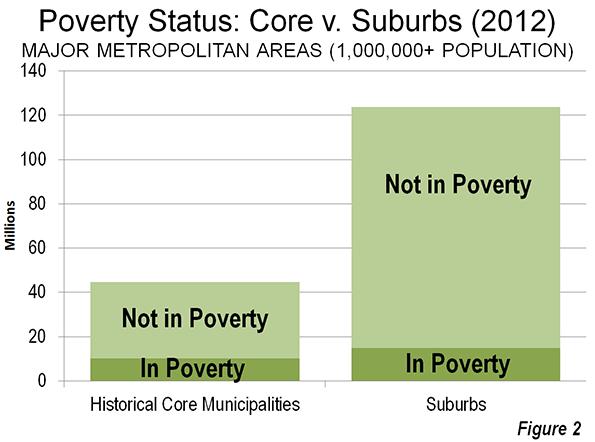
    The majority of the major metropolitan area poverty population now lives in the suburbs, by virtue of their population dominance; overall suburban populations are now 2.7 times as large as those of all core cities. In fact, rather than being a new phenomenon, suburban areas passed the urban cores in poverty population before 2000. The 2000 Census indicated that approximately 53 percent of the poverty population was in suburban areas of the 52 metropolitan areas. The share of poverty rose to 59 percent in the suburbs, largely as a consequence of their having dominated growth between 2000 and 2012. While there were nearly 5 million more people below the poverty line in the suburbs than in the historical core municipalities, the suburbs contained more than three times the above-poverty line population – some 109 million – as the urban cores (Figure 2).
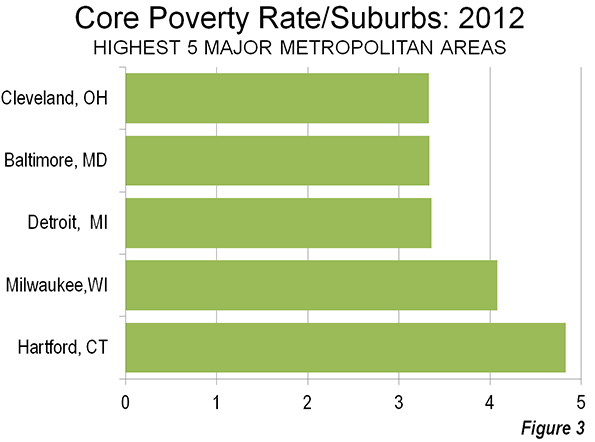
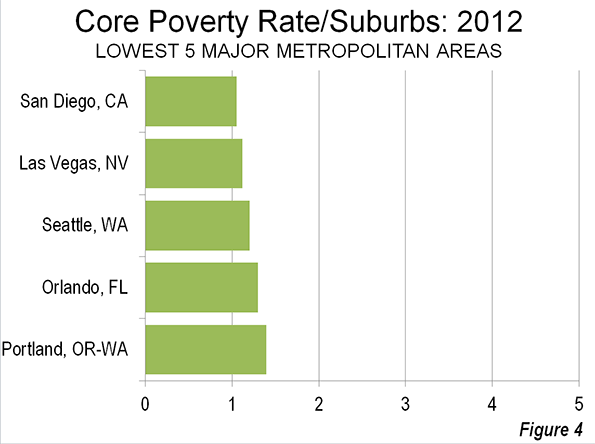
    In 2012, suburban poverty rates were below those of the urban cores in all 52 major metropolitan areas (Table 2). The urban core poverty rates ranged from 5 percent above the suburban rates, in San Diego to nearly 5 times the suburban rate in Hartford. San Diego, Las Vegas, Seattle, Orlando and Portland had the lowest urban poverty rates relative to the suburbs of the same metropolitan areas (Figure 3). The urban cores of Hartford, Milwaukee, Detroit, Baltimore and Cleveland had the highest poverty rates relative to the suburbs of the same metropolitan areas (Figure 4).
    Poverty by Historical Core Municipality Category

    When the new poverty data was announced, Milwaukee Mayor Tom Barrett bemoaned the fact that the city’s poverty rate was the highest in the nation relative to that of the suburbs. The Milwaukee Journal-Sentinel’s “Politifact” pointed out that the mayors’ contention was based on 2010 data rather than the new 2012 data. As is noted above, Hartford had displaced Milwaukee with the highest urban core poverty rate relative to the suburbs by 2012.

    However, Mayor Barrett’s concern is well founded. The city of Milwaukee’s high poverty rate relative to the suburbs is surprising. Among the five urban cores with the highest poverty rates relative to the corresponding suburbs, only Milwaukee includes substantial areas of suburban land use development. The city of Milwaukee is categorized as a Pre-World War II core with substantial suburbanization, by virtue of having more than doubled its land area by annexing lower density (suburban) areas. Each of the four other urban cores with the highest ratios relative to suburban poverty rates are classified as pre-World War II cores with little suburbanization. None of these municipalities (Hartford, Detroit, Baltimore, and Cleveland) has annexed significant suburban territory since before World War II.

    Since poverty tends to be more concentrated in urban cores in the United States, it is to be expected that pre-World War II historical core municipalities would have higher poverty rates relative to the suburbs.

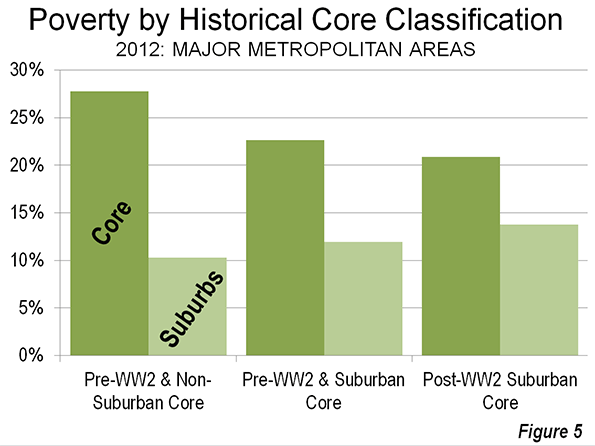
    The smallest differences between urban core and suburban poverty rates are found in the metropolitan areas with heavily suburban core cities and lack major pre-World War II cores (Figure 5). San Jose, Phoenix, Orlando, and Las Vegas are examples of metropolitan areas in this category.
    From Poverty to Prosperity

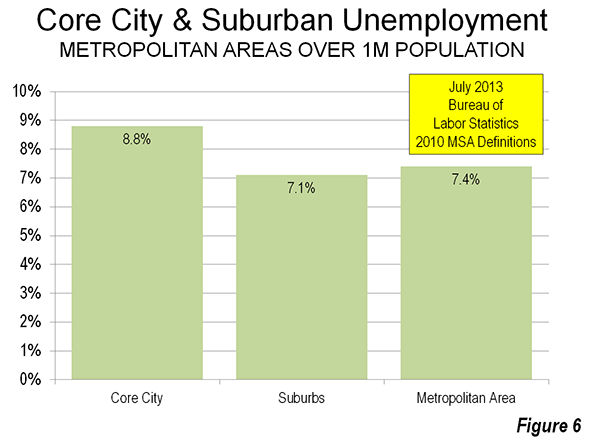
    The continuing high rates of poverty in the urban cores and the higher than previous poverty rates in suburban areas is cause for primary concern. At the heart of the problem is the lingering high unemployment rate, which averages nearly a quarter higher in the urban cores than in the suburbs (Figure 6).
    The principal purpose of cities (from the urban core to the exurban periphery) is to facilitate a better standard of living for all income segments. This has, of course, been made difficult by the Great Recession and could be lengthened should grudging growth nurture a long-term Great Malaise. Obviously, the answer is stronger economic growth, which will require a better investment climate

    Wendell Cox is a Visiting Professor, Conservatoire National des Arts et Metiers, Paris and the author of “War on the Dream: How Anti-Sprawl Policy Threatens the Quality of Life.

    —–

    Note: These data vary from those reported by the Brookings Institution, which classifies “cities” and “suburbs” differently. For example, the Brookings Institution classifies suburbs such as Arlington, Texas in the Dallas-Fort Worth metropolitan area, Aurora, Colorado in Denver (see photo above),  Mesa, Arizona in Phoenix, Bellevue , Washington in Seattle and  Paradise, Nevada in Las Vegas as “cities.” The net effect is generally higher suburban poverty rate in the Brookings Institution analysis than in this “urban core” versus suburban analysis.

    —–

    Photo: Suburban Denver (Aurora), by author
  • Housing: Bubble Trouble or Staying the Course?

    There is a lot of speculation that residential real estate markets are in a bubble. Certainly there is cause for concern: The rates of gains in prices over the past year are unsustainable, and a bit disturbing. We are seeing multiple offers on a huge percentage of homes that are sold, and buyers are racing to make offers.

    Sustained strong real estate markets are usually driven by household formation, or an increase in the percentage of the population that owns a home. Neither is happening.

    Household formation drives a real estate market by increasing demand for modest homes and pushing existing homeowners up the ladder. It isn’t happening now because our young people, at the age when we would expect them to start households, can’t do so. The economy has crushed them. They are unemployed or underemployed, burdened with college debt, and living with their parents. They will not be a source of strength for the real estate markets until job growth is far higher than it is now. End of story.

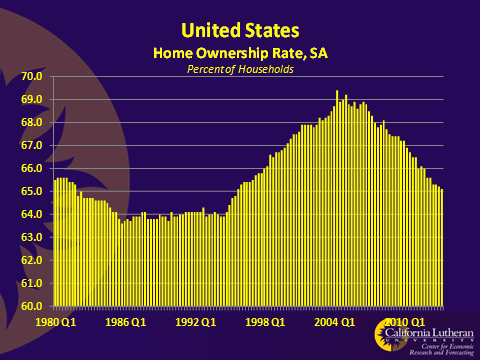
    Home ownership rates aren’t increasing either, thank goodness. Policy can only push home ownership so far, and then things go bad, really bad. A too-high home ownership rate was a significant contributor to our recent recession, and to its extraordinarily slow recovery. In spite of headlines, the continuing decline in home ownership is good economic news.

    The home ownership percentage peaked at about 69 percent just prior to the recession. Since then, it’s fallen to about 65 percent. Based on history, we think about 64 percent is a sustainable rate. Given the ongoing changes in how homes are financed, the sustainable rate may fall below 64 percent. In any event, growth in the home ownership rate is not and will not soon be a source of demand for homes.

    Then there are the stories. We hear lots of stories about behavior that sound like stories we heard in previous bubbles.

    Still, we don’t think we’re in a bubble. We’d prefer a more orderly market — that’s for sure. We also don’t expect to see continued price increases at last year’s pace.
    The demand driving real estate markets comes from investors. This is something that had to happen. When the home ownership rate is too high, home ownership needs to be moved from unqualified residents to investors.

    It took investors a while to see this, and government at every level did its very best to slow or stop the process. Eventually, though, investors couldn’t continue to ignore the situation, and economic incentives overwhelmed government efforts to stop the process. Investors were flush with cash, and they had few alternative investments. Interest rates were at record lows, and home prices were low, often below construction costs.

    So the investors stepped in, all at once, and in a big way. We’ve seen reports of some investment firms bidding on 200 homes a day in Florida.

    You have to ask: How long can this go on? The answer is in the economic models used by investors. Their models look at interest rates, expected rents, capital gains, and price. Interest rates have ticked up, and markets are concerned about tapering of QE3. Still, we don’t see any reason for a sustained significant upward move in interest rates. We also don’t see any sign of a softening in rents, and thus the expect capital gains.

    So, purchase price is the key to how long we’ll see strong investor of demand. That is, given interest rates and expected rents and capital gains, there is a price below which Investors will purchase houses and above which they will not purchase houses. Call this the critical price. For simplicity, we’re assuming — unrealistically — that all markets are the same. In reality, there is a critical price for every neighborhood or even every home.

    The situation is clearly self-limiting. The investors all use very similar models. Once they hit the critical price, they will all exit the market. Since they are all using very similar models, they will all abandon markets at about the same time.

    Then what happens? I think we’ll have a new floor at the critical price. If the price falls, the investors will jump back in. Since we don’t see any other strong source of demand, it’s hard to see why the price would continue to increase above the critical price. So prices are likely to again be stable.

    While investors do not always behave in rational ways — in particular they exhibit herd behavior — we are inclined to believe that they will not bid the price up significantly above a price supported by fundamentals: rents, interest rates, incomes, and the like. So, we built a simple model to see where we are.

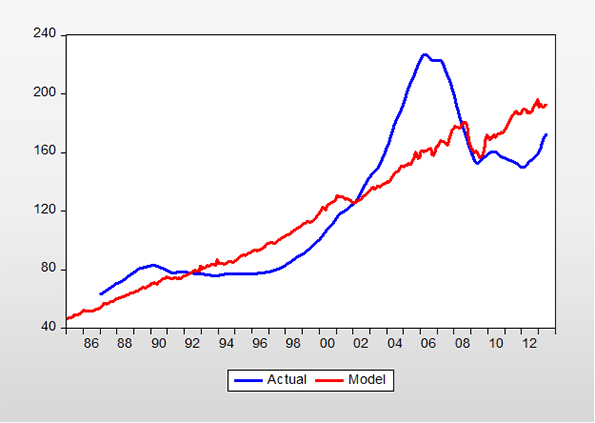
    Below is a chart that shows actual market prices based on the Case-Shiller survey, represented by the blue line, and our estimate of a price based on fundamentals, by the red line. According to this model, there is some room for continued gains:

    That is not to say that prices couldn’t fall. Our model is based on current economic conditions, and it is not forward looking in any way. If the fundamentals change, our model’s estimate of value will change. Specifically, if interest rates increase or if income falls (because we go into another recession) we would expect to see prices decline. If job creation suddenly accelerates, we’d expect to see prices increase.

    So, while we don’t think that real estate markets are in a bubble, the current rate of price increase will probably not continue for long, either. The very good news is that, absent some unexpected negative economic shock, we don’t see any reason for another price decrease within the forecast horizon.

    Bill Watkins is a professor at California Lutheran University and runs the Center for Economic Research and Forecasting, which can be found at clucerf.org. A slightly different version of this story appeared in CLU Center for Economic Research and Forecasting’s September, 2013 California Economic Forecast.

    Flickr Photo by thinkpanama

  • Taking Flight from Asia

    Viewed from a 50-year perspective, the rise of East Asia has been the most significant economic achievement of the past half century. But in many ways, this upward trajectory is slowing, and could even reverse. Simply put, affluence has led many Asians to question its cost, in terms of family and personal life, and is sparking a largely high-end hegira to slower-growing but, perhaps, more pleasant, locales.

    The Asian Century may have arrived, but many Asians – disproportionately entrepreneurial, well-educated and familial – are heading elsewhere. In the United States, they have surged past Hispanics as the largest source of immigrants and now account for well over a third of all newcomers. But that’s just the tip of this wave: Recent Gallup surveys reveal that tens of millions more – 40 million from the Indian subcontinent and China alone – would come if they could. This is far more than the 5 million in Mexico who would still like to move here.

    For the most part, these highly urbanized Asians are headed to places that may not be exactly pastoral, but are decidedly less-crowded places, either in the suburbs of great cities or, increasing, to sprawling low-density regions such as Houston, Dallas, Charlotte and Phoenix. In large swaths of Los Angeles County’s San Gabriel Valley, parts of the southeastern Orange County as well as the Santa Clara Valley, six cities, including tony San Marino, already are majority Asian, and many, including several in Orange County, are either there or well on the way.

    For the most part, these primarily suburban places, widely disdained by the dominant media and academic classes, appear to seem awfully nice to Asian immigrants. Nationwide over the past decade, the Asian population in suburbs grew by almost 2.8 million, or 53 percent, while their numbers expanded in core cities by 770,000, or 28 percent. In Southern California, the shift is even more pronounced: In Los Angeles and Orange counties – the nation’s largest Asian region, the suburbs added roughly five times as many Asians as did the core city. There are now roughly three Asian suburbanites for every core city dweller in our region.

    This is not just an American phenomenon. Asians, by far the fastest-growing large ethnic group in Canada, constitute a majority in many Toronto suburbs, like Markham, Brampton, Mississauga and Richmond Hill. The same pattern is seen in areas around Vancouver, such as Richmond, Greater Vancouver, Burnaby and Surrey. Asians, who, following New Zealanders, constitute a majority of newcomers in Australia, also tend to settle in suburbs, particularly newer ones.

    It’s most important to understand the reasons these people leave their homelands. Historically, people immigrate from places where there is a perceived lack of opportunity. Yet, many of the Asian countries seeing people leave – places like Singapore, Taiwan and China – have enjoyed consistently higher economic growth rates than any of the destination countries. What these immigrants increasingly understand is that, as their country’s GDP has surged, their quality of life has not and, in many ways, has deteriorated.

    These are the sometimes subtle but important things that tend to be ignored by geopoliticians and urban ideologues, attracted by the density and transit-richness of the Asian cities. “Everyday life,” observed the great French historian Fernand Braudel, “consists of the little things one hardly notices in time and space.” And, by these measurements, life in the United States, Canada or Australia is simply better than that in most Asian countries.

    In contrast, urban Asia, although rich and often colorful, has become an increasingly difficult place both for everyday life and for families. A nice salary might be satisfying, but is unlikely to be large enough to buy a house or apartment in places like Taipei or Hong Kong, where the cost of even a tiny apartment equals more than twice – adjusted for income – what would be sufficient to purchase a house in Irvine, and four times as much as an even larger residence in Houston, Dallas or Phoenix. Not surprisingly, most Asians in America feel they are living better than their parents, compared with their counterparts at home. Only 12 percent would choose to move back to their home country.

    Beyond housing, life in hyperurbanized Asia does not buy much happiness. Prosperous Singapore, for example, is one of the most pessimistic places on the planet, while ultradense South Korea has been ranked as among the least-happy nations in the Organization for Economic Cooperation and Development, ranking 32nd of 34 members. The country also suffers from among the highest suicide rates in the higher-income world.

    This reflects the often-ignored impacts of dense urbanization, including rising obesity, particularly among the young, who get less exercise and spend more time desk-bound. The air is foul, particularly in Beijing, no matter how much money you have. A healthy bank account does not exempt one from emphysema.

    Others complain about the dangers of a political system where wealth can always be confiscated by the state; no surprise, then, that a new survey shows roughly half of China’s millionaires are looking to move, primarily to the U.S. or Canada. During 2010-11, the number of Chinese applying for a U.S. investor visa, which requires a $1 million investment in the country, more than tripled, to more than 3,000. Repression of political thought and, particularly, against religion, also ranks as a major cause for leaving the homeland.

    The family – the historic centerpiece of cultures from India to Korea – may constitute the biggest victim of the hypercompetitive, ultradense Asian lifestyle. Hong Kong, Singapore and Seoul suffer among the world’s lowest fertility rates, with rates around 1. Meanwhile, Shanghai’s fertility rate has fallen to 0.7, among the lowest ever reported, well below China’s “one child” mandate and barely one-third the rate required simply to replace the current population. Due largely to crowding and high housing prices, 45 percent of couples in Hong Kong say they have given up having children.

    For those who do want to start a family, it increasingly makes sense to immigrate. This is evident in rising emigration from China’s cities, Hong Kong and Singapore, where roughly one in 10 citizens now lives abroad, often in lower-density communities in Australia, Canada and the United States.

    The nature of those immigrating is critically important. We are long past the days when the average Asian migrant is a physical laborer or a small-scale merchant. Now, the more typical newcomer is a student or a highly qualified professional. In Australia, Asians, notably from India, China and Taiwan, make up the vast majority of immigrants who qualify for entry under skills-oriented criteria.

    This pattern also can be seen in the United States. Asians now constitute a majority of workers in Silicon Valley. They also tend to concentrate in what may be best described as the country’s largely suburban nerdistans – magnets for high-tech workers – places like Plano, Texas, Bellevue, Wash., Irvine and large swaths of Santa Clara County.

    Does all this mean Asia is about to experience a precipitous decline? Not at all. But it is also increasingly clear that the dense model of development adopted on much of that continent – exacerbated by a mass movement to cities – is not, in a larger social sense, truly sustainable. Societies that become difficult for families, and exact too much stress on their residents, are destined to suffer maladies from ultrarapid aging, shrinking workforces and a host of psychological maladies.

    These strains will become more evident over time. Already, most Asian societies, from Japan and China to Singapore and Taiwan, are experiencing less growth, linked in part to financial pressures from a rapidly aging society. The economic motivations for staying in Asia will likely decline, accelerating the flight both of financial and, more importantly, human capital.

    Every society relies on the resourcefulness of its people, particularly the young. The loss of skilled individuals and, especially, families suggests we may have already witnessed the peak of the half-century-long Asian ascendency, well before the American era has even come to its oft-predicted demise.

    Joel Kotkin is executive editor of NewGeography.com and Distinguished Presidential Fellow in Urban Futures at Chapman University, and a member of the editorial board of the Orange County Register. He is author of The City: A Global History and The Next Hundred Million: America in 2050. His most recent study, The Rise of Postfamilialism, has been widely discussed and distributed internationally. He lives in Los Angeles, CA.

    This piece originally appeared at The Orange County Register.

    Singapore skyline photo by Bigstockphoto.com.

  • Well-Heeled in the Windy City

    A couple weeks ago, noting the apparently immunity of global city Chicago to problems elsewhere in the city, I asked the question: What happens when global city Chicago realizes there’s a good chance it can simply let the rest of the city fail and get on with its business?

    I’d argue we’re seeing the results right before our eyes.

    At the same time murders in significant parts of the city are even higher than during the peak of the crack epidemic, when the city says its too poor to hire more cops, when 54 schools are closed and a 1000 teachers laid off, half the mental health clinics closed, libraries cut back, etc., Chicago has found a nearly limitless stream of money for elite amenities, most recently – and appallingly – $50+ million in TIF subsidies for a new DePaul arena. There’s also been hundreds of millions of dollars more in corporate welfare under Daley and Rahm.

    Investing in success is a great idea – if you plan to harvest a return on that investment to fund city services and your safety net. It’s clear there’s no intention of doing this in Chicago. I discuss this in my most recent City Journal piece, “Well-Heeled in the Windy City.” Here’s an excerpt:

    Clearly, cities like Chicago must retain a substantial portion of upscale residents and businesses. Detroit and other cities show the results of failure on this front. Yet the moral case for elite amenities has always rested on the assumption of a broader public good: what benefited the wealthy would also make life better for the rest of the city….Under Emanuel’s leadership, though, Chicago has made peace with a two-tier society and broken the social contract. Rather than trying to expand opportunity, Chicago has bet its future on its already successful residents—leading some on the left to call Emanuel Mayor 1 Percent. The Windy City isn’t alone in following this strategy. Detroit has gone bankrupt, but that hasn’t stopped city government from lavishing $450 million in subsidies on a new Red Wings arena.

    Since I critique bike infrastructure as part of Chicago’s splurge for the elite, I want to clarify that point here where there are lots of bike advocates. I strongly support bike infrastructure. In fact, I once gave a presentation where I said protected bike lanes and bike share should be Rahm’s top two transport priorities on taking office because they are cost-effective and can leverage outside funds. However, even the most passionate advocates must admit that the optics are bad on making a full court press on bike lanes when cutting core services elsewhere. More importantly, Rahm’s explicit rationale on bike infrastructure has been luring talent for the tech economy, thus it is an elite focused venture. For example, the Sun-Times reported:

    Emanuel called protected bike lanes central to the city’s sustainability plan and his efforts to make Chicago the high-tech hub of the Midwest. Chicago “moved up dramatically” in the list of major cities whose employees bike to work, he said.

    “It’s part of my effort to recruit entrepreneurs and start-up businesses because a lot of those employees like to bike to work,” he said.

    “It is not an accident that, where we put our first protected bike lane is also where we have the most concentration of digital companies and digital employees. Every time you speak to entrepreneurs and people in the start-up economy and high-tech industry, one of the key things they talk about in recruiting workers is, can they have more bike lanes.”

    I’m simply taking the mayor at his word. (See also here and here).

    This piece originally appeared at The Urbanophile.

  • There’s Real Economic Development Gold in El Dorado—Arkansas

    For centuries, explorers searched for the legendary golden city of El Dorado, seeking instant wealth in the jungles of South America. But today’s treasure trove may be found much closer to home; cities like El Dorado, Arkansas, for example, that have successfully linked their economic development strategy to improving the educational attainment of their residents.

    El Dorado, a city of about 20,000 people that was at the heart of Arkansas’s oil boom in the 1920s has been hard pressed to reprise that economic growth experience in this century.  Instead of chasing after the fool’s gold of becoming cool, it has found a way to attract new residents and increase its economic vitality by promising its public school students a free college education if they graduate from high school with good grades. That promise has the potential to provide the critical glue in holding together a broad based economic recovery not just for cities such as El Dorado but for entire states or even the country.

    The El Dorado Promise is a scholarship program established and funded by Murphy Oil Corporation, the town’s largest employer. Modeled after a similar program in Kalamazoo, MI, It provides graduates of the city’s high school a scholarship covering tuition and mandatory fees that can be used at any accredited two- or four-year, public or private, educational institution in the US up to an amount equal to the highest annual resident tuition at an Arkansas public university.

    Since its inception in 2007, 1239 students have taken advantage of the offer. Over 90% of them have completed at least one year of college. The first high school class to enjoy this benefit has graduated after five years from college at a rate almost 40% greater than the state’s higher education student population. These gains in acquiring the skills necessary to be competitive in today’s global economy have been achieved by virtually all of the city’s high school students, over 90% of whom graduated from high school last year.

    Furthermore the culture of a college-bound student population is now permeating throughout the school district, with a recent study finding that students in grades three through eight in the city scored significantly higher than their matched peers in nearby school districts in both math and literacy. The greatest gains have come from those who were the youngest when the Promise was announced.

    The goal of the El Dorado Promise was not just greater educational attainment, however. The visionaries who established the program also wanted to use this program to improve the community’s economic vitality and quality of life. They have clearly done that.  Enrollment in the city’s schools was up 5% in just the first four years of the program’s existence. As the Promise website says, “the prospect of an increasingly educated workforce gives economic development leaders new tools to attract businesses to the region.”

    The first such Promise was made in Kalamazoo, Michigan in 2005 by still anonymous benefactors seeking to restore the reputation of a city made famous in 1942 by the Glenn Miller Orchestra’s hit tune about a “gal” who lived there. Rather than raise taxes to balance the city’s budget, those who established the Kalamazoo Promise offered a fully paid four-year scholarship to any public institution of higher education in Michigan to any student who went to the city’s high schools for all four years. Under the terms of the Kalamazoo Promise, students have no obligation to repay the money or even to reside in Kalamazoo after they graduate from college.

    The results are very similar to those of El Dorado. Kalamazoo’s student population is up 17.6% and dropout rates have been cut in half. Ninety percent of the city’s female African-American high school graduates have gone on to college. On the economic front, the proportion of residential construction in the city rose sharply from around 30% to nearly 50% of all permits issued in the greater Kalamazoo area. The community’s careful tracking of the results has identified 1600 families who say they are living in the city because of the Promise.

    The economic challenges that caused El Dorado and Kalamazoo to up their game in getting local residents to graduate from high school and go on to college are no different than the challenge facing the country as a whole  in trying to create a competitive workforce in today’s increasingly global and technology driven economy.  For example, the Georgetown University’s Center on Education and the Workforce estimates that 62% of the jobs in the United States by the year 2018 will require at least some college education – for example a certificate for a specific skill – and that more than half of those jobs will require a bachelor’s degree. Unless the nation wants to fill those jobs with immigrants from other countries, it will have to do a much better job of giving each American who graduates from high school a chance to pursue a two year skill certificate or a baccalaureate degree. 

    A promise that rewards good academic performance in high school with a scholarship that pays for four years of college tuition has demonstrated it can make a major difference in achieving our educational and economic goals. Now it’s time for the rest of the country to find the gold that Kalamazoo and El Dorado have already discovered. Just as the country, as part of its overall economic development strategy, once expanded access to a universal free education first for primary schools and later for high schools, it must now find ways to make these two pioneering cities’ promise to their young people America’s Promise to all of its youth.

    Morley Winograd and Michael D. Hais are co-authors of the newly published Millennial Momentum: How a New Generation is Remaking America and Millennial Makeover: MySpace, YouTube, and the Future of American Politics and fellows of NDN and the New Policy Institute.

    Graduation photo by Bigstock.