Blog

  • Where Are The Boomers Headed? Not Back To The City

    Perhaps no urban legend has played as long and loudly as the notion that “empty nesters” are abandoning their dull lives in the suburbs for the excitement of inner city living. This meme has been most recently celebrated in the Washington Post and the Wall Street Journal.

    Both stories, citing research by the real estate brokerage Redfin, maintained that over the last decade a net 1 million boomers (born born between 1945 and 1964) have moved into the city core from the surrounding area. “Aging boomers,” the Post gushed, now “opt for the city life.” It’s enough to warm the cockles of a downtown realestate speculator’s heart, and perhaps nudge some subsidies from city officials anxious to secure their downtown dreams.

    But there’s a problem here: a look at Census data shows the story is based on flawed analysis, something that the Journal subsequently acknowledged. Indeed, our number-crunching shows that rather than flocking into cities, there were roughly a million fewer boomers in 2010 within a five-mile radius of the centers of the nation’s 51 largest metro areas compared to a decade earlier.

    If boomers change residences, they tend to move further from the core, and particularly to less dense places outside metropolitan areas. Looking at the 51 metropolitan areas with more than a million residents, areas within five miles of the center lost 17% of their boomers over the past decade, while the balance of the metropolitan areas, predominately suburbs, only lost 2%. In contrast places outside the 51 metro areas actually gained boomers.

    Only one city, Miami, recorded a net gain in the boomer population within five miles of the center, roughly 1%. Much ballyhooed back to city markets including Chicago, New York, Washington, D.C., and San Francisco suffered double-digit percentage losses within the five-mile zone.

    Where the boomers move is critical to the real estate industry, as well as other businesses. This is a large and relatively wealthy generation. Boomers account for some 70% of the country’s disposable income, and their spending decisions will shake markets around the country.

    Given the importance of this market, why has the analysis of it proved so wrong? One factor may well be that most boomers generally do not really want to move if they can help it. Three out of four boomers want to “age in place,” according to a recent AARP  study.

    Part of the problem is one found commonly in press reporting on demographic trends; reporters only tend to know what they see, and mostly they work almost exclusively in urban cores. They encounter empty nester who moves to Manhattan or even downtown St. Louis, but not the ones who moves to the desert, lake, the mountains, the woods or into an adult-oriented community on the urban fringe. Out of the core, these people often fade into media oblivion.

    However, as people age, they turn out to be not, as one developer suggests, “more hip hop and happening” than more likely to seek remaining not only close to home, but attached to the workforce and the neighborhood. A recent series in the Dallas Morning News tracked where local empty nesters were moving — largely to low-crime, well-maintained suburbs and exurbs. What were they looking for? The paper found the biggest concern by far to be safety, followed by affordability and quiet.

    So if boomers aren’t flocking to inner cities, which of the 51 biggest metro areas are gaining the largest share of them? The top gainers are all relatively low-cost, low-density Sun Belt metropolises, led by Las Vegas. Its boomer population expanded 20.2% from 2000 to 2010, with a 12.2% decline in the five-mile inner ring and 36.3% growth outside it. In second place, Tampa-St. Petersburg, Fla., up 11.5% (-8.3% in the five-mile zone, +13.5% outside); followed by Phoenix, whose boomer population rose 11.3% (-22.8%, +15.0%). In contrast, more expensive, denser cities like New York, San Francisco, Los Angeles and San Jose, Calif., saw the worst boomer flight, suffering double-digit percentage losses.

    What are the implications of these findings? For cities, time to forget the long-anticipated “back to the city” trend among seniors as something that can save their downtowns. To be sure, there may be some ultra-affluent urban districts that may attract wealthy older investors and buyers, many of them part-time residents, such as Chicago’s Gold Coast and parts of Manhattan. In some elite Manhattan buildings, full-time residents constitute as little as 10% of the total.

    A  little further out from these hot spots, boomers are fleeing. The five-mile zone around the City Hall of New York lost about 20% of its boomer population in the past decade, while in Chicago the corresponding area lost 26%.

    Ultimately, some downtown places might be a “wonderland,” as The New York Times puts it,for a small group of highly affluent residents. But for most they are outrageously expensive. At an age when capital preservation if often paramount, in New York, the senior best positioned is one living a long time in a rent-controlled apartment.

    Cities need to understand that, for the most part, their appeal remains primarily to young, largely single people, students and couples before they have children; cities’ real challenge, and opportunity, lies in trying to keep more of this youthful cohort in the city as they age and expand their households. Boomers and seniors may be able to support luxury apartment developers in parts of Manhattan, but not in most cities.

    The boomer population in the five-mile radius of the 51 largest U.S. metropolitan areas fell by roughly a million from 2000 to 2010, out of a 2000 population of nearly 6 million, or 17%. The boomer population outside the five-mile zone in these metro areas also fell, but at a much lower rate: 2%, or 800,000 people out of a population of 39.5 million in 2000.  Away from the major metros, smaller metropolitan areas and rural areas gained nearly 450,000 boomers. However, there was an overall loss of about 1.3 million boomers, principally due to deaths.

    Given the trends, suburbs will likely persist as a primary arena for aging populations. This suggests these communities will have to ramp up services to accommodate them, such as shuttle buses and hospitals. They should cultivate  downshifting boomers as new consumers for local stores, and particularly on Main Streets, and as sources for capital and expertise.

    Perhaps the biggest impact, however, may be on smaller metropolitan areas and the less expensive Sun Belt communities. As more boomers achieve “empty nester” status they could bring investment capital, and broader connections to smaller cities that could much use them.

    One early sign of this trend may be the recent rise in migration to Florida. After a brief recession-driven hiatus a net 200,000 people have moved to Florida in the last two years. New Census numbers also suggest a  large number of people continue to leave the Northeast, the Midwest and California.  Also likely to benefit will be some emerging boomer magnet communities in Idaho, Arizona, Uta­h, the Carolinas and Colorado.

    For real estate developers and investors, the ones often most entranced by the “back to the city” story, the lessons are very clear. It makes more sense to follow the numbers, and understand the logic of senior migration, than swallow the snake oil so many have been carelessly imbibing. There are great opportunities in the expanding senior market, including in some uniquely attractive urban districts— but the bigger plays are in outlying areas, and, increasingly, smaller towns.

    Baby Boomer Population (35-54 in 2000/45-64 in 2010)
    Comparison: 5 Mile Radius of City Hall v. Balance of Metropolitan Area          
    51 Major Metropolitan Areas (2010 Popultion over 1,000,000)            
    In thousands (000)                
                       
        POPULATION   % OF POPULATION
        2000 2010 Change %   2000 2010  % Change
                       
    5-MILE RADIUS     5,895     4,890   (1,005) -17.1%   7.1% 6.0% -15.7%
    BALANCE     39,352   38,575      (777) -2.0%   47.5% 47.3% -0.4%
    MAJOR METROPOLITAN AREAS (MMAS)   45,247   43,464   (1,783) -3.9%   54.6% 53.3% -2.4%
                       
    OUTSIDE MMAS   37,579   38,025        446 1.2%   45.4% 46.7% 2.8%
                       
    UNITED STATES   82,826   81,489   (1,337) -1.6%   100.0% 100.0% 0.0%
                       
    Calculated from Census Burea data


    This story originally appeared at Forbes.

    Joel Kotkin is executive editor of NewGeography.com and Distinguished Presidential Fellow in Urban Futures at Chapman University, and a member of the editorial board of the Orange County Register. He is author of The City: A Global History and The Next Hundred Million: America in 2050. His most recent study, The Rise of Postfamilialism, has been widely discussed and distributed internationally. He lives in Los Angeles, CA.

  • My Presence Is a Provocation

    The urbanist internet has been a ga ga over an article by artist and musician David Byrne (photo credit: Wikipedia) called “If the 1% stifles New York’s creative talent, I’m out of here.” Now David Byrne himself is at least a cultural 1%er, and at with a reported net worth of $45 million, isn’t exactly hurting for cash. In fairness to him, he forthrightly admits he’s rich. He also is bullish on the positive changes in New York in areas like public safety, transportation, and parks, and does not fall prey to romanticizing the bad old days of the 70s and 80s. However, in his assigning blame for New York’s affordability, he points the finger squarely at Wall Street, neglecting the role he himself played in bringing about the changes he decries, changes in which he was more than a passive participant.

    Back in the early 90s I liked to hang out in a neighborhood called Fountain Square in Indianapolis, a down at the heels commercial district near downtown largely populated by people from Appalachia. I enjoyed browsing the low end, marginal shops and eating at diners where the food was mediocre and the waitresses sassy but not all that attractive (not that I let that stop me from flirting with them). Today, Fountain Square is not exactly gentrified, but is seeing a lot of investment and new residential construction. It’s a long way from unaffordable, but it isn’t impossible to conceive of a day when it features almost entirely higher prices (by Indianapolis standards) in the way some other zones downtown do.

    About that time I also liked to drive around the city and take pictures of various neighborhoods in the inner city. One time I was on the East Side and was walking around taking snaps of streetscapes. I apparently pointed my camera too close in the direction of a white minivan whose owner took umbrage. The driver, who was white, long-haired, with a bit of a redneck air about him, circled the block and pulled up next to me to berate me in a semi-menacing way, alternately demanding to know why I was taking pictures of his van and warning me I should never do it again. (I generally take pains to try to avoid including people in my photographs when possible, and things like this are one reason why).

    I’m not going to claim there was any hidden agenda here other than this guy being directly suspicious of my pointing a camera his way. But I can’t help but wonder if subconsciously he was aware of a more subtle but potentially more dangerous threat that I posed to his neighborhood and way of life.

    I’m not taking credit or blame for neighborhood change in Indianapolis. But I do know that I’m part of the dynamic of the city I’m in. And when I guy like me walks into a neighborhood, my mere presence can be a provocation. Cities are inherently dynamic places, and we are agents of the forces of change whether we want to be or not. (Which is as true for the poor as for the one percent, we just label it “fair housing” when poor people move into rich neighborhoods, but “gentrification” when the reverse occurs).

    While I am a writer and observer on cities, I’m an endogenous not exogenous observer. All of us are players in the development of the places we live and visit, event if only bit players in some cases. And oftimes in the complex world of the city, our actions are part of forces or trends we are not event aware of, ones that may have consequences we would never have desired. That does not absolve us of our role.

    As for David Byrne, the role of artists and musicians in paving the way for gentrification is so well known as to be conventional wisdom. Similarly today the hipster. And what’s one of the original signature markers of the hipster? The fixed-gear bicycle.

    Just as reductions in crime obviously have an effect of dramatically raising property values (and thus rents) in a place as intrinsically attractive as New York, so do other quality of life improvements such as bicycle infrastructure. By making New York an even more desirable place to live, these improvements, wonderful as they may be and which I would heartily endorse, clearly attract more well-off residents and drive up prices.

    Byrne has even taken a direct role in this. He created a series of nine public art type back racks from the city, all but one of which is in Manhattan, and which even includes this delightful example from Wall Street:


    Photo Credit: Flickr/zombiete

    These racks and his activism with regards to bicycles are what give Bryne his standing an urban commentator.

    I for one am glad he made the bike racks as they are fantastic and I’m a fan of New York’s improved cycling infrastructure. But I also recognize that this sort of quality of life improvement contributes towards New York’s attractiveness to the wealthy. It’s just not realistic to think one can clean up the crime, the parks, improve infrastructure, etc. and then expect that prices will remain what they were back in the 70s when Bryne moved to the city. Rather than pointing the finger at the Other, the finance industry in this case, it would be more helpful if those of us who advocate for better urban environments would recognize the inevitable side effects many of our proposed policies would produce, and our own role in bringing them about.

    Aaron M. Renn is an independent writer on urban affairs and the founder of Telestrian, a data analysis and mapping tool. He writes at The Urbanophile, where this piece originally appeared.

  • Middle-Wage Jobs That Have Survived, and the States That Are Fostering Them

    Middle-skill jobs are in the same camp as green jobs, STEM jobs, and other groups of occupations that garner lots of attention: They can be defined many ways, by many rubrics. Regardless of the definition, however, it’s clear that middle-skill, or middle-wage, jobs have been in decline for years.

    New research from the Federal Reserve indicates the share of middle-skill jobs in the workforce has dropped from 25% in 1985 to just above 15% today, part of the hollowing-out effect that David Autor of MIT has documented. And as our chart above shows, middle-wage jobs — those that pay between $13.84 and $21.13 per hour, as defined by the National Employment Law Project — sustained much deeper cuts during the 2008-2009 recession than high- and low-wage jobs.

    But not every middle-skill, middle-wage job is now extinct because of automation and offshoring. A subset of mid-wage manufacturing jobs (along with jobs in energy, health care, and other sectors) are among the healthiest post-recession occupations in the U.S. Furthermore, in a handful of states (Wyoming, Iowa, North Dakota, Michigan), mid-wage fields account for more than or close to 40% of all new jobs since 2010.

    Mid-Skill or Mid-Wage?

    For our analysis, we used middle-wage jobs instead of middle-skill jobs (i.e., those that require less than a bachelor’s degree but more than a high school degree). This is because some occupations that the BLS has assigned a mid level of education (e.g., registered nurses) often require a higher level of education by employers.

    This methodology is similar to the one used by Autor is his 2010 study. For a brief synopsis of why Autor used wage to approximate skill, see here.

    Share of New Jobs in Mid-Wage Category

    In the U.S., a quarter of all new jobs since 2010 fall in the mid-wage range. That’s a slightly smaller share than high-wage jobs (29%), while almost half (46%) of new jobs have been low-wage.

    ShareNewJobsbyWage

    No state has stood out more than Wyoming, where 45% of new jobs since 2010 have been mid-wage — well ahead of Iowa (37%), North Dakota (36%), and Michigan (35%). Texas (25%) and California (23%) have created the most total new middle-wage jobs in the nation, but they’re in the middle of the pack in terms of the share of all new jobs.

    State-MidWage-ShareAt the bottom, Rhode Island is the only state that’s lost middle-wage jobs the last few years. Coincidentally, it’s also seen a decline in high-wage jobs, meaning all of its job growth has been in occupations that pay $13.83 or lower.

    Meanwhile, Mississippi (10%) and New York (13%) have the lowest share of new mid-wage jobs among states that have seen job increases.

    Generally, states with higher cost of living are at the bottom in mid-wage job growth, with the exception of Mississippi. (It’s worth noting 80% of new jobs in Mississippi have been low-wage).

    State Name 2013 Jobs New Jobs Since 2010 (Total) New Jobs Since 2010 (Mid-Wage) Share of New Jobs Since 2010 (Mid-Wage)
    Source: QCEW Employees, Non-QCEW Employees & Self-Employed – EMSI 2013.3 Class of Worker
    Wyoming 319,672 7,607 3,411 45%
    Iowa 1,689,811 58,987 21,902 37%
    North Dakota 492,918 71,607 25,970 36%
    Michigan 4,391,882 214,075 74,536 35%
    Arizona 2,805,158 155,430 53,115 34%
    Alaska 388,436 9,790 3,296 34%
    New Mexico 913,612 13,215 4,315 33%
    Oklahoma 1,786,664 66,837 21,153 32%
    Minnesota 3,007,618 128,418 39,433 31%
    Pennsylvania 6,215,891 123,999 37,616 30%
    Vermont 356,643 10,494 3,158 30%
    Hawaii 742,002 27,637 8,262 30%
    Kentucky 2,038,143 72,485 21,562 30%
    South Carolina 2,085,991 83,597 24,601 29%
    Wisconsin 2,989,657 60,737 17,661 29%
    Louisiana 2,143,399 64,696 18,736 29%
    Ohio 5,585,543 159,403 44,960 28%
    Indiana 3,160,881 146,127 40,050 27%
    Kansas 1,530,232 35,131 9,471 27%
    Colorado 2,668,013 153,362 40,122 26%
    Nebraska 1,059,262 28,648 7,430 26%
    Texas 12,485,450 904,317 226,927 25%
    Tennessee 3,061,383 144,846 34,657 24%
    Utah 1,408,139 112,919 26,974 24%
    California 17,523,783 913,413 208,707 23%
    Massachusetts 3,679,152 149,301 33,836 23%
    Oregon 1,908,085 66,034 14,817 22%
    North Carolina 4,564,124 202,606 45,008 22%
    Georgia 4,449,841 182,068 40,297 22%
    Montana 511,880 18,730 4,122 22%
    Maryland 2,881,471 103,598 22,439 22%
    Nevada 1,260,218 47,951 10,160 21%
    Idaho 724,549 26,236 5,250 20%
    South Dakota 472,376 12,811 2,476 19%
    District of Columbia 775,185 23,111 4,378 19%
    Washington 3,379,817 140,985 26,352 19%
    West Virginia 789,978 22,278 4,134 19%
    Arkansas 1,302,641 15,044 2,652 18%
    Illinois 6,243,694 178,096 30,999 17%
    Missouri 2,988,014 62,799 10,803 17%
    Maine 672,708 2,998 508 17%
    Delaware 453,952 12,810 2,133 17%
    Florida 8,370,099 373,274 61,868 17%
    Alabama 2,084,701 22,075 3,605 16%
    Connecticut 1,831,478 44,701 7,161 16%
    Virginia 4,175,545 133,765 19,079 14%
    New Jersey 4,211,361 104,096 14,478 14%
    New Hampshire 702,271 13,694 1,877 14%
    New York 9,602,939 325,490 43,591 13%
    Mississippi 1,255,654 22,961 2,236 10%
    Rhode Island 503,723 5,140 -46
    Total 150,645,641 6,080,429 1,502,652 25%

    Mid-Skill, Mid-Wage Occupations on the Rise

    The list of still-vibrant middle-wage jobs is long, and most typically require on-the-job training, work experience, or short-term certificates and degrees that community colleges specialize in. This includes customer service representatives (up 6%) and heavy/tractor-trailer truck drivers (up 7%), two occupations that have each added more than 118,000 estimated jobs since the start of 2010. Both offer solid, mid-tier earnings ($14.91 and $18.14 median hourly earnings, respectively).

    Other examples of strong mid-wage occupations:

    • Machinists have the best combination of total jobs added from 2010 to 2013 (nearly 50,000) and percentage job growth (14%). This occupation is just one of several on-the-rebound production fields: computer controlled machine tool operators (17% growth since 2010), welders (11%), and inspectors, testers, sorters, samplers, and weighers (8%) have also performed well post-recession.
    • The fastest-growing mid-wage jobs are clustered in energy fields, specifically oil and gas: roustabouts (38% growth since 2010), oil, gas, and mining service unit operators (38%), helpers of extraction workers (28%), and extraction workers, all other (22%). Next in percentage growth since 2010 are computer controlled machine tool operators (17%).

    These occupations are the cream of the crop in terms of recent job growth, and there are dozens of other viable mid-wage professions.

    Joshua Wright is an editor at EMSI, an Idaho-based economics firm that provides data and analysis to workforce boards, economic development agencies, higher education institutions, and the private sector. He manages the EMSI blog and is a freelance journalist. Contact him here.

  • Shenzhen II?: The New Shanghai Financial Free Trade Zone

    Less than 35 years ago, China established its first special economic zone in Shenzhen, a prefecture (Note) bordering Hong Kong. This model is about to be expanded with the establishment of a new financially oriented free-trade zone in Shanghai, which could prove a major breakthrough in that city’s quest to become East Asia’s financial capital. The “China (Shanghai) Pilot Free Trade Zone (FTZ)” is located in eastern Pudong, the Shanghai’s suburban district (qu) that includes the huge new Pudong business district, across the river from the central business district in Puxi. 

    The potential here for rapid growth can be seen by reviewing the success of the Shenzen special economic zone (SEZ), When founded, the SEZ contained little more than a fishing village, but soon was transformed into a manufacturing and trading center, propelled by a less constrained regulatory environment. Foreign investment soared. The success of the Shenzhen model led to expansion of the zone and other special economic zones were established around the country. Shenzhen’s prosperity extended into neighboring Pearl River Delta prefectures such as Guangzhou, Dongguan, Foshan, Zhuhai and Zhongshan. Investment friendly policies were applied virtually across the nation in the years that followed. Today, for example, Apple makes many of its tablets in Chengdu, the capital of Sichuan, 1200 miles (2000 kilometers) inland via China’s larger equivalent of the US interstate highway system.

    Yet the economic advances of the special economic zones were anything but inevitable. Chinese leader Deng Xiaoping faced strong opposition from some high government officials, who were intent on limiting the scope of the Shenzhen experiment. Some even hoped to shut it down altogether (see Ezra Vogel’s Deng Xiaoping and the Transformation of China). Moreover, the economic advance of China involved, as the late Nobel Laureate Ronald Coase and Ning Wang relate in How China Became Capitalist  much more than conscious economic policy. Coase and Wang characterize the government’s light handed policies as permitting the “marginal revolutions” in individual entrepreneurship, township and village enterprises (locally owned enterprises) and private farming. These, and the special economic zones, were the driving forces in the Chinese economic miracle.

    And, as is predictable, not everyone is happy with the results of China’s transformation. There is persistent criticism of the inequality of income that has developed in China over the period. Yet, sitting on the sidelines, it is easy to second-guess the results of national economic policies, which do not always produce the intended outcomes. Suffice it to say that since 1980, China, one of the poorest nations in the world, has pursued policies, both of commission and omission, that have together lifted more people from poverty than ever before in history (See: Alleviating Poverty: A Progress Report). There is probably not a more important domestic objective for governments.

    Shanghai’s New Financially Oriented Free Trade Zone

    In the past the free trade zones focused principally on manufacturing. The new Shanghai free trade zone is the first to specialize in finance. The zone stretches along the Pacific Coast from north of Pudong International Airport, south through the large new town of Nanhui and across the Donghai Bridge to the new deep water port, which is an important component of the Port of Shanghai, now the largest in the world, and is designed to focus on finance. Initially, it will cover 11 square miles (29 square kilometers), but Hong Kong’s South China Morning Postsuggests that it might eventually be expanded to cover all of the Pudong New Area. This would expand the area to 467 square miles (1,210 square kilometers), an area nearly as large as the San Francisco-Oakland built up urban area.

    According to The Wall Street Journal “China’s government said it would turn a new free-trade zone here into a laboratory for remaking the country’s financial sector…” The Journal continues: “Financial-sector changes are at the heart of the experimentation in the zone: letting the market, rather than regulators, set interest rates and allowing firms to convert money more freely from yuan to foreign currencies and move the money overseas.”

    The Chinese based Global Times characterized the new free trade zone as an important step in China’s economic reform and the internationalization of the yuan. 

    As in the case of Shenzhen, government officials are characterizing the establishment of the new “Pilot Free Trade Zone” as an experiment. The Journal reports that the project is championed by new Premier Premier Li Keqiang, just as Shenzhen was championed by Deng Xiaoping. Should the zone be successful, it would not be surprising to see other such zones established. Perhaps, it will lead to an eventual liberalization of financial regulation across the nation, which is critical for China’s future development.

    Shanghai American Chamber of Commerce president Kenneth Jarrett responded positively to the announcement, telling China Daily: "One thing significant about the zone is its relationship to China’s economic reform agenda. Because there are a lot of talks about the need to rebalance the economy and make it more market-oriented, the FTZ (free trade zone) is a signature piece for the whole process."

    Yet, this will be far from a total free-market paradise. The government has announced a list of restrictions, including industries in which foreign investment will not be permitted and industries in which investment will be limited to joint ventures with Chinese companies.

    Chinese sources emphasize the evolutionary nature of the restrictions. According to Shanghai Daily, “The list is a temporary version for 2013 and the zone regulators will update the list every one or two years to better facilitate liberalization policies testing in the free trade zone.”

    Differing Views

    The new free trade zone move comes as analysts increasingly suggest the need to liberalize its financial sector. The Pilot FTZ could lead China’s financial sector toward greater integration into the globalized economy. This would strengthen China’s integration with the world, and could pose a major challenge to established financial centers, such as New York, London, Hong Kong and Singapore, In an editorial, The South China Morning Post (SCMP) speculates that the reforms begun with the Pilot FTZ could eventually undermine Hong Kong’s position as Asia’s financial center. The SCMP further notes that “The ultimate effect” of the Pilot FTZ “could be to help speed up economic reform nationwide. And that might be the bigger threat to Hong Kong.”

    If the skeptics are right, the restrictions and slowness of reform could limit the effectiveness of the zone and the challenge it poses to Hong Kong and other global financial capitals.  Such a view may be naïve. Other views are that reforms could lead to far more important consequences both in Asia and the World,.

    The most significant impacts could be on the United States, at least if former International Monetary Fund economist Arvind Subramanian is right. In his controversial book, Eclipse: Living in the Shadow of China’s Economic Dominance, Subramanian predicts that China will replace the United States as the world’s dominant economy by 2030 and that the yuan could replace the dollar as the principal reserve currency by that time. This could become more plausible if the financial liberalization apparently at the heart of the Pilot FTZ effort proceeds with dispatch.

    History: Repeating Itself?

    The signs from China are not completely clear. Bob Davis and Lingling Wei have just published an analytical The Wall Street Journal article that notes that President Xi Jinping has “veered left on some political issues.” Yet, indications on the economic front could be the opposite. The article focuses on Lie He, Xi Jinping’s leading economic advisor, Liu He, who Harvard’s 2001 Nobel laureate Michael Spence calls “an example of Chinese pragmatism," Spence adds that  Liu "…thinks markets are important mechanisms for getting things done efficiently," but "they’re not religion to him."

    Deng Xiaoping famously talked of crossing the river by “following the stones.” This cautious approach uses seemingly glacial policy changes that gradually initiate major change.This is how China has evolved over the past 35 years. Again, the Chinese appear to be choosing caution. This is not fast enough for some analysts, but this may also be a development that could augur many changes, not only for China, but for all its primary competitors in Asia and elsewhere.

    —–

    Note: The alternate term “prefecture” is used to denote the local jurisdictions into which all of China’s land area is divided. These go by various terms, with “municipality” or “city” used most frequently. In each case, municipalities are more akin to metropolitan areas (or even larger areas), which include the built-up urban areas and substantial expanses of surrounding rural territory.

    Photo: Pudong, Century Avenue toward the China (Shanghai) Pilot Free Trade Zone (by author)

  • Cashing in on So Cal Culture

    Southern California has always been an invented place. Without a major river, a natural port or even remotely adequate water, the region has always thrived on reinventing itself – from cow town to agricultural hub to oil city, Tinsel Town and the “Arsenal of Democracy.”

    Today, the need for the region to reinvent itself yet again has never been greater. Due in large part to regulatory pressures, as well as competitive forces both global and national, many industries that have driven the Southland economy – notably, aerospace, garments and oil – are under assault. A high cost of living, particularly for housing, stymies potential in-migration and motivates industries to look elsewhere to locate or expand.

    As a result, virtually every key Southern California industry has been either stagnating or losing ground to competitors. More important, the area in the past decade has lost much of its appeal as a destination for both immigrants and young people, drying up a huge source of potential innovation.

    To put it in vaudeville terms, Southern California needs a new shtick. We must look to leverage our natural advantages (beyond just our climate) into a new economic paradigm that can withstand competition from the rest of the world and the rest of the country. This opportunity is best seen as the commercialization of culture. These include, as one recent Los Angeles County Economic Development Corp. report stated, “businesses and individuals involved in producing cultural, artistic and design goods and services.”

    This is not largely a matter of museums or concert venues. When it comes to the “fine” arts, Southern California is an increasingly respectable player, but cannot compete on equal footing with London, Paris, New York or Chicago, locales with far older endowments and, arguably, more people with refined artistic tastes. There is also growing competition from cash-rich wannabe cities, from Houston and Dallas to Shanghai, Beijing or Singapore. Fine art has always been for sale to the highest bidder.

    Where Southern California retains a decisive edge is in the popular arts – from casual fashion and industrial design to movies, television and commercials – which could provide the basis for a broad-based economic revival. This requires political and business leadership to shift from their obsession with downtown Los Angeles and dense building projects to a focus on nurturing long-term, sustainable employment.

    This demands that we do everything to maintain the quality of life, largely a matter of our region’s spread-out neighborhoods, that has always been our primary calling card to creative talent. Los Angeles, in particular, boasts by far the largest concentration of artists in the country. Overall, the “creative industries” account, according to a recent Otis Institute study, for roughly 337,000 direct jobs in the Los Angeles-Orange County region. Adding indirect employment, the study estimated these industries employed more than 642,000 people, more than the total employment of the Sacramento area.

    Each of these economic drivers deserves a closer look:

    Fashion

    Over the past quarter century, Los Angeles, with roughly three times as many establishments, has replaced New York as the nation’s garment capital. Most of these companies are small, but, together, the fashion industry across the five-county Southland region employs more than 100,000 people.

    In recent years, apparel manufacturing has been in decline, losing some 40,000 jobs. But there has been growth in such areas as clothing design and merchandising. The region has become the de facto capital for “fast forward” fashion, paced by firms such as Forever 21 Inc., Wet Seal and Papaya. Orange County, capital of the surfwear industry, is home to firms such as Oakley, Volcom, Hurley, Gotcha International, O’Neill, Raj Manufacturing, Mossimo and Stussy.

    These firms, and the businesses serving them, are expected to experience more growth in the coming years, according to the U.S. Bureau of Labor Statistics. Aided by the “onshoring” trend – returning jobs from overseas – and a demand for quicker product turnaround, the Southern California apparel industry seems poised to solidify its hold over the country’s fashions over the coming years.

    Entertainment

    This fashion industry derives much of its success from a link with Hollywood and the rest of the entertainment world. Accounting for more than 40 percent of all creative industry jobs, the entertainment complex is increasingly critical to the region’s resurgence. Much concern has been raised about the future of this key industry, whose growth has slowed, due in part to massive tax incentives from other states and countries.

    Despite this, the industry has been on something of an upswing recently, adding more than 4,600 jobs last year, a gain of 3.7 percent. At 129,700 jobs, employment in the industry is now at its highest level in four years but still tantalizingly below its levels in 2004 (132,200 jobs) and 1999 (146,300 jobs). Growth derives not so much from studio employment but from the ranks of independent contractors, now more than 85,000, well above the prerecession level. Nearly 80 percent of all new entertainment jobs are from the ranks of independent proprietors.

    Digital Arts

    The stabilization, and hopefully resurgence, of the entertainment sector could boost other industries, like digital media, hoping to play off the region’s extraordinary concentration of artists, specialists and story-tellers. Historically, Southern California, in large part due to a relative shortage of venture capital, has been playing catch-up with the Bay Area, and to a lesser extent, Seattle.

    The key to the future is combining other assets besides Hollywood, such as having the largest number of engineers – 70,000 – of any area in the country. Much hope has been placed on the rise of the much-ballyhooed “Silicon Beach” that follows the coastline, largely in Los Angeles, which some people claim is becoming a real competitor to Silicon Valley.

    Yet this is not the first time we have heard this story. Similar growth took place in past digital media waves, only to see reductions as the inevitable cratering takes place during market shake-outs. But employing the strong ties to the Hollywood creative community, there is the real prospect for the region to achieve a critical mass that will allow digital entrepreneurs to remain comfortably here rather than head up to Silicon Valley.

    Industrial Design

    Even as manufacturing employment has declined over time, improving recently to a level of mere stagnation recently, Southern California has maintain a leading position in industrial design. This field is expected to grow, both nationally and in the Southland.

    The area has maintained its leadership as center of automotive design, with studios such as the BMW Design Works, in Ventura, and Mercedes Advanced Design, in Carlsbad, as well as GM’s Advance Design Studio in North Hollywood. The fact that many international firms – for example, Hyundai (Fountain Valley), Kia (Irvine), Honda and Toyota – maintain their North American headquarters in the Southland provides a critical link to the expanding global auto market.

    Primacy in industrial design also extends into other product lines, such as furniture and household furnishings. If this design edge can be combined with automation and the onshoring of jobs, Southern California could enjoy a broad-based resurgence more sustainable than those of more-narrowly based economies, such as in New York or the Bay Area.

    Design of Life

    As we have seen over the past decade, local industries such as entertainment – not to mention fields like fashion, digital and industrial design – are going to be subject to enormous pressure from both home and abroad. China, for example, is building a massive $8.2 billion film studio in a concerted drive to replace Hollywood as the center of the world entertainment industry.

    If we lose our stranglehold on entertainment and other creative industries, there is very little hope for a regional resurgence. We lack the deep digital bench and funding sources of the Bay Area, or New York’s financial industry and its ability to dominate the news media. We can never be as cheap, or business friendly, as our emerging cultural rivals in the South, such as New Orleans, Nashville, Tenn., Austin, Texas, or Dallas, nor can we offer the kind of bargain-basement deals that desperate places, such as Detroit or Las Vegas, might offer to creative types.

    This means we have to focus on preserving and improving those very things – our cultural legacy and a predominately low-rise and flexible-work lifestyle – that differentiates us from far more congested, structured and often far-less pleasant locales like New York – and, even more so, China. In the past, this region has won the “design wars” by being itself, not by trying to create a faux vision that seeks to mimic Manhattan or Shanghai. Ultimately, Southern California can win only by playing the same aces that for generations have led the creative and the questioning to settle in our sun-drenched metropolis.

    Joel Kotkin is executive editor of NewGeography.com and Distinguished Presidential Fellow in Urban Futures at Chapman University, and a member of the editorial board of the Orange County Register. He is author of The City: A Global History and The Next Hundred Million: America in 2050. His most recent study, The Rise of Postfamilialism, has been widely discussed and distributed internationally. He lives in Los Angeles, CA.

    This piece originally appeared at The Orange County Register.

  • Twitter And The Real Economy Of Jobs

    With Twitter’s high-profile IPO, the media and much of the pundit class are revisiting one of their favorite themes: the superiority of the brash, young urban tech elite, who don’t need to produce much in the way of profits to be showered with investor cash.  Libertarians will celebrate the triumph of fast-paced greed and dismiss concerns over equity; progressives may dislike the easy money but will be comforted when much of it ends up supporting their candidates and causes.

    Lost amid this discussion is any sense of reality about the economy for the rest of us. To be sure, in large part due to the Fed, the Bay Area and Manhattan are awash in money. But these places are barely typical of their regions, much less the nation, and are not attuned to creating a prosperity that will benefit more than a slight percentage of our population.

    The focus on digital uber alles is endorsed by a new school of American economics that essentially cedes the future to information-based industries and considers tangible activities like fossil fuel production, manufacturing and construction passé. In the mind of its devotees, such as UC Berkeley’s Enrico Moretti, author of The New Georgaphy of Jobs, information industries, clustered in ultra-expensive, overwhelmingly white (and Asian) enclaves, are the lodestones of our economic future.

    But what about those lacking degrees from elite colleges? The economist Tyler Cowen suggests that the 85% of the population without the proper cognitive pedigree will need to adopt the survival strategies of the poor in Latin America, including a diet heavy in beans.

    Another suggestion is that they can cut hair, walk dogs, and work on the houses of the digerati; given the extraordinary housing prices in the places where the anointed live, how they will afford to live anywhere near them is a bit of mystery. Yet most now putative middle-class Americans are not likely to walk easily to go into that dark night of limited opportunity. There remain economies anchored to more mundane industries, such as energy, construction, manufacturing and logistics, that still offer paths of upward mobility to people who didn’t go to Harvard, MIT or Stanford. These industries also employ more engineers and scientists than the IT sector, and in the case of energy produce more economic benefit to local economies, according to a 2007 study by the Bureau of Economic Analysis.

    In contrast celebrated social media firms, overwhelmingly concentrated close to the venture capital spigot, are both geographically constrained and and employ shockingly  few workers. The darlings of the bubblicious tech boom — Twitter, Facebook, Zynga, LindedIn and Google — employ roughly 58,000 people combined; in contrast the old-line tech firm Intel employ 85,000 people, half in the U.S., while ExxonMobil provides livelihoods to 80,000.

    In term of profits, the supposed holy grail of business, it’s not even close. In Exxon’s disappointing last quarter it racked up $6.9 billion. By contrast Google earned $3.1 billion, while Facebook made $333 million and LinkedIn $3.7 million. Yet what the new tech oligarchs lack on the balance sheet, they seem to make up for with a combination of presumed potential and PR panache.

    The money that has flowed to tech companies in San Francisco has and the much more important Silicon V alley has transformed these geographies,  peninsula  into something resembling glorified gated communities, populated by those lucky enough to have bought earlier and, increasingly, by techno-coolies shipped in from abroad.

    With the cost of housing soaring, the Bay Area has lost domestic migrants until very recently. Meanwhile,  the strongest household growth is taking place in less glitzy metro areas like Houston and other Texas cities, Atlanta, Raleigh and Jacksonville. With the worst of the recession over, most new jobs, once again, according to Moody Analytics, are likely to be  created largely in Sun Belt locations such as Texas, Arizona, Georgia and even Nevada as well as the Great Plains and Intermountain West.

    The people who settle in these places are not, as often asserted dummies stuck at the low rung of the meritocracy; the cities with the fastest-growing college-educated populations are primarily in the Sun Belt and Intermountain West, such as Houston, Austin, San Antonio and Nashville.

    Although many of the new economists believe these areas are generating mainly “crummy” jobs, employment is expanding in higher-wage areas such as energy and manufacturing as well as services and even high-tech. What these unfashionable regions offer are good business conditions, reasonable housing prices and usually lower taxes. Increasingly these seem like the remaining future bastions of middle-class jobs and lifestyles while the coasts mint the most billionaires, many in tech and finance.

    Ideally America’s economy should benefit from both Twitter and wildcatters. But increasingly Silicon Valley, led by Google, has chosen to wage an economic war on competing sectors, notably the fossil fuel industry,  including producers of relatively clean, abundant and cheap natural gas. By doing this they also threaten America’s nascent industrial renaissance, and particularly the country’s heartland. These jobs may not replace all those lost in past decades, but they tend to be higher paying and offer communities, particularly in the Midwest and Southeast, opportunities that few previously thought possible.

    Tech boosters like Moretti tend to claim that jobs created by social media and software firms are more solid, and permanent, than those in more traditional sectors. This is absurd. Tech employment has become, if anything, more unstable than energy. Indeed between 2000 and 2008, Valley tech companies lost well over 100,000 jobs; even with the current bubble, Silicon Valley’s STEM employment, according to estimates by Economic Modeling Specialists Inc., has only now started to make up for what was lost in the last recession.

    Of course, energy, as well as manufacturing, suffer through cycles, although the opening of the developing world economies has created a vast, and likely permanent, long-term market. New technologies, including fracking and horizontal drilling, also suggest that resources may not erode as quickly as in the past.

    Rather than celebrate or at least coexist with the tangible economy’s power, the tech oligarchs , along with their allies on Wall Street and within the political-media class, seem intent on stamping them out. One manifestation of this alliance could be seen in the recent pronunciamento against the Keystone Pipeline signed by three prominent oligarchs: Bay Area hedge fund manager Tom Steyer, retiring New York Mayor Michael Bloomberg and former Treasury Secretary Hank Paulson, the designer of the TARP bailouts and first rescuer of Wall Street’s worst miscreants.

    But for some, like the politically connected billionaire Steyer, there’s more to this more than just misguided idealism. Steyer and his allies, such as Google and associated venture firms, have sought to profit mightily by backing renewable energy ventures dependent on regulations mandating their use and guaranteeing high prices.

    The price of this enlightened progressive profit-taking largely falls on working class Californians, and traditional industries, which get stuck with exorbitant energy prices. We can see similar phenomena in New York State, where grandees now finance  much of the anti-fracking movement, joined by academics,  Manhattan glitterati and gentry landowners. In contrast to Pennsylvania and Ohio, where new energy development is sparking manufacturing and opportunities in formerly destitute communities, the anti-fracking band seems destined to keep upstaters the economic equivalent of fat, dumb and pregnant.

    Perhaps we should call the new concert of tech, media and finance “Billionaires for Poverty.” Their approach — backed by the new economists –  leaves most Americans only the prospect of a dim future envisioned, with people huddled together, like our grandparents in small apartments, working at low wages with little hope of advancement. Perhaps some will be satisfied with a higher minimum wage, more digital gadgetry, and an expanded welfare state in lieu of a middle-class existence.

    Instead of waging a senseless economic war that is sure to expand class divisions perhaps the best economic model would be to encourage growth of both the tangible and digital economies.  According to my colleague Mark Schill of the Praxis Strategy Group, the tech and energy sectors employ roughly the same number of people, 2.4 million, and pay around the same average wages, slightly above $100,000.

    Texas has benefited by going after both sectors, something  California as well as New York have disdained to do. Indeed even in tech, Texas is gaining ground, since 2001 adding tech jobs at a much faster pace than than California. The Lone Star state could, at the current rate, equal the Golden State in this critical field within a decade or two.

    But there’s no real competition in the energy sweepstakes. Since 2001 Texas has added some 208,000 jobs in this field, and now employs over 580,000. In contrast California, whose fossil fuel resources may match or even exceed Texas’, has created barely 20,000, for a total of 185,000. Critically, IT work generally employs only college graduates, while the energy industry employs, often at high wages, not only geologists and other highly trained workers but blue-collar workers on rigs, driving trucks, or monitoring equipment.

    Providing broad opportunities for the mass of Americans — not enriching the few, even if they happen to be hip and cool — should be the primary objective in an economy in a democracy. The supremacy of the emerging digital economy may be OK for people at Twitter or Facebook, but how many of the rest of us want our children to grow up with little chance of reaping much from the economy except an updated app that allows them to stay in touch with their largely unemployed or underemployed “friends.”

    This story originally appeared at Forbes.

    Joel Kotkin is executive editor of NewGeography.com and Distinguished Presidential Fellow in Urban Futures at Chapman University, and a member of the editorial board of the Orange County Register. He is author of The City: A Global History and The Next Hundred Million: America in 2050. His most recent study, The Rise of Postfamilialism, has been widely discussed and distributed internationally. He lives in Los Angeles, CA.
    Midwest drilling rig photo by Bigstock.

  • Viewing McJobs From the Flip Side

    The headline read, “We Have Become a Nation of Hamburger Flippers: Dan Alpert Breaks Down the Jobs Report.” Seems that Alpert, the managing partner of New York investment bank Westwood Capital, LLC, was unhappy that most of the jobs created in July were for low-wage workers.

    Albert wasn’t alone. Plenty of people have been complaining that most of the recently-created jobs have been for low-wage workers. These people have apparently forgotten who it was that lost jobs in the Great Recession: It was low-wage workers. College educated people were hardly impacted at all, especially those that headed households and had several years of work experience.

    The recession hit less educated, and therefore low-wage, workers far more than it hit high-human-capital workers, and the discrepancy persists, even as analysts complain about hamburger-flipping jobs.

    The July unemployment rate for college graduates was only 3.8 percent, down from 3.9 percent the previous month. By contrast, the unemployment rate for people with less than a high school diploma was 11 percent in July, up from 10.7 percent in June, even though more than 270,000 of these workers left the workforce.

    The July unemployment rate for high school graduates without any years of college was unchanged from June at 7.6 percent, while unemployment for those with some college fell from 6.4 percent in June to 6.0 percent in July.

    So, even though we are hearing some complaints about the composition of new jobs, college educated people and people with some college were apparently better off at the end of July than they were at the beginning of the month. The less educated were not better off. Indeed, it looks as if many were worse off.

    The disparity is worse if you look at labor force participation rates. The rate for people with less than a high school education is only 45 percent. Over half don’t even try to find work.
    The labor force participation rate climbs as education increases. It’s 59 percent for high school graduates, 67.3 percent for people with some college, and 75.5 percent for college graduates.
    We need more hamburger-flipper jobs.

    With an unemployment rate of only 3.8 percent for college graduates, it seems that it would be difficult to fill many more of these jobs. Given the relative unemployment rates, it’s unavoidable that hamburger-flipper jobs will continue to dominate new job numbers.

    I calculated how many jobs it would take to create a three percent unemployment rate for everybody. We’d need 870,000 jobs for people with less than a high school education, 1,689,000 high-school-graduate jobs, 1,116,000 for people with some college, and only 417,000 college-graduate jobs.
    That’s assuming no change in labor force participation rates. The numbers gets a lot larger if you want to improve labor force participation rates.

    Suppose the target was a three percent unemployment rate, and labor force participation for everyone was at the 75.5 percent rate that it is for college graduates. In that scenario, we’d need to create 7,783,000 jobs for people without a high school diploma, 15,421,000 jobs for people with a high school diploma, 8,165,000 jobs for people with some college, and still only 417,000 jobs for college graduates.

    A lot has been made of the increasing income inequality in America. Part of it is due to higher wages for higher education. Another major reason is that the percentage of those who are working is smaller among lower-educated people, and bigger among those with more education. We could go a long ways toward reducing American’s inequality by putting more of our least advantaged people to work.
    I’d say we need a lot more hamburger flipping jobs, and I’m not about to complain because we are creating lots of them.

    Flickr photo by Jeremy Brooks

    Bill Watkins is a professor at California Lutheran University and runs the Center for Economic Research and Forecasting, which can be found at clucerf.org. A slightly different version of this article ran in the Orange County Register.

  • Exporting Metros

    If there’s one thing that people of pretty much every political persuasion agree on, it’s the need to boost exports. This is true not just at the national level, but also the local one. The balance of world population and economic growth is outside the United States. McKinsey estimates that there will be an additional one billion people added to the global “consuming class” by 2025.  An economy focused solely on a domestic American or North American market is missing a huge part of the addressable market, dooming it to slower growth.

    Exports have also long been seen as a key part of economic growth in the city. Jane Jacobs noted how cities develop import substitutes. That is, cities develop replacements for goods and services they formerly imported, and subsequently start exporting these to other places. So exporting, both to domestic and to foreign destinations, is critical for cities.

    The US Department of Commerce recently released foreign export totals by metropolitan area for 2012. The data series goes back as far as 2005. A number of metro regions are exporting power houses.  There are 31 metro areas that export more than $10 billion in goods and services every year.  Here is the top ten:

    Rank

    Metro Area

    2012

    1

    Houston-Sugar Land-Baytown, TX

    110,297,753,116

    2

    New York-Northern New Jersey-Long Island, NY-NJ-PA

    102,298,029,869

    3

    Los Angeles-Long Beach-Santa Ana, CA

    75,007,521,224

    4

    Detroit-Warren-Livonia, MI

    55,387,305,415

    5

    Seattle-Tacoma-Bellevue, WA

    50,301,690,645

    6

    Miami-Fort Lauderdale-Pompano Beach, FL

    47,858,713,857

    7

    Chicago-Joliet-Naperville, IL-IN-WI

    40,567,953,537

    8

    Dallas-Fort Worth-Arlington, TX

    27,820,946,540

    9

    San Jose-Sunnyvale-Santa Clara, CA

    26,687,656,696

    10

    Minneapolis-St. Paul-Bloomington, MN-WI

    25,155,739,576

    Table 1: Dollar Value of Exports, 2012

    Unsurprisingly, bigger cities have more exports, but it’s not a perfect correlation. Energy and chemicals intensive Houston ranks #1, and places like #5 Seattle (home to Boeing and Microsoft) and #6 Miami (the hub of Latin American trade) punch above their weight.

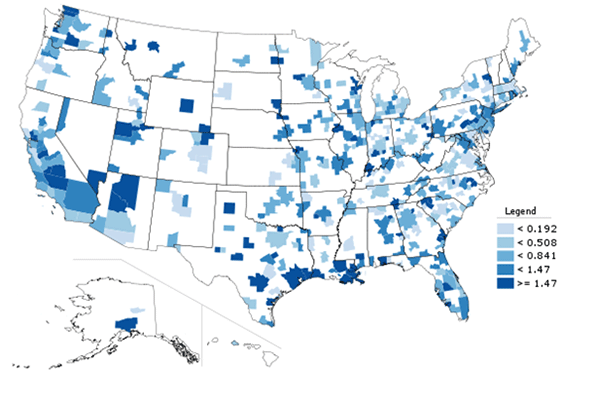
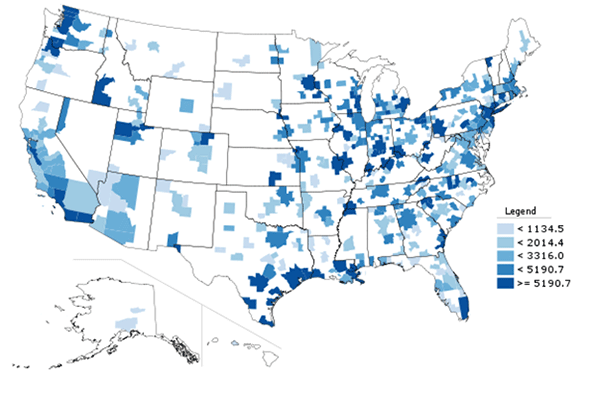
    But perhaps a better measure of the export intensity of an economy is exports per capita. Here’s a map of US metro areas for that metric:


    Map 1: Export dollar value per capita, 2012.

    Here are the top ten metros in America among those with a population greater than one million:

    Rank

    Metro Area

    2012

    1

    New Orleans-Metairie-Kenner, LA

    20209.1

    2

    Houston-Sugar Land-Baytown, TX

    17778.0

    3

    Seattle-Tacoma-Bellevue, WA

    14160.9

    4

    San Jose-Sunnyvale-Santa Clara, CA

    14087.7

    5

    Salt Lake City, UT

    13764.1

    6

    Detroit-Warren-Livonia, MI

    12904.6

    7

    Cincinnati-Middletown, OH-KY-IN

    9312.0

    8

    Portland-Vancouver-Hillsboro, OR-WA

    8881.9

    9

    Memphis, TN-MS-AR

    8522.5

    10

    Miami-Fort Lauderdale-Pompano Beach, FL

    8304.9

    Table 2: Top Ten Large Metros, Dollar Value of Exports Per Capita, 2012

    Here we see that some top exporters like Houston, Seattle, and Miami continue to rank well.  But some smaller metros crack the list like #1 New Orleans (another major petroleum center) and #7 Cincinnati (which has a major GE aircraft engine plant).

    And lastly, here’s a look at the growth in total exports from metro areas over the time period for which data is available:


    Map 2: Percent change in total exports, 2005-2012.

    There was extremely wide variability in the growth rates of exports among metro areas. Here is the top 10 for large metro areas:

    Rank

    Metro Area

    2005

    2012

    Percent
    Change

    1

    San Antonio-New Braunfels, TX

    2,346,954,123

    14,010,234,128

    496.95%

    2

    New Orleans-Metairie-Kenner, LA

    4,857,754,172

    24,359,505,265

    401.46%

    3

    Salt Lake City, UT

    3,912,555,433

    15,989,999,420

    308.68%

    4

    Houston-Sugar Land-Baytown, TX

    41,747,920,224

    110,297,753,116

    164.20%

    5

    Las Vegas-Paradise, NV

    716,805,170

    1,811,480,065

    152.72%

    6

    Birmingham-Hoover, AL

    796,241,450

    1,939,217,017

    143.55%

    7

    Washington-Arlington-Alexandria, DC-VA-MD-WV

    6,058,364,485

    14,609,712,467

    141.15%

    8

    Raleigh-Cary, NC

    974,832,168

    2,308,052,342

    136.76%

    9

    Miami-Fort Lauderdale-Pompano Beach, FL

    20,382,947,257

    47,858,713,857

    134.80%

    10

    Providence-New Bedford-Fall River, RI-MA

    2,667,670,867

    5,830,785,377

    118.57%

    Table 3: Large metro top ten, Percent change in total exports, 2005-2012.

    San Antonio is the champion, but Houston and New Orleans score well again.  A few unexpected metro areas like Birmingham and Providence, traditionally viewed as economic laggards, appear on the list though these are growing admittedly from small bases. What this does show is that even long struggling metros have a major opportunity to improve themselves through focusing on export growth.

    While there’s a general nod of approval in the direction of boosting exports, few urban strategies seem to focus on it. Rather, sexier items like subsidized real estate development is generally front and center. But given the positive results even struggling cities like Providence have seen with exports, this type of more basic economic blocking and tackling would seem to be a better place to focus.

    Aaron M. Renn is an independent writer on urban affairs and the founder of Telestrian, a data analysis and mapping tool. He writes at The Urbanophile.

    Great Lakes Freighter photo by BigStockPhoto.com.

  • Rahm Emanuel’s Chicago More Violent than Al Capone’s Chicago and the Old West

    Since Rahm Emanuel entered the political scene years ago, he’s been a master at manipulating the press to his benefit. A pliant media has largely gone along with whatever talking point Emanuel desired. Lately, some of the media has begun to put the spotlight on violent Chicago with its rather high murder rate. Banning or restricting handguns has not been very successful in combatting violence in Chicago.  The website Big Government reports the bloody details:

    After Chicago recorded a terrible homicide total of 53 in August, September wasn’t much better for Rahm’s "world class" city. The city suffered 41 homicides, 30 of which resulted from 184 total shootings

    September brings more bad news for Chicago residents. While Mayor Rahm Emanuel, Police Superintendent Garry McCarthy, and the Chicago media have continued to hammer the point that the "crime rate is down," and "murder is down," as of September 22, the homicide total for 2013 now exceeds the rate up to the same date in 2011 by two percent at 350, according to the Chicago Police Crime Data Portal.

    How does today’s Chicago hold up at the violent memory of Al Capone’s Chicago of the 1920s? Not very well.  WLS-TV investigated the data and the evidence is rather stunning report in February:

    Let’s compare two months: January 1929, leading up to the St. Valentine’s Day Massacre, and last month, January 2013. Forty-two people were killed in Chicago last month, the most in January since 2002, and far worse than the city’s most notorious crime era at the end of the Roaring Twenties.

    Even though the image of Chicago, perpetuated by Hollywood over the years, was that mobsters routinely mowed down people on the streets, the crime stats tell us that we were safer under Capone than Emmanuel. In January 1929 there were 26 killings. Forty-two people were killed in Chicago last month, the most in January since 2002.

    Even though the image of Chicago, perpetuated by Hollywood over the years, was that mobsters routinely mowed down people on the streets, the crime stats tell a different story. The figures from January 2013 are significantly higher than the January of Al Capone’s most famous year.

    It’s not just the Capone era violence that doesn’t hold up to scrutiny. Constantly we hear from the media and advocates of gun control that we don’t want things to become “the Wild West”. In the last several years, historians have begun to look at this long time legend that was promoted by Hollywood movies.  As Ryan McMaken explains:

    Historian Richard Shenkman largely attributes this to the legacy of those reliably-violent Western films. "Many more people have died in Hollywood Westerns than ever died on the real Frontier…[i]n the real Dodge City, for example, there were just five killings in 1878, the most homicidal year in the little town’s Frontier history: scarcely enough to sustain a typical two-hour movie."

    The old West with its minimal government and armed populace has never been too popular with progressives. But, the reality is it was never really violent according to Terry Anderson and Peter Hill. So, the murder rate of the Capone era and Dodge city of 1878 would be a major improvement for Mayor Rahm Emanuel.

    Note: This post was originally incorrectly attributed to Wendell Cox.

  • Driving Alone Dominates 2007-2012 Commuting Trend

    New data from the American Community Survey makes it possible to review the trend in mode of access to employment in the United States over the past five years. This year, 2012, represents the fifth annual installment of complete American Community Survey data. This is also a significant period, because the 2007 was a year before the Lehman Brothers collapse that triggered the Great Financial crisis, while gasoline prices increased about a third between 2007 and 2012.

    National Trends

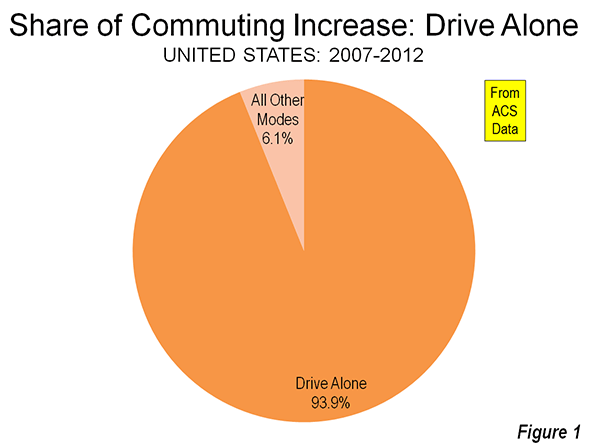
    The work trip access data is shown in Tables 1 and 2. Driving alone continued to dominate commuting, as it has since data was first reported in the 1960 census. In 2007, 76.1 percent of employment access was by driving alone, a figure that rose to 76.3 percent in 2012. Between 2007 and 2012, driving alone accounted for 94 percent of the employment access increase, capturing 1.55 million out of the additional 1.60 million daily one-way trips (Figure 1). The other 50,000 new transit commutes were the final result of increases in working at home, transit and bicycles, minus losses in car pooling and other modes.

    Carpools continued to their long decline, losing share in 43 of the 52 major metropolitan areas. Approximately 810,000 fewer people travel to work by carpools in 2012, which reduced its share from 10.7 percent to 9.7 percent.

    Transit did better, rising from 4.9 percent of work access in 2007 to 5.0 percent in 2012. There was an overall increase of approximately 250,000 transit riders. This increase, however, may be less than might have anticipated in view of the much higher gasoline prices and the imperative for commuters to save money in a more difficult economy.

    Bicycling also did well, rising from a 0.5 percent share in 2007 to a 0.6 percent share in 2012. Approximately 200,000 more people commuted by bicycle by 2012.

    Walking retained its 2.8 percent share, with only a modest 15,000 increase over the period. The largest increase in employment access outside single occupant driving was working at home, which rose from 4.1 percent to 4.4 percent. This translated into an increase of approximately 470,000.

    Metropolitan Area Highlights

    Among the 52 metropolitan areas with more than 1 million population (major metropolitan areas), 47 had drive alone market shares of 70 percent or more. Birmingham was the highest, at 85.6 percent. Surprisingly, this grouping included metropolitan areas with reputations for strong transit ridership, such as Chicago, Philadelphia, and Portland. Four metropolitan areas had drive alone shares of between 60 percent and 70 percent: Seattle, Washington, Boston, and San Francisco, which had the second lowest in the nation at 60.8 percent. As would be expected, New York had by far the lowest drive alone market share at 50.0 percent.

    Consistent with its low drive alone market share, New York led by a large margin the other metropolitan areas in its transit work trip market share. Transit carried 31.1 percent of New York commuters, up nearly a full percentage point from the 30.2 percent in 2007. New York alone accounted for nearly one-half of the growth in transit commuting over the period.

    San Francisco continued to hold onto second place, with a 15.1 percent transit market share, up a full percentage point from 2007. Washington rose to 14.0 percent, up from 13.2 percent in 2007. Boston (11.9 percent) and Chicago (11.0 percent) were the only other major metropolitan areas to achieve a transit work trip market share of more than 10 percent, and were little changed from 2007.

    Working at home continued to increase at a larger percentage rate than any other mode of work access. Four metropolitan areas were tied for the top position in 2012, at 6.4 percent. These included Raleigh, Austin, San Diego, and Portland, all metropolitan areas with a strong high-tech orientation. In San Diego and Portland, where large light rail systems have been developed, working at home is now more popular as a mode of access to work than transit.

    According to 2012 US Census Bureau estimates, the major metropolitan areas comprised 55.2 percent of the national population. These metropolitan areas represented a slightly larger share of total employment, at 57.3 percent. The combined major metropolitan areas also had similar shares to their national population share in each of the employment access modes, ranging from a low of 55.3 percent of communters driving alone to 59.9 percent of walkers. The one exception was transit, where the major metropolitan areas constituted nearly all of commuters, at 90.7 percent, well above their 55.2 percent share of US population (Table 1).

    Table 1
    Distribution of Employment Access (Commuting) by Employment Location: 2012
    SHARE OF WORK ACCESS BY MODE (2012)
      All Employment Drive Alone Car Pool Transit Bike Walk Other Work at Home
    MAJOR METROPOLITAN AREAS 57.3% 55.3% 55.4% 90.7% 59.9% 56.0% 55.6% 59.3%
    Metropolitan Areas with Legacy Cities 17.1% 13.8% 14.4% 65.4% 21.5% 27.8% 18.3% 17.1%
      6 Legacy Cities (see below) 6.0% 2.7% 4.1% 55.1% 12.7% 16.3% 7.8% 4.6%
      Suburban 11.1% 11.1% 10.3% 10.3% 8.8% 11.5% 10.5% 12.6%
      New York Metropolitan Area 6.4% 4.2% 4.5% 39.6% 5.8% 13.6% 8.5% 5.9%
        Legacy City: New York 3.1% 1.0% 1.5% 35.4% 4.2% 9.5% 4.2% 2.5%
        Suburban 3.3% 3.2% 3.0% 4.2% 1.7% 4.1% 4.3% 3.5%
      5 Other Metropolitan Areas with Legacy Cities 10.7% 9.6% 9.9% 25.8% 15.7% 14.2% 9.8% 11.2%
        5 Legacy Cities (CHI, PHI, SF, BOS, WDC) 2.9% 1.7% 2.6% 19.7% 8.5% 6.8% 3.6% 2.1%
        Suburban 7.8% 7.9% 7.3% 6.1% 7.1% 7.5% 6.2% 9.1%
    46 Other Major Metropolitan Areas 40.2% 41.5% 41.0% 25.3% 38.4% 28.2% 37.3% 42.2%
    OUTSIDE MAJOR METROPOLITAN AREAS 42.7% 44.7% 44.6% 9.3% 40.1% 44.0% 44.4% 40.7%
    United States 100% 100% 100% 100% 100% 100% 100% 100%
    Calculated from American Community Survey: 2012 (one year)

    Follow this link to a table containing data for the nation’s major metropolitan areas.

    Commuting Becomes More Concentrated in Legacy Cities

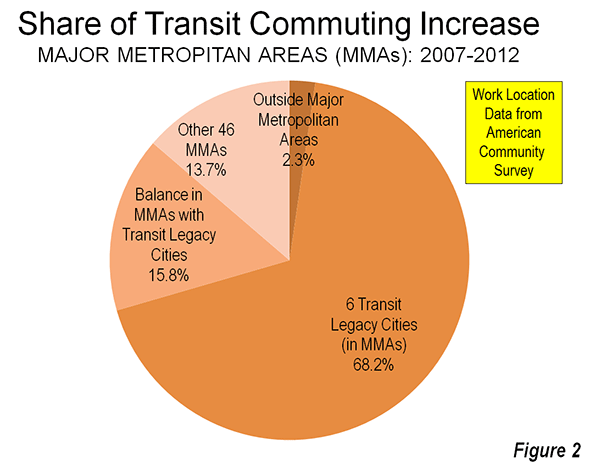
    This concentration of transit commuting was most evident to the six large "transit legacy cities," (the core cities of New York, Chicago, Philadelphia, San Francisco, Boston, and Washington), which still exhibit sufficient remnants of their pre-automobile urban cores that support extraordinarily high transit market shares. The transit legacy cities accounted for 55 percent of all transit commuting destinations in the United States, yet have only six percent of the nation’s jobs. Between 2007 and 2012, the concentration increased, with transit legacy cities accounting 68 percent of the additional transit commutes were between 2007 and 2012. Outside the legacy cities, there was relatively little difference in the share of transit commutes within metropolitan areas with legacy cities and in the other major metropolitan areas (Figure 2)

    The key to the intensive use of transit in the legacy cities is the small pockets of development that are particularly amenable to high transit market shares – the six largest downtown areas (central business districts) in the United States. Most of the commuting to transit legacy cities is to these downtown areas, Yet, the geographical areas of these downtowns is very small. Combined, the six downtown areas are only one-half larger than the land area of Chicago’s O’Hare International Airport. This yields employment per square mile densities of from 40 to 150 times densities of employee residences throughout their respective urban areas.  

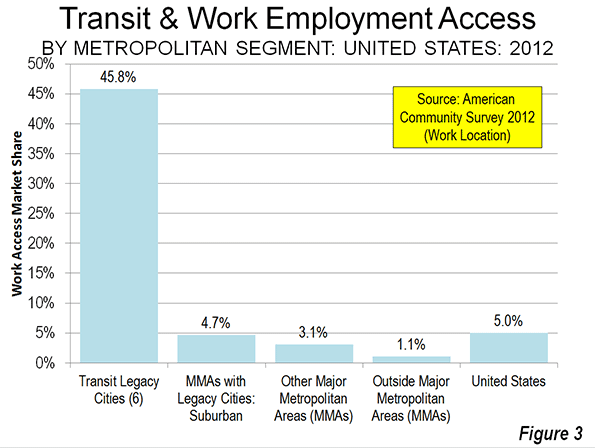
    Not surprisingly, transit has very strong market shares to work locations in the transit legacy cities, at 45.8 percent. At the same time, transit commuting to locations outside the transit legacy cities is generally well below the national average. The exception is New York, where transit commuting to suburban locations is 6.4 percent, above the overall national average of 5.0 percent. In the five other metropolitan areas with transit legacy cities, transit commuting to suburban locations is 3.9 percent. This drops to 3.1 percent, overall, in the 46 other major metropolitan areas and 1.1 percent in the rest of the nation (Table 2 and Figure).

    Table 2
    Employment Access (Commuting) by Employment Location: 2012
      Drive Alone Car Pool Transit Bike Walk Other Work at Home
    MAJOR METROPOLITAN AREAS 73.6% 9.4% 7.9% 0.6% 2.8% 1.2% 4.5%
    Metropolitan Areas with Legacy Cities 61.7% 8.2% 19.2% 0.8% 4.6% 1.3% 4.4%
      6 Legacy Cities (see below) 33.9% 6.5% 45.8% 1.3% 7.6% 1.6% 3.3%
      Suburban 76.8% 9.1% 4.7% 0.5% 2.9% 1.1% 5.0%
      New York Metropolitan Area 50.0% 6.8% 31.1% 0.6% 6.0% 1.6% 4.1%
        Legacy City: New York 23.7% 4.6% 57.1% 0.8% 8.6% 1.6% 3.5%
        Suburban 74.8% 8.9% 6.4% 0.3% 3.5% 1.6% 4.6%
      5 Other Metropolitan Areas with Legacy Cities 68.6% 9.0% 12.1% 0.9% 3.7% 1.1% 4.6%
        5 Legacy Cities (CHI, PHI, SF, BOS, WDC) 44.8% 8.6% 33.7% 1.8% 6.5% 1.5% 3.1%
        Suburban 77.6% 9.1% 3.9% 0.6% 2.7% 1.0% 5.1%
    46 Other Major Metropolitan Areas 78.7% 9.9% 3.1% 0.6% 2.0% 1.1% 4.6%
    OUTSIDE MAJOR METROPOLITAN AREAS 79.9% 10.1% 1.1% 0.6% 2.9% 1.3% 4.2%
    United States 76.3% 9.7% 5.0% 0.6% 2.8% 1.2% 4.4%
    Transit legacy cities include the municipalities of New York, Chicago, Philadelphia, San Francisco, Boston & Washington

    Staying the Same

    The big news in the last five years of commuting data is that virtually nothing has changed. This is remarkable, given the greatest economic reversal in 75 years and continuing gasoline price increases that might have been expected to discourage driving alone. Yet, driving alone continues to increase, while the most cost effective mode of car pooling continued to suffer huge losses, while working at home continued to increase strongly.

    Wendell Cox is a Visiting Professor, Conservatoire National des Arts et Metiers, Paris and the author of “War on the Dream: How Anti-Sprawl Policy Threatens the Quality of Life.

    Photograph: DART light rail train in downtown Dallas (by author)