Blog

  • Bipartisan Distrust of the Beltway

    Much has been written and spoken about the deep divide between “red” and “blue” America, but the real chasm increasingly is between Washington and the rest of the country. This disconnect may increase as both conservatives and liberals outside the Beltway look with growing disdain upon their “leaders” inside the imperial capital. Indeed, according to Gallup, trust among Americans toward the federal government has sunk to historic lows, regarding both foreign and domestic policy.

    The debate over Syria epitomizes this division. For the most part, Washington has been more than willing to entertain another military venture. This includes the Democratic policy establishment. You see notables like Anne Marie Slaughter and the New York Times’ Bill Keller join their onetime rivals among the neoconservative right in railing against resurgent “isolationism” on the Right.

    Yet some people, like the Weekly Standard’s Bill Kristol, who pushed for our disaster in Iraq, now insist that turning away from a Syrian involvement would be “disastrous for the nation in very clear ways.”

    Yet, out in the country, where people, even those who (like me) supported Iraq initially, know that that war was not worth the price, in blood, treasure or damage to national unity. The citizens are not remotely interested in getting a second shot of neoconservative disaster in Syria. A recentCNN poll found that seven in 10 would oppose attacking Bashar al-Assad’s regime without congressional approval, which about 60 percent think Congress should not give.

    This is not a partisan consensus, but an outside-the-Beltway one. Liberals, who might be expected to rally behind their president, have remained deeply divided. At the grass-roots level, both left-wing groups, like Moveon.org, and those on the right, notably Tea Party factions, have opposed entering the Syrian quagmire. One liberal writer, utterly confused by the new alignment, admitted he was looking to the “far-right fringe” with its “abominable” nativist and racist views, to “salvage our Syria policy.”

    Similarly, most conservatives who in the past instinctively supported intervention have turned decisively dovish. Increasingly, as one conservative commentator acidly put it, the support for war reflects “an insider urge to use U.S. military power,” which helps “advance the careers of government officials through bigger budgets, new departments and more exposure and influence.” It also helps the think tanks, consulting firms and others who benefit from foreign adventurism.

    Syria suspicions

    This cynicism, felt on both sides of the political chasm, is what doomed the president’s Syria adventure and left him to the tender mercies of Vladimir Putin. Americans in general, suggests the National Interest’s Robert Merry, have concluded that “the country’s elites – of both political parties and across the political spectrum – have been wrong on just about everything they have done since the end of the Cold War.”

    This chasm between the ruled and the rulers has both widened and deepened during the Obama years. Initially, Democrats supported the idea of a strong federal expansion to improve the economy. Yet, as it turned out, the stimulus and other administration steps did little to help the middle and working classes. The Obama economic policy has turned out to be at least as much – if not more – “trickle down” than that of his Republican predecessor.

    Similarly embarrassing, the administration’s embrace of surveillance, as demonstrated by the National Security Agency revelations, has been no less, and maybe greater, than that of former vice president Dick Cheney and his crew of anti-civil libertarians. And it’s been the Left, notably, the British Guardian newspaper, that has led the fight against the mass abuse of privacy. Americans as a whole are more sympathetic to leaker Edward Snowden and increasingly concerned about government intrusions on their privacy. A July Washington Post-ABC News poll found fully 70 percent of Democrats and 77 percent of Republicans said the NSA’s phone and Internet surveillance programs intrude on some Americans’ privacy rights. Nearly six in 10 political independents who saw intrusions said they are unjustified.

    The Right intrinsically opposes expansion of the civilian part of the federal government, but it supported the national security state both during the Cold War and after 9/11. This has now begun to change. The revelations about IRS targeting of Tea Party and other grass-roots groups likely have not reduced their fears of Big Brother. Yet, by better than 2-1, Democrats, according to a Quinnipiac survey, also supported appointing a special prosecutor to get to the bottom of this scandal.

    Beltway boom-times

    Besides shared concerns over Syria, the NSA and IRS, grass-roots conservatives and liberals increasingly reject the conventional wisdom of their Washington betters. What increasingly matters here is not political “spin,” but the breadth of anti-Washington sentiment. After all, while most of the country continues to suffer low economic growth, the Washington area has benefitted from the expansion of federal power. The entire industry of consultants, think tanks, lawyers and related fields, no matter their supposed ideologies, has waxed while the rest of America has waned.

    This has been a golden era for the nation’s capital, perhaps the one place that never really felt the recession. Of the nation’s 10 richest counties, seven are in the Washington area. In 1969, notes liberal journalist Dylan Matthews, wages in the D.C. region were 12 percent higher than the national average; today, they are 36 percent higher. Matthews ascribes this differential not so much to government per se, but on the huge increase in lobbying, which has nearly doubled over the past decade.

    Matthews draws a liberal conclusion, not much different than one a conservative would make, that “Washington’s economic gain may be coming at the rest of the country’s expense.” Washington may see itself as the new role model for dense American cities but this reflects the fact that it’s one of the few places where educated young people the past five years have been able to get a job that pays well.

    This is intolerable to Americans of differing political persuasions. It is not just a detestation of government but also of the Washington-centered media, which has sent some 20 of its top luminaries into an Obama administration that, at least until recently, has managed to spin them better than any of its predecessors. Not surprisingly, along with that of Congress, themedia’s credibility has been crashing to historic lows, with 60 percent expressing little trust in the fourth estate.

    New generation

    These trends might gain velocity as the millennial generation begins to shape American politics. Indeed, although they have supported Obama against his GOP opponents, their activism is more grass-roots than governmentally oriented. Only 6 percent of recent college graduates want to work for government at any level, down from 8 percent in 2008; barely 2 percent would consider joining the federal workforce.

    As generational chroniclers Mike Hais and Morley Winograd point out, millennials – those born from 1983-2003 – tend to be liberal, but not strongly supportive of top-down, administrative solutions. “Millennials,” Winograd notes, “believe in solving national issues at the local, community level. They are as suspicious of large government bureaucracies as any libertarian but as dedicated to economic equality and social justice as any liberal.”

    Winograd’s notion of “pragmatic idealism” might include dispersing power and influence away from Washington. Perhaps, as some have suggested, putting Congress “on the road,” for example, forcing it to legislate, say, at the convention center in Wilkes-Barre, Pa., or Ontario, Calif. Maybe lawmakers might have to confront what life is like for their subjects, who do not live privileged lives funded by our tax dollars. Instead of croissants in Georgetown, let them eat bread and tortillas.

    Joel Kotkin is executive editor of NewGeography.com and Distinguished Presidential Fellow in Urban Futures at Chapman University, and a member of the editorial board of the Orange County Register. He is author of The City: A Global History and The Next Hundred Million: America in 2050. His most recent study, The Rise of Postfamilialism, has been widely discussed and distributed internationally. He lives in Los Angeles, CA.

    This piece originally appeared at The Orange County Register.

  • California’s New Feudalism Benefits a Few at the Expense of the Multitude

    California has been the source of much innovation, from agribusiness and oil to fashion and the digital world. Historically much richer than the rest of the country, it was also the birthplace, along with Levittown, of the mass-produced suburb, freeways, much of our modern entrepreneurial culture, and of course mass entertainment. For most of a century, for both better and worse, California has defined progress, not only for America but for the world.

    As late as the 80s, California was democratic in a fundamental sense, a place for outsiders and, increasingly, immigrants—roughly 60 percent of the population was considered middle class. Now, instead of a land of opportunity, California has become increasingly feudal. According to recent census estimates,  the state suffers some of the highest levels of inequality in the country. By some estimates, the state’s level of inequality compares with that of such global models as  the Dominican Republic, Gambia, and the Republic of the Congo.

    At the same time, the Golden State now suffers the highest level of poverty in the country—23.5 percent compared to 16 percent nationally—worse than long-term hard luck cases like Mississippi. It is also now home to roughly one-third of the nation’s welfare recipients, almost three times its proportion of the nation’s population.

    Like medieval serfs, increasing numbers of Californians are downwardly mobile, and doing worse than their parents: native born Latinos actually have shorter lifespans than their parents, according to one recent report. Nor are things expected to get better any time soon. According to a recent Hoover Institution survey, most Californians expect their incomes to stagnate in the coming six months, a sense widely shared among the young, whites, Latinos, females, and the less educated.

    Some of these trends can be found nationwide, but they have become pronounced and are metastasizing more quickly in the Golden State. As late as the 80s, the state was about as egalitarian as the rest of the country. Now, for the first time in decades, the middle class is a minority, according to the Public Policy Institute of California.

    The Role of the Tech Oligarchs.

    California produces more new billionaires than any place this side of oligarchic Russia or crony capitalist China. By some estimates the Golden State is home to one out of every nine of the world’s billionaires. In 2011 the state was home to 90 billionaires, 20 more than second place New York and more than twice as many as booming Texas.

    The state’s digital oligarchy, surely without intention, is increasingly driving the state’s lurch towards feudalism. Silicon Valley’s wealth reflects the fortunes of a handful of companies that dominate an information economy that itself is increasingly oligopolistic.  In contrast to the traditionally conservative or libertarian ethos of the entrepreneurial class, the oligarchy is increasingly allied with the nominally populist Democratic Party and its regulatory agenda. Along with the public sector, Hollywood, and their media claque, they present California as “the spiritual inspiration” for modern “progressives” across the country.

    Through their embrace of and financial support for the state’s regulatory regime, the oligarchs have made job creation in non tech-businesses—manufacturing, energy, agriculture—increasingly difficult through “green energy” initiatives that are also sure to boost already high utility costs. One critic, state Democratic Senator Roderick Wright from heavily minority Inglewood, compares the state’s regulatory regime to the “vig” or high interest charged by the Mafia, calling it a major reason for disinvestment in many industries.

    Yet even in Silicon Valley, the expansion of prosperity has been extraordinarily limited. Due to enormous losses suffered in the current tech bubble, tech job creation in Silicon Valley has barely reached its 2000 level. In contrast, previous tech booms, such as the one in the 90s, doubled the ranks of the tech community. Some, like UC Berkeley economist Enrico Moretti, advance the dubious claim that those jobs are more stable than those created in Texas. But even if we concede that point for the moment,  the Valley’s growth primarily benefits its denizens but not most Californians. Since the recession, California remains down something like 500,000 jobs, a 3.5 percent loss, while its Lone Star rival has boosted its employment by a remarkable 931,000, a gain of more than 9 percent.

    Much of this has to do with the changing nature of California’s increasingly elite-driven economy. Back in the 80s and even the 90s, the state’s tech sector produced industrial jobs that sparked prosperity not only in places like Palo Alto, but also in the more hardscrabble areas in San Jose and even inland cities such as Sacramento. The once huge California aerospace industry, centered in Los Angeles, employed hundreds of thousands, not only engineers but skilled technicians, assemblers, and administrators.

    This picture has changed over the past decade. California’s tech manufacturing sector has shrunk, and those employed in Silicon Valley are increasingly well-compensated programmers, engineers and marketers. There has been little growth in good-paying blue collar or even middle management jobs. Since 2001 state production of “middle skill” jobs—those that generally require two years of training after high-school—have grown roughly half as quickly as the national average and one-tenth as fast as similar jobs in arch-rival Texas.

    “The job creation has changed,” says Leslie Parks, a long-time San Jose economic development official. “We used to be the whole food chain and create all sorts of middle class jobs. Now, increasingly, we don’t design the future—we just think about it. That makes some people rich, but not many.”

    In the midst of the current Silicon Valley boom, incomes for local Hispanics and African-Americans, who together account for one third of the population, have actually declined—18 percent for blacks and 5 percent for Latinos between 2009 and 2011, prompting one local booster to admit that “Silicon Valley is two valleys. There is a valley of haves, and a valley of have-nots.”

    The Geography of Inequality

    Geography, caste, and land ownership increasingly distinguish California’s classes from one another. As Silicon Valley, San Francisco, and the wealthier suburbs in the Bay Area have enjoyed steady income growth during the current bubble, much of the state, notes economist Bill Watkins, endures Depression-like conditions, with stretches of poverty more reminiscent of a developing country than the epicenter of advanced capitalism.

    Once you get outside the Bay Area, unemployment in many of the state’s largest counties—Sacramento, Los Angeles, Riverside, San Bernardino, Fresno, and Oakland—soars into the double digits. Indeed, among the 20 American cities with the highest unemployment rates, a remarkable 11 are in California, led by Merced’s mind-boggling 22 percent rate.

    This amounts to what conservative commentator Victor Davis Hanson has labeled “liberal apartheid,” a sharp divide between a well-heeled, mostly white and Asian population located along the California coast, and a largely poor, heavily Latino working class in the interior. But the class divide is also evident within  the large metro areas, despite their huge concentrations of affluent individuals. Los Angeles, for example, has the third highest rate of inequality of the nation’s 51 largest metropolitan areas, and the Bay Area ranks seventh.

    The current surge of California triumphalism, trumpeted mostly by the ruling Democrats and their eastern media allies, seems to ignore the reality faced by residents in many parts of the state. The current surge of wealth among the coastal elites, boosted by rises in property, stock, and other assets, has staved off a much feared state bankruptcy. Yet the the state’s more intractible problems cannot be addressed if growth remains restricted to a handful of favored areas and industries. This will become increasingly clear when, as is inevitable, the current tech and property boom fades, depriving the state of the taxes paid by high income individuals.

    The gap between the oligarchic class and everyone else seems increasingly permanent. A critical component of assuring class mobility, California’s once widely admired public schools were recently ranked near the absolute bottom in the country. Think about this: despite the state’s huge tech sector, California eighth graders scored 47th out of the 51 states in science testing. No wonder Mark Zuckerberg and other oligarchs are so anxious to import “techno coolies” from abroad.

    As in medieval times, land ownership, particularly along the coast, has become increasingly difficult for those not in the upper class. In 2012, four California markets—San Jose, San Francisco, San Diego, and Los Angeles—ranked as the most unaffordable relative to income in the nation. The impact of these prices falls particularly on the poor. According to the Center for Housing Policy and National Housing Conference, 39 percent of working households in the Los Angeles metropolitan area spend more than half their income on housing, as do 35 percent in the San Francisco metro area—both higher than 31 percent in the New York area and well above the national rate of 24 percent. This is likely to get much worse given that California median housing prices rose 31 percent in the year ending May 2013. In the Bay Area the increase was an amazing 43 percent.

    Even skilled workers are affected by these prices. An analysis done for National Core, a major developer of low income housing, found that prices in such areas as Orange County are so high that even a biomedical engineer earning more than $100,000 a year could not afford to buy a home there. This, as well as the unbalanced economy, has weakened California’s hold on aspirational families, something that threatens the very dream that has attracted  millions to the state.

    This is a far cry from the 50s and 60s, when California abounded in new owner-occupied single family homes. Historian Sam Bass Warner suggested that this constituted “the glory of Los Angeles and an expression of its design for living.” Yet today the L.A. home ownership rate, like that of New York, stands at about half the national average of 65 percent. This is particularly true among working class and minority households. Atlanta’s African-American home ownership rate is approximately 40 percent above that of San Jose or Los Angeles, and approximately 50 percent higher than San Francisco.

    This feudalizing trend is likely to worsen due to draconian land regulations that will put the remaining stock of single family houses ever further out of reach, something that seems related to a reduction in child-bearing in the state. As the “Ozzie and Harriet” model erodes, many Californians end up as modern day land serfs, renting and paying someone else’s mortgage. If they seek to start a family, their tendency is to look elsewhere, ironically even in places such as Oklahoma and Texas, places that once sent eager migrants to the Golden State.

    Breaking Down the New Feudalism: The Emerging Class Structure

    The emerging class structure of neo-feudalism, like its European and Asian antecedents, is far more complex than simply a matter of the gilded “them” and the broad “us.” To work as a system, as we can now see in California, we need to understand the broader, more divergent class structure that is emerging.

    The Oligarchs: The swelling number of billionaires in the state, particularly in Silicon Valley, has enhanced power that is emerging into something like the old aristocratic French second estate. Through public advocacy and philanthropy, the oligarchs have tended to embrace California’s “green” agenda, with a very negative impact on traditional industries such as manufacturing, agriculture, energy, and construction. Like the aristocrats who saw all value in land, and dismissed other commerce as unworthy, they believe all value belongs to those who own the increasingly abstracted information revolution that has made them so fabulously rich.

    The  Clerisy: The Oligarchs may have the money, but by themselves they cannot control a huge state like California, much less America. Gentry domination requires allies with a broader social base and their own political power. In the Middle Ages, this role was played largely by the church; in today’s hyper-secular America, the job of shaping the masses has fallen to the government apparat, the professoriat, and the media, which together constitute our new Clerisy. The Clerisy generally defines societal priorities, defends “right-thinking” oligarchs, and chastises those, like traditional energy companies, that deviate from their theology.

    The New Serfs: If current trends continue, the fastest growing class will be the permanently property-less. This group includes welfare recipients and other government dependents but also the far more numerous working poor. In the past, the working poor had reasonable aspirations for a better life, epitomized by property ownership or better prospects for their children. Now, with increasingly little prospect of advancement, California’s serfs depend on the Clerisy to produce benefits making their permanent impoverishment less gruesome. This sad result remains inevitable as long as the state’s economy bifurcates between a small high-wage, tech-oriented sector, and an expanding number of lower wage jobs in hospitality, health services, and personal service jobs. As a result, the working class, stunted in their drive to achieve the California dream, now represents the largest portion of domestic migrants out of the state.

    The Yeomanry: In neo-feudalist California, the biggest losers tend to be the old private sector middle class. This includes largely small business owners, professionals, and skilled workers in traditional industries most targeted by regulatory shifts and higher taxes. Once catered to by both parties, the yeomanry have become increasingly irrelevant as California has evolved into a one-party state where the ruling Democrats have achieved a potentially permanent, sizable majority consisting largely of the clerisy and the serf class, and funded by the oligarchs. Unable to influence government and largely disdained by the clerisy, these middle income Californians are becoming a permanent outsider group, much like the old Third Estate in early medieval times, forced to pay ever higher taxes as well as soaring utility bills and required to follow regulations imposed by people who often have little use for their “middle class” suburban values.

    The Political Implications of Neo-Feudalism

    As Marx, among others, has suggested, class structures contain within them the seeds of their dissolution. In New York, a city that is arguably as feudal as anything in California, the  emergence of mayoral candidate Bill de Blasio reflected growing  antagonism—particularly among the remaining yeoman and serf class— towards the gentry urbanism epitomized by Mayor Michael “Luxury City” Bloomberg.

    Yet except for occasional rumbling from the left, neo-feudalism likely represents the future. Certainly in California, Gov. Jerry Brown, a former Jesuit with the intellectual and political skills needed to oversee a neo-feudal society, remains all but unassailable politically. If Brown, or his policies, are to be contested, the challenge will likely come from left-wing activists who find his policies insufficiently supportive of the spending demanded by the clerisy and the serfs or insufficiently zealous in their pursuit of environmental purity.

    The economy in California and elsewhere likely will determine the viability of neo-feudalism. If a weaker economy forces state and local government budget cutbacks, there could be a bruising conflict as the various classes fight over diminishing spoils. But it’s perhaps more likely that we will see enough slow growth so that Brown will be able to keep both the clerisy and the serfs sufficiently satisfied. If that is the case, the new feudal system could shape the evolution of the American class structure for decades to come.

    Joel Kotkin is executive editor of NewGeography.com and Distinguished Presidential Fellow in Urban Futures at Chapman University, and a member of the editorial board of the Orange County Register. He is author of The City: A Global History and The Next Hundred Million: America in 2050. His most recent study, The Rise of Postfamilialism, has been widely discussed and distributed internationally. He lives in Los Angeles, CA.

    This piece originally appeared at The Daily Beast.


  • You Say You Want A (Metropolitan) Revolution?

    [Book Review] The Metropolitan Revolution: How Cities and Metros Are Fixing Our Broken Politics and Fragile Economy, by Bruce Katz and Jennifer Bradley. 2013, Brookings Focus Book

    It’s now decades after deindustrialization, and several years since the Great Recession supposedly ended. Yet too many American cities are still struggling to recover from the losses of jobs, population, taxes, and identities. Detroit’s declaration of bankruptcy in July drew new attention to the problem, and it helped fuel the extensive marketing campaign for The Metropolitan Revolution: How Cities and Metros Are Fixing Our Broken Politics and Fragile Economy by Bruce Katz and Jennifer Bradley of the Brookings Institution, published just a few weeks earlier. The book quickly became a cause célèbre garnering high praise from various media outlets.

    Katz and Bradley highlight the emergence of “trading metros” with “innovation districts,” clusters of universities and local businesses, hospitals, museums, and advanced technology and manufacturing industries held together regionally with housing, retail and transit networks that seem to promise a better economic future. The book’s strength lies in its attention to metros, rather than cities, as the unit of urban settlement and economics. The authors encourage planners and government officials to develop new strategies based on “Emergent Metros” rather than “Legacy Cities.”

    This attention to metropolitan areas is welcome, but the book’s outline of the future is overly optimistic. Describing deindustrialization and disinvestment as part of an evolutionary process and a “revolution unleashed” is hyperbole reminiscent of Atlas Shrugged. More critically, The Metropolitan Revolution can be read as a neoliberal sales pitch. In fact, Katz and Bradley have “doubled down” on an approach that has not only dominated economic thought since the 1980s, but that has actually contributed to the urban crisis today.

    Neoliberal theory hypothesizes that small government, deregulation, global production networks, free trade agreements, labor market flexibility, abandonment of full employment policy, cost shifting, and capital mobility improve corporate competitiveness and unleash the entrepreneurial spirit, and increase productivity. These ideas have been applied to corporate restructuring over the last 30 years, informing changes like downsizing, outsourcing, and rightsizing. In another example, neoliberals argued that the housing bubble and the subsequent Great Recession resulted from federal government intervention in the housing market, which encouraged home ownership for the unqualified, and from a national liberal monetary policy. Even when neoliberal economic policies have failed, proponents have continued their unwavering critique of “big government” and regulations.

    Using the language of neoliberalism and corporate restructuring, Katz and Bradley write that the metropolitan revolution is “exploding the tired construct” about the role of the federal government. Now, they say, it is the cities and metro areas that “are becoming the leaders in the nation: experimenting, taking risks, making hard choices and asking for forgiveness not permission.” Their metropolitan revolution sees power relations being restructured, as metros and cities take greater responsibility for their economic growth, and as federal government power devolves: “The metropolitan revolution has only one logical conclusion: the inversion of the hierarchy of power in the US.” But, we should ask, inversion for whom? Their examples all seem to suggest shifts from elected government officials to unelected business and economic leaders and non-governmental organizations.

    Katz and Bradley borrow heavily from neoliberal architects who claimed that, in the corporate world, restructuring would result in greater local and regional cooperation and in independence for the new businesses on which future growth would be based. But corporate restructuring promised more than it delivered, as corporations were downsized, outsourced, and resource starved. Instead of cooperation, restructuring often led to an increase in internal predatory activity and greater control by corporate headquarters, under the rubric of the ‘survival of the fittest’.

    Much like the early supporters of corporate restructuring, Katz and Bradley make an overly optimistic case, citing cherry-picked metros that seem to have accepted current conditions and neoliberal strategies as part of the natural economic order. But, constrained by state and federal neoliberal defunding policy, cities that lie within metros, especially in the Rust Belt, are hoarding or fighting for resources in a zero sum game of economic and regional development. Just as in the corporate sector, local and regional collaborations are largely ineffective. As Harvard economist Stephan Marlin has suggested, it may be that thinking like an economist can undermine a real sense of community.

    Rather than Katz and Bradley’s view of metro areas as collaborative communities on which future growth could be based, we might better see them as urban archipelagos, autonomous islands of self-interest, and rational calculators in a neoliberal sea.

    Northeast Ohio, for example, is an area optimistically viewed by Katz and Bradley. It’s a place where community officials have historically ignored regional economic plans unless they were directly impacted by them. Instead, they pursued localized development efforts, often competing rather than cooperating within a metropolitan region. Greg LeRoy, director of the public policy group Good Jobs First, found that between 1996 and 2005 many small and medium sized firms received lucrative tax breaks to move to new locations… all within the Cleveland metro area. The average distance moved in this metro cannibalization was five miles. A new regional sustainability plan for Northeast Ohio has now been funded by a $4.25 million grant from the US Department of Housing and Urban Development and a consortium of regional foundations. But the plan has garnered only limited support among the 375 cities, townships, and regional agencies in the metro area. Most observers see little chance of the plan being adopted on any meaningful scale.

    Katz and Bradley’s book may end up being more of a distraction than a revolution for many metros. It dilutes the distinctly urban crisis. Racial and class polarization, and growing inequities in education, housing, health care, and infrastructure mark this urban crisis. The book essentially offers platitudes about economic growth for cities and first rings suburbs that have suffered from the neoliberal crisis, rather than offering suggestions for how to rebuild and reclaim urban neighborhoods and schools and prevent further decline. While praising sympathetic NGOs, Katz and Bradley fail to acknowledge the populist revolt in many metros, cities, and neighborhoods. In fact, they are contemptuous of grass-roots efforts such as the Occupy Movement. Their census-defined metropolitan revolution is “reasoned rather than emotional, leader driven rather than leaderless, born of pragmatism and optimism rather than despair or anger.” Despite claims to the contrary, the book is another indicator the economic divergence between Main Street and Wall Street.

    John Russo is a visiting research fellow at the Metropolitan Institute of Virginia Tech, a former co-director of the Center for Working-Class Studies, and professor (emeritus) in the Williamson College of Business Administration at Youngstown State University. He is a board member of the Mahoning Valley Organizing Collaborative (Youngstown-Warren), and the co-author, with Sherry Linkon, of Steeltown U.S.A.: Work and Memory in Youngstown.

  • The Unrise of the Creative Working Class

    Scarcity leads to creativity out of necessity. That’s the pop culture meme at least. Think “starving artist,” or the survivors in Survivor. The thinking has penetrated the business culture as well. For example, in the shadow of the 2008 recession, Google founder Sergey Brin, in a letter to his shareholders, writes: “I am optimistic about the future, because I believe scarcity breeds clarity: it focuses minds, forcing people to think creatively and rise to the challenge.”

    But a recent book, Scarcity: Why Having Too Little Means So Much, by Ivy League psychologists Sendhil Mullainathan and Eldar Shafir, states otherwise. Through years of investigative research, the authors found that people operating from a bandwidth of scarcity don’t have the luxury of preemptive thought. Rather, being in survivor mode saps a person’s cognitive reserve.

    “Think about being hungry,” says Shafir in a piece in Pacific Standard. “If you’re hungry, that’s what you think about. You don’t have to strain for years—the minute you’re hungry, that’s where your mind goes.” The mental preoccupation extends to unpaid utility bills, debt, or, more generally, anything that’s life-pressing, he adds. The effect drains resources from a person’s “proactive memory”.

    Think of the absence of scarcity, then, as the freedom to think, visualize, and create. The results of Mullainathan and Shafir’s findings have implications for cities. Specifically, it’s widely theorized that cities must innovate to survive, and it is a city’s creative reservoir—which is dependent on the size of its educated workforce—that will nurture innovation. This is how  a city of soot can evolve into a city of software, not unlike what has occurred in Pittsburgh.

    But what about  Rust Belt cities struggling with high rates of poverty? Over 36 percent of Detroit’s 700,000 plus are below the poverty line. In Cleveland, the poverty rate is 33 percent of nearly 400,000. The national poverty rate is 14 percent.  This is a ridiculous amount of brain capacity consumed by unforgiving reality.  No wonder Detroit inches to get a leg up. The feral dogs, abandoned houses, and creditors looking for money have eaten up the capability to envision. Hence, the collective exasperation, and the bankruptcy death spiral.

    What will save the Clevelands and Detroits? The most prescribed cure is to find a way to attract more educated people. This has led cities across the country to compete for the vaunted “creative class” professional demographic. To urban theorist Richard Florida, to get creative types a city must have “[an] indigenous street-level culture – a teeming blend of cafes, sidewalk musicians, and small galleries and bistros, where it is hard to draw the line between participant and observer or between creativity and its creators.”

    According to Florida, a city needs to know it is on stage,and compete for the attention of a select demographic. In theatre parlance, this is called “capturing the audience experience.”  In urban place-making parlance it is called  “principles of persuasion” that emphasize novelty, contrast, surprise, color, etc.

    Robin_Williams_779552

    In other words, cities must become the collective embodiment of Robin Williams.

    Then, once you get your audience, you just watch them go,  says Florida, as creativity is “a social process.”  Creativity is bred by “the presence of other creative people.”  The scarcity of creativity in a poor city hypothetically gets filled up by the big-bang spontaneity of two creative types talking, neurologically egged on, no doubt, by a festival performer on stilts in a clown suit sauntering before them.

    If this strategy sounds like an overly simplified way to change what ails Detroit and Cleveland, it’s because it is. In fact Florida himself acknowledged this, stating in Atlantic Cities that, “On close inspection, talent clustering provides little in the way of trickle-down benefits [to the poor].”  In fact, because housing costs rise, it  makes the lives of lower- and middle-income people worse.

    But cities keep revitalizing this way because it is a feel-good prescription that is politically palatable. Who hates art, carnivals, drinking, and eating?  Displays of abundance provide the incentive to look the other way. Writes Thomas Sewell, “The first lesson of economics is scarcity: There is never enough of anything to satisfy all those who want it. The first lesson of politics is to disregard the first lesson of economics”.

    Where does that leave the millions operating on the wrong side of scarcity? Florida’s answer is for cities to somehow convince corporate America to pay their service workers more. While admirable, I doubt Daniel Schwartz, CEO of Burger King, is listening.

    Another option would be refocusing the lens through which modern urban revitalization is viewed. The default setting is to compete for scarcity of the educated elite. Instead, we should alleviate the scarcity from the struggling.  But flipping this script requires cities to give up on the idea that there is some audience that will save them. It is a city’s people who ultimately ruin or save themselves.

    In the meantime, the urban play continues. Cleveland is directing $4 million dollars of its casino windfall profits into the creation of an outdoor chandelier  that will hang at an intersection outside of Playhouse Square, the city’s theater district. The design, evoked by chandeliers inside the Playhouse itself, is intended to blur the line between drama and reality, and will “add glittery outdoor glamour to a district that tends at times to look gray and lifeless,”  according to architecture critic Steven Litt–all the while making the intersection “feel like a giant theater lobby”.

    But the script on Cleveland’s streets is one of hardship, not glittery glamour. Here’s hoping the outdoor chandelier illuminates that scarcity to those walking beneath it.

    This piece was originally published in Belt Magazine.

    Richey Piiparinen is a writer and policy researcher based in Cleveland. He is co-editor of Rust Belt Chic: The Cleveland Anthology. Read more from him at his blog and at Rust Belt Chic.

    Lead photo by David Shvartsman.

  • Congratulations Senator Bob Day

    Congratulations to Bob Day, who was elected as a federal Senator from South Australia. Day was one of six Senators elected from the state in the September 7 election. While most of the seats in the lower house of Parliament were quickly decided, the Senate seats too considerably longer under Australia’s preferential voting system. According to the Australian Broadcasting Company, Day’s election and that of the other five Senators was confirmed on October 2.

    Day is an ultimate entrepreneur, having founded Home Australia and related companies that has emerged as a leading home builder across the nation. He served a term as President of the Housing Industry Association. Day has also been a newgeography.com author, writing a piece on one of his passions, the importance of restoring housing affordability in Australia (see The Land Premium that’s Punishing Property).

  • Norway Breaks with Social Democracy

    Largely uncommented on in the US press, Europe’s long-standing social democratic tilt has changed. During recent years, almost all Western European nations have seen a dramatic fall in support for the traditional Social Democratic parties, which for so long have dominated the political landscapes. In response, the centre-left parties have morphed, moving towards greater emphasis on the benefits of free markets and individual responsibility. In several countries the former communist parties now claim that they fill the role of traditional Social Democrats. A new breed of modernized centre-left parties is likely to replace several centre‑right governments during coming years. The third consecutive loss for the German Social Democrats illustrates the continuing difficulties for Europe’s labor movements to gather the strong support that they previously almost took for granted.

    Until recently oil-rich Norway has remained unique, as the only nation where Social Democrats have resisted change to highly generous welfare benefits. In 1999 the former Swedish social democratic minister of business, Björn Rosengren, famously called Norway “the last Soviet state” due to the lack of willingness to adopt market policies. But now even Norway is shifting with the recent election of a centre‑right government formed by Erna Solberg. Making the transition from a full-scale welfare state to a system which consistently rewards work more than public handouts will be a difficult one for Norway. Hopefully, the newly elected government will draw inspiration from the neighbor to the east.
    Politicians in Norway for long admired the Swedish social system, seeing their larger neighbor as a pioneer of Social Democratic policies.

    Recently however, particularly the left has begun to emphasize the uniqueness of the Norwegian Welfare Model rather than the Scandinavian Welfare Model. Swedish policies have even been used in the recent election as deterrence by the left. It is easy to see why. The current centre-right government in Sweden, elected in 2006 and re‑elected in 2010, has focused on a broad reform agenda. The workfare policies introduced include: somewhat less generous benefits, tax reductions aimed particularly at those with lower incomes, liberalizations of the temporary employment contracts and a gate-keeping mechanism for receiving sick and disability benefits.

    The policies have successfully addressed the problem of overutilization of welfare benefits. The number of those on sick leave in Sweden has fallen from around 212,000 individuals in 2005 to 136,000 in 2012. At the same time, the number of individuals on early retirement has fallen from 557,000 to 378,000. If we look at the total share supported by various government benefits, we can see that this figure has been reduced from 25 to 16 percent of the working age population between 2005 and 2012 (adjusted to full‑time equivalents). Not a bad feat given that the period has been shaped by the global economic downturn.

    Until recently, Norway has continued on the path of very generous public handouts. Contrary to Sweden, overutilization of welfare systems has thus continued in Norway. Erna Solberg utilized this fact to criticize the Social Democratic policies during the recent election campaign. Solberg noted that the working age population which depends on welfare benefits has increased slightly from 31.2 percent in the beginning of 2006 to 31.7 percent in the beginning of 2013. After adjusting the figures to full‑time equivalents, and thus making them more comparable to the Swedish data given above, the Norwegian magazine Aftenposten calculates that the share has been stable around 20 percent of the population since 2005.

    By relying on workfare policies, Sweden has thus gone from having considerably more to quite less dependency on public handouts.  It should be noted that both countries are very healthy. The high share on sick benefits, disability benefits and early retirement is not a sign of bad health. Rather, it is a combination of overutilization of welfare systems by segments of the population at one hand, and of the willingness of politicians to hide the true unemployment by classifying individuals as outside the labor force on the other hand.

    The difference between the more work-fare oriented Sweden and the more welfare oriented Norway are also seen in the number of hours worked. Swedes on average spend 14 percent more hours working than their neighbors to the west. (In fact, as my brother has shown, in terms of hours worked per working age adult, Sweden has recently even outpaced the US). Particularly young Norwegians are considered to have a notoriously weak working ethic, while Swedish workers are highly praised in Norway. Interestingly, since Norway has such significant oil resources, the countries welfare state is supported by lower taxes than Sweden. Clearly, overly generous welfare systems will create welfare dependency even when combined with more moderate tax levels.

    Norway remains, in many regards, one of the most affluent nations in the world thanks to its oil‑wealth. But whilst Sweden and Denmark have introduced significant market reforms during recent decades (Denmark recently even ranked slightly above the US in the Heritage/WSJ index of economic freedom), Norway has resisted change. It is of course an exaggeration to call Norway “the last Soviet state”, although this notion remains popular in Sweden.

    A more nuanced perspective is that although Norway has yet to introduce market liberalizations which promote competition, reduce state involvement in the economy and promote workfare policies, it seems headed in this direction. Norwegians can continue to afford an overly generous welfare system. But they have good reasons to be concerned over the social and economic consequences that follow long‑term welfare dependency and deterioration of the work ethic. Like many other European systems, Norway has much to gain in bringing in more emphasis on individual responsibility and free markets in the traditional Social Democratic system.

    Dr. Nima Sanandaji has written two books about women’s carreer opportunities in Sweden, and has recently published the report “The Equality Dilemma” for Finnish think-tank Libera.


    Bergen Norway photo by Jim Trodel.

  • The Growing Public Safety Inequality Gap in Chicago

    Take a look at the two maps below. Like the captions say, the one on the left shows homicide rates in Chicago by police district in the early 90s, when crime was at its peak, and the one on the right shows the same thing, but about two decades later.* The areas in dark green are the safest; the ones in dark pink are the most dangerous. The colors are calibrated so that green areas are safer than average for the early 90s, and pink ones are more dangerous than average for the early 90s. The 2008-2011 map keeps the same calibration: green is safe compared to the early 90s, so that you can see change in the levels of violence over time.

    And, indeed, the first thing that jumps out from these maps is that there’s way more green nowadays, and it tends to be darker. The city is way safer! Some areas we might consider a bit dicey today – like, say, the Lawndale/Little Village area – actually register as light green, meaning that by early 90s standards, they would be considered relatively safe.

    HOMICIDE RATE BY POLICE DISTRICT

    Hom90 hom20

    1990-1993 2008-2011

    [For those of you craving numbers, the murder rate averaged 30 per 100k during the first period, and 17 per 100k during the second, a decline of nearly 50%.]

    Of course, the other thing we notice is that there are some very distinct patterns to safety. These maps are breaking exactly no news by indicating that the more dangerous parts of the city are on the West and South Sides, but it is striking, I think, to see that nowadays, basically the entire North Side is the darkest green, which translates to a homicide rate of less than 6 per 100k. In fact, the dark-green part of the city has a murder rate of 3.3 per 100k.

    Three point three. In New York City, which is constantly (and mostly correctly) being held up as proof that urban safety miracles can happen in America, it’s 6.3. Toronto, which as far as North American big cities go occupies a fairy tale land where no one hurts anybody, had a homicide rate of 3.3 per 100k as recently as 2007. The North Side is unbelievably safe, at least as far as murder goes.

    But there are none of the darkest green on the West or South Sides. There’s actually a fair amount of pink, meaning places that are relatively dangerous even by the terrifying standards of the early 90s.

    This raises a question: Has the great Crime Decline benefited the whole city equally? Are the South and West Sides still relatively dangerous because they started from such a bad place, or because they haven’t seen nearly as much of a decline as the North Side has?

    Here is the answer in another map:

    CHANGE IN HOMICIDE RATE, EARLY 90s – LATE 2000s

    Murderchange

    The areas in darkest green saw the greatest decline; red means the murder rate actually increased.

    So: Yes, the great Crime Decline is a fickle thing. The North Side saw huge decreases (in Rogers Park, it was over 80%) pretty much everywhere; the few areas that are lighter green were the safest in the city to begin with. The parts of the South and West Sides closest to downtown – Bronzeville, the West Loop, Pilsen, etc. – got a lot safer. But most of the rest actually got worse, including some neighborhoods that were already among the most dangerous in the city, like Englewood and Garfield Park.

    This is a complicated state of affairs, and probably goes at least part of the way to explaining why, in the face of a 50% decrease in homicides citywide over the last two decades, many people persist in believing that the opposite is true: because in their neighborhoods, it is. It’s a dynamic that defies an easy narrative, and makes me slightly less angry (though only slightly) at all those journalists who have written in the last year or two about murder in Chicago without mentioning that the city is, in fact, safer on the whole than it has been in fifty years.

    Here is one final pair of maps:

    RATIO OF POLICE DISTRICT HOMICIDE RATE TO CITY AVERAGE

    Homicideratios90s homicideratio2

    1990-1993 2008-2011

    This is slightly less intuitive. These maps show the how the homicide rate in any given police district compares to the citywide average, using ratios; for example, if the homicide rate in West Town is 10 per 100k, and citywide it’s 5 per 100k, West Town’s ratio is 2 to 1. If West Town were 2.5 per 100k, its ratio would be 0.5 to 1. (Obviously the numbers in these examples are made up.) Blue areas have ratios below 1, and so are relatively safe; red ones above 1, and are relatively dangerous.

    With the help of these maps, I’m going to ignore what I said about all this defying an easy narrative, and try to supply one: Over the last twenty years, at the same time as overall crime has declined, the inequality of violence in Chicago has skyrocketed. The pattern of what’s blue and what’s red in each map is mostly the same; I count only three out of twenty-five districts that switched from one color to another. But the colors are much darker in the 2000s than they were in the 1990s. There have always been safer and more dangerous areas here, as there are everywhere; but the gap between them is way, way bigger now than it used to be.

    Numbers will help this case. Imagine that for each of these two time periods, we cut the city into equal thirds: one contains the most dangerous neighborhoods; another, the safest; and the last, everything else. In the early 90s, the most dangerous third of the city had about six times as many murders as the safest third. By the late 2000s, the most dangerous part of the city had nearly fifteen times more homicides than the safest third.

    In addition, here are two charts (click to enlarge):

    HomRatio90

    Homratio20

    The divergence is self-evident. The early 90s look very roughly like a normal curve: most neighborhoods are in the middle, and there’s a clear, if slightly bumpy, slope down towards the extremes.

    Today, any semblance of a normal curve has been annihilated. Or, actually, that’s not quite right. Now it looks like there might be two completely separate normal curves, one with a peak at 0.2-0.4, and the other peaking at 3.1-4. Plus a few guys who got lost in the middle.

    I suppose there are many, many things that one might say about what this means, but here’s the bottom line: The disadvantages and tragedies that people in “dangerous” neighborhoods experience are both absolute and relative. The death of an innocent person** is an indescribable loss no matter what. And, on that count, things are somewhat better for Chicago’s most violent areas: the homicide rate for the most dangerous third of the city declined from 51 to 39 per 100k in the time period we’ve looked at here. That is a real accomplishment, and hundreds, if not thousands, of people are still with their families and friends because of it.

    But in other ways, it does matter if other parts of the city are getting safer much, much faster. When people weigh safety in their decisions about where to live, they do so by comparing: How much safety am I gaining by living in one neighborhood versus another? The same is true of entrepreneurs considering where to open their next business. The same is true of tourists looking to explore the city. The same is true of locals looking to travel to another neighborhood to eat out or go shopping.

    On every one of those counts, the disadvantages that are accruing to already-disadvantaged neighborhoods in terms of lost population, investment, and connections to the rest of the city are now much more severe. The hurdles are that much higher.

    That’s bad for those physical neighborhoods. It’s also terrible for the people who have good reasons to live there, like social networks, nearby family, or the affordability of real estate.

    Because I don’t have the data in front of me, but who would doubt that over these same twenty years, there has also been a growing gap between how much it costs to live on the safe North Side compared to the more dangerous parts of the South and West Sides? Who would doubt that, as the North Side reaches Toronto-level peacefulness, the cost of rent has greatly diminished the number of apartments there affordable to the poor and working class?

    In other words, just as the stakes have been tripled as to whether you live in Relatively Safe Chicago or Relatively Dangerous Chicago, it has become much, much harder to establish yourself on the winning side.

    So: Next time you hear someone talking about “record violence” in the city, tell them that actually, murders are down almost 50% from twenty years ago. And then tell them that what’sreally alarming is murder inequality.

    * Why does this data end in 2011? Because I made these maps using data from the Chicago Police Department annual reports, which are available online, and which only broke down crimes by police district in the 1990s. In 2012, the police district boundaries changed, making it not quite an apples-to-apples comparison to prior years. Maybe somewhere data exists by Community Area for the early 90s, and then I could redo all of this.

    ** And I think reporting like that done by This American Life at Harper High in Englewood ought to challenge conventional middle-class ideas about “innocence” in the ghetto. It is very easy for those who don’t live in the neighborhood to talk about “thugs” and “gangsters” getting what they deserve. It is also very cruel, and very naive about what exactly “gangs” are, and what kind of people join one, and how, and why.

    This post originally appeared in City Notes on August 5, 2013. Daniel Hertz is a masters student at the Harris School of Public Policy at the University of Chicago.

    Chicago photo by Bigstock.

  • Our Federal Government: “There You Go Again!”

    Remember this?

    The fact remains that Congress has not passed a real federal budget since 1997 (“the first balanced budget in a generation”.) An “omnibus spending bill” was passed in April of 2009 but that is not technically a budget.

    Congressional inaction has left the federal government running on extensions (“Continuing Resolutions”) of a budget that was passed when Bill Gates was still CEO of Microsoft, NASA landed the first spacecraft on Mars, and Google was working out of a garage. The last federal budget is from the time before iPods and iPads, before SPAM e-mail exceeded legitimate email, before Facebook, YouTube and Twitter – and before the global financial crisis that sent the world into recession and US federal spending into the stratosphere.

    (“This is Your Government on Crack,” by Susanne Trimbath 02/12/2013).

    As one very famous Republican President said (repeatedly in his defeat of Jimmy Carter): “There you go again!”

    And, sure, this isn’t the first time the federal government has shut down for lack of spending authorization. I remember when my elderly mother and her sisters – first generation Americans eager to see the place where their parents disembarked after their long ocean voyage from Sicily – were so disappointed to find Ellis Island and the Status of Liberty closed that October of 1996.

    The big difference this time is the way government is spending – which I discuss in detail in the article quoted above. USAToday has an article that summarizes just how different the government operates today than it did 17 years ago. There is a big reason Republicans might want to re-think shutting down the government. According to USAToday, gun permits cannot be issued while the federal government is closed.

    Let’s hope one thing is the same in 2013 as it was in 1996 – when they re-opened the government Congress passed a real budget.

  • What Conservatives Can Teach Liberals About Global Warming Policy

    Over the last decade, progressives have successfully painted conservative climate skepticism as the major stumbling block to reducing greenhouse gas emissions. Exxon and the Koch brothers, the story goes, fund conservative think tanks to sow doubt about climate change and block legislative action. As evidence mounts that anthropogenic global warming is underway, conservatives’ flight from reason is putting us all at risk.

    This week’s release of a new United Nations Intergovernmental Panel on Climate Change report opens another front in the climate wars. But beneath the bellowing, name-calling, and cherry-picking of data that have become the hallmark of contemporary climate politics lies a paradox: the energy technologies favored by the climate-skeptical Right are doing far more to reduce greenhouse gas emissions than the ones favored by the climate-apocalyptic Left.

    How much more? Max Luke of Breakthrough Institute ran the numbers and found that, since 1950, natural gas and nuclear prevented 36 times more carbon emissions than wind, solar, and geothermal. Nuclear avoided the creation of 28 billion tons of carbon dioxide, natural gas 26 billion, and geothermal, wind, and solar just 1.5 billion.

    Environmental leaders who blame “global warming deniers” for preventing emissions reductions point to Germany’s move away from nuclear and to renewables. “Germany is the one big country that’s taken this crisis seriously,” wrote Bill McKibben. Other progressive and green leaders, including Al Gore, Bill Clinton, and Bobby Kennedy, Jr., have held up Germany’s “energy turn,” theEnergiewende, as a model for the world. 

    But for the second year in a row, Germany has seen its coal use and carbon emissions rise — a fact that climate skeptical conservatives have been quick to point out, and liberal environmental advocates have attempted to obfuscate. “Last year, Germany’s solar panels produced about 18 terawatt-hours (that’s 18 trillion watt-hours) of electricity,” noted Robert Bryce from the conservative Manhattan Institute. “And yet, [utility] RWE’s new coal plant, which has less than a 10th as much capacity as Germany’s solar sector, will, by itself, produce about 16 terawatt-hours of electricity.

    Reagan historian Steven Hayward, formerly of the American Enterprise Institute, noted in the conservative Weekly Standard earlier this week, “Coal consumption wentup 3.9 percent in Germany last year. Likewise, German greenhouse gas emissions — the chief object of Energiewende — rose in Germany last year, while they fell in the United States.”

    Emissions fell in the United States thanks largely to a technology loathed by the Left:fracking. From 2007 to 2012, electricity from natural gas increased from 21.6 to 30.4 percent, while electricity from coal declined from 50 to 38 percent — that’s light speed in a notoriously slow-changing sector. And yet the Natural Resources Defense Council, Sierra Club, and most other green groups are working to oppose the expansion of natural gas.

    Hayward and Bryce are two of the most respected writers on energy and the environment on the Right. Both are highly skeptical that global warming poses a major threat. Both regularly criticize climate scientists and climate models. Both men are regularly attacked by liberal organizations like Media Matters for working for organizations, the American Enterprise Institute and Manhattan Institute, respectively, that have taken money from both Exxon and the Koch brothers. And yet both men are full-throated advocates for what Bryce calls “N2N” — accelerating the transition from coal to natural gas and then to nuclear.

    Arguably, the climate-energy paradox is a bigger problem for the Left than the Right. One cannot logically claim that carbon emissions pose a catastrophic threat to human civilization and then oppose the only two technologies capable of immediately and significantly reducing them. And yet this is precisely the position of Al Gore, Bill McKibben, the Sierra Club, NRDC, and the bulk of the environmental movement.

    By contrast, there are plenty of good reasons for climate skeptics to support N2N. A diverse portfolio of energy sources that are cheap, abundant, reliable, and increasingly clean is good for the economy and strengthens national security – all the more so in a world where energy demand will likely quadruple by the end of the century.

    Why then is there so much climate skepticism on the Right? One obvious reason is that climate science has long been deployed by liberals and environmentalists to argue not only for their preferred energy technologies but also for sweeping new regulatory powers for the federal government and the United Nations.

    But here as well, the green agenda hasn’t fared well. Those nations that most rapidly reduced the carbon intensity of their economies over the last 40 years did so neither through regulations nor international agreements. Nations like France and Sweden, which President Obama rightly singled out for praise earlier this month, did so by directly deploying nuclear and hydroelectric power. Now the United States is the global climate leader, despite having neither a carbon price nor emissions trading, thanks to 35 years of public-private investment leading to the shale gas revolution. Meanwhile, there is little evidence that caps and carbon taxes have had much impact on emissions anywhere.

    In the end, both Left and Right reject a more pragmatic approach to the climate issue out of fear that doing so might conflict with their idealized visions for the future. Conservatives embrace N2N as a laissez-faire outcome of the free market in the face of overwhelming evidence that neither nuclear nor gas would be viable today had it not been for substantial taxpayer support. Progressives seized on global warming as an existential threat to human civilization because they believed it justified a transition to the energy technologies – decentralized renewables – that they have wanted since the sixties.

    The Left, in these ways, has been every bit as guilty as the Right of engaging in “post-truth” climate politics. Consider New Yorker writer Ryan Lizza’s glowing profile of Tom Steyer, the billionaire bankrolling the anti-Keystone campaign. After Lizza suggested that Steyer and his brother Tom might be the Koch brothers of environmentalism, Steyer objects.  The difference, he insists, is that while the Koch brothers are after profit, he is trying to save the world.

    It is telling that neither Lizza nor his editors felt it necessary to point out that Steyer is a major investor in renewables and stands to profit from his political advocacy as well. Clearly, Steyer is also motivated by green ideology. But it is hard to argue that the Koch brothers haven’t been equally motivated by their libertarian ideology. The two have funded libertarian causes since the 1970s and, notably, were among the minority of major energy interests who opposed cap and trade. Fossil energy interests concerned about protecting their profits, including the country’s two largest coal utilities, mostly chose to game the proposed emissions trading system rather than oppose it as the Koch brothers did.

    As Kathleen Higgins argues in a new essay for Breakthrough Journal, it’s high time for progressives to get back in touch with the liberal tradition of tolerance, and pluralism. “Progressives seeking to govern and change society,” she writes, should attempt to “see the world from the standpoint of their fiercest opponents. Taking multiple perspectives into account might alert us to more sites of possible intervention and prime us for creative formulations of alternative possibilities for concerted responses to our problems.”

    As Left and Right spend the next week slugging it out over what the climate science does or does not tell us, we would do well to remember that science cannot tell us what to do. Making decisions in a democracy requires understanding and tolerating, not attacking and demonizing, values and viewpoints different from our own.

    Conservatives have important things to say when it comes to energy, whether or not they think of it as climate policy. Liberals would do well to start listening. 

  • Canada: Suburban, Automobile Oriented Nation

    Canada is even more a suburban nation than generally thought, according to new research that digs deeper than the usual core city versus suburbs distinctions. Researchers at Queen’s University in Kingston, Ontario have announced groundbreaking research that disaggregates 33 census metropolitan areas into four classifications: (1) urban core, (2) transit oriented suburban, (3) automobile oriented suburban and (4) exurban lifestyles, which are also automobile oriented. The findings were made available to canada.com and will be published during the autumn in an academic journal.

    Suburbs and Urban Cores: The Complexities

    Professor David Gordon, director of the School of Urban and Regional Planning at Queen’s University summarized the research as indicating that “Canada is a suburban nation.” This may be surprising, the core cities of Canada represent a larger share of their metropolitan area population than is common in the United States. However, the core city versus suburban (outside the core city) classification substantially understates the suburban and automobile oriented nature of Canada’s metropolitan areas. This definition has long since become obsolete with the substantial annexations of suburban areas by Calgary and Edmonton and the forced consolidations of Toronto, Montréal (parts of which were reversed) and Ottawa.

    Even the core city of Vancouver, which has had essentially the same boundaries for at least 60 years, contains considerable expanses of suburbanization beyond its urban core. The core city of Toronto contains large areas of suburban development, such as in Scarborough, North York and Etobikote. The same is true of the core cities of Calgary, Edmonton and Ottawa and the ville de Montréal.

    To get around this difficulty, we used federal electoral district data to do an early analysis of urban core versus suburban growth when the 2011 census data was released. Our findings were that the greatest share of growth had been in suburban areas (See: Special Report: Census 2011: Urban Dispersion in Canada). The Queens University researchers went considerably deeper, and showed that 95 percent of metropolitan area growth had been in suburban areas between 2006 and 2011, a somewhat higher figure than the 93 percent suburban growth derived from the federal electoral district data (federal electoral districts are smaller than the large core cities).

    The Queen’s University Approach

    Gordon and the research team divided metropolitan areas into the four classifications at the census tract level. The census tract level is ideal for this type of analysis, because it is the closest approximation to the neighborhood. The Gordon et al analysis is thus finely grained, and may be virtually unprecedented in the world.

    The research uses criteria developed from journey to work mode data (such as transit, walking, cycling and automobile) and residential densities. Gordon et al called their urban core classification "active core," to note the greater dependence of residents on walking and cycling for commuting to work. They divided suburban areas into transit and auto suburban areas, and designated the rural areas of metropolitan areas as exurban (Note).

    The findings may be surprising to those retro-urbanists who hold Canada up as a planning model. When urbanization is examined at the neighborhood level, little of the metropolitan population actually follows    the urban core model. Overall, the average urban core constitutes approximately 12% of the metropolitan area. This varies little by population category.

    In describing the results, Gordon noted that there is a tendency to “overestimate the importance of the highly visible downtown cores and underestimate the vast growth happening in the suburban edges.” This is especially evident in the largest metropolitan areas.

    Major Metropolitan Areas

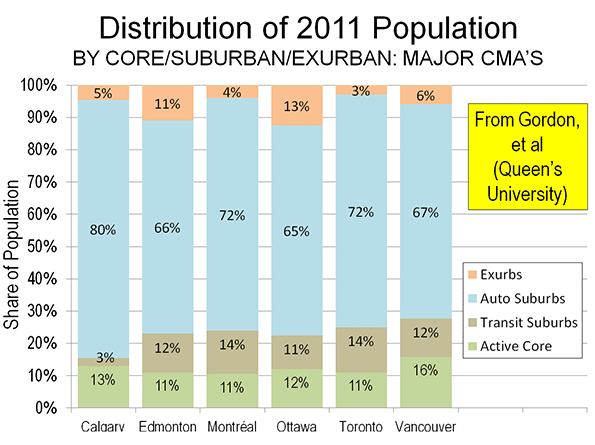
    Among the six major metropolitan areas (those with more than 1 million population), the urban cores also average 12 percent of the population (Figure).


    In relative terms, Vancouver has the largest urban core, at 16% of its population, followed by Calgary with 13% of its population. Toronto, Montréal and Edmonton all have urban cores with approximately 11% of their population, while Ottawa, which is both in Ontario and Quebec, stands at 12%. This means that the major metropolitan areas are, on average, 88% suburban or exurban.

    There is also relative consistency with respect to the populations of the transit oriented suburban areas. The largest are in Toronto and Montréal, at 14%. Vancouver and Edmonton have 12% of their populations in transit oriented suburban areas and Ottawa 11%. However, transit’s reach is much less in Calgary, where the transit suburbs have only 3% of the population.

    Calgary was the most automobile oriented of the major metropolitan areas, with 85 percent of residents living in automobile suburbs and exurbs. But other major metropolitan areas were not far behind, ranging from 73 percent in Vancouver to 78 percent in Ottawa, with Toronto Montréal and Edmonton in between.

    Smaller Metropolitan Areas

    Generally, the level of suburbanization was similar even in the smaller metropolitan areas. Interestingly, Gordon’s method did not require an urban core. This is illustrated by the Abbotsford (BC), where there no urban core is reported. Abbotsford is located in the Fraser River Valley, east of the Vancouver metropolitan area. Abbotsford developed in recent decades and, as a result, is so automobile oriented that the Queen’s University researchers do not even find a transit oriented suburb.

    Further, there were two instances of transit suburban areas being oriented toward urban cores outside their own metropolitan areas. In Oshawa, to the east of Toronto, a transit suburban area is west of Oshawa’s core, along the GO Transit commuter rail line to Toronto’s Union Station. Similarly, in Hamilton, a transit suburban area is located east of Hamilton’s core, on the GO Transit commuter rail line to Toronto.

    Maps

    The media site canada.com has also published A Country of Suburbs  with detailed census tract level maps for each of the metropolitan areas. There are also articles on each of the major metropolitan areas.

    Professor Gordon and his associates have pioneered a new, far more detailed method of analyzing the lifestyle components of the modern metropolitan area. They deserve credit for their objectiveness and attention to detail. Similar analysis is needed in other high income world nations.

    ——

    Note: Metropolitan areas always include rural areas – areas that are not urban. This is because metropolitan areas are employment market areas and people invariably commute from outside the population center (formerly called the urban area by Statistics Canada). The rural areas of metropolitan areas are far larger in geography than population centers or urban areas.

    Photograph: Centre Block, Parliament Hill: Ottawa (by author)

    This has been adapted from an article published at Frontier Centre for Public Policy Notes.