Blog

  • Democratic “Upstairs-Downstairs” Coalition at Risk

    Michael Bloomberg’s passing from New York City Hall, and his likely replacement as mayor by a fire-breathing populist Democrat, Bill de Blasio, marks a historic shift, not just in urban politics but, potentially, also national politics. For 20 years, under first Rudy Giuliani and then Bloomberg, New Yorkers accepted a form of “trickle down economics” where Wall Street riches flowed into city coffers and kept Gotham, at least on the surface, humming and solvent.

    That period ended with Tuesday’s election, and with it, the unraveling of one of the great contradictions in modern American politics: the melding of liberalism with a plutocratic elite. Bloomberg epitomized this synthesis, and with his departure, the formula of blending social and “luxury city” liberalism now appears to have run its course. Bloomberg himself appears to have realized the jig could be up, last weekend accusing de Blasio of running a racist campaign based on “class warfare.”

    But for the American Left, now emerging from its Obamian slumbers, de Blasio’s focus on class has also turned him into a national hero. The Nation hails de Blasio as the harbinger of “the rebirth of economic liberalism.” He has won the backing of the magazine’s influential publisher, Katrina van den Heuvel, as well maverick plutocrat-progressive George Soros and former Vermont Gov. Howard Dean.

    To be sure, class warfare has made de Blasio. His plans to raise more taxes from the rich appeals both to the middle class and, more importantly, to the poor and near poor. Those last two groups account for nearly half the “luxury city’s” population. The same middle class New Yorkers who may have voted for a hard-edged Republican, like Giuliani, or a pragmatic billionaire, like Bloomberg, when they feared for their lives and simply wanted the city cleaned up. They now are more concerned with economic issues. De Blasio was the one New York politician to understand the sea change.

    “This election is not going to be about crime, as some previous elections were,” de Blasio told National Journal last month. “It used to be, in New York you worried about getting mugged. But today’s mugging is economic. Can you afford your rent?”

    His argument is sticking, in large part, because perhaps nowhere are the limitations of gentry urbanism so obvious as in New York. The wealth of Wall Street, protected by the tax code and bathed in Bernanke bucks, has expanded inequality. As Wall Streeters have partied, most New Yorkers have not done well. Indeed, according to a recent study by University of Washington demographer Richard Morrill, the once-proudly egalitarian city has become the most unequal big city in the country, worse even than the most racially divided, historically underdeveloped Southeast.

    Here are the facts. In New York, the top 1 percent earns roughly twice as much of the local GDP than is earned in the rest of country. Yet, controlling for costs, the average paycheck is among the lowest in the nation’s 51 largest metro areas, behind not only San Jose, but Houston, Raleigh, N.C., and a host of less-celebrated burgs. There’s only so much middle-class families can do when the cost of living in Manhattan is twice the national average, and the median Manhattan apartment price about $4,000 a month. These economic facts, not crime or mayhem in the streets, explains why, since 2000, the region has lost the most net domestic migrants – some 1.9 million – in the country, sending along $50 billion elsewhere, almost $15 billion in household income just to Florida, the most common destination.

    National leftward shift

    The de Blasio triumph is not solely a New York story. Nationally, this opens a new chapter in the evolution of the American Left. If de Blasio continues his surge and becomes the first openly leftist New York mayor in a generation, the pressure to shift Democratic Party politics to the left could become as inexorable as the Tea Party’s shove to the right has been for the Republicans.

    Like the Republican schism, about which much has been written, the reason for the Democratic lurch to the left is grounded in class realities. In the GOP case, the Tea Party derives support from largely unconnected middle- and working-class Republicans, as opposed to country club or corporate types. For its part, the modern Democratic Party fuses two dissimilar groups: the “upstairs” well-educated gentry, with their urbanist and green politics, and the broader, but less-influential “downstairs” working-class element, concerned about jobs, making more money and likely aspiring to own a home in the suburbs.

    Now that they don’t have to toe the line for another Obama presidential run, leftist Democrats, including what’s left of the labor movement, are less compelled to defend his economic record. Under the current administration, already-troublesome income inequality in the country has been accelerating, to the benefit primarily of the vilified 1 percent. Race, which has served as a rallying cry for both white liberal and minority Democratic voters, likely will lose some of its appeal now that the first African-American president will not appear on the ballot.

    Conflicts loom

    This conflict between populist and gentry factions figures to arise over a host of issues in months to come. One looming issue may be the Keystone XL pipeline, favored by most private-sector unions, but vehemently opposed by greens and their gentry allies. President Obama may find that parts of his party, particularly in the inland West, the Great Plains, Louisiana and Appalachia, care more about jobs than environmental purity.

    Another flash point may emerge over who Obama will choose as head of the Federal Reserve. Wall Street favors Larry Summers, a convenient ally to Obama, whose relations with high finance are complicated by his occasional flights of populist fancy. But, big-business ties and Summers’ role in deregulation during the Clinton era arouse suspicion among more hard-left Congress members; already three left-leaning Democratic senators – Jeff Merkley of Oregon, Sherrod Brown of Ohio and Elizabeth Warren of Massachusetts – appear to oppose a Summers nomination.

    Expect more of this in the future. Some labor unions, including the powerful Teamsters and UNITE, now fear their health care coverage could be sacrificed under Obamacare. The most powerful force in urban Democratic politics, public employees, fear they may be caught between efforts, most notably in Detroit and, possibly, the president’s adopted hometown, Chicago, to revive cities by ransacking their pensions. This may occur even as powerful real estate and corporate interests – primary funders of gentry urbanism – win subsidies from taxpayers for their ambitious plans.

    These contradictions within the Democrats’ unwieldy “upstairs-downstairs” coalition have been papered over for years by focusing on social and racial issues. They were often aided by Republicans, seemingly always looking for ways to alienate persuadable voters. Democrats, like de Blasio, may find that waging class warfare returns more than running on troublesome issues like climate change, guns, hygienic fascism (a Bloomberg specialty) or abortion; in some surveys, a majority of Americans favor some form of redistribution of wealth.

    Unless there is a change in the country’s economic direction, growing inequality could undermine the unnatural marriage of the gentry and the Left. In retrospect, the real political genius of Barack Obama has been to keep this contradictory coalition intact through his image, mastery of media and rhetoric. But, as the post-Bloomberg reality in New York suggests, at some point even the most agile politician can not keep fundamental social conflict swept under the rug forever.

    Joel Kotkin is executive editor of NewGeography.com and Distinguished Presidential Fellow in Urban Futures at Chapman University, and a member of the editorial board of the Orange County Register. He is author of The City: A Global History and The Next Hundred Million: America in 2050. His most recent study, The Rise of Postfamilialism, has been widely discussed and distributed internationally. He lives in Los Angeles, CA.

    This piece originally appeared at The Orange County Register.

    Photo courtesy of Bill de Blasio.
  • The Promise and the Peril of Rust Belt Chic

    What do you do when you’re a post-industrial city fallen on hard times? There’s a sort of default answer in the marketplace that I’ll call for want of a better term the “Standard Model.” The Standard Model more or less tells cities to try to be more like Portland. That is, focus on things like local food, bicycles, public transit, the arts, New Urbanist type real estate development, upscale shopping, microbreweries, coffee shops, etc., etc. The idea seems to be that the Rust Belt city model is a failure and should be chucked in favor of something better. In this model the publicly subsidized real estate project is the preferred economic development strategy. We’ve seen city after city work to create downtown and near-downtown “Green Zones” resembling miniature Chicagos. While these have generated excitement and even attracted some residents (upwards of 4,000 in Cleveland and 3,000 in St. Louis, though these are the high end), they have not fundamentally changed the civic trajectory other than in the largest Tier One type cities. And they likely never will. People who want Standard Model urbanism can find superior versions in many cities that generally boast more robust economies to boot.

    Enter Rust Belt Chic. This approach in theory solves two of the issues plaguing Standard Model urbanism, authenticity and uniqueness. I haven’t seen a crisp definition of what Rust Belt Chic actually is according to its boosters, but Pete Saunders summed up some of the salient points. The three key elements I see, which build upon each other:

    1. Do the Fail. Giving up on the idea of the factories coming back or large scale re-population.

    2. Reject Growth as a Success Marker. This actually aligns it somewhat with the standard model. Traditional signs of civic success such as population and job growth are rejected in favor of items like per capita income, brain gain, etc.

    3. Brashly Embrace the “Rust” in Rust Belt. This extends Do the Fail to actually embrace the civic characteristics failure produced, as well as various quirky legacies of the industrial past such as Pittsburgh potties.

    The best part of Rust Belt Chic is that it understands that you have to be who you are, not who you aren’t. Someone once described a brand as “a promise delivered.” When cities decide that what they are is of no worth or that it can’t succeed in the marketplace, the temptation can then be to try to pretend like they are Portland or some such. Almost invariably in such cases cities end up building towards a false promise they can never deliver. That’s not to say any of the elements of Standard Model urbanism are bad in an of themselves. The problem is that they are basically “best practices” types of things. Just as no company can succeed as nothing but an agglomeration of best practices, no city can either.

    The tendency in Rust Belt cities has been to try to downplay their authentic characteristics in order to try to portray themselves as hip and with it. As I’ve noted before, the one thing most clearly associated with Indianapolis is the Indianapolis 500, yet auto racing plays a fairly small role in how the city tries to sell itself these days.

    Rust Belt Chic is a first attempt at a region deciding no longer to be a passive importer of ideas about what cities should be, but instead trying to chart a path that is rooted in a unique, local history, culture, geography, etc. To the extent that it steers cities away from a purely “me too” strategy towards creating something that has a unique market positioning that’s real to the place and has at least some competitive advantage in the marketplace, Rust Belt Chic is a big win.

    However, as currently constituted, Rust Belt Chic would appear to be limited. In effect, it is really a marketing and to some extent a talent attraction program. Looking at the ironically appropriated trappings of the working man that characterize so much of hipsterdom, Rust Belt Chic says “Hey, we’ve got the real thing.” So rather than drinking PBR ironically, you drink I.C. Light with a more subtle degree of irony (i.e., by pretending that you’re actually drinking it authentically). The term “chic” itself is suggestive of fashion, and thus of artifice.

    What Rust Belt Chic does not do is address any of the core problems of the cities in question, ranging from fiscal crises to corruption to poor business climates to segregation, to say nothing of safe streets, better schools, etc. Maybe that isn’t its aim. But if not, then it would appear to be only one small component of an overall civic strategy, and not an alternative to the Standard Model in its own right. The theory of change it embodies would appear to be that authenticity of place and culture will attract people looking for the real, thus restarting the demographic engine through more population dynamism and ultimately that will percolate into the economy. That’s fine as far as it goes, but it’s insufficient.

    The elevation of authenticity also poses the danger of imprisoning the community in a straitjacket from the past. With “do the fail” and the embrace of decline as part of the culture, Rust Belt Chic deftly side steps some of the worst dangers of the corrosive force of nostalgia. However, the problem with authenticity is that is has to be, well, authentic. And the way that’s normally accomplished is by encasing something in amber, stunting its evolution.

    What Rust Belt Chic needs to be able to do is inform real, substantive change, and to not only unearth the authentic civic character, but updates it for 21st century realities.

    A city I think has done this quite well is Nashville. It would have been tempting for them to see their country music legacy as déclassé, and try to basically pitch themselves as the Portland of the South or some such. Instead, while they have embraced a number of Standard Model approaches – as I said, there’s nothing per se wrong with them – they kept country music as core to their identity. But it isn’t yesterday’s country music or culture. People in Nashville today aren’t sitting around watching Hee Haw reruns. Country music today is as much Hollywood as Hank Williams.

    That’s not to say Nashville disparages its past. Far from it. The old classic country performers are still honored, and their music still respected and listened to. And they see today’s country as linked across time to that of previous generations. So there’s evolution, but with continuity. They very much value their traditions. But they haven’t become imprisoned by them. Also, Nashville happens to have a stellar business climate, far less corruption than your average Rust Belt city, an openness to outsiders, an increasingly diverse population base, and an aggressiveness towards growth missing in most of the Rust Belt. That’s not to say Nashville’s perfect, but they’ve done a pretty good job of updating their authentic culture while backing it up with an actual product that’s functional demographically and economically.

    If Rust Belt Chic wants to reach its potential, it has to be able to do more than unearth and embrace the authentic culture of a place – though that’s important – it needs to be able to inform cultural evolution and also the very real changes in the product (such as Atlanta’s striving to shuck itself of the stigma of racism in the South by becoming the “city too busy to hate” and in the process becoming America’s premier city for blacks) needed to make these cities competitive again.

    Aaron M. Renn is an independent writer on urban affairs and the founder of Telestrian, a data analysis and mapping tool. He writes at The Urbanophile, where this piece originally appeared.

  • America’s Fastest-Growing Counties: The ‘Burbs Are Back

    For nearly a half century, the death of suburbs and exurbs has been prophesied by pundits, urban real-estate interests and their media allies, and they ratcheted up the volume after the housing crash of 2007. The urban periphery was destined to become “the next slums,” Christopher Leinberger wrote in The Atlantic in 2008, while a recent book by Fortune’s Leigh Gallagher, The End of Suburbsclaimed that suburbs and exurbs were on the verge of extinction as people flocked back to dense cities such as New York.

    This has become a matter of faith even among many supposed development professionals. “ There’s a pall being cast on the outer edges,” John McIlwain, a fellow at the Urban Land Institute, told USA Today. “The foreclosures, the vacancies, the uncompleted roads. It’s uncomfortable out there. The glitz is off.”

    Yet an analysis by demographer Wendell Cox of the counties with populations over 100,000 that have gained the most new residents since 2010 tells us something very different: Suburbs and exurbs are making a comeback, something that even the density-obsessed New York Times has been forced to admit. Of the 10 fastest-growing large counties all but two — Orleans Parish, home to the recovering city of New Orleans, and the Texas oil town of Midland— are located in the suburban or exurban fringe of major metropolitan areas.

    Fastest Growiing US Counties: 2010-2012
    Counties over 100,000 Population
    Rank County Equivalent Jurisdiction Growth
    1 Williamson, TX 7.94%
    2 Loudoun, VA 7.87%
    3 Hays, TX 7.56%
    4 Orleans, LA 7.39%
    5 Fort Bend, TX 7.16%
    6 Midland, TX 7.14%
    7 Forsyth, GA 7.07%
    8 Montgomery, TN 7.04%
    9 Prince William, VA 7.04%
    10 Osceola, FL 6.97%


    Not surprisingly several of these fast-growth areas are in burgeoning Texas metro areas. The population of Williamson County, on the outskirts of Austin, has expanded 7.94% since 2010, the strongest growth in the nation over that period. Far from turning into a slum, over the past 25 years the county’s residents have enjoyed the Lone Star state’s fastest rate of income growth and the sixth-highest in the nation. With a strong tech scene – Dell is headquartered in the Williamson town of Round Rock — the county has increased employment by 73% since 2000, the third highest rate in the country.

    Another Austin outer suburb, Hays County, ranks third on our list, with population growth of 7.6% since 2010 and 67% since 2000. Also impressive has been the growth of another Texas exurb, Fort Bend County, to the west of Houston.

    Since 2010 the county’s population has grown 7.2%, and since 2000 employment has increased 78%, in part due to the expansion of energy companies outside Houston. Fort Bend County is now home to 625,000 people, considerably more than the total population of most major core cities, including Atlanta, Cleveland, Baltimore and Portland. Like many of the boom counties, Fort Bend is alsoincreasingly diverse, with a rapidly growing Asian population that is approaching 20% of the total. It is now the unlikely home to one of the nation’s largest Hindu temples.

    In second place is Loudoun County, 25 miles from Washington, D.C., where the population has expanded 7.87% since 2010 and the number of jobs has grown 83% over the past decade. Much of this has come from tech and telecommunications companies, as well as growing numbers of jobs tied to Dulles Airport as well as the nation’s capital.

    They are not on the road to “next slum” status: Loudoun is one of the nation’s wealthiest counties. Another D.C. exurb on our list in ninth place, Prince William County, Va., ranks among America’s 10 wealthiest counties in terms of per capita income.Most of the other fastest-growing counties have a similar profile, attracting large numbers well-educated residents to the fringe of urban regions.

    What these findings demonstrate is that more people aren’t moving “back to the city” but further out. In the last decade in the 51 largest U.S. metropolitan areas, inner cores, within two miles of downtown, gained some 206,000 people,  while locations 20 miles out gained over 8.5 million. Although the recession slowed exurban growth, since 2011, notes Jed Kolko at Trulia, suburbs have continued to grow far faster than inner ring areas as well as downtown. Americans, he concludes, “still love their suburbs.”

    Rather than an inevitable long-range shift, the post-crash slowdown of suburban growth seems to have been largely a response to economic factors. The retro-urbanist dream of eliminating, or at least undermining, suburban alternatives depends very much on maintaining recessionary conditions that discourage relocation, depress housing starts, as well as lowering marriage and birthrates.

    Where incomes are growing along with rapid job growth , suburban and exurban growth tends to be strong.  The metro regions that contain our fastest-growing counties — Austin, Houston, Nashville and Northern Virginia — all epitomize this phenomenon. For example, nearly 80% of all housing growth in greater Houston takes place in the areas west of Beltway 8 (the outer beltway). A similar pattern can be seen in the D.C. area, where the number of units permitted in Loudoun has more than doubled since 2007. In 2012 permit issuances were the highest since 2005, and the vast majority were for either detached or attached single-family houses.

    This doesn’t mean the central areas of  thriving Washington or Houston are in decline; both core areas    enjoy modest population growth not seen in many more hard-pressed cities. But this highly visible and relentlessly promoted growth has not altered the fundamental pattern of faster development on the fringes.  As the economy strengthens, these trends will become evident in other areas.

    It now seems clear that the preference for single-family houses did not change in the recession, but was just stunted by it. With construction starts up again— more than two-thirds single family — this trend is beginning to re-assert itself. Mortgage lending is now at the highest level in five years.

    Indeed suburbia — or sprawl to use the perjorative term — is back even in the anti-suburban stretches of the San Francisco area, where suburban and exurban developers are once again pushing plans to develop new housing for the area’s expanding workforce. In long-suffering areas such as the Inland Empire, east of Los Angeles, there has been a steady housing recovery, leading to talk of new development.

    Other signs suggest that the widely predicted dense city nirvana may need to be put on hold. For example, car sales  — automobiles dominate transportation in most suburbs and exurbs — have been on the upswing, hitting a record in August. And despite predictions that the size of new homes would shrink, the median home size in the country has continued to rise, reaching a record high in 2012.Even shopping malls, long seen as doomed, are experiencing something of a resurgence.

    Demographic forces should accelerate suburban and exurban growth. As the economy has improved, we are starting to see an uptick in the birthrate, and household formation.

    Given the tendency of families to move to suburbs, this should spark further growth there in the future. High-density neighborhoods and the densest U.S. cities may be good for many things, and certain individuals, but not so much for families. During the last decade, suburbs and exurbs accounted for four-fifths of all household growth, a pattern that does not seem likely to change.

    Indeed, what we are seeing now is not the “end of suburbs” but the end of a brief period in which peripheral development was quashed by the severity of the Great Recession. With the return of even modest economic growth, we can expect that most demographic growth will continue to favor suburbs and exurbs, as has been the case for the better part of the last half century.

    This story originally appeared at Forbes.

    Joel Kotkin is executive editor of NewGeography.com and Distinguished Presidential Fellow in Urban Futures at Chapman University, and a member of the editorial board of the Orange County Register. He is author of The City: A Global History and The Next Hundred Million: America in 2050. His most recent study, The Rise of Postfamilialism, has been widely discussed and distributed internationally. He lives in Los Angeles, CA.

    Georgetown, Texas Town Square photo by Jeffrey W. Spencer.

  • Cincinnati: Bridging Downtown and the Suburbs

    One of the most contentious under-the-radar mayoral races heated up in Cincinnati on September 10th, with former city council representative John Cranley surging to a huge 55%-37% primary victory over previously presumed frontrunner Vice Mayor Roxanne Qualls. The primary eliminates minor candidates; now, both Cranley and Qualls are still alive for November’s general election. Cranley’s huge primary victory is a notable development for planners everywhere.

    Cincinnati, long lumped together with many “declining” rust belt cities, is hot on the trail for “solutions” to cope with its dropping municipal population, along with its gaping budget deficit and struggling competitiveness. Many assumed an easy Qualls victory would spur a continuation of the city’s rampant recent investments in a litany of trendy new planning schemes, seen by some as the key to the city’s future. Down the road, a November loss would deal an unexpected blow that would potentially threaten that future

    These schemes include a citywide form-based code, a $130-million streetcar system, the gentrification of two key neighborhoods adjacent to downtown, and a plan to privatize the city’s parking meters in exchange for a $92 million windfall. All of the ideas have all been initiated under the belief that the city needs to grow its population, and that the key to doing so is to make the region stand out nationally. The presumption that the best way to do this is to invest heavily in the core neighborhoods, primarily downtown, presumes that hoards of new residents, especially young graduates will be lured by the array of hip new developments. With the exception of the parking deal, all of these projects were initiated with significant state or federal grants and tax credits.

    As Vice Mayor, Qualls has been one of the most vocal proponents of these efforts. Her particular affinity for the parking and streetcar initiatives as essential to economic development and maintaining regional competitiveness has been a hot topic throughout the election season because Cranley, her opponent, is opposed to them. By contrast, he’s built a campaign around “jobs and core services” to meet the needs of the existing population. And while he hasn’t objected to all of the downtown redevelopment schemes, he’s much more adamantly backing a approach featuring several highway projects, including a major bridge and a new interchange

    The fight for Cincinnati is important not just because it’s a battle over dollars, but because Cincinnati has suddenly become a guinea pig for the broader redevelopment of the Rust Belt. If the city reverses its primary leanings and chooses to move forward on its current path behind Qualls in the general election, it will become perhaps the foremost national testing ground on whether “Portlandization” is the key to growing regions against national competition by kindling latent demand for dense, urban living to their city cores.

    The real dynamism of the region is and will continue to be well outside the Cincinnati core. City leaders have argued that reduction in the pace of the city’s population decline from at least 2 percent every year between 2000 and 2010 down to 0.2 percent between 2010 and 2011 proves that city living really is the future of the area, they simultaneously seem to miss noticing the rapid regional growth that for several decades has dwarfed the relatively minuscule population changes occurring within the city itself.

    The race to claim victory in the rejuvenation of Cincinnati among the “city core” crowd has now spurred a goal to reach 100,000 new residents by 2023, an aspiration that virtually everyone recognizes as extreme. Never in the city’s history has Cincinnati added more than 52,000 residents in a decade, even in its heyday as a national riverboat transportation hub a century and a half ago.

    Coincidentally, as a region, the Cincinnati area hasn’t added fewer than 100,000 new residents since regional statistics became reliably available in the 1950s. In fact, Cincinnati is one of the fastest-growing Rust Belt areas since 1980. The idea of a need to “solve” Cincinnati’s “decline” is inaccurate; it says far more about the aesthetics of saving the city’s central area and shoring up municipal finances than about a benevolent intent to help the city’s broader regional growth, though the latter is typically the stated motive.

    Even more pertinent to the objective of adding population by luring residents from other cities is the fact that between 2000 and 2010 no city in the nation that lost population regionally gained population in its core city or in its central downtown. There is almost no evidence of any city successfully rejuvenating its region through downtown reinvestment. While Cincinnati (the region) has been growing, adding 100,000 people to the city core would do little to increase net demand for the area that the region isn’t providing for already, and would most likely represent a heavily subsidized “redistribution” of people from the region’s outlying cities and towns. While just as good for Cincinnati’s municipal tax rolls, it’s hardly realistic to link that to any sort of push to lure “the talent that every city competes for”.

    Clearly, the growth Cincinnati leaders are seeking is already coming, and in volumes far exceeding their wildest projections. Unfortunately for downtown’s cheerleaders, people choosing to live have overwhelming chosen the densities best found in the suburbs. And while more choice is of course terrific, the development of a mix of densities and housing options should happen naturally, not as the product of the yearnings by some to increase a city’s dwindling piece of the regional pie for financial reasons.

    Lofty talk of a region that needs dynamism downtown to lure talent from other cities, hence more population to help pay for budget deficits, doesn’t really make sense. The talent that wants to come is already coming — it’s just not coming to downtown, and it’s coming at a rapid (for the Rust Belt) rate. Any downtown investment may lure growth from the suburbs, but is unlikely to lure growth from outside.

    While many would contend that luring growth from a city’s own suburbs is a good thing to combat sprawl and undue “suburban flight”, the situation in regional Cincinnati suggests that there really is a happy density that people are choosing, and that people really do like what they’re getting in the suburbs.

    Cincinnati’s suburban growth over the last several decades has far outpaced population loss from the city by taking advantage of the region’s infrastructural assets: developing along the I-75 corridor north to Dayton, and filling the I-275 loop around the city. Contrary to conventional wisdom, neither the growth nor the emerging densities have been radial. The region’s hubs have become less dense, while the more lightly-populated areas around the highways have become more dense. The average difference in the densities of the region’s many cities and towns is dropping rapidly. In other words, outside of the city core, Cincinnati is settling into a comfortable regional density.

    Uniquely well-served by exurban highways, development has continued at these remarkably consistent low densities. There’s been little pressure on home values, and virtually zero formation of any new “nodes” of higher density, all because high-speed highway transportation to the major job centers is quickly accessible from a huge land area, and Dayton and Cincinnati, the region’s two largest job hubs, are only 45 minutes apart. Commute times have stayed shorter in Cincinnati than in nearly all other cities. Congestion is low by national standards, and the profile of transit use as opposed to other means of travel is virtually unchanged.

    Clearly, adequate room and infrastructure exists: the densities emerging in regional Cincinnati reflect broadly emerging preferences for the future of this part of the country. Coincidentally, they also reflect almost exactly the idyllic utopian idea espoused by Frank Lloyd Wright of one family per acre.

    Roger Weber is a city planner specializing in global urban and industrial strategy, urban design, zoning, and real estate. He holds a Master’s degree from the Harvard Graduate School of Design. Research interests include land use, demography, political geography, economics, freight transport, environmental planning, urban design, and architecture.

    Flickr photo of a Cincinnati bridge by Jim Orsini

  • “Unblocking Constipated Planning” in New Zealand

    One of the National Party’s principal objectives since coming to power in New Zealand has been to address that nation’s terribly deteriorated housing affordability problem.  Deputy Prime Minister Bill English explained the problem in his Introduction to the 9th Annual Demographia International Housing Affordability Survey:

    “It costs too much and takes too long to build a house in New Zealand. Land has been made artificially scarce by regulation that locks up land for development. This regulation has made land supply unresponsive to demand. When demand shocks occur, as they did in the mid-2000s in New Zealand and around the world, much of that shock translates to higher prices rather than more houses.”

    In the largest markets (Auckland, Christchurch and Wellington), house prices had doubled relative to incomes over the past two decades, as land prices were driven up by urban containment land-use policies (Note), that severely restrict the supply of land available for new housing. Across New Zealand, this rationing of land has led to the destruction of the competitive supply of land the Brookings Institution economist Anthony Downs says is essential to maintaining housing affordability. The relationship between urban containment policy and higher house prices is documented in a large body of international research. Economists Richard Green and Stephen Malpezzi succinctly summarized the issue:

    “When the supply of any commodity is restricted, the commodity’s price rises. To the extent that land – use, building codes, housing finance, or any other type of regulation is binding, it will worsen housing affordability.”

    On September 5, the government took an important step toward improving housing affordability, with the enactment of ground-breaking land use regulation reform. In the Parliamentary debate, Housing Minister Dr. Nick Smith expressed the imperative for passage by describing the regulatory situation in Auckland, the nation’s largest city (metropolitan area):

    Auckland has just 1,300 sections (lots) currently available for housing. That’s a third of what it had 10 years ago.

    We need 13,000 each year just to keep up with population growth.

    We’ve got a rigid Metropolitan Urban Limit (urban growth boundary) prohibiting any new housing developments beyond the artificial line drawn 15 years ago.

    We’ve got a few lucky land owners sitting on the last few parcels of developable residential land holding prospective homebuyers to ransom.

    Section (lot) prices have trebled and gone up by more than any other part of the housing cost equation.

    We’ve got a convoluted RMA (Resource Management Act) planning system where it takes an average of seven years to get a plan changed by the time you get through all the consultation and appeal processes.

    And even when you get a plan change, it takes an average of another three years to get a consent for a greenfields development and a year for a brownfields development.

    We’ve got a constipated planning system blocking new residential construction and this bill is a laxative to get new houses flowing.

    The passage represents an important step in the campaign by Dr. Smith and the National Party government to improve New Zealand’s housing affordability.

    According to Dr. Smith: “The increased land supply will help take the pressure off the over-heated Auckland housing market and help the economic recovery. It will enable tens of thousands of kiwi families to realise the dream of owning their own home.”

    Housing Accords and Special Housing Areas Act

    The new Housing Accords and Special Housing Areas Act permits the government to establish special housing districts that permit bypassing expensive planning regulations. Initially, the Act will be applied in Auckland, where an urban growth boundary (the “Metropolitan Urban Limit”) has been blamed for driving house prices to more than double their historic relationship to household incomes. Smith indicated that the Act would “over-ride Auckland’s Metropolitan Urban Limit” and that  ”…it would enable low-rise greenfield developments to be consented in six months, when they previously took three years, and low-rise brownfield developments to be consented in three months, when they previously took a year.”

    Smith also noted that support for the act was based on advice from the New Zealand Productivity Commission, the Reserve Bank of New Zealand (the central bank), the Organization for Economic Cooperation and Development (OECD) and the International Monetary Fund (IMF), which have indicated that “increasing supply is crucial to addressing housing affordability.”

    The government intends to move quickly, according to Minister Smith:

    “The main initial focus of the new law would be to enact the Auckland Housing Accord through which it is planned to build 39,000 new houses in a three year period in the Auckland region. Housing Minister Nick Smith says he expects the Auckland Council to approve the accord next Tuesday and is talking about having special housing areas approved by Christmas that would be able to cater for 5000 houses.”

    Housing Affordability in New Zealand

    The housing affordability crisis problem is the most severe in Auckland. The most recent Demographia International Housing Affordability Survey reported that median house prices were 6.7 times median household incomes in 2012 (this is the “median multiple”). This price to income ratio has more than doubled since the early 1990s. This is a particular problem because housing cost is by far the largest element of household budgets in New Zealand (as well as in Australia, Canada and the United States).

    The extent of the problem in Auckland is illustrated by the fact that across the urban growth boundary, values are one-tenth per acre for comparable land, according to research by Dr. Arthur Grimes, Chairman of the Board of Reserve Bank of New Zealand. In a competently governed market, there would be little difference.

    The higher land prices of urban containment also encourages builder “up-market,” to achieve competitive returns on the required larger investments. This is illustrated in New Zealand Productivity Commission research by Guanyu Zheng for the New Zealand Productivity Commission found that the higher prices generated by Auckland’s urban growth boundary were more severe for lower cost housing: “…when the supply of land on the urban periphery is restricted, the price of available residential land rises and new builds tend to be larger and more expensive houses.”

    High house prices are not limited to Auckland. Like in the United Kingdom, where exorbitant house prices occur from depressed Glasgow and Liverpool to dynamic London, house prices are high from the top of North Island to Invercargill in the South, irrespective of the economy.

    The provisions of the Act will also be applied in other more expensive markets in New Zealand. The Minister said: “The Government is also having discussions with other councils in high cost housing areas on how the tools in this law can assist in addressing the housing supply and affordability issues in their communities.”

    The Campaign

    The extent of New Zealand’s housing affordability problem has been known for some time and has been cause for serious concern.

    The long-time Governor of the Reserve Bank, Donald Brash wrote in 2008 that “the one clear factor that separates all of the” affordable and unaffordable housing markets “is the severity of the artificial restraints on the availability of land for residential building.” Later, Brash zeroed in on the cause., which he characterized as the extent to which urban containment policy “has pushed the price of residential land well beyond the reach of far too many New Zealanders.”

    For the last decade, Christchurch’s Hugh Pavletich (co-author of the Demographia International Housing Affordability Surveys) has been drawing attention to the problem: “We are currently paying near double per square metre build costs because of this…”

    More recently, Governor Graeme Wheeler of the Reserve Bank of New Zealand raised concerns about house price increases and implemented stronger loan qualification requirements to cool the market. Similar action was taken by the Bank of Canada last year, though monetary policy is severely limited in reigning in bubbles in the face of regional policies that drive up land prices.

    Moreover, urban containment is a poor strategy for reducing greenhouse gas emissions, because of its exorbitant costs per ton and its meager results.

    Getting Priorities Right

    By these reforms, the New Zealand government has given priority to the quality of life of its households over the more peripheral issues of city form and how people travel. In an increasingly globalized and competitive world, this sends an important signal.

    Wendell Cox is a Visiting Professor, Conservatoire National des Arts et Metiers, Paris and the author of “War on the Dream: How Anti-Sprawl Policy Threatens the Quality of Life.

    —–

    Note: Urban containment is also referred to as “smart growth,” growth management,” “compact cities” and other terms.

    —-

    Photograph: Downtown Auckland (by author)

  • Thinking Outside the Rails on Transit

    To many in the transit business – that is, people who seek to profit from the development and growth of buses, trains and streetcars – Southern California is often seen as a paradise lost, a former bastion of streetcar lines that crossed the region and sparked much of its early development. Today, billions are being spent to revive the region’s transit legacy.

    Like many old ideas that attract fashionable support, this idea, on its surface, is appealing. Yet, in reality, the focus on mass transit, however fashionable, represents part of an expensive, largely misguided and likely doomed attempt to re-engineer the region away from its long-established dispersed, multipolar and auto-dependent form.

    Traditional transit works best when a large number of commuters work in a central district easily accessible by trains or buses. New York and Washington, D.C., where up to 20 percent of the regional workforces labor downtown (the central business district), are ideal for transit. Even in those metropolitan areas, however, the auto is king.

    In contrast, less than 3 percent of Southern Californians work in downtown Los Angeles. Overall, despite all the money sunk into new rail lines around the country, Americans’ transit commuting is overwhelmingly concentrated in a few older “legacy” cities. Altogether, 55 percent of transit work trips are to six core cities: New York, Chicago, Philadelphia, San Francisco, Boston and Washington, and 60 percent of those commutes are to downtown.

    In contrast, in the Los Angeles-Orange County region, barely 6 percent of workers take transit, one-fifth the rate in New York. Yet we’re a bunch of committed strap-hangers compared with Phoenix, Atlanta, Charlotte, N.C., and Dallas-Fort Worth, where, despite surfeits of new trains and streetcars, 2 percent or less of commuters use public transit. Even in Portland, Ore., widely proclaimed the exemplar of new urbanism and transit investment, the percentage of commuters taking transit is less today than in 1980. Portland is now contemplating cutbacks that could eventually eliminate up to 70 percent of its transit service.

    Imposing Past on Future

    This miserable record reflects how trains, a largely 19th century technology, have limited utility in a contemporary setting. Indeed, the only way to make it work, planners insist, is if the population is moved from their low-density neighborhoods to high-density “pack and stack” areas near transit stops, while suburban businesses are dragooned to denser downtown locations. This is the essence of the recently approved Bay Area Plan.

    Although these kinds of strategies have never materially reduced automobile use – the Bay Area Plan itself says automobile use will still increase by 18 percent over 30 years – the bureaucratic logic here is almost Stalinesque in the scope of its social-engineering ambitions. As Bay Area journalist and plan advocate John Wildermuth puts it, people know they should take transit but don’t because it’s very inconvenient. But by forcing three quarters of new residents into dense housing, some with no parking, he reasons, it then will be “easier for them to either give up their cars or, at least, use them a lot less.”

    Yet getting people to change their way of life, as many central planners have discovered, is not as easy as it seems. The highly dispersed San Jose-Silicon Valley area, the economic epicenter of the Bay Area and worldwide information technology, has a commute trip market share barely a third of major metropolitan area average… . Building “one of the longest” light rail systems in the United States in 50 years has barely moved the percentage of transit commuters over the past three decades.

    What the Bay Area Plan will probably accomplish is to boost housing prices ever further out of reach, both in urban areas and in the suburbs. With new single-family development effectively all but banned, prices of homes in the Bay Area already are again rising far faster than the national average and now are approaching two and half times higher, based on income, than in competitor regions such as Salt Lake City, Phoenix, Dallas-Fort Worth, Austin, Tex., Houston or Raleigh, N.C.

    Environmental Imperative?

    Greens and their allies in the high-density housing lobby long have suggested that “peak oil” and rising prices will inevitably drive suburbanites out their cars. But, clearly, recent advances in U.S. oil and natural gas production may have already made this moot. Transit activists increasingly have focused on climate change to justify massive spending on expanding transit and forcing recalcitrant suburbanites from their cars.

    This logic is largely based on the notion that suburbanites must travel greater distances to work. Yet, a study by McKinsey & Co. and the Conference Board found that – largely because of the impact of higher energy standards for cars forecast by the Department of Energy – sufficient greenhouse gas emission reductions can be achieved without reducing driving or necessitate “a shift to denser urban housing.”

    The fundamental limitations of transit in dispersed cities further weakens environmentalists’ claim. Ridership on some transit systems is so sparse that cars are more energy efficient. Then, there’s the oft-mistaken assumption that higher-density housing will reduce congestion and travel. But in multipolar areas like Southern California, traffic congestion and resultant pollution generally becomes worse with higher density.

    There may be other, more technologically savvy ways to reduce emissions and energy use. People have cut automobile use the past three years but their reduced travel is not showing up so much in transit usage, but, rather, is driven by other factors such as unemployment and the high price of gasoline.

    But, arguably the biggest reduction can be traced to the rise of telecommuting. Over the past decade, the country added some 1.7 million telecommuters, almost twice the much-ballyhooed increase of 900,000 transit riders. In Southern California, the number of home-based workers grew 35 percent, three times the increase for transit usage. By 2020, according to projections from demographer Wendell Cox, telecommuting should pass transit, both nationally and in this region, in total numbers.

    What About the Poor?

    Perhaps the most compelling argument for transit stems from serving those populations – the poor, students, minorities – who often lack access to a private car. Yet, for workers in newer cities, public transit often is not an effective alternative. Brookings Institution research indicates that less than 5 percent of the jobs in the Los Angeles and Riverside-San Bernardino areas are within reach of the average employee within 45 minutes, using transit. The figure is less than 10 percent in the San Jose metropolitan area, the same percentage as for cities nationwide. Moreover, 36 percent of entry-level jobs are completely inaccessible by public transit.

    Not surprisingly, roughly three in four poorer workers use cars to get to work. Recent work by University of Southern California researcher Jeff Khau finds that car ownership is positively correlated with job opportunities; no such relationship can be proven with access to transit.

    At the same time, we should look at more-flexible systems, notably, expanded bus and bus rapid transit, which work better in dispersed areas and are less costly. Most rail systems tend to cannibalize most of their riders from existing bus lines, which explains the small net increases in total transit ridership.

    Transit too expensive

    Costs matter, and will become more important as cities and counties face the looming threat of fiscal defaults. In this respect, rail systems essentially steal from other transit – notably, the buses used mostly by the poor – and from hard-pressed city and county general-fund budgets. Gov. Jerry Brown’s outrageously expensive high-speed rail, which will principally serve the affluent, takes this unfairness to an extreme.

    Instead, we should push far more cost-effective ways to provide transportation options, including those from the private sector, such as the successful Megabus, which provides efficient, quicker and far-less expensive transport between cities than either existing rail or short-haul airline flights. USC’s Khau suggests the private sector also could enhance solutions for lower-income commuters through car loans and car-sharing services such as ZipCar and and Lyft, a mobile app that links riders with drivers.

    As we attempt to figure out ways to improve both the environment and people’s economic prospects, innovative 21st century solutions – from telecommuting to car-sharing – may prove more effective than relying on the 19th century technology of rail. We should not blindly follow transit ideology but focus on how to improve people’s mobility in ways other than the overpriced, inefficient and often far-less-equitable solutions being bandied about today.

    Joel Kotkin is executive editor of NewGeography.com and Distinguished Presidential Fellow in Urban Futures at Chapman University, and a member of the editorial board of the Orange County Register. He is author of The City: A Global History and The Next Hundred Million: America in 2050. His most recent study, The Rise of Postfamilialism, has been widely discussed and distributed internationally. He lives in Los Angeles, CA.

    This piece originally appeared at The Orange County Register.

    Photo by biofriendly, Metro Bus Campaign, Los Angeles

  • Is Scandinavia Female Friendly?

    Scandinavia is often hailed as the best place on the planet for women. Yet in reality — despite being frontrunners in gender equality — Nordic countries have not been so successful when judged by women’s career progress.

    A few years ago Professor Alison Wolf, director of Public Services Policy and Management at King’s College, remarked: “the statistics are clear: among young, educated, full-time professionals, being female is no longer a drag on earnings or progress”. Her view is supported by the research of demographer Andrew Beveridge, who has shown that full-time working single women in New York aged 21-30 years went from earning 19 percent less than their male counterparts in 1970 to having the same median income in 2000. Five years later a 17 percent wage gap resurfaced, this time to the favor of the young women. Similar trends have been shown for many metropolitan areas in the US.

    Even when we include smaller cities and the countryside, it is clear that the glass ceiling has been broken by US singles. The latest figures show that the average single American women aged 22-30 earns $27,000 annually, eight percent more than the average single man in the same age group. In the UK figures from the Office for National Statistics show that young women have 2 to 3 percent higher hourly wages than young men.

    Nordic nations are characterized by early labor market entry of women, the least gender-biased attitudes in the world and a culture where men take much of the responsibility for care of children and household work. The emergence of a large public sector has historically played an important role in women’s entry into the labor market. One reason is that many women have found jobs in the public sector. Another is that public services such as childcare facilitate the combination of work and family life. But in the long run, women’s career success has been hampered by the fact that the labor market entry of women has been so intimately connected with public sector monopolies.

    In 1998 the International Labour Organization noted that an unusually gender-segregated labor market had developed in Nordic countries, since many women worked in the public rather than the private sector. The report concluded: “in terms of differences amongst industrialized countries, several studies comment on how Nordic countries, and in particular Sweden, have among the greatest inequalities”. A similar conclusion is reached by Swedish economists Magnus Henrekson and Mikael Stenkula in their paper “Why are there so few female top executives in egalitarian welfare states?”.

    Sweden is a case in point. Much of the progress that women are making throughout the world relates to their success in higher education. Women make up the majority of university students in Sweden. But although Sweden has fully tax-financed higher education, calculations by the OECD show that a young Swedish women opting for higher education will only earn the equivalent of 5,000 U.S. dollars more than if she would have worked right after high school – over her entire lifespan. In the U.S. the corresponding increase in earnings is $75,500. Swedish women who work for public sector monopolies, and monopolies often have a negative premium, as education is simply not sufficiently rewarded to compensate the income lost while in school.

    But change is coming, albeit slowly, in the Nordic nations. Between 2007 and 2011 the share of female Swedish entrepreneurs rose from 18 to 22 percent, partially due to greater opportunities for private businesses in female dominated welfare services such as education and health care. The majority of the new firms in these sectors, which have been opened up for private business as previous public monopolies have been replaced by voucher systems, are run by women. Studies show that increased competition from private firms also pushes up wages and reduces sick-leave for employees.

    The gender equal Nordic societies clearly have the potential to be world leaders also when it comes to women’s success in the business sector. The question is what policies will be used to reach that goal. The state mandated affirmative action which has been in place in Norway has not yet produced a ripple effect – only benefiting a handful of powerful women often filling positions in many boards.

    The market approach taken in Sweden seems a wiser way. Perhaps there is also a good lesson here for the UK. While women do thrive in the private service sector in Britain, women’s entrepreneurship is, similarly to Nordic nations, hampered by public monopolies on welfare services. Opening up these services for private businesses can create a much needed boost for women owned businesses. Reducing women’s reliance on the welfare systems thus seems central for promoting gender equality.

    Dr. Nima Sanandaji has written two books about women’s carreer opportunities in Sweden, and has recently published the report “The Equality Dilemma” for Finnish think-tank Libera.

    Creative commons photo “Flags” by Flickr user miguelb.

  • The Next Urban Crisis, And How We Might Be Able To Avoid It

    Urban boosters are rightly proud of the progress American cities have made since their nadir in the 1970s; Harvard economist Ed Glaeser has gone so far as to proclaim “the triumph of the city.” Yet recent events — notably Detroit’s bankruptcy and the victory of left-wing populist Bill de Blasio in the Democratic primary of the New York mayoral election — suggest that the urban future may prove far more problematic than commonly acknowledged.

    Detroit’s bankruptcy revealed the unsustainable fiscal problems facing most major urban centers, including, most importantly, President Obama’s political base of Chicago. This summer, Moody’s downgraded the Windy City’s credit rating three notches, noting the unsustainable nature of its pension obligations. Some 37 cities have filed for bankruptcy since 2010, most of them small, and as many as 20 others may be on the verge, including larger places like the California cities of Oakland and Fresno, and Providence, R.I.

    My hometown of Los Angeles may not be far behind. Perhaps the most union-dominated big city in America, the City of Angels’ pension obligations have gone from 3% of the city budget a decade ago to 18% last year. They are rising at a phenomenal 25% annual rate, according to a recent report by an independent watchdog, California Common Sense.

    Given this background, the political tides in New York suggest a worsening of the crisis. Thanks to the Bernanke-inspired Wall Street boom, the New York economy has not suffered the extreme fiscal distress of other big cities. But its fiscal condition is far worse than Mayor Michael Bloomberg and his well-oiled media machine might suggest. Under Bloomberg city spending grew 55% while pension costs have grown 300%.

    With de Blasio likely to be the next mayor, we can expect the bleeding to get worse. Many business people rightly fear a de Blasio’s administration will raise taxes in order to meet public employee demands. Faced with financial shortfalls, de Blasio’s response, notes historian Fred Siegel, is likely to be similar to that of his hero, former Mayor David Dinkins, who consistently gave in to public unions and raises taxes.

    But it’s not enough to dismiss de Blasio as a throwback. His victory reveals the depth of a profound social crisis beneath the glitz and glitter of Bloomberg’s luxury city. Similar class and geographic divisions can be seen throughout the country but inequality seems most egregious in New York. A recent analysis of inequality by University of Washington demographer Richard Morrill found New York to be the least egalitarian big metro area in America.

    This is borne out by other research: the New York City comptroller’s office found that the top 1% account for roughly a third of Gotham’s income, twice as high a share as in the rest of the country. Incomes have surged on Wall Street but most New Yorkers — two-thirds of whom are racial minorities — have struggled to keep pace. Controlling for cost, in fact, the New Yorker’s average paycheck is among the lowest among the nation’s 51 largest metro areas. Nearly half the city’s residents, notes theNation, are either below the poverty line or just above it.

    Bloomberg’s policy focus on ultra-dense development geared to Wall Street, the global rich, and the needs of the all-powerful, largely Manhattan real estate community has done very little for the vast majority of New Yorkers. This reality has lent credibility to de Blasio’s “tale of two cities ” stump speech and the growing rejection of Bloomberg’s legacy.

    Not that all of this can be laid at Bloomberg’s feet. New York’s economy has been changing for decades. New York of the 1950s was a manufacturing, trade and fashion superpower, employing hundreds of thousands of middle- and working-class residents. Large corporations employed large numbers of white- and pink-collar workers. This made New York, although always with its extremes, still a very middle- and working-class city.

    New York’s blue-collar economy has withered to a degree unmatched in most other U.S. cities. The port, the city’s original raison d’etre , lost its primacy to Los Angeles-Long Beach by 1980 and now ranks third in cargo value behind Houston-Galveston as well. The manufacturing sector, which employed a million in 1950, has shriveled to 73,000 jobs today (note that a small part of the decline is due to the BLS’ reclassification of some jobs to other sectors, and other statistical changes). Manufacturing employment in NYC has shrunk 39% since 2004, the worst performance of any major metropolitan area.

    A similar, albeit less dramatic decline has occurred in white-collar employment, in part due to the movement of large companies out of the city. In 1960 New York City boasted one out of every four Fortune 500 firms; today there are 46. And even among those keeping their headquarters in Gotham, many have shipped most of their back office operations elsewhere. Employment has even dropped in the “booming” financial sector, down 7.4% since 2007. The big employment gains have been almost entirely concentrated in the low-wage hospitality and retail sectors.

    If inequality is now greater in New York, the overall economic situation in other cities is, if anything, worse. New York at least has Wall Street, media and a constant infusion of wealth from the rest of world to keep its economy going and stave off the bond-holders. Yet even New York’s economy is underperforming its periphery. The city’s unemployment rate is 8.7% while the surrounding suburbs stand at 7.5%. This gap exists in almost all major metropolitan areas ; among the 51 largest metros the core unemployment rate is 8.8 percent compared to 7.1% in the suburbs.

    The gap is wider in other major cities. In the Chicago area, unemployment in the city is 2 percentage points higher than in the suburbs; in Los Angeles, the city unemployment rate is near 12%, three points higher than in suburbs. This, of course, all pales to Detroit where the city jobless rate stands at over 18% compared to 10% in the suburbs.

    Rather than “cure poverty” or export it to the suburbs, as is regularly claimed, cities retain a poverty rate twice as high as in the suburbs. And although hipsters and the global rich dominate media coverage, the vast majority of the population growth in urban cores over the past decade — upward of 80% — has come not from hipsters but the poor.

    These woes have been largely ignored by the press, but, as de Blasio’s primary victory shows, cannot be hidden forever. True, big investments aimed at attracting the “hip and cool” urban element have helped real estate speculators in selected districts, but has precious little positive impact on the neighborhoods where most urbanities reside.

    Unless addressed, the inequality in core cities suggests a similar lurch to the left could be seen in other cities. What is needed now is a new strategy that promotes the kind of broad-based economic growth that would make the urban “triumph” more than an empty one.

    This story originally appeared at Forbes.

    Joel Kotkin is executive editor of NewGeography.com and Distinguished Presidential Fellow in Urban Futures at Chapman University, and a member of the editorial board of the Orange County Register. He is author of The City: A Global History and The Next Hundred Million: America in 2050. His most recent study, The Rise of Postfamilialism, has been widely discussed and distributed internationally. He lives in Los Angeles, CA.

    Photo courtesy of Bill de Blasio.

  • Health, Happiness, and Density

    The proponents of currently fashionable planning doctrines favouring density promulgate a variety of baseless assertions to support their beliefs. These doctrines, which they group under the label of “Smart Growth”, claim, among other things, that from a health and sustainability perspective, the need to increase population densities is imperative.

    With regard to health these high-density advocates have seized upon the obesity epidemic as a reason to advocate squeezing the population into high-density. This is based on a supposition that living in higher densities promotes greater physical activity and thus lower levels of obesity.  They quote studies that show associations between suburban living and higher weight with its adverse health implications. But the weight differences found are minor – in the region of 1 to 3 pounds. Nor do the studies show it is suburban living that has caused this.

    The suburbs, after all, have been with us for 70 years and reached its mature development over 40 years ago. Obesity, on the other hand, is a much more recent phenomenon and is primarily due to people eating too much fattening food.

    Less discussed, however, are other facets to human health and it is important to consider the results of research on the association with high-density living of mental illness, children’s health, respiratory disease, heart attacks, cancer and human happiness.

    A significant health issue relates to the scourge of Mental Illness. There is convincing evidence showing adverse mental health consequences from increasing density.

    A monumental Swedish study of over four million Swedes examined whether a high level of urbanisation (which correlates with density) is associated with an increased risk of developing psychosis and depression. Adjustments were made to cater for individual demographic and socio-economic characteristics. It was found that the rates for psychosis (such as the major brain disorder schizophrenia) were 70% greater for the denser areas. There was also a 16% greater risk of developing depression. The paper discusses various reasons for this finding but the conclusion states: "A high level of urbanisation is associated with increased risk of psychosis and depression".

    Another analysis, in the prestigious journal Nature, discusses urban neural social stress. It states that the incidence of schizophrenia is twice as high in cities. Brain area activity differences associated with urbanisation have been found. There is evidence of a dose-response relationship that probably reflects causation.

    There are adverse mental (and other) health consequences resulting from an absence of green space. After allowing for demographic and socio-economic characteristics, a study of three hundred and fifty thousand people in Holland found that the prevalence of depression and anxiety was significantly greater for those living in areas with only 10% green space in their surroundings compared to those with 90% green space.

    High-density advocates seem most oblivious to the needs of children. Living in high-density restricts children’s physical activity, independent mobility and active play. Many studies find that child development, mental health and physical health are affected. They also find a likely association of high-rise living with behavioural problems.

    An Australian study of bringing up young children in apartments emphasizes resulting activities that are sedentary. It notes there is a lack of safe active play space outside the home – many parks and other public open spaces offer poor security. Frustrated young children falling out of apartment windows can be a tragic consequence. Children enter school with poorly developed social and motor skills. Girls living in high-rise buildings are prone to increased levels of overweight and obesity.

    A British study found that 93% of children living in centrally located high-rise flats had behavioural problems and that this percentage was higher than for children living
    in lower density dwellings. Anti-social behaviour often results. An Austrian study showed disturbances in classroom behaviour higher for children living in multiple-dwelling units compared to those living in lower densities. 

    There is also evidence of other potential health impacts on children living in higher density housing. These include short-sightedness due to restricted length of vision, and diminished auditory discrimination and reading ability due to exposure to noise.

    Air pollution increases with density. This results from higher traffic densities together with less volume of air being available for dilution and dispersion. Nitrogen oxides in this pollution have adverse respiratory effects including airway inflammation in healthy people and increased respiratory symptoms in people with asthma. There is consistent evidence that proximity to busy roads, high traffic density and increased exposure to pollution are linked to a range of respiratory conditions. These can range from severe conditions (such as a higher incidence of death) to minor irritations. Moreover, these respiratory health impacts affect all age groups.

    Several studies relate low birth weight to air pollution. A South Korean report, for example, found the pollutants carbon monoxide, nitrogen dioxide, sulfur dioxide, and total suspended particle concentrations in the first trimester of pregnancy pose significant risk factors for low birth weight.

    Air pollution particulates are associated with killing more people than traffic accidents. Pollutants such as those emitted by vehicles are significantly associated with an increase in the risk of heart attacks and early death.

    Cancer is a major health scourge and a relationship between increased colon cancer, breast cancer and total cancer mortality with population density has been found.

    There is an association between overall Human Happiness and density. Professor Cummins’ Australian Unity Wellbeing Index reports that the happiest electorates have a lower population density. A United States study finds the satisfaction of older adults living in higher density social housing reduces as building height increases and as the number of units increases. By contrast, in lower densities there are higher friendship scores, greater housing satisfaction, and more active participation. This does not apply only to single family houses: Residents of garden apartments have a greater sense of community than residents of high-rise dwellings.

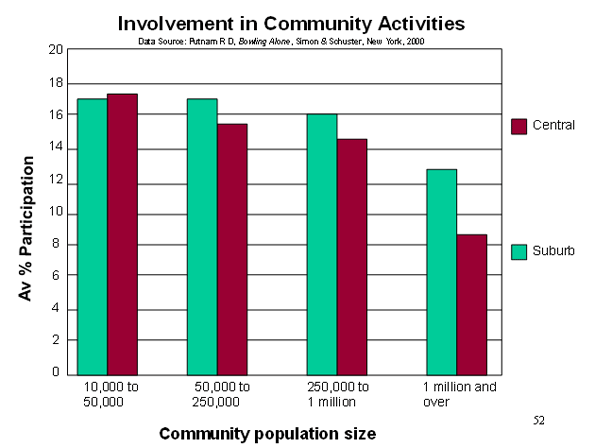
    An example of misinformation on this issue can be found in R.D. Putnam’s famous book “Bowling Alone”.  Putnam states that "suburbanisation, commuting and sprawl" have contributed to the decline in social engagement and social capital.  However I have shown that data from charts in his book indicate quite the opposite:

    Adapted from Figure 50, Putnam R D, Bowling Alone, Simon & Schuster, New York, 2000

    This shows that involvement in these social activities are more common in the suburbs than in the denser centres of cities (and that they become more common as the community size and density decreases).

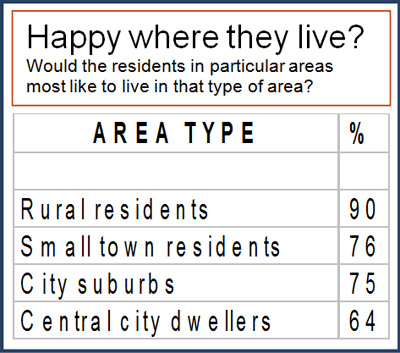
    Community contentment relating to the density of surroundings is revealed by a study in New Zealand that asked people if the type of area they would most prefer to live in is similar to the area they currently live in. The responses are shown in this table.


    So 90% of rural residents would prefer an area similar to their current area but only 64% of central city dwellers would prefer an area similar to their current surroundings.  It can be seen that satisfaction decreases as density increases.

    Thus evidence from a variety of sources points to greater human happiness and better health in lower densities — the exact opposite of the theories of the advocates for “cramming” people into ever small places.

    (Dr) Tony Recsei has a background in chemistry and is an environmental consultant. Since retiring he has taken an interest in community affairs and is president of the Save Our Suburbs community group which opposes over-development forced onto communities by the New South Wales State Government.

    Sydney suburb photo by BigStockPhoto.com.

  • Fast-Growing Mining and Oil & Gas Industries, and the Huge Number of Supply-Chain Jobs They Create

    The fastest-growing industry in the U.S since 2010 isn’t large or well-known. In fact, nearly half of the estimated 5,100 jobs in support activities for metal mining are located in one state: Nevada. Nonetheless, employment in this niche mining industry has ballooned 53% since 2010, and it creates a huge number of supply-chain jobs in other parts of the economy.

    Four of the five fastest-growing industries from 2010-2013, based on EMSI’s 2013.2 employment dataset, are related in some form to mining and oil & gas. These industries (e.g., oil & gas pipeline construction and support activities for oil & gas operations) have been carried by the boom in oil and natural gas production in pockets of the U.S., from North Dakota to Pennsylvania to Texas. And their growth has sparked new jobs in other sectors.

    This is especially the case for support activities for metal mining. For every job in this industry, another 6.1 supply-chain jobs are created elsewhere. That means the tiny industry accounts for a much more significant 36,180 jobs in all. (Note: This does not count the induced effects that come when employees and other income claimants spend what they make on food, clothes, and other goods and services.)

    NAICS Code Description 2013 Jobs % Change Since 2010 Supply-Chain Jobs Multiplier Total Supply-Chain Jobs
    Source: EMSI Wage-and-Salary and Self-Employed Workers (2013.2) and EMSI Input-Output Model
    213114 Support Activities for Metal Mining 5,103 53% 7.09 36,180
    212322 Industrial Sand Mining 5,241 49% 1.75 9,172
    237120 Oil and Gas Pipeline and Related Structures Construction 145,870 49% 1.68 245,062
    213112 Support Activities for Oil and Gas Operations 302,077 43% 2.15 649,466
    212234 Copper Ore and Nickel Ore Mining 15,109 37% 2.7 40,794
    532412 Construction, Mining, and Forestry Machinery and Equipment Rental and Leasing 70,151 36% 2.74 192,214
    333132 Oil and Gas Field Machinery and Equipment Manufacturing 78,502 32% 2.12 166,424
    212221 Gold Ore Mining 15,738 32% 1.86 29,273
    211112 Natural Gas Liquid Extraction 6,374 28% 1.85 11,792
    TOTAL 644,165 1,380,376

    Mining and similar extraction-based industries take a lot of equipment and materials to operate, so their growth is felt by a wide variety of suppliers. Altogether, the nine mining and oil & gas industries highlighted above — all of which have grown at least 28% since 2010 — account for 644,165 estimated jobs. And when you consider the spin-off jobs in their supply chain, the employment number more than doubles to 1,380,376. (As reader Gene Hayward calculated, when you add the direct and supply-chain jobs created since 2010, these nine industries account for nearly 600,000 total jobs created in three-plus years. Keep in mind EMSI’s 2013 job numbers are estimates and are based on historic and projected data).

    To understand what we mean by “supply-chain jobs,” it’s helpful to look at the different components of EMSI’s job multiplier:

    • Initial: Jobs in the focus industry (e.g., support activities for metal mining).
    • Direct: Jobs in the supplying industries.
    • Indirect: The subsequent ripple effect in further supply chains. These are the suppliers of the suppliers.
    • Induced: This change is due to the impact of the new earnings created by the initial, direct, and indirect changes (otherwise known as the income effect). These earnings enter the economy as employees spend their paychecks in the region on food, clothing, and other goods and services.

    As we mentioned earlier, we’ve only included the first three components in this analysis. These are the jobs directly related to these industries’ supply chains, and the indirect suppliers of their supply chain. So these industries, especially support activities for metal mining, have deep roots in the economy — the more they grow, the more the economy as a whole grows. But how do the supply-chain job multipliers in these mining and oil & gas industries compare to other export-based industries?

    Comparing Supply-Chain Multipliers

    Support activities for metal mining packs serious job-creation punch, and its 7.1 supply-chain job multiplier compares favorably with other industries with hefty multipliers. The largest supply-chain multiplier in the mainstream manufacturing sector belongs to light truck and utility vehicle manufacturing (a whopping 15.0), while cyclic crude and intermediate manufacturing and cheese manufacturing are both at 10.2. This means that every job in these these heavyweight sectors leads to between nine to 14 new jobs in the U.S.

    supplychainmultipliers

    Impressive. But various processing and refining industries have even larger supply-chain multipliers. The largest supply-chain multiplier in the U.S. is petroleum refineries (20.8), followed by soybean processing (19.1). What makes an industry’s multiplier so large (or so small)? Here’s an explanation from EMSI co-founder and chief economist Hank Robison:

    The size of supply-chain employment multipliers generally reflects a mix of three things: 1) the number and complexity of steps involved in producing the good, 2) capital requirements, and 3) the vertical integration of the production process (in a vertically integrated industry most of the production steps occur within the industry itself). Producing a quart of common motor oil provides a good example of a process resulting in a large employment multiplier. Producing refined oil products entails a complex many-stepped process – starting with exploration, and then drilling, oil field to refinery transportation, testing, treating and refining, and finally packaging of the end product. Oil refining is as capital intensive as it gets; refineries represent enormous capital investments, with sophisticated cracking towers, gauges, piping and more. And finally the production of refined oil products reflects a very disintegrated production process: the bulk of the labor embodied in the final product is added in the earlier production steps, e.g., in exploration, drilling, transport, etc. It is little wonder then that at 20.83, the supply-chain employment multiplier for the petroleum refining (NAICS 324110) sector is the largest of all employment multipliers in the US IO Model.

    Consider now an industry at the other end of the supply-chain employment multiplier spectrum, soil preparation, planting, and cultivating (NAICS 115112). Operating under contract from farmers, firms in this sector conduct a variety of basic farm support activities. Their capital investment in tractors, tillers and such is relatively modest, and they often use the equipment of the contracting farmer. Compared to manufacturing, and most other sectors, their production process entails few steps: buy some fuel, maybe some seed, and go to work. There is little room for vertical integration as they add all but the smallest sliver of the labor entailed in delivering their end product – season-ready land. It is little wonder that their supply-chain employment multiplier is a mere 1.02, one of the lowest of all supply-chain employment multipliers in the US IO Model.

    SupplyChainMultipliers_Low

    Joshua Wright is an editor at EMSI, an Idaho-based economics firm that provides data and analysis to workforce boards, economic development agencies, higher education institutions, and the private sector. He manages the EMSI blog and is a freelance journalist. Contact him here.