Blog

  • City Leaders Are in Love With Density but Most City Dwellers Disagree

    People care deeply about where they live. If you ever doubt that, remember this: they staged massive protests over a park in Istanbul. Gezi Park near Taksim Square is one of that ancient city’s most beloved spots. So in June, when Prime Minister Recep Tayyip Erdogan threatened to demolish the park to make room for his grandiose vision of the city as “the financial center of the world,” the park’s neighbors and supporters took to the streets. The protests were directed against what has been described as “authoritarian building”—the demolition of older, more-human-scaled neighborhoods in favor of denser high-rise construction, massive malls, and other iconic projects.

    Other protests, usually more peaceful, but sparked by a similar revulsion against gigantism, have erupted in cities as various as Sao Paolo, Singapore, and Los Angeles. But what is most striking are the eerily similar reactions of mayors, city planners, architects, and developers, all of whom seem remarkably tone deaf to the wishes of their constituents.

    New York’s Mayor Michael Bloomberg, for example, is a tireless advocate for more density in the Big Apple. Along with many of the world’s leading academic, media, and real estate leaders, Bloomberg dreams of a future where urban dwellers live cheek by jowl in ever-closer proximity. Bloomberg’s notions are supported not only by developers but also a large cadre of academics, such as Columbia University’s Kenneth Jackson, who considers dissent from the mayor’s plans an affront to “Gotham’s towering ambitions” by reactionary “opponents of change.”

    There’s just one problem with this brave new condensed world: most urban residents aren’t crazy about it. In the United States and elsewhere, people, when asked, generally say they prefer less dense, less congested places to live. The grandiose vision of high-rise, high-density cities manifestly does not respond to the actual needs and desires of most people, who continue to migrate to the usually less congested, and often less expensive, periphery. And as the people’s desires continue to run counter to what those in power dictate, the urban future is likely to become increasingly contentious.

    Protests over urban development priorities similar to Istanbul’s occurred earlier this year in São Paulo, where the government is accused of putting mega-projects ahead of basic services such as public transport, education, and health care, particularly in the run-up to the 2014 World Cup and the 2016 Olympics.

    Singapore, often held up as a role model for densification, has seen growing concern about the destruction of historic structures, ever-more crowded subways, escalating house prices, and lack of open space. Similarly in Los Angeles, neighborhood councils have rallied against attempts to build denser buildings, which generate more congestion and erode local character. In London, too, attempts to build what the Independent describes as “the tall, the ostentatious, the showy and ‘iconic’” have been widely criticized for undermining the human-scaled nature ofLondon. Densification may be revealed religion to British planners, but this faith is not well accepted by citizens who live nearby. Novelist Will Self noted the “Wizard of Oz–hollowness” of these structures that seek to inspire but also “belittle us” with the mass, scale, and stand against this great city’s historic grain.

    Even in Manhattan, the red-hot center of American ultra-density, eight of the island’s 10 community boards oppose Mayor Bloomberg’s attempts to densify midtown. The midtown project has prompted Yale architect Robert Stern, a devoted urbanist and no opponent of density, to warn that too much high-rise development creates a dehumanized aesthetic that chases away creative businesses and tourists, while preserving older districts attracts them.

    Voting With Their Feet

    The growing disconnect between people and planners is illustrated by the oft-ignored fact that around the world the great majority of growth continues to occur on the suburban and exurban frontier, including the fringes of 23 out of 28 of the world’s megacities. This, notes NYU professor Shlomo Angel in his landmark book A Planet of Cities, is true both in developing and developed countries.

    In Europe, immigration has slightly boosted populations in urban cores, but the flow of domestic migration still heads towards the periphery. The evidence is even more telling in the U.S. In the last decade, nearly 90 percent of all metropolitan growth in this country took place in suburban locations, up from the previous decade. At the same time, a net 3.5 million people left our largest metropolitan areas—those over 10 million—while the majority of growth took place in cities under 2.5 million. Between 2000 and 2010, a net 1.9 million left New York, 1.3 million left Los Angeles, 340,000 left San Francisco, and 230,000 left both San Jose and Boston.       

    This is not what you read regularly in the New York Times or the Wall Street Journal. Young reporters, virtually all of whom live in dense, expensive places like New York or Washington, believe the world is the one they know first-hand, the one in which they and their friends reside. Yet most Americans are not young, highly educated Manhattan residents. Many downtown areas may have experienced a substantial boost in numbers over the last decade, but this accounted for less than 1 percent of the 27 million in population growth experienced by the nation between 2000 and 2010. The total population increase in counties with under 500 people per square mile was more than 30 times that of the increase in counties with densities of 10,000 and greater.

    All of this flies in the face of the argument, made by a well-funded density-boosting industry, that people want more density, not less. Lobbies to force people back into cities enjoy generous funding provided by urban land interests and powerfulmultinationals that build subways and other city infrastructure to bolster the cause of ever greater density.

    These interests speak about cities as if they were giant Lego constructions to be toyed with at the whim of planners or developers. But they neglect the things that matter to people in their daily lives: privacy, room to raise children, the desire for a backyard, decent schools, and safe streets. Roughly four in five home buyers, according to a 2011 study conducted by the National Association of Realtors and Smart Growth America, for example, prefer a single-family home, something that is anathema to the densifiers.

    The Political Economy of Density

    In the Obama era, the cause of densification has gained strong support at HUD, EPA, and other agencies. Yet this is hardly an issue any sane politician—outside New York anyway—wants to run with. People pretty much everywhere naturally resist increasing densification and gigantism—and favor what the Taksim Squareprotesters call a drive for “healthy urbanization and livable city.” 

    Densifiers also claim their work makes cities richer, yet the nation’s greatest wealth-creator—Silicon Valley—is essentially suburban, and the world’s wealthiest metropolitan area—greater Hartford, Connecticut—is largely a collection of bucolic towns and suburbs with a density nearly as low as Atlanta’s. In addition, nearly all urban cores, including New York and Chicago, have considerably higher unemployment rates than their much-dissed suburban rivals. Overall, notes demographer Wendell Cox, 80 percent of the last decade’s urban population growthcame from people below the poverty line, compared with one third in suburbs.

    The new urban densification also shifts the role of the city from an aspirational model to what might be called the geography of inequality. Economists such as Ed Glaeser speak about density as an unalloyed factor in wealth creation, but they rarely factor in such things as cost of living, or in how such factors affect the middle and working classes.  

    Glaeser’s favorite city, New York, is also America’s most unequal metropolis, where the 1 percent earn roughly twice as much of the local GDP than is earned in the rest of country, and where the average paycheck, when controlled for costs, is among the lowest among the nation’s 51 largest metro areas, behind not only San Jose, but Houston, Raleigh, and a host of less celebrated burgs. These inequalities are precisely what opened the door for the previously obscure leftist Bill de Blasio to make his impressive mayoral run. And Gotham’s great rival, London, according to one recent study, now may be the most unequal major city in the Western world.

    Yet rather than re-think density, planners and powerful urban land interests continue to force ever higher-density development down the throats of urban dwellers. In the already pricey San Francisco Bay Area, for example, municipal planners have embraced what is known as a “pack and stack” strategy that will essentially prohibit construction of all but the most expensive single-family homes, prompting one Bay Area blogger to charge that “suburb hating is anti-child,” because it seeks to undermine single-family neighborhoods.

    Unsustainable Post-Familial Cities of Asia

    Perhaps the key measurement of social sustainability is the willingness of people to have children. Historically we fear overpopulation, but increasingly, at least in high-income countries, the real challenges may be over rapid aging and a diminished workforce. There is a countries, the real issue is now below replacement birthrates and rapid aging. High-density environments such as Manhattan, San Francisco, Seattle, Washington, D.C., or Boston invariably have the lowest percentages of children in the country, with Japan-like fertility rates (by 2050 there may well be more Japanese over 80 than under 15).

    The negative impacts of densification are even more evident in the fast-rising cities of the developing world, where most of new high-rise office and residential towers are being erected. In 1980 the world’s 10 tallest buildings were found in New York, Chicago, Houston, and Toronto. Today, only one building in North America—the Sears Tower in Chicago, built in 1973—ranks among the world’s tallest. The rest are located in Dubai, Mecca, Kuala Lumpur, Shenzen, Nanjing, Taipei, Hong Kong, and Shanghai, where the world’s second-tallest building is nearing completion.

    These towers symbolize Asia’s economic ascendency, but they also seem to diminish grassroots economies and discourage family formation. The ultradense cities of East Asia—Hong Kong, Singapore, and Seoul—have among the lowest fertility rates on the planet. Tokyo and Seoul now have fertility rates around one child per family while Shanghai’s has fallen to 0.7, among the lowest ever reported, well below the “one child” mandate and barely one-third the number required simply to replace the current population. Due largely to crowding and high housing prices, 45 percent of couples in Hong Kong say they have given up having children.

    Some Asian urban residents, if they can, now seek to leave these cities—among the most widely praised by urbanists—for more affordable and lower density locales. This is evident in rising emigration from China’s citiesHong Kong, and Singapore, where roughly one in 10 citizens now chooses to settle abroad, mostly in lower density countries like Australia, Canada and the United States.

    To some, this boils down to an issue of health. Dense urbanization, notes a recent Chinese study, engenders more obesity, particularly among the young, who get less exercise, and spend more time desk-bound. Stroke and heart disease have become leading causes of death. These concerns have led, even in authoritarian China, to growing grassroots protests, many of them targeted at new industrial plants located near cities, including Shanghai.

    Perhaps no developing city better reflects the brutalism of Asia’s emerging urban paradigm than Seoul, the densest of the high-income world’s urban areas over 10 million (megacities). The Korean capital is more than 2.5 times as crowded as Tokyo, twice as dense as London and five times as crowded as New York. No surprise then that urban pundits love the place, as epitomized by a glowing report in Smithsonianon Seoul as “the city of the future.” Architects, naturally, join the chorus. In 2010, the International Council of Societies of Industrial Design named the Seoul the “world design capital.”

    Rarely considered, however, is whether this form of urbanization creates a good place for people, particularly families. Korea is already among the unhappiest places on earth, according to a recent  study by the Organization for Economic Cooperation and Development (OECD) and, not surprisingly, suffers a birthrate even lower than Singapore’s.   

    Seoul is, as its boosters claim, fully modern but also both highly congested and aesthetically barren. The result, notes one recent Korean newspaper article is one of the most dehumanized and aesthetically unappealing cities on the planet. MIT architecture professor Lee Kwanghyun charges that over the past decade, development has effectively replaced Seoul’s once unique neighborhoods with seemingly endless blocks of 200-foot high white concrete boxes.     

    Public opposition to this approach has been mounting, and Seoul’s city government recently suspended a “new towns” proposal that sought to knock down the city’s last remaining low-density areas. Not surprisingly, Koreans have been rejecting the hyper-dense core of Seoul, which has lost nearly 1 million residents (10 percent) in 20 years, with residents and migrants from elsewhere in the country heading for the relatively less dense suburbs.

    The City of Disappointment

    The damage done to people by megacity urbanism is most pronounced in poorer countries. My colleague Ali Modarres calls places like Tehran “cities of disappointment.” There, he notes, high housing prices and lack of space have already reduced the birthrate to well below the replacement level, a phenomena he also sees in such unlikely places as urban Tunis, Istanbul, and many otherdeveloping cities in the Islamic world. As in Asia, Modarres says, marriage rates are dropping and increasingly many women are choosing to remain single—heretofore something rare in these countries.

    In cities like Tehran, Modarres says, housing has become equated with living in a small apartment/condominium in a residential building. Rarely does the younger population think about housing in terms of a detached single-story building. And the exorbitant cost of housing in such a high-density city in turn creates constant worries about money and housing—having even one child is prohibitively expensive.

    Gigantism’s effects in the developing world—where much of the most rapid urban growth is now taking place—is even more profound. In Mumbai, home to 20 million people, life expectancy for city residents is at least 10 years below the life expectancy of their country cousins, even though urban residents have much better access to health care. And nearly four of five urban households complain about contaminated water. In 1971, slum dwellers accounted for one in six Mumbai residents. Today, they constitute an absolute majority.

    Indeed, much of the population of most developing country cities—such as Mexico City, Cairo, Jakarta, Manila, Lagos, Mumbai, and Kolkata, megacities all—continue to live in “informal” housing that is often unhygienic, dangerous, and subject to all kinds of disasters, natural or man-made. Moreover, many of these unmanageable megacities—most notably Karachi—offer ideal conditions for gang-led rule and unceasing ethnic conflict.

    Remarkably, many Western pundits find much to celebrate in megacities mushrooming in low-income countries. To them, the growth of megacities is justified because it offers something more than unremitting rural poverty. But surely there’s a better alternative than celebrating slums, as one prominent author did recently inForeign Policy.

    In the mainstream press, there’s even a tendency to engage in what one critic has labeled “slumdog tourism.” A recent National Geographic article, for example, celebrated the entrepreneurial spirit of Kinshasa’s slum dwellers, which is understandable, but underplayed the miserable conditions in which the majority of Kinshasa’s eight million residents are forced to live. That city, which Belgian researchers described as an example of “aborted urban development,” suffers from high crime, poor drinking water, and pervasive informal housing. Similar conditions exist in virtually all of Africa’s largest cities, which are growing as fast as any in the world.

    Toward a Human City

    Rather than concocting sophisticated odes to misery, perhaps we might consider a different approach to urban growth. Perhaps we factor in what exactly we are inflicting on people with “pack and stack” strategies. Planners often link density with community, notes British social critic James Heartfield, but maintaining that “physical proximity that is essential to community is to confuse animal warmth with civilization.” When University of California at Irvine’s Jan Brueckner and Ann Largey conducted 15,000 interviews across the country, they found that for every 10 percent drop in population density, the likelihood of people talking to their neighbors once a week goes up 10 percent, regardless of race, income, education, marital status, or age.  In 2009, Pew recently issued a report that found suburbanites to be the group far more engaged with their communities than those living in core cities.

    A market—or simply human—approach would permit a natural  shift towards smaller, less dense cities and, yes, the suburbs, where more people end up wanting to live. Those who prefer high-density living would still have their opportunity if they so desire. In the developing world, we might to find ways of making villages and smaller cities more attractive, perhaps through the development of local industries, farm-to-market agriculture, and even high-tech development. “We are copying the Western experience in our own stupid and silly way,” says Ashok R. Datar, chairman of the Mumbai Environmental Social Network. “For every tech geek, we have two to three servants. The villages pour out and the city gets more crowded.”

    The primary goal of a city should not be to make wealthy landlords and construction companies ever richer, or politicians more powerful. Instead, we should look for alternatives that conform to human needs and desires, particularly those of families. Urbanism should not be defined by the egos of planners, architects, politicians, or the über-rich, who can cherry-pick the best locales in gigantic cities. Urbanism should be driven above all by what works best for the most people.

    This story originally appeared at The Daily Beast.

    Joel Kotkin is executive editor of NewGeography.com and Distinguished Presidential Fellow in Urban Futures at Chapman University, and a member of the editorial board of the Orange County Register. He is author of The City: A Global History and The Next Hundred Million: America in 2050. His most recent study, The Rise of Postfamilialism, has been widely discussed and distributed internationally. He lives in Los Angeles, CA.

    Skyline photo by Bigstock.
  • Is Portugal Facing a “Shortage Of Japanese”?

    So, about the slow growth/debt connection: I’ve done a quick and dirty mini-RR for the period 1950-2007 ……focusing only on the G7……and if you look at it, you see that most of the apparent relationship is coming from Italy and Japan……And it’s quite clear from the history that both Italy and (especially) Japan ran up high debts as a consequence of their growth slowdowns, not the other way around.” – Paul Krugman, Reinhart-Rogoff, Continued

    Despite so much intense debate about the ailment from which Portugal suffers, and the mountain of sacrifices currently being borne by the Portuguese people one fact has gone virtually unnoticed in amongst all the noise – for the first time, at least in the modern era, Portugal’s working age population has started to shrink. Demography and its possible impact on economic growth is a topic which has been largely ignored by practitioners of economic science in recent decades as population growth has by-and-large been on an upward trend. However, as we enter a new period in human history, one in which the upward trend has shifted towards stagnation or even in some cases towards long run decline, the economic and financial implications of this transformation can no longer be ignored. As Nobel economist Paul Krugman indicates in the above quote, some countries have large debt simply because they have low growth.

    So what is the common thread that runs through these low-growth high-debt countries? Could it be decelerating labour force growth and eventual labour force contraction? The cases of Italy and Japan are well known. In the case of Portugal, it will be argued here, demographic trends can not only explain a significant part of the slow economic growth the country experienced during the first decade of this century, they can also help us understand the depth of the current recession. More important still, we need to think about the consequences of this continuing lose-lose dynamic for the country’s future in both the short and much longer term.

    Economists didn’t always take the view that population dynamics were irrelevant to economic performance. The 1930s gave birth to a serious debate about the possible problem that would arise if many decades of strong population growth were followed by population stagnation and then decline, a debate which was provoked by the fact that birthrates in a number of countries fell below replacement level for the first time in human history during the economic depression. And among the names of those economists who took the problem seriously enough to think and write about it was none other than John Maynard Keynes.

    There are, indeed, several important social consequences already predictable as a result of a rise in population being changed into a decline. But my object this evening is to deal, in particular, with one outstanding economic consequence of this impending change; if, that is to say, I can, for a moment, persuade you sufficiently to depart from the established conventions of your mind as to accept the idea that the future will differ from the past.” J.M. Keynes, Eugen Rev. 1937 April; 29(1): 13–17.

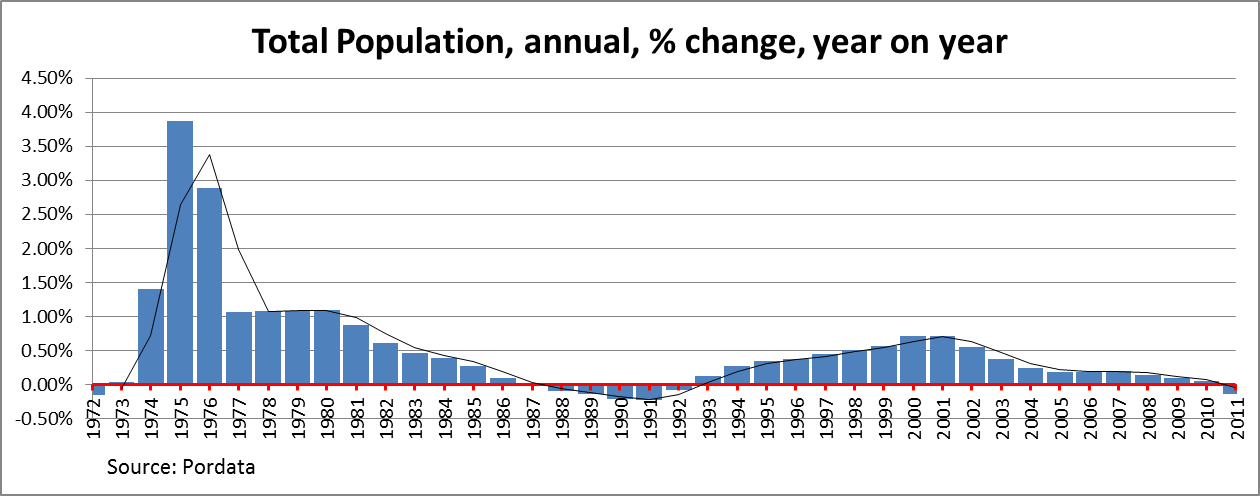
    While the phenomenon has arrived largely unnoticed Portugal’s total population has long been near to stationary.

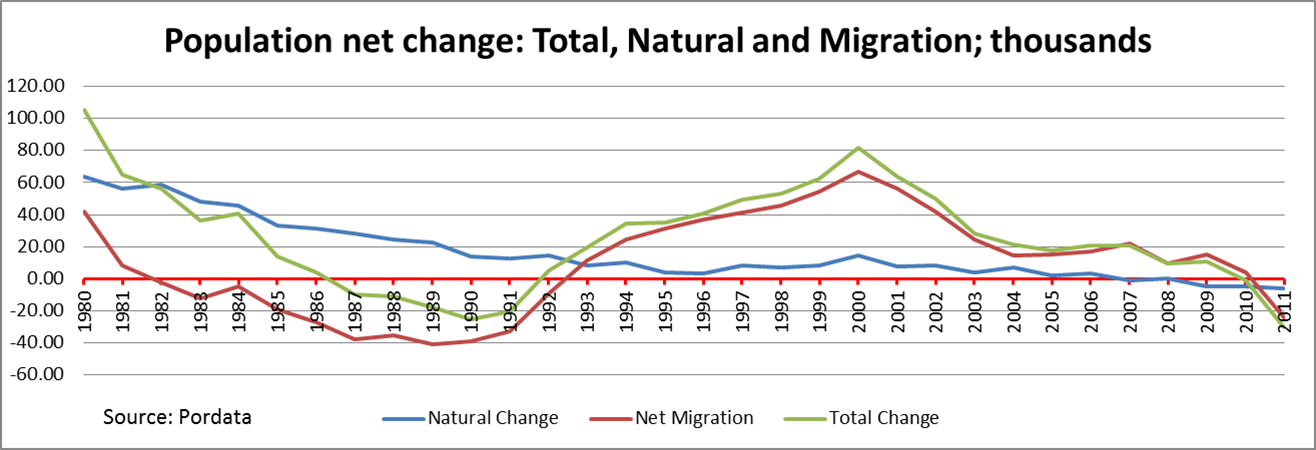
    As can be seen in the above chart, Portugal’s population has been struggling to find growth momentum since the mid 1980’s (the first time numbers actually dipped downwards) but the years 2010/2011 seem to mark a more fundamental turning point, since it was in that time interval that Portugal’s population started on a long, and possibly irreversible, path of decline. Having long had a total fertility rate of below 1.5 this was a more than predictable outcome, and one that should have been expected ever since the total fertility rate fell (and stayed) below the 2.1 replacement level in 1982.

    As is well known, population change is comprised of two major components: natural growth and net migration. Natural growth, births minus deaths, became negative in 2007 and thereafter population growth has become exclusively dependent on having sufficient positive net migration. Up to 2010 this condition was satisfied given the continuing influx of immigrants into the country as can be seen in the chart below.


    However, since the onset of the 2008 recession, not only have the immigration flows reversed completely, but emigration has started to increase again, thus reanimating a trend that has been constantly present in Portuguese history over decades, even centuries. This is perhaps the most critical factor driving the recent population decline. In fact the decline would have occurred much earlier had it not been for the return of thousands of refugees from the Portuguese colonies in the 1974-1981 period.


    According to the European Commission’s 2012 Ageing Report, projections for the Portuguese population during the period 2010 – 2060 anticipated that population would peak in 2034, but as we have seen, the latest data show the population unexpectedly reached its peak in 2010 (total population, previous chart), the year in which the population began to decrease (a similar phenomenon seems to have occurred in Spain in 2012, with again a reversal in migrant flows in an otherwise stagnant population being the trigger). This fact that this turnaround comes as a surprise is clearly the result over optimistic assumptions on the net migration front since the numbers for natural growth are well known and change little (although birth numbers are now dropping in many EU countries under the impact of the long recession). Clearly the unexpected factor here is the severity of the recession from which the country is suffering and the size of the exodus of young people who are leaving.

    Just to highlight even more the speed with which all this is happening, in Japan, the interval between the beginning of the decline of the working age population and the beginning of total population decline was a full decade. In Portugal this interval was only two years.

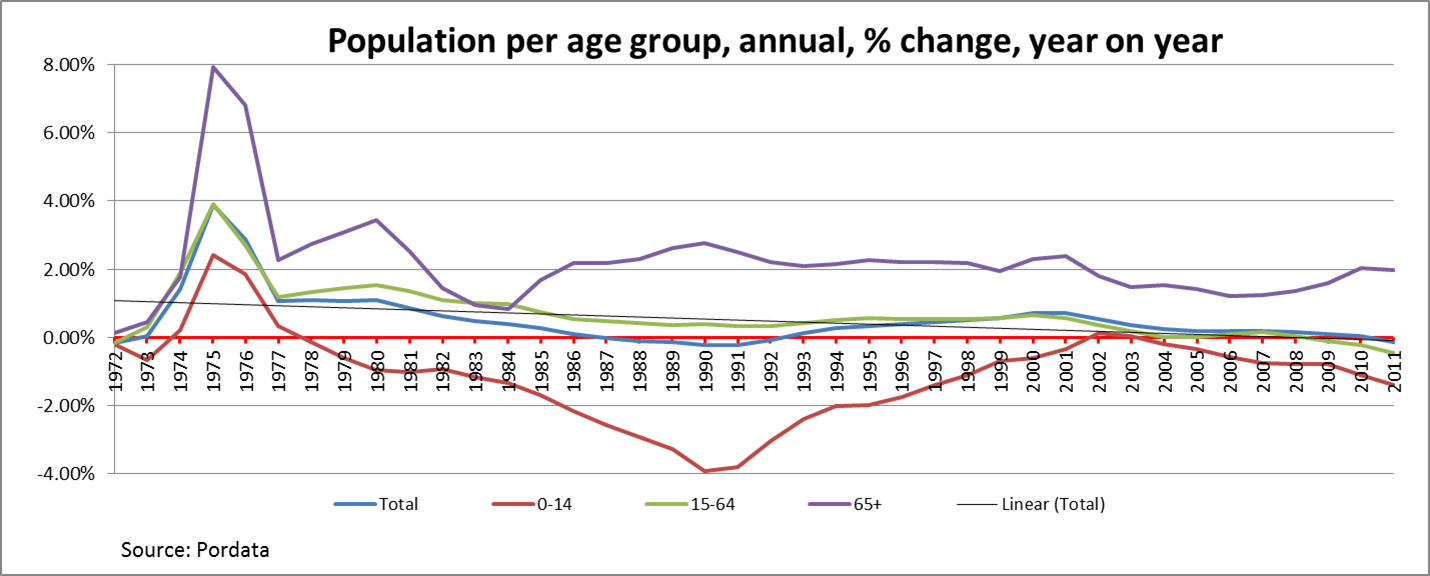
    Even more relevant than the decline in total population for the purpose of the present discussion is the decline in the working-age population. While the former gives us a good proxy for domestic consumption, it is the later which is important in terms of potential national output. All other things being equal a reduction in the working-age population means a reduction in output. Therefore, the most important detail to catch from the chart above is that the working-age population, defined as the population with ages ranging from 15-64, declined for the first time in Portugal between 2008 and 2009. As highlighted by both Daniel Gros and Paul Krugman if you want to compare economic growth performance as between countries with growing populations and those with declining ones the best indicator to use is undoubtedly GDP per Working Age Person (GDP/WAP).

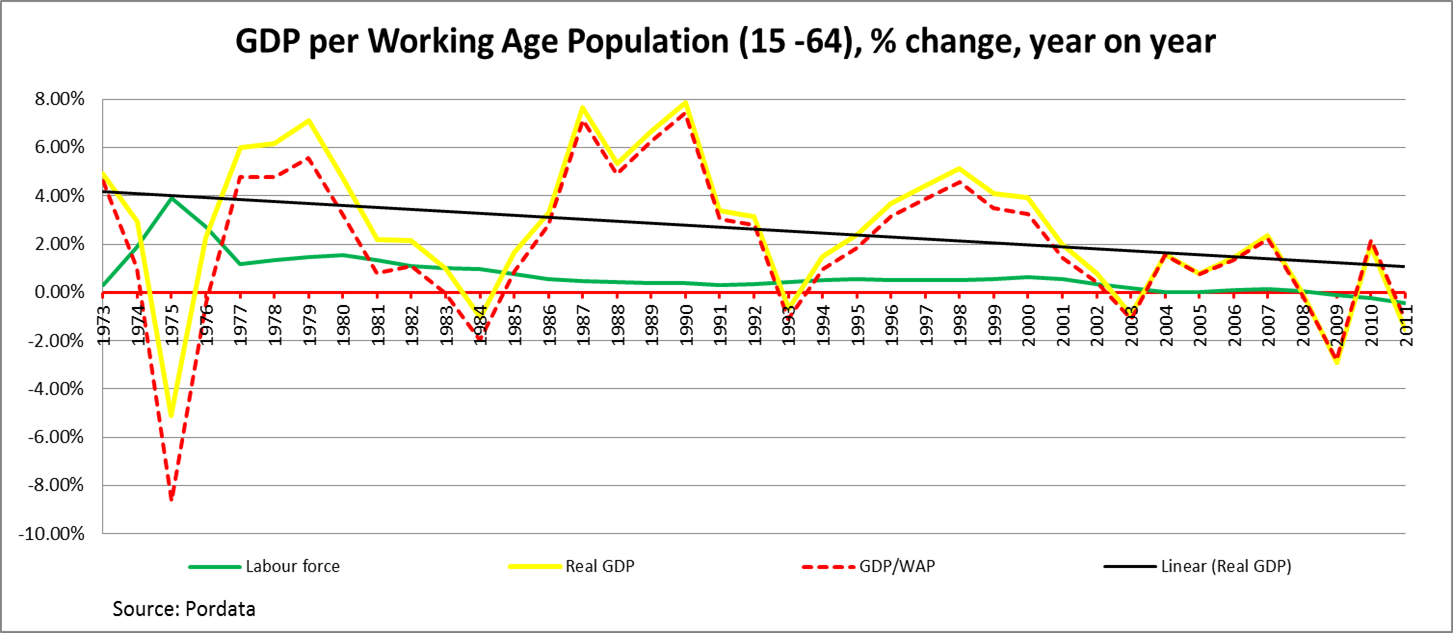
    In the Portuguese case if we take this ratio and compare it with both Real GDP growth and Working Age Population change (my calculations VM), we can get an impression of how variations in the Working Age Population affect the economic growth of a country. Surprisingly or otherwise, the data for Portugal viewed graphically not only confirms the existence of the “workforce effect” – the relationship seen between Real GDP and GDP/WAP – but also suggests that Portugal has already passed the point where this effect is beginning to have a negative impact on GDP growth.


    As can be seen in the above chart, until 2008 the growth rate of Real GDP was always higher than the rate for GDP/WAP offering a strong suggestion that labour force growth was having a positive impact on GDP growth. It is noteworthy, however, that both in the period 1986 – 1991 and in the period 2003 – 2008, the growth rates of Real GDP and GDP/WAP almost overlapped. This phenomenon coincided with very low or zero rates of working age population growth and as such the “workforce effect” was mostly neutral. The first of these periods, 1986 – 1991, the stagnation in the workforce was the direct result of the increase in emigration that followed the entry of Portugal in the European Union. The second one coincides with the arrival of the turning point in long term WAP growth, as the size of the working age population irrevocably turns negative.

    Indeed, during this early period of emigration towards the EU Portugal’s total population decreased, as shown in the chart Population by age group (above, blue line), but at the time, since the population in general was much younger, and many more new labour force entrants were arriving at working age, the growth rate of the workforce remained slightly positive. In other words, there were still enough Portuguese entering the labour market to replace those who were leaving it (either to retire or to seek a future abroad). In the second period, 2003 – 2008, the large exit of Portuguese nationals, about 700,000 between 1998 and 2008 according to research by the now Economy and Employment Minister Álvaro Santos Pereira, was to some extent offset by an inflow of immigrants, but these were only sufficient in number to maintain the workforce at a stationary level.

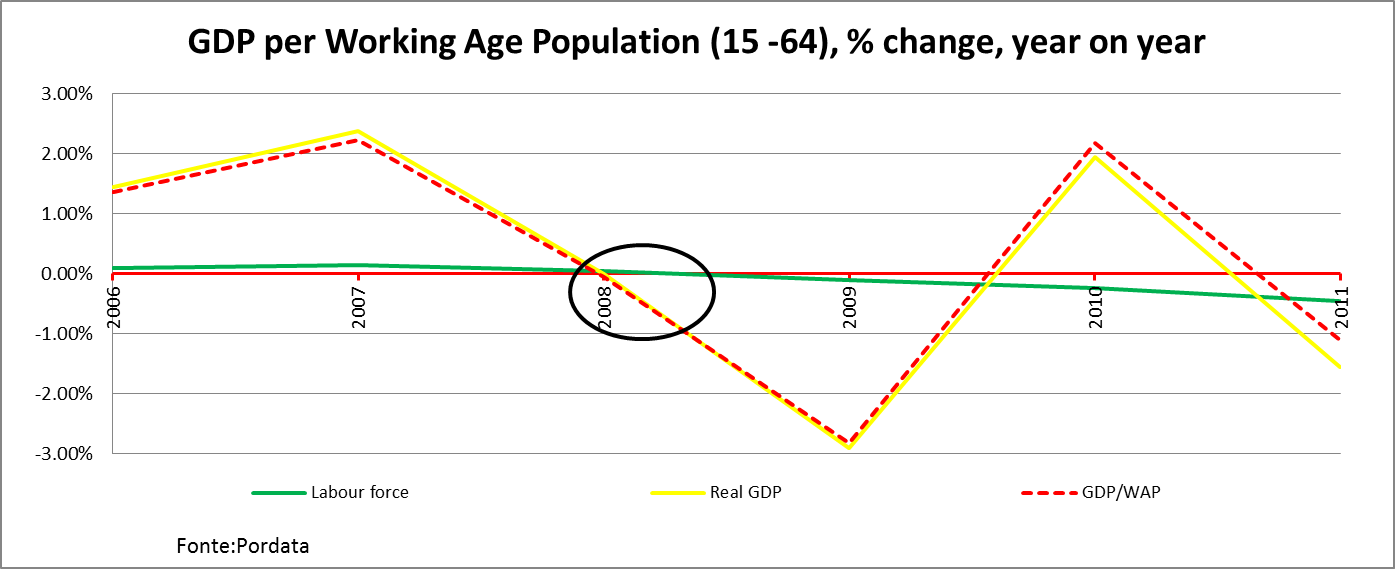
    All this calm and stability disappeared, however, after 2008 when the growth rate of Working Age Population turned negative, i.e. the labour force began to decline (see graph below). Where the growth rates of Real GDP and GDP/WAP overlap we can surmise that working age population change is having no effect on real GDP growth. Subsequently, however, the growth rate of GDP/WAP becomes higher than the growth rate of Real GDP and thus the “workforce effect” starts to act as a drag on the economy steadily bringing the potential overall growth rate down. In other words, Portugal is now suffering from a “Shortage of Japanese” as Edward Hugh has called the phenomenon, after Paul Krugman originally coined the term to describe the underlying problem which has been afflicting the Japanese economy since the mid-1990s.

    The fact that the three lines in the above chart happen to intersect at zero is perhaps just an unfortunate coincidence but is consequences are disastrous, since the downward trend that was already evident accelerated greatly after the onset of the recession. The resulting rise in unemployment not only caused a collapse in the immigration flow, it also led to a sharp increase in emigration. As a result workforce shrinkage intensified even further, as can be seen in the above chart by looking at the growing distance between the Real GDP and the GDP/WAP lines. That is, if the workforce had remained stationary the economy would be growing at similar rates to the GDP/WAP, i.e. above the current level as indeed happened in the period 2003 – 2008.

    Naturally, the argument can be advanced here that the recession is a cyclical phenomenon, and this is surely true, there is an ongoing cycle, but the argument being used refers to long term trends – a reversal in direction (or change of sign) for inputs from the labour force component brings down the overall trend growth rate making booms weaker and recessions deeper, all other things being equal. This would seem to be a simple conclusion which stems from elementary growth accounting theory. Naturally, there are other factors which contribute to growth, like multi factor productivity, but again other things being equal you would need more of this to achieve the same growth rate as before under conditions of weakening in the labour force growth component.

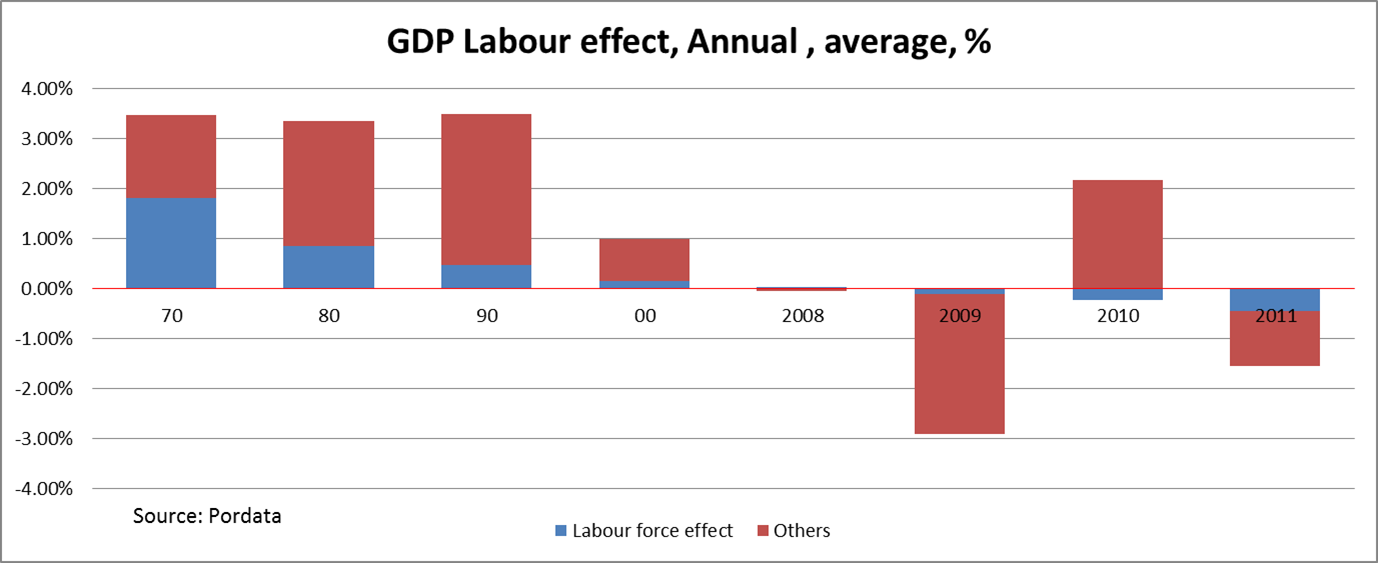
    Thus the argument is not that economic growth becomes impossible with a stagnant or slowly declining workforce, but simply that it becomes harder to achieve because it relies more on other factors, such as productivity and raising participation rates, but these change slowly over time, and more so in already developed countries. As such trend growth will surely steadily fall. This can be clearly seen in the following chart: while workforce growth was an important source of growth when Portugal was a developing country, its importance fell back as the workforce started to stagnate even as Portugal was approaching converge with other developed countries in terms of productivity. Other factors took over and increased their importance steadily as the economy started to converge with more advanced ones. Now that this catch up process seems to have come to a standstill as well the economy simply can’t growth, at least at rates considered normal. With a stagnant workforce, low growth or no growth is the new normal.


    Following standard growth accounting procedures, during the 1970s workforce growth accounted for more than half of Portuguese economic growth (see chart above, my calculations VM), and this contribution had fallen to only 16% in the first decade of this century. However, since 2008 not only has this contribution reversed sign but also the magnitude of the negative effect has begun to increase rapidly. Such that, by 2011 the “workforce effect” could be considered to explain more than 29% of the GDP decline. This “negative drag” will continue, and the effect possibly become greater, as the working age population shrinks further. Had the workforce remained stationary we could surmise the 2010 recovery would have been more pronounced and the 2011 recession wouldn’t have been so deep. This is the principal reason why official growth forecasts have been being constantly revised to the downside, and this will continue to happen until the models the forecasters use adequately incorporate the effects of population decline on economic growth. Adding insult to injury, ignorance of the existence of such effects recently led Portugal’s Prime Minister Pedro Passos Coelho to suggested young unemployed Portuguese resort to emigration as an escape route from the crisis, advice thousands have now followed thus making a bad situation even worse.

    Economic growth in Portugal appears to be on a long downward trend, a trend which will only be made worse by the onset of the decline in its working age population. Economic output is now at 2001 levels and thus we can now conclude that the last decade has been completely lost. More worryingly though, is that after such a bad start to this decade, it might not be unreasonable to conclude that this one is also in the process of being lost too.

    At best the economy will stagnate in the years to come but the possibility is there that it will continue to regress – especially if nothing is done to stem the outflow of young educated people – and by 2019 it might even be back somewhere in the 1990’s. This is scenario simply cannot be excluded since, in addition to all the other problems the country faces, a situation that would be in any circumstance challenging is now being aggravated by one more variable whose contribution cannot be easily reversed in the short term – the decrease in the working age population. More than the fact in itself, it is the speed at which this is happening which is alarming, and the fact that policymakers appear unaware of the problem. In analyzing the low Portuguese economic growth issue the decrease in the country’s working age population can no longer be ignored! Or at least it is hoped that this will be one of the outcomes of this short report.

    To return to where we started, Keynes concluded in his pioneering presentation that a stationary or slowly declining population could increase its standard of life while preserving the institutions society values most if, and only if, the process was managed with the necessary strength and wisdom. On the contrary, he argued, a rapid decline in population, of the kind that we are seeing in Portugal today, would almost inevitably result in a serious decline in living standards and a breakdown in highly valued social security mechanisms. The distinction Keynes drew some 80 years ago between rapid and managed rates of decline seems plausible, reasonable and highly relevant today. What we now need to see are urgent measures taken – initiated by the EU and the IMF – to counter the exodus which lies behind this dramatic decline which is occurring before our eyes, measures which at least try to decrease its speed, because once a process like this gains full velocity it will be very difficult to stop, and we have already seen it gather considerable traction. Ireland is a pointer and a great example to learn from, since it took that country more than a century to recover the population decline precipitated by the Great Famine which hit the country in the middle of the nineteenth century.

    Valter Martins is a self-taught economist and his research interests include demographics and its impact on economic growth. He holds a degree in International Business from University of Minho, Portugal and a Professional Diploma in Financial Advice (QFA) from Ireland.

  • America’s True Power In The NAFTA Century

    OK, I get it. Between George W. Bush and Barack Obama we have made complete fools of ourselves on the international stage, outmaneuvered by petty lunatics and crafty kleptocrats like Russia’sVladimir Putin. Some even claim we are witnessing “an erosion of world influence” equal to such failed states as the Soviet Union and the French Third Republic. “Has anyone noticed how diminished, how very Lilliputian, America has become?” my friend Tunku Varadajaran recently asked.

    In reality, it’s our politicians who have gotten small, not America. In our embarrassment, we tend not to notice that our rivals are also shrinking. Take the Middle East — please. Increasingly, we don’t need it because of North America’s unparalleled resources and economic vitality.

    Welcome then to the NAFTA century, in which our power is fundamentally based on developing a common economic region with our two large neighbors. Since its origins in 1994, NAFTA has emerged as the world’s largest trading bloc, linking 450 million people that produce $17 trillion in output. Foreign policy elites in both parties may focus on Europe, Asia and the Middle East, but our long-term fate lies more with Canada, Mexico and the rest of the Americas.

    Nowhere is this shift in power more obvious than in the critical energy arena, the wellspring of our deep involvement in the lunatic Middle East. Massive finds have given us a new energy lifeline in places like the Gulf coast, the Alberta tar sands, the Great Plains, the Inland West, Ohio, Pennsylvania and potentially California.

    And if Mexico successfully reforms its state-owned energy monopoly, PEMEX, the world energy — and economic — balance of power will likely shift more decisively to North America. Mexican President Pena Nieto’s plan, which would allow increased foreign investment in the energy sector, is projected by at least one analyst to boost Mexico’s oil output by 20% to 50% in the coming decades.

    Taken together, the NAFTA countries now boast larger reserves of oil, gas (and if we want it, coal) than any other part of the world. More important, given our concerns with greenhouse gases, NAFTA countries now possess, by some estimates, more clean-burning natural gas than Russia, Iran and Qatar put together. All this at a time when U.S. energy use is declining, further eroding the leverage of these troublesome countries.

    This particularly undermines the position of Putin, who has had his way with Obama but faces long-term political decline. Russia, which relies on hydrocarbons for two-thirds of its export revenues and half its budget, is being forced to cut gas prices in Europe due to a forthcoming gusher of LNG exports from the U.S. and other countries. In the end, Russia is an economic one-horse show with declining demography and a discredited political system.

    In terms of the Middle East, the NAFTA century means we can disengage, when it threatens our actual strategic interests. Afraid of a shut off of oil from the Persian Gulf? Our response should be: Make my day. Energy prices will rise, but this will hurt Europe and China more than us, and also will stimulate more jobs and economic growth in much of the country, particularly the energy belts of the Gulf Coast and the Great Plains.

    China and India have boosted energy imports as we decrease ours; China is expected to surpass the United States as the world’s largest oil importer this year. At the same time, in the EU, bans on fracking and over-reliance on unreliable, expensive “green” energy has driven up prices for both gas  and electricity.

    These high prices have not only eroded depleted consumer spending but is leading some manufacturers, including in Germany, to look at relocating production , notably to energy-rich regions of the United States. This shift in industrial production is still nascent, but is evidenced by growing U.S. manufacturing at a time when Europe and Asia, particularly China, are facing stagnation or even declines. Europe’s industry minister recently warned of “anindustrial massacre” brought on in large part by unsustainably high energy prices.

    The key beneficiaries of NAFTA’s energy surge will be energy-intensive industries such as petrochemicals — major new investments are being made in this sector along the Gulf Coast by both foreign and domestic companies. But it also can be seen in the resurgence in North American manufacturing in automobiles, steel and other key sectors. Particularly critical is Mexico’s recharged industrial boom. In 2011 roughly half of the nearly $20 billion invested in the country was for manufacturing. Increasingly companies from around the world see our southern neighbor as an ideal locale for new manufacturing plants; General Motors GM -0.96%Audi , Honda, Perelli, Alcoa and the Swedish appliance giant Electrolux have all announced major investments.

    Critically this is not so much Ross Perot’s old “sucking sound” of American jobs draining away, but about the shift in the economic balance of power away from China and East Asia. Rather than rivals, the U.S., Mexican and Canadian economies are becoming increasingly integrated, with raw materials, manufacturing goods and services traded across the borders. This integration has proceeded rapidly since NAFTA, with U.S. merchandise exports to Mexico growing from $41.6 billion in 1993 to $216.3 billion in 2012, an increase of 420%,while service exports doubled. MeanwhileU.S. imports from Mexico increased from $39.9 billion in 1993 to $277.7 billion in 2012, an increase of 596%.

    At the same time, U.S. exports to Canada increased from $100.2 billion in 1993 to $291.8 billion in 2012.

    Investment flows mirror this integration. As of 2011, the United States accounted for 44% of all foreign investment in Mexico, more than twice that of second-place Spain; Canada, ranking fourth, accounts for another 10%. Canada, which, according to a recent AT Kearney report, now ranks as the No. 4 destination for foreign direct investment, with the U.S. accounting for more than half the total in the country. Over 70% of Canada’s outbound investment goes to the U.S.

    Our human ties to these neighbors may be even more important. (Disclaimer: my wife is a native of Quebec). Mexico, for example, accounts for nearly 30% of our foreign-born population, by far the largest group. Canada, surprisingly, is the largest source of foreign-born Americans of any country outside Asia or Latin America.

    We also visit each other on a regular basis, with Canada by far the biggest sender of tourists to the U.S., more than the next nine countries combined; Mexico ranks second. The U.S., for its part, accounts for two-thirds of all visitors to Canada and the U.S. remains by far largest source of travelers to Mexico.

    These interactions reflect an intimacy Americans simply do not share with such places as the Middle East (outside Israel), Russia, and China. There’s the little matter of democracy, as well as a common sharing of a continent, with rivers, lakes and mountain ranges that often don’t respect national borders. Policy-maker may prefer to look further afield but North America is our home, Mexico and Canada our natural allies for the future. Adios, Middle East and Europe; bonjour, North America.

    This story originally appeared at Forbes.

    Joel Kotkin is executive editor of NewGeography.com and Distinguished Presidential Fellow in Urban Futures at Chapman University, and a member of the editorial board of the Orange County Register. He is author of The City: A Global History and The Next Hundred Million: America in 2050. His most recent study, The Rise of Postfamilialism, has been widely discussed and distributed internationally. He lives in Los Angeles, CA.

    NAFTA logo by AlexCovarrubias.

  • The Consequences of Urban Containment

    Recently published research by Brian N. Jansen and Edwin S. Mills represents notable addition to the already rich academic literature that associates more stringent land use regulation with higher house prices. The analysis is unusually comprehensive and its conclusions indicate greater consequences than is usually cited. Mills is Professor Emeritus of Real Estate and Finance at Northwestern University and is renowned for his contributions to urban economics over more than five decades.

    The Research

    The comprehensiveness of the research is indicated by the fact that it covers all of the 268 metropolitan areas in the United States for which complete data was available. The focus was on the trend of house prices leading up to 2006, the peak of the housing bubble. Their econometric analysis showed that "stringent land use controls raise house prices."

    They also found that more stringent land use controls were associated with greater house price losses following the peak.

    “The strong conclusion of this paper is that stringent residential land use controls were a primary cause of the massive house price inflation from about 1992 two 2006 and possibly of the deflation that started in 2007.”

    Overall, this finding is consistent with the work of others (such as in Glaeser and Gyourko) who have associated more stringent land use controls with greater house price instability.

    Consistency with Economic Principle & Previous Research

    The Jansen and Mills findings reiterate those of a large body of research. Economists Richard Green and Stephen Malpezzi summarized the issue a decade ago:

    “When the supply of any commodity is restricted, the commodity’s price rises. To the extent that land – use, building codes, housing finance, or any other type of regulation is binding, it will worsen housing affordability.”

    This relationship is even acknowledged by proponents of more stringent land use policies. A Brookings Institution team led by University of Utah Professor Arthur C. Nelson indicated that “If … policies serve to restrict land supplies, then housing price increases are expected.”

    Needless to say, any other effect would be the equivalent of “sun rising in the West” economics.”

    The more stringent land use regulations include blunt tools like the urban growth boundaries of Vancouver, Sydney, Portland or the San Francisco Bay Area but also the large-lot suburban lots that have rendered Boston’s urban densities nearly as low as Atlanta. Artificial limits on development lead to higher house prices, other things being equal.

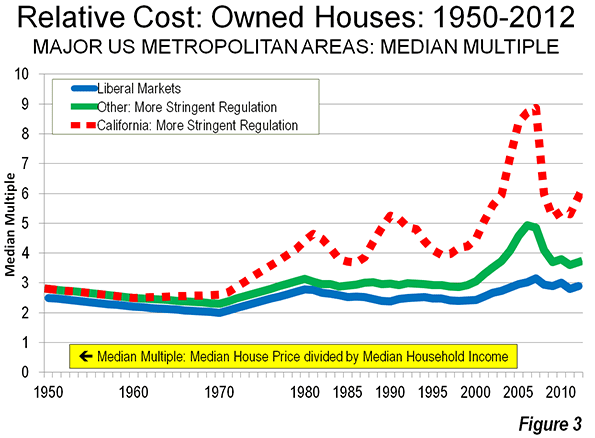
    This will come as no surprise to those familiar with the work of Dartmouth economist William Fischel who attributed California’s high house prices to stringent land use regulation. He noted that until around 1970, California house prices had been nearly the same, relative to incomes as the rest of the nation, before more stringent land use regulation began. Now house prices in coastal California markets are double those in liberally regulated markets, measured by the median multiple (median house price divided by median household income).

    Unintended Consequences: Portland and California

    The Jansen and Mills findings will disappoint urban containment (smart growth or growth management) advocates who have often denied the economic reality of its influence on house prices. Some had hoped that the house price increasing effects of stringent land use regulation would be neutralized by more affordable housing costs in the cores of metropolitan areas, where more dense housing would be permitted. A principle source of this view is an analysis of early 1990s Portland (Oregon) house prices by Justin Phillips and Eban Goodstein, who said that such an effect “should” occur.

    Yet in the 15 years since the period covered by this research, Portland house prices have risen with a vengeance (see The Evolving Urban Form: Portland), with the median multiple rising more than 40 percent, from 3.0 in 1995 to 4.3 in 2012. Obviously, with such an increase, the price increasing impacts of Portland’s urban growth boundary have not been negated.

    Further, housing costs rose in Portland’s densifying areas at virtually the same rate as in the rest of the metropolitan area over the period from 1999 to 2009. Census and American Community Survey data indicates that densifying zip code areas (housing unit density increases of 5 percent or more) experienced median multiple increases of 37 percent, compared to 36 percent for the balance of the metropolitan area (Note). Rents in the densifying areas rose 9 percent, compared to 8 percent in the rest of the area.

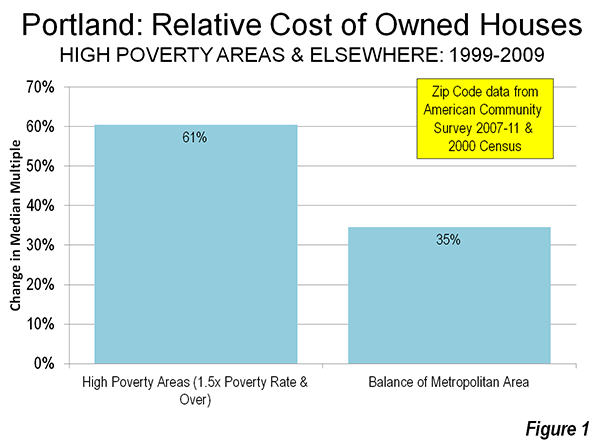
    The impact on Portland’s low income population, however, was less than equitable. The cost of owned housing rose 75 percent more in areas of higher poverty (areas with poverty rates 50 percent or more than the average rate) than in the balance of the metropolitan area. The median multiple (value) rose 61 percent in the high poverty areas and only 35 percent elsewhere (Figure 1).

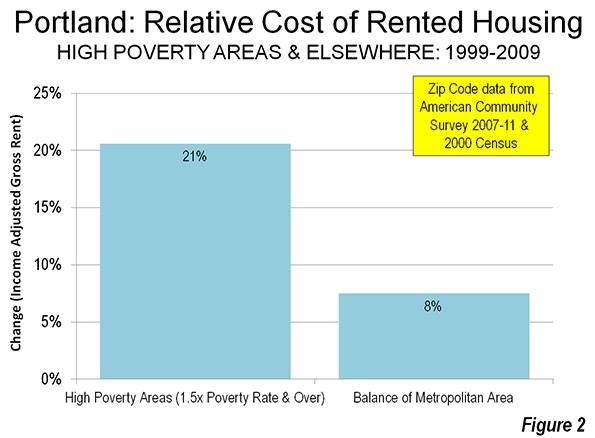
    The difference was even starker in rentals, where low income households are concentrated. Income adjusted median gross rents in the high poverty areas rose more than 2.5 times the increase in the rest of the metropolitan area. In the high poverty areas, the increase was 21 percent and only 8 percent elsewhere (Figure 2).

    The housing cost increases in the higher poverty areas appears to be at least partially from gentrification as well as Portland’s efforts to improve neighborhoods through urban renewal. In assessing the results of the 2010 census, The Oregonian noted that the core city of Portland had become less diverse and that many African-American households were driven out of their neighborhoods by “gentrification.”

    This greater housing cost burden on lower income households belies the noble intentions expressed in much of the urban containment and smart growth literature. Results are more important than intentions.

    Portland is not alone. Nelson, et al, were uncritical of Portland a decade ago (before the evidence of house price increases was so clear), but did not mince words in characterizing the already evident higher prices from stringent land use policies in California, saying: “This is arguably what happened in parts of California where growth boundaries were drawn so tightly without accommodating other housing needs that housing supply fell relative to demand.”

    The Broader Consequences of Stringent Land Use Regulation

    Jansen and Mills took the research farther than most others. In their econometrics, they found more stringent land use regulation negatively impacted metropolitan area population, employment and per capita real income.

    They also considered the role of stringent land use controls in the Great Financial Crisis. This issue had also been a subject of inquiry of the congressionally established United States Financial Crisis Inquiry Commission, which documented much larger than national housing bubbles in the so-called “sand states” of California, Florida, Arizona and Nevada. Three of the
    10 members issued a minority opinion citing land use controls as one of the causes of the housing bubble (which is widely considered to have sparked the Great Financial Crisis). The major metropolitan areas in the “sand states” all had strong land use restrictions.

    “Land use restrictions. In some areas, local zoning rules and other land use restrictions, as well as natural barriers to building, made it hard to build new houses to meet increased demand resulting from population growth. When supply is constrained and demand increases, prices go up.”

    My analysis of metropolitan markets for the National Center for Policy Analysis suggested a similar relationship (see The Housing Crash and Smart Growth).

    Jansen and Mills squarely place blame for the Great Financial Crisis on stringent land use controls.

    “Indeed, it is difficult to imagine another plausible cause of the 2008–2009 financial crisis. Popular accounts simply refer to a speculative housing price bubble. But productivity growth in housing construction is faster than in the economy as a whole and the US has an aggressive and competitive housing construction sector. In the absence of excessive controls, housing construction would quickly deflate a speculative housing price bubble.”

    The absence of excessive controls would have defused the housing bubble, they suggested. This notion is supported by the experience of metropolitan areas with liberal land use regulation (Figure 3) where median multiple remained near or below 3.0 in liberally regulated markets. This standard has typified affordable markets since World War II, as well as California markets to the early 1970s and Portland until 1995. The retention of housing affordability is especially significant in Atlanta, Dallas-Fort Worth and Houston, which experienced some of the largest rates of domestic in-migration during the bubble. This is in contrast to the more stringently regulated high cost markets of coastal California, which experienced huge out-migration during the same period.

    The Imperative for Job Creation and Economic Growth

    All of this is particularly important because housing is the most expensive element of household budgets, and unlike transportation and most consumer goods, is extremely sensitive to varying local and regional public policies. Where households have to pay more for housing, they have less discretionary income and necessarily have a lower standard of living. This is deleterious to virtually all households and is especially burdensome on lower income households.

    Many young adults are “doubling up” with their parents, deferring their own independence, facing huge student loan debts and inadequate employment prospects in what may become the Great Malaise. Taxpayers in many jurisdictions face unprecedented burdens in funding unsustainable government employee pension benefits. Only job creation and economic growth can solve these problems. The last thing the economy needs is stringent land use policies that reduce employment, economic growth and per capita real incomes.

    Wendell Cox is a Visiting Professor, Conservatoire National des Arts et Metiers, Paris and the author of “War on the Dream: How Anti-Sprawl Policy Threatens the Quality of Life.

    —–

    Note: Median multiple data from the Census Bureau (and the American Community Survey) are reported using median house values, instead of the more common median house price.

    —–

    Photo: 1,700 square foot house in exurban Los Angeles priced at $575,000 at the peak of the housing bubble (by author).

    CORRECTION

    Land use regulation as a cause of the housing bubble should have been should have been attributed to a dissenting opinion in the United States Financial Crisis Inquiry Commission, rather to the Commission itself.

  • Book Review: “The Fate of the States: The New Geography of American Prosperity” by Meredith Whitney

    In December 2010, Meredith Whitney, the financial analyst, appeared on 60 Minutes, where she predicted that the United States would see between 50 and 100 defaults of municipal bonds. Since she was one of the earliest analysts to predict the financial meltdown, publishing a research report in October 2007 that said that because of mortgage losses Citigroup might have to cut its dividend, it was not surprising that her statement attracted a great deal of attention, but also significant pushback from industry representatives, who insisted that municipal bonds were safe.  This book, "Fate of the States: The New Geography of American Prosperity" is her effort to elaborate on that call.    

    Whitney begins her analysis with a review of the housing bubble and banking crisis, which by now is well trod ground, but she does so in a highly informed and balanced way.  Where some commentators want to place most of the blame on government, others on Wall Street, and yet others on the Federal Reserve Bank for keeping interest rates too low for too long, she argues that everyone behaved badly.  The self-destructive behavior that she witnessed on the part of many banks and financial institutions during this period remains an enduring and puzzling part of the story.   

    Readers of New Geography will be familiar with two of the themes that she articulates.  One is the rise of a zone of prosperity from the Gulf Coast through the heartland and up to North Dakota that has been built on pro-active energy policy and strong global demand for agricultural commodities.  A second theme she articulates is the striking disparity in the cost of living between states like California and New Jersey compared with far more affordable states like Texas.  Low cost states, she says, will continue to attract new investment and jobs.

    In arguably the core section of the book, she explains how the housing bubble interacted with banking and government to create what she calls “The Negative Feedback Loop from Hell.”  By way of background, it should be noted that the underlying economics of banking are unusual.   As economist Joseph Stiglitz demonstrated in the 1980s, the price of money does not necessarily clear markets.  Instead, banks often employ credit rationing in order to control risk.  As she argues, this is exactly what happened in the states where the housing bubble inflated the most. These are the states where the subsequent economic decline was the greatest.    

    As Whitney shows, it was also these states, where government officials handed out the most generous pay packages, including large back loaded pensions. On top of that, these states often piled on the most government debt, which nearly doubled between 2000 and 2010.  The result has been significant retrenchment on core government services, from police and fire protection to public education. In her view, this is the negative feedback loop from hell, and the reason that she believes that fiscal stress will continue for a long period of time.

    As the fight for limited resources works itself out, she believes that besides government there will be three parties at the negotiating table. Two are straightforward enough: the bondholders, who expect to be paid back the money they lent, and the public sector employees, who expect to receive the pensions they were promised. But she also sees a third party. Writing shortly before the bankruptcy in Detroit, she presciently recognized that citizens will also have a claim on resources, arguing that they need and deserve the services that government is supposed to provide.

    Although the sub title of the book mentions geography, Whitney largely dismisses what a contemporary textbook on economics and geography calls the “who, why, and where of the location of economic activity.” This is not surprising. There are probably few people who are aware that this branch of economics even exists.  (Among professional economists, more attention has been paid in recent years with the advent of New Economic Geography as championed by Paul Krugman, although, ironically, empirical research indicates that key elements of  of Krugman’s theoretical work are almost certainly wrong.)

    While Whitney rightly focuses on the economic growth that distinguishes many of the states in the central corridor of the country, she cites data that shows that most economic activity continues to occur elsewhere.  She observes, “These so-called flyover states contributed 25 percent of U.S. GDP in 2011, up from 23 percent in 1999.” That is nearly a 10 percent increase, but obviously from a lower base. A current and highly visible example of the importance of geography is the huge growth in the number of warehouses along the New Jersey Turnpike, as engineering projects deepen New York harbor and expand the Panama Canal. Access to water will always be important.    

    Additionally, I would argue that the issues that Whitney addresses cannot be fully understood without taking into account the challenges that continue to face older industrial cities. All economies must constantly re-invent themselves. In the case of cities with a large industrial legacy, however, intrinsic market failures caused by asymmetric and imperfect information have made redevelopment significantly more difficult.  Theoretical and empirical work in recent years has also shown that joint and several liability under U.S. environmental law undermines efficient price discovery for properties that once had an industrial use.      

    These issues aside, Whitney has written a book that is both provocative and necessary. Clearly, certain states have instituted policies that are far more effective at attracting business and new residents. At the same time, other states appear unable to reform. Perhaps her central insight is that problems associated with debt can take on a life of their own. Therefore, her message is clear. States that properly manage their debt and pension obligations will enjoy a prosperous future. States that do not will encounter severe problems.  Investors and public sector employees take note.

    Eamon Moynihan is the Managing Director for Public Policy at EcoMax Holdings, a specialty finance company that focuses on the redevelopment of previously used properties.

  • What Triggers a Civic Turnaround?

    Lots of cities in America are struggling with low population growth and sluggish economies. Poor demographics and economics lead to fiscal problems that result in more people and businesses leaving, perpetuating a downward spiral. Detroit, which recently filed bankruptcy, is an extreme case, but many cities and states find themselves in similar straits, including much of New England and especially most of Rhode Island.

    How to places break out of this and renew prosperity? Looking at cities where there has been change, I have observed several basic patterns of turnaround.

    Structural Changes

    Many cities failed for structural economic reasons like deindustrialization and globalization. Similarly, many ended up reviving for similar external reasons. In her seminal book The Global City, Saskia Sassen noted that while globalization permitted the dispersal of economic activities to lower cost locations, it created a parallel need for specialized financial and producer services to manage and control those global production networks. These services were disproportionately concentrated in so-called “global cities” like New York and London. While once those cities had fallen on hard times (in NYC’s case, nearly going bankrupt itself in the 1970s), globalization more than any other factor perhaps brought them back to life. Unfortunately, localities have no ability to conjure up these macro-economic changes.

    Natural Lifecycle Progression

    In a few places, notably Pittsburgh, it seems that the problems simply reached the end of their life cycle. To borrow a phase, they “hit bottom” and started reviving, if slowly. Of course, many places hit bottom and stayed there. Pittsburgh has been helped by the presence of large, world-class institutions. Being in the Marcellus Shale formation that’s the epicenter of the American gas fracking boom doesn’t hurt. It’s worth noting that Pittsburgh has seen fairly slow growth and still faces big challenges, including major pension and infrastructure problems.

    Outsider Influx

    Other cities hit a growth inflection point when they were able to attract a critical mass of outsiders. I have argued that having a critical mass of outsiders, that is, of people who aren’t long time natives or “boomerang” migrants, is almost a prerequisite for major civic change:

    You need them, and you need enough of them that they a) don’t get beaten down by the man, so to speak and b) that they become a base of support for change in their own right. Once this group becomes large enough, it opens up the field of possibilities. They have the insights and different ideas from having lived elsewhere. They aren’t bought into the status quo or burdened by the baggage of the past. They are willing to question they way things are done. They are more likely to want change. In short, outsiders are the natural constituency for the new. That’s why outsiders are so important for a community to change, and why absent enough newcomers, change is difficult if not impossible.

    Of course, this almost begs the question: how do you attract those outsiders? This would appear to be a second order factor. It would be worth doing a deep dive on how significant inward migration began in these places. Also, the places that seemed to do well on this model – like Nashville or Denver – are places that weren’t in terrible shape to begin with.

    Transformational Leaders

    Any number of cities lend themselves to a narrative of transformational change led by a particular leader or group of leaders. You can think of Richard M. Daley in Chicago or Rudy Giuliani and Michael Bloomberg in New York. Cory Booker in Newark may be an emerging story in this mold. Or in previous generations there were business magnates like J. Irwin Miller in Columbus, Indiana that through superior vision combined with clout were able to put their community on a different path than other similarly positioned cities. (Among other things, Columbus, Indiana is an internationally renowned center of modernist architecture, with no fewer than six National Historic Landmarks in a modernist style).

    The obvious question here is how much leadership had to do with it. So many of these large tier one type cities came back at the same time that it seems likely some common outside force like globalization was the real driver. Or at least that it was a prerequisite to enable the leadership to be effective. However, there are some examples like Columbus that appear to be less the result of outside forces.

    Civic Sector Led Revitalization

    Some cities have done well in models without a single dominant leader such as a larger than life mayor. In Indianapolis, for example, it was a broader coalition of business, community, and institutional leaders that championed items such as their sports hosting strategy that had a transformational impact. This is the model most cities try to use, but it has failed nine times out of ten in delivering transformational impact, so would appear to be a very high risk strategy.

    What other models suggest themselves? I won’t claim this as a comprehensive list.

    A Look At Providence and Rhode Island

    Where does Rhode Island fit in? Well, it hasn’t seen a turnaround yet. But there has been a sort of slow growth in personal incomes that could add up over time. In this light, Providence would be a sort of Pittsburgh-like city from a lifecycle perspective, though I should note with a much smaller asset base. Alon Levy made the case for this view last year in a piece called “The Quiet Revival”:

    Rhode Island may have one of the highest unemployment rates in the US today, but income growth is high; things are slowly getting better. The most visible growth in the US is in population rather than income, and so the usual markers are new housing starts, new infrastructure, and a lot of “coming soon” signs. Providence of course doesn’t have much of this. Instead, people are getting richer, slowly… Economic growth in the richest countries is slow enough that people don’t perceive it. Instead, they think it’s the domain of countries that are catching up, such as China, where it’s so fast it includes new construction and the other markers that signify population growth in the first world. In the long run, it matters that a city’s income grows 1.8% a year rather than 1.1%, but it’s not visible enough to be captured by trend articles until long after the spurt of growth has started.

    Given the lack of structural economic forces boosting the city, and a comparatively small base of newcomers, particularly outside of Providence proper and other core cities, this will likely have to do for now, unless we witness the emergence of a disruptive and transformational type leader.

    This post originally appeared in GoLocalProv on August 26, 2013.

    Aaron M. Renn is an independent writer on urban affairs and the founder of Telestrian, a data analysis and mapping tool. He writes at The Urbanophile.

    Photo by Will Hart.

  • Canada’s Changing Income Patterns

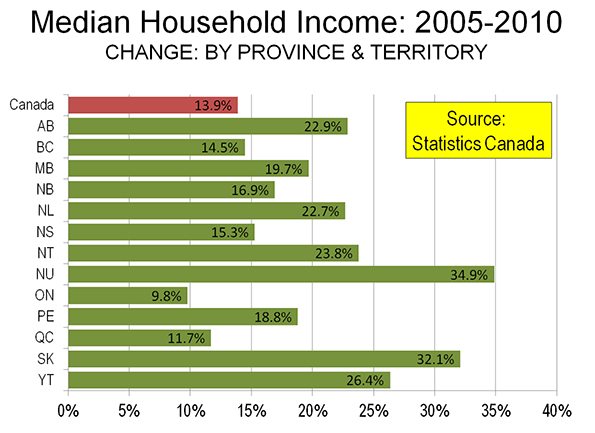
    Statistics Canada’s newly released National Household Survey indicates changes in the distribution of median household incomes among the provinces and territories. The new data is for 2010, and indicates that an increase of 13.9 percent per household at the national level from the 2005 data collected in the 2006 census.

    The big story, however, is the progress in parts of Canada that have grown used to laggard economic performance. In 2005, few would have expected the progress made in the provinces of Saskatchewan and Newfoundland & Labrador. In both cases, the resource boom had much to do with the turnaround.

    Gains in Saskatchewan and the Prairies

    Saskatchewan’s median household income grew 32.1 percent, out-distancing perennial champion Alberta and emerging Newfoundland & Labrador by nearly a third (Figure). Alberta’s income was up 22.9 percent, while Newfoundland & Labrador experienced a nearly as great 22.7 percent increase. Saskatchewan had trailed British Columbia by more than 10 percent five years before, but had edged ahead by 2010. Saskatchewan’s income level now leads all of the provinces except Alberta and Ontario.

    All three of the Prairie Provinces did well. In addition to Saskatchewan and Alberta, household income in Manitoba grew at a 20 percent, stronger than all provinces outside the prairies except for Newfoundland & Labrador.

    A New Day in Newfoundland and Labrador

    While Saskatchewan has experienced prosperity from time to time in its history, the same is not so true in Newfoundland and Labrador. In fact, in 1933, the government of Newfoundland (as it was then known) voted itself out of existence as a Dominion of the British Empire because of its serious financial difficulties. Effectively, the Dominion was relegated to the status of a British crown colony (like former Hong Kong). Newfoundland joined Canada as the 10th province in 1949. With that, representative government was restored, but Newfoundland always lagged behind (generally along with the Maritime provinces of New Brunswick, Nova Scotia and Prince Edward Island). In 2005, Newfoundland and Labrador ranked 10th out of the 10 provinces in median household income. By 2010, the ranking had improved to 7th.

    The Prosperous Territories

    The greatest income growth (35 percent) was in the territory of Nunavut, which was created by carving out the eastern portion of the Northwest Territories in 1999. Nunavut covers a land area about 1.3 times that of Alaska, but has only 30,000 residents (about the same as live in a square kilometer of Manhattan or Paris). The Yukon experienced a 26 percent increase, while the Northwest Territories had a 24 percent increase. The Yukon and the Northwest Territories had stronger income growth than all of the provinces, except Saskatchewan.

    The Old Dynamos Trail

    Meanwhile, the economic dynamo of the nation, Ontario experienced household income growth of less than 10 percent, nearly a third less than the national average, and less than one-third of Saskatchewan. Ontario is home to more than one-third of the national population. British Columbia, which has historically experienced strong economic growth, could muster only slightly above average household income growth (14.4 percent compared to the national 13.9 percent).

  • Urban Core Boomer Populations Drop 1 Million 2000-2010

    This may be a surprising headline to readers of The Wall Street Journal and the Washington Post, which reported virtually the opposite result in their August 19 editions. The stories, “Hip, Urban, Middle-Aged: Baby boomers are moving into trendy urban neighborhoods, but young residents aren’t always thrilled,” by Nancy Keates in The Wall Street Journal and “With the kids gone, aging Baby Boomers opt for city life,” by Tara Barampour in the Washington Post reported on information from the real estate firm, Redfin (a link to the corrected Wall Street Journal story is below). Both stories reported virtually the same thing: that 1,000,000 baby boomers moved to within five miles of the city centers of the 50 largest cities between 2000 and 2010. Because these results appeared to be virtually the opposite of census results, I contacted both papers seeking corrections.

    When pressed for more information, Redfin.com responded with a tweet indicating that: “We don’t have a link to share or published study; Redfin did a special analysis of Census data at reporters’ requests.”

    In fact, the census data shows virtually opposite. Redfin’s method was not clear, so I queried the five mile radius within the main downtown areas of the 51 metropolitan areas with more than 1,000,000 population in 2010, shown below in this table and figure.

    Within the five mile radius of downtown, there was a net loss of 1,000,000 baby boomers, or 2 percent of the 2000 population (ages 35 to 55 in 2000). There was also a loss of 800,000 in the suburbs, or 17 percent of the 2000 population. The continuing dispersion of the nation is indicated by the fact that there was a gain of nearly 450,000 in this cohort outside the major metropolitan areas. Overall, there was a net loss of 1.3 million, principally due to deaths.

    To its credit, The Wall Street Journal issued a correction, as I would have expected. The incorrect reference to an increase of baby boomers in the urban cores was removed. To my surprise, not only did the Washington Post fail to make a correction, but they also ignored multiple requests to deal with the issue (though my emails received courteous computer generated acknowledgements).

    With the ongoing repetition of the “return to the city from the suburbs” myth, it is important to draw conclusions from the data, not from impressions.

  • Inequality of the Largest U.S. Metropolitan Areas

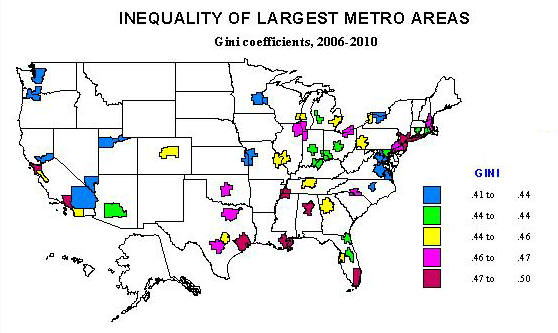
    We earlier mapped inequality of the US states. Now I show the geography of inequality for metropolitan areas over 1,000,000.  These measures of inequality are gini coefficients, calculated by the US Census Bureau for 2005-2009. These indicate how amazingly severe inequality, or the concentration of income and wealth at the top, has become.  The gini is a measure of the departure of a curve of accumulated income, ranking from the poorest to the richest. The current US gini is .467, up from .39 back in 1974, and much higher than other rich countries, such as Canada at .32, Germany at 27, France at .33, and Sweden at .23.

    Interpretation of these indices is relative. Even the lowest value, for Salt Lake City, is absolutely high compared to high-income-country norms, or even our own recent past. But in the contemporary US context, ginis from .41 to .44 are  low, between .44 and .447 medium low, .448 to .46 moderate, .46 to .47  moderately high,  and over .47 very high inequality.  Note that the US average is .467, and that most of the metropolitan areas are below that. This is a reflection of the demographic influence of the high levels of inequality of the following few large metropolitan areas:

    Region Population Gini  
    New York 18.9 million 0.502
    Miami 5.5 0.493
    LA 12.8 0.484
    Houston 5.6 0.478
    San Francisco   4.2 0.473

    These national or regional capitals are highly unequal because of the concentration of wealthy families or wealth-producing sectors like finance. Other contributors are a dearth of middle income jobs and large numbers of the poor. These higher than the US average metro areas are joined by three southern metropolitan areas, New Orleans, Memphis, and Birmingham, where in equality is more explainable instead by racial inequality.

    Metro areas around or just below the national average (in red) similarly include a mix of regional economic and financial capitals, along with southern large metros, including Chicago, Philadelphia,  Cleveland, Dallas, and Charlotte plus Oklahoma City and San Antonio.


    A handful of  metro areas, shown in yellow, are moderately lower than the national average and dominantly in the east central part of the country, and include a mix of sizes, from Detroit, St. Louis and Atlanta, Pittsburgh, Buffalo and Milwaukee, Nashville, Tampa, and Austin, with only Denver and San Diego in the west. 

    Less unequal areas, shown in green, are with the exception of Phoenix, all in the east, from Hartford and Providence, to Baltimore, Jacksonville and Orlando, and a cluster in the north central states, with Cincinnati, Columbus, Louisville, Indianapolis, and Grand Rapids. These mostly follow the pattern observed in our recent state analysis where inequality was generally lower across the northern tier of the country.

    The least unequal metro areas are even more focused on the Germanic belt that stretches across the Midwest to far west, with Minneapolis, Kansas City, Salt Lake, Seattle and Portland, Sacramento Las Vegas and Riverside-San Bernardino, plus some in the Atlantic states, including Rochester, Raleigh, Richmond  and the government dependent Washington DC and Virginia Beach-Norfolk. Salt Lake, influenced both by Mormonism and a moderately Scandinavian population, is the least unequal followed by Virginia Beach and Minneapolis.  Overall, with the exception of the Washington DC area,  the least  unequal metro areas tend to have the lowest shares of minority populations. Less unequal metros also tend to retain strong middle class industries, whether it’s Boeing in the Seattle area or the burgeoning tech and manufacturing industries found in places like the Salt Lake region.

    Highly unequal and less unequal may appear together on the map, suggesting lesser suburban or satellite inequality. Generally speaking, suburbanized, less dense (and often less globalized) areas tend to be more equal. We can see this in the difference between Los Angeles and Riverside-San Bernardino,    San Francisco as opposed to Sacramento, Boston vs. Providence, and Washington DC vs. Baltimore. Washington is especially interesting, as the city is extremely unequal, the wider metro area (more homogenous middle class suburbs) far less so. This is even more telling if we look at a more local geographic scale, with central cities marked by the juxtaposition of the very rich and very poor, while suburban cities tend to be dominated by similar middle class folks.

    Among metro areas under 1 million the most unequal is Bridgeport-Stamford, CT  ( those wealthy suburbanites next to historic industrial cities), while the least unequal are Ogden, UT, Appleton, WI, York, PA and Fairbanks, AK.

    Inequality in selected cities

    The most unequal cities (over 100,000) are all southern (Atlanta, #1, New Orleans, Washington, Miami, Gainesville, Ft. Lauderdale, Dallas and Baton Rouge), all except for mighty New York City. Race and ethnicity matter, as does the composition of the local economy. 

    The least unequal  cities are all suburban or satellite, except for Port St. Lucie (military and space), such as of Chicago (Elgin), Kansas City (Olathe), Salt Lake (West Valley, West Jordan), Sacramento (Elk Grove), Los Angeles (Norwalk), Phoenix (Gilbert) , Denver (Thornton) and North Las Vegas.

    Conclusion

    Inequality in distributions of income are high and have become higher in recent years in the United States. But there remains fascinating geographic variation, resulting from abiding racial differences, variation in industrial structure and class homogeneity, and in geographic situation, regionally and locally. This helps both to explain some of the drivers of inequality, but also the complexities of finding ways to alleviate it.

    Richard Morrill is Professor Emeritus of Geography and Environmental Studies, University of Washington. His research interests include: political geography (voting behavior, redistricting, local governance), population/demography/settlement/migration, urban geography and planning, urban transportation (i.e., old fashioned generalist).

  • Book Review: ‘The End of the Suburbs,’ by Leigh Gallagher

    Suburbia has been a favorite whipping boy of urbane intellectuals, who have foretold its decline for decades. Leigh Gallagher’s “The End of the Suburbs” is the latest addition to this tired but tireless genre. The book lacks the sparkling prose and original insights one could find in the works of, say, Jane Jacobs or Lewis Mumford. Indeed, Ms. Gallagher’s book is little more than a distillation of the conventional wisdom that prevails at Sunday brunch in Manhattan.

    The author restages many of the old anti-suburban claims, and her introduction’s section headings easily give away the gist of the argument: “Millennials hate the burbs”; “Our households are shrinking”; “We are eco-obsessed”; “The suburbs are poorly designed to begin with”; and so on.

    Ms. Gallagher, an editor at Fortune magazine, fails to persuade. For starters, her focus on the recent past distorts her argument. She starts with reporting about a dismal home-building conference in Orlando in early 2012, when the housing market was still close to its post-bubble nadir. She portrays those dark times as the harbinger of a new reality that will see suburban living fade away. She quotes real-estate economist Robert Schiller saying that suburban home prices won’t recover “in our lifetime.” But given that prices have indeed risen, and are now reaching precrash levels in some markets, such predictions should be viewed skeptically.

    There isn’t much room for contrarian viewpoints here. All the usual anti-suburbanite suspects are marshaled to support the book’s thesis: Al Gore suggests suburbs will die because they aren’t green enough; the critic James Howard Kunstler makes exaggerated claims about how “peak oil”—the notion that we are running out of fossil fuels and that their cost will skyrocket—will bankrupt suburbanites; other experts claim that young people will desert suburbia for their entire lifetimes and that empty-nesters will abandon their stale suburban lives in favor of urban density.

    Today barely 11% of Americans live in densities of more than 10,000 people per square mile, which is about the level of an inner-ring San Fernando Valley suburb, one-seventh of the Manhattan level and almost one-third of the five boroughs. Four out of five prospective home buyers in the U.S. prefer single-family houses, according to a 2011 survey conducted by the National Association of Realtors and the advocacy group Smart Growth America. In short, most of America isn’t about to densify itself along Gothamite, or even Los Angeles, lines.

    The author ignores most of these findings. She believes cities are poised to become the main beneficiaries of the suburban decline she projects. “To see that cities are resurgent centers of wealth and culture, all you need to do is set foot in one,” she writes. To be sure, some American urban centers, most notably New York, San Francisco and Washington, have experienced modest population growth over the past decade or two, although still well below the national average. And even in these cities, there are many neighborhoods that sophisticated urbanites wouldn’t really want to “set foot in.” In newly hip, and now increasingly expensive, Brooklyn, nearly a quarter of residents live below the poverty line. The borough’s artisanal cheese shops and trendy restaurants are charming, but one in four Brooklynites receives food stamps. The urban renaissance is even less obvious in places like St. Louis, Cleveland and Detroit, which have lost residents in significant numbers over the past decade and whose gentrified zones are tiny.

    Having misunderstood the past, Ms. Gallagher is likely off in her predictions of a high-density future. She insists that young people overwhelmingly want to live “in urban areas and don’t want to own a car.” But most millennials entering their 30s, according to surveys, are likely to get married and eventually have children. That is when they will start to seek out single-family houses in lower-density areas. They may well experience suburbia differently than their parents. More of them will work at home or close to home, or drive fuel-efficient cars on their commutes. Even so, most aging millennials can be expected to seek out homes in affordable areas with decent schools, meaning either the suburbs of older cities or lower-cost, economically vibrant regions like the Southeast, the Gulf Coast or the Mountain West.

    Much the same can be said about the other key emerging demographic group, immigrants and their offspring. Nationwide over the past decade, the Asian population in suburbs grew by almost 2.8 million, or 53%, while that of core cities grew 770,000, or 28%. In Los Angeles, the region with the nation’s largest Asian population, the suburbs added roughly five times as many Asians as the core city.

    One reason: Immigrants are more likely to have families than the native-born. They don’t share the conviction, held by many anti-suburbanites such as Ms. Gallagher, that we are seeing “the end of the nuclear family.” The family, like suburbia, has been written off numerous times. But as Margaret Mead once observed, it “always comes back.” High-density cities generally repel families, and they aren’t conducive to middle-class aspirations. In New York City and Los Angeles, for example, the homeownership rate is 20% less than the national figure of 65%. Things are even worse for working-class and minority households. Metropolitan Atlanta’s African-American homeownership rate is approximately 40% above those of San Jose and Los Angeles, approximately 50% higher than Boston’s, San Francisco’s and Portland’s, and nearly 60% higher than New York’s.

    Many of those migrating to Atlanta, Houston, Dallas-Fort Worth and other low-density, lower-cost cities come from denser, more expensive areas. Between 2000 and 2010, 1.9 million net domestic migrants left the New York area, 1.3 million left Los Angeles and 340,000 left San Francisco, while 230,000 left San Jose and Boston, according to Census Bureau data. The death of the suburbs may suggest a pleasant prospect for the New York and D.C. urbanist crowd, but for most, the American dream remains a suburban one. As long as the American family and the national aspiration for a better life persist, the suburbs are likely to retain their pre-eminent role.

    Joel Kotkin is executive editor of NewGeography.com and Distinguished Presidential Fellow in Urban Futures at Chapman University, and a member of the editorial board of the Orange County Register. He is author of The City: A Global History and The Next Hundred Million: America in 2050. His most recent study, The Rise of Postfamilialism, has been widely discussed and distributed internationally. He lives in Los Angeles, CA.

    This piece originally appeared at The Wall Street Journal.