Blog

  • Should Uncle Sam Chase a Scandinavian Model?

    When American progressives dream their future vision of America, no place entices them more than the sparsely populated countries of Scandinavia. After all, here are countries that remain strongly democratic and successfully capitalist, yet appear to have done so despite enormously pervasive welfare systems.

    Paul Krugman, the current high priest of progressive economics, approves of Sweden’s high level of spending on benefits as an unadulterated economic plus. He says that Sweden, unlike other European states like France, thrives despite its high tax rate and notes that, while half of all children are born out of wedlock, those children have far less poverty than American children. Progressive pundit Richard Florida, for his part, claims that Sweden is the most creative place on Earth, just ahead of the U.S.

    Some even suggest America should adopt wholesale the Scandinavian system as a policy imperative. The Washington Post praises Sweden as the “rock star” of the financial crisis and lists five ways the U.S. could learn from Sweden. ThinkProgress lauds Sweden’s ability to achieve the world’s highest rate of “social progress” despite a lower per capita income than the U.S. Writer David Dietz, contributor to PolicyMic, sees countries such as Sweden, Norway and Denmark as models that can guarantee both future economic growth and a way for America “to regain its global edge and cement its economic dominance.”

    But before we all go out drinking aquavit, shouting “skol” and dyeing our hair blonde, it makes sense to recognize that not only is relatively small, historically homogenous Scandinavia an ill-suited role mode for a megapower like the U.S., but that, in many ways, the Nordic system may be far more limited than its admirers here might acknowledge.

    Of course, it’s not that there’s not something to learn from these or other countries. Certainly Europe’s chilly corner seems in much better shape than the rest of the continental mess. Given today’s circumstances, recent books extolling the EU as a model such as Stephen Hill’s “Europe’s Promise” or Jeremy Rifkin’s “The European Dream” seem just slightly absurd.

    In truth, Scandinavian countries have performed better than the dismal continental norm in large part because, with the exception of recession-wracked Finland, they have stayed out of Euro currency.

    But even those outside the Euro-destruct zone are not doing as well as widely asserted. Overall unemployment in Sweden, at 8.4 percent, is also higher than that of the U.S.

    Even Norway is underperforming. The last quarter its GDP grew .3 percent, down from an expected .8 percent. As long as mainland Europe is gripped by negative growth and record unemployment, export-oriented Scandinavian countries will continue to struggle.

    In addition, not all the reasons for Scandinavia’s relative health are those that would warm the heart of U.S. progressives. These countries, led by Sweden, have reformed many aspects of their welfare state, including such things as labor laws, and reduced taxes in ways that make them more competitive – and far less egalitarian than in the past.

    Another positive factor for Scandinavia lies in their exploitation of resources, something many progressives, notably green policy aficionados, tend to view with disdain. Sweden exports loads of iron ore to drive its economy and employs massive dams to drive hydropower, which accounts for 42.8 percent of their energy. Norway benefits from a gusher of oil and gas that, producing nearly 2 million barrels of oil per day, making it the 14th largest oil producer in the world despite having a population of 5 million. If anything, Norway can be a model socialist economy because its economic base resembles the Nordic enclave of North Dakota. Overall, the tiny country produces nearly 15 times as much oil per person than the U.S.

    There’s also the matter of scale. Demographically, Scandinavia’s population is microscopic compared to our far vast multi-ethnic Republic. Taken together the four Scandinavian countries – Finland, Denmark, Sweden and Norway – are home to barely 26 million people, far fewer than California and about the same as Texas. These hardy souls are widely dispersed. The population density of Norway and Finland is roughly half that of the U.S., while that of Sweden is one-third less.

    Sweden, to put things in perspective, has fewer people than Los Angeles County. Norway and Finland are less populous than Minnesota, which is about the closest thing we have to Scandinavia. The Minneapolis-Saint Paul region, with 3.6 million residents, would be by far the biggest urban area in the region. Overall American Nordics, including those of mixed ancestry, total 11 million, more than the population of Sweden, by far the region’s largest country.

    Scandinavia’s greatest strength may lie in its least political correct asset: its Nordic culture. Scandinavians’ traditional interest in education, hard work and good governance serves them well both at home and abroad. It’s not socialism that is primarily responsible.

    After all, America’s Scandinavians, although largely the descendents of poor immigrants also are pretty successful, earning more on average than their counterparts back home.

    A Scandinavian economist, for example, once stated to Milton Friedman: “In Scandinavia, we have no poverty.” To which the caustic Nobel Prize winner replied: “That’s interesting, because in America among Scandinavians, we have no poverty, either.” Indeed, the poverty rate for Americans with Swedish ancestry is only 6.7 percent, half the U.S. average which is on par with the poverty rate at home.

    Yet these cultural attributes, notes Swedish based commentator Nima Sanandaji, now appear to be eroding in part because of rising immigration. Long highly homogeneous, the Nordic countries – notwithstanding their liberal kumbaya rhetoric – are facing huge problems absorbing immigrants. Despite populations that are more than 90 percent native, there is growing unease about concentrations of largely Muslim immigrants around large cities like Copenhagen, Malmo and Stockholm.

    These immigrants are not doing remotely as well as those counterparts in the U.S. or Canada. Unemployment rates can reach as high as 80 percent among African and Middle Eastern immigrants in Scandinavia.

    In May, there was a major riot in Stockholm’s heavily Muslim, dense and highly planned inner suburbs. Many immigrants do not seem to embrace the Scandinavian ethos that having strong welfare system available does not mean people should take undue advantage of it.

    More troubling still, notes Sanandaji, who is of Swedish-Kurdish ancestry, many young Scandinavians also seem to be rejecting the old Nordic social compact. Increasing numbers of people under 40 are retiring early, citing disabilities and sickness.

    These trends point to serious problems for countries whose birthrates, despite widely praised natalist policies, are dropping and generally are below ours. With immigration growing ever more unpopular, further demographic decline in the Nordic countries seems inevitable.

    As a result, the Scandinavian welfare state faces challenges arguably far worse than those here at home. The Bank of Finland, for example, warns that an aging population and large public debt would cause a “risk that Finland will drift onto a path of fading economic growth, persistently high unemployment and deteriorating public finance.”

    To be sure, America faces many of these same problems, but it seems silly to look for solutions in a region of the world that is not only fundamentally different but also faces equal, or even greater challenges. Rather than adopt solutions forged in the Nordic cold, American progressives would do better to hone their prescriptions to meet the illnesses of the very different patient here at home.

    Joel Kotkin is executive editor of NewGeography.com and Distinguished Presidential Fellow in Urban Futures at Chapman University, and a member of the editorial board of the Orange County Register. He is author of The City: A Global History and The Next Hundred Million: America in 2050. His most recent study, The Rise of Postfamilialism, has been widely discussed and distributed internationally. He lives in Los Angeles, CA.

    This piece originally appeared at The Orange County Register.

  • Bruce Springsteen: The Wrecking Ball Strikes Europe

    It makes sense that the European continent would enthusiastically welcome Bruce Springsteen this summer on his Wrecking Ball Tour. Europe is in its second year of a prolonged recession, and its economic union looks like a failed savings and loan association. As he has in the past, the Boss is making The Grand Tour. Instead of gracing luxury hotel suites, though, he’s filling up the kinds of cost-overrun stadiums in Barcelona, Paris, Düsseldorf, and Cork that are one reason the European Union is starting to look like Youngstown.

    I caught the Wrecking Ball in the Geneva soccer stadium, known locally as La Praille, that was built at the cost of millions for the UEFA European championships in 2006. It has since stood largely empty, a symbol that local politicians are better at spending bread than putting on circuses.

    According to the stadium’s promoters, La Praille was to have played host to the local soccer team, FC Servette, which was “shackled and drawn” with bad debts just when the stadium was finished. Now the organizers are filling in with the odd rock concert, rugby friendlies, and the peripatetic longtime French rock and roller, movie star, and all around heartthrob Johnny Halliday, whose concert industry is the only thing standing between the EU and collapse.

    Not even the Boss and the E Street Band could fill La Praille, although they arrived with a multiplex cinema in tow and started the concert at the distinctly suburban hour of 7:30 p.m., mindful that Switzerland is intolerant of rockers making noise after 10:00 p.m. (the hour in some Zurich apartment buildings when “upright urinating” is shut down).

    The Boss’s handlers evidently taught him enough French (clearly not a subject pushed at Freehold Regional High School) so that when he came on stage he could say “bon soir” and “merci beaucoup” to a crowd so carefully dressed and well behaved that it could have been the summer jamboree of an international actuarial association.

    Those toward the front held aloft carefully lettered signs welcoming the Springsteen to Geneva. These placards were not of the heavy-metal variety, suggesting after-party wastage or death to American droners, but rather mild exhortations to the Boss for song requests, or slow dances in the dark.

    The Boss’s stage presence is much more upbeat than his lyrics. I am not sure anyone cared whether or not this town is “a death trap, it’s a suicide rap,” when he was cavorting with the crowd and mussing the hair of small children—Uncle Bruce from the Jersey Shore on his way around Europe.

    As you would expect, he was dressed for the concert in the apparel of a hardware store assistant—tight shirt and jeans—although, in a concession to his age (63), he had two large wrist bands and what looked like sensible shoes (I’m guessing maybe Rockports?). During the performance he was in perpetual motion around the stage, with that uptempo air of ’80s exercise guru Richard Simmons, and the same hypnotic effect on what in French are called “women of a certain age.”

    From where I was standing, the E Street Band was a thin black line on a stage of Nuremberg proportions. Fortunately, the Boss had his own multi-screen video feeds, and all around the stadium there were cameras and roadies, beaming the concert live to the Megatron screens that surrounded the stage.

    When I went on my toes to see Bruce or the band live, the E Streeters looked like porcelain miniatures in some Franklin Mint rocker collection (“…collect them all”).

    On the nearby silver screens, however, the Boss and his cohorts were the size of floats in the Macy’s Thanksgiving Day parade. At times I felt like I was squeezed into the world’s largest electronics store with all the televisions tuned to the E Street network.

    I confess that my middle-aged ears, even with the plugs they passed out at the main gate, could not pull down all the lyrics from the pulsing sound system. So I took it on faith that his girlfriend was pregnant, the plant was closing, and the Vietnam War wasn’t working out.

    Because English is not as widely understood in Switzerland as you might think, I suspect that some of the lyrics were lost in translation. For example, in Geneva, “working on the highway” is practically a white collar job. I can imagine local puzzlement at the thought that anyone holding “a red flag” and watching “the traffic pass me by” would lead to the contemplation that there is “a better life than this.” Around here traffic wavers get early retirement and full European social benefits.

    Nor are the American depressions that the Boss evokes equivalent to recent European hard times. Industrial America downsized and shipped the jobs to Asia (‘death to my hometown’) while the recession in Europe is the result of an overvalued currency and social costs for its aging population. Nobody is thinking ‘we gotta get out while we’re young,’ if the goal is to hang on until the state pension starts ‘treating us good.’

    I have no idea what the Boss is like at home. In person he sounds a little like Rocky Balboa saying “Yo, Adrian.” But his stage presence is magnetic, warm and empathetic. Because his wife, E Street band member Patty Scialfa, was tending home fires (‘Got a wife and kids in Baltimore, jack’), the Boss danced with a number of women from the front rows—did their signs have phone numbers?—and he let numerous fans share his mic.

    I was on my feet for four hours in what felt like a crowded elevator, waiting for the TV in the corner to play Born in the U.S.A. So, during the concert, I had time to reflect on the E Street corporate culture and came to the conclusion that Springsteen is an inclusive manager, something often missing in rigid, hierarchical European companies.

    The band looks happy, and Springsteen Inc. is very good at retaining key employees, even though on stage Stevie van Zandt looked like a jet-lagged pirate and Nils Lofgren hopped around like a chimney sweep.

    The irony of the concert is that it was held the night before the 4th of July, normally a moment, even overseas, when the United States can bask in its refracted glory. Before insurance premiums closed down the carousels, even Geneva had one of the largest July 4th parties abroad. Now, however, Swiss and American relations are at a low ebb.

    Like the rest of Europe, the Swiss “celebrated” the 4th with the news that the National Security Agency has tapped European Union phones, much the way the U.S. has used local airports for rendition flights and beaten up on local bankers and the euro.

    Nevertheless, the two flags of the so-called sister republics flew over the stage, ‘waitin’ on a sunny day,’ and the Boss closed with Thunder Road. When he belted out, ‘It’s a town full of losers/ And I’m pulling out of here to win,’ there was no hint as to whether he was eulogizing the American dream or European decline.

    Matthew Stevenson, a contributing editor of Harper’s Magazine, is the author of Remembering the Twentieth Century Limited, a collection of historical travel essays. His next book is Whistle-Stopping America.

    Flickr photo by Maripuchi: The Wrecking Ball Tour in Gijón, Spain, a few days before it arrived in Switzerland.

  • America’s Emerging Housing Crisis

    The current housing recovery may be like manna to homeowners, but it may do little to ease a growing shortage of affordable residences, and could even make it worse. After a recession-generated drought, household formation is on the rise, notes a recent study by the Harvard Joint Center on Housing Studies, and in many markets there isn’t an adequate supply of housing for the working and middle classes.

    Given problems with regulations in some states, particularly restrictions on new single-family home development, the uptick in housing prices threatens both prospective owners and renters, forcing people who would otherwise buy into the rental market. Ownership levels continue to drop, most notably for minorities, particularly African Americans. Last year, according to the Harvard study, the number of renters in the U.S. rose by a million, accompanied by a net loss of 161,000 homeowners.

    This is bad news not only for middle-income Americans but even more so for the poor and renters. The number of renters now paying upward of 50% of their income for housing has risen by 2.5 million since the recession and 6.7 million over the decade. Roughly one in four renters, notes Harvard, are now in this perilous situation. The number of poor renters is growing, but the supply of new affordable housing has dropped over the past year.

    So while the housing recovery — and the prospect of higher prices — does offer some relief to existing homeowners, it’s having a negative impact further down the economic ladder. For the poorest Americans, nearly eight decades of extensive public subsidies have failed to solve their housing crisis. Given the financial straits of most American cities — particularly those like Detroit that need it the most — it’s unlikely the government can rescue households stressed by the cost of shelter.

    As one might suspect, the problem is greatest in New York, New Jersey and California, say the Harvard researchers .In those three states 22% of households are paying more than 50% of pre-tax income for housing, while median home values and rents in these states are among the highest in the country. According to the Center for Housing Policy and National Housing Conference, 39% of working households in the Los Angeles metropolitan area spend more than half their income on housing, 35% in the San Francisco metro area and 31% in the New York area. All of these figures are much higher than the national rate of 24%, which itself is far from tolerable.

    Other, poorer cities also suffer high rates of housing poverty not because they are so expensive but because their economies are bad. In the most distressed neighborhoods of Baltimore, Chicago, Cleveland and Detroit, where vacancy rates top 20%, about 60% of vacant units are held off market, indicating they are in poor condition and likely a source of blight.

    America’s emerging housing crisis is creating widespread hardship. This can be seen in the rise of families doubling up. Moving to flee high costs has emerged as a major trend, particularly among working-class families. For those who remain behind, it’s also a return to the kind of overcrowding we associate with early 20th century tenement living.

    As was the case then, overcrowded conditions create poor outcomes for neighborhoods and, most particularly, for children. Overcrowding has been associated with negative consequences in multiple studies, including greater health problems. The lack of safe outside play areas is one contributing factor. Academic achievement was found to suffer in overcrowded conditions in studies by American and French researchers. Another study found a higher rate of psychological problems among children living in overcrowded housing.

    This is occurring as a generation of middle-class people — weighed down by a poor economy, inflated housing prices and often high student debt — are being pushed to the margins of the ownership market. There will be some 8 million people entering their 30s in the next decade. Those struggling to move up face rising rents and dismal job prospects. It’s not surprising that a growing number of Americans now believe life will be worse for their children.

    How do we meet this problem? How about with a sense of urgency? Not that government can solve the problem, but we should consider trying to encourage the kind of entrepreneurs who in the past created affordable “start up” middle- and working-class housing in places like Levittown (Long Island), Lakewood (Los Angeles) and the Woodlands (Houston). Government policy should look at opportunities to create housing attractive to young families, which includes some intelligent planning around open space, parks and schools.

    There’s certainly much that government can stop doing. The drive for “smart growth” is increasingly hostile to the very idea of single-family housing. Instead the emphasis, for example in the newly adopted Bay Area plan, is on high-density housing around transit links and virtual prohibition on single-family housing on the urban fringe, without which much higher housing prices — owned and rental — are inevitable. This may appeal to some — especially those in what historian Robert Bruegmann calls “the incumbent’s club: who are already comfortably housed and benefit financially from policy-induced housing shortages. But for the majority of Americans, including immigrants, who would prefer a single-family home, this is bad news indeed.

    The situation is worst in high-regulation states with out-of-whack rent and housing cost inflation. Until the 1970s, housing costs were only a little higher relative to income in metropolitan areas like San Francisco and New York compared to elsewhere in the country, staying within the same ratio of roughly 3 to 1. Then came the anti-growth regulatory regime that has doubled house prices relative to incomes, and even more so in San Francisco and San Jose.

    But this is not just a California issue. Other states — Oregon, Washington, Maryland — have adopted similar policies. According to Brookings Institution economist Anthony Downs, the housing affordability problem is rooted in the failure to maintain a “competitive land supply.” Downs notes that more urban growth boundaries can convey monopolistic pricing power on sellers of land if sufficient supply is not available, which, all things being equal, is likely to raise the price of land and housing that is built on it.

    Generally speaking, as prices rise, single-family homes become scarcer and rents also rise. The people at the bottom, of course, suffer the most, since the lack of new construction, and the inflated prices for houses, also impacts the rental market. Since 1980, the average house price as reported by the National Association of Realtors has moved in near-lockstep with rents, as reported in the Consumer Price Index, except for the worst years of the housing bubble.

    To be sure, this does not mean we should build more of the classic suburbs of the 1980s. There needs to be thought as to how to provide housing for people who live near work, or encourage more peopleto work at least part-time at home. It is also imperative that policy provides greater opportunity for people to purchase the housing they prefer and that is also affordable. Technology allows for most jobs to disperse, for tremendous opportunity for overall savings for households. Long linear parks — and even some smaller farms — could provide the critical link to nature and recreation that many households seek.

    More than anything we need to recognize that we are not building a reasonable future for the next generation by forcing them to work to pay someone else’s mortgage, that of the landlord. This is the opposite of the American dream and certainly doesn’t reflect the future our parents sought, nor is it one we should bequeath to our children.

    Joel Kotkin is executive editor of NewGeography.com and Distinguished Presidential Fellow in Urban Futures at Chapman University, and a member of the editorial board of the Orange County Register. He is author of The City: A Global History and The Next Hundred Million: America in 2050. His most recent study, The Rise of Postfamilialism, has been widely discussed and distributed internationally. He lives in Los Angeles, CA.

    This piece originally appeared at Forbes.

    Creative Commons photo “Signs of the Times” by Flickr user coffeego

  • Manufacturing in Los Angeles: A Test Case in Why Increasing Concentration Isn’t Always a Positive

    What comes to mind when you think of Los Angeles’ big industries? Motion pictures and other entertainment sectors, yes. Real estate and corporate headquarters, too. But probably not manufacturing.

    No other sector, however, contributes more to the Los Angeles metro area’s gross regional product – the final market value of all goods and services in a region – than manufacturing. It accounted for 11% of L.A.’s GRP in 2012, narrowly beating out the real estate and rental and leasing sector (10%).

    Manufacturing is also the fourth-largest major industry sector in Los Angeles by employment, with nearly 535,000 jobs. But the manufacturing labor market has taken a beating in L.A. — and the downward spiral began years before the Great Recession. In 2001, in fact, manufacturing was the largest sector in L.A., accounting for more than 800,000 jobs, many of which were centered in two sub-industries: computer/electronic products and apparel.

    The Apparel Manufacturing Story

    Apparel manufacturing is a particularly interesting case study for L.A. manufacturing as a whole. Nearly 10% of all manufacturing jobs in the Los Angeles metro — a little over 52,000 —  are in this subsector. And 40% of workers in apparel manufacturing are sewing machine operators whose overall median earnings in L.A. are $9.48 per hour.

    ApparelMfg

    Jobs in apparel manufacturing have declined 43% in Los Angeles since 2001, a reduction of some 40,000 jobs. But nationally, the industry has fared worse; it’s lost 63% of its workforce since 2001. This explains why the concentration of apparel manufacturing jobs in L.A., as measured by location quotient, is actually increasing, despite the heavy local cutbacks.

    ApparelMfg2L.A. has 7.8 times the national average of these jobs, after having 4.9 times the national average in 2001. Looking at it another way, a third of all apparel manufacturing jobs in America are in the Los Angeles metro (and 89% of these jobs in California are in L.A.).

    Why has L.A.’s concentration increased so much? Because location quotient compares the industry’s share of regional employment with its share of national employment. In this case, apparel manufacturing is dwindling as a share of all jobs nationally and in L.A. But the rate of decline hasn’t been as sharp in Los Angeles as it has been in the nation.

    In many cases, a high concentration like apparel manufacturing’s in L.A. signals that it’s a key local industry. And to be sure, apparel manufacturing still has a large presence and helps bring money into the region. Further, there are sub-industries inside apparel manufacturing that are adding jobs. But this is an example of why increasing concentration isn’t always a positive.

    Many firms have moved apparel manufacturing operations overseas, and the jobs that have remained in the U.S. are mostly unappealing: low-wage, low-skill, with little career potential. In L.A., the average earnings per job in apparel manufacturing is $44,859 — a figure that includes workers at all levels, from management to the production floor. That annual salary is only slightly higher than the national average ($43,947).

    Compare the above numbers to industries with increasing employment and increasingconcentration. The following are some of the real emerging industries in L.A., and most pay well, too:

    • Other scientific and technical consulting services, a professional services industry that has doubled in concentration since 2001 and added the third-most jobs of any detailed industry in L.A. over that time. This industry pays $60,828 per job and has gone from 6,900 jobs in 2001 to over 42,000 in 2013.
    • Port and harbor operations. This industry is 14 times more concentrated in L.A. than the nation, and it’s grown 27% since 2001. (Plus, average earnings are $111,650.)
    • Surgical and medical instrument manufacturing, which has more than doubled in employment and concentration in L.A. And it requires a diverse and mostly high-skilled workforce that is paid well.

    And while it’s hard to label entertainment industries in L.A. as “emerging,” there are a stream of related industries that fit the criteria of high growth and increasing specialization. Most notably, teleproduction and other postproduction services (11.5 times more concentrated than nation; 19% growth), motion picture and video production (10.3 times more concentrated; 31% growth, though it’s declined 2008), and agents and managers for artists, athletes, entertainers, and other public figures (7 times more concentrated; 59% growth) fit that mold.

    Other Manufacturing Sectors in L.A.

    We’ve focused on apparel manufacturing, and briefly touched on surgical and medical instrument manufacturing. The performance of other detailed manufacturing industries is also worth noting. In all, 352 of the 472 manufacturing subsectors classified by the U.S. Census Bureau have lost jobs since 2001 in Los Angeles. The two most notable declines have come aircraft manufacturing (-16,502 jobs, a 50% loss) and search, detection, navigation, guidance, aeronautical, and nautical system and instrument manufacturing (-15,664 jobs, a 42% loss). Both used to be major industries in L.A., and both have bled high-paying jobs.

    But there are growth areas in L.A.’s manufacturing scene. The following table shows 17 detailed industries that have added at least 500 jobs since 2001 in L.A., topped by surgical and medical instrument manufacturing:

    NAICS Code Description 2001 Jobs 2013 Jobs Change % Change 2001 National Location Quotient 2013 National Location Quotient 2013 Avg. Earnings Per Job 2012 Establishments
    Source: QCEW Employees, Non-QCEW Employees & Self-Employed – EMSI 2013.2 Class of Worker
    339112 Surgical and Medical Instrument Manufacturing 4,861 11,268 6,407 132% 1.05 2.15 $128,685 82
    315232 Women’s and Girls’ Cut and Sew Blouse and Shirt Manufacturing 2,151 7,046 4,895 228% 6.43 21.26 $49,550 165
    336414 Guided Missile and Space Vehicle Manufacturing 8,131 11,594 3,463 43% 3.54 5.11 $157,273 29
    312111 Soft Drink Manufacturing 3,089 5,398 2,309 75% 0.81 1.71 $86,690 29
    339116 Dental Laboratories 3,749 6,026 2,277 61% 1.63 2.8 $56,424 345
    311991 Perishable Prepared Food Manufacturing 1,581 3,666 2,085 132% 1.62 2.35 $39,344 50
    311941 Mayonnaise, Dressing, and Other Prepared Sauce Manufacturing 476 1,429 953 200% 0.86 2.46 $68,096 19
    334419 Other Electronic Component Manufacturing 4,647 5,563 916 20% 1.19 2.18 $80,262 90
    311811 Retail Bakeries 6,339 7,156 817 13% 1.8 2.08 $26,520 488
    336112 Light Truck and Utility Vehicle Manufacturing 13 805 792 6092% 0 0.45 $73,522 5
    333996 Fluid Power Pump and Motor Manufacturing 1,247 2,022 775 62% 1.26 2.52 $108,005 13
    332722 Bolt, Nut, Screw, Rivet, and Washer Manufacturing 6,906 7,677 771 11% 3.19 4.83 $78,025 65
    332912 Fluid Power Valve and Hose Fitting Manufacturing 3,042 3,659 617 20% 1.56 2.41 $96,089 46
    336415 Guided Missile and Space Vehicle Propulsion Unit and Propulsion Unit Parts Manufacturing 425 957 532 125% 0.82 2.2 $125,893 6
    335129 Other Lighting Equipment Manufacturing 780 1,305 525 67% 1.37 3.39 $68,257 31
    331111 Iron and Steel Mills 503 1,020 517 103% 0.1 0.27 $55,782 37
    334510 Electromedical and Electrotherapeutic Apparatus Manufacturing 4,623 5,135 512 11% 2 2.15 $99,271 70


    Notice the second industry on the list — women’s and girls’ cut and sew blouse and shirt manufacturing. It’s part of the declining apparel manufacturing sector, but it’s one of the rare growth subsectors that we mentioned above. And also of note is guided missile and space vehicle manufacturing, which has made an 86% jump in jobs since 2010 and pays big wages. This industry would no doubt also fall in the emerging category, given it’s increasing concentration and employment.

    Joshua Wright is an editor at EMSI, an Idaho-based economics firm that provides data and analysis to workforce boards, economic development agencies, higher education institutions, and the private sector. He manages the EMSI blog and is a freelance journalist. Contact him here.

  • High Confidence Not Translating to High Math Scores for American and European Students

    Swedish fourth graders are leading the world in mathematics, followed closely by those in other developed European nations, at least if we look at students’ reported self-confidence in the subject. Fully 77% of Swedish students at fourth grade express a high level of confidence about their learning, compared to merely 5% who express a low level. In Austria, Germany, Denmark, and Norway seven out of ten students have high confidence about their mathematics knowledge. One in ten or fewer have low confidence. Self-confidence is somewhat less common amongst US fourth graders, where 67% believe that they perform highly in mathematics and 10% express the opposite view. Unfortunately, this confidence – in America and elsewhere – is not backed up by high achievement.

    As shown by the Trends in International Mathematics and Science Study, the average US student with high confidence only scored 551 on the test. This is just half a standard deviation from the average score of 500. The phenomenon where many students believe that they are doing well in mathematics – while they are in fact lagging behind other nations – is even more evident in several European nations. In Sweden the average score of the self-identified high achievers is only 514. The sureness of Swedish students seems to rise from a progressive school system. As more focus is put on promoting self-expression and raising self-esteem than on actual knowledge gathering and hard work, students with only slightly higher international scores identify themselves as being high achievers.

    When competing in the global marketplace, or applying for top universities, the self-identified high-achievers of Europe and the US are challenged by students from places such as Hong Kong and Singapore – where the school systems focus more on actual achievements and thrift. In Hong Kong and Singapore 46% of fourth graders identify themselves as high achievers. On average they score impressively 634 and 639 respectively on the international math test. Even the students who have a low self-confidence in Singapore score 544 on the international test. This is considerably higher than the values reached by those believing themselves to be high-achievers in Sweden and close to that of the same group in the US.

    Hong Kong’s self-identified low-achievers score on average 574. The students who believe themselves to have low math skills in Hong Kong thus outperform those who believe themselves to have high skills in the US. In an increasingly knowledge intensive society, policy leaders should ask themselves what this western complacency does with the urge to learn more?

    We should of course never blame the students, who simply react to the school system and the overall society created by their adults. It is the societies that are created by the adults who should consider changing. Encouraging high confidence in general is of course a good thing. But why not focus more on actually teaching out than focusing on self-esteem regardless of achievement?  

    Norway is Perhaps the most interesting nation in terms of the gap between self-perception and reality. This may in part due to the country’s oil wealth that has allowed it to remain the only European country yet to challenge a traditional social democratic model. In Norway, public handouts can be as generous as work income.

    Not surprisingly, the previously strong Nordic working ethic of the country seems to have plummeted while student perceptions of their own knowledge have strongly inflated. Fully 69% of Norwegian students have a high confidence regarding their math scores. On average this groups scores only 490 on the international test – below the international average.

    In the same study, standardized tests are also given to eighth graders. Again, the average global score is set to 500. We can see that as students grow up, their perceptions somewhat adapt to reality. Only 49% of eighth graders in Sweden have high confidence, scoring on average 528. Half of Norway’s eight graders share the same optimistic view, scoring slightly above the average global values (505). In the United States, 53% of students have high confidence regarding their mathematic learning, with an average score of 537. Hong Kong and Singapore   students also face a reality check. Only 30% of the eight graders in the former country and 41% in the latter country have high confidence relating to their math knowledge. However, even the eighth graders with low confidence in these two countries do better on average than those with high confidence in the US and many rich European nations.

    To be sure, mathematic scores are far from the only metrics of educational success. Mathematics is however interesting since it is a vital tool for logical reasoning and since skills in this subject can be readily compared amongst students from different cultures. Mathematics scores are deemed to be so important since they give a good expression of how much knowledge and analytical ability students in different nations have.

    The progressive elements in the school systems in Norway, Sweden and the US seem to foster inflated views about mathematic knowledge that is not backed up by actual knowledge. I am sure there is much good to say about the softer school systems in these countries compared to more knowledge-focused school systems in for example South East Asia. Studying in a soft school system, after all, leads to less stress.

    But at the same time, life is not always soft. The adults have a responsibility to create a system where as many students as possible are given good opportunities to further their knowledge, working-ethics and analytical ability. Without this human capital, many will face difficulties in the real world. Perhaps the school systems in rich European countries and the US could empower their students in the long-term by teaching the necessary knowledge, and making their students aware of their performance-gap in a global competition.

    Dr. Nima Sanandaji is a Swedish author of Kurdish-Iranian origin. He has written numerous books and reports about issues such as entrepreneurship, women’s career opportunities, integration, and welfare.

    School bus photo by BigStockPhoto.com.

  • Is the “Rust Belt” a Dirty Word?

    Many people hate the term “Rust Belt”. They dislike the aesthetics of the Rust Belt. For others, the term is less loaded, but rather a moniker denoting who we are. Consider me in the latter camp. But I often cross paths with those who loathe the term, or more exactly any notion of there being a Rust Belt culture.

    For instance, I recently ran into a top official for the City of Cleveland. We shook hands, discussed backgrounds, before the individual put a name to a book I co-edited called Rust Belt Chic: A Cleveland Anthology, which is a collection of stories detailing what it means to be a Clevelander, a Rust Belter. The official let on she didn’t care for the term “Rust Belt”, and in fact found the idea of celebrating a Rust Belt culture backwards and distasteful. I told the official there was a new generation taking ownership of having grown up in a post-industrial reality, and that make no apologies for it. The official insinuated those people are not in positions of power, so what does it matter. I responded in ten years many will be, and so it matters a lot.

    Anyway, the conversation stayed with me for a few weeks, if only because it was a living, breathing example of what needs to go in Cleveland, if not the whole of the Rust Belt; namely, shame and false pride. Both characteristics go together. Said philosopher Lao Tzu:

    Pride attaches undue importance to the superiority of one’s status in the eyes of others; And shame is fear of humiliation at one’s inferior status in the estimation of others. When one sets his heart on being highly esteemed, and achieves such rating, then he is automatically involved in fear of losing his status.

    Shame. It’s pretty thick in these parts, and it’s linked to the region’s nickname, “The Rust Belt”. After all, rust connotes disuse, or of being left behind. Yet we are only shameful because the region did have status. We were a proud region once, as our forefathers and foremothers built this country. They protected this country. They enabled the defeat of Hitler. No hyperbole on that last part.

    Specifically, before being the “Rust Belt” the region was the “Arsenal of Democracy”, which was a term coined by Detroiter Bill Knudsen in his conversation with a weary and worried President Roosevelt on the eve of WWII. At the time of the talk, May 28th, 1940, America had the 18th largest army in the world, and so what FDR needed from Knudsen was reassurance Detroit’s industrial infrastructure could produce weapons at a pace unimaginable. Knudsen replied Detroit’s manufacturing might could transform into the country’s “Arsenal of Democracy”, with term eventually gaining traction in an FDR fireside chat dated December 29, 1940. In it, the President states:

    We must be the great arsenal of democracy. For us this is an emergency as serious as war itself. We must apply ourselves to our task with the same resolution, the same sense of urgency, the same spirit of patriotism and sacrifice as we would show were we at war.

    Obviously, the area succeeded, with Pittsburgh having produced one-fifth of the Allied forces steel from 1940 to 1945 alone.


    Courtesy of Seeking Michigan

    Needless to say, the region has had a lot to be proud of. But then macroeconomic forces took hold. Things globalized, and thus the way we lived and the things we did became obsolete. Shit happened. Shit is still happening. Yet part of the reason this is so is because we cannot let go. Being proud turned into stubborn pride, particularly for the region’s leadership who is hanging on to the illusion that yesterday will happen as long as we adhere to the same thought processes and power structures that held tow during the region’s heyday. But then yesterday doesn’t happen. Year after year it doesn’t happen. The pride becomes desperation. The pride becomes false. Said William Blake:

    Shame is pride’s cloak.

    And so with the collective shame comes collective temptation and desperation. Casinos will save the cities. Convention centers will save the cities. If only the cities will beautify enough. If only we had an outdoor chandelier. Or a suburban-type downtown mall. Or a tech district. Or a critical mass of microbreweries and boutiques. Or whatever anyone else doing. Anyone else, but us.

    Meanwhile, such city transformations erode the region’s true competitive advantage, which is who we are, and the various potentials inherent in our ability to persevere, i.e., our “learned resilience”. Writes Erie, PA native and economic development blogger Jim Russell:

    What I mean is seeing opportunity hiding in a community struggling with survival. There’s just something about Youngstown that stirs passion in me. I’m not gawking at ruin porn or glossing over everything that is wrong. I love Rust Belt cities. I love Rust Belt culture. I’m proud to be from the Rust Belt. That’s what Rust Belt Chic now means to me. It’s personal. It’s who I am. For Pittsburgh, I could sense the tide turning. I see the same transformation taking place in other Rust Belt cities. A pejorative, Rust Belt-ness is an asset. It’s a starting point for moving forward, not a finish line or a civic booster campaign.

    There is indeed a growing movement of Rust Belt pride taking hold. Yet it is not a false pride, rather a pride that’s derived from an acceptance of having become rust. Such can be immeasurable for the psychogeography of the region. After all, says William James,

    Acceptance of what has happened is the first step to overcoming the consequences of any misfortune.

    Richey Piiparinen is a writer and policy researcher based in Cleveland. He is co-editor of Rust Belt Chic: The Cleveland Anthology. Read more from him at his blog and at Rust Belt Chic.

  • Why Trayvon Martin Defines Sanford, Florida

    For other rural cities in America, Sanford, Florida, home of the George Zimmerman trial, is useful as a cautionary tale: Define yourself now, before an incident like the shooting of Trayvon Martin defines you.

    All of Florida is once again in an uncomfortable position, this time with the Zimmerman verdict. The state has by now earned a solid last-place position in its contribution to America’s culture. Its poor history was topped by its performance in the 2000 presidential election, but it includes lurid crimes going back well over a century. Most Florida residents quickly change the subject when the conversation gets around to asking what state you’re from, but Floridians must confront the fact – at least at home in the mirror, if not publicly – that we have a lot of hard work to do. Florida’s social ills, including racism, run deep. Its public-relations image as a tropical paradise of sandy beaches belies the real Florida lurking within, and its urban geography reflects a state that has still deep schisms that are not going away between residents.

    When Henry Sanford built a railroad town in 1877, calling his place “the gateway to South Florida,” it quickly succeeded as a population magnet, swelling to a size far larger than sleepy Orlando by the turn of the century. Bustling with railroads, citrus, and celery, Sanford was a testbed for Spanish oranges, later sold as the “Valencia” variety. Like many Florida cities, it was home to both a black and a white population, and in 1891 the railroad workers to the west incorporated a new town called Goldsboro. One of the first African American towns in Florida, Goldsboro lasted twenty years until white Sanford petitioned to absorb it. Even a century ago, African-American urban success was a challenge to the status quo that was too much to stand.

    Sanford lies on the northernmost edge of Seminole County, north of Orlando, a place named after a tribe whose history is another whole litany of sorrows. Today, it’s a place of lakes, wetlands, and green rolling hills, with neighborhoods and commercial strips sandwiched in between — a sort of exurban enclave of Orlando, slightly more affluent than the average Florida household. A historic town, Sanford is a symbolic landmark more than a true city center, and suffers from being a bit too far from Orlando to be considered a realistic commute.

    This unfavorable geography helped preserve the town’s distinctive historic architecture, as the forces of growth found more accessible real estate to develop elsewhere around it. Mostly new-ish, mostly white-ish subdivisions and commercial strips carve up the land along north/south corridors: US 441, Interstate 4, and US 17-92. Rural Florida has mostly been banished out of Seminole County by this miasma of growth that rings the north side of metropolitan Orlando.

    Sanford preserved its downtown core and much of the surrounding neighborhood as National Historic Districts, keeping a strong sense of place but inhibiting modernization. Downtown, like a stage set waiting for players, hopes in vain for some kind of re-identification. Art galleries, restaurants and antique shops suggest a tourist destination, not a thriving, productive community. Second floor windows loom over Main Street with mostly empty eyes. The waterfront, a few blocks away, is absurdly disconnected from the downtown core. An obligatory six-story stucco condo — naturally almost empty — sits at the point where the city meets Lake Monroe, Sanford’s tribute to the great banking crisis of 2008.

    Sanford’s struggle to survive has led to a grim sense of despair among many who gambled on development and continue to wait for the gentrification payoff. With the railroad and agriculture economy mostly gone, its quaint and highly affordable neighborhoods have yet to attract throngs seeking the good life.

    So, in 2012, the city began a public campaign to reinvent itself. But the Trayvon Martin/ George Zimmerman case did this instead, tying Sanford to a troubling lack of progress in civil rights and race relations. It has laid bare the most difficult social problem in America, and pointed a fair share of blame squarely at Florida.

    What happened in this case may be analyzed for some time to come, but it is not just a Sanford phenomenon. Florida’s geography seems to beget slightly deeper divisions than most other places do.
    A have and have-not condition is almost certainly ingrained into the state’s subconscious culture. With over a thousand miles of coastline, half of which is beaches, Florida’s main contribution to the country’s economy is that of waterfront real estate; second homes for the wealthy and retirement communities. The interior is chock full of golf courses and theme parks that reinforce a sense of affluent leisure. This divides, not unites, into servant and served.

    For the service workers in Florida, the living conditions are vastly different, with little or no upward mobility. A lack of connectivity between citizens, as well as low taxes, exacerbate problems in the state’s education system. Growth has created a big bottom, as well as a big top, with little investment in between.

    Oceanfront condos and houses make good profits for lenders, and the state has gone from a glut to a bubble again. What this boom-bust economy may be doing, however, is helping to redefine Florida as a sort of third-world economy, uncomfortably latched to the underbelly of America. Anyone traveling to leisure destinations in the Caribbean, Asia, or much of South America may recall venturing off the hotel property, only to be immediately struck by a different living standard. Such a difference is striking overseas. Here in the Sunshine State, it’s more subtle: a little less emphasis on schools, a little less melting-pot culture, a little more politically regressive… nothing one might notice while here on vacation. But it has been eating away at society’s veneer over time, and the Zimmerman trial has cast a harsh light on the realities in much of Florida.

    With its emphasis on tourism and growth, Florida will remain a geography of privilege. For the unprivileged, it is a state of danger that is getting worse all the time. Gun law makes this land of sunshine and warm weather a cold, harsh place if you are not on the golf course, tanning on the sand, or in your beachfront condo.

    And for those who want to make this place better? We have a lot of very hard work ahead if we are going to rebuild a state of compassion and shared ownership out of the ashes of our contemporary culture.

    Richard Reep is an architect and artist who lives in Winter Park, Florida. His practice has centered around hospitality-driven mixed use, and he has contributed in various capacities to urban mixed-use projects, both nationally and internationally, for the last 25 years.

    Photo by Christine Wood

  • Detroit Bankruptcy: Missing the Point

    Nobel Laureate Paul Krugman tells us that “sprawl killed Detroit” in his The New York Times column.
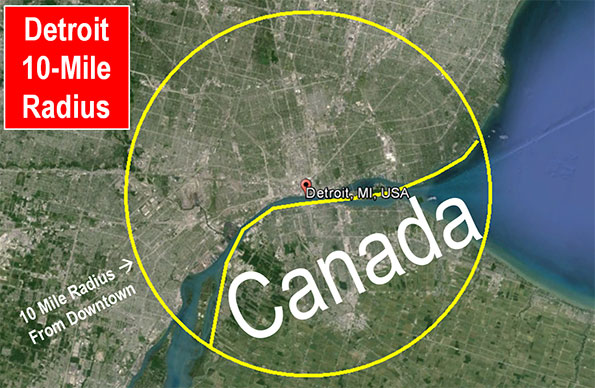
    The evidence is characterized as “job sprawl” – that a smaller share of metropolitan area jobs are located within 10 miles of downtown Detroit than in the same radius from downtown Pittsburgh (see Note on Decentralization and “Job Sprawl”). It is suggested that this kept the city of Pittsburgh out of bankruptcy.

    Not so. The subject is not urban form; it is rather financial management that was not up to par. State intervention may have been the only thing that saved the city of Pittsburgh from sharing Detroit’s fate.

    Detroit and Pittsburgh: Birds of a Financial Feather

    The city of Pittsburgh had been teetering on bankruptcy for some time. In 2004, the city’s financial affairs were placed under Act 47 administration (the Financially Distressed Municipalities Act“) by the state of Pennsylvania. One of Act 47’s purposes is to assist municipalities in avoiding bankruptcy. A 2004 state ordered recovery plan summarized the situation:

    The City of Pittsburgh, already in fiscal distress, now stands on the precipice of full-blown crisis. In August 2003, the City laid off 446 employees, including nearly 100 police officers. City recreation centers and public swimming pools were closed, and services from police mounted patrol to salt boxes were eliminated. In October and November 2003, the City’s credit ratings were downgraded repeatedly, leaving Pittsburgh as the nation’s only major city to hold below-investment-grade “junk bond” ratings. With the City’s most recent independent audit questioning the City’s ability to continue as a going concern, a looming cash shortfall now threatens pension payments and payroll later this year. (emphasis added)

    The good news is that Act 47 has worked so well that the city could soon be released from state control. It may have helped that all of this was overseen by former Democratic Governor Ed Rendell, whose tough administration saved another abysmally-managed municipality when he was mayor of Philadelphia more than a decade before.

    Not everyone, however, is willing to grant that Pittsburgh has solved all its problems. Democratic candidate for mayor of Pittsburgh, Bill Peduto, recently urged Harrisburg to not release the city from Act 47 control. According to Peduto, “the city is not out of the financial woods,” and “we’re still in the middle of it, and in fact we have an opportunity in the next five years to build a sustainable budget for at least a decade.” Given the strong Democratic majority in the city, Peduto will probably be the next mayor.

    The Key: Strong Management

    In Detroit’s case, the state dithered for years, jumping in only when it was too late. Maybe the “tough love” of a Michigan-style Act 47 could have saved Detroit.

    Meanwhile, best of luck to the Detroit bankruptcy court and Pittsburgh’s next mayor. Both were dealt a bad hand by predecessors who said yes to spending interests too often, to the detriment of residents and taxpayers.

    ——–

    Note on Decentralization and “Job Sprawl”

    The dispersed American metropolitan area has performed better than its mono-centric (downtown oriented) urban form of the past. American metropolitan areas are the most affluent in the world, and they are also the most decentralized. Decentralization of employment facilitates mobility, as economists Peter Gordon and Harry W. Richardson found 15 years ago. Work trip travel times are shorter and traffic congestion is less intense in US metropolitan areas than in similar sized metropolitan areas in Western Europe, Japan, Canada and Australia. At the same time, metropolitan areas around the world are themselves becoming more decentralized. The bottom line is that better mobility facilitates greater economic growth, which also reduces poverty.

    Comparing the “job sprawl” of Detroit and Pittsburgh not only misses the point; it also glosses over differences that render any comparison virtually meaningless.

    Detroit is Larger: The Detroit metropolitan area has nearly 60 percent more jobs than the Pittsburgh metropolitan area. Other things being equal, this would mean that Detroit would cover more area than Pittsburgh. As a result, even if the employment densities were equal, a smaller percentage of the jobs would be within 10 miles of downtown Detroit and within 10 miles of downtown Pittsburgh.

    Nearly Half of Detroit’s 10 Mile Radius is in Canada and a Lake:But other things are not equal. Approximately 40 percent of the area within 10 miles of downtown Detroit is in Canada or in Lake St. Clair. Canadian jobs are appropriately excluded from the Detroit “job sprawl” numbers developed by the Brookings Institution (Figure), and no 10 mile radius comparison can thus be made to Pittsburgh.  None of the 10 mile radius from downtown Pittsburgh is in Canada and none of it is in a large lake.

    See Also: Peter Gordon’s Blog: Detroit

  • The Diminishing Returns of Large Cities: Population Growth Myths

    One of the big myths of the twentieth century is that large American cities are necessary and inevitable. Yet in reality growth has been dispersing to suburbs and smaller cities for the last two decades. As the decline of Detroit, once the country’s fourth largest city, reveals in all too harsh terms, being bigger is not always better.

    Yet the big city myth remains virtually unchallenged. A biased print media and a subsidized academic cartel are constantly singing the praises of big city life (as opposed to suburban or rural life). While American cities exhibited strong population growth in the early part of the twentieth century, recent Census numbers show America’s mega cities are growing below the national growth rate. According to the 2010 Census, San Antonio was the only city with a population of over 1 million people that grew above the national growth rate of 9.7%.   

    Years ago, scholar Milton Kotler wrote an important but much forgotten book on local government. Kotler showed what was behind the amazing growth numbers of the some big cities:

    Statistics show New York’s population increase from 1890-1900 to have been 2,096,370. This seems amazing, except that most of the increase came about with the annexation of Brooklyn, population 1,166,582. In short, its population grew at a rate far less than the increase by annexation.

    Municipalities are creations of the state legislature. In many cities, the boundaries changed to expand the power of cities along with their political class and related business rent-seekers. While some would argue about New York city’s population numbers, which has recovered from their lows, few would question Detroit’s long-term decline. As Detroit takes center stage line, the entire municipal bond market is about to take notice. Much is at stake here.

    Not only the economic foundation of a large American city but the concept that a creditor will get back its principal back.  The Detroit Free Press explains:

    Borrowing for Michigan cities could get more expensive in the future, if Detroit emergency manager Kevyn Orr’s restructuring plan is accepted by creditors and Chapter 9 bankruptcy is avoided, some bond experts caution.

    That’s because Orr’s plan would set a major precedent by treating all unsecured debt the same way — instead of giving a better payout or greater deference to general obligation bonds, sold for generations as safer investments backed by a city’s taxing authority.

    In Detroit, both the lack of checks and balances, and the maintenance of an engaged, informed public undermined the city’s fiscal health. Many Detroit citizens voted with their feet by exiting the corrupt system. With the middle class of all races deserting, the city of Detroit was ripe for looting of the taxpayers.

    In conclusion, it’s time for the informed public to realize many of our big cities are expensive, corrupt, and not redeemable. The Michigan Legislature should cut Detroit down to size. Perhaps they should consider de-annexation. It’s better to have Detroit become ten smaller municipalities. Of course there would be major political resistance for those who have made big money from Detroit’s decline. But without de-annexation, Detroit seems likely to remain on the brink of insolvency for a long-term since its political boundaries are too large for responsive governance and the crafting of unique solutions to its problems.

  • Detroit, Why Hast Thou Forsaken Me?

    Thou wouldst fain destroy the temple! If thou be Jesus, Son of the Father, now from the Cross descend thou, that we behold it and believe on thee when we behold it. If thou art King over Israel, save thyself then!

    God, My Father, why has thou forsaken me? All those who were my friends, all have now forsaken me. And he that hate me do now prevail against me, and he whom I cherished, he hath betrayed me.

    Lyric excerpts from the Fifth and Fourth and Words, respectively, of the Seven Last Words of Christ orchestral work by Joseph Haydn.

    I’m pissed.

    Ever since the announcement late Thursday that the City of Detroit was indeed going to file for Chapter 9 municipal bankruptcy protection, the Internet has been overflowing with commentary on the matter. The commentary has come from all places and taken on by all comers – from the political left and right; from hard news and general interest sources. And all usually with the same scripted and lazy tripe about how Detroit reached its nadir:

    • Single-minded dependence on a collapsing auto industry doomed Detroit.
    • An inability to diversify economically doomed Detroit.
    • Public mismanagement and political corruption doomed Detroit.
    • An inability to effectively deal with its racial matters doomed Detroit.
    • The dramatic and total loss of its tax base doomed Detroit.

    That’s it, people, they seem to reason. The Motor City’s fall from grace is as simple as that. You do the things Detroit did, and you get what Detroit got. You defer decisions just as Detroit did, and you too will suffer the consequences. The speed with which the various articles on Detroit came out proved to me that many writers anticipated the announcement with at least a twinge of glee.

    As I’ve written before, Detroit’s narrative serves everyone else as the nation’s whipping boy, and that came through in the last couple of days:

    You can find Detroit in Cleveland, St. Louis, Buffalo, Milwaukee, Baltimore and Philadelphia. You can find it in Indianapolis, Minneapolis, Cincinnati, Columbus and Louisville. You can find it in Atlanta, Miami, Houston, Dallas and Phoenix. You can even find it in Las Vegas, Seattle, San Francisco and Portland. And yes, you can definitely find it in New York, Chicago, Los Angeles and Washington, DC. You can find elements of the Detroit Dystopia Meme™ in every major city in the country. Yet Detroit is the only one that owns it and shoulders the burden for all of them.

    But let’s leave that aside. I’m pissed because no one seems to acknowledge the central reason Detroit is filing for bankruptcy now. It has endured abandonment – white flight abandonment – on an absolutely epic scale. Before there was auto industry collapse, before there was a lack of economic diversity, before there was mismanagement and corruption, there was abandonment. People skirt and dance around the issue when they talk about the loss of Detroit’s tax base. What Detroit lost was its white people. The chart above illustrates how Detroit’s unique experience when compared to similar cities.

    Detroit is what happens when the city is abandoned. And frankly, there is a part of me that views those that abandoned Detroit with the same anger reserved for hit-and-run drivers – they were the cause of the accident, they left the scene of the crime, and they left behind others to clean up the mess and deal with the pain. What’s worse, so many observers seem to want to implicate those left behind – in Detroit’s case a large African-American majority community – for not cleaning up the mess or easing the pain. Their inflicted pain which they’ve made ours.

    White abandonment of Detroit did not start with the 1973 election of Coleman Young as mayor, or even the 1967 riots, yet those two events accelerated the process. And indeed, Detroit had a very unique set of circumstances that caused it to veer down a troubled path. The very first piece featured in my blog was about the land use and governing decisions that were made more than one hundred years ago in Detroit that literally set the city’s decline in stone. I identified eight key factors:

    • Poor neighborhood identification, or more broadly a poorly developed civic consciousness.
    • A housing stock of poor quality, cheap and disposable, particularly outside of the city’s traditional core.
    • A poorly developed and maintained public realm.
    • A downtown that was allowed to become weak.
    • Freeway expansion.
    • Lack of or loss of a viable transit network.
    • A local government organization type that lacked accountability at the resident/customer level.
    • An industrial landscape that was allowed to constrain the city’s core.

    Conor Friedersdorf of the Atlantic wrote perhaps one of the best recent articles I saw on Detroit when he acknowledged that even a half-century ago, journalists were predicting a dire future for the D. Take this quote Conor found from The Reporter, published October 31, 1957:

    The auto industry created modern Detroit simply as its dormitory and workshop, attracted polyglot millions to it, used it, and now threatens to abandon it. Civic consciousness played little part in the lives of the masses of Irish, German, Poles and Italians who flocked to Detroit in search of a Ford or Dodge or Packard pay check, and who settled there in islands of their own – any more than it played a part in the managements of Ford or Dodge or Packard themselves, or in the crowd of Negroes who also descended upon the city during the boom years of the Second World War… Indeed, it is remarkable that any sense of civic responsibility at all should have been generated in so rootless and transient a community.

    What can a city do when it finds its patron industry and its middle class moving out, leaving it a relic of extremes?… But urban deterioration offers at least one advantage. Once a city core has become as run-down as Detroit’s you can start to rebuild fairly cheaply.

    Yes, that is from 1957.

    The chart at the top of this article was done for an article I did more than a year ago, looking at U.S. Census data for several peer cities over the last seven decennial censuses. In it, I concluded that Detroit’s experience of abandonment was entirely unique:

    Between 1950 and 1970, the decline in Detroit’s white population was on the low end of the spectrum of cities on this list, but it was in the ballpark. Prior to 1970, Detroit and St. Louis were the white flight laggards. After 1970, the bottom fell out and Detroit stood alone. While there certainly are economic reasons white residents may have had for moving, this graph may lend credence to the twin theories of Motor City white flight – the 1967 riots and the 1973 election of Mayor Coleman Young.

    I’m not trying to persuade anyone of the invalidity of their decision to move from Detroit. There were good reasons and not so good reasons. I’m only trying to describe its impact relative to other cities. And where exactly are those white residents who left over the last 60 years? Certainly many have passed on. Some are currently in the Detroit suburbs or elsewhere in Michigan. Some are part of that great Detroit Diaspora that took them to New York, Washington, Charlotte, Atlanta, Houston, Phoenix, Los Angeles, Seattle and Portland. There are clearly at least 1.5 million reasons why white residents left Detroit.

    But the fact is, had Detroit experienced white flight at the same combined rate as the other cities on this list, and not experienced any other changes, there would be nearly 350,000 more white residents today. Maybe 140,000 more households. Maybe more stable neighborhoods.

    Can you imagine that? An additional 350,000 residents means Detroit would still be a city with more than one million people. It would likely be viewed in the same way that a Philadelphia or Baltimore is now – challenged but recovering – instead of the urban dystopia it’s widely seen as today. What impact would that have had on the city’s economy? On the metro area’s economy? On the state’s economy? Or simply the city’s national perception?

    I’ve mentioned here on several occasions that the reason I chose the planning profession is because I grew up in Detroit during the 1970s. I looked around and saw a city with an inferiority complex and saw people leaving in droves. My naïve and childish thinking was, “instead of leaving the city, why don’t people stay and work to make it better?”

    Silly of me. Abandonment is the American way.

    Nonetheless, I view Detroit’s bankruptcy announcement positively. It acknowledges that its troubles are far deeper than most realize. It can be the springboard for fiscal recovery, a re-imagining of the city and an actual and complete revitalization. Detroit indeed is in uncharted waters, and its abandonment means that in many respects it could be viewed as a frontier city once again. I would not be surprised if, after restructuring and reorganization, after recapturing its innovative spirit, the city could see growth almost like it did at the beginning of the twentieth century, mimicking what, say, Las Vegas has done for the last 40 years. Even at this dark moment, Detroit has assets that are the envy of other cities.

    But let no one forget that it is abandonment that brought Detroit to this point.

    This piece originally appeared at The Corner Side Yard.

    Pete Saunders is a Detroit native who has worked as a public and private sector urban planner in the Chicago area for more than twenty years.  He is also the author of "The Corner Side Yard," an urban planning blog that focuses on the redevelopment and revitalization of Rust Belt cities.