Blog

  • The Collapse of Racial Politics in Southeast Asia

    The recent general election in Malaysia left behind a bitter legacy of political divisions, threats of lawsuits, growing demonstrations, and arrests under the Sedition Act. In a larger sense, however, it was another sign that the race-based political order in Malaysia, and to a certain extent in neighboring Singapore, is breaking down.

    Ever since Malaysia won independence in 1957 it has been governed by a coalition – the National Front or Barisan Nasional (BN) – made up of as many as a dozen parties, representing the ethnic and racial makeup of this multicultural country.

    The quintessential representative of the old order was Mahathir Mohamad, who served 22 years (1981 to 2003) as prime minister. He spoke in Tokyo shortly after the May 5th general election and defended the coalition system as a means of apportioning the power and wealth of the country among its diverse groups.

    After each general election the Barisan distributed cabinet posts to the leaders of the various partners, assuring that some posts went to ethnic Chinese, to ethnic Indians, and to representatives of aboriginal and indigenous peoples in the states of Sabah and Sarawak on the island of Borneo.

    Mostly, these were second and third-tier portfolios. The plum jobs, such as defense, foreign affairs, finance, and of course the prime minister’s post itself went to the United Malays National Organization (UMNO) that represented, in this racial scheme, the Malays, who make up about 60 percent of the population.

    This year, for the first time, no ethnic Chinese will be serving in the cabinet. Chinese voters deserted the main Chinese coalition parties in droves to vote for an opposition coalition under the leadership of Anwar Ibrahim, leaving hardly anyone available to take up the jobs. Prime Minister Najib Razak called it a “Chinese tsunami”.

    Increasingly, the BN is dependent on East Malaysian parties to maintain a majority. The 47 seats that the Barisan won in Sabah and Sarawak saved Najib’s bacon last month. Without them, he might have fallen short of the majority needed to form a government under Malaysia’s Westminster style of government.

    But it is an unstable base, as it depends on continued malapportionment. For example, the capital, Kuala Lumpur, with a population of 7 million has 11 seats, while Sabah, with 3.5 million people sends 25 members to parliament. That kind of imbalance cannot persist in a democratic country, especially as more young people drawn to the under-represented areas see themselves left out.

    In his recent talk, Mahathir lamented that Malaysia is still a divided country, without seeming to acknowledge that the system of race-based politics might itself have contributed to the divisions. The Chinese, who make up a quarter of the population, refuse to assimilate, unlike ethnic Chinese in Indonesia or Thailand, he said.

    He might have noted that for years, the Suharto regime in Indonesia suppressed outward manifestations of ethnicity, to the point of banning celebrations of Chinese New year, Chinese language schools even the use of the Chinese script. These restrictions were lifted only with the end of the New Order regime in 1998.

    In neighboring Singapore, the old order, built around a monopoly of power for the governing Peoples’ Action Party, is slowly crumbling, too. In the 2011 general election the PAP garnered about 60 percent of the vote, better perhaps than the Barisan’s 47 percent this year, but still the lowest percentage since independence.

    For the first time, the opposition captured a Group Representative Constituency, a unique Singaporean form of electoral machinery whereby five candidates run as a slate. The system was ostensibly designed to ensure racial balance, since at least one member had to come from a Malay, Indian or other minority community.

    That is the rationale, anyway. Many believe it was meant to disable the opposition by making it harder to recruit enough candidates and pay the costs of running, while at the same time providing electoral refuge for weaker PAP candidates who might lose in face-to-face encounters.

    Overnight, the opposition tripled its numbers in parliament. Capturing the Aljuniad GRC was like climbing Mount Everest. It will be easier next time. The opposition in Singapore, such as it was, once was made up of gadflies and loners. But a new breed of highly educated Singaporeans is aspiring to lead, exemplified by the new opposition MP Chen Shaw Mao, a former Rhodes Scholar.

    Malaysia’s prime minister returns to office considerably weakened. His coalition performed even worse than it did in 2008 under his predecessor, Abdullah Badawi, who resigned, taking the blame for the poor showing. Najib faces threat of coalition defections and the possibility, though remote, that some of his members may be disqualified through successful challenges based on voter fraud.

    He is fighting back, in part by wielding the Sedition Act against demonstrators, and by packing the cabinet with Malay nationalists. Najib has to stand for re-election as leader of UMNO at a party conference later this month, where he may be challenged by his deputy, Muhyidden Yassin.

    Mahathir predicted that, in the end, the party and the coalition will come around to supporting Najib because “there is no alternative.” That maybe more true today than it will be tomorrow.

    Todd Crowell is a Tokyo-based journalist. He has covered Malaysian politics for Asiaweek magazine.

    Flickr photo by Hitoribocchi; Pakatan Rakyat Rally, general elections, Malaysia, May, 2013.

  • Reforming Higher Education

    For years, some justified high pay for college educated professionals because they served as a data base for certain types of knowledge – medicine, dentistry, pharmacy, law, accounting or any number of other disciplines taught at the college level. But with the advances in information technology and robotics, those salaries might not be justified in the near future. Information technology is currently forcing downsizing in the law sector, as fewer lawyers are needed to research cases or produce wills, trusts and divorce decrees. And robots will eventually do the jobs of dentists and surgeons and pharmacists.

    But technology encroaching on the jobs of college educated professionals doesn’t mean an end to the relevance of institutions of higher learning. Our country’s technology hubs are based around universities, as they provide the necessary research and development for the formation of such companies. However, it must be added that military research and procurement also play a role in our technology sector. In addition, academics in the humanities produce knowledge that enhances our communities, cities and country.

    We must also look at the burden that student loan debt on our economy, as the more young people owe on student loans the less they spend on the consumer economy. Cities and suburban municipalities could and should charter universities for city residents, and a university education should be free to all residents. This would help combat the problem.

    Reform could help our country build on its past. Doctors, lawyers and college professors didn’t always spend years in school to learn their trade. A Midwestern lawyer named Abraham Lincoln studied for the bar on his own before becoming a successful railroad lawyer and President of the United States. And in the late 1800s, the country was dotted with medical schools that would train doctors. In fact, there were more medical students back then than today, and this put the downward pressure on prices for the consumer.

  • The Transit-Density Disconnect

    Around the world planners are seeking to increase urban densities, at least in part because of the belief that this will materially reduce automobile use and encourage people to give up their cars and switch to transit, or walk or cycle (Note 1). Yet research indicates only a marginal connection between higher densities and reduced car use. Never mind that the imperative for trying to force people out of their cars has rendered largely unnecessary by fuel economy improvements projected to radically reduce greenhouse gas emissions from cars (see Obama Fuel Economy Rules Trump Smart Growth).

    Transit Use and Density: A Tenuous Connection at Best

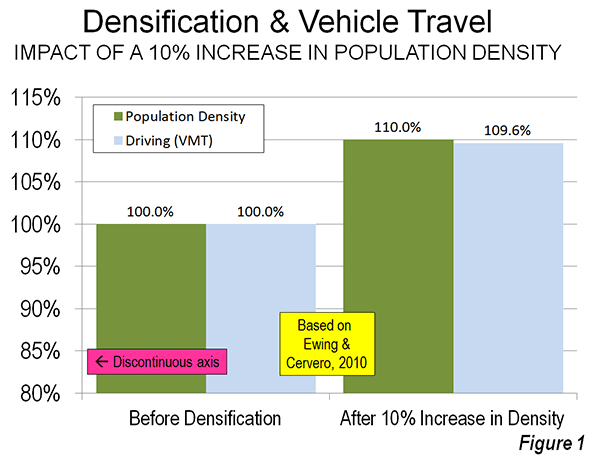
    In a widely cited study, Reid Ewing of the University of Utah, and UC Berkeley’s Robert Cervero reported only a minimal relationship between higher density and less driving per capita. In a meta-analysis of nine studies that examined the relationship between higher density and per household or per capita car travel, they found that for each 1 percent higher density, there is only 0.04 percent less vehicle travel per household (or per capita). This would mean that a 10 percent higher density should be associated with a reduction of 0.4 percent in per capita or household driving.

    More people in the same area driving a little less means overall driving is greater, as Peter Gordon reminds us. This is illustrated by the Ewing-Cervero finding — a 10 percent increase in population density is associated with  9.6 percent increase in overall driving, as is indicated in Figure 1 (the calculation is shown in the table). Ewing and Cervero placed this appropriate caution in their research: "we find population and job densities to be only weakly associated with travel behavior once these other variables are controlled."

    There is another limitation to the density-transit research. The comparison of travel behaviors between areas of differing density   provides no evidence that conversion of an area from lower to higher density would replicate the travel behavior of already existing (historic) areas of higher density.

    Transit is about Downtown, Not Density

    Ewing and Cervero also found that proximity to the central business district (downtown) is far more likely to reduce vehicle travel than higher densities. This mirrors the findings of others. The Ewing-Cervero conclusion is that, all things being equal, there is a 0.22 percent reduction in travel per capita for each one percent reduction in the distance to downtown.

    Table
    Density and Driving Example
      Base Density 1% Higher Density 10% Higher Density
    Households 100 101 110
       Change from Base Density 1.0% 10.0%
    Daily Driving per Household (Miles) 10 9.996 9.960
       Change from Base Density -0.04% -0.40%
    Total Daily Driving (Miles)        1,000       1,009.6           1,095.6
       Change from Base Density 0.96% 9.56%
    Based on Ewing & Cervero (2010)


    Transit commuting is strongly concentrated toward the largest downtown areas, which is the only place automobile-competitive mobility can be provided from large parts of the modern metropolitan area (whether in North America, Western Europe or Australasia).

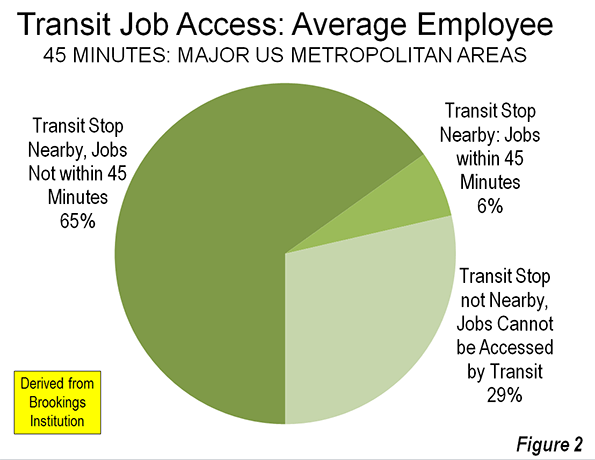
    This is, at least in part, why transit service provides such minimal employment access throughout major US metropolitan areas. Data from the Brookings Institution indicates that among the 51 metropolitan areas with more than 1,000,000 population, the average worker can reach only six percent of jobs in 45 minutes (see: Transit: The 4 Percent Solution). Nearly two-thirds of the jobs cannot be reached in 45 minutes, despite transit’s being nearby, while slightly less than one third of workers are not nearby transit at all (Figure 2). By comparison, the average driver reaches work in approximately 25 minutes.

    Of course, not everyone can (or would want to) live near downtown. Hong Kong comes closest to this urban containment ideal, with the highest population density of any major urban area in the high income world (67,600 per square mile or 26,100 per square kilometer).Yet despite these extraordinary densities,   one-way work trip travel times average 46 minutes, 20 minutes longer than in lower density, similar sized Dallas-Fort Worth.  

    High Density Commuting in the United States

    The centrality of downtown to transit ridership was a principal point of my “transit legacy city” research, which found that 55 percent of all transit commuting in the United States was to just six municipalities (not metropolitan areas). These include the municipalities of New York, Chicago, Philadelphia, San Francisco, Boston and Washington. Among the 55 percent of transit commuters in the nation who work in these six municipalities, 60 percent work in the downtown areas, which are the largest and most concentrated in the nation. This, combined with nearby high density neighborhoods, makes for transit Nirvana.

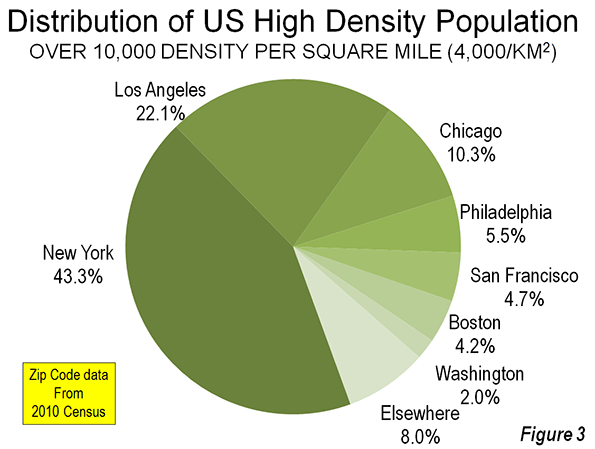
    The highest population densities are concentrated in just a few metropolitan areas (Note 2). Approximately 43 percent of the nation’s population living at or above 10,000 per square mile density (approximately 4000 per square kilometer) lives in the New York metropolitan area. Despite its low density reputation, Los Angeles has the second largest concentration of densities above 10,000 per square mile, at 22 percent. Chicago’s high density zip codes contain a much smaller 10 percent of the national high density population (Note 3), while nearly all of the balance is in Boston, San Francisco, Philadelphia, and Washington (Figure 3).

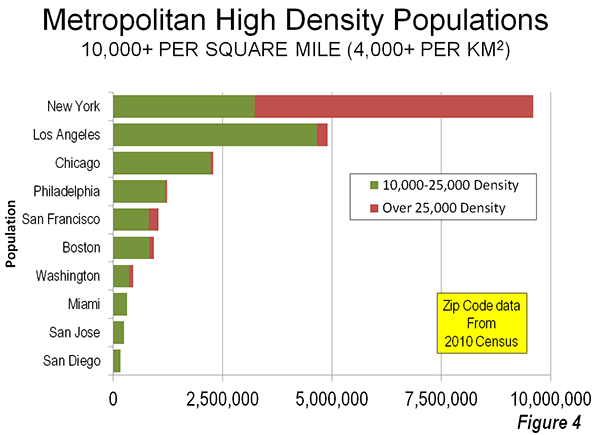
    The greatest concentration of the highest densities is in New York, which has 88 percent of the national population living at more than 25,000 per square mile (approximately 10,000 per square kilometer). Los Angeles ranked second at 3.5 percent and San Francisco ranks third at 3.2 percent (Figure 4). At this very high population density, nearly 60 percent of New York resident workers use transit to get to work. No one, however, rationally believes that densities approximating anything 25,000 per square mile or above will occur, no matter how radical urban plans become.

    An examination of transit work trip market shares in the density range of 10,000 per square mile to 25,000 per square mile illustrates the importance of proximity to downtown. There are nine metropolitan areas in the United States that have more than 200,000 residents living in zip codes with this density. These include the metropolitan areas with the six transit legacy cities, as well as Los Angeles, Miami and San Jose. These latter three experienced from two-thirds to 90 percent of their urban growth since World War II.

    San Jose’s large high density population is surprising, because it has a post-War suburban core city and, as a result, a comparatively weak downtown area. Moreover, San Jose has nearly 20 times as many people living at high densities as larger Portland, despite its more than three decades of densification policy (Note 4).

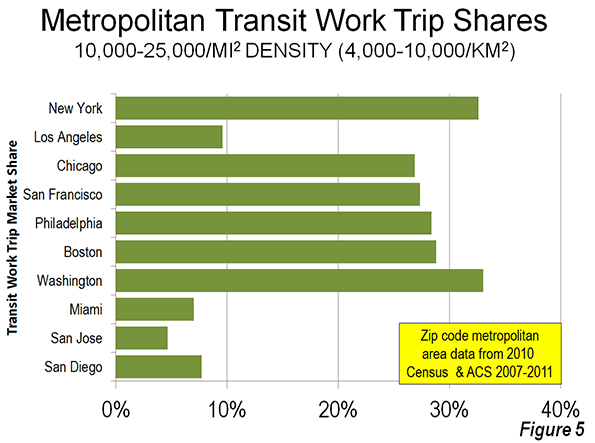
    Transit market shares are by far the highest in the high density zip codes of the metropolitan areas with the six transit legacy cities, at 30 percent. This ranges from 27 percent in Chicago to 33 percent in New York and Washington. At first glance, this would be evidence of a fairly consistent transit market share for high densities among the six metropolitan areas (Note 5).

    However, metropolitan areas containing the transit legacy cities are unique. Their high density areas are located near their large downtown areas (which are the largest and most concentrated employment centers in the nation), as is to be expected from urban forms that date from the 19th and early 20th centuries. The more recent urban forms of the metropolitan areas rounding out the top ten in high density residents, Los Angeles, Miami, San Jose and San Diego, are very different. Not only do they have smaller downtowns but their high density areas are not concentrated to the same degree around downtown. As a result, their high density transit work trip market shares are much lower (Figure 5).

    This is best illustrated by Los Angeles, the metropolitan area with the largest number of people living at 10,000 to 25,000 residents per square mile in the nation. The transit work trip market share of these high density zip code residents is 9.6 percent, one-third that of similarly high densities in the metropolitan areas with transit legacy cities.

    In Miami, the transit work trip market share of high density residents is only 7.0 percent. In San Jose, the transit work trip market share for high density residents is only 4.6 percent, less than one-sixth that of the metropolitan areas with legacy cities. San Jose’s high density transit work trip market share is even below the national average for all densities (5.0 percent).  San Diego’s high density transit work trip market share is 7.7 percent.

    “A Negligible Impact”

    The transit-density disconnect may have been best summarized by Paul Shimik in 2007 research published in the Transportation Research Record: "The effect of density is so small that even a relatively large-scale shift to urban densities would have a negligible impact on total vehicle travel."

    Wendell Cox is a Visiting Professor, Conservatoire National des Arts et Metiers, Paris and the author of “War on the Dream: How Anti-Sprawl Policy Threatens the Quality of Life.

    —–

    Note 1: This article is limited to the potential for transferring automobile demand from cars to transit. Walking and cycling have only marginal potential for reducing vehicle travel, because these modes cannot provide access throughout today’s large metropolitan (labor) markets.

    Note 2: This analysis uses zip code level data from the 2010 Census and the American Community Survey for 2007-2011.

    Note 3: Los Angeles also has the second highest share of its population living at densities of 10,000 per square mile and above, at 38 percent. New York has 49 percent at this density, while in Chicago and San Francisco, 24 percent of residents live at these high densities.

    Note 4: Portland ranked 25th in high density (at or above 10,000 per square mile) out of the 51 metropolitan areas with more than 1,000,000 population in 2010. Portland’s high density share of its metropolitan population, at 0.7 percent, is well below that of the nation’s most market oriented development metropolitan area, Houston, at 2.0 percent and slightly below that of Dallas-Fort Worth.

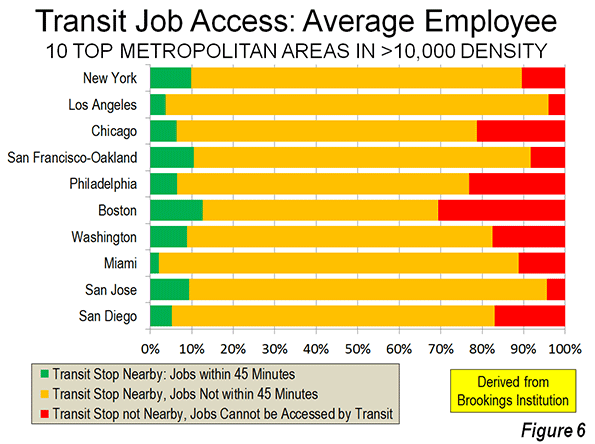
    Note 5: Despite their much higher transit work trip market shares in high density areas, the jobs in suburban areas in the metropolitan areas with legacy cities can be as inaccessible by transit as in the metropolitan areas with post-War core municipalities. See Figure 6.

    Photo: San Diego (by author)

  • Did the Midwest Ever Have Strong Coastal Connections?

    Pete Saunders recently described how, after being built in part with eastern money, West Coast outposts like San Francisco and Los Angeles never relinquished their East Coast connections. This created bi-coastal connectivity that continues to play dividends for both coast at the expense of relatively disconnected “flyover country.”

    But I wonder: did most places in the Midwest ever have great connections to the East Coast (especially New York City) to begin with? It brought to mind William Cronon’s tour de force book “Nature’s Metropolis: Chicago and the Great West” in which he documented the rise of Chicago and the rest of the Midwest together as an integrated system. One of the things he did was try to trace financial flows. This wasn’t easy, but he looked at things like bankruptcy and probate records, as well as other people’s research into correspondent banking relationships.

    What Cronon found is that Chicago served as the the gateway that connected the rest of the Midwest to eastern markets. This was true physically via the industrial works in Chicago that converted raw materials into finished goods, railroads, etc. But it was also true financially. Cronon notes:

    By choosing Chicago to be the greatest concentration of railroad capital on the continent, and by giving Chicago merchants special access to credit and discounts that made wholesaling possible, New Yorkers and other eastern capitalists place it atop the western system at the very moment that settlement in the region began its most explosive growth
    ….
    Canadian geographer A. F. Burghardt has used less grandiloquent language to describe this same process. In his phrase, Chicago became a “gateway city” by serving as the chief intermediary between newly occupied farms and town in the West and the maturing capitalist economy of the Northeast and Europe.

    Writing specifically about finance, Cronon notes:

    In 1884 a Chicago guidebook author could report, “Our banks are now depended on to a great extent to furnish Eastern exchange for other cities, and Chicago has become the recognized financial center of the West – bearing the same relation to the West that New York does to the entire country.”

    If one moves further down the urban hierarchy, the implications of these banking linkages for Chicago’s regional hinterland become clearer still. By looking at medium-sized cities that used Chicago banks for their principal correspondent relations, one discovers that Chicago’s financial hinterland extended from Cleveland in the east to Denver in the west. Three decades later, in 1910, it extended all the way west to Seattle, San Francisco, and Los Angeles.

    What this suggests to me, though I didn’t see Cronon explicitly state it, is that much of the Midwest may never have had much in the way of independent East Coast connections. Rather, their connections were with Chicago, relationships that definitely continue to the modern day. Thus it may be less a matter of Midwestern cities giving up East Coast ties as never having had much of them in the first place.

    Chicago, by contrast, had not only its original East Coast connections, but also developed networks to the West. The persistence of these networks is one of the many factors that enabled Chicago to more readily adapt to the global era than other Rust Belt locales. Chicago may be the only Midwest city with reasonably strong coastal connections.

    It would be interesting to study the development of financial relationships in cities over time. Saunders posited that New York money originally financed San Francisco, but Cronon notes the dominance of Chicago connections by 1910. San Francisco ultimately became the major west coast financial center in its own right and retains a significant finance center function through its venture capital concentrations.

    Cleveland as the easternmost extent of Chicago’s hinterland is something we see today. Indeed, I’ve been told the west side of the Cleveland region tilts towards Chicago and the east side towards New York even today.

    In any case, I’m not making definitive claims, just looking for potential explanations for the paucity of Midwest networks. Cronon basically makes the argument that Chicago and the Midwest were the original “megaregion” and as a result, perhaps Midwestern cities developed networks that were excessively Chicago-centric. Given the historic status of Chicago as a gateway city to national and global markets, my idea that Chicago should see itself as the Midwest’s global gateway seems directionally correct.

    Aaron M. Renn is an independent writer on urban affairs and the founder of Telestrian, a data analysis and mapping tool. He writes at The Urbanophile where this piece originally appeared.

    Photo by Doug Siefken

  • America’s Fastest-Growing Cities Since The Recession

    It was widely reported that the Great Recession and subsequent economic malaise changed the geography of America. Suburbs, particularly in the Sun Belt, were becoming the “new slums” as people flocked back to dense core cities.

    Yet an analysis of post-2007 population trends by demographer Wendell Cox in the 111 U.S. metro areas with more than 200,000 residents reveals something both very different from the conventional wisdom and at the same time very familiar. Virtually all of the 20 that have added the most residents from 2007 to 2012 are in the Old Confederacy, the Intermountain West and suburbs of larger cities, notably in California. The lone exception to this pattern is No. 15 Portland. The bottom line: growth is still fastest in the Sun Belt, in suburban cities and lower-density, spread out municipalities.

    The No. 1 city on our list, New Orleans, fits this picture to a degree as a quintessentially Southern city, but it’s a bit of an anomaly. Its fast growth is partially a rebound effect from its massive population loss after Katrina, but is also a function of a striking economic revival that I have seen firsthand as a consultant in the area.

    Since 2007 New Orleans’ population has grown 28% to 370,000. Many are newcomers who came, at least initially, to rebuild the city.  But the city is still way below the 2002 population of 472,000, much less its high of 628,000 in 1960.

    New Orleans is one of six cities where the population of the core has grown more in total numbers than the surrounding suburbs. (The other five are New York; San Jose, Calif.; Providence, R.I.; Columbus, Ohio; and San Antonio.) This is also a product of the fact that, when the Greater New Orleans region began to recover, the return to the suburban regions, for the most part, came before that to the city.

    Nothing in the data, however suggests a revival of the older, dense “legacy” cities that were typical of the late 19th century and pre-war era. Most of the fastest-growing big cities since 2007 are of the sprawling post-1945 Sun Belt variety, including Charlotte, N.C. (No. 4); Ft. Worth, Texas (No.  6); Austin, Texas, (10th); El Paso, Texas (11th); Raleigh, N.C. (12th); and Oklahoma City (18th). Some of the fastest-growers are also outside the major metropolitan areas,  such as No. 5 Bakersfield in California’s Central Valley, the North Carolina cities of Greensboro and Durham, (9th and 14th, respectively), and  Corpus Christi, Texas (16th).

    Among the big Northeast cities, the best performer is Washington (27th with 7.8% population growth) followed by Boston (71st, 2.2%). New York has managed only 0.3% population growth since 2007 (88th). Among other leading U.S. cities San Francisco’s population is up 3.3%, Los Angeles has grown 2.1%, and Chicago’s population has dropped 3.4%.

    The other somewhat surprising result is the strong performance of more purely suburban cities, that is, ones that have grown up since car ownership became nearly universal. They are not the historic cores of their regions but have developed into major employment centers with housing primarily made up of single-family residences. These include the city that has grown the second most in the U.S. since 2007: Chula Vista, a San Diego suburb close to the Mexican border, whose population expanded 17.7%. It’s followed in third place by the Los Angeles suburb of Irvine (16.3%); No. 7 Irving, Texas; and the California cities of Fremont (13th) , located just east of San Jose-Silicon Valley, and Oxnard (17th), north of Los Angeles.

    What do these results tell us? First, that Americans continue to move decisively to both lower-density, job-creating cities and to those less dense areas of major metropolitan areas particularly where single-family houses, good schools and jobs are plentiful.

    Irvine, a planned postwar city of some 230,000 which ranks as the country’s seventh-wealthiest municipality, has three jobs for every resident; roughly two in five residents work in the city. Irvine’s 16.3% growth rate since 2007 has been bolstered by a strong inflow of Asians. Once overwhelmingly white, Irvine’s population is now roughly 40% Asian and 9% Hispanic.

    Similarly, Irving, Texas, also thrived through the recession. Like Irvine this Dallas-area suburb is a major job center. Headquarters for Nokia , NEC Corporation of America, Blackberry, and Exxon Mobil, Irving’s population has soared over 13% over the past five years to 225,000.

    This contrasts with some similarly sized suburbs that boomed in the first part of the decade. North Las Vegas added 80,000 people between 2002 and 2007 but its growth slowed down considerably as the Nevada economy cratered. This extension of Las Vegas has added a relatively paltry 12,000 people since 2007. With Phoenix losing 3.2% of its population since ’07, the nearby former boomtowns of Mesa and Scottsdale have also seen net outflows of residents.

    Migration numbers for 2010 to 2012 alone hammer home that suburban areas are continuing to attract people, and that the more dense core areas do not generally perform as well. Although their growth has slowed compared to the last decade, suburban locales, with roughly three-quarters of all residents of metropolitan areas, have added many more people than their core counterparts.

    Where do we go from here? The urban future will continue to evolve in directions that contradict the prevailing conventional wisdom of a shift toward more crowded living. The continued dispersion of America’s population is evidenced by the persistent, and surprising, strength of suburban towns, as well as the low-density cities of Texas and the Plains. The key to growth in the next decade may depend largely on whether these rising municipalities can continue to create the jobs, favorable educational environment and amenities necessary to attract more newcomers in the future.

    MUNICIPALITIES OVER 200,000 IN 2012
    25 Fastest Growing 2007-2012
    POPULATION CHANGE
    RANK MUNICIPALITY 2002 2007 2012 2007-2012
    1 New Orleans, Louisiana     472,744     288,113     369,250 28.2%
    2 Chula Vista, California     194,167     214,506     252,422 17.7%
    3 Irvine, California     162,205     197,714     229,985 16.3%
    4 Charlotte, North Carolina     590,857     669,690     775,202 15.8%
    5 Bakersfield, California     259,146     312,454     358,597 14.8%
    6 Fort Worth, Texas     570,808     680,433     777,992 14.3%
    7 Irving, Texas     195,764     198,119     225,427 13.8%
    8 Laredo, Texas     189,954     215,789     244,731 13.4%
    9 Greensboro, North Carolina     231,415     245,767     277,080 12.7%
    10 Austin, Texas     684,634     749,120     842,592 12.5%
    11 El Paso, Texas     570,336     600,402     672,538 12.0%
    12 Raleigh, North Carolina     313,829     379,106     423,179 11.6%
    13 Fremont, California     205,034     199,187     221,986 11.4%
    14 Durham, North Carolina     196,432     216,943     239,358 10.3%
    15 Portland, Oregon     538,803     546,747     603,106 10.3%
    16 Corpus Christi, Texas     276,877     283,445     312,195 10.1%
    17 Oxnard, California     176,594     183,235     201,555 10.0%
    18 Oklahoma, Oklahoma     519,100     545,910     599,199 9.8%
    19 Aurora, Colorado     282,707     309,007     339,030 9.7%
    20 Denver, Colorado     561,072     578,789     634,265 9.6%
    21 Fontana, California     158,916     184,814     201,812 9.2%
    22 Fresno, California     442,987     465,669     505,882 8.6%
    23 Orlando, Florida     199,358     230,239     249,562 8.4%
    24 Colorado Springs, Colorado     376,341     399,751     431,834 8.0%
    25 Riverside, California     272,814     290,601     313,673 7.9%


    Joel Kotkin is executive editor of NewGeography.com and a distinguished presidential fellow in urban futures at Chapman University, and a member of the editorial board of the Orange County Register. He is author of The City: A Global History and The Next Hundred Million: America in 2050. His most recent study, The Rise of Postfamilialism, has been widely discussed and distributed internationally. He lives in Los Angeles, CA.

    This piece originally appeared at Forbes.com.

    New Orleans photo by Bigstock.

  • As the North Rests on Its Laurels, the South Is Rising Fast

    One hundred and fifty years after twin defeats at Gettysburg and Vicksburg destroyed the South’s quest for independence, the region is again on the rise. People and jobs are flowing there, and Northerners are perplexed by the resurgence of America’s home of the ignorant, the obese, the prejudiced and exploited, the religious and the undereducated. Responding to new census data showing the Lone Star State is now home to eight of America’s 15 fastest-growing cities, Gawker asked: “What is it that makes Texas so attractive? Is it the prisons? The racism? The deadly weather? The deadly animals? The deadly crime? The deadly political leadership? The costumed sex fetish conventions? The cannibal necromancers?” 

    The North and South have come to resemble a couple who, although married, dream very different dreams. The South, along with the Plains, is focused on growing its economy, getting rich, and catching up with the North’s cultural and financial hegemons. The Yankee nation, by contrast, is largely concerned with preserving its privileged economic and cultural position—with its elites pulling up the ladder behind themselves.

    This schism between the old Confederacy and the Northeastern elites is far more relevant and historically grounded than the glib idea of “red” and “blue” Americas. The base of today’s Republican Party—once the party of the North—now lies in the former secessionist states, along with adjacent and culturally allied areas, such as Appalachia, the southern Great Plains, and parts of the Southwest, notably Arizona, largely settled by former Southerners.

    “In almost every species of conceivable statistics having to do with wealth,” John Gunther wrote in 1946, “the South is at the bottom.” But even as Gunther was writing, the region had begun a gradual ascendancy, now in its seventh decade. That began with a belated post-WWII push to promote industrialization, much of it in relatively low-wage industries such as textiles. “Southerners don’t have any rich relatives. God was a Northerner,” the head of the pro-development Southern Regional Council told author Joel Garreau in 1980. “Without a heritage of anything except denial, Southerners, given a chance to improve their standard of living, are doing so.”

    While the Northeast and Midwest have become increasingly expensive places for businesses to locate, and cool to most new businesses outside of high-tech, entertainment, and high-end financial services, the South tends to want it all—and is willing to sacrifice tax revenue and regulations to get it. A review of state business climates by CEO Magazine found that eight of the top 10 most business-friendly states, led by Texas, were from the former Confederacy; Unionist strongholds California, New York, Illinois, and Massachusetts sat at the bottom.

    The South’s advantages come in no small part from decisions that many Northern liberals detest—lack of unions, lower wages, and less stringent environment laws. But for many Southerners, particularly in rural areas, a job at the Toyota plant with a $15-an-hour starting salary, and full medical benefits, is a vast improvement over a minimum-wage job at Wal-Mart, much less your father’s fate chopping cotton on a tenant farm.

    And the business-friendly policies that keep costs down appeal to investors. Ten of the top 12 states for locating new plants are in the former confederacy, according to a recent study by Site Selection magazine. In 2011 the two largest capital investments in North America (PDF)—both tied to natural-gas production—were in Louisiana.

    More recently, the region—led by Texas—has moved up the value-added chain, seizing a fast-growing share of the jobs in higher-wage fields such as auto and aircraft manufacturing, aerospace, technology, and energy. Southern economic growth has now outpaced the rest of the country for a generation and it now constitutes by far the largest economic region in the country. A recent analysis by Trulia projects the edge will widen over the rest of this decade, owing to factors including the region’s lower costs and warmer weather.

    These developments are slowly reversing the increasingly outdated image of the South as hopelessly backward in high-value-added industries. Alabama and Kentucky are now among the top-five auto-producing states, while the Third Coast corridor between Louisiana and Florida ranks as the world’s fourth-largest aerospace hub, behind Toulouse, France; Seattle; and California.

    Southern growth can also be seen in financial and other business services. The new owners of the New York Stock Exchange are based in Atlanta.

    While the recession was tough on many Southern states, the area’s recovery generally has been stronger than that of Yankeedom: the unemployment rate in the region is now lower than in the West or the Northeast. The Confederacy no longer dominates the list of states with the highest share of people living in poverty; new census measurements (PDF), adjusted for regional cost of living, place the District of Columbia and California first and second. New York now has a higher real poverty rate than Mississippi.

    Over the past five decades, the South has also gained in terms of population as Northern states, and more recently California, have lost momentum. Once a major exporter of people to the Union states, today the migration tide flows the other way. The hegira to the sunbelt continues, as last year the region accounted for six of the top eight states attracting domestic migrants—Texas, Florida, North Carolina, Tennessee, South Carolina, and Georgia. Texas and Florida each gained 250,000 net migrants. The top four losers were New York, Illinois, New Jersey, and California.

    These trends suggest that the South will expand its dominance as the nation’s most populous region. In the 1950s, the Confederacy, the Northeast, and the Midwest all had about the same populations. Today the South is nearly as populous as the Northeast and the Midwest combined, and the Census projects the region will grow far more rapidly (PDF) in the years to come than its costlier Northern counterparts.

    Yankees tend to shrug off such numbers as largely the chaff drifting down. “The Feet are moving south and west,” The Atlantic’s Derek Thompson wrote in 2010, “while the Brains are moving toward coastal cities.”

    To be sure, some Yankee bastions, such as Massachusetts and Connecticut, enjoy much higher percentages of educated people than the South. Every state in the Southeast falls below the national average of percentage of residents 25 and over with at least a bachelor’s degree—but virtually every major Southern metropolitan region has been gaining educated workers faster than their Northeastern counterparts. Over the past decade, greater Atlanta added over 300,000 residents with B.A.s, more than the larger Philadelphia region and almost 70,000 more than Boston.

    The region—as recently as the 1970s defined by its often ugly biracial politics—has become increasingly diverse, as newly arrived Hispanics and Asians have shifted the racial dynamics. While the vast majority of 19th-century immigrants to America settled in the Northeast and Midwest, today the fastest-growing immigration destinations—including Nashville, Atlanta, and Charlotte—are in the old Confederacy. Houston ranked second in gaining new foreign-born residents in the past decade, just behind New York City, with nearly three times its size. And Houston and Dallas both now attract a higher rate of immigration than Boston, Chicago, Seattle, or Philadelphia.

    These immigrants are drawn to the South for the same reasons as other Americans—more jobs, a more affordable cost of living and better entrepreneurial opportunities. A 2011 Forbes ranking of best cities for immigrant entrepreneurs—measuring rates of migration, business ownership, and income—found several Southeastern cities at the top of the list, with Atlanta in the top slot, and Nashville coming in third.

    Then there’s the most critical determinant of future power: family formation. The South easily outstrips the Yankee states in growth in its 10-and-under population. Texas and North Carolina expanded their kiddie population by over 15 percent; and every Southern state gained kids except for Katrina-ravaged Louisiana. In contrast New York, Rhode Island, and Michigan lost children by a double-digit margin while every state in the Northeast as well as California suffered net losses.

    The differences are most striking when looking at child-population growth among the nation’s 51 largest metropolitan areas. Eight of the top ten cities for growth in children under 15 were located in the old Confederacy—Raleigh-Cary, Austin, Charlotte, Dallas, Houston, Orlando, Atlanta, and Nashville. New York, Los Angeles, and Boston, along with several predictable rust-belt locals, ranked in the bottom 10.

    Historically, regions with demographic and economic momentum tend to overwhelm those who lack it. Numbers mean more congressional seats and more electoral votes, and governors who command a large state budget and the national stage. Unless there is a major political change, the South’s demographic elevation will do little to help Democrats there, who, like Northern Republicans, appear to be an endangered species.

    Pundits including the National Journal’s perceptive Ron Brownstein suggest that the GOP’s Southern dominance has “masked” the party’s decline in much of the rest of the country. Other, more partisan voices, like the New Yorker’s George Packer simply dismiss Southern conservatives as overmatched by the Obama coalition of minorities, the young, and the highly educated. The even more partisan Robert Shrum correctly points out that the Southern-dominated GOP is increasingly out of step with the rest of the country on a host of social and economic issues, from income inequality to support for gay marriage.

    “A lot of sociologists have projected that the South will cease to exist because of things like the Internet and technology,” Jonathan Wells told Charlotte Magazine. An associate professor of history at UNCC and author of Entering the Fray: Gender, Culture, and Politics in the New South, Wells predicts the region “will lose its distinctive identity that it had in the past.”

    It’s unlikely, though, that the South will emulate the North’s social model of an ever-expanding welfare state and ever more stringent “green” restrictions on business—which hardly constitutes a strong recipe for success for a developing economy. It’s difficult to argue, for example, that President Obama’s Chicago, broke and with 10 percent unemployment, represents the beacon of the economic future compared to faster-growing Houston, Dallas, Raleigh, or even Atlanta. People or businesses moving from Los Angeles, New York, or Chicago to these cities will no doubt carry their views on social issues with them, but it’s doubtful they will look north for economic role models.

    Instead, you might see some political leaders, even Democrats, in states such as Pennsylvania, Ohio (a Civil War hotspot for pro-Southern Copperheads), and Michigan come to realize that pro-development policies, such as fracking, offer broader benefits than the head-in-the-sand “green” energy policy that slow growth in places like New York and California. The surviving Southern Democrats (by definition, a tough breed) like Houston Mayor Anise Parker have shown that you can blend social liberalism with “good old boy” pro-business policies.

    Politicians like Parker, along with Republicans such as former Florida governor Jeb Bush, represent the real future of the states that once made up the Confederacy. As they look to compete with the Northeast and California for the culture, and high-test and financial-service firms that are forced to endure the high cost of the coasts, Southerners are likely to at least begin shrugging off their regressive—and costly—social views on issues like gay marriage.

    Bluntly put, if the South can finally shake off the worst parts of its cultural baggage, the region’s eventual ascendancy over the North seems more than likely. High-tech entrepreneurs, movie-makers, and bankers appreciate lower taxes and more sensible regulation, just like manufacturers and energy companies. And people generally prefer affordable homes and family-friendly cities. Throwing in a little Southern hospitality, friendliness, and courtesy can’t hurt either.

    Joel Kotkin is executive editor of NewGeography.com and a distinguished presidential fellow in urban futures at Chapman University, and a member of the editorial board of the Orange County Register . He is author of The City: A Global History and The Next Hundred Million: America in 2050. His most recent study, The Rise of Postfamilialism, has been widely discussed and distributed internationally. He lives in Los Angeles, CA.

    This piece originally appeared at The Daily Beast.

    Photo by Belle of Louisville.
  • Economy Needs More than Tech Sector

    We are entering a domain where looms a lost decade of income, growth and opportunity – and maybe it’s time to address that fact. Yes, the stock market is high, social-media types are rolling in billions, and asset inflation now extends to the residential home, the one investment where the middle and upper-middle classes can make a "killing." But, overall, everyone but the wealthy – the top 7 percent – are continuing to get pummeled, notes a recent Pew study.

    Actually, it’s worse than that in terms of the great progressive value, "equality." Hurt particularly has been the middle class – whatever the ethnicity – whose jobs have been decreasing most rapidly, while much of the new employment is in very low-paid work. In reality, many of the major metro regions with the greatest degree of inequality are in deep-blue states like California, New York or, in the belly of the beast, Washington D.C.

    But, outside of pontificating, neither political party is ready to address this issue. Under an alliance of the ostensible "party of the people" and the corporate serfs of the Republican Party, Wall Street, arguably the primary felon of the Great Recession, has been protected from any serious reform. Indeed, with Federal Reserve Chairman Ben Bernanke essentially giving it free money, the financial industry gets to party on, while middle-class incomes stagnate or fall.

    All most of us are left with is the hopeful upside in housing, but this boom is being fueled largely by investors, including some investment interests who fueled the previous bubble. Meanwhile, in California and other states, the pipeline for new housing, particularly the single-family homes preferred by the vast majority of people, faces an ever-more rigorous regulatory torture test.

    The entire political system reflects the growing class divisions in our society. Essentially, it is devolving into a battle between two factions – the tech oligarchs, allied with the public sector and much of academia, against the old power structure of agribusiness, energy, manufacturing and consumer products, including housing. It is a conflict that holds little promise.

    Popular oligarchs?

    Like Skynet in the "Terminator" films, the Silicon Valley billionaires, and their counterparts in places like Seattle, are now conscious of their real and potential power. "Politics for me is the most obvious area [to be disrupted by the Web]," suggests former Facebook President Sean Parker.

    The success with which the tech industry assisted President Obama’s re-election effort offers clear support for Parker’s assertion. In addition, the tech oligarchs have lots of quick money – of the world’s 29 billionaires under age 40, 10 come from the tech sector.

    Perhaps more important still, unlike most of American business, the tech oligarchs are widely beloved by much of the population. As Christopher Lasch noted, modern society teaches "people to want a never-ending supply of new toys." People love their toys, and as long as Apple, Google and the rest keep supplying them, those firms are likely to remain something of American heroes.

    Yet, for the most part, these people – including those in the entertainment sector – are not generating lots of middle-wage jobs, or any at all. Over the past decade, the information sector has lost more than 850,000 jobs. Social-media firms do not employ very many people overall; and many of their employees do not require high salaries as long as they get to play in the glitiziest sandbox. There are still 40,000 fewer people working in Silicon Valley than in 2001.

    Blue-collar heroes

    In contrast, energy continues to create a high number of good-paying jobs – 200,000 in Texas alone – for both white- and blue-collar professions. Manufacturing has made a modest recovery, and there are at least some stirrings in construction, as well. Oil riggers, machine-tool firms and suburban homebuilders may not often be celebrated, but they certainly do more for the middle-class economy, at least in terms of jobs, than the tech oligarchs.

    This is not to suggest that we should favor one sector over another. Or that there are not many positive effects from social media and the Internet. Information technology could provide the basis for a more practical way of life, with more people working from home, higher levels of productivity and less need to waste so much time – and resources – in travel.

    But the real world matters at least as much, if not more. The next generation, we can safely say, will not have it easy. Degrees in the liberal arts and, of course, law, are no longer guaranteed tickets to the upper-middle class; sometimes they serve as little more than calling cards for far less-prestigious work. Even many American IT graduates, perhaps nearly half, notes a recent Economic Policy Institute study, are having a hard time finding steady work.

    The key for society – and for geographic regions – lies not in obliterating one economy in favor of another. Some firms, such as Google, seem committed to energy policies, for example, that guarantee high electricity prices and, likely, poorer reliability. They can play with green-sponsored land policies, which help make new homes in the Bay Area absurdly expensive, because their employees already have houses and, if not, they can afford almost anything, anyway.

    Yet, such policies cause havoc in the real economy; high energy prices, and likely reliability problems, are a potential negative for many industries, particularly manufacturing. Regulations that favor high-density occupancy and impose ultrarigorous rules make it difficult to build new housing projects. Yet, by itself the tech economy is no panacea, in large part because it is less and less focused on middle-class jobs. Those can be pushed out to other countries or to the cheaper, more business-friendly great American interior. Tech doesn’t seem likely to turn around the economy in Oakland, much less in Stockton, Sacramento or Santa Ana.

    Work together

    What needs to happen – and soon – is a truce between the tech sector and the "real economy." They need each other; innovation can help make Detroit competitive, but society really benefits if that car is designed and made in the United States. Tech can drive the economy, but it is simply not enough by itself. Living on the creative edge cannot create sufficient employment, opportunities or an overall positive impact on day-to-day life. A generation hooked on Facebook – and working at Starbucks – is not likely to be terribly productive or successful.

    California, particularly Southern California, could prove a leader here. The region’s legacy – from the aqueducts to the development of aerospace, planned communities and entertainment visual effects – has been about the applications of technology. It retains the intellectual firepower through its concentration of universities and retains at least a residue of talent from the aerospace sector. The still-dominant entertainment industries, and the influential design community, also provide powerful assets that could spur new local industries with jobs potential.

    But if we are to move this notion forward, there must be a clear idea of what our goal is – not a few very good jobs but a broad array of opportunities. Detached from productive use, tech by itself can be largely a diversion and, sometimes, painfully disruptive. Rather than seeing tech as some kind of alchemy that will save us all, we need to see it, as the French sociologist Marcel Mauss noted, as "a traditional action made effective" – and a way to kick our lethargic economic engine into higher gear.

    Joel Kotkin is executive editor of NewGeography.com and a distinguished presidential fellow in urban futures at Chapman University, and a member of the editorial board of the Orange County Register. He is author of The City: A Global History and The Next Hundred Million: America in 2050. His most recent study, The Rise of Postfamilialism, has been widely discussed and distributed internationally. He lives in Los Angeles, CA.

    This piece originally appeared in the Orange County Register.

  • US Sets New House Size Record in 2012

    There have been numerous press reports about the expansion of micro housing, and expectations that Americans will be reducing the size of their houses. As the nation trepidatiously seeks to emerge from the deepest economic decline since the 1930s, normalcy seems to be returning to US house sizes.

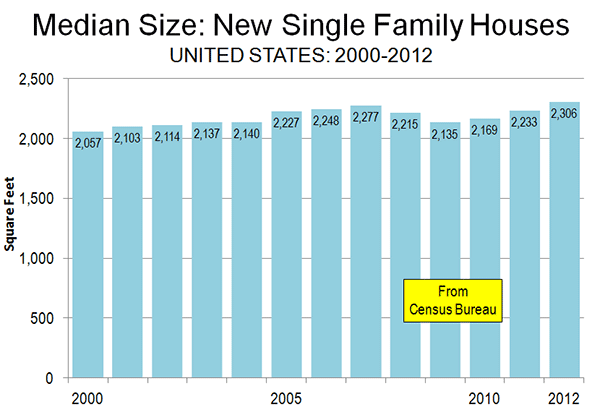
    According to the latest new single-family house size data from the US Census Bureau, the median house size rose to an all-time record of 2306 square feet in 2012. This is slightly above the 2277 square feet median that was reached at the height of the housing bubble in 2007 (Figure). The average new house size (2,505 square feet) remains slightly below the 2007 peak of 2,521 square feet.

    There was little coverage in the media, with the notable exception of Atlantic Cities, in which Emily Badger repeated the expectation of many:

    “It appeared after the housing crash that the American appetite for ever-larger homes was finally waning. And this would seem a logical lesson learned from a recession when hundreds of thousands of households found themselves stuck in cavernous houses they neither needed nor could afford.”

    But she concluded “Perhaps we have not changed our minds after all.” Well stated.

  • The Evolving Urban Form: The Rhine-Ruhr (Essen-Düsseldorf)

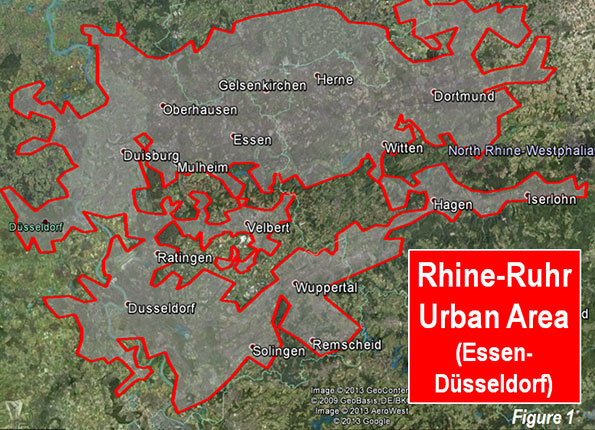
    Rhine-Ruhr, or Essen-Düsseldorf, is among the world’s least recognized larger urban areas (Figure 1).  Germany does not designate urban areas according to the international standard, and for that reason the Rhine-Ruhr does not appear on the United Nations list of largest urban areas. Yet, in reality this contiguous urban area is Germany’s largest urban area, a position as it has held since at least the end of World War II. The Rhine-Ruhr is the third largest urban area in Western Europe, trailing only Paris and London. The area was one of the strongest early urban industrial areas in the 18th century and continued as a major manufacturing and coal mining center through the first half of the 20th century.

    An Early Polycentric Urban Area

    The Rhine Ruhr is unusual in not having evolved around a single core municipality. The Rhine Ruhr has multiple core municipalities, which have grown together to form a conurbation, the second largest in the world following Osaka –Kobe – Kyoto. But the Rhine Ruhr is probably the most polycentric urban region in the world, with a minimum of eight older, large municipalities now linked by urbanization. These include Essen and Düsseldorf, which were until recently the two largest municipalities. In addition there are Dortmund, Duisburg, Bochum, Wuppertal, Gelsenkirchen and Oberhausen. Each of these eight municipalities reached a population of 250,000 or more by 1961.

    Like nearly all prewar municipalities in the high income world that had not expanded their boundaries, each of these has lost population since 1961. By 2011, the combined population of these eight municipalities was under 3.4 million, a reduction of 700,000 (Table) from their 1961 total (a 17% loss).

    Table
    Larger Rhine-Ruhr Municipalities: Population 1961-2011
      1961 2011 Change %
    Bochum      441,000      362,000     (79,000) -17.9%
    Dortmund      645,000      571,000     (74,000) -11.5%
    Duisburg      504,000      488,000     (16,000) -3.2%
    Dusseldorf      705,000      586,000   (119,000) -16.9%
    Essen      730,000      566,000   (164,000) -22.5%
    Gelsenkirchen      384,000      259,000   (125,000) -32.6%
    Oberhausen      258,000      210,000     (48,000) -18.6%
    Wuppertal      422,000      343,000     (79,000) -18.7%
    Total   4,089,000   3,385,000   (704,000) -17.2%


    Data for the balance of the urban area and the broader Rhine-Ruhr region (Note 1) is not readily available for 1961. As a result, this analysis considers the Rhine-Ruhr region to consist of the Dusseldorf, Arnsberg and Münster subregions of the state (lander) of North Rhine-Westphalia, which had a combined population of 11.22 million in 2011, up only modestly from 11.06 million in 1987. The urban area has a population of approximately 6.5 million residents, covering a land area of approximate 950 square miles (2,450 square kilometers). The urban density is approximately 6,800 per square mile (2,650 per square kilometers), less than that of Los Angeles (7,000 per square mile or 2,700 per square kilometer) or Toronto (7,600 per square mile or 2,900 per square kilometer).

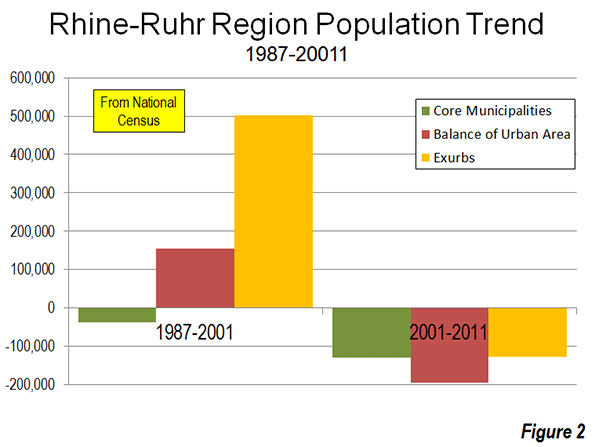
    Since 1987, the Rhine-Ruhr has added 161,000 residents, having gained 617,000 residents between 1987 and 2001, and losing 456,000 from 2001 to 2011. The eight older cities lost 170,000 residents from 1987 to 2011, while the balance of the urban area lost 42,000. The exurbs, outside the urban area have added 373,000 residents, and account for more than all of the modest growth since 1987. All three sectors lost population after 2001 (Figure 2).

    Slow Growth, Even for Germany

    The Rhine-Ruhr is located in the lander of North Rhine-Westphalia, which has the largest population in Germany. Its growth, however, has been glacial. Since 1961, the average annual growth rate of the lander was 0.2%. This is one third the growth rate of the other lander that constituted the former Federal Republic of Germany (West Germany).

    North Rhine-Westphalia’s performance is stellar compared to the lander of the former Democratic Republic of Germany (East Germany), which have fallen back to their 1961 population, having lost 10% of their residents since 1990. Germany itself lost more than 2 million people in the last decade, reflecting its well-below replacement fertility rate. Based upon this rate, Germany could lose more than the 5 million more residents projected by United Nations projectionsto 2050 (to 75 million).

    But even within the slow growth environment of North Rhine Westphalia, the  Rhine Ruhr region is falling behind as nearly all the growth has shifted elsewhere to the regions of the lander that surround other urban areas, Cologne (Köln), which includes the former West German capital of Bonn, and Aachen (which stretches into the Netherlands). Local authorities in the Ruhr Valley are forecasting a population loss of approximately 8 percent by 2030.

    The Setting

    The Rhine-Ruhr conurbation is organized around confluences of two rivers with the Rhine. The northern part of the urban area stretches from the west bank of the Rhine eastward along the Ruhr River Valley with the large municipality of Duisburg anchoring the West and Dortmund the East. The southern part of the urban area stretches along the Wupper River Valley starting at Düsseldorf and continuing eastward to south of Dortmund. The elevation at the two river junctions is less than 100 feet (40 meters). A transverse, low mountain range (Rhenish Massif) separates the northern and southern parts of the urban area (maximum elevation 800 feet or 300 meters), though much of the hilly area is urban.

    Transport

    Without a dominant, large center, the Rhine-Ruhr has a lower transit work trip market share – 18 percent – than would be expected for a European urban area of its size. This is well below the 30 percent share of Berlin and the approximately 35 percent shares of Madrid, Lisbon, and Stockholm, which are all smaller than the Rhine-Ruhr. Wuppertal is home to one of the icons of mass transit, the Wuppertal Monorail, which opened in 1901. The Monorail is suspended for much of its route above the Wupper River, with supports straddling the river (such a configuration would probably not be permitted to be constructed today in any high-income world metropolitan area because of environmental regulations).

    The Rhine-Ruhr’s polycentricity requires substantial reliance on its road system. The region is well served by an extensive freeway (autobahn) system consisting of at least four east-west routes and five north-south routes. Traffic congestion is worse than in most US urban areas, but the Rhine-Ruhr’s traffic flows better than in any metropolitan area of similar size in Europe, according to 2012 data from the INRIX Traffic Scorecard. The average peak hour delay is 14.8 percent compared to “free flow.” This is less than one-half the average delay in smaller Milan (30.2 percent) and well below Paris (27.8 percent) and London (26.1 percent). In 2005, the Rhine-Ruhr had the fifth highest rated freeway access among 30 surveyed international urban areas.

    Shrinking City

    Shrinking cities (where cities are defined as metropolitan areas or urban areas) have been unusual in the high income world (Pittsburgh and Liverpool are exceptions). Even as core municipalities have lost population, such as in Atlanta and Copenhagen, metropolitan areas have continued to grow. This is likely to change because of the severe national population declines forecast in a number of countries. The Rhine-Ruhr, and other similarly situated cities, will face serious challenges in retaining dynamic economies and delivering public services in the years to come for an aging population supported by a smaller work force.

    Wendell Cox is a Visiting Professor, Conservatoire National des Arts et Metiers, Paris and the author of “War on the Dream: How Anti-Sprawl Policy Threatens the Quality of Life.

    ———–

    Note 1: The entire Rhine-Ruhr and Cologne areas are considered by Germany to be the Rhine-Ruhr metropolitan area (ballungsräume). This article is limited to an area roughly conforming to the northern part of the ballungsräume. Eurostat defines a much smaller Düsseldorf-Ruhrgebiet metropolitan area that includes the Rhine-Ruhr urban area and most of the exurban area in this analysis. There is no international standard for the designation of metropolitan areas (labor markets).

    Note 2: INRIX classifies the Rhine-Ruhr as two areas (north and south). This is the population weighted congestion delay.

    Photo: Wuppertal Monorail

  • An Economics Lesson from The New York Times

    The New York Times restates basic economics in a June 9 editorial that should be required reading for planners and public officials who fail to comprehend how restrictions on housing raise prices. The Times expressed concern about the extent to which investor involvement in some markets has raised the price of houses for new homebuyers and others who actually plan to live in the houses that they purchase. The price increasing impact of excess demand on housing markets from institutional investors is no different what occurs when urban planning policies restrict housing supply, as occurs with urban containment policy.

    Referring to the recent house price increases, The Times said “Those gains, in turn, have propelled rising home prices nationwide, in part by reducing supply and in part by fostering a shift in perceptions about the housing market that has drawn some potential home buyers off the sidelines.” In this, The Times simply expresses the economic reality that when demand exceeds supply, house prices (or any other prices), other things being equal, will tend to rise. The cause of the imbalance is of no account.

    But The Times did not limit its analysis to economics. Venturing into the social dimension, The Times went so far as to endorse home ownership: “Given the traditional role of homeownership in building wealth, fostering communities and driving the economy forward, a lower rate of homeownership is a troubling development.”

    The Times editorial board has taken a position challenging the agendas of some of the most prominent retro-urbanist theorists, who favor more renting and less home ownership, clinging to the fantasy that, somehow housing markets constrained by excessive planning regulations are exempt from the laws of supply and demand.