Blog

  • Canada’s Central Bank Issues Warning on Toronto Condominium Market

    For a few years, concern has been expressed about house price increases in Canada, which have been disproportionate compared to household incomes.

    In this regard, the latest, semi-annual Bank of Canada Financial System Review points to the overbuilt multi-unit market, especially the Toronto condominium market, as having the potential to inflict serious harm on the economy (see A Toronto Condo Bubble?), including “reduced household net worth.” In its report, Canada’s central bank said:

    “…the total number of housing units under construction remains significantly above its historical average relative to the population. This development is almost entirely attributable to multiple-unit dwellings (which include condominium units). In the Toronto condominium market, the number of unsold high-rise units in the pre-construction and under-construction stages has remained near the high levels observed since early 2012. If the investor component of demand has boosted construction in the condominium market beyond demographic requirements, this market may be more susceptible to shifts in buyer sentiment. Furthermore, if the upcoming supply of units is not absorbed by demand as they are completed over the next 12 to 30 months, the supply-demand discrepancy would become more apparent, increasing the risk of an abrupt correction in prices and residential construction activity.

    Any correction in condominium prices could spread to other segments of the housing market as buyers and sellers adjust their expectations. Such a correction would reduce household net worth, confidence and consumption spending, with negative spillovers to income and employment. These adverse effects would weaken the credit quality of banks’ loan portfolios and could lead to tighter lending conditions for households and businesses. This chain of events could then feed back into the housing market, causing the drop in house prices to overshoot.

    (Emphasis by author)

    Canadian analysts have long been concerned about the potential for its rising house prices to collapse, as occurred in the overheated US markets. Just as the housing bust in California, Florida, Arizona and Nevada threw the US economy and that of the world into the worst economic decline since the Great Depression, a housing price bust could inflict serious damage to the Canadian economy, which has performed strongly in recent years.

    In the United States, the housing bust led to a nearly 20 percent reduction in household net worth, while recent reports show that the loss has been recovered. However, this recovery has been anything but equal. Many households who suffered losses, such as in investments intended to finance retirement, have not seen their wealth restored.

    There is plenty about housing market distortion for Canada to be concerned about.

  • No Solar Way Around It: Why Nuclear Is Essential to Combating Climate Change

    Nobody who has paid attention to what’s happened to solar panels over the last several decades can help but be impressed. Prices declined an astonishing 75 percent from 2008 to 2012. In the United States, solar capacity has quintupled since 2008, and grown by more than 50 times since 2000, according to US Energy Information Administration data. In 1977, solar panels cost $77 per watt. Today, they are less than a dollar per watt.

    So it came as a shock to many and an offense to some to learn that new nuclear plants still cost substantially less than solar. Solar advocates have challenged our recent analysis finding that the electricity from Finland’s beleaguered Olkiluoto plant is still four times cheaper than electricity from Germany’s solar program, claiming that we cherry-picked cases to make nuclear look good and solar look bad.

    It is an odd objection, given that we selected perhaps the most expensive nuclear power plant ever built for our comparison. The complaint is odder still because many of the same critics who accused us of cherry-picking then turned around and, without any apparent irony, cherry-picked small, one-off solar projects as evidence that our analysis is slanted toward nuclear. 

    The reason we compared the Finnish plant to the German solar program is not just because renewables advocates have long claimed that the two examples prove that solar is cheap and nuclear is expensive. We also compared the two because both projects exist in the real world at significant scale, which helps avoid the cherry-picking problem of overgeneralizing from particular cases. Thanks to generous subsidies, Germany generated 5 percent of its electricity from solar last year — a huge amount compared to other nations. By contrast, last year the United States produced just 0.18 percent of its electricity from solar, according to the EIA.

    Some have reasonably asked if there aren’t broader surveys of the costs of new solar and new nuclear. There are. Both the International Energy Agency and the EIA have done them, and both find that solar costs substantially more than new nuclear construction.

    While those figures represent the cost of the average solar installation today, they don’t tell us what it costs for a major industrial economy to scale up solar rapidly, such that it gets a significant percentage of its electricity from solar. To date, Germany is the only major economy in the world that has done so. The costs of Germany’s solar feed-in tariff represent the only real world figure we have. 

    As solar has scaled up in Germany, the costs have declined. But the dynamics are not dissimilar with nuclear. France saw significant cost declines as it scaled up standardized plant designs in the 70s and 80s. The new plant in Finland is a first-of-kind design. Subsequent builds are already showing significantly lower costs. The EPR under construction in France, initiated around the same time as the one in Finland, is expected to cost slightly less. The third and fourth versions of the EPR, currently under construction in China, will be a third the cost of the Finnish plant.

    Had we chosen to use the two new Chinese plants, solar would have cost twelve times more than nuclear, rather than just four times more. Of course this comparison would almost certainly have raised further objections that we had compared German apples to Chinese oranges. Yet it turns out that the German solar program has benefited enormously from the scaling up of Chinese solar manufacturing — or in the eyes of the US Solar Energy Association, the US Trade Commission, and the European Union, the outright dumping of solar panels by Chinese firms. Indeed the flood of Chinese solar panels, which take up as much as 80 percent of market share in Europe, has depressed the cost of solar panels by as much as 88 percent according to EU officials.

    Surely, if it is appropriate to tout solar cost reductions that have been driven by Chinese mercantilism and industrial policy it is also appropriate to consider the cost benefits that Chinese manufacturing and construction costs are bringing to nuclear ­— even more so given that the vast majority of future carbon emissions will come from places like China, not Finland or Germany.   

    Our analysis was further biased toward solar over nuclear by not accounting for the high costs of backing up and integrating intermittent solar electricity. Leading anti-nuclear greens, including Bill McKibben and Robert F. Kennedy Jr., note that for a few hours during a sunny weekend day, solar provided 50 percent of Germany’s electricity; at the same time, as we pointed out, only five percent of the country’s total electricity came from solar in 2012. What that means is that if Germany doubled the amount of solar, as it intends to do, there might be a few hours or even days every year where the country gets 100 percent of its electricity from solar, even though solar only provides 10 percent of its annual electricity needs.

    What happens beyond that is anyone’s guess. Some say Germany could sell its power to other countries, but this would mean other countries couldn’t move to solar since Germany would provide electricity at the same hours it would seek to unload it on their neighbors. Solar advocates say cheap utility-scale storage is just around the corner; in fact, choices are extremely limited and expensive. As a result, analysis by the Clean Air Task Force suggest that integration costs for solar and wind are likely to surge dramatically should renewables rise much above 20 or 30 percent of total electrical generation (see graph below).


    Costs of adding intermittent generation are likely to scale super-linearly with penetration, creating a deployment barrier.  Some examples (various bases) in the figure: “Wind A” is the marginal cost per MWh of wind in ERCOT relative to the same index at 0% wind penetration. “Wind B” is the reciprocal of total system wind capacity factor in CAISO relative to 0% wind penetration (an indicator relative total system construction cost).“Wind C” is the number of annual CCGT start-ups in Ireland relative to 0% wind penetration (a proxy for system-wide O&M costs and emissions due to cycling).“PV” is the marginal cost per MWh of PV in ERCOT relative to the same index at 0% PV penetration. “RE Bundle” is the relative size of the US bulk transmission system (million MW-miles) due to bundled renewables (roughly ½ wind+solar) relative to 0% penetration.

    Sources: CATF from Denholm & Hand, 2011 (Wind A); Hart et al, 2012 (Wind B); Troy et al, 2010 (Wind C); Denholm & Margolis, 2006 (PV); NREL, 2012 (RE Bundle). 

    We do not present this evidence to advocate against solar subsidies or Germany’s program. We have long advocated that governments spend significantly more on energy innovation, including the deployment of solar panels. But it’s one thing to endorse Germany’s big investment in solar in the name of accelerating solar innovation, and it’s quite another to claim — as McKibben, Kennedy, and environmental groups do — that Germany’s solar program and increasingly cheap solar panels demonstrate that solar energy is ready to scale, capable of substantially displacing fossil energy, and a viable alternative to nuclear.

    In reality, there’s little evidence that renewables have supplanted — rather than supplemented — fossil fuel production anywhere in the world. Whatever their merits as innovation policy, Germany’s enormous solar investments have had little discernible impact on carbon emissions. Germany’s move away from baseload zero-carbon nuclear has resulted in higher coal consumption since 2009. In 2012, Germany’s carbon emissions rose 2 percent.

    Nuclear, by contrast, replaces fossil energy. A recent analysis by the Business Spectator’s Geoff Russell finds that big nuclear programs around the world have shown the ability to scale up three to seven times faster than Germany’s vaunted Energiewende (see below). In 1970, fossil fuels supplied roughly two-thirds of France’s electricity, with the balance mostly coming from hydro. By 1990, fossil’s share of the electricity supply had dropped to 10 percent, according to EIA data, while nuclear supplied 80 percent, an energy mix that still holds today. As a result, France’s electricity sector emits 80 grams of CO2 per kWh, compared to Germany’s 450 grams CO2 per kWh. Sweden and Ontario, which also have large shares of nuclear in their electricity supply, augmented by large hydro projects, are even lower. 

    In the United States, nuclear power grew from supplying zero percent of US electricity in 1965 to 20 percent in 1990. Over that same period, coal generation remained flat, rising from 54 percent of generation in 1965 to 60 percent in 1990, during a period when total electricity demand roughly tripled. Since the early 1990’s, when the US nuclear build-out stalled, the vast majority of new US electricity demand has been met by coal and gas.

    Even so, nuclear still needs to get better and cheaper if it is going to displace fossil energy at any scale that will make much difference in terms of climate change. Next generation plants that are safer, cheaper, and more reliable will be necessary if nuclear is to be more than a hedge against fossil energy in the developing world and to see significant new deployment at all in the developed world. Solar, wind, and energy storage technologies will need substantial further advances if they are going to even begin to achieve the scale possible with present day nuclear.

    Our analysis serves a broader point: we must reject technology tribalism if we are to meet rising energy demand and combat global warming. This entails paying close attention to the substantial challenges emergent technologies face, not ignoring them, and discerning how far different technologies are from being capable of replacing fossil energy. The question is not whether solar is the solution, or nuclear. The question is what technologies will deliver clean, reliable, and cheap energy to a growing population, and what it will take to get those technologies to scale. Any movement serious about addressing climate change will thus be characterized by a broad commitment to innovation and a willingness to take a hard, non-ideological look at present day zero-carbon technologies.

    Shellenberger and Nordhaus are co-founders of the Breakthrough Institute, a leading environmental think tank in the United States. They are authors of Break Through: From the Death of Environmentalism to the Politics of Possibility.

    This piece originally appeared at TheBreakthrough.org.

    Photo Credit: SonomaPortal.com.

  • The Unexotic Underclass

    The startup scene today, and by ‘scene’ I’m sweeping a fairly catholic brush over a large swath of people – observers, critics,  investors, entrepreneurs, ‘want’repreneurs, academics, techies, and the like – seems to be riven into two camps.

    On one side stand those who believe that entrepreneurs have stopped chasing and solving Big Problems – capital B, capital P: clean energy, poverty, famine, climate change, you name it.  I needn’t replay their song here; they’ve argued their cases far more eloquently elsewhere In short, they contend that too many brains and dollars have been shoveled into resolving what I call ‘anti-problems’ –  interests usually centered about food or fashion or ‘social’ or gaming.  Something an anti-problem company  might develop is an app  that provides  restaurant recommendations based on your blood type, a picture of your childhood pet, the music preferences of your 3 best friends, and the barometric pressure of the nearest city beginning with the letter Q.  (That such an app does not yet exist is reminder still of how impoverished a state American scientific education has descended.  Weep not! We redouble our calls for more STEM funding.)

    On  the other side stand those who believe that entrepreneurs have stopped chasing and solving Big Problems – capital B, capital P – that there are too many folks resolving anti-problems… BUT  just to be on the safe side, the venture capitalists should keep pumping tons of  money  into  those anti-problem entrepreneurs because you never know when some corporate leviathan – Google, Facebook, Yahoo! – will come along and buy what yesterday looked like a nonsense app and today is still a nonsense app, but a nonsense app that can walk a bit taller, held aloft by the insanities of American exceptionalism.  For not only is our sucker birthrate still high in this country (one every minute, baby!), but our suckers are capitalists bearing fat checks.

    On the other other side, a side that receives scant attention, scanter investment, is where big problems – little b, little p – reside.  Here, you’ll find a group I’ll refer to as the unexotic underclass.  It’s rather quiet in these parts, except during campaign season when the politicians stop by to scrape anecdotes off the skin of someone else’s suffering.  Let’s see who’s here.

    To your left are single mothers, 80% of whom, according to the US Census,  are poor or hovering on the nasty edges of working poverty.  They are struggling to raise their kids in a country that seems to conspire against  any semblance of proper rearing: a lack of flexibility in the workplace; a lack of free or affordable after-school programs;  an abysmal public education system where a testing-mad, criminally-deficient curriculum is taught during a too-short school day; an inescapable lurid wallpaper of sex and violence that covers every surface of  society;  a cultural disregard for intelligence, empathy and respect;  a cultural imperative to look hot, spend money and own the latest “it”-device (or should I say i-device) no matter what it costs, no matter how little money Mum may have.

    Slightly to the right, are your veterans of two ongoing wars in the Middle East. Wait, we’re at war? Some of these veterans, having served multiple tours, are returning from combat with all manner of monstrosities ravaging their heads and bodies.  If that weren’t enough, welcome back, dear vets, to a flaccid economy, where your military training makes you invisible to an invisible hand that rewards only those of us who are young and  expensively educated.

    Welcome back to a 9-month wait for medical benefits.  According to investigative reporter Aaron Glantz, who was embedded in Iraq, and has now authored The War Comes Home: Washington’s Battle against America’s Veterans, 9 months is the average amount of time  a veteran waits for his or her disability claim to be processed after having filed their paperwork.  And by ‘filed their paperwork,’ I mean it literally: veterans are sending bundles of papers to some bureaucratic Dantean capharnaum run by the Department of Veterans’ Affairs,  where, by its own admission, it processes 97%  of its claims by hand, stacking them in heaps on tables and in cabinets.

    In the past 5 years, the number of vets who’ve died before their claim has even been processed has tripled. This is America in 2013: 40 years ago we put a man on the moon; today a young lady in New York can use anti-problem technology if she wishes  to line up a date this Friday choosing only from men who are taller than 6 feet, graduated from an Ivy, live within 10 blocks of Gramercy, and play tennis left-handed…

    …And yet, veterans who’ve returned from Afghanistan and Iraq have to wait roughly 270 days (up to 600 in New York and California) to receive the help — medical, moral, financial – which they urgently need, to which they are honorably entitled, after having fought our battles overseas.

    Technology, indeed, is solving the right problems.

    Let’s keep walking.  Meet the people who have the indignity of being over 50 and finding themselves suddenly jobless.  These are the Untouchables of the new American workforce: 3+ decades of employment and experience have disqualified them from ever seeing a regular salary again.   Once upon a time, some modicum of employer noblesse oblige would have ensured that loyal older workers be retained or at the very least retrained, MBA advice be damned.  But, “A bas les vieux!” the fancy consultants cried, and out went those who were  ‘no longer fresh.’  As Taylor Swift would put it, corporate America and the Boomer worker  “are never ever getting back together.”  Instead bring in the young, the childless, the tech-savvy here in America, and the underpaid and quasi-indentured abroad willing to work for slightly north of nothing in the kinds of conditions we abolished in the 19th century.

    For, in the 21st century, a prosperous American business is a soaring 2-storied cake: 1 management layer at top thick with perks, golden parachutes, stock options, and a total disregard for those beneath them; 1 layer below of increasingly foreign workers (If you’re lucky, you trained these people before you were laid off!), who can’t even depend on their jobs because as we speak, those sameself consultants – but no one that we know of course — are scouring the globe for the cheapest labor opportunities, fulfilling their promise that no CEO be left behind.

    Above all of this, the frosting on the cake,  the nec plus ultra of evolutionary corporate accomplishment: the Director of Social Media.  This is the 20-year old whose role it is to “leverage social media to deliver a seamless authentic experience across multiple digital streams to strategic partners and communities.”  In other words, this person gets paid six figures to send out tweets. But again, no one that we know.

    Time and space and my own sheltered upbringing  defend me from giving you the whole tour of the unexotic underclass, but trust that it is big, and only getting bigger.

    ___________________________________

    Now, why the heck should any one care? Especially a young entrepreneur-to-be.  Especially a young entrepreneur-to-be whose trajectory of nonstop success has placed him or her leagues above the unexotic underclass.  You should care because the unexotic underclass can help address one of the biggest inefficiencies plaguing  the startup scene right now: the flood of  (ostensibly) smart, ambitious young people desperate to be entrepreneurs; and the embarrassingly idea-starved landscape where too many smart people are chasing too many dumb ideas, because they have none of their own (or, because  they suspect no one will invest in what they really want to do).  The unexotic underclass has big problems, maybe not the Big Problems – capital B, capital P – that get ‘discussed’ at Davos.  But they have problems nonetheless, and where there are problems, there are markets.

    The space  that caters to my demographic – the cushy 20 and 30-something urbanites – is oversaturated. It’s not rocket science: people build what they know.  Cosmopolitan, well-educated young men and women in America’s big cities are rushing into startups and building for other cosmopolitan well-educated young men and women in big cities.  If you need to plan a trip, book a last minute hotel room, get your nails done, find a date, get laid, get an expert shave, hail a cab, buy clothing, borrow clothing, customize clothing, and share the photos instantly, you have Hipmunk, HotelTonight, Manicube, OKCupid, Grindr, Harry’s, Uber, StyleSeek, Rent the Runway, eshakti/Proper Cloth and Instagram respectively to help you. These companies are good, with solid brains behind them, good teams and good funding.

    But there are only so many suit customisation, makeup sampling, music streaming, social eating, discount shopping, experience  curating companies that the market can bear.  If you’re itching to start something  new, why chase the nth  iteration of a company already serving the young, privileged, liberal jetsetter? If you’re an investor, why revisit the same space as everyone else?  There is life, believe me, outside of NY, Cambridge, Chicago, Atlanta, Austin, L.A. and San Fran.

    It’s where the unexotic underclass lives.  It’s called America.  This underclass is not some obscure niche market.  Take the single mothers. Per the US Census Bureau, there are 10 million of them  today; and an additional 2 million single fathers.  Of the single mothers, the majority is White, 1 in 4 is Hispanic, and 1 in 3 is Black.  So this is a fairly large and diverse group.

    Take the veterans. (I will beat the veteran drum to death.) According to the VA’s latest figures, there are roughly 23 million vets in the United States.  That number sounds disturbingly high; that’s almost 1 in 10 Americans.  Entrepreneurs and investors like big numbers.  Other groups you could include in the underclass: ex-convicts, many imprisoned for petty drug offenses, many released for crimes they never even committed.  How does an ex-convict get back into society?  And navigate not just freedom, but a transformed technological landscape?  Another group, and this one seems to sprout in pockets of affluence: people with food allergies.  Some parents today resort to putting shirts and armbands on their kids indicating what foods they can or can’t eat.  Surely there’s a better fix for that?

    Maybe you could fix that.

    ___________________________________

    Why do I call this underclass unexotic?  Because, those of us, lucky enough to be raised in comfortable environs – well-schooled, well-loved, well-fed – are aware of only 2 groups: those at the very bottom and those at the very top.

    We have clear notions of what the ruling class resembles – its wealth,  its connections, its interests.  Some of you reading this will probably be part of the ruling class before you know it.  Some of you probably already are.  For the 1% aspirants (and there’s no harm in having such aspirations), hopefully by the time you get there, you will have found meaningful problems to solve – be they big, or Big.

    We have clear ideas of what the exotic underclass looks like because everyone is clamoring to help them.  The exotic underclass are people who live in the emerging and third world countries that happen to be in fashion now -– Kenya, Bangladesh, Brazil, South Africa. The  exotic underclass are poor Black and Hispanic children (are there any other kind?) living in America’s urban ghettos.  The exotic underclass suffer from diseases that have stricken the rich and famous, and therefore benefit from significant attention and charity.

    On the other hand, the unexotic underclass, has the misfortune of being insufficiently interesting.  These are the huddles of Whites – poor, rural working class – living in the American South, in the Midwest, in Appalachia.  In oh-so-progressive Northeast, we  refer to them as ‘hicks’ and ‘hillbillies’ and ‘trailer trash,’ because apparently, this is the one demographic that American manners have forgotten.

    The unexotic underclass are the poor in Eastern Europe, and Central Asia, who just don’t look foreign enough for our taste.  Anyone who’s lived in a major European city can attest to the ubiquity of desperate Roma families, arriving from Bulgaria and Romania, panhandling in the streets and on the subways. This past April, the employees of the Louvre Museum in Paris went on strike because they were tired of being pickpocketed by hungry Roma children.   But if you were to go to Bulgaria to volunteer or to start a social enterprise, how would the folks back on Facebook know you were helping ‘the poor?’  if the poor in your pictures kind of looked like you?

    And of course, the biggest block of the unexotic underclass are the ones I alluded to earlier: that vast, suffocating mass right here in in America. We don’t notice them because they don’t get by on $1 a day. We don’t talk about them because they don’t make $1 billion a year.  The only place where they’re popular is in Washington, D.C. where President Obama and  his colleagues in Congress can can use members of the underclass to spice up their stump speeches: “Yesterday, I met a struggling family out in yadda yadda yadda…” But there’s only so much Washington can do to help out, what with government penniless and gridlocked, and its elected officials occupying a caste of selfishness, cowardice and spite, heretofore unseen in American politics.

    __________________________________

    If you’re an entrepreneur looking for ideas, consider looking beyond the city-centric, navel-gazing, youth-obsessed mainstream.  That doesn’t mean you need to fly to the end of the world.  Chances are there are more people addressing the Big Problems of slum dwellers in Calcutta, Kibera or Rio, than are tackling the big problems of hardpressed folks in say, West Virginia, Mississippi or Louisiana.

    To be clear, I’m not painting the American South as the primary residence of all the wretched of the earth. You will meet people down there who are just as intelligent and cultured and affluent as we pretend everyone up North is.

    Second, I’m not pitting the unexotic against the exotic.  There is nothing easy or trendy about the work being done by the brave innovators on the ground in Asia, Africa, and Latin America.  Some examples of that work: One Earth Designs which helps deliver clean energy and heating solutions to communities in rural China; Sanergy, which is bringing low-cost sanitation to Kenya’s poorest slums;  Samasource, which provides contract work to youth and women in Haiti, Ghana, Kenya, Uganda and India.  These are young startups with young entrepreneurs who attended the same fancy schools we all know and love (MIT, Harvard, Yale, etc.), who lived in the same big cities where we all congregate, and worked in the same fancy jobs we all flocked to post-graduation.  Yet, they decided they would go out and  tackle Big Problems – capital B, capital P. We need to encourage them, even if we could never imitate them.

    If we can’t imitate them,and we’re not ready for the challenges of the emerging market, and we have no new ideas to offer, then maybe there are problems, right here in America for us to solve…The problems of the unexotic underclass.

    ____________________________________

    Now, I can already hear the screeching of meritocratic,  Horatio Algerian Silicon Valley,

    “What do we have to do with any of this? The unexotic underclass has to pull itself up by its own bootstraps!  Let them learn to code and build their own startups!  What we need are more ex-convicts turned entrepreneurs, single mothers turned programmers, veterans turned venture capitalists!
    The road out of welfare is paved with computer science!!!”

    Yes, of course.

    There’s nothing wrong with the entrepreneurship-as-salvation gospel. Nothing wrong with teaching more people to code.  But it’s impractical in the short term, and misses the greater point in the long term:   We shouldn’t live in a universe of solipsistic startups…  where I start a company and produce things only for myself and for people who resemble me.  Let’s be honest.  Very few of us are members of this unexotic underclass.  Very few of us even know anyone who’s  in it.   There’s no shame in that.  That we have  sailed on a yacht of good fortune most of our lives — supportive generous families, a stable peaceful democracy, excellent schooling, prestigious careers and companies, relatively good health – is nothing to be ashamed of. Consider yourselves remarkably blessed.

    What is shameful though, is that in a country with so many problems, with such a heaving underclass, we find the so-called ‘best and brightest,’ the 20-and 30-somethings who emerge from the top American graduate and undergraduate programs, abandoning their former hangout,Wall Street, to pile into anti-problem entrepreneurship.

    Look, I worked for Goldman Sachs immediately after graduating from Wellesley. After graduating from MIT, I worked at a hedge fund. I am not throwing stones.   Here in hell, the stones wouldn’t reach you anyhow… If you’re under 30 and in finance, you’ve definitely noticed the radical migration of your peers from Wall Street to Silicon Valley and Silicon Alley.   This should have been a good exchange.  When I first entered banking, leftist hippie that I was (and still am), my biggest issue was what struck me as a kind of gross intellectual malpractice:  how could so many bright historians and economists, athletes and engineers, writers and biogeneticists, from every great school you could think of – Princeton, Berkeley, Oxford, Harvard, Imperial, Caltech, Amherst, Wharton, Yale, Swarthmore, Cambridge, and so on — be concentrated into a single sector, working obscene hours at a sweatshop to manufacture money?

    When I look at the bulk of startups today – while  there are notable exceptions (Code for America for example, which invites local governments to request technology help from teams of coders) – it doesn’t seem like we’ve aspired to something nobler: it just looks like we’ve shifted the malpractice from feeding the money machine to making inane, self-centric apps. Worse,  is that the power players, institutional and individual — the highflying VCs, the entrepreneurship incubators, the top-ranked MBA programs, the accelerators, the universities,  the business plan competitions have been complicit in this nonsense. 

    Those who are entrepreneurially-minded but young and idea-poor need serious direction from those who are rich in capital and connections.  We see what ideas are getting funded, we see money flowing like the river Ganges towards insipid me-too products, so is it crazy that we’ve been thinking small?  building smaller? that our “blood and judgment” to quote Hamlet, have not been  “so well commingled?”

    We need someone bold (and older than us) to stand up for Big Problems which are tough and dirty.  But what we especially need is someone to stand up for big problems – little b, little p –which are tough and dirty and too easy to overlook.

    We need:

    A Ron Conway, a Fred Wilson-type at the venture level to say, ‘Kiddies, basta with this bull*%!..  This year we’re only investing in companies targeting the unexotic underclass.”

    A Paul Graham and his Y Combinator at the incubator level, to devote one season to the underclass, be it veterans, single moms or overworked young doctors, Native Americans, the list is long:  “Help these entrepreneurs build something that will help you.”

    The head of an MIT or an HBS or a Stanford Law at the academic level, to tell the entire incoming class: “You are lucky to be some of the best engineering and business and law students, not just in the country, but in the world.  And as an end-of-year project, you are going to use that talent to develop products, policy and programs to help lift the underclass.”

    Of the political class, I ask nothing.  With a vigor one would have thought inaccessible to people at such an age, our leaders in Washington have found ever innovative ways to avoid solving the problems that have been brought before them.  Playing brinkmanship games with filibusters and fiscal cliffs;  taking money to avoid taking votes.  They are entrepreneurs of the highest order: presented with 1 problem, they manage to create 5 more. They have demonstrated that government is not only not the answer, it is the anti-answer…

    The dysfunction in D.C. is a big problem.

    Entrepreneurs: it looks like there’s work for you there too…

    C.Z. Nnaemeka studied Philosophy at Wellesley; logically, she has spent most of her time in finance, beginning at Goldman Sachs. Born in Manhattan to Nigerian parents, she attended French schools, graduating from the Lycée Français de New York. Since then she has alternated between writing, banking, and consulting to startups in Europe, Latin America, and Australia. Previously, she lived in Paris where she founded a political discussion group and was a foreign affairs commentator for the conservative newspaper, Le Figaro. She graduated from MIT in 2010, focusing on Entrepreneurship + Innovation.

  • The Mad Drive to Subvert Democracy in Toronto

    Let me stipulate that I think Toronto’s Rob Ford is a terrible mayor. In fact, while I might not go so far as Richard Florida, who labeled Ford “the worst mayor in the modern history of cities, an avatar for all that is small-bore and destructive of the urban fabric, and the most anti-urban mayor ever to preside over a big city,” I’m willing to say he’s probably in the running for the title.

    The roots of Rob Ford lie in “amalgamation,” the forcible merging of the city of Toronto government with various of its suburbs by the Ontario provincial government. The idea was cost savings, but of course costs went up. Also, it created a Mars-Venus situation that ultimately led to Ford, a former city councilor in Etobicoke, being elected mayor. This would be like a consolidation of Chicago with Cook County in which a member of the Schaumburg city council ended up mayor. Not good. The urban intelligentsia that despises Ford now find themselves in the embarrassing position of having to explain to their friends that they are in total agreement with Wendell Cox, an implacable foe of government consolidations, who predicted these results.

    But there’s a big difference between Florida’s bashing of Ford, which falls within the principles of democratic discourse as we’ve come to know it, and what appears to be an effort by some to subvert democracy by finding any pretext to run Rob Ford out of office.

    I’m not sure where the idea that the loser in an election tries to undermine the legitimacy of the government of the winner came from. But in the modern era it could be the Republican impeachment of Bill Clinton that launched it. This quickly proved to be standard fare. There was the brouhaha over the “selected not elected” George W. Bush as well as the more passionate strain of “birthers” when it comes to President Obama. Given that, especially in the big leagues, there is always some dirtiness in politics, it’s easy to find things to seize upon to claim someone’s holding of an office is invalid. After all, it appears that Clinton really did commit perjury and there was shall we say some murkiness down in Florida. However, these aren’t truly what the people raising a ruckus cared about. What they cared about was the man in office they didn’t like – and getting him out of it.

    Canada has a reputation as a kinder, gentler nation, but they now appear to have imported from America what Clinton labeled “the politics of personal destruction.” Rob Ford has been the target of a series of vicious attacks, generally aided and abetted (if not outright instigated) by the old city Toronto media that clearly don’t like him, designed to drive him out of office.

    One was a lawsuit that claimed he should be tossed out of office because of events related to his using official letterhead and such to raise $3,500 for a charity. Believe it or not, the trial judge actually agreed with this and ordered him removed from office. If that’s the threshold for getting someone kicked out of office, I dare say every major politician in America would be gone. Yes, politicians do often use affiliated charities as a, shall we say, lubricating mechanism. Yes, there’s the appearance or even the reality of some impropriety in these things. But this is such small fry stuff that to throw the mayor of the biggest city in the country out of office over it defies belief. If you think this is removal worthy, I’m confident I can find something just as bad in almost any politician that you actually like. Fortunately, saner heads at the appeals level prevailed and the ruling was overturned.

    Recently we’ve also seen reports originating from, I kid you not, Gawker, in which some shady Somalis supposedly showed a reporter a cell phone video of Rob Ford smoking crack. Shortly thereafter the Toronto Star got in on the act, saying their reporters had seen the video in the back seat of the car, though with the CYA proviso that they had “no way to verify the authenticity of the video.” Other media that may not have directly originated such a story have piled on and thus there’s a firestorm awhirl.

    Where is the video, you might ask? Good question. Supposedly it’s for sale for $200K but oddly no one snapped it up, not even one of the extremely wealthy Ford haters that Toronto has in abundance. So you want to buy it? Oh, Gawker now tell us it might be “gone.” Hmmm…..

    I’m not saying there’s no video. Rob Ford has certainly acted like he’s guilty of something. But it seems amazing to me that in this era in which all types of tapes and documents spontaneously get loose, this one is no where to be found. Also, the idea of the mayor of Toronto smoking crack with a bunch of Somalis while they film him falls into the “extraordinary claims require extraordinary proof” category. The still photo is interesting, but I’ve seen many compromising photos of mayors, who are routinely snapped with all sorts of random people who they may find out later are unsavory characters. I can’t imagine this sort of media feeding frenzy over say, similar allegations against Michael Bloomberg or Rahm Emanuel.

    The Toronto Globe and Mail is a serious newspaper that’s roughly Canada’s New York Times. Though they didn’t break the video story, they did follow-up with a rather tabloidesque article about the history of Rob Ford’s family with drugs. Ford’s brother Doug, the focus of the piece, is on the city council himself, so is a legitimate investigative target so to speak, but the piece also digs into other family members.

    Not only is the Globe and Mail digging up dirt on Rob Ford’s family, this piece did it entirely with anonymous sources. They claimed to talk to no fewer than ten people who called Doug Ford a drug-dealer, but curiously none of them were willing to talk on the record. That didn’t stop the Globe and Mail from reporting:

    Ten people who grew up with Doug Ford – a group that includes two former hashish suppliers, three street-level drug dealers and a number of casual users of hash – have described in a series of interviews how for several years Mr. Ford was a go-to dealer of hash. These sources had varying degrees of knowledge of his activities: Some said they purchased hash directly from him, some said they supplied him, while others said they observed him handling large quantities of the drug.

    The events they described took place years ago, but as mayor, Rob Ford has surrounded himself with people from his past. Most recently he hired someone for his office whose long history with the Fords, the sources said, includes selling hashish with the mayor’s brother.

    There’s nothing on the public record that The Globe has accessed that shows Doug Ford has ever been criminally charged for illegal drug possession or trafficking. But some of the sources said that, in the affluent pocket of Etobicoke where the Fords grew up, he was someone who sold not only to users and street-level dealers, but to dealers one rung higher than those on the street. His tenure as a dealer, many of the sources say, lasted about seven years until 1986, the year he turned 22. “That was his heyday,” said “Robert,” one of the former drug dealers who agreed to an interview on the condition he not be identified by name.

    Upon being approached, the sources declined to speak if identified, saying they feared the consequences of outing themselves as former users and sellers of illegal drugs.

    The Globe also tried to contact retired police officers who investigated drugs in the area at the time. One said he had no recollection of encountering the Fords.

    The article is full of innuendo about the Ford’s such as the idea that Rob Ford recently hired a drug dealing associate of Doug’s from the old days (highlighted above), along with curious mentions and links to beatings, killings, and white supremacy/KKK. (Rob Ford is a white supremacist who likes to smoke crack with Somalis???) It’s capped off by having various anonymous sources given pseudonyms so that they appear to be actual people on the record. As this excerpt notes, the police record and police contacts don’t back up the story, which just adds to the general notion of dubiosity and suggests this is a very exaggerated piece that tries to throw things to the wall to see what sticks.

    All it all, given the extreme reactions to financial dealings that, even if they were proven, would have been a non-issue almost anywhere else, along with a firestorm of allegations about smoking crack and so much more with no actual proof, the Rob Ford affair has thus far generated much more smoke than fire.

    Rob Ford is the price Toronto is paying for the foolishness of the provincial government and the failure of an urban candidate to offer a compelling vision for the entire amalgamated city. But it strikes me very much that a group of old Toronto city partisans, who are incensed a guy like Ford had the temerity to win an election, are determined to use any means necessary to correct what they see is that injustice. But just as with what happened in America and its politics in the wake of the Clinton impeachment, Canada may come to rue the day a group of its citizens decided to try to overturn an election by destroying the winner rather than waiting for their next opportunity at the ballot box.

    Aaron M. Renn is an independent writer on urban affairs and the founder of Telestrian, a data analysis and mapping tool. He writes at The Urbanophile, where this piece originally appeared.

    Photo by Wiki Commons user MTLskyline.

  • Housing Boom Is The Best Chance For A Recovery For The Rest Of Us

    Our tepid economic recovery has been profoundly undemocratic in nature. Between the “too big to fail” banks and Ben Bernanke’s policy of dropping free money from helicopters on the investor class, there have been two recoveries, one for the rich, and another less rewarding one for the middle class.

    Viewed in this light, the recent run-up in home prices, the biggest in seven years, offers some relief from this dreary picture. Home equity accounts for almost two-thirds of a “typical” family’s wealth (those in the middle fifth of U.S. wealth distribution); there is no other investment by which middle-class families can so easily grow their nest eggs.

    But the housing recovery’s benefit extend beyond owners. The housing industry drives a significant portion of the nation’s economy, accounting for millions of jobs. According to the National Association of Home Builders, the average single-family detached house under construction results in an additional three jobs for one year. This includes the employees working on the house, and those employed in producing products to build the house.

    Overall, residential construction and upkeep generates between 15% and 18% of GDP. If the economy is to expand in a sustainable way that helps a broad section of Americans, suggests Roger Altman, a Clinton administration deputy Treasury secretary, “a housing boom will be the biggest driver.”

    Perhaps even more important, the growth of housing sales also revives something many have written off as obsolete: “the American dream” of owning a home. Since the great recession, some economists have argued that the future of America will be a “rentership” society.

    Others such as Richard Florida have argued forcibly that home ownership is “over-rated,” maintaining that America’s fixation on it has fostered “countless forms of over-consumption that have a horribly distorting affect on the economy.” Workers, he argues, are better off as renters since this allows them to change jobs more nimbly. If anything, he suggests, the government would be better off encouraging “renting, not buying.”

    Greens have also embraced this downscaled future, with people living cheek to jowl in some urbanized form of ecological harmony. They envision a new generation that will reject materialism, suburbs, single-family homes and other expressions of acquisition. In other words, forget ambition and save the whales. One writer at Grist argues, the fact the millennial generation can’t afford homes is a good thing, since it will lead to “a rejection of the mindset that got us into this mess.”  Welcome back to the green Age of Aquarius: “we’re looking for ways to avoid that ladder altogether — maybe by climbing a tree instead.”

    Perhaps this is true for some, but overall the desire to own a home is far from dead. A 2012 study by the Woodrow Wilson Center found that over 80% of Americans associated homeownership with the American dream. A 2012 study by the Joint Center for Housing Studies at Harvard, found “little evidence to suggest that individuals‘ preferences for owning versus renting a home have been fundamentally altered by their exposure to house price declines and loan delinquency rates, or by knowing others in their neighborhood who have defaulted on their mortgages.”

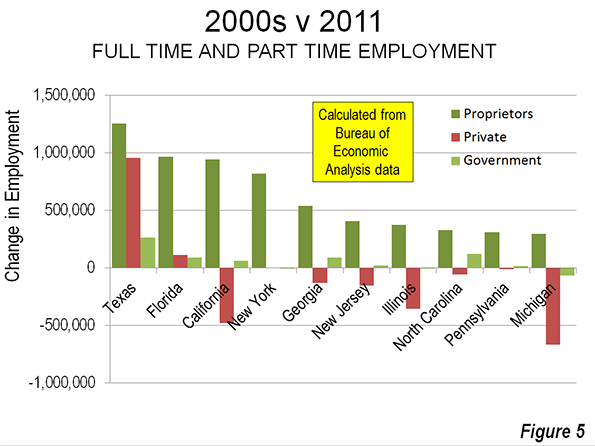
    Some predict that changing demographics — and attitudes — will erode such sentiments. Yet homeownership seems to be embraced by two groups who will dominate our future: the emerging millennial generation and immigrants . Between 2000 and 2011, there has been a net increase of 9.3 million in the foreign-born (immigrant) population, largely from Asia and Latin America. These newcomers have accounted for roughly two out of every five new homeowners.

    What about millennials? Despite the hopes of the counter-culture enthusiasts, a full 82% of adult millennials surveyed said it was “important” to have an opportunity to own their home. This rose to 90% among married millennials, who generally represent the first cohort of their generation to start settling down. Another survey, by TD Bank, found that 84% of renters aged 18 to 34 intend to purchase a home in the future. Still another, this one from Better Homes and Gardens, found that three in four saw homeownership as “a key indicator of success.”

    Over time, these demographics could provide the basis for a new and more widely distributed economic boom hopefully healthier than that which accompanied the last housing boom. For one thing, there are far fewer dubious loans, and lending standards are somewhat stricter. And building activity, although bouncing back, is not as fevered as last time, except perhaps in the somewhat over-hyped multi-family sector. Two-thirds of all housing starts, now at the highest level since June 2008, are single-family homes, a sure sign that the traditional buyer is back.

    Yet there are some disturbing aspects of the current housing boom. In much of the country, much of the activity has been fueled by investors; in states such as California they account for roughly one-third of buyers. Large players such as Blackstone and Colony Capital have been particularly active in buying distressed properties in places like Tampa, the Inland Empire and Phoenix, in the process boosting prices.

    This has set up what could become a potential conflict between prospective middle-income homeowners and the very deep-pocketed investors who have been the primary beneficiaries of the age of Obama. Although investors have indeed set a “floor” that has prevented a further deterioration of prices, their investment appear to be threatening to push homes out of the reach of middle-income buyers. Some local officials also worry that when the investors tire of their new properties, they may leave them to languish on the market.

    This can be seen even in California, which has experienced a weak recovery in jobs and income, but a decisive and escalating increase in housing prices, largely due to the prescence of investors, domestic and foreign, as well as the resurgent flippers. Over the past five years inventory has dwindled from 16 months supply to less than three months. Prices are up over 30% from 2008 in San Francisco and over 17% in the Los Angeles area, driving down affordability.

    But, still, the housing recovery is the best news to hit the American middle class in at least half a decade. Some investors seem to be realizing there are limits to rental income and might be persuaded to start selling homes to individuals. Already in Phoenix, a hotbed of investor interest, the percentage of homes sold to investors dropped to about 25% in March from a high of 36% last summer.

    If this trend takes hold, investors, rather than undermining the market, could be seen as having played a critical role in maintaining housing during a very hard time. If they start an orderly withdrawal, or start selling their homes to families, the speculators, not always a lovable group, could end up being among the unlikely saviors of the American dream, particularly for the next generation.

    Joel Kotkin is executive editor of NewGeography.com and a distinguished presidential fellow in urban futures at Chapman University, and a member of the editorial board of the Orange County Register. He is author of The City: A Global History and The Next Hundred Million: America in 2050. His most recent study, The Rise of Postfamilialism, has been widely discussed and distributed internationally. He lives in Los Angeles, CA.

    This piece originally appeared at Forbes.com.

  • Is Michael Bloomberg Finally Ready for His Close-Up?

    After being elected New York City’s mayor in 2002, Michael Bloomberg quickly expanded on the city’s progress during the 1990s. He combined predecessor Rudolph Giuliani’s reforms in welfare and policing with his own. He rezoned land for needed housing, reduced public school inefficiencies, and advanced major transportation projects like the 7-train extension and rapid buses. Along with these, he pioneered changes in the urban fabric—from the High Line Park to an automobile-free Times Square—that may have seemed insubstantial to outsiders, but were appreciated by New Yorkers.

    These and other measures supported Bloomberg’s reputation as a pragmatic-businessman-turned-public-servant who could generate economic dynamism in a city often hostile to it. Journalists described Bloomberg as, for example a “centrist” and data-driven “technocrat” who was “beholden to no one.” The mayor quickly gained national credibility, and was even mentioned as a possible independent presidential candidate.

    Now, as Bloomberg nears the end of his third term, the thought of him having this platform seems far less attractive. Just as the term itself violated local term limit legislation (that was overturned before his election), the policies he’s enacted show that his ideal model of government is not just one that spurs growth and delivers services, but that excessively polices private behavior, setting a dangerous precedent for urban America.

    The best-publicized of these was Bloomberg’s recently-defeated measure to ban large sodas. But this only echoed other products the board of health has targeted, including trans-fat in cooking oils, Styrofoam containers, and salt. He extended New York’s decade-long ban on cigarette smoking in bars to some other public spaces.

    These measures may seem like benevolent ways to protect New York’s citizens from themselves. But they underlie a broader willingness to intrude in other ways. For example, following the Kelo v. New London Supreme Court case, Bloomberg enthusiastically supported eminent domain for land transfers in both Brooklyn’s Atlantic Yards and by Columbia University in Harlem.

    Bloomberg has also expanded New York’s unpopular stop-and-frisk policy, which allows police to search people not after arrest, but based on “reasonable suspicion.” The policy was begun in the 1970s as a way for police to intervene in overtly threatening situations. But under Bloomberg it has been used reflexively five million times. It overwhelmingly targets minorities, and has proven to be poor at accomplishing its stated goal of collecting illegal guns. According to an analysis by Columbia University law professor Jeffrey Fagan, the first 4.4 million stop-and-frisks under Bloomberg yielded under 6,000 guns, (just over 0.01% of stops).

    Some of the same behaviors discouraged by Bloomberg are violated in his personal life. His insistence that New York rigorously combat global warming is ironic, given that he frequently flies private jets to homes in Bermuda, London, and Colorado. He blasted attempts by businesses and unions to roll back campaign finance reform, even after forming his own super-PAC for favored Congressional candidates, and using hundreds of millions of his personal fortune on his own mayoral campaigns. This same chutzpah is evident in his endless bloviating on national issues. While sometimes refreshing, it seems inane coming from a jet-setting mayor who, in lusting for national attention, ignores his own city. Although unemployment has decreased recently, it still remains over 8%, above the national average. The city continues to suffer from high taxes and slow job growth. Income inequality in Bloomberg’s New York has also risen at well above the national rate.

    Bloomberg doesn’t necessarily have control over all of this. But he can at least control what appears as his administration’s priorities. Over the course of his mayoralty, they seem to have shifted from addressing practical aspects of city management to pet peeves about citizen behavior. This has brought New York City negative publicity, and grown offensive to many of those who value personal freedom, with all its flaws, over the tedious and destructive encroachment of “technocrats.”

    Flickr photo from Be the Change, Inc. by Gillooly/PEI.

    Scott Beyer is traveling the nation to write a book about revitalizing U.S. cities. His blog, Big City Sparkplug, features the latest in urban news. Originally from Charlottesville, VA, he is now living in different cities month-to-month to write new chapters.

  • Falling In Love With Where You Are

    Where I live is where most Californians live: in a tract house on a block of more tract houses in a neighborhood hardly distinguishable from the next, and all of these houses extending as far as the street grid allows.

    My exact place on the grid is at the southeast corner of Los Angeles County, between the Los Angeles and San Gabriel rivers. But my place could be almost anywhere in the suburbs of Los Angeles and Orange counties.

    My suburb may seem characterless, but it has a complex history of working class aspiration, of assumptions about social hygiene, of urban politics, and the decisions of many who imposed their imagination on the landscape.

    Where I live is a tract of wood-framed houses on a 5,000-square-foot lot at a density of about seven units per acre, where houses are set back 20 feet from the sidewalk and a street tree the city trims, and where neighborhood businesses are clustered at intersections so that anyone can walk to the store or a bar or to a fast food place.

    It’s also a place with 10 parks of 20 or more acres each so that everyone is about a mile from supervised open space with playgrounds, ball diamonds, picnic tables, and bar-b-cues.

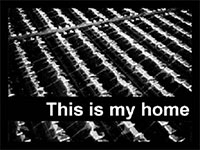
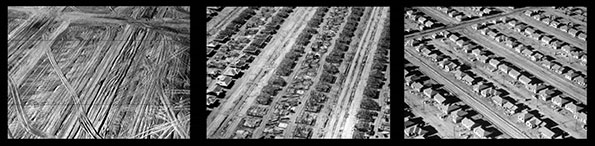
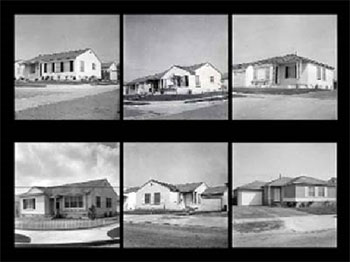
    There is a persistent belief that suburban places like mine must be awful places they must be inhuman and soul-destroying places. That belief persists partly because of these photographs, taken by a brilliant young aerial photographer named William Garnett who worked for the developers of Lakewood between 1950 and 1952.

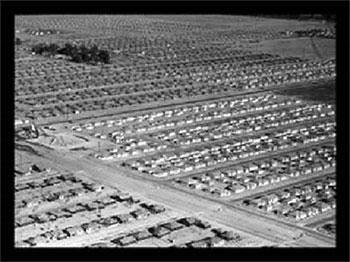
    The historian and social critic Lewis Mumford used Garnett’s photographs in 1961 to indict the post-war suburbs which, he said, had become “A multitude of uniform unidentifiable houses, lined up inflexibly at uniform distances on uniform roads, in a treeless command waste inhabited by people of the same class, the same incomes, the same age group, witnessing the same television performances, eating the same tasteless prefabricated foods, from the same freezers … .Thus the ultimate effect of the suburban escape in our time is, ironically, a low grade uniform environment from which escape is impossible.”

    The architectural historian Peter Blake used these photographs in 1964 to define the post-war suburbs as “God’s own junkyard.”

    In 1969, Garnett’s photographs were part of Nathaniel Owings’s The American Aesthetic, a passionate critique of 20th century urban planning.

    Today, you can go to the Getty Museum in Brentwood and the Autry National Center in Los Angeles and see these photographs used as defining images of the suburbs of Los Angeles.

    They are beautiful and terrible photographs.

    With no little irony, these images of Lakewood became emblematic of the suburbs at the moment when Lakewood no longer was the eerie and empty place Garnett had photographed only a few months before. Between 1950 and 1953 – in less than 33 months – 17,000 houses had been built, sold, and made someone’s home. Nearly 100,000 people lived there, including my parents. In 1954, Lakewood had even become a city in the political sense, having completed the first municipal incorporation in California since 1939.

    Listen to Lakewood Blvd by Sara Lindsay

    We can presume that the developers of Lakewood – Mark Taper, Ben Weingart, and Louis Boyar – saw Garnett’s photographs mostly as a record to be filed with work logs and construction accounts when the project ended. But I also imagine that they looked at Garnett’s photographs and read into them a grandeur, a collective heroism that still attaches itself to the great construction projects of the 1930s and 1940s.

    And we know that Boyer, Taper, and Weingart and Fritz Burns and Joseph Eichler and Henry Kaiser understood that the Progressive era model of low-cost housing they had adapted to mass production would result in new relationships to the idea of place. Garnett’s photographs of deeply shadowed forms on a titanic grid would for some critics and many Americans permanently define that relationship as dread.
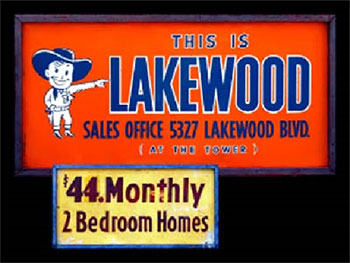
    In a memorable speech by James Howard Kunstler at the 1999 Congress for the New Urbanism, the kind of place where I live was described as a perversion of a place. “It is the dwelling place of untruth,” Kunstler told the New Urbanists. The title of his speech was “The place where evil dwells.”

    My parents and their neighbors more generously than Mumford or Blake or Kunstler understood what they had gained and lost in owning a small house on a small lot in a neighborhood connected to square miles of just the same.

    Despite everything that was mistaken or squandered in making my suburb, I believe a kind of dignity was gained. More men than just my father have said to me that living in my kind of place gave them a life made whole and habits that did not make them feel ashamed.
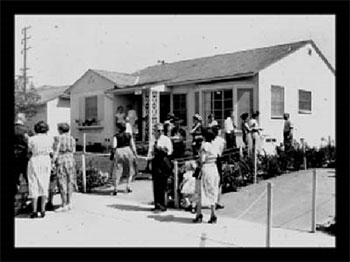

    As far as I could tell by their lives, my parents did not escape to their mass-produced suburb. They never considered escaping from it. Nor have I.

    I’ve lived my whole life in the 957-square-foot house my parents bought when the suburbs were new, when no one could guess what would happen after tens of thousands of working-class husbands and wives – so young and so inexperienced – were thrown together without an instruction manual and expected to make a fit place to live.

    What happened after was the usual redemptive mix of joy and tragedy.

    The suburb where I live is a place that once mass-produced a redemptive future for displaced Okies and Arkies, Jews who knew the pain of exclusion, Catholics who thought they did, and anyone white with a job. Left out were many tens of thousands of others: people of color whose exclusion was not just a Californian transgression.

    Today, futures still begin here, except the anxious, hopeful people who seek them are as mixed in their colors and ethnicities as all of southern California.

    I continue to live in Lakewood with anticipation because I want to find out what happens next to new narrators of suburban stories who happen to be my Latino, black, Filipino, Chinese, Korean, and Vietnamese neighbors.

    There are Californians who don’t regard a tract house as a place of pilgrimage, but my parents and their friends did. They were grateful for the comforts of their not-quite-middle-class life. Their aspiration wasn’t for more but only for enough despite the claims of critics then and now who assume that suburban places are about excess.


    I actually believe that the place where I live is, in words of the Californian philosopher Josiah Royce, a “beloved community.” The strength of that regard, Royce thought, might be enough to form what he called an “intentional community” – a community of shared loyalties – even if the community is as synthetic as a tract-house suburb or the Gold Rush towns that Royce knew in his boyhood. I believe Royce was right: At a minimum, loyalty to the idea of loyalty is necessary, even if the objects of our loyalty are uncertain.

    Urban planners tell me that my neighborhood was supposed to have been bulldozed away years ago to make room for something better, and yet the houses on my block stubbornly resist, loyal to an idea of how a working-class neighborhood should be made.

    It’s an incomplete idea even in Lakewood, but it’s still enough to bring out 400 park league coaches in the fall and 600 volunteers to clean up the weedy yards of the frail and disabled on Volunteer Day in April and over 2,000 residents to sprawl on lawn chairs and blankets to listen to the summer concerts in the park.

    I don’t live in a tear down neighborhood, but one that makes some effort to build itself up. All this is harder now, for reasons we all know.

    The suburbs aren’t all alike, of course, and there are plenty of toxic places to live in gated enclaves and McMansion wastelands. Places like that have too much – too much isolation and mere square footage – but, paradoxically, not enough. Specifically, they don’t have enough of the play between life in public and life in private that I see choreographed by the design of my suburb.

    With neighbors just 15 feet apart, we’re easily in each other’s lives – across fences, in front yards, and even through the thin, stucco-over-chicken-wire of house walls. When I walk out my front door, I see the human-scale, porous, and specific landscape into which was poured all the ordinariness that has shaped my work, my beliefs, and my aspirations. Out there, I renew my “sense of place” and my conviction that a “sense of place,” like a “sense of self,” is part of the equipment of a conscious mind.

    We often find it difficult to talk coherently about these issues or to make coherent policy choices for places to which our loyalty is only lightly attached.

    It seems to me that the abiding problem of southern California indeed of the entire West is the problem of home. We long for a home here, but doubt its worth when we have it. We depend on a place to sustain us, but dislike the claims on us that places make. Each of us is certain about our own preference for a place to live, but we’re always ready to question your choice.

    How do we make our home here, in new and sudden and places like Lakewood, like Irvine, like Santa Clarita? We’ve been asking that question for a very long time sometimes in despair. At almost the beginning of California, a disillusioned 49er named Thomas Swain wrote in 1851, “Large cities have sprung into existence almost in a day. . . The people have been to each other as strangers in a strange land ….”

    And too many of us are strangers still in a place that too many regard as uniquely perverse. And because much of southern California looks roughly the same too many of us see all these suburban places as aesthetically, politically, and morally perverse as well. And no place – however well crafted – is immune from the peculiarly American certainty that something better – something more adequate to the demands of our desire – is just beyond the next bend in the road.

    The question of “home” is increasingly acute because there’s hardly anywhere left to build another Lakewood or Irvine or Santa Clarita.

    The closing of the suburban frontier in southern California ends a 100-year experiment in place making on an almost unimaginable scale. The experiment was based on a remarkably durable consensus about the way ordinary people ought to be housed, beginning with turn-of-the-century beliefs about the power of a “home in its garden” to ameliorate the lives of working people and ending in the 1950s with tract houses turned into an affordable commodity.

    Today, most of southern California is what it will continue to be: uniformly dense and multi-polar, urbanized in fact but suburban in appearance, characterized by single-family homes in neighborhoods with a strong – but provisional – dependence on more “urban-like” nodes.

    This is a form for living and working, but it is neither “incoherent” nor “mindless sprawl.” That form in the future will, of course, be somewhat more dense – but our evolving suburbs cannot deliver mere density. In tandem with greater concentration of housing types must come what working-class people have always sought in southern California: a home with enough private space around it and enough public space adjacent to it so that this assemblage of house, lot, street, and transportation grid form the neighborhood-specific space that answers our desires.

    We can lament that too many suburban places are less than they some wish them to be, but I see no perfect way to bring “utopias” out of these suburban habits both good and bad. I see only a persistent longing to make fit places in which to live.

    Many of these places will look an awful lot like Orange County – dispersed, uniformly dense, and embedded in a metropolitan region in which historic downtowns function as “nodes.” The contest for the soul of our suburban region hinges on whether this constitutes enough to make a place where memories might be unblighted and desires assuaged.

    The author and environmentalist Barry Lopez considered some years ago what might be needed to make a durable life for ourselves in southern California. And in considering the problem of home, Lopez asked a challenging question: “How can we become vulnerable to the place where we live?”

    If that might be a goal if that tenderness were possible we might ask different questions when we build or approve a development project. We could ask, "What aspects of its design encourage loyalty to this place? What is built into this place that might evoke someone’s sympathy? Would anyone ever become vulnerable to this place?”

    What I have been speaking of is the acquisition something more than an idiosyncratic sensibility but a communal achievement that requires something from all of us. Built-out, maximally diverse, and more grown up, southern California requires courage to extend one’s imagination across its whole, tragic, human, and humanizing body.

    As for me, my suburb’s modesty keeps me there. When I stand at the head of my block, I see a pattern of sidewalk, driveway, and lawn, set between parallel low walls of house fronts that aspires to be no more than harmless. We live in a time of great harm to the ordinary parts of our lives and I wish that I had acquired all the resistance that my neighborhood offers.

    What I hope we might gain is a larger “moral imagination” … the imagination by which we might write ourselves into the story of our place and negotiate a way from the purely personal to the public.

    I don’t really know how (or perhaps I do only dimly). But faithfulness to what can be found in our history – to what can be found in our shared stories – impels me forward.

    It may surprise you to learn the object of Lopez’s meditation on vulnerability was the place where he grew up – a tract house neighborhood in the San Fernando Valley. And Lopez had this additional insight while contemplating his Valley home. He wrote . . . “Always when I return there, I have found again the ground that propels me past the great temptation of our time to put one’s faith in despair.”

    Despair or regret: “There once was a perfect Eden,” the conventional story goes, “to which gullible people were lured and as a result this Edenic place declined into the horrors of suburbanization.” And the moral of that story is “people ruin places.”

    I believe that people and places form each other … the touch of one returning the touch of the other. What we seek, I think, is tenderness in this encounter, but that goes both ways, too. I believe that places acquire their sacredness through this giving and taking. And with that ever-returning touch, we acquire something sacred from the place where we live. What we acquire, of course, is a home.

    It’s a question of falling in love … falling in love with the place where you are; even a place like mine … so ordinary, so commonplace, and my home.

    # # #

    D. J. Waldie is a contributing editor at the Los Angeles Times and a contributing writer for Los Angeles magazine. He is the author most recently of California Romantica with Diane Keaton. He blogs for KCET TV at http://www.kcet.org/user/profile/djwaldie.

  • Suburbs and Sacred Space

    Suburbs are often unfairly maligned as lacking the qualities that make cities great. But one place that criticism can be fair is in the area of sacred space. There most certainly is sacred space in the suburbs, but usually less of it than in the city both quantitatively and qualitatively.  In fact, the comparative lack of sacred space is one of the distinguishing characteristics of the suburb that makes it “sub” urban, that is, in a sense lesser than the city.

    Lewis Mumford put it this way:

    Behind the wall of the city life rested on a common foundation, set as deep as the universe itself: the city was nothing less than the home of a powerful god. The architectural and sculptural symbols that made this fact visible lifted the city far above the village or country town….To be a resident of the city was to have a place in man’s true home, the great cosmos itself.

    Mumford was onto something here in positing how great temples and such distinguished the city as unique.

    What Is Sacred Space?

    Mumford also hints at what makes something truly sacred space. We should clearly distinguish between what is merely public space and truly sacred space. The key to sacred space is the linkage to the transcendent.  That is, sacred space connects us to something beyond or bigger than our surroundings, our present existence, and even ourselves.

    Here are three ways sacred space can do that. It can:

    1. Connect us to a larger spiritual or religious reality, as in our Mumford example.  This is the most obvious case.
    2. Serve as a locus or repository of the culture and traditions of a people.
    3. Be a temporal connection between the present and the past and/or the future.

    As one example, consider the Indiana World War Memorial in downtown Indianapolis.

    This building is of course a symbol of the bedrock American values of that community and the willingness of its people to die to defend them yesterday, today, and tomorrow. Thus it is both a cultural repository and a temporal linkage.

    Also note the use of neoclassicism. The use of neoclassical architecture anchors Indianapolis and Indiana firmly within the 2,500 year history of Western Civilization, as a link in a chain of peoples connected by shared, timeless values and extending backwards and forward throughout time, thus achieving a sort of immortality.  This building is a statement of the permanence of this community, its people, and their values.

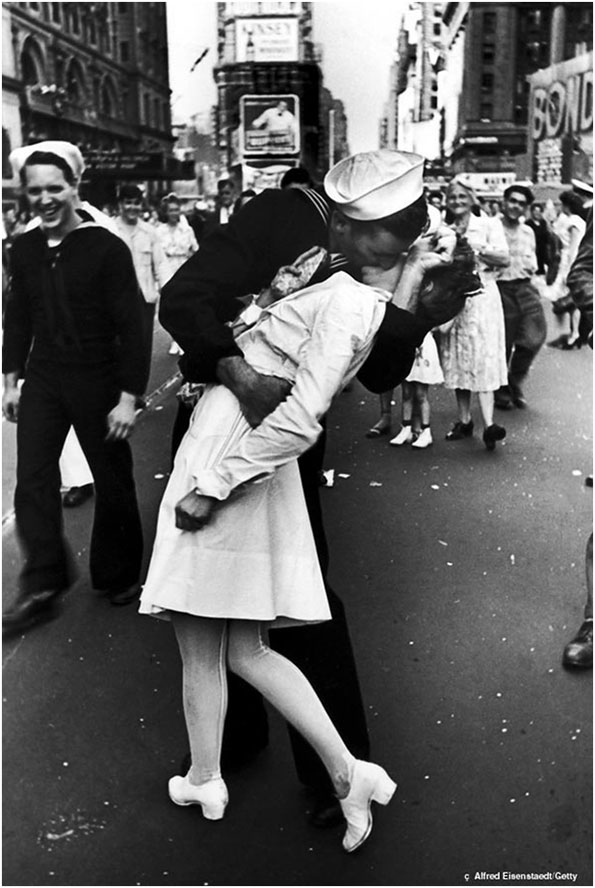
    We can also think of a radically different space such as Times Square, and how it has played host to so many civic celebrations and traditions over the years such that it has become not just a local but a national repository of our culture. The ball dropping on New Year’s Eve is an obvious example. But consider also this iconic photo.

    This is one of the most famous pictures from the war era and I don’t think it’s any surprise it was taken Times Square.

    How Suburbs Are Comparatively Lacking in Sacred Space

    Let’s apply the definition of sacred space to the suburbs. Yes, suburbs do have war memorials and culture and traditions and churches, but in general these are qualitatively different from what is found in the city core.  Here are three reasons why.

    1. Suburban traditions and spaces are often ephemeral and generational. When I was in high school, everybody liked to go to a place called Down Home Pizza in Corydon on the weekends. And that was something kids from every high school in the area did, not just those from mine. Today that place is long gone. And the kids are doing something else, whatever that may be.  In fact, it’s amazing how many of the places and traditions from my high school days are already gone after only 25 years because of physical and economic changes in the community such as restaurants and stores going out of business.

    This happens in the city too, like when the department stores went under, taking their white-gloved tea rituals and the like with them. But to a much greater extent than the city, suburbs rely on commercial establishments as focal points of shared experience, and by their very nature those tend to come and go. And suburbs have not to nearly as a great a degree established truly trans-generation rituals and spaces.

    2. Lack of transcendent scale. This is also something Mumford hints at. The “human scale” is a big buzzword in urbanism today. Contrary to what many say, the suburbs actually do a pretty good job of the human scale, especially from an automobile era perspective. But a unique essence of urbanity and often of transcendent experience itself is what we might call the “anti-human scale.” British writer Will Wiles put it this way:

    The “human scale” only tells part of the story of the city – after all, this can be found in villages and small towns. All cities need sublimity, a touch of holy terror, a defiance of human scale that asserts connection to the greater urban whole.

    The sheer scale of something like the Indiana War Memorial, which is a very imposing structure inside and out, renders it qualitatively different that your average small scale suburban memorial. This is true not just physically but also in terms of the humanity represented. That memorial stands for an entire state, not just a single town. Which is the same reason there may be more suburban school kids who have visited their state capital or the US Capitol than their local village hall.  There’s a reason the US Capitol and Lincoln Memorial and such have such powerful resonance. They represent an entire nation and a vast sea of humanity. Cities also participate in this scale effect.

    3. Low quality religious architecture. When it comes to the most obvious category of sacred space, the religious building, the suburbs also fall flat. That’s because Protestant Christianity, the largest suburban religious strain, has itself become unmoored from the transcendent. This is clear, for example, from the rise of what has been dubbed “Moralistic Therapeutic Deism” as a dominant worldview, especially among the young.

    The average suburban megachurch is an architectural horror show. The best of them generally rise to the level of an upscale corporate conference center. The worst are like “That 70’s High School”.

    Someone once said that all sin results from failing to believe one of the “4 G’s” about God, namely, God is great, God is good, God is gracious, and God is glorious. Applying that to religious life generally, in modern Evangelical churches, God may be very good and gracious, but He’s doesn’t seem all that great, and He’s certainly not very glorious.  This is religion that can inspire good works, but not great ones. There’s no trace of the overwhelming glory of God in nearly any of these structures. There’s no longer a faith like the Lutheranism of Johann Sebastian Bach that can inspire the greatest works of human artistic achievement.  Because modern suburban church architecture is so poor and so disposable, it diminishes the impact of sacredness in the space.

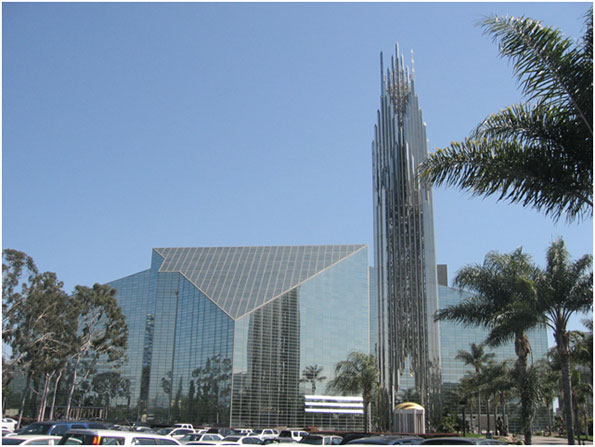
    The recent stories about the sale of Orange County’s Crystal Cathedral, designed by Philip Johnson, brings to mind an exception that proves the rule.

    Unsurprisingly it was the Catholic Church that bought it. Unlike Protestantism, Catholicism has always had a theology of place. And they’ve always used architecture and art as a way of telling the story of the gospel. Though obviously not in this case, they’ve also used Gothic sort of like neoclassical architecture as a way creating a sense of permanence and linkage to an everlasting, eternal church.

    So sacred space is one area where the suburbs really are deficient versus the city. But how important is this? Metropolitan areas today are mosaics. In an ever more complex and competitive global economy, every part of a region, city and suburb, needs to know its role on the team and bring it’s A-game. Just as there’s no need for every job to be located downtown, there’s no need for every major piece of sacred space in a region to be replicated in every suburb. Downtown does just nicely. However, this is one reason that while economically the core may no longer dominate a region, a healthy center still plays a key role in overall regional vitality. That’s because it remains home to things like the major pieces of sacred space such as war memorials and cathedrals that bind a region together and give it civilizational permanence, meaning, and purpose beyond the mundane.

    This article was adapted from remarks at the No Place Like Home conference on June 3, 2013 in Anaheim, CA.

    Aaron M. Renn is an independent writer on urban affairs and the founder of Telestrian, a data analysis and mapping tool. He writes at The Urbanophile.

    Suburbs photo by Bigstock.

  • Toward a Self Employed Nation?

    The United States labor market has been undergoing a substantial shift toward small-scale entrepreneurship. The number of proprietors – owners of businesses who are not wage and salary employees, has skyrocketed, especially in the last decade. Proprietors are self employed business owners who use Internal Revenue Service Schedule C to file their federal income tax. Wage and salary workers are all employees of any establishment (private or government), from executives to non-supervisory workers.

    From 2000 to 2011, the number of non-farm proprietors grew by 10.7 million. Total wage and salary employment grew by only 105,000 between 2000 and 2011. Government employment, including federal, state and local, grew 1.36 million, while private employment declined by 1.26 million (Figure 1).

    As a result, 99 percent of the total increase in employment from 2000 to 2011 was in the self-employed, according to Bureau of Economic Analysis of the United States Department of Commerce data. By comparison, during the 1990s, self employment accounted for only 22 percent of the increase in jobs nationally (Figure 2). The economic impact of the increase in self employment may be less, however, than its gross numbers, because many of the self employed are also engaged in wage and salary employment (Note).

    Self Employment Gains in the Great Recession

    Perhaps most striking is the fact that the number of entrepreneurs continued to grow in the Great Recession and what might be called the continuing Great Malaise. From 2007 to 2011, there was an increase of 1.8 million proprietors. This annual growth of nearly 450,000 was more modest than between 2000 and 2007, when the average number of proprietors grew 1.28 million, nearly three times as fast. The continuing growth in proprietors starkly contrasts with the loss of 5.9 million in private sector jobs. Government employment grew 44,000.

    A Longer Term Trend

    The data from 2000 to 2011 indicates an acceleration of an already developing trend of greater self employment, which can be traced back to at least 1970 (the earliest data readily available). In 1970, proprietors were 11.0 percent of employment, a figure that rose to 15.6 percent by 2000. The greatest increase occurred after 2000, when the number of proprietors increased 42 percent. In 2011, proprietors represented 21 percent of employment, nearly double their proportion in 1970 (Figure 3).

    This increase in proprietors (and their generally smaller commercial establishments) tracks with the continuing decline in average establishment size (Figure 4). United States Bureau of Labor Statistics data shows that between 2002 and 2012, there was a loss of 2.3 million private jobs in establishments with 100 or more employees. Establishments with 500 or more employees experienced a reduction of 1.8 million jobs, 80 percent of the large establishment (100 and over) losses. These losses were nearly made up by gains in establishments with under 100 employees (2.1 million).

    State Self Employment Trends

    Self employment added the largest number of jobs in 40 states between 2000 and 2011 (Table). Its percentage increase exceeded both those of private and government employment in all but two states (North Dakota and Alaska)

    Texas added the largest number of proprietors between 2000 and 2011. The Lone Star state added 1.26 million proprietors. Florida ranked second, added 970,000 proprietors, followed by California with 940,000. New York with its long laggard economic growth , added 820,000 proprietors. Georgia ranked 5th, adding 540,000. The next five included fast growing North Carolina (8th), as well as slower growing New Jersey, Illinois, Pennsylvania and Michigan (yes, Michigan).

    The story, however, was much different among these states in wage and salary employment. Texas, with the nation’s most vibrant and business friendly big state economy (according to chiefexecutive.net), added 1.22 million wage and salary jobs, 960,000 of which were in the private sector. Florida did somewhat worse, adding only 201,000 jobs, 113,000 in the private sector. California lost 480,000 private sector jobs, while adding 62,000 government jobs. Public and government employment changed little in New York. Georgia lost 131,000 private jobs, while adding 87,000 to government payrolls, while New Jersey and Illinois suffered private sector losses of 155,000 and 355,000 respectively (Figure 5 and Table).

    EMPLOYMENT CHANGE BY TYPE OF JOB: 2000-2011
    Wage & Salary Employment Total Employment
      Private Government Total Proprietors
    Alabama            (69,050)          22,297        (46,753)          154,522           107,769
    Alaska             39,839          12,355         52,194             9,621             61,815
    Arizona            126,805          51,509       178,314          245,934           424,248
    Arkansas              (8,806)          27,902         19,096           47,141             66,237
    California           (479,691)          62,143      (417,548)          941,071           523,523
    Colorado              (8,740)          70,077         61,337          209,084           270,421
    Connecticut            (64,857)            3,022        (61,835)          168,636           106,801
    Delaware            (11,550)            6,597         (4,953)           35,349             30,396
    District of Columbia             46,402          27,180         73,582           29,288           102,870
    Florida            113,353          88,063       201,416          968,006        1,169,422
    Georgia           (131,337)          87,525        (43,812)          537,451           493,639
    Hawaii             33,157          17,126         50,283           35,638             85,921
    Idaho             37,459            8,327         45,786           54,325           100,111
    Illinois           (354,730)           (5,481)      (360,211)          374,270             14,059
    Indiana           (180,865)          18,415      (162,450)          105,068            (57,382)
    Iowa             10,472          11,440         21,912           49,320             71,232
    Kansas            (17,794)          21,022          3,228           74,747             77,975
    Kentucky            (48,771)          39,826         (8,945)           86,259             77,314
    Louisiana               8,380         (16,543)         (8,163)          219,700           211,537
    Maine            (11,858)            1,060        (10,798)           23,994             13,196
    Maryland             28,580          54,102         82,682          249,229           331,911
    Massachusetts            (96,684)           (4,699)      (101,383)          211,607           110,224
    Michigan           (666,239)         (66,184)      (732,423)          294,215          (438,208)
    Minnesota              (3,680)            6,886          3,206          155,151           158,357
    Mississippi            (64,479)            5,696        (58,783)           87,067             28,284
    Missouri           (107,603)          12,903        (94,700)          138,189             43,489
    Montana             38,149            7,163         45,312           31,068             76,380
    Nebraska             15,922          12,470         28,392           42,849             71,241
    Nevada             75,814          35,526       111,340          136,382           247,722
    New Hampshire              (7,892)            9,275          1,383           41,525             42,908
    New Jersey           (155,108)          21,622      (133,486)          405,353           271,867
    New Mexico             48,017          11,506         59,523           37,120             96,643
    New York               2,427           (5,997)         (3,570)          818,861           815,291
    North Carolina            (58,042)        121,486         63,444          329,109           392,553
    North Dakota             65,306            7,595         72,901           15,776             88,677
    Ohio           (514,436)           (5,380)      (519,816)          277,931          (241,885)
    Oklahoma             28,310          41,462         69,772          106,262           176,034
    Oregon             19,047          16,878         35,925           95,406           131,331
    Pennsylvania            (11,087)          17,678          6,591          310,306           316,897
    Rhode Island            (15,349)           (4,281)        (19,630)           29,356              9,726
    South Carolina            (42,912)            9,998        (32,914)          242,447           209,533
    South Dakota             28,301            7,155         35,456           20,290             55,746
    Tennessee            (84,441)          33,905        (50,536)          196,021           145,485
    Texas            956,988        264,871    1,221,859       1,255,773        2,477,632
    Utah            109,728          33,864       143,592          137,781           281,373
    Vermont              (4,419)            4,179            (240)           21,467             21,227
    Virginia             90,766          64,639       155,405          282,009           437,414
    Washington             77,224          62,267       139,491          170,512           310,003
    West Virginia               8,796            9,736         18,532           20,765             39,297
    Wisconsin            (81,794)          13,783        (68,011)          148,572             80,561
    Wyoming             33,972          10,034         44,006           21,077             65,083
    United States        (1,259,000)     1,364,000       105,000     10,698,900      10,803,900

    The Future?

    Robert Fairlie, one of the nation’s leading experts on self-employment and a professor at the University of California, Santa Cruz, associates much of the increase in proprietors during the Great Recession to higher unemployment rates, measured at the local level. This is consistent with the rise in self employment during the Great Recession and the huge wage and salary job losses. At the same time, the larger increases in the decade before the Great Recession may indicate a strong underlying trend toward self employment. Certainly, this is supported by the rise of the Internet, which provides cheaper access to information and more comprehensive marketing opportunities.

    The future could see stronger self employment gains. As the baby boom generation reaches retirement age, it is likely that many former employees will turn to self employment to increase their incomes.

    Finally, the increasing global competitiveness could continue to reduce establishment sizes and encourage greater self employment. Stronger business regulation, including the mandates of the new medical care system ("Obamacare") could result in stunted employment growth, or even losses, forcing more people into self-employment even if they continue to work with current employers as contractors.

    America may not become a "nation of shopkeepers," like 19th century Britain, but is   increasingly becoming a self-employed nation. It will be challenging for governments, both at the national and local level to develop regulatory and tax structures that encourages this entrepreneurial expression, and perhaps more problematic, figure out to aid their conversion into larger businesses.

    Wendell Cox is a Visiting Professor, Conservatoire National des Arts et Metiers, Paris and the author of “War on the Dream: How Anti-Sprawl Policy Threatens the Quality of Life.

    —-

    Note: This article uses Bureau of Economic Analysis employment counts — the number of jobs, rather than employees (an employee may have more than one job). The database in this analysis includes full and part time employment. Last year’s Forbes article used a different database, limited to people who make their livings principally from self employment.

    Self employment photo by BigStockPhoto.com.

  • Florida’s Pinellas County: Growth Gone Wild

    In the seventeen years since my last visit, Florida’s Pinellas County hasn’t much changed. It’s still a low-grade carpet of commercial junk space from coast to coast, and the edges – where the value really lies – aren’t very different than they were in the 1990s. There’s more, but not better. A county that has consistently avoided growth regulation, Pinellas could have been a model for cooperative public/private real estate development, unimpeded by pesky government regulations. Instead, it is a living example of the atrocious results when leaders focus on quantity, not quality.

    Situated midway down Florida’s west coast, Pinellas County has become a kind of garbage can for America; a place where trash culture and trash capitalism trickles down, finally pooling in this subtropical peninsula. The people of Pinellas, like many other Americans, aren’t dancing in the festival of urban triumphalism. Instead, they’re largely left out of the hip, cool class of places celebrated by the rich. Pinellas’ population largely serves as service workers for wealthier coastal tourists and local financial operations, struggling on low income and unsteady work. The residents seem to have passively accepted the traffic-choked commercial strips, poorly planned subdivisions, and low-performing schools without asking for more. And this is a shame.

    The peninsula’s tragedy is that man replaced nature with something considerably worse. Since its discovery in 1528 by Panfilo de Narvaez, man has graced this natural environment with enough paving, concrete blocks, chemicals and steel to completely cover it up, but none of this handiwork is particularly good, or even well thought out, as most all the county’s residents will grumble when asked.

    Raising their living standards isn’t about adding urban lofts and coffeehouses; instead, the average resident would like safer neighborhoods and roads, and better jobs and schools. These are the important struggles on the suburban frontier, and Pinellas is emblematic of much of America’s population today, left out of the luxury star system to which so many of our urban centers aspire. The hotels and condos erected on the coastline have added quantity, but not any overall quality to the waterfront. The peninsula’s interior remains a patchwork of squabbling municipalities, unable to unite. America’s parade of brand names dominates the Pinellas County experience, with few independent businesses and few distinct, legible places.

    Pinellas County produces nothing whatsoever. It offers some moderately valuable beachfront real estate. It has no natural resources and no endemic industry, and thus it remains about 280 square miles of cannibalistic economy that contributes little to the overall net productivity of Tampa Bay, Florida, or America.

    At the peninsula’s tip, St. Petersburg — “God’s Waiting Room” — sits like a grinning old grandmother, Florida’s original retiree community. This ephemeral location offers a quality of life, and a place to just be. Unlike most of the peninsula, St. Petersburg has art museums, shuffleboard stadiums, and a gorgeous waterfront park. Around Tampa Bay, its superb set of commons is widely acknowledged. All of this was OK for a few generations, as we gratefully acknowledged and respected those who endured the Depression and fought the war. But this Sybaris of the South may no longer be able to feed off of itself.

    As a retirement community, St. Pete led the pack with an economy that fabricated its identity out of balmy sea breezes, and it has slowly diversified its demographic to include families and young couples; it’s also created a sports-oriented industry out of its baseball team, the Rays. Yet age, class and race divisions still underlie this city, and its economy seems tenuous, with little to go on but distinguished good looks.

    Is it time to call Pinellas County a failed experiment in laissez-faire government? A lost cause that would be best returned to nature? Nothing man has done has made it better, and the sooner this is recognized, the sooner Pinellas residents can begin the process of resculpting the county into something worthwhile.

    Blaming government for over-regulating us into mediocrity is certainly in vogue, but that is decidedly not the problem. Here, the built environment fails to deliver an uplifting quality of life, and this failure must be laid at the feet of the private interests, not the public guardians.

    For the government consistently turned its back when private companies wanted to build more and more and more. In a sad, multigenerational litany of subverted growth management rules, unregulated development approvals, and corporate relocations, one town off of another in a quest for the least-costly, least-regulated place to put a low-wage, back-office workplace. Firms got exactly what they wanted in Pinellas. We must now all live with the result.

    One possibility is for Pinellas County to start buying up the substandard, stucco-smeared construction that litters the landscape, grind it up, and sell it for fill. City-building requires copious amounts of gravel and sand, both in abundance in Pinellas County’s vertical material, much of it unmaintained, underused, or abandoned. The land that is uncovered beneath all this hardscape might then be ritually cleansed, and, as in some parts of Detroit, returned to a more naturalized state.

    Where seawalls haven’t destroyed coastlines, Pinellas’ soft edges are blurred. Estuaries vary by inches in elevation, and the whole of the land is a complex, marshy mosaic. Like a miniature Florida, freshwater sheets flow over some parts. Salt water from the warm Gulf of Mexico undoubtedly has shaken hands with briny Old Tampa Bay more than once during hurricanes and floods. The indistinct boundaries — not quite solid ground, not quite wetland, not quite navigable water — has begotten a human-made environment that is not quite city, not quite country, and not quite suburb.

    The lost potential makes one shudder: the beauty of beaches tragically wasted by cheap condos and crappy hotels; the miserably hot and humid interior beaten into submission by a million buzzing air conditioners, separated by tiny, seared lawns and cracked pavement. Ordinarily, the hum of a city — street traffic, planes taking off, and other forces marking its rhythm — inspires a sort of thrill, a localized dance beat. In Pinellas, the beat is an annoying headache. The coastal communities aren’t quaint or attractive. In comparison, even the junky mess of Venice, California qualifies as a higher-order vernacular made of cheap cloth. Here, the architectural character has lower aspirations, a charmless sea of mobile homes, apartments, and small houses.

    The people elected leaders who rallied for a higher quality of life, only to give in too easily to quantity. Once that trend began, there was no turning back, and the result is an urban form that looks like everybody threw in the towel and just quit. As the next generation begins to take hold, some big questions can be considered for its future.

    Pinellas County could try to stand up on its own two feet, and actually produce something of value. Geriatric medicine might be a good start. Such coordinated effort, however, has eluded Pinellas in the past, and it is not likely in the future. A tech hub might attract a new industry, but there is not much to lure people here, especially when competitors can offer beaches and sun without the high crime rate and poor schools. Tampa has long used Pinellas County as a dumping-ground to house its low-wage service sector, and like much of metropolitan Florida, it suffers as a peripheral zone around the higher-income financial center. Its multiple small towns remain weak and tribal, benefitting Tampa the most.

    But, suggestions aside, it’s high time for the tribes to get together and create their own future. This could take the form of some kind of super-council to re-establish their rights. Other places, such as Minneapolis-St. Paul, formed a multi-town metropolitan council to break the stalemate between feuding municipal entities, and take control of growth. The Metro Council has been credited by writers such as Anthony Orum for redefining the Twin cities during an era when Milwaukee, Cleveland, and Detroit failed miserably at reinventing themselves.

    Such a council would need extraordinary power to succeed. In Minnesota, the Governor nominates council members to provide authority over the small towns and county politics. Whether this would work in Florida is questionable, but some kind of direct, participatory democracy must be considered if the county’s destiny is to be something other than a garbage can.

    Could any of this happen? Ultimately, compassion is in order. Until Pinellas begins rejecting growth in favor of quality development, all we can do is treat it like a terminally ill patient: make it comfortable, give it the low-quality growth that it wants, and let it slide. Perhaps Pinellas County can become a better place, but it is more likely that it will evolve into a kind of Dark Ages suburban favela…and share the fate of so much of America’s sad, confused landscape.

    Richard Reep is an architect and artist who lives in Winter Park, Florida. His practice has centered around hospitality-driven mixed use, and he has contributed in various capacities to urban mixed-use projects, both nationally and internationally, for the last 25 years.

    Flickr photo by JM Barxtux: In Northern St Petersburg.