Blog

  • Addressing Housing Affordability Using Cooperatives

    Our country is six years into the Great Recession, the biggest economic downturn since the Great Depression. It’s been replete with reports of home foreclosures, collapsing commuter towns, and young people struggling to become home owners. The term “generation rent” is often used in the media to describe the struggles of aspiring young people.  

    This is really a problem of upward mobility, and  how little the political system has responded to this problems of “generation rent” and those who have lost their homes. The current lack of action can be contrasted with the two very different periods in our economic history – the Roaring Twenties and the Great Depression.

    When discussing home ownership, many often bring up the efforts of Franklin Delano Roosevelt during the Great Depression. FDR called a nation of homeowners “unconquerable.”  But his administration really built on the ideas of previous administrations. Herbert Hoover, while serving as Warren Harding and Calvin Coolidge’s Secretary of Commerce, lent his support the “Own Your Own Home Campaign” of the Federal National Mortgage Association. This campaign touted the benefits of home ownership to the American people. And when Hoover became president, he created the Federal Home Loan Bank Board which chartered and supervised federal savings and loan institutions and created Federal Home Loan Banks to lend money to finance home mortgages. The purpose of this bank was to make homeownership cheaper for lower income people. It also represented a portion of Hoover’s efforts to fight the depression, and those efforts often went unrecognized by the American people both then and now. Hoover said home ownership could "change the very physical, mental and moral fiber of one’s own children." 

    After being elected president, Roosevelt created the Federal Housing Administration which insured homes made by banks and other lenders. The agency made it possible for people to pay for homes over three decades, before this period most homes were paid for through a three to five year loans. This program, followed up by Harry Truman’s support of veteran’s home loans and the home mortgage interest deduction, helped turn a nation of urban tenement dwellers into a nation of suburban home owners. Today, the federal government spends billions in subsides to ensure people have the opportunity to own their own homes. 

    Urbanist Richard Florida discusses the issue of home ownership in the 2010 book The Great Reset. In his interesting but misguided book, he correctly points out that too many people attained loans in the housing bubble and that high rates of homeownership hobble the labor market, as owning a home makes it harder for the job seeker to move. He also faults the Obama Administration for trying to do too much to prop up the mortgage market and recommends that the government quit supporting home ownership and start supporting renting to a greater extent. He said Fannie Mae has already taken steps in this direction by allowing people who experienced foreclosure to rent their houses. 

    But Florida is overstating the importance of renting in the lives of the American people, as we have a strong heritage as an upwardly mobile, ownership society that stretches back to the homesteading legislation pushed by Thomas Jefferson and Abraham Lincoln. But there’s no doubting that we’re a more mobile society than in the homesteading days. While FDR built on the work of his Republican predecessors, today’s leaders also have a template in the cooperative housing movement. According to the National Association of Housing Cooperatives, cooperative housing is defined as when “people join together on a democratic basis to own and control the housing or community facilities where they live.” Each month those who live in a housing cooperative pay their share of the expenses while sharing the benefits of the cooperative. According to the NAHC, 1.2 million families live in cooperative housing in the United States.

    What if we could create more forms of cooperative housing to make sure families have the opportunity to own a home and at the same time have a certain amount of mobility? Could a new Cooperative Housing Authority, with funding from Fannie Mae, buy up foreclosed houses and charge a monthly below market rate to a family? All such houses could be considered a part of the CHA and the family in the house would share in the profits of the authority. If and when the family moves, they’ll be entitled to those profits which could be used for rent or a down payment on a house. Such a program would help commuter towns who are suffering from high gas prices and foreclosures. 

    But a Cooperative Housing Authority would also be a conduit for affordable housing in America’s big cities and the surrounding suburbs, as the added supply of new housing forces the cost down. This would be an asset to certain cities where the supply of affordable housing is dwindling due to gentrification. Like most cooperative housing, the housing could take various forms: condos, townhomes and single family homes. I would suspect single family homes would be the most popular because they are the preference of most Americans. 

    A Federal Community Land Trust could be along with a CHA another way to deal with affordable  housing shortages. Like any land trust, it could add civic buildings, commercial spaces and community assets to the areas where the housing exits. This would ensure mixed/use type neighborhoods where residents would have access to shopping and civic life nearby. 

    Returning to FDR’s administration, during the 1930s the government constructed what was called garden suburbs outside of major cities: Greenbelt, Maryland; Greenhills, Ohio; and Greendale, Wisconsin. The garden suburbs were intended to house rural people who were migrating to the city as well as poor urban workers. The project was a two way street, as the government provided the road grid and cheap credit for the suburbs while aspiring families provided the mortgage payments.  These garden suburbs – designed to be suburban with some green (trees and parks) – provided a template for the mass automobile suburbanization that occurred in the 1950s.

    Of course, urbanists have never quit critiquing this suburban development model since it emerged. Like many in the city planning world, Lewis Mumford was horrified at the way suburbanization played out after World War II:
    "The planners of the New Towns seem to me to have over-reacted against nineteenth-century congestion and to have produced a sprawl that is not only wasteful but–what is more important–obstructive to social life."
    Mumford advocated the regional city – a city that included an urban core surrounded by well-planned suburbs, as he also rejected the densely packed cities of the decades before the war.     

    Could a FCLT and CHA work to create family friendly suburbs with mixed use development, and in turn save families money on energy and at the same time spare the environment more greenhouse gas pollution? I think that it could, and if these developments were to become a reality, Lewis Mumford’s vision of a regional city might look like a reality. 

    Jason Sibert is a freelance writer who has lived in the St. Louis Metro Area since the late 90s. He worked for the Suburban Journals for a decade and his work has appeared in various publications over the last four years.

    Chicago housing cooperative photo by Jennifer D. Ames.
  • East Coast, West Coast – What about Our Coast?

    Most Americans take it as an article of faith that there’s a strong connection and relationship between the major cities of the East and West coasts.  Indeed, there may be 3,000 miles separating New York from Los Angeles, or San Francisco from Washington, but psychologically the cities each seem to be more connected to each other than, say, Dallas to New York or Atlanta to San Francisco.  Of course, in the minds of the coastal crowd, the rest of the nation has become “flyover” country.  That wasn’t always the case.  How exactly did that happen?

    Lots of factors helped to develop America’s west coast.  Certainly the pioneer spirit that initially brought settlers west led to a strong sense of individualism and entrepreneurism that pushed development forward.  The allure of the weather brought many transplants west.  But I think the West Coast benefitted much more from the kinds of connections identified by Jim Russell at Burgh Diaspora (and now at Pacific Standard) – the West Coast had an effective talent attraction strategy, created strong bonds with the East Coast, and never let them go.  It’s a lesson that the shrinking cities of the Rust Belt should heed and practice.

    I’m no historian, nor am I the ultimate authority on the development of cities.  But it’s clear West Coast cities did some things that Rust Belt cities did not.  As we all know, the settlement of California was kicked off with the Gold Rush of 1849.  Prior to that California was a sparsely-settled former Mexican territory with no physical or institutional infrastructure.  The Gold Rush propelled Eastern financiers to provide the money to develop San Francisco as the financial center that would open up the west, and give it the physical and institutional resources to deliver its goods to the rest of the nation.  San Francisco never relinquished those ties.

    Further south, Los Angeles used its fabulous and consistent weather as a means to attract parts of a budding film industry previously based on the East Coast.  The growth of the film industry ultimately led to the growth of the media industry in Southern California, and voila – the economic underpinnings of a major metropolis are established.  Like San Francisco, LA never relinquished those ties.  (Side note: I don’t think you can understate the importance of the Rose Bowl in luring Midwesterners in particular to Southern California.  The “Granddaddy of Them All”, started in 1902, annually brought the Big Ten’s best and brightest for a few weeks of sun and fun in winter.  The strategy paid off.)

    The lesson here for the Rust Belt is talent attraction, and maintaining the connections over time.  San Francisco was able to parlay its Eastern financial connections into the development of a strong financial center, which later served as the financial apparatus for the tech industry.  Los Angeles was able to do the same with the film industry and media, and it could be argued that the city’s ties to Midwestern interests led to the growth of the defense industry there.

    As for the Rust Belt?  It seems that what sets it apart from the West Coast is that it remained content to be the industrial hearth of the nation, instead of seeking other avenues to leverage its advantages for even more growth.  That, and the fact that West Coast cities understood the importance of maintaining strong connections with East Coast partners, and East Coast cities understood the financial upside – for their own cities – of staying close to those on the West Coast.  Can the Rust Belt do the same?

    This piece first appeared at Corner Side Yard.

  • Driving Trends in Context

    There are grains of reality, misreporting and exaggeration in the press treatment of a report on driving trends by USPIRG. The report generated the usual press reports suggesting that the millennial generation (ages 16 to 35) is driving less, moving to urban cores, and that with a decline in driving per capita, people are switching to transit. These included the usual, but not representative anecdotes about people whose lifestyles and mobility needs are sufficiently served by the severe geographical and travel time limitations of transit.

    Further, in an important contribution, the USPIRG report provides driving trend forecasts that are lower than other projections. If accurate, these would result in materially greater greenhouse gas emissions reductions to 2040 than projected by the Department of Energy, further undermining the justification for anti-mobility policies as well as urban containment.

    Millennials and More Urban and Walkable Living

    It is again reported that millennials "like to live in the city center." Last year, a report by USPIRG cited a poll indicating that 77 percent of millennials plan to live in urban cores. Their actual choices have been radically different.

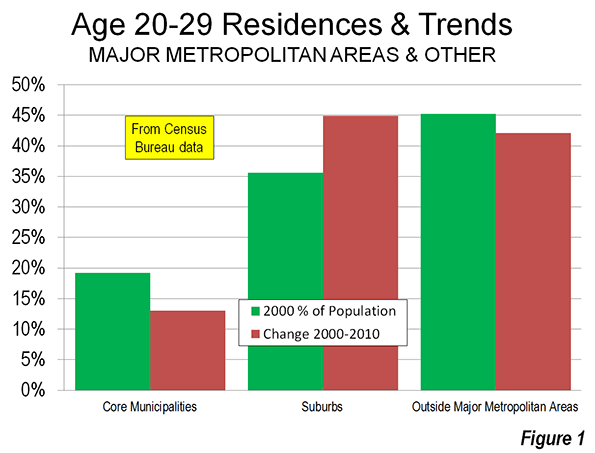
    In fact, 2010 census data indicates that people between 20 and 29 years old were less inclined to live in more urban and walkable neighborhoods than their predecessors. In 2000, 19 percent of people aged 20 to 29 lived in the core municipalities of major metropolitan areas, where transit service and walkable neighborhoods are concentrated. Only 13 percent of the increase in 20 to 29-year-old population between 2000 and 2010 was in the core municipalities. By contrast, the share of the age 20 to 29 living  in the suburbs of major metropolitan areas was 45 percent, higher than the 36 percent living there in 2000 (Figure 1).

    The Decline in Driving

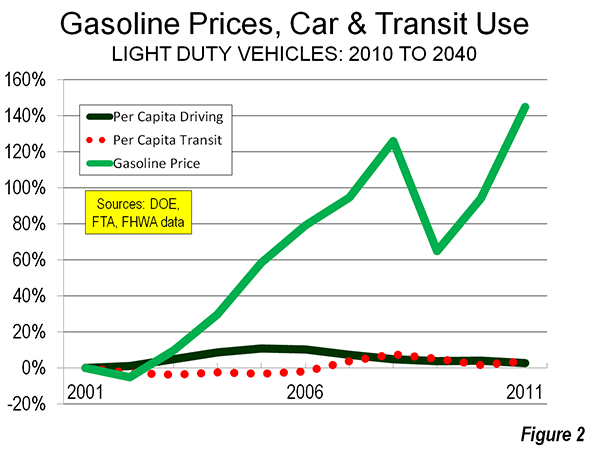
    Driving per capita in urban areas peaked in 2005. Between 2005 and 2011, driving declined seven percent. In the context of rising gasoline prices, and economic trends, the real news is not how much driving has fallen, but rather how little. A seven percent reduction is slight compared to the one and one-half times increase in gas prices over the past decade (Figure 2). Per capita travel by car and light truck has fallen back only to 2002 levels, which remained above the driving rates of previous years.

    Drivers: Not Switching to Transit

    The USPIRG report gives the impression that instead of driving, Americans are switching to other modes of transport, principally transit. In discussing the report, Nick Turner, of the Rockefeller Foundation said: "Americans are making very different transportation choices than they did in years past."

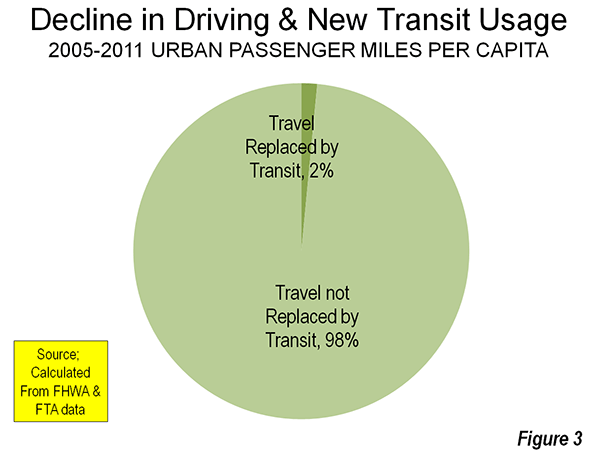
    Actually not. The data shows that as people drove less, they did not switch to transit. The driving reduction was approximately 900 miles per capita from 2005 to 2011. At the same time, transit ridership per capita was up approximately 15 miles – a small change compared to the reduction in driving (Figure 3). People just traveled a less (perhaps fewer trips to the store or to the beach, not to mention the fewer work trips in a depressed economy).

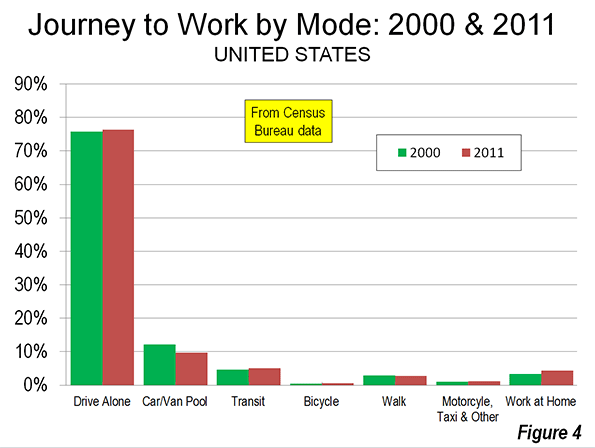
    Work trip travel trends are little changed over the past decade. Driving alone and transit were up marginally between 2000 and 2011. Working at home increased the most, while car pooling declined the most (Figure 4).

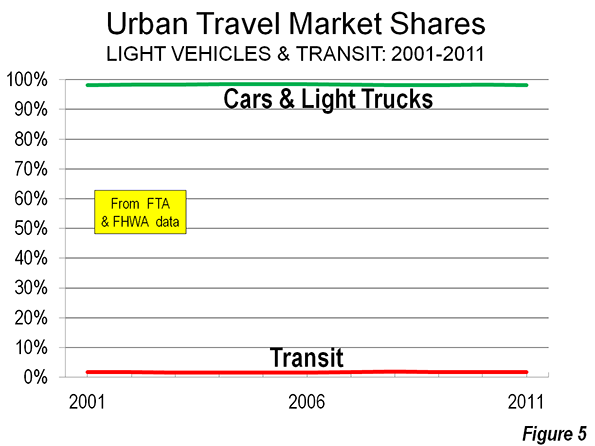
    This raises the issue of context. While driving was declining about seven percent per capita from 2005 to 2011, transit use was increasing about seven percent. The percentages were similar, but the amount of travel was radically different, because of transit’s much smaller base. Transit usage would need to increase nearly 400 percent to equal the mileage of a seven percent loss in travel by car. For all of the impressive transit ridership increase claims, transit’s share of urban travel has changed little (Figure 5).

    Transit’s failure to capture much of the decline in driving simply reflects the limitation of its effectiveness in taking people where they need to go. Transit is very effective in providing mobility to the nation’s largest downtown areas, where it provides half to three quarters of the trips. Approximately 55 percent of all US transit commuting is to six transit legacy cities (municipalities), including New York, Chicago, Philadelphia, Boston, San Francisco, and Washington. Most of this commuting is to the compact and dense downtown areas.

    Outside the transit legacy cities, transit’s impact is slight, because of the "last mile" problem.  Transit service is not close enough (or fast enough) to be practical for most trips in metropolitan areas. For example, Brookings Institution data indicates that the average worker can reach fewer than 10 percent of of jobs in major metropolitan areas within 45 minutes. By contrast, the average solo driver reaches work in approximately 25 minutes. There is no solving this problem, because the infrastructure that would be required is far from affordable, as Professor Jean-Claude Ziv and I showed in a WCTRS paper (See: Megacities and Affluence).

    Millennial Driving in Context

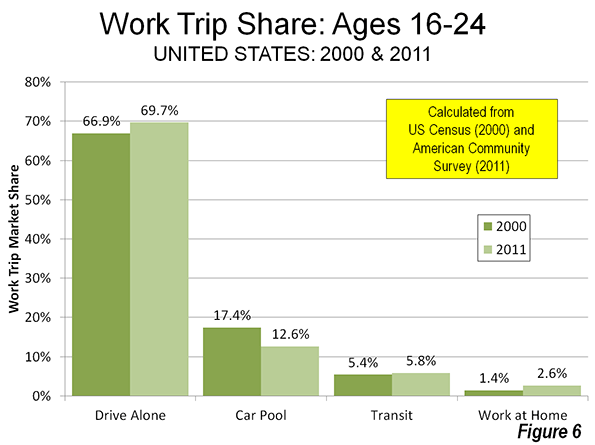
    Survey data does indicate a decline in driving among millennials, but those with jobs are not flocking to transit. Single occupant commuting in this age group increased between 2000 and 2011, from 66.9 percent to 69.7 percent. Transit use and working at home also increased (5.4 percent to 5.8 percent and 1.4 percent to 2.6 percent respectively. There was, however, a substantial decline in car pool use among millennials, from 17.4 percent to 12.6 percent (Figure 6).

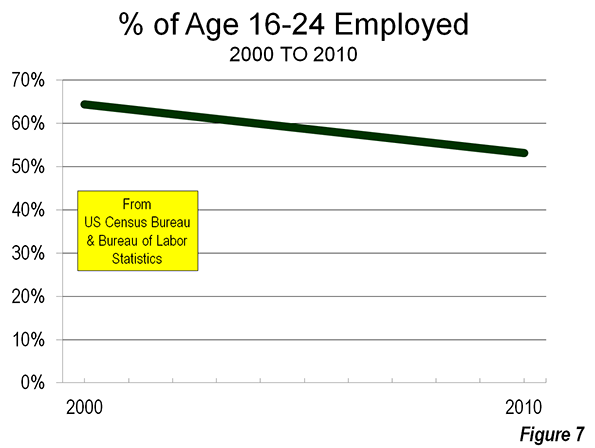
    Younger workers have suffered disproportionately from the economic decline. There has been a substantial reduction in the percentage of people aged 16 to 24 who have jobs (Figure 7). These lost work trips have contributed more than any perceived preference for urban living to the decline in driving. Transportation expert Alan Pisarski has attributed much of the decline in demand in this age group to such economic factors.

    At the same time, and as USPIRG indicates, the increase in social media use may well have contributed to the declining demand for discretionary travel.

    Driving Less in the Future and the GHG Emissions Implications

    The decline in per capita driving is not surprising. Back in 1999, Pisarski predicted that per capita driving would soon peak ("Cars, Women and Minorities: The Democratization of Mobility in America"), because automobile availability had now spread to most all segments of society.

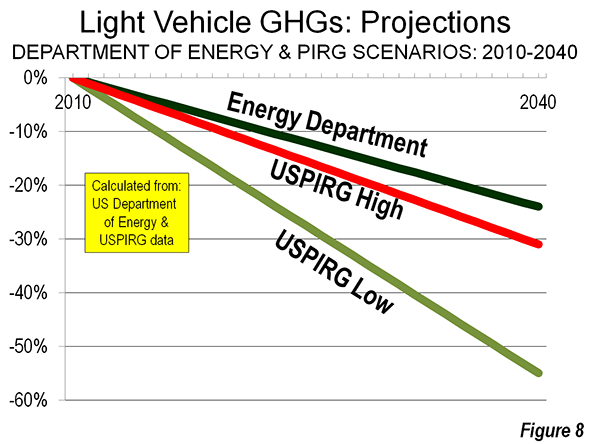
    USPIRG forecasts driving volumes below US Department of Energy predictions. According to USPIRG:  "Coupled with improvements in fuel efficiency, reduced driving means Americans will use about half as much gasoline and other fuels in 2040 than they use today." This means an even greater reduction in GHG emissions than currently forecast. Department of Energy forecasts a 21 percent decline in total (not per mile) GHG emissions from light vehicles between 2010 and 2040, despite a 40 percent increase in driving. The more modest driving levels in USPIRG scenarios would result in GHG emissions reductions of between 31 percent and 55 percent between 2010 and 2040 (Figure 8). These projections provide further evidence that of the "greening" of the automobile and the needlessness of urban containment policies.

    Reality

    Regardless, however, of the future trend, it is important to minimize the time that people spend traveling in metropolitan areas, because of the strong association between effective mobility, job access, and economic growth. Modern metropolitan areas require the quickest possible access between all origins and destinations to facilitate greater household affluence (measured in discretionary income) and lower levels of poverty. The objective should be the greatest reduction in travel delay per dollar spent on transportation.

    Dug Begley accurately characterized the situation in the Houston Chronicle:

    "We spend a lot of transportation money in the Houston region on roads, and for good reason: That’s how most people travel. Houston is a growing place, and there aren’t two or three job centers, there are about eight. Getting people between them … is going to take roads."

    Outside the municipal boundaries of the six legacy cities and especially their downtown enclaves, Houston (despite its reputation) is little different than the rest of metropolitan America. From the suburbs of New York, to the entire Portland and Phoenix metropolitan areas, the automobile carries the overwhelming share of travel (see Table 1, here). It cannot be any other way, since no planning agency in the New World or Western Europe has a plan, much less the resources, to construct a transit system that would duplicate the mobility of the automobile throughout its metropolitan area.

    Wendell Cox is a Visiting Professor, Conservatoire National des Arts et Metiers, Paris and the author of “War on the Dream: How Anti-Sprawl Policy Threatens the Quality of Life.

    —–

    Methodology: This article is based on data from the Federal Highway Administration, the Federal Transit Administration, Census Bureau, Department of Energy and USPIRG.

    Photo: Roadways, Fort Lauderdale (Miami metropolitan area)

  • Southern California Economy Not Keeping Up

    One of Orange County’s top executives asked me over lunch recently why Southern California has not seen anything like the kind of tech boom now sweeping large parts of the San Francisco Bay Area. In many ways, it is just one indication of how this region – once seen as the cutting edge of American urbanism – has lost ground not only to its historic northern rival, but also to some venerable East Coast cities, as well as the boom towns of Texas and the recovering metropolitan areas of the Southeast.

    This divergence became particularly clear to me as I put together the most recent Forbes Best Places for Jobs with Pepperdine University economist Mike Shires. Our rankings focus heavily on momentum: What areas are growing fastest now and have made the best progress over the past decade. For me, a 40-year resident of the Los Angeles Basin (Shires is a native of San Diego), the results were far from encouraging.

    To be sure, Los Angeles, Orange County and Riverside-San Bernardino are up somewhat from their dismal showings in past years, in part due to the housing recovery. But none did well enough to ascend even to mediocrity. Yet, of 66 regions with more than 450,000 jobs, Los Angeles ranked No. 49, while Riverside-San Bernardino clocked in at No. 45, and Santa Ana-Anaheim-Irvine did best, with a still-less-than-middling No. 38.

    These rankings were way below those registered in the country’s emerging economic powerhouse, Texas, which placed a remarkable four regions in the top 10 (Fort Worth, Dallas, Houston, Austin) or rising burgs such as No. 2, Nashville, No. 3, Salt Lake City, and No. 9, Denver. We also got smoked by such low-exposure places as No. 13, Columbus, Ohio, No. 15, Oklahoma City, and No. 16, Indianapolis.

    But our relative decline is not merely a reflection of the natural effects of lower costs and better business climate. We also lagged well behind such famously expensive, and hyper-regulated, places as No. 14, Seattle, No. 17, Boston, and No. 18, New York City. Worse of all, Southern California was left completely in the dust by its two great interstate rivals, the No. 1-ranked San Francisco Bay Area and No. 7-ranked San Jose/Silicon Valley. The only California cities to do worse than the Southland were No. 56, Oakland, and No. 57, Sacramento.

    Why is the Southern California economy lagging, even in this recovery? Much of the answer can be found by looking at the information sector, which is driving much of the Bay Area’s growth. As my luncheon partner, who is investing heavily in the Silicon Valley, suggested, the entire wave of new tech companies has largely bypassed Southern California.

    This is not merely a question of achieving less growth, but actually losing ground, while the Bay Area metros soar. Since 2007, for example, the information sector – which includes software, media and entertainment – surged 18 percent in the San Francisco-San Mateo area and by a remarkable 25 percent in the San Jose-Silicon Valley region. In contrast, the Los Angeles information sector declined by 7.3 percent, while in Orange County, once a tech hotbed, it dropped by 21 percent.

    These declines impact not only demonstrably tech-oriented jobs, but also professional and business services that often serve tech clients. Over the past five years, these jobs have been growing smartly in San Francisco and decently in Silicon Valley, while declining in both Orange County and Los Angeles. Only recently have these sectors showed any sign of recovery in the Southland, but at a far weaker rate than in the Bay Area.

    Why is this happening? Certainly the answers are complex. Historically, the L.A.-Orange County tech economy has been strongly tied to aerospace and defense, and these sectors have been declining under President Barack Obama. The defense sector also has tended to shift toward more politically potent places like Texas, Georgia and Alabama, where politicians actually work on behalf of industrial jobs. With the exception of drone technology, the Southern California region’s aerospace industry, as one analyst put it, has become “dormant,” a victim of a talent drain and a gradual withdrawal of aerospace giants, most recently, Northrop, from the region.

    Like Los Angeles, Silicon Valley’s tech community was largely birthed by the Defense Department and NASA, something rarely acknowledged by the region’s hagiographers. But, starting in the 1980s, the Bay Area began to apply early innovations in semiconductor design and software to other industries, such as personal computers, the Internet and, more recently, social media and mobile devices, something that has generated not only jobs, but also buzz.

    Capital, too, has played a role. The L.A. area has lots of rich people, but a relatively weak venture capital community. The Bay Area has roughly five times as much venture capital – more than $10 billion – as the far more populous L.A.-O.C. region. New York and New England also enjoy far more money in local venture investment firms than does Southern California.

    Politics and image-making also has contributed to the Southland’s eclipse. California politics are now almost totally dominated by Bay Area politicians – from Gov. Jerry Brown to Lt. Gov. Gavin Newsom and Attorney General Kamala Harris. Both our U.S. senators are from San Francisco and its environs. Their economic orientation, when they have one, tends to be to worship at the altar of allied Bay Area software giants, like Google, and social media firms such as Twitter or Facebook. Life in cyberspace makes less-direct demands on green “progressive” sensibilities than making airplanes or garments, or the work of processing trade with Asia.

    In general, the Bay Area economic mindset tends to disdain the tangible economy – manufacturing, wholesale trade, construction – critical to the more diverse and more blue-collar-oriented Los Angeles-area economy. California’s tight land-use regulation and soaring energy prices do not much impact the Bay Area giants, since they simply shift their energy-intensive operations to places like Texas or Utah. And, as for soaring housing prices, people who cannot afford Bay Area prices also can be shifted to Salt Lake City, Austin, Texas, or Raleigh, N.C.

    In contrast, Southern California, like much of the Central Valley, is far less able to slough off the green-dominated policies of the Bay Area political cliques. Los Angeles, for example, still has 360,000 manufacturing jobs, down more than 18 percent since 2007, and Orange County has an additional 160,000 such jobs, after a drop of 11 percent the past five years. In contrast, San Francisco-San Mateo has only 36,000 industrial jobs. These, too, have been declining rapidly, but have far less impact on the economy than down here.

    Then, there’s the question of image. According to a recent Bloomberg Businessweek survey, San Francisco ranked as “best city” to live in. Suburban San Jose ranked No. 33.

    Los Angeles? Try No. 50, behind such places as Cleveland, Omaha, Neb., Tulsa, Okla., Indianapolis and Phoenix.

    In another survey, identifying the top 10 cities for “millennials,” Seattle ranked first, followed by such cities as Houston, Minneapolis, Dallas, Washington, Boston and New York. Needless to say, neither Los Angeles nor Orange County made the cut.

    Is there something we can do about this decline? I think this is more than just a marketing issue. Southern California, a region that largely invented itself out of combination of real estate speculation and great climate, needs to rediscover the roots of its success. Once our entrepreneurs imagined and forced into being great things, such as massive water and port systems; they dominated the race for space and planned out the suburban dreamscapes of Lakewood, Valencia and the Irvine Ranch. With the possible exception of Elon Musk and Space X, Southern California’s entrepreneurial guile is now decidedly low-key – food trucks, ethnic shopping, reality shows, hipster-oriented lofts and shopping areas.

    This limited vision extends to politics as well. As recently as the 1980s, the region boasted an aggressive business community that bullied Sacramento and bestrode Washington like a colossus. Now, our business leaders cringe like supplicants before well-funded greens, racialist warlords and public employee unions. We need business and community leaders to match the increasing arrogance and audacity of the Silicon Valley oligarchs, to force legislators to address the needs of our economically diverse, and still tangibly oriented economy.

    This also requires that the cultural resources of the region – Hollywood, the fashion industry, universities and colleges – become more engaged in something larger than protecting their narrow interests. At some point, they should realize that, as our region loses luster, so, too, does the fundamental attractiveness of their institutions and industries.

    Until this happens, Southern California – despite its cultural richness, ideal climate and great history of economic vigor – will continue to lag, performing, at best, to its current level of underachievement, slouching toward a permanent state of mediocrity.

    Joel Kotkin is executive editor of NewGeography.com and a distinguished presidential fellow in urban futures at Chapman University, and a member of the editorial board of the Orange County Register. He is author of The City: A Global History and The Next Hundred Million: America in 2050. His most recent study, The Rise of Postfamilialism, has been widely discussed and distributed internationally. He lives in Los Angeles, CA.

    This piece originally appeared in the Orange County Register.

  • Texas Suburbs Lead Population Growth

    The US Census Bureau has reported that eight of the fifteen 2011-2012 fastest-growing municipalities with at least 50,000 population were in Texas. Three of them were in the Austin metropolitan area. San Marcos, south of Austin, grew the fastest in the nation at 4.9 percent. Cedar Park, located in Austin’s northern suburbs, ranked fourth in growth at 4.7 percent while Georgetown, also north of Austin grew 4.2 percent and ranked seventh. Houston suburb Conroe placed 10th adding 4.0 percent to its population. Dallas-Fort Worth suburbs McKinney and Frisco placed 11th and 12th. The other two Texas municipalities ranking high were outside the major metropolitan areas, Midland (third) and Odessa (13th).

    Growth Outside Texas

    South Jordan, located in the southern suburbs of the Salt Lake City metropolitan area was the second fastest-growing municipality, at 4.9 percent. Atlanta suburb Alpharetta grew 4.4 percent and ranked sixth. The largest municipality among the fastest-growing was Irvine, an Orange County suburb in the Los Angeles metropolitan area, which grew 4.2 percent to a population of 230,000. Buckeye, a suburb on the western periphery of the Phoenix metropolitan area placed ninth, growing 4.1 percent.

    Among the above 11 fastest-growing suburbs in major metropolitan areas, all are either near the periphery of the urban area or beyond the principal urban area. This illustrates the historic tendency of the fastest-growing city sectors to be located on (or beyond) their fringes. This was also strongly evident in the 2000 to 2010 census data, which showed 94 percent of major metropolitan area growth to be 10 miles or more from the urban cores.

    Other fast growers were not in major metropolitan areas, including Midland, Texas, Odessa, Texas, Auburn, Alabama and Manhattan, Kansas. Clarksville, Tennessee grew fifth-fastest. Clarksville is the core city of the second fastest-growing metropolitan area in the nation, just north of Nashville.

    First Census Bureau Municipal Estimates Since 2010

    These were the first reliable municipality (sub-county) population estimates produced by the Census Bureau since the 2010 census. The 2011 municipality estimates were virtually meaningless, since they were simply percentage allocation of county growth to municipalities based upon their share of the 2010 population.

    Growth in the Major Metropolitan Core Cities

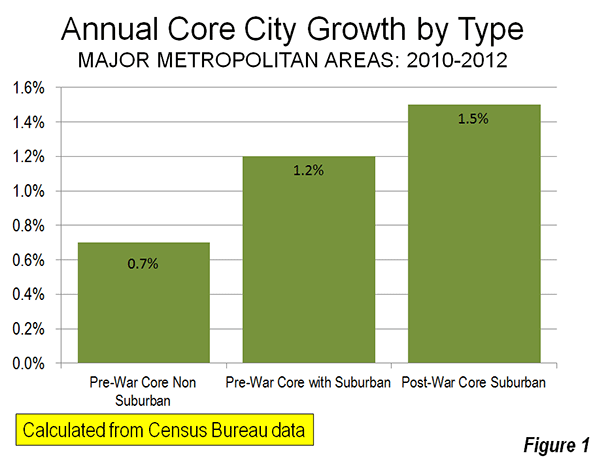
    Nonetheless, over the past two years the greatest historical core municipality growth has been in those with the most suburban (Figure 1) land use characteristics. (See Suburbanized Core Cities for discussion of how “Historical Core Cities” are defined).

    Pre-War & Non Suburban Core Cities: The least suburban core cities, those with little postwar suburban development, grew 0.7 percent between 2010 and 2012. The strongest growth in this category was in Washington, which added 2.2 percent annually. In reaching a population of 634,000, Washington passed nearby Baltimore for the first time in its history. New York added the largest number of people in the category at 162,000.

    Pre-War and Suburban Core Cities: The Pre-War Core cities with large tracts of post-war suburban development grew at a 1.2 percent annual rate (Note 1). In this category, New Orleans grew the fastest, at an annual rate of 3.2 percent, as it continues to recover from Hurricane Katrina. Denver also grew strongly, at an annual rate of 2.5 percent.

    Post-War & Suburban Core Cities: These core cities, none of which had strong urban cores before World War II and which are virtually all suburban, grew at an annual rate of 1.5 percent. Austin, which is at the core of the fastest-growing major metropolitan area in the United States, grew the fastest in this category, at 2.9 percent.

    Metropolitan, Core City and Suburban Trends

    The estimates also indicate that the suburban population boom that accompanied the housing bubble has run its course. During the 2000s, the share of major metropolitan area (over 1 million population) growth in historical core municipalities fell to approximately one-half the rate of the 1990s. That picked up in the late 2000s as housing construction came to a near standstill and the slower suburban growth rates that have continued through to 2012.

    In a few metropolitan areas, historical core municipalities attracted the majority of the population growth. The leader in this regard was Providence, with 75 percent of its metropolitan growth, which was miniscule. New Orleans captured nearly 2/3 of the growth in its metropolitan area, while New York accounted for 61 percent of its metropolitan area growth. San Antonio, San Jose, and Columbus also attracted more than one half of their metropolitan area growth, though the high share of core-city growth in San Jose and San Antonio was reflective of their high population shares (Table 1).

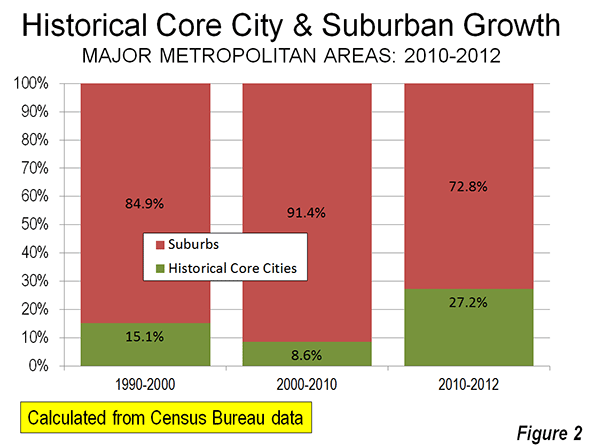
    Between 2000 and 2012, historical core municipalities accounted for 27.2 percent of the growth in major metropolitan areas (Figure 2). This is slightly more than their 26.4 percent of the population in 2010. It would be a mistake to interpret this as presaging the long predicted "return to the city." It would take a continuation of these growth rates for nearly 500 years for historical core municipality populations to struggle to 30 percent of the major metropolitan area population. At the same time, there have been recent indications of even more dispersion, as major metropolitan areas lost nearly two million domestic migrants to smaller areas between 2000 and 2011, according to Census Bureau data.

    Further, the trends in domestic migration indicate that people continue to move to the suburbs from elsewhere, while moving away from the core counties (migration data is not available below the county level). Overall, the core counties of major metropolitan areas lost 167,000 domestic migrants, while the suburban counties added 286,000 (Note 2).

    The domestic migration losses in some core counties were substantial. In the five counties that constitute New York, there was a loss of 139,000 domestic migrants (there was also a loss of 114,000 domestic migrants in the suburbs). Los Angeles County lost 111,000 domestic migrants, while Chicago’s Cook County lost 74,000. The largest gainers were in Austin (Travis County: 36,000), Atlanta (Fulton County: 32,000) and San Antonio (30,000). Core counties continued to attract most international migration, adding 757,000, compared to 589,000 in the suburban counties (Table 2).

    The Future?

    It seems apparent that the nation’s growth continues to be in a transitional period. Should a more normal and vibrant economy replace the current malaise, it seems likely that suburban growth will be renewed. That would not, however, preclude a continuation of the recent smaller inner-core population growth in the increasingly safer and more attractive downtown areas.

    Table 1
    Metropolitan and Historical Core CityPopulation: 2010-2012
    Metroplitan Area Metropolitan Area Change Historical Core City(s) Change Share of Growth
    Atlanta, GA        5,457,831         171,099         443,775        23,496 13.7%
    Austin, TX        1,834,303         118,017         842,592        51,955 44.0%
    Baltimore, MD        2,753,149           42,660         621,342            381 0.9%
    Birmingham, AL        1,136,650             8,600         212,038           (250) -2.9%
    Boston, MA-NH        4,640,802           88,400         636,479        18,885 21.4%
    Buffalo, NY        1,134,210            (1,301)         259,384         (1,926)
    Charlotte, NC-SC        2,296,569           79,534         809,798        21,221 26.7%
    Chicago, IL-IN-WI        9,522,434           61,329       2,714,856        19,258 31.4%
    Cincinnati, OH-KY-IN        2,128,603           14,023         296,550           (400) -2.9%
    Cleveland, OH        2,063,535          (13,705)         390,928         (5,886)
    Columbus, OH        1,944,002           42,037         809,798        21,221 50.5%
    Dallas-Fort Worth, TX        6,700,991         274,781       1,241,162        43,329 15.8%
    Denver, CO        2,645,209         101,731         634,265        34,241 33.7%
    Detroit,  MI        4,292,060            (4,187)         701,475       (12,302)
    Grand Rapids, MI        1,005,648           16,710         190,411          2,371 14.2%
    Hartford, CT        1,214,400             2,016         124,893            118 5.9%
    Houston, TX        6,177,035         256,579       2,160,821        63,604 24.8%
    Indianapolis. IN        1,928,982           41,105         834,852        14,410 35.1%
    Jacksonville, FL        1,377,850           32,254         836,507        14,723 45.6%
    Kansas City, MO-KS        2,038,724           29,386         464,310          4,523 15.4%
    Las Vegas, NV        2,000,759           49,490         596,424        12,637 25.5%
    Los Angeles, CA       13,052,921         224,079       3,857,799        65,172 29.1%
    Louisville, KY-IN        1,251,351           15,643         605,110          7,774 49.7%
    Memphis, TN-MS-AR        1,341,690           16,861         655,155          8,266 49.0%
    Miami, FL        5,762,717         198,060         413,892        14,384 7.3%
    Milwaukee,WI        1,566,981           11,073         598,916          4,176 37.7%
    Minneapolis-St. Paul, MN-WI        3,422,264           73,405         683,650        16,004 21.8%
    Nashville, TN        1,726,693           55,803         624,496        20,969 37.6%
    New Orleans. LA        1,227,096           37,233         369,250        25,421 68.3%
    New York, NY-NJ-PA       19,831,858         264,451       8,336,697      161,561 61.1%
    Oklahoma City, OK        1,296,565           43,573         599,199        19,196 44.1%
    Orlando, FL        2,223,674           89,263         249,562        11,258 12.6%
    Philadelphia, PA-NJ-DE-MD        6,018,800           53,459       1,547,607        21,601 40.4%
    Phoenix, AZ        4,329,534         136,647       1,488,750        41,198 30.1%
    Pittsburgh, PA        2,360,733             4,448         306,211            509 11.4%
    Portland, OR-WA        2,289,800           63,791         603,106        19,328 30.3%
    Providence, RI-MA        1,601,374               522         178,432            396 75.9%
    Raleigh, NC        1,188,564           58,074         423,179        19,232 33.1%
    Richmond, VA        1,231,980           23,879         210,309          6,072 25.4%
    Riverside-San Bernardino, CA        4,350,096         125,245         213,295          3,343 2.7%
    Rochester, NY        1,082,284             2,613         210,532              20 0.8%
    Sacramento, CA        2,196,482           47,355         475,516          9,028 19.1%
    St. Louis,, MO-IL        2,795,794             8,099         318,172         (1,122) -13.9%
    Salt Lake City, UT        1,123,712           35,839         189,314          2,871 8.0%
    San Antonio, TX        2,234,003           91,495       1,382,951        55,346 60.5%
    San Diego, CA        3,177,063           81,755       1,338,348        36,727 44.9%
    San Francisco-Oakland, CA        4,455,560         120,169       1,226,603        30,649 25.5%
    San Jose, CA        1,894,388           57,477         982,765        30,203 52.5%
    Seattle, WA        3,552,157         112,348         634,535        25,875 23.0%
    Tampa-St. Petersburg, FL        2,842,878           59,635         347,645        11,936 20.0%
    Virginia Beach-Norfolk, VA-NC        1,699,925           23,105         245,782          2,979 12.9%
    Washington, DC-VA-MD-WV        5,860,342         224,110         632,323        30,600 13.7%
    Total     173,283,025       3,770,067     45,771,761    1,026,581 27.2%
    Calculated from US Census Bureau data
    Table 2
    Migration: Major Metropolitan Areas
    Net Domestic Migration Net International Migration
    Metroplitan Area Core County(s) Suburban Counties Core County(s) Suburban Counties
    Atlanta, GA             32,368             4,672                8,122             31,891
    Austin, TX             36,045           30,339                9,536              2,161
    Baltimore, MD             (9,476)             9,895                4,282             14,336
    Birmingham, AL             (6,365)             2,141                1,709              1,119
    Boston, MA-NH             (2,596)             3,109              14,543             36,407
    Buffalo, NY             (4,920)            (1,473)                4,930                 440
    Charlotte, NC-SC             20,354           16,936                9,535              2,732
    Chicago, IL-IN-WI            (74,050)          (48,018)              36,540             15,580
    Cincinnati, OH-KY-IN            (10,814)            (3,155)                3,420              3,622
    Cleveland, OH            (24,548)            (2,628)                6,409              1,382
    Columbus, OH              3,116             2,366                9,220              1,088
    Dallas-Fort Worth, TX              9,745           88,765              20,652             22,153
    Denver, CO             17,317           29,839                3,447              6,393
    Detroit,  MI            (49,741)              (706)                7,716             13,973
    Grand Rapids, MI                 171                 59                1,794                 776
    Hartford, CT            (10,189)            (3,202)                9,480              1,428
    Houston, TX             20,101           50,554              42,096             12,295
    Indianapolis. IN             (6,523)           11,509                5,561              2,670
    Jacksonville, FL             (2,000)           12,461                5,991              1,546
    Kansas City, MO-KS             (6,842)             2,624                1,957              4,711
    Los Angeles, CA          (110,934)             8,439              88,868             23,635
    Louisville, KY-IN                (906)             1,837                3,871                 647
    Memphis, TN-MS-AR             (4,670)              (656)                3,727                 261
    Miami, FL                   26           44,255              66,308             44,873
    Milwaukee,WI            (11,271)               662                3,740                 911
    Minneapolis-St. Paul, MN-WI              2,706            (4,786)              11,583             11,424
    Nashville, TN              6,117           19,203                5,357              2,714
    New Orleans. LA             19,061              (585)                1,439              4,262
    New York, NY-NJ-PA          (139,190)        (114,335)            151,431           117,636
    Oklahoma City, OK              7,494           12,791                3,335              1,432
    Orlando, FL             16,507           15,163              21,115             10,779
    Philadelphia, PA-NJ-DE-MD            (14,535)          (18,095)              16,276             22,104
    Phoenix, AZ             42,243             4,716              18,971                 413
    Pittsburgh, PA              3,114             4,050                5,006                 783
    Portland, OR-WA              9,266           14,323                5,055              7,153
    Providence, RI-MA             (9,263)            (5,050)                6,428              2,988
    Raleigh, NC             25,546             3,409                7,207                 568
    Richmond, VA              1,965             3,781                1,656              4,908
    Riverside-San Bernardino, CA             (4,221)           33,207                6,649              6,184
    Rochester, NY             (5,738)            (2,222)                4,392                 583
    Sacramento, CA             (2,086)             6,472              11,150              3,172
    St. Louis,, MO-IL             (7,666)          (14,640)                2,322              6,677
    Salt Lake City, UT              1,486                 47                5,486                   28
    San Antonio, TX             30,130           16,031                7,417                 604
    San Francisco-Oakland, CA              1,736           17,103              12,294             36,783
    San Jose, CA             (7,029)               476              30,315                 104
    Seattle, WA             21,616             5,003              26,670              9,748
    Tampa-St. Petersburg, FL             20,153           15,875              12,823              7,086
    Virginia Beach-Norfolk, VA-NC             (4,405)            (7,859)                3,269             10,065
    Washington, DC-VA-MD-WV             14,170           21,026                6,199             73,365
    Total          (163,363)         285,728            798,480           588,593
    Calculated from US Census Bureau data


    Wendell Cox is a Visiting Professor, Conservatoire National des Arts et Metiers, Paris and the author of “War on the Dream: How Anti-Sprawl Policy Threatens the Quality of Life.

    —–

    Note 1: See 2010 historical core municipality list. This list does not include Grand Rapids, which now exceeds 1,0000,000 population as a result of the new metropolitan definitions, and is classified as Pre-War Core and Suburban.

    Note 2: Excludes the Las Vegas and San Diego metropolitan areas, which have only one county.

    Photo: Google Earth image of Cedar Park, Texas

  • The Cities Winning The Battle For Information Jobs

    The information industry has long been a darling of the media — no surprise since the media constitutes a major part of this economic sector, which includes publishing, software, entertainment and data processing. Yet until the last few years, it has been a sector in overall decline, with almost 850,000 jobs lost since 2001. The biggest losses have been in telecommunications (half a million jobs gone since 2001) and print publishing (books, newspapers, magazines), which lost 290,000 jobs — 40% of its 2001 job base.

    Yet over the past two years, spurred largely by social media and the growing use of data in business, there has been something of a resurgence in the information sector, with strong hiring in software publishing, data processing and other information services. To identify the cities making the biggest gains, we ranked metropolitan statistical areas’ employment growth in the sector over the long-term (2001-12), mid-term (2007-12) and the last two years, as well as momentum.

    Best Cities for Information Sector Jobs

    The Usual Suspects

    On our large cities list (the 66 metropolitan statistical areas with more than 450,000 jobs), the top two, perhaps not surprisingly, are San Jose-Sunnyvale-Santa Clara, Calif., aka Silicon Valley, followed by San Francisco-San Mateo-Redwood City. Since 2007, the number of information jobs in the Valley has grown by 25%, although this has not offset the large job losses in manufacturing, construction and government. Overall, San Francisco comes off a bit better: information employment is up less over the same period, 18%, but it has suffered less grievous losses in its smaller industrial and construction sectors. The San Francisco metro area ranks No. 1 on our 2013 list of The Best Cities For Jobs.

    Several other of our top performers come from what we might consider the usual suspects of high-tech hype, including Boston (No. 4), where information employment is up over 8% since 2007, and Seattle (15th), which has posted solid if not overwhelming growth of 4% in the sector since 2007, but has a much stronger manufacturing scene than the Bay Area. (See: America’s New Manufacturing Boomtowns)

    The Rising Stars

    But the big story in the information sector may be the emergence of a whole series of smaller metro areas that are usually less expensive. Some of the names here would also not surprise, such as Austin, Texas (fifth), and Raleigh-Cary, N.C. (eighth). They have been pulling information jobs from places like Boston, New York and the Bay Area for almost a generation. For example, Apple decided last year to center its Americas operations division in Austin, which is likely to bring upward of 3,000 information jobs to the Texas capital.

    Less well-known has been the growth in other upstart locations. Perhaps the most dramatic player is third-place New Orleans-Metairie-Kenner, where information employment is up 28% since 2009. The information sector in the area, where I am currently working as a consultant to the regional development agency, GNO, Inc., is very broad-based, including companies in digital effects, videogames, software development as well as a burgeoning film and television industry. The recent decision by General Electric to place its new technology center and its 300 new technology jobs in New Orleans is another sign of the Crescent City’s emergence as a viable information hub.

    GE is representative of a growing trend to place high-tech jobs in a new cadre of low-cost locations. In addition to New Orleans, the conglomerate has announced, over the past year, new technology centers in Detroit; Richmond, Va.; and San Ramon, Calif. While these expansions were not enough to reverse the overall poor showing on our large cities list of Richmond (second to last out of 66) and Detroit (60th), they reflect a growing tendency of businesses to tap relatively low-cost pools of talent.

    In many ways, New Orleans’ success story in information — the migration of jobs to lower cost, but still attractive, regions — is mirrored in other metro areas in our rankings. This includes No. 6 Atlanta, whose 85,000-strong information sector is now the nation’s fourth largest, if you combine Silicon Valley and San Francisco into one region. As in New Orleans, mega-companies also see Atlanta as a major and affordable talent center. General Motors, for example, recently announced plans to set up its new software center in the Atlanta suburbs, bringing more tech jobs.

    Several other large but affordable metro areas are also gaining momentum, most of which are in the Sun Belt. These include seventh-place San Antonio, which has experienced strong growth in such fields as cyber-security, and Phoenix (ninth),which traditionally draws talent and companies from California, and has also won a 1,000-person strong GM tech center in suburban Chandler.

    Finally, tech and media watchers should look out for 10th-place Nashville-Murfreesboro-Franklin, Tenn. Like New Orleans, the country music capital has a very strong media base and provides newcomers with everything from a hip urban ambiance to bucolic country suburbs. Its information sector is also helped by growth in health and manufacturing in the area.

    What About The Big Boys?

    New York, with some 174,000 information jobs, and Los Angeles, with over 190,000, retain the largest clusters of information industry jobs, but they are not growing as quickly as our top 10 metros. New York, at No. 13, has enjoyed only modest 3.2% growth in employment in the sector since 2007, and, despite all the renewed hype about “Silicon Alley,” growth ground to a halt over the past year. Overall since 2001 New York has lost some 16,000 information jobs, many of them directly tied to a big drop in publishing employment.

    But the Big Apple is an information boom town compared to Los Angeles (28th), with information employment there dropping 7.3% since 2007. L.A. today has 25,000 fewer information jobs than in 2001. Things appear to be more stable recently, but the big issue for L.A. lies in the decline of the entertainment industry, which dominates much of the area’s information sector. Since 2007, the Big Orange has lost roughly 9,000 jobs connected to the motion picture, television and recording industry, something the region has not found a way to redress.

    The only information hub that arguably has done consistently worse is Chicago, which has lost 30,000 information jobs since 2001. Many of those losses came from publishing and telecom, which suffered huge losses early in the last decade. Since then, the information sector decline has slowed and last year the area eked out growth of 0.4%.

    Best Cities for Information Sector Jobs

    Little Wonders

    Information businesses historically cluster in big cities, but there are now several smaller regions whose sectors are now growing rapidly. On our medium-size metro area list (between 150,000 and 450,000 jobs), the top spot goes to Trenton-Ewing, N.J., which enjoyed 9.2% growth in the sector since 2007 and appears to be attracting software development jobs. There’s also been considerable growth in Utah, which boasts Provo-Orem (fourth) and Ogden-Clearfield (sixth). Combined with Salt Lake City, a respectable 17th on the large metro area list, the Wasatch Front appears to be a real comer in the information economy.

    The mid-sized list, like the rising stars, appears very much to be driven by lifestyle preferences and the proximity of universities to provide raw talent. If there’s a more physically attractive metro area than No. 2 Santa Barbara-Santa Maria-Goleta, Calif., we’d like someone to find it for us. Lansing-East Lansing, Mich. (third), and Madison, Wisc. (fifth), may be a lot colder and less spectacularly beautiful than Santa Barbara, but as college towns and state capitals, they boast considerable amenities and a constant flow of recent graduates. Much the same can be said of No. 7 Baton Rouge, La., which also enjoys the benefits of an expanding energy industry. Albuquerque, N.M. (eighth), and Huntsville, Ala. (ninth), while not state capitals, are home to major national science laboratories that also attract a deep pool of local technology talent.

    The impact of the modern energy industry on information grows from the need of oil and gas firms to use technology to discover, maintain and expand their operations. This can be seen in our number one small metro for information jobs, Cheyenne, Wyo., as well as the Texas towns of College Station-Bryan (third) and Tyler (fourth). The link between manufacturing and information is evident in some of the small metros, including No. 2 Flint, Mich., and No. 8 Columbus, Ind.

    Who’s Left Behind?

    The information industry’s growth has missed many, if not most American metro areas. This includes many large cities in California, including Oakland-Fremont-Hayward (58th on our large cities list), Sacramento-Arden Arcade-Roseville (63rd) and San Bernardino-Riverside (64th). Given its proximity to both Silicon Valley and San Francisco, Oakland’s slow recovery is a bit surprising, but remember it was only when growth in Silicon Valley went hyper-critical during the ’90s dot-com bubble that Oakland finally surged. Other poor performers include last-place Camden, N.J.; Oklahoma City (62nd), Kansas City, Kan. (61st).

    Yet to an extent not well appreciated in the media, a slow-growing or even shrinking information sector isn’t necessarily an economic kiss of death. Information remains a relatively small, if highly obsessed over, sector of our economy. Additionally, some of these jobs are being subsumed into the indistinguishable category of business services as more and more firms bring them in-house as part of the normal course of doing business. Nonetheless, while you can certainly thrive without it, given the glitz factor, most metro areas would probably prefer to rank among those that are winning these jobs than missing out on them.

    Joel Kotkin is executive editor of NewGeography.com and a distinguished presidential fellow in urban futures at Chapman University, and a member of the editorial board of the Orange County Register. He is author of The City: A Global History and The Next Hundred Million: America in 2050. His most recent study, The Rise of Postfamilialism, has been widely discussed and distributed internationally. He lives in Los Angeles, CA.

    Michael Shires, Ph.D. is a professor at Pepperdine University School of Public Policy.

    This piece originally appeared at Forbes.com.

  • Large Cities Information Jobs – 2013 Best Cities Rankings

    The methodology for the 2013 rankings for best cities for information jobs parallels that used for our 2013 Best Cities for Job Growth rankings (link to that page here or “above” if on the same page).  Instead of using Total Nonfarm Employment, the information rankings use employment in the information sector (supersector 50) in the BLS MSA employment data.  The information rankings include the 317 MSAs for which there are sectoral employment data for all 12 years used in our analysis. 

    2013 MSA Info  Ranking – LARGE MSAs Area Weighted INDEX 2012 Info Emplymnt 2012 Info Ranking – Large MSAs 2013  Change from 2012 – Large MSAs
    1 San Jose-Sunnyvale-Santa Clara, CA 96.2          51.6 1 0
    2 San Francisco-San Mateo-Redwood City, CA Mtr Div 88.5          47.1 2 0
    3 New Orleans-Metairie-Kenner, LA 87.2            8.2 3 0
    4 Boston-Cambridge-Quincy, MA NECTA Division 81.8          59.9 9 5
    5 Austin-Round Rock-San Marcos, TX 81.7          22.2 10 5
    6 Atlanta-Sandy Springs-Marietta, GA 80.2          85.0 14 8
    7 San Antonio-New Braunfels, TX 79.4          20.3 37 30
    8 Raleigh-Cary, NC 78.4          17.9 4 (4)
    9 Phoenix-Mesa-Glendale, AZ 77.1          29.8 13 4
    10 Nashville-Davidson–Murfreesboro–Franklin, TN 75.0          20.2 20 10
    11 Charlotte-Gastonia-Rock Hill, NC-SC 74.5          22.2 8 (3)
    12 Fort Lauderdale-Pompano Beach-Deerfield Beach, FL Mtr Div 74.2          18.1 35 23
    13 New York City, NY 73.9        174.2 6 (7)
    14 Indianapolis-Carmel, IN 73.5          15.4 46 32
    15 Seattle-Bellevue-Everett, WA Mtr Div 71.3          85.8 7 (8)
    16 Warren-Troy-Farmington Hills, MI Mtr Div 71.2          19.4 17 1
    17 Salt Lake City, UT 69.7          16.8 30 13
    18 Omaha-Council Bluffs, NE-IA 67.4          11.4 39 21
    19 Louisville-Jefferson County, KY-IN 67.4            9.5 34 15
    20 Chicago-Joliet-Naperville, IL Mtr Div 66.9          74.9 27 7
    21 Minneapolis-St. Paul-Bloomington, MN-WI 66.5          39.0 22 1
    22 Las Vegas-Paradise, NV 66.1            9.5 19 (3)
    23 Philadelphia City, PA 66.0          11.9 29 6
    24 Houston-Sugar Land-Baytown, TX 65.3          31.9 38 14
    25 St. Louis, MO-IL 65.1          30.2 42 17
    26 Pittsburgh, PA 64.9          18.5 51 25
    27 Portland-Vancouver-Hillsboro, OR-WA 64.5          22.6 23 (4)
    28 Los Angeles-Long Beach-Glendale, CA Mtr Div 64.1        190.5 12 (16)
    29 Columbus, OH 63.4          16.5 15 (14)
    30 Dallas-Plano-Irving, TX Mtr Div 61.2          64.1 16 (14)
    31 Miami-Miami Beach-Kendall, FL Mtr Div 60.7          17.7 24 (7)
    32 Buffalo-Niagara Falls, NY 60.3            7.5 44 12
    33 Denver-Aurora-Broomfield, CO 60.3          42.5 31 (2)
    34 Edison-New Brunswick, NJ Mtr Div 60.3          24.6 45 11
    35 Cincinnati-Middletown, OH-KY-IN 60.1          13.7 28 (7)
    36 San Diego-Carlsbad-San Marcos, CA 59.8          24.9 58 22
    37 Santa Ana-Anaheim-Irvine, CA Mtr Div 59.1          24.3 47 10
    38 Newark-Union, NJ-PA Mtr Div 58.6          19.7 63 25
    39 Nassau-Suffolk, NY Mtr Div 58.5          24.0 50 11
    40 West Palm Beach-Boca Raton-Boynton Beach, FL Mtr Div 57.5            9.0 21 (19)
    41 Rochester, NY 57.1            8.9 53 12
    42 Orlando-Kissimmee-Sanford, FL 56.5          23.3 18 (24)
    43 Bethesda-Rockville-Frederick, MD Mtr Div 56.0          14.4 41 (2)
    44 Memphis, TN-MS-AR 55.8            6.0 52 8
    45 Hartford-West Hartford-East Hartford, CT NECTA 55.7          10.9 11 (34)
    46 Honolulu, HI 55.4            7.2 66 20
    47 Cleveland-Elyria-Mentor, OH 54.9          15.2 48 1
    48 Tampa-St. Petersburg-Clearwater, FL 54.6          25.4 26 (22)
    49 Northern Virginia, VA 54.4          39.6 43 (6)
    50 Washington-Arlington-Alexandria, DC-VA-MD-WV Mtr Div 52.2          62.3 25 (25)
    51 Milwaukee-Waukesha-West Allis, WI 52.1          14.7 36 (15)
    52 Jacksonville, FL 51.4            9.0 33 (19)
    53 Putnam-Rockland-Westchester, NY 50.4          13.1 49 (4)
    54 Fort Worth-Arlington, TX Mtr Div 50.2          13.4 40 (14)
    55 Bergen-Hudson-Passaic, NJ 49.7          18.3 56 1
    56 Providence-Fall River-Warwick, RI-MA NECTA 48.1          10.6 5 (51)
    57 Virginia Beach-Norfolk-Newport News, VA-NC 47.8          11.4 64 7
    58 Oakland-Fremont-Hayward, CA Mtr Div 45.8          21.6 54 (4)
    59 Birmingham-Hoover, AL 45.4            8.7 60 1
    60 Detroit-Livonia-Dearborn, MI Mtr Div 42.7            7.1 65 5
    61 Kansas City, MO 40.2          14.2 59 (2)
    62 Oklahoma City, OK 37.7            8.7 61 (1)
    63 Sacramento–Arden-Arcade–Roseville, CA 36.3          14.9 57 (6)
    64 Riverside-San Bernardino-Ontario, CA 34.0          11.5 32 (32)
    65 Richmond, VA 25.3            7.8 55 (10)
    66 Camden, NJ Mtr Div 11.5            6.3 62 (4)
  • Midsized Cities Information Jobs – 2013 Best Cities Rankings

    The methodology for the 2013 rankings for best cities for information jobs parallels that used for our 2013 Best Cities for Job Growth rankings (link to that page here or “above” if on the same page).  Instead of using Total Nonfarm Employment, the information rankings use employment in the information sector (supersector 50) in the BLS MSA employment data.  The information rankings include the 317 MSAs for which there are sectoral employment data for all 12 years used in our analysis. 

    2013 MSA Info  Ranking – Midsized MSAs Area Weighted INDEX 2012 Info Emplymnt 2012 MSA Info Ranking – Midsized MSAs 2013 Ranking Change from 2012 – Midsized MSAs
    1 Trenton-Ewing, NJ 88.3            6.7 64 63
    2 Santa Barbara-Santa Maria-Goleta, CA 86.6            4.2 7 5
    3 Lansing-East Lansing, MI 85.9            3.0 4 1
    4 Provo-Orem, UT 85.4            9.0 5 1
    5 Madison, WI 81.1          11.9 1 (4)
    6 Ogden-Clearfield, UT 77.9            2.2 12 6
    7 Baton Rouge, LA 77.6            5.3 84 77
    8 Albuquerque, NM 76.2            8.7 23 15
    9 Huntsville, AL 75.4            2.6 3 (6)
    10 Jackson, MS 74.9            4.5 25 15
    11 Durham-Chapel Hill, NC 74.4            3.6 47 36
    12 Asheville, NC 72.3            2.0 17 5
    13 Fort Wayne, IN 72.0            3.4 35 22
    14 Santa Rosa-Petaluma, CA 71.9            2.6 45 31
    15 Calvert-Charles-Prince George’s, MD 71.8            5.7 2 (13)
    16 Spokane, WA 70.4            2.9 48 32
    17 Greenville-Mauldin-Easley, SC 69.8            6.7 9 (8)
    18 Bridgeport-Stamford-Norwalk, CT NECTA 69.5          11.0 19 1
    19 Bakersfield-Delano, CA 67.6            2.7 18 (1)
    20 Fresno, CA 66.6            3.5 73 53
    21 York-Hanover, PA 65.4            1.9 59 38
    22 Reading, PA 65.1            1.4 33 11
    23 Worcester, MA-CT NECTA 63.9            3.5 79 56
    24 El Paso, TX 63.6            5.0 26 2
    25 Toledo, OH 63.5            3.4 22 (3)
    26 Tallahassee, FL 63.5            3.2 6 (20)
    27 Knoxville, TN 63.3            5.4 14 (13)
    28 Springfield, MA-CT NECTA 63.2            3.7 11 (17)
    29 Charleston-North Charleston-Summerville, SC 62.9            4.9 38 9
    30 Boulder, CO 62.8            8.7 15 (15)
    31 Peoria, IL 62.4            2.5 56 25
    32 Montgomery, AL 62.3            2.2 39 7
    33 Ann Arbor, MI 61.8            4.0 13 (20)
    34 Springfield, MO 61.6            4.1 8 (26)
    35 Colorado Springs, CO 60.9            7.1 21 (14)
    36 Framingham, MA  NECTA Division 60.7            5.4 36 0
    37 Cape Coral-Fort Myers, FL 59.4            3.0 50 13
    38 Lake County-Kenosha County, IL-WI Mtr Div 59.3            4.1 40 2
    39 Oxnard-Thousand Oaks-Ventura, CA 59.0            4.9 37 (2)
    40 Gary, IN Mtr Div 57.2            2.0 52 12
    41 Boise City-Nampa, ID 57.1            4.3 27 (14)
    42 Greensboro-High Point, NC 56.7            5.3 32 (10)
    43 McAllen-Edinburg-Mission, TX 56.7            1.9 10 (33)
    44 Canton-Massillon, OH 56.4            1.8 29 (15)
    45 Allentown-Bethlehem-Easton, PA-NJ 55.2            5.7 67 22
    46 Kansas City, KS 54.5          15.4 89 43
    47 Deltona-Daytona Beach-Ormond Beach, FL 53.4            2.0 31 (16)
    48 Akron, OH 53.3            3.7 43 (5)
    49 Albany-Schenectady-Troy, NY 52.7            8.4 57 8
    50 Tucson, AZ 52.7            4.2 85 35
    51 Green Bay, WI 51.9            1.9 75 24
    52 Baltimore City, MD 51.8            4.1 54 2
    53 Grand Rapids-Wyoming, MI 50.7            4.1 66 13
    54 Syracuse, NY 48.6            4.6 44 (10)
    55 Lakeland-Winter Haven, FL 47.9            1.6 77 22
    56 Corpus Christi, TX 47.7            2.0 83 27
    57 Shreveport-Bossier City, LA 47.2            2.5 68 11
    58 Lexington-Fayette, KY 46.9            5.7 24 (34)
    59 Tulsa, OK 46.8            7.8 51 (8)
    60 Anchorage, AK 46.5            4.4 16 (44)
    61 Palm Bay-Melbourne-Titusville, FL 46.3            2.1 28 (33)
    62 Roanoke, VA 45.8            1.8 81 19
    63 Mobile, AL 45.7            2.0 41 (22)
    64 Savannah, GA 45.1            1.4 65 1
    65 Davenport-Moline-Rock Island, IA-IL 44.1            2.4 63 (2)
    66 Des Moines-West Des Moines, IA 43.6            7.4 46 (20)
    67 Columbia, SC 43.4            5.2 20 (47)
    68 Fayetteville-Springdale-Rogers, AR-MO 42.7            1.9 82 14
    69 North Port-Bradenton-Sarasota, FL 42.5            3.3 65 (4)
    70 Lancaster, PA 42.5            3.1 60 (10)
    71 Poughkeepsie-Newburgh-Middletown, NY 42.4            3.6 61 (10)
    72 Lincoln, NE 40.2            2.1 34 (38)
    73 Tacoma, WA Mtr Div 39.9            2.7 74 1
    74 Scranton–Wilkes-Barre, PA 39.1            4.4 80 6
    75 Wilmington, DE-MD-NJ Mtr Div 39.0            4.7 42 (33)
    76 Harrisburg-Carlisle, PA 38.8            4.9 70 (6)
    77 Winston-Salem, NC 37.9            1.8 30 (47)
    78 Beaumont-Port Arthur, TX 37.2            1.4 91 13
    79 Evansville, IN-KY 36.8            2.0 55 (24)
    80 Augusta-Richmond County, GA-SC 34.9            2.6 76 (4)
    81 Reno-Sparks, NV 33.6            2.0 58 (23)
    82 Little Rock-North Little Rock-Conway, AR 30.7            7.3 78 (4)
    83 Stockton, CA 30.0            1.8 71 (12)
    84 Pensacola-Ferry Pass-Brent, FL 28.7            2.3 62 (22)
    85 Lafayette, LA 27.7            2.4 49 (36)
    86 Dayton, OH 26.2            8.7 69 (17)
    87 Chattanooga, TN-GA 24.0            2.7 53 (34)
    88 New Haven, CT NECTA 23.9            4.3 88 0
    89 Youngstown-Warren-Boardman, OH-PA 14.6            2.1 72 (17)
    90 Wichita, KS 12.0            4.4 86 (4)
    91 Portland-South Portland-Biddeford, ME NECTA 7.0            3.0 90 (1)