Blog

  • Small Cities Information Jobs – 2013 Best Cities Rankings

    The methodology for the 2013 rankings for best cities for information jobs parallels that used for our 2013 Best Cities for Job Growth rankings (link to that page here or “above” if on the same page).  Instead of using Total Nonfarm Employment, the information rankings use employment in the information sector (supersector 50) in the BLS MSA employment data.  The information rankings include the 317 MSAs for which there are sectoral employment data for all 12 years used in our analysis. 

    2013 MSA Info Overall Ranking Area Weighted INDEX 2012 Information Employment 2012 MSA Info Ranking –Small MSAs 2013 Ranking Change from 2012 – Small MSAs
    1 Cheyenne, WY 96.4            1.2 13 12
    2 Flint, MI 95.1            3.8 2 0
    3 College Station-Bryan, TX 89.3            1.3 9 6
    4 Tyler, TX 86.2            2.4 12 8
    5 Fort Smith, AR-OK 85.2            1.4 117 112
    6 Yuma, AZ 83.7            0.6 77 71
    7 Rochester, MN 83.5            1.7 30 23
    8 Columbus, IN 81.9            0.5 1 (7)
    9 Logan, UT-ID 81.9            0.8 72 63
    10 Hickory-Lenoir-Morganton, NC 80.2            1.0 3 (7)
    11 Clarksville, TN-KY 78.0            1.0 74 63
    12 Rochester-Dover, NH-ME NECTA 77.8            1.2 87 75
    13 Kingston, NY 77.7            1.0 115 102
    14 Portsmouth, NH-ME NECTA 77.6            1.9 15 1
    15 St. George, UT 76.0            0.8 44 29
    16 Laredo, TX 74.6            0.6 27 11
    17 Las Cruces, NM 73.3            0.9 42 25
    18 San Luis Obispo-Paso Robles, CA 71.9            1.2 33 15
    19 Sebastian-Vero Beach, FL 71.7            0.7 4 (15)
    20 Chico, CA 71.4            1.1 not rated not rated
    21 Nashua, NH-MA  NECTA Division 69.9            2.0 38 17
    22 Casper, WY 69.9            0.5 18 (4)
    23 Cleveland, TN 69.9            0.3 19 (4)
    24 Leominster-Fitchburg-Gardner, MA NECTA 69.9            0.5 36 12
    25 Kokomo, IN 69.9            0.4 21 (4)
    26 Lewiston, ID-WA 69.9            0.4 22 (4)
    27 El Centro, CA 69.9            0.4 20 (7)
    28 Flagstaff, AZ 69.9            0.4 43 15
    29 Holland-Grand Haven, MI 67.9            0.7 69 40
    30 Lafayette, IN 67.9            1.0 5 (25)
    31 Barnstable Town, MA NECTA 67.5            1.6 29 (2)
    32 Manchester, NH NECTA 67.4            3.2 11 (21)
    33 Oshkosh-Neenah, WI 67.2            1.6 6 (27)
    34 Topeka, KS 66.7            1.8 121 87
    35 Prescott, AZ 66.2            0.6 24 (11)
    36 St. Cloud, MN 65.7            1.7 150 114
    37 Glens Falls, NY 65.3            1.0 10 (27)
    38 Abilene, TX 65.2            1.1 45 7
    39 Bloomington, IN 64.8            1.3 91 52
    40 La Crosse, WI-MN 64.6            1.1 80 40
    41 Fort Collins-Loveland, CO 64.4            2.5 58 17
    42 Naples-Marco Island, FL 63.5            1.5 95 53
    43 Greenville, NC 63.5            0.9 85 42
    44 Decatur, IL 63.2            0.7 70 26
    45 Terre Haute, IN 63.2            0.7 55 10
    46 Odessa, TX 62.4            0.6 52 6
    47 Medford, OR 61.4            1.6 7 (40)
    48 Longview, TX 61.1            1.4 154 106
    49 Ithaca, NY 60.6            0.5 129 80
    50 Eugene-Springfield, OR 60.4            3.3 59 9
    51 Binghamton, NY 60.3            1.8 116 65
    52 Janesville, WI 60.2            1.1 35 (17)
    53 Rapid City, SD 59.7            0.9 93 40
    54 Cedar Rapids, IA 58.9            4.9 47 (7)
    55 Racine, WI 58.2            0.4 75 20
    56 Bangor, ME NECTA 58.0            1.1 138 82
    57 Haverhill-North Andover-Amesbury, MA-NH  NECTA Division 58.0            0.8 82 25
    58 Peabody, MA  NECTA Division 57.8            1.0 32 (26)
    59 Madera-Chowchilla, CA 57.5            0.4 108 49
    60 Killeen-Temple-Fort Hood, TX 57.5            2.3 57 (3)
    61 Dothan, AL 57.4            0.7 104 43
    62 Yuba City, CA 56.2            0.4 111 49
    63 Elkhart-Goshen, IN 56.1            0.6 89 26
    64 Bloomington-Normal, IL 55.7            0.8 110 46
    65 Pueblo, CO 54.8            0.7 73 8
    66 Decatur, AL 54.2            0.3 61 (5)
    67 Lewiston-Auburn, ME NECTA 54.2            0.7 51 (16)
    68 Brockton-Bridgewater-Easton, MA  NECTA Division 54.2            0.7 67 (1)
    69 Johnstown, PA 52.8            0.8 not rated not rated
    70 Texarkana, TX-Texarkana, AR 52.6            0.5 155 85
    71 Redding, CA 51.6            0.6 131 60
    72 Fairbanks, AK 50.9            0.5 34 (38)
    73 Tuscaloosa, AL 49.6            0.8 8 (65)
    74 Erie, PA 48.9            1.5 134 60
    75 Salem, OR 47.6            1.1 102 27
    76 Napa, CA 47.4            0.6 60 (16)
    77 Burlington, NC 47.1            0.5 17 (60)
    78 Fargo, ND-MN 47.0            3.2 31 (47)
    79 Wilmington, NC 46.5            2.8 41 (38)
    80 Bay City, MI 46.4            0.4 97 17
    81 Appleton, WI 45.5            1.6 50 (31)
    82 Altoona, PA 44.9            0.8 not rated not rated
    83 Bend, OR 44.7            1.3 94 11
    84 Amarillo, TX 44.3            1.4 76 (8)
    85 South Bend-Mishawaka, IN-MI 44.3            1.6 146 61
    86 Sioux Falls, SD 44.0            2.6 37 (49)
    87 Fond du Lac, WI 44.0            0.8 53 (34)
    88 Muncie, IN 43.9            0.3 140 52
    89 Eau Claire, WI 43.8            0.9 128 39
    90 Ocala, FL 43.8            1.5 66 (24)
    91 Sherman-Denison, TX 43.7            0.5 54 (37)
    92 Fayetteville, NC 43.4            1.4 64 (28)
    93 Norwich-New London, CT-RI NECTA 42.5            1.4 143 50
    94 Hanford-Corcoran, CA 42.3            0.2 118 24
    95 Columbus, GA-AL 42.3            1.4 149 54
    96 Hagerstown-Martinsburg, MD-WV 42.0            2.3 81 (15)
    97 Bismarck, ND 41.1            0.9 48 (49)
    98 Vallejo-Fairfield, CA 41.0            1.1 137 39
    99 New Bedford, MA NECTA 40.7            0.6 40 (59)
    100 Elmira, NY 40.1            0.4 136 36
    101 Waterbury, CT NECTA 39.9            0.6 145 44
    102 Grand Junction, CO 39.8            0.8 26 (76)
    103 Grand Forks, ND-MN 39.0            0.6 99 (4)
    104 Wichita Falls, TX 38.9            1.1 112 8
    105 Salinas, CA 36.9            1.5 98 (7)
    106 Saginaw-Saginaw Township North, MI 36.7            1.1 79 (27)
    107 Punta Gorda, FL 36.1            0.4 28 (79)
    108 Pittsfield, MA NECTA 36.0            0.5 114 6
    109 Rockford, IL 36.0            1.6 84 (25)
    110 Lawton, OK 35.4            0.5 88 (22)
    111 Anderson, IN 35.4            0.5 147 36
    112 San Angelo, TX 35.1            1.0 124 12
    113 Charleston, WV 35.1            1.9 71 (42)
    114 Auburn-Opelika, AL 34.9            0.5 62 (52)
    115 Vineland-Millville-Bridgeton, NJ 34.9            0.8 39 (76)
    116 Port St. Lucie, FL 33.2            1.3 14 (102)
    117 Champaign-Urbana, IL 33.2            2.2 16 (101)
    118 Waco, TX 32.6            1.3 109 (9)
    119 Gainesville, FL 31.5            1.4 122 3
    120 Atlantic City-Hammonton, NJ 31.2            0.8 141 21
    121 Santa Cruz-Watsonville, CA 30.6            0.8 100 (21)
    122 Brownsville-Harlingen, TX 30.1            1.2 46 (76)
    123 Morristown, TN 29.8            0.4 153 30
    124 Palm Coast, FL 29.7            0.9 105 (19)
    125 Victoria, TX 28.6            0.4 49 (76)
    126 Lake Havasu City-Kingman, AZ 28.5            0.7 139 13
    127 Muskegon-Norton Shores, MI 28.5            0.7 65 (62)
    128 Burlington-South Burlington, VT NECTA 26.8            2.1 135 7
    129 Lowell-Billerica-Chelmsford, MA-NH  NECTA Division 26.3            4.0 90 (39)
    130 Utica-Rome, NY 26.0            1.7 83 (47)
    131 Owensboro, KY 26.0            0.4 23 (108)
    132 Midland, TX 25.7            1.0 101 (31)
    133 Duluth, MN-WI 23.6            1.3 157 24
    134 Crestview-Fort Walton Beach-Destin, FL 22.6            1.0 113 (21)
    135 Lubbock, TX 22.3            3.7 107 (28)
    136 Idaho Falls, ID 22.2            0.9 106 (30)
    137 Pocatello, ID 22.1            0.4 158 21
    138 Sheboygan, WI 21.9            0.2 25 (113)
    139 Florence-Muscle Shoals, AL 20.3            0.4 86 (53)
    140 Springfield, IL 19.5            1.4 130 (10)
    141 Jackson, TN 19.0            0.5 144 3
    142 Coeur d’Alene, ID 18.5            0.6 123 (19)
    143 Niles-Benton Harbor, MI 18.3            0.5 152 9
    144 Danville, IL 17.8            0.2 63 (81)
    145 Wausau, WI 17.8            0.4 142 (3)
    146 Panama City-Lynn Haven-Panama City Beach, FL 17.7            1.1 120 (26)
    147 Greeley, CO 17.5            0.7 156 9
    148 Jackson, MI 16.3            0.3 56 (92)
    149 Kalamazoo-Portage, MI 16.3            0.9 126 (23)
    150 Kingsport-Bristol-Bristol, TN-VA 15.2            1.4 119 (31)
    151 Visalia-Porterville, CA 14.8            0.8 125 (26)
    152 Santa Fe, NM 14.1            0.8 151 (1)
    153 Gadsden, AL 13.7            0.3 103 (50)
    154 Johnson City, TN 12.1            1.4 78 (76)
    155 Corvallis, OR 10.5            0.7 148 (7)
    156 Merced, CA 9.6            0.4 68 (88)
    157 Modesto, CA 8.1            1.0 132 (25)
    158 Anniston-Oxford, AL 4.6            0.6 133 (25)
    159 Kankakee-Bradley, IL 4.6            0.4 92 (67)
    160 Dover, DE 1.3            0.4 127 (33)
  • Overall Information Jobs – 2013 Best Cities Rankings

    The methodology for the 2013 rankings for best cities for information jobs parallels that used for our 2013 Best Cities for Job Growth rankings (link to that page here or “above” if on the same page).  Instead of using Total Nonfarm Employment, the information rankings use employment in the information sector (supersector 50) in the BLS MSA employment data.  The information rankings include the 317 MSAs for which there are sectoral employment data for all 12 years used in our analysis. 

    2013 MSA Info Overall Ranking Area Weighted INDEX 2012 Info Emplymt 2012 MSA Info Overall Ranking 2013  Change from 2012 –
    All MSAs
    1 Cheyenne, WY 96.4            1.2 34 33
    2 San Jose-Sunnyvale-Santa Clara, CA 96.2          51.6 3 1
    3 Flint, MI 95.1            3.8 2 (1)
    4 College Station-Bryan, TX 89.3            1.3 26 22
    5 San Francisco-San Mateo-Redwood City, CA Mtr Div 88.5          47.1 7 2
    6 Trenton-Ewing, NJ 88.3            6.7 212 206
    7 New Orleans-Metairie-Kenner, LA 87.2            8.2 8 1
    8 Santa Barbara-Santa Maria-Goleta, CA 86.6            4.2 19 11
    9 Tyler, TX 86.2            2.4 32 23
    10 Lansing-East Lansing, MI 85.9            3.0 10 0
    11 Provo-Orem, UT 85.4            9.0 13 2
    12 Fort Smith, AR-OK 85.2            1.4 253 241
    13 Yuma, AZ 83.7            0.6 169 156
    14 Rochester, MN 83.5            1.7 65 51
    15 Columbus, IN 81.9            0.5 1 (14)
    16 Logan, UT-ID 81.9            0.8 159 143
    17 Boston-Cambridge-Quincy, MA NECTA Division 81.8          59.9 36 19
    18 Austin-Round Rock-San Marcos, TX 81.7          22.2 38 20
    19 Madison, WI 81.1          11.9 4 (15)
    20 Hickory-Lenoir-Morganton, NC 80.2            1.0 9 (11)
    21 Atlanta-Sandy Springs-Marietta, GA 80.2          85.0 62 41
    22 San Antonio-New Braunfels, TX 79.4          20.3 137 115
    23 Raleigh-Cary, NC 78.4          17.9 14 (9)
    24 Clarksville, TN-KY 78.0            1.0 161 137
    25 Ogden-Clearfield, UT 77.9            2.2 27 2
    26 Rochester-Dover, NH-ME NECTA 77.8            1.2 198 172
    27 Kingston, NY 77.7            1.0 248 221
    28 Portsmouth, NH-ME NECTA 77.6            1.9 42 14
    29 Baton Rouge, LA 77.6            5.3 278 249
    30 Phoenix-Mesa-Glendale, AZ 77.1          29.8 55 25
    31 Albuquerque, NM 76.2            8.7 69 38
    32 St. George, UT 76.0            0.8 90 58
    33 Huntsville, AL 75.4            2.6 6 (27)
    34 Nashville-Davidson–Murfreesboro–Franklin, TN 75.0          20.2 89 55
    35 Jackson, MS 74.9            4.5 83 48
    36 Laredo, TX 74.6            0.6 57 21
    37 Charlotte-Gastonia-Rock Hill, NC-SC 74.5          22.2 33 (4)
    38 Durham-Chapel Hill, NC 74.4            3.6 168 130
    39 Fort Lauderdale-Pompano Beach-Deerfield Beach, FL Mtr Div 74.2          18.1 127 88
    40 New York City, NY 73.9        174.2 21 (19)
    41 Indianapolis-Carmel, IN 73.5          15.4 170 129
    42 Las Cruces, NM 73.3            0.9 87 45
    43 Asheville, NC 72.3            2.0 53 10
    44 Fort Wayne, IN 72.0            3.4 130 86
    45 San Luis Obispo-Paso Robles, CA 71.9            1.2 73 28
    46 Santa Rosa-Petaluma, CA 71.9            2.6 163 117
    47 Calvert-Charles-Prince George’s, MD 71.8            5.7 5 (42)
    48 Sebastian-Vero Beach, FL 71.7            0.7 11 (37)
    49 Chico, CA 71.4            1.1 not rated not rated
    50 Seattle-Bellevue-Everett, WA Mtr Div 71.3          85.8 30 (20)
    51 Warren-Troy-Farmington Hills, MI Mtr Div 71.2          19.4 71 20
    52 Spokane, WA 70.4            2.9 172 120
    53 Nashua, NH-MA  NECTA Division 69.9            2.0 79 26
    54 Casper, WY 69.9            0.5 45 (9)
    55 Cleveland, TN 69.9            0.3 46 (9)
    56 El Centro, CA 69.9            0.4 47 (9)
    57 Flagstaff, AZ 69.9            0.4 88 31
    58 Kokomo, IN 69.9            0.4 48 (10)
    59 Leominster-Fitchburg-Gardner, MA NECTA 69.9            0.5 77 18
    60 Lewiston, ID-WA 69.9            0.4 49 (11)
    61 Greenville-Mauldin-Easley, SC 69.8            6.7 22 (39)
    62 Salt Lake City, UT 69.7          16.8 118 56
    63 Bridgeport-Stamford-Norwalk, CT NECTA 69.5          11.0 61 (2)
    64 Holland-Grand Haven, MI 67.9            0.7 153 89
    65 Lafayette, IN 67.9            1.0 12 (53)
    66 Bakersfield-Delano, CA 67.6            2.7 58 (8)
    67 Barnstable Town, MA NECTA 67.5            1.6 60 (7)
    68 Manchester, NH NECTA 67.4            3.2 29 (39)
    69 Omaha-Council Bluffs, NE-IA 67.4          11.4 142 73
    70 Louisville-Jefferson County, KY-IN 67.4            9.5 125 55
    71 Oshkosh-Neenah, WI 67.2            1.6 15 (56)
    72 Chicago-Joliet-Naperville, IL Mtr Div 66.9          74.9 114 42
    73 Topeka, KS 66.7            1.8 259 186
    74 Fresno, CA 66.6            3.5 237 163
    75 Minneapolis-St. Paul-Bloomington, MN-WI 66.5          39.0 97 22
    76 Prescott, AZ 66.2            0.6 51 (25)
    77 Las Vegas-Paradise, NV 66.1            9.5 84 7
    78 Philadelphia City, PA 66.0          11.9 116 38
    79 St. Cloud, MN 65.7            1.7 303 224
    80 York-Hanover, PA 65.4            1.9 193 113
    81 Houston-Sugar Land-Baytown, TX 65.3          31.9 139 58
    82 Glens Falls, NY 65.3            1.0 28 (54)
    83 Abilene, TX 65.2            1.1 91 8
    84 Reading, PA 65.1            1.4 122 38
    85 St. Louis, MO-IL 65.1          30.2 148 63
    86 Pittsburgh, PA 64.9          18.5 192 106
    87 Bloomington, IN 64.8            1.3 203 116
    88 La Crosse, WI-MN 64.6            1.1 176 88
    89 Portland-Vancouver-Hillsboro, OR-WA 64.5          22.6 102 13
    90 Fort Collins-Loveland, CO 64.4            2.5 124 34
    91 Los Angeles-Long Beach-Glendale, CA Mtr Div 64.1        190.5 54 (37)
    92 Worcester, MA-CT NECTA 63.9            3.5 254 162
    93 El Paso, TX 63.6            5.0 86 (7)
    94 Naples-Marco Island, FL 63.5            1.5 214 120
    95 Greenville, NC 63.5            0.9 195 100
    96 Toledo, OH 63.5            3.4 67 (29)
    97 Tallahassee, FL 63.5            3.2 17 (80)
    98 Columbus, OH 63.4          16.5 64 (34)
    99 Knoxville, TN 63.3            5.4 35 (64)
    100 Decatur, IL 63.2            0.7 156 56
    101 Terre Haute, IN 63.2            0.7 112 11
    102 Springfield, MA-CT NECTA 63.2            3.7 24 (78)
    103 Charleston-North Charleston-Summerville, SC 62.9            4.9 141 38
    104 Boulder, CO 62.8            8.7 37 (67)
    105 Odessa, TX 62.4            0.6 108 3
    106 Peoria, IL 62.4            2.5 188 82
    107 Montgomery, AL 62.3            2.2 146 39
    108 Ann Arbor, MI 61.8            4.0 31 (77)
    109 Springfield, MO 61.6            4.1 20 (89)
    110 Medford, OR 61.4            1.6 18 (92)
    111 Dallas-Plano-Irving, TX Mtr Div 61.2          64.1 70 (41)
    112 Longview, TX 61.1            1.4 309 197
    113 Colorado Springs, CO 60.9            7.1 66 (47)
    114 Miami-Miami Beach-Kendall, FL Mtr Div 60.7          17.7 103 (11)
    115 Framingham, MA  NECTA Division 60.7            5.4 132 17
    116 Ithaca, NY 60.6            0.5 273 157
    117 Eugene-Springfield, OR 60.4            3.3 126 9
    118 Buffalo-Niagara Falls, NY 60.3            7.5 154 36
    119 Denver-Aurora-Broomfield, CO 60.3          42.5 119 0
    120 Binghamton, NY 60.3            1.8 250 130
    121 Edison-New Brunswick, NJ Mtr Div 60.3          24.6 166 45
    122 Janesville, WI 60.2            1.1 75 (47)
    123 Cincinnati-Middletown, OH-KY-IN 60.1          13.7 115 (8)
    124 San Diego-Carlsbad-San Marcos, CA 59.8          24.9 241 117
    125 Rapid City, SD 59.7            0.9 208 83
    126 Cape Coral-Fort Myers, FL 59.4            3.0 177 51
    127 Lake County-Kenosha County, IL-WI Mtr Div 59.3            4.1 147 20
    128 Santa Ana-Anaheim-Irvine, CA Mtr Div 59.1          24.3 174 46
    129 Oxnard-Thousand Oaks-Ventura, CA 59.0            4.9 135 6
    130 Cedar Rapids, IA 58.9            4.9 93 (37)
    131 Newark-Union, NJ-PA Mtr Div 58.6          19.7 269 138
    132 Nassau-Suffolk, NY Mtr Div 58.5          24.0 185 53
    133 Racine, WI 58.2            0.4 165 32
    134 Bangor, ME NECTA 58.0            1.1 287 153
    135 Haverhill-North Andover-Amesbury, MA-NH  NECTA Division 58.0            0.8 186 51
    136 Peabody, MA  NECTA Division 57.8            1.0 72 (64)
    137 Madera-Chowchilla, CA 57.5            0.4 236 99
    138 West Palm Beach-Boca Raton-Boynton Beach, FL Mtr Div 57.5            9.0 95 (43)
    139 Killeen-Temple-Fort Hood, TX 57.5            2.3 121 (18)
    140 Dothan, AL 57.4            0.7 229 89
    141 Gary, IN Mtr Div 57.2            2.0 180 39
    142 Boise City-Nampa, ID 57.1            4.3 96 (46)
    143 Rochester, NY 57.1            8.9 204 61
    144 Greensboro-High Point, NC 56.7            5.3 113 (31)
    145 McAllen-Edinburg-Mission, TX 56.7            1.9 23 (122)
    146 Orlando-Kissimmee-Sanford, FL 56.5          23.3 80 (66)
    147 Canton-Massillon, OH 56.4            1.8 101 (46)
    148 Yuba City, CA 56.2            0.4 243 95
    149 Elkhart-Goshen, IN 56.1            0.6 200 51
    150 Bethesda-Rockville-Frederick, MD Mtr Div 56.0          14.4 145 (5)
    151 Memphis, TN-MS-AR 55.8            6.0 201 50
    152 Bloomington-Normal, IL 55.7            0.8 242 90
    153 Hartford-West Hartford-East Hartford, CT NECTA 55.7          10.9 40 (113)
    154 Honolulu, HI 55.4            7.2 293 139
    155 Allentown-Bethlehem-Easton, PA-NJ 55.2            5.7 222 67
    156 Cleveland-Elyria-Mentor, OH 54.9          15.2 182 26
    157 Pueblo, CO 54.8            0.7 160 3
    158 Tampa-St. Petersburg-Clearwater, FL 54.6          25.4 109 (49)
    159 Kansas City, KS 54.5          15.4 304 145
    160 Northern Virginia, VA 54.4          39.6 150 (10)
    161 Decatur, AL 54.2            0.3 133 (28)
    162 Lewiston-Auburn, ME NECTA 54.2            0.7 104 (58)
    163 Brockton-Bridgewater-Easton, MA  NECTA Division 54.2            0.7 149 (14)
    164 Deltona-Daytona Beach-Ormond Beach, FL 53.4            2.0 107 (57)
    165 Akron, OH 53.3            3.7 157 (8)
    166 Johnstown, PA 52.8            0.8 not rated not rated
    167 Albany-Schenectady-Troy, NY 52.7            8.4 189 22
    168 Tucson, AZ 52.7            4.2 289 121
    169 Texarkana, TX-Texarkana, AR 52.6            0.5 310 141
    170 Washington-Arlington-Alexandria, DC-VA-MD-WV Mtr Div 52.2          62.3 105 (65)
    171 Milwaukee-Waukesha-West Allis, WI 52.1          14.7 129 (42)
    172 Green Bay, WI 51.9            1.9 246 74
    173 Baltimore City, MD 51.8            4.1 184 11
    174 Redding, CA 51.6            0.6 279 105
    175 Jacksonville, FL 51.4            9.0 123 (52)
    176 Fairbanks, AK 50.9            0.5 74 (102)
    177 Grand Rapids-Wyoming, MI 50.7            4.1 220 43
    178 Putnam-Rockland-Westchester, NY 50.4          13.1 183 5
    179 Fort Worth-Arlington, TX Mtr Div 50.2          13.4 143 (36)
    180 Bergen-Hudson-Passaic, NJ 49.7          18.3 226 46
    181 Tuscaloosa, AL 49.6            0.8 25 (156)
    182 Erie, PA 48.9            1.5 283 101
    183 Syracuse, NY 48.6            4.6 162 (21)
    184 Providence-Fall River-Warwick, RI-MA NECTA 48.1          10.6 16 (168)
    185 Lakeland-Winter Haven, FL 47.9            1.6 251 66
    186 Virginia Beach-Norfolk-Newport News, VA-NC 47.8          11.4 276 90
    187 Corpus Christi, TX 47.7            2.0 275 88
    188 Salem, OR 47.6            1.1 227 39
    189 Napa, CA 47.4            0.6 131 (58)
    190 Shreveport-Bossier City, LA 47.2            2.5 223 33
    191 Burlington, NC 47.1            0.5 44 (147)
    192 Fargo, ND-MN 47.0            3.2 68 (124)
    193 Lexington-Fayette, KY 46.9            5.7 76 (117)
    194 Tulsa, OK 46.8            7.8 179 (15)
    195 Anchorage, AK 46.5            4.4 41 (154)
    196 Wilmington, NC 46.5            2.8 85 (111)
    197 Bay City, MI 46.4            0.4 216 19
    198 Palm Bay-Melbourne-Titusville, FL 46.3            2.1 98 (100)
    199 Roanoke, VA 45.8            1.8 267 68
    200 Oakland-Fremont-Hayward, CA Mtr Div 45.8          21.6 210 10
    201 Mobile, AL 45.7            2.0 152 (49)
    202 Appleton, WI 45.5            1.6 100 (102)
    203 Birmingham-Hoover, AL 45.4            8.7 264 61
    204 Savannah, GA 45.1            1.4 215 11
    205 Altoona, PA 44.9            0.8 not rated not rated
    206 Bend, OR 44.7            1.3 209 3
    207 Amarillo, TX 44.3            1.4 167 (40)
    208 South Bend-Mishawaka, IN-MI 44.3            1.6 298 90
    209 Davenport-Moline-Rock Island, IA-IL 44.1            2.4 211 2
    210 Sioux Falls, SD 44.0            2.6 78 (132)
    211 Fond du Lac, WI 44.0            0.8 110 (101)
    212 Muncie, IN 43.9            0.3 291 79
    213 Eau Claire, WI 43.8            0.9 272 59
    214 Ocala, FL 43.8            1.5 144 (70)
    215 Sherman-Denison, TX 43.7            0.5 111 (104)
    216 Des Moines-West Des Moines, IA 43.6            7.4 164 (52)
    217 Fayetteville, NC 43.4            1.4 138 (79)
    218 Columbia, SC 43.4            5.2 63 (155)
    219 Fayetteville-Springdale-Rogers, AR-MO 42.7            1.9 274 55
    220 Detroit-Livonia-Dearborn, MI Mtr Div 42.7            7.1 280 60
    221 North Port-Bradenton-Sarasota, FL 42.5            3.3 219 (2)
    222 Lancaster, PA 42.5            3.1 197 (25)
    223 Norwich-New London, CT-RI NECTA 42.5            1.4 295 72
    224 Poughkeepsie-Newburgh-Middletown, NY 42.4            3.6 206 (18)
    225 Hanford-Corcoran, CA 42.3            0.2 255 30
    226 Columbus, GA-AL 42.3            1.4 301 75
    227 Hagerstown-Martinsburg, MD-WV 42.0            2.3 178 (49)
    228 Bismarck, ND 41.1            0.9 94 (134)
    229 Vallejo-Fairfield, CA 41.0            1.1 286 57
    230 New Bedford, MA NECTA 40.7            0.6 82 (148)
    231 Kansas City, MO 40.2          14.2 256 25
    232 Lincoln, NE 40.2            2.1 128 (104)
    233 Elmira, NY 40.1            0.4 285 52
    234 Tacoma, WA Mtr Div 39.9            2.7 239 5
    235 Waterbury, CT NECTA 39.9            0.6 297 62
    236 Grand Junction, CO 39.8            0.8 56 (180)
    237 Scranton–Wilkes-Barre, PA 39.1            4.4 262 25
    238 Grand Forks, ND-MN 39.0            0.6 218 (20)
    239 Wilmington, DE-MD-NJ Mtr Div 39.0            4.7 155 (84)
    240 Wichita Falls, TX 38.9            1.1 244 4
    241 Harrisburg-Carlisle, PA 38.8            4.9 233 (8)
    242 Winston-Salem, NC 37.9            1.8 106 (136)
    243 Oklahoma City, OK 37.7            8.7 266 23
    244 Beaumont-Port Arthur, TX 37.2            1.4 314 70
    245 Salinas, CA 36.9            1.5 217 (28)
    246 Evansville, IN-KY 36.8            2.0 187 (59)
    247 Saginaw-Saginaw Township North, MI 36.7            1.1 173 (74)
    248 Sacramento–Arden-Arcade–Roseville, CA 36.3          14.9 240 (8)
    249 Punta Gorda, FL 36.1            0.4 59 (190)
    250 Pittsfield, MA NECTA 36.0            0.5 247 (3)
    251 Rockford, IL 36.0            1.6 194 (57)
    252 Lawton, OK 35.4            0.5 199 (53)
    253 Anderson, IN 35.4            0.5 299 46
    254 San Angelo, TX 35.1            1.0 263 9
    255 Charleston, WV 35.1            1.9 158 (97)
    256 Augusta-Richmond County, GA-SC 34.9            2.6 249 (7)
    257 Auburn-Opelika, AL 34.9            0.5 134 (123)
    258 Vineland-Millville-Bridgeton, NJ 34.9            0.8 81 (177)
    259 Riverside-San Bernardino-Ontario, CA 34.0          11.5 120 (139)
    260 Reno-Sparks, NV 33.6            2.0 191 (69)
    261 Port St. Lucie, FL 33.2            1.3 39 (222)
    262 Champaign-Urbana, IL 33.2            2.2 43 (219)
    263 Waco, TX 32.6            1.3 238 (25)
    264 Gainesville, FL 31.5            1.4 260 (4)
    265 Atlantic City-Hammonton, NJ 31.2            0.8 292 27
    266 Little Rock-North Little Rock-Conway, AR 30.7            7.3 252 (14)
    267 Santa Cruz-Watsonville, CA 30.6            0.8 221 (46)
    268 Brownsville-Harlingen, TX 30.1            1.2 92 (176)
    269 Stockton, CA 30.0            1.8 234 (35)
    270 Morristown, TN 29.8            0.4 307 37
    271 Palm Coast, FL 29.7            0.9 230 (41)
    272 Pensacola-Ferry Pass-Brent, FL 28.7            2.3 207 (65)
    273 Victoria, TX 28.6            0.4 99 (174)
    274 Lake Havasu City-Kingman, AZ 28.5            0.7 288 14
    275 Muskegon-Norton Shores, MI 28.5            0.7 140 (135)
    276 Lafayette, LA 27.7            2.4 175 (101)
    277 Burlington-South Burlington, VT NECTA 26.8            2.1 284 7
    278 Lowell-Billerica-Chelmsford, MA-NH  NECTA Division 26.3            4.0 202 (76)
    279 Dayton, OH 26.2            8.7 225 (54)
    280 Utica-Rome, NY 26.0            1.7 190 (90)
    281 Owensboro, KY 26.0            0.4 50 (231)
    282 Midland, TX 25.7            1.0 224 (58)
    283 Richmond, VA 25.3            7.8 213 (70)
    284 Chattanooga, TN-GA 24.0            2.7 181 (103)
    285 New Haven, CT NECTA 23.9            4.3 302 17
    286 Duluth, MN-WI 23.6            1.3 312 26
    287 Crestview-Fort Walton Beach-Destin, FL 22.6            1.0 245 (42)
    288 Lubbock, TX 22.3            3.7 232 (56)
    289 Idaho Falls, ID 22.2            0.9 231 (58)
    290 Pocatello, ID 22.1            0.4 313 23
    291 Sheboygan, WI 21.9            0.2 52 (239)
    292 Florence-Muscle Shoals, AL 20.3            0.4 196 (96)
    293 Springfield, IL 19.5            1.4 277 (16)
    294 Jackson, TN 19.0            0.5 296 2
    295 Coeur d’Alene, ID 18.5            0.6 261 (34)
    296 Niles-Benton Harbor, MI 18.3            0.5 306 10
    297 Danville, IL 17.8            0.2 136 (161)
    298 Wausau, WI 17.8            0.4 294 (4)
    299 Panama City-Lynn Haven-Panama City Beach, FL 17.7            1.1 258 (41)
    300 Greeley, CO 17.5            0.7 311 11
    301 Jackson, MI 16.3            0.3 117 (184)
    302 Kalamazoo-Portage, MI 16.3            0.9 270 (32)
    303 Kingsport-Bristol-Bristol, TN-VA 15.2            1.4 257 (46)
    304 Visalia-Porterville, CA 14.8            0.8 265 (39)
    305 Youngstown-Warren-Boardman, OH-PA 14.6            2.1 235 (70)
    306 Santa Fe, NM 14.1            0.8 305 (1)
    307 Gadsden, AL 13.7            0.3 228 (79)
    308 Johnson City, TN 12.1            1.4 171 (137)
    309 Wichita, KS 12.0            4.4 290 (19)
    310 Camden, NJ Mtr Div 11.5            6.3 268 (42)
    311 Corvallis, OR 10.5            0.7 300 (11)
    312 Merced, CA 9.6            0.4 151 (161)
    313 Modesto, CA 8.1            1.0 281 (32)
    314 Portland-South Portland-Biddeford, ME NECTA 7.0            3.0 308 (6)
    315 Anniston-Oxford, AL 4.6            0.6 282 (33)
    316 Kankakee-Bradley, IL 4.6            0.4 205 (111)
    317 Dover, DE 1.3            0.4 271 (46)
  • Visions of the Rust Belt Future (Part 2)

    There are interesting developments being played out in the Rust Belt. Some cities, like Detroit, seem to be embarking whole hog down the creative class path. Others, like Pittsburgh, have their own thing going on, a thing loosely delineated as the “Rust Belt Chic” model of economic development, with no modest amount of success. How a given Rust Belt city reinvests will have a large say in its future.

    Part 1 of this series examined the nascent creative classification of Detroit. Part 2 analyzes whether or not there is a new way forward for post-industrial cities, using the lessons from Pittsburgh and Cleveland as a guide.

    Rust Belt Chic

    Rust Belt Chic is the opposite of Creative Class Chic. The latter [is] the globalization of hip and cool. Wondering how Pittsburgh can be more like Austin is an absurd enterprise and, ultimately, counterproductive. I want to visit the Cleveland of Harvey Pekar, not the Miami of LeBron James. I can find King James World just about anywhere. Give me more Rust Belt Chic.—Jim Russell, Talent Geographer and economic development blogger at Pacific Standard.

    ***

    Pittsburgh has been referred to as “hell with the lid taken off”. It’s not a compliment, with the moniker originating from an 1868 travelogue written in The Atlantic Monthly. But the reference is a misquote. From the piece:

    On the evening of this dark day, we were conducted to the edge of the abyss, and looked over the iron railing upon the most striking spectacle we ever beheld … It is an unprofitable business, view-hunting; but if any one would enjoy a spectacle as striking as Niagara, he may do so by simply walking up a long hill to Cliff Street in Pittsburg, and looking over into — hell with the lid taken off.”

    As stated, the context of the piece has been lost to the narrative of the Rust Belt malaise, with one Pittsburgh local writing: “It was practically a love letter to the city, yet that damned ‘hell with the lid taken off’ line is all that survives”.

    This Rust Belt notion of “hell with the lid taken off”, “Shittsburgh”, and Cleveland as the “Mistake by the Lake” flows from a certain reality, as the post-industrial transition hasn’t exactly been a sun-bathing. But the lore is also partly contrived, since it’s derived from a stubborn stereotyping of the Rust Belt as a backwater you go to die. Such rigid yet malleable beliefs are “mesofacts”, or cognitions which—while not necessarily reflecting reality—nonetheless influence reality, particularly the act of migration. Writes Samuel Arbesman, the founder of the term:

    [I]magine you are considering relocating to another city. Not recognizing the slow change in the economic fortunes of various metropolitan areas, you immediately dismiss certain cities. For example, Pittsburgh, a city in the core of the historic Rust Belt of the United States, was for a long time considered to be something of a city to avoid.

    Mesofacts are an issue for Rust Belt cities. But the  resultant civic booster pandering comes off as desperation, with the image makeover usually but a process to “hip” your city into something, anything else. In fact there has been ample shame in being Rust Belt. Shame for having been post-industrialized. Abandoned. Idled from what the culture is known for: hard work. The collective sense has affected how the future is plotted.  Buffalo, St. Louis, Dayton yearn to be Las Vegas, Miami, Portland, New York. In fact, as we speak, Cleveland is planning a “transformational” vibrancy effort that entails hanging a Rodeo Drive-like outdoor chandelier in its theatre district. It will hang not a mile away from a neighborhood, Central, with a 70% poverty rate. Such dissonance-ensuing efforts kills recovery efforts. Said Jean de la Fontaine:

    “Everyone has his faults which he continually repeats: neither fear nor shame can cure them”.

    The alternative is for a city to know itself,  to chart its own way. Let others copycat their way to oblivion, or to become, according urbanist Aaron Renn, some “sort of mini-Brooklyn instead of who they really are at heart”. But this isn’t easy. It requires a collective and sustained effort, and a conceptual frame that can guide the process. This, then, is the central driving tenant of Rust Belt Chic economic development. It is not a process of “kumbaya-ing”, but a strategy sourced through that basic wisdom of the ages: “Know Thyself”.


    Courtesy of Red, White, and Blueprints

    Below details the experiences of Pittsburgh and Cleveland using the Rust Belt Chic lens, particularly showing how an awareness of its legacy costs and legacy opportunities can be used to build emerging economies and evolving societies.

    The New Economy: Neither Extraction nor Retention

    A reality for the Rust Belt is that people left. Cleveland’s population declined by one-third in the 1970s. Pittsburgh’s exodus occurred in the 1980s. In fact, the whole of the region exported people, with states like California historically benefiting. Commonly, domestic outmigration has been viewed akin to leprosy, with angst-ridden brain drain initiatives haranguing people to stay put. This is a prime example of a mesofact-driven policy that does more harm than good. Rather, understanding how to leverage the fact your citizens are everywhere would be wise in an economy where connection matters more than place. This is the view in international economic development. Rust Belt cities should get wise. How Sweden thinks:

    Swedish Foreign Affairs Minister Carl Bildt believes it’s essential to embrace globalization. “I want to have more of the world in Sweden and more of Sweden in the world,” he told me. Sweden isn’t afraid of brain drain, he said. Instead, “we encourage our young people to study abroad and to work abroad.” Many return, but even those who don’t help to connect Sweden to what Mr. Bildt calls “the global flow of ideas.”

    This “global flow of ideas” is not just talk. It has legs. Writes leading Rust Belt Chic thinker, and colleague, Jim Russell: “Moving from one place to another is an economic stimulus. People leaving Cleveland promotes growth.”
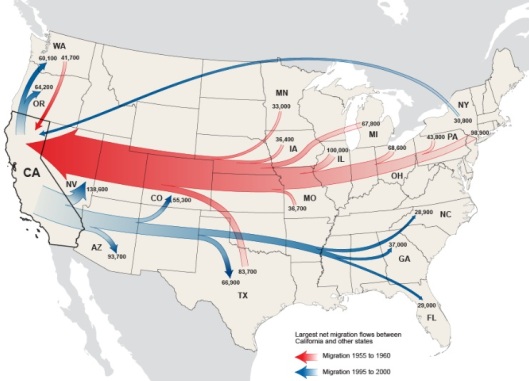
    Courtesy of the Census.

    Courtesy of the Census.

    How does this work exactly?

    Think of an act of migration as a lying down of fiber optics, with each trip thickening the network between two points in space. Often, cluster relationships begin forming. Take Los Angles and Pittsburgh. For years, the best talent would be poached at Carnegie Mellon. On the surface, this meant Pittsburgh would grow the talent and California, though an employer such as Disney Labs, would reap the rewards.

    Brain drain, right? Thus, spend money to herd the nerds, and make your talent inert for the sake of a Census count. Or, as Russell writes: “Pittsburgh is dying. Time to pony up the jingle and get Richard Florida to save the day.”

    Well, as Ernest George Ravenstein wrote in “The Laws of Migration, 1885”, “Each main current of migration produces a compensating counter-current”, and this is exactly what happened between Pittsburgh and Los Angeles. For instance, as the cost of attracting talent into “spiky locales” started becoming prohibitive, alternatives were sought. For Disney Labs, one was locating an R&D center near Carnegie Mellon, with the decision influenced by the networks formed through by Pittsburgh’s “brain drain”. Count Google and Apple as two others bellying up in the Rust Belt backwater. As is Schell Games, an educational gaming company with a founder born in Jersey, educated in Pittsburgh, and refined in Los Angeles. Located in the South Side neighborhood of Pittsburgh, the company totaled a quarter of a billion dollars in sales in 2011. A similar process is being played out in Cleveland between Case Western, University Hospitals, and Philips Technology in the field of medical imaging. These are just some of the  relational opportunities across the whole of the Rust Belt.

    Digging further, there is something else going on here, particularly as it relates to the Rust Belt’s legacy asset of growing talent. To wit, other regions, like Portland, attract talent, but their educational ecosystems are less developed. The Rust Belt educates. It mines talent. Exports talent. For instance, according to the Chronicle of Higher Education, the top 10 states for out-of-state freshman enrollment reside in the Midwest (Pennsylvania is 1, Ohio is 7).

    Why does this matter? Because much like the industrial epoch before it, the innovation economy—to buy a term from Economist Enrico Moretti—is converging; that is, it is becoming less “spiky” and looking for leverage. Thus, the “rise of the rest”. From the Harvard Business Review:

    It goes without saying that no matter how much talent a company might have, there are many more talented people working outside its boundaries. Yet all too many companies focus solely on acquiring talent, on bringing talent inside the firm. Why not access talent wherever it resides?

    The overall lesson here is this: Rust Belt cities need to get over lamenting the Chicken Little-like strategy that is plugging the brain drain. Let your people go. Let them grow. Concentrate on the network.  The trend of jobs constricting its supply line to talent is likely to grow. Welcome to the “talent economy”.

    “Cool” Exhaustion

    Venture capitalist Brad Feld recently said, “The cities that have the most movement in and out of them are the most vibrant”. The statement speaks to the reality that Pittsburgh et al. won’t shrink their way to growth, as in-migration is needed. On that score, there’s some indication of Rust Belt demographic inflows, indicating changes of a mesofact shift.

    For example, people are returning to Pittsburgh, with a positive net migration for the past five years. In fact, U-Haul’s latest annual survey marks Pittsburgh as the top growth city in the U.S. There’s some movement back to Cleveland as well. My past research for the Urban Institute showed a net inflow of 25- to 34-year olds in the city’s downtown, as well as its surrounding inner-core neighborhoods. Other Cleveland neighborhoods and inner-ring suburbs are seeing a net inflow of young adults as well. Also, migration patterns from 2005 to 2010 flowed net positive to Cleveland’s Cuyahoga County from the “spiky” counties of Chicago’s Cook County and Brooklyn’s King County.

    Will the trend grow? Here, it’s necessary to infer why it is occurring, so as to emphasize the inherent competitive advantages Rust Belt cities have to offer.

    Part of the psychogeographic attraction that Cleveland and Pittsburgh have is the fact they are not Portland, Brooklyn, or any other variety of venerable hot spots engaging in an  arms race of mod. Industrial cities maintain distinct cultures comprised of unique histories that are manifested by both elegant and unpolished bones. In short, the Rust Belt is real places, with real people. Wrote a New York City cyclist and author on his recent trip entitled “It’s Monday, I’m Back, And Cleveland!”:

    Portlanders ride around on bespoke bicycles wearing artisanal fanny packs and eating kimchi quesadillas out of food trucks.  Clevelanders watch “The Deer Hunter” and eat rabbit and tubular meats while basking in the warm glow of their leg lamps…

    …Cleveland has its own unique take on the whole “artisanal” phenomenon.  For example, in Brooklyn people open stores where they only sell olive oil or mayonnaise, or where some Oberlin graduate will give you an old-timey shave with a straight razor and a leather strop for $75.  In Cleveland, this guy sits outside his shop making bats.


    Courtesy of Bike Snob NYC

    Rust Belt cities, then, got their own thing going on, something at variance with the universal creative class typology said to attract “young and the restless”. To engage in copycatting would be a tragedy for Cleveland and Pittsburgh to adopt—like re-branding a flower by eroding its scent.

    Joi Ito, the head of MIT’s Media Lab, agrees, saying city making is not about heavy-handed creative class endeavors, but about backing off, letting things emerge. But again, this requires city self-awareness, which, according to Ito, “has to do with the character of the city, the character of the people, the character of the mayor”. In other words, the answers for a city are inside of it. Not inside the idea of outside programming.

    And by being self-aware, Cleveland and Pittsburgh could position themselves as places for the “cool exhausted”, or places about community, affordability, and family. Places that contain good single-family housing stock. Places with coffee shops, taverns, and backyards. Places not prone to the dichotomy of micro-apartments v. McMansions but rather rest in a middle-grounding sweet spot that is projected to be attractive to the next generation of homebuyers. Says a newcomer to Pittsburgh from Brooklyn:

    Moving to Lawrenceville was one of the smartest things we’ve done.  It’s a visually, historically, and socially stimulating neighborhood with a stronger sense of community than I’ve experienced anywhere else.

    No doubt,  in-migration of all types is needed—i.e., Pittsburgh’s and Cleveland’s foreign-born rates are at historic lows— but the low-hanging fruit is Rust Belt refugees, or “boomerangers”, many Global City graduates. Russell, who has been examining the phenomenon for years, sees this variant of return migration as a potential game-changer for historically declining Rust Belt cities, particularly because it represents a counter flow to the donut hole-patterning of urban decline. “This is happening, and it’s on a scale much larger than expected,” Russell says. “We are busy catching up to a trend. The Rust Belt Chic migration is a particular form of return migration: Rust Belt suburb-to Big City-to grandpa’s neighborhood”.

    Economically speaking, such migrants pack a wallop, as the act of migration is primarily an entrepreneurial act. Such is illustrated in a recent New York Times piece called “Replanting the Rust Belt”. In it, they profile Cleveland chef Jonathan Sawyer who moved back home from New York to raise his family. Yet he was also determined “to help the city transcend its Rust Belt reputation”. Once there, Sawyer “foraged for people”, eventually setting up a local food ecosystem that “connects mushroom farms, bean gardens, Italian bakeries, Amish dairies, noodle makers, butchers and the basement and backyard of his own house”.

    Migrants like Sawyer are economic change agents. Pittsburgh and Cleveland need to scale them up, and then do everything they can to eliminate barriers so they can forage properly.

    Bowling with Strangers

    As the middle class re-enters and gentrifies inner city Rust Belt neighborhoods, consequences will arise. Still, desperate city leaders are happy with any trade-offs, as is evidenced by Detroit’s economic development czar George Jackson recent declaration that: “I’m sorry, but, I mean, bring it on [gentrification]. We can’t just be a poor city and prosper.”

    Such conceptions are common in government, institutionalized even. Notes Neil Smith:

    Gentrification became a systematic attempt to remake the central city, to take it back from the working class, from minorities, from homeless people, from immigrants…What began as a seemingly quaint rediscovery of the drama and edginess of the new urban “frontier” became in the 1990s broad-based market driven policy.

    It is widely understood gentrification does little to eliminate the systemic problems facing not only the Rust Belt, but most communities: that of segregation and inequality. There needs to be a prioritizing of the underlying neighborhood dynamics that offer both hope and challenges for a path forward. To that end, given the rapidity of demographic and housing change in the industrial Midwest—i.e., it’s “brokenness”—consider the Rust Belt as good a living “lab” as any.

    For instance, certain demographic shifts in various Rust Belt cities are going against longstanding patterns, particularly the organic evolution of mixed neighborhoods. The integration is coming from several angles, which is largely due to the “benefits” of a depressed housing market. For instance, in Ohio City, one of Cleveland’s gentrifying neighborhoods, the percentage of black residents increased from 24% of the population to 34% from 1990 to 2010, whereas the percentage of whites declined 58% to 50%. Given that Ohio City is one of the areas seeing an inflow of 25- to 34-year old residents, there appears to be  a meet-up of lower-to-middle-income black families that have migrated from the East Side of Cleveland with younger suburban and exurban whites. The same demographic patterns are occurring in other Cleveland neighborhoods such as Edgewater, Old Brooklyn, and Kamm’s Corners, as well numerous suburbs, suggesting a “shake-up” of social capital paradigms that have kept Cleveland not only geographically segregated, but psycho-sociologically segregated.

    “Social capital”, you say?

    Yes. Most often social capital is talked about in good terms only, a la Putnam’s seminal book Bowling Alone But as illustrated in the paper “Why the Garden Club Couldn’t Save Youngstown”, too much social capital kills. For example, too much trust in others like you can parallel not enough trust in others unlike you, leading  to immobility, insularity, and stagnation of ideas.  What is needed in Cleveland and Pittsburgh is less social capital, or more movement, more outsiders, and more crossing of such psychogeographic divides as the Cuyahoga River, which has served to divide the  city of Cleveland between the East and West Sides. These “shake-ups” that are occurring fosters the heterogeneity necessary to reverse Cleveland’s declining, patriarchal course.


    “My Hometown”. Courtesy of Plain Dealer

    But simple diversification of neighborhoods won’t do the trick. For instance, a white teen may go to a diverse high school but it doesn’t mean she will have black friends. This filtering along entrenched historical fault lines happens in neighborhoods as well. The scene in D.C.:

    Both groups [whites and blacks] feel entitled and resent the other’s sense of entitlement. Over time the neighborhood’s revitalization engineers a rigid caste system eerily reminiscent of pre-1965 America. You see it in bars, churches, restaurants and bookstores. You see it in the buildings people live in and where people do their shopping. In fact, other than public space, little is shared in the neighborhood. Not resources. Not opportunities. Not the kind of social capital that is vital for social mobility. Not even words.

    What is partly occurring here relates to a controversial finding of Putnam’s, or that diversity can decrease social capital—perhaps too much. “People living in ethnically diverse settings appear to ‘hunker down’”, writes Putnam, or “to pull in like a turtle”.

    Why?

    Part of the reason is that neighborhood diversity can equate to living “by” each other and not “with” each other. As such, neighborhood integration is still raw in the American zeitgeist, with heterogeneity, according to Putnam, engendering mistrust and too little social capital. A next step is needed. Here, community leaders should heed lessons from the concept of creative destruction. From the article “The Downside of Diversity”:

    If…diversity, at least in the short run, is a liability for social connectedness, a parallel line of emerging research suggests it can be a big asset when it comes to driving productivity and innovation…

    … In other words, those in more diverse communities may do more bowling alone, but the creative tensions unleashed by those differences in the workplace may vault those same places to the cutting edge of the economy and of creative culture.

    This, then, represents a key opportunity for Cleveland and Pittsburgh to reconstitute a new American neighborhood model by harnessing the potential inherent in its integrating neighborhoods. This opportunity is perhaps greater in Rust Belt communities given—as of yet—the absence of housing market pressure that tends to filter people along similar demographic lines. The mission is simple: how can cities foster mobility without a complete sacrifice of trust? This entails thinking about social capital in a new way: neither a presence nor absence of it, but a continuum of social capital with insularity based on comfortability on one end, and insularity based on mistrust on the other. The sweet spot of social capital is somewhere in the middle, which entails not bowling with your buddies or bowling alone, but bowling with strangers—until they no longer aren’t.

    Why is this so important?

    Where people live informs them no less than where they go to school. Neighborhoods are factories of human capital. America needs to go past the gentrification model of revitalization. The cities that still have a fighting chance, like in the Rust Belt, should lead.

    Richey Piiparinen is a writer and policy researcher based in Cleveland. He is co-editor of Rust Belt Chic: The Cleveland Anthology. Read more from him at his blog and at Rust Belt Chic.

    Lead photo courtesy of Spicy Biscotti.

  • Poverty and Growth: Retro-Urbanists Cling to the Myth of Suburban Decline

    In the wake of the post-2008 housing bust, suburbia has become associated with many of the same ills long associated with cities, as our urban-based press corps and cultural elite cheerfully sneer at each new sign of decline. This conceit was revealed most recently in a a studyreleased Monday by the Brookings Institution–which has become something of a Vatican for anti-suburban theology–trumpeting the news that there are now 1 million more poor people in America’s suburbs than in its cities.

    America’s suburbs, noted one British journalist, are becoming “ghost towns” as middle-class former suburbanites migrate to the central core. That’s simply untrue: both the 2010 Census and other more recent analyses demonstrate that America is becoming steadily more suburban: 44 million Americans live in America’s 51 major metropolitan areas, while nearly 122 million Americans live in their suburbs. In other words, nearly three quarters of metropolitan Americans live in suburbs, not core cities.

    The main reason there are now more poor people in the suburbs is that there are now many more people in the suburbs, which have represented almost all of America’s net population growth in recent years. Despite trite talk about “suburban ghettos,” suburbs have a poverty rate roughly half that of urban centers (20.9 percent in core compared to 11.4 percent in the suburbs as of 2010).

    To be sure, poverty in suburbs, or anywhere else, must be addressed. But not long ago, suburbs were widely criticized for being homogeneous; now they are mocked for having many of the problems associated with being “inclusive.”

    Many poor suburbs are developing because minorities and working-class populations are moving to suburbs. Yet even accounting for these shifts, cities continue to contain pockets of wealth and gentrification that give way to swathes of poverty. In Brooklyn, it’s a short walk east from designer shoe stores and locavore eateries to vast stretches of slumscape. The sad fact is that in American cities, poor people—not hipsters or yuppies—constitute the fastest-growing population. In the core cities of the 51 metropolitan areas, 81 percent of the population increase over the past decade was under the poverty line, compared to 32 percent of the suburban population increase.

    In Chicago, oft cited as an exemplar of “the great inversion” of affluence from suburbs to cities, the city poverty rate stands at 22.5 percent, compared to 10 percent in the suburbs. In New York, roughly 20 percent of the city population lives in poverty, compared to only 9 percent in the suburbs.

    Looking at it from a national perspective, most of the major metropolitan counties with the highest rates of poverty are all urban core, starting with the Bronx, with 30 percent of people living under the poverty line, followed by Orleans Parish (New Orleans), Philadelphia, St. Louis, and Richmond, Va. In contrast all 10 large counties with the lowest poverty rates are all suburban.

    This divergence has an impact on other measurements of social health. Despite substantial improvement in crime rates in “core cities” over the past two decades, suburban areas generally have substantially lower crime rates, according to Brookings Institution’s own research. Yet at the same time suburban burgs dominate the list of safest cities over 100,000 led by Irvine and Temecula, Calif., followed by Cary, N.C. Overall suburban crime remains far lower than that in core cities.

    A review of 2011 crime data, as reported by the FBI, indicates that the violent-crime rate in the core cities of major metropolitan areas was approximately 3.4 times that of the suburbs. (The data covers 47 of the 51 metropolitan areas with more than 1 million population, with data not being available for Chicago, Las Vegas, Minneapolis-St. Paul, and Providence.)

    In the least suburbanized core cities, that is places that have annexed little or no territory since before World War II (New York, Philadelphia, Washington, etc.) the violent crime rate was 4.3 times the suburban rate. Among the 24 metropolitan areas that had strong central cities at the beginning of World War II but which have significant amounts of postwar suburban territory (Portland, Seattle, Milwaukee, Los Angeles, etc.), the violent crime rate is 3.1 times the suburban rate. Among the metropolitan areas that did not have strong pre–World War II core cities (San Jose, Austin, Phoenix, etc.), the violent crime rate was 2.2 times the suburban rate. Basically, the more suburban the metropolis, the lower the crime rate.  
    Rather than castigating suburbs for exaggerated dysfunction, retro-urbanists would be much better served focusing on how to correct and confront the issue of poverty, which continues to concentrate heavily in the urban core and elsewhere in America.

    Joel Kotkin is executive editor of NewGeography.com and a distinguished presidential fellow in urban futures at Chapman University, and a member of the editorial board of the Orange County Register. He is author of The City: A Global History and The Next Hundred Million: America in 2050. His most recent study, The Rise of Postfamilialism, has been widely discussed and distributed internationally. He lives in Los Angeles, CA.

    Wendell Cox is a Visiting Professor, Conservatoire National des Arts et Metiers, Paris and the author of “War on the Dream: How Anti-Sprawl Policy Threatens the Quality of Life.

    This piece originally appeared in the The Daily Beast.

    Suburban neighborhood photo by Bigstock.

  • Rust Belt: Can Micro-Suburbs Stay Independent?

    The Ohio suburb of East Cleveland abuts the core city to its west and north, and in terms of physical appearance the boundary between the two is indistinct. A century ago, the City of Cleveland unsuccessfully attempted to annex East Cleveland on two occasions. These days, Cleveland is unlikely to perceive its eastern neighbor as much of a catch. East Cleveland fell on hard times during the deindustrialization that took place throughout the Cuyahoga Valley: since 1970, it has lost more than half of its population. Nearly 40% of the 2010 population falls below the poverty level.

    East Cleveland’s residents and depressed real estate do not contribute a tax base by which the city can provide fundamental services. In this way, it’s no different than numerous exceedingly small towns and micro suburbs scattered nationwide. Can it — and other places like it — survive? And, if so, how?

    East Cleveland’s ‘solution’ is to shift the burden to motorists by tackling them with hefty speeding tickets. The 2.5-mile stretch of Euclid Avenue that passes through town is one of the city’s few revenue-raisers; a sidewalk sign promises camera monitoring and $90 speeding tickets.

    East Cleveland is a “Community of Strict Enforcement” that may not have high road fatalities, but the city’s socioeconomics give it few other options to generate the revenue it needs. The placard on the sidewalk (seen above) undoubtedly owes its existence to the debacle that a few years back brought about the demise of another Ohio town, New Rome.

    New Rome, outside Columbus, was a tiny village of only about nine city blocks (approximately twelve acres) that, even at its peak, no more than 150 people called home; the 2000 Census estimated its population at 60. It would probably have gone completely ignored if it weren’t for a four-block stretch of U.S. 40 (West Broad Street in Columbus) that fell within the town’s corporate limits. Within New Rome’s 1000-foot segment of highway, the speed limit dropped from 45 mph to 35. The New Rome Police Department had every right to issue $90 citations to motorists going 42 mph within this speed trap — and it did. The village of a dozen ramshackle houses, three apartment buildings, and a handful of small businesses earned nearly all its revenue from traffic tickets. With no other real public agencies, the money paid for the police force (which at times had as many as 14 employees, one quarter of the then-population) and the village council.

    A few neighbors eventually grew so frustrated that they launched the website New Rome Sucks. And after a series of corruption revelations, the town attracted the attention of the Franklin County Prosecutor and Ohio Attorney General Jim Petro, who determined that, after decades of incompetent management, New Rome should be abolished. Eventually, Petro convinced the Ohio General Assembly to pass a law allowing the state to seek dissolution of a village under 150 people if the State Auditor found that it provided few public services and demonstrated a pattern of wrongdoing. In 2004, the Village of New Rome was irrevocably absorbed into Prairie Township of Franklin County, Ohio.

    In most municipalities, good governance is a selling point. However, New Rome’s malfeasance was unequivocally a reflection of the will of its constituents. They got the racket that a majority of them apparently wanted. And eventually the village forfeited its very existence.

    While a New Rome could realistically emerge anywhere in the country, it is worth questioning whether the municipal incorporation structure in Ohio — and other states — particularly abets the process. Tiny municipalities exist everywhere. But they seem particularly prevalent in the industrial heartland. Cleveland’s Cuyahoga County has 57 incorporated municipalities; Columbus’ Franklin County has 25; Cincinnati’s Hamilton County has 38. Most states to Ohio’s northeast are almost completely incorporated: William Penn mandated this characteristic in his original charter for Pennsylvania. New Jersey is 99% incorporated. It is not uncommon to find boroughs as small as New Rome in both of these states; the Philadelphia suburb of Millbourne, for example, measures only .07 square miles.

    Conversely, southern states are more likely to opt for either expanses of unincorporated urbanized land (which characterizes the vast New Orleans suburb of Metairie) or mega-municipalities, such as the “town” of Gilbert outside Phoenix, with a population over 200,000.

    The majority of shrinking cities — and towns, villages, boroughs, and townships — now are clustered in the Northeast and the Midwest. “Home Rule” provisions in the Ohio state constitution, and similar legislation elsewhere in these regions, coupled with a small population, allow for a disproportionate amount of self-actualization… for better or worse. Cleveland’s most prosperous micro-suburbs have wielded it effectively to stem the erosion of their tax base.

    Does this broad-brush distinction between North and South yield any conclusions? At the very least, Rust Belt states must carefully weigh the benefits of entitling tiny populations to remain as independent towns. Otherwise, the only way many communities in a metropolitan mosaic will ever paint themselves out of the red is through surreptitious speed traps.

    Eric McAfee is an itinerant urban planner/emergency manager who fuses his cross county (and trans-national) travels and love of contemporary landscapes into his blog, American Dirt, where a different version of this article appeared.

    Photo in East Cleveland by the author.

  • Large Cities Manufacturing Jobs – 2013 Best Cities Rankings

    The methodology for the 2013 rankings for best cities for manufacturing jobs parallels that used for our 2013 Best Cities for Job Growth rankings.  Instead of using Total Nonfarm Employment, the manufacturing rankings use employment in manufacturing (supersector 30) in the BLS MSA employment data.  The manufacturing rankings include the 357 MSAs for which there are sectoral employment data for all 12 years used in our analysis. 

    2013  Mfg Rank – Large MSAs Area 2013 Weighted MFG INDEX 2012 MFG Employment (1000s) 2012  Mfg Rank – Large MSAs 2013 Mfg Rank Change from 2012
    1 Houston-Sugar Land-Baytown, TX 87.1         248.3 4 3
    2 Louisville-Jefferson County, KY-IN 82.2           72.5 47 45
    3 Seattle-Bellevue-Everett, WA Metropolitan Division 80.4         169.9 1 (2)
    4 Oklahoma City, OK 79.1           35.6 2 (2)
    5 Warren-Troy-Farmington Hills, MI Metropolitan Division 77.2         143.3 5 0
    6 Nashville-Davidson–Murfreesboro–Franklin, TN 75.7           70.4 48 42
    7 Virginia Beach-Norfolk-Newport News, VA-NC 75.4           55.1 33 26
    8 Detroit-Livonia-Dearborn, MI Metropolitan Division 71.0           80.4 24 16
    9 Fort Worth-Arlington, TX Metropolitan Division 70.1           92.8 9 0
    10 Salt Lake City, UT 67.8           55.7 3 (7)
    11 San Antonio-New Braunfels, TX 64.9           47.0 7 (4)
    12 Birmingham-Hoover, AL 64.5           37.5 46 34
    13 Charlotte-Gastonia-Rock Hill, NC-SC 64.3           71.0 22 9
    14 Milwaukee-Waukesha-West Allis, WI 59.5         119.5 10 (4)
    15 Minneapolis-St. Paul-Bloomington, MN-WI 59.2         181.5 15 0
    16 Austin-Round Rock-San Marcos, TX 59.2           51.1 8 (8)
    17 Fort Lauderdale-Pompano Beach-Deerfield Beach, FL Metropolitan Division 58.0           26.7 16 (1)
    18 San Jose-Sunnyvale-Santa Clara, CA 57.7         156.5 11 (7)
    19 Omaha-Council Bluffs, NE-IA 57.4           31.6 14 (5)
    20 Santa Ana-Anaheim-Irvine, CA Metropolitan Division 56.9         158.0 20 0
    21 Phoenix-Mesa-Glendale, AZ 56.6         117.8 43 22
    22 Denver-Aurora-Broomfield, CO 56.3           63.4 34 12
    23 Indianapolis-Carmel, IN 55.3           83.7 50 27
    24 Portland-Vancouver-Hillsboro, OR-WA 54.8         114.7 19 (5)
    25 Cincinnati-Middletown, OH-KY-IN 54.7         106.0 6 (19)
    26 Pittsburgh, PA 54.1           89.3 28 2
    27 Cleveland-Elyria-Mentor, OH 53.9         122.4 18 (9)
    28 Columbus, OH 53.0           65.6 21 (7)
    29 Sacramento–Arden-Arcade–Roseville, CA 52.6           34.1 57 28
    30 San Diego-Carlsbad-San Marcos, CA 52.5           93.1 29 (1)
    31 Honolulu, HI 52.4           10.8 36 5
    32 Atlanta-Sandy Springs-Marietta, GA 51.6         148.8 25 (7)
    33 Raleigh-Cary, NC 51.2           27.2 45 12
    34 Chicago-Joliet-Naperville, IL Metropolitan Division 50.9         324.7 26 (8)
    35 Nassau-Suffolk, NY Metropolitan Division 49.3           73.4 35 0
    36 Buffalo-Niagara Falls, NY 49.0           50.9 12 (24)
    37 Jacksonville, FL 47.6           28.0 53 16
    38 Boston-Cambridge-Quincy, MA NECTA Division 47.2           91.5 23 (15)
    39 Hartford-West Hartford-East Hartford, CT NECTA 46.7           56.8 27 (12)
    40 Bergen-Hudson-Passaic, NJ 46.5           60.2 17 (23)
    41 San Francisco-San Mateo-Redwood City, CA Metropolitan Division 44.9           36.2 37 (4)
    42 Oakland-Fremont-Hayward, CA Metropolitan Division 43.5           79.9 44 2
    43 St. Louis, MO-IL 42.0         109.0 31 (12)
    44 Providence-Fall River-Warwick, RI-MA NECTA 41.6           50.8 36 (8)
    45 Dallas-Plano-Irving, TX Metropolitan Division 40.9         164.2 30 (15)
    46 Los Angeles-Long Beach-Glendale, CA Metropolitan Division 40.8         362.7 49 3
    47 Memphis, TN-MS-AR 40.2           43.7 42 (5)
    48 Las Vegas-Paradise, NV 39.0           20.2 51 3
    49 Orlando-Kissimmee-Sanford, FL 38.7           37.7 40 (9)
    50 Philadelphia City, PA 38.6           23.1 55 5
    51 West Palm Beach-Boca Raton-Boynton Beach, FL Metropolitan Division 37.1           15.2 56 5
    52 New York City, NY 35.7           75.2 58 6
    53 Edison-New Brunswick, NJ Metropolitan Division 34.0           58.4 64 11
    54 Richmond, VA 33.9           31.9 65 11
    55 Tampa-St. Petersburg-Clearwater, FL 33.3           58.9 41 (14)
    56 Rochester, NY 32.9           57.9 32 (24)
    57 New Orleans-Metairie-Kenner, LA 32.1           29.8 38 (19)
    58 Northern Virginia, VA 30.7           21.9 39 (19)
    59 Bethesda-Rockville-Frederick, MD Metropolitan Division 30.5           15.8 54 (5)
    60 Kansas City, MO 29.6           37.8 13 (47)
    61 Putnam-Rockland-Westchester, NY 27.7           24.5 63 2
    62 Newark-Union, NJ-PA Metropolitan Division 27.5           63.4 52 (10)
    63 Miami-Miami Beach-Kendall, FL Metropolitan Division 26.8           35.0 59 (4)
    64 Riverside-San Bernardino-Ontario, CA 25.5           86.4 62 (2)
    65 Washington-Arlington-Alexandria, DC-VA-MD-WV Metropolitan Division 24.6           32.0 61 (4)
    66 Camden, NJ Metropolitan Division 21.9           35.3 60 (6)
  • Midsized Cites Manufacturing Jobs – 2013 Best Cities Rankings

    The methodology for the 2013 rankings for best cities for manufacturing jobs parallels that used for our 2013 Best Cities for Job Growth rankings.  Instead of using Total Nonfarm Employment, the manufacturing rankings use employment in manufacturing (supersector 30) in the BLS MSA employment data.  The manufacturing rankings include the 357 MSAs for which there are sectoral employment data for all 12 years used in our analysis. 

    Note: This page was updated June 6, 2013 to correct errors in the “2012 Mfg Employment” column.

    2013 Mfg Rank – Midsized MSAs Area 2013 Weighted INDEX 2012 Mfg Employment (000s) 2012  Mfg Rank – Midsized MSAs Mfg Size Ranking Change 2012-2013
    1 Mobile, AL 92.3            18.5 4 3
    2 Savannah, GA 86.2            15.6 24 22
    3 Lafayette, LA 82.3            11.3 1 (2)
    4 Albany-Schenectady-Troy, NY 82.1            23.1 15 11
    5 Tulsa, OK 80.1            50.4 5 0
    6 Anchorage, AK 79.2              2.2 57 51
    7 Charleston-North Charleston-Summerville, SC 78.5            23.7 2 (5)
    8 Ogden-Clearfield, UT 77.1            23.1 8 0
    9 Baton Rouge, LA 75.6            27.1 30 21
    10 Roanoke, VA 73.0            17.2 20 10
    11 Grand Rapids-Wyoming, MI 72.8            66.0 10 (1)
    12 Des Moines-West Des Moines, IA 71.8            19.5 14 2
    13 Bakersfield-Delano, CA 71.0            13.5 3 (10)
    14 Beaumont-Port Arthur, TX 69.4            21.7 6 (8)
    15 Davenport-Moline-Rock Island, IA-IL 68.9            24.6 25 10
    16 Toledo, OH 68.5            41.7 39 23
    17 Boulder, CO 68.2            16.6 24 7
    18 Gary, IN Metropolitan Division 68.0            36.3 26 8
    19 Reading, PA 66.5            29.8 28 9
    20 Allentown-Bethlehem-Easton, PA-NJ 65.1            36.8 41 21
    21 El Paso, TX 63.3            17.9 32 11
    22 Lincoln, NE 63.2            13.4 35 13
    23 Greenville-Mauldin-Easley, SC 63.0            38.7 11 (12)
    24 Framingham, MA  NECTA Division 62.7            24.8 7 (17)
    25 Montgomery, AL 62.0            18.0 74 49
    26 Green Bay, WI 61.8            28.4 27 1
    27 Santa Barbara-Santa Maria-Goleta, CA 61.8            12.0 38 11
    28 Trenton-Ewing, NJ 61.4              8.7 40 12
    29 Chattanooga, TN-GA 60.3            30.8 18 (11)
    30 Knoxville, TN 59.5            32.2 22 (8)
    31 Columbia, SC 58.0            28.1 9 (22)
    32 Lakeland-Winter Haven, FL 57.7            14.7 81 49
    33 Asheville, NC 57.5            18.5 29 (4)
    34 Akron, OH 57.1            40.2 19 (15)
    35 Fort Wayne, IN 56.4            33.3 45 10
    36 Corpus Christi, TX 56.0              9.8 36 0
    37 Canton-Massillon, OH 55.8            26.4 13 (24)
    38 Evansville, IN-KY 55.7            28.2 70 32
    39 Provo-Orem, UT 55.0            17.3 16 (23)
    40 Lake County-Kenosha County, IL-WI Metr Div 54.3            55.0 34 (6)
    41 Deltona-Daytona Beach-Ormond Beach, FL 52.6              8.5 56 15
    42 Lansing-East Lansing, MI 52.3            18.1 21 (21)
    43 Kansas City, KS 51.6            33.8 17 (26)
    44 Peoria, IL 50.3            28.0 12 (32)
    45 Santa Rosa-Petaluma, CA 49.9            19.4 33 (12)
    46 Lancaster, PA 49.6            36.1 66 20
    47 Youngstown-Warren-Boardman, OH-PA 47.8            30.5 42 (5)
    48 Greensboro-High Point, NC 47.0            52.1 31 (17)
    49 North Port-Bradenton-Sarasota, FL 46.6            14.2 64 15
    50 Harrisburg-Carlisle, PA 46.4            20.2 54 4
    51 Wilmington, DE-MD-NJ Metropolitan Division 46.0            18.8 61 10
    52 Dayton, OH 46.0            41.0 46 (6)
    53 Augusta-Richmond County, GA-SC 45.9            19.8 72 19
    54 Springfield, MA-CT NECTA 45.0            31.2 58 4
    55 McAllen-Edinburg-Mission, TX 44.9              6.3 82 27
    56 Tucson, AZ 42.7            23.2 52 (4)
    57 Lexington-Fayette, KY 42.6            29.3 78 21
    58 Wichita, KS 42.5            53.4 73 15
    59 Poughkeepsie-Newburgh-Middletown, NY 42.1            18.0 76 17
    60 Portland-South Portland-Biddeford, ME NECTA 42.1            12.7 53 (7)
    61 Palm Bay-Melbourne-Titusville, FL 41.3            20.8 71 10
    62 Springfield, MO 40.7            13.9 50 (12)
    63 Scranton–Wilkes-Barre, PA 39.9            27.0 69 6
    64 York-Hanover, PA 39.4            31.5 55 (9)
    65 Jackson, MS 39.3            16.5 75 10
    66 Little Rock-North Little Rock-Conway, AR 39.1            19.9 86 20
    67 Reno-Sparks, NV 38.4            11.5 87 20
    68 Ann Arbor, MI 37.2            14.1 62 (6)
    69 Colorado Springs, CO 36.6            12.7 60 (9)
    70 New Haven, CT NECTA 36.5            25.6 67 (3)
    71 Bridgeport-Stamford-Norwalk, CT NECTA 35.4            33.6 47 (24)
    72 Pensacola-Ferry Pass-Brent, FL 35.0              5.6 83 11
    73 Boise City-Nampa, ID 34.9            23.9 63 (10)
    74 Fayetteville-Springdale-Rogers, AR-MO 34.9            26.9 80 6
    75 Madison, WI 34.7            28.2 65 (10)
    76 Spokane, WA 34.2            15.1 23 (53)
    77 Tacoma, WA Metropolitan Division 33.7            16.8 43 (34)
    78 Cape Coral-Fort Myers, FL 32.9              4.5 51 (27)
    79 Winston-Salem, NC 31.5            19.6 85 6
    80 Baltimore City, MD 31.4            12.3 77 (3)
    81 Worcester, MA-CT NECTA 30.7            23.8 37 (44)
    82 Fresno, CA 26.2            22.4 44 (38)
    83 Syracuse, NY 25.1            24.6 68 (15)
    84 Durham-Chapel Hill, NC 23.0            33.5 79 (5)
    85 Albuquerque, NM 20.4            17.3 59 (26)
    86 Stockton, CA 19.2            17.1 48 (38)
    87 Calvert-Charles-Prince George’s, MD 17.8              8.5 88 1
    88 Tallahassee, FL 17.4              3.3 90 2
    89 Oxnard-Thousand Oaks-Ventura, CA 14.1            29.5 84 (5)
    90 Huntsville, AL 11.2            22.1 91 1
    91 Shreveport-Bossier City, LA 1.3              8.8 89 (2)
  • Small Cities Manufacturing Jobs – 2013 Best Cities Rankings

    The methodology for the 2013 rankings for best cities for manufacturing jobs parallels that used for our 2013 Best Cities for Job Growth rankings.  Instead of using Total Nonfarm Employment, the manufacturing rankings use employment in manufacturing (supersector 30) in the BLS MSA employment data.  The manufacturing rankings include the 357 MSAs for which there are sectoral employment data for all 12 years used in our analysis. 

    2013  Mfg Rank – Small MSAs Area 2013 Weighted INDEX 2012 Manufacturing Employment (000s) 2012 Mfg Size Category Ranking Overall Ranking Change Within Category
    1 Columbus, IN 96.1                18.5 3 2
    2 Kennewick-Pasco-Richland, WA 94.8                   7.3 44 42
    3 Florence-Muscle Shoals, AL 94.6                   8.8 11 8
    4 Odessa, TX 94.5                   5.7 1 (3)
    5 Greenville, NC 89.8                   7.7 52 47
    6 Flagstaff, AZ 87.8                   4.3 19 13
    7 Midland, TX 87.7                   3.5 5 (2)
    8 Napa, CA 86.1                11.7 63 55
    9 Muskegon-Norton Shores, MI 85.9                12.7 72 63
    10 Elizabethtown, KY 84.8                   6.1 81 71
    11 Wenatchee-East Wenatchee, WA 84.5                   2.4 4 (7)
    12 Panama City-Lynn Haven-Panama City Beach, FL 84.4                   3.5 161 149
    13 Punta Gorda, FL 84.1                   0.8 73 60
    14 Springfield, OH 83.8                   7.2 60 46
    15 Waterloo-Cedar Falls, IA 83.3                17.8 13 (2)
    16 Rockford, IL 82.8                32.4 20 4
    17 Lafayette, IN 82.3                16.6 15 (2)
    18 Visalia-Porterville, CA 82.3                12.0 121 103
    19 College Station-Bryan, TX 82.2                   5.6 77 58
    20 Fond du Lac, WI 81.8                10.3 29 9
    21 Madera-Chowchilla, CA 81.7                   3.5 56 35
    22 Fargo, ND-MN 81.3                10.1 10 (12)
    23 Holland-Grand Haven, MI 81.2                33.3 12 (11)
    24 Racine, WI 81.2                18.8 31 7
    25 Idaho Falls, ID 80.9                   3.4 82 57
    26 Bremerton-Silverdale, WA 80.7                   2.0 80 54
    27 Sioux Falls, SD 78.3                13.2 95 68
    28 San Angelo, TX 77.5                   3.9 21 (7)
    29 San Luis Obispo-Paso Robles, CA 77.0                   6.3 106 77
    30 El Centro, CA 76.7                   2.7 115 85
    31 Jackson, MI 76.7                   8.8 28 (3)
    32 Erie, PA 76.0                22.7 24 (8)
    33 Cleveland, TN 75.6                   8.6 65 32
    34 Bellingham, WA 74.8                   8.9 27 (7)
    35 Spartanburg, SC 74.0                25.7 98 63
    36 Kankakee-Bradley, IL 73.0                   5.3 16 (20)
    37 Battle Creek, MI 72.5                11.3 99 62
    38 Appleton, WI 72.4                22.7 25 (13)
    39 Bloomington, IN 72.4                   9.3 40 1
    40 Fort Collins-Loveland, CO 71.9                11.5 32 (8)
    41 Portsmouth, NH-ME NECTA 71.7                   3.5 158 117
    42 Saginaw-Saginaw Township North, MI 71.7                11.4 18 (24)
    43 Victoria, TX 70.9                   6.0 34 (9)
    44 Bay City, MI 70.2                   4.1 157 113
    45 Vallejo-Fairfield, CA 70.1                10.0 108 63
    46 Haverhill-North Andover-Amesbury, MA-NH  NECTA Division 69.8                10.3 112 66
    47 Sandusky, OH 69.2                   5.8 23 (24)
    48 Eau Claire, WI 68.5                10.7 49 1
    49 Muncie, IN 68.3                   4.2 104 55
    50 Coeur d’Alene, ID 68.3                   4.5 30 (20)
    51 Morgantown, WV 68.0                   4.1 14 (37)
    52 Mount Vernon-Anacortes, WA 67.6                   5.2 70 18
    53 Merced, CA 67.3                   8.3 119 66
    54 Greeley, CO 67.1                11.3 7 (47)
    55 Waco, TX 66.8                14.6 67 12
    56 Logan, UT-ID 66.4                11.1 61 5
    57 Casper, WY 66.1                   1.9 6 (51)
    58 Anderson, IN 65.5                   3.8 125 67
    59 Lubbock, TX 65.1                   5.0 51 (8)
    60 Danville, VA 63.9                   7.0 26 (34)
    61 Elkhart-Goshen, IN 63.8                50.5 78 17
    62 Rapid City, SD 63.7                   2.7 128 66
    63 Santa Cruz-Watsonville, CA 63.5                   5.6 132 69
    64 Altoona, PA 63.2                   7.5 64 0
    65 Dover, DE 62.4                   3.4 114 49
    66 Anderson, SC 62.3                12.1 37 (29)
    67 Hattiesburg, MS 62.2                   4.4 191 124
    68 Yuba City, CA 62.2                   2.1 38 (30)
    69 Terre Haute, IN 62.2                11.6 59 (10)
    70 Flint, MI 62.0                11.9 110 40
    71 Ithaca, NY 62.0                   3.3 118 47
    72 Burlington-South Burlington, VT NECTA 61.1                14.2 88 16
    73 Bowling Green, KY 60.4                   8.6 68 (5)
    74 Lake Charles, LA 59.7                   8.7 69 (5)
    75 Monroe, MI 59.5                   5.2 126 51
    76 Sioux City, IA-NE-SD 58.8                12.2 124 48
    77 Medford, OR 58.5                   6.7 111 34
    78 Bloomington-Normal, IL 58.3                   4.4 165 87
    79 Fayetteville, NC 58.1                   9.2 103 24
    80 Kingsport-Bristol-Bristol, TN-VA 57.4                22.0 45 (35)
    81 Amarillo, TX 57.3                13.2 48 (33)
    82 Barnstable Town, MA NECTA 56.9                   2.9 8 (74)
    83 Tuscaloosa, AL 56.7                13.2 130 47
    84 Topeka, KS 56.5                   7.2 2 (82)
    85 Naples-Marco Island, FL 56.3                   2.7 152 67
    86 Lowell-Billerica-Chelmsford, MA-NH  NECTA Division 55.9                17.4 86 0
    87 Brownsville-Harlingen, TX 54.9                   5.8 148 61
    88 Gadsden, AL 54.3                   5.0 50 (38)
    89 Danville, IL 54.1                   5.3 92 3
    90 Port St. Lucie, FL 53.8                   5.2 151 61
    91 St. George, UT 53.7                   2.5 83 (8)
    92 Longview, WA 53.4                   6.1 123 31
    93 Prescott, AZ 53.3                   2.9 55 (38)
    94 Pittsfield, MA NECTA 53.0                   3.3 144 50
    95 Grand Forks, ND-MN 53.0                   3.7 194 99
    96 Kalamazoo-Portage, MI 52.8                18.8 183 87
    97 Lewiston, ID-WA 52.8                   3.1 75 (22)
    98 Lawton, OK 52.6                   3.5 62 (36)
    99 Redding, CA 52.5                   2.3 164 65
    100 Vineland-Millville-Bridgeton, NJ 52.4                   8.2 131 31
    101 State College, PA 51.8                   4.1 36 (65)
    102 Yuma, AZ 51.6                   2.1 177 75
    103 Niles-Benton Harbor, MI 51.0                12.0 127 24
    104 Owensboro, KY 51.0                   8.2 100 (4)
    105 Monroe, LA 50.8                   6.8 172 67
    106 Mansfield, OH 50.7                   9.5 180 74
    107 Yakima, WA 50.7                   7.8 58 (49)
    108 Grand Junction, CO 50.7                   2.7 84 (24)
    109 Charleston, WV 50.2                   5.4 120 11
    110 Glens Falls, NY 49.9                   6.2 87 (23)
    111 Santa Fe, NM 49.6                   0.8 196 85
    112 Sherman-Denison, TX 49.4                   5.3 85 (27)
    113 Huntington-Ashland, WV-KY-OH 49.3                   9.0 101 (12)
    114 Burlington, NC 48.1                   8.9 146 32
    115 Pueblo, CO 46.8                   4.1 22 (93)
    116 Lebanon, PA 45.8                   8.9 76 (40)
    117 Michigan City-La Porte, IN 45.7                   7.9 71 (46)
    118 Kokomo, IN 45.5                10.1 141 23
    119 Utica-Rome, NY 45.3                10.9 139 20
    120 Lima, OH 44.2                   7.5 109 (11)
    121 Champaign-Urbana, IL 44.1                   8.1 163 42
    122 Springfield, IL 43.7                   3.0 74 (48)
    123 St. Cloud, MN 43.7                15.0 94 (29)
    124 Duluth, MN-WI 43.7                   7.2 17 (107)
    125 Bangor, ME NECTA 43.5                   2.6 116 (9)
    126 Jackson, TN 43.4                   8.7 171 45
    127 South Bend-Mishawaka, IN-MI 43.2                17.0 53 (74)
    128 Norwich-New London, CT-RI NECTA 42.7                14.1 147 19
    129 Rochester, MN 42.7                10.1 89 (40)
    130 Cedar Rapids, IA 42.1                20.4 39 (91)
    131 Lynchburg, VA 41.6                14.5 142 11
    132 Rochester-Dover, NH-ME NECTA 41.5                   5.7 102 (30)
    133 Olympia, WA 41.2                   3.1 41 (92)
    134 Peabody, MA  NECTA Division 41.0                10.1 90 (44)
    135 Carson City, NV 40.1                   2.6 149 14
    136 Anniston-Oxford, AL 40.1                   5.8 153 17
    137 Decatur, AL 39.9                11.8 47 (90)
    138 Janesville, WI 39.8                   8.8 159 21
    139 Joplin, MO 39.7                12.8 170 31
    140 Killeen-Temple-Fort Hood, TX 39.6                   7.1 137 (3)
    141 Waterbury, CT NECTA 39.3                   7.6 117 (24)
    142 Hanford-Corcoran, CA 39.2                   3.7 9 (133)
    143 Las Cruces, NM 39.1                   2.9 136 (7)
    144 Hickory-Lenoir-Morganton, NC 38.4                37.1 150 6
    145 Lake Havasu City-Kingman, AZ 38.2                   2.8 173 28
    146 Wilmington, NC 37.9                   7.3 168 22
    147 Auburn-Opelika, AL 37.7                   5.5 96 (51)
    148 Longview, TX 37.0                11.4 35 (113)
    149 Bend, OR 36.6                   3.9 174 25
    150 New Bedford, MA NECTA 36.4                   8.3 57 (93)
    151 Sumter, SC 35.9                   5.9 176 25
    152 Rocky Mount, NC 35.5                10.1 187 35
    153 Elmira, NY 34.9                   5.5 93 (60)
    154 Morristown, TN 34.9                10.6 190 36
    155 Cheyenne, WY 34.3                   1.4 46 (109)
    156 Gulfport-Biloxi, MS 33.6                   5.2 134 (22)
    157 Hagerstown-Martinsburg, MD-WV 33.3                   7.9 167 10
    158 Ocala, FL 33.0                   6.7 169 11
    159 La Crosse, WI-MN 32.7                   8.3 113 (46)
    160 Manchester, NH NECTA 32.7                   7.7 97 (63)
    161 Johnstown, PA 32.5                   4.1 122 (39)
    162 Salem, OR 32.4                11.0 200 38
    163 Salinas, CA 32.4                   5.1 33 (130)
    164 Nashua, NH-MA  NECTA Division 31.9                20.8 135 (29)
    165 Modesto, CA 31.8                19.2 129 (36)
    166 Sheboygan, WI 31.5                18.5 162 (4)
    167 Wheeling, WV-OH 31.5                   3.5 133 (34)
    168 Abilene, TX 31.4                   2.7 184 16
    169 Gainesville, FL 31.2                   4.5 154 (15)
    170 Rome, GA 31.0                   5.6 192 22
    171 Johnson City, TN 30.5                   7.8 156 (15)
    172 Albany, GA 29.7                   4.3 195 23
    173 Pocatello, ID 29.0                   3.0 43 (130)
    174 Fairbanks, AK 29.0                   0.5 143 (31)
    175 Williamsport, PA 27.7                   8.3 54 (121)
    176 Chico, CA 27.6                   3.3   Not Rated
    177 Lewiston-Auburn, ME NECTA 27.1                   4.7 175 (2)
    178 Kingston, NY 26.3                   3.3 107 (71)
    179 Sebastian-Vero Beach, FL 25.6                   1.7 66 (113)
    180 Steubenville-Weirton, OH-WV 24.2                   6.1 91 (89)
    181 Clarksville, TN-KY 24.1                10.2 166 (15)
    182 Leominster-Fitchburg-Gardner, MA NECTA 23.5                   6.1 181 (1)
    183 Texarkana, TX-Texarkana, AR 22.7                   4.1 178 (5)
    184 Brockton-Bridgewater-Easton, MA  NECTA Division 21.5                   7.2 140 (44)
    185 Palm Coast, FL 21.1                   0.8 138 (47)
    186 Wausau, WI 20.3                14.5 160 (26)
    187 Corvallis, OR 19.8                   3.1 188 1
    188 Decatur, IL 18.7                10.1 79 (109)
    189 Wichita Falls, TX 16.9                   5.3 193 4
    190 Pascagoula, MS 16.5                13.3 155 (35)
    191 Crestview-Fort Walton Beach-Destin, FL 16.1                   3.2 179 (12)
    192 Eugene-Springfield, OR 14.6                12.1 197 5
    193 Fort Smith, AR-OK 13.3                18.8 198 5
    194 Binghamton, NY 11.3                12.7 182 (12)
    195 Tyler, TX 11.2                   5.3 185 (10)
    196 Bismarck, ND 9.1                   1.7 186 (10)
    197 Dalton, GA 7.3                20.8 189 (8)
    198 Atlantic City-Hammonton, NJ 7.3                   2.1 145 (53)
    199 Dothan, AL 6.6                   4.7 199 0
    200 Laredo, TX 0.7                   0.7 105 (95)
  • Overall Manufacturing Jobs – 2013 Best Cities Rankings

    The methodology for the 2013 rankings for best cities for manufacturing jobs parallels that used for our 2013 Best Cities for Job Growth rankings.  Instead of using Total Nonfarm Employment, the manufacturing rankings use employment in manufacturing (supersector 30) in the BLS MSA employment data.  The manufacturing rankings include the 357 MSAs for which there are sectoral employment data for all 12 years used in our analysis. 

    2013 Overall Mfg Rank Area Weighted INDEX 2012 Mfg Emplymt (1000s) 2012 Overall Mfg Rank  Overall Rank Change
    2012-2013
    1 Columbus, IN 96.1         18.5 5 4
    2 Kennewick-Pasco-Richland, WA 94.8           7.3 78 76
    3 Florence-Muscle Shoals, AL 94.6           8.8 16 13
    4 Odessa, TX 94.5           5.7 1 (3)
    5 Mobile, AL 92.3         18.5 15 10
    6 Greenville, NC 89.8           7.7 91 85
    7 Flagstaff, AZ 87.8           4.3 27 20
    8 Midland, TX 87.7           3.5 7 (1)
    9 Houston-Sugar Land-Baytown, TX 87.1       248.3 36 27
    10 Savannah, GA 86.2         15.6 76 66
    11 Napa, CA 86.1         11.7 105 94
    12 Muskegon-Norton Shores, MI 85.9         12.7 121 109
    13 Elizabethtown, KY 84.8           6.1 135 122
    14 Wenatchee-East Wenatchee, WA 84.5           2.4 6 (8)
    15 Panama City-Lynn Haven-Panama City Beach, FL 84.4           3.5 291 276
    16 Punta Gorda, FL 84.1           0.8 123 107
    17 Springfield, OH 83.8           7.2 102 85
    18 Waterloo-Cedar Falls, IA 83.3         17.8 19 1
    19 Rockford, IL 82.8         32.4 28 9
    20 Lafayette, IN 82.3         16.6 21 1
    21 Visalia-Porterville, CA 82.3         12.0 210 189
    22 Lafayette, LA 82.3         11.3 3 (19)
    23 College Station-Bryan, TX 82.2           5.6 129 106
    24 Louisville-Jefferson County, KY-IN 82.2         72.5 258 234
    25 Albany-Schenectady-Troy, NY 82.1         23.1 55 30
    26 Fond du Lac, WI 81.8         10.3 46 20
    27 Madera-Chowchilla, CA 81.7           3.5 97 70
    28 Fargo, ND-MN 81.3         10.1 12 (16)
    29 Holland-Grand Haven, MI 81.2         33.3 17 (12)
    30 Racine, WI 81.2         18.8 48 18
    31 Idaho Falls, ID 80.9           3.4 136 105
    32 Bremerton-Silverdale, WA 80.7           2.0 134 102
    33 Seattle-Bellevue-Everett, WA mtr div 80.4       169.9 14 (19)
    34 Tulsa, OK 80.1         50.4 18 (16)
    35 Anchorage, AK 79.2           2.2 221 186
    36 Oklahoma City, OK 79.1         35.6 34 (2)
    37 Charleston-North Charleston-Summerville, SC 78.5         23.7 4 (33)
    38 Sioux Falls, SD 78.3         13.2 162 124
    39 San Angelo, TX 77.5           3.9 29 (10)
    40 Warren-Troy-Farmington Hills, MI mtr div 77.2       143.3 38 (2)
    41 Ogden-Clearfield, UT 77.1         23.1 32 (9)
    42 San Luis Obispo-Paso Robles, CA 77.0           6.3 188 146
    43 El Centro, CA 76.7           2.7 202 159
    44 Jackson, MI 76.7           8.8 45 1
    45 Erie, PA 76.0         22.7 33 (12)
    46 Nashville-Davidson–Murfreesboro–Franklin, TN 75.7         70.4 260 214
    47 Cleveland, TN 75.6           8.6 109 62
    48 Baton Rouge, LA 75.6         27.1 110 62
    49 Virginia Beach-Norfolk-Newport News, VA-NC 75.4         55.1 180 131
    50 Bellingham, WA 74.8           8.9 42 (8)
    51 Spartanburg, SC 74.0         25.7 169 118
    52 Kankakee-Bradley, IL 73.0           5.3 24 (28)
    53 Roanoke, VA 73.0         17.2 65 12
    54 Grand Rapids-Wyoming, MI 72.8         66.0 41 (13)
    55 Battle Creek, MI 72.5         11.3 174 119
    56 Appleton, WI 72.4         22.7 37 (19)
    57 Bloomington, IN 72.4           9.3 73 16
    58 Fort Collins-Loveland, CO 71.9         11.5 50 (8)
    59 Des Moines-West Des Moines, IA 71.8         19.5 53 (6)
    60 Portsmouth, NH-ME NECTA 71.7           3.5 285 225
    61 Saginaw-Saginaw Township North, MI 71.7         11.4 26 (35)
    62 Bakersfield-Delano, CA 71.0         13.5 13 (49)
    63 Detroit-Livonia-Dearborn, MI mtr div 71.0         80.4 155 92
    64 Victoria, TX 70.9           6.0 54 (10)
    65 Bay City, MI 70.2           4.1 282 217
    66 Vallejo-Fairfield, CA 70.1         10.0 192 126
    67 Fort Worth-Arlington, TX mtr div 70.1         92.8 63 (4)
    68 Haverhill-North Andover-Amesbury, MA-NH  NECTA Division 69.8         10.3 199 131
    69 Beaumont-Port Arthur, TX 69.4         21.7 22 (47)
    70 Sandusky, OH 69.2           5.8 31 (39)
    71 Davenport-Moline-Rock Island, IA-IL 68.9         24.6 86 15
    72 Eau Claire, WI 68.5         10.7 84 12
    73 Toledo, OH 68.5         41.7 152 79
    74 Muncie, IN 68.3           4.2 184 110
    75 Coeur d’Alene, ID 68.3           4.5 47 (28)
    76 Boulder, CO 68.2         16.6 81 5
    77 Morgantown, WV 68.0           4.1 20 (57)
    78 Gary, IN mtr div 68.0         36.3 87 9
    79 Salt Lake City, UT 67.8         55.7 35 (44)
    80 Mount Vernon-Anacortes, WA 67.6           5.2 118 38
    81 Merced, CA 67.3           8.3 208 127
    82 Greeley, CO 67.1         11.3 9 (73)
    83 Waco, TX 66.8         14.6 113 30
    84 Reading, PA 66.5         29.8 93 9
    85 Logan, UT-ID 66.4         11.1 103 18
    86 Casper, WY 66.1           1.9 8 (78)
    87 Anderson, IN 65.5           3.8 217 130
    88 Lubbock, TX 65.1           5.0 88 0
    89 Allentown-Bethlehem-Easton, PA-NJ 65.1         36.8 157 68
    90 San Antonio-New Braunfels, TX 64.9         47.0 59 (31)
    91 Birmingham-Hoover, AL 64.5         37.5 255 164
    92 Charlotte-Gastonia-Rock Hill, NC-SC 64.3         71.0 147 55
    93 Danville, VA 63.9           7.0 40 (53)
    94 Elkhart-Goshen, IN 63.8         50.5 132 38
    95 Rapid City, SD 63.7           2.7 223 128
    96 Santa Cruz-Watsonville, CA 63.5           5.6 236 140
    97 El Paso, TX 63.3         17.9 124 27
    98 Lincoln, NE 63.2         13.4 137 39
    99 Altoona, PA 63.2           7.5 107 8
    100 Greenville-Mauldin-Easley, SC 63.0         38.7 43 (57)
    101 Framingham, MA  NECTA Division 62.7         24.8 23 (78)
    102 Dover, DE 62.4           3.4 201 99
    103 Anderson, SC 62.3         12.1 66 (37)
    104 Hattiesburg, MS 62.2           4.4 345 241
    105 Yuba City, CA 62.2           2.1 70 (35)
    106 Terre Haute, IN 62.2         11.6 101 (5)
    107 Montgomery, AL 62.0         18.0 288 181
    108 Flint, MI 62.0         11.9 194 86
    109 Ithaca, NY 62.0           3.3 207 98
    110 Green Bay, WI 61.8         28.4 89 (21)
    111 Santa Barbara-Santa Maria-Goleta, CA 61.8         12.0 146 35
    112 Trenton-Ewing, NJ 61.4           8.7 156 44
    113 Burlington-South Burlington, VT NECTA 61.1         14.2 148 35
    114 Bowling Green, KY 60.4           8.6 115 1
    115 Chattanooga, TN-GA 60.3         30.8 62 (53)
    116 Lake Charles, LA 59.7           8.7 116 0
    117 Monroe, MI 59.5           5.2 218 101
    118 Milwaukee-Waukesha-West Allis, WI 59.5       119.5 68 (50)
    119 Knoxville, TN 59.5         32.2 69 (50)
    120 Minneapolis-St. Paul-Bloomington, MN-WI 59.2       181.5 108 (12)
    121 Austin-Round Rock-San Marcos, TX 59.2         51.1 60 (61)
    122 Sioux City, IA-NE-SD 58.8         12.2 216 94
    123 Medford, OR 58.5           6.7 196 73
    124 Bloomington-Normal, IL 58.3           4.4 302 178
    125 Fayetteville, NC 58.1           9.2 183 58
    126 Fort Lauderdale-Pompano Beach-Deerfield Beach, FL Mtr Div 58.0         26.7 112 (14)
    127 Columbia, SC 58.0         28.1 39 (88)
    128 Lakeland-Winter Haven, FL 57.7         14.7 306 178
    129 San Jose-Sunnyvale-Santa Clara, CA 57.7       156.5 72 (57)
    130 Asheville, NC 57.5         18.5 106 (24)
    131 Kingsport-Bristol-Bristol, TN-VA 57.4         22.0 79 (52)
    132 Omaha-Council Bluffs, NE-IA 57.4         31.6 99 (33)
    133 Amarillo, TX 57.3         13.2 83 (50)
    134 Akron, OH 57.1         40.2 64 (70)
    135 Santa Ana-Anaheim-Irvine, CA mtr div 56.9       158.0 130 (5)
    136 Barnstable Town, MA NECTA 56.9           2.9 10 (126)
    137 Tuscaloosa, AL 56.7         13.2 227 90
    138 Phoenix-Mesa-Glendale, AZ 56.6       117.8 233 95
    139 Topeka, KS 56.5           7.2 2 (137)
    140 Fort Wayne, IN 56.4         33.3 177 37
    141 Naples-Marco Island, FL 56.3           2.7 272 131
    142 Denver-Aurora-Broomfield, CO 56.3         63.4 182 40
    143 Corpus Christi, TX 56.0           9.8 138 (5)
    144 Lowell-Billerica-Chelmsford, MA-NH  NECTA Division 55.9         17.4 144 0
    145 Canton-Massillon, OH 55.8         26.4 52 (93)
    146 Evansville, IN-KY 55.7         28.2 278 132
    147 Indianapolis-Carmel, IN 55.3         83.7 265 118
    148 Provo-Orem, UT 55.0         17.3 58 (90)
    149 Brownsville-Harlingen, TX 54.9           5.8 264 115
    150 Portland-Vancouver-Hillsboro, OR-WA 54.8       114.7 122 (28)
    151 Cincinnati-Middletown, OH-KY-IN 54.7       106.0 49 (102)
    152 Lake County-Kenosha County, IL-WI mtr div 54.3         55.0 131 (21)
    153 Gadsden, AL 54.3           5.0 85 (68)
    154 Danville, IL 54.1           5.3 154 0
    155 Pittsburgh, PA 54.1         89.3 168 13
    156 Cleveland-Elyria-Mentor, OH 53.9       122.4 119 (37)
    157 Port St. Lucie, FL 53.8           5.2 271 114
    158 St. George, UT 53.7           2.5 139 (19)
    159 Longview, WA 53.4           6.1 212 53
    160 Prescott, AZ 53.3           2.9 96 (64)
    161 Columbus, OH 53.0         65.6 143 (18)
    162 Pittsfield, MA NECTA 53.0           3.3 257 95
    163 Grand Forks, ND-MN 53.0           3.7 349 186
    164 Kalamazoo-Portage, MI 52.8         18.8 334 170
    165 Lewiston, ID-WA 52.8           3.1 127 (38)
    166 Lawton, OK 52.6           3.5 104 (62)
    167 Sacramento–Arden-Arcade–Roseville, CA 52.6         34.1 292 125
    168 Deltona-Daytona Beach-Ormond Beach, FL 52.6           8.5 220 52
    169 Redding, CA 52.5           2.3 300 131
    170 San Diego-Carlsbad-San Marcos, CA 52.5         93.1 170 0
    171 Honolulu, HI 52.4         10.8 190 19
    172 Vineland-Millville-Bridgeton, NJ 52.4           8.2 228 56
    173 Lansing-East Lansing, MI 52.3         18.1 67 (106)
    174 State College, PA 51.8           4.1 57 (117)
    175 Atlanta-Sandy Springs-Marietta, GA 51.6       148.8 158 (17)
    176 Yuma, AZ 51.6           2.1 327 151
    177 Kansas City, KS 51.6         33.8 61 (116)
    178 Raleigh-Cary, NC 51.2         27.2 241 63
    179 Niles-Benton Harbor, MI 51.0         12.0 222 43
    180 Owensboro, KY 51.0           8.2 175 (5)
    181 Chicago-Joliet-Naperville, IL mtr div 50.9       324.7 161 (20)
    182 Monroe, LA 50.8           6.8 318 136
    183 Mansfield, OH 50.7           9.5 330 147
    184 Yakima, WA 50.7           7.8 100 (84)
    185 Grand Junction, CO 50.7           2.7 140 (45)
    186 Peoria, IL 50.3         28.0 44 (142)
    187 Charleston, WV 50.2           5.4 209 22
    188 Glens Falls, NY 49.9           6.2 145 (43)
    189 Santa Rosa-Petaluma, CA 49.9         19.4 125 (64)
    190 Santa Fe, NM 49.6           0.8 352 162
    191 Lancaster, PA 49.6         36.1 252 61
    192 Sherman-Denison, TX 49.4           5.3 141 (51)
    193 Nassau-Suffolk, NY mtr div 49.3         73.4 186 (7)
    194 Huntington-Ashland, WV-KY-OH 49.3           9.0 176 (18)
    195 Buffalo-Niagara Falls, NY 49.0         50.9 90 (105)
    196 Burlington, NC 48.1           8.9 262 66
    197 Youngstown-Warren-Boardman, OH-PA 47.8         30.5 165 (32)
    198 Jacksonville, FL 47.6         28.0 279 81
    199 Boston-Cambridge-Quincy, MA NECTA Division 47.2         91.5 149 (50)
    200 Greensboro-High Point, NC 47.0         52.1 117 (83)
    201 Pueblo, CO 46.8           4.1 30 (171)
    202 Hartford-West Hartford-East Hartford, CT NECTA 46.7         56.8 163 (39)
    203 North Port-Bradenton-Sarasota, FL 46.6         14.2 247 44
    204 Bergen-Hudson-Passaic, NJ 46.5         60.2 114 (90)
    205 Harrisburg-Carlisle, PA 46.4         20.2 214 9
    206 Wilmington, DE-MD-NJ mtr div 46.0         18.8 237 31
    207 Dayton, OH 46.0         41.0 181 (26)
    208 Augusta-Richmond County, GA-SC 45.9         19.8 281 73
    209 Lebanon, PA 45.8           8.9 128 (81)
    210 Michigan City-La Porte, IN 45.7           7.9 120 (90)
    211 Kokomo, IN 45.5         10.1 250 39
    212 Utica-Rome, NY 45.3         10.9 248 36
    213 Springfield, MA-CT NECTA 45.0         31.2 225 12
    214 San Francisco-San Mateo-Redwood City, CA mtr div 44.9         36.2 206 (8)
    215 McAllen-Edinburg-Mission, TX 44.9           6.3 309 94
    216 Lima, OH 44.2           7.5 193 (23)
    217 Champaign-Urbana, IL 44.1           8.1 299 82
    218 Springfield, IL 43.7           3.0 126 (92)
    219 St. Cloud, MN 43.7         15.0 160 (59)
    220 Duluth, MN-WI 43.7           7.2 25 (195)
    221 Oakland-Fremont-Hayward, CA mtr div 43.5         79.9 235 14
    222 Bangor, ME NECTA 43.5           2.6 204 (18)
    223 Jackson, TN 43.4           8.7 313 90
    224 South Bend-Mishawaka, IN-MI 43.2         17.0 92 (132)
    225 Tucson, AZ 42.7         23.2 203 (22)
    226 Norwich-New London, CT-RI NECTA 42.7         14.1 263 37
    227 Rochester, MN 42.7         10.1 150 (77)
    228 Lexington-Fayette, KY 42.6         29.3 297 69
    229 Wichita, KS 42.5         53.4 287 58
    230 Poughkeepsie-Newburgh-Middletown, NY 42.1         18.0 294 64
    231 Cedar Rapids, IA 42.1         20.4 71 (160)
    232 Portland-South Portland-Biddeford, ME NECTA 42.1         12.7 213 (19)
    233 St. Louis, MO-IL 42.0       109.0 173 (60)
    234 Lynchburg, VA 41.6         14.5 253 19
    235 Providence-Fall River-Warwick, RI-MA NECTA 41.6         50.8 197 (38)
    236 Rochester-Dover, NH-ME NECTA 41.5           5.7 179 (57)
    237 Palm Bay-Melbourne-Titusville, FL 41.3         20.8 280 43
    238 Olympia, WA 41.2           3.1 74 (164)
    239 Peabody, MA  NECTA Division 41.0         10.1 151 (88)
    240 Dallas-Plano-Irving, TX mtr div 40.9       164.2 172 (68)
    241 Los Angeles-Long Beach-Glendale, CA mtr div 40.8       362.7 261 20
    242 Springfield, MO 40.7         13.9 195 (47)
    243 Memphis, TN-MS-AR 40.2         43.7 232 (11)
    244 Carson City, NV 40.1           2.6 267 23
    245 Anniston-Oxford, AL 40.1           5.8 273 28
    246 Scranton–Wilkes-Barre, PA 39.9         27.0 270 24
    247 Decatur, AL 39.9         11.8 82 (165)
    248 Janesville, WI 39.8           8.8 286 38
    249 Joplin, MO 39.7         12.8 311 62
    250 Killeen-Temple-Fort Hood, TX 39.6           7.1 243 (7)
    251 York-Hanover, PA 39.4         31.5 219 (32)
    252 Jackson, MS 39.3         16.5 293 41
    253 Waterbury, CT NECTA 39.3           7.6 205 (48)
    254 Hanford-Corcoran, CA 39.2           3.7 11 (243)
    255 Little Rock-North Little Rock-Conway, AR 39.1         19.9 326 71
    256 Las Cruces, NM 39.1           2.9 242 (14)
    257 Las Vegas-Paradise, NV 39.0         20.2 266 9
    258 Orlando-Kissimmee-Sanford, FL 38.7         37.7 229 (29)
    259 Philadelphia City, PA 38.6         23.1 284 25
    260 Hickory-Lenoir-Morganton, NC 38.4         37.1 268 8
    261 Reno-Sparks, NV 38.4         11.5 333 72
    262 Lake Havasu City-Kingman, AZ 38.2           2.8 319 57
    263 Wilmington, NC 37.9           7.3 307 44
    264 Auburn-Opelika, AL 37.7           5.5 164 (100)
    265 Ann Arbor, MI 37.2         14.1 245 (20)
    266 West Palm Beach-Boca Raton-Boynton Beach, FL mtr div 37.1         15.2 290 24
    267 Longview, TX 37.0         11.4 56 (211)
    268 Colorado Springs, CO 36.6         12.7 234 (34)
    269 Bend, OR 36.6           3.9 321 52
    270 New Haven, CT NECTA 36.5         25.6 254 (16)
    271 New Bedford, MA NECTA 36.4           8.3 98 (173)
    272 Sumter, SC 35.9           5.9 324 52
    273 New York City, NY 35.7         75.2 296 23
    274 Rocky Mount, NC 35.5         10.1 340 66
    275 Bridgeport-Stamford-Norwalk, CT NECTA 35.4         33.6 187 (88)
    276 Pensacola-Ferry Pass-Brent, FL 35.0           5.6 312 36
    277 Boise City-Nampa, ID 34.9         23.9 246 (31)
    278 Elmira, NY 34.9           5.5 159 (119)
    279 Morristown, TN 34.9         10.6 344 65
    280 Fayetteville-Springdale-Rogers, AR-MO 34.9         26.9 304 24
    281 Madison, WI 34.7         28.2 251 (30)
    282 Cheyenne, WY 34.3           1.4 80 (202)
    283 Spokane, WA 34.2         15.1 75 (208)
    284 Edison-New Brunswick, NJ mtr div 34.0         58.4 325 41
    285 Richmond, VA 33.9         31.9 336 51
    286 Tacoma, WA mtr div 33.7         16.8 166 (120)
    287 Gulfport-Biloxi, MS 33.6           5.2 239 (48)
    288 Hagerstown-Martinsburg, MD-WV 33.3           7.9 305 17
    289 Tampa-St. Petersburg-Clearwater, FL 33.3         58.9 230 (59)
    290 Ocala, FL 33.0           6.7 310 20
    291 Cape Coral-Fort Myers, FL 32.9           4.5 198 (93)
    292 Rochester, NY 32.9         57.9 178 (114)
    293 La Crosse, WI-MN 32.7           8.3 200 (93)
    294 Manchester, NH NECTA 32.7           7.7 167 (127)
    295 Johnstown, PA 32.5           4.1 211 (84)
    296 Salem, OR 32.4         11.0 356 60
    297 Salinas, CA 32.4           5.1 51 (246)
    298 New Orleans-Metairie-Kenner, LA 32.1         29.8 215 (83)
    299 Nashua, NH-MA  NECTA Division 31.9         20.8 240 (59)
    300 Modesto, CA 31.8         19.2 224 (76)
    301 Sheboygan, WI 31.5         18.5 298 (3)
    302 Winston-Salem, NC 31.5         19.6 317 15
    303 Wheeling, WV-OH 31.5           3.5 238 (65)
    304 Abilene, TX 31.4           2.7 337 33
    305 Baltimore City, MD 31.4         12.3 295 (10)
    306 Gainesville, FL 31.2           4.5 274 (32)
    307 Rome, GA 31.0           5.6 346 39
    308 Worcester, MA-CT NECTA 30.7         23.8 142 (166)
    309 Northern Virginia, VA 30.7         21.9 226 (83)
    310 Johnson City, TN 30.5           7.8 277 (33)
    311 Bethesda-Rockville-Frederick, MD mtr div 30.5         15.8 283 (28)
    312 Albany, GA 29.7           4.3 350 38
    313 Kansas City, MO 29.6         37.8 95 (218)
    314 Pocatello, ID 29.0           3.0 77 (237)
    315 Fairbanks, AK 29.0           0.5 256 (59)
    316 Williamsport, PA 27.7           8.3 94 (222)
    317 Putnam-Rockland-Westchester, NY 27.7         24.5 322 5
    318 Chico, CA 27.6           3.3    
    319 Newark-Union, NJ-PA mtr div 27.5         63.4 276 (43)
    320 Lewiston-Auburn, ME NECTA 27.1           4.7 323 3
    321 Miami-Miami Beach-Kendall, FL mtr div 26.8         35.0 308 (13)
    322 Kingston, NY 26.3           3.3 191 (131)
    323 Fresno, CA 26.2         22.4 171 (152)
    324 Sebastian-Vero Beach, FL 25.6           1.7 111 (213)
    325 Riverside-San Bernardino-Ontario, CA 25.5         86.4 320 (5)
    326 Syracuse, NY 25.1         24.6 269 (57)
    327 Washington-Arlington-Alexandria, DC-VA-MD-WV mtr div 24.6         32.0 315 (12)
    328 Steubenville-Weirton, OH-WV 24.2           6.1 153 (175)
    329 Clarksville, TN-KY 24.1         10.2 303 (26)
    330 Leominster-Fitchburg-Gardner, MA NECTA 23.5           6.1 331 1
    331 Durham-Chapel Hill, NC 23.0         33.5 301 (30)
    332 Texarkana, TX-Texarkana, AR 22.7           4.1 328 (4)
    333 Camden, NJ mtr div 21.9         35.3 314 (19)
    334 Brockton-Bridgewater-Easton, MA  NECTA Division 21.5           7.2 249 (85)
    335 Palm Coast, FL 21.1           0.8 244 (91)
    336 Albuquerque, NM 20.4         17.3 231 (105)
    337 Wausau, WI 20.3         14.5 289 (48)
    338 Corvallis, OR 19.8           3.1 342 4
    339 Stockton, CA 19.2         17.1 189 (150)
    340 Decatur, IL 18.7         10.1 133 (207)
    341 Calvert-Charles-Prince George’s, MD 17.8           8.5 335 (6)
    342 Tallahassee, FL 17.4           3.3 348 6
    343 Wichita Falls, TX 16.9           5.3 347 4
    344 Pascagoula, MS 16.5         13.3 275 (69)
    345 Crestview-Fort Walton Beach-Destin, FL 16.1           3.2 329 (16)
    346 Eugene-Springfield, OR 14.6         12.1 353 7
    347 Oxnard-Thousand Oaks-Ventura, CA 14.1         29.5 316 (31)
    348 Fort Smith, AR-OK 13.3         18.8 354 6
    349 Binghamton, NY 11.3         12.7 332 (17)
    350 Huntsville, AL 11.2         22.1 351 1
    351 Tyler, TX 11.2           5.3 338 (13)
    352 Bismarck, ND 9.1           1.7 339 (13)
    353 Dalton, GA 7.3         20.8 343 (10)
    354 Atlantic City-Hammonton, NJ 7.3           2.1 259 (95)
    355 Dothan, AL 6.6           4.7 355 0
    356 Shreveport-Bossier City, LA 1.3           8.8 341 (15)
    357 Laredo, TX 0.7           0.7 185 (172)
  • Religious Freedom Lures Many to U.S. from Asia

    It’s been two decades since California Gov. Pete Wilson used grainy ads of undocumented immigrants – “They keep coming” – as an effective means of stoking fear of newcomers and assuring his re-election. Yet, increasingly America’s immigration realities are moving far beyond the mojado paradigm of the 1990s in ways that challenges the stereotypes of both conservatives and progressives.

    This discussion of the undocumented, and about the relative benefits of accepting millions of poor, often modestly educated newcomers, has sharply divided the Left and Right. But this often-polarized debate largely has missed the changing nature of immigration and its potential long-term impact on our national future.

    The biggest shift in immigration lies in primary motivation. Traditionally, most immigrants came primarily for economic reasons. Poor people in Mexican or Central American villages saw a better life in the United States and, unlikely to do so legally, chose to make the crossing, anyway. Legal immigrants from further away, including many with educations, such as from Asia, the Middle East and Africa, also came to reap financial opportunities that their still-developing economies could not provide.

    Today these economic motivations are losing their primacy, both for documented and undocumented workers. Many of the economies from which immigrants once fled – including Mexico, Korea, India, Taiwan and China – are now arguably doing better than the U.S. economy. A machinist from Monterrey, a technician from Taipei, or a biologist from Bangalore can find ample, and even greater, opportunities at home than here.

    Most important have been changes with Mexico, from where most undocumented immigrants have come. A survey from the Pew Hispanic Center notes that, during 2005-10, about 1.4 million Mexicans immigrated to the U.S. – exactly the same number of Mexican immigrants and their U.S.-born children who moved back, or were deported, home.

    This trend is likely to continue. Brighter economic prospects south of the border, a rapidly declining birth rate and lack of good jobs for the modestly skilled do much to explain the plunge in Mexican immigration. The “back to Mexico” numbers could even grow since many Mexicans immigrants here – roughly two-thirds of legal residents – have chosen not to become American citizens.

    ‘Lifestyle’ migration

    Now we see a shift both in the primary motivation and geography of immigration. Increasingly, immigrants are coming less out of economic distress and more as a result of what may be called “lifestyle” migration. This may be particularly applicable to the largest source of immigration, Asia. Opportunity, notes a recent Pew study, remains a key lure but freedom to express political views and a better environment to raise children was cited by more than three in five as reasons for coming here.

    Asia has become much richer in the past few decades, but many people find conditions there less than satisfactory. In a place like Beijing, Shanghai and Singapore, even the highest levels of wealth and “success” cannot buy you the comfort and privacy of single-family home. In China, even a billionaire can’t breathe clean air, drink the tap water or easily access quality public education.

    Recent immigrants to places like such as Irvine or Eastvale, a newly minted suburb just outside Ontario, California, will tell you that the “quality of life” here is simply unavailable in their home country, at virtually any price. This quality-of-life migration is particularly evident in California, where twice as many new immigrants now come from Asia than from Latin America. Even the New York Times admits they are not coming here to duplicate the high-density environment of Mumbai or Shanghai, but to indulge “the new suburban dream.”

    Religious freedom

    Of course, some immigrants still come for venerable reasons, such as the freedom to worship. Christians, who make up some 42 percent of Asian-Americans, face surveillance and repression, particularly, in China, where religion is tightly regulated, and dissent from the party line can land adherents in jail. Over half of Asian immigrants, Pew notes, cite freedom of religion as a key advantage of living in America. New faith-based migration could also be seen soon among Christians fleeing increasingly Islamic regimes in Egypt, Syria and other Middle Eastern countries.

    And then there’s the related issue of legality. In China, in particular, property ownership is never secure from state confiscation. This, in part, accounts for a rise in immigrant investors, not only to the United States but to such bastions of legality as Canada and Australia. Lack of faith in the long-term political stability is also driving a growing group of Chinese professionals to emigrate.

    “Chinese come from a country where it isn’t infrequent that government takes land for redevelopment with little concerns for the American notions of due process,” Realtor Tommy Bozarjian of Aslan Properties told Chapman University researcher Grace Kim. “Vietnamese come from a country where they had to gather what little they had into pillow cases and makeshift bags” before boarding helicopters and boats in efforts to escape the communist regime.

    Overall, this new immigration is far more promising than that portrayed in Pete Wilson’s grainy videos. An influx of young families, seeking to establish a better way of life for the children, represent something of an elixir for a sagging economy. Asians, the fastest-growing group, outperform other racial groups across a broad array of measurements, notably education and income.

    Higher entrepreneurship rates among immigrants are providing a bright spot in an otherwise-sagging start-up economy. The immigrant share of all new businesses, notes the Kauffman Foundation, more than doubled, from 13.4 percent in 1996 to 29.5 percent in 2010.

    But not all the positives pertain at the higher end. Clearly, the country will also need some lower-skilled workers, particularly in agriculture, who work in circumstances few Americans would embrace. More important still, immigrants may be necessary for addressing a looming shortage of skilled technicians, such as process engineers, machinists, mold-makers, which are, in part, a result of our still-neglected high school vocational training programs, trade schools and junior colleges.

    Less-in-demand jobs

    At the same time, there may be less need to encourage the migration of workers in hospitality, retail and other entry-level industries when many native-born and naturalized residents still struggle for employment. College graduates, in particular, are increasingly turning to these professions since the number of opportunities for all but the most credentialed, and gifted, seem rather limited. More than 43 percent of recent graduates now working, according to a recent report by the Heldrich Center for Workforce Development, are at jobs that don’t require a college education.

    This dynamic may even be applied to some higher-skilled professions. Silicon Valley executives, such as Facebook’s Mark Zuckerberg, insist we need to import large quantities of tech workers. He’s even backed a faux conservative group to push his agenda within the GOP. Yet, there is growing evidence, as recently revealed in a study by left-of-center Economic Policy Institute, that the country’s much-ballyhooed shortage of STEM (science-technology-engineering-mathematics-related) workers may be vastly exaggerated.

    If EPI’s analysis is accurate, importing vast numbers of young code-writers – what in the Silicon Valley has been sometimes referred to as “techno-coolies” – may result in lowering the price of labor and allow the Silicon Valley elite to not address issues such as inflated housing costs that keep older, American-born workers out of the Valley’s labor pool.

    These are the kind of issues Washington should focus on as politicians look to reshape our immigration laws. So, too, are policies that encourage the immigration of families likely to stay and put down roots long-term here in the United States. As an immigrant country, we do not want to duplicate the dependence on transitory workers associated with places like Dubai, Singapore and large parts of Europe.

    Overall, the newer wave of “lifestyle” immigrants seems a net plus, but legislators should take care to recognize that even the most obvious windfall could have negative unintended impacts on Americans and our economy. Rather than simply a politically motivated rush to judgment, or replaying the immigration wars of the past, we need to pay more attention to the emerging realities of this new wave and devise a policy that best serves the long-term interests of the nation in the decades ahead.

    Joel Kotkin is executive editor of NewGeography.com and a distinguished presidential fellow in urban futures at Chapman University, and a member of the editorial board of the Orange County Register. He is author of The City: A Global History and The Next Hundred Million: America in 2050. His most recent study, The Rise of Postfamilialism, has been widely discussed and distributed internationally. He lives in Los Angeles, CA.

    This piece originally appeared in the Orange County Register.

    Photo “asian american” by flicker user centinel.