Blog

  • The Average Manufacturing Establishment Is Smaller Than You Think, and Getting Smaller

    The common image of American manufacturing, as Harold L. Sirkin wrote in Bloomberg Businessweek, is of huge plants with waves of assembly-line workers producing cars and refrigerators. But there’s a whole other world of niche manufacturers in the U.S., and these small firms are more typical — and should be more of a priority, Sirkin argued — than you might think.

    Some 250,000 manufacturers in the U.S. have fewer than 500 employees. Studies show these smaller businesses produce more innovations per employee than large manufacturers. And truth be told, it is generally from these small companies that the jobs of the future will spring. Indeed, as David Rocks and Nick Leiber observed last summer, smaller manufacturers have been leading the “reshoring” wave that my colleagues and I have been writing about.

    The average manufacturing establishment was home to 35.3 jobs in 2012, according to EMSI’s 2013.2 dataset. That’s larger than retail trade (14.4 jobs per establishment), finance and insurance (11.9), and the average size across all industries (15.7 jobs, as the following chart from the BLS shows).

    But like all establishments, manufacturing work sites are getting smaller — dramatically smaller, in fact, over the last 12 years.

    Note: An establishment is a single physical location of some type of economic activity — in other words, a business. A single company may have multiple establishments.

    In 2001, the average manufacturing establishment had 41.8 jobs. By 2007, it was 38.3. And in 2012, as we mentioned, it was 35.3.

    Part of the substantial drop in the last five years is likely the result of the recession — a period in which many employers go through a “cleansing,” as mentioned in a 2012 paper by the Eleanor Choi and James Spletzer of the BLS. The two economists also concluded, when looking across the board, that “establishments are starting smaller and staying smaller. The average size of establishment births (new startups, excluding seasonal businesses) in the 1990s was around 7.6 employees, whereas the average size of births fell from 6.8 employees in 2001 to 4.7 employees in 2011.”

    Another notable trend: Since 2010, job growth in manufacturing has predominantly been in sub-sectors with larger-than-average establishment sizes. Consider this table:

    NAICS Code Description 2012 Jobs 2010-12 % Job Change 2012 Establishments Jobs Per Establishments (2012)
    Source: QCEW Employees – EMSI 2013.2 Class of Worker BETA
    331 Primary Metal Manufacturing 399,767 11% 5,658 70.7
    333 Machinery Manufacturing 1,090,723 10% 29,015 37.6
    336 Transportation Equipment Manufacturing 1,445,062 9% 14,282 101.2
    332 Fabricated Metal Product Manufacturing 1,391,954 9% 58,067 24.0
    316 Leather and Allied Product Manufacturing 29,436 5% 1,255 23.5
    335 Electrical Equipment, Appliance, and Component Manufacturing 370,810 4% 7,341 50.5
    326 Plastics and Rubber Products Manufacturing 641,042 3% 13,090 49.0
    312 Beverage and Tobacco Product Manufacturing 189,476 3% 5,918 32.0
    339 Miscellaneous Manufacturing 575,852 2% 30,936 18.6
    311 Food Manufacturing 1,457,721 1% 29,334 49.7
    334 Computer and Electronic Product Manufacturing 1,096,643 0% 18,795 58.3
    325 Chemical Manufacturing 784,101 0% 16,180 48.5
    324 Petroleum and Coal Products Manufacturing 111,472 0% 2,387 46.7
    313 Textile Mills 118,205 -1% 3,065 38.6
    321 Wood Product Manufacturing 334,995 -1% 14,594 23.0
    327 Nonmetallic Mineral Product Manufacturing 365,302 -1% 16,575 22.0
    337 Furniture and Related Product Manufacturing 351,304 -1% 18,743 18.7
    322 Paper Manufacturing 380,900 -3% 5,714 66.7
    314 Textile Product Mills 115,898 -3% 7,198 16.1
    315 Apparel Manufacturing 149,036 -5% 7,279 20.5
    323 Printing and Related Support Activities 461,503 -5% 30,499 15.1
    Total 11,861,203 3% 335,924 35.3

    Primary metal manufacturing, which includes foundries and steel mills, grew the most from 2010 to 2012 — 11%, which equates to nearly 39,000 new jobs. It has the second-most jobs per establishment (70.7) among all manufacturing sub-sectors. Transportation equipment manufacturing had the third-fastest growth rate, at 9%, and it has the most jobs per establishment (101.2).

    At the bottom of the table are printing and related support activities, apparel manufacturing, and textile product mills. All three have jobs-per-establishments ratios of 20.5 or fewer, far below the 35.3 average.

    This isn’t to say that there’s a clear relationship between establishment size and employment growth; the results are too varied to make that declaration (see fabricated metal product manufacturing), and statistical analysis doesn’t bear that out. But at a time when establishments are shrinking, most of the best-performing manufacturing industries are ones that still have sizable establishments.

    Joshua Wright is an editor at EMSI, an Idaho-based economics firm that provides data and analysis to workforce boards, economic development agencies, higher education institutions, and the private sector. He manages the EMSI blog and is a freelance journalist. Contact him here.
  • The Cleveland Miracle That Should Never Have Been

    “[T]he most obvious, ubiquitous, important realities are often the ones that are the hardest to see and talk about.” Writer David Foster Wallace
    The story of the three Cleveland women kidnapped over 10 years ago and recently found alive in a house on the city’s Near West Side has captivated the national imagination. There is the miracle aspect from the fact that such situations rarely end this way. There is the hero aspect that is Charles Ramsey, the raw dog, uber-Cleveland man that tells it like it is (e.g., “Bro, I knew something was wrong when a little, pretty white girl ran into a black man’s arms.”) But that is not what this essay is about. Rather, it is about our failure as a city, particularly a failure of priority.

    On Monday, May 6th, the feeling in the air as one of the girls-turned-women emerged into her freedom was torn. There was elation at the miracle that the supposed dead were alive, yet there was also a collective unease that comes with the reality that Cleveland can be a violent city, and that there was a need for a miracle in the first place.

    Worse, the fact that the decades-long captivity occurred in the shadows of Cleveland’s revitalization success story, Ohio City—the city’s artisan district and home of the West Side Market—well, let’s just say it was enough to give many in this city pause. Including myself.

    Specifically, the week’s events left me acutely aware that Cleveland is still comprised of remnants of a post-industrial community. For it is a city still reeling. Still struggling. Still failing the most vulnerable. And it is a city still culpable, if only through fostering a continued failure in leadership that refuses to build the city the right way.

    Yes, like many cities, there are pockets of reinvestment, such as the gentrifying neighborhoods of Detroit Shoreway, Downtown, University Circle, Ohio City, and Tremont. And reinvestment in inner-city neighborhoods is needed, as concentrated poverty and segregation is no path forward. But Cleveland is not going to consume and play its way out of this. Re-treading the entertainment district into whatever urban revitalization fad appears to be going on in any given decade will only lead to what we always got: a perpetual state of “revitalization”. What will work is a real reconstitution of Cleveland’s neighborhoods; that is, a reconstitution of people, and not simply of place. To that end, think of the city as a net. No amount of investment will stick until we rethread our community fabric, which involves growing the people that comprise a community in the first place.

    Maslow's Hierarchy of Needs.svg

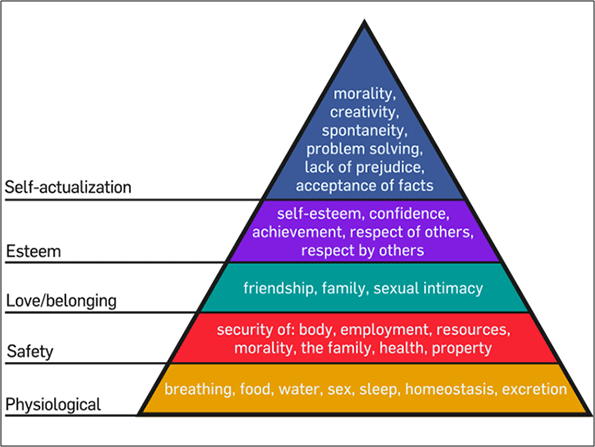
    How does a city do this? Well, the first step is to not get too cute, and to do the obvious realities right.. No amount of beautification projects will save a post-industrial city. A city needs to focus on the basics, as you develop a city like you grow a child. Here, the psychologist Albert Maslow’s hierarchy of needs can help.

    To wit, city leaders must prioritize physiological needs: eradicate food deserts, curb environmental threats, etc. Then, focus on safety. Not just manning safety force slots, but making sure those protecting us respect their duty. There are big questions about this in Cleveland. Also, shelter. Real local housing policies are needed, as are innovative educational and workforce development strategies. If you want to get creative, you can even leverage and strategize various needs together, like utilizing a glut of vacant storefronts into small business/entrepreneurial initiatives. Next, encourage social and cultural attachment so the benefits of community capital can be had. Don’t worry. If persons can breathe, eat, work, feel safe, and go home, they are likely to do this on their own. In fact that is the beauty of a hierarchy approach, as investment at the bottom turns into a self-fulfilling process up top. And then the icing on the cake: actualizing individuals, perhaps through fostering creative capital programs. That said, creatively classifying a city is doing it backwards if you haven’t built your city from the foundation up. Said Maslow: “A first-rate soup is more creative than a second-rate painting.”

    And while this makes intuitive sense to regular Clevelanders, it is confusing for the local leaders, if only through the advice of revitalization experts. For instance, in an article addressing concerns over whether or not Detroit’s investment should go to a bike path initiative, the author references an expert as to why the answer is “yes”:

    As Peter Kageyama argues in his book For the Love of Cities, “In the city making ‘hierarchy of needs’ we see most communities focused on bottom-line, core issues of making cities functional and safe. There still are many communities that struggle to even deliver functional and safe but that is not the problem. The problem is when communities only focus on the functional and safe and never raise their aspirations.”…Ultimately, places that do not engage us emotionally do not feel worth caring about.

    Clicking on the link above to Kageyama’s page, the expert details his thoughts and his audience:

    I focus primarily on American cities though the ideas are relevant to any place. I pay particular attention to some of our most challenged places such as Detroit, Cleveland and New Orleans as they have become hot beds of social innovation as government and the “official” city-makers have struggled to reconcile shrinking budgets and diminished capabilities. Into this vacuum has flowed a new breed of city-maker – usually young, independent, unofficial, creative, rule breaking and entrepreneurial. These are the new “frontiersmen” and “frontierswomen” who are rebuilding these cities from the ground up.

    There are a few problems here. First, while attachment to place is important, the logic is a bit flawed. A person insecure in various aspects of livability, like food and shelter, is not going to have their concerns addressed via an emotional connection to a given place. I am not saying developing place is bad. I am only saying such an approach is akin investing in nice drapes as your house is on fire. Put the fire out. Protect your people. Grow your people. After all, according to economic developer Jim Russell, people develop, not places.

    Second, local leaders are elected for a reason. To lead. And to serve and protect. “Frontiersmen” or Frontierswomen” are not going to protect the preyed upon—notwithstanding Charles Ramsey, though I doubt that is what Kageyama had in mind.

    No doubt, the events in Cleveland have shaken the city—yet another tear in an already torn city. And while the local and national news media is branding the escape of three women and one child as the “Miracle in Cleveland”, it wasn’t. At least not for us. We failed these young women. We failed the women before them. I hope this serves as our wake-up call. We will not play our way out of this. And if we continue to try, there will always be shame in the shadows of our revitalization.

    Richey Piiparinen is a writer and policy researcher based in Cleveland. He is co-editor of Rust Belt Chic: The Cleveland Anthology. Read more from him at his blog and at Rust Belt Chic.

    Top photo Courtesy of WOIO/AP

  • Can Public Banks Help Fix Local Finance?

    Are public banks the answer for the recession-induced decline in municipal revenue and other ills that plague our cities? It’s a solution being discussed in more than one American city.  

    Mike Krauss, a founder of the Public Banking Institute and a chairmen of the Pennsylvania Pubic Bank Project, both non-profits that promote public banking, said this month an ad hoc committee made up of Philadelphia City Council members and civic groups started working on the adoption of language for a public bank in the city. He also said the measure is being adopted out of a need for “affordable and sustainable credit.” The PPBP is leading the effort for public banking in the city.

    The recession’s impact on municipal taxes and anger at Wall Street were factors in the push for a public bank. Krauss described the losses to Philadelphia’s school district, street, police and fire departments as “phenomenal.”  

    Krauss mentioned North Dakota’s public bank, founded in 1919 to promote agriculture, commerce and industry in the state, as a role model for cities. The North Dakota bank arose in reaction to farmers’ anger over the predatory practices of East Coast and Minneapolis banks. The bank’s revenues come from the state’s general revenue fund. Krauss cites the Bank of North Dakota’s 2.9 billion portfolio in a state with a population of roughly 600,000 as an example of its success. Philadelphia has a population of approximately 1.5 million. Krauss also said a public bank would be a job creator for cities and again used the BND as an example, as it produced a job for every 100,000 dollars it loaned.

    Like North Dakota’s bank, the proposed public bank in Philadelphia wouldn’t be a commercial bank that offers checking and savings accounts. It would lend money for city projects and also partner with local commercial banks on loans. There are also efforts underway for public banks in San Francisco and Boston, according to Krauss. 

    Public Banking Institute Chairmen Marc Armstrong said that over a trillion dollars in revenue from states and municipalities are deposited in big Wall Street banks every year. Armstrong also said many of the deposits are used to provide loans for transnational corporations that don’t invest in their states and cities. Public banks can provide loans as low as one percent interest, and Wall Street banks consider their existence as a threat, said Armstrong.  When it comes to taxation and other issues that confront cities, a public bank could be used as a weapon against the rent-seeking – meaning using social and political circumstances to extract more money out of the public – activities by financiers. The public bank would instead invest in higher education, automotive and banking industries and as a tool for productive economic enterprises and individuals. This weapon could in turn create more vibrant activities in urban economies.  

    Krauss admitted the possibilities for the use of revenue generated by a public bank are endless, and he said investment in the school district, infrastructure and public safety would be positives. However, other job creating services and projects could be a reality – free wi-fi, the construction of affordable rental housing for retired people and low income residents, rent-to-own home ownership (or condo) programs, research and development to support public science, scientific innovation and high technology industries, childcare facilities, higher education for city residents, public media, new parks, free or reduced utilities for businesses and individuals, and also investments in energy efficiency, recycling, renewable energy and car sharing.  

    The positive impacts of the above mentioned investments go beyond public banking, as it is the starting point for a more vibrant urban economy, education system and ecology. With a new source of revenue, business taxes could be slashed to promote business formation in public banking inclined cities, and more businesses within city limits would mean even more revenue.    

    Similar to slashing taxes for business, free or reduced costs on wi-fi and utilities would also help local businesses and individuals by reducing their overhead costs and in turn create more jobs, as more money could be spent in the form of investment by businesses themselves and in increased individual purchasing power that works its way back into local businesses.  

    Recycling would have a similar effect, as it’s cheaper for a city to recycle, if the program is a well-run, than to pay for waste collection, land filling and incineration. By reducing the costs of waste, cities could again reduce business taxes and once again create more business formation, and at the same time reduce greenhouse gas emissions. Recycling reduces pollution not only by reducing the waste sent to landfills, but it also reduces the need for cutting down more trees and the inputs needed to manufacture a product.

    Urban and non-urban citizens all create waste and for that reason recycling is a bigger job creator than renewable energy which cannot produce all of our energy due to intermittency and also the cost, as it’s still more expensive than traditional forms. Despite these drawbacks, new revenue could be used to create jobs in solar energy by installing solar panels on public buildings – school district offices, schools, and city hall. Also worth thinking about is the possibility of constructing biogas plants that break down organic waste – which can come from the vast amount of sewage a city creates – to create another, perhaps more reliable form of renewable energy.       

    The additional revenue produced by the use of public banking and increased business formation could also be used to lift the burden of rent-seeking higher education institutions by offering lower interest loans to help young people attain a higher education, affordable rent and affordable home or condo ownership without acquiring crushing debt. Cities could offer a few years of free vocational, art, culinary and business education. The media is full of stories of urban residents burdened with student loan debt which benefits universities, colleges and the government and decreases the amount of money circulating into local businesses. Also, cities would benefit from this investment by creating a new generation of productive workers, chefs and artists and the businesses that are created along with them.

    Low interest loans could also be offered to local real estate interest for rent-to-own condo and house programs and affordable apartments could be constructed with low-interest loan portfolios. Of course, landlords would have to abide by low-rent policies if they are to take advantage of the policies, blunting the rent raising effects of gentrification while maintaining its’ positive side.

    Cities could also put public dollars behind a new innovation in transportation – car sharing – which has been pioneered by Zipcar. Cities could help expand the company’s business by offering it low tax rates and subsides to locate within their borders; those arguing they would wasteful should take a second look at what’s spent on sports stadiums. Or maybe cities could building their own car sharing industry with local business leaders. The expansion of car sharing would mean less impact on the infrastructure and reduce the amount spent on infrastructure. It would also reduce traffic congestion and make it possible for residents of surrounding suburbs to enjoy the city’s attractions.      

    Cities can and should be hubs for creative people and immigrants, as they see life in almost-dead neighborhoods and create gentrifying enterprises such as restaurants, cafes, music venues, art galleries, artisan manufacturing, coffee roasting, small boutique retailers and all sorts of internet and technology businesses. However, cities can’t and shouldn’t lose focus on what sustains critical functions such as public safety, infrastructure and education – revenue. The public bank offers an opportunity for cities to invest in themselves, not the profit portfolios of Wall Street.

    Jason Sibert is a freelance writer who has lived in the St. Louis Metro Area since the late 90’s. He worked for the Suburban Journals for a decade and his work has appeared in various publications over the last four years.

    Photo by David Shankbone.

  • Leaving Portlandia

    There have been two universal reactions to my announcement that I was going to move from Portland to the Midwest: surprise and disbelief. But I also found a number of people who, if given a few moments to find clear and honest footing in the conversation, could see through the self-absorbed mental fog that covers the city in equal measure to the grey rain clouds and tells its inhabitants every day that Portland is the most amazing possible place in this country to live. The amount of media devoted to reinforcing this idea is overwhelming in the sense that I believe it has overwhelmed people’s ability to have their own thoughts and identity in Portland.  Instead they have a Portland identity…because they live in Portland and that is what defines them.

    On the surface, Portland has many progressive aspects. Sustainability and the “greening of the city” stand front and foremost as two easily recognized. Curbside recycling and composting, increasing investment in bicycle transportation, native gardening, and urban farming. There is an intense concentration of a wide range of alternative health practitioners. Artisan craftspeople abound, creating specialty foods and other handcrafted products. “Shop local” is the resounding cry to support small businesses, and farmers markets adorn every neighborhood in the summertime.

    Idyllic as this sounds, there is a less appealing aspect to this picture. As Portland concentrates is cultural practices into a few baskets, the proliferation of other ideas diminishes. Ten years ago I would have characterized Portland as a place that had progressive perspectives. Now I would characterize Portland as a place with few ideas, all perpetually reinforced and more deeply ingrained every day.  People regurgitate a handful of versions of the same thoughts in ever narrowing expressions.  Everywhere you look it is repetition of the same ideas, whether it be on politics, design, or social culture. People strive to look the same, to dress the same, and to have the same lifestyle.  It is so pervasive, that women within a 30 to 40 year age range may display similar choices in hair, dress, and accessories.  What began as a city with progressive and forward looking ideas to develop a new urban course has become a closed container of cultural conformity.  There is a new cookie cutter in Portland, and it is young, alterna-hip, and white.

    I grew up in a place like this…it is called Orange County.

    Sweeping shocked gasps aside, this comparison is worth a long pause to consider.  Stripping away the key difference between Multnomah and Orange County of political affiliation, with Orange County being a historic Republican stronghold and Portland staunchly Democrat, these two counties have some key cultural similarities all hinging on a pivotal word used above: conformity. Conformity of dress, thought, and mannerisms, shared ideas and ideals, and a strong attitudinal belief that there is a “right” or “correct” way to be and to appear to others. There is also limited interest or investment in the arts, creative, innovative, or intellectual development. Just because the surface ideals these two places seem extremely different from each other, does not mean that they don’t breed the same obedience to a self-referencing norm within themselves. And by perpetuating their particular cultures and tailoring their environments to fit with a narrow range of ideals, the inhabitants of these areas increasingly live on the margins of reality and instead inhabit a fabricated cocoon of their own self-rewarding design.

    What disturbed me most about Portland in the months leading up to my decision to leave was the increasingly strong social culture of invisibility. I am referring to the tendency of people in Portland to not acknowledge the physical presence of other people around them in close proximity. This can easily be seen by the increasing tendency of people to brush past you without making eye contact or saying “excuse me” and instead being intensely focused on some spot just beyond your left shoulder. But it manifests in countless other ways: letting dogs off leash (and not picking up after them), ignoring red lights and stop signs, allowing children license to act out without discipline in the presence of other adults.

    In this city where conformity to a particular identity is so strong, people no longer see each other as people. People come in and out of your field of vision as an object to be ranked according to usefulness to you, and invariably avoided, ignored and dismissed the majority of the time. It is unpleasant, unsettling and dehumanizing. The countless tiny social interactions we have with other people throughout the day are the glue that hold us together as a community and keep us from being automatons randomly bumping into one another like the balls in a pinball machine. This critical stickiness in Portland is dissolving rapidly. As people lose the ability to engage and connect with one another, there appears to be an increasingly growing level of resentment, frustration and anger brewing under the surface of social interactions. Not just interactions where overt conflict is involved, but all of them. Because it feels like they all contain some level of conflict just by the occurrence of people being together in a place, time and circumstance.

    There is little likelihood that I would ever have been physically assaulted in Portland. But I think there is a pretty strong likelihood that if I were physically assaulted that no one around me would react or get involved or help. Because chances are, I wouldn’t even be seen.

    When confronted with difficult situations or challenging environments, often it is heard “it’s the people that keep me here…keep me working, living, etc. in this place despite its shortcomings”. In Portland, the situation is reversed….the environment is being made increasingly pleasant and comfortable, but it is the people that make it so difficult to live there.

    Read Jennifer Wyatt’s blog about her cross country move at isaymissourah.wordpress.com.

  • The 2012 Year in Unemployment

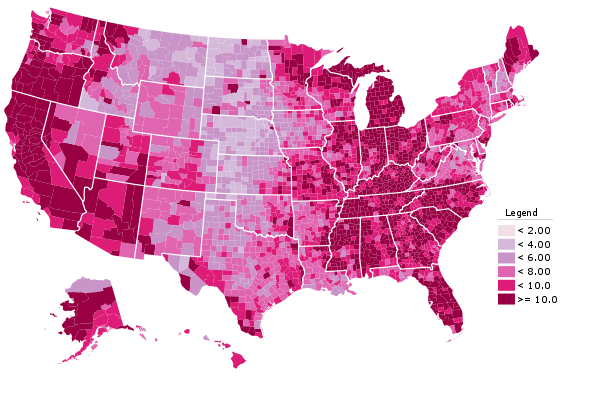
    I recently looked at the changes in jobs in metro areas for 2012. Here’s a follow-on look at unemployment. First a look at the national unemployment rate picture, which has improved remarkably.


    2012 Unemployment Rate by County

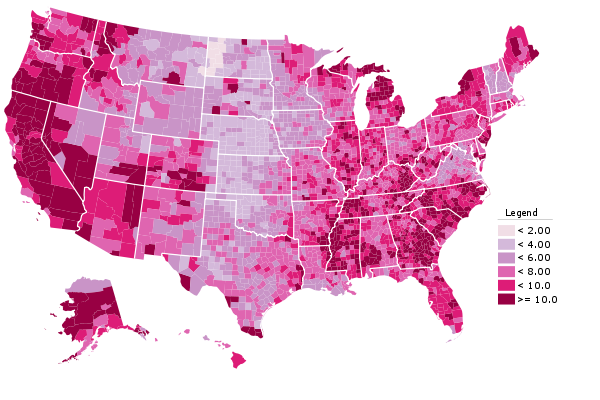
    To put this in perspective, here’s the corresponding map for 2009:


    2009 Unemployment Rate by County

    It’s interesting to see where there has been improvement versus where there hasn’t, though I stop thresholding at 10% so that if people we well above it but dropped to just merely above it, my maps wouldn’t show that improvement.

    Here’s a look at the large metro areas, ranked by total decline in unemployment rate.

    Rank by Total Improvement Metro Area 2011 2012 Total Change
    1 Las Vegas-Paradise, NV 13.5 11.2 -2.3
    2 Orlando-Kissimmee-Sanford, FL 10.2 8.4 -1.8
    3 Tampa-St. Petersburg-Clearwater, FL 10.6 8.8 -1.8
    4 Miami-Fort Lauderdale-Pompano Beach, FL 10.2 8.5 -1.7
    5 Jacksonville, FL 9.9 8.3 -1.6
    6 Sacramento–Arden-Arcade–Roseville, CA 11.9 10.4 -1.5
    7 Birmingham-Hoover, AL 7.9 6.4 -1.5
    8 Cincinnati-Middletown, OH-KY-IN 8.6 7.1 -1.5
    9 Riverside-San Bernardino-Ontario, CA 13.6 12.1 -1.5
    10 Nashville-Davidson–Murfreesboro–Franklin, TN 8.1 6.6 -1.5
    11 Louisville/Jefferson County, KY-IN 9.7 8.3 -1.4
    12 San Jose-Sunnyvale-Santa Clara, CA 10.0 8.6 -1.4
    13 Columbus, OH 7.5 6.1 -1.4
    14 Kansas City, MO-KS 8.0 6.6 -1.4
    15 Houston-Sugar Land-Baytown, TX 8.1 6.8 -1.3
    16 Charlotte-Gastonia-Rock Hill, NC-SC 10.8 9.5 -1.3
    17 Seattle-Tacoma-Bellevue, WA 8.7 7.4 -1.3
    18 San Francisco-Oakland-Fremont, CA 9.4 8.1 -1.3
    19 Los Angeles-Long Beach-Santa Ana, CA 11.4 10.1 -1.3
    20 Salt Lake City, UT 6.7 5.5 -1.2
    21 Phoenix-Mesa-Glendale, AZ 8.5 7.3 -1.2
    22 St. Louis, MO-IL 8.8 7.6 -1.2
    23 Dallas-Fort Worth-Arlington, TX 7.8 6.7 -1.1
    24 San Diego-Carlsbad-San Marcos, CA 10.0 8.9 -1.1
    25 Detroit-Warren-Livonia, MI 11.6 10.5 -1.1
    26 Portland-Vancouver-Hillsboro, OR-WA 9.3 8.2 -1.1
    27 Atlanta-Sandy Springs-Marietta, GA 9.8 8.8 -1.0
    28 Austin-Round Rock-San Marcos, TX 6.8 5.8 -1.0
    29 San Antonio-New Braunfels, TX 7.5 6.5 -1.0
    30 Memphis, TN-MS-AR 10.0 9.0 -1.0
    31 Chicago-Joliet-Naperville, IL-IN-WI 9.8 8.9 -0.9
    32 Minneapolis-St. Paul-Bloomington, MN-WI 6.3 5.5 -0.8
    33 Raleigh-Cary, NC 8.5 7.7 -0.8
    34 Providence-Fall River-Warwick, RI-MA – Metro 11.1 10.3 -0.8
    35 Richmond, VA 7.1 6.4 -0.7
    36 New Orleans-Metairie-Kenner, LA 7.2 6.5 -0.7
    37 Cleveland-Elyria-Mentor, OH 7.8 7.1 -0.7
    38 Oklahoma City, OK 5.5 4.8 -0.7
    39 Denver-Aurora-Broomfield, CO 8.6 7.9 -0.7
    40 Hartford-West Hartford-East Hartford, CT – Metro 9.0 8.4 -0.6
    41 Milwaukee-Waukesha-West Allis, WI 8.0 7.4 -0.6
    42 Indianapolis-Carmel, IN 8.4 7.8 -0.6
    43 Baltimore-Towson, MD 7.7 7.2 -0.5
    44 Virginia Beach-Norfolk-Newport News, VA-NC 7.1 6.6 -0.5
    45 Boston-Cambridge-Quincy, MA-NH – Metro 6.6 6.1 -0.5
    46 Washington-Arlington-Alexandria, DC-VA-MD-WV 6.0 5.6 -0.4
    47 Philadelphia-Camden-Wilmington, PA-NJ-DE-MD 8.6 8.6 0.0
    48 Pittsburgh, PA 7.2 7.2 0.0
    49 New York-Northern New Jersey-Long Island, NY-NJ-PA 8.6 8.8 0.2
    50 Rochester, NY 7.8 8.1 0.3
    51 Buffalo-Niagara Falls, NY 8.1 8.5 0.4
  • The 2013 Best Cities For Job Growth

    The 2013 edition of our list shows many things, but perhaps the most important is which cities have momentum in the job creation sweepstakes. Right now the biggest winners are the metro areas that are adding higher-wage jobs thanks to America’s two big boom sectors: technology and energy.

    Our rankings are based on short, medium and long-term employment performance, and take into account both growth and momentum — whether growth is slowing or accelerating. (For a detailed description of our methodology, click here.) Consequently, areas that have made the strongest recoveries from deep setbacks often do well. Nowhere is this clearer than in the case of the San Francisco-San Mateo-Redwood City metropolitan division, our top-ranked large metro area (urban regions with more than 450,000 jobs). Over the last year, employment in the San Francisco area expanded a remarkable 4.1%, and is up 3.3% since 2008.

    A decade ago, the San Francisco area was reeling from the collapse of the last dot-com bubble; the damage was so deep that today it has only 0.6% more jobs than in 2001. Its sharp recent growth is primarily in the information sector, which has expanded a torrid 21.3% since 2009.

    Much the same can be said about San Jose-Sunnyvale-Santa Clara, better known as Silicon Valley, which is No. 7 on our large metro area list due to 3.4% job growth last year, and 2.3% growth since 2008; it is also propelled by 25% growth in information jobs since 2007. Yet looking at the longer term, the Valley, like San Francisco, is still rebounding from a deep downturn connected to the dot-com disaster of a decade ago. In fact, the Valley is still down almost 40,000 jobs from 2001.

    Is California Pulling Ahead Of Texas?

    Some East Coast boosters of the Golden State are making this claim, but we don’t see it in this year’s numbers. Besides the tech-rich Bay Area, home to two of our top 10 large metro areas, there are no other major California cities near the top. Most of the state’s big metros are in the poor to middling range over the long term; only Riverside-San Bernardino (45th place on our big cities list) has 10% more jobs than a decade ago. Los Angeles, the state’s dominant urban region, has lost some 120,000 jobs since 2001.

    In contrast, the Texas juggernaut rolls on. Growth there has not only been steady, it’s been widely spread across the state. Texas boasts a remarkable four major metros in our top 10, led by Ft. Worth-Arlington (No. 4), Houston-Sugarland-Baytown (No. 5), Dallas-Plano-Irving (No. 6 ) and Austin-Round Rock, which slips from first place last year to 10th. The state’s other big city, San Antonio, comes in at a very healthy No. 12.

    All these metro areas have more jobs than they did a decade ago — often a lot more. Since 2001, employment in Houston has expanded 20%; in Ft. Worth, it’s up roughly 16%; Dallas; 11%; Austin, a remarkable 26.5%; and San Antonio, 18.4%.

    The Energy Boomtowns

    The unconventional oil and gas boom has helped turn Texas into an economic juggernaut, particularly world energy capital Houston, but growth has also been strong in tech, manufacturing and business services. You see this same kind of blending of energy and other sectors in other strong growth economies elsewhere in the U.S., such as No. 3 Salt Lake City, No. 9 Denver and No. 15 Oklahoma City.

    But the real evidence of energy’s power can be seen in smaller metro areas. Oil-rich Midland, Texas, places first on our list of smaller metro areas (those with less than 150,000 jobs) and also first overall among the country’s 398 metropolitan areas. Nipping at its heels in second place in both categories is Odessa, Texas. On our medium-size cities list, energy towns with strong growth include No. 4 Corpus Christi, Texas; No. 5 Bakersfield, Calif.; and No. 6 Lafayette, La.

    Affordability + Quality of Life = Success

    But you don’t have to be a huge tech hub or energy capital to generate new jobs. The No. 2-ranked place in our big metro ranking, Nashville-Davidson-Murfreesboro-Franklin, Tenn., reflects the power of economic diversity coupled with ample cultural amenities, pro-business policies and a mild climate. Nashville’s 3.8% expansion in employment last year, and 7% growth since 2008, has been propelled by business services, education and health. There’s also been a recent recovery in manufacturing, up over 9% last year, as well as retail and wholesale trade. Like the Texas cities, Nashville has registered long-term growth as well, with 112,000 jobs added since 2001, a nice 16.6% increase.

    Much the same can be said about Charlotte-Gastonia-Rock Hill, N.C., No. 8 on our big city list, whose job base grew 3.3% last year. Virtually every business sector has been on the rebound since 2009, including financial services, despite Bank of America’s continuing troubles. Overall the local economy has added 100,000 jobs since 2001, up almost 13%.

    Steady, diverse growth can be seen in other low-cost and business-friendly towns such as our No. 11 big metro area, Raleigh Cary, N.C.; No. 13 Columbus, Ohio; and No. 15 Indianapolis. The shift towards stronger growth in areas away from the coasts has continued, at least in the more attractive metro areas.

    Who Doesn’t Have It?

    Of course, any list has its share of losers as well as winners. Sadly this includes long-suffering old industrial cities such as our last-placed big metro area, Newark-Union, N.J., which is followed, in order, by Saint Louis, MO-IL; Cleveland-Elyria- Mentor, Ohio; and Providence-Fall River-Warwick RI-MA. All but Providence, which stayed about even, slipped from last year’s rankings.

    But not all factory towns are headed in the wrong direction. No.  51 Detroit-Livonia-Dearborn advanced an impressive 11 places from last year’s list. The key here has not been the much talked about attempt to turn downtown Detroit into a cool place, but the resurgence of the auto industry. Manufacturing employment, concentrated in the region’s suburbs, is up over 18% since 2009 after decades of tumultuous losses.

    Also flailing a bit have been many of our largest, and most often celebrated, metros. Believe it or not, Detroit comes in one place ahead of Chicago-Joliet-Naperville ,Ill., which continues to promote itself as one of the nation’s great comeback stories, but in reality has continued to lose ground. You can tell the same tale about No. 46 Philadelphia, Pa., No. 41 Portland-Hillsboro-Vancouver OR-WA, and No. 37 Miami, which dropped a staggering 16 places despite the much celebrated recovery of its condo market. Selling to South America flight capital (legal or otherwise) and sun-deprived Europeans does not seem to be doing enough to revive the region’s overall economic vigor.

    There are also some signs that the big beneficiaries of the Bernanke-Obama-Bush economic policy may be losing some momentum. New York City, the major winner from the “too big to fail” banking bailout, fell seven places from last year to No. 18. Even Washington-Arlington-Alexandria, D.C., the nation’s prime beneficiary of crony capitalism and fiscal bloat, has lost steam, falling 10 places to No. 26 — a big decline from its No. 6 rankings in 2010 and 2011. We are usually loath to celebrate declines, but Washington’s loss, reflecting a slowdown in government growth, may be evidence that some equilibrium between the public and private sectors is slowly being restored.

    Joel Kotkin is executive editor of NewGeography.com and a distinguished presidential fellow in urban futures at Chapman University, and a member of the editorial board of the Orange County Register. He is author of The City: A Global History and The Next Hundred Million: America in 2050. His most recent study, The Rise of Postfamilialism, has been widely discussed and distributed internationally. He lives in Los Angeles, CA.

    Michael Shires, Ph.D. is a professor at Pepperdine University School of Public Policy.

    This piece originally appeared at Forbes.com.

  • 2013 How We Pick the Best Cities For Job Growth

    Read about how we selected the 2013 Best Cities for Job Growth
    View the interactive map

    The methodology for the 2013 rankings largely corresponds to that used in previous years, which emphasizes the robustness of a region’s growth both recently and over time.  It allows the rankings to include all of the metropolitan statistical areas (MSAs) for which the Bureau of Labor Statistics reports monthly employment data. They are derived from three-month rolling averages of U.S. Bureau of Labor Statistics "state and area" unadjusted employment data reported from November 2001 to January 2013.

    The data reflect the North American Industry Classification System categories, including total nonfarm employment, manufacturing, financial services, business and professional services, educational and health services, information, retail and wholesale trade, transportation and utilities, leisure and hospitality, and government.

    This year’s rankings use four measures of growth to rank all 398 metro areas for which full data sets were available from the past 10 years.  "Large" areas include those with a current nonfarm employment base of at least 450,000 jobs. "Midsize" areas range from 150,000 to 450,000 jobs. "Small" areas have as many as 150,000 jobs.  This year’s rankings reflect the current size of each MSA’s employment.   Only two MSAs changed size categories, with Honolulu, HI moving from “Midsized” to “Large” and Savannah, GA moving from “Small” to “Midsized.” In the instances where the analysis refers to changes in ranking order within the size categories, these two MSA’s changes are reported as if they had been included in their current category in the prior year.

    The index is calculated from a normalized, weighted summary of: 1) recent growth trend: the current and prior year’s employment growth rates, with the current year emphasized (two points); 2) mid-term growth: the average annual 2007-2012 growth rate (two points); 3) long-term trend and momentum: the sum of the 2007-2012 and 2001-2006 employment growth rates multiplied by the ratio of the 2001-2006 growth rate over the 2007-2012 growth rate (two points); and 4) current year growth (one point).

  • All Cities Rankings – 2013 Best Cities for Job Growth

    Read about how we selected the 2013 Best Cities for Job Growth
    View the interactive map

    This year’s rankings use four measures of growth to rank all 398 metro areas for which full data sets were available from the past 10 years. "Large" areas include those with a current nonfarm employment base of at least 450,000 jobs. "Midsize" areas range from 150,000 to 450,000 jobs. "Small" areas have as many as 150,000 jobs. This year’s rankings reflect the current size of each MSA’s employment. Only two MSAs changed size categories, with Honolulu, HI moving from “Midsized” to “Large” and Savannah, GA moving from “Small” to “Midsized.” In the instances where the analysis refers to changes in ranking order within the size categories, these two MSA’s changes are reported as if they had been included in their current category in the prior year.

    2013
    Overall Ranking
    Area 2013 Weighted INDEX  2012 Nonfarm Employment (1000s)  2012 Overall Rank  Overal Movement
    1 Midland, TX 100.0 83.6 2 1
    2 Odessa, TX 100.0 74.2 1 -1
    3 Columbus, IN 98.5 49.8 3 0
    4 Cleveland, TN 93.9 43.8 372 368
    5 San Angelo, TX 88.3 47.0 7 2
    6 Owensboro, KY 87.1 53.4 28 22
    7 Boulder, CO 86.2 171.2 56 49
    8 Jonesboro, AR 85.5 52.0 146 138
    9 San Francisco-San Mateo-Redwood City, CA Metropolitan Division 84.7 1016.2 85 76
    10 Williamsport, PA 84.6 57.1 11 1
    11 Provo-Orem, UT 83.9 198.0 47 36
    12 Fayetteville-Springdale-Rogers, AR-MO 81.9 215.1 107 95
    13 San Luis Obispo-Paso Robles, CA 81.8 104.1 327 314
    14 Auburn-Opelika, AL 81.7 56.4 103 89
    15 Nashville-Davidson–Murfreesboro–Franklin, TN 81.4 802.5 45 30
    16 Salt Lake City, UT 81.1 656.3 22 6
    17 Barnstable Town, MA NECTA 81.1 95.9 34 17
    18 Napa, CA 81.0 64.3 142 124
    19 Corpus Christi, TX 80.9 187.0 6 -13
    20 Fort Worth-Arlington, TX Metropolitan Division 80.5 915.0 37 17
    21 Winchester, VA-WV 80.1 58.6 77 56
    22 Bakersfield-Delano, CA 79.9 243.8 51 29
    23 Houston-Sugar Land-Baytown, TX 79.2 2740.8 8 -15
    24 Dallas-Plano-Irving, TX Metropolitan Division 79.1 2156.0 39 15
    25 Cheyenne, WY 78.5 45.6 32 7
    26 Lafayette, IN 78.5 98.1 53 27
    27 Greenville, NC 78.2 81.9 148 121
    28 San Jose-Sunnyvale-Santa Clara, CA 78.1 918.5 38 10
    29 Blacksburg-Christiansburg-Radford, VA 78.0 72.7 9 -20
    30 Portsmouth, NH-ME NECTA 77.8 55.8 18 -12
    31 Billings, MT 77.5 81.9 281 250
    32 Laredo, TX 77.5 95.8 14 -18
    33 Victoria, TX 77.4 52.6 42 9
    34 Charlotte-Gastonia-Rock Hill, NC-SC 77.1 865.8 96 62
    35 Lafayette, LA 77.1 157.3 4 -31
    36 Haverhill-North Andover-Amesbury, MA-NH  NECTA Division 76.5 80.3 83 47
    37 Muncie, IN 76.5 52.6 300 263
    38 Greeley, CO 76.3 84.5 79 41
    39 Holland-Grand Haven, MI 75.9 113.1 19 -20
    40 Fargo, ND-MN 75.6 131.4 25 -15
    41 Denver-Aurora-Broomfield, CO 75.6 1258.2 74 33
    42 Austin-Round Rock-San Marcos, TX 75.0 837.9 5 -37
    43 Lexington-Fayette, KY 74.7 260.0 236 193
    44 Sioux Falls, SD 74.6 140.9 87 43
    45 Raleigh-Cary, NC 74.5 526.6 40 -5
    46 New Bedford, MA NECTA 74.3 67.5 262 216
    47 Grand Rapids-Wyoming, MI 73.8 390.2 64 17
    48 Baton Rouge, LA 73.2 380.7 124 76
    49 Longview, TX 72.9 101.7 35 -14
    50 Fort Collins-Loveland, CO 72.7 140.3 59 9
    51 Charleston-North Charleston-Summerville, SC 72.2 304.4 29 -22
    52 Hagerstown-Martinsburg, MD-WV 72.1 103.7 172 120
    53 Casper, WY 72.0 41.1 10 -43
    54 Bismarck, ND 71.9 67.6 21 -33
    55 Houma-Bayou Cane-Thibodaux, LA 71.7 96.2 23 -32
    56 San Antonio-New Braunfels, TX 71.4 883.8 99 43
    57 Kansas City, KS 71.3 446.9 86 29
    58 Lubbock, TX 71.3 130.8 13 -45
    59 Burlington-South Burlington, VT NECTA 71.2 117.8 113 54
    60 McAllen-Edinburg-Mission, TX 71.2 233.6 20 -40
    61 Grand Forks, ND-MN 71.1 56.8 193 132
    62 Columbus, OH 71.0 957.3 112 50
    63 Clarksville, TN-KY 71.0 87.6 117 54
    64 Manhattan, KS 70.9 57.7 269 205
    65 Seattle-Bellevue-Everett, WA Metropolitan Division 70.8 1459.5 68 3
    66 Merced, CA 70.7 58.6 173 107
    67 Oklahoma City, OK 70.7 600.0 48 -19
    68 Indianapolis-Carmel, IN 70.6 918.6 164 96
    69 Columbia, MO 70.4 97.4 15 -54
    70 Jackson, TN 70.1 61.8 338 268
    71 Springfield, MO 70.0 200.0 149 78
    72 Ann Arbor, MI 69.7 207.0 108 36
    73 Dubuque, IA 69.4 59.1 95 22
    74 Boston-Cambridge-Quincy, MA NECTA Division 69.0 1745.5 139 65
    75 Lake Charles, LA 68.9 92.2 326 251
    76 Santa Barbara-Santa Maria-Goleta, CA 68.4 171.0 116 40
    77 Brownsville-Harlingen, TX 68.3 132.8 71 -6
    78 Waco, TX 68.2 108.0 229 151
    79 Ogden-Clearfield, UT 68.1 201.6 175 96
    80 Durham-Chapel Hill, NC 68.1 285.9 92 12
    81 Spartanburg, SC 68.0 124.8 298 217
    82 El Centro, CA 67.8 46.7 189 107
    83 Rochester, MN 67.7 105.9 284 201
    84 Boise City-Nampa, ID 67.5 267.7 235 151
    85 Asheville, NC 67.5 173.9 75 -10
    86 Des Moines-West Des Moines, IA 67.2 328.7 169 83
    87 St. Joseph, MO-KS 67.1 62.6 52 -35
    88 New York City, NY 66.9 3908.8 49 -39
    89 Trenton-Ewing, NJ 66.7 245.7 89 0
    90 Harrisonburg, VA 66.7 64.9 105 15
    91 Northern Virginia, VA 66.7 1364.8 50 -41
    92 Louisville-Jefferson County, KY-IN 66.3 618.5 132 40
    93 Waterloo-Cedar Falls, IA 66.3 92.5 63 -30
    94 Wenatchee-East Wenatchee, WA 65.9 39.1 104 10
    95 Minneapolis-St. Paul-Bloomington, MN-WI 65.7 1780.8 176 81
    96 Lincoln, NE 65.6 177.8 81 -15
    97 Morgantown, WV 65.5 67.7 60 -37
    98 St. Cloud, MN 65.3 102.1 131 33
    99 Abilene, TX 65.0 67.2 264 165
    100 Bowling Green, KY 64.7 62.4 160 60
    101 Kokomo, IN 64.2 42.4 226 125
    102 Peabody, MA  NECTA Division 63.9 102.5 101 -1
    103 El Paso, TX 63.8 286.0 27 -76
    104 Visalia-Porterville, CA 63.5 110.5 335 231
    105 Brockton-Bridgewater-Easton, MA  NECTA Division 63.3 89.7 272 167
    106 Jacksonville, NC 62.9 48.8 102 -4
    107 Atlanta-Sandy Springs-Marietta, GA 62.7 2381.0 157 50
    108 Crestview-Fort Walton Beach-Destin, FL 62.7 78.6 61 -47
    109 Iowa City, IA 62.7 94.2 128 19
    110 Canton-Massillon, OH 62.6 167.2 90 -20
    111 Savannah, GA 62.5 157.9 299 188
    112 New Orleans-Metairie-Kenner, LA 62.4 535.0 62 -50
    113 Honolulu, HI 62.0 454.7 194 81
    114 Richmond, VA 62.0 625.8 135 21
    115 Elkhart-Goshen, IN 61.9 113.6 178 63
    116 Muskegon-Norton Shores, MI 61.9 61.6 219 103
    117 Washington-Arlington-Alexandria, DC-VA-MD-WV Metropolitan Division 61.7 2485.6 78 -39
    118 Palm Coast, FL 61.5 20.2 72 -46
    119 Bay City, MI 61.4 37.1 136 17
    120 Killeen-Temple-Fort Hood, TX 61.3 130.3 44 -76
    121 Ithaca, NY 61.2 68.1 304 183
    122 Reading, PA 61.1 172.2 118 -4
    123 San Diego-Carlsbad-San Marcos, CA 61.1 1272.7 196 73
    124 Lebanon, PA 60.9 51.5 163 39
    125 Tampa-St. Petersburg-Clearwater, FL 60.9 1174.4 171 46
    126 Eau Claire, WI 60.9 83.0 278 152
    127 Danville, VA 60.8 40.9 126 -1
    128 Anchorage, AK 60.8 176.3 161 33
    129 Anderson, IN 60.6 40.7 277 148
    130 Mankato-North Mankato, MN 60.6 53.9 80 -50
    131 Nassau-Suffolk, NY Metropolitan Division 60.6 1269.4 120 -11
    132 Battle Creek, MI 60.2 56.3 266 134
    133 Pittsburgh, PA 60.1 1160.5 43 -90
    134 La Crosse, WI-MN 59.6 75.5 191 57
    135 Missoula, MT 59.1 56.2 331 196
    136 Macon, GA 59.0 99.0 239 103
    137 Green Bay, WI 58.7 169.4 156 19
    138 Tuscaloosa, AL 58.6 96.8 287 149
    139 Allentown-Bethlehem-Easton, PA-NJ 58.5 345.6 110 -29
    140 Orlando-Kissimmee-Sanford, FL 58.3 1052.4 208 68
    141 Flagstaff, AZ 58.1 62.3 354 213
    142 Sherman-Denison, TX 57.7 43.3 55 -87
    143 Jacksonville, FL 57.5 606.5 204 61
    144 Edison-New Brunswick, NJ Metropolitan Division 57.5 1007.2 282 138
    145 St. George, UT 57.4 49.2 251 106
    146 Framingham, MA  NECTA Division 57.1 158.9 84 -62
    147 Knoxville, TN 57.0 334.1 33 -114
    148 Wilmington, NC 56.9 138.1 312 164
    149 Baltimore City, MD 56.8 360.1 67 -82
    150 Santa Cruz-Watsonville, CA 56.7 90.9 215 65
    151 Myrtle Beach-North Myrtle Beach-Conway, SC 56.6 111.1 185 34
    152 Tulsa, OK 56.5 427.0 153 1
    153 Corvallis, OR 56.5 39.2 203 50
    154 Fort Wayne, IN 56.4 208.5 150 -4
    155 Omaha-Council Bluffs, NE-IA 56.4 468.1 119 -36
    156 Logan, UT-ID 56.2 55.2 97 -59
    157 Ocean City, NJ 55.9 35.2 26 -131
    158 Fairbanks, AK 55.7 38.3 165 7
    159 Sioux City, IA-NE-SD 55.6 74.8 216 57
    160 Amarillo, TX 55.5 113.1 70 -90
    161 Gainesville, GA 55.4 74.9 17 -144
    162 Lawrence, KS 55.3 51.7 316 154
    163 Greenville-Mauldin-Easley, SC 55.3 309.3 88 -75
    164 Gainesville, FL 55.1 131.5 333 169
    165 Albany-Schenectady-Troy, NY 54.9 445.0 223 58
    166 Bethesda-Rockville-Frederick, MD Metropolitan Division 54.4 572.1 230 64
    167 Naples-Marco Island, FL 54.3 120.2 192 25
    168 Colorado Springs, CO 54.0 252.7 260 92
    169 Virginia Beach-Norfolk-Newport News, VA-NC 54.0 747.8 247 78
    170 Elizabethtown, KY 53.9 48.8 188 18
    171 Miami-Miami Beach-Kendall, FL Metropolitan Division 53.7 1037.7 111 -60
    172 Lowell-Billerica-Chelmsford, MA-NH  NECTA Division 53.6 118.8 106 -66
    173 Ames, IA 53.5 48.5 93 -80
    174 Columbia, SC 53.3 355.9 158 -16
    175 Vallejo-Fairfield, CA 53.1 121.1 206 31
    176 Santa Ana-Anaheim-Irvine, CA Metropolitan Division 53.1 1416.5 242 66
    177 Oshkosh-Neenah, WI 52.8 93.1 82 -95
    178 Kankakee-Bradley, IL 52.8 44.1 147 -31
    179 Phoenix-Mesa-Glendale, AZ 52.8 1793.0 227 48
    180 Cape Coral-Fort Myers, FL 52.6 211.9 228 48
    181 Tyler, TX 52.6 94.7 31 -150
    182 West Palm Beach-Boca Raton-Boynton Beach, FL Metropolitan Division 52.4 528.5 308 126
    183 Portland-Vancouver-Hillsboro, OR-WA 52.4 1010.3 137 -46
    184 North Port-Bradenton-Sarasota, FL 52.1 249.5 292 108
    185 Harrisburg-Carlisle, PA 51.9 325.7 222 37
    186 Cedar Rapids, IA 51.8 140.8 246 60
    187 Fort Lauderdale-Pompano Beach-Deerfield Beach, FL Metropolitan Division 51.7 743.2 291 104
    188 Peoria, IL 51.6 183.6 66 -122
    189 Idaho Falls, ID 51.4 49.7 240 51
    190 Glens Falls, NY 51.3 53.7 12 -178
    191 Fayetteville, NC 51.1 130.0 58 -133
    192 Topeka, KS 51.1 109.8 263 71
    193 Joplin, MO 51.1 80.6 122 -71
    194 Poughkeepsie-Newburgh-Middletown, NY 50.9 253.8 115 -79
    195 Pueblo, CO 50.8 58.8 54 -141
    196 Akron, OH 50.7 327.3 296 100
    197 Danbury, CT NECTA 50.5 68.8 98 -99
    198 Athens-Clarke County, GA 50.5 88.8 244 46
    199 College Station-Bryan, TX 50.4 97.5 167 -32
    200 Hattiesburg, MS 50.2 60.5 294 94
    201 Spokane, WA 50.2 209.7 319 118
    202 Yakima, WA 50.2 76.7 198 -4
    203 Rochester, NY 50.2 513.9 91 -112
    204 State College, PA 50.1 75.4 24 -180
    205 Bloomington-Normal, IL 49.9 91.1 256 51
    206 Manchester, NH NECTA 49.8 99.8 151 -55
    207 Cumberland, MD-WV 49.5 39.8 16 -191
    208 Jackson, MS 49.5 259.0 134 -74
    209 Sumter, SC 49.4 37.3 373 164
    210 Rapid City, SD 49.3 60.4 73 -137
    211 Little Rock-North Little Rock-Conway, AR 49.1 343.5 182 -29
    212 Winston-Salem, NC 49.0 207.4 259 47
    213 Grand Junction, CO 49.0 60.6 46 -167
    214 Buffalo-Niagara Falls, NY 48.9 548.2 183 -31
    215 Riverside-San Bernardino-Ontario, CA 48.7 1174.1 276 61
    216 York-Hanover, PA 48.6 179.1 121 -95
    217 Roanoke, VA 48.5 159.1 310 93
    218 Bangor, ME NECTA 48.5 65.7 224 6
    219 Hot Springs, AR 48.4 37.5 271 52
    220 Warner Robins, GA 48.4 59.4 174 -46
    221 Chattanooga, TN-GA 48.2 237.0 249 28
    222 Pensacola-Ferry Pass-Brent, FL 48.2 163.5 325 103
    223 Lancaster, PA 48.2 230.5 248 25
    224 Philadelphia City, PA 48.1 663.8 211 -13
    225 Appleton, WI 48.1 117.5 155 -70
    226 Port St. Lucie, FL 48.1 125.1 346 120
    227 Davenport-Moline-Rock Island, IA-IL 47.9 182.7 347 120
    228 Oxnard-Thousand Oaks-Ventura, CA 47.8 281.9 280 52
    229 Hartford-West Hartford-East Hartford, CT NECTA 47.7 547.7 152 -77
    230 Tacoma, WA Metropolitan Division 47.4 271.0 234 4
    231 Madison, WI 47.0 348.7 218 -13
    232 Augusta-Richmond County, GA-SC 46.8 215.3 265 33
    233 Modesto, CA 46.6 148.6 356 123
    234 Deltona-Daytona Beach-Ormond Beach, FL 46.4 157.2 258 24
    235 Warren-Troy-Farmington Hills, MI Metropolitan Division 46.2 1111.5 199 -36
    236 Worcester, MA-CT NECTA 46.1 244.7 166 -70
    237 Monroe, LA 45.9 77.2 201 -36
    238 Duluth, MN-WI 45.6 129.9 364 126
    239 Valdosta, GA 45.6 54.0 322 83
    240 Springfield, IL 45.5 111.4 141 -99
    241 Los Angeles-Long Beach-Glendale, CA Metropolitan Division 45.5 3912.7 355 114
    242 Madera-Chowchilla, CA 45.5 33.2 352 110
    243 Columbus, GA-AL 45.4 119.8 76 -167
    244 Stockton, CA 45.4 191.9 286 42
    245 Tucson, AZ 45.3 366.3 288 43
    246 Altoona, PA 45.1 60.9 100 -146
    247 Great Falls, MT 44.9 35.2 303 56
    248 Olympia, WA 44.8 99.1 129 -119
    249 Scranton–Wilkes-Barre, PA 44.8 256.9 170 -79
    250 Las Vegas-Paradise, NV 44.8 833.9 313 63
    251 Fresno, CA 44.7 284.6 267 16
    252 Rochester-Dover, NH-ME NECTA 44.7 56.2 123 -129
    253 Texarkana, TX-Texarkana, AR 44.6 57.1 65 -188
    254 Detroit-Livonia-Dearborn, MI Metropolitan Division 44.5 715.4 363 109
    255 Cape Girardeau-Jackson, MO-IL 44.5 44.1 367 112
    256 Lawton, OK 44.2 43.6 274 18
    257 New Haven, CT NECTA 44.2 271.3 225 -32
    258 Chicago-Joliet-Naperville, IL Metropolitan Division 44.1 3731.6 245 -13
    259 Beaumont-Port Arthur, TX 44.1 160.6 270 11
    260 Evansville, IN-KY 44.0 176.1 109 -151
    261 Florence-Muscle Shoals, AL 44.0 55.6 252 -9
    262 Memphis, TN-MS-AR 43.8 605.6 202 -60
    263 Longview, WA 43.8 36.0 375 112
    264 Las Cruces, NM 43.7 69.1 140 -124
    265 Chico, CA 43.1 69.4 365 100
    266 Camden, NJ Metropolitan Division 42.2 509.8 324 58
    267 Bergen-Hudson-Passaic, NJ 42.2 888.1 220 -47
    268 Hanford-Corcoran, CA 42.1 35.3 36 -232
    269 Ocala, FL 42.0 93.4 345 76
    270 Oakland-Fremont-Hayward, CA Metropolitan Division 41.9 992.8 374 104
    271 Sacramento–Arden-Arcade–Roseville, CA 41.7 824.8 358 87
    272 Gary, IN Metropolitan Division 41.7 272.2 232 -40
    273 Erie, PA 41.6 130.1 57 -216
    274 Cincinnati-Middletown, OH-KY-IN 41.5 1000.1 205 -69
    275 Lake County-Kenosha County, IL-WI Metropolitan Division 41.4 383.5 311 36
    276 Johnstown, PA 41.3 60.2 243 -33
    277 Salisbury, MD 41.3 52.8 210 -67
    278 Huntsville, AL 41.3 209.4 255 -23
    279 Hinesville-Fort Stewart, GA 41.1 19.6 138 -141
    280 Yuma, AZ 41.0 52.2 376 96
    281 Kingsport-Bristol-Bristol, TN-VA 40.9 120.1 257 -24
    282 Portland-South Portland-Biddeford, ME NECTA 40.6 190.1 273 -9
    283 Johnson City, TN 40.3 79.3 94 -189
    284 Bellingham, WA 40.2 80.9 159 -125
    285 Mount Vernon-Anacortes, WA 39.3 44.2 275 -10
    286 Prescott, AZ 39.3 55.9 371 85
    287 Yuba City, CA 39.2 37.1 231 -56
    288 Putnam-Rockland-Westchester, NY 39.0 562.3 133 -155
    289 Wilmington, DE-MD-NJ Metropolitan Division 38.6 336.9 339 50
    290 Nashua, NH-MA  NECTA Division 38.2 126.1 349 59
    291 Lynchburg, VA 38.1 103.2 344 53
    292 Brunswick, GA 38.0 40.6 382 90
    293 Punta Gorda, FL 37.8 42.4 209 -84
    294 Reno-Sparks, NV 37.7 192.5 343 49
    295 Kennewick-Pasco-Richland, WA 37.5 98.2 41 -254
    296 Charlottesville, VA 37.4 99.8 30 -266
    297 Milwaukee-Waukesha-West Allis, WI 37.3 822.5 307 10
    298 Bloomington, IN 37.3 82.4 309 11
    299 Rockford, IL 37.3 149.1 253 -46
    300 Birmingham-Hoover, AL 37.2 501.1 384 84
    301 Lakeland-Winter Haven, FL 36.7 194.7 351 50
    302 Coeur d’Alene, ID 36.5 52.7 114 -188
    303 Wheeling, WV-OH 36.4 66.3 238 -65
    304 Bend, OR 36.4 61.5 337 33
    305 Syracuse, NY 36.3 316.1 237 -68
    306 Montgomery, AL 36.1 167.1 359 53
    307 Toledo, OH 36.0 305.8 301 -6
    308 Calvert-Charles-Prince George’s, MD 35.6 378.5 190 -118
    309 Charleston, WV 35.6 146.6 180 -129
    310 Salinas, CA 35.5 122.7 143 -167
    311 Pittsfield, MA NECTA 35.4 35.2 330 19
    312 Lewiston-Auburn, ME NECTA 34.9 48.1 144 -168
    313 Santa Rosa-Petaluma, CA 33.9 173.3 389 76
    314 Kansas City, MO 33.9 549.5 212 -102
    315 Providence-Fall River-Warwick, RI-MA NECTA 33.8 547.2 380 65
    316 Janesville, WI 33.8 62.4 396 80
    317 Florence, SC 33.7 84.0 213 -104
    318 Palm Bay-Melbourne-Titusville, FL 33.4 196.7 342 24
    319 Terre Haute, IN 33.4 71.6 370 51
    320 Medford, OR 32.9 76.2 340 20
    321 Cleveland-Elyria-Mentor, OH 32.7 1015.9 361 40
    322 Shreveport-Bossier City, LA 32.6 175.5 125 -197
    323 Saginaw-Saginaw Township North, MI 32.6 86.1 306 -17
    324 Pocatello, ID 32.2 35.9 297 -27
    325 Huntington-Ashland, WV-KY-OH 32.0 114.2 268 -57
    326 Rome, GA 32.0 39.0 387 61
    327 Salem, OR 31.9 141.5 318 -9
    328 St. Louis, MO-IL 31.7 1301.5 302 -26
    329 Panama City-Lynn Haven-Panama City Beach, FL 31.0 70.0 200 -129
    330 Pascagoula, MS 30.9 55.1 254 -76
    331 Albany, GA 30.9 61.4 393 62
    332 Tallahassee, FL 30.7 166.4 289 -43
    333 Eugene-Springfield, OR 30.2 141.9 379 46
    334 Anderson, SC 30.1 61.5 378 44
    335 Sebastian-Vero Beach, FL 30.0 45.5 168 -167
    336 Farmington, NM 29.8 48.8 186 -150
    337 Gadsden, AL 29.7 36.4 341 4
    338 Lewiston, ID-WA 29.4 25.8 241 -97
    339 Santa Fe, NM 29.3 60.3 207 -132
    340 Springfield, OH 29.1 49.9 181 -159
    341 Mobile, AL 28.6 174.2 261 -80
    342 Greensboro-High Point, NC 28.4 343.6 328 -14
    343 Fort Smith, AR-OK 28.3 116.6 385 42
    344 Jefferson City, MO 28.2 75.9 217 -127
    345 Goldsboro, NC 28.2 42.9 162 -183
    346 Alexandria, LA 27.6 62.7 295 -51
    347 Leominster-Fitchburg-Gardner, MA NECTA 27.3 48.2 377 30
    348 Bridgeport-Stamford-Norwalk, CT NECTA 27.2 404.2 305 -43
    349 Albuquerque, NM 26.8 366.8 293 -56
    350 Burlington, NC 26.8 58.8 145 -205
    351 Danville, IL 26.7 29.6 321 -30
    352 Dover, DE 26.6 63.1 177 -175
    353 Fond du Lac, WI 25.5 45.5 283 -70
    354 Bremerton-Silverdale, WA 25.3 81.4 315 -39
    355 Lansing-East Lansing, MI 25.2 218.0 127 -228
    356 Dayton, OH 24.8 377.9 250 -106
    357 Youngstown-Warren-Boardman, OH-PA 24.4 225.0 320 -37
    358 Champaign-Urbana, IL 24.3 106.9 394 36
    359 Anniston-Oxford, AL 23.8 48.0 383 24
    360 Dothan, AL 23.3 57.0 329 -31
    361 Wichita, KS 22.9 288.0 350 -11
    362 Vineland-Millville-Bridgeton, NJ 21.9 57.3 195 -167
    363 Newark-Union, NJ-PA Metropolitan Division 21.5 980.8 334 -29
    364 Pine Bluff, AR 21.3 36.2 381 17
    365 Racine, WI 21.3 74.1 348 -17
    366 Elmira, NY 20.7 39.9 317 -49
    367 Sheboygan, WI 20.6 57.3 390 23
    368 Springfield, MA-CT NECTA 19.9 281.7 290 -78
    369 Morristown, TN 19.8 45.5 397 28
    370 Michigan City-La Porte, IN 19.8 42.8 360 -10
    371 Niles-Benton Harbor, MI 19.7 59.4 187 -184
    372 Jackson, MI 19.6 54.0 233 -139
    373 Parkersburg-Marietta-Vienna, WV-OH 19.5 69.1 323 -50
    374 Wausau, WI 19.0 66.4 357 -17
    375 Lake Havasu City-Kingman, AZ 18.6 44.7 362 -13
    376 Monroe, MI 18.1 38.5 392 16
    377 Redding, CA 17.4 56.5 279 -98
    378 South Bend-Mishawaka, IN-MI 16.8 134.5 221 -157
    379 Decatur, AL 16.8 54.4 197 -182
    380 Waterbury, CT NECTA 16.7 63.3 366 -14
    381 Utica-Rome, NY 16.7 127.9 69 -312
    382 Kingston, NY 16.5 60.4 179 -203
    383 Flint, MI 15.7 135.9 314 -69
    384 Wichita Falls, TX 15.3 58.6 369 -15
    385 Gulfport-Biloxi, MS 14.8 104.7 184 -201
    386 Kalamazoo-Portage, MI 14.7 136.4 386 0
    387 Hickory-Lenoir-Morganton, NC 12.8 142.9 368 -19
    388 Lima, OH 11.1 51.6 285 -103
    389 Sandusky, OH 9.7 33.8 130 -259
    390 Norwich-New London, CT-RI NECTA 8.0 126.7 353 -37
    391 Binghamton, NY 7.8 107.2 214 -177
    392 Carson City, NV 7.0 27.6 395 3
    393 Mansfield, OH 5.9 52.0 332 -61
    394 Decatur, IL 5.4 51.2 154 -240
    395 Steubenville-Weirton, OH-WV 5.2 43.5 391 -4
    396 Atlantic City-Hammonton, NJ 2.9 130.2 336 -60
    397 Rocky Mount, NC 2.1 57.9 388 -9
    398 Dalton, GA 1.6 63.1 398 0
  • Large Cities Rankings – 2013 Best Cities for Job Growth

    Read about how we selected the 2013 Best Cities for Job Growth
    View the interactive map

    This year’s rankings use four measures of growth to rank all 398 metro areas for which full data sets were available from the past 10 years. "Large" areas include those with a current nonfarm employment base of at least 450,000 jobs. "Midsize" areas range from 150,000 to 450,000 jobs. "Small" areas have as many as 150,000 jobs. This year’s rankings reflect the current size of each MSA’s employment. Only two MSAs changed size categories, with Honolulu, HI moving from “Midsized” to “Large” and Savannah, GA moving from “Small” to “Midsized.” In the instances where the analysis refers to changes in ranking order within the size categories, these two MSA’s changes are reported as if they had been included in their current category in the prior year.

    2013  Rank Among Large Cities Area 2013 Weighted INDEX  2012 Nonfarm Employment (1000s)  Size Movement 2012 Size Ranking
    1 San Francisco-San Mateo-Redwood City, CA Metropolitan Division 84.7 1016.2 16 17
    2 Nashville-Davidson–Murfreesboro–Franklin, TN 81.4 802.5 7 9
    3 Salt Lake City, UT 81.1 656.3 0 3
    4 Fort Worth-Arlington, TX Metropolitan Division 80.5 915.0 0 4
    5 Houston-Sugar Land-Baytown, TX 79.2 2740.8 -3 2
    6 Dallas-Plano-Irving, TX Metropolitan Division 79.1 2156.0 0 6
    7 San Jose-Sunnyvale-Santa Clara, CA 78.1 918.5 -2 5
    8 Charlotte-Gastonia-Rock Hill, NC-SC 77.1 865.8 11 19
    9 Denver-Aurora-Broomfield, CO 75.6 1258.2 6 15
    10 Austin-Round Rock-San Marcos, TX 75.0 837.9 -9 1
    11 Raleigh-Cary, NC 74.5 526.6 -4 7
    12 San Antonio-New Braunfels, TX 71.4 883.8 8 20
    13 Columbus, OH 71.0 957.3 9 22
    14 Seattle-Bellevue-Everett, WA Metropolitan Division 70.8 1459.5 0 14
    15 Oklahoma City, OK 70.7 600.0 -5 10
    16 Indianapolis-Carmel, IN 70.6 918.6 16 32
    17 Boston-Cambridge-Quincy, MA NECTA Division 69.0 1745.5 12 29
    18 New York City, NY 66.9 3908.8 -7 11
    19 Northern Virginia, VA 66.7 1364.8 -7 12
    20 Louisville-Jefferson County, KY-IN 66.3 618.5 5 25
    21 Minneapolis-St. Paul-Bloomington, MN-WI 65.7 1780.8 13 34
    22 Atlanta-Sandy Springs-Marietta, GA 62.7 2381.0 9 31
    23 New Orleans-Metairie-Kenner, LA 62.4 535.0 -10 13
    24 Honolulu, HI 62.0 454.7 12 36
    25 Richmond, VA 62.0 625.8 2 27
    26 Washington-Arlington-Alexandria, DC-VA-MD-WV Metropolitan Division 61.7 2485.6 -10 16
    27 San Diego-Carlsbad-San Marcos, CA 61.1 1272.7 9 36
    28 Tampa-St. Petersburg-Clearwater, FL 60.9 1174.4 5 33
    29 Nassau-Suffolk, NY Metropolitan Division 60.6 1269.4 -5 24
    30 Pittsburgh, PA 60.1 1160.5 -22 8
    31 Orlando-Kissimmee-Sanford, FL 58.3 1052.4 10 41
    32 Jacksonville, FL 57.5 606.5 7 39
    33 Edison-New Brunswick, NJ Metropolitan Division 57.5 1007.2 18 51
    34 Omaha-Council Bluffs, NE-IA 56.4 468.1 -11 23
    35 Bethesda-Rockville-Frederick, MD Metropolitan Division 54.4 572.1 11 46
    36 Virginia Beach-Norfolk-Newport News, VA-NC 54.0 747.8 13 49
    37 Miami-Miami Beach-Kendall, FL Metropolitan Division 53.7 1037.7 -16 21
    38 Santa Ana-Anaheim-Irvine, CA Metropolitan Division 53.1 1416.5 9 47
    39 Phoenix-Mesa-Glendale, AZ 52.8 1793.0 6 45
    40 West Palm Beach-Boca Raton-Boynton Beach, FL Metropolitan Division 52.4 528.5 15 55
    41 Portland-Vancouver-Hillsboro, OR-WA 52.4 1010.3 -13 28
    42 Fort Lauderdale-Pompano Beach-Deerfield Beach, FL Metropolitan Division 51.7 743.2 10 52
    43 Rochester, NY 50.2 513.9 -25 18
    44 Buffalo-Niagara Falls, NY 48.9 548.2 -9 35
    45 Riverside-San Bernardino-Ontario, CA 48.7 1174.1 5 50
    46 Philadelphia City, PA 48.1 663.8 -4 42
    47 Hartford-West Hartford-East Hartford, CT NECTA 47.7 547.7 -17 30
    48 Warren-Troy-Farmington Hills, MI Metropolitan Division 46.2 1111.5 -11 37
    49 Los Angeles-Long Beach-Glendale, CA Metropolitan Division 45.5 3912.7 10 59
    50 Las Vegas-Paradise, NV 44.8 833.9 6 56
    51 Detroit-Livonia-Dearborn, MI Metropolitan Division 44.5 715.4 11 62
    52 Chicago-Joliet-Naperville, IL Metropolitan Division 44.1 3731.6 -4 48
    53 Memphis, TN-MS-AR 43.8 605.6 -15 38
    54 Camden, NJ Metropolitan Division 42.2 509.8 3 57
    55 Bergen-Hudson-Passaic, NJ 42.2 888.1 -11 44
    56 Oakland-Fremont-Hayward, CA Metropolitan Division 41.9 992.8 7 63
    57 Sacramento–Arden-Arcade–Roseville, CA 41.7 824.8 3 60
    58 Cincinnati-Middletown, OH-KY-IN 41.5 1000.1 -18 40
    59 Putnam-Rockland-Westchester, NY 39.0 562.3 -33 26
    60 Milwaukee-Waukesha-West Allis, WI 37.3 822.5 -6 54
    61 Birmingham-Hoover, AL 37.2 501.1 4 65
    62 Kansas City, MO 33.9 549.5 -19 43
    63 Providence-Fall River-Warwick, RI-MA NECTA 33.8 547.2 1 64
    64 Cleveland-Elyria-Mentor, OH 32.7 1015.9 -3 61
    65 St. Louis, MO-IL 31.7 1301.5 -12 53
    66 Newark-Union, NJ-PA Metropolitan Division 21.5 980.8 -8 58
  • Midsized Cities Rankings – 2013 Best Cities for Job Growth

    Read about how we selected the 2013 Best Cities for Job Growth
    View the interactive map

    This year’s rankings use four measures of growth to rank all 398 metro areas for which full data sets were available from the past 10 years. "Large" areas include those with a current nonfarm emplymt base of at least 450,000 jobs. "Midsize" areas range from 150,000 to 450,000 jobs. "Small" areas have as many as 150,000 jobs. This year’s rankings reflect the current size of each MSA’s employment. Only two MSAs changed size categories, with Honolulu, HI moving from “Midsized” to “Large” and Savannah, GA moving from “Small” to “Midsized.” In the instances where the analysis refers to changes in ranking order within the size categories, these two MSA’s changes are reported as if they had been included in their current category in the prior year.

    2013  Rank Among Medium Cities Area 2013 Weighted INDEX  2012 Nonfarm Employment (1000s)  Size Mvmnt 2012 Size Ranking
    1 Boulder, CO 86.2 171.2 8 9
    2 Provo-Orem, UT 83.9 198.0 5 7
    3 Fayetteville-Springdale-Rogers, AR-MO 81.9 215.1 18 21
    4 Corpus Christi, TX 80.9 187.0 -2 2
    5 Bakersfield-Delano, CA 79.9 243.8 3 8
    6 Lafayette, LA 77.1 157.3 -5 1
    7 Lexington-Fayette, KY 74.7 260.0 47 54
    8 Grand Rapids-Wyoming, MI 73.8 390.2 2 10
    9 Baton Rouge, LA 73.2 380.7 20 29
    10 Charleston-North Charleston-Summerville, SC 72.2 304.4 -5 5
    11 Kansas City, KS 71.3 446.9 5 16
    12 McAllen-Edinburg-Mission, TX 71.2 233.6 -9 3
    13 Springfield, MO 70.0 200.0 20 33
    14 Ann Arbor, MI 69.7 207.0 8 22
    15 Santa Barbara-Santa Maria-Goleta, CA 68.4 171.0 11 26
    16 Ogden-Clearfield, UT 68.1 201.6 26 42
    17 Durham-Chapel Hill, NC 68.1 285.9 3 20
    18 Boise City-Nampa, ID 67.5 267.7 35 53
    19 Asheville, NC 67.5 173.9 -6 13
    20 Des Moines-West Des Moines, IA 67.2 328.7 20 40
    21 Trenton-Ewing, NJ 66.7 245.7 -3 18
    22 Lincoln, NE 65.6 177.8 -8 14
    23 El Paso, TX 63.8 286.0 -19 4
    24 Canton-Massillon, OH 62.6 167.2 -5 19
    25 Savannah, GA 62.5 157.9 -8 76
    26 Reading, PA 61.1 172.2 1 27
    27 Anchorage, AK 60.8 176.3 11 38
    28 Green Bay, WI 58.7 169.4 8 36
    29 Allentown-Bethlehem-Easton, PA-NJ 58.5 345.6 -5 24
    30 Framingham, MA  NECTA Division 57.1 158.9 -15 15
    31 Knoxville, TN 57.0 334.1 -25 6
    32 Baltimore City, MD 56.8 360.1 -20 12
    33 Tulsa, OK 56.5 427.0 2 35
    34 Fort Wayne, IN 56.4 208.5 0 34
    35 Greenville-Mauldin-Easley, SC 55.3 309.3 -18 17
    36 Albany-Schenectady-Troy, NY 54.9 445.0 12 48
    37 Colorado Springs, CO 54.0 252.7 25 62
    38 Columbia, SC 53.3 355.9 -1 37
    39 Cape Coral-Fort Myers, FL 52.6 211.9 11 50
    40 North Port-Bradenton-Sarasota, FL 52.1 249.5 33 73
    41 Harrisburg-Carlisle, PA 51.9 325.7 6 47
    42 Peoria, IL 51.6 183.6 -31 11
    43 Poughkeepsie-Newburgh-Middletown, NY 50.9 253.8 -18 25
    44 Akron, OH 50.7 327.3 31 75
    45 Spokane, WA 50.2 209.7 35 80
    46 Jackson, MS 49.5 259.0 -14 32
    47 Little Rock-North Little Rock-Conway, AR 49.1 343.5 -4 43
    48 Winston-Salem, NC 49.0 207.4 13 61
    49 York-Hanover, PA 48.6 179.1 -21 28
    50 Roanoke, VA 48.5 159.1 28 78
    51 Chattanooga, TN-GA 48.2 237.0 6 57
    52 Pensacola-Ferry Pass-Brent, FL 48.2 163.5 30 82
    53 Lancaster, PA 48.2 230.5 3 56
    54 Davenport-Moline-Rock Island, IA-IL 47.9 182.7 33 87
    55 Oxnard-Thousand Oaks-Ventura, CA 47.8 281.9 13 68
    56 Tacoma, WA Metropolitan Division 47.4 271.0 -4 52
    57 Madison, WI 47.0 348.7 -11 46
    58 Augusta-Richmond County, GA-SC 46.8 215.3 6 64
    59 Deltona-Daytona Beach-Ormond Beach, FL 46.4 157.2 1 60
    60 Worcester, MA-CT NECTA 46.1 244.7 -21 39
    61 Stockton, CA 45.4 191.9 8 69
    62 Tucson, AZ 45.3 366.3 8 70
    63 Scranton–Wilkes-Barre, PA 44.8 256.9 -22 41
    64 Fresno, CA 44.7 284.6 1 65
    65 New Haven, CT NECTA 44.2 271.3 -16 49
    66 Beaumont-Port Arthur, TX 44.1 160.6 0 66
    67 Evansville, IN-KY 44.0 176.1 -44 23
    68 Gary, IN Metropolitan Division 41.7 272.2 -17 51
    69 Lake County-Kenosha County, IL-WI Metropolitan Division 41.4 383.5 10 79
    70 Huntsville, AL 41.3 209.4 -11 59
    71 Portland-South Portland-Biddeford, ME NECTA 40.6 190.1 -4 67
    72 Wilmington, DE-MD-NJ Metropolitan Division 38.6 336.9 12 84
    73 Reno-Sparks, NV 37.7 192.5 13 86
    74 Lakeland-Winter Haven, FL 36.7 194.7 15 89
    75 Syracuse, NY 36.3 316.1 -20 55
    76 Montgomery, AL 36.1 167.1 14 90
    77 Toledo, OH 36.0 305.8 -1 76
    78 Calvert-Charles-Prince George’s, MD 35.6 378.5 -34 44
    79 Santa Rosa-Petaluma, CA 33.9 173.3 12 91
    80 Palm Bay-Melbourne-Titusville, FL 33.4 196.7 5 85
    81 Shreveport-Bossier City, LA 32.6 175.5 -51 30
    82 Tallahassee, FL 30.7 166.4 -11 71
    83 Mobile, AL 28.6 174.2 -20 63
    84 Greensboro-High Point, NC 28.4 343.6 -1 83
    85 Bridgeport-Stamford-Norwalk, CT NECTA 27.2 404.2 -8 77
    86 Albuquerque, NM 26.8 366.8 -12 74
    87 Lansing-East Lansing, MI 25.2 218.0 -56 31
    88 Dayton, OH 24.8 377.9 -30 58
    89 Youngstown-Warren-Boardman, OH-PA 24.4 225.0 -8 81
    90 Wichita, KS 22.9 288.0 -2 88
    91 Springfield, MA-CT NECTA 19.9 281.7 -19 72