Blog

  • Small Cities Rankings – 2013 Best Cities for Job Growth

    Read about how we selected the 2013 Best Cities for Job Growth
    View the interactive map

    This year’s rankings use four measures of growth to rank all 398 metro areas for which full data sets were available from the past 10 years. "Large" areas include those with a current nonfarm employment base of at least 450,000 jobs. "Midsize" areas range from 150,000 to 450,000 jobs. "Small" areas have as many as 150,000 jobs. This year’s rankings reflect the current size of each MSA’s employment. Only two MSAs changed size categories, with Honolulu, HI moving from “Midsized” to “Large” and Savannah, GA moving from “Small” to “Midsized.” In the instances where the analysis refers to changes in ranking order within the size categories, these two MSA’s changes are reported as if they had been included in their current category in the prior year.

    2013  Rank Among Small Cities Area 2013 Weighted INDEX  2012 Nonfarm Emplmt (1000s)  Size Mvmt 2012 Size Ranking
    1 Midland, TX 100.0 83.6 1 2
    2 Odessa, TX 100.0 74.2 -1 1
    3 Columbus, IN 98.5 49.8 0 3
    4 Cleveland, TN 93.9 43.8 216 220
    5 San Angelo, TX 88.3 47.0 -1 4
    6 Owensboro, KY 87.1 53.4 15 21
    7 Jonesboro, AR 85.5 52.0 78 85
    8 Williamsport, PA 84.6 57.1 -1 7
    9 San Luis Obispo-Paso Robles, CA 81.8 104.1 179 188
    10 Auburn-Opelika, AL 81.7 56.4 53 63
    11 Barnstable Town, MA NECTA 81.1 95.9 14 25
    12 Napa, CA 81.0 64.3 69 81
    13 Winchester, VA-WV 80.1 58.6 36 49
    14 Cheyenne, WY 78.5 45.6 10 24
    15 Lafayette, IN 78.5 98.1 18 33
    16 Greenville, NC 78.2 81.9 71 87
    17 Blacksburg-Christiansburg-Radford, VA 78.0 72.7 -12 5
    18 Portsmouth, NH-ME NECTA 77.8 55.8 -4 14
    19 Billings, MT 77.5 81.9 144 163
    20 Laredo, TX 77.5 95.8 -10 10
    21 Victoria, TX 77.4 52.6 8 29
    22 Haverhill-North Andover-Amesbury, MA-NH  NECTA Division 76.5 80.3 31 53
    23 Muncie, IN 76.5 52.6 150 173
    24 Greeley, CO 76.3 84.5 26 50
    25 Holland-Grand Haven, MI 75.9 113.1 -10 15
    26 Fargo, ND-MN 75.6 131.4 -7 19
    27 Sioux Falls, SD 74.6 140.9 27 54
    28 New Bedford, MA NECTA 74.3 67.5 122 150
    29 Longview, TX 72.9 101.7 -3 26
    30 Fort Collins-Loveland, CO 72.7 140.3 8 38
    31 Hagerstown-Martinsburg, MD-WV 72.1 103.7 67 98
    32 Casper, WY 72.0 41.1 -26 6
    33 Bismarck, ND 71.9 67.6 -17 16
    34 Houma-Bayou Cane-Thibodaux, LA 71.7 96.2 -17 17
    35 Lubbock, TX 71.3 130.8 -26 9
    36 Burlington-South Burlington, VT NECTA 71.2 117.8 31 67
    37 Grand Forks, ND-MN 71.1 56.8 77 114
    38 Clarksville, TN-KY 71.0 87.6 31 69
    39 Manhattan, KS 70.9 57.7 116 155
    40 Merced, CA 70.7 58.6 59 99
    41 Columbia, MO 70.4 97.4 -30 11
    42 Jackson, TN 70.1 61.8 155 197
    43 Dubuque, IA 69.4 59.1 14 57
    44 Lake Charles, LA 68.9 92.2 143 187
    45 Brownsville-Harlingen, TX 68.3 132.8 0 45
    46 Waco, TX 68.2 108.0 88 134
    47 Spartanburg, SC 68.0 124.8 124 171
    48 El Centro, CA 67.8 46.7 63 111
    49 Rochester, MN 67.7 105.9 116 165
    50 St. Joseph, MO-KS 67.1 62.6 -18 32
    51 Harrisonburg, VA 66.7 64.9 14 65
    52 Waterloo-Cedar Falls, IA 66.3 92.5 -11 41
    53 Wenatchee-East Wenatchee, WA 65.9 39.1 11 64
    54 Morgantown, WV 65.5 67.7 -15 39
    55 St. Cloud, MN 65.3 102.1 21 76
    56 Abilene, TX 65.0 67.2 96 152
    57 Bowling Green, KY 64.7 62.4 35 92
    58 Kokomo, IN 64.2 42.4 75 133
    59 Peabody, MA  NECTA Division 63.9 102.5 2 61
    60 Visalia-Porterville, CA 63.5 110.5 134 194
    61 Brockton-Bridgewater-Easton, MA  NECTA Division 63.3 89.7 96 157
    62 Jacksonville, NC 62.9 48.8 0 62
    63 Crestview-Fort Walton Beach-Destin, FL 62.7 78.6 -23 40
    64 Iowa City, IA 62.7 94.2 9 73
    65 Elkhart-Goshen, IN 61.9 113.6 37 102
    66 Muskegon-Norton Shores, MI 61.9 61.6 64 130
    67 Palm Coast, FL 61.5 20.2 -21 46
    68 Bay City, MI 61.4 37.1 9 77
    69 Killeen-Temple-Fort Hood, TX 61.3 130.3 -39 30
    70 Ithaca, NY 61.2 68.1 105 175
    71 Lebanon, PA 60.9 51.5 23 94
    72 Eau Claire, WI 60.9 83.0 89 161
    73 Danville, VA 60.8 40.9 -1 72
    74 Anderson, IN 60.6 40.7 86 160
    75 Mankato-North Mankato, MN 60.6 53.9 -24 51
    76 Battle Creek, MI 60.2 56.3 77 153
    77 La Crosse, WI-MN 59.6 75.5 35 112
    78 Missoula, MT 59.1 56.2 113 191
    79 Macon, GA 59.0 99.0 59 138
    80 Tuscaloosa, AL 58.6 96.8 87 167
    81 Flagstaff, AZ 58.1 62.3 126 207
    82 Sherman-Denison, TX 57.7 43.3 -47 35
    83 St. George, UT 57.4 49.2 61 144
    84 Wilmington, NC 56.9 138.1 94 178
    85 Santa Cruz-Watsonville, CA 56.7 90.9 42 127
    86 Myrtle Beach-North Myrtle Beach-Conway, SC 56.6 111.1 21 107
    87 Corvallis, OR 56.5 39.2 33 120
    88 Logan, UT-ID 56.2 55.2 -30 58
    89 Ocean City, NJ 55.9 35.2 -69 20
    90 Fairbanks, AK 55.7 38.3 5 95
    91 Sioux City, IA-NE-SD 55.6 74.8 37 128
    92 Amarillo, TX 55.5 113.1 -48 44
    93 Gainesville, GA 55.4 74.9 -80 13
    94 Lawrence, KS 55.3 51.7 87 181
    95 Gainesville, FL 55.1 131.5 98 193
    96 Naples-Marco Island, FL 54.3 120.2 17 113
    97 Elizabethtown, KY 53.9 48.8 13 110
    98 Lowell-Billerica-Chelmsford, MA-NH  NECTA Division 53.6 118.8 -32 66
    99 Ames, IA 53.5 48.5 -44 55
    100 Vallejo-Fairfield, CA 53.1 121.1 21 121
    101 Oshkosh-Neenah, WI 52.8 93.1 -49 52
    102 Kankakee-Bradley, IL 52.8 44.1 -16 86
    103 Tyler, TX 52.6 94.7 -80 23
    104 Cedar Rapids, IA 51.8 140.8 39 143
    105 Idaho Falls, ID 51.4 49.7 34 139
    106 Glens Falls, NY 51.3 53.7 -98 8
    107 Fayetteville, NC 51.1 130.0 -70 37
    108 Topeka, KS 51.1 109.8 43 151
    109 Joplin, MO 51.1 80.6 -39 70
    110 Pueblo, CO 50.8 58.8 -76 34
    111 Danbury, CT NECTA 50.5 68.8 -52 59
    112 Athens-Clarke County, GA 50.5 88.8 30 142
    113 College Station-Bryan, TX 50.4 97.5 -17 96
    114 Hattiesburg, MS 50.2 60.5 54 168
    115 Yakima, WA 50.2 76.7 2 117
    116 State College, PA 50.1 75.4 -98 18
    117 Bloomington-Normal, IL 49.9 91.1 31 148
    118 Manchester, NH NECTA 49.8 99.8 -30 88
    119 Cumberland, MD-WV 49.5 39.8 -107 12
    120 Sumter, SC 49.4 37.3 101 221
    121 Rapid City, SD 49.3 60.4 -74 47
    122 Grand Junction, CO 49.0 60.6 -91 31
    123 Bangor, ME NECTA 48.5 65.7 9 132
    124 Hot Springs, AR 48.4 37.5 32 156
    125 Warner Robins, GA 48.4 59.4 -25 100
    126 Appleton, WI 48.1 117.5 -36 90
    127 Port St. Lucie, FL 48.1 125.1 75 202
    128 Modesto, CA 46.6 148.6 20 208
    129 Monroe, LA 45.9 77.2 -10 119
    130 Duluth, MN-WI 45.6 129.9 82 212
    131 Valdosta, GA 45.6 54.0 54 185
    132 Springfield, IL 45.5 111.4 -52 80
    133 Madera-Chowchilla, CA 45.5 33.2 72 205
    134 Columbus, GA-AL 45.4 119.8 -86 48
    135 Altoona, PA 45.1 60.9 -75 60
    136 Great Falls, MT 44.9 35.2 38 174
    137 Olympia, WA 44.8 99.1 -63 74
    138 Rochester-Dover, NH-ME NECTA 44.7 56.2 -67 71
    139 Texarkana, TX-Texarkana, AR 44.6 57.1 -97 42
    140 Cape Girardeau-Jackson, MO-IL 44.5 44.1 75 215
    141 Lawton, OK 44.2 43.6 17 158
    142 Florence-Muscle Shoals, AL 44.0 55.6 3 145
    143 Longview, WA 43.8 36.0 79 222
    144 Las Cruces, NM 43.7 69.1 -65 79
    145 Chico, CA 43.1 69.4 68 213
    146 Hanford-Corcoran, CA 42.1 35.3 -119 27
    147 Ocala, FL 42.0 93.4 54 201
    148 Erie, PA 41.6 130.1 -112 36
    149 Johnstown, PA 41.3 60.2 -8 141
    150 Salisbury, MD 41.3 52.8 -26 124
    151 Hinesville-Fort Stewart, GA 41.1 19.6 -73 78
    152 Yuma, AZ 41.0 52.2 71 223
    153 Kingsport-Bristol-Bristol, TN-VA 40.9 120.1 -4 149
    154 Johnson City, TN 40.3 79.3 -98 56
    155 Bellingham, WA 40.2 80.9 -64 91
    156 Mount Vernon-Anacortes, WA 39.3 44.2 3 159
    157 Prescott, AZ 39.3 55.9 62 219
    158 Yuba City, CA 39.2 37.1 -23 135
    159 Nashua, NH-MA  NECTA Division 38.2 126.1 45 204
    160 Lynchburg, VA 38.1 103.2 40 200
    161 Brunswick, GA 38.0 40.6 67 228
    162 Punta Gorda, FL 37.8 42.4 -39 123
    163 Kennewick-Pasco-Richland, WA 37.5 98.2 -135 28
    164 Charlottesville, VA 37.4 99.8 -142 22
    165 Bloomington, IN 37.3 82.4 12 177
    166 Rockford, IL 37.3 149.1 20 146
    167 Coeur d’Alene, ID 36.5 52.7 -99 68
    168 Wheeling, WV-OH 36.4 66.3 -31 137
    169 Bend, OR 36.4 61.5 27 196
    170 Charleston, WV 35.6 146.6 -12 104
    171 Salinas, CA 35.5 122.7 -89 82
    172 Pittsfield, MA NECTA 35.4 35.2 18 190
    173 Lewiston-Auburn, ME NECTA 34.9 48.1 -90 83
    174 Janesville, WI 33.8 62.4 66 240
    175 Florence, SC 33.7 84.0 -50 125
    176 Terre Haute, IN 33.4 71.6 42 218
    177 Medford, OR 32.9 76.2 21 198
    178 Saginaw-Saginaw Township North, MI 32.6 86.1 -2 176
    179 Pocatello, ID 32.2 35.9 -9 170
    180 Huntington-Ashland, WV-KY-OH 32.0 114.2 -26 154
    181 Rome, GA 32.0 39.0 51 232
    182 Salem, OR 31.9 141.5 -43 183
    183 Panama City-Lynn Haven-Panama City Beach, FL 31.0 70.0 -65 118
    184 Pascagoula, MS 30.9 55.1 -37 147
    185 Albany, GA 30.9 61.4 52 237
    186 Eugene-Springfield, OR 30.2 141.9 -11 226
    187 Anderson, SC 30.1 61.5 38 225
    188 Sebastian-Vero Beach, FL 30.0 45.5 -91 97
    189 Farmington, NM 29.8 48.8 -81 108
    190 Gadsden, AL 29.7 36.4 9 199
    191 Lewiston, ID-WA 29.4 25.8 -51 140
    192 Santa Fe, NM 29.3 60.3 -70 122
    193 Springfield, OH 29.1 49.9 -88 105
    194 Fort Smith, AR-OK 28.3 116.6 36 230
    195 Jefferson City, MO 28.2 75.9 -66 129
    196 Goldsboro, NC 28.2 42.9 -103 93
    197 Alexandria, LA 27.6 62.7 -28 169
    198 Leominster-Fitchburg-Gardner, MA NECTA 27.3 48.2 26 224
    199 Burlington, NC 26.8 58.8 -115 84
    200 Danville, IL 26.7 29.6 -16 184
    201 Dover, DE 26.6 63.1 -100 101
    202 Fond du Lac, WI 25.5 45.5 -38 164
    203 Bremerton-Silverdale, WA 25.3 81.4 -23 180
    204 Champaign-Urbana, IL 24.3 106.9 34 238
    205 Anniston-Oxford, AL 23.8 48.0 24 229
    206 Dothan, AL 23.3 57.0 -17 189
    207 Vineland-Millville-Bridgeton, NJ 21.9 57.3 -92 115
    208 Pine Bluff, AR 21.3 36.2 19 227
    209 Racine, WI 21.3 74.1 -6 203
    210 Elmira, NY 20.7 39.9 -28 182
    211 Sheboygan, WI 20.6 57.3 23 234
    212 Morristown, TN 19.8 45.5 29 241
    213 Michigan City-La Porte, IN 19.8 42.8 -3 210
    214 Niles-Benton Harbor, MI 19.7 59.4 -105 109
    215 Jackson, MI 19.6 54.0 -79 136
    216 Parkersburg-Marietta-Vienna, WV-OH 19.5 69.1 -30 186
    217 Wausau, WI 19.0 66.4 -8 209
    218 Lake Havasu City-Kingman, AZ 18.6 44.7 -7 211
    219 Monroe, MI 18.1 38.5 17 236
    220 Redding, CA 17.4 56.5 -58 162
    221 South Bend-Mishawaka, IN-MI 16.8 134.5 -90 131
    222 Decatur, AL 16.8 54.4 -106 116
    223 Waterbury, CT NECTA 16.7 63.3 -9 214
    224 Utica-Rome, NY 16.7 127.9 -181 43
    225 Kingston, NY 16.5 60.4 -122 103
    226 Flint, MI 15.7 135.9 -47 179
    227 Wichita Falls, TX 15.3 58.6 -10 217
    228 Gulfport-Biloxi, MS 14.8 104.7 -122 106
    229 Kalamazoo-Portage, MI 14.7 136.4 2 231
    230 Hickory-Lenoir-Morganton, NC 12.8 142.9 -1 216
    231 Lima, OH 11.1 51.6 -65 166
    232 Sandusky, OH 9.7 33.8 -157 75
    233 Norwich-New London, CT-RI NECTA 8.0 126.7 -27 206
    234 Binghamton, NY 7.8 107.2 -108 126
    235 Carson City, NV 7.0 27.6 4 239
    236 Mansfield, OH 5.9 52.0 -44 192
    237 Decatur, IL 5.4 51.2 -148 89
    238 Steubenville-Weirton, OH-WV 5.2 43.5 -3 235
    239 Atlantic City-Hammonton, NJ 2.9 130.2 -44 195
    240 Rocky Mount, NC 2.1 57.9 -7 233
    241 Dalton, GA 1.6 63.1 1 242
  • Best Cities for Jobs 2013

    Best cities main page 2013

  • Millennial Lifestyles Will Remake American Homes

    As Millennials, America’s largest generation, enter their thirties in ever greater numbers, their beliefs about how and where to raise a family will have a major impact on the nation’s housing market. This follows as their media and political preferences have helped shape how we entertain ourselves and who is the president of the United States.   A 2012 survey indicated that seventy percent of Millennials would prefer to own a home in the suburbs if they can “afford it and maintain their lifestyle.” Now a new survey of 1000 18-35 year olds conducted for Better Homes and Garden Real Estate (BHGRE) by Wakefield Research provides a much more detailed picture of the type of home Millennials believe best fits their needs and desires.  


    Reflecting their overall attitudes about spending their hard-to-come-by money, Millennials look more for value than “pizzazz” in a new home. Seventy-seven percent told BHGRE they preferred an “essential” home over a “luxury” model. And more than half (56%) believe the technological capabilities of a house are more important than its “curb appeal.”            

    Millennials are known for their fascination with technology.  The BHGRE survey demonstrates that tendency in reference to their home buying decisions. Almost two-thirds (64%) would not want to live in a home that wasn’t “tech-friendly.” Not surprisingly, almost half (44%) focus on the technological sophistication of the family room rather than other rooms in the house in making that determination. In fact, almost as many (43%) would rather turn their living room into a home theater with a big screen TV than use it in more traditional ways. Even in the kitchen, a solid majority (59%) would rather have a television screen than a second oven (41%).

    Another constant concern of Millennials, security, is also reflected in their technology preferences. Almost half (48%) named a security system as one of the technological essentials in a home and about a quarter (28%) would like to be able to control such a system from their smart phone.

    In addition, befitting the generation that first popularized social media sites such as MySpace and Facebook, most Millennials want a house that can be customized to their individual preferences. Forty-three percent want their home to be less a “cookie cutter” offering and more capable of allowing them to put their own finishing touches on it. Almost one-third (30%) would prefer a “fixer upper” to a “move-in-ready” home, and seventy-two percent of those surveyed thought they were at least as capable of making those repairs as their parents. Almost all (82%) of this supposedly “entitled” generation say they would find a way to handle the cost of these repairs themselves rather than borrowing the money from Mom or Dad.

    Millennials also take their concern for the environment into account when choosing a home. Almost half (45%) don’t want a home that wastes energy. Reflecting this, an energy efficient washer and dryer topped their essential technology wish list (57%). A smart thermostat was important to 44% of those surveyed, placing it third on the list of Millennial housing essentials.

    These preferences aren’t the only reason that Millennial homes will reduce the nation’s carbon footprint in coming years. Millennials see their home as a place to “do work,” not just a place to return to “after work.” Already one in five Millennials say that “home office” is the best way to describe how they use their dining room. The generation’s blurring of gender roles as well as its facility in using digital technologies means that Millennials will likely work as much from home as “at work,” as they share child rearing responsibilities based upon whose work responsibilities require which partner to be away from the house during the day.

    The cumulative impact on America’s energy consumption from this shift could be dramatic. A study by Global Workplace Analytics suggested that, if half of American worked from home, it would reduce carbon emissions by over 51 million metric tons a year—the equivalent of taking all of greater New York’s commuters off the road. Eliminating traffic jams would save almost 3 billion gallons of gas a year and cut greenhouse gas emissions by another 26 million tons. Additional carbon footprint savings would come from reduced office energy consumption, roadway repairs, urban heating, office construction, and business travel.

    By the end of this decade the Millennial generation will comprise more than one out of every three adult Americans (36%). Just as the Baby Boomers influenced the housing market when they started buying homes and raising families, the Millennial generation’s overwhelming size will place an indelible stamp on the nation’s housing market. Its numbers will produce a boom in demand for housing that will help heal this critical sector of the nation’s economy. 

    This may affect boomers and other old generations. Every seller of houses will have to adjust their offerings to accommodate Millennial preferences for the type of home in which they want to raise a family. The end result will be more family friendly neighborhoods where homes serve as the hub for their owner’s economic activity, simultaneously lowering the nation’s  carbon footprint and improving  the civic health of its communities.

    Morley Winograd and Michael D. Hais are co-authors of the newly published Millennial Momentum: How a New Generation is Remaking America and Millennial Makeover: MySpace, YouTube, and the Future of American Politics and fellows of NDN and the New Policy Institute.

    New home photo by BigStockPhoto.com.

  • The Myth of Green Australia

    Having collected the Nobel peace prize in 2007, Al Gore’s fortunes as a climate crusader slid into the doldrums.  But 8th November 2011 arrived as a ray of sunshine. On that day Australia’s parliament passed into law the world’s first economy-wide carbon tax. Rushing to his blog, Gore posted a short but rapturous statement, cross-posted in The Huffington Post. His fervent language echoed in progressive circles across the globe. Australians have been held-up as pioneering environmentalists ever since, putting Americans to shame.

    “This is a historic moment”, thundered Gore. “With this vote”, he blogged, “the world … turned a pivotal corner in the collective effort to solve the climate crisis”. He proclaimed it “the result of tireless work of an unprecedented coalition that came together to support the legislation”; he praised the “leadership of Prime Minister [Julia] Gillard and the courage of legislators”; and he declared “the voice of the people of Australia has rung loud and clear”.

    But maybe Gore’s enthusiasm was a bit misplaced. In September, less than two years later,   Australians seem likely, according to the polls, to hand the Gillard Labor government a stinging landslide defeat.     

    “A pivotal corner in the collective effort”

    As it turns out, and not for the first time, Gore’s analysis was wrong. For one thing, calling the carbon tax “pivotal” is pure hyperbole. Although a relatively large land mass, Australia is populated by just 23 million people who collectively emit a minuscule 1.5 per cent of the world’s greenhouse gases. Nor is the country influential in a broader political union or association beyond its borders.  Since climate change alarmists suggest that global emissions must fall by 25 to 40 per cent in 2020 compared to 1990 levels, Australia’s efforts must be seen as more symbolic than effective.    Currently, the tax and its post-2015 form as an emissions trading scheme (ETS) are adjusted for a trivial 5 per cent cut from 2000 levels in 2020; 5 percent of 1.5 percent of the world’s emissions barely registers against a few days increase in countries like China.   

    Environmentalists maintain that the important thing is not results, but setting a moral example of climate action. They argue Australia’s emissions may be tiny in absolute terms, but amongst the highest in per capita terms. Major emitters like the US, China, India and the EU, they argue, can be shamed into action by Australia’s noble sacrifice. Unfortunately for them, this argument, not very strong to being with, deflated like a punctured balloon since the shambles at Copenhagen.

    We’ve been here before. In December 2009 Australia’s newly minted Labor Prime Minister, Kevin Rudd, with a bulging entourage of 114 officials, descended on the Copenhagen conference to negotiate a successor to the Kyoto Protocol. He was awarded the task of preparing a draft negotiating text. Rudd played an active role in the lead up, having signed Kyoto and undertaken to legislate for an ETS in his first term, a serious step given Australia’s status as the world’s leading coal exporter. Before flying out to Denmark, he introduced the necessary bills into parliament for a second time.

    Copenhagen was a test of the ‘noble sacrifice’ argument driving Rudd’s activism but resulted in an epic fail. Rudd’s draft text was tossed aside and the conference collapsed into bickering between delegations from the developed and developing worlds. There was no successor to Kyoto, just a flimsy, non-binding accord the delegates “took note of” but didn’t adopt. Greenpeace called Copenhagen “a crime scene”.    

    The UN’s Framework Convention on Climate Change has stayed off the rails ever since. Later Conferences of the Parties (COPs) at Cancun and Durban did little more than kick the can down the road. Durban opened twenty days after the “historic moment” of Australia’s carbon tax, but delegates deferred all talk of a binding agreement to 2015, anticipating a possible start in 2020. Canada pulled the plug on Kyoto altogether, later followed by Japan and Russia. “This empty shell of a plan leaves the planet hurtling towards catastrophic climate change”, huffed Friends of the Earth.

    Under the non-binding Copenhagen Accord, parties were invited to submit emission reduction “pledges”, and most have done so. Even if achieved, though, they get the world nowhere near 25 to 40 per cent reductions on 1990 levels in 2020. Writing in Nature, analysts from the Potsdam Institute of Climate Impacts dismiss them as “paltry”. Amid rising emissions, Australia’s “pivotal” carbon tax is but a straw in the wind.

    “An unprecedented coalition that came together”

    At the end of 2009, Rudd’s ETS was rejected by parliament a second time, due in part from rising doubts about the climate agenda. As 2010 progressed, his popularity waned, battered by his inept handling of the contentious mining tax. Labor colleagues bristled at his secretive and high-handed manner, while powerful union bosses resented his indifference to their concerns. Taking advantage of drooping opinion polls, Rudd was sacked and replaced with Deputy Prime Minister Julia Gillard.

    This sent shockwaves through the country, which had never seen a sitting prime minister dumped in his first term. Fearing a backlash, Gillard hastily called an election for 21st August, hoping to exploit positive feelings around serving as Australia’s first female leader. She proved a poor campaigner, however, and a series of damaging leaks scuttled her efforts. Labor’s support faded and on election night Gillard was left with 72 seats, four short of a majority in the 150 seat House of Representatives. The Liberal-National opposition ended up with 73 seats, also short of a majority. The balance of power was in the hands of one Greens Party member and four independents.

    After weeks of negotiations, the Greens and three of the independents pledged support for a Labor Government under Gillard, the first minority government since the 1940s.  But it became increasingly clear that a fresh election would produce a solid Liberal-National Party majority. Returning to the people for a new mandate was never in Gillard’s interests. As for the Greens and independents, fortune delivered them more power than they ever had or would ever have again. Making the most of their time in the sun, they opted for Gillard, who wasn’t about to call another election. Gillard’s coalition may be “unprecedented”, in Al Gore’s words, but it’s untrue that they “came together to support” high principle. They were thrown together by electoral chance and stuck together out of grim self-interest.

    “Leadership of Prime Minister Gillard and the courage of legislators”

    After the second rejection of his ETS, Rudd shelved the policy indefinitely, to the dismay of the world’s environmentalists. The inner circle which advised him to take this course, according to later revelations, included Julia Gillard. On becoming prime minister she showed little enthusiasm for the climate cause, ruling out a price on carbon unless there was “a deep and abiding community consensus”. Her tokenistic policy at the 2010 election was “citizen’s assembly” to canvass options. The opposition also ruled out a price on carbon. Twice in the lead up to polling day, Gillard explicitly denied rumours of a hidden agenda, uttering the now infamous words “there will be no carbon tax under the government I lead”.

    Gillard entered the post-election negotiations desperately hoping to save her prime ministership.  The radical Greens would never have backed the conservative opposition. But when they demanded a carbon tax as the price of their support, she caved in a fit of panic, displaying little of the courage praised by Gore. The independents signed on to keep the minority government in business.

    Labor’s Clean Energy Future package includes a carbon tax, but also billions of dollars of compensation and credits to cushion the blow. In a massive money churn, around $5 billion of the revenue is disbursed to households in higher benefits and tax breaks, and $9.2 billion goes to industry assistance, including free permits for high emitting industries, $300 million to the steel industry, $1.26 billion to the coal sector, and $1.2 billion to manufacturing. Unhappy about these handouts, the Greens were bought off with a $10 billion Clean Energy Finance Corporation. Australians are left wondering how all of this encourages shifts to “cleaner” energy sources. The handouts muffle some damaging impacts of the tax, but they are hardly “courageous” from the perspective of Al Gore.

    “The voice of the people of Australia has rung loud and clear”

    Gillard made her plans for a carbon tax public on 25th February 2011. Her residual popularity sank like a stone. The Newspoll of 18-20 February 2011 recorded 50 per cent satisfied and 39 per cent dissatisfied with her performance. In the next survey of 4-6 March 2011, those figures were reversed: 39 per cent satisfied, 51 per cent dissatisfied. Labor’s support (first preference) plunged to 30 per cent in the March survey, from 38 per cent at the election. These results were consistent with a general fall in support for climate action. From a high of 68 per cent in 2006, reported the Lowy Institute Poll, it dropped to 41 per cent in 2011. Only 32 per cent of Australians supported the carbon tax when Gore wrote his rapturous blog post.    

    Gillard’s frantic attempts to recover have come to nothing, and calling an election for 14th September hasn’t helped. The latest Newspoll of 5-7 April 2013 had her satisfaction rating at a dismal 28 per cent, with 62 per cent dissatisfied. Labor’s support is still in the basement at 32 per cent, with the Liberal-Nationals at 48 per cent. Likely, the government faces a devastating loss of around 20 seats.  

    The opposition’s implacable campaign against the carbon tax has rocked Gillard’s time in office. They promise to repeal it, dismantle much of the Clean Energy Future package and even abolish the Department of Climate Change. Since the 2010 election Labor has suffered a succession of defeats at the state level, losing power in New South Wales, Victoria, Queensland and the Northern Territory, while the Liberal-National Coalition improved their majority in Western Australia. These elections were fought on state issues, but in every case the conservatives echoed Opposition Leader Tony Abbott’s anti-carbon tax message. Closer to home, Gillard was forced to stare down moves against her by colleagues to restore Kevin Rudd, once in February 2012 and again in March this year. Four senior cabinet ministers were sacked or resigned after the second episode. Labor limps forward in the worst possible shape.

    A Liberal-National victory would probably mean the end of climate change as a major political priority in Australian politics. Al Gore was mistaken. He didn’t hear “the voice of the people of Australia” on 8th November 2011; but if he’s listening he’ll hear it “loud and clear” on 14th September 2013.

    John Muscat is a co-editor of The New City Journal.

  • Observations on Urbanization: 1920-2010

    Ninety years have made a world of difference in the United States. Between 1920 and 2010, the nation’s population nearly tripled. But that was not the most important development. Two other trends played a huge role in shaping the United States we know today. The first trend was increasing urbanization, a virtually universal trend, but one which occurred earlier in the high income countries, while the other was a rapidly falling average household size. 

    National Trends

    In 1920, the United States had just crossed the same 50 percent urbanization threshold that China recently crossed. By 2000, the United States was 81 percent urban. 

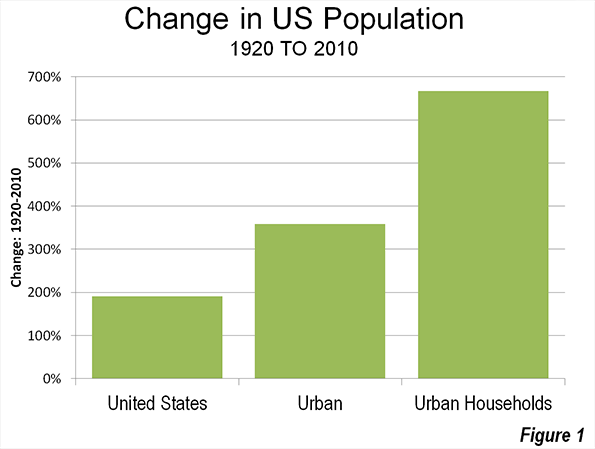
    The second trend was even more significant. Average household size has fallen from 4.6 in 1920 to 2.6 by 2000, where it remained in the 2010 census. The result is that there are now 7.7 times as many households (Note 1) in urban areas as there were in 1920 (Figure 1).

    Urban Area Trends

    In the 1960s, the Urban Land Institute sponsored research by Jerome P. Pickard (Note 2) to replicate urban area population and density data going back to 1920, using the generalized criteria that had been developed by the Census Bureau for the 1950 and 1960 censuses.

    According to Pickard’s work, there were five urban areas in the United States with more than 1 million population in 1920. Unfortunately, the publication did not include Detroit, which undoubtedly had an urban area population of more than 1 million in 1920 (Note 3). In addition, Pickard found nine urban areas with populations between 500,000 and 1 million.

    By contrast, today there are 42 urban areas with more than 1 million population and 38 with between 500,000 and 1 million population.

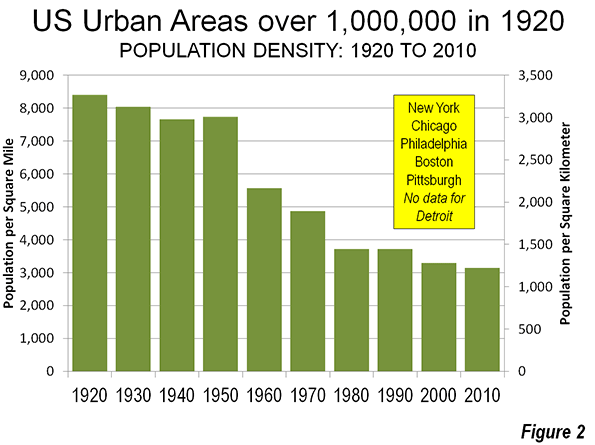
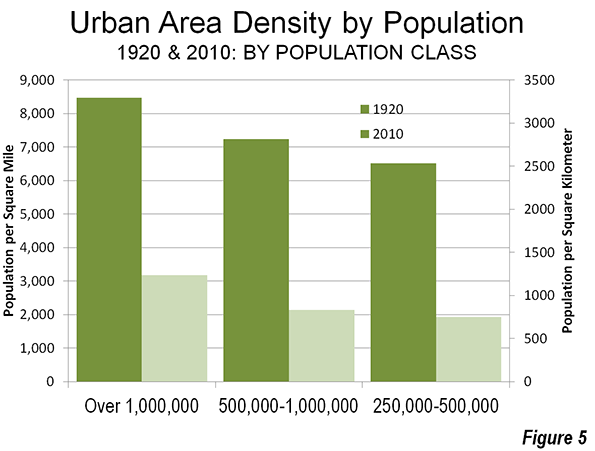
    In 1920, the five major urban areas for which there is data had an overall population density of 8,400 per square mile (3,700 per square kilometer). This figure dropped continually, except for between 1940 and 1950 as to its present level (Figure 2) of approximately 3,100 per square mile (1,200 per square kilometer).

    However, caution is required, because before 2000, urban areas generally contained only complete municipalities. Two of the nation’s major urban areas had substantial rural (greenfield) expenses inside their core cities in 1920. This was most pronounced in the core city of New York, where most of Queens and most of Staten Island were undeveloped. Between 1920 and 2010, these two boroughs added more than 1.8 million population, most of which was on greenfield land, rather than the densification of the existing urban neighborhoods. This was in effect, suburban expansion within the city of New York. The same dynamics occurred, to a lesser degree in core cities such as Philadelphia and Los Angeles.

    Pickard finds a population density of 10,600 per square mile (4,100 per square kilometer) for the New York urban area in 1920. It had fallen by half to 5,300 per square mile (2,050 per square kilometer) by 2010.

    Core City and Suburban Growth

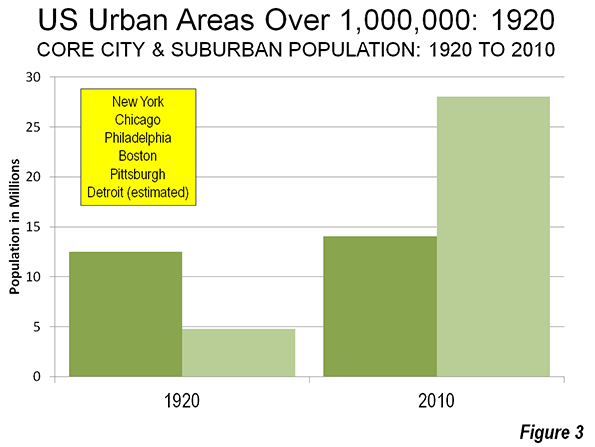
    Over the period, the bulk of the population growth (92 percent) was in the suburbs (Figure 3). Even that figure, however, understates the extent of suburban growth. As was above, the inclusion of rural areas as urban in municipalities appears to have been a major driver of the population increase in the city of New York, which added 2.4 million people between 1920 and 2010. Among the other five major urban areas, which includes an estimate for Detroit (Note 2), the core municipalities lost population in each case over the 90 years, though they all continued to grow at least until 1950.

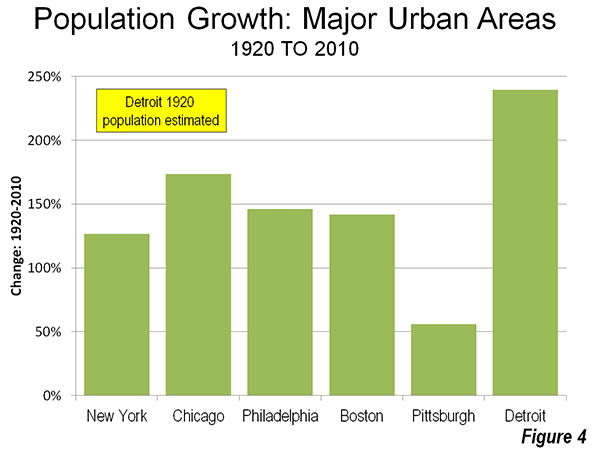
    All of the six major urban areas in 1920 were in the Northeast or the Midwest. The fastest growing urban area from 1920 to 2010 among the six was Detroit, despite the huge losses of its core municipality (Figure 4). No municipality in the world of Detroit’s 1950 size (1.85 million) has lost so much of its population (1.1 million) in all of history. Yet, the Detroit urban area is estimated to have added approximately 2.6 million people to its urban area population since 1920, for an approximately 240 percent increase in population. The Detroit urban area peaked in 2000 at 160,000 higher than in 2010. The second fastest growing larger urban area was Chicago, at approximately 175 percent, while Philadelphia gained 146 percent and Boston 142 percent.

    Urban Areas with 500,000 to 1,000,000 Population in 1920

    The nine urban areas with 500,000 to 1,000,000 population in 1920 had a much lower population density, at 7,200 per square mile (2,800 per square kilometer). This figure, however, is artificially low because of the Los Angeles urban area’s extremely small 1920 density (1,700 per square mile or 650 per square kilometer). Just a few years before the 1920 census, Los Angeles had annexed the San Fernando Valley and other largely rural areas. As a result the city quadrupled in land area. Again, the inclusion of rural areas in the core city rendered Pickard’s urban area (and that of the Census Bureau to at least in 1950) unreflective of actual urban densities in Los Angeles.

    Milwaukee: More Dense than New York

    The Milwaukee urban area, with a population of 504,000 had the highest density in the nation, at 10,900 per square mile (4,200 per square kilometer), which was the last time before 1990 that the New York urban area was not the most dense major urban area. In 1990, the Los Angeles area became more dense than  the New York urban area. By 2000, both the San Francisco and the all-suburban San Jose urban area had also passed New York,

    Falling Densities and Causes

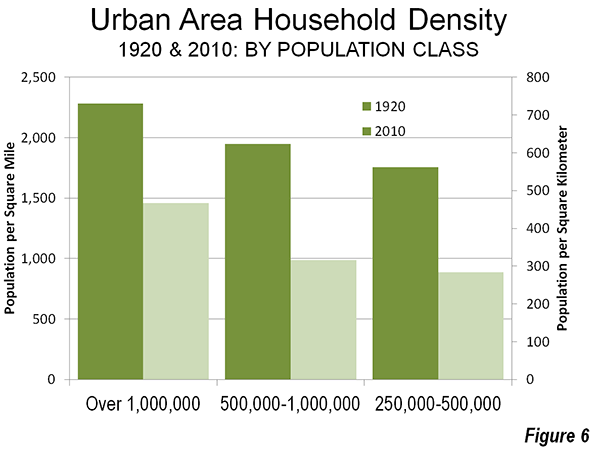
    The population density declines were substantial over the period, at from 63 percent to 70 percent. At the same time, falling household sizes created the requirement for more houses and household densities fell at a slower rate, 37 percent in the largest areas and 50 percent in the smaller metropolitan areas. There were other factors as well, such as more efficient manufacturing and commercial operations, that took more space, urban planning requirements in some metropolitan areas (such as Boston and Atlanta) that required larger than market  building lots (large lot zoning)and the general preference for more land and space on the part of consumers. The US has not been alone in this. The trend toward lower densities has been virtually universal, from Mumbai and Manila to Moscow and Milan.


    Wendell Cox is a Visiting Professor, Conservatoire National des Arts et Metiers, Paris and the author of “War on the Dream: How Anti-Sprawl Policy Threatens the Quality of Life.

    —-

    Note 1: Assumes the same average household size for urban and rural areas.

    Note 2: Jerome P. Pickard, Dimensions of Metropolitanism, Urban Land Institute, 1967.

    Note 3: In 1920, the municipality of Detroit had a population of 993,000 and a population density of 12,700 per square mile (4,900 per square kilometer). Wayne County, which includes Detroit, had a population of 1,170,000. The land area of the county was approximately nine times that of the municipality, nearly all of it rural. On that basis it is estimated that the urban area would have had no more than 1,100,000 residents.

    Photo: New York in the 1920s (Singer Building in foreground, Woolworth Building in the background). Photograph by the U.S. Census Bureau, Public Information Office (PIO).

  • Bank Collapse in Cyprus: Which Way Now?

    Having run out of options to solve its bigger problems, European Union commissioners, in the spirit of famed bank robber Willy Sutton, have decided to go after depositors’ money on Cyprus for a simple reason: “That’s where the money is.” Will the current shake down of bank depositors on Cyprus save or sink the Euro? It stretches the imagination to fathom how putting bank depositors in play will comfort European Union bondholders or other EU banks.

    In exchange for $13 billion in bailout money for the Cyprus government, the EU has demanded that the local banking system, bloated with offshore deposits including many from Russia and Eastern Europe, pony up in the interests of Euro harmony.

    An island divided into Greek and Turkish spheres of influence, Cyprus was allowed into the EU, and later the Euro, as an early attempt to gloss over European ethnic fault lines and pump hot money into the sovereign debts of Greece and East European countries. Greek Cyprus is the tax haven of choice for Russian companies and oligarchs, many of whom register their worldwide assets under Cypriot holding companies and maintain huge deposits in the local banking system.

    Before the recent crisis, the Cypriot banking system held assets in its banks and fiduciary companies that amounted to more than five times the country’s gross domestic product.

    Business as usual in Cyprus meant that, with few questions asked locally, an overseas investor — including many from Serbia, Romania, and the Ukraine, as well as Russia—could set up a front company, open a bank account, and run his or her financial empire away from the long arm of any government accountants.

    The problem for the Cypriot banks wasn’t attracting deposits, it was finding a place to put them once they arrived by SWIFT (the international transfer system), the Fed Wire, or suitcases.

    Confusing their swelling balance sheets with the genius of J.P. Morgan, local bankers made several fatal mistakes. They lent their newfound money to the Greek government by buying its bonds, they invested in now-failing real estate deals, and they funded these long-term bets with deposits that could be withdrawn in less than ninety days.

    In justifying these strategies to clients, the Cyprus banks claimed that their long positions in Greek government bonds, denominated in Euros, came with an implicit EU guarantee, which also served as a reason to pay minimum rates on short-term deposits, and to bet the ranch on long-term Euro bonds. The Euro gave Cyprus cover for punting.

    In the era of the Greek drachma, German leader Angela Merkel would not have delayed a hair appointment to keep Greece solvent, let alone to save its lovechild in Nicosia, a Balkan money-changing city hard up against the border of the Turkish mercenary state in northern Cyprus. Still, even today, the Cypriot pyramid might have withstood the lazy stress test of a buoyant market.

    The first Cyprus rescue plan called for the island’s bank depositors (whose deposits totaled $82 billion at the peak) to cough up 10% of their wealth into the stabilization fund. That financial haircut, however, called also for a 7% trim from local clients, not just a shave for Russian oligarchs. Local Cypriots voted with their middle fingers.

    Although the inspiration to drain local bank accounts to offset subsidies from Brussels was attributed to EU bureaucrats, if not Merkel and French President François Hollande, the impulse for an open season on passbook savings comes from the worldwide assault on tax havens, led by the United States.

    In its search for money to balance it own mismatched accounts, the US has taken the position that the dollar, instead of an international commodity or method of exchange, is a national loyalty oath, and is imposing tax obligations on those that have some in their wallets. Even though the EU is more a tariff union than a functioning government, Brussels has warmed to the idea that bank depositors within its fragile borders are fair game for a fleecing.

    The revised Cyprus plan walked back from skimming all bank deposits, and shook down the depositors only of the two largest banks, the Bank of Cyprus and Laiki (Cyprus Popular) Bank. It demanded the sale of $500 million in the central bank’s gold, unsettling financial markets.

    While the heist was in the planning stage, all Cypriot banks were closed, to keep the hot money from turning into flight capital, once removed.

    The Bank of Cyprus will survive, barely, although Laiki is going belly up, which through the magic of bankruptcy laws will put its €24 billion in deposits at the disposal not just of local liquidators but also of EU “structural reformists,” who have more in common with Butch Cassidy and the Sundance Kid than with International Monetary Fund economists.

    The biggest losers are the Cyprus banks’ shareholders, bondholders, and depositors, who are being bled dry so that the Euro might live. Think of these write-downs as a pan-European tax, assessed mostly on shady front companies that don’t vote in German regional elections. Russian President Vladimir Putin isn’t thrilled that his offshore economy was chosen to make the world safe for par-value Spanish bonds.

    As a consequence, bank depositors will flee not just failing Mediterranean banks, but those in Milan, London, and Frankfurt. They will seek safety in gold, real estate, art, stock markets, and hedge funds, leaving money-center banks down the road to scramble for their liabilities (in the accounting world, deposits are something you owe).

    The bigger problem with the Cypriot financial collapse of 2013, though, is that it threatens to turn the EU into a divided nation — not unlike Cyprus itself — that may need to balance its books with offshore money and lax accounting.

    More than the crises of Italian elections or French unemployment, the Cyprus bank run threatens to pull apart the rickety architecture of a union that can no longer roll over its Eurobonds on what Willy Loman used: “a smile and a shoeshine.” Because of bad balance sheets in Cyprus, as well as in Spain, Italy, Ireland, and Greece, bondholders are no longer “smiling back” at the EU.

    German Chancellor Otto von Bismarck said in the late nineteenth century that “some damn thing in the Balkans” might drag Russia into war with Austria-Hungary, or with his Prussian confederation. In that instance, the murder of an Austrian archduke in Sarajevo shattered Europe into fragments that lasted for most of the twentieth century, a division that the EU and its Euro were designed to glue together.

    When the dust settles on Cyprus, the losers will be the local economy — headed for a double-digit recession — and Europe’s bank depositors, who in theory should be the backbone of a successful economic union.

    Matthew Stevenson, a contributing editor of Harper’s Magazine, is the author of Remembering the Twentieth Century Limited, a collection of historical travel essays. His next book is Whistle-Stopping America.

    Flickr photo by Leonid Mamchenkov taken in Limassol, Cyprus.

  • Enterprising States 2013: Getting Down to Small Business

    The following is an exerpt form a new report, Enterprising States, released this week by the U.S. Chamber of Commerce Foundation and written by Praxis Strategy Group and Joel Kotkin. Visit this site to download the full pdf version of the report, or check the interactive dashboard to see how your state ranks in economic performance and in the five policy areas studied in the report.

    Nothing better expresses America’s aspirational ideal than the notion of small enterprise as the primary creator of jobs and innovation. Small businesses, defined as companies with fewer than 500 employees, have traditionally driven our economy, particularly after recessions. Yet today, in a manner not seen since the 1950s, the very relevance and vitality of our startup culture is under assault. For the country and the states, this is a matter of the utmost urgency.

    The central motor of the job engine clearly is not firing on all cylinders. Historically, small business has accounted for almost two-thirds of all net new job creation, but recent research shows that the rates of new business startups are at record lows. The “gazelle companies”—fast-growing firms, mostly younger ones—have traditionally made outsized contributions to new job creation. After previous recessions, these businesses drove job growth and, perhaps more important, created innovations that often spread to larger, older, more established firms, which sometimes later acquired them.

    Weak job growth has touched the entire economy. Gross domestic product growth is weak, unemployment remains at nearly 8%, and business sentiment is far from optimal. Despite high stock prices and consistently strong corporate profits, the rate of employment growth remains lower than the rate of the expansion of the workforce. Given the understandable focus of larger firms on boosting productivity and on investing capital into technology, it’s highly unlikely these companies will create enough jobs to dent our huge and growing employment deficit.

    Policymakers ignore small business at their own peril and that of the economy.

    The Changing Nature of Small Business

    Small business may be down, but it is far from out. There have been some small, subtle upward shifts in employment in three of the industries—construction, manufacturing, and retail—that bore the brunt of the recession-driven job losses. Any sustained uptick in growth will further widen the opportunities for small business to expand and perhaps recover something of its past vigor.

    It is critical that states and communities that embrace a pro-enterprise vision address a rapidly changing small business environment. Small business today reflects a host of ethnic, social, and generational changes. Successful programs will need to adapt to these new realities that reflect a far more diverse, and profoundly different, set of players.

    Immigrants constitute a growing and important part of the entrepreneurial landscape. Even in the midst of the recession, newcomers continued to form businesses at a record rate. The number of women-owned firms has grown at one and a half times the rate of other small enterprises over the past 15 years. These companies now account for almost 30% of all enterprises. Finally, there is the issue of generational change. Baby boomers were, on the whole, a profoundly entrepreneurial generation, and by many measurements their Generation X successors have proven even more so. The millennial generation, based on recent assessments, may be somewhat less entrepreneurial than their predecessors.

    We are also witnessing the rise of a new kind of enterprise that often employs no more than the proprietors but frequently provides quite sophisticated high-level products or services. In many cases, these “jobless entrepreneurs” include corporate executives, technicians, and marketing professionals who, by either choice or necessity, have chosen to strike out in their own micro-enterprises. A large portion of this growing “1099 economy” comes from the growing ranks of boomers who are no longer willing or able to work for a larger enterprise. According to the Census Bureau, small business without payroll makes up more than 70% of America’s 27 million companies, with annual sales of $887 billion.

    The States Get Down to Small Business

    Every state has policies and programs that are intended to encourage entrepreneurship and support small business development and expansion. Many states have introduced legislation or established programs to focus on startup companies, and many states have bolstered policies targeted at helping existing businesses grow and expand their markets. State funding of programs for entrepreneurial development is estimated to have increased by 30% between 2012 and 2013.  

    States vary considerably in the policies, regulations, and taxes that affect small business. Most states have an array of loosely integrated small business programs, although some have a more comprehensive, integrated small business policy and program framework. No state has the “best” tax policy for all entrepreneurs. Instead, different states have tax policies that suit certain types of companies better than others. Consequently, the states that are best for new businesses are not always the most favorable for existing small businesses; the states that are best for one business sector may not be best for another.

    States and cities should consider small business development not as a separate cause, but as a basic building block for economic growth. Even if state governments can do little to promote enterprise and small business development directly, there are things they can do to increase the chances that entrepreneurs will thrive. Smart, pragmatic economic policymaking at the state level can play an instrumental role in fostering startups and growing companies, particularly when programs are effectively deployed right where the businesses are located.

    The following are some new and innovative policy and program approaches that states are employing and/or supporting to create and expand small businesses, often in cooperation with local and regional development organizations:

    • Accelerator initiatives that focus on starting high-growth firms by turning startups into enduring companies.
    • Economic gardening initiatives that focus on expanding existing firms with strong growth potential.
    • Business plan competitions to identify companies with exciting ideas and high potential.
    • Business ecosystem initiatives, often with a regional focus, that take a comprehensive approach to creating an environment that is highly conducive to startups.
    • Workforce development initiatives that help small businesses find and train the talent they need to operate and compete.
    • Seed and venture funds that focus on startups and expanding firms.
    • Networking and collaboration initiatives that bring small businesses and self-employed entrepreneurs together with large companies and universities.
    • International trade programs that help small businesses reach out to new global export markets.
    • Streamlined state administrative processes and regulatory procedures for small business by cleaning up the DURT (delays, uncertainty, regulations, taxes) that impede small business success.
    • Broadband investments that provide small businesses of all types with the online access necessary in the 21st century.

    Governors of states recognize the importance of small businesses and often take the lead in reforming state policy and service delivery to make growth and commerce easier for small business. Governors can offer fast-track access to financial resources and a full slate of state services that help small businesses connect with technical expertise, customers, suppliers, and state agencies that interact with small business as regulators or partners in development.

    State and local chambers of commerce are on the front lines of promoting a pro-business free enterprise agenda and thwarting anti-business legislation, regulations, and rules. Across the country, chambers of commerce lead the way in advocating on behalf of their members for lower costs of doing business, fairer taxes, fairer regulations, and less regulatory paperwork. They work with the U.S. Chamber of Commerce, governors, industry, and professional associations to pursue outcomes that are beneficial to all businesses and, thereby, advance America’s free enterprise economy.

    Visit this site to download the full pdf version of the report, or check the interactive dashboard to see how your state ranks in economic performance and in the five policy areas studied in the report.

    Praxis Strategy Group is an economic research, analysis, and strategic planning firm. Joel Kotkin is executive editor of NewGeography.com and author of The Next Hundred Million: America in 2050.

  • It’s Not About The Climate: How the Left Lost Sight of Social Justice

    Over the last few decades, humans achieved one of the most remarkable victories for social justice in the history of the species. The percentage of people who live in extreme poverty — under $1.25 per day — was halved between 1990 and 2010. Average life expectancy globally rose from 56 to 68 years since 1970. And hundreds of millions of desperately poor people went from burning dung and wood for fuel (whose smoke takes two million souls a year) to using electricity, allowing them to enjoy refrigerators, washing machines, and smoke-free stoves.

    Of course, all of this new development puts big pressures on the environment. While the transition from wood to coal is overwhelmingly positive for forests, coal-burning is now a major contributor to global warming. The challenge for the 21st Century is thus to triple global energy demand, so that the world’s poorest can enjoy modern living standards, while reducing our carbon emissions from energy production to zero.

    For the last 20 years, most everyone who cared about global warming hoped for a binding international treaty abroad, and some combination of carbon pricing, pollution regulations, and renewable energy mandates at home. That approach is now in ruins. In 2010, UN negotiations failed to create a successor to the failed Kyoto treaty. A few months later cap and trade died in the Senate. And two weeks ago, the slow motion collapse of the European Emissions Trading Scheme reached its nadir, with carbon prices, already at historic lows, collapsing after EU leaders refused to tighten the cap on emissions.

    What rushed into the vacuum was “climate justice,” a movement headed by more left-leaning groups like 350.org, the Sierra Club, and Greenpeace. These groups invoke the vulnerability of the poor to climate change but elide the reality that more energy makes them more resilient. “Huge swaths of the world have been developing over the last three decades at an unprecedented pace and scale,” writes political scientist Christopher Foreman in “On Justice Movements,” a new article (below) for The Breakthrough Journal. “Contemporary demands for climate justice have been, at best, indifferent to these rather remarkable developments and, at worst, openly hostile.”

    For the climate justice movement, global warming is not to be dealt with by switching to cleaner forms of energy but rather by returning to a pastoral, renewable-powered, and low-energy society. “Real climate solutions,” writes Klein, “are ones that steer these interventions to systematically disperse and devolve power and control to the community level, whether through community-controlled renewable energy, local organic agriculture or transit systems genuinely accountable to their users…”

    Climate change can only be solved by “fixing everything,” says McKibben, from how we eat, travel, produce, reproduce, consume, and live.”It’s not an engineering problem,” McKibben argued recently in Rolling Stone, “it’s a greed problem.” Fixing it will require a “new civilizational paradigm,” says Klein, “grounded not in dominance over nature but in respect for natural cycles of renewal.”

    Climate skeptics are right, Klein cheerily concludes: the Left is using climate change to advance policies they have long wanted. “In short,” says Klein, “climate change supercharges the pre-existing case for virtually every progressive demand on the books, binding them into a coherent agenda based on a clear scientific imperative.”

    As such, global warming is our most wicked problem. The end of our world is heralded by ideologues with specific solutions already in mind: degrowth, rural living, low-energy consumption, and renewable energies that will supposedly harmonize us with Nature. The response from the Right was all-too predictable. If climate change “supercharges the pre-existing case for virtually every progressive demand,” conservatives long ago decided, then climate change is either not happening, or is not much to worry about.

    Wicked problems can only be solved if the ideological discourses that give rise to them are disrupted, and that’s what political scientist Foreman does brilliantly in “On Justice Movements.” If climate justice activists truly cared about poverty and climate change, Foreman notes, they would advocate things like better cook stoves and helping poor nations accelerate the transition from dirtier to cleaner fuels. Instead they make demands that range from the preposterous (e.g., de-growth) to the picayune (e.g., organic farming).

    Once upon a time, social justice was synonymous with equal access to modern amenities — with electric lighting so poor children could read at night, with refrigerators so milk could be kept on hand, and with washing machines to save the hands and backs of women. Malthus was rightly denounced by generations of socialists as a cruel aristocrat who cloaked his elitism in pseudo-science, in the claim that Nature couldn’t possibly feed any more hungry months.

    Now, at the very moment modern energy arrives for global poor — something a prior generation of socialists would have celebrated and, indeed, demanded — today’s leading left-wing leaders advocate a return to energy penury. The loudest advocates of cheap energy for the poor are on the libertarian Right, while The Nation dresses up neo-Malthusianism as revolutionary socialism.

    Left-wing politics was once about destabilizing power relations between the West and the Rest. Now, under the sign of climate justice, it’s about sustaining them.

    This piece originally appeared at The Breakthrough.

  • The Triumph of Suburbia

    The “silver lining” in our five-years-and-running Great Recession, we’re told, is that Americans have finally taken heed of their betters and are finally rejecting the empty allure of suburban space and returning to the urban core.

    “We’ve reached the limits of suburban development,” HUD Secretary Shaun Donovan declared in 2010. “People are beginning to vote with their feet and come back to the central cities.” Ed Glaeser’s Triumph of the City and Alan Ehrenhalt’s The Great Inversion—widely praised and accepted by the highest echelons of academia, press, business, and government—have advanced much the same claim, and just last week a report on jobs during the downturn garnered headlines like “City Centers in U.S. Gain Share of Jobs as Suburbs Lose.”

    There’s just one problem with this narrative: none of it is true. A funny thing happened on the way to the long-trumpeted triumph of the city: the suburbs not only survived but have begun to regain their allure as Americans have continued aspiring to single-family homes.

    Read the actual Brookings report that led to the “Suburbs Lose” headline: it shows that in 91 of America’s 100 biggest metro areas, the share of jobs located within three miles of downtown declined over the 2000s. Only Washington, D.C., saw significant growth.

    To be sure, our ongoing Great Recession slowed the rate of outward expansion but it didn’t stop it—and it certainly didn’t lead to a jobs boom in the urban core.

    “Absent policy changes as the economy starts to gain steam,” report author and urban booster Elizabeth Kneebone warned Bloomberg, “there’s every reason to believe that trend [of what she calls “jobs sprawl”] will continue.”

    The Hate Affair With Suburbia

    Suburbs have never been popular with the chattering classes, whose members tend to cluster in a handful of denser, urban communities—and who tend to assume that place shapes behavior, so that if others are pushed to live in these communities they will also behave in a more enlightened fashion, like the chatterers. This is a fallacy with a long pedigree in planning circles, going back to the housing projects of the 1940s, which were built in no small part on the evidently absurd, and eventually discredited, assumption that if the poor had the same sort of housing stock as the rich, they would behave in the same ways.

    Today’s planning class has adopted what I call a retro-urbanist position, essentially identifying city life with the dense, highly centralized and transit-dependent form that emerged with the industrial revolution. When the city—a protean form that is always changing, and usually expands as it grows—takes a different form, they simply can’t see it as urban growth.

    In his masterwork A Planet of Cities, NYU economist Solly Angel explains that virtually all major cities in the U.S. and the world grow outward and become less dense in the process. Suburbs are expanding relative to urban cores in every one of the world’s 28 megacities, including New York and Los Angeles.  Far from a perversion of urbanism, Angel suggests, this is the process by which cities have grown since men first established them.

    In the U.S., the hate affair with suburbs and single-family housing, even in the city, dates to their rapid growth in the American boom after the first World War. In 1921 historian and literary criticic Lewis Mumford described the expansion of New York’s outer boroughs as a “dissolute landscape,” “a no-man’s land which was neither town or country.” Decades later, Robert Caro described the new rows of small, mostly attached houses—still the heart of the city’s housing stock—built in the post-war years as “blossoming hideously” as New Yorkers fled venerable, and congested, parts of Brooklyn and Manhattan for more spacious, tree-lined streets farther east, south, and north.

    In the 1950s, the rise of mass-produced suburbs like Levittown, New York, and Lakewood, California, sparked even more extreme criticism. Not everyone benefited from the innovation that allowed the Levitts to pioneer homes costing on average just $8,000—African-Americans were excluded from the original development—but for many middle- and working-class American whites, the housing and suburban booms represented an enormous step forward. The new low-cost suburbia, wrote Robert Bruegmann in his compact history of sprawl, “provided the surest way to obtain some of the privacy, mobility and choice that once were available only to the wealthiest and most powerful members of society.”

    The urban gentry and intelligentsia, though, disdained this voluntary migration. Perhaps the most bitter critic was the great urbanist Jane Jacobs. An aficionado of the old, highly diverse urban districts of Manhattan, Jacobs not only hated trendsetter Los Angeles but dismissed the bedroom communities of Queens and Staten Island with the memorable phrase, “The Great Blight of Dullness.” The 1960s social critic William Whyte, who, unlike Jacobs, at least bothered to study suburbs close up, denounced them as hopelessly conformist and stultifying. Like many later critics, he predicted in Fortune that people and companies would tire of them and return to the city core.

    More recent critiques of suburbia have focused as well on their alleged vulnerability in an energy-constrained era. “The American way of life—which is now virtually synonymous with suburbia—can only run on reliable supplies of cheap oil and gas,” declares James Howard Kunstler in his 2005 peak oil jeremiad, The Long Emergency. “Even mild to moderate deviations in either price or supply will crush our economy and make the logistics of daily life impossible.”

    Too often, the anti-surbanites seem to take a certain perverse comfort in any development, no matter how grim, that “helps” protect Americans from the “wrong choice” of aspiring to space of their own. The housing crash of 2007 was cheered on in some circles as the death knell of the suburban dream, as when theorist Chris Leinberger declared in the Atlantic that soon, poor families would be crowding into dilapidated McMansions in the “suburban wastelands.

    For retro-urbanists such as Richard Florida the reports, however premature, of the death of the suburbs, confirmed deeply held notions about the superiority of dense, urban living.  He summarily declared the single-family house archaic, and the quest for homeownership one of the “countless forms of over-consumption that have a horribly distorting affect on the economy."

    The Real Geography of America

    But the simple fact remains that the single-family home has remained the American dream, with sales outpacing those of condominiums  and co-ops despite the downturn.

    Florida has suggested that simply stating the numbers makes me a sprawl lover While he and other urban nostalgists see the city only in its dense urban core, and the city’s role as intimately tied with the amenities that are supposed to attract the relatively wealthy members of the so-called “creative class,” I see the urban form as ever changing, and consider a city’s primary mission not aesthetic or simply economic but to serve the interests and aspirations of all of its residents.

    Clearly the data supports a long-term preference for suburbs. Even as some core cities rebounded from the nadir of the 1970s, the suburban share of overall share of growth in America’s 51 major metropolitan areas (those with populations  of at least one million) has accelerated—rising from 85 percent in the ’90s to 91 percent in the ’00s. There’s more than a tinge of elitism animating the urban theorists who think that urban destiny rides mostly with the remaining nine percent matters. Overall, over 70 percent of residents in the major metropolitan areas now live in suburbs.

    Surveys, including those sponsored by the National Association of Realtors, suggest roughly 80 percent of Americans prefer a single family house to an apartment or a townhouse. Only 8 percent would prefer to live in an apartment. Yet just 70 percent of households live in a single-family house, while 17 percent live in apartments—suggesting the demand for single-family houses is still not being met. Such housing may be unaffordable, particularly in high-cost urban cores, but there is a fundamental market demand for it.

    To be sure, the Great Recession did slow the growth of suburbs and particularly exurbs—but recent indicators suggest a resurgence. An analysis last October by Jed Kolko, chief economist at the real estate website Trulia, reports that between 2011 and 2012 less-dense-than-average ZIP codes grew at double the rate of more-dense-than-average ZIP codes in the 50 largest metropolitan areas. Americans, he wrote, “still love the suburbs.”

    The Future Demographics of Suburbia

    Ultimately the question of growth revolves around the preferences of consumers. Despite predictions that the rise of singles, an aging population and the changing preferences of millennials will create a glut of 22 million unwanted large-lot homes by 2025, it seems more likely that three critical groups will fuel demand for more suburban housing.

    Between 2000 and 2011, there has been a net increase of 9.3 million in the foreign born population, largely from Asia and Latin America, with these newcomers accounting for about two out of every five new residents of the nation’s 51 largest metropolitan areas. And these immigrants show a growing preference for more “suburbanized” cities such as Nashville, Charlotte, Houston and Dallas-Fort Worth. An analysis of census data shows only New York—with nearly four times the population—drew (barely) more foreign-born arrivals over the past decade than sprawling Houston. Overwhelmingly suburban Riverside–San Bernardino expanded its immigrant population by nearly three times as many people as the much larger and denser Los Angeles–Orange County metropolitan area.

    Clearly, immigrants aren’t looking for the density and crowding of Mexico City, Seoul, Shanghai, or Mumbai. Since 2000, about two-thirds of Hispanic household growth was in detached housing. The share of Asian arrivals in detached housing is up 20 percent over the same span. Nearly half of all Hispanics and Asians now live in single-family homes, even in traditionally urban places like New York City, according to the census’s American Community Survey.

    Nowhere are these changes more marked than among Asians, who now make up the nation’s largest wave of new immigrants. Over the last decade, the Asian population in suburbs grew by about 2.8 million, or 53 percent, while that of core cities grew by 770,000, or 28 percent.

    Aging boomers, too, continue to show a preference for space, despite the persistent urban legend that they will migrate back to the core city. Again, the numbers tell a very different story.

    A National Association of Realtors survey last year of buyers over 65 found that the vast majority looked for suburban homes. Of the remaining seniors, only one in 10 looked for a place in the city—less than the share that wanted a rural home. When demographer Wendell Cox examined the cohort that was 54 to 65 in 2000 to see where they were a decade later, the share that lived in the suburbs was stable, while many had left the city—the real growth was people moving to the countryside. Within metropolitan areas, more than 99 percent of the increase in population among people aged 65 and over between 2000 and 2010 was in low-density counties with less than 2,500 people per square mile.

    With the over-65 population expected to double by 2050, making it by far America’s fastest-growing age group, they appear poised to be a significant source of demand for suburban housing.

    But arguably the most critical element to future housing demand is the rising millennial generation. It has been widely asserted by retro-urbanists that young people prefer urban living. Urban theorists such as Peter Katz have maintained that millennials (the generation born after 1983) have little interest in “returning to the cul-de-sacs of their teenage years.” 

    To bolster their assertions, retro-urbanist point to stated-preference research showing that more than three quarters of millennials say they “want to live in urban cores.” But looking at where millenials actually live now—and where they see themselves living in the future—shows a very different story. In the nation’s major metropolitan areas, only 8 percent of residents aged 20 to 24 (the only millennial adult age group for which census data is available) live in the highest-density counties—and that share has declined from a decade earlier. What’s more, 43 percent of millenials describe the suburbs as their “ideal place to live”—a greater share than their older peers—and 82 percent of adult millenials say it’s “important” to them to have an opportunity to own their home.

    And, of course, as people get older and take on commitments and start families, they tend to look for more settled, and less dense, environments. A 2009 Pew study found that 45 percent of Americans 18 to 34 would like to live in New York City, compared with just 14 percent of those over 35. As about 7 million more millenials—a group the Pew surveys show desire children and place a premium on being good parents—hit their 30s by 2020, expect their remaining attachment to the city to wane.

    This family connection has always eluded the retro-urbanists. “Suburbs,” Jane Jacobs once wrote, “must be difficult places to raise children.” Yet suburbs have served for three generation now as the nation’s nurseries. Jacobs’s treatment of the old core city—particularly her Greenwich Village in the early 1960s—lovingly portrayed these places as they once were, characterized by class, age, and some ethnic diversity along with strong parental networks, often based on ethnic solidarity.

    To say the least, this is not what characterizes Greenwich Village or in Manhattan today. In fact, many of the most vibrant, and high-priced urban cores—including Manhattan, San Francisco, Chicago, and Seattle—have remarkably few children living there. Certainly, the the 300-square-foot “micro-units” now all the rage among the retro-urbanist set seem unlikely to attract more families, or even married couples.

    The Persistence of the Suburban Economy

    As Americans have voted with their feet for the suburbs, employers have followed.

    Despite the attention heaped on a handful of companies like United Airlines and Quicken Loans that have moved “back to the city,” the suburbanization of the overall American economy has continued apace. Historically, suburbs served largely as residential areas, so-called bedroom communities, but their share of steadily.

    Job dispersion is now a reality in virtually every metropolitan area, with twice as many jobs located 10 miles from city centers as in those centers. Between 1998 and 2006, as 95 out of 98 metro areas saw a decrease in the share of jobs located within three miles of downtown, according to a Brookings report. The outermost parts of these metro areas saw employment increase by 17 percent, compared to a gain of less than 1 percent in the urban core. Overall, the report found, only 21 percent of employees in the top 98 metros in America live within three miles of the center of their city.

    This decentralization of jobs was slowed somewhat by the Great Recession, which hit more dispersed industries like construction, manufacturing and retail particularly hard. Yet an analysis of jobs in 2010 by the Rudin Center for Transport Policy and Management found that dispersion had continued. Between 2002 and 2010 only two of the top 10 metropolitan regions (New York and San Francisco) saw a significant increase in employment in their urban core.

    Some observers claim that job growth is coming to the urban core in response to the changing preferences of younger workers, particularly in high-tech fields and as much media attention has been given to a few prominent social media start ups in New York and San Francisco. Similar pronouncements were  made during the great dot-com boom of the late 1990s, and burst along with the bubble. In fact, the number of urban core country tech jobs actually shrank over the past decade, according to an analysis of Science, Technology, Engineering and Management (STEM) jobs by Praxis Strategy Group.

    While companies in walking distance of big-city reporters make news out of all proportion to their importance, virtually all the major tech concentrations in the country—including Silicon Valley—are suburban. San Jose is a postwar suburban core municipality, having experienced the vast bulk of its growth since 1940. Virtually all the nation’s top tech companies—Apple, Google, Hewlett-Packard, Intel, Oracle and even Facebook—are located in suburban settings 45 minutes or more from San Francisco. Apple’s recent plans to construct its new corporate campus in bucolic Cupertino elicited anger from the Environment Defense Fund and other smart-growth advocates, but reflects the fact that the vast majority of the tech industry is located, along with the bulk of its workforce, in the suburbs.

    Apple employs many experienced engineers, many of whom have families and prefer to live in suburbs. In 2012 San Francisco had a significantly lower share of STEM jobs per capita than Santa Clara County. And the new rising stars of the tech world—Austin and Raleigh-Cary—are even more dispersed and car-dependent than San Jose. 

    What Really Matters

    While they’ve weaved a compelling narrative, the numbers make it clear that the retro-urbanists only chance of prevailing is a disaster, say if the dynamics associated with the Great Recession—a rise in renting, declining home ownership and plunging birthrates—become our new, ongoing normal. Left to their own devices, Americans will continue to make the “wrong” choices about how to live.

    And in the end, it boils down to where people choose to live. Despite the dystopian portrays of suburbs, suburbanites seem to win the argument over place and geography, with far higher percentages rating their communities as “excellent” compared to urban core dwellers.

    Today’s suburban families, it should be stressed, are hardly replicas of 1950s normality; as Stephanie Coontz has noted, that period was itself an anomaly. But however they are constituted—as blended families, ones headed up by single parents or gay couples—they still tend to congregate in these kinds of dispersed cities, or in the suburban hinterlands of traditional cities. Ultimately life style, affordability and preference seem to trump social views when people decide where they would like to live.

    We already see these preferences establishing themselves, again, among   Generation X and even millennials as some move, according to The New York Times,toward “hipsturbia,” with former Brooklynites migrating to places along the Hudson River. The Times, as could be expected, drew a picture of hipsters “re-creating urban core life” in the suburbs. While it may be seems incomprehensible to the paper’s Manhattan-centric world view by moving out, these new suburbanites are opting not to re-create the high-density city but to leave it for single-family homes, lawns, good schools, and spacious environments—things rarely available in places such as Brooklyn except to the very wealthiest. Like the original settlers of places like Levittown, they migrated to suburbia from the urban core as they get married, start families and otherwise find themselves staked in life. In an insightful critique, the New York Observerskewered the pretensions of these new suburbanites, pointing out that “despite their tattoos and gluten-free baked goods and their farm-to-table restaurants, they are following in the exact same footsteps as their forebears.”

    So, rather than the “back to the cities” movement that’s been heralded for decades but never arrived, we’ve gone “back to the future,” as people age and arrive in America and opt for updated versions of the same lifestyle that have drawn previous generations to the much detested yet still-thriving peripheries of the metropolis.

    Joel Kotkin is executive editor of NewGeography.com and a distinguished presidential fellow in urban futures at Chapman University, and a member of the editorial board of the Orange County Register. He is author of The City: A Global History and The Next Hundred Million: America in 2050. His most recent study, The Rise of Postfamilialism, has been widely discussed and distributed internationally. He lives in Los Angeles, CA.

    This piece originally appeared in the The Daily Beast.

    Suburbs photo by BigStock.

  • Class Warfare for Republicans

    As a Truman-style Democrat left politically homeless, I am often asked about the future of the Republican Party. Some Republicans want to push racial buttons on issues like immigration, or try to stop their political slide on gay marriage, which will steepen as younger people replace older people in the voting booth. Others think pure market-oriented principles will, somehow, win the day. Ron Paul did best among younger Republican voters in the primaries.

    Yes, ideas do matter, but a simple defense of free markets is not likely to have broad-enough appeal. What Republicans need is a transformative issue that can attract a mass base – and that issue is class.

    Of course, the whole idea of appealing to class may be repellant to most libertarian-conservative or country-club remnants of the Republican Party. Yet, it’s the issue of the day, as President Obama recognized when he went after patrician Mitt Romney. It also may be the issue Obama now most wants to avoid, which explains his current focus on secondary issues like gun control and gay marriage.

    For their part, Republicans need to make Obama own the class issue since his record is fairly indefensible. The fortunes of the middle quintiles of Americans have been eroding pretty much since Obama took office in 2009.

    There’s nothing fundamentally unRepublican about class warfare. After all, the party – led by what was then called Radical Republicans – waged a very successful war against the old slave-holding aristocracy; there’s nothing to be ashamed of in that conquest. Republicans under Abraham Lincoln also pushed for greater landownership through such things as the Homestead Act, which supplied 160 acres of federal land to aspiring settlers.

    No one expects the Republicans to turn socialist, but they can reap benefits from anger over the crony capitalism that has become emblematic of the Obama era. Wall Street and its more popular West Coast counterparts, the venture capital "community," consistently game the political system and, usually, succeed. They win, but everyone else pretty much has to content themselves with keeping up with the IRS.

    This is where the opportunity lies. Republican opposition to Wall Street is already evident in the rise of Texas Republican Rep. Jeb Hensarling to the chairmanship of the House Banking Committee. He and Iowa GOP Sen. Charles Grassley’s attack on "too big to fail" banks are a stark contrast to the likes of New York Democratic Sen. Charles Schumer, the Capitol consigliere of the Wall Street oligarchs, or the prince of gentry liberals and defender of billionaires everywhere, New York City Mayor Michael "luxury city" Bloomberg.

    Who’s angry and ready to raise their raise their pitchforks? Try the self-employed, who are now, according to Gallup, the large constituency most alienated from the present regime. Even the hapless Romney picked up their support against Obama.

    The new core constituency of the GOP can best be identified as the enterprise base. They include small property owners, mainly in the suburbs, those who are married or aspiring to be so. They are more suburban than urban, and likely to work for someone else or themselves as opposed to working for the state. Combine the top half of private employees, over 50 million people, add some 10 million self-employed and you get to a serious economic, and political, base.

    This group also includes many immigrants, particularly Asians, a constituency that should be tilting GOP but still isn’t. They, too, increasingly live in the suburbs, own homes as well as business. And rarely do they benefit from the prevailing crony capitalism.

    The enterprise base is by nature not ideologically rigid. Most, if you talk to them, would generally support sensible infrastructure improvement as well as repairs; they also tilt towards restrained taxation and a lighter regulatory hold. It’s a movement for "Let’s get this fixed and get on with our lives."

    This new orientation would define the Republicans where they are strongest and the administration weakest – on the economy. The new wedge issues must be for a "level playing field" for entrepreneurs and the middle class and definitely not social issues, like opposition to gay rights, or support for old and new unwise wars.

    An enterprise approach, and a focus on restarting real growth, could put the Democrats on their heels and worrying about their own base. Minorities, for example, have done far worse under this administration than virtually any in recent history, including that of George W. Bush. For many, this has been what the Fiscal Times has called "a food stamp recovery."

    Among Obama’s loyalist core, African Americans, unemployment now stands at the highest level in decades; blacks, while 12 percent of the nation’s population, account for 21 percent of the nation’s jobless. The picture is particularly dire in Los Angeles and Las Vegas, where black unemployment is nearly 20 percent, and Detroit, where’s it’s over 25 percent.

    Of course, Republicans have their work cut out for them among African-Americans. But remember that Barack Obama will not be on any future ballots. A return to what Ishmael Reed has called "neo-classical" Republicanism – the same spirit that freed the slaves and fought for equal rights – could make some inroads.

    Latinos, the other major part of the party’s "downstairs" coalition, also have fared badly under Obama and could be even more amenable to a smarter GOP message. They have seen their incomes drop 4 percent over the past three years, and suffer unemployment two full points above the national average. Overall, the gap in net worth of minority households compared with whites is greater today than in 2005. White households lost 16 percent in recent years, but African-Americans dropped 53 percent and Latinos a staggering 66 percent of their precrash wealth.

    But the most critical potential constituency may prove the millennial generation, who hitherto have been a strong constituency for both the president and his party. They continue to suffer the most of any age cohort in this persistently weak economy. Already, the first wave of millennials are hitting their thirties and may be getting restless about being permanent members of "Generation Rent."

    Let’s say, in two or four years, they are still finding opportunity lagging? Cliff Zukin at Rutgers John J. Heidrich Center for Workforce Development, predicts that many will "be permanently depressed and will be on a lower path of income for probably all their [lives]." One has to wonder if even the college-educated may want to see an economy where their educations count for more than a job at Starbucks. Remember: Baby boomers, too, once tilted to the left, but moved to the center-right starting with Ronald Reagan and have remained that way.

    Yet, despite these threats, Democrats may still be rescued by perennially misfiring Republicans. There’s no Stu Spencer, Michael Deaver or Peter Hannaford on the blue team to plot strategy. Missteps remain endemic: A group of North Carolina Republicans recently proposed a measure to establish Christianity as the state religion, only to blocked by the state’s leadership.

    Others think opposing gay marriage is the ticket to revival, even though public opinion, particularly among the young, is swinging in the other direction. Some 70 percent of millennials – people in their early thirties and younger – support gay marriage, twice the rate of those over 50. Social conservatives are also gearing up on the abortion issue even though three in five Americans, according to the latest Pew survey, oppose overturning Roe v. Wade. North Dakota could be showing that America can work, literally and figuratively, but instead the state passes abortion laws that are among the strictest in the country.

    Yet, there’s still hope that some Republicans will recognize this opportunity. I would like to see this, in part, because I have seen one-party politics in action here in California, and it doesn’t work. Even more so, I’d like to see Republicans wage class warfare on behalf of the "enterprise" constituency because Democrats then would have to offer something in response, which could only have good consequences for the rest of us.

    Joel Kotkin is executive editor of NewGeography.com and a distinguished presidential fellow in urban futures at Chapman University, and a member of the editorial board of the Orange County Register. He is author of The City: A Global History and The Next Hundred Million: America in 2050. His most recent study, The Rise of Postfamilialism, has been widely discussed and distributed internationally. He lives in Los Angeles, CA.

    This piece originally appeared in the Orange County Register.

    Lincoln Memorial photo by Bigstock.