Blog

  • Megacities And The Density Delusion: Why More People Doesn’t Equal More Wealth

    Perhaps no idea is more widely accepted among urban core theorists than the notion that higher population densities lead to more productivity and sustainable economic growth. Yet upon examination, there are less than compelling moorings for the beliefs of what Pittsburgh blogger Jim Russell calls “the density cult,” whose adherents include many planners and urban land speculators.

    Let’s start at the top of the urban food chain, the world’s 28 megacities of over 10 million people (which we are defining as areas of continuous urban development, incorporating suburbs and satellite communities). Is greater density the key to great prosperity? For the most part, the world’s densest megacities are the poorest. Take the densest, the Bangladeshi capital of Dhaka. Its 14 million residents are squeezed into an area of 125 square miles, making for a population density of 115,000 per square mile, as reported in the latest edition of Demographia World Urban Areas (which includes estimates for all known urban areas in the world with at least 500,000 residents). Dhaka’s per capita gross domestic product, $3,100, is the lowest of all the world’s megacities.

    Three other megacities — Mumbai, Karachi, Delhi — have population densities that are between three to seven times as high as the biggest megacity, Tokyo-Yokohama, which has a density of 11,000 per square mile. Tokyo is also much richer; the region’s per capita GDP tops $41,100, while the three ultra-crowded metropolises on the subcontinent have GDPs under $10,000 per capita. In contrast the two most spread out megacities, Los Angeles and New York, have population densities about half or less of Tokyo’s, but their per capita GDPs rank number rank first and third ($63,100 in New York and $54,400 in Los Angeles).

    Do any dense metropolitan areas boast higher GDPs? Seoul-Incheon, South Korea, packs more than 20 million people into an area roughly a quarter of Tokyo’s and at a density four times that of Los Angeles. Its per capita GDP, at $32,200, is the highest among the 10 most dense megacities. Paris, which is twice as dense as New York and 50% more dense than Los Angeles, stands at $53,900. (Yes, Los Angeles is denser than New York — despite its small central core, L.A. lacks the wide stretches of bucolic suburbia common in eastern cities).

    This imperfect, if not inverse, relationship between density and wealth is widely ignored by most urban core boosters, many of whom argue that packing people together is the true key to economic growth. But more often than not, notes Russell, the objective is aggrandizing the “creative class” — those who tend to settle in dense urban cores and also work in industries that do best there, but with little positive for everyone else.

    Many retro-urban theorists maintain that high density is the key to urban prosperity. These theorists often point for justification to Santa Fe Institute research that, they claim, links productivity with density. Yet in reality it does nothing of the kind. Instead the study emphasizes that population size, not compactness, is the decisive factor.

    Size does matter. A region is helped by the infrastructure that generally comes only with a large population, for example airports. But being big does not mean being dense. In fact the U.S. cities that made the largest gains in GDP  in 2011 — Houston, Dallas-Fort Worth and greater Detroit — are not dense cities at all.

    Some of the metropolitan regions that have the highest per capita GDPs in the world based on purchasing power are not particularly dense. The two regions at the top — Hartford, Conn. and San Jose, Calif., — are if anything largely suburban in character. Neither has a strong central core, and most of the jobs in the areas are on the periphery.

    These areas are marked by everything that density advocates detest: They have very low levels of transit ridership and are largely dominated by single-family homes. The most affluent, Hartford, has among the lowest urban population densities in the world. It turns out that our low-density, “sprawling” metropolitan areas do very well in terms of wealth creation. Of the top 10 urban regions in the world in terms of GDP per capita all but one — Abu Dhabi in the United Arab Emirates — are located inside the United States.

    There are many thriving American urban areas with densities below the U.S. average for large urban areas.This includes not only Hartford, but also Boston, Durham, Seattle and Houston. Indeed, smaller, low-density Des Moines nearly broke into the top 10 (13th), reflective of the economic gains being made in the Great Plains.

    We may think, for example, of Boston, which ranks fifth in the world in per capita GDP, as a tightly packed urban area. But once one gets behind the relatively small urban core, the overall density is barely 2,200 per square mile, less than half San Jose or Los Angeles, hardly a fifth that of Tokyo and not much more than Atlanta, the least dense major city in the world with more than 2.5 million residents.

    Why is this the case? One key reason is that cities, as they evolve, naturally spread out. As New York University’s Shlomo Angel has pointed out, virtually all major cities in the world are growing more outward than inward, and becoming less dense in the process. This is not only true in the United States, but also in Europe and, even more surprisingly developing countries as well. For example, over the past four decades, everyone’s favorite dense core city, Paris, has seen its urban land area expand 55%, while its population has risen only 21%. Today, the geographical extent of urban Paris is more than 25 times that of the ville de Paris, home to most of the familiar tourist attractions.

    In some ascendant countries, notably China, American-style suburbs are being duplicated; and when Chinese and other Asians immigrate, they tend to move to lower-density suburban areas. The only exceptions have been cities where development has been distorted by ideology, such as Moscow before the fall of the Soviet Union, notes Alain Bertaud, a former principal planner World Bank.

    The reason for moving outward may be lost on theorists and their real estate backers, but they remain compelling for many people, particularly families. A national association of realtors survey in 2011 found that roughly 8o% of adults prefer to live in detached single-family houses while only 8% preferred an apartment. It is thus not surprising that the suburbs, which abound in detached housing, contain nearly three-quarters of America’s major metropolitan population or that areas outside the urban core accounted for 99% of growth between 2000 and 2010.

    For the most part, this suggest the population, for the most part, will continue to seek out the periphery. This is not only true, as NYU’s Angel points out, in the United States or in similar countries such as Australia or Canada. As people seek out more affordable and larger housing, they tend to spread out from their historic cores. It happens most decisively in wealthy areas that are also land-rich.

    This is not to say that the higher-density enclaves of urban areas do not have an important place. In terms of culture, finance, media and certain other transaction-based industries, a number of dense urban cores remain unassailable in their efficiency and appeal. But in the United States, and much of the rest of the high-income world, this is accomplished by bringing residents from the periphery to the core — by car, train, bus and increasingly through telecommunications, even as most jobs are located elsewhere in the urban area.

    The future shape of the city is likely to continue expanding, even as some urban cores grow. Visit any burgeoning city in the developing world from Shanghai to Mexico City and the same reality emerges: as cities get larger, they spread out, as people begin to aspire, as best they can, for the quality of life that most North Americans and Europeans already take for granted.

    Joel Kotkin is executive editor of NewGeography.com and a distinguished presidential fellow in urban futures at Chapman University, and a member of the editorial board of the Orange County Register. He is author of The City: A Global History and The Next Hundred Million: America in 2050. His most recent study, The Rise of Postfamilialism, has been widely discussed and distributed internationally. He lives in Los Angeles, CA.

    This piece originally appeared at Forbes.com.

    Dhaka photo by wiki commons user BL2593.

  • Building Authenticity: Finding Gems in Florida’s Stucco Mansions

    This jaded land, Florida, is the world-weary capital of architectural irony, with more tongue-in-cheek showpieces than even Las Vegas. But hidden within the MedRev McMansions, the stucco-smeared stage sets, and the high cynicism of our highway junkspace, there lies hidden a handful of true works of quiet beauty. Leave it to Paul Goldberger, Pulitzer prize-winning architecture critic and best-selling author of Why Architecture Matters, to point it out to us godless heathens. In an interview, he tells me that he’s excited to tour these nuggets we’re hoarding. Who knew?

    “While Frank Lloyd Wright and other ‘star-chitects’ hogged center stage,” Goldberger says, “many more created earnest, sincere buildings that fulfilled their obligation to the street. These unsung heroes of American architecture matter. I think that James Gamble Rogers II was one of these in Winter Park. I hope so, anyway, because I’m coming down from New York to see them for the first time ever.” Sincere architecture: an endangered species in the world today, but in over-themed Orlando, practically nonexistent.

    Last year, a popular vote placed Cinderella’s Castle in Florida’s top 100 most influential pieces of architecture. For God’s sake. At the same time Goldberger, the consummate modernist connoisseur, revealed his admiration for Yale University’s Gothic architecture, which he told me “belongs to a different age … it shows innocence risen to a heroic grandeur.” Speaking of its crusty stone structures as “deeply ethical,” Goldberger praised the buildings for their sincerity. Today this architectural authenticity has all but vanished among the fake Mediterranean, fake Colonial and fake just-about-everything, so it stands out when you see it.

    Yale’s original campus was designed by James Gamble Rogers. He happened to have a nephew, James Gamble Rogers II, who was an architect in Winter Park and designed some of the most viscerally marvelous houses I’ve seen. 160 Glenridge Way, for example, is a shaggy, organic, simply gorgeous shingle-style cottage. Casa Feliz, one of his best, is modeled after an Andalusian farmhouse, standing today at the north end of swanky Park Avenue. Its humble brick and barrel tile have a prehistoric quality, as if a woolly mammoth had wandered into a cocktail party, snorkeling martinis. Its studied casualness is sophisticated and resonates with your deepest emotions, if you aren’t yet numb from Orlando’s overwrought garish glitz.

    Goldberger seeks something real, the unadorned truth, in his voyage here next week. He says that he’s come to Orlando many times and enjoys “the theater of the theme parks,” and confesses he has yet to set foot in Winter Park. It may be the ultimate irony that Central Florida’s lure for the most important architecture critic of our time is a few humble, unadorned houses tucked into side streets, largely overlooked by the rest of us.

    This piece first appeared at Orlando Weekly.

    Richard Reep is an architect and artist who lives in Winter Park, Florida. His practice has centered around hospitality-driven mixed use, and he has contributed in various capacities to urban mixed-use projects, both nationally and internationally, for the last 25 years.

  • Chinese Cancel Treasure Island Investment as Brown Seeks High Speed Rail Funds

    California’s Governor Jerry Brown and an entourage of public officials and corporate executives has spent much of the last week traveling around China trying to drum up business for the state. One of his principal objectives is to entice Chinese investors to take a stake in the California high-speed rail project. From the Governor’s perspective, this makes all sense in the world.

    California’s high-speed rail program may be the current holder of the largest projected funding deficit of any infrastructure in the world, at approximately $50 billion. (That’s after shaving $30 billion off the project and losing the support of former California High Speed Rail Authority Chairman, former state Senator Quentin Kopp, who charges that the line is no longer "genuine high speed rail").

    As Governor Brown concludes his trip to the Orient, word comes from The San Francisco Chronicle that "A $1.7 billion deal with China Development Corp., the Chinese national railway and Lennar Corp. to construct 12,500 homes on the former Hunters Point Naval Shipyard in San Francisco and a string of high-rises on Treasure Island has collapsed." The project was to be built over up to three decades and would have housed 20,000 people. The deal is said to have fallen apart over not allowing the Chinese investors sufficient control and "unresolved tax issues."

    The now defunct deal may have been the largest serious Chinese investment proposal in California.

    There are important lessons for proponents of the high-speed rail system, who sometimes fantasize about China as the bailout investor of last resort. The Chinese, like the other investors who have found better things to do with their money are not likely to be swayed by the line’s excessively high cost or its modest ridership potential. Nor will the Chinese bear gifts to California.

    These issues are described in detail in the new Reason Foundation Updated Due Diligence report by Joseph Vranich and me.

  • Why Cities Matter

    Why Cities Matter
    by Stephen Um and Justin Buzzard

    Pretty much everybody doing anything today has to be thinking about how to respond to urbanism, especially in a global but also a developed world context. While it’s clearly too early to proclaim the “death of the suburb” clearly cities have experienced a resurgence. New York, LA, and San Francisco are at all time population highs. The District of Columbia and Philadelphia grew for the first time since 1950 according to the latest census.

    Religion has been one of those movements that has to respond to urbanism. Christianity was traditionally an anchor of cities, especially the Catholic Church which was a key agency of assimilating of immigrants into American society, among other things.

    However, in recent decades the urban church went into decline while the heartland of Christianity moved to the suburbs (along with rural and small town environments where it had always been strong). The growth of mega-churches to some extent parallels the rise of the mega-mall. Those steeped in this more suburban milieu need to have adjust their thinking if they want to succeed in penetrating a more urban one.

    The book “Why Cities Matter” by Stephen Um of Citylife Church in Boston and Justin Buzzard of Garden City Church in Silicon Valley is an attempt to provoke that thinking. It’s fairly brief at only six chapters (of which I’ll talk about five), but covers some interesting ground.

    The first couple of chapters make the case for why cities are important in general. I actually think this is a pretty good general purpose overview of the case for urbanism quite apart from any religious context.

    One thing that really caught my eye was when they tackled the matter of why some cities fail. They seem to anticipate the objection that if cities are so great, why are so many of them like Detroit so screwed up? The answer they give is diversity – in the broadest sense of the word. Detroit is very racially diverse, but lacked economic diversity. As they put it:

    The one phenomenon guaranteed to stifle the power of density is homogeneity. In other words, if everyone in a city does the same thing for work, thinks along the same lines, and lives relatively similar lives, no matter how densely clustered they may be, that city will lack the necessary innovation capital needed to sustain itself over the long haul.

    Or as they put it in a way I’d never read elsewhere:

    Density + Diversity = Multiplication
    Density – Diversity = Addition

    In effect, the non-diverse city is simply scaling horizontally as it grows. And when that growth stops, as it inevitably will, the authors note the obvious implication: “When the bottom falls out on a density-minus-diversity city, population addition becomes subtraction and there is no platform left on which to rebuild.”

    The third chapter is a Biblical case for the city. I think this is particularly key and is something far too many people trying to adapt to cities and urbanism – the auto companies, for example – haven’t really done. What the authors are doing is re-telling the narrative of their own movement in an urban context. It’s not just that cities are important. But you have to be able to see how what you do has some authentic urban component to it so that you see the city as part of you, not just some foreign country you have to go figure out.

    Having taken a look at the narrative of Christianity as authentically urban, they then turn for two chapters towards how to contextualize Christianity to serve the city. This starts with understanding the city itself on its own terms. In short, it starts with knowing the city’s story. Some questions they suggest asking include:

    1. What is your city’s history?
    2. What are your city’s values?
    3. What are your city’s dreams?
    4. What are your city’s fears?
    5. What is your city’s ethos?

    I’ve noted before how urban church leaders like Tim Keller have been willing to ask themselves the tough question of what they need to do adapt their ministry to the needs of their city, in contrast to too many urbanists themselves. How many urbanists really ask themselves these questions? How many of them go on an anthropology mission to understand their city? Too often, it doesn’t seem like many do. Because so frequently it’s the exact same “school solutions” that are proposed in city after city with little to indicate they’ve been seriously thought about in relation to the city in question: light rail, bike lanes, tech startups, mixed use, density, etc., etc., etc.

    I’m not saying there’s anything wrong with these or that sometimes you can’t just import a good idea once it’s been perfected elsewhere. Lots of mass consumer products succeed. However, if your entire plan for your city is based on off the shelf ideas from elsewhere, it’s probably going to fall far short of your ambitions.

    I find it ironic that it is religious leaders, who I would expect might argue that they are selling the Ultimate Product, actually seem to be more advanced in seeking to contextualize what they do than do some urbanists themselves.

    Aaron M. Renn is an independent writer on urban affairs and the founder of Telestrian, a data analysis and mapping tool. He writes at The Urbanophile, where this piece originally appeared.

  • US Suburbs Approaching Jobs-Housing Balance

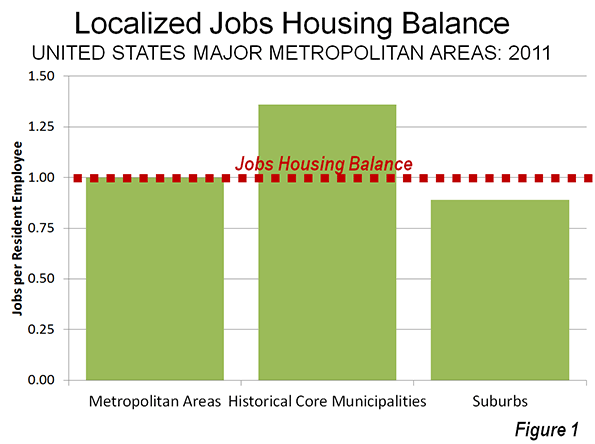
    Suburban areas in the US metropolitan areas with more than 1 million total regional population, once largely seen as bedroom communities, are nearing parity between jobs and resident employees. The jobs housing balance, which measures the number of jobs per resident employee in a geographical area has reached 0.89 (jobs per resident workers) in these 51 major metropolitan areas, according to data in the 2011 one-year American Community Survey. This is well below the 1.39 ratio of jobs to resident employees in the historical core municipalities (Figure 1).

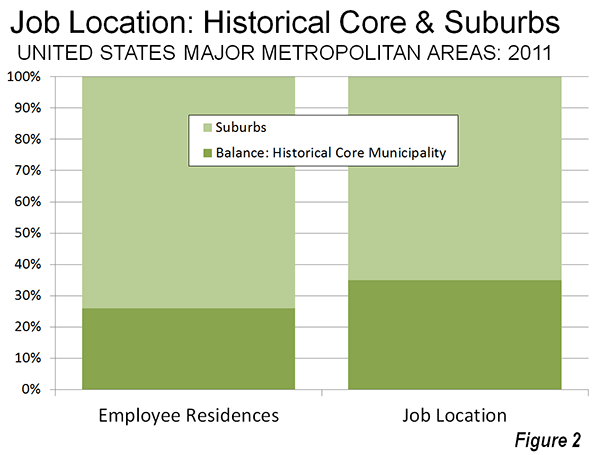
    The historical core municipalities still have a larger share of metropolitan employment than they have of resident workers. However, 65 percent of major metropolitan area jobs are now in the suburbs, where 74 percent of workers live (Figure 2). The 0.89 jobs housing balance index indicates that there are only 11 percent fewer jobs in the suburbs than resident workers. Overall, the jobs housing balance of metropolitan areas (a synonym for labor markets) is at or near 1.00.

    From Monocentric to Polycentric to Dispersed Cities
    The data indicates the extent to which the classical monocentric city has been left behind by the evolution of the modern metropolitan area. Before the near universal extension of automobile ownership, cities were necessarily much more monocentric. Transit lines tended to converge on downtown, which made downtowns far more dominant in their share of metropolitan employment than they are today.

    For example, in 1926, according to historian Robert M. Fogelson writing in Downtown: Its Rise and Fall: 1880-1950, in 1926 41 percent of Los Angeles residents went to downtown every day, a figure that had dropped to 15 percent by 1953, principally for work and shopping. Today, in a much larger metropolitan area that also includes Orange County, 3 to 5 percent of jobs are located downtown (depending on the geographical definition). The area not only lost a significant share of metropolitan employment, but saw its share of retail sales drop as regional shopping centers were built throughout the area. Similar trends occurred in virtually every metropolitan area of the United States.

    All of this occured as the automobile facilitated access to virtually everywhere in the metropolitan area, not just downtown.

    The emerging polycentricity of the city long was obvious to many analysts, but it was Joel Garreau who brought the issue to popular attention in his classic Edge City: Life on the New Frontier. Garreau documented the development of large suburban employment centers throughout the major metropolitan areas and provided a list. Later, Robert Lang of the University of Nevada Las Vegas took the issue further in his Edgeless Cities: Exploring the Elusive Metropolis, which examined office space outside downtown areas and edge cities in 1999. Gross office space was greatest outside both the downtowns and edge cities, according to Lang’s data (Note 1).

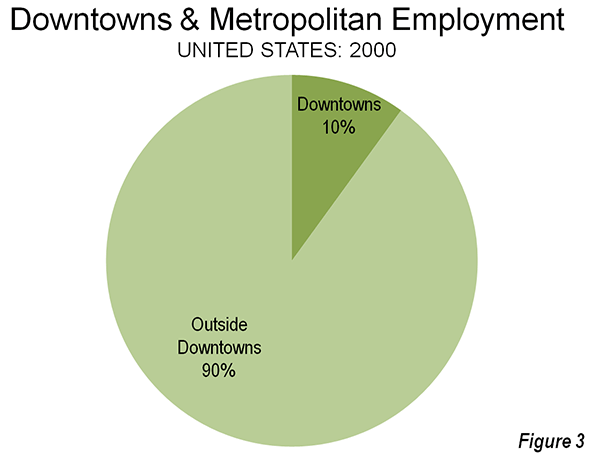
    Lang’s analysis is limited to office space, which is more concentrated in downtown areas than employment. On average, 2000 data indicates that downtown areas had approximately 10 percent of employment, well below downtown’s 36 percent share of office space (Figure 3).

    Even so, there remains a misconception today that cities remain monocentric. Yet as the figures show we are progressing toward a distribution of jobs that nearly matches its distribution of housing, with the exception of downtown (where there is the greatest imbalance, see below).

    Historical Core Municipalities: Where the Jobs-Housing Imbalance is the Greatest

    The excess of jobs in relation to residential workers is greatest in the historical core municipalities. It is driven by the downtown areas (central business districts or CBDs), which have by far the highest employment densities in the metropolitan areas. For example, in 2000, the downtown areas of the nation’s 50 largest urban areas had an average job density 92,000 per square mile. This is approximately 70 times the average non-downtown urban area employment densities (1,300 per square mile). Downtown residential densities, if they were readily available, would doubtless be a small fraction of the downtown employment figures.

    Largest Historical Core Municipality Jobs-Housing Imbalances

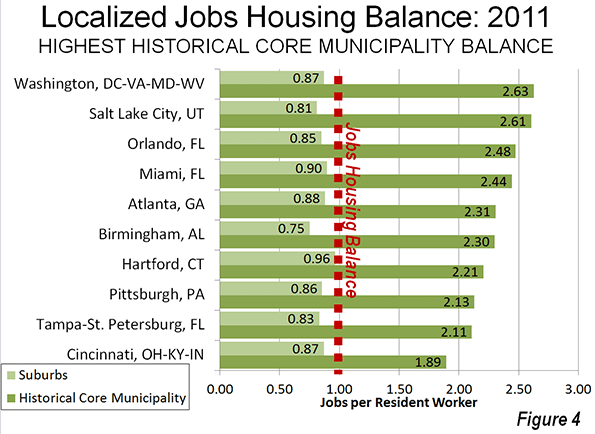
    The imbalance between jobs and housing is highest among the historical core municipalities of Washington (2.63), Salt Lake City (2.61), Orlando (2.48), Miami (2.44) and Atlanta (2.31). Yet, these large historical core municipality imbalances co-exist with generally near average suburban jobs housing balances. For example, in Washington there are 0.87 jobs per resident worker in the suburbs, or only 13 percent fewer jobs than workers who reside in the suburbs. In the other four metropolitan areas, the suburban jobs housing balance is above 0.80 (Figure 4).

    Smallest Historical Core Municipality Jobs-Housing Imbalances

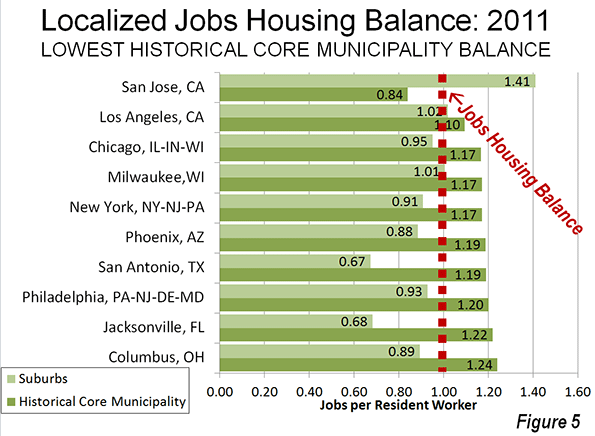
    The smallest historical core municipality jobs housing imbalance is in San Jose (0.84), which is the only major metropolitan area in which has fewer jobs than resident workers (Figure 5). However, the municipality of San Jose is a "Post War Suburban" core municipality, having experienced virtually all of its growth since 1940. This is despite the fact that San Jose’s corresponding urban area is the third most dense (following Los Angeles and San Francisco). Generally higher suburban housing densities were built in San Jose compared to less dense urban areas – which extend over vast distances – such as New York, Philadelphia and Boston. San Jose is also the only metropolitan area in which there are more suburban jobs than suburban resident workers (1.41 jobs per worker).

    The other historical core municipalities with the least imbalance between employment and resident workers are Los Angeles (1.10), Chicago (1.17), Milwaukee (1.17) and New York (1.17). The surprising inclusion of New York is discussed below.

    Each of the historical core municipalities with the fewest jobs per resident worker has a higher than average jobs housing balance in its suburban areas. Los Angeles has 1.02 jobs per suburban resident worker, principally the result of importing workers from the adjacent Riverside-San Bernardino metropolitan area. Milwaukee also has more suburban jobs than suburban resident workers (1.01).

    New York

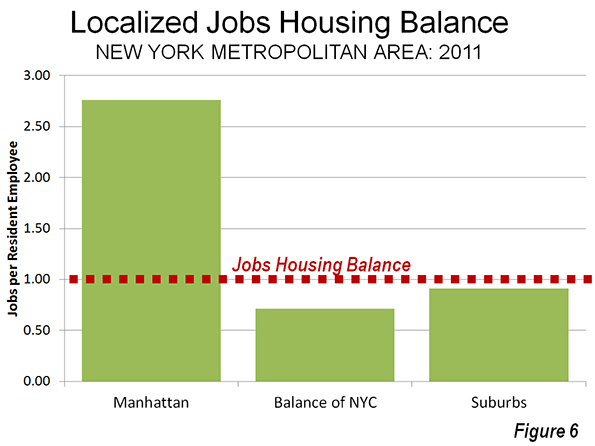
    New York has the second largest central business district in the world, following Tokyo. It therefore seems odd that the municipality of New York should have such a low ratio of jobs per resident worker. The borough of Manhattan, where the central business district is located, has 2.76 jobs per resident workers, higher than that of top ranked Washington, DC (above). There are 1,450,000 more jobs than resident workers in Manhattan.

    New York’s low ratio is the result of a huge shortage of jobs relative to workers the outer boroughs (the Bronx, Brooklyn, Queens and Staten Island). There are 830,000 fewer jobs than resident workers in the four outer boroughs. Their ratio of jobs per resident, at 0.71 is lower than all but five suburban areas in the other 50 major metropolitan areas (Figure 6).

    The suburbs of New York, ironically, are more job-rich than the outer boroughs. They boast an 0.91 jobs per resident worker, ranking 17th out of the 51 metropolitan areas.

    The New Normal

    The former assumption that "everyone works downtown" is a thing of the past. Dispersion of jobs throughout the metropolitan area has become the rule. The "old normal" was that of the bedroom community – people living in the suburbs and working in the core cities. The "new normal" is about downtown and the core city. To the extent that there is a distortion in the jobs housing balance throughout the modern metropolitan area, it is the result of a larger number of jobs than residents in the core cities (and especially downtown).

    Wendell Cox is a Visiting Professor, Conservatoire National des Arts et Metiers, Paris and the author of “War on the Dream: How Anti-Sprawl Policy Threatens the Quality of Life.

    ———————-

    Photo: Houston downtown (to the left), edge city (Texas Medical Center in the middle) and dispersed employment (rest of photo). Photo by author.

    Note 1: The total office space outside the primary downtowns, secondary downtowns and edge cities was 37.0 percent in reviewed 13 metropolitan areas. Primary downtowns accounted for 36.5 percent, secondary downtown for 6.5 percent and edge cities for 19.8 percent (this analysis classifies Beverly Hills, Mid-Wilshire and Santa Monica in Los Angeles  as secondary downtowns, rather than as primary as in the book. See tables 4-2 and 4-10).

    Note 2: The historical core municipalities are the largest municipalities in each metropolitan area, with the following exceptions.
    (a) Oakland and St. Paul are also historical core municipalities.
    (b) Norfolk is the historical core municipality in the Virginia Beach metropolitan area.
    (c) San Bernardino is the historical core municipality in Riverside San Bernardino
    (see Classification of Historical Core Municipalities)

  • Density Boondoggles

    Is it density or migration? Venture capitalist Brad Feld weighs in:

    The cities that have the most movement in and out of them are the most vibrant.

    The densest city in the world won’t be as vibrant as the city with the most talent churn. Yet planners and urbanists tout the former over the latter. We’ve reached the point of density for the sake of density. It is an end instead of a means to an end. The art of the density boondoggle:

    The following is the conversation held at every regional summit on Long Island:

    Advocate: Let’s keep our young people from leaving! There’s a…brain drain!

    Public: How do we stop it?

    Developer: Build denser housing! Let’s make it…affordable! Walkable! Let’s make it…mixed-use sustainable smart growth…with a downtown, pedestrian-friendly feel.

    Municipality: Development approved!

    What’s the question? Greater density is the answer. It will plug the brain drain. I promise. But plugging the brain drain will reduce talent churn. Long Island will be less vibrant.

    There is a name for the Cult of Density. It now has its very own -ism. All hail Vancouverism:

    Vancouverism is, at the root, a movement to go from low density, to higher density, to make Canadian and North American cities about people once again.

    Making cities all about people sounds great. All I hear is the chant of the Underpants Gnomes:

    Phase 1: Create a cool city.
    Phase 2: ?
    Phase 3: Retain talent.

    That will be $500,000. Thank you for your patronage, Memphis. Consulting is fun!

    Development approved. That’s the story line playing out in downtown Las Vegas with Zappos. Density is king. Don’t listen to Brad Feld. Talent churn doesn’t matter.

    If Vancouverism were harmless, then I wouldn’t blog about it. The misplaced emphasis on density has negative impacts. Vancouver is more about people, those who are young, single and college-educated:

    ‘Revitalizing,’ but leaving seniors behind

    Last July, Vancouver city council unanimously approved a three-year Chinatown Neighbourhood Plan and Economic Revitalization Strategy. More than a decade in the making, the plan focused on economic revitalization, after two-thirds of businesses surveyed in Vancouver’s original Chinatown reported declining revenues between 2008 and 2011 — blamed mainly on losses to newer Chinese-language communities in suburbs like Richmond.

    The revitalization plan envisions new residential development, "to connect with younger generations and reach out to people of all backgrounds to ensure Chinatown is increasingly relevant to a more multi-cultural Vancouver." At the same time, it acknowledged that in a neighborhood where 67 per cent of households are low-income — more than twice the City of Vancouver average — such redevelopment "can displace low-income residents." What is good for old Chinatown’s businesses, in short, may be less so for its poor and isolated elderly.

    S.U.C.C.E.S.S., Vancouver’s primary provider of culturally- and linguistically-supportive housing and services for Chinese seniors, is providing a partial answer. It operates a single multi-level care facility in old Chinatown for people with cognitive impairments or who require round-the-clock nursing. But its 103 beds, soon to be 113, are about one-tenth of what the UBC Centre for Urban Economics anticipates will be needed over the next 15 years to house Chinese seniors.

    Meanwhile, the support it offers seem a world away from Rosesari and her neighbours living in privately operated SROs like the May Wah Hotel. Yet the women are spirited and resilient. "I’m happy and I’m healthy," Rosesari told me through Pang’s interpretation. Both she and Lin say they like living in Chinatown. They feel at home here, where the language spoken is the one they know.

    They are also in their 90s. As time goes on, they and others may no longer be able to manage the May Wah’s staircases, its lack of mobility aids, and its communal bathing facilities. The alternatives available to them then are in terribly short supply.

    Welcome to the dark side of the obsession with wants and needs of the Creative Class. Vancouverism is boutique urbanism, catering to a specific demographic at the exclusion of all others. People are either displaced or fall into the cracks. Bike lanes and food trucks trump the needs of seniors.

    Jim Russell is a talent geographer with particular interest in the Rust Belt. Read his blog at Burgh Diaspora, where this piece originally appeared.

    Downtown Vancouver photo by runningclouds

  • The World’s Fastest-Growing Megacities

    The modern megacity may have been largely an invention of the West, but it’s increasingly to be found largely in the East. The seven largest megacities (defined as areas of continuous urban development of over 10 million people) are located in Asia, based on a roundup of the latest population data released last month by Wendell Cox’s Demographia. The largest megacity remains the Tokyo-Yokohama area, home to 37 million, followed by the Indonesian capital of Jakarta, Seoul-Incheon, Delhi, Shanghai and Manila.

    With roughly 20 million inhabitants, the New York metro area, the world’s largest urban agglomeration from early in the 20th century till Tokyo surpassed it in the 1950s, ranks eighth. The only other western urban areas among the 28 biggest megacities now are Moscow (15th), Los Angeles (17th), and Paris (28th). London, which was the first modern city of a million people, is not on the list at all, with expansion long ago stopped by its green belt. In 1990, New York ranked second and Los Angeles ranked eighth.

    This de-Westernizing trend seems likely to continue. The fastest-growing megacities over the past decade have been primarily in the developing world. Karachi, Pakistan, has led the growth charge, with a remarkable 80% expansion in its population from 2000 to 2010. The growth economies of China and India dominate the rest of the list of most rapidly growing megacities.

    China, not surprisingly, has the most megacities of any country, four. The second fastest growing megacity over the past decade, Shenzhen, was a small fishing village not long ago that became a focus of Deng Xiaoping’s first wave of modernization policies. In 1979 it had roughly 30,000 people; now it is a thriving metropolis of over 12 million whose population in the past decade grew 56%. Its rise has been so quick that the Asia Society has labeled it “a city without a history.”

    Older Chinese cities are also growing rapidly. Shanghai, a cosmopolitan world city decades  before the Communist takeover of the country, expanded almost 50% since 2000. The ancient capital Beijing and the southern commerce and industrial hub of Guangzhou grew nearly as rapidly.

    India matches Japan with three megacities, but they are all growing much faster. The population of Delhi, the world’s fourth-largest city, expanded 40% over the past decade; Mumbai, almost 20%; and Kolkata, roughly 10%, a relatively low rate for a city in a developing country.

    Other rapidly growing megacities are scattered throughout the developing world. In Nigeria, Lagos saw its population swell by over 48%; The Thai capital of Bangkok and Dhaka, Bangladesh, both grew some 45%. The world’s second-largest megacity, Jakarta, expanded 34% to almost 27 million.

    One caveat: Estimating population for comparably defined urban areas, particularly in the developing world, can be difficult. For example, there is considerable disagreement about the population of Lagos, where local officials claimed there were twice as many people in 2005 as were counted in the 2006 Nigerian census. Add the “missing” 8 or more million people and the population would be 22 million this year. The higher local count, however, has not been broadly accepted. There population of Karachi is also disputed, with some claiming a somewhat lower population than reported.

    In contrast, high-income countries in Europe and the U.S., where population tracking is more reliable, grew relatively slowly. The only city with a purchasing power adjusted GDP of over $40,000 that registered population growth over 10% was Moscow, which has expanded rapidly as the center of Russia’s resource-led boom. The population of Paris grew 8%; Los Angeles, 6%; and New York, barely 3%.

    Japan, one of the world’s most urbanized major countries, has also logged slower growth. Tokyo, the great outlier in that country’s stagnant population profile, expanded 7%, Nagoya grew 5.7% and Osaka-Kobe a weak 2.4%. The rapid population depletion in the rest of the country and a lack of immigrants suggest that Japan’s great cities will grow even slower in the years ahead, as the country runs short on migrants from rural areas and young people in general.

    So what do the numbers tell us about the future of megacities? For one thing, it’s clear that the most rapid growth is taking place in countries that still have large rural hinterlands and relatively young populations. These mostly poor places — most with median incomes between Dhaka at $3,100 per capita and Bangkok at $23,000 — will continue to grow, at least until their populations begin to see the results of decreasing birthrates.

    U.N. projections to 2025 suggest that the future list of megacities will be dominated by such lower-income cities, with growth primarily in places like Africa and central Asia. Among the likely new entrants are Lima (Peru) , Kinshasa (Democratic Republic of the Congo) and Tianjin (China). At least seven others (Chennai, Bangalore, Bogota, Ho Chi Minh City, Dongguan, Chengdu and Hyderabad) are now above 8 million, making it likely they could reach megacity status by 2030. Among high-income world cities, London might finally reach 10 million while the only other high-income world candidate, Chicago, with more than 9 million residents, could take until 2040.

    At the same time, some megacities in the low and middle-income world already seem to have reached a point of saturation. A generation ago, it was widely predicted that Mexico City would become the world’s largest city. Yet its growth has slowed to a modest 11% over the past decade. Lower Mexican birthrates and the development of other urban alternatives have made La Capital far less a growth hub than once imagined.

    Similar processes can be seen elsewhere in Latin America, where fertility rates have been dropping to levels closer to American and northern European norm, but not yet those of the ultra-low Japan or southern European countries. Over the past decade population growth was 13% in Buenos Aires, 15%  in Sao Paulo and 10%  in Rio de Janeiro. These cities will likely continue to grow, but at a reduced rate.

    The real winners in the coming decades are likely to be Chinese megacities, and to a lesser extent those in India. China’s megacities all enjoy per capita incomes above $20,000 and the vast scale of the country’s rural population suggests there is still room for growth. It will be perhaps another decade or so before the country’s low birthrate catches up with it, and slows growth down to western or Japanese levels.

    India’s cities, notably Mumbai and Delhi, are not as wealthy as China’s, but are clearly getting richer, with Delhi getting close to the $10,000 per capita income level. With a somewhat higher birthrate than its Chinese or South American counterparts, Indian cities can be expected to continue expanding at least for the next decade or so.

    These trends, of course, may be altered by any number of developments, including the possible threats to  cities from wars, environmental challenges or other large-scale disruptions. But we can say, with some confidence, that the world’s megacities will continue to become increasing Asian and African, reflecting the protean nature of an urban growth pattern that continues to de-emphasize slower expanding regions in the Americas, Japan and, of course, Europe.

    FASTEST GROWING MEGACITIES IN THE WORLD
    (Urban Areas with more than 10 million residents)
    Rank Geography Urban Area Population Estimate GROWTH (Decade)
    1 Pakistan Karachi 20,877,000 80.5%
    2 China Shenzhen 12,506,000 56.1%
    3 Nigeria Lagos 12,090,000 48.2%
    4 China Beijing, BJ 18,241,000 47.6%
    5 Thailand Bangkok 14,544,000 45.2%
    6 Bangladesh Dhaka 14,399,000 45.2%
    7 China Guangzhou-Foshan 17,681,000 43.0%
    8 China Shanghai 21,766,000 40.1%
    9 India Delhi 22,826,000 39.2%
    10 Indonesia Jakarta 26,746,000 34.6%
    11 Turkey Istanbul 12,919,000 25.3%
    Source: Demographia World Urban Areas (2013): http://demographia.com/db-worldua.pdf

    Joel Kotkin is executive editor of NewGeography.com and a distinguished presidential fellow in urban futures at Chapman University, and a member of the editorial board of the Orange County Register. He is author of The City: A Global History and The Next Hundred Million: America in 2050. His most recent study, The Rise of Postfamilialism, has been widely discussed and distributed internationally. He lives in Los Angeles, CA.

    Wendell Cox is a Visiting Professor, Conservatoire National des Arts et Metiers, Paris and the author of “War on the Dream: How Anti-Sprawl Policy Threatens the Quality of Life.

    This piece originally appeared at Forbes.com.

  • Houston Rising—Why the Next Great American Cities Aren’t What You Think

    America’s urban landscape is changing, but in ways not always predicted or much admired by our media, planners, and pundits. The real trend-setters of the future—judged by both population and job growth—are not in the oft-praised great “legacy” cities like New York, Chicago, or San Francisco, but a crop of newer, more sprawling urban regions primarily located in the Sun Belt and, surprisingly, the resurgent Great Plains.

    While Gotham and the Windy City have experienced modest growth and significant net domestic out-migration, burgeoning if often disdained urban regions such as Houston, Dallas-Ft. Worth, Charlotte, and Oklahoma City have expanded rapidly. These low-density, car-dominated, heavily suburbanized areas with small central cores likely represent the next wave of great American cities.

    There’s a whole industry led by the likes of Harvard’s Ed Glaeser, my occasional sparring partner Richard Florida and developer-funded groups like CEOs for Cities, who advocate for old-style, high-density cities, and insist that they represent the inevitable future.

    But the numbers tell a different story: the most rapid urban growth is occurring outside of the great, dense, highly developed and vastly expensive old American metropolises.

    An aspirational city, by definition, is one that people and industries migrate to improve their economic prospects and achieve a better relative quality of life. In the 19th and early 20th centuries, this aspirational spirit was epitomized by cities such as New York and Chicago and then in the decades after World War Two by Los Angeles, which for many years was the fastest-growing big city in the high-income world.

    Until the 1970s, the country’s established big cities were synonymous with aspiration—where the jobs and opportunities for broad portions of the population abounded. But as the financial markets took on an oversized role in the American economy and manufacturing receded, the cost of living in the nation’s oldest metropolises shot up far faster than the median income there—and Americans have turned elsewhere now that, as Virginia Postrel wrote in an important essay on the nation’s growing economic wall, “the promise of a better life that once drew people of all backgrounds to rich places like New York and [coastal] California now applies only to an educated elite—because rich places have made housing prohibitively expensive.”

    Like the great legacy cities during their now long-past adolescent and at times ungainly growth spurts, today’s aspirational cities often meet with little approval from travelers from other, older cities. A 19th-century Swedish visitor to Chicago described it as “one of the most miserable and ugly cities” in North America. New York, complained the French Consul in 1810, was a city where the inhabitants had “in general no mind for anything but business”; later Bostonian Ralph Waldo Emerson, granted Gotham’s entrepreneurial supremacy only to explain that his more cultured “little city” was “appointed” by destiny to “lead the civilization of North America.”

    Los Angeles, most of whose early-20th-century migrants came from the Midwest, became a favorite object of scorn from sophisticates. William Faulkner in the 1930s described the city of angels as “the plastic asshole of the world.” As the first great city built largely around the automobile, mainstream urbanists detested it; their icon Jane Jacobs called it “a vast blind-eyed reservation.”

    A half century later, today’s aspirational urban centers suffer similarly poor reputations among urbanists, planners and journalists. One New York Post reporter recently described Houston as “brutally ugly” while new urbanists like Andres Duany relegate the region to a netherworld inhabited by car-centric cities such as Phoenix and Atlanta.

    Yet over the past decade the 25 fastest-growing cities have been mostly such urbanist “assholes”—Raleigh, Austin, Houston, San Antonio, Las Vegas, Orlando, Dallas-Fort Worth, Charlotte, and Phoenix. Despite hopeful claims from density advocates that the Great Recession and the housing bust ended this trend, the latest census data shows that Americans have continued choosing places that are affordable enough to offer opportunity, and space.

    One common article of faith among mainstream urbanists, at least when they stop to note this growth at all, is that these cities grow mainly because they are cheap and can house the unskilled. But in reality many of these metropolitan areas are also leading the nation in growing their number of well-educated arrivals. Houston, Charlotte, Raleigh, Las Vegas, Nashville, and San Antonio, for example, experienced increases in the number of college-educated residents of nearly 40 percent or more over the decade, roughly twice the level of growth as in “brain centers” such as Boston, San Francisco, San Jose (Silicon Valley), or Chicago. Atlanta, Houston, and Dallas each have added about 300,000 college grads in the past decade, more than greater Boston’s pickup of 240,000 or San Francisco’s 211,000.

    Once considered backwaters, these Sunbelt cities are quietly achieving a critical mass of well-educated residents. They are also becoming major magnets for immigrants. Over the past decade, the largest percentage growth in foreign-born population has occurred in sunbelt cities, led by Nashville, which has doubled its number of immigrants, as have Charlotte and Raleigh. During the first decade of the 21st century, Houston attracted the second-most new, foreign-born residents, some 400,000, of any American city—behind only much larger New York and slightly ahead of Dallas-Ft. Worth, but more than three times as many as Los Angeles. According to one recent Rice University study, Census data now shows that Houston has now surpassed New York as the country’s most racially and ethnically diverse metropolis.

    Why are these people flocking to the aspirational cities, that lack the hip amenities, tourist draws, and cultural landmarks of the biggest American cities? People are still far more likely to buy a million dollar pied à terre in Manhattan than to do so in Oklahoma City. Like early-20th-century Polish peasants who came to work in Chicago’s factories or Russian immigrants, like my grandparents, who came to New York to labor in the rag trade, the appeal of today’s smaller cities is largely economic. The foreign born, along with generally younger educated workers, are canaries in the coal mine—singing loudest and most frequently in places that offer both employment and opportunities for upward mobility and a better life.

    Over the decade, for example, Austin’s job base grew 28 percent, Raleigh’s by 21 percent, Houston by 20 percent, while Nashville, Atlanta, San Antonio, and Dallas-Ft. Worth saw job growth in the 14 percent range or better. In contrast, among all the legacy cities, only Seattle and Washington D.C.—the great economic parasite—have created jobs faster than the national average of roughly 5 percent. Most did far worse, with New York and Boston 20 percent below the norm; big urban regions including Philadelphia, Los Angeles, and, despite the current tech bubble, San Francisco have created essentially zero new jobs over the decade.

    Another common urban legend maintains these areas lag in terms of higher-wage employment, lacking the density essential for what boosters like Glaeser and Florida describe as “knowledge-intensive cities.” Defenders of traditional cities often cite Santa Fe Institute research that they say links innovation with density—but actually does nothing of the kind. Rather, that research suggests that size, not compactness, constitutes the decisive factor. After all, it’s hard to define Silicon Valley, still the nation’s premier innovation region, as anything other than large, sprawling, and overwhelmingly suburban in form.

    Size does matter and many of the fastest growth areas are themselves large enough to sport a major airport, large corporate presences and other critical pieces of economic infrastructure. The largest gains in GDP (PDF) in 2011 were in Houston, Dallas and, surprisingly, resurgent greater Detroit (and that despite its shrinking urban core). None of these areas are characterized by high density yet their income growth was well ahead of Seattle, San Francisco, or Boston, and more than twice that of New York, Washington, or Chicago.

    But in fact neither density nor size necessarily determine which regions generate new high-end jobs. The growth in STEM—or science-technology-engineering and mathematics-related—employment in Houston, Raleigh, Nashville, Austin, and Las Vegas surpassed that in San Francisco, Los Angeles, Boston, or New York. One reason: most STEM jobs are not found in fashionable fields like designing social media or videogames but in more prosaic activities tied to medicine, manufacturing, agriculture and (horror of horrors) natural resource extraction, including fossil fuel energy. In this sense, technology reflects the definition of the French sociologists Marcel Mauss as “a traditional action made effective.”

    This pattern also extends to growth in business and professional services, the nation’s biggest high-wage job category. Since 2000, Houston, Dallas-Fort Worth, Charlotte, Austin and Raleigh expanded their number of such jobs by twenty percent or more—twice the rate as greater New York, the longtime business-service capital, while Chicago and San Jose actually lost jobs in this critical category.

    Finally there is the too often neglected topic of real purchasing power—that a dollar in New York doesn’t go nearly as far as one in Atlanta, for example. My colleague Mark Schill at the Praxis Strategy group has calculated the average regional paycheck, adjusted for cost of living. Houston led the pack in real median pay in, and seven of the 10 cities with the highest adjusted salary were aspirational ones (the exceptions were San Jose-Silicon Valley, Seattle, and the greater Detroit region). Portland, Los Angeles, New York, and San Diego all landed near the bottom of the list.

    Conventional urbanists—call them density nostalgists—continue to see the future in legacy cities that, as the University of Washington demographer Richard Morrill notes, were built out before the dominance of the car, air-conditioning and with them the prevalence of suburban lifestyles.

    Looking forward, it is simply presumptuous and ahistorical to dismiss the fast-growing regions as anti-cities, as 60s-era urbanists did with places like Los Angeles. When tradition-bound urbanists hope these sprawling young cities choke on their traffic and exhaust fumes, or from rising energy costs, they are reflecting the classic prejudice of city-dwellers of established urban centers toward upstarts.

    The reality is that most urban growth in our most dynamic, fastest-growing regions has included strong expansion of the suburban and even exurban fringe, along with a limited resurgence in their historically small inner cores. Economic growth, it turns out, allows for young hipsters to find amenable places before they enter their 30s, and affordable, more suburban environments nearby to start families.

    This urbanizing process is shaped, in many ways, by the late development of these regions. In most aspirational cities, close-in neighborhoods often are dominated by single-family houses; it’s a mere 10 or 15 minute drive from nice, leafy streets in Ft. Worth, Charlotte, or Austin to the urban core. In these cities, families or individuals who want to live near the center can do without being forced to live in a tiny apartment.

    And in many of these places, the historic underdevelopment in the central district, coupled with job growth, presents developers with economically viable options for higher-density housing as well. Houston presents the strongest example of this trend. Although nearly 60 percent of Houston’s growth over the decade has been more than 20 miles outside the core, the inner ring area encompassed within the loop around Interstate 610 has also been growing steadily, albeit at a markedly slower rate. This contrasts with many urban regions, where close-in areas just beyond downtowns have been actually losing population.

    Even as Houston has continued to advance outwards, the region has added more multiunit housing over the past decade than more populous New York, Los Angeles or Chicago. With its economy growing faster and producing wealth faster than any other region in the country, urban developers there usually do not need subsidies or planning dictates to be economically viable.

    Modern urban culture also is spreading in the Bayou City. In what has to be a first, my colleagues at Forbes recently ranked Houston as America’s “coolest city,” citing not only its economy, but its thriving arts scene and excellent restaurants. Such praise may make some of us, who relish Houston’s unpretentious nature, a little nervous—but it shows that hip urbanism can co-exist with rapidly expanding suburban development.

    And Houston’s not the only proverbial urban ugly duckling having an amenity makeover. Oklahoma City has developed its central “Bricktown” into a centerpiece for arts and entertainment. Ft. Worth boasts its own, cowboy-themed downtown, along with fine museums, while its rival Dallas, in typical Texan fashion, boasts of having the nation’s largest arts district.

    More important still, both for families and outdoor-oriented singles, both cities are developing large urban park systems. At an expense of $30 million, Raleigh is nearing the completion of its Neuse River Greenway Trail, a 28-mile trail through the forested areas of Raleigh. Houston has plans for a series of bayou-oriented green ways. For its part, Dallas is envisioning a vast new 6,000 acre park system, along the Trinity River that will dwarf New York’s 840-acre Central Park.

    To be sure, there’s no foreseeable circumstance in which these cities will challenge Paris or Buenos Aires, New York, or San Francisco as favored destinations for those primarily motivated by aesthetics that are largely the result of history. Nor are they likely to become models of progressive governance, as poverty and gaps in medical coverage become even more difficult problems for elected officials without a well-entrenched ultra-wealthy class to cull resources from.

    Finally, they will not become highly dense, apartment cities — as developers and planners insist they “should.” Instead the aspirational regions are likely to remain dominated by a suburbanized form characterized by car dependency, dispersion of job centers, and single-family homes. In 2011, for example, twice as many single-family homes sold in Raleigh as condos and townhouses combined. The ratio of new suburban to new urban housing, according to the American Community Survey, is 10 to 1 in Las Vegas and Orlando, 5 to 1 in Dallas, 4 to 1 in Houston and 3 to 1 in Phoenix.

    Pressed by local developers and planners, some aspirational cities spend heavily on urban transit, including light rail. To my mind, these efforts are largely quixotic, with transit accounting for five percent or less of all commuters in most systems. The Charlotte Area Transit System represents less a viable means of commuting for most residents than what could be called Manhattan infrastructure envy. Even urban-planning model Portland, now with five radial light rail lines and a population now growing largely at its fringes, carries a smaller portion of commuters on transit than before opening its first line in 1986.

    But such pretentions, however ill-suited, have always been commonplace for ambitious and ascending cities, and are hardly a reason to discount their prospects. Urbanistas need to wake up, start recognizing what the future is really looking like and search for ways to make it work better. Under almost any imaginable scenario, we are unlikely to see the creation of regions with anything like the dynamic inner cores of successful legacy cities such as New York, Boston, Chicago or San Francisco. For better or worse, demographic and economic trends suggest our urban destiny lies increasingly with the likes of Houston, Charlotte, Dallas-Ft. Worth, Raleigh and even Phoenix.

    The critical reason for this is likely to be missed by those who worship at the altar of density and contemporary planning dogma. These cities grow primarily because they do what cities were designed to do in the first place: help their residents achieve their aspirations—and that’s why they keep getting bigger and more consequential, in spite of the planners who keep ignoring or deploring their ascendance.

    Joel Kotkin is executive editor of NewGeography.com and a distinguished presidential fellow in urban futures at Chapman University, and a member of the editorial board of the Orange County Register. He is author of The City: A Global History and The Next Hundred Million: America in 2050. His most recent study, The Rise of Postfamilialism, has been widely discussed and distributed internationally. He lives in Los Angeles, CA.

    This piece originally appeared in the The Daily Beast.

    Photo by telwink.
  • Progessives, Preservation & Prosperity

    Conservatives often fret that Barack Obama is leading the nation toward socialism. In my mind, that’s an insult to socialism, which, in theory, at least, seeks to uplift the lower classes through greater prosperity. In contrast, the current administration and its core of wealthy supporters are more reminiscent of British Tories, the longtime defenders of hereditary privilege, a hierarchical social order and slow-paced economic change.

    The notion that the "progressives" are, in fact, closeted Royalists has been trotted out by a handful of Obama admirers, such as Andrew Sullivan, who calls the president "the conservative reformist of my dreams." Essentially, Sullivan argues, Obama has been a "Tory president," with more in common with, say, an aristocratic toff like British Prime Minister David Cameron than a traditional left-liberal reformer.

    The fundamental conservativism underlying the modern "progressive" marks the central thesis of an upcoming book by historian Fred Siegel, appropriately titled "Revolt Against the Masses." Siegel traces the roots of the new-fashioned Toryism to the cultural wars of the 1960s, when the fury of the "Left," once centered on the corporate elites, shifted increasingly to the middle class, which was widely blamed for everything from a culture of conformity to racism and support for the Vietnam War.

    Tory progressivism’s most-unifying theme, Siegel notes, includes the preservation and conservation of the landed order enjoyed by the British ultrawealthy and upper-middle classes. In the 19th century, Siegel notes, Tory Radicals, like William Wordsworth, William Morris and John Ruskin, objected to the ecological devastation of modern capitalism and sought to preserve the glories of the British countryside.

    They also opposed the "leveling" effects of a market economy that sometimes allowed the less-educated, less well-bred to supplant the old aristocracies, with their supposedly more enlightened tastes. "Strong supporters of centralized monarchical power, this aristocratic sensibility also saw itself as the defender of the poor – in their place," writes Siegel. "Its enemies were the middle classes and the aesthetic ugliness they associated with the industrial economy borne of bourgeois energies."

    Today, this Tory tradition lives on in contemporary Britain, where industry remains widely disparaged and land use tightly controlled. There is no more strident defender of preserving the space of the landed gentry than the leading Tory mouthpiece, The Daily Telegraph. All efforts are made to restrict the expansion of suburbs and new towns, all the better to preserve the British countryside for the better enjoyment of the gentry.

    As a result, Britain now suffers some of the world’s highest housing prices – even in the economically devastated north of the country. Unable to afford decent accommodations, notes author James Heartfield, some British families have been forced to live in old restrooms, garden sheds, even abandoned double-decker buses.

    Until recent decades, such an "enlightened" conservatism has been rare in America, with its strong tradition of upward mobility and vast landscape for development. As early as the 1950s, however, intellectuals, architects, planners and aesthetes have railed against the banality of suburbanizing, and democratizing, America, but the real turn towards gentry progressivism took place with the rise of the environmental movement in the 1970s.

    Rightfully alarmed by the deterioration of the environment at that time, early green activists made contributions to a remarkable cleanup of the nation’s air and water, something that widely benefited millions of Americans. But the movement also fell ever more prone to all manner of hysterias; at the first Earth Day, in 1970, some scientists predicted that, by the 1980s, people would not be able to walk outside without a helmet. Then followed a series of jeremiads about "limits of growth" associated with the depletion of critical minerals, "peak oil" and, finally, the call for radical steps to address climate change.

    All these causes, sometimes based on fact or somewhat overheated extrapolation, gradually diverted American progressives from their historic interest in economic growth and social mobility to a primary focus on environmental purity, whatever the social or economic cost. Their Tory-like policies have helped stunt economic growth, particularly in the blue-collar industrial and construction sectors, promoting, albeit unintentionally, ever-narrowing opportunity for all but a few Americans.

    Despite its opportunistic use of populist rhetoric, the Obama administration has presided over widespread economic distress – with the average household now earning considerably less than it did four years ago. This trend has worsened during the current "recovery," even as the Federal Reserve’s policies have generated record profits for corporate and Wall Street grandees.

    It has been a particular boon time for a new rising class of oligarchs from Silicon Valley, which has embraced Obama with money and technical expertise. Not surprisingly, the ultra-affluent coastal areas have become primary supporters of the administration, which in November won eight of the nation’s 10 wealthiest counties, many of them handily.

    The growing gaps between the "1 percent" and everyone else have been particularly marked in those regions under the most complete progressive control. The Holy Places of urbanism, such as New York, San Francisco and Washington, D.C., also suffer some of the worst income inequality.

    In these regions, the so-called "creative class" is courted by politicians, developers and corporate big-wigs. Meanwhile their putative political allies, in places like Oakland and parts of New York’s the outer boroughs, experience seemingly irrepressible permanent unemployment and, increasingly, rising crime. Perhaps the most outrageous example of the dual nature of the new progressive economy, notes Walter Russell Mead, can be seen in Detroit, where a shrinking, debt-ridden and dysfunctional city that fails its largely poor residents has generated $474 million since 2005 for well-connected Wall Street bond issuers.

    Under the progressive Tory regime, the best that can be offered the middle class is an outbound ticket to less-Tory-dominated, albeit often less culturally "enlightened" places, such as Texas, the Southeast or Utah. There, manufacturing, energy and agricultural industries still anchor much of the economy. Despite their expressions of concern for the lower orders, gentry progressives don’t see much hope for the recovery of blue-collar manufacturing or construction jobs, at least not in their bailiwicks. Instead they suggest that the hoi polloi seek their future in what the British used to call "service," that is, as caregivers, haircutters, dog walkers, waiters and toenail painters for their more-highly educated betters.

    Such kindness, however, is no replacement for the kind of broad-based economic growth that historically has promoted self-sufficiency and upward mobility, both in California and elsewhere. Due in large part to the new progressive policies, this is now increasingly out of reach for many in the middle class, as well as the increasingly Latino working classes. Indeed, a recent report from the Public Policy Institute of California reveals that class stratification in the state has expanded far faster than the national average.

    "We have created a regulatory framework that is reducing employment prospects in the very sectors that huge shares of our population need if they are to reach the middle class," notes economist John Husing. A onetime Democratic activist, Husing laments how, in progressive California, green energy policies have driven up electricity costs to twice as high as those in competitor states, such as Utah, Texas and Washington, and considerably above those of neighboring Arizona and Nevada. These and other regulatory policies, he suggests, are largely responsible for the Golden State missing out on the country’s manufacturing rebound, losing jobs, while others, not only Texas but also in the Great Lakes, have expanded jobs in this sector.

    Similarly, Draconian land-use regulations have not only kept housing prices, particularly on the coasts, unnecessarily high, but slowed a potential rebound in the construction sector, traditionally a source of higher-wage employment for less-than-highly educated workers. So, while Google workers are pampered and celebrated by the progressive regime, California suffers high unemployment and a continued exodus of working-class and middle-class families.

    Sadly, there currently is no strong counterweight to the new Tory ascendency. Until traditional social democrats awake to realities, or the GOP acknowledges the painful reality of class, America will continue to lurch towards the very Tory model that our forefathers had the wisdom to reject throughout most of our history.

    Joel Kotkin is executive editor of NewGeography.com and a distinguished presidential fellow in urban futures at Chapman University, and a member of the editorial board of the Orange County Register. He is author of The City: A Global History and The Next Hundred Million: America in 2050. His most recent study, The Rise of Postfamilialism, has been widely discussed and distributed internationally. He lives in Los Angeles, CA.

    This piece originally appeared in the Orange County Register.

    Photo by: conservativeparty