Blog

  • Green Office Towers Cast Shadow Over Sydney

    Known for her spiky hair, studded-collar and heels, Sydney’s Lord Mayor is the epitome of progressive chic. For a green activist, though, Clover Moore attracts some surprising company. Landlords owning 58 per cent of the CBD’s office space have rushed to join her Better Buildings Partnership, an alliance “to improve the sustainability performance of existing commercial and public sector buildings”. At first glance, the property industry’s enthusiasm for ‘green building’ seems strange.  Shouldn’t they be insisting on less costly design and materials?  Or despite their hard-nosed reputation, are they out to save the planet after all?

    As it turns out, the lure of green building has more to do with cash than climate. By virtue of the soft economy and creeping “sustainability” measures, green-rated office towers are a gilt-edged opportunity for investors fleeing stocks and bonds. The wave of change rolling over central Sydney displays a certain logic. Meddling officials get to wrap themselves in virtue while big landlords – local and global investment trusts and fund managers – get a new premium grade rating for their properties. How better to protect asset values in an unsettled world? It’s a cosy, CBD-boosting deal, even if it distorts job and investment flows in outlying parts of the city.

    The floor-space revolution

    Even before the crash of 2008, banks, insurance companies and other financial services were under pressure to extract higher value out of every inch of floor-space. The global debt meltdown only accelerated the process. Aggressive cost-cutting saw Australian banks reduce their cost-to-income ratios from around 60 per cent in the late 1980s to around 45 per cent today. This priority is turning Sydney CBD’s office core inside-out, a trend reinforced by pay-offs from the green-rating of building stock.

    One recent headline summed it up neatly: “Martin Place exodus”. The article describes how major banks like Westpac, ANZ and Commonwealth are all vacating large office blocks in stately Martin Place, “the heart of Sydney’s financial centre”. Linking George Street, the CBD’s commercial “spine”, to the city’s government office sector along Macquarie Street, near state Parliament House, Martin Place has hosted the cream of Australia’s banking and insurance houses since the nineteenth century. The Reserve Bank is based there as well.   

    Sydney’s traditional office core enclosed Martin Place within Clarence, King and Macquarie Streets and the waterfront at Circular Quay. In line with conventional CBD morphology, this lies just north of the longstanding, but expanding, retail core bounded by York, Park, Elizabeth and King Streets, where large department stores are concentrated around the conjunction of George and Market Streets, the CBD’s peak land value intersection (PLVI).  

    Driven to economise on floor-space, larger financial and professional services firms are leaving the traditional office core for outer blocks, which until recently were, in the parlance of CBD theory, “zones in transition”, low-grade areas on the periphery of the office and retail cores with potential for higher value functions. Some “see the axis of the Sydney central business district changing.” Typically, landlords are now expected “to work with Sydney tenants to address their concerns around relocating or redesigning … and help minimise costs and increase efficiencies in their work environment.”  Lest this be dismissed as penny-pinching, a new “workplace philosophy” has been invented to sell the floor-space revolution, and, predictably, that old chestnut “sustainability” has been pressed into service.

    Spreading from banks to insurance companies to professional services and other large white-collar workplaces, “activity-based working” (ABW) has been treated to rapturous media coverage. “Gen Y shuts door on open-plan century”, is how one headline put it. In progressive outlets, ABW is depicted more as a reaction than an initiative, a revolution forced on employers – and indirectly on property developers – by green, socially aware, tech-savvy Gen Y office workers. As the narrative goes, they reject confinement in the “assigned desks” of open-plan workstations or offices. 

    At one prominent bank, staff are “free to roam and work where and how the mood takes them.” Usually, we are told, “they start the day at an ‘anchor point’ where their locker is and which they share with about 100 other workers … they might stay around that area for the day, with a choice of work situations ranging from quiet spaces to conversation areas, or they may set up somewhere else depending on who they need to see.” Equipped with laptops, i-pads, mobile phones and wi-fi, they “can move from space to space and hardware isn’t an inhibitor.” Some organisations “have been … expanding a whole range of tools from [their] internal social-media platform to crowd-sourcing …” Spaces come in all varieties, including meeting rooms, “hush” rooms, discussion pods, team tables, cafes, “floor hubs”, “touch-and-go area[s] for short stays”, even “funky kitchens”.

    And topping off the semblance of a white-collar wonderland, ABW adapted buildings often have glass lifts and “a central atrium allowing views to other floors”, so “you really do feel part of a bigger whole, you can see everybody.”

    Touted in near-utopian language, ABW unites the high-end circle of developers, architects, interior designers, building managers, real estate agents and progressive media. Most of all, we are assured, it’s about values, lifestyles and the coming generation, invariably presented as model progressives. According to a Colliers International report, Generation Y “prefer to work for an organisation with a commitment to social causes than one without … [i]n relation to the built environment, being green as an office occupier will become more of a ‘must have’ than a ‘nice to have’ in order to attract and retain staff.” Amongst other things, this means “creating less hierarchical workplaces, which facilitate collaboration, personal accountability and flexibility.”

    Such are the times, that if a business announced ABW-type reforms to improve its bottom line, raise productivity or increase returns to investors, it would be damned as a “slave to neo-liberal dogma”. But if the very same measures were dressed-up in the garb of “sustainability”, it would be showered with awards and accolades.

    Notwithstanding the pushy New Age rhetoric, ABW is more an economic-cum-technological opportunity for employers, than a revolt by the young and restless. Focus on costs is inevitable when economic conditions are so tight, and information and communications devices so ubiquitous and portable. A popular measure of office space efficiency is the workspace ratio, explains a researcher at Jones Lang Lasalle, or the number of square metres occupied by each office worker. The typical ratio is 15 square metres per person, but technology is freeing up workers to leave the office, so occupancy is typically now between 40 and 50 per cent, which translates, on average, to each worker occupying 37.5 square metres. “That’s expensive space”, he says.

    Other research found that in a traditional office, between 55 and 85 per cent of desks are not used at any given time. Yet other studies indicate that “trading off individual territory for shared areas” can reduce floor space requirements by 20 to 40 per cent. This all leads directly to the bottom line. By cutting the amounts paid for rent and outgoings, says a Colliers researcher, ABW could reduce a firm’s total cost by up to 30 per cent.

    That’s reason enough to drive large organisations out of their digs in Martin Place and the old office core, mostly for state-of-the-art towers designed to accommodate ABW floor-plans and facilities. “Macquarie Bank was an early mover (to Shelley Street), as was Westpac to its vertical campus in the western central business district”, report Jones Lang Lasalle on the major banks, and “[m]ore recently, the Commonwealth Bank has moved to Darling Quarter and ANZ will soon move to Pitt Street.” One way or another, the larger financial institutions, whose head-office functions were scattered throughout the CBD, have “implemented strategies to consolidate their space requirements and build in [ABW] flexibility.”

    This isn’t happening to satisfy worker demands for “sustainability”, but recourse to “green ethics” no doubt helped prise the sceptical from their desks.

    Green-star trek

    Nor have landlords failed to gain from the floor-space revolution. Large and institutional players like real estate investment trusts and fund managers profited from a wave of demand for innovative, capital-intensive building stock. More unexpectedly, they encountered a rising class of green-tinged activists, designers and architects, whose obsessions with energy-saving and natural power came in useful. As climate change crept up the political agenda, progressives across all tiers of government soon turned to the built environment, churning out laws and regulations that defined and mandated ‘green building’ standards. The property industry’s peak bodies embraced the concept.    

    This is somewhat paradoxical. Despite its obsession with all sorts of metrics, ratios and indices, the property sector doesn’t seem to care that the object of these standards is unmeasurable. Their effect on the global climate system can never be known (it was always fanciful to suggest that Australian building styles would affect the climate, but anyone who believes it after Copenhagen, Cancun, Durban and Rio is deluded).

    On the other hand, the financial benefits are rather more tangible. The key is NABERS, the National Australian Built Environment Rating System. Administered nationally by the New South Wales Office of Environment and Heritage, NABERS is a rating scale from a low of 1 to a high of 6 stars (the “Green Star”) applicable to buildings or tenancies, based on criteria like energy efficiency, water usage, waste management and indoor environment quality. The federal and some state governments have mandated at least a 4.5 star rating for public sector offices, and 4.5 has generally become the minimum for image-conscious corporates. A building or suite designed or refurbished for ABW will naturally score well.

    The Commonwealth Bank’s new campus-style headquarters at Darling Quarter is in the CBD’s “western corridor”, formerly a “zone in transition” near the disused docks and freight yards of Darling Harbour. It achieved a coveted 6 star rating. Coming up with two curved-roof buildings of six and eight stories, “the designers have emphasised the natural light, air quality and water recycling … with features including a full-height atrium, single-pass ventilation, blackwater recycling, trigeneration power and passive chill beam air-conditioning.” Westpac’s new campus further up the corridor at 275 Kent Street achieved 4 stars, and the three towers underway at Barangaroo, a futuristic, mixed-use precinct at the corridor’s northern end, meet 6 star specifications. ANZ’s new headquarters at 242 Pitt Street (161 Castlereagh), towering over the CBD’s “mid-town” south of the retail core, also aims for 6 stars.

    The most vaunted 6 star tower is the oval-shaped, “flagship” tower at 1 Bligh Street. Using 3D software called Building Information Modelling or BIM, the designers conceived an edifice with “gas and solar panels reduc[ing] electricity consumption by as much as 25 per cent, while water recycling reduces mains water by up to 90 per cent …” But its “principal sustainability feature is a fully glazed doubleskin façade made from clear glass panels … allow[ing] for automated sunshading that dramatically reduces the heat load on the building, which means [it needs] less airconditioning and can have … better natural light.” First-tier law firm Clayton Utz is the building’s anchor tenant.

    To the extent that creative designers, developers and landlords have combined to meet a demand in the market, these buildings are impressive enough. That’s how markets should work. But on the pretext of “sustainability”, activist politicians and officials have, effectively, codified the product and marketing strategies of the most powerful players. NABERS does that by granting official recognition to a system mirroring the star scale long used in the hotel industry. Overnight, hundreds of thousands of square metres of non-rated office space was downgraded. Rent-seeking opportunities for the owners of rated space proliferated, to the detriment of smaller, more marginal players, their tenants and peripheral regions. “While the NABERS rating of a building is not the sole factor for corporate tenants”, said a CBRE director, “it is playing a significant role in selecting suitable office space.”

    Clover Moore, whose jurisdiction covers capital-rich Sydney CBD and surrounds, has actively boosted the interests of large and institutional landlords with a grab-bag of lucrative benefits. There’s the CitySwitch Green Office program, which assists landlords leasing more than 2000 square metres of office space to achieve a mandatory NABERS rating; there are “green loans” for “sustainable retrofits” to be repaid as a levy on council rates; there’s a scheme under the Better Buildings Partnership that enables commercial property owners to enter Environmental Upgrade Agreements (EUAs) and share the cost of green building upgrades with tenants; and there are exemptions from a levy on new construction for green initiatives. 

    All in all, NABERS effects have proven a boon to the high-end property industry. Particularly for listed real estate investment trusts (REITs) and fund managers, but also many unlisted investors, which value stable capital growth as much as income, and continually trade or “recycle” assets to manage their portfolios. By allocating capital efficiently for market-oriented purposes, these investors can play a positive role in urban development, as long as green distortions (amongst others) don’t get in the way.

    An Australian Property Institute study at the end of 2011 found that office buildings with a 6 star NABERS rating enjoyed a premium in value of 12 per cent, those with a 5 star rating 9 per cent, those with 4.5 stars 3 per cent, and those with 3 stars 2 per cent. In May 2012, the IPD green property survey found that “prime office buildings with high NABERS ratings – from 4 stars to 6 stars – outperformed the broader prime office market over the past year … the greener buildings delivered an 11.3 per cent total return compared with the overall CBD office return of 10.8 per cent.” Further, buildings with a high NABERS rating “significantly outperformed assets as having a NABERS rating of 3.5 stars or less … better-rated assets delivered 11.8 per cent compared with 8.7 per cent for the lower-rated properties.”

    Capital growth conscious REITs and funds must have been pleased to hear, from a principal of the IPD Green Property Investment Index, that “owners who improve the sustainability attributes of their buildings are more likely to experience relatively stronger growth in capital values and will mitigate downside risk in asset values.” That’s a bonus for such local and global investors who have poured billions into the “safe haven” of Australian – especially Sydney – commercial real estate for other reasons, like the diminished standing of other asset classes, stock market volatility, a relatively sound economy, a reputable legal system and links to the booming Asia-Pacific region. Sydney was the world’s fourth most popular destination for cross-border property investment in the 18 months to June 2010, while the spreading use of NABERS culiminated in November 2011, when a rating became mandatory for space above 2000 square metres.   

    This is how a mayor can spend her life cultivating a progressive persona, only to end up the unwitting tool of some canny fund managers.

    Regressive recentralisation

    Green building is promising to be a goldmine for the well-placed, and a dead weight for almost everyone else. In an April 2012 Market Overview for Parramatta, a second-tier CBD servicing Sydney’s western region, Knight Frank explain that “the gap between economic rents and market rents remains a constraint on new [office] supply.” In other words the cost of land acquisition, planning and building processes, construction and fitting out, and a profit margin, on a square metre basis (economic rent) exceeds the rent obtainable from prospective tenants (market rent). Not all the gap between economic and market rents can be pinned on green standards, now essential for investor interest. But they are an undeniable factor. On one estimate, by consultants Davis Langdon, achievement of a 4 to 6 star NABERS rating can add between 3 and more than 11 per cent to construction costs.

    If supply constraints are serious in Parramatta, where the federal and NSW governments have relocated several agencies and departments, apparently they are acute in more suburban locations. According to a newspaper report in April 2011, “the trend across the Sydney metropolitan markets is falling [office] supply … this is evident across all key markets including North Sydney, St Leonards, Parramatta, North Ryde, Rhodes and Homebush … at present there is no speculative development across these suburbs, so the problem of reduced A-grade space will only increase during the next couple of years, putting pressure on rents and incentives.” The only speculative office block started at the time was at Norwest, says the report, a specialised business park in north-west Sydney. The building was designed for a 4.5 star NABERS rating.

    These weak conditions have various causes, but green standards shouldn’t be underestimated. Investors have lost interest in non-rated projects, and the economics of rated projects are trickier beyond high-rent centres like the CBD or business parks. According to a CBRE director, as of June 2011 there was “more capital looking to invest in the office sector than was evident before the global financial crisis … however, the majority of this capital is only chasing prime assets with very few groups willing to consider smaller secondary assets and non-central business locations.” For their part, more demanding tenants are also retreating to the green citadels and ABW theme-parks of Sydney CBD. Noting the CBD’s low office vacancy rate, Jones Lang Lasalle explain that “any downsizing that has occurred in the financial services sector has been offset by tenant centralisation … [a]s companies continue to look to improve the environment and amenity for staff as a means of attracting and retaining the best talent.” They detect a “trend to centralisation”.  Similarly, a Colliers director observed that “tenants were being driven out of metro markets by tight vacancy rates for quality space and are attracted by a greater ability to attract and retain staff if located in the CBD.”

    Phrases like “attract and retain staff”, of course, suggest NABERS rated buildings adapted for ABW. The portability of communications devices should be liberating workers from fixed locations, not just assigned desks. ABW advocates love phrases like “work is a thing you do not a place you go” and “work is becoming a process not a place”. But green imposts are having a countervailing effect.

    This withdrawal of capital and tenants is bound to choke-off a range of suburban and peripheral businesses, the small to medium sized service operators, start-ups, microbusinesses, consultants, franchisees and sole traders which rely on freely-available space and low rents.  

    To all but the greenest ideologues, it should be clear that the decentralisation of offices – as well as factories and warehouses – over recent decades has fuelled Sydney’s prosperity, enabling the city to absorb an extra 1.5 million people since the mid-1980s. Equally, it should be clear that decentralisation offers better outcomes on access to affordable housing, traffic congestion and employment dispersion. On average, peripheral Local Government Areas (LGAs) still experience higher unemployment rates than central LGAs. That’s why the centralising forces unleashed by green planning and building codes pose serious dangers to economic vitality across the greater metropolitan region. Plenty of attention has been lavished on the pampered few in their ABW playgrounds. Some should be spared for the vast majority who seek to make a life in Sydney.

    John Muscat is a co-editor of The New City, where this piece originally appeared. 

    Photo by Christopher Schoenbohm.
  • Tokyo Dust: The Geography of Pollen

    TOKYO – The weather here is turning warmer, the cherry trees are blossoming and the waiting rooms in clinics that specialize in nose and eye problems are filling up with people suffering from runny noses, sneezing and bloodshot eyes.

    Tokyo is known for many things: the Imperial Palace gardens, cherry trees in the springtime, super-crowded commuter trains. But it has a more dubious distinction. It is also the world capital for allergies, especially for hay fever, known to the Japanese as pollen sickness.

    Of course this is no secret to the bulk of the people living here, especially the estimated six or seven million who are prone to pollen allergies (based on general rule that 15- 20 percent of the Japanese population suffers from hay fever).

    Tokyoites know that by the time the plum trees start to blossom in March, it’s time to stock up on antihistamine tablets, eye drops, herbal medicines and face masks. Those most susceptible to pollen sometimes also avail themselves of allergy shots and other more exotic remedies.

    One might wonder, why Tokyo? The answer goes back to just before World War II, and just after its end. In those hardscrabble years, people denuded the forests of the nearby mountains to repair burned out homes, keep warm and cook food.

    In the 1950s and 1960s the Japanese government undertook a successful reforestation program, planting millions of cedars, a cheap, fast-growing native tree and a prodigious pollen producer. Unlike the US, where ragweed is the main pollen source, most of Japan’s suffering is caused by cedar and cypress trees.

    It was expected that these trees would be cut to produce timber, but Japan has found it more economical to import lumber from the US and Canada, so they have been left standing. Now 40 to 50 years old, they have reached their pollen producing peak, pumping literally tons of the irritant into the atmosphere.

    The cedar pollen season peaks in March, but just as it dies down the pollination of the cypress trees begins to kick in. So for those who suffer from both pollens, there is an unbroken period of sneezing and sniffling through the end of April.

    Ironically, it is Tokyo’s urban nature that compounds the problem, since the pollen particles fall on asphalt pavements or on the roofs of buildings rather than being absorbed in the soil. From there, they are picked up and blown around in little invisible eddies and whirlwinds.

    The inexorable march of suburbia to the west has eliminated many of the farms and windbreaks that had once helped keep much of the pollen from reaching the city. But now the urban area of Tokyo extends to the very foothills of the mountains.

    The forest agency, which had planted 4.5 million hectares (11.1 million acres) of cedar trees, now proposes to cut them down and reseed the areas with different broadleaf trees that produce less pollen. The goal is to halve the number of cedar trees by 2017.

    Hay fever is thought to have a measurable impact on Japan’s economy, both in a negative and a positive way. The Dai-Ichi Life Insurance Research Institute estimates that the economy lost about $3 billion due to absenteeism in the memorable hay fever year of 2005. On the other hand, Dai-Ichi Life also estimates that Japanese spend more than $6 billion a year on hay fever prevention products, such as eye drops and face masks.

    Dust that originates in China’s Inner Mongolia province and other parts of Central Asia and is blown east in prevailing winds is called “yellow dust” by the Japanese. In recent years, the hay fever season has merged with the yellow dust peril to aggravate the woes of allergy sufferers.

    When it settles, cities are bathed in a kind of yellow haze, similar to smog, and the dust particles get into everything. Weather reports on local television stations plot the approaching dust and recommend that people refrain from hanging washed clothing out of doors. In more extreme cases, the yellow dust can cut visibility to the point where airports close temporarily.

    Of late, the yellow dust has been augmented by real smog from China. In Fukuoka city on Kyushu, the average amount of particulates is estimated to have reached 50 micrograms per cubic meter. The air pollution from China has caused the first official smog alerts in Japan.

    This being Japan, various exotic remedies have been proposed over the years to lessen the burden. One pharmaceutical company touts its olive leaf extraction as a way of alleviating hay fever symptoms without causing side effects such as drowsiness.

    An institute associated with the Ministry of Agriculture, Forestry and Fisheries touts a new kind of genetically engineered rice. Eating it may produce an immune tolerance. The rice is said to produce an amino acid that mimics the cedar pollen and helps produce immunities.

    However, the Health, Labor and Welfare Ministry has been slow to classify the engineered rice as a safe food, disappointing many sufferers who had hoped it would be available from this year’s harvest.

    Several Japanese companies are increasing the production of face masks for sale in Japan. One firm, Ohyama, has developed an improved mask to screen out micro particles. The masks are made in Dailin China.

    At this time of year newspapers carry stories filled with tips on how to prevent, or at least alleviate, the symptoms of hay fever. They all seem to boil down to the same piece of advice: find and wear a good face mask or stay indoors.

    Todd Crowell is a writer based in Tokyo.

    Flickr photo by OiMax: Yellow Dust , Tokyo, Japan

  • The Evolving Urban Form: Athens

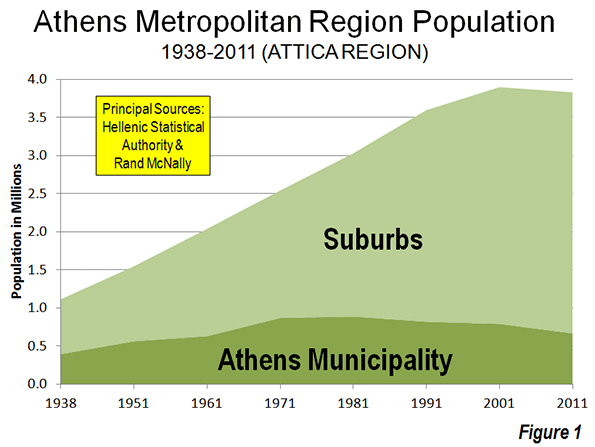
    Around the fifth century BCE, Athens may have been the most important city in the West. Like China’s Chang’an (modern Xi’an), the "on and off" capital of China, Athens has experienced many severe "ups and downs" throughout its remarkable history. At its ancient peak, Athens is estimated to have had more than 300,000 residents (historic population estimates vary greatly). At least one estimate indicates that Athens may have fallen to a population of under 5,000 by the middle 19th century. The city, now having evolved into the modern manifestation of the metropolitan area (Attica region), peaked at 3.9 million in the early 2000s, but its population has begun to drop again.

    Athens is the capital of Greece and located at the south end of the Attica peninsula, on the Aegean Sea. The core municipality of Athens is located approximately 5 miles (8 kilometers) from the historic port of Piraeus, from which ferries operate to the Greek Islands.

    Metropolitan Dispersion

    Like virtually all of the world’s metropolitan areas, population growth has been concentrated in the suburbs and exurbs for decades.

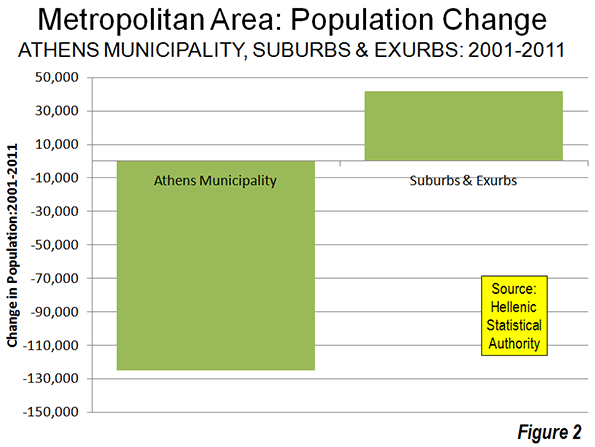
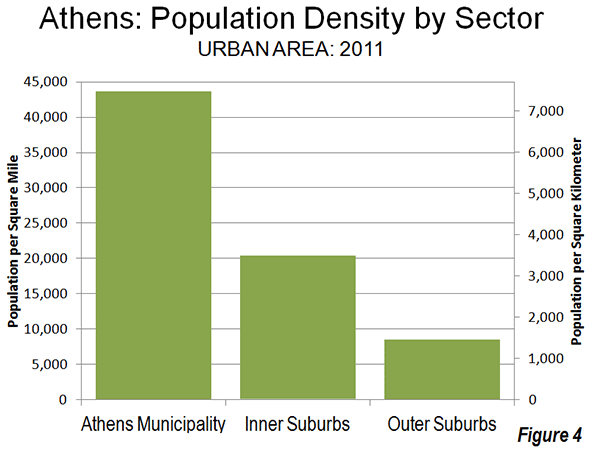
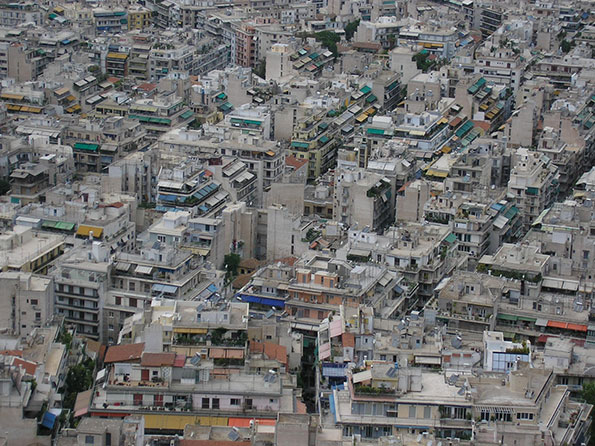
    The Athens municipality (the historic core city) peaked at 885,000 in 1981. At a population density of nearly 60,000 per square mile (23,000 per square kilometer), Athens once stood among the most dense municipalities in the world. However, the Athens municipality since has declined, with population losses in each of the three subsequent decades. Between 2001 and 2011, the population fell 125,000 to 664,000, a decline of 16%. The Athens municipality is still dense, however, at 44,000 per square mile (17,000 per square kilometer). The rest of the urban organism, as is usually the case, is considerably less so.


    Photo: Athens Core Density

    Since 1951, suburban and exurban Athens (see The Evolving Urban Form Series Definitions) has accounted for 95% of the growth in the metropolitan region, adding 2.2 million new residents, compared to approximately 100,000 for the Athens municipality. Since 1971, all of the population growth has been in the suburbs and exurbs (Figure 1).

    However, over the last decade, population growth has dropped across the entire Athens metropolitan region. Certainly, the low Greek fertility rate is a factor (see The Rise of Post-Familialism: Humanity’s Future?). Greece’s total fertility rate (average number of children per women of child bearing age) is approximately 1.5, according to Eurostat, well below the replacement rate of 2.1 not to mention the 2.3 Greek figure in the late 1970s. More recently, it is likely that the Greek fiscal crisis has contributed to an even lower rate of increase by reducing the previously flow of international migration as well as discouraging family formation among native Greeks.

    Athens growth slowed dramatically well before the financial crisis. Between 1991 and 2001, the Athens metropolitan region added approximately 300,000 new residents. But  between 2001 and 2011, the metropolitan region lost 67,000 residents. However, the suburbs and exurbs gained marginally, adding 58,000 residents, partially offsetting the loss in the Athens municipality (Figure 2). Even so, the suburban population increase was miniscule compared to the 330,000 gain of the previous decade (photo: North Suburban Athens).


    Photo: North Suburban Athens

    The Urban Area

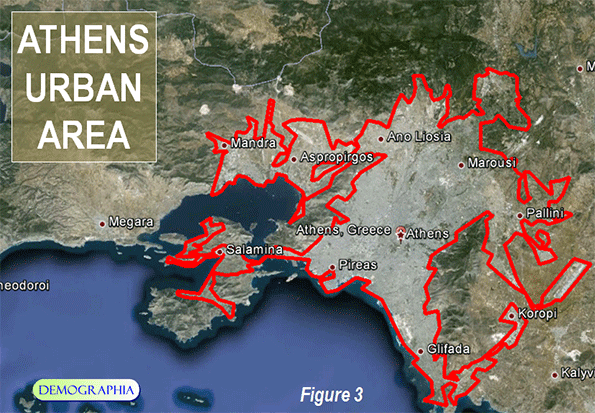
    Even with its slow and even negative growth, the  Athens urban area remains  among the most dense in the developed world (Figure 3). No major urban area in Western Europe, Japan or the New World (Australia, Canada, New Zealand and the United States) is as dense. The 2013 edition of Demographia World Urban Areasindicates that the Athens urban area has a population of 3.5 million (Note), living in a land area of 225 square miles (580 square kilometers), for a density of 15,600 per square mile (6,000 per square kilometer). This places Athens slightly ahead of London (15,300 per square mile or 5,900 per square kilometer), about double the density of Toronto or Los Angeles and more than four times that of Portland.

    As is typical around the world, the urban area of Athens exhibits a generally declining density from the core to the urban fringe. From the 44,000 per square mile (17,000 per square kilometer) Athens municipality density, the inner suburbs drop to approximately 20,000 per square mile (7,700 per square kilometer). This is still a high population density for inner suburbs, reflecting the fact that much of the area was developed before the broad achievement of automobile ownership (a similar situation is obvious in the inner ring suburbs of Paris). The outer ring suburbs have been more shaped by the automobile, yet have a density of 8,500 per square mile (3,300 per square kilometer), which still  is high by Western European standards (Figure 4).

    Affluence

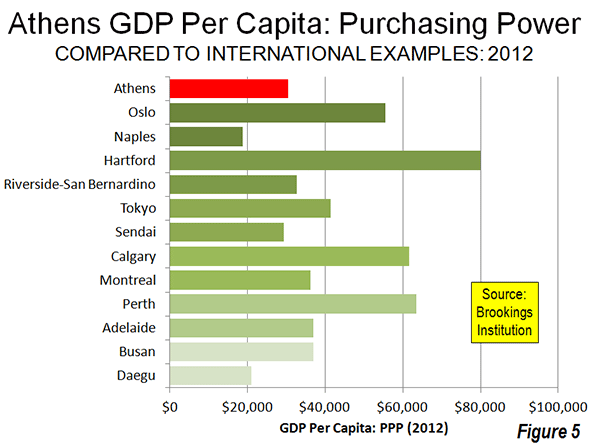
    Athens has below average affluence among the metropolitan regions of the developed world. According to data in the Brookings Institution Global Metro-Monitor, Athens had a gross domestic product, purchasing power parity adjusted (GDP-PPP) per capita of $30,500 in 2012. This trails the most affluent metropolitan regions around the more developed world. It is less than one-half the gross domestic product per capita of Hartford (US), the world’s most affluent major urban area ($79,900). The Athens GDP-PPP is approximately one-half that of regional leaders Perth (Australia) at $63,400, Calgary ($61,100), Tokyo ($41,400) and Busan (South Korea) at $36.900. Athens also ranks well below Western Europe’s most affluent metropolitan region, Oslo, at $55,500. Athens is also less affluent than the least major metropolitan areas with the lowest GDP-PPPs per capita in Australia (Adelaide), Canada (Montréal), and the United States (Riverside-San Bernardino). However, Athens has a higher GDP-PPP per capita than Sendai (Japan), Daegu (South Korea) and Naples (Figure 5), the least affluent major metropolitan areas in their respective geographies.

    Low Fertility, Declining Migration and An Uncertain Future

    Even as the national fertility rate dropped in the late 20th century, Athens continued to grow strongly due largely to international migration, especially from Albania. During the 1990s, virtually all of the population growth in Greece was the result of immigration, as the natural components of growth (births minus deaths) fell into decline. During the 2000s, immigration declined so severely that the nation lost population, most of it in the Athens metropolitan region (with the Athens municipality’s loss exceeding the nation’s) where the foreign born population has concentrated. Much of the decline in international migration resulted from the severe economic crisis.

    Athens typically exhibits the principal function of cities in civilization. When cities compete well by facilitating economic aspiration, they grow. When they do not, cities stagnate or fall into decline. For Athens, stagnation or decline seems the likely scenario in the foreseeable future.   

    Wendell Cox is a Visiting Professor, Conservatoire National des Arts et Metiers, Paris and the author of “War on the Dream: How Anti-Sprawl Policy Threatens the Quality of Life.

    —–

    Note: The difference between the metropolitan area and urban area population is the residents living in exurban areas (outside the urban area, but within the metropolitan area).

    Photo: The Acropolis (all photos by author)

  • Does the Post Office Deliver in Today’s Urban Culture?

    The postal service has been ravaged by enormous deficits and massive layoffs. It will inevitably see the closing of thousands of buildings. Planners have taken notice. Countless journalists have lamented the loss of post-office buildings, praised their often remarkable architecture and called for pressure to save them. These buildings are catalysts of “community”, the authors have suggested, citing the chance encounters of townspeople. Something is profoundly wrong, we are told, when community incubators are eradicated.

    Certainly, the loss of these buildings signals the decline of an economic sector and inevitable job losses. Is it possible, though, that the focus on post office buildings overlooks contemporary urbanism? Could it signal inattention to the evolution of “community,” and an obsession with the 19th century?

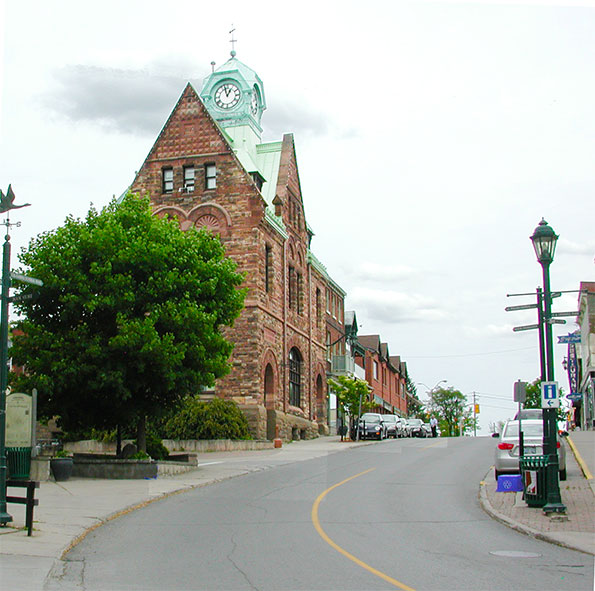
    The Evolving PO: The post office building pictured at the opening of this article began its life in a traditional Canadian village of the 1860s. The 1800s was an era of the small entrepreneur and family business; fewer than 20% of families relied on a paycheque, compared to 80% today. The timber-merchant owner of this enterprise lived in a sprawling, classical style house that boasted status and refinement. By contrast, his 650 square foot store was a humble wood building. Even though its sign advertized dry goods groceries, it provided much more — it was a virtual mini-department store — including a postal service. It also supplied credit for up to a year, because farmers paid all their bills in the fall, after harvest. A similar pragmatic and profitable strategy of blending services now prevails in the K-mart, Wall-Mart and Target superstores.

    The idea is simple: a single service means only one source of revenue for the owner and single purpose trips for his customers. Neither is efficient, particularly in a small, walkable town. The store’s role as a community catalyst in comparison to the local tavern or church remains a matter of speculation.

    This 1891 example (below), is a stylish, elaborate 2000 square feet building in a town of 3,000 people, during the era of government-run postal service. Nearly four times larger than the first, it retails no other goods. Railway expansion, a bustling regional economy and a total reliance on postal delivery for communication, boosted business in Canada to annual revenues of $4,600 by the time this building surpassed its predecessor; a venerable sum when average daily wages were $1.50. The vast difference in building quality, size, civic importance and services, can be easily explained by the brisk business, the revenue size and, importantly, government ownership. Status and state symbolism could be financed with pride.

    Not for long. By the late 1960s only half of the 33 ornamented buildings in Ontario were still standing and none were owned by the government. The loss and shift in ownership had little to do with planning. A new urban culture of instant, and distant, paperless exchange had emerged that forced the transition to the next “building”.

    The Village Option: Today, it is not uncommon to see locations where the postal service counter occupies a miniscule portion of a small drugstore on the ground floor of a 20-storey apartment building. It resides on a principal artery, but without street facade, not even a sign announcing it. As in the village example, the service is only one of many the building houses: habitation, car park and a chain drugstore that offers the gamut of goods including convenience foods and drinks. Management’s “building” choice has reinvented the village option, where the PO is not housed in a separate building.

    In his turn, the retailer, opting to rent space for a postal service, knew the benefit of luring customers by mixing services on the same premises. The new urban condition, by now in full swing, puts the postal service in an appropriate symbiotic niche, reflecting its cultural status and economic value. The uncertain “community” incubator role that it might have played in the 1800s cannot be discerned in its current form.

    The postal service trajectory is not unique. The 20th century saw the decline of the church, the pub, live theatres and classic movie theatres.

    Of all the buildings that are presumed to play a catalytic community role, none rivals the church. Historically, innumerable towns sprang up through faith groups. Church buildings were their focus and intellectual well-spring. Nonetheless, the 20th century treated the church no differently than it did the pub and the post office.

    By 2005, of the 60% of US citizens who said they were religious, less than 20% attended church regularly. Attendance among US Roman Catholics fell from 75% to 45% in the last 60 years. In the UK, annual church attendance stands at 12%, in Sweden at 5%, and in Denmark at 3%. These are striking figures for an institution that has been a cornerstone of “community”. The outcome of this abstention is inevitable: churches are demolished or converted.

    Should the Pub Get a Sub? Pubs in Britain were closing at the rate of 27 a week in 2007 and 2008, continuing a downward trend that affected their small town numbers disproportionately. The media lamented the loss of a celebrated social tradition and, with it, exquisite examples of architecture and interior design.

    This loss of building-and-function raises the question of preservation, which leads to the question of subsidization. Should the pub get a sub to support its important value as social cement? Should other such buildings and their functions be subsidized? Some planners think so, in sharp contrast to the historic Protestant ethic of self-reliance.

    In a 2002 Urban Land article we read: “… In any case, the main street in a new urbanist community should not necessarily be considered a profit center; instead, it plays the role of the principal amenity.” And further on, “…However, had the [main street] shops been located there [where traffic is heavy], the regional traffic may have overwhelmed the small main street and undermined its role as a social condenser of the community.”

    This view permeates the pro-preservation articles on post offices and pubs. It implies that social incubator functions may well deserve a subsidy, and may function better when protected from heavy traffic. In contrast to this view is the vast array of traditional village and towns of exemplar urbanism, where a thriving Main Street is also a main thoroughfare through the town.

    A New Era: The loss of post office, church and pub buildings does not stem from some wrongheaded, antisocial planning philosophy that needs to be debunked, denigrated and disposed of. It is simply symptomatic of cultural, technological and economic shifts that go way beyond the realm of urban planning. To stop the loss of post offices, for example, it would be imperative to rescind the use of e-mail, fax and phone, an absurd proposition. For the salvation of the church, it might mean a new wave of proselytizing that would result in commitment to attendance, also a bizarre projection.

    Subsidies, protestations and benevolent planning decrees are hardly the answer for either existing or new communities. The urbanist’s “community” dilemma dissolves when the transition to a new era is recognized and embraced. Rather than compulsively hold on to “community’s” past loci, let’s stir the imagination toward its emergent places.

    Fanis Grammenos is the founder of Urban Pattern Associates (UPA), and was a Senior Researcher at Canada Mortgage and Housing Corporation for over 20 years, focused on housing affordability, building adaptability, municipal regulations and sustainable planning. Research on street network patterns produced the innovative Fused Grid. He holds a degree in Architecture from the U of Waterloo.

    Photos by the author.

  • States Seek to Become More Self-Reliant for Infrastructure

    During his March 29 visit to the privately built and financed PortMiami tunnel project, President Obama unveiled a new infrastructure plan. His latest proposal—costing $21 billion— includes a renewed call for a National Infrastructure Bank capitalized at $10 billion,  a  $7 billion  "America Fast Forward Bonds" program modeled after the former Build America Bonds;  and a sum of $4 billion in direct loans and loan guarantees. The White House announcement did not make it clear whether  this latest infrastructure initiative — " to encourage private investment in America’s infrastructure" —replaces or is in addition to the $50 billion "fix-it-first" infrastructure plan that the President announced in his State-of-the-Union address less than two months ago (see, "Infrastructure Advocacy and Public Credibility," InnoBrief, Vol. 24, No. 2, February 20).

    Decidedly, infrastructure investment remains on the President’s mind. It also continues to generate headlines. Just a week earlier, the American Society of Civil Engineers (ASCE) released its latest  "report card" giving the nation a D for highways and estimating the investment needs in surface transportation to the year 2020 to amount to a staggering $1.723 trillion. With expected funding during the same period amounting only to $877 billion, the funding gap comes out to be an astronomical sum of $846 billion— more than $100 billion per year. As if to reinforce the ASCE conclusions, the Washington Post came out with a front-page story about the deteriorating state of the Capital Beltway, "a politically iconic and locally vital highway… dying beneath your turning wheels"  (Beneath the Surface, the Beltway Crumbles, March 31, 2013)

    What kind of an impact the President’s repeated pleas, combined with the ASCE report card and alarming press stories of "crumbling " infrastructure, will have on public opinion and congressional attitudes remains to be seen. As we have noted earlier, they come at a time of severe budget pressures and intense Republican efforts to curb excessive discretionary spending. To be successful,  pro-infrastructure advocates must explain to the skeptical lawmakers where the money would come from.  "At some point somebody  has to pay the bill," House Speaker John Boehner pointedly remarked in reaction to Obama’s latest infrastructure proposal. The advocates also must persuade fiscally conservative House members that there are urgent and compeling reasons to boost spending on public works that override the imperative to reduce the deficit and get the nation’s fiscal house in order. 

    Second, the nation’s taxpayers must become convinced that spending more on transportation will make a difference in practical terms such as easing congestion and improving the lot of  commuters, and that the money will not be wasted on questionable projects that have little to do with improving mobility. "The Bridge to Nowhere" as a symbol of wasteful spending still lives in the collective public consciousness. 

    Third, infrastructure alarmists must contend with the upbeat conclusions of a Reason Foundation study, "Are Highways Crumbling?" That study has found that  America’s highways and bridges are in a far better condition today than they were 20 years ago. "There are still plenty of problems to fix, but our roads and bridges aren’t crumbling," said David Hartgen, lead author of the Reason study. "The overall condition of the public road system is getting better and you can actually make the case that it has never been in better shape." The study affirms what the traveling public experiences every day —- that  the nation’s highways and bridges not only are not "crumbling" but in most places are holding up pretty well. "Should I believe the pundits or my own eyes," asked Charles Lane, a Washington Post editorial writer, in a much-quoted column after having traveled thousands of miles "without actually seeing any crumbling roads."  (The U.S. Infrastructure Argument that Crumbles Upon Examination, October 31, 2012). 

    Fourth, as one highly knowledgeable reader of ours (a civil engineer) has observed, "we must get an objective, precise and quantifiable assessment of bridge conditions  before launching full bore into repair or replacement actions" costing billions of dollars. "Today," he wrote, " no one, and I mean no one  has an objective, clear and precise understanding of the actual condition of America’s bridges." Before asking taxpayers for billions of dollars to fix a problem based on subjective visual assessments of bridge conditions,  we want to be very sure that we have accurate data to back up our position, our reader concluded. His remarks about bridges could equally well be applied to the condition of the nation’s roads.

    Lastly, infrastructure advocates must overcome a cynical perception, common among the public, that pressures to increase federal funding for transportation are nothing more than special interest pleadings by interest groups that stand to profit from higher levels of public spending (ASCE is one of them, raising questions as to its objectivity, several observers have noted). 

    As one transportation advocate at a recent conference observed, "there is an enormous disconnect between us and the American public" — a disconnect that may not be easy to overcome.

    States Are Acting on their Own

    As we have argued in recent columns, no one disputes the infrastructure advocates’ claim that some of America’s transportation facilities, such as the Capital Beltway, are reaching the limit of their useful life and need reconstruction. Nor does any one disagree about the need to expand infrastructure to meet the needs of a growing population. But fiscal conservatives among infrastructure advocates (and we count ourselves among them) contend that this does not rise to the level of a national crisis requiring a massive $50-70 billion federal crash program as proposed by the President, or the expenditure of more than $100 billion per year as recommended by ASCE.

    Instead, the challenge can be met if each state did its part to incrementally, over a period of years, bring its transportation facilities up to a "state of good repair" using its own gas tax revenues  and its formula allocation of the Highway Trust fund dollars. As numerous news dispatches attest, that is precisely what’s happening (see below). A growing number of states are not waiting for the federal government to come to the rescue. They are using their own resources and raising additional revenue to pay for reconstruction of their aging facilities– "one lane at a time" if necessary—and keep their transportation systems in good working condition. "Governors and state legislatures realize that the level of federal assistance beyond 2014 is highly uncertain and they are acting on a credible assumption that federal funding will remain at current levels or may even be cut back," an association executive who is familiar with the thinking of senior-level state officials, told us.

    What about  large-scale reconstruction and capacity-expansion projects that require billions of dollars—transportation  investments that are beyond the states’  fiscal capacity to fund on a pay-as-you-go basis? Those investments,  provided they are credit-worthy (i.e. are revenue producing or backed by dedicated tax revenue),  will be mostly financed through long-term credit instruments  and public-private partnerships. The future of infrastructure megaprojects is intimately tied to the financial involvement of the private sector and to a wider use of  tolling, "availability payments,"  and innovative credit instruments such as TIFIA and private activity bonds (PABs), a veteran facilitator of public-private partnerships told us. " President Obama was right to have shined a spotlight on the PortMiami tunnel project and drawn attention to the importance of private investment in major transportation infrastructure. The Highway Trust Fund no longer can serve that purpose."

    The scenario we have suggested above—i.e., having states assume financial responsibility for fixing their aging transportation systems, while relying on debt financing for major facility reconstruction and system expansion—makes practical sense in view of the uncertain future level of  federal transportation funding.  It also may constitute a way to save the Highway Trust Fund from insolvency and provide a lasting solution to the federal transportation funding dilemma.

    NOTE: States that recently have undertaken to raise additional funds for transportation include: Virginia and  Maryland (broad transportation funding overhaul  that includes a dedicated sales tax applied to the wholesale price of gasoline.  A sales tax, it has been argued, is no less a "user fee" than the gas tax since every consumer who pays a sales tax also is served by or "uses"  the highway system for goods delivery );  Arkansas (one-half cent sales tax increase to back a $1.3 billion bond issue to fund highway construction over the next ten years); Massachusetts ($13.7 billion bond-financed transportation plan); Maine ($100 million transportation bond proposal);  Michigan ($1.5 billion road plan funded with vehicle registration fees and a tax on fuel at the wholesale level); Missouri (proposal for a dedicated one-cent sales tax for transportation; the tax is expected to raise $7.9 billion over ten years); New Hampshire (12-cent hike in the gas tax over three years approved by the House; Senate approval uncertain);  Ohio (turnpike toll-backed $1.5 billion bond issue for highway and bridge improvements); Texas (statewide tolling);  Wisconsin ($824-million boost to the state transportation fund);  Wyoming (10-cent fuel tax increase, the first in 15 years); and California, Oregon and Washington (exploring new mechanisms for project finance through the cooperative West Coast Infrastructure Exchange).

    Recent major transportation infrastructure projects largely financed with long-term credit instruments rather than federal dollars include: the I-495 Beltway HOT lanes project in Northern Virginia; New York’s Tappan Zee Bridge replacement; the San Francisco Bay Bridge Eastern Span replacement; the I-5 Columbia River Crossing;  the Highway 520 floating bridge in Seattle, the Midtown tunnel linking Norfolk and Portsmouth, VA, East End Crossing over the Ohio River, and the PortMiami Tunnel.

  • Why Inmigration Really Matters, Particularly to the Rust Belt

    Cleveland Mayor Frank Jackson’s recent comment about immigration has drawn some local ire. At his annual remarks on the state of the city, the Mayor—in response to a question of how Cleveland can end its population decline by attracting immigrants—stated: “I believe in taking care of your own”.

    To be fair, the Mayor contextualized the statement by inferring that the best attraction strategy is to build a city that works for those who reside in it. In some respects I agree. In fact America attracts immigrants not because of “attraction strategies”, but because it offers the prospects of a better quality of life. So, if a city can nail that down, well, that is a hell of a pull.

    The problem, though, is that historically inward-facing legacy cities such as Cleveland have had a hard time moving the needle toward progress because fresh blood is lacking, and so a “taking care of your own” strategy often devolves into policies that simply further fossilize the status quo.

    Why?

    Because such cities—with low rates of inmigration, and a long lineage of social capital that can tip to the side of insularity and territorial encampment—have too much inertia, which is defined as “the resistance of an object to change its state of motion or rest”.

    Inertia is real, not simply in physics, but in organizational behavior, such as city politics and policy. And the more historical it is, the thicker the status quo, and thus the harder it is for a city to change—meaning the future, or the momentum of the city, can be like a train chugging to constant stops of stagnation unless a “force outside the system…act[s] upon the system for a long enough period of time to have any effect on changing the momentum.”

    Enter the importance of outsiders, be they immigrants, returning expats, or just new people from other parts of the country. Without them cities get stuck. People see the same things, talk the same things over. Bullshit territorial divides like East- versus West-side of the Cuyahoga River reign, effectively cutting a city’s “brain” in half. Business is business as usual, then. Hence the post-industrial-sixty-year decline.

    Writes Aaron Renn over at Urbanophile:

    I previously noted how it generally takes a critical mass of outsiders, enough to create a constituency for change in its own right, to drive real disruptive change in a community. These are the people who aren’t invested in the status quo. Absent that, getting reform that works will be a difficult challenge.

    Echoes migration expert and blogger Jim Russell:

    Without migration, there are no cities. An urban landscape is more than a draw for talent. Metros thrive on churn, both the influx and egress of people…

    … The very act of moving, particularly to the top tier of global cities, is entrepreneurial. You are surrounded by risk-takers and innovation. The competition is fierce. The cream of the crop is seeking any edge, looking for any opening.

    I am learning about the power of migration first hand. You see, I am a lifelong Clevelander, a West Sider, one well-versed in the how things are customarily done around here, and what thoughts and words are commonly produced if only through a Rust Belt inertia that can be cloaked in “tradition”. My partner, Andiara Lima, is a relative newcomer from Vale do Aço, or the “Steel Valley” of Brazil. Before I met her I was ignorant to the presence of the Brazilian community in Cleveland. Now, I no longer am, and the experience provides me with on-the-ground lessons as to the importance of migration in evolving the Rust Belt “way”.

    brazil house party


    For instance, individually speaking, my panorama is being broadened, with the dominant cultural connotations of Cleveland defined primarily by whiteness or blackness taking a needed hit. For instance, I was at a Brazilian-hosted house party not long back, and it was like nothing I ever experienced. The dining room was cleared, bodies moved, sweat poured, people screamed and shook ass. A band was set up to play bossa nova along a window seat. And it was happening all in the neighborhood of my childhood, but way beyond my childhood. Rather a feeling of something forward.  Not just past. Not identity politics, but a freshness needed so that crusty legacy and power can be dampened if only to bust identity politics up.

    No doubt, these identity politics hurt the region’s ability to welcome and catalyze emerging groups. For instance, I am reminded of a recent Facebook comment on a local politician’s page that discussed a community forum about how Cuyahoga County government reform would affect race relations. The commenter notes:

    The whole panel was black or white people. The Asians and Latinos were in the back of the room wondering “what about us?”

    “What about us?”

    It’s a good question, and one local leaders shouldn’t underestimate given the region’s need for fresh blood. And we aren’t just talking bodies, but talent, as migrants are “economic ass-kickers”, particularly due the fact that migration is in itself an act of entrepreneurialism.

    For instance, my partner Andiara studies the Brazilian trade market for a local investment company. Her informational network into the country, both professionally and informally, is deep. For me, she is a link between two Rust Belt worlds, shattering my sense of restrictive locality for a borderless view that gets me thinking about how to position Cleveland not just regionally, but globally.

    For Cleveland, she is a reserve for local industry that should be both cultivated and tapped, especially since—as the US Ambassador to Brazil recently said at Cleveland’s Union Club—“Brazil is an economic and democratic power the United States needs as a partner”.


    And there is Luca Mondaca and Moises Borges, both acclaimed Brazilian musicians who are plugging (into) and broadening (out) Cleveland’s musical legacy. Yet there is frustration, particularly for Luca, as she feels isolated, untapped, and sometimes lost in the culture of a city that—while desperate for freshness—has difficulty getting beyond the inertia that comes with being comfortably stale. And while I am hopeful that the city is in fact becoming more welcoming—and that the opportunity afforded by the region’s affordability and legacy assets can further open the inmigrant sluicegates—passive optimism is not an option.

    Neither is parochial playmaking.

    In fact, Andiara Lima, Luca Mondaca, and Moises Borges are Cleveland’s “own”. But without that recognition, they may not be for very much longer.

    Richey Piiparinen is a writer and policy researcher based in Cleveland. He is co-editor of Rust Belt Chic: The Cleveland Anthology. Read more from him at his blog and at Rust Belt Chic.

  • Will Obama Play his Aces?

    With the stock market hitting new highs, and unemployment easing, albeit slightly, President Obama can now seize his moment. After spending four years blaming George W. Bush for his lousy hand, the president now sits at the table with three strong aces among his cards.

    The key question is: Will he play them?

    One reason he might not is that most of his good hand stems primarily not from his stewardship but America’s economic and demographic kismet. In fact, this resurgence is primarily not taking the "green," urban and high-tech form, as preferred by most coastal Democrats, but stems largely from the productive forces being unleashed in the nation’s largely red heartland.

    But Barack Obama is president, and if the country resurges on his watch, he will get much of the credit. This country, for all its problems, is naturally blessed, with both human and physical resources. It is beginning to both pull away from laggard Europe and Japan and seems far more well-positioned to compete with China than most observers believe. The choice for the president is whether to ride this resurgence, or throw it away as incompatible with his political agenda.

    This dichotomy starts with energy, the thing most propelling the real, as opposed to the paper, economy. The current energy boom is taking place in a manner precisely what Obama and, certainly, many of his strongest backers, least likely would have preferred. In his first term, Obama charted a path on energy typical of the university faculty lounge. His departing energy secretary, Steven Chu, embraced the idea that Americans used fossil fuels irresponsibly, comparing them to teenagers. He liked forcing higher costs for energy while using our tax dollars to subsidize often-dodgy renewable schemes.

    Yet, history, as is often the case, played out quite differently than the expected script. Rather than being required to accept enforced scarcity, Americans, largely due to new drilling techniques and advanced technology for identifying previously undiscovered fields, now are on the cusp of a massive energy boom. This has changed the country’s trade and economic prospects immeasurably. Since 2009, the industry, according to the consultancy EMSI, has added some 430,000 jobs, in contrast to the much subsidized "green" energy industry, which has suffered a spate of embarrassing failures.

    Energy employment

    One problem for the president: The big winners to date have come from outside the coastal strips whose residents constitute his base. Over the past decade, Texas alone has added 180,000 mostly highly paid energy-related jobs. Oklahoma added 40,000, and the Intermountain West well over 30,000. In what could be a persuasive case, Pennsylvania, a blue state with a hunger for jobs, has joined the party; the original center of the U.S. energy industry is now enjoying a resurgence.

    In contrast, energy-rich California, despite the nation’s third-highest unemployment rate, has chosen to stand largely on the sidelines, creating a mere 20,000 such energy-related jobs. The same can be said about New York, which so far has chosen to follow the lead of celebrity "fracktivists" and is refusing to exploit its rich natural gas resources. Yet even in California, some normally progressive voices, such as former longtime Los Angeles Times columnist Tim Rutten, suggest that, in order "to jump-start" its economy, the state ought to climb on the energy bandwagon.

    To be a successful president, Obama can embrace this growth while maintaining his green bona fides. As the environmentalists at the Breakthrough Institute have noted, America’s recent remarkable progress in reducing greenhouse gases primarily is not the result of the sort of green technologies financed by the president’s venture-capitalist friends and embraced by his media allies. Instead, it has been overwhelmingly the result of the gradual replacement of coal usage with natural gas.

    Embracing gas – not only to generate electricity but also for transportation – serves both Obama’s interest and the country’s long-term interest. But his task is made more perilous by his efforts to appease his urban, green constituency, once strongly supportive of natural gas, but now decisively against it. Two contrarian environmentalists, an increasingly endangered species, have labeled the celebrity-driven protesters of hydraulic fracturing drilling techniques as "fracktivists for global warming."

    Some observers, such as former Al Gore aide Morley Winograd, suggest that Obama’s appointment of Ernie Moniz as energy secretary will bolster the notion that the president has shifted towards "pragmatic idealism" on energy. Obama may still be reluctant to allow much drilling in publicly held land but he could countenance a negotiated reasonable solution to the contentious issue of fracking.

    High-flying farming

    Energy is only one, albeit the most dramatically apparent, ace in the presidential hand. Another is agriculture, which is on a historic tear. This has been led, particularly in the Great Plains and the Midwest, by a boom in agriculture exports: The U.S. exported a record $135 billion in 2011, with a net favorable trade balance of $47 billion, the highest in nominal dollars since the 1980s.

    What accounts for this boom? One driver is growing markets in the developing world – notably, China, which consumes almost 60 percent of the world’s soybean exports and 40 percent of its cotton. The Great Plains Corridor, in particular, produces both these crops in abundance, which is one reason for its increased share of U.S. exports.

    Most farmers and farm communities – outside of some who might ship to lovocore (eat local) restaurants – tilt conservative, but the exports of this sector drive growth in services and even technology. Farming today is increasingly tied to science, and that includes efforts to reduce the use of fertilizers and water. Cities from Omaha, Neb., to Kansas City to New Orleans all benefit from agricultural trade.

    Cars come back

    The last of Obama’s aces comes from manufacturing, whose resurgence has been among the most surprising developments of the past five years. Some of this is tied to the energy boom, which is boosting industry along the Gulf Coast, with its burgeoning petrochemical complex. By itself, the expansion of energy – particularly cheap and plentiful natural gas – will create, according to a recent PricewaterhouseCoopers study, more than 1 million industrial jobs nationwide.

    But more politically important for the president is the resurgence of the U.S. auto industry. Whatever one thinks of how the GM and Chrysler bailouts were conducted, the return to profitability in Detroit represents a big win for Obama and may be one of the reasons for his surprisingly strong electoral showing in the industrial Great Lakes. In comparison with Europe and, increasingly, even China, American manufacturers are showing great resiliency and growing competitive strength.

    Yet, even here Obama needs to be careful. What a recent Boston Consulting Group report described as the incipient "reallocation of global manufacturing" will primarily benefit lower-cost, nonunion red states such as South Carolina, Alabama and Tennessee. This is where most new investment from German, Japanese and Korean firms is going. Yet, if this growth continues, Obama is helping his core constituencies, notably African-Americans, who now can see the prospect of higher-wage employment with benefits.

    Ultimately, as the former Gore aide Winograd suggests, how Obama plays these cards may well determine the success of his tenure.

    He could choose to throw out his trump cards in a gesture to placate his gentry funding base, urban progressives and his most devoted media claque. Or he could, like most great politicians, choose, instead, to play the great hand providence has provided him, irrespective of his core supporters, thereby all but assuring his stature as one of the more successful presidents in recent history.

    Joel Kotkin is executive editor of NewGeography.com and a distinguished presidential fellow in urban futures at Chapman University, and a member of the editorial board of the Orange County Register. He is author of The City: A Global History and The Next Hundred Million: America in 2050. His most recent study, The Rise of Postfamilialism, has been widely discussed and distributed internationally. He lives in Los Angeles, CA.

    This piece originally appeared in the Orange County Register.

    Barack Obama photo by Bigstock.

  • MoneySense Top 10 Best Places to Live in Canada in 2013

    Here we go again! Another ranking of the “best” places to live. I wonder how many of those there are.  They just pop up on your computer screen like unwanted ads. Perhaps there are so many “best” cities rankings that at some point most cities end up winning or being in the top 10. Mayors and chambers of commerce know it, just like car companies. If you don’t win the top prize you will simply pick a category and exploit it to death to sell your product. It could be safety, trunk size, fuel efficiency, resale value. In the case of cities, it can be average house price, commuting time, unemployment rate, safety and the pièce de resistance, the vaguest criteria of all, the one that makes rankings such subjective tool: amenities.

    What does it mean for MoneySense to be the best? A look at the methodology shows that the criteria are quite typical of most rankings: crime, amenities, commuting, heath, housing etc.  Also, the number of points given to each criterion varies from one to another and are totally based on the mood of those who design the ranking. If you think that dry weather is important then you will give it more points. If you dislike bike paths you give it less point. If professional sport teams seem unimportant, you simply don’t use it as a criterion.

    One big mistake that those guys do is to mess up distinctions between metropolitan areas and suburbs. Too often, they only include the boundaries of municipalities and break up larger cities into pieces even though they are really parts of greater metropolitan areas.  For example, The Greater Toronto Area (GTA) has close to 6 million residents. The Municipality (or City) of Toronto has about 2.5 million people. Mississauga, a populous suburb of the GTA, but has its own place  in the very same ranking. How can this be? This is major flaw, a very common one.

    So let’s take look at the ranking. We indicate when a city was part of a Census Metropolitan area):

    1. Calgary, Alberta
    2. St. Albert, Alberta ( a suburb of the Census Metropolitan Area of Edmonton)
    3. Burlington, Ontario (a suburb of the Census Metropolitan Are of Toronto)
    4. Strathcona County, Alberta ( a suburb of the Census Metropolitan Area of Edmonton)
    5. Oakville, Ontario (a suburb of the Census Metropolitan Are of Toronto)
    6. Ottawa, Ontario (Since all suburbs of Ottawa has been amalgamated it couldn’t be broken down like Edmonton or Toronto)
    7. Saanich, British Columbia ( a suburb of the Census Metropolitan Area of Victoria)
    8. Lacombe, Alberta ( a suburb of the Census Metropolitan Area of Edmonton)
    9. Lethbridge, Alberta
    10. Newmarket, Ontario (a suburb of the Census Metropolitan Are of Toronto)

    It would be hard to end up with a more flawed ranking. There is a mix of small cities (Lethbridge), the mid-size city of Ottawa, with suburbs that have been amalgamated into one unified City of Ottawa, without taking account that the Census Metropolitan Area includes the City of Gatineau, across the Ottawa River, in the Province of Québec. It is simply impossible to judge a suburb or a city that is part of a metropolitan area and ignore the fact that its amenities, transportation system, jobs, highways etc. are all linked. How would Mississauga’s economy perform if it wasn’t of Toronto, or its airport, (located in Mississauga!)? How would Ottawa do if they didn’t have its pool Gatineau and its pool of 75,000 civil servants living in its more affordable houses, commuting by across the Ottawa River by one of its 5 bridges?

    I am not pro-gentrification nor a big fan of downtown living, at least not until my kids will live at home. I myself live in an Ontario suburb of Ottawa, while commuting by train to Montreal a few times a month. However, I am fully aware that my suburb would not exist if not for downtown Ottawa. When 75% of the labour force living in my suburb commutes to downtown Ottawa each day to go to work, if the city had not been amalgamated in 2000, I would have laughed at any ranking that would have considered my suburb as a stand- alone city.

    Please guys, you do not rank cities like you rank sports teams.

  • Why British Prosperity is Hobbled by a Rigged Land Market

    The British have the least living space per head, the most expensive office rents and the most congested infrastructure of any EU-15 country. Thanks to a rapidly growing population –  the result of a healthy birth-rate and immigration – these trends are worsening steadily. At the same time, the British economy is languishing in a prolonged slump brought on by a collapse of demand. The answer is obvious: Britain needs to build more. Unfortunately, the obstacles to development are formidable. Britain’s supply-side problems are of a different character to those holding back other struggling European economies, but arguably no less serious.

    Britain is generally considered a flexible, economically liberal economy, in which insiders have few opportunities to rig the system for their own benefit. To the extent that supply-side problems are considered a significant obstacle to economic growth, attention generally centres on the country’s patchy skills base. A high drop-out rate from secondary school and weak vocational training are no doubt real constraints on the UK economy, but there is an equally, if not more, serious one. Housing, commercial property and infrastructure are central to a country’s economic and social well-being. The UK’s essentially rigged market for land and its restrictive planning system are as big an obstacle to economic growth as restrictive labour markets and protected professions are in Southern Europe.

    The number of new homes built each year in Britain has lagged far behind demand from a growing population for 30 years. Despite faster population growth, house construction is currently running at half the level of the 1960s. At the same time the average size of homes built in Britain is now the smallest in the EU. The result of these two trends has been a steady fall in the amount of living space per head. Property prices relative to average household incomes have come down a bit since 2007, but remain very high. Moreover, the problem is not just restricted to the residential sector: Britain has the highest office rents in the EU. Firms in cities such as Manchester pay more than in Frankfurt or Milan. And transport infrastructure is very expensive to build in Britain, which is one reason why there is too little of it.

    Britain is small and densely-populated, but does not suffer from particularly acute land scarcity. Around 13 per cent of the UK is built on, a lower proportion than in countries with a similar population density such as Germany, Belgium or the Netherlands. Britain’s problem is that the supply of new housing and commercial space is uniquely unresponsive to increases in property prices. Alone among the countries that experienced a house price boom in the run up to the financial crisis, Britain had no construction boom. The number of houses being built picked up only slightly, despite UK house prices rising by more than in any other developed countries except Ireland.

    This situation has far-reaching economic and social consequences for the UK. Massive house price inflation has aggravated the UK’s already high levels of inequality by shifting wealth from the young (and property-less) to the old (and propertied). The poor availability of affordable housing undermines labour mobility – people are unable to move to where jobs are available because they cannot afford accommodation. Those on welfare are discouraged from working (as they then lose access to subsidised housing).  Congested, expensive infrastructure combined with pricey commercial property pushes up the cost of business, depresses investment and holds back economic growth.

    The two reasons for Britain’s land-use woes – a complex planning system and insufficient land for development – are inter-related. A major constraint on the supply of land is the existence of a protected ‘greenbelt’: land around cities on which development is very tightly controlled. There are also strict controls over building on other so-called green-field sites. The market for land is essentially rigged in favour of landowners, who pay no tax on their land holdings and hence pay no penalty for sitting on it, waiting for the artificially-created scarcity to push prices up further. With no revenue from land taxes, local authorities are unable to capture any increase in the value of land that takes place when planning permission is granted. As a result, they have little incentive to open up land for development. 

    The UK should, of course, redevelop so-called ‘brownfield’ sites – vacant or derelict buildings and land. But this will only ever comprise part of the solution to its land use crisis. By its very nature, brownfield land is concentrated in parts of the country where people do not want to live. And it is often very expensive to redevelop, not least because the government has stipulated that 60 per cent of new homes must be built on brownfield sites. There is no alternative to building on the green-belt, much of which is neither beautiful nor green. The greenbelt was originally established to combat urban sprawl, but is now an obstacle to sensible development. For example, allowing London to expand by between two and three miles in each direction would easily solve the city’s land-use problems. Increasing that proportion of the UK’s surface area under development by between 1 and 2 percentage points would address the country’s  land constraints  and would not involve concreting over England’s ‘green and pleasant land’. Urban sprawl could easily be prevented by good quality town planning.

    The sanctity of the greenbelt, and green-field land more generally, has much to do with vested interests perpetuating a system which rewards speculation. Many Britons have profited from land scarcity (and the tax-free property price gains it has led to), and are determined to defend those gains. They may complain about their children being unable to buy a house, but at the same time will staunchly oppose new development. For their part, landowners are a powerful and politically well-connected lobby; many of the biggest sit in the House of Lords (the country’s upper house). They have a big stake in inflated land prices and are well-placed to resist the taxation of land.

    A land tax would involve property owners paying a percentage of the value of their land in tax each year. If the value of their property rose, so would the amount of tax paid on it. This would achieve a number of things. First, local authorities would have a financial incentive to change land from agricultural to residential (and commercial) use as they would profit from the increased value of the land this would cause. Second, it would make it more expensive to speculate on future rises in land values, and some of those gains would be captured by the government. Third, construction companies would not be able to sit on large amounts of land (so-called land banks), and drip feed the market, maintaining prices at artificially high levels. Instead, land would have to be developed or sold, which together with the increased availability resulting from the freeing up of greenbelt land, would bring down the price of developing land and with it the cost of housing, commercial property and infrastructure. Lower land costs would also increase competition by reducing barriers to entry to the construction sector: for example, at present housing building is dominated by a small number of big players.

    Supply-side measures are rarely a quick solution to a demand-side crisis. That is certainly the challenge facing other struggling European economies. Spain and France suffer from inflexible labour markets, Germany from over-regulated product and services markets, Italy from both. Academic research shows that addressing such problems improves economic performance in the longer term, but it provides no immediate boost to demand. However, the UK is almost certainly an exception. Addressing Britain’s biggest supply-side problem (its rigged market for land) could provide a more immediate economic stimulus by releasing massive pent-up demand, as well as lift growth potential.

    Britain should turn its weaknesses into strengths. Other struggling European countries have a surfeit of housing and infrastructure and poor demographics. For example, boosting construction in Spain would do no good – Spain has far too many unsold houses and it is now suffering from net emigration (more people are leaving the country than arriving). In Italy and Germany, populations are stagnant, although there is more scope to boost spending on infrastructure than in Spain. France’s population is growing, but as a result of persistently strong public investment, it already has very good physical infrastructure. And thanks to a rational planning system and plenty of land, it does not suffer from a housing shortage. Unlike Britain, these countries have few low-hanging fruit.

    Far-reaching reform of the greenbelt and the introduction of land taxes could open the way for a boom in housing and commercial development. Local authorities and the national government could agree to set aside a proportion of the funds raised through land taxes to fund investment in infrastructure. Moreover, land taxes would make the tax system fairer by taxing unearned income. And by redistributing money from the wealthy (who save a high proportion of their income) to construction sector workers (who save little of it), it would provide a further boost to economic activity. The current Conservative-Liberal government has pushed through modest reforms of the planning system, but has shied away from opening up the greenbelt and has no intention of introducing a land tax. 

    An economy in which speculation is rewarded and wealth is increasingly concentrated in the hands of those with property risks stagnation. It faces an uphill battle to hold on to its young or attract skilled immigrants. Britain needs to strike a better balance between the interests of existing property-owners and the rest of the country. This includes acknowledging that the value of land is determined by the activities of society as a whole and not the landowner, and hence needs to be taxed accordingly.

    Simon Tilford is chief economist at the Centre for European Reform, where this piece originally appeared.