Blog

  • Annual Update on World Urbanization: 2013

    Tokyo continues to be the world’s largest urban area with more than 37 million people, according to the recently released 9th Annual edition of Demographia World Urban Areas. Tokyo has held the top position for nearly 60 years, since it displaced New York. There have been only modest changes in the ranking of the world’s largest urban areas over the past year. The top four urban areas remain the same, with Jakarta (Jabotabek) second, Seoul third and Delhi fourth. Fast-growing Shanghai, however, assumed fifth place, displacing Manila where the latest census data showed less population growth than had been expected (Table 1).

    Table 1          
    LARGEST URBAN AREAS IN THE WORLD          
    Rank Geography Urban Area Population Estimate Land Area: Square Miles Density Land Area: Square Kilometers Density
    1 Japan Tokyo-Yokohama 37,239,000 3,300 11,300 8,547 4,400
    2 Indonesia Jakarta (Jabotabek) 26,746,000 1,075 24,900 2,784 9,600
    3 South Korea Seoul-Incheon 22,868,000 835 27,400 2,163 10,600
    4 India Delhi, DL-HR-UP 22,826,000 750 30,400 1,943 11,800
    5 China Shanghai, SHG 21,766,000 1,350 16,100 3,497 6,200
    6 Philippines Manila 21,241,000 555 38,300 1,437 14,800
    7 Pakistan Karachi 20,877,000 310 67,300 803 26,000
    8 United States New York, NY-NJ-CT 20,673,000 4,495 4,600 11,642 1,800
    9 Brazil Sao Paulo 20,568,000 1,225 16,800 3,173 6,500
    10 Mexico Mexico City 20,032,000 790 25,400 2,046 9,800
    11 China Beijing, BJ 18,241,000 1,350 13,500 3,497 5,200
    12 China Guangzhou-Foshan, GD 17,681,000 1,225 14,400 3,173 5,600
    13 India Mumbai, MAH 17,307,000 211 82,000 546 31,700
    14 Japan Osaka-Kobe-Kyoto 17,175,000 1,240 13,900 3,212 5,300
    15 Russia Moscow 15,788,000 1,700 9,300 4,403 3,600
    16 Egypt Cairo 15,071,000 640 23,500 1,658 9,100
    17 United States Los Angeles, CA 15,067,000 2,432 6,200 6,299 2,400
    18 India Kolkota, WB 14,630,000 465 31,500 1,204 12,100
    19 Thailand Bangkok 14,544,000 900 16,200 2,331 6,200
    20 Bangladesh Dhaka 14,399,000 125 115,200 324 44,500
    21 Argentina Buenos Aires 13,776,000 1,020 13,500 2,642 5,200
    22 Iran Tehran 13,309,000 525 25,400 1,360 9,800
    23 Turkey Istanbul 12,919,000 520 24,800 1,347 9,600
    24 China Shenzhen, GD 12,506,000 675 18,500 1,748 7,200
    25 Nigeria Lagos 12,090,000 350 34,500 907 13,300
    26 Brazil Rio de Janeiro 11,616,000 780 14,900 2,020 5,700
    27 France Paris 10,869,000 1,098 9,900 2,845 3,800
    28 Japan Nagoya 10,183,000 1,475 6,900 3,820 2,700
    Source: Demographia World Urban Areas (2013)


    Provisional census results moved Karachi into the top 10 for the first time, while two urban areas, Bangkok and Tehran, reached megacities status (over 10 million population), reflecting strong growth and the availability of more precise data for estimation.

    As before, the most dense megacity was Dhaka, Bangladesh, at 115,000 per square mile (45,000 per square kilometer). New York continues to have the largest urban footprint, covering nearly 4,500 square miles (more than 11,500 square kilometers) and the least dense megacity in the world.

    Coverage

    This year’s Demographia World Urban Areas report provides current and coordinated population, urban land area and density data for all 875 identified urban areas with 500,000 population or more as well as estimates for 650 smaller urban areas. The report includes a total population of approximately 1.86 billion in urban areas with 500,000 or more population and an overall population for urban areas of all sizes of 2.0 billion. These urban areas account for approximately 53% of the world’s urban population.

    Distribution of Population by Urban Area Size

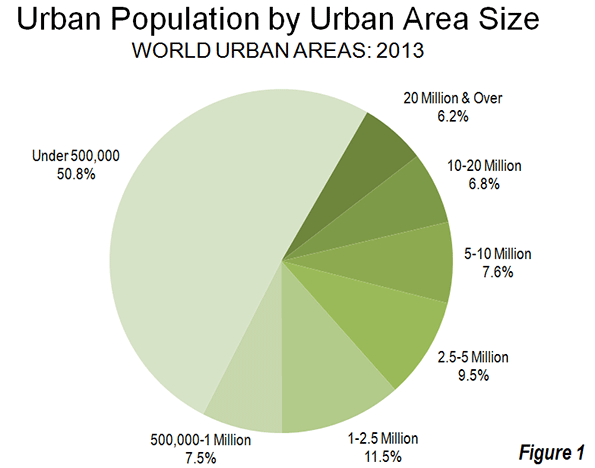
    As was noted in What is a Half Urban World? a considerable share of the world’s urban population lives in smaller urban areas (as small as 200 population). In 2013 is estimated that 51% of the world’s urban population lives in urban areas with less than 500,000 population, based on the data in Demographia World Urban Areas. The 10 largest urban areas, each with over 20 million population, account for approximately 6% of the urban population while the 28 megacities, each with more than 10 million population, account for 13% of the population. Approximately 21% of the urban population is in the more than 375 urban areas with between 1 million and 5 million population (Figure 1).
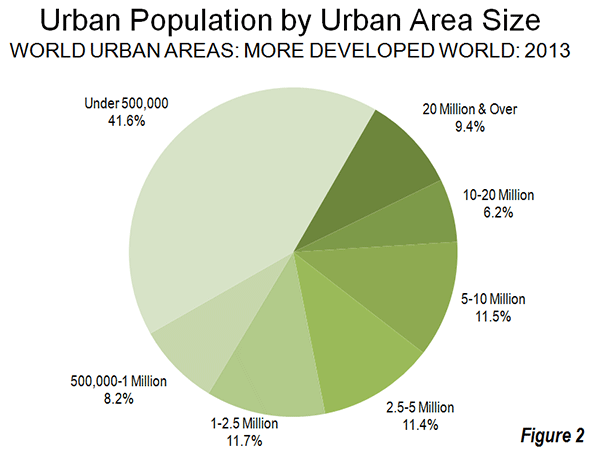
    The share of the population in larger urban areas is greater in the more developed world than in the developing world. Only 42% of the population lives in urban areas with less than 500,000 population in the more developed world. The share of the population in megacities is greater than the world figure, at approximately 16% (Figure 2).
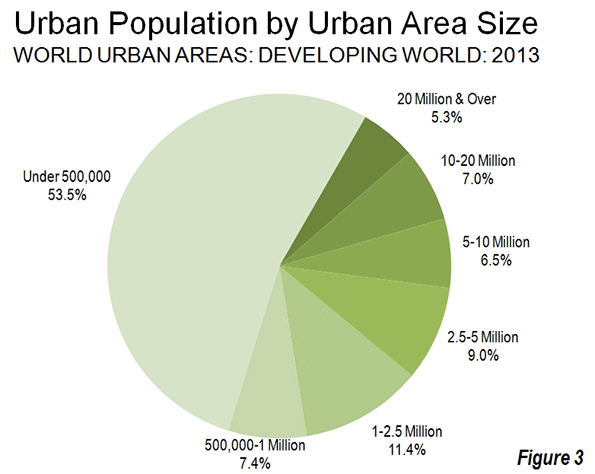
    A larger share of the population is in smaller urban areas in the developing world, at 54%. Combined, 13% of the developing world population is in the megacities and 20% of the population is in urban areas with between 1 million and 5 million population (Figure 3).
    Distribution of Population by Urban Area Size

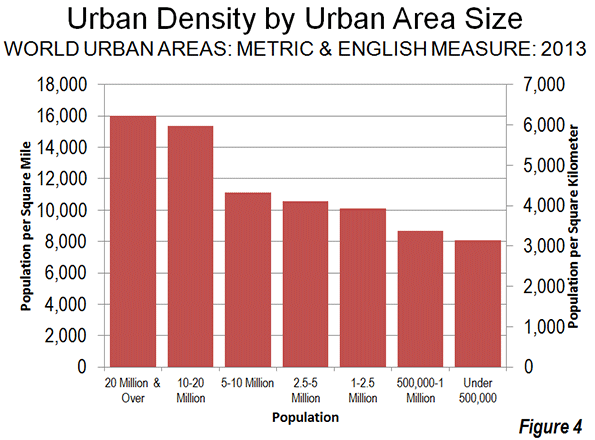
    Generally, the larger urban areas have higher average population densities than smaller urban areas (Figure 4). Overall, the urban areas with more than 20 million population have a density of approximately 16,000 per square mile (6,200 per square kilometer), while urban areas between 10 million and 20 million population are nearly as dense at 15,400 per square mile (6,000 per square kilometer). The urban areas with from 5 million to 10 million population are considerably less dense, at 11,100 per square mile (4300 per square kilometer). The smallest urban areas (Note), below 500,000 population are estimated to have a density of approximately 8,100 per square mile (3,100 per square kilometer).
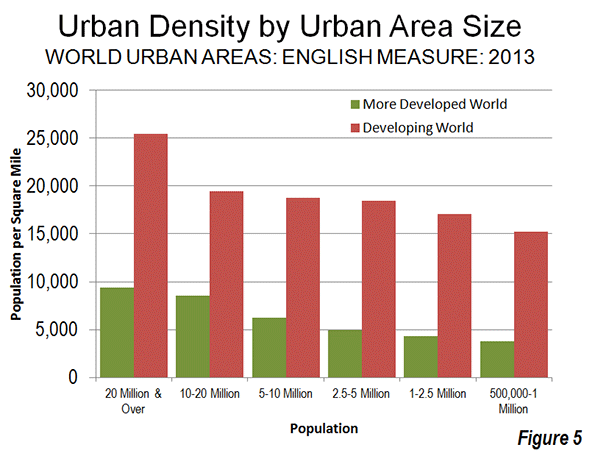
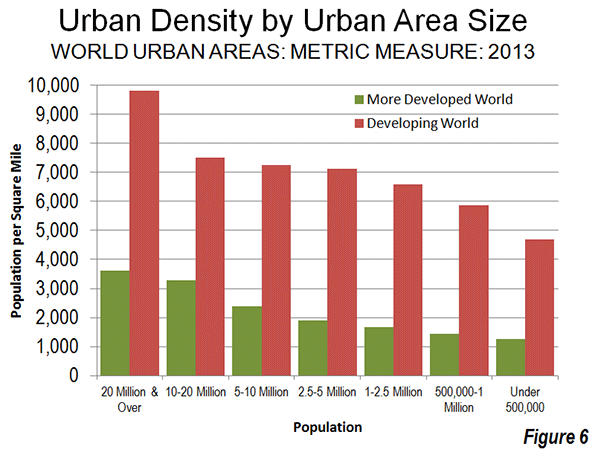
    A similar relationship exists in both the more developed and developing world, with the largest urban areas being considerably more dense than smaller urban areas. The megacities in the  more developed world have an average population density of approximately 9,000 per square mile (3,600 per square kilometer), compared to 3,700 per square mile (1,400 per square kilometer) for urban areas in the 500,000 to one million population range.

    However, urban areas in the developing world are considerably more dense in the less developed world, to be expected given the relationship between lower incomes and higher population densities. Developing world megacities are approximately 2.5 times as dense as megacities in the more developed world. The differences are even greater in smaller urban areas. Developing world urban with less than 5 million population are approximately four times as dense as those in the more developed world (Figures 5 and 6).
    However, megacities in both the more developed and developing world have both population growth and decreasing densities in common. This is illustrated in an examination of megacity trends, which indicates that in recent decades, all 23 examined experienced falling densities. The same is also true of the other five megacities (Karachi, Teheran, Lagos and Paris), which will be described in greater detail in future articles. (see Dispersion in the World’s Urban Areas). Cities everywhere are continuing to expand organically, with nearly all growth on the periphery.

    Distribution of Large Urban Areas

    The world’s largest urban areas are increasingly located in the developing world. Only three of the 10 urban areas with more than 20 million are located in the more developed world, Tokyo, Seoul and New York. Among the 28 megacities, only seven are in the more developed world. More than three quarters of the urban areas with 500,000 or more population are located in the developing world (658 of 875). There is a similar ratio with respect to population, with developing world urban areas having approximately 2.9 million population, while the urban population in the more developed world is approximately 850 million (Table 2).

    Table 2
    DISTRIBUTION OF WORLD URBAN AREAS BY SIZE
    Population More Developed World Developing World World Share in Developing World
    20 Million & Over 3 7 10 70.0%
    10-20 Million 4 14 18 77.8%
    5-10 Million 15 26 41 63.4%
    2.5-5 Million 28 76 104 73.1%
    1-2.5 Million 65 217 282 77.0%
    500,000-1 Million 102 318 420 75.7%
    Total 217 658 875 75.2%
    Source: Demographia World Urban Areas (2013)


    The Future of Urbanization

    This concentration of urbanization in the developing world is likely to become much greater in the decades to come. According to the United Nations, urban population will increase more than 2.5 billion between 2010 and 2050 in less developed regions, compared to less than 150 million in its more developed regions. By 2050, more than  85 percent of the world’s urbanization is expected to be in today’s less developed regions.

    Wendell Cox is a Visiting Professor, Conservatoire National des Arts et Metiers, Paris and the author of “War on the Dream: How Anti-Sprawl Policy Threatens the Quality of Life.

    ——–

    Note: The population density of urban areas under 500,000 is estimated by applying ratios from, Making Room for a Planet of Cities(Shlomo Angel, with Jason Parent, Daniel L. Civco, and Alejandro M. Blei) to the Demographia data.

    Photo: Travel by bajaj in Jakarta (by author)
  • The Ecology of Obesity

    Starting in the mid-nineties, ecologically-minded Americans increasingly came to see farmers markets as a way to bring healthy foods to poor neighborhoods, support local organic agriculture, and even address global warming. During the Bush years, major health philanthropies joined these efforts, making new grocery stores their highest priority in combating obesity, which was disproportionately affecting the poor.

    Food justice advocates were thus taken aback last April when new public health research revealed that there were more grocery stores and supermarkets in poor communities than in middle- and upper-income ones. More importantly, the studies found no relationship whatsoever between childhood obesity and neighborhood food availability. In effect, children who have more access to grocery stores and supermarkets are no more likely to become obese than children who have less. The findings — independently arrived at by two large national studies published by RAND and Social Science and Medicine — landed on the front page of the New York Times.

    The reaction from some advocates was swift and harsh. "I’d love to take a couple of those researchers and drop them in several neighborhoods where I grew up," First Lady Michelle Obama told NPR. "Go get a head of lettuce — one that’s affordable, that’s fresh — and see what happens." Mrs. Obama went on to suggest that poor mothers on the south side of Chicago have to travel five miles to reach a grocery store.

    But Mrs. Obama need only visit the US Department of Agriculture’s online Food Desert Locator to discover that the vast majority of Chicago’s poor live well within walking distance of grocery stores. Just 0.4 percent of Cook County’s 5 million residents are low-income and live more than a mile away from a grocery store or supermarket. In Mrs. Obama’s old neighborhood, fewer than 7,000 poor people have to travel more than a mile.

    It is no exaggeration to say that most Americans, and especially the poorest among us, have greater access to healthy food than ever before. Why, then, the rush to attribute our growing waistlines to a supposed lack of fruits, vegetables, and other whole foods?

    In a major new essay for Breakthrough Journal, sociologist Helen Lee, who authored the Social Science and Medicine study challenging the neighborhood-obesity connection, explains how journalists, public health officials, and food justice advocates got the obesity epidemic so wrong.

    She begins in the late 1990s, when activist journalists and public health officials were less focused on food deserts than with how we had become a "fast food nation." The decision to blame food corporations for our burgeoning waistlines came in part from a misunderstanding of the successes of the tobacco-control movement. Some public health scholars believed that framing smoking as a consequence of corporate power had created a "public opinion environment conducive to public policy solutions that burden powerful groups." 

    Convinced that reducing obesity rates would require a similar effort, scholar-activists advocated targeting food corporations as the source of the obesity epidemic. The problem was that the major declines in smoking came not from the high-profile anti-Joe Camel campaigns of late nineties but rather from decades-long public education efforts about the harms of smoking. 

    Moreover, the relationship between fast food and obesity has always been conjectural. Consider that between 1952 and 1980 the number of McDonald’s franchises skyrocketed from 1 to 8,000, and yet obesity rates remained virtually flat. The rise in obesity rates starting in the nineties and its plateau in the mid-aughts remain as mysterious to public health researchers as the decline in violent crime is to criminologists.

    Moreover, where smoking can result in largely untreatable diseases like lung cancer, obesity is one risk factor among many for diseases that are, in fact, highly treatable. While national health philanthropies were pouring hundreds of millions into farmers markets and grocery stores, better medical care was reducing mortality rates for diabetic adults by an astonishing 25 percent and cardiovascular disease by 40 percent.

    Part of what makes obesity a wicked problem is how existing solutions — farmers markets, anti-corporate marketing — led advocates to frame the problem in particular ways. "The picture painted by advocates of grocery stores and gardens in the inner city was compelling to so many in no small part because it combined an established way of thinking about poor neighborhoods as materially deprived along with rising cultural support from middle-class Americans for eating healthier, locally grown foods," Lee writes.

    The new research has not exactly inspired food justice advocates to rethink their approach. "Obesity is declining in Philadelphia because of a network of people dedicated to helping vulnerable children and families," asserted the head of the Kellogg Foundation recently. And yet another journalist, Pulitzer-winning New York Times reporter Michael Moss, is out with a book (subtitle: How the Food Giants Hooked Us) reducing the obesity epidemic to food companies. 

    To be sure, food corporations have played a role in making the obesity epidemic. They must exercise greater responsibility. And farmers markets can be a way to both deliver fresh produce and build community.

    But in focusing so narrowly on food availability, many in the public health and philanthropic communities lose sight of the far more important determinants of health and well-being. "For the poor,” Lee writes, “the problem has less to do with food deserts and more to do with income deserts, college degree deserts, and quality health care deserts.” 

    Confronting the negative impacts of obesity on low-income Americans means confronting difficult social problems like inter-generational poverty, inadequate access to health care, under-performing schools, and myriad barriers to higher education. It requires a perseverance over decades, and a commitment to getting the science right.

    Easier to build more farmers markets.

    Shellenberger and Nordhaus are co-founders of the Breakthrough Institute, a leading environmental think tank in the United States. They are authors of Break Through: From the Death of Environmentalism to the Politics of Possibility.

    This piece originally appeared at TheBreakthrough.org.

    Photo Credit: Lance Cheung/USDA

  • CEO Bonuses: Who Pays the Price?

    Because so many chief executives of failed or mediocre companies have walked away with millions in bonuses and swag bags, both Switzerland and the European Union recently voted to put a cap on corporate bonuses, limiting them to a small multiple of base salary. What prompted the acceptance of the “Minder Initiative”—named after the independent parliamentarian who sponsored the referendum — is a string of stunning business losses that had no affect on the bonuses paid to the sitting executives.

    Swissair went bankrupt in 2001, although not before it could pay out a $10 million bonus to its grounded chairman. The chief executive of the Swiss pharmaceutical giant, Novartis, was recently offered a $78 million sendoff. The Swiss bank, UBS AG, appears regularly in the headlines as the poster-child of bad loans ($40 billion absorbed by the government), LIBOR rate rigging ($1.5 billion in fines), and other dim practices (a so-called rogue trader lost $2.3 billion in London), although the losses are never enough to drain the bonus pool.

    The architect that turned the once-staid UBS into an off-track betting parlor, chairman Marcel Ospel, regularly paid himself CHF (Swiss Francs) 24 million in annual salary, something that Swiss voters had in mind, along with the Novartis proposal, when casting their votes with Minder. After the vote, UBS quietly offered an incoming executive a $28 million sign-on bonus — something the law, when enacted, will prohibit.

    In the US, corporate activists and some regulators want shareholders to have a “say on pay” of the top CEOs, or for Congress to tax away paycheck windfalls. So far, most reforms have been non-binding.

    Members of the business community, nevertheless, resent the intrusion of state or federal bureaucracies into their corner offices. In their minds, salaries are best left to compensation committees and captive boards of directors, which are free to rain money on a handful of senior executives, some of whom are chairmen of the same boards that dole out their pay.

    According to the latest estimate, Fortune 500 CEOs have to scrape by with compensation that averages $12 million a year and that is 380 times the pay of the average worker. In 1965, this ratio stood at 24 times and in 1990 it was 71 times.

    Meanwhile, real American wages have been declining since 1974, and per capita average income in the country is about $27,000, just above the poverty line of $21,000. The median income for American households is about $50,000 a year. The reason most American corporations reward senior management and stiff the rest of the work force is because many public companies are little different from banana republics.

    In theory, the shareholders elect the board, and the board watches their interests, a mandate that includes signing off on the top salaries. In practice, shareholders, even big ones, have little say in who is put on the board, especially if the CEO is also chairman. In those cases, board members serve at the whim of the same CEO. Often such an approval rating depends on voting the prince a big salary, along with big bonuses and stock options.

    Under the new Swiss law and other corporate reform proposals, shareholders are given the right to approve the top pay packages in a company. This sounds democratic enough, except that most corporate proxy votes turn out results that would be familiar to commissars in the Soviet Union.

    One reason is that many mutual and pension funds, which own the large positions in many public companies, are required by charter to vote with management or, if they disagree, to sell the positions. It’s unusual for a large institutional shareholder to both hold on to a position and vote against management. So letting shareholders approve top compensation will not keep managers from pocketing $50 million pay envelopes.

    The usual justification for multimillion-dollar rewards is that the company has performed well “in the market” or “exceeded the budget forecasts.” Of course, meeting such a benchmark explains a bonus of $250,000, not necessarily one of $20 million. Yes, the CEO has responsibilities and “duties of care,” but if the board were to auction off the position of CEO in most companies, it’s likely that they would find many qualified takers for $1 million a year.

    The truism about salaries—“You don’t get what you deserve; you get what you negotiate”—does not apply to the C-suite, which gets what the board is dumb enough to give away almost blindly. They go along with the lavish payouts based on similar compensation paid by competitors.

    Because of this mutual-remuneration self-congratulatory circle, salaries have skyrocketed, even if stock prices have remained flat or plummeted. General Electric’s CEO has earned $54 million in the past five years, while the company’s stock went from $37 to $7 and back up to $23 a share. As the Death of Salesman line goes, “No man only needs a little salary.”

    Ex-Treasury Secretary Robert Rubin pulled down $126 million from 1999 to 2009 as a top Citigroup senior executive, but when it went bust said that he had no responsibility for the bank’s creditworthiness. He confessed, “My great regret is that I and so many of us who have been involved in this industry for so long did not recognize the serious possibility of the extreme circumstances that the financial system faces today.” But he didn’t give back any of the money. Rubin’s boss, Charles Prince, left the chairmanship of Citi with about $80 million in his pockets, even though the company went to the wall the moment he was out the door.

    The goal should not be just to limit CEO pay, but to increase average wages and salaries, and think of increasing the dividend, especially in companies eager to throw millions at the boss. Stock options and profit sharing could be allocated equally to all employees, and not simply reserved as corner-suite perks.

    Likewise, cumulative voting of board directors allows smaller blocks of shareholders to elect a representative (you put all of your votes on one candidate).

    Many top CEOs live in a bubble of private jets and pillowed suites, and are accountable to only a handful of cronies—certainly not the vote of the employees or the shareholders. They thrive in the cozy confines of oligopoly — think of a golf club lounge — in which a corporation’s success is due only to the top managers, not to the shareholders’ capital or to the workers.

    Why not have a companywide plebiscite on the chief executive every two years? The Greeks knew that war was too important to be left to the generals, and had their soldiers elect them.

    Employees, pensioners and shareholders all ought to have seats at the table. The Chinese garment workers in sweat shops who stitch together all those sailor suits that are sold at vast markups might be less inclined to pay Ralph Lauren $66 million a year than the board in New York would.

    Minder’s law and its clones in the EU or, were legislation to come about, in the US, won’t solve the problem on their own. Rather than passing legislation that sounds good in the headlines (The Economist: “Fixing the Fat Cats”) but achieves little reform at the office, the most significant recovery for the ransoms paid to many senior executives would be to overhaul how boards of directors are established and operated — to make them legally accountable for the company’s performance and representative of all stakeholders, including the work force. Keep in mind that when salesman Willy Loman asked for a golden parachute, he only needed fifty dollars “to set his table.”

    Flickr photo by World Affairs Council of Philadelphia: Former Citigroup Director and executive Robert Rubin. Is that the size of his bonus?

    Matthew Stevenson, a contributing editor of Harper’s Magazine, is the author of Remembering the Twentieth Century Limited, a collection of historical travel essays. His next book is Whistle-Stopping America.

  • Marissa Mayer’s Misstep And The Unstoppable Rise Of Telecommuting

    Marissa Mayer’s pronunciamento banning home-based work at Yahoo reflects a great dilemma facing companies and our country over the coming decade. Forget for a minute the amazing hubris of a rich, glamorous CEO, with a nursery specially built next to her office, ordering less well-compensated parents to trudge back to the office, leaving their less important offspring in daycare or in the hands of nannies.

    The real issue is how we deal with three concerns: the promotion of families; humane methods to reduce greenhouse gases; and, finally, how to expand the geography of work and opportunity.

    For parents, particularly women, telecommuting provides a golden opportunity to balance the challenges of child-raising with those of work. Working at home, full or part-time, shrinks the number of hours wasted commuting and allows greater flexibility that is often critical to maintaining a family. In a country with a deteriorating fertility rate, and ever greater strains on those trying to raise children, telecommuting offers, at least for some, a way to remain in the labor force without cheating the next generation.

    Equally important, as the online universe expands, telecommuting allows us to reduce carbon emissions and energy use without forcing people to live in dense communities that most Americans, particularly in their adult years, clearly do not prefer. Greens, planners and many pundits seem anxious to force people to live in crowded housing close to buses and trains, yet rarely mention that it’s infinitely more eco-friendly to not commute at all.

    Finally there’s the often ignored issue of geography. If you force people to work in daily commuting distance from Yahoo’s Palo Alto headquarters, you are essentially telling them to live in a region where housing is among the most expensive in the nation. For anyone under 40 who does not have wealthy parents, a large amount of dot-com stock or recently robbed a bank, it’s almost impossible to buy a single-family home or spacious townhouse in the Valley, even in the only modestly attractive parts.

    So what’s the beef with the expansion of telecommuting? The conventional explanation usually revolves around the notion that putting employees together every day together generates greater innovation. See the New Yorker’s James Surowiecki for a good summary of this argument.

    That’s really not too surprising, since one of the last rationales for many without large financial resources to put up with big city home prices and taxes lies in the idea that, as the great economic royalist Michael Bloomberg maintains, you have to be located in “the intellectual capital of the world” to be successful. Natural allies of the anti-telecommuting crowd include urban land speculators and developers, who prefer that the “talent” remain chained to their particular locations and not wander off to the awful periphery.

    There are clearly advantages in face-to-face contact, particularly for younger people and top-echelon executives, who may be more effective minding the store if they hang around the office. But for most employees productivity actually rises with telecommuting.

    This is confirmed by broad studies such as one by the consultancy Workshifting that found, on average, a 27 percent rise in productivity among telecommuting employees. Over two thirds of the employers surveyed reported higher productivity among home-based employees, including British Telecom, Dow Chemical, American Express and Compaq.

    One of the best examples of telecommuting advantages can be seen at the high-tech company Cisco, which in contrast to Mayer’s assertion, has found telecommuters are effective at communicating and collaborating. It has also improved employee retention and also saved $277 million by allowing its employees to telecommute.

    Other companies reporting positive results, particularly in terms of retaining employees, from telecommuting, include IBM and Best Buy.

    Equally critical, notes a study by Global Workplace Analytics, are the tremendous environmental savings. Half-time telecommuting could reduce carbon emissions by over 51 million metric tons a year — the equivalent of taking all of greater New York’s commuters off the road. Additional carbon footprint savings will come from reduced office energy consumption, roadway repairs, urban heating, office construction, business travel and paper usage (as electronic documents replace paper). Traffic jams idle away almost 3 billion gallons of gas a year and accounts for 26 million extra tons of greenhouse gases.

    But perhaps most relevant, whatever its merits, telecommuting and home-based work seems to be the inevitable wave of the future, whether corporate managers like it or not. Working at home grew faster percentage-wise than any other mode of work access in the United States between 2000 and 2010. In that decade, the country added some 1.7 million telecommuters, almost twice the much ballyhooed increase of 900,000 transit riders.

    This tends to be more true in places like Silicon Valley, where workers are computer savvy and housing costs are onerous. Between 2005 and 2009, the Valley workforce grew by less than 10 percent but the telecommuting population increased by almost 130 percent. Tech-oriented places like Austin, Portland, Denver, San Diego, San Francisco and Seattle all rank among the cities with the highest percentage of people working at home.

    As workers become more familiar with technology, these trends should accelerate. A survey by the Information Technology Association of America found that 36 percent of respondents would choose telecommuting over a pay raise. These preferences appear to be even greater among millennial generation workers, who, according to a Pew study, tend to seek a “balance” between work and life. Global Workplace Analytics suggests this means they will be more attracted to flexible work throughout their careers , particularly as they start families.

    Other trends, including the huge expansion in self employment in the U.S., promise to accelerate telecommuting in years ahead. The ranks of independent contractors have grown by 1 million since 2005, according to George Mason University economist Jeffrey Eisenach. One in five work in such fields as management, business services or finance, where the percentage of people working for themselves rose from 28 percent to 40 percent between 2005 and 2010. Many others work in fields like energy, mining, real estate or construction. Altogether there are now as many as 10 million such independent workers, constituting upwards of 7.6 percent of the national labor force and over $626 billion in income.

    This trend will be further accelerated not only by millennials but increasingly by the other big growth demographic, aging boomers. The self-employment rate for adults 55 and older is 16.4 percent, according to the Bureau of Labor Statistics, well above the 10.4 percent rate of self-employment for the total labor force. From 2007 to 2008, the latest data available, new businesses launched by 55- to 64-year-olds grew 16 percent, an increase that was faster than that of any other group, according to the Kauffman Foundation. All told, Boomers in that age group started approximately 10,000 new businesses a month.

    Many of these older entrepreneurs are likely to work out of their homes, which many now own outright. In fact, over time, according to Workplace Analytics, upward of half the American workforce could eventually telecommute. Ultimately the issue of whether managers of office developers like this trend is beside the point. Smart managers who learn how to adjust to this path will flourish. Those who do not, like Marissa Mayer, are standing against a historical wave that is likely to prove too powerful for any company or CEO to overcome.

    Joel Kotkin is executive editor of NewGeography.com and a distinguished presidential fellow in urban futures at Chapman University, and a member of the editorial board of the Orange County Register. He is author of The City: A Global History and The Next Hundred Million: America in 2050. His most recent study, The Rise of Postfamilialism, has been widely discussed and distributed internationally. He lives in Los Angeles, CA.

    This piece originally appeared at Forbes.com.

    Photo by By Rae Allen, "My portable home office on the back deck"

  • Postmodernity: Will Another Bite from the Apple Help?

    The visionary evangelical zeal of Steve Jobs lured me from my   cozy philosophical pursuits at Barry University in south Florida to the frenetic gyrations of 1980s Silicon Valley. Jobs’ incantations held me spellbound with his revelation of an Information Revolution that would not only democratize the entire world, but would inevitably and infallibly take a bite out of every apple that stood in the way of humanity’s own paradise.

    I would later come to dub this techno-omnipotence "Her Highness Technology." After the Dot Com Dot Bomb of March 2000, however, I came to refer to the whole Valley scene as just "sillyConValley." Now, let’s fast forward some thirteen years to 2013 and see what’s up…

    iPads that take dictation! Location-based services that guide you to the nearest Italian restaurant! And soon, we are promised, human-computer interfaces that respond to your needs even before you speak, tap, or click. With all this going on it would only be natural to expect that the priesthood of the high-tech self-proclaimed digital Mecca of Silicon Valley   would surely devise a host of dazzling techno-wizardries to conquer whatever ills are ailing America, all the way from here to Eternity. To question the omnipotence of Her Highness Technology or her saving graces would be a matter of heresy against new age orthodoxy. Even so, I am willing to stick my neck out and risk excommunication from Techno-Paradise and do just that. Why not?  

    So, not discounting the remarkable accomplishments of the past hundred years, there are some nagging developments that would seem to signal that we are approaching some kind of tipping point—where three steps forward over here are confounded by three steps backward over there. Have a look, now, at some social, economic and political illustrations where even the most glittering technologies failed to deliver the expected end results. 

    Jobs Crisis or Jobs’ Crisis?

    Her Highness Technology has been performing more and more of the work that we used to do. This was once the chief selling point for the industrial revolution: washer plus dryer equals more leisure time for everyone. But now our labor-saving fantasies are turning into a daily nightmare for millions of lately obsoleted workers. In China, they’re even replacing—note "replacing," not helping—waiters with robots. Can it be that Steve Jobs’ revolution is now contributing to a Jobs Crisis?

    For sure, major innovations like Jobs’ Apple II and Macintosh once created a plethora of breathtaking career opportunities, along with personal empowerment. Perhaps another such game changer might come along. But absent that, new technologies will likely extend the trend of the last ten years: creating splendid career opportunities for fewer and fewer while diminishing job opportunities for more and more.

    Looking forward, most advanced technologies like AI, quantum computing, and nanotech robotics are sure to put more and more professional, skilled, and semi-skilled people out of work. Their only hope might be to merge themselves with their technology, as presently being prototyped in Alzheimer’s patients and military volunteers.  Make way for "Homo Sapiens 2.0?"

    Global Democracy or Ersatz Democracy?

    Working as a manager at Xerox LiveWorks during the rise of the Internet, I uncritically promoted Steve Jobs’ utopian vision of electronic democracy. All my fellow engineers, on the other hand, ardently insisted "Forget about it!" Computerized balloting, they warned, is 180 degrees out of phase with old-fashioned paper balloting. Why? While paper ballot processing is transparent to anyone who can count, computerized ballot processing is transparent to no one except the software proprietor. To be authentic, however, democracy requires a transparent ballot process.  

    Since its implementation, opaque computerized elections have yielded the widest discrepancies ever between the "official count" and many exit polls—historically the most accurate predictor of who actually won the election. While technology is not inherently anti-democratic, it is not inherently democratic either; and just because we can computerize anything does not mean we must computerize everything.

    On the bright side of computerization, social media do represent a potential force for democratization by enabling peoples’ movements across national, religious, and racial boundaries, and with a speed and facility never before thought possible. How about global consumer unions that patronize only those vendors that meet published standards of acceptance? Every time you shop, you’re voting: that’s effective participative democracy.

    Education crisis: "No amount of technology will make a dent."—Steve Jobs

    In 1996, when asked what should be done about education’s gradual slide into mediocrity, technology evangelist Jobs cautioned "What’s wrong with education cannot be fixed with technology…The problems are sociopolitical." And he’s right.

    For thousands of years Egyptian mathematicians, Greek philosophers, Roman architects and British engineers solved complex geometry problems, were literate in multiple languages, built durable bridges and aqueducts, and designed powerful internal combustion engines—with not much more than "paper and pencil" or a slide rule. Today, after thirty years of computerization and the Internet, our high school graduates can barely compose a complete sentence in their native language and don’t even know why we celebrate the Fourth of July. The problem is not technical. It has to do with basic human nature and the need for discipline, focus, integrity and commitment—traditionally the stuff of good parenting. (Hint: Less time twittering equals more time for studying.)

    Computerized Government: Digital Deliverance or Digital Disaster?

    When I arrived in Silicon Valley in the mid-1980s California had a strong billion state surplus and was the ninth largest economy in the world. By 2004, after computerizing the government, the state had accumulated a $22 billion debt. Apparently, all the $billions they had put into computers, databases, servers, web applications, and middleware was not able to offset the mismanagement of state budgeting, population growth, and a rapidly globalizing (and digitizing) economy.

    And the feds? Well, since digitizing the entire government under Clinton and Bush, federal debt has only gotten much worse. Why? Because balanced budgeting is not so much a technical problem; it’s mostly a matter of good arithmetic and basic integrity. For example, following computerization, we saw Rumsfeld report $2.3 trillion unaccounted for in Pentagon spending.   Before digitized "friction-free capitalism" (Bill Gates, The Road Ahead) a loss that stupendous was not only unthinkable, it was not even technically possible!

    US Trade Deficit

    This is largely a matter of importing more than we export, or consuming more than we produce—a likely result of globalization and too much offshoring of manufacturing. SCM (supply chain management) and other high-tech e-commerce software have only greased the rails for US corporations to outsource and offshore more operations, which ultimately translates to increased imports. While the US continues to lead the world in arms and pharmaceuticals exports, our leading imports are now those things everybody needs for everyday life.   Americans must either go back to manufacturing real products for everyday consumption, or shrink consumption—or both. New technology exports won’t help much, since after invention and productization most of the operations are soon offshored.

    Maybe Biting the Apple Never was the Way to Paradise

    The US was once a world leader in manufacturing, exports, agriculture, education and trade surplus—all without iPads, laptops, social media, cell phones, high-speed computer trading, or computerized derivatives. And also without ponderous debt or a jobs crisis.

    Of course, only a Luddite would reject all mechanized or computerized technology. It is equally true that only an overreaching religious zealot would tenaciously hold to the credo: "Her Highness Technology Über Alles!" Even Steve Jobs backed off of that one.

    Technology is very good at solving many problems. Transforming human nature is not one of them. People still cheat, steal, lie, shade the truth in their favor, betray, enslave, bomb, torture, and murder—only now it’s at light speed. This wanton behavior has been going on since Adam bit the apple and lost paradise. Can technology rehabilitate the human situation? While transhumanists insist "Yes", history emphatically says "No."   

    The quandaries of post-modern—some say posthuman—civilization are not essentially technical in nature and do not fit neatly into a technical solution. The errant human condition and its predicament is essentially spiritual in nature and calls for a spiritual remedy—one ordered under a combination of proven virtues and a serious dose of transcendent Wisdom. Without this, all the science, technology and bitten apples in the whole universe are more likely to lead us to Kidron Valley than back to Eden. 

    Rob Argento is a senior technical writer and project leader with a background in aerospace engineering and some 18 years in Silicon Valley with Oracle, Xerox, Microsoft, and Sony. His broad industry experience includes NASA, e-commerce, US Navy, Biotech, and PC Games. He has degrees in physics and theological studies.

    Shanghai photo by flickr user acaben

  • U.S. Could be Courting Trouble in Europe

    One of the most fascinating aspects of Barack Obama’s presidency stems not so much from his racial background, but his status as America’s first clearly post-European, anti-colonialist leader. Yet, after announcing his historic "pivot" to vibrant Asia, the president, the son of an anti-British Kenyan activist, recently announced as his latest foreign policy initiative an economic alliance with, of all places, a declining, and increasingly decadent, Europe.

    Some analysts, such as Walter Russell Mead, suggest the possible "ratting out" of the new Asia focus could constitute "a mistake of historic proportions." In East Asia, leaders, from Vietnam and Singapore to Japan, have been counting on a strong U.S. presence to ward off Chinese hegemony in the region. The idea of a reduced naval presence and a weakening commitment to allies would undermine our influence in this increasingly critical economic region.

    At the same time, the president’s desire to integrate our economies more closely to that of Europe reflects a longtime prejudice within the Democratic Party favorable to the old Continent. The notion of a new trade tie to the European Union set longtime Eastern policy types, such as former Bill Clinton aide and onetime Woodrow Wilson School head Anne-Marie Slaughter into rhapsodies about an emerging new "Atlantic Century." Vice President Joe Biden, for his part, told a recent Munich security conference that Europe represents "the cornerstone of our engagement with the rest of the world."

    This is delusional, to say the least. Republicans have their faults, but at least they know how to tell historic time. In contrast, largely Democratic Europhiles simply want to relive the glorious past, and consume a legacy of affluence. And to be sure, generally it’s more pleasant to attend – as long as someone is paying the bill – a conference in London, Paris or Zurich than Beijing, Mumbai or Mexico City. Europe, as we know from the debates over compensation of EU bureaucrats, knows how to treat functionaries with the comfort to which they easily can become accustomed.

    Pumping for greater Euro-ties seems almost insane under current conditions. The Continent’s unemployment rate, nearly 12 percent among the 17 EU member countries, is already at record levels, and its younger generation suffers unemployment approaching 30 percent or higher in at least five EU countries, including Greece, Spain and France. In Portugal, 2 percent of the population has migrated just in the past two years, not only to Northern Europe but, amazingly, also to Portugal’s booming former African colonies.

    This does not seem to be setting up the prime conditions for Ms. Slaughter’s imagined new "Atlantic Century." Although North America retains the resources, demographics and innovative culture to compete with Asia and other rising powers, Europe is in a notably downward trajectory. Its share of the world economy has plummeted from nearly 40 percent in 1900 to 27 percent today and continues to shrink rapidly. By 2050, not only the United States, but China and the rest of the developing world, according to the European Commission, will have surpassed the total of the 27 countries in the EU.

    One has to be a cockeyed optimist not to see that the long-term prognosis, even without the current euro crisis, is not good. Manufacturing, long a Continental bastion, is weak and falling behind that of the U.S. as well as Asia. German engineering may still be first-class, but much of the production and design will be moving to Mexico, the U.S., Latin America and Asia.

    Energy may prove a particular vulnerability. Although the region has shale and other energy resources, greens are far more powerful in Europe than in America and hostile to the hydraulic fracking that has created the current U.S. boom in oil and gas. The combination of radical green policies favoring expensive, often unreliable renewables, as well the shuttering of the Continent’s once-strong nuclear industries, are creating both high prices and wobbly reliability of electricity supplies. (Ironically, the reluctance to maintain nuclear power and oppose fracking for natural gas has led to a rise in greenhouse gas emissions and even some increased use of coal.) Tulane’s Eric Smith suggests many of Germany’s manufacturing powers are intensifying efforts to shift operations, notably to the southern United States, for cheap electricity and lower overall costs.

    Demographics, however, may be Europe’s weakest suit. Although East Asia is now experiencing low fertility, Europe has been demographically stagnant for at least a generation longer. By 2050, Europe’s workforce is expected to decline by 25 percent from 2000 levels; the U.S. is expected to see expansion of upward of 40 percent.

    This phenomenon threatens Europe’s lone serious economic power, Germany. The country now produces fewer children than in 1900. Given the expansive welfare state, the fiscal burdens being faced in Germany and other EU countries will dwarf those of the United States; by 2050 Germany will have nearly twice as many retirees per active worker as America.

    Yet remarkably, for all its manifest failings, Europe remains a Mecca and role model for many American progressives, like Ms. Slaughter. The past decade has seen the publication of a spate of books, such as Jeremy Rifkin’s "The European Dream" and Steven Hill’s "Europe’s Promise," that see Europe’s regulation state and "soft power" an alluring alternative to America. Some hail the EU as the prototype of a benign "new kind of empire" based on culture and pacifism.

    If so, it’s an empire rapidly hurtling into its dotage. The great European historian Walter Lacquer has pointed out that such optimism about the Continent becoming "united and prosperous" is likely "misplaced." In policy terms, for the U.S. to follow Europe’s model is an almost sure recipe for our own decline. Even the usually pro-free-trade Wall Street Journal is concerned that any attempt to "harmonize" American policies with those of the "European model" will simply expand government power and bureaucratic hegemony.

    To be sure, there remain parts of Europe, particularly in the Northern rim, that are doing better. These countries – the Netherlands, Scandinavia and Germany – have enacted significant labor market reforms, retain some strong industries and have tried to be responsible fiscally. If they broke off from the EU and set up a modern-day Hanseatic League, it may make sense for us to embrace stronger ties with them. But that can’t be said of an alliance with the weak sisters of the EU’s southern and eastern fringes, or even dirigiste state-dominated France.

    In reality, the EU will never become a giant Sweden. Scandinavia possesses a unique history, shaped by massive outmigration in the past century and a largely homogeneous population; many of these countries possess great natural resources, such as oil, iron ore or hydroelectricity. In contrast, the eastern edge of the zone contains some of the most depopulating parts of the planet, as people seek opportunities in the more economically viable North. The comic political economy of Italy, the political violence of Greece and the mass disenchantment of Spain presage a European future that contrasts greatly with the relative prosperity and order of the North.

    None of this suggests that, if the political strings are not wound too tight, that a free-trading arrangement with Europe may prove useful. But if an agreement becomes a wedge for accelerating the adoption of Euro-style policies, it could allow us to squander an opportunity to maintain our pre-eminence in the post-colonial, and post-European-centered, world.

    Joel Kotkin is executive editor of NewGeography.com and a distinguished presidential fellow in urban futures at Chapman University, and a member of the editorial board of the Orange County Register. He is author of The City: A Global History and The Next Hundred Million: America in 2050. His most recent study, The Rise of Postfamilialism, has been widely discussed and distributed internationally. He lives in Los Angeles, CA.

    This piece originally appeared in the Orange County Register.

  • Seeking Community in Vancouver’s High Rise Ghost Towns

    The Province in Vancouver reports (in "15% of downtown Vancouver condos sit empty, turning areas into ghost towns: Study") that "much of the downtown core is starting to look like B.C.’s ghost towns — with apartments languishing empty, businesses closing down and residents not feeling the sense of community they bought into." The study, by University of British Columbia (UBC) planning professor Andy Yan, indicates that the problem is most pronounced outside the long-established high-rise district of the West End. He notes that in Coal Harbour, well located adjacent to the downtown area along Burrard Inlet, approximately 25% of the condominium units are unoccupied.

    UBC economics professor Tour Somerville suggests that the number may even be higher, at 65% vacant, including both unsold units and units that have been purchased but not occupied by their owners. Vancouver has had an unusual amount of investment from mainland China, especially as that nation has substantially limited the purchase of condominium units for investment purposes.

    Reporter Mike Reptis of The Province notes the difficulties for businesses in the area, indicating that "it’s a problem to local small business owners and residents — especially in Coal Harbour — who have bought into the neighbourhood expecting more of a community, and more business."

    A long time convenience store manager complained that “foot traffic has slowed" and "local people can’t afford (to live here)," concluding that "small grocery stores are closing up" and "A lot of small companies are closing up.”

  • Children Falling from High Rises in New South Wales

    Frustrated young children confined in the small apartments proliferating in New South Wales are naturally inquisitive and incapable of judging risks.  They climb onto window sills or balustrades to fall onto concrete many metres below.

    The results have been appalling. In Sydney during the period 1998 to 2008 169 children have fallen to serious injury or death, and, as the proportion of apartments increase, so do these tragic incidents, of which there is now one a week.

    Apartments are especially unsuitable for bringing up very young children. Research  reveals that there are poor health and parenting outcomes. Crawling and walking is stymied due to space problems with children having little access to areas for meaningful activity. There is a lack of safe active play space outside the home. Parks and other public open space offer poor security due to the use of these areas by local youth gangs and the socially dysfunctional.

    Over the past decade, the goal of the New South Wales Government has been that more than half of the population of NSW be squeezed into apartments by the year 2030. These high-density policies have placed a restrictive growth boundary around Sydney, and have been enforced by stripping away the planning powers of those local authorities that dared to offer any resistance.

    This draconian approach is despite the fact that the vast majority of Australians prefer living in free-standing homes rather than in apartments. Half of apartment-dwellers would rather live in a house with a garden.

    The government has been creating a child-hostile city and a child-hostile city is a disaster for the future.

    The Westmead Children’s Hospital in Sydney formed a working party in 2009 in response to the growing number of child tragedies.  As a result the NSW Government has now belatedly announced that window safety locks that restrict the degree to which windows can open will be mandatory for new apartments.

    But is locking children into apartments and restricting fresh air a good solution? Surely a much better resolution is for the high-density policies to be unambiguously abandoned. Housing that the vast majority of people want should be readily available – that is family friendly single-residential housing with a safe backyard for children’s recreation. 

    There is some good news for young children, namely the recent announcement by the New South Wales Government of a proposed modified Metropolitan Strategy with the Minister of Planning saying “We’re trying to be less constrictive and restrictive and what we’re saying is the market place should have far more of a say in what the mix of housing is and where it will be.” Might the long-suffering families in Sydney and their young children hope that the iron grip of the high-density policies of the last two decades could be weakening at last?

    The new Metropolitan Strategy announcement may indicate a faint light at the end of the tunnel. One hopes this will not be a mere will-of-the-wisp, but that this glimmer will brighten into a beam that will consign urban containment policies to the dustbin of history – and prevent the ongoing falling deaths of some of our most vulnerable kids.

  • Commuting in Australia

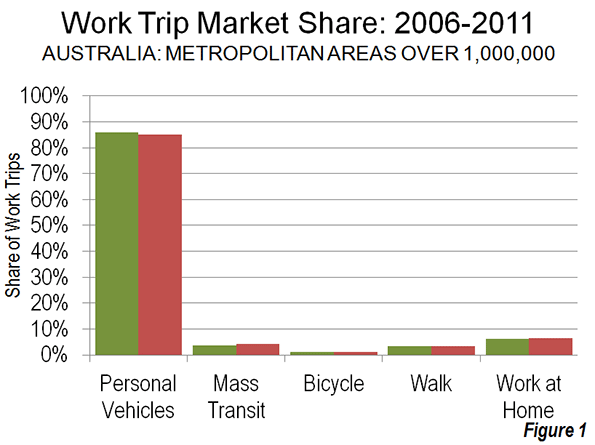
    Data from the 2011 censuses indicates that mass transit is gaining market share in all of but one of Australia’s major metropolitan areas. The greatest increase as in Perth, at 21% , aided by the new Mandurah rail line to the southern urban fringe. On average, mass transit’s market share increased by 10.8% in the five metropolitan areas with more than 1 million population. This increase seems likely to be in response to both mass transit service improvements (such as in Perth) and higher petrol (gasoline) prices. The highest mass transit market share is in Sydney, at 22%, approximately equal to that of Toronto and greater than all major US metropolitan areas except New York (31%). Adelaide has the smallest transit market share, at 9.5%, which is nonetheless 50% above that of Portland, to which Adelaide officials have often looked as a model (Figure 1).

    At the same time, there was a personal vehicle (automobiles, motorcycles, taxis and trucks) market share in all 5 metropolitan areas, averaging 2.2% (Table). However, the much larger base of personal vehicle use prevented mass transit from materially reducing the share of the automobile in any of the metropolitan areas.

    Work Trip Market Share 2006-2011
    Major Metropolitan Areas in Australia
    2000 Personal Vehicles Mass Transit Bicycle Walk (Only) Work at Home Other
    Adelaide 81.2% 9.6% 1.5% 3.1% 3.5% 1.2%
    Brisbane 76.5% 13.2% 1.1% 3.5% 4.5% 1.2%
    Melbourne 76.7% 13.3% 1.3% 3.4% 4.2% 1.1%
    Perth 80.8% 10.0% 1.1% 2.5% 4.1% 1.5%
    Sydney 69.0% 20.3% 0.6% 4.7% 4.4% 1.0%
    Average 76.8% 13.3% 1.1% 3.5% 4.1% 1.2%
    2010
    Adelaide 81.1% 9.5% 1.3% 2.8% 3.7% 1.6%
    Brisbane 75.1% 14.3% 1.2% 3.5% 4.6% 1.4%
    Melbourne 74.5% 15.4% 1.5% 3.3% 4.1% 1.2%
    Perth 78.1% 12.1% 1.2% 2.6% 3.9% 2.0%
    Sydney 66.9% 22.2% 0.8% 4.6% 4.4% 1.1%
    Average 75.2% 14.7% 1.2% 3.4% 4.1% 1.4%
    Change in Market Share
    Adelaide -0.1% -0.6% -12.2% -7.4% 4.6% 32.1%
    Brisbane -1.8% 8.3% 10.5% 0.3% 0.5% 14.4%
    Melbourne -2.9% 15.6% 17.2% -4.4% -1.0% 10.8%
    Perth -3.3% 21.0% 11.3% 4.0% -3.9% 30.2%
    Sydney -2.9% 9.4% 30.3% -3.6% -0.4% 11.1%
    Average -2.2% 10.8% 11.4% -2.2% 0.0% 19.7%
    Source: Calculated from Australian Bureau of Statistics data


    Unlike the United States, where working at home is the fastest growing method of work access (and likely to pass mass transit in this decade), Australia’s working at home share has stayed constant. Working at home is also increasing in Canada.  

    Mass Transit: About Downtown

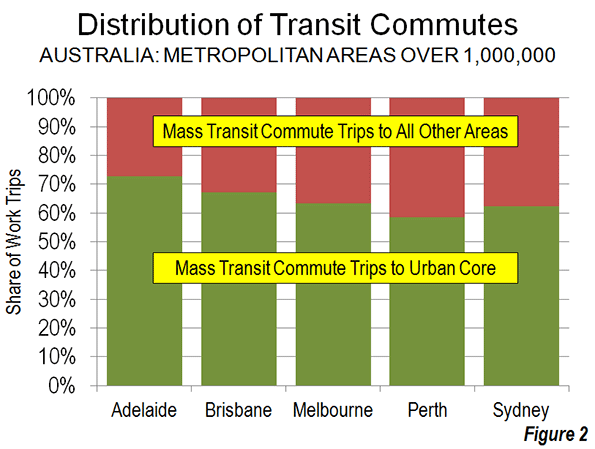
    In Australia, as in Canada and the United States, mass transit is dominated by commuting to the central business district (downtown). On average, 65% of mass transit commuters had a work trip destination in the urban core, which includes the central business district (downtown). This ranges from a low of 59% in Perth to a high of 73% in Adelaide (Figure 2). This concentration of mass transit destinations in the central business district is epitomized by Sydney, where there was a core share of all trips of nearly 60%. By contrast, in Parramatta, which includes one of the largest suburban business centers, is well served by not only the region’s rail system but also by an exclusive busway, the mass transit market share was 15%, one-fourth that of Sydney’s core.

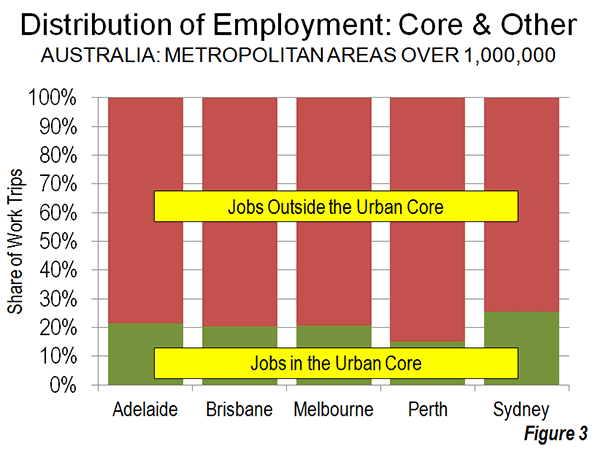
    In the five large Australian metropolitan areas, nearly 21% of jobs are located in these urban core areas that include the central business district (Figure 3). The difficulty for transit in serving the nearly 80% of work trip destinations outside the urban core lies with far lower employment densities and mass transit travel times not remotely competitive with the automobile (on the assumption that services even available). On average, mass transit carries 200 times as many commuter to each square kilometer of core land area for each commuter carried per square kilometer in the rest of the urban area (urban centre).

    It is not surprising that the central business districts dominate mass transit commuting. They are the only locations in virtually any urban area that have a sufficient employment densities and a comprehensive enough radial rapid transit system to provide no-transfer service to a large number of riders.

    Australia’s Long Work Trip Travel Times

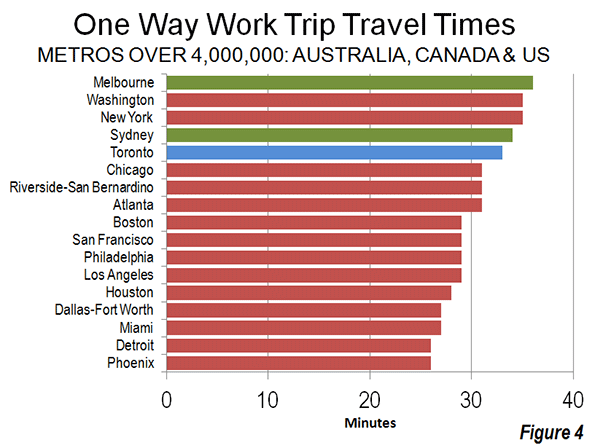
    The growth of transit has not reduced travel times but may have boosted it. In fact Australia’s workers already are traveling for longer times to work than in nearly all similar- or larger-sized metropolitan areas in Canada and the United States (Figure 4). For example, the average one-way work trip travel time in Melbourne is 36 minutes, which is longer than that of any major metropolitan area in the US or Canada.  Sydney’s one-way work trip travel time is 34 minutes. This exceeds that of all similarly sized or larger metropolitan areas in the three countries with the exceptions of New York and Washington, which are larger. In Improving the Competitiveness of Metropolitan Areas, I cited Statistics Canada data showing that mass transit work trip travel is much longer than by car and that transferring demand to transit would not improve average travel times.

    Both Melbourne and Sydney have slightly longer one-way travel times than larger Toronto, which is also larger, at 33 minutes. The Toronto Board of Trade, the Federation of Canadian Municipalities, and the Canadian Urban Transit Association have all expressed serious concern about Toronto’s long journey to work time, noting that it places is a competitive disadvantage relative to other metropolitan areas.

    Melbourne and Sydney also have longer one-way travel times than all of the other 12 US metropolitan areas with more than 4 million population. Perhaps the starkest comparison is with Los Angeles, often cited as having some of the worst traffic congestion in the high income world. Yet, despite having a urban population density higher than that of either Melbourne or Sydney and a far lower transit work trip market share, Los Angeles has a one-way work trip travel time of 28 minutes The secret in Los Angeles, is more dispersed work locations and a more comprehensive freeway system (though major parts of the planned freeway system were not built).

    Far starker is the comparison with Dallas-Fort Worth, which has a population density well below that of both Melbourne and Sydney and a much lower transit work trip market share (2%, compared to 22% in Sydney and 15% in Melbourne). Yet, in Dallas-Fort Worth, the average work trip travel time is 26 minutes, a full quarter less than in Melbourne and 8 minutes less than in Sydney.

    Where Should Planners "Put" People?

    A recent Infrastructure Australia report (The State of Australia’s Cities: 2012) cites "Marchetti’s Constant," which it characterizes as holding that "people will devote on average 90 minutes a day to travel and no more." (In fact, 90 minutes represents is a full 30 minutes greater than Marchetti indicates: See Note on Marchetti’s Constant).

    Infrastructure Australia continues "This suggests that improving the efficiency of urban transport systems by putting people in their economically optimal location within a total travel time of 90 minutes may be the key to improving the productivity of cities."

    "Putting people" where they have total travel time of 90 minutes seems a pessimistic goal; Sydney’s average daily travel time is now nearing 80 minutes. This justifies policy makers to further increase its already non-competitive work trip travel times. Economic research associates maximizing the number of jobs that can be reached by people in a metropolitan area in a specified time (such as 30 minutes) is critical to improving city productivity  (see The Need to Expand Personal Mobility.)

    The issue is not where to "put" people, but rather to facilitate more rapid access for commuters throughout the metropolitan area.

    Things are Likely to Get Worse

    In the end, there is only so much mass transit can do. Already the Australian metropolitan areas have high transit commute market shares to the cores, which leaves only modest room for improvement. At the same time there is little potential for material increases elsewhere in the metropolitan areas. Automobile competitive transit to these locations would be cost prohibitive, perhaps requiring annual expenditures rivaling the total income of the metropolitan area each year for operations, capital costs and debt service (see Megacities and Affluence: Transport and Land Use Considerations).

    Australian urban areas are generally underserved by freeways, despite their overwhelming reliance on personal vehicle travel. At the same time, urban consolidation, “smart growth” land use policies are increasing population densities without accommodating the inevitable associated additional personal vehicle demand (see Urban Travel and Urban Population Density). Things could get worse.

    Wendell Cox is a Visiting Professor, Conservatoire National des Arts et Metiers, Paris and the author of “War on the Dream: How Anti-Sprawl Policy Threatens the Quality of Life.

    —–

    Methodology: The analysis is based upon Australian Bureau of Statistics (ABS) data for capital city statistical divisions. The urban core was defined as the following local government areas: Sydney, North Sydney, Melbourne, Perth and Adelaide. In Brisbane, where the local government area is far larger, the inner Brisbane census division was used. Consistent data is limited to the central business district is not readily available. All trips which include transit as a mode are counted as transit. Workers who did not work on census day or who did not provide information were excluded from the analysis.

    Note on "Marchetti’s Constant:" Not only does Marchetti find a 60 minute, rather than a 90 minute average, but he also credits Zahavi of the World Bank with the concept, noting that with respect to travel:  "The empirical conclusion reached by Zahavi is that all over the world, the mean exposure time for man is around one hour per day.” While there are few references to Marchetti’s Constant in the academic literature, it might be more appropriately named "Zahavi’s Constant." In a further irony, Professor Peter Newman, a member of the board of Infrastructure Australia, cited 60 minutes (echoing Marchetti), rather than the 90 minute average in describing the "Zahavi/Marchetti Constant" in a Sydney Morning Herald commentary ("Why We’re in Reaching Our Limits as a One-Hour City" ).

    Photo: Downtown Brisbane (by author)

  • Portland’s Slothful Creative Class?

    In an article entitled "Portland area’s college-educated workers depress metro earning power by choosing low-paying fields, shorter hours," The Oregonian’s Betsy Hammond reports on a new study decrying the less than robust economic impact of Portland’s younger college graduates, especially males. According to Hammond, " the Portland metro area’s young college-educated white men are slackers when it comes to logging hours on the job, and that’s one reason people here collectively earn $2.8 billion less a year than the national average." The report is characterized as finding that "Portlanders tend to choose majors, careers and work hours that lead to low pay."

    The report, "Higher Education & Regional Prosperity; The Story Behind Portland-Metro’s Income Decline," was commissioned by the Value of Jobs Coalition. It documents a "startling decline in per capita income relative to the US" metropolitan average. Since 1997, metropolitan Portland’s per capita income has fallen from 5% above the national metropolitan average to 5% below.

    The report indicates that "the biggest driver of this trend is our college educated workers, who work less and earn less, creating a significant income gap," though cautiously notes that it is not clear whether” the lower hours and earnings are the result of a lack of higher-paying/time-intensive jobs available or the result "life style choice(s)" to not work in higher-paying jobs."

    The report found the largest differences compared to other metropolitan areas to be among white males from 25 to 39 years old. The differences with the rest of the country were substantially less among older white males.