Blog

  • 2017 How We Pick the Best Cities for Job Growth

    The methodology for our 2017 ranking, which seeks to measure the robustness of metro areas’ growth both recently and over time, largely corresponds to that used in previous years. The ranking is based on U.S. Bureau of Labor Statistics “state and area” unadjusted employment data reported from November 2005 to January 2017.

    The data reflect the North American Industry Classification System categories, including total nonfarm employment, manufacturing, financial services, business and professional services, educational and health services, information, retail and wholesale trade, transportation and utilities, leisure and hospitality, and government.

    We used five measures of growth to rank MSAs over the past 10 years. “Large” areas include those with a current nonfarm employment base of at least 450,000 jobs. “Midsize” areas range from 150,000 to 450,000 jobs. “Small” areas have as many as 150,000 jobs. The total number of MSAs included in this year’s rankings is 421.

    The index is calculated from a normalized, weighted summary of: 1) recent growth trend: the current and prior year’s employment growth rates, with the current year emphasized (two points); 2) mid-term growth: the average annual 2011-2016 growth rate (two points); 3) long-term momentum: the sum of the 2011-2016 and 2005-2010 employment growth rates multiplied by the ratio of the 2005-2010 growth rate over the 2011-2016 growth rate (one point); 4) current year growth (one point); and 5) the average of each year’s growth rate, normalized annually, for the last 10 years (two points).  The goal of our methodology is to capture a snapshot of the present and prospective employment outlook in each MSA, and these revisions allow the reader to have a better sense of the employment climate in each.

  • The New American Heartland: Renewing the Middle Class by Revitalizing the Heartland

    This is the introduction to a new report written by Joel Kotkin and Michael Lind with a team of contributors. Download the full report (pdf) here.

    The greatest test America faces is whether it can foster the kind of growth that benefits and expands the middle class. To do so, the United States will need to meet three challenges: recover from the Great Recession, rebalance the American and international economies, and gain access to the global middle class for the future of American goods and services.

    The fulcrum for meeting these challenges is the combination of industries and resources concentrated in the New American Heartland, the center of the country’s productive economy. Traditionally, the Heartland has been defined as the agriculturally and industrially strong Midwest, alone or perhaps together with the Upper Plains. However, the geographic distribution of US manufacturing and energy extraction has expanded through the growth of new manufacturing zones, largely in Texas, the South and the Gulf Coast.

    Our map of the New American Heartland includes not only the Midwest and Upper Plains, but portions of all the Gulf States — Texas, Louisiana, Mississippi, Alabama, Florida — and the non-coastal southern states of Georgia, Tennessee, and Arkansas.

    It comprises most of the US between the Rocky Mountains and the Appalachians.

    The New Heartland incorporates the old Midwest and much of the South. Alongside it, the new continental periphery consists of the mountain and desert spine of North America from Mexico through to Canada, a region that is likely to remain thinly populated and devoted to resource extraction, tourism and wilderness preservation.

    While every region contributes to American prosperity, the New American Heartland has the potential to play an outsized role in powering economic growth in the twenty-first century.

    Download the full report (pdf) here.

  • The globalization debate is just beginning

    The decisive victory of Emmanuel Macron for president of France over Marine Le Pen is being widely hailed as a victory of good over evil, and an affirmation of open migration flows and globalization. Certainly, the defeat of the odious National Front should be considered good news, but the global conflict over trade and immigration has barely begun.

    On both sides of the Atlantic, there are now two distinct, utterly hostile, opposing views about globalization and multiculturalism. The world-wise policies of the former investment banker Macron play well in the Paris “bubble” — and its doppelgangers in New York, San Francisco, Tokyo and London — but not so much in the struggling industrial and rural hinterlands.

    The trade dilemma

    For much of the past half-century, the capitalist powers, led by the United States, favored free trade, even with terms often vastly unbalanced. Now President Donald Trump has undermined this orthodoxy. But anti-globalism transcends conservatism. Besides the National Front, which won over a third of the vote, doubling its support from 2002, the other rising political force in the country, far-left socialist Jean-Luc Melenchon, is at least as hostile to free trade. Much the same can be said of the ascendant Bernie Sanders wing of the Democratic Party.

    Globalists argue that the free trade regime, primarily promoted by the United States, has been a boon to the world economy. Certainly, the last half-century has seen enormous progress in some countries, most notably in East Asia, and led to a general decline in global poverty. It has also produced lower prices for consumers in America and elsewhere.

    Yet, there has been a price to pay, perhaps not in Newport Beach or Beverly Hills, but definitely in areas such as Lille, France, or Rust Belt Ohio, where workers and communities suffered for free trade “principles.” The trade deficit with China alone, notes the labor backer Economic Policy Institute, has cost the country some 3.4 million jobs between 2001 and 2015.

    Read the entire piece at the Orange County Register.

    Joel Kotkin is executive editor of NewGeography.com. He is the Roger Hobbs Distinguished Fellow in Urban Studies at Chapman University and executive director of the Houston-based Center for Opportunity Urbanism. His newest book is The Human City: Urbanism for the rest of us. He is also author of The New Class ConflictThe City: A Global History, and The Next Hundred Million: America in 2050. He lives in Orange County, CA.

    Photo: By Lorie Shaull from Washington, United States (French Election: Celebrations at The Louvre, Paris) [CC BY-SA 2.0], via Wikimedia Commons

  • The Downside of Pragmatism

    ‘Pragmatism killed Michigan.”

    When my consultant friend Dwight Gibson said this about his home state, I was taken aback. I always thought pragmatism was a good thing, and I think of myself as a pragmatic person in many ways. My first response to hearing somebody present an intriguing but nebulous policy idea is usually to say, “Yes, but what exactly am I supposed to do to make this happen?”

    Pragmatism, which we like to identify as a quintessentially American trait, indeed is often a good thing. But as with many other good things, it comes with a dark side.

    In what Gibson, who heads the Exploration Group, calls the “maker” cities and states of the Midwest and Northeast, people historically worked primarily with their hands. They were factory workers, carpenters, plumbers, engineers. They could interact with the physical world to make it do what they wanted.

    That was powerful, but it brought negative baggage, such as the devaluing of other ways of interacting with the world. Political commentator David Frum once said of Detroit that a key reason it failed was a “defiant rejection of education and the arts.” To Frum, the statue of Joe Louis’ fist downtown is a powerful statement: “Here is a city ruled by brawn.” Manual workers often don’t really respect mental work (and vice versa). Hence the old refrain, “He might have book learning, but he doesn’t have any common sense.”

    But there’s more to it than that. We all see problems though the lens of our own occupational backgrounds and skill sets. I often see the world as a consultant would, for example. Rust Belt places, steeped in a culture of working with their hands, view the world in that pragmatic way. The manual worker or tinkering engineer says, “What can I do with the things that are in my hands?” They are often quite ingenious and creative in making use of these, but they tend to think only in those practical terms. The key question is, “Does it work?” From there it is, “Does it work efficiently?” These are the values of industrial management articulated by Frederick Taylor a century ago.

    The problem with this is that there’s no room for anything outside of the immediate and practical. In a pragmatic mindset, how do you make progress when you don’t see a practical path from point A to point B? You can’t, which is one reason why so many of these old industrial communities are stuck, even when you adjust for their legitimate structural challenges. Their world is limited to the possibilities that they hold, in a sense, in their hands. The people are gifted with their hands, but then end up being limited by them. The thinking goes something like, “If I can’t do it, it can’t be done.”

    By contrast, the coasts and creative centers have very different ways of seeing and interacting with the world. Creative people from the Rust Belt who move to Silicon Valley or Austin or New York often describe a sense of relief or even exhilaration. This isn’t because of the physical environment, but because of a culture that sees and values possibilities rather than only practicalities.

    We see this in the mantra of Steve Jobs, who thought that products needed to be “insanely great” and who built a company whose advertising slogan was “Think Different.” In Silicon Valley, people dream the impossible dream, one that is decidedly impractical, then sail off into the unknown to try to make it happen. This is very risky. It often flops badly. But the successes are what create the world we live in.

    On the other coast, it wasn’t a pragmatic decision for Donald Trump to ride down that escalator and announce that he was running for president. He already had a great business. He had a lot to lose by getting involved with politics. As commentators routinely asserted, he didn’t have “a path to victory.” And yet he won anyway.

    Trump is a lifelong New Yorker. His willingness to sail off on a difficult, audaciously ambitious journey without knowing if he could make it to the other side is a powerful, tangible example to the world of why New York has remained America’s and the world’s premier city for so long, even decades after its physical advantages, such as its port, have declined in value.

    Sailing off into the dangerous unknown is what the explorers of old did. Gibson named his firm the Exploration Group to make the point that it is still possible for organizations and places to get to destinations when they aren’t sure how to get there or what they’ll find when they do. This is ultimately what the people in creative capitals do. They explore unknown territories without a map, even if they don’t think about it that way.

    Rust Belt regions shouldn’t try to jettison their history and culture. That’s neither realistic nor desirable. Pragmatism itself is a powerful and necessary tool. It just can’t be the only one in the tool chest. If these communities want to bend the growth curve, they need to expand their repertoire of capabilities to include what appears to be the impractical and the decidedly non-pragmatic. That would do much more for their entrepreneurial ecosystems than any amount of gigabit fiber or venture capital funding ever will.

    *For more on this topic from Aaron M. Renn, listen to this episode of his podcast.

    This article originally appeared on Governing.

    Aaron M. Renn is a senior fellow at the Manhattan Institute, a contributing editor of City Journal, and an economic development columnist for Governing magazine. He focuses on ways to help America’s cities thrive in an ever more complex, competitive, globalized, and diverse twenty-first century. During Renn’s 15-year career in management and technology consulting, he was a partner at Accenture and held several technology strategy roles and directed multimillion-dollar global technology implementations. He has contributed to The Guardian, Forbes.com, and numerous other publications. Renn holds a B.S. from Indiana University, where he coauthored an early social-networking platform in 1991.

    Photo: Mike Boening Photography, CC License.

  • California’s War on the Emerging Generation

    It should be the obligation of older citizens to try to improve the prospects for their successors. But, here in California, as seen in a new report issued by the Chapman Center for Demographics and Policy, we seem to have adopted an agenda designed to make things tougher for them.

    Millennials everywhere face many challenges. The U.S. Census Bureau estimates that, even when working full-time, they earn $2,000 less than the same age group made in 1980. Nationwide, a millennial with a college degree and college debt, according to a recent analysis of Federal Reserve data, earns about the same as someone of the baby boomer generation did at the same age without a degree.

    Generational crisis

    But California millennials face an even greater challenge than most. Despite the anecdotes of youthful fortunes emanating from Silicon Valley, California’s millennials, on average, do not earn more than their counterparts elsewhere. Yet, they confront the highest housing prices in the nation, now 230 percent of the national average.

    These prices hit the newest and youngest buyers hardest. California boomers have rates of homeownership close to the national average, but people aged 25 to 34 suffered the third-worst homeownership rate (25.3 percent) among the 50 states. In San Francisco, Los Angeles and San Diego, the 25-34 homeownership rates range from 19.6 percent to 22.6 percent — approximately 40 percent or more below the national average. That is no surprise here, given that in Los Angeles and the Bay Area a monthly mortgage takes, on average, are close to 40 percent of income, compared to 15 percent nationally.

    California’s young people are also staying with their parents more than their counterparts elsewhere. Overall, approximately 47 percent of 18-34s lived with parents or other relatives in 2015, according to the American Community Survey. In California, the figure was 54 percent.

    Long-term implications

    These soaring prices could have severe demographic consequences. For every two homebuyers who have come to the state, five homeowners left, the research firm Core Logic has found. If millennials continue their current rate of savings, notes one study, it would take them 28 years to qualify for a median-priced house in the San Francisco area, but only five years in Charlotte, N.C., or three years in Atlanta. A recent ULI report found that 74 percent of all Bay Area millennials are considering a move out of the region in the next five years.

    This exodus could accelerate over the next decade, as most millennials reach their 30s, marry, settle down, start families and consider a home purchase. We have already passed, in the words of USC demographer Dowell Myers, “peak urban millennial.”

    The future market demand for affordable single-family homes seems likely to continue expanding. Nationally, among home purchases made by those under 35, four-fifths choose single-family detached houses, a form that is increasingly out of reach. This is not due to preference. Indeed, according to a California Association of Realtors survey, 82 percent of millennial renters in the state believe that purchasing a home is a clever idea and a safe investment.

    Some assume that building more high-density housing will solve California’s severe housing affordability crisis. Unfortunately, construction costs for higher-density housing range up to 7.5 times the cost of building detached housing. Equally important, the clear majority of new households generally prefer single-family residences by a wide margin.

    Read the entire piece at The Orange County Register.

    Click here to see the video on millennial prospects in California.

    Joel Kotkin is executive editor of NewGeography.com. He is the Roger Hobbs Distinguished Fellow in Urban Studies at Chapman University and executive director of the Houston-based Center for Opportunity Urbanism. His newest book is The Human City: Urbanism for the rest of us. He is also author of The New Class ConflictThe City: A Global History, and The Next Hundred Million: America in 2050. He lives in Orange County, CA.

    Photo by American Advisors Group, obtained via flickr using a CC License

  • California’s Fading Promise: Millennial Prospects in the Golden State

    Homeownership continues to be the most important part of the American dream for millennials, but California’s rising house prices continue to force them out of the state.

    This video is part of the larger report “California’s Fading Promise: Millennial Prospects in the Golden State”, conducted by Joel Kotkin and Chapman University researchers, in partnership with the California Association of Realtors.

  • Guaranteed Minimum What?

    I was on the road a while back and needed to stop to use the facilities. A chain restaurant on the side of the highway seemed like a reasonable spot. As I headed to the men’s room I noticed iPads on all the tables. These are the new electronic menus. They don’t replace wait staff, but they do make the whole process of ordering food more efficient with a likely reduction in the overall number of humans needed to do the same amount of work. And there are all the other benefits that come with data mining and systems optimization. The global supply chain managers must love it.

    Here’s a multiplex movie theater with a generous supply of self serve ticketing machines. Swipe your card, touch a few icons on a screen, and presto!

    Here’s the automated check out cluster at the big box store. Six or eight self serve machines are now overseen by a single human attendant.

    CafeX is beta testing a robotic barista. Here’s where high tech and high touch converge on the masses.

    Humans are aggressively being eliminated from as many business models as possible. The early adopters will be the largest companies with the most to gain from improvements in efficiency. Over the next few years we’ll see fewer and fewer people behind the counters. There will always be a need for someone to wipe down the tables, mop the floors, and take out the trash so a few minimum wage level positions will linger on. And there will need to be slightly better trained folks to manage the machines. But the overall level of employment in the service economy will consistently contract.

    At the other end of the spectrum I enjoyed lunch at an upscale restaurant. The entree consisted of delicately prepared seasonal wild foraged mushrooms served with local organic mixed greens and “moss” which the attentive wait staff explained was sponge cake infused with pureed parsley. The dish was called The Forest. It was delicious. $80. Spot the difference?

    Agriculture was mechanized a century ago and the population migrated away from small farm towns to big industrial cities where factory jobs were plentiful.

    Industrial cities crested and then were depopulated as factories were sent elsewhere and people moved on to the suburbs to participate in the post industrial service economy.

    We’re now seeing the next wave of creative destruction transforming society. We don’t yet know how it will end. At the moment it looks like people with the skills to create and manage complex systems or build and maintain computer guided equipment will do pretty well. So what about everyone else?

    This isn’t a technical problem. It’s a cultural and political conundrum. Americans aren’t big fans of taxing the rich and redistributing the money to the folks lower down the food chain. We tend to think of that as social engineering and Godless communism. My best guess is that we’re not going to resolve these challenges in any intentional comprehensive logical manner. At least not at first. Instead circumstances are going to overwhelm us until enough of the population is miserable enough to demand real change. That’s been the historical model and it tends to be messy. Big fun.

    This piece first appeared on Granola Shotgun.

    John Sanphillippo lives in San Francisco and blogs about urbanism, adaptation, and resilience at granolashotgun.com. He’s a member of the Congress for New Urbanism, films videos for faircompanies.com, and is a regular contributor to Strongtowns.org. He earns his living by buying, renovating, and renting undervalued properties in places that have good long term prospects. He is a graduate of Rutgers University.

  • Déjà Vu and the Dilemma for Planners

    Some planners may be feeling a little angst. A few months ago, the Federal Highway Administration released 2016 vehicle miles of travel data, indicating robust travel demand growth in 2016, up 2.8%. The increase pushed total vehicle miles of travel (VMT) to a new record and boosted travel per capita to levels not seen since mid-2008. That disappointment was compounded by the recent release of 2016 transit ridership data, indicating a decline of 2.3% in 2016, which compounds last year’s 1.3% decline. The disheartening news continued with the recent release of Census data indicating growth trends that had many highly urbanized counties loosing population while growth flourished in predominately suburban style counties. The top ten shrinking counties had a transit commute mode share over twice as high as the top ten growing counties. Piling on, other data indicates that millennials are morphing toward more traditional characteristics as “Millennials are starting to find jobs and relocating to the suburbs and smaller cities,” according to a recent Bloomberg article. “Everything we thought about millennials not buying cars was wrong,” says the title of a Business Insider news story.

    Meanwhile, in spite of an improving economy and the millennial generation aging, 31% of all 18- to 34-year-olds remain living in their parents’ home in 2016 – 46.9% in New Jersey—a large group that has not yet necessarily expressed their unconstrained preferences with respect to living location and mobility choices.

    Meanwhile, the expectations regarding automated (driverless) vehicles, most probably coupled with shared vehicle ownership and the adoption of electric vehicles, have ramped up. The trickle of public attention is now a firehose of media and policy interest as the public begins to grasp the speculated transformative implications.

    The planner is left in a dilemma. How in the world do we do long-range planning if we have so badly missed the mark about the future of mobility and housing choice?

    Future plans are influenced by four characteristics of interest: planners’ aspirations, revealed phenomenon and behaviors, stated preferences of stakeholders and the engaged public, and innovation and change. Each is discussed briefly below.

    Planners’ Aspirations

    Like in any profession, planners carry their own values and life experiences to work in the morning. These experiences and values influence their work. Historically the implications of varying politics was of subtle and nuanced relevance when there was a strong consensus on the critical role of providing transportation capacity, travel safety and cost effectiveness. However, in an era when everything is political, including transportation planning, different values have more significant implications going forward. As noted in a series of essays on planning theory nearly 40 years ago, the political nature of planning is no secret.

    “One of the planning profession’s most cherished myths – [is] that the planner is an apolitical professional, promoting goals that are widely accepted through the use of professional standards that are objectively correct.” (Burchell and Sternlieb, 1978)

    The recent past has seen the myth of an unbiased media exposed with explicit enumeration of political party registration, voting preferences, political contribution tallies, and measures of coverage bias. Such revelations show a media well out of sync with the public they serve. A consequence has been the polarization of media and audiences, which reinforces the value differences. Is the planning profession at risk of being similarly unmasked, and could political biases be impacting plans and their prospects for implementation? Can decision makers place full confidence in the objectivity of analyses and plans that are provided by planners? With the acknowledgement of the political nature of planning, should more senior planners be political appointees, or are other steps necessary to neutralize or expose planner biases?

    I have always enjoyed the Albert Einstein quote, “The right to search for truth implies also a duty; one must not conceal any part of what one has recognized to be true,” as it alludes to the sin of omission and the subtleties of objectivity. In our ever more politicized world, the politics of planning and planners is more relevant, yet it receives little attention.

    Revealed Phenomenon and Behaviors

    The foundation of planning practice is captured information about the behaviors of individuals and phenomenon and the use of that knowledge to predict how various policies and investments will perform in scenarios of future conditions. Examples include understanding the noise impacts of infrastructure as facilities are built, the emissions of vehicles in operation, and the travel of individuals when faced with various choices. Planners gain knowledge by observing history, discerning relationships, and extrapolating those relationships to reflect current and proposed future conditions—a process that often includes building and calibrating various models. Part of the current challenge of planning is understanding how valid historic relationships are for application to the future. People had, for example, observed changes in travel behavior and location decisions associated with millennials and extrapolated those to various conclusions regarding future transportation needs. Yet, a growing body of evidence suggests that the magnitude of those changes is not what had been expected, or perhaps hoped for. Many aspects of behavior are not fully understood and changes in demographics, economics, and technology are impacting behaviors in ways that are not reliably predicted based on current levels of knowledge. Our data and models are not always keeping up with changes. Thus, caution should be used in presuming significant variance from historic norms in fundamental travel and location behaviors, as the reversion toward historic trends in travel demand and development trends reveal.

    Stated Preferences

    “If I had asked people what they wanted, they would’ve said faster horses.”

    This quote, attributed to Henry Ford, is often used to characterize the fact that people’s aspirations for the future are often constrained by the range of experiences to which they been exposed. While historians debate if this quote originated with Henry Ford, it has stirred discussion about the extent to which people’s current aspirations should be a basis for guiding future actions.

    The good intentions of planners have resulted in outreach and public participation initiatives to support planning efforts. Virtually ubiquitous communications have enabled broad dissemination of sophisticated information. The solicitation of input from the public offers many benefits: creating a sense of ownership of plans, bringing information and ideas to the table that have not previously been articulated, and cueing planners and decision makers to critical issues that may need to be addressed before approvals and successful implementation can occur. But public expressions about future desires or behaviors may not be a sound basis for action.

    Stated preferences often run counter to revealed preferences. Everybody knows a doting parent who years earlier had sworn off having kids or has witnessed the bitter divorce of a couple not long after having seen them vow lifelong commitments. The stated expectations for how people will act in the future often run counter to strong evidence of how people actually behave. The literature is replete with examples of stated preferences varying substantially from actual choices, yet we have little guidance for how to “calibrate” expressions of stated preferences against revealed behaviors such that our plans will more closely address actual future needs.

    Innovation and Change

    The final factor influencing future plans is the impact of innovation and change. As we are beginning to grasp the potentially transformative impacts of technology, it has flummoxed our ability to plan for the future. Many marvel at the transformative impact of smartphones over a single decade, pointing out how everything from retail to media to business to social interactions has been profoundly impacted. Many are anticipating that self-driving vehicles will inevitably have a similar transformative impact on transportation and land-use. Massive financial and intellectual resources are being directed at transportation, and significant change is inevitable. The costs and impacts of transportation merit this attention. Unfortunately, the long lead times, high costs, and constrained flexibility of many traditional transportation investments make them particularly susceptible to risk if driverless, shared, and electric vehicles become dominant.

    So What

    So in summary, planners’ biases might be more relevant than in the past, our foundational knowledge of behaviors and relationships is getting shaky as the world changes in multiple dimensions, we often don’t know how to interpret the public’s aspirations, and the pace of technological change might be undermining our historically infrastructure-intensive strategy for dealing with transportation. So planners have some big challenges and important issues to address to insure scarce resources serve the public well. Responding to that challenge is a noble calling, to be sure. On the other hand, if you are overwhelmed with the challenges planners face, both Uber and Lyft are looking for drivers. Bridj—not so much.

    This piece first appeared on Planetizen.

    Dr. Polzin is the director of mobility policy research at the Center for Urban Transportation Research at the University of South Florida and is responsible for coordinating the Center’s involvement in the University’s educational program. Dr. Polzin carries out research in mobility analysis, public transportation, travel behavior, planning process development, and transportation decision-making. Dr. Polzin is on the editorial board of the Journal of Public Transportation and serves on several Transportation Research Board and APTA Committees. He recently completed several years of service on the board of directors of the Hillsborough Area Regional Transit Authority (Tampa, Florida) and on the Hillsborough County Metropolitan Planning Organization board of directors. Dr. Polzin worked for transit agencies in Chicago (RTA), Cleveland (GCRTA), and Dallas (DART) before joining the University of South Florida in 1988. Dr. Polzin is a Civil Engineering with a BSCE from the University of Wisconsin-Madison, and master’s and Ph.D. degrees from Northwestern University.

    Top photo: Daryl Hutchison, darylhutchison.com

    .

  • The Evolving Urban Form: Warsaw

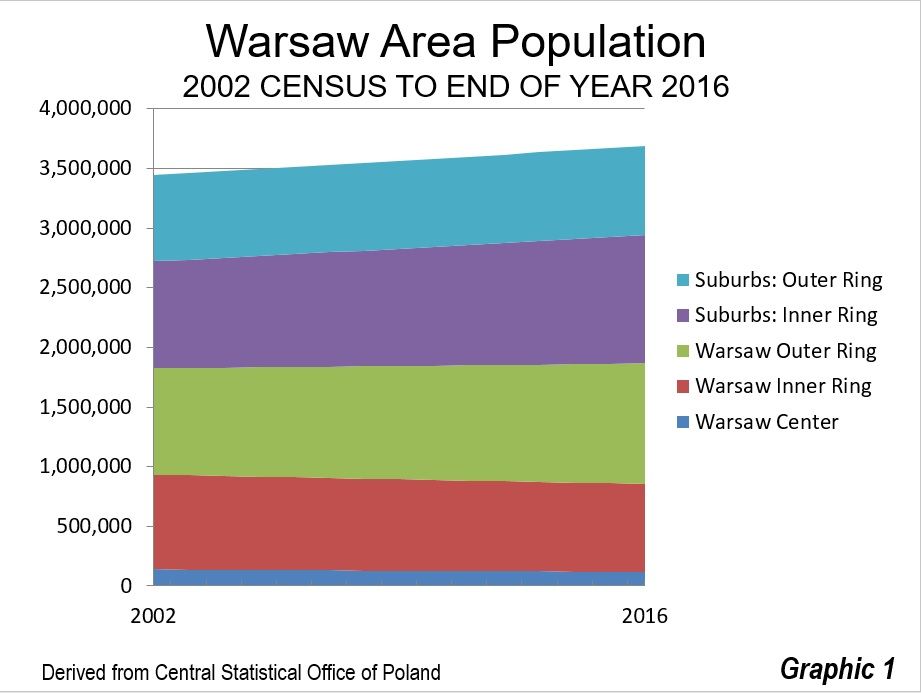
    Like other major cities in the high income world, Warsaw has seen central area population losses, with all of the population growth taking place outside the urban core, principally in the suburbs and exurbs (Graphic 1). The city’s districts were reconfigured so that direct comparisons cannot be made before the 2002 census.

    The Warsaw region consists of the city of Warsaw, a county-level national jurisdiction (powiat) and seven powiats in the suburbs and nine in the exurbs. The Warsaw region grew from 3.31 million residents in 2002 to 3.58 million in 2016, a 0.5 percent annual growth rate. Warsaw’s slow growth is substantially faster than that of the nation, which has not gained in population since 2002, both as a result of a below-replacement fertility rate and migration to other parts of Europe.

    The Central District

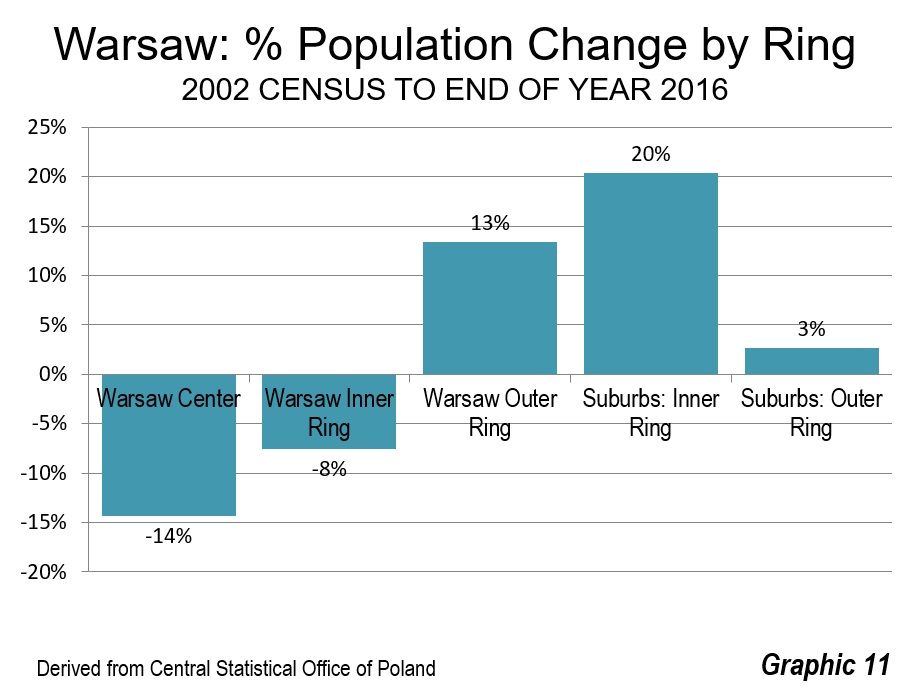
    The central district (Śródmieście), which includes the central business district (CBD) and the central railway station (Warszawa Centralna) experienced a loss in population of 14 percent from the 2002 census to 2016, according to the Central Statistical Office of Poland.

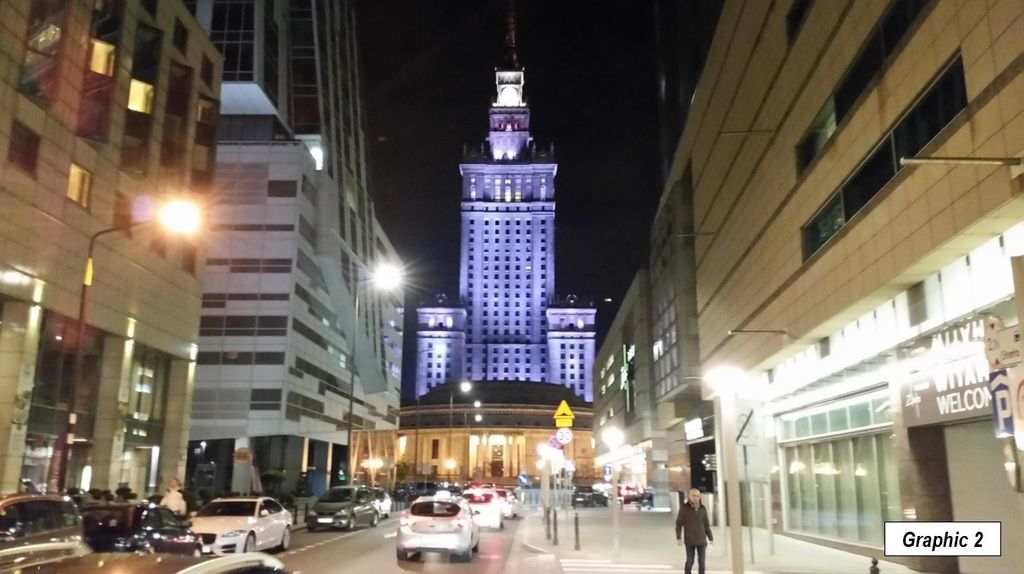
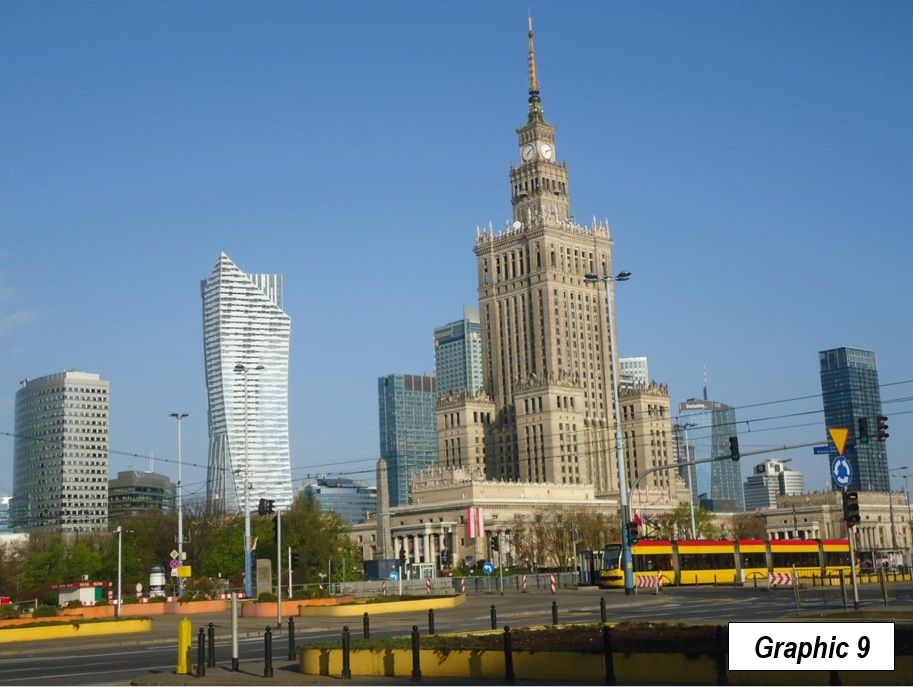
    The skyline of Warsaw (Graphic 2) used to be dominated by the Palace of Culture and Science, which was constructed as a “gift” to the Polish people from Soviet leader Josef Stalin in the early 1950s (though completed after his death). It is sometimes called the “Eighth Sister,” referring to its similarity to the “seven sisters” in Moscow that share a very similar “wedding cake” design. Like Moscow State University and Ukraina Hotel buildings in the Russian capital, the Palace of Culture and Science is fully symmetric from the base up. The Palace is located at the very center of Warsaw, adjacent to Warszawa Centralna and even has suburban rail entry structures in the surrounding green area.

    The building spent decades as a reviled reminder of Soviet domination and the restrictions imposed under Soviet communism. When the Poles took control of their own destiny about 28 years ago, there was considerable pressure to dismantle the Palace as many felt it was a symbol of oppression. The parliament defeated a measure to demolish the building, despite significant public pressure. Today, the Palace seems to have been, at least reluctantly accepted. It is now impressively lighted at night.

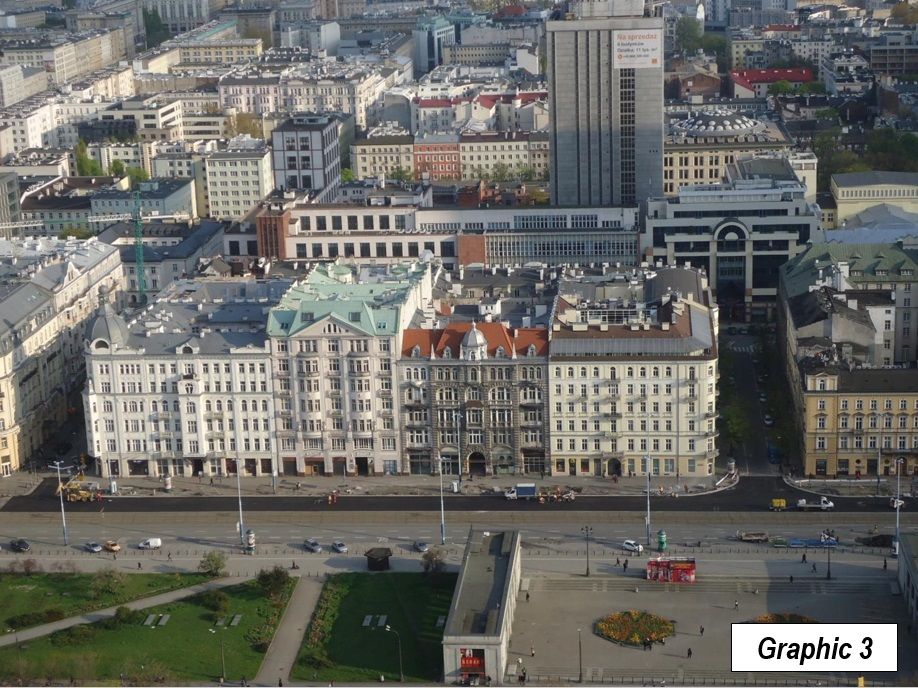
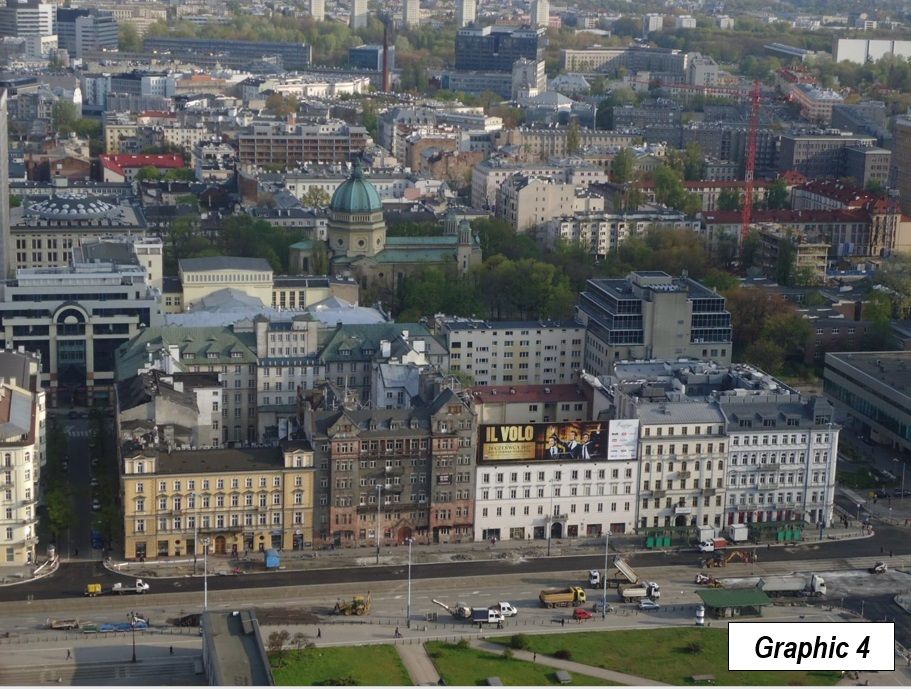
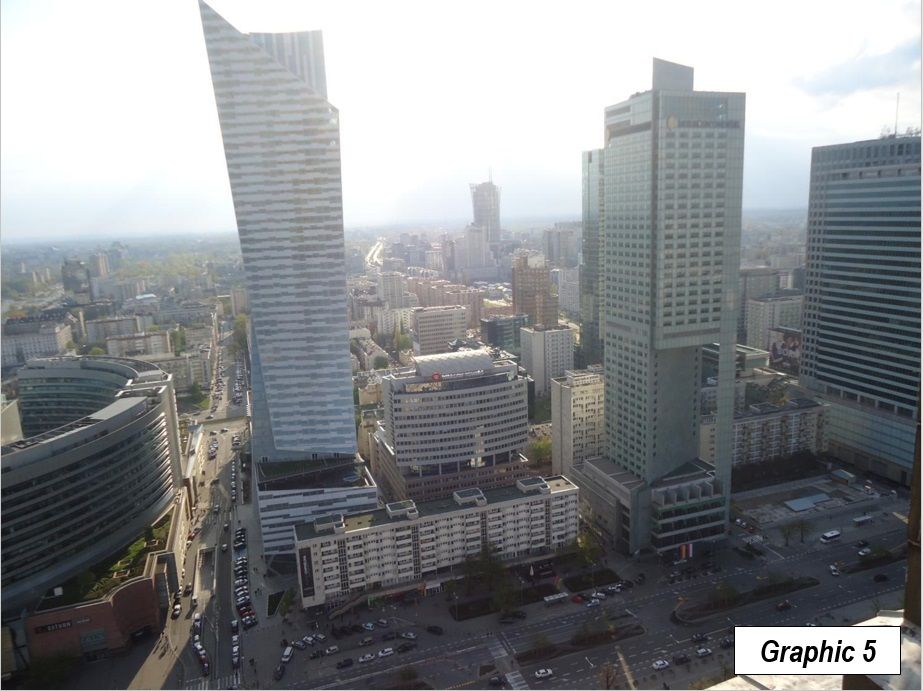
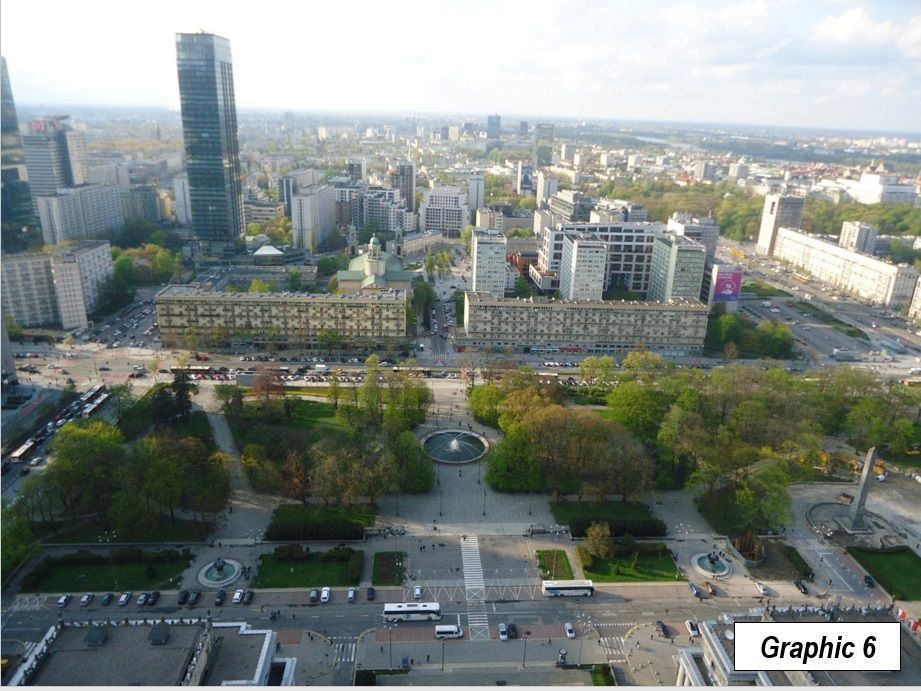
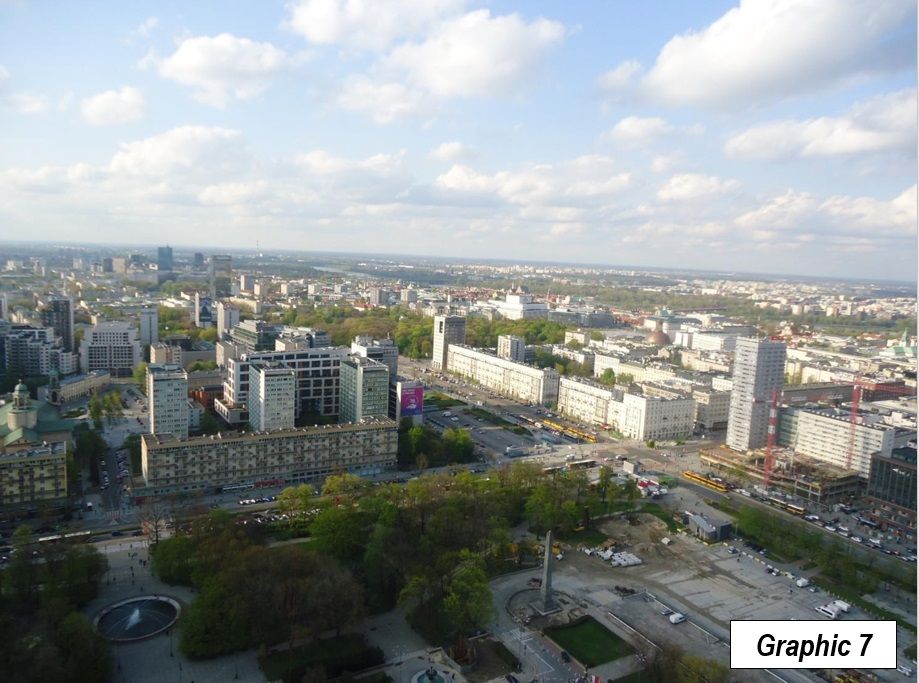
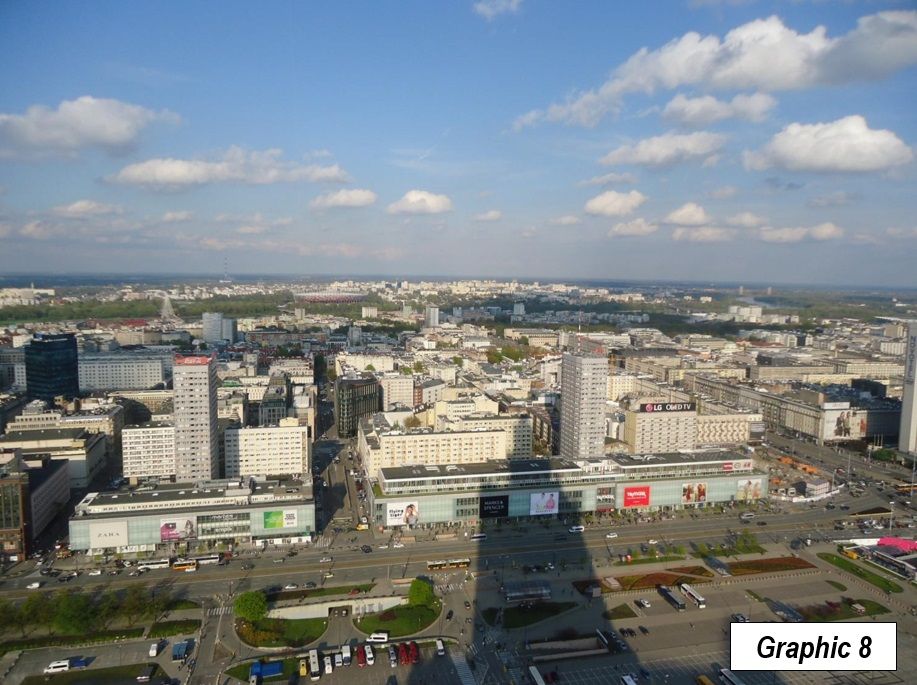
    Since that time, the building has had a significant change in function. The building now houses offices, a museum, university facilities, the Polish Academy of Sciences, a fitness center and other functions. Even so, some people will still tell you that the best place to see Warsaw from is the Palace of Culture and Science, because it is the one place from which you cannot see the building. However, the view from the top is certainly worthwhile (Graphics 3-8).

    A number of new, modern skyscrapers have been built, principally to the west. The buildings, however, are not closely packed, as would be expected in an American, Canadian, or Australian central business district. Graphic 9 shows the skyline, with the Palace of Culture and Science in the center and other large buildings around it. The distribution of Warsaw’s post-Soviet commercial high rises is similar throughout both the central districts and the inner districts, widely spaced and reflecting a modern metropolitan area that has become much more automobile oriented.

    The central district also includes the intersection of (Pope) Jana Pawla II and Solidarity (the trade union led by Poland’s first post-Soviet president, Lech Walesa), boulevards named for two of the strongest forces responsible for separation from control by the Soviet Union and restoration of Polish independence (photograph at the top). Significantly, one of the corners of the intersection is occupied by a McDonald’s, one of the most obvious symbols of the market economy that Poland has embraced.

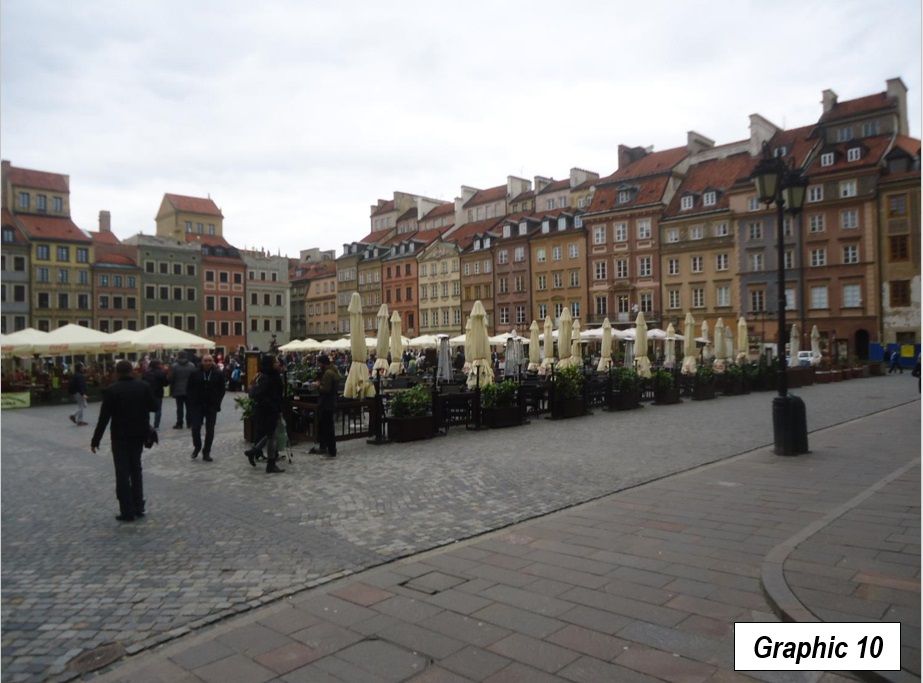
    The central district also includes the “old town,” which like most of Warsaw was reduced to rubble by the bombing and street battles of World War II, including the premeditated destruction of the city by retreating German forces. It has been painstakingly rebuilt as it was before (Graphic 10).

    Other Districts of Warsaw

    The inner ring of districts, each of which borders on Śródmieście, lost eight percent of its population between 2002 and 2016. These six districts include Mokotów, Ochota, Praga Północ, Praga Południe, Wola and Żoliborz.

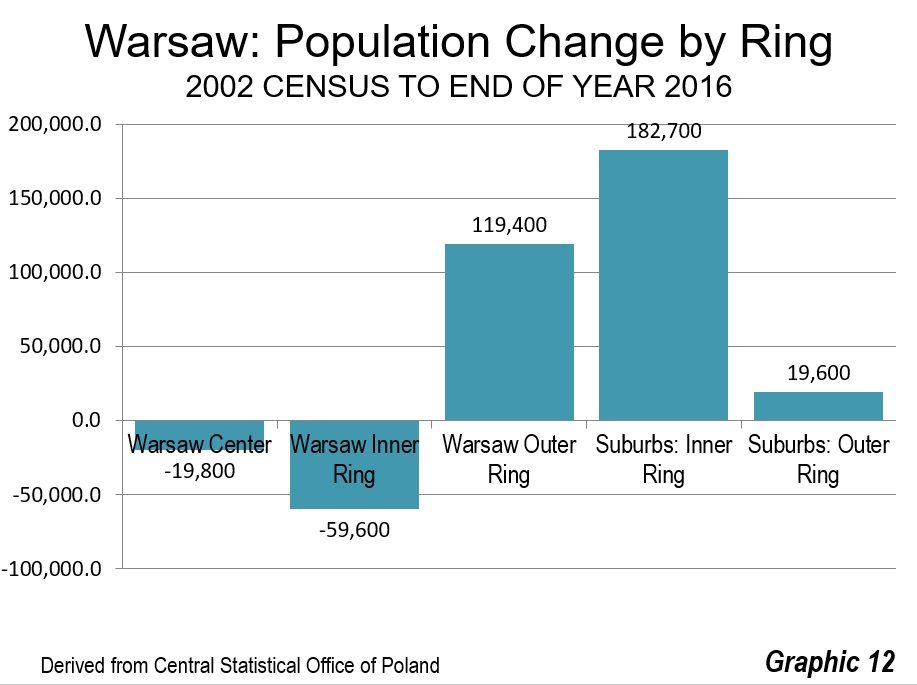
    The outer city districts gained 13 percent in population. Their nearly 120,000 gain more than offset the 60,000 loss in the inner ring districts and the 20,000 loss in the central district.

    Suburbs and Exurbs

    The inner suburban powiats captured most of the growth, growing 20 percent, and adding 182,000 residents. Growth in the outer nine counties was much less, at three percent and 20,000. Nearly 85 percent of the Warsaw area’s population growth occurred in these suburban and exurban areas (Graphics 11 and 12).

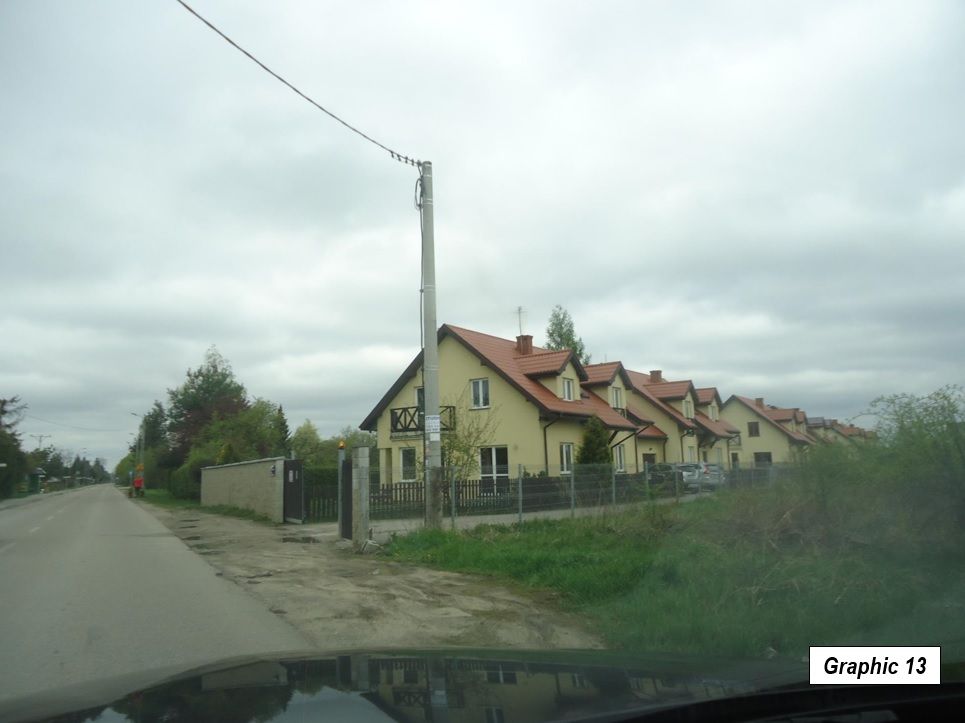
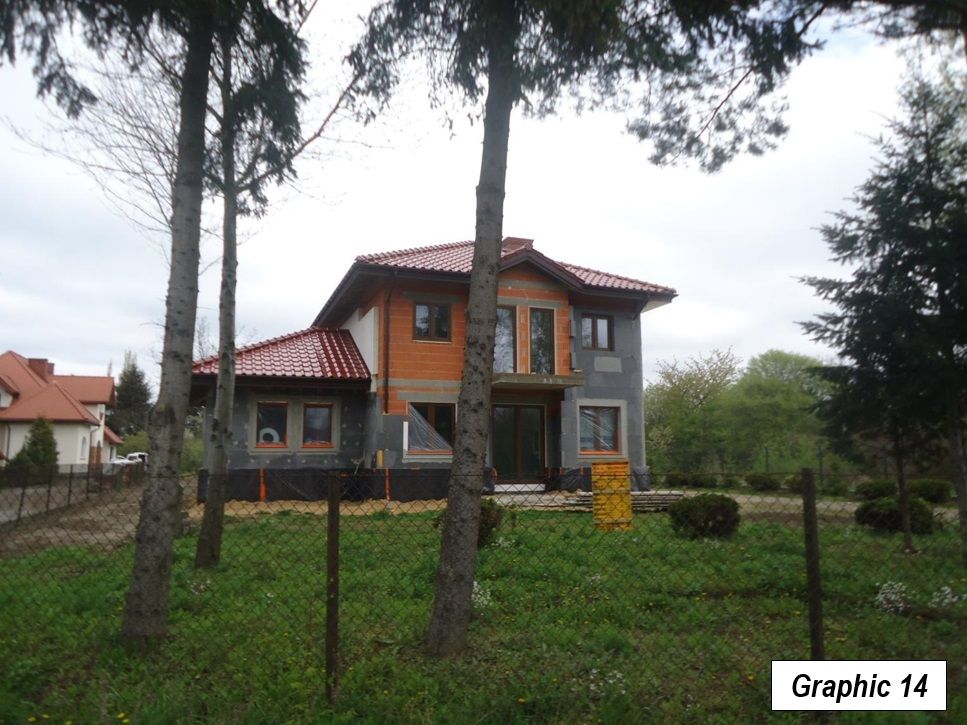
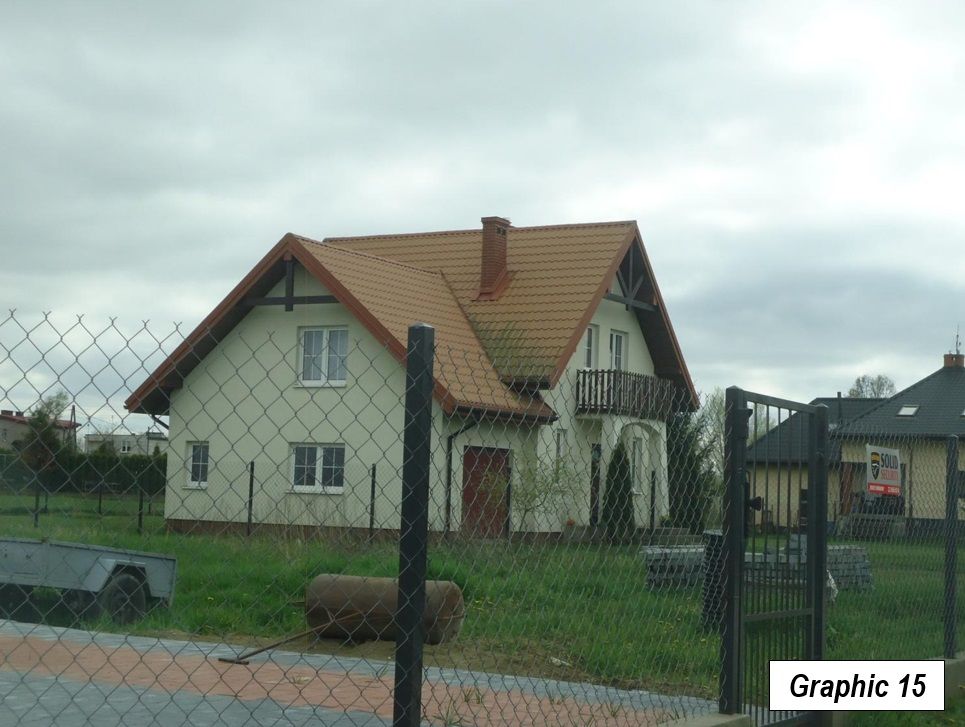
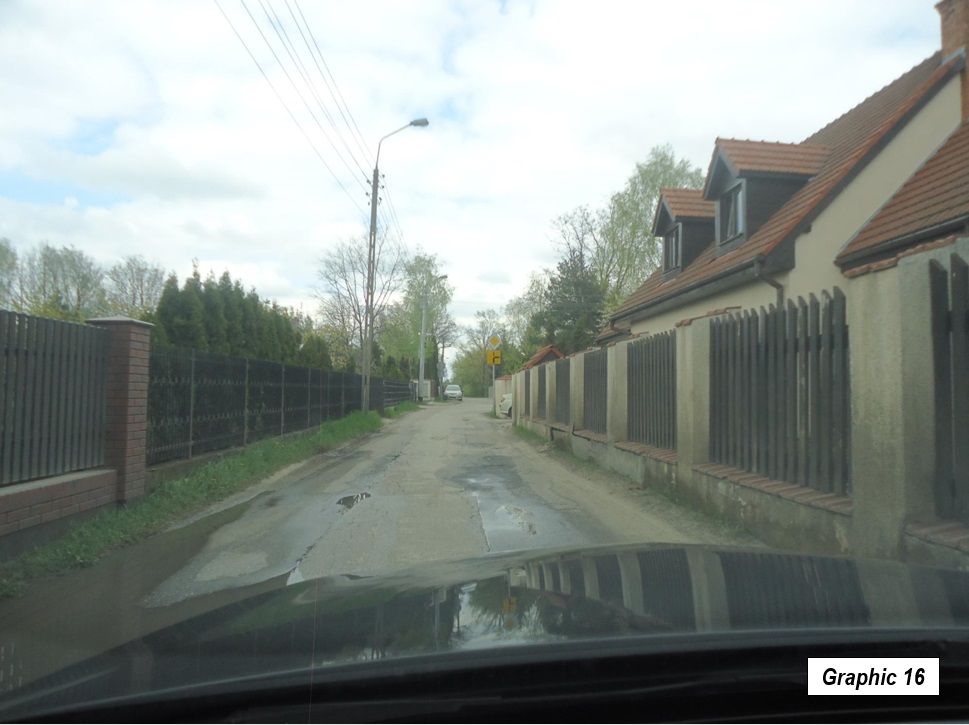
    The suburban and exurban residential areas are comparatively sparsely developed. Development is more contiguous in the inner ring of suburbs and much less dense exurbs of the outer ring (Graphics 13-16). Many suburban and exurban residential streets are far narrower and often without sidewalks and curbs. The suburban infrastructure generally appears to be of a lower standard than is found in the suburban areas of Australia, Canada and the United States, where larger individual developments have been required to install wide streets, sidewalks and usually sewers, as opposed to the generally smaller or even individually developed parcels that are more evident in suburban Warsaw.

    Nevertheless, Warsaw, and Poland, are developing rapidly. Real gross domestic product per capita in the nation has increased by at least three times since 1990. The shopping centers of Warsaw look very much like others in the core of western Europe, and even similar to those in Canada and the United States. The nation is constructing a high-speed motorway system, which has among the highest posted speeds in the world, at 140 kilometers per hour (87 miles per hour), though a number of important segments remain to be built. After many difficult decades, Warsaw and Poland are truly a part of modern Europe.

    Wendell Cox is principal of Demographia, an international public policy and demographics firm. He is a Senior Fellow of the Center for Opportunity Urbanism (US), Senior Fellow for Housing Affordability and Municipal Policy for the Frontier Centre for Public Policy (Canada), and a member of the Board of Advisors of the Center for Demographics and Policy at Chapman University (California). He is co-author of the “Demographia International Housing Affordability Survey” and author of “Demographia World Urban Areas” and “War on the Dream: How Anti-Sprawl Policy Threatens the Quality of Life.” He was appointed to three terms on the Los Angeles County Transportation Commission, where he served with the leading city and county leadership as the only non-elected member. He served as a visiting professor at the Conservatoire National des Arts et Metiers, a national university in Paris.

    Top Photograph: Street signs at the intersection of Jana Pawla II and Solidarity, named respectively for their roles in securing independence from the Soviet bloc (Pope John Paul II and the Solidarity Trade Union, led by eventual President Lech Walesa). By author.

  • The news media are losing their search for truth

    To someone who has spent most of his career in the news business, it’s distressing to confront the current state of the media. Rather than a source of information and varied opinion, the media increasingly act not so such as disseminators of information but as a privileged and separate caste, determined to shape opinion to a certain set of conclusions.

    When you pick up a great newspaper like the New York Times, it is sometimes shocking how openly partisan the coverage tends to be. For example, when President Donald Trump unveiled his new tax plan, the headline was not about the proposal per se, but rather how it would serve the wealthy. This may indeed be the case, but such an approach would traditionally be the role of the editorial pages — not the Page 1 headline writers.

    This approach oddly actually plays exactly into the president’s hands at a time when, according to a September Gallup poll, confidence in the media stands at a historic low of 32 percent, down from 55 percent in 1999. Even if they don’t like Trump, most Americans are turned off by the relentless negativity.

    The unique challenge of Trump

    Alienating customers is not good business, especially for an industry that has seen close to 40 percent of its jobs disappear over the past 20 years. Some of the problems, of course, reflect other issues, most notably the rise of online media and the fact that barely 5 percent of Americans aged 18 to 29 get their news from print newspapers. Cable and network news are not doing much better; their audience, notes a March 2014 Pew Research Center report, is now smaller than it was in 2007.

    The public’s growing disdain allows Trump to give the media a “big, fat, failing grade” as one of his essential talking points. His no-show at the White House Correspondents’ Dinner plays well with a large part of the population that feels alienated from the mainstream media.

    Conservatives have long railed against media bias. But under Ronald Reagan, media experts like Michael Deaver and Pete Hannaford flanked the press by using television and radio to go “over their heads.” The Trump approach, spurred by bully-in-chief Steve Bannon, decries the media as “enemies of the people,” an approach more Stalinesque than Reaganesque.

    Trump’s often dubious relationship with the facts remains fair game, but does not excuse the media becoming so obvious and willing a tool of progressive Democrats. Under President Obama, the media simply ignored, or buried, stories such as the Internal Revenue Service’s targeting of conservatives, the expulsion of 2 million immigrants, Obama’s repeated foreign policy failures or his blatant misdirection over health care.

    In contrast, some issues, like transgender issues, anything relating to immigration, particularly undocumented aliens, or climate change, are covered with a one-sided stridency characteristic of Vladimir Putin’s Russia. As a cub reporter, I was told by my editor at the Washington Post, “Nobody gives a crap about your opinion,” and we were obliged to look for dissenting opinions. Informing the public was our job, leaving analysis and opinion to the pundits on the inside pages.

    Read the entire piece at The Orange County Register.

    Joel Kotkin is executive editor of NewGeography.com. He is the Roger Hobbs Distinguished Fellow in Urban Studies at Chapman University and executive director of the Houston-based Center for Opportunity Urbanism. His newest book is The Human City: Urbanism for the rest of us. He is also author of The New Class ConflictThe City: A Global History, and The Next Hundred Million: America in 2050. He lives in Orange County, CA.

    Photo: Steve Jurvetson [CC BY 2.0], via Wikimedia Commons