Blog

  • Is Hawaii the Bellwether for California?

    California used to consider itself the leading state and the bellwether for the entire country. Now that the entrepreneurial initiative has mostly switched to Texas and other such places, and Texas’s infrastructure has pulled ahead of California’s in its quality (I lived in Texas in the 1970s, and it was not so then!), California is, at the very least, still thought of as a bellwether for the whole country, if perhaps a dystopian one. But there is a state that even Californians look to for popular cultural leadership, visit frequently, and admire. And, while it is often said that California became the first “majority-minority” state, it is not true. This other state, which lies far to the southwest of California, has always been “majority-minority.” It is, of course, Hawai’i. (The apostrophe is a letter in Hawaiian, and it is pronounced.) It has wrestled with “multicultural” issues for longer than it has been part of the United States. And one born in Hawai’i is now President of the United States.

    The majority of the residents of Hawaii are Asian, the largest number being of Japanese descent with some Chinese and Filipinos and a few Koreans, though Koreans have mostly preferred California. President Obama is exceptional; people of African descent have never been numerous in Hawai’i. Five to ten percent of the people have some percentage of native Hawaiian blood, though there are almost no pure-blood Hawaiians.

    On the mainland, whites and blacks are moving out of areas flooded by immigration; in Hawaii, whites (including retirees) and even a few minimum-wage Mexicans, are moving in on a net basis. It is important to note, however, that Hawaii’s Asians are not mostly recent immigrants; they are descended from people who came over in the late nineteenth and early twentieth centuries. Today’s immigrants have generally preferred California, which had a more vibrant entrepreneurial economy, and on some fronts still does. (The maker of computer chips is probably itching to move to Texas; less so the programmer.) The reason for all this is that Hawaii was so long dominated by the “Big Five” corporations.

    The historical reasons for the Big Five, and for Hawaii’s other oddities, are interesting. In the 19th century, a large percentage of Hawaii’s land and economy fell into the hands of a few white (haole) families, like Bishop, Dillingham, Baldwin, and Parker, who sometimes did marry into the local noble (ali’i) caste. The corporations they founded were eventually known as the Big Five. (Some of this heritage is chronicled in the recent film The Descendants.) They brought large numbers of Asians in as contract labor to work the vast fields of pineapple and sugar cane. California had its counterparts, the Irvines, O’Neills, Bixbys, Millers, Hearsts, and more, but they only controlled part of the land and exercised little control of the commercial economy. The rest of the Mexican grants were broken up into smaller farms and ranches soon after the American conquest. (It is where the grants remained intact until recently, such as south Orange County, that you have the notorious “planned communities.”)

    Japan was the first main source of Asian labor, but the Japanese came largely from the Ryukyus, Kyushu, and the less developed south of Japan, and were often part of the Eta undercaste that in Japan had butchered animals and cleaned toilets. China, the Azores, and later the Philippines were also sources of labor, but the majority of Hawaiian Asians are of Japanese descent.

    In the 1940s and 1950s, culminating in 1954, there was a labor and political movement by which the predominantly Asian workers took control of the territory from the Big Five. They could regulate the Big Five, they could unionize the Big Five, but they did not have legal authority to break up the Big Five (only the federal government could have done that); so both right and left in Hawai’i retained a corporatist rather than an entrepreneurial mentality. The establishment had been Republican, so the workers were Democrats, and Hawai’i entered a long era of Democratic dominance, which continues to this day. The plantation experience is one major reason why most of Hawai’i’s Asians, unlike Asian Californians until recently, have been Democrats.

    An interesting fact about Hawai’i is that there are only four functioning local governments, the counties.  There had been a fifth, the Hansen’s Disease (Leper) colony on Kalaupapa Peninsula, which was the lifework of Saint Damien, canonized in 2009. While the counties are divided into “judicial districts” that are marked on some maps, the judicial districts do not have governments. Each county has a “mayor,” but there are no incorporated cities as they are known in other states.

    Another force influencing the Hawaiian culture and worldview is the Native Hawaiians. There are almost no pure blooded Native Hawaiians (other than on Ni’ihau), but up to ten percent of the population has some Hawaiian blood. The old pre-Christian culture had some brutal elements. While on the one hand there was premarital sexual freedom, on the other a woman could be killed instantly for eating a banana or a coconut, and a commoner could be killed instantly for letting his shadow fall on a chief. Infanticide was employed in population control and human sacrifices were offered to Madame Pele, the volcano goddess. They had no system of writing. In the days before it became unfashionable to distinguish between “civilized” and “uncivilized,” they were therefore considered “uncivilized.” However they did build permanent stone structures as temples and as “cities of refuge,” places where people who had broken, or were accused of breaking, a kapu (taboo) could go to save their lives. Also there was a vast lore of herbal healing, which survives.

    Between 1790 and 1810, Kamehameha the Great united the islands into a single kingdom, and established a monarchy that lasted until 1893, long after Hawai’i had been modernized, Westernized, and largely Christianized, and had already received large numbers of immigrants. It was not any crowned head of Europe that was the first monarch to have his voice recorded, and to travel around the world, but King David Kalaka’ua of Hawai’i. All this is far different from how it was for American Indians of the mainland! Another uniqueness is that the Hawaiian language, spoken daily by hardly a thousand people, a tiny fraction of those who speak, say, Navajo, has nonetheless become part of the culture; a language which has left a long list of words in Hawaiian English, a language in which much locally popular music is recorded, and a tourist attraction in its own right. Its status is in some way similar to that of Irish Gaelic in Ireland. (By comparison, in Palm Springs I have never heard music sung in Cahuilla.)

    What, then, of Hawai’i today? There is an active Christian minority, but Pele, the goddess who supposedly lives at Kilauea Crater, regularly gets offerings of flowers and gin. “Haoles” are wary of getting into fights with “locals.” The culture values the ohana, or extended family, but it is hardly Confucian. One might mention at this point Will Durant on later ancient Rome:

    “But most of the inflowing peoples had literally been de-moralized by uprootage from their native surroundings, cultures, and codes; … and daily friction with groups of different customs had worn away still more of their custom-made morality.” (Caesar and Christ, p. 366.)

    This sort of multiculturalism, however, had nothing to do with the fact that Hawai’i was the first state where same-sex marriage was seriously proposed? No, it was, I believe, a case of imperial judiciary, and same-sex marriage was voted down two to one in November of 1998. If democratic processes continue and are not overridden by judicial fiat, Hawai’i will be one of the last states outside the South to adopt same-sex marriage. And in California, it was the votes of people of color, who would never think of becoming Republicans, that won Proposition 8 and delayed same-sex marriage for some years. It makes me think that the Republican party should be replaced by two new ones; one socially conservative, pro-voucher, fiscally moderate to liberal, and led by people of color; the other, a more semi-libertarian party. Neither, preferably, should bear the name Republican Party.

    Howard Ahmanson of Fieldstead and Company, a private management firm, has been interested in these issues for many years.

  • The Value of a Liberal Arts Education in Landing a Job

    North Carolina Gov. Pat McCrory made waves when he said on syndicated radio that he wants to encourage the funding of four-year programs that align with the job market — not those, like gender studies, that do little to help a graduate’s employment prospects.

    This was covered in a pointed column for The Wall Street Journal by Jane Shaw, the president of the John William Pope Center of Higher Education Policy in Raleigh, N.C. Shaw supports McCrory’s attempt to roil the higher education establishment and get students — heaven forbid — thinking about job prospects when they pick a major:

    Referring specifically to North Carolina’s 16-campus state university system, Mr. McCrory wondered if state funding incentives should encourage areas of study that align with the job market. Other disciplines, such as gender studies, Mr. McCrory said, might be subsidized less. The funding formula, he said perhaps a bit indelicately, should not be based on the number of “butts in seats, but how many of those butts can get jobs.”

    The education establishment immediately went bonkers. The pundits piled on. But Mr. McCrory raised a legitimate concern. And the solution he proposed, sketchy as it is at this stage, is not a bad one.

    The truth is: Elite universities, such as the University of North Carolina at Chapel Hill, are doing a disservice when they lead students into majors with few, if any, job prospects. Stating such truths doesn’t mean you’re antagonistic to the liberal arts.

    This discussion — and the one we contributed to last year after Viriginia Postrel’s column for Bloomberg — got us thinking: just how valuable is a liberal arts education in landing a job and contributing in the business world? Because EMSI works with so many community and technical colleges, we’re all for matching educational programs to in-demand fields. (In fact, we’ve developed a tool, Career Coach, that does just that.) For schools that specialize in offering associate’s and certificate programs, data-driven program assessment makes sense — and it helps students, colleges, and the regions that colleges serve.

    But what about universities like the University of North Carolina, which McCrory chose to use an example? It’s much trickier to link gender studies, history, or some other liberal arts degree to an actual career. But these graduates — in theory — are getting a more well-rounded education than they would get at a vocational school, and they should have the critical thinking, analytical, and writing skills valuable in the marketplace.

    Or do they?

    In criticizing American higher education institutions, Shaw writes, “Many liberal-arts graduates, even from the best schools, aren’t getting jobs in large part because they didn’t learn much in school. They can’t write or speak well or intelligently analyze what they read.” If this is the case, these students are bound to get a poor education regardless of what they major in.

    However, as Postrel mentioned in her column last year, the students who flow into well-regarded schools and the majors that result in well-paying jobs, like some STEM degrees, “have the aptitudes, attitudes, values and interests that draw them to those fields (which themselves vary greatly in content and current job prospects).” And as Anthony Carnevale at Georgetown showed in a study last year, the unemployment rate for graduates of certain scientific or technical fields isn’t any better, and sometimes it’s worse, than the rate for graduates who major in education or the humanities (see above chart).

    We looked at completions data from the National Center for Education Statistics to get a sense of the top educational programs for graduates from 2003 to 2011 among all award levels. First, here’s the top 10 programs in the U.S. Liberal arts comes in second — just under 50,000 completions short of business administration — while psychology, cosmetology, and general studies are also hugely popular.

    But what’s striking is to look at the same chart for North Carolina. Notice the huge growth in liberal arts degrees — from 4,111 in 2003 to 8,778 in 2011. And since the recession, the rate of students graduating in liberal arts fields has picked up, not slowed down like you might think.

    Based on this data, perhaps McCrory has a point. North Carolina has far outpaced the nation in terms of the proportion of liberal arts degree it awards. But the real question in this debate is, what kind of education are these students getting? If it’s as lousy as Shaw depicts, and if they’re not aggressively pursuing internships and other career-advancing opportunities while in school, many of these graduates are in for a tough time no matter what.

    Joshua Wright is an editor at EMSI, an Idaho-based economics firm that provides data and analysis to workforce boards, economic development agencies, higher education institutions, and the private sector. He manages the EMSI blog and is a freelance journalist. Contact him here.

    Lead illustration by Mark Beauchamp.

  • Wall Street’s Hollow Boom: With Small Business And Startups Lagging, Job Recovery Unlikely

    On Wall Street, even as layoffs mount, the upper echelons are clinking champagne glasses for good reason. The stock market is hitting new highs, propelled largely by Bernanke dollars and strong corporate profits. Big financial institutions like Wells Fargo and JPMorgan have announced record profits.

    But on Main Street, for the most part, the mood is far more subdued. Big business may be flourishing, but small business is still in recession. The number of startup jobs per 1,000 Americans over the past four years fell a full 30% below the levels of the Bush and Clinton eras. The Ewing Marion Kauffman Foundation, a nonprofit that studies startups, estimates that the rate of new business formation in the U.S. has fallen to a record low. The number of startups in 2011 was lower than in 1994, when the economy was smaller, as was the workforce and population.

    According to the BLS, smaller firms accounted for two thirds of all net jobs added between 1992 and 2007, a figure much cited by small business advocates. (This is hotly disputed by labor-backed economists, who have traditionally downplayed entrepreneurial ventures since they are not amenable to organizing.)

    But whatever the actual percentages, the weakness of smaller, and particularly newer firms, is one key reason for our current, persistent job shortfall. This time around, as a recent Brookings study reveals, larger businesses came out of the recovery stronger, not their beleaguered smaller counterparts.

    Big businesses often drive the economy but newer, smaller ones, historically, have created the jobs. If the U.S. had come out of the recession maintaining the same rate of startup formation as in 2007, notes McKinsey, we would today have almost 2.5 million more jobs.

    The problem is that in many ways, the recession never ended for small business. The reductions in small business employment during the fourth quarter of 2008 and in 2009 were the largest ever recorded in the history of the National Federation of Independent Business data series. And now, as we enter the sixth year since the onset of the Great Recession, more than four years after the “recovery” officially began, small business remains in a largely defensive mode. Hiring and startup rates have been far less dynamic than in the aftermath of the downturns of 1976 and 1983.

    Since big companies largely have recovered, and government employment has grown, at least at the federal level, clearly the real problem lies with the poor performance of smaller, and most critically newer, firms. In the past, young businesses bailed out the economy and spurred innovation. Yet today fewer than 8% of U.S. companies are five years old or younger, down from between 12% and 13% in the early 1980s, another period following a deep recession.

    It’s difficult to predict a rapid turnaround. In sharp contrast to the Fed-inspired boomlet on Wall Street, Gallup polling has found that one in five small firms expect to drop their employee count, one in three expect to decrease capital spending and almost as many expect to be in more severe cash flow troubles by the end of the year.

    Why is this small business recession persisting? The causes are diverse. Certainly the prospect of Obamacare scares some smaller firms, who lack the resources of larger companies to deal with the new health regime. This is leading some to reduce full-time staff to avoid new mandates. In states such as California, New York, Massachusetts, Minnesota and Illinois, higher taxes on incomes directly threatens the cash flow of smaller firms.

    Another source of trouble could be the decline of community banks, which traditionally have focused on smaller businesses. New regulations and Federal Reserve giveaways to “too big to fail” financial institutions have fostered an unprecedented concentration of financial assets in the hands of a few banks. In 2013 the top four banks controlled over 40% of the credit markets in the top 10 states, up 10% from 2009 and roughly twice their share in 2000. At the same time, since the passage of Dodd-Frank, there are some 330 fewer small banks. In the four years following June 2007, the volume of business loans under $1 million fell 13%.

    But perhaps most important has been the weak GDP growth that has kept consumer spending at a low level, a particularly rough condition for smaller, start-up businesses. A growing economy and marketplace is critical for newer firms; without a sustained economic expansion many will suffer or never even come into existence.

    Small business’ future is further obscured by political shifts. The Obama years have been golden for “crony” capitalists with good connections in Washington or in the various statehouses. As larger firms readjust to the realities of the Obama-Bernanke regime, they seem more willing to accommodate themselves, for example, to the new health care law, and also have better opportunities to feed off the federal trough; federal subsidies for renewable energy , for example, largely benefit bigger firms or well-heeled investors. Absent real tax reform, they also have less to fear from higher income taxes than smaller businesses, which are often sole proprietorships.

    The emerging alliance of the “bigs” — big business, government and labor — represents a return to a kind of dirigiste economy not well suited to smaller firms. Former Clinton Administration advisor Bill Galston openly urges Democrats to cement what he considers a a natural alliance with larger firms, including the financial industry, while denouncing small business lobbies as “a building-block of the Republican base.”

    In the long run, this new corporatism threatens not only small business — less able to lobby for itself and adjust to regulations than giant firms – it also also represents something of a threat to the very justification for a capitalist economy. Today large banks and big companies have public approval ratings down around 20%, according to Gallup. In contrast, small business has retained positive ratings of over 60%, as it has for decades. Another survey, conducted by Frank Magid and Associates, found large businesses approaching “the netherworld” inhabited by Congress — almost two-to-one unfavorable. Wall Street fared even worse. Small business, in contrast, was viewed positively 10 times as much as unfavorably.

    This is not just entrepreneurial romanticism. The notion of reasonably widespread entrepreneurial opportunity underpins basic faith in the free-market system. Small enterprises, and expanded business ownership, justify capitalism by showing it is still open to competition, and that anyone, however humble, can participate and gain from the system. “Wherever there is small business and freedom of trade,” noted V.I. Lenin, founder of the Soviet Union, “capitalism appears.”

    Without the innovative and job-creating potential of new small businesses, capitalism devolves into a fixed game dominated by big money and insider influence, as long portrayed by socialists, before Lenin and since. And, if the economic picture does not change soon, they will have been proven right, at least about that.

    Joel Kotkin is executive editor of NewGeography.com and a distinguished presidential fellow in urban futures at Chapman University, and a member of the editorial board of the Orange County Register. He is author of The City: A Global History and The Next Hundred Million: America in 2050. His most recent study, The Rise of Postfamilialism, has been widely discussed and distributed internationally. He lives in Los Angeles, CA.

    This piece originally appeared at Forbes.com.

    Wall Street photo by flickr user Manu_H.

  • Chicago: Outer Suburban and Exurban Growth Leader

    Greg Hinz at Crain’s Chicago Business congratulates Chicago for its nation-leading population growth. Heinz also notes that the far suburbs also gained population strongly, but there had been losses in the areas between the two. He asks: "the question now is whether the area can prosper with a thriving core but sinking neighborhoods and inner-ring suburbs around it."

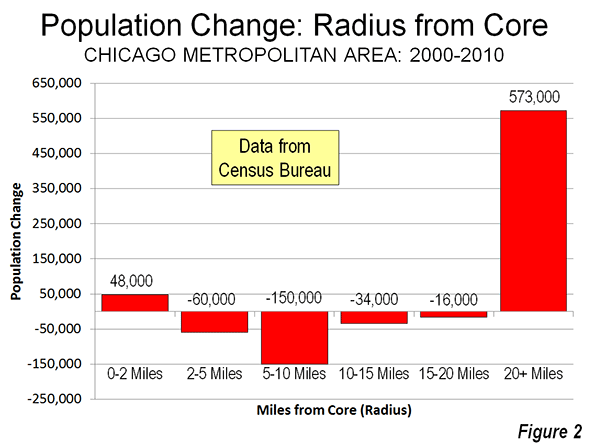
    The area within 2 miles of downtown gained nearly 50,000 people between 2000 and 2010. No other US metropolitan area equaled this urban core population increase.

    The article cites a number of factors beyond population growth to indicate that the city of Chicago is outperforming the suburbs. Retail sales tax collections have increased faster in the city. However, Hinz also notes that there has also been a sizable proliferation of big-box stores (Target and Wal-Mart), which is made it possible for residents to shop in the city instead of the suburbs.

    Empty Nesters Not Flocking to Downtown

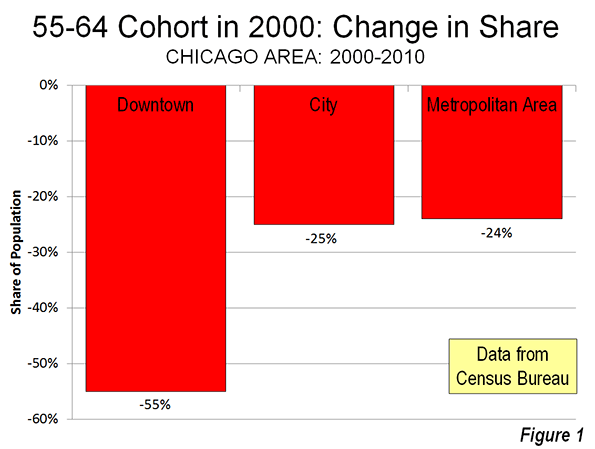
    Hinz notes that "empty nesters" are moving to the urban core. Yet this is not confirmed by the data. Between 2000 and 2010, the age cohort that was from 55 to 64 years old in 2000 dropped by 55 percent as a share of the population in the fast growing core census tracts of central Chicago. In contrast, in the city of Chicago overall, the loss was 25%, and the reduction was 24% in the entire metropolitan area (Figure 1). Our previous national research showed that the population losses in this cohort were the greatest in the core cities among the 51 major metropolitan areas.

    The article goes on to quote Alan Ehrenhalt to the effect that an "inversion" of the city to suburban movement pattern is occurring, and "it’s happening more in metropolitan Chicago than just about any other city in the country."

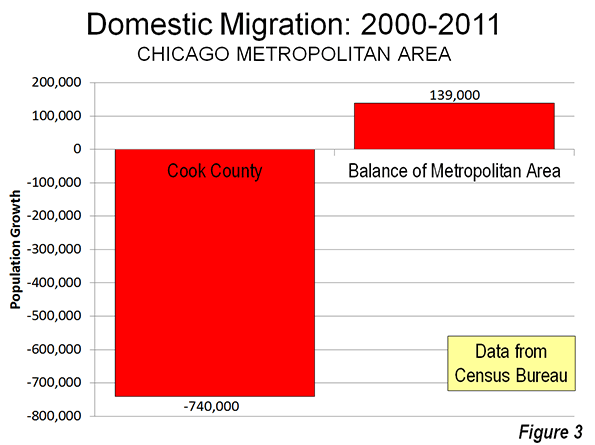
    "Inversion" implies "turning upside down." For an inversion to have occurred, there would need to have been a reversal of the trend in movement from the core cities to the suburbs. The most important indicator of any such inversion would be that domestic migration would show a flow from a suburbs to cities. It does not. Domestic migration from Cook County, in which Chicago is located, was minus 740,000 between 2000 and 2011 (Note). Domestic migration in the suburban counties was a plus 139,000. Thus, there was no net migration from the suburbs to Cook County (Figure 2).  

    The City of Chicago Outside Downtown

    The story was much different outside the core area. The balance of the city, where 93 percent of the people live, lost 250,000 residents – a loss greater than that of any municipality in the nation over the period – including Detroit. The losses were pervasive. More than 80 percent of the city’s 77 community areas located outside the core lost population.

    Thus, the core area boom is far more than negated by the losses in the balance of the city. The losses that were sustained in the area between the urban core and the outer suburbs and exurbs were virtually all in the city itself.

    Inner Suburbs

    At the same time, the inner ring suburbs (between the city and 20 miles from the core for this analysis) grew only modestly, gaining less than 20,000 between 2000 and 2010. This is not unexpected, especially in a metropolitan area with slow growth, like Chicago. Urban areas tend to grow organically, with the greatest growth on the urban fringe. As the urban fringe moves further from the core, growth will be less in the established developed areas. 

    An important exception is the small pockets of growth developing and occupying previously disused warehouse and commercial and even railroad yard areas. The core of Chicago is among these, along with Portland’s Pearl District, the Washington Avenue corridor in St. Louis, the Third Ward in Milwaukee, and others. The exit of commercial activities permitted conversion to residential uses, often decades after the abandonment of previous uses.

    Outer Suburban and Exurban Growth

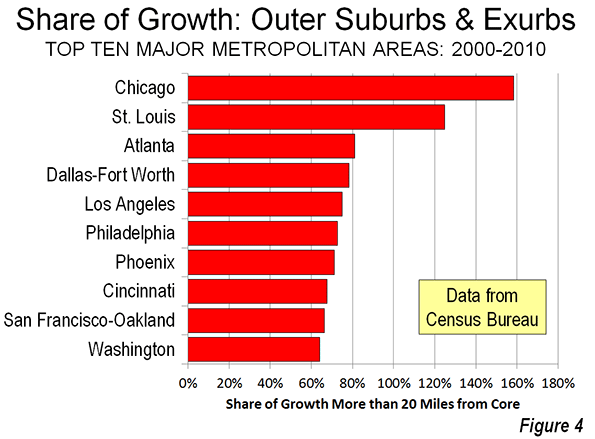
    The overwhelming reality of metropolitan growth in Chicago, however, is that the outer suburbs and exurbs continue to capture virtually all growth. Overall, areas outside 20 miles from the core of Chicago gained 573,000 residents between 2000 and 2010. By contrast, the entire metropolitan area gained only 362,000 residents. As a result, these outer suburbs and exurbs accounted for 158% of the Chicago metropolitan area’s population growth between 2000 and 2010. The core gains, city and inner suburban losses are illustrated in Figure 3.

    Approximately 52 percent of the metropolitan area population is now in the outer suburbs and exurbs. If Chicago’s outer suburbs and exurbs were a separate metropolitan area, they would rank as the 10th largest in the nation, with a population of nearly 5 million, between Atlanta and Boston.

    Chicago: Outer Suburban and Exurban Growth Leader

    As significant as Chicago’s core population growth has been over the last decade, it has been substantially overshadowed by outer suburban and exurban growth. Approximately 12 residents were added in the outer suburbs and exurbs for each new resident in the urban core. Like its urban core growth, Chicago’s growth in the urban core led the nation. Only one other metropolitan area, St. Louis, exceeded 100 percent in its population growth outside a 20 mile radius from downtown (Figure 4).

    Wendell Cox is a Visiting Professor, Conservatoire National des Arts et Metiers, Paris and the author of “War on the Dream: How Anti-Sprawl Policy Threatens the Quality of Life.

    Photograph: Outer suburbs of Chicago (by author)

    Note: Domestic migration data is not available below the county level.

  • The Psychology of the Creative Class: Not as Creative as You Think

    “Innovation distinguishes between a leader and a follower”
    –Steve Jobs

    Behind every sociological movement is a psychology. The ever-growing creative classification of America is no different. The following teases the psychology of the movement apart.

    Why do this?

    Because it is needed. The costs of blindly acquiescing to copycat community building are too great. These costs are not simply aesthetic, even economic, but are costs in the ability to distinguish creativity from repetition, and ultimately: truth from fiction.

    Be Creative or Die

    “Anxiety is the dizziness of freedom”
    –Kierkegaard

    You may think creative classification—or the commoditization of cities as products to be consumed by creative people with means in the name of economic growth—begins with happiness. It doesn’t. It begins with anxiety. Writes Richard Florida on page 12 in The Rise of the Creative Class:

    [T]he September 11, 2001, tragedy and subsequent terrorist threats have caused Americans, particularly those in the Creative Class, to ask sobering questions about what really matters in our lives. What we are witnessing in America and across the world extends far beyond high-tech industry or any so-called New Economy: It is the emergence of a new society and a new culture — indeed a whole new way of life. It is these shifts that will prove to be the most enduring developments of our time. And they thrust hard questions upon us. For now that forces have been unleashed that allow us to pursue our desires, the question for each of us becomes: What do we really want?

    By tapping the defining moment of a generation of young people—a moment, mind you, defined by terror, insecurity, and “what if”— Florida begins his path to individual and societal progress from a point common to thinkers since the beginning of time, i.e., what does it all mean?

    In fact, if I was going to start a galvanizing societal theory, I’d begin there too, as uncertainty, if not fear, is a great motivator and catalyzer. Fearing failure, loneliness, meaninglessness, regret—it’s all fuel in the search for meaning, for life. And while this intrapersonal battle is stoked inside the individual, it becomes actualized in the world around us, not least in that relationship between a person and a place.

    Hence, the creative class credo: if you want to “live” you need to go to where the “action” is, else succumb to missing out. Such existentially-fueled place-pedestaling is perhaps the driving tenant of creative class urbanism. Writes Frank Bures:

    I know now that this was Florida’s true genius: He took our anxiety about place and turned it into a product. He found a way to capitalize on our nagging sense that there is always somewhere out there more creative, more fun, more diverse, more gay, and just plain better than the one where we happen to be.


    Courtesy of kenfager.com

    Of course many of us in “flyover country” can identify with this: our cities “suck”, and the lights of aspiration shine brighter elsewhere, particularly on the coast. And it’s a kind of self-loathing grown particularly virulent in the Rust Belt—that bastion of decay and anti-vibrancy. Regardless of the validity, the mesofact is out there: the Rust Belt is dead, go away to really live. Take this 2002 article entitled (aptly) “Be creative—or die”. Here, Florida, in a interview, states:

    They [cool cities] created a lifestyle mentality, where Pittsburgh and Detroit were still trapped in that Protestant-ethic/bohemian-ethic split, where people were saying, “You can’t have fun!” or “What do you mean play in a rock band? Cut your hair and go to work, son. That’s what’s important.” Well, Austin was saying, “No, no, no, you’re a creative. You want to play in a rock band at night and do semiconductor work in the day? C’mon! And if you want to come in at 10 the next morning and you’re a little hung over or you’re smoking dope, that’s cool.” I went to the Continental Club — I was invited by Austin’s leading political officials — and we went to see Toni Price the singer-songwriter, and there were hippies smoking dope right there on the back porch.

    Florida’s advice to city leaders? If you are uncool be cool, because cool nurtures a vibrant city, and a vibrant city attracts the crème de la crème who are different, unique, and anxious to suck the marrow out of life—and they will eventually spit it out into insights and innovation.

    Freedom Can Be Frightening

    One does not become fully human painlessy–Rollo May, existential psychologist.

    Recently on Twitter, Florida brought out the virtual creative class conch to alert to his followers that Yahoo was yanking its work-at-home privileges due to concerns over worker productivity. In a series of Tweets that lasted most of two days, Florida lambasted the decision, in effect showing how the 10 am start time has been liberalized over the years to not having to come into the office at all:

    1. Working from home = focus. 2. Office =distraction. 3. Innovation more a product of “urban” interaction than in-office interaction.

    — Richard Florida (@Richard_Florida) February 25, 2013

    Yahoo end game … Stars leave. Slackers go to office where they distract others. Result: Reduced overall productivity.

    — Richard Florida (@Richard_Florida) February 26, 2013

    Yahoo’s decision goes against, according to writer Charles Shaw: “‘the élan vital of the Creative Class [which] is “take me as I am and facilitate the use of my unique skills, but don’t expect me to buy into some corporate culture that requires me to change who I am’”.

    Explicit in such discourse is the unusual levels of individuality that’s supposedly threaded in the DNA of the creative class. No doubt, the concept of “individuality” in creative class theory is important, as unique, free-thinking creative-types are said to be the engine of the innovation economy, with the thinking that such individuals aren’t saddle-bagged with conformity and convention in their pursuit for fresh ideas.

    But is this true? Is the creative class really beyond the bounds of social conformity?

    To examine this, we return to the building blocks of creative class theory; namely, fear and anxiety.

    In Erich Fromm’s 1942 classic Escape from Freedom, the author takes pains to emphasize that freeing oneself from societal conventions is not a fun process, as “freedom can be frightening”. While his delineation of the lineage of modern man’s loneliness is spelled out extensively in the book, it is enough here to say that while market capitalism enabled a freedom in the pursuit of happiness through technological and democratic innovations, it also chained us because “the self” had become a commodity. Writes Fromm:

    “Man does not only sell commodities, he sells himself and feels himself to be a commodity…If there is no use for the qualities a person offers, he has none…Thus, the self-confidence, the “feeling of self”, is merely an indication of what others think of the person…If he is sought after, he is somebody; if he is not popular, he is simply nobody. The dependence of self-esteem on the success of the “personality” is the reason why for modern man popularity has this tremendous importance.”

    Fromm was damn prescient, as today more than ever there’s a tremendous amount of pressure to create a “false self” if you are interested in successfully navigating established social structures. This false self accepts not what it wants, but what it is supposed to want. To buck the system—that is, to emphasize the components of the “true self” that often have little value in a hyper-competitive society in which avatars compete in a virtual 24/7 spit-off so as to game a personal brand—we must, according to Fromm, realize that to know what one wants is not easy “butone of the most difficult problems any human being has to solve”.


    Courtesy of Jeff Bullas

    Of course many don’t solve this. We know this. We live it. Struggle with it, including this author. Instead, individuality is commonly sacrificed for the comfort in conformity. Writes Fromm:

    “[We] become a part of a powerful whole outside of oneself, to submerge and participate in it…By becoming part of a power which is felt as unshakably strong, eternal, and glamorous, one participates in its strength and glory.”

    It says here that one of these “powerful wholes” is to be able to self-identify with membership in the creative class. This is not a leap. Instead, the evidence of creative class conformity is increasingly clear in cities where creative class enclaves are thickest.

    Uniquely Conforming and Creatively Monotononizing

    In a time of deceit telling the truth is a revolutionary act–George Orwell

    One of Florida’s greatest accomplishments was to imbue a sense of distinctiveness in the millions upon millions of individuals that make up the creative class. This in itself is a feat, as it involves convincing persons that it is their own uniqueness that makes them a special, if massive, group. Writes Florida (The Rise of the Creative Class, 2002, 315, 326) via Jamie Peck:

    [The creative class] needs to see that their economic function makes them the natural — indeed the only possible — leaders of twenty-first century society . . .

    …[W]e must harness all of our intelligence, our energy and most important our awareness. The task of building a truly creative society is not a game of solitaire. This game, we play as a team’.

    Yet while preaching uniqueness to the self-believers as a galvanizing gimmick is clever, the problem for Florida is that those actually greasing the rails of creative classification on the ground are developers (Forest City’s Albert Ratner called Florida’s book the “playbook” for developers), and the only individuality they care about is the marketing kind, or the “you-are-so-special-you-deserve-this-condo” kind. Here, “individuality” and “diversity” aren’t meant to be taken literally, but as words to coax want so as to placate the shitty feeling of being a conformer, with of course conforming only placating the shitty feeling of loneliness.

    From an article “How to Brand Your City”, which covered Forest City’s Alexa Arena’s recent presentation about her San Francisco development project called “5M”:

    She said cultural diversity is a key ingredient in shaping a hub for innovation. Some of the best ways to promote diversity are restaurants, trendy corner shops and community events — all staples of 5M’s plan.

    Courtesy of Bold Italic

    Courtesy of Bold Italic

    Of course uttering such nonsense is beyond laughable–somewhat terrifying even–and if Arena and her ilk really believe such then they got their vested heads in the sand, fantasizing about diversity while monotone forms around them.

    Regardless, for others watching reality as it really happens they see creative class gentrification for what it is: a process of homogenization. In fact the sheer number of creative class = vanilla articles popping up everywhere of late may indicate that the jig is up (see here, here, here, and here), and those who actually moved to Big City for “the real”, or who grew up in Big City when it was in fact diverse before planned diversification, well, they are getting snarly. Writes Charles Hurbert in the “Homogenization of San Francisco”:

    Take a walk down Valencia Street today and you’ll find yourself waiting in line at a Disneyland of pop-culture opulence. Oblivious of the stark irony, graphic designers and marketing managers frequent $50/seat old-time barbershops and shop at retail boutiques obsessed with the rugged appeal of working-class fashion. Simultaneously, the actual businesses and experiences the proprietors are emulating are unable to compete in the increased rental market. What we’re left with are stage props and costumes in an increasingly detached culture of disingenuous, blue-collar nostalgia.

    This is not to say that the creative class movement will go down without a fight. Part of the fight is to acknowledge creative classification’s faults, with Florida himself–the “Urban Prophet” as he was recently donned in Property Week–out front and center owning the solutions to the consequences of his own policy. For instance, there is the Atlantic Cities “Class-Divided Series” which vividly demonstrates the extent the creative class forms enclaves in Global City space, thus exacerbating disparity. And there is a recent NPR Morning Edition interview that states “Urban scholar Richard Florida has found a problem with the way our cities are evolving”, ignoring of course the work of scholars like Jamie Peck who have been “finding” problems for the past decade.

    And then there is the other part of the fight which simply means believing it doesn’t exist. Here, economic development types carry the pail largely through good, old-fashioned “nothing to see here” pieces that serve to obfuscate the truth. Like this one in the San Francisco Chronicle entitled “Gentrification is no longer a dirty word” that I just picked up from Florida’s Twitter feed, which basically smashes a happy face over the pain creative classification can make:

    “Young people with talent are the new movers and shakers in the city,” says [30-year real estate veteran] Thompson, who says the city sells itself. “Last weekend I had some clients who were looking in the Mission. We drove by Dolores Park, and it was packed. They said, ‘Is there a street fair?’ “

    Nope, just another afternoon in trendy town.

    Again, the creative class movement will not walk gently into the art-festival-lit night. There is too much at stake. Too much money, and too much psycho-sociological comfort in being able to believe your part of a privileged group that has both force and uniqueness: a kind of snowstorm in which no two creative class snowflakes are alike.

    Largely, this fight will be played out in a clash of ideas in which reality versus relativism takes center stage in a battle for meaning versus no meaning: an Orwellian sociological/psychological shit show to determine whether or not 2 plus 2 = 5, diversity = homogeneity, individuality = conformity, authenticity = fake, and a life of meaning = the deep existential loneliness occurring when the false self aches.

    Nothing less than the integrity of creativity is at stake.

    Richey Piiparinen is a writer and policy researcher based in Cleveland. He is co-editor of Rust Belt Chic: The Cleveland Anthology. Read more from him at his blog and at Rust Belt Chic.

    Lead photo: The vibe in Cleveland. Courtesy of David Jurca

  • Nerdwallet.com Mixes Apples and Oranges on “Worst Cities for Drivers”

    The website nerdwallet.com mixes apples and oranges in producing a list of the 10 worst "cities" for car drivers in the United States. The ratings hardly matter, since the nerdwallet.com score is based on a mixture of urban area and municipality data.

    The Apples: Nerdrwallet.com uses the Texas Transportation Institute traveled the may delay measures for urban areas. These are areas of continuous urban development that always include far more population than is in the central city or municipality. There is no data for the traffic congestion measures at the central city level. These traffic congestion scores are nerdwallet.com’s "apples."

    The Oranges: The oranges of the population densities for the core municipalities. For example, the density shown for New York is that of the city, at 27,000 per square mile. The urban area has a density of approximately 5000 per square mile.

    The Comparison: The net effect is that nerdwallet.com uses the city of New York, with its 8 million people in approximately 300 square miles to the New York urban area with approximately 18 million people in 3,400 square miles. These are not the same things and any score derived from the mixing of these two definitions is inherently invalid.

    This is one of all too many examples of comparisons that are made in the press between "cities," with editors and fact checkers taking insufficient care to ensure that they are using comparable data.

  • Should California Governor Jerry Brown Take a Victory Lap?

    "Memento Mori" – "Remember your mortality" – was whispered into the ears of Roman generals as they celebrated their great military triumphs. Someone should be whispering something similar in the ear of Gov. Jerry Brown, who has been quick to celebrate his tax and budget "triumph" and to denounce as "declinists" those who threaten to rain on the gubernatorial parade.

    Brown speaks about California’s "rendezvous with destiny" and the state’s "special destiny… more vibrant and more stunning in its boldness." His pitch certainly has persuaded much of the mainstream media to add their horns to the triumph.

    Yet right now, despite its many blessings, our state remains more on a collision course with mediocrity – at best– than with any such manifest destiny. California may not be a "death-spiral state" as some conservatives suggest, but Brown’s triumphs – the Proposition 30 tax increases, the marginalization of the GOP as well as his Democratic rivals – have been more political than substantial and have done little to address the state’s major long-term challenges.

    Let’s check this out. Unemployment remains the third-highest among the states; we still have one-third of the nation’s welfare recipients; the highest poverty rate in the country, with one in five of California’s diminishing ranks of children living in poverty, including more than a third of children in Fresno. Our education system, with new dollars or not, continues to fail young people and our economy.

    Critically, the three key elements typically invoked to promote the comeback meme – budget relief, the genius of Silicon Valley alchemists and "green" jobs – are themselves suspect. Even Brown, who suggested that we could create 500,000 jobs from his climate change agenda, isn’t speaking much about it. In California, and across the nation, "green jobs" have failed to materialize enough to offset the higher costs imposed on the rest of the economy, the high public subsidies and parade of failed ventures associated with these policies.

    Yet, Brown is so dogmatically loyal to this agenda that he remains committed to massive regulation of the economy, which is slowing growth. And he shows – despite his occasional bouts of fiscal sanity – no signs of backing away from his financially troubled bullet-train fantasy.

    If green economics are failing, can Silicon Valley bail out the state? Reporters anxious to celebrate our deep-blue state’s comeback almost always genuflect to the tech industry. They rarely bother to look at the fact that, even with considerable growth in the tech sector over the past two years, the valley has not even recovered the job levels of a decade ago.

    More troubling still, Silicon Valley is becoming less an exemplar of capitalism than the beneficiary of an insider game that relies on access to capital and contacts more than on innovation. It is also becoming increasingly dependent on government largesse: No one bet more on subsidized "green" companies than the venture-capital elite. Prospects are also dimming for social media, the valley’s latest signature industry. User interest in Facebook is slipping, notes Pew, and the industry now sees its next great opportunity, of all socially worthless things, in online gambling.

    Even under the best of circumstances, Silicon Valley is neither robust enough nor predisposed to help solve the state’s long-term fiscal challenges. In fact, the high-tech darlings of the progressives, such as Google and Apple, are turning out to be as adept in not paying taxes as are Mitt Romney or General Electric. For its part, Facebook now appears to have paid no income taxes at all last year.

    In fact, the only thing bailing out California is not growing tech firms, but the enormous legacy of wealth, including inherited wealth, that has built up in our state over the past 30 years. California is still rich in rich people, whose stock and real estate holdings are gaining value. As long as Uncle Ben’s printing press hands out free money, California could collect enough in state income taxes to perhaps balance its annual budget for a spell.

    None of this places, to say the least, California on a firm footing. So at the risk of engendering some gubernatorial ire, here’s my memento mori suggestions for restoring California’s promise. This starts with the assumption that the elements of a true revival exist and that, if Brown would shed some of his dogma, he may end up deserving his current plaudits.

    Get real on the budget.Asset bubbles may rescue the state from annual budget woes, but the state’s long-term prospects remain cloudy, due largely to mounting government employee pension costs. Attempts to revise the game for new employees are not sufficient to scale the state’s mounting "wall of debt"; Californians per capita now owe almost five times as much to Wall Street as residents of our chief rival, Texas. Analyst Joe Matthews suggests we need more drastic fixes, such as cutting off retirees’ health benefits after they reach Medicare age.

    Redirect the climate-change jihad. California can keep leading in conservation but needs to adopt a more pragmatic people-friendly approach, such as by encouraging telecommuting and energy-saving technologies. In contrast, the current high-density housing diktats and ultra-expensive "green" energy will force up prices for housing and electricity rates way out of proportion to national norms. This damages the middle and working class even if it won’t impinge on the lifestyles of Brown’s rich and famous friends.

    Focus on basic industry. Tech and entertainment can never drive enough jobs or wealth to support this huge state. But California is blessed with the country’s richest soil and huge fossil-fuel reserves. These could bring in new revenue to the state and create new jobs for a broad number of Californians, particularly in the hard-pressed interior. Particularly critical is the state of the water system, which once again faces large cutbacks because of pressure from environmentalists. Brown has spoken in favor of a peripheral canal; solving the water problem may leave him with a greater legacy than the dodgy bullet train.

    Reform the education system. More money alone won’t save the schools, but may be used only to prop up the pensions of teachers and administrators. Some kind of radical reform – perhaps school choice, vouchers, mass use of charters – must be the price of any increase in money to education. Brown has made some reformist noises with the University of California, but he remains tethered to the teachers unions on K-12 schools.

    Invest in economically needed infrastructure. Besides the peripheral canal, Brown should look at expanding the state’s energy supply by permitting the construction of low-polluting, economically efficient gas-fired power plants. Rather than waste money on a "train to nowhere," he should be looking at fixing roads, bridges, ports – the sinews of a modern economy – and improving existing inter-city trains (and buses), particularly in high-volume corridors in the Bay Area/Sacramento and across Southern California.

    Prioritize blue-collar opportunities. California’s greatest challenges lie with a widening class divide. Bolstering manufacturing, which is in a secular decline here, and restarting construction could create new opportunities for blue-collar workers. Port expansion would create lots of jobs in everything from warehousing to assembly and business services. This can be meshed with revitalized training programs for the skilled trades. In simple terms: California needs more skilled machinists, electricians and irrigation technicians and likely fewer marginally employable ethnic-studies or humanities grads from second- and third-tier schools.

    One can understand why our governor, at age 74, wants to enjoy his triumph. But to deserve the laurel wreath, he first needs to make the major changes that can bring this greatest of states back to its historic potential.

    Joel Kotkin is executive editor of NewGeography.com and a distinguished presidential fellow in urban futures at Chapman University, and a member of the editorial board of the Orange County Register. He is author of The City: A Global History and The Next Hundred Million: America in 2050. His most recent study, The Rise of Postfamilialism, has been widely discussed and distributed internationally. He lives in Los Angeles, CA.

    This piece originally appeared in the Orange County Register.

    Jerry Brown photo by Bigstock.

  • New York Catholic Schools: Will Decline Spark Innovation?

    In a heart-breaking scene in the 2010 documentary Waiting for Superman, a young mother is crying in her Harlem apartment, which overlooks her daughter’s school. Bianca, her daughter, has been barred from attending graduation. The villain isn’t a union boss or a bureaucrat in Albany – instead, it’s the Archdiocese of New York and its affable leader, Cardinal Dolan. Bianca hadn’t misbehaved or been excessively tardy. But her mother owed the school a few hundred dollars in tuition and fees.

    The Archdiocese’s schools cannot afford to be lenient with such hard-luck cases, because they are drowning in red ink, too. The solution has been to shutter uneconomical schools, even those where parents raised vast sums to keep them open. If the un-named Catholic school Bianca attended hasn’t been closed already, it probably will be soon. In late January, the Archdiocese released a list of 26 schools slated for closure in June, on top of the 50 it closed in the two years previous.

    Across the US, 167 Catholic schools closed in 2012, according the National Catholic Education Association, with 27 in the New York Archdiocese alone. If nothing radical is done, by this time next year parents at another two dozen Catholic schools in New York will be scrambling to find a new school for their kids.

    The decline of New York’s Catholic schools has been dramatic. In 1961, the Archdiocese boasted over 414 elementary and high schools, and an enrollment of over 213,000 pupils. After the latest round of closings, the Archdiocese will have fewer than 250 schools and an enrollment of 70,000 students.

    For decades, Catholic schools promised poor and urban communities rigorous academic and values-based education at a low cost. Catholic school alumni graduated high school, attended college, stayed out of jail and joined the middle class at staggering rates. Hardworking parents like Bianca’s mom recognized the value proposition of a high-quality education at a low cost.

    But for many of New York’s neediest families that promise is going unfulfilled. Most parents sacrifice immensely to pay tuition, but it’s becoming prohibitively expensive. Catholic school costs are rising, as personnel costs balloon and dilapidated, century-old buildings need repairs. In the event of layoffs, teachers unions (yes, Catholic schools are closed shops in New York) insist the most senior (read: expensive) teachers be the first re-hired when an opening occurs.

    Across the US, the Catholic school average annual per-pupil cost jumped from $5,600 in 1998 to $10,800 in 2010, and tuition costs for 9th graders doubled from $4,300 to $8,800 in the same period. Philanthropists have tried to make up the shortfall, but the waves of red ink keep swallowing up school budgets. Furthermore, Catholic schools are rarely transparent as to why tuition is rising twice as fast as inflation (because per-pupil costs are rising even faster).

    Adding to Catholic school woes, new research by Albany Law School’s Abe Lackman suggests that competition with charter schools is partly responsible for the Catholic school enrollment decline. Although the future of charters in a post-Mayor Bloomberg New York remains unclear, the promise of charter schools – a high-quality education for no cost – has created an education marketplace where Catholic schools must compete to survive. Says John Eriksen, the former superintendent of Paterson, New Jersey’s diocese schools, “Charter schools are competition, and Catholic schools that don’t recognize that will be on the menu instead of having a seat at the table.”

    Catholic schools should recognize that the rise of charters is an opportunity, not a threat. Charters borrowed Catholic schools’ best practices (discipline, academic rigor, and uniforms), and now Catholic schools should return the favor and adopt the entrepreneurial and innovation-focused ethos of charter schools (you can see my report for the Lexington Institute, urging this approach, here.)

    One such path is “blended learning” – an academic model that promises not only excellence but financial sustainability. At blended learning charter schools from Newark’s Merit Prep to San Jose’s Rocketship schools, instructors work in concert with online tools to deliver the right lesson to the right student at the right time. Students progress through lessons at their own pace toward subject mastery, while teachers use real-time data generated from students’ online work to guide individual and small-group instruction to children’s specific levels of mastery. The results have been impressive: Rocketship’s five schools are among California’s highest performing elementary schools.

    On the brink of closure, a Catholic K-8 school in San Francisco, Mission Dolores Academy, adopted this innovative method. After one year, student scores jumped 16% in math and 6% in reading. By increasing class sizes and enrollment, per-pupil costs have fallen by an astounding 20% over the last two years.

    Mission Dolores and its sister school in Seattle, St. Therese, were only able to innovate because their respective parishes granted the schools independence. Philadelphia’s Archbishop Charles Chaput recognized the need for independence to enact reform and ceded control of its 17 high schools to the Faith in the Future Foundation, led by longtime education reformer Casey Carter. Another 16 inner-city elementary schools joined the Independent Mission Schools consortium. Both organizations have committed to transparency, efficiency and major investments in academic excellence like blended learning.

    Cardinal Dolan should follow Chaput’s lead. Excellent and efficient Catholic schools are sustainable and necessary.

    Flickr photo by Joe Shlabotnik, Our Lady Queen of Martyrs School, Forest Hills, New York.

    Sean Kennedy is a fellow at the Lexington Institute in Arlington, Va., and author of the recent study, Building 21st Century Catholic Learning Communities: Enhancing the Catholic Mission with Data, Blended Learning, and Other Best Practices From Top Charter Schools. Kennedy is a graduate of Catholic elementary and secondary schools.

  • Top GOP Budget Officials Call for Investigation of Xpress West High Speed Train from Victorville to Los Angeles

    Congressman Paul Ryan, chairman of the House of Representatives Budget Committee and Sen. Jeff Sessions, Ranking Member of the Senate Budget Committee have expressed serious reservations on the proposed taxpayer loan to the Xpress West high-speed rail line that would operate two thirds of the way between Los Angeles and Las Vegas (from Victorville).

    A joint letter dated March 7 to United States Secretary of Transportation Ray LaHood called the taxpayer risks untenable. They asked for a Government Accounting Office investigation of the project and asked Secretary LaHood to suspend final determination on the taxpayer loan until the GAO investigation is completed.

  • New York City’s Revival: The Post-Sandy Apple

    Although its manufacturing jobs are gone forever, New York continues to ride the crests of its paper-profits prosperity. Housing in once-notorious slums now costs more than $1.5 million. The waterfront is getting a green-space makeover. The city’s future depends on Wall Street’s ability to attract capital, be it from clients or bailouts. And the jury is still out how the rise and rise of New York reflects on the legacies of former mayors Rudy Giuliani, Ed Koch, and (soon to be former) Michael Bloomberg.

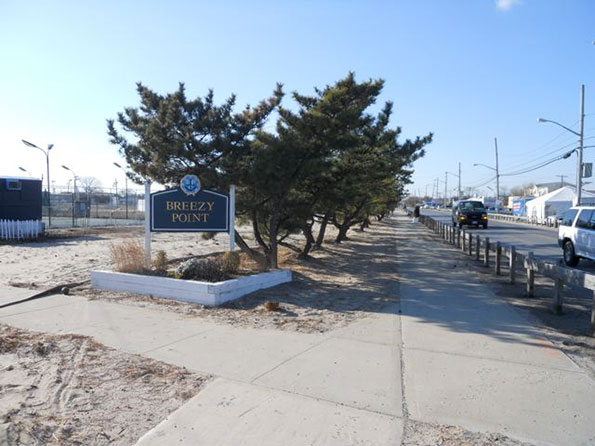
    While in New York for the last month, I took stock of the city (post Great Recession and post Hurricane Sandy) on a number of bicycle rides, in the company of city-pigeon friends, from Breezy Point in Queens to the northern reaches of the Bronx.

    Biking around New York is a lot easier now than it was when I last lived in the city, from 1976 to 1991. Bike lanes were nonexistent in those days, the curbs were littered with broken glass, and many potholes were the size of Lake Erie.

    Thanks to Mayor Michael Bloomberg (a riding friend said, “He’s not pro-bike; he’s anti-car”), the city now has a growing network of dedicated, at least with paint, bike lanes. One runs up First Avenue, another goes from Williamsburg to downtown Brooklyn, and a great one travels the length of the West Side.
    One of the longer rides took us from midtown Manhattan out to Breezy Point, to see what remains of the beach community that Sandy flooded and burned. From the Queensboro Bridge, we took in Greenpoint and Williamsburg, two of Brooklyn’s hottest neighborhoods (“hot” means rents have tripled and Sunday brunch costs $29), and then meandered through Bedford Stuyvesant, another stop on the gentrification express.

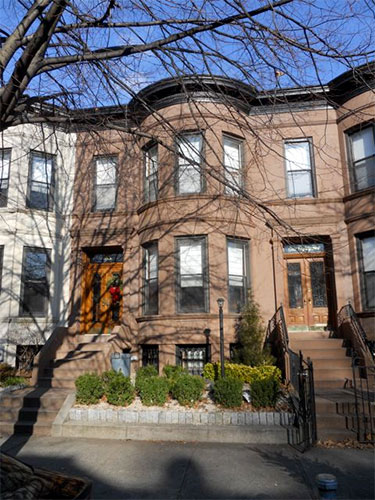
    In the 1980s, Bed Stuy meant vacant lots and high crime rates. Now it’s a neighborhood of elegant—million dollar plus—brownstones and a growing number of boutiques. At Atlantic and Flatbush avenues, the new Barclay Center, home to the Brooklyn Nets, looms over the tracks of the Long Island Rail Road.

    I don’t believe in stadiums as anchor tenants in transitional neighborhoods: most of the time they are empty, and when in use they provide jobs only for ushers. Nor do I care much for the center’s rusted-iron exterior; Brooklyn has enough corroded steel. But if it helps to brand Brooklyn as a modern and dynamic city or bring a wine bar to our old Flatbush neighborhood, I will not complain.

    At the southern end of the borough, Breezy Point is the tip of an Atlantic barrier peninsula. As we rode toward Sandy’s ground zero, we passed emergency services checkpoints and many police out on patrol, although the approach is along a desolate road and the community has the feeling of Appalachia-by-the-sea.

    Breezy Point isn’t a summer beach colony so much as a year-round enclave of firefighters and police who like the location as a world apart. Even riding bikes along the main streets, we felt like trespassers. When we couldn’t find the blocks of houses that burned during the storm, I asked directions from one of the police officers. His answer was: “Are you kidding me? Get the fuck out of here.”

    The bizarre rumor that I heard in the Rockaways is that some residents torched their own houses, as fire insurance covers more damage than that underwritten for hurricanes and floods. Such speculation is impossible to verify, although the media obsession with the beached whales from Sandy—and thus the need for disaster-relief millions—was at odds with what we saw: a beach community suffering after a bad storm but still mostly intact.

    At the other end of the Rockaways, the more substantial houses came through the storm fine, although many had flooded to their first floors, alas, a hazard that comes from living near the beach and, again, not a national tragedy.

    Uptown Manhattan neighborhoods never lost power during Sandy, although the Lower East Side, a mix of high-rise apartments and funky restaurants, had some buildings in the dark well into December.

    Nor did the storm or, for that matter, the Great Recession, sidetrack Harlem’s latest renaissance, which can be seen on many of the area’s roughly 200 blocks. When I was a student at Columbia University in the 1970s, Harlem was overrun with arsonists and drug dealers. Morningside Park, which borders the university, was nicknamed Needle Park. The neighborhood’s proud history as a spawning ground for Jews, Italians, Latinos, and African-Americans was shrouded in the dark waters of abandoned buildings, graffiti, and nighttime sirens.

    This time, I rode my bike, as if on a lawn mower, up and down the blocks between 110th and 145th streets and was charmed to find so many renovated apartments and brownstones, not to mention restaurants and trendy stores on the avenues. In his elegant history, Harlem, Jonathan Gill quotes Langston Hughes: “I would rather have a kitchenette in Harlem than a mansion in Westchester.” Ed Koch said the same.

    Sadly, the jazz and night clubs are largely gone, and the Apollo Theater is among the last of its cultural generation still in use. Many longtime Harlem residents are now being priced out of the neighborhood. Nevertheless, the streets around Mount Morris Park (Fifth Avenue and 120th Street) and Striver’s Row (West 137th and 138th streets) are more elegant than many on Manhattan’s East Side. The only thing now being traded in Morningside Park appears to be Pampers.

    Because I was in New York when Koch died, much of the handlebar conversation, especially as we rode around his Crotona Park birthplace in the Bronx, was about whether he or Rudy Giuliani deserved the most credit for New York’s return from the dead. Not part of the discussion was the mayoralty of David Dinkins, including the legendary three or four showers that he took each day in office.

    I argued for Koch, as he became mayor at the city’s ebb tide in the late 1970s, when Howard Cosell said, during the World Series, “Ladies and gentlemen, the Bronx is burning,” and President Jimmy Carter visited the smoldering rubble of Charlotte Street (now a suburban-like development). Gill wrote: “Huge swatches of the neighborhood began to resemble the bombed-out European cities of World War II.”

    The argument for Giuliani’s contribution is that he took on petty crime, which in turn got bigger criminals off the streets, although my revivalist heart is with Koch, who as mayor had accepted an invitation to lunch that my friends and I extended (in person he was more serious and very tall). More than Giuliani, he epitomized the city, as when he said: “If you agree with me on 9 out of 12 issues, vote for me. If you agree with me on 12 out of 12 issues, see a psychiatrist.”

    Koch understood that cities rise or fall on questions of confidence or, as he asked rhetorically, “How’m I doin’?” Giuliani, despite his 9/11 heroics, always struck me as having the soul of a TV detective, although with less empathy than Kojak. Bloomberg is praised as being a grown up—competent and capable at managing city affairs, even if he sounds like a shoe salesman.

    On one subfreezing, windy day I biked the length of the Bronx’s Grand Concourse, stopping to warm up in a hospital waiting room when no Starbucks appeared on the frigid horizon. I loved the Botanical Gardens, but loathed the pretentious new Yankee Stadium, whose $1.5 billion construction budget did little for the South Bronx (hand-lettered signs for game parking probably do not count).

    The risk of the New York renaissance is that the era of good-feeling is a variation on the bonds for the new stadium. It’s something that’s funded on Wall Street, which may explain why Harlem brownstones cost $2 million, but the only new jobs in the neighborhood are for part-time clerks at CVS or Dunkin’ Donuts.

    Photos by the author: A bike lane near Mount Morris Park in Harlem; Breezy Point; the author’s former home in Brooklyn.

    Matthew Stevenson, a contributing editor of Harper’s Magazine, is the author of Remembering the Twentieth Century Limited, a collection of historical travel essays. His next book is Whistle-Stopping America.