Blog

  • Gas Crushes Coal

    Coal electricity declined by 12.5 percent in 2012, mostly driven by the switch to natural gas, which increased by almost the exact same amount (217 terrawatt-hours) as coal declined (216 TWh), according to new annual numbers released by the US Energy Information Administration.

    Wind electricity increased as well — by about one-tenth (20.5 TWh) as much as gas. Solar increased a little more than one-hundredth as much as gas (2.5 TWh).

    The figures come at a time when renewable energy advocates have claimed that wind and solar have been responsible for the big declines in coal — claims that do not stand up to scrutiny, according to a new Breakthrough Institute analysis.

    Indeed, the new numbers highlight the key difference between gas and solar and wind. Where taxpayers subsidized unconventional gas exploration from 1980 to 2002 to the tune of $10 billion, natural gas in recent years has been replacing coal without subsidies.

    Wind and solar, by contrast, remain almost wholly dependent on public support. Uncertainty last year over whether Congress would renew the key wind subsidy meant that less than half as much new wind will be installed in 2013 as was installed in 2012.

    Where the problem for wind has been its high cost, the problem for gas is that it has become too cheap. Natural gas production slowed last year in the face of unprofitably low prices caused by overproduction.

    This does not mean that subsidies for solar and wind should be cut, only that they should be reformed. Instead of subsidizing the production of electricity from the same old technologies, we need the kind of innovation that allowed natural gas to become cheaper than coal.

    This piece first appeared at The Breakthrough.

  • Gentrification and its Discontents: Cleveland Needs to Go Beyond Being Creatively Classed

    “Indeed, we have the know-how, but we do not have the know-why, nor the know-what-for”—Erich Fromm, social psychologist.

    The question of how you “become” as a city has been weighing on me lately. Is it enough to get people back into the emptiness? Is it enough to pretty the derelict? I mean, is the trajectory of Cleveland’s success simply a collection of micro-everythings, start-ups, and occupancy rates? That is, is Cleveland’s reward simply the benefit of being creatively classed?

    I hope not. It won’t work. Here is why.

    The problem with most city revitalization these days relates to its playbook: there are the investors who have the capital, and then the political power from which finance flows. Here, money not only talks, it builds, with investors’ wishes transcribed in how a city looks, feels, and functions. That said, the main interest of the investors is to make money, and so people are seen as consumers as opposed to citizens. Consumers that fill up real estate space. Consumers that salivate over tastes. Consumers of art and design, with the attraction to beauty meant to establish a “vibrancy for profit” mindset as opposed to experiencing beauty for the value of beauty’s sake. Come to think of it, the creative class is really just the consumer class, just like the rest of us. Yet they are anointed in status by city makers because they are thought to have more spending power than their working- and service-class counterparts.

    “Follow the creative community, and property values will rise,” states one recent article in a real estate publication. “You have given real estate developers the playbook”, echoes Albert Ratner, head of Cleveland-based Forest City, on his reading of “The Rise of the Creative Class”. The motivations, as such, are quite blatant.

    Now, why is this a problem?

    Because developers have extraordinary amounts of pull in directing where finances goes (this is particularly true in Cleveland), which means investment can get skewed to a select demographic. As such, the gap between the haves and have not’s grows and the geographic disparities begin to cement social inequities into the city’s fabric. Cracks then show: drug use, murders, alienation and disenfranchisement, growing pockets of continued disinvestment, and it won’t stop because research has consistently shown that inequity is an endless source of social ills. The only thing left to do is to compartmentalize our shadows, with “bad” kept in places away from the spots of our “hope”. This is not unique to Cleveland or to this era. It is just the way things have been, which leads me to wonder if Cleveland’s recent comeback is just a carousel in which progress is simply rearranging the broken deckchairs.

    But while the future is uncertain, failure need not be inevitable. Yet what can be done in Cleveland and other Rust Belt cities to ensure we don’t waste our opportunity? Unfortunately, little outside of a radical shift in how cities think about themselves, particularly as it relates to the notion of “revitalization”.

    This is where the concept of “Rust Belt Chic” comes in, which—when it is boiled down—is really just a process of collectively “knowing thyself” (an in depth description of Rust Belt Chic economic development will be delineated in a subsequent post). Specifically, by becoming aware of who we are as “Cleveland” we know who we are not, or more exactly: what we don’t need to be. This is important as it relieves the temptation of Cleveland trying to copy some other city’s so-called success which, in the end, is counterproductive, as such efforts—like the historic Columbia Building demolition for a Vegas-style “look”—ultimately eliminates those things like history and architecture which ties us together.

    columbia building

    The historic Columbia Building being demolished. Courtesy of the Cleveland Kid.

    This is all to say that Cleveland need not be “brochured” for the so-called creative class. That is simply objectifying your city as a product as opposed to a people, which is crude, and such posturing and posing is hardly Cleveland, besides.

    Instead, a hammering down of who we are in our process of becoming is needed. We are Clevelanders. We care and fight for this city, endlessly. We swear, shake hands, bleed, heal, work, fight, and pray—all in an environment molded more so by the reality of Mickey Rourke than the donning of Ashton Kutcher. And so while repopulating the core is needed, we also must engage in building the productive capacity of people as opposed to simply relying on a capacity to spend. Specifically, squeezing out price per sq. feet at the expense of community fabric is not true economic growth. It is mountains turned to coal.

    I cannot emphasize enough how important community development is to Cleveland’s future. For as creative classification goes main stream, more and more cities will begin looking and feeling the same, and more and more cities will be turned to products to be gobbled up by those with stars in their eyes. But this kind of thing is not for everyone, or even for most. It is for a slice, a finicky slice. And so I gather creative classification will go the way of the fad, like all styles do. Some cities will be stuck left to look at the cartoon tattoos that dot their body, while the people left longing will decompress to find something a little more real.

    Then—if we do it right—people will turn to Cleveland not because we faked the place as attractive, but because Cleveland made an effort to turn to its people.

    This post originally appeared at Cool Cleveland.

    Richey Piiparinen is a writer and policy researcher based in Cleveland. He is co-editor of Rust Belt Chic: The Cleveland Anthology. Read more from him at his blog and at Rust Belt Chic.

    Lead photo: Don’t call him creative classed. A Cleveland artist, Mac, and his rooster, Morty.

  • America’s Growth Corridors: The Key to a National Revival – A New Report

    In the wake of the 2012 presidential election, some political commentators have written political obituaries of the "red" or conservative-leaning states, envisioning a brave new world dominated by fashionably blue bastions in the Northeast or California. But political fortunes are notoriously fickle, while economic trends tend to be more enduring.

    These trends point to a U.S. economic future dominated by four growth corridors that are generally less dense, more affordable, and markedly more conservative and pro-business: the Great Plains, the Intermountain West, the Third Coast (spanning the Gulf states from Texas to Florida), and the Southeastern industrial belt.

    Read or download the full report from the Manhattan Institute.

    Overall, these corridors account for 45% of the nation’s land mass and 30% of its population. Between 2001 and 2011, job growth in the Great Plains, the Intermountain West and the Third Coast was between 7% and 8%—nearly 10 times the job growth rate for the rest of the country. Only the Southeastern industrial belt tracked close to the national average.

    Historically, these regions were little more than resource colonies or low-wage labor sites for richer, more technically advanced areas. By promoting policies that encourage enterprise and spark economic growth, they’re catching up.

    Such policies have been pursued not only by Republicans but also by Democrats who don’t share their national party’s notion that business should serve as a cash cow to fund ever more expensive social-welfare, cultural or environmental programs. While California, Illinois, New York, Massachusetts and Minnesota have either enacted or pursued higher income taxes, many corridor states have no income taxes or are planning, like Kansas and Louisiana, to lower or even eliminate them.

    The result is that corridor states took 11 of the top 15 spots in Chief Executive magazine’s 2012 review of best state business climates. California, New York, Illinois and Massachusetts were at the bottom. The states of the old Confederacy boast 10 of the top 12 places for locating new plants, according to a recent 2012 study by Site Selection magazine.

    Energy, manufacturing and agriculture are playing a major role in the corridor states’ revival. The resurgence of fossil fuel–based energy, notably shale oil and natural gas, is especially important. Over the past decade, Texas alone has added 180,000 mostly high-paying energy-related jobs, Oklahoma another 40,000, and the Intermountain West well over 30,000. Energy-rich California, despite the nation’s third-highest unemployment rate, has created a mere 20,000 such jobs. In New York, meanwhile, Gov. Andrew Cuomo is still delaying a decision on hydraulic fracturing.

    Cheap U.S. natural gas has some envisioning the Mississippi River between New Orleans and Baton Rouge as an "American Ruhr." Much of this growth, notes Eric Smith, associate director of the Tulane Energy Institute, will be financed by German and other European firms that are reeling from electricity costs now three times higher than in places like Louisiana.

    Korean and Japanese firms are already swarming into South Carolina, Alabama and Tennessee. What the Boston Consulting Group calls a "reallocation of global manufacturing" is shifting production away from expensive East Asia and Europe and toward these lower-cost locales. The arrival of auto, steel and petrochemical plants—and, increasingly, the aerospace industry—reflects a critical shift for the Southeast, which historically depended on lower-wage industries such as textiles and furniture.

    Since 2000, the Intermountain West’s population has grown by 20%, the Third Coast’s by 14%, the long-depopulating Great Plains by over 14%, and the Southeast by 13%. Population in the rest of the U.S. has grown barely 7%. Last year, the largest net recipients of domestic migrants were Texas and Florida, which between them gained 150,000. The biggest losers? New York, New Jersey, Illinois and California.

    As a result, the corridors are home to most of America’s fastest-growing big cities, including Charlotte, Raleigh, Atlanta, Houston, Dallas, Salt Lake City, Oklahoma City and Denver. Critically for the economic and political future, the growth corridor seems particularly appealing to young families with children.

    Cities such as Raleigh, Charlotte, Austin, Dallas and Houston enjoy among the country’s fastest growth rates in the under-15 population. That demographic is on the wane in New York, Los Angeles, Chicago and San Francisco. Immigrants, too, flock to once-unfamiliar places like Nashville, Charlotte and Oklahoma City. Houston and Dallas already have more new immigrants per capita than Boston, Philadelphia, Seattle and Chicago.

    Coastal-city boosters suggest that what they lose in numbers they make up for in "quality" migration. "The Feet are moving south and west while the Brains are moving toward coastal cities," Derek Thompson wrote a few years ago in The Atlantic. Yet over the past decade, the number of people with bachelor’s degrees grew by a remarkable 50% in Austin and Charlotte and by over 30% in Tampa, Houston, Dallas and Atlanta—a far greater percentage growth rate than in San Francisco, Los Angeles, Chicago or New York.

    Raleigh, Austin, Denver and Salt Lake City have all become high-tech hubs. Charlotte is now the country’s second-largest financial center. Houston isn’t only the world’s energy capital but also boasts the world’s largest medical center and, along with Dallas, has become a major corporate and global transportation hub.

    The corridors’ growing success is a testament to the resiliency and adaptability of the American economy. It also challenges the established coastal states and cities to reconsider their current high-tax, high-regulation climates if they would like to join the growth party.

    Read or download the full report from the Manhattan Institute.

    Joel Kotkin is executive editor of NewGeography.com and a distinguished presidential fellow in urban futures at Chapman University, and a member of the editorial board of the Orange County Register. He is author of The City: A Global History and The Next Hundred Million: America in 2050. His most recent study, The Rise of Postfamilialism, has been widely discussed and distributed internationally. He lives in Los Angeles, CA.

    This piece first appeared in the Wall Street Journal.

  • In California, Don’t Bash the ‘Burbs

    For the past century, California, particularly Southern California, nurtured and invented the suburban dream. The sun-drenched single-family house, often with a pool, on a tree-lined street was an image lovingly projected by television and the movies. Places like the San Fernando Valley – actual home to the "Brady Bunch" and scores of other TV family sitcoms – became, in author Kevin Roderick’s phrase, "America’s suburb."

    This dream, even a modernized, multicultural version of it, now is passé to California’s governing class. Even in his first administration, 1975-83, Gov. Jerry Brown disdained suburbs, promoting a city-first, pro-density policy. His feelings hardened during eight years (1999-2007) as mayor of Oakland, a city that, since he left, has fallen on hard times, although it has been treated with some love recently in the blue media.

    As state attorney general (2007-11) Brown took advantage of the state’s 2006 climate change legislation to move against suburban growth everywhere from Pleasanton to San Bernardino. Now back as governor, he can give full rein to his determination to limit access to the old California dream, curbing suburbia and forcing more of us and, even more so our successors, into small apartments nearby bus and rail stops. His successor as attorney general, former San Francisco D.A. Kamala Harris, is, if anything, more theologically committed to curbing suburban growth.

    Sadly, much of the state’s development "community" has enlisted itself into the densification jihad. An influential recent report from the Urban Land Institute, for example, sees a "new California dream," which predicts huge growth in high-density development based on underlying demographic trends – like shifts in housing tastes among millennials or empty-nesters rushing to downtown condos.

    Yet it’s not enough for the planners, and their developer allies, to watch the market shift and take advantage of it. That would be both logical and justified. But the planning clerisy are not content to leave suburbia die; it must, instead, be cauterized and prevented, like some plague, from spreading.

    Ironically, it turns out that the "new California dream" is more widely shared by planners and rent-seeking developers than by the consuming public. During the past decade, when pro-density sentiment has supposedly building, some 80 percent of the new construction in the state was single-family, a rate slightly above the national average. Over time, Californians continue to buy single-family houses, mostly in the suburban and exurban periphery. They do it because they are like most Americans, roughly four of five of whom prefer single-family houses, preferably closer to work but, if that proves unaffordable, further out.

    This includes both working-class and upper middle-class markets. The more-affluent, including many largely Asian immigrants, have been willing to buy high-priced homes closer to employment centers in places like Irvine or Cupertino, near San Jose. Meanwhile, the less-affluent of all ethnicities continue to move further out, to places like the Inland Empire or the further reaches of the Bay Area. These peripheral areas have continued to represent the vast majority of growth in both greater Los Angeles and around the Bay Area.

    Meanwhile, some of the urban-centric residential construction now being put up will, as occurred in the housing bust, may be fashionable but, in some cases, not so profitable over time. Construction is being driven mostly by tax breaks, Uncle Ben’s essentially ultralow-interest money for wealthy investors and, in some cases, subsidies. Overall, the Wall Street Journal notes, the rental market is beginning to "lose steam," as people again start looking into buying homes. This may suggest that new speculative building in places like downtown Los Angeles – where there’s good evidence that rents and occupancy levels are, if anything, getting weaker – may end up in tears.

    To date, the anti-suburb jihad has been somewhat constrained by the recession and the collapse of the housing bubble about five years ago. But now that there’s an incipient housing recovery in parts of the state, including Orange County, the constraints could be problematical, particularly for younger buyers about to start a family or for people migrating into the state.

    The impact may be felt first in Silicon Valley and its environs. The planners now dominating the Bay Area want only highly dense bus-stop- or train-oriented development in the valley. Yet, notes real estate consultant John Burns, this does not reflect market realities marked by what they describe "as a resilient and ongoing preference for single-family homes."

    Even more fanciful, they are promoting high density in areas, far distant from current employment centers, in dreary locales like Newark, south of Oakland, claiming workers there will take public transit to jobs in the Valley. The belief among planners and some gullible developers that aging millennials will choose to live in high density, far from costly San Francisco or Palo Alto, and commute to work by transit is somewhat north of absurd; today, a bare 3 percent of workers in Silicon Valley get to work by transit, and downtown San Jose, the logical terminus of any transit strategy, is home to barely 26,000 of the region’s 860,000 workers.

    Some tech workers may put up with a few years of high rents and shared apartments in San Francisco or Palo Alto, but not many will want to live in expensive towers far from both Silicon Valley’s primary employers and the amenities of the big city. Apple’s plans for a new headquarters in Cupertino has drawn criticism from green-minded urbanists precisely because they rest on the sensible presumption that Apple’s workforce will remain largely suburban and car-oriented. One can also wonder the effect on the start-up culture when workers have been forced to live in places lacking the proverbial garage or extra bedroom that historically have nurtured new firms.

    More important still, forced densification, by denying single-family alternatives, is likely, and in some places, already is, spiking prices, which are up $85,000 in Silicon Valley in a year. This, over time, will force millennials, as they age, to look for other locales to meet their longtime aspirations. Generational chroniclers Morley Winograd and Mike Hais, in their surveys, have found more than twice as many millennials prefer suburbs over dense cities as their "ideal place to live." The vast majority of 18-to-34-year-olds do not want to spend their lives as apartment renters; a study by TD Bank found that 84 percent of them hope to own a home.

    Much the same can be said of Asian immigrants, who are now driving much of the new-home sales, particularly in desirable places like Orange County or Silicon Valley. Nationwide, over the past decade, the Asian population in suburbs grew by almost 2.8 million, or 53 percent, while the Asian population of core cities grew 770,000, 28 percent. In greater Los Angeles, there are now three times as many Asian suburbanites as their inner-city counterparts.

    If California is not willing to meet the needs of its own emerging middle class, there’s no doubt that other states, from Arizona and Texas to Tennessee – although not as fundamentally alluring – will be, and are already, more than happy to oblige.

    Rather than seeking to destroy our suburbs, California leaders should expend their energy figuring out how to make them better. Rather than some retro-1900s urbanist vision, they need to embrace the multipolarity of our urban agglomerations. They could look to preserve open space nearby, when possible, or cultivate natural areas, parks, walking and biking trails that would appeal to families as well as to singles.

    Instead of attempting to force employment into the center city, it would make more sense to expand home-based and dispersed work in order to cut down or eliminate commuting times. These moves would create both healthier suburbs and reduce carbon emissions without devastating the natural aspirations of most California families.

    Joel Kotkin is executive editor of NewGeography.com and a distinguished presidential fellow in urban futures at Chapman University, and a member of the editorial board of the Orange County Register. He is author of The City: A Global History and The Next Hundred Million: America in 2050. His most recent study, The Rise of Postfamilialism, has been widely discussed and distributed internationally. He lives in Los Angeles, CA.

    This piece originally appeared in the Orange County Register.

    Suburb photo by BigStockPhoto.com.

  • Why The Red States Will Profit Most From More U.S. Immigration

    In recent years, the debate over immigration has been portrayed in large part as a battle between immigrant-tolerant blue states and regions and their less welcoming red counterparts. Yet increasingly, it appears that red states in the interior and the south may actually have more to gain from liberalized immigration than many blue state bastions.

    Indeed an analysis of foreign born population by demographer Wendell Cox reveals that the fastest growth in the numbers of newcomers are actually in cities (metropolitan areas) not usually seen as immigrant hubs. The fastest growth in population of foreign born residents–more than doubling over the decade was #1 Nashville, a place more traditionally linked to country music than ethnic diversity. Today besides the Grand Old Opry, the city also boasts the nation’s largest Kurdish population, and a thriving “Little Kurdistan,” as well as growing Mexican, Somali and other immigrant enclaves.

    Other cities are equally surprising, including #2 Birmingham, AL; #3 Indianapolis, IN; #4 Louisville, KY and#5 Charlotte, NC, all of which doubled their foreign born population between 2000 and 2011. Right behind them are #6 Richmond,VA, #7 Raleigh,NC , #8 Orlando, Fl, #9 Jacksonville,Fl and #10 Columbus, OH. All these states either voted for Mitt Romney last year or have state governments under Republican control. None easily fit the impression of liberally minded immigrant attracting bastions from only a decade ago.

    Although the New York metropolitan area still has the greatest numeric growth in immigrants since 2000, a net gain of more than 600,000, there’s no question that the momentum lies with these fast growing immigrant hubs.The reasons are not too difficult to fathom. In the modern global economy, migrants represent the veritable “canaries in the coalmine”. They go to economic opportunities are often the greatest, which often means thriving places like Nashville, Raleigh, Charlotte, Columbus or #11 Austin, TX. Housing prices and business climate also seem to be a factor here; all these areas have lower home prices relative to income than many traditional immigrant hubs.

    As a result, many immigrants are moving from their traditional “comfort zone” cities with historical larger immigrant populations — New York, Los Angeles, San Francisco and Chicago — to generally faster growing, more affordable cities.

    This is drastically reshaping the demographic future of the country. Over the past decade the increase in foreign born residents accounted for 44% of the nation’s overall population growth rate. With the U.S. birthrate heading downwards, at least for now, immigration represents perhaps the one way regions can boost their populations and energize their economies. It may be America’s biggest hope  as well in keeping Social Security and Medicare from collapse.

    Ironically, even as they migrate elsewhere, immigrants also may prove particularly critical in some of our older cities. Newcomers have been vital to maintaining population growth or at least fending off stagnation. Los Angeles, Miami, New York, Chicago and San Francisco metros have maintained enough growth among the foreign born to keep going negative due to significant losses in net domestic migration. Yet even among biggest metros the biggest growth has been among lower-cost, until fairly recently largely native-born, regions such as Houston, Dallas-Fort Worth and Atlanta.

    The impact on these areas is likely to be profound over time. Urbanists like to speak about the “great inversion” of upper-class professionals to cities, but it’s really the immigrants who provide the demographic and economic momentum for our largest metros. This point may be missed because many times immigrants — unlike the much cherished (and much publicized) hip, cool, largely white professionals — often do not choose to live in the overpriced, crowded urban core (although some may have businesses there).

    Instead immigrants tend to cluster in the less dense, more affordable and spacious periphery, where their “American dream” of a single family house is often far more achievable. In Southern California, for example, decidedly exurban #25 San Bernardino Riverside added three times as many foreign born than long-time immigrant hub Los Angeles, despite having only one-third the total popoulation. Los Angeles actually recorded the smallest percentage growth in foreign born of any major U.S. metro.

    Over time, the immigrant impact may prove greatest in terms of economics. Immigrants, in a word, tend to be resilient, and opportunistic by nature. Although many immigrants and their offspring still lag behind economically, over time they appear to be integrating. Overall their rate of home ownership still lags that of native born Americans, but appears to have held up better since the recession.

    Nowhere is the impact greater than in the entrepreneurial sector. Between 1982 and 2007, the number of businesses owned by the primary immigrant groups, Asian Americans and Hispanics grew by 545% and 696% respectfully. In contrast businesses owned by whites grew by only 81%.

    Perhaps more important still, even in the midst of the recession, newcomers continued to form businesses at a record rate, even as those by native-born entrepreneurs declined. The immigrant share of all new businesses, notes Kauffman, more than doubled from from 13.4% in 1996 to 29.5% in 2010.

    Some emerging tech centers are particularly dependent on foreign born migration as evidenced by rapid growth in Raleigh, Austin and Columbus. Established tech centers like San Jose, San Francisco and Seattle also all have large foreign born populations. Overall immigrants are responsible for roughly a quarter of all high-tech start ups .

    Much of this can be attributed to Asians, who constitute over 40%of all newcomers andnow stand as the fastest growing immigrant group. They now account for roughly twenty percent of all tech workers, four times their percentage of the population.

    Yet these impacts will be felt well beyond the tech community. Professionals of all kinds are moving in record numbers from the riskier political environment and pollution of China, seeking places where they can use their skills most effectively. Immigrants also play an increasingly important role in such less tech oriented industries, from the garment, carpet and furniture industries as well as small scale retail enterprise.

    Newcomers also are playing a major role in the reviving housing market, particularly in places such as New York, Los Angeles, Miami, Phoenix and the Bay Area. A house that might seem outrageously overpriced to the average American family might seem rather a bargain if you are coming from Hong Kong, Beijing or Shanghai.

    It is likely that, if sensible reform is passed, these impacts will begin to extend to other parts of country — such as Cleveland, Milwaukee and Memphis — that still get very little new foreign immigration. Like Houston in the 1990s, these areas have affordable housing to attract newcomers and, with any resurgence of economic growth, could provide opportunities for up and coming immigrants. A decade ago, after all, who would have seen Nashville, the ultimate symbol of our country heritage, as a rising immigrant hub?

    Joel Kotkin is executive editor of NewGeography.com and a distinguished presidential fellow in urban futures at Chapman University, and a member of the editorial board of the Orange County Register. He is author of The City: A Global History and The Next Hundred Million: America in 2050. His most recent study, The Rise of Postfamilialism, has been widely discussed and distributed internationally. He lives in Los Angeles, CA.

    This piece originally appeared in Forbes.

    Photo by telwink

  • Failing Economies Shorten Lives

    A recent study has come up with some shocking news: life expectancy of the least educated white Americans, both men and women, is going down. White women without a high school diploma now live five years less on the average than they did 20 years ago: for white male dropouts, the decline is three years.

    This is a calamity matched only by the six-year decline in longevity among Russian men in the waning years of Communism there. But that decline, blamed on rampant alcoholism, has been mostly reversed.

    What’s going on here? No one really knows, but my bet is that the cause is economic — the collapse of the industrial, steady, low-wage jobs that once supported even the least-educated Americans. These people once were lower middle-class. Now they’re just poor, the losers in the global economy, increasingly cut off from jobs, a steady income and, not incidentally, decent health care.

    In a sense, we’ve been here before. What’s happening to this new white underclass is a repeat of what happened to the black American underclass in the wake of the collapse of urban industry. That destroyed economy hit inner-city blacks 30 years ago, with results that echo today. Now, it’s hitting whites, with results that mostly are yet to come.

    So far as I can see, blacks never experienced the severe dip in longevity afflicting low-income whites today. According to the Center for Disease Control, average life expectancy for black men dipped by a year or two between 1984 and 1989, largely due to HIV and homicides. But black life expectancy is still shockingly low — an average of 67.6 years for black men, as opposed to nearly 75 years for white men, according to a UCLA study. Black women live nearly 75 years on the average, but this is still five years less than the 80-year average for white women.  

    I wrote about this in my book, Caught in the Middle, on the impact of globalization on the Midwest. In a chapter entitled "Left Behind," I described the plight of urban blacks, the descendants of Southerners who came north in the Great Migration between 1915 and 1970, to escape Jim Crow laws down south and to find jobs in the booming factories of Chicago, Detroit and other cities. Since the ’60s, the departure of this industry destroyed jobs, mostly held by men, and stranded families in a familiar cycle of unemployment, bad schools, crime, drugs, single-parent households and, increasingly low life expectancy.

    More recently, this industrial collapse swept through the Midwest, hitting white workers and their communities as hard as black workers and towns. Most of all, the Midwesterners now being "left behind" are rural whites, a clan about as far from urban blacks as one can imagine but now sharing the same pathology  — poverty, bad health, reliance on government handouts, high dropout rates, drugs, down-home religions, broken families, empty futures.

    Charles Murray and other writers have remarked on this growing gap between rich and poor white Americans. Murray called them virtually separate nations, with radically different patterns of marriage, work habits, education, religion, politics, even diet and TV watching. Some of Murray’s past work is suspect — he once found whites genetically superior to blacks. But his latest book, Coming Apart,  argues that "our nation is coming apart at the seams — not ethnic seams, but the seams of class." My own reporting in the left-behind stretches of the industrial Midwest supports much of this.

    Murray doesn’t think economic distress has much to do with this. He’s wrong. The economic disasters that struck inner-city African Americans 30 years ago is happening again to whites, in both cause and effect. There’s no reason to think these effects will stop with the decline in longevity among the first-hit and the worst-hit.

    The latest longevity findings were in a study led by S. Jay Olshansky, a public health professor at the University of Illinois at Chicago. They showed that white female high school dropouts lived only 73.5 years on the average in 2008, down exactly five years from the 78.5 years they could expect in 1990. For white male dropouts, the drop was three years, from 70.5 years in 1990 to 67.5 years in 2008.

    In the same period, both black and Latino life expectancy rose at all levels of education.

    Other studies have shown vast differences in life expectancy between education levels, incomes, race and other factors. If the average white male dropout can expect to live only 67.5 years, white men with a college degree have an expectancy of 80.4 years, a 13-year gap. Those white women dropouts, with an expectancy of 73.5 years, are ten years behind white women with a college degree.

    It gets worse. A National Institutes of Health study reported that black men live on the average eighteen years less than Asian females. Some geographical differences take this to even greater extremes: Native American men in one impoverished area of South Dakota live only 58 years on the average, fully 33 years less than the 91 years expected by Asian females in Bergen County, N.J., a high-rent district just across the Hudson River from Manhattan.

    Genetics may have something to do with it. But not as much as economics and the fallout from economic differences. Poor people get less schooling, which leads to worse jobs, which leads to poorer lifestyles, which leads to stress, which leads to more smoking and drinking, which increases the chances of joblessness, which means no health insurance, all of which adds up to the kind of debilitating despair that never lengthened anyone’s life.

    Will life expectancy figures for whites begin to dip toward those of blacks? Possibly. The relatively short life expectancy for black men, for instance, is the result of two centuries of reduced life chances, in which the average man moved from slavery to sharecropping to a hard but relatively secure life on assembly lines, to unemployment when those lines closed, followed by several decades now of insecure employment, no health insurance, a vanishing role as the family breadwinner, bad diet and, increasingly, heavy drug use. White men in the Midwestern industrial belt enjoyed decades of economic stability, but for many of them, that’s gone now. The least educated were hit first, and the longevity statistics illustrate the result.

    Richard Longworth is a Senior Fellow at The Chicago Council on Global Affairs. He is the author of Caught in the Middle: America’s Heartland in the Age of Globalism, now out in paperback (Bloomsbury USA). He writes at The Midwesterner: Blogging the Global Midwest, where this piece originally appeared.

  • Is the Family Finished?

    Sitting around a table at a hookah bar in New York’s East Village with three women and a gay man, all of them in their 20s and 30s and all resolved to remain childless, a few things quickly became clear: First, for many younger Americans and especially those in cities, having children is no longer an obvious or inevitable choice. Second, many of those opting for childlessness have legitimate, if perhaps selfish, reasons for their decision.

    “I like seeing people with their children, because they have their special bond, and that’s really sweet, but it’s not something I look at for myself,” says Tiffany Jordan, a lively 30-year-old freelance wardrobe stylist who lives in Queens in a rent-stabilized apartment and dates a man who “practically lives there.”

    Jordan and her friends are part of a rising tide. Postfamilial America is in ascendancy as the fertility rate among women has plummeted, since the 2008 economic crisis and the Great Recession that followed, to its lowest level since reliable numbers were first kept in 1920. That downturn has put the U.S. fertility rate increasingly in line with those in other developed economies—suggesting that even if the economy rebounds, the birthrate may not. For many individual women considering their own lives and careers, children have become a choice, rather than an inevitable milestone—and one that comes with more costs than benefits.

    “I don’t know if that’s selfish,” says Jordan, the daughter of an Ecuadoran and an Ohioan who grew up in the South Bronx, explaining her reasons for a decision increasingly common among women across the developed world, where more than half of the world’s population is now reproducing at below the replacement rate. “I feel like my life is not stable enough, and I don’t think I necessarily want it to be … Kids, they change your entire life. That’s the name of the game. And that’s not something I’m interested in doing.”

    The global causes of postfamilialism are diverse, and many, on their own, are socially favorable or at least benign. The rush of people worldwide into cities, for example, has ushered in prosperity for hundreds of millions, allowing families to be both smaller and more prosperous. Improvements in contraception and increased access to it have given women far greater control of their reproductive options, which has coincided with a decline in religion in most advanced countries. With women’s rights largely secured in the First World and their seats in the classroom, the statehouse, and the boardroom no longer tokens or novelties, children have ceased being an economic or cultural necessity for many or an eventual outcome of sex.

    But those changes happened quickly enough—within a lifetime—that they’ve created rapidly graying national populations in developed, and even some developing, countries worldwide, as boomers hold on to life and on to the pension and health benefits promised by the state while relatively few new children arrive to balance their numbers and to pay for those promises.

    Until recently that decrepitude has seemed oceans away, as America’s open spaces, sprawling suburbs, openness to immigrants, and relatively religious culture helped keep our population young and growing. But attitudes are changing here as well. A plurality of Americans—46 percent—told Pew in 2009 that the rising number of women without children “makes no difference one way or the other” for our society.

    These changes are not theoretical or inconsequential. Europe and East Asia, trailblazers in population decline, have spent decades trying to push up their birthrates and revitalize aging populations while confronting the political, economic, and social consequences of them. It’s time for us to consider what an aging, increasingly child-free population, growing more slowly, would mean here. As younger Americans individually eschew families of their own, they are contributing to the ever-growing imbalance between older retirees—basically their parents—and working-age Americans, potentially propelling both into a spiral of soaring entitlement costs and diminished economic vigor and creating a culture marked by hyperindividualism and dependence on the state as the family unit erodes.

    Crudely put, the lack of productive screwing could further be screwing the screwed generation.

    Consider contemporary Japan, which after decades of economic stagnation has become the most aged big country on the planet. Since 1990 the world’s third-largest economy has had more people over 65 than under 15; by 2050 it’s projected there will be more people over 80 than under 15. More than one in three Japanese women, predicts sociologist Mika Toyota, will never marry or have children (childbearing outside of marriage is still relatively rare in Japan and other wealthy Asian countries).

    The results haven’t been pretty. In some places in Japan, particularly in the countryside, there are already too few working adults remaining to take care of the elderly, and kodokushi, or “lonely death,” among the aged, the unmarried, and the childless, is on the rise. Long a model of frugality, the demographically declining nation now has by far the high-income world’s highest rate of public indebtedness as spending on the elderly has shot past what the state can extract from its remaining productive workers. Last month, the nation’s new finance minister, Taro Aso, outright said that the elderly should be given grace to “hurry up and die.” This situation will not be made better by a desexualized younger Japanese generation: one in three young men ages 16 to 19 express “no interest” in sex—and that may be a good thing, given that 60 percent of young women of the same age share their indifference.

    Europe may lag in sexual indifference, but its fertility rate—or births per woman—is around 1.5, also well below the replacement rate of 2.1. In Germany, the fertility rate has stagnated at around 1.4 for 40 years, despite vastly expensive attempts by the state to bribe potential mothers and reverse the problem of schrumpfnation Deutschland, or “shrinking” Germany. Thirty percent of German women say they do not intend to have children, and 48 percent of German middle-aged men now contend that they could have a happy life without children—three times as many as among their fathers.

    While postfamilialism isn’t nearly as far along in the U.S., American marriage is faltering—and the baby is being thrown out with the bath water. Forty-four percent of millennials agree that marriage is becoming “obsolete.” And even among those who support tying the knot (including many of those who say it’s obsolete), just 41 percent say children are important for a marriage—down from 65 percent in 1990. It was the only factor to show a significant decline. (Others, such as sharing chores, sexual relationship, and sharing politics, either held steady or were seen as increasingly important.) On the flip side of the coin, the percentage of adults who disagreed with the contention that people without children “lead empty lives” has shot up, to 59 percent in 2002 from 39 percent in 1988.

    Even before the 2008 crash, childlessness among American women ages 40 to 44 of all races and ethnicities had steadily increased for a decade, with the proportion of childless women doubling from 10 percent in 1980 to 20 percent today. But the negative trend has accelerated since the Great Recession began. In 2007 the fertility rate in America was 2.12 and had been holding nearly steady for decades at about replacement rate—the highest level of any advanced country. In just half a decade since, the rate has dropped to 1.9, the lowest since 1920 (when reliable records began being kept) and just half of the peak rate in 1957, in the midst of the baby boom, according to the Pew Research Center. Now projections of future U.S. population growth are diving, with the census estimate for 2050 down almost 10 percent from the mark predicted in 2008.

    Making the trend even more worrisome, the sharpest drop in fertility and birthrates came from immigrants, particularly Hispanics, who hitherto have been responsible for much of our continued population growth. But that unique advantage seems to have ended, with net migration from Mexico to the U.S. having stopped or possibly even reversed since 2008, according to Pew. Mexico’s own fertility rate has plunged, from 7.3 in 1960 to 2.4 today; among immigrants, the rate drops to the American norm in just a generation.

    In the short run, the falling birthrate has coincided with the emergence, for the first time, of the single and childless as a self-aware, powerful, and left-leaning political constituency. Yet what’s proven good for the Democratic Party may not be so good for the country in the long term. Even using the more optimistic 2008 projections, the proportion of retirees to working Americans—sometimes called the “dependency ratio”—is likely to rise to 35 retirees for every 100 workers in 2050, twice today’s ratio. That sets the stage for a fight over debt, austerity, benefits, and government spending that will make the vicious battles of the last four years seem more like, well, a tea party.

    Of course, the women making reasonable decisions about their own lives aren’t spending much time considering the age breakdown of voters in future elections or the nation’s fiscal health in 2050. “I kind of like to have my own time,” Elizabeth Deegan, a 33-year-old living in Jersey City, told Newsweek in a phone interview. Even as a child, she says with a laugh, baby dolls “were not appealing. I always wanted the Barbies with the boyfriend and the job, not these helpless things.”

    Deegan—who clerked years ago with Jordan at the Enchanted Forest, a toy store in Manhattan, and now works as a part-time delivery person for FedEx, a pet-sitter, and the founder of a community-based arts program called Project Greenville—said that for herself and other women, having a child had become an affirmative decision rather than a passive or accidental one. She was the only woman Newsweek spoke with who said she had ever been pregnant. She was 18—she can’t remember if it was just before or after graduating high school—and had an abortion.

    Deegan and Jordan both stressed that they always tell prospective beaus very early on that they don’t intend to have children and cut off any budding relationships with men who feel otherwise. “You can’t be that interested in the beginning,” says Jordan, explaining why she won’t date the natally inclined. “Like what, you’re really hot or you’re really cool? There’s tons of those people out there—this is New York City.” (The man with them, on the other hand, asked after the interview that his name not be used, after realizing that his desire not to have children might not be appreciated by his partner of five years; they’d never directly discussed the topic.)

    At the hookah bar, Jordan and Emily Wernet, a 25-year-old freelance illustrator of comics and tattoos, joked about the grotesqueness of a hand appearing inside a belly and about “parasites,” “popping one out,” and “horrible little grubs” in the midst of more serious conversation about their fears of relinquishing sole ownership of one’s own body.

    While they bemoaned the expense and the physical and emotional effects of their birth-control regimens, they agreed it was a price worth paying to control their own fertility. “There’s a feeling like we’re basically like wombs on legs,” said another of Jordan’s former toy-store colleagues, Janet Rivera, a soft-spoken 30-year-old office manager from Brooklyn. “I feel like as a teen part of my reaction to having kids was definitely … just wanting to be seen as more than a baby factory. And then as I got older, I feel like the responsibility of having a child is a really huge deal and the expense is out of control.”

    Along with kids, the group also recoiled at the domestic, often suburban lifestyle that comes with them.“Certain groups of friends have all gotten married and gone ahead and had kids and moved to Long Island because that seems to be the benchmark of success in Queens—the schools, and the pool and things that I like for weekends,” says Deegan. “It’s very orderly, like if you put them in different clothes, it could be the 1950s.”

    The strong correlation between childlessness and high-density city living has created essentially two Americas: child-oriented and affordable areas, and urban centers that have become increasingly expensive and child-free over the last 30 years—not coincidentally the same span over which middle-class incomes have stagnated. In Manhattan now, nearly half of all households are singletons. Over the past decade, the San Francisco, Boston, New York, Los Angeles, and Philadelphia metropolitan areas all lost children, even as lower-density and more affordable metropolitan areas such as Raleigh, North Carolina; Austin, Texas; Houston; Atlanta; Dallas–Fort Worth; and Salt Lake City registered significant gains. Seattle, once known as a strong family town, is now home to significantly more dogs than children.

    Amid this shift, the childless and even the partnerless life has gained something of a cultural cachet, with some suggesting they represent not just a legitimate choice but a superior one. It’s a burgeoning movement that’s joined cultural tastemakers, academics, neo-Malthusians, greens, feminists, Democratic politicians, urban planners, and big developers. Unlike families, whose members, after all, are often stuck with one another, University of Santa Barbara psychology professor Bella De Paulo praises singles as enjoying “intentional communities” and being more likely “to think about human connectedness in a way that is far-reaching and less predictable.”

    In his provocative 2012 book Going Solo: The Extraordinary Rise and Surprising Appeal of Living Alone, Eric Klinenberg writes that for the hip urban professionals who make up the so-called creative class, living alone represents a “more desirable state,” even “a sign of success and a mark of distinction, a way to gain freedom and experience the anonymity that can make city life so exhilarating.” Certainly, the number of singletons has skyrocketed: more than half of all adults today are single (a group that includes divorcées and widows and widowers), up from about one in five in 1950.

    Many urban developers are placing big bets on this postfamilial demographic, while governments put money into bikeways, transit systems, art palaces, and cool residential developments that cost considerably less than schools and roads. “Singles and childless couples are the emerging household type of the future,” notes developer and urban booster Chris Leinberger. This has led to calls for creating ever-smaller apartments intended for single professionals, notes demographer Wendell Cox, an impulse that has gained the support of mayors including New York’s Michael Bloomberg.

    Seeking support for their plans to build taller and smaller, urbanists like Peter Calthorpe also link their density agenda with environmentalism; he’s deemed dense urbanism “a climate-change antibiotic.” Decades after dire predictions of mass starvation and rising population growth lost credibility, the environmental mantra against children remains reflexive. Now greens are pushing for fewer high-income children, since they generate more carbon than offspring in poorer countries. Jonathon Porritt, an adviser to Prince Charles, has called for Britain to halve its population, arguing that having even two children is “irresponsible.” Lisa Hymas, senior editor at Grist, has signed up for what she calls a “fledgling child-free movement” to stand up against the “pro-natal bias that runs deep.” Her self-designation: “GINK, green inclinations, no kids.”

    This trend is likely to reshape American politics in the coming decades. As the number of single women swelled by 18 percent in the last decade, they have emerged as a core constituency of the Democratic Party, a group pollster Stan Greenberg has identified as “the largest progressive voting bloc in the country” and a key part of demographer Ruy Teixeira’s “emerging Democratic majority.” That majority emerged with a vengeance in the 2012 presidential contest, as married women narrowly favored Mitt Romney, according to exit polls, while two out of three single women backed Barack Obama—and their overwhelming support accounted for the president’s margin of victory in the popular vote.

    That helps explain the Obama’s campaign’s much-discussed “The Life of Julia,” a flash animation of a woman’s life over the years as marked solely by what government benefits and services she would receive from an Obama administration or be deprived of by a Romney one. This was a none-too-subtle suggestion that government can fill many of the roles, from child care to old-age care, traditionally covered by family. Conservatives assailed the pocketbook appeal (and sometimes the women who found it appealing), noting that no husband or life partner appears and that Julia’s child is referenced only twice in the span of her life, when she’s pregnant and receives free health services under health-care reform and when he later goes to a public kindergarten. After that, the child disappears.

    But if singletons are swelling as a voting bloc and interest group now, the demographics of childlessness mean that they’re likely to lose out in the long term. Already, retirees have bent government to their will, with people 65 and older receiving $3 in total government spending for every dollar spent on children younger than 18 as of 2004. At the federal level (which excluded most education spending) the gap widens to 7 to 1. With an aging population, that spread will continue to expand, placing an ever-greater burden on the remaining workers and creating a disincentive for the young to have children.

    In the long run, notes Eric Kaufmann, the author of Shall the Religious Inherit the Earth?, high birthrates among such conservative, religious populations as Mormons and evangelical Christians will slant our politics against the secular young, childless voting bloc as well. Even among generally liberal groups like Jews, the most religious are vastly out-birthing their secular counterparts; by some estimates roughly two in five New York Jews are Orthodox—as are three in four of the city’s Jewish children. If these trends continue, and if these children share their parents’ politics—two big ifs, to be sure—even the Democratic stronghold of Gotham will be pulled rightward.

    This prospect would pose dangers to our society as a whole, and singletons in particular, including a potential reversion to a more rigidly traditionalist worldview. But perhaps most damaging would be declining markets and a hobbled economy in which governments are forced to tax the shrinking workforce to pay for the soaring retirement and health expenses of an increasingly doddering population; this is already occurring in Germany and Japan. Almost 14 million Americans are projected to have Alzheimer’s disease by 2050, according to the journal Neurology, with a cost of care that experts say could exceed $1 trillion. Less tangible may be the cultural and innovative torpidity of a country dominated by the elderly.

    Of course neither outcome—the breeders multiplying their way into political power or a shrinking population, with all that would imply economically and culturally—is inevitable. There are several steps our government could take that might mitigate postfamilialism without aspiring to return to some imagined “golden age” of traditional marriage and family. These include such things as reforming the tax code to encourage marriage and children; allowing continued single-family home construction on the urban periphery and renovation of more child-friendly and moderate-density urban neighborhoods; creating extended-leave policies that encourage fathers to take more time with family, as has been modestly successfully in Scandinavia; and other actions to make having children as economically viable, and pleasant, as possible. Men, in particular, will also have to embrace a greater role in sharing child-related chores with women who, increasingly, have careers and interests of their own.

    But as things stand now, the group at the hookah bar suggests where we’re going if we don’t collectively change course. “I was talking to my dad about how I don’t want to have kids,” says Jordan. “At this point, he’s resigned himself to the fact that I don’t. He’s like, ‘Tiffany, people don’t plan to have children, they just have them.’ Which is funny, because now people do plan and decide.”

    We should listen carefully. In the coming decades, success will accrue to those cultures that preserve the family’s place, not as the exclusive social unit but as one that is truly indispensable. It’s a case we need to make as a society, rather than counting on nature to take its course.

    This piece first appeared in The Daily Beast.

    Joel Kotkin is executive editor of NewGeography.com and a distinguished presidential fellow in urban futures at Chapman University, and a member of the editorial board of the Orange County Register. He is author of The City: A Global History and The Next Hundred Million: America in 2050. His most recent study, The Rise of Postfamilialism, has been widely discussed and distributed internationally. He lives in Los Angeles, CA.

    Harry Siegel is a senior politics editor for Newsweek and The Daily Beast. A former editor for The New York Sun, New York Press, and Politico and a 2010–11 Knight-Wallace Fellow at the University of Michigan, his journalism has been published in outlets including The New Republic, The New York Daily News, The New York Observer, The New York Post, The Public Interest, The Village Voice and the Weekly Standard. Email: harrysiegel@gmail.com.

    Baby photo by Bigstock.

  • Transit Legacy Cities

    Transit’s greatest potential to attract drivers from cars is the work trip. But an analysis of US transit work trip destinations indicates that this applies in large part to   just a few destinations around the nation. This is much more obvious in looking at destinations than the more typical method of analysis, which looks at the residential locations of commuters. This column is adapted from my new Heritage Foundation Backgrounder "Transit Policy in an Era of the Shrinking Federal Dollar."

    Transit Legacy Cities

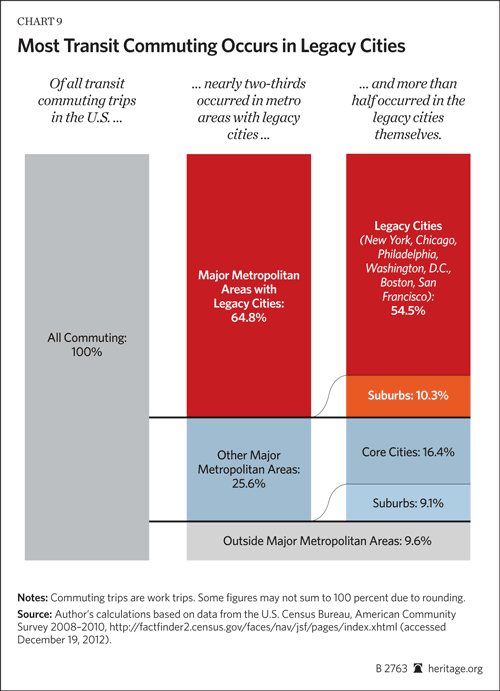
    Transit commuting is heavily concentrated to destinations in just the six core cities (historical core municipalities) of New York, Chicago, Philadelphia, San Francisco, Boston and Washington (Backgrounder Chart 9). I call them the "transit legacy cities," because their high transit market shares relate to their development before the automobile became dominant. Because there is such a lack of clarity in the use of terms that apply to cities, it is important to emphasize that the transit legacy cities are municipalities, not the surrounding metropolitan areas or urban areas, where the majority of residents live (Note 1). 


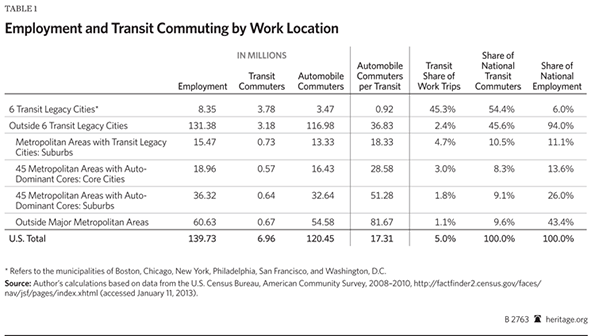
    The transit legacy cities account for nearly 55 percent of the nation’s transit commuters, by work trip destinations, according to the American Community Survey (2008-2010). By contrast, the transit legacy cities have an overall national employment market share barely one-tenth their national transit share (6 percent). Moreover, combined, the transit legacy cities cover a land area little larger than the core city (municipality) of Jacksonville, Florida.

    At the same time, the "other side of the coin" is that commuting to other destinations is dominated by the automobile, from the suburbs in metropolitan areas with transit legacy cities, and even more so in the other 45 major metropolitan areas (with more than 1,000,000 population) and the balance of the nation.

    Legacy Cities: Transit’s Strength

    The extent of the concentration in the six transit legacy cities is illustrated in Backgrounder Table 1. In some ways, transit is, first and foremost,  really a New York story. More than one-third of all transit work-trip commuting is to destinations in the core city of New York. The dominance is even greater for high-capacity subways/elevated services, a mode in which where New York represents two-thirds of national commuting.

    The Key: Large, Concentrated, Well Served Downtowns: The concentration of transit commuting in the six transit legacy cities reflects the factor that is probably more responsible than any other for attracting people from cars to transit. This is a highly concentrated downtown area (central business district, or "CBD") from which a dense network of rapid transit services radiates.

    The six transit legacy cities are also home to the six largest CBDs in the nation, where transit’s share of commuting is far higher than compared to the rest of the nation. Approximately three quarters of commuters to the sprawling Manhattan CBD in New York (south of 59th Street) commuted by transit in 2000. Less well known is that New York also contains the CBD with the second largest transit work trip destination, downtown Brooklyn (58 percent), which is followed by downtown Chicago (55 percent).

    In addition, between nearly 40 percent and more than 50 percent of commuters used transit to the CBDs of Boston, San Francisco, Philadelphia and Washington. While covering a land area less than one-half the size of Orlando’s Walt Disney World, these downtowns accounted for 35 percent of national transit commuting.

    Outside the Transit Legacy Cities: Automobile and Work at Home Country

    So what about the 94 percent of US commuters who work outside the transit legacy cities? The answer is that the automobile dominates, and transit has been overtaken by working at home. In the suburban areas of metropolitan areas with transit legacy cities, the car carries 18 times as many people to work locations as transit. In the core municipalities of the 45 major metropolitan areas without legacy cities, cars carry 29 times as many commuters as transit, and 51 times as many in the suburbs. Outside the nation’s major metropolitan areas, cars carry 82 times as many commuters as transit (Backgrounder Table 1)

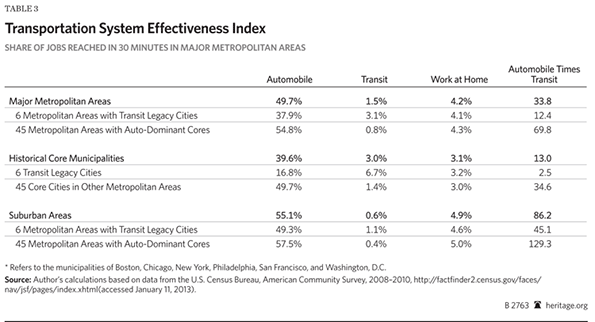
    Further, outside the transit legacy cities, working at home (including telecommuting) provides access to twenty percent more jobs than transit (Backgrounder Table 3).

    An American Love Affair with the Automobile?

    The enduring myth of the American love affair with automobile is countered by the huge transit market shares to city downtowns . For example, commuters to Manhattan are five times as likely to use transit as cars. On the other hand, commuters to the edge city of Parsippany, on the I-287 corridor in suburban New Jersey are 50 times as likely to use their cars as transit. Yet both employment centers serve the same labor market. The issue is not preferences, it is rather rational choice. It would be irrational for most people to commute to Manhattan by car, principally because of the traffic congestion and cost, particularly for parking. It would similarly be irrational for most people to commute to Parsippany by transit, because it either could not be done at all, or it would take too long.

    Transit’s work trip destination market share is an effective measure of its relevance to the market.

    And lest anyone should counter that the answer is more money, consider this.

    A Cost Not A Revenue Problem

    Portland (with a core city that is not a legacy city) has long been held out as a model for improving transit. Yet, after billions of dollars in federal and local tax subsidies, more than 50 times as many people travel to work to suburban locations by car as by transit. More than five times as many work at home as use transit, and working at home costs taxpayers virtually nothing. Yet, despite all these billions, Portland’s transit system is in crisis. Tri-Met’s  Executive Director Neil McFarlane has warned of 70 percent service cuts over 12 years without substantial changes to union contracts.

    Transit’s fundamental problem is not insufficient revenue but insufficient cost control. Since 1983, national transit expenditures have risen at an inflation-adjusted rate nine times that of its increase in commuters (Note 2). Even if costs were under control, it would be financially impossible to provide automobile-competitive transit throughout the modern urban area, as Professor Jean-Claude Ziv and I showed in our WCTRS paper (Megacities and Affluence: Transport and Land Use Considerations).

    Celebrating Transit

    Yet, beyond its inability to convert generous taxpayer subsidies into corresponding ridership increases, transit deserves credit for the large number of people it moves to jobs in the legacy cities. This success should be celebrated although it remains an impossible, prohibitively expensive, dream elsewhere.

    Wendell Cox is a Visiting Professor, Conservatoire National des Arts et Metiers, Paris and the author of “War on the Dream: How Anti-Sprawl Policy Threatens the Quality of Life.”

    —-

    Note 1: Each of the transit legacy cities has a lower population than the surrounding suburbs. This ranges from nearly 45 percent of the population in the suburbs of the New York metropolitan area to little more than 10 percent in Washington.

    Note 2: Within the first 30 days of my time on the Los Angeles County Transportation Commission, I became convinced that transit’s principal problem was cost control (see Toward More Prosperous Cities). This was then and today remains clear from the above-inflationary escalation of unit costs. Regrettably that trend continues today and has seriously impeded transit’s ability to increase ridership.

    —–

    Photo: Downtown Philadelphia (by author)

  • How We Should Navigate the Florida Archipelago

    Leafy, timeless rural routes and monotonous, flat highways have characterized Florida’s network of state roads since the early 20th century. Vacationers in the Sunshine State either stick to the interstates – often a hot, frustrating parking lot – or consign themselves to the stop-and-go, confusing local roads. Future Corridors, the state’s vision of a future, integrated road network, is set to finish its conceptual phase this year, and promises to radically revamp the state’s road system. Since this vision will quickly harden, it deserves a close look by a broad portion of the state’s population to see if it truly addresses the state’s needs or, like so many Florida initiatives (the state’s notorious voting system comes to mind), becomes an ignominious reminder of provincial politics at its worst.

    Begun in 2006, Future Corridors contains some progressive, sophisticated thinking. Taking existing corridors and redesigning them to segregate shorter trips, trucks, and transit makes sense and should have happened a long time ago. Such managed use lanes are already popular in California, Texas, and elsewhere. The study also looks at enhancing rail systems for both freight and passenger service.

    Florida is already a maze of country roads, rail lines, commercial strips, turnpikes, and interstate highways, with little remote wilderness left. So enhancing, multiplexing, and otherwise modernizing the existing corridors is practical and efficient, and will conserve the state’s inner beauty.

    Smoothing out the lumpy traffic flow will also improve the state’s economy. Florida consumes more than twice the goods that it exports in terms of freight, and its tourist-business throughput is more than that of many nations. Its boom/bust economic oscillations, however, mean that road-building comes in fits and spurts, and is not necessarily tied to real-time needs. To get from Gainesville to Jacksonville, for example, you still have to journey upon twisty, peculiar roads built in the 1930s.

    Florida’s home-grown turnpike, built in the 1970s to funnel tourism, is impossibly congested in some areas today. As population has swelled, it has changed into a local alternative to traffic-choked arteries for short trips and commutes, as well.

    Future Corridors isn’t just about highways, however. Besides its beaches, Florida’s signature characteristic seems to be the ubiquitous, homogenous, low-grade commercial strips that have overtaken our once-quirky roadside culture. Along these main drags, the American narrative can be read in all of its glory: they are the great equalizers, where all institutions are reduced to blue or red logos 300 yards before the turn lane. Decried as the aesthetic horror that they certainly are, these highway markets remain, nonetheless, emblems of the American dream. Anyone with a car can access everything; emporiums are born, flourish, and die. They are transformed quickly and without sentimentality into newer offerings. These strips have transformed much of the state’s coastline into a continuous, multi-stranded conduit of consumption for the masses. The Future Corridors proposal calls for more rural highways in Florida and opens up more land for this kind of development.

    Florida’s future, regardless of its new road plan, inevitably will include more of these strips, not fewer; more traffic and highways, not less. Nevertheless, the state’s environmentalists and urban intelligentsia are already forming positions against much of the vision. As the first regions — Tampa-Orlando and Tampa-Jacksonville — are rolled out, 2013 will prove to be a dynamic year of controversy. As state government battles environmental and urbanist boosters, it seems like a California-like trajectory is already set, with some critical concerns sadly cast aside.

    Florida currently suffers from “hourglass” transportation planning. On the bottom of the curve, short, regional toll highways and roads are built to enhance local connectivity, but connect only feebly to the rest of the state. On the top, the federal interstate highway system dumps huge quantities of people into the state from the Midwest, the east coast, and the South. In the middle a statewide, home-grown transportation system built to handle this volume has been notably missing.

    Competing regions have little incentive to link up with each other. Tampa and St. Petersburg, for example, continue to squabble for small economic advantages, instead of looking at the bigger picture. Meanwhile, the nation’s Department Of Transportation is only mildly interested in state connectivity issues. The gaping hole in statewide transportation planning has never been adequately filled, as any tourist sitting on I-75 in the springtime can attest.

    Future Corridors is the latest incarnation of Florida’s long, mostly inept growth management strategy. The Department of Community Affairs, a state-level regulatory bureaucracy, replaced the previous laissez-faire ethos. It survived until 2011. The regulators represented an impediment in a state that is developed largely by outside economic interests, so they were done away with. With a new bubble growing, these interests salivate over future developable land that will be made available by road-building activity. Thus, growth management continues in a sort of feudalistic twilight, where political connectedness replaces the public process with the tacit support of the citizens.

    Politicians come and go, so the new process may not continue past the next election. In the meantime, public advocates for the state’s future would do well to advance their own vision of the future, which should include several key ideas.

    For starters, the state would benefit from a twenty-first century transportation network that is digitally connected. Planning a trip in Florida is a bit like planning a sailing trip without a weather report. Traffic jams, road construction, and other obstacles seem to crop up without warning, causing trip or meeting delays or even postponements. Delivering real-time digital information to travelers might be out of the cost and logistical range of individual regions, but the state could feasibly invest in a system that updates a driver’s handheld device to help reroute traffic flow and forecast problems ahead.

    And no argument about wilderness preservation or road construction carries any weight until the state’s notorious safety issues have been addressed. Whether it is traffic accidents, pedestrian fatalities, or gruesome bicycle clashes, Florida’s roads consistently make the list of the most dangerous roads in the nation. Buried deep in DOT PowerPoints are meek statements about safety, but little has been done. While Florida beckons the world to its door for vacation, its reputation is marred far worse by poor roads than it is by junky, bland, retail, and it must be fixed.

    More strategically, however, a road system should reflect the new notion that Florida’s urban clusters constitute a single large megapolis, unified in demography, economics, and culture: the so-called “Florida Archipelago”. Geography is responsible for the weblike settlement pattern, and this geography should be enhanced by a safe and effective transportation system, rather than be treated as an obstacle to be ignored or plowed over with ruthless technology. Corridors should be planned to take advantage of this spread-out nature. Intensifying urban activity where it makes sense, and intelligently intertwining agriculture and wilderness into the planning process, could create a vibrant, robust tropical megapolis.

    Finally, the state’s transportation system should help reconcile the growing affordability gap in housing, which is glaring in Florida. A thin line of very high-priced vacation homes hug the coastline, subsidized by people living in less risky locations. This arrangement exacerbates the affordability gap in housing. Meanwhile, rural road networks are often disconnected and poorly maintained. Public transit is ineffective and perennially used as a political plaything, rather than a serious attempt to reduce car dependence for those who would most benefit from it – the low income and the elderly.

    Paving over Florida’s interior will close rural areas that remain within the cost of living of the state’s retirees, and it points to a future that will increasingly resemble overpriced, highly regulated California. And with more and more dependence upon toll roads, the state’s transportation system will, if it continues on this trajectory, further separate the haves and the have-nots.

    Urban feudalism is the top-down, urban-centric, affluent-class authoritarianism that seems to be overtaking the future of Florida and of America. Historically the state has been able to escape this fate, partly because it has a diversified lower middle class, along with service and construction workers. In the past, the rich came to the state mostly when on vacation. This era appears to be waning, however.

    Florida’s working-class population will be squeezed tighter if policies create rising costs that move people further from their jobs. As Florida’s new growth strategy, Future Corridors, moves from concept into planning stages, the broadest conversation among citizens and the planners will do the most good in the long run.

    Richard Reep is an architect and artist who lives in Winter Park, Florida. His practice has centered around hospitality-driven mixed use, and he has contributed in various capacities to urban mixed-use projects, both nationally and internationally, for the last 25 years.

    Photo by Adam Fagen: Roadside Gator in Monroe County, Florida, along the park road to Flamingo, Everglades National Park.