Blog

  • Churches and Parking

    A recent story over at Atlantic Cities got me thinking about a debate that’s heated up over the last few years: urban parking policy for churches.

    Per Atlantic Cities, San Francisco has decided to start charging for metered parking on Sundays. This is starting to happen across America. In San Francisco, as in Chicago and elsewhere, the driver (no pun intended) appears to be revenue raising, plain and simple.

    This has angered many attendees of local churches (who have in many cases now moved out of town and drive in for services). They seem to believe that they have a constitutional right to free parking on Sunday mornings. On the other side, of course, are bicycle advocates, who are positively gleeful. (Bicycle advocates are without a doubt the single most self-righteous advocacy group I know, which is why so many people who otherwise might support reasonable pro-bicycling policy can’t stand them).

    I think a more nuanced approach should be taken, based on neighborhood conditions and creating the right incentive structures. For example, in some places across the country (San Francisco and Chicago come to mind again), it’s traditional for church goers to park even in what would otherwise be illegal spots. In general, this isn’t a problem – at least from my personal observations in Chicago. Traffic is pretty light on Sunday mornings, and it doesn’t cause any problems.

    What’s more, enabling that temporary use of public space for a couple hours on a Sunday morning is exactly the sort of thing we need more of, not less. An institution like a church that has a single demand spike for parking during a generally low demand period is a great candidate for flexible uses of public space that would otherwise be underutilized. Liveable streets advocates are quick to decry the empty lanes off peak from oversized roads. So what’s the problem with putting a boulevard on a “road diet” on Sunday morning by using a lane for parking? Sounds like a winner to me. I’d be asking what other types of institutions or events could do similar things.

    And consider, what will happen if churches are banned from using these spots or otherwise have to pay? Well, it depends on the neighborhood, but it’s easy to see what organizations often do when they need parking: build parking lots. Do we really want churches acquiring private off street lots that will sit empty 166 out of 168 hours per week – and generate no property taxes? It makes no sense to me. Why would we want to create incentives for people to own parking lots just because some folks hate cars? We should be going exactly the other direction. There are way too many church parking lots already if you ask me. We should be trying to cut deals with them to open that land up for development by making temporary blocks of street parking available for a couple hours on Sundays.

    Now, in places where there is legitimately congestion and/or parking shortages on Sunday mornings (and San Francisco might be a case here – I don’t know for sure), implementing parking charges and restrictions would certainly be reasonable. The principal reason for allowing these church uses in the first place shouldn’t be some religious exemption per se, but rather enabling a local chronologically niche use to take advantage of underutilized public space. (Keep in mind that many other local users get truly special privileges based solely on their local presence: loading zones, valet zones, residential parking – and the latter is usually de facto free). If the space is over-subscribed, then feeding the meters to help rationalize demand is reasonable, and the churches should stop grumbling.

    In short, we should be basing this on some type of rational decision process based on neighborhood conditions, setting the right overall incentives, and balancing the needs of competing uses, not pandering to churches treating illegal spots as if they were some ancient feudal right, nor sanctimonious bicyclists behaving as if a double parked car on Sunday morning is a menace to the planet or to their own self-evident status as the most perfectly entitled form of urban transport.

    This piece first appeared at The Ubanophile.

  • U.S. Late to the Party on Latin America, Africa

    President Barack Obama’s proposed tilt of U.S. priorities toward the Pacific – and away from the historical link to Europe – represents one of the most encouraging aspects of his foreign policy. Although welcome, we should recognize that this shift comes about three decades too late and that it may miss the rising geopolitical centrality of sub-Saharan Africa and Latin America. The emergence of these longtime historically impoverished backwaters has been largely missed as American policy-makers and businesses are now obsessed with the challenges and opportunities posed by the emergence of China and, to a lesser extent, India. Sub-Saharan Africa, for example, over the past decade has produced six of the world’s 10 fastest-growing economies. Through 2011-15, according to the International Monetary Fund, seven of the fastest-growing countries will be African, and Africa as a whole will surpass the slowing growth rates in Asia, particularly China.

    This growth has caused the region’s poverty rates, still unacceptably high, to fall from 56.5 percent in 1990 to 47 percent today. Further growth will likely push poverty levels down further.

    Outgrowing U.S.

    With 600 million people, including a middle class of some 400 million, Latin America represents one of the world’s great growth markets. Over the past two years the growth rate in Latin America has been twice – and more in some countries – that in the United States, Europe and Japan. Latin America’s unemployment rate is reaching historic lows. A decade ago, it was 11 percent. Today it is 6.5 percent, well below levels in the U.S. or Europe.

    As in Africa, growth has worked to reduce Latin America’s historic high rate of poverty by 17 percent since 1990. Overall, Latin America’s combined gross domestic product is already larger than that of Russia and India combined – larger, in fact, than any nation or region besides the U.S., the E.U. and China.

    Demographic trends are likely to accelerate this process. Rapidly aging populations in Europe, Japan and East Asia threaten both workforce growth and fiscal stability. Today, people at least age 60 account for 13 percent of the population in China, 15 percent in east Asia, 32 percent in Japan and 22 percent in Europe, but barely one in 10 residents in Latin America; only 6 percent of Africa’s population is made up of seniors. By 2050, one-third of people in east Asia, Europe and China will be over 60, while Japan will pass 40 percent. In contrast, Latin America’s over-60 population will be 20 percent, and Africa’s half that.

    Indeed, over the next decade, Africa is slated to add more people than all of Asia, while Latin America’s growth will far exceed that of Europe, East Asia or North America. A surprising percentage of the residents in these regions will be middle class. From 2000-14, according to a McKinsey survey, the number of African households with annual incomes of at least $5,000 will grow from roughly 59 million to well over 106 million. Africa already has more middle-class households (defined as those with incomes of at least $20,000) than India.

    This demographic vibrancy is helping spark industrial growth, both for export and domestic consumption. Latin American countries, led by Brazil, have emerged as industrial centers while Mexico is rapidly replacing China as the preferred foreign manufacturing platform for American firms hailing from California to Texas. Manufacturing growth – particularly in textile and garments – has also begun to grow in parts of sub-Saharan Africa, following in many ways the patterns earlier seen in Japan, China, Southeast Asia and Bangladesh.

    Hunt for Resources

    But much of the importance of these regions lies with their enormous natural resources.

    Conventional wisdom in our chattering classes holds that, in the "information age," raw materials no longer represent an advantage for economic growth. Yet as the world’s population grows, and its middle class expands, there seems to be a cascading demand for raw materials, either for direct consumption or for use in manufactured goods. Energy consumption itself, according to the International Energy Agency, could rise as much as 50 percent by 2030, with more than 84 percent of that increase coming from fossil fuels.

    Increasingly the competition over Latin America and Africa reflects something of a reprise of what was once seen as "the great game," where European colonial powers struggled for control of resources and land masses in regions as diverse as Central Asia, Africa, South America and the Middle East. Today, this struggle includes many more protagonists, including Japan, Korea and, most powerfully, China, all of whom are targeting investments in the continent.

    One result has been growing interest in Africa, where foreign direct-investment projects grew by 27 percent in 2011 alone. American companies like Wal-mart and Google are expanding there, but much of the big investment comes from China. China’s former vice-minister of commerce, Wei Jianguo, recently told China Daily that Africa eventually will surpass the U.S. and the E.U. to become China’s largest trading partner. Last year, Latin America reaped a record $145 billion in FDI, an increasing share from China.

    Resource-hungry China has reason to focus on Africa and Latin America, which hold much of the world’s diminishing supply of not-yet-developed farmland, as well as tremendous reserves of precious minerals and energy. Africa, by current accounts, possesses 10 percent of the world’s reserves of oil, 40 percent of its gold, and 80 percent to 90 percent of the chromium and the platinum metal group.

    These supplies, notes a recent McKinsey report, may be grossly undercounted, since much of the continent has not been thoroughly explored. But, to date, Africa has a proven stock of $13 trillion to $14.5 trillion worth of energy resources (oil, coal, gas, uranium); South Africa alone is estimated to have $2.5 trillion in mineral wealth.

    Latin America, too, enjoys ample natural resources, to go with its rapidly developing industrial sector. Brazil is the world’s third-leading food exporter, and other Latin countries, such as Chile and Mexico, have been emerging as major producers of commodities.

    Latin America also seems well-positioned to benefit from the shift of world energy production from the Middle East and Russia to the Americas. Brazil has already made large strides in offshore oil development; possible future offshore oil finds in Mexico and Cuba create an energy boom through the entire Caribbean Basin.

    U.S. Needs to Shift

    Clearly, the rise of these two regions signals that we need to adjust our foreign policy priorities. American business is already becoming more engaged with these two continents; over the past decade trade growth there has more than tripled, compared with a doubling of trade with Asia and Europe. We need to move not only beyond our old strategic ties with Europe, and embroilment with the volatile Middle East, and look to engage in the places where our primary rivals, notably China, already see the future of the world economy.

    Will America, finally awakening from its European slumbers and no-win Middle Eastern involvements, get with the new program? It took three decades for the foreign policy establishment to acknowledge the reality of the Pacific era. Hopefully it won’t take nearly as long to acknowledge the growing influence of both our southern neighbors and emergent powerhouse that is Africa.

    Joel Kotkin is executive editor of NewGeography.com and a distinguished presidential fellow in urban futures at Chapman University, and a member of the editorial board of the Orange County Register. He is author of The City: A Global History and The Next Hundred Million: America in 2050. His most recent study, The Rise of Postfamilialism, has been widely discussed and distributed internationally. He lives in Los Angeles, CA.

    This piece originally appeared in the Orange County Register.

    World image by BigStockPhoto.com.

  • Natural Gas Boom: The “Janus” Effect

    The last five years have seen a revolution in terms of the amount of inexpensive U.S. natural gas made available for consumption in power plants, road fuels, and as a feedstock for new and expanded petrochemical plants. We are now even debating the advisability of large volume natural gas exports in the form of liquid natural gas (LNG).  

    This bonanza has created euphoria in the fossil energy and industrial communities, but has also created something of a “Janus effect” within the Environmental community.  To the Romans, Janus (the two faced god) provided a cohesive view of the present as well as an uncertain view of the future. In Rome, the temple to Janus was opened only when Rome was at war. During peace time, presumably because the future was more certain, the doors of the temple remained closed. They were last opened in AD 531 immediately prior to an invasion by the Goths. We all know how well that turned out.

    Environmentalists are reacting to the natural gas bonanza in three ways. The first group, which we may define as “pragmatists”, see a hopeful face based on solid evidence that natural gas helps with achieving multiple environmental goals by reducing particulate emissions, sulfur emissions, NOX levels and CO2 emissions.  They acknowledge natural gas fueled generators emit approximately 40% less CO2 per kilowatt hour than the older coal-fired units they are largely replacing. Although the aftermath of the recession has reduced the use of most other fuels, natural gas now rivals coal as the major fuel source for power generation in the US.

    A second group, the “environmental fatalists” are less impressed with the displacement effects on coal but appreciate that natural gas plants provide crucial support when mandated, for intermittent renewable power options, such as solar and wind. Once renewables represent approximately 10% of aggregate capacity, negative side effects of these “intermittent” sources become problematic; too much dependence on them can cause grid “instability” or, in a worse case, cascading power failures and massive blackouts. 

    Then there’s the third group, we’ll call the “ideologues.” Often the loudest, this group views natural gas as an implacable enemy for undermining the economic viability of renewable energy projects. They oppose the use of natural gas on principle and call for ever more restrictive regulations and production constraints on natural gas fueled power production. In their view, increasing the costs of generating electric power from natural gas will allow renewable generation finally to achieve cost parity. This “logic” explains at least some of the objections to fracking, an essential requirement for shale gas production, which, if restricted, would seriously undermine production and consumption of additional natural gas in the U.S.  

    The ideologues believe in “leveling the playing field” so that renewables such as solar and wind can be made economically viable. They see themselves fostering a new economy based on renewable energy. The rest of society’s role is to “shut up” and allow them unimpeded access to scarce and valuable assets (e.g. subsidized prices and preferential access to the grid) in order to wipe fossil fuels off the grid. 

    Natural gas based power generation represents the ideologue’s worst nightmare.  They know that increasing the use of natural gas for a generation undermines the economic value of renewable-based generating companies. It’s not hard to imagine that for those individuals and businesses profiting from renewable subsidies and mandates, natural gas represents a great threat. The argument therefore does make a certain amount of sense if you accept the initial premise.    

    Renewable mandates generally represent a commandment that “Thou shalt generate e.g. 10% of a given utility’s power output using approved renewable resources”, regardless of the costs to ultimate consumers.  Requiring utilities to purchase high priced renewable power under so called feed in tariffs results in those higher prices simply being “rolled in” to the aggregate cost of power delivered to all consumers and duly covered by an aggregate rate requirement.

    Such initiatives to support an artificial market for renewable power generation are politically vulnerable, since the public tends to reject mandates forcing investors in renewable energy projects to face bankruptcy as a distinctly possible outcome. Government-guaranteed loans supporting construction of the plants manufacturing new PV solar cells or wind turbines have already outraged a public forced to pay for their bankruptcies.  

    What is the future of America if the renewable mandate regime expands under state or federal programs? That future is now on display in Germany, a trailblazer in applying subsidies and preferential access to the grid to support the adoption of solar and wind power. The country has not only restricted the construction of new coal and nuclear power units, but also limited the operations of natural gas fueled generation by providing preferential prices and access to the grid for renewables. To be fair, the Germans are also groaning under the cost of imported natural gas supplies, primarily from Russia.

    Unfortunately, as a result Germany does not have adequate load following capacity to absorb the ups and downs of renewable power generation. The result is grid instability. These policies are creating potential dangers for an economy heavily dependent on power intensive manufactured exports.  Already German petrochemical manufacturers, such as BASF and Bayer, have warned that the country faces grave threats to its manufacturing base due to lower cost competition in the natural gas-rich US. Volkswagen has been equally blunt about their need to manufacture car parts outside of Germany. Remember that Germany’s job pool has roughly 24% of the work force engaged in export focused activity.

    The Germans avoid discussing their lack of enthusiasm for searching out low cost coal gas and shale gas deposits in the fatherland. The country now endures an aggregate price of 32 cents/kilowatt hour vs. a US price of about 10 cents/kwh. The bad news is that this already elevated German rate is slated to increase further in the next year, by another 50%, to a level of 48 cents/kwh.  

    To make it through Germany presumes the good will of neighboring countries which face their own energy challenges. Germany’s current power generation profile has approximately 20% of its power being provided by renewable sources, primarily wind and solar. Germany’s neighbors complain that the country is exporting the grid instability associated with its “green” policies. It’s gotten so bad that the country, which loathes nuclear power, is actually expanding the use of coal fired generation. In essence, coal fired generation is growing in Germany at the expense of higher cost natural gas generation. (The silver lining is that the U.S. is supplying the extra low cost coal required). Naturally, Germany’s CO2 and particulate targets are not being met, while the equivalent US targets are being met ahead of schedule.   

    Not surprisingly, the German government is now back tracking because their economy cannot support, from a technical or economic perspective, the current level of installed renewables. Angela Merkel has recently called for a more balanced approach to power generation. That will probably mean a policy of diverting subsidies and preferential treatment from solar and wind to natural gas and hydro.

    The Current Status in the US

    Back here in the US, we’ve managed to spend $97 billion or so on government funded wind and solar projects that certainly will not survive without operating subsidies, feed in tariffs, preferential access to the grid and production mandates.

    Fortunately, the US is upgrading our power generation fleet by building new, unsubsidized, gas-fired generation plants throughout the country. We are also seeing new pipeline and grid infrastructure coming to market along with significant expansions of our refining and petrochemical manufacturing facilities, exploiting nonconventional hydrocarbon resources. The bulk of this expenditure is being managed with minimal federal financial support.

    However, adverse government regulation of fracking could bring the shale gas band wagon to a sudden halt. (Beyond that, a measurable, multi-year slowdown in permits for new gas pipelines is also having a deleterious effect.)

    Recognizing the risks, shale gas proponents are taking another approach. Having apparently convinced the pragmatists and the fatalists of the benefits of natural gas, they are now beginning to spend significant sums in an effort to educate the general electorate and thereby isolate the diehard   ideologues.  

    Fortunately, the majority of the environmental community is not made up of latter day luddites bent on destroying western civilization, just as the majority of the oil and gas industry is not made up of barbarians seeking to plunder the environment. The majority of the population consistently supports measured progress on both the environmental and economic fronts.

    The challenge now is to grow support for  environmental compromises that produce favorable results for everyone. We still live in a democracy where everyone gets to vote and to have his or her say. However, we do not live in an “Alice and Wonderland” world where everyone can create his own reality. Germany is already facing the downside of listening to their ideological enthusiasts. Let’s take the German lesson to heart, and embrace a more pragmatic approach. It is after all, the American way.

    Eric Smith is a Professor of Practice at the A.B. Freeman School of Business at Tulane University. He serves as the Associate Director of the Tulane Energy Institute. He is a Chemical Engineer and has an MBA from the A. B. Freeman School at Tulane University. 

  • That Sucking Sound You Hear…Solutions to America’s Housing Crisis Are Needed

    There is a crisis in America that’s not being attended to. It is the housing crisis, and its tentacles reach deep into the decline of the American middle class. Particularly, the interlocking dynamics of foreclosure, abandonment, and blight are draining the net worth of millions of Americans. The solutions to date have been piecemeal and ineffective. One possible initiative on the radar—which will be explained further below—entails a federal investment in the strategic demolishing of thousands of “zombie properties” that are eroding equity and quality of life.

    This erosion is real. Writes Howie Kahn of his recent tour with a City of Detroit demolition crew:

    Old roofs half-collapse under the weight of snow, forcing the walls to bulge outward. Moisture eats away the insides. Mold spoils the walls, softens the floors. In the summer, the sun bakes it all to a high stink and turns it crisp as tinder. Nature takes over. Trees sprout through the dormers. Animals get comfortable. We see this everywhere we go…So many innocent onetime starter homes, built on credit and striving, now in foreclosure. The holding company writes it off as a loss. And unless some crusading neighborhood association acts as a sentry, no one’s watching the house anymore. In essence, it belongs to nobody—or to everybody. Because once a house becomes worthless and unwanted…it’s everybody’s problem. Everybody’s crime scene.

    As both a policy researcher and a Clevelander, I know these realities first hand. The city was home to over 40,000 vacant housing units in 2010, or nearly 20% of its stock. Several of these units were across a street from me, the result of a foreclosure on a rental investment purchased during housing inflation heights. Tenants were kicked out around 2009. The place sat empty, but I soon noticed people constantly disappearing into the back of the building. Drug activity I thought. Then one day I found a pile of hypodermic needles on my front lawn while cutting the grass. I have a child. The very real effect of blight acted as a drain on my property value, not to mention my quality of life.

    And while I stayed in the City of Cleveland, many don’t. Cleveland lost 17% of its population from 2000 to 2010. The population decline (which is a long-term trend)—combined with the subprime mortgage crisis—created for unprecedented amounts of oversupply. Often, with both banks and homeowners walking away, the vacant structure devolves into blight until it becomes “a disamentiy effect”, which in plain-speak simply means living near something nobody would want to, with the unappealing prospect monetized in the devaluation of the house’s market value.

    This disamentiy effect has been quantified. For instance, my colleague Nigel Griswold found that in Flint, MI each abandoned structure within 500 ft. reduced a home’s sales price by 2.27%. A study by Thomas Fitzpatrick of the Federal Reserve Bank of Cleveland showed an additional property within 500 ft. that is either delinquent or vacant reduces prices by 1.3%. In low-poverty areas the effect is greater: 4.6%.

    Of course the larger problem is the broader economic effect, as depreciation goes beyond a lower return on investment and gets at household net worth. Specifically, according to the Census Bureau, household net worth declined 20% from 2005 to 2010 (40% since 2007). Of this decline, 76% was attributed to a loss of home equity. Minorities were hardest hit, with average Black household equity falling from $70,000 to $50,000 and average Hispanic household equity falling $90,000 to $40,000.

    Such declines in net worth have swelled the number of Americans stuck in precarious economic conditions. A recent report called “Living on the Edge: Financial Insecurity and Policies to Rebuild Prosperity in America” found that nearly half of Americans are “liquid asset poor”, meaning “they lack the savings to cover basic expenses for three months if unemployment, a medical emergency or other crisis leads to a loss of stable income.”

    Vacant house in Detroit. Courtesy of Streetsblog

    Such economic figures are alarming, and they call for intensive solutions aimed at reconstituting the American middle class, if only to achieve a broader economic recovery outside of the investor class. One such solution could entail a large-scale strategic demolition of “zombie properties” in America’s hardest hit areas, such as the Rust Belt.

    Why demolition?

    It is simple, really: by removing the disamentiy effect you are giving the value of the surrounding houses a chance, and there is initial empirical proof that this does in fact occur. Specifically, in his examination of Flint, MI, Griswold found that Genesee County’s demolition investment was paying off, with $3.5 million of demolition activity producing $112 million in improved surrounding property values. Not a bad ROI, and it’s a return that positively affects homeowners, investors, and government alike.

    The question remains: why isn’t there a concerted effort to once and for all excise the hundreds of thousands “zombie properties” that are draining value from the American economy?

    The reasons are varied, but one in particular relates to a lack of empirical proof that demolition has a definitive monetary impact. One current study, spearheaded by Jim Rokakis of the Thriving Communities Institute, aims to fill the gap. The study, headed by Nigel Griswold, myself, and the Center on Urban Poverty and Community Development at Case Western Reserve University, was partly conceived out of a September 2012 interagency meeting on Residential Property Vacancy, Abandonment and Demolition in which—after hearing pleas from a largely Midwestern contingent—officials from Federal Treasury issued a challenge: show through robust empirical means that demolition (1) retains value on nearby properties, and (2) decreases the likelihood of future foreclosures. If the results prove definitive, Treasury suggested they could make a federal strategic demolition initiative a reality.

    Vacant houses in Buffalo. Courtesy of the NY Times.

    Of course the operative word here is “strategic”, as bulldozing for the sake of bulldozing does not a solution to a crisis make. As such, the intent of this research is also to help those on the ground ascertain where an investment in demolitions could pay off most. For example, there are properties—particularly architecturally-rich properties with high intrinsic value—that should be preserved and shuttled down another path. As well, there are areas in cities in which population decline is shifting ever so slightly. The area I had lived was one of them. And the house that was once vacant across from me has been renovated and is now home to a number of tenants. Thus, the authors of the study are cognizant of the contextualization that exists in various hardest hit cities, and so recommendations will be matched with an understanding as such.

    That said, the study is currently ongoing, and while the results are as yet unclear—and in fact may not be robust enough to convince D.C. to act—the effect of “zombie properties” on the financial and mental well-being of regular Americans is anything but uncertain.

    As a Clevelander, I know this all too well.

    Richey Piiparinen is a writer and policy researcher based in Cleveland. He is co-editor of Rust Belt Chic: The Cleveland Anthology. Read more from him at his blog and at Rust Belt Chic.

    Vacant Cleveland house photo by Flickr user edkohler.

  • America’s Oldest Cities

    One of the most important turning points in the social history of the United States occurred at the beginning of the 1940s. This is not about Pearl Harbor or the Second World War, but  rather about the economic, housing and transportation advances that have produced more affluence for more people than ever before in the world.

    After being delayed by World War II, people began moving from the overcrowded cities to spacious (for that time) houses in the suburbs. They increasingly traveled to work and other destinations by car. These trends were at least two decades old at the time, but had been put on hold by the Great Depression. The prewar city (metropolitan area) was considerably denser, more oriented to mass transit and largely monocentric. By 2010, all major metropolitan areas had developed an urban form that was overwhelmingly suburban and polycentric, with the rise of edge cities and the even greater dispersion of edgeless cities. On average, areas outside the traditional downtowns (central business districts) accounted for 90 percent of metropolitan employment in 2000, ranging from a high of more than 95 percent in metropolitan areas like Phoenix, San Jose and Tampa-St. Petersburg to a low of 80 percent in New York.

    Rating Metropolitan Areas by Pre-War Residential Development

    Although dense urban cores persist in most metropolitan areas, their size and significance varies greatly. This can be illustrated by data from the 2007- 2011 American Community Survey, which makes it possible to rank metropolitan areas by their shares of pre-World War II residential development.

    This article uses the percentage of dwelling units, both owner and renter occupied constructed before 1940 to rate the ages of the nation’s 51 major metropolitan areas (those with more than 1 million population in 2010).  Overall, America’s major metropolitan areas are overwhelmingly postwar in their urban development, with approximately 14% of residences built before 1940. By comparison the 1940 populations of today’s major metropolitan counties were just 35 percent of their 2010 populations.

    Oldest Metropolitan Areas

    The nation’s oldest metropolitan areas, not surprisingly, are concentrated in the Northeast and the upper Midwest. Overall population growth has been modest in these regions compared especially to the South and the West.

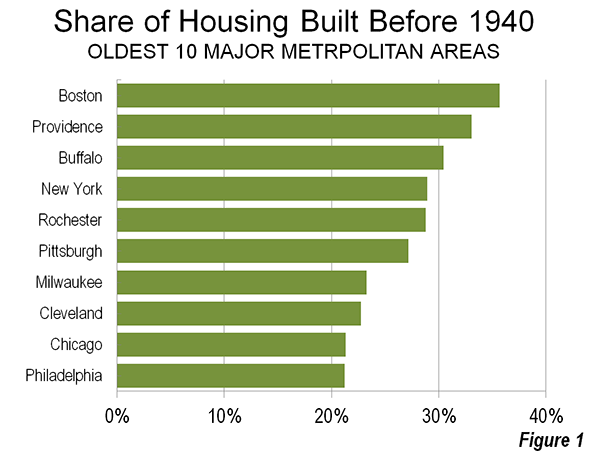
    • Boston is the oldest with 35.7% of its residences built before 1940. This varies from 55.6% in the historical core city of Boston to roughly 32 percent in the suburbs, which are the oldest themselves in the country.   
    • Nearby Providence is the second oldest metropolitan area, with 33.1% of its dwellings built before 1940. The city of Providence is also the second oldest among historical core municipalities, at 58.8%. Providence overall share of pre-1940 housing stands at 30.2%. It is notable that the Office of Management and Budget now considers Boston and Providence to be in the same combined statistical area (consolidated metropolitan area).
    • Buffalo is the nation’s third oldest metropolitan area with 30.5% of its residences preceding 1940. The core city of Buffalo is the oldest historical core municipality, with 62.8% of its housing predating 1940. Buffalo suburbs, however, are considerably newer, with only 20.1% older than 1940.
    • New York is the nation’s fourth oldest metropolitan area, with 28.9% of its dwellings having been built before 1940. The city of New York has a much lower prewar housing percentage than the top four, largely because of the substantial amount of green field housing built in the more distant sections of Queens and especially in Staten Island during the 1950s and 1960s. New York’s suburbs, which have accounted for nearly all of the growth in the metropolitan area have a pre-1940 housing share of 18.9%.
    • Rochester is the nation’s fifth-oldest metropolitan area, with 28.8% of its housing prewar. The historical core municipality of Rochester has a high 58.1% of its housing in prewar stock, while the suburbs have a 21.1% share.

    The next five oldest metropolitan areas are Pittsburgh, at 27.2%, Milwaukee and 23.3%, Cleveland 22.7% Chicago and 21.3% and Philadelphia at 21.2%. Among these, the oldest historical core municipalities are Cleveland, at 51.9% and Pittsburgh at 50.3%. Pittsburgh has the highest suburban pre-1940 housing stock, at 23.5%, the third highest in the nation after Boston and Providence (Figure 1).

    Youngest Metropolitan Areas

    The nation’s youngest major metropolitan areas are concentrated in the South and West, comprising 28 of the 51.

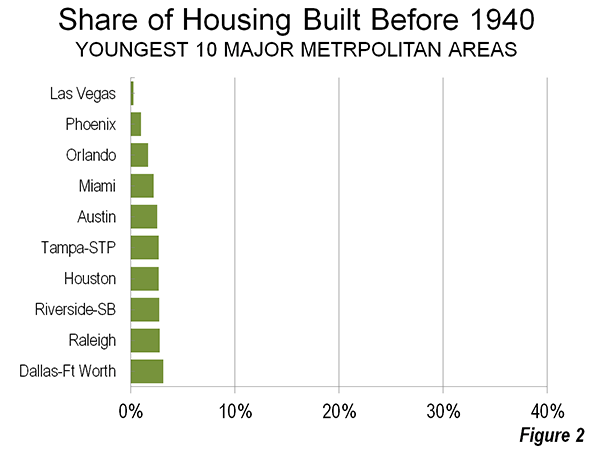
    • Las Vegas is the youngest major metropolitan area.  "Sin City" has had the greatest percentage population growth since 1940, and is now approaching a population of 2 million, compared to less than 20,000 in 1940. Only 0.3% of the housing stock in Las Vegas was built pre-war.
    • Phoenix, which is grown from little more than 200,000 people in 1940 to more than 4 million people today, has a pre-1940 housing stock of only 1.0%. The city of Phoenix has a miniscule pre-1940 housing stock of 1.9%.
    • The third youngest major metropolitan area is Orlando with 1.7% of its housing stock having been built before 1940.
    • Perhaps surprisingly, Miami is the fourth youngest major metropolitan area with only 2.2% predating 1940. The historical core municipality of Miami, however, has one of the highest densities in the United States and a comparatively strong 10.6% of its housing is prewar.
    • Austin is the fifth youngest major metropolitan area, with 2.5% of its housing predating the war.


    Tampa St. Petersburg, Houston, Riverside-San Bernardino, Raleigh and Dallas-Fort Worth round out the 10 youngest major metropolitan areas. Each of these has a pre-1940 housing stock between 2.7% and 3.1% (Figure 2).

    Data for all metropolitan areas is provided in the table.

    Table
    Share of Housing Units Constructed Before 1940
    US Metropolitan Areas Over 1,000,000 Population in 2010
    Rank Metropolitan Area Metropolitan Area Historical Core Municipality(s) Rank Suburbs Rank HCM
    1 Boston, MA-NH 35.7% 55.6% 4 32.4% 1 1
    2 Providence, RI-MA 33.1% 58.8% 2 30.2% 2 1
    3 Buffalo, NY 30.5% 62.8% 1 20.1% 5 1
    4 New York, NY-NJ-PA 28.9% 41.3% 12 18.9% 6 1
    5 Rochester, NY 28.8% 58.1% 3 21.1% 4 1
    6 Pittsburgh, PA 27.2% 50.3% 7 23.5% 3 1
    7 Milwaukee,WI 23.3% 38.9% 16 14.0% 10 1
    8 Cleveland, OH 22.7% 51.9% 6 15.4% 8 1
    9 Chicago, IL-IN-WI 21.3% 43.8% 10 11.6% 13 1
    10 Philadelphia, PA-NJ-DE-MD 21.2% 39.1% 14 14.9% 9 1
    11 San Francisco-Oakland, CA 20.4% 45.5% 9 9.2% 15 1
    12 Hartford, CT 19.3% 43.1% 11 16.7% 7 1
    13 Cincinnati, OH-KY-IN 17.2% 41.3% 13 12.6% 11 1
    14 St. Louis,, MO-IL 15.8% 54.4% 5 10.3% 14 1
    15 Minneapolis-St. Paul, MN-WI 15.0% 46.7% 8 6.1% 24 1
    16 Baltimore, MD 14.4% 39.0% 15 6.8% 22 1
    17 Portland, OR-WA 13.1% 31.8% 19 5.5% 25 2
    18 Columbus, OH 12.5% 12.6% 31 12.4% 12 2
    19 Louisville, KY-IN 12.3% 16.9% 27 8.1% 20 2
    20 Indianapolis. IN 12.1% 15.6% 28 8.8% 16 2
    21 Los Angeles, CA 12.0% 20.2% 26 8.3% 18 2
    22 Detroit,  MI 12.0% 31.7% 22 8.2% 19 1
    23 Kansas City, MO-KS 11.9% 21.5% 24 8.8% 17 2
    24 New Orleans. LA 11.7% 31.7% 21 3.0% 35 1
    25 Seattle, WA 11.1% 29.9% 23 6.1% 23 2
    26 Richmond, VA 9.0% 32.0% 18 4.1% 31 2
    27 Salt Lake City, UT 8.9% 31.8% 20 3.1% 34 2
    28 Washington, DC-VA-MD-WV 8.6% 36.1% 17 4.6% 29 1
    29 Denver, CO 7.1% 21.4% 25 2.1% 43 2
    30 Birmingham, AL 6.8% 15.6% 29 4.5% 30 2
    31 Oklahoma City, OK 6.7% 8.8% 34 4.9% 27 2
    32 Memphis, TN-MS-AR 5.6% 8.8% 35 2.3% 41 2
    33 Virginia Beach-Norfolk, VA-NC 5.4% 1.1% 50 7.0% 21 2
    34 San Jose, CA 5.3% 5.5% 42 5.1% 26 3
    35 Nashville, TN 5.1% 6.9% 39 3.9% 33 2
    36 San Antonio, TX 5.1% 5.7% 40 4.1% 32 2
    37 Sacramento, CA 4.6% 11.5% 32 2.7% 36 3
    38 San Diego, CA 4.3% 7.0% 38 2.1% 42 2
    39 Charlotte, NC-SC 4.0% 3.3% 46 4.6% 28 2
    40 Jacksonville, FL 3.8% 4.7% 43 2.3% 40 2
    41 Atlanta, GA 3.2% 14.5% 30 2.0% 45 2
    42 Dallas-Fort Worth, TX 3.1% 5.7% 41 2.5% 38 2
    43 Raleigh, NC 2.8% 3.1% 47 2.6% 37 3
    44 Riverside-San Bernardino, CA 2.7% 7.9% 37 2.5% 39 3
    45 Houston, TX 2.7% 4.6% 45 1.6% 47 2
    46 Tampa-St. Petersburg, FL 2.7% 8.4% 36 1.9% 46 2
    47 Austin, TX 2.5% 3.0% 48 2.0% 44 3
    48 Miami, FL 2.2% 10.6% 33 1.5% 48 2
    49 Orlando, FL 1.7% 4.7% 44 1.3% 49 3
    50 Phoenix, AZ 1.0% 1.9% 49 0.6% 50 3
    51 Las Vegas, NV 0.3% 0.3% 51 0.3% 51 3
    Total 13.6% 25.5% 9.0%

    Notes:
    Calculated from American Community Survey 2007-2011
    HCM: Historical core municipality category: (1) Pre-War & Non-Suburban, (2) Pre-War & Suburban, (3) Post-War Suburban. There is one HCM per metropolitan area, except in in San Francisco-Oakland (San Francisco and Oakland) and Minneapolis-St. Paul (Minneapolis & St. Paul). Otherwise, the HCM is the first named municipality in the metropolitan area name, except in Virginia Beach-Norfolk, where it is Norfolk and Riverside-San Bernardino, where it is San Bernardino.

    Not All Core Cities are the Same

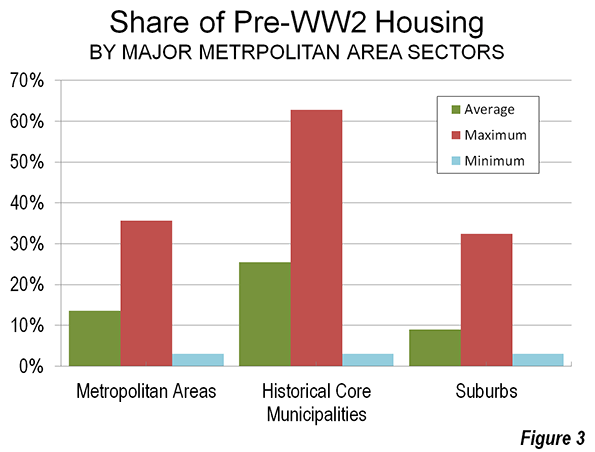
    This analysis indicates the substantial differences between not only the nation’s metropolitan areas, but even more the differences between the core municipalities. For example, the core cities of Phoenix and Philadelphia have approximately the same population. Yet they could not be more different. Philadelphia has a long history, including a time as the nation’s largest city around the period of the Revolutionary War. Phoenix, in contrast, is a product of the post-World War II boom. By 2010, Phoenix had become the nation’s 6th largest municipality. Its 65,000 population in 1940 would rank it around 600th today. Figure 3 shows the average, maximum and minimum pre-war housing stock percentages by metropolitan area, historical core municipality and suburbs.

    Categorizing Core Municipalities

    In Suburbanized Core Cities, we classified the nation’s core municipalities into three categories, based upon the extent of their pre-automobile development (This was described further in a paper co-authored with Peter Gordon of the University of California, Cities in Western Europe and America: Do Policy Differences Matter?).

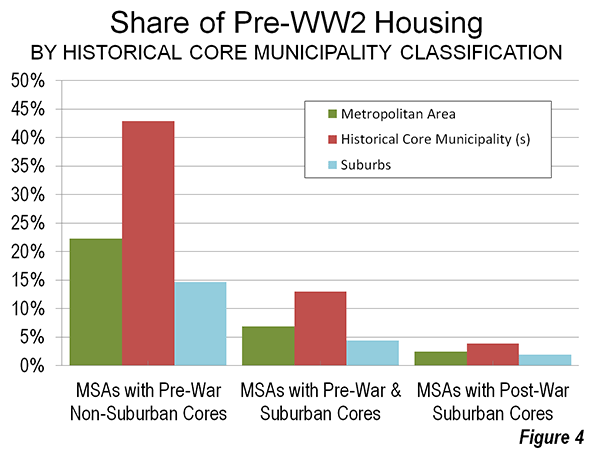
    The categories included "Pre-War Non-Suburban," which are core municipalities that were of high density in 1940 and have expanded their boundaries little since that time. Philadelphia, Baltimore and Providence are examples of these. The second category was "Post-War and Suburban," which includes municipalities that had a dense core of more than 100,000 residents in 1940, but contain large swaths of post-War suburban development (such as Los Angeles, Milwaukee and Atlanta). The third category was Post-War Suburban, which includes core cities that had little or no dense urban core in 1940 (such as Phoenix, Austin and San Jose).

    Figure 4 illustrates the huge differentials in the pre-1940 housing stock between the metropolitan areas as classified by their historical core municipalities.

    Commonalities

    Even so, metropolitan areas are much more similar than their historical core municipalities. The bottom line is one different than one tends to hear in the urban-core-oriented press. In most of America the detached house predominates and virtually all development since 1940 has been suburban, both inside and outside the historical core municipalities.

    Wendell Cox is a Visiting Professor, Conservatoire National des Arts et Metiers, Paris and the author of “War on the Dream: How Anti-Sprawl Policy Threatens the Quality of Life.”

    —-

    Photograph: Boston (by author)

  • Blue States Double Down On Suicide Strategy

    Whatever President Obama proposes in his State of the Union for the economy, it is likely to fall victim to the predictable Washington gridlock. But a far more significant economic policy debate in America is taking place among the states, and the likely outcome may determine the country’s course in the post-Obama era.

    On one side are the blue states, who believe that higher taxes are not only just, but also the road to stronger economic growth. This is somewhat ironic, since, as we pointed out earlier, higher taxes on the “rich” would seem to hurt their economies more, given their high concentration of high-income earners. However, showing themselves to be gluttons for punishment, many of these states have decided to double down on high taxes, raising their rates to unprecedented levels.

    This cascade of higher income taxes started in 2011 when Illinois, arguably the big state with the weakest economy, and the lowest bond ratings, raised income taxes by 66% and business taxes by 46%. Over the past year several other Democratic state governments have pushed through income tax increases, notably California, which raised the tax rate on people with annual income over $1 million to 13.3%, the highest in the nation. And now it appears that Massachusetts and Minnesota are about to raise their taxes as well.

    This is happening at the same time that some red states — notably Kansas and Louisiana — are looking at lowering income tax rates by shifting to rely more on consumption or sales tax revenues. Some red states don’t have income taxes — notably Florida, Texas and Tennessee — and most of those who do are holding the line. Red state leaders, most notably Louisiana’s Bobby Jindal, are placing their bets on  expanding their economies, which would create new taxpayers, boost consumer spending and expand collections of sales taxes.

    The contrast with the blue states — not so much those who voted for Obama, but those controlled totally by Democrats — could not be clearer. They appear to have chosen an economic path that essentially penalizes their own middle and upper-middle class residents, believing that keeping up public spending, including on public employee pensions, represents the best way to boost their economy.

    Yet the gambit of raising state income taxes could not be coming at a worse time. The president’s adopted tax reforms have eliminated write-offs for state taxes for those individuals with incomes over $250,000 and families earning over $300,000. As a result, the affluent residents of these states — California, New York, New Jersey and Illinois alone count for 40% of these deductions nationally — now can expect to get whacked coming and going.

    So which strategy is likely to work best? Most conservatives would assert that the red state approach will prove more effective. But in the short run at least, the free-money policies of the Federal Reserve are supporting many blue-state economies. Plastering institutional investors with low-interest greenbacks raises the price of assets — notably stocks and real estate — creating high incomes for wealthy taxpayers that can then fill the coffers of these states.

    This particularly benefits New York, which depends heavily on Wall Street earnings. (Residents of New York City, which has a city-level income tax on top of high state rates, have the highest overall tax burden in the country.) States such as Massachusetts, Minnesota and even Illinois also have larger than average pockets of wealthy investors; if they do well, higher income taxes could, in the short run at least, bring substantial returns to their state coffers.

    Perhaps the most obvious short-term beneficiary of the new high-tax policy may be my adopted home state of California. Given the higher share of the tax burden borne by the wealthy, a rising stock market tends to send gushers of funds into state coffers, particularly when Silicon Valley is enjoying one of its periodic bubbles. Equally important, increases in real estate prices — up some 25% in Orange County alone — also drives up capital gains and income taxes. This growth is driven not by higher salaries for Californians but is largely investor driven. A remarkable one in three California home purchasers paid with cash in 2012, up from 27% from the previous year. Home prices are climbing rapidly in the Bay Area, where the economy is performing better, and could reach 2007 pre-crash levels within the next year or two, if the current tech bubble continues.

    In the short run, asset inflation combined with higher levels of taxation could solve California’s perennial budget problems, at least temporarily. The state is expected to move into surplus over the coming year. Gov. Jerry Brown sees this convergence as justification for his current “victory lap” in the state and national media. Brown, argues progressive analysts such as Harold Meyerson, has become very much the model of a modern blue state leader.

    Yet, in the longer run, it’s dubious that higher income taxes will make states like California any more competitive or stable fiscally. During the property bubble in the mid-2000s, California also balanced the budget; in 2007 Gov. Arnold Schwarzenegger started comparing the Golden State to ancient Athens and blithely initiated draconian laws on climate change as well as expansion of the social safety net. All things seemed possible until the bubble burst, and with it the windfall from a relative handful of taxpayers. As revenues fell, the state went through five years of huge deficits, a major loss of jobs and growing impoverishment.

    This is likely to happen again, once there’s a downturn in the housing or stock markets. In a sense  higher income taxes serve as an equivalent to what economist Suzanne Trimbath calls “fiscal crack.” For a short period there’s euphoria, as tax revenues flow in and the economy seems to recover. Yet the real problems, such as inadequate private-sector job growth, are never addressed, and as the high fades, the state again faces a loss of jobs and people.

    Perhaps most troubling, states with high income taxes tend to lose people, particularly in the middle class. Over the past 20 years the four biggest net losers of population were high tax states: California, New York, New Jersey and Illinois. Between them they lost roughly a net 8 million out-migrants. The two big net winners, Texas and Florida, had no such taxes, and most of the other big gainers were relatively low-tax states.

    Of course, not everyone is so concerned with income taxes. The ultra-wealthy like David Geffen seem gleeful to pay higher taxes, perhaps because this class, as Mitt Romney showed, have lots of ways to reduce their tax burdens, and after all, don’t have to worry about personal cash flow to keep the business going.

    But enthusiasm for higher taxes historically has been less marked among the much larger group who, although affluent, are far from billionaires. Between 2006 and 2009, California lost a net 45,000 taxpayers earning between $5 million and $300,000 a year, according to the State Department of Finance.

    To be sure, the outward movement slowed during the recession, but more recently the pattern has reasserted itself. Last year, all ten of the leading states gaining domestic migrants were low-tax states including five with no income tax: Texas, Florida, Tennessee, Washington and Nevada. In contrast high-tax New Jersey, New York, Illinois and California suffered the highest rates of out-migration.

    Given these realities, raising already high income taxes has to qualify as somewhat self-destructive over the long run. But so great are the pressures in the blue states to fund expansive welfare programs and public employee pensions that there’s little chance the rising tax tide will soon abate. Sadly, there’s no hotline that seems capable of persuading them to rethink their latest suicidal lurch.

    Joel Kotkin is executive editor of NewGeography.com and a distinguished presidential fellow in urban futures at Chapman University, and a member of the editorial board of the Orange County Register . He is author of The City: A Global History and The Next Hundred Million: America in 2050. His most recent study, The Rise of Postfamilialism, has been widely discussed and distributed internationally. He lives in Los Angeles, CA.

    This piece originally appeared at Forbes.com.

    Income tax photo by Bigstock.

  • This is Your Government on Crack

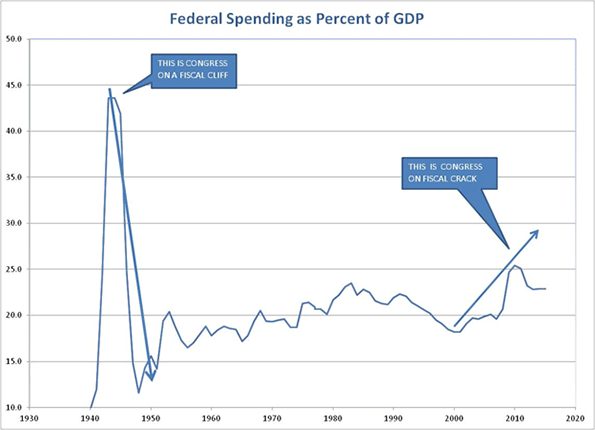
    Forget about a fiscal cliff or the threat of sequestrations. Bernanke’s use of the term “cliff” in 2012 is based on the erroneous analogy that fiscal policy had been moving along some level road for a period of time and was just now approaching an “end” or “falling-off” point. The reality is that federal spending has been rising rapidly since the federal government 1) absorbed the cost of repairing the damage done by the terrorist attacks of 2001, 2) decided to support wars on multiple fronts in the Middle East, 3) bailed out the Wall Street Banks, and 4) failed to pass a budget but 5) decided to continue spending as if nothing had happened. So called “sequestration” – which in this case basically means reducing spending and increasing revenue – would simply be a return to reality, coming down to earth, getting our feet back under us. Unfortunately, we the people appear co-dependents in this addiction.

    This year started with Congress succeeding at its favorite athletic event: kicking the can down the road. The January inauguration of the President and installation of their new members provided the excuse. The fact remains that Congress has not passed a real federal budget since 1997 (“the first balanced budget in a generation”.) An “omnibus spending bill” was passed in April of 2009 but that is not technically a budget.

    Congressional inaction has left the federal government running on extensions (“Continuing Resolutions”) of a budget that was passed when Bill Gates was still CEO of Microsoft, NASA landed the first spacecraft on Mars, and Google was working out of a garage. The last federal budget is from the time before iPods and iPads, before SPAM e-mail exceeded legitimate email, before Facebook, YouTube and Twitter – and before the global financial crisis that sent the world into recession and US federal spending into the stratosphere.

    In lieu of doing anything meaningful, three senators – Kelly Ayotte (R-NH), Ron Johnson (R-WI) and Marco Rubio (R-FL), all in office since 2011 – took the time to write and introduce an amendment to the 1974 Budget Act that would require a macroeconomic analysis of the impact of new legislation. This monumental act of denial was such a complete waste of time that GovTrack.us gave it only a 9% chance of getting out of committee and a 1% chance of being enacted. In fact, from 2011 to 2013, while we were paying these three senators and hundreds more people in Congress, only 12% of the bills introduced in the Senate made it out of committee (11% in the House) and only 14% of those were enacted (24% in the House)! Having passed just a few more than 200 bills, the 112th Congress will go down in history as even less productive than President Harry Truman’s "Do-Nothing Congress" (the 80th, 1947-1948) which nevertheless managed to get 906 bills enacted.

    In the 2012 election, openings were available for 1 new president, 33 new senators and 435 new representatives. Instead, Americans re-elected the same President, 19 of the same senators (58%) and 351 of the same representatives (81%). As a result, the 113th congress looks a lot like the 112th.

    Recently, President Obama signed an executive order to lift the 2009 freeze on federal employee salaries – including the salaries for all members of Congress. When Congress voted to rescind the executive order – they have to vote to prevent an automatic annual pay increase – they did it not just for themselves but for all federal employees. Then they kicked the can (of the “sequestration” spending cuts) down the road two more months.

    Their final act in January was suspending the debt limit “at least until May 19”. H.R. 325 may turn out to be the bright spot in this whole mess despite the fact that it gives Geithner’s, now Lew’s, Treasury carte blanche for financing profligate spending. The “No Budget, No Pay Act” was written on Thursday January 3, 2013; introduced in the House on January 21st by Rep. Dave Camp (R-MI since 1991) and cosponsor Rep. Candice S. Miller (R-MI since 2003); passed in the House on January 23rd by a vote of 285-144; passed in the Senate on January 31st by a vote of 64 to 34.

    According to the bill, if Congress does not pass a real budget by April 15, the salaries of the members of the chamber unable to agree to the budget will be held in escrow until either they pass a budget or the last day of the 113th Congress. All the new Democrat senators voted “aye”; all the new Republican senators voted “nay”. The new House members were mixed. The bill goes to President Obama this week for signature.

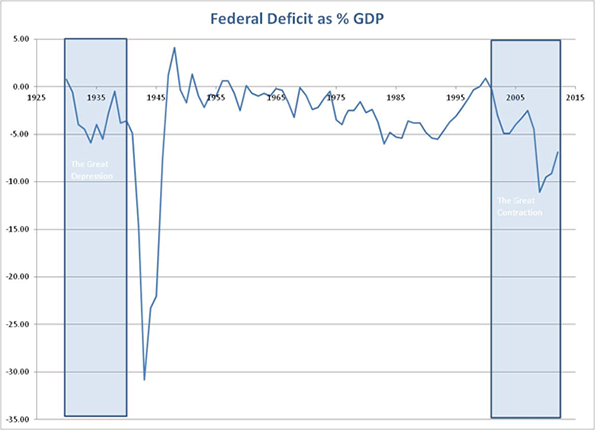
    Assuming he signs it, H.R. 325 allows the federal government to borrow money beyond the record $16.4 trillion debt we already owe. That debt is 104.5% of 2012’s $15.7 trillion GDP. The budget deficit – which has to be covered by borrowing – is running over $1 trillion each year or about 7% of GDP. The deficit alone is 44% of federal receipts. In other words, the government is spending over 40% more than it earns! That’s your government on crack.

    It is like living with a drug addict:

    “Waiting for the problem to resolve itself will get you nowhere. What you are seeing now, if it isn’t already completely out of control, will get completely out of control.”

    The difference is that we, the taxpayers and our children and our children’s children, have to shoulder the burden – something the families of addicts are advised not to do. In a democracy, the majority rules and the majority decided to continue to live with these fiscal crack addicts. For the rest of us, our choice has to be to try to remain optimistic – take the good news where you can find it. There are no “fiscal therapists” or “family support groups” for disgruntled voters. We must seek out the venues where we can talk about the problem openly, don’t be fooled when the fourth estate hides the crack vials to gain favor with the Washington and Wall Street elites and take care of ourselves.

    Susanne Trimbath, Ph.D. is CEO and Chief Economist of STP Advisory Services. Dr. Trimbath’s credits include appearances on national television and radio programs and the Emmy® Award nominated Bloomberg report Phantom Shares. She appears in four documentaries on the financial crisis, including Stock Shock: the Rise of Sirius XM and Collapse of Wall Street Ethics and the newly released Wall Street Conspiracy. Dr. Trimbath was formerly Senior Research Economist at the Milken Institute. She served as Senior Advisor on United States Agency for International Development capital markets projects in Russia, Romania and Ukraine. Dr. Trimbath teaches graduate and undergraduate finance and economics.

    Lead photo: Marion Barry smoking crack, screenshot from FBI surveillance video footage in 1990 via Wikipedia Commons.

  • California Becoming Less Family-Friendly

    For all of human history, family has underpinned the rise, and decline, of nations. This may also prove true for the United States, as demographics, economics and policies divide the nation into what may be seen as child-friendly and increasingly child-free zones.

    Where California falls in this division also may tell us much about our state’s future. Indeed, in his semi-triumphalist budget statement, our 74-year-old governor acknowledged California’s rapid aging as one of the more looming threats for our still fiscally challenged state.

    Gov. Jerry Brown, unsurprisingly, did not acknowledge or address the many factors driving the aging trend that include his own favored policy prescriptions. Whatever their intent, the usual "progressive" basket of policies have had regressive results: a tougher time for both the poor and middle class, and a set of density-oriented policies that are likely to drive up housing prices, particularly for the single-family houses largely preferred by people with children.

    These policies have helped turn California into a state that looks less Sunbelt and more like the long-aging centers of the Northeast and the Midwest. It also mirrors declines in fertility and marriage rates in the most-rapidly aging parts of Europe and east Asia. These regions are shifting toward what Chapman University’s recent report, in cooperation with the Civil Service College of Singapore, characterized as post-familialism. Released this past fall in Singapore, the report will be presented in Orange County this week.

    We believe that the rapid decline of marriage and fertility rates in many advanced countries inevitably leads to economic decline, reduced workforces and, likely, an inevitable fiscal disaster. This may be becoming now more true in the United States, a country which once boasted the most vibrant demographics in the high-income world but since the 2007-09 recession has seen a rapid drop in both its marriage rate and fertility rates to well below 2.1 children per female, what is generally referred to as "the replacement rate."

    Just as it differs by country, the degree of post-familialism varies among countries, but it also does among states and regions. Some states, notes a recent Packard Foundation study, such as Texas, Utah and North Carolina, have seen double-digit gains in their child populations over the past decade while California’s has dropped by over 3 percent. Some urban regions like Raleigh, Austin, Houston, Charlotte, Dallas-Fort Worth and Atlanta have also seen rises in their number of children, with population between ages 5 and 17 growing by 20 percent or more over the past decade.

    Historically, California and its regions stood among these family magnets, but no more. Like the states of the Northeast and upper Midwest, the Golden State is becoming rapidly geriatric, as families opt out, and immigration, the primary source of our growth in younger people, declines in an economy ill-suited to migrants with aspirations for a better life.

    Southern California, where immigration has dropped by roughly a third over the past decade, has shared in this decline.

    All three major regions of greater Los Angeles – the San Bernardino-Riverside area, Orange and Los Angeles counties – have seen a sharp drop in their percentages of children. Only the Inland Empire remains still relatively youthful overall, with some 26 percent of its population under 15, well above the national average. In contrast, Los Angeles and Orange counties experienced a 15.6 decline in under-15 population, highest among the nation’s metropolitan areas. Meanwhile, the over 60 population grew by 21 percent.

    One clear indicator can be seen in our declining school populations. Despite massive expenditures for new construction, over the past decade the Los Angeles Unified School District has seen enrollment drop by 7.5 percent. In that period, the student count fell by over 50,000, the largest numerical drop in the nation.

    What is leading to this exodus of families? Sacramento politicians and their media enablers blame insufficient investment in education or simply national aging trends as the root causes. But then, why are other states, including our key competitors, gaining families and children?

    Sacramento lawmakers of both parties share some responsibility. The dominant progressives’ regulatory and tax agenda continues to reduce economic prospects for younger Californians, leading many young families to exit the state. In contrast, older Anglos, the bulwark of the now largely irrelevant GOP, are committed to massive property tax breaks because of Proposition 13. Add good weather and the general inertia of age, and it’s not surprising that families might flee as seniors stay.

    Other factors work against parents, prospective or otherwise. The knee-jerk progressive response to our demographic problems usually entails more money be sent to the schools.

    But they rarely include the student-oriented reform measures such as those enacted in New Orleans (where I am working as a consultant). The poor performance of public education, clear from miserable test results and dropout rates, makes raising children in California either highly problematic or, factoring the cost of private education, extremely expensive.

    If you think Proposition 30’s higher sales and income taxes will change anything, think again.

    Much of that money will end up, almost inevitably, going toward pensions of teachers and other state workers. The hegemonic teacher unions have as their primary goal protecting the system at all costs and resisting change.

    Equally critical, the state’s "enlightened" planning policies also work to discourage families. California’s new climate-change-mandated housing regime – preferring apartments over houses – does not specifically target families, but the case for greater density is often predicated on an ever-declining number of families and an undemonstrated growing preference for density. "Singles and childless couples are the emerging household type of the future," suggests developer and smart growth guru Chris Leinberger.

    These post-familial trends have been incorporated into the influential report, "The New California Dream," widely accepted as gospel by many in our state’s development community.

    The author, the University of Utah’s Chris Nelson, interpreted early 2000s public opinion surveys to suggest a growing preference for smaller lot sizes and apartments, though the data indicate no change over the past 10 years. Developers assume that as singles, empty-nesters and childless couples become as the state’s primary market, this likely misperceived preference will gain even greater strength

    So what would a post-familial future mean for California? You don’t need a crystal ball to figure this one out. Just look at what is happening in other rapidly aging economies, especially Japan, but also much of Europe.

    Dense housing, high taxes and lack of space (such as back yards) tend to discourage family formation. Slower population and labor-force growth then slows the economic engine, which, in turn, creates a greater imbalance between workers and pensioners. The result, ultimately, could be a kind of fiscal Armageddon.

    Fortunately, none of this is inevitable. States such as Utah, Texas and North Carolina continue to attract families, bringing with them new workers, companies and customers. As their economies grow, they can generate broadly based revenue, unlike California, which is increasingly reliant on housing or stock-price bubbles that benefit the already affluent and older populations.

    It is not our karma, Gov. Brown, to submit to a Japanese-like demographic demise. But revitalizing California will require a radical reevaluation of priorities and reconsideration of policy impacts on families.

    Joel Kotkin is executive editor of NewGeography.com and a distinguished presidential fellow in urban futures at Chapman University, and a member of the editorial board of the Orange County Register. He is author of The City: A Global History and The Next Hundred Million: America in 2050. His most recent study, The Rise of Postfamilialism, has been widely discussed and distributed internationally. He lives in Los Angeles, CA.

    This piece originally appeared in the Orange County Register.

    Childhood kids photo by BigStockPhoto.com.

  • Time to Acknowledge Falling Private Car Use

    The prospect of falling car use now needs to be firmly factored into planning for western cities. 

    That may come as a bit of a surprise in light of the preoccupation with city plans that aim to get people out of their cars, but it is already happening.  And it is highly likely to continue regardless of whether or not we promote urban consolidation and expensive transit systems. 

    But not necessarily lower resource consumption
    Of course, as day-to-day travel savings are made by households these can simply result in other forms of consumption, offsetting any resource savings.  This should not be surprising.   Final demand embodies resources consumed right across the production and distribution chain.  Savings from lower transport spending (including commuting) – an intermediate input in the chain – that lead to lower prices translate into increases in discretionary spending (assuming constant or rising incomes). 

    Hence, the reduction in resource use and pollution sought by subsidising public transport and promoting higher density living may simply be spent on resource-intensive appliances, recreation, entertainment, and inter-city and international travel.

    Look to the fringe to look to the future
    Putting that inconvenient equation aside, long-term plans for cities should avoid simply projecting past behaviours into the future. Instead, we might look to changes at the margin that signal the issues, discoveries, and events that might determine the long-term outcomes we are interested in. 

    So let’s look at what’s happening at the margins of car use, focusing for the purpose of illustration on Auckland.

    First, travel demand
    The New Zealand Travel Survey has been conducted since 2003.  The results are published on a two-yearly rolling basis.  Using Statistics New Zealand population estimates I have calculated annual “per person” measures for Auckland from 2003 to 2011.  There are some sampling issues and qualifications regarding the survey that mean motor cycle and bicycle use statistics for Auckland are not considered reliable enough to use. Even given sampling error, the balance point to some significant and consistent shifts.

    For example, total travel (measured as annual kilometres per resident) appears to have peaked around 2007 (Figure 1). In fact, recorded travel declined by 15% over the period.  Public transport has done better, down 12% overall but actually increasing 13% between 2007 and 2011.

    Figure 1: Aucklanders’ Travel by Mode, 2003-2011


    More telling, though, has been declining car use.  The first column in Table 1 shows changes over the whole period.  The second column shows changes between the 2007 travel peak and 2011.

    The fall in car dependence since 2007 has been marked among passengers (-23%).  Perhaps that means fewer discretionary trips are being taken. This and a 14% decline in driver kilometres and 17% fewer trip legs confirms what the vehicle counts say – cars are being driven significantly less in Auckland  (particularly inner Auckland) now than they were five or ten years ago.

     
    Period

    2003-11
    Peak
    2007-11
    Driver
    Km
    -4%
    -14%
    Hours
    3%
    -12%
    Trip Legs
    1%
    -17%
    Passenger
    Km
    -33%
    -23%
    Hours
    -18%
    -17%
    Trip Legs
    -8%
    -22%
    All Car Users
    Km
    -16%
    -17%
    Hours
    -5%
    -13%
    Trip Legs
    -3%
    -19%

    Possible reasons:

    1.      We know already that an ageing population reduces car use.

    2.      Public transport is playing a growing but so far minor role (up from 3.7% to 3.9% share of all kilometres travelled).  An average 76km per person growth in public transport use since 2007 hardly offsets the 1,810km average contraction in distance travelled by car.

    3.      Lower real incomes and higher fuel prices play a part.  A sharp contraction since 2007 suggests that economic conditions have an impact on motoring far more immediate and influential than trying to reshape the shape the city and how people live in it might.   

    4.      The decentralisation of jobs, recreation and entertainment, professional services, and consumer services – including retailing – mean that people can get more done closer to where they live.  Trying to turn this clock back by pushing commercial activity back into the central city and then providing subsidised public transport to access it seems somewhat obtuse in the light of this development.

    Second, car purchases

    The Ministry of Transport publishes new car registrations (which include imported used cars).  It also provides data on the total  vehicle fleet since 2000.  

    Long-term registration statistics are interesting when related to national population data (Figure 2). Apart from a hiccup in 1991 growth in registrations was more or less continuous from 1950 until 2003.  Since then there has been a sharp decline.  Time will tell whether this is cyclical or signals a long-term shift.  It is noteable, though, that 2009, 2010, and 2011 figures fall well below trend.

    Figure 2: Trends in New Car Registrations

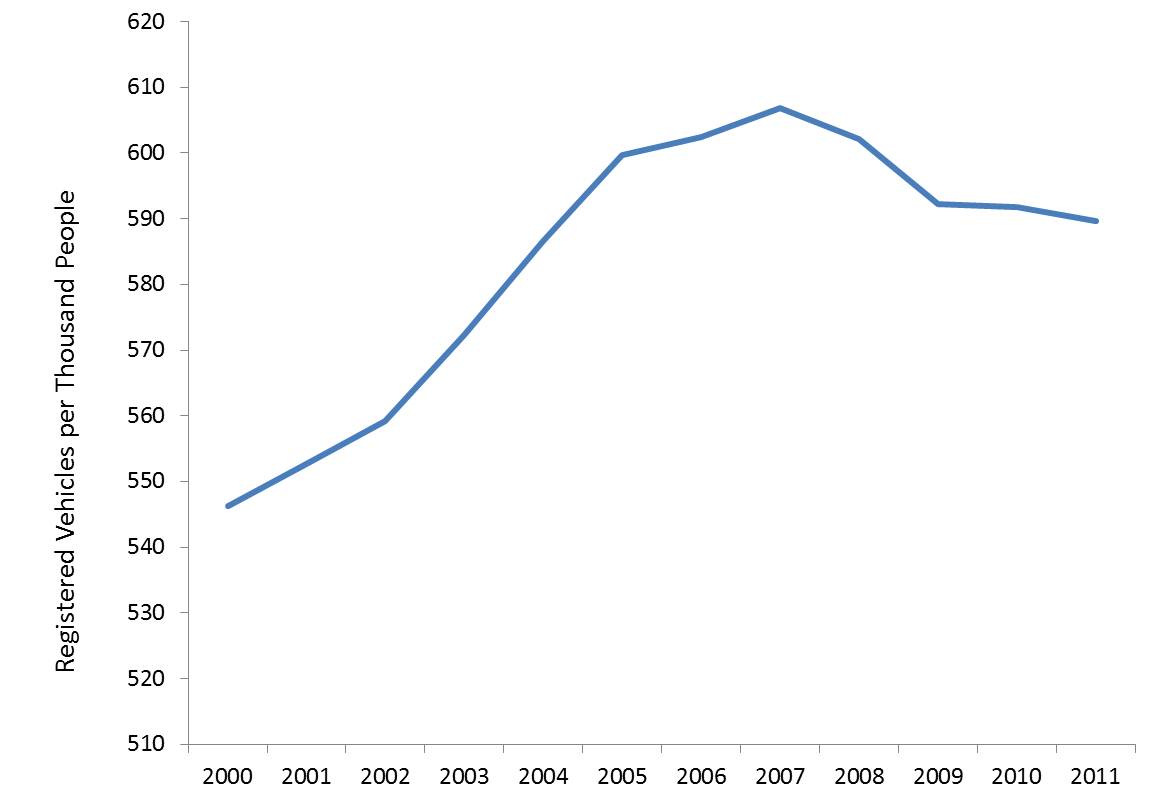
    This slowdown in new car registrations is reflected in two ways.  First, it is reflected in total fleet size, for which data are available from 2000 (Figure 3). This shows that  2007 was a turning point in total numbers, consistent with evidence that driving in Auckland peaked in that year.  That’s presumably good for the environment.

    Figure 3: New Car Registrations, New Zealand 2000-2011,

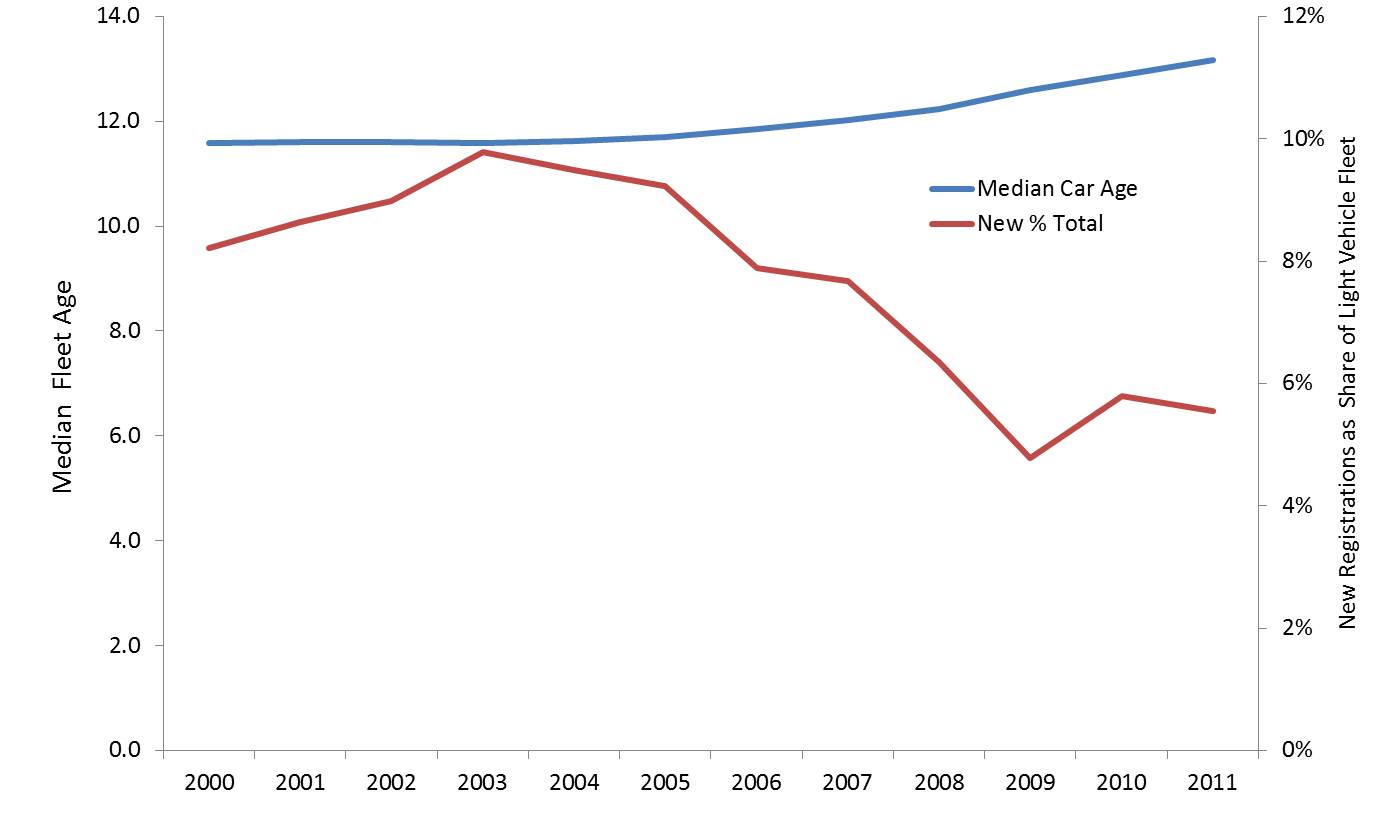
    Second, with the slow-down in imports, the fleet has begun to age (Figure 4).  That’s presumably bad for the environment, as older cars are less efficient and generate more emissions.

    Figure 4: New Zealand’s Ageing Car Fleet

    Third, fleet changes
    Fleet composition is changing as growth slows. The average CC rating of newly registered vehicles in 2000 was 2,127.  This climbed to 2,191 in 2005, but fell to 2,033 in 2011, an 8% fall in six years. 

    If this is a sign of things to come an increase in the turnover of vehicles would boost fleet efficiency over the medium term even without taking account of the greater engine efficiencies being delivered and gains among electric and hybrid vehicles

    Add to that the prospect supported by these numbers of increasing differentiation among vehicle styles (Figure 5).  At one end sits the large weekend recreational vehicle, perhaps falling as a share of new vehicles – or at least being down-sized.  At the other is the increasingly popular city runabout or smart car, and in the middle  the family sedan, the work horse with an engine size now likely to be well under 2,000cc.  

    Figure 5: Changes in Engine Size of Newly Registered Vehicles, 2000-2011

    So what does this all mean?
    There is evidence accumulating to suggest that significant changes are taking place at the margin of transport demand and car dependence.  If this is a sign of things to come it raises questions about long-term road expenditure, about dire predictions of road congestion, and about the benefits of adopting expensive land use and transport measures designed to force people out of their cars.

    Already, within a more constrained economy, people seem to be making their own decisions to reduce car dependence.

    In terms of city planning, it suggests that decentralisation may be more sustainable than the compact city protagonists make out.  In this respect, is interesting that motorway traffic counts show that significant reductions in inner city vehicle flows are offset by gains (albeit much smaller) in outer parts of the city – even as measured distance travelled falls. 

    And Auckland definitely needs to rethink assumptions behind spending plans for major road and rail infrastructure – and confront the risks and costs of getting them wrong. 

    And, incidentally, it’s about time New Zealand’s Ministry for the Environment updated its report card on trends in the environmental impact of vehicle travel – which only goes up to 2007, a year which may prove to be a turning point in long-term travel behaviour.

    Phil McDermott is a Director of CityScope Consultants in Auckland, New Zealand, and Adjunct Professor of Regional and Urban Development at Auckland University of Technology.  He works in urban, economic and transport development throughout New Zealand and in Australia, Asia, and the Pacific.  He was formerly Head of the School of Resource and Environmental Planning at Massey University and General Manager of the Centre for Asia Pacific Aviation in Sydney. This piece originally appeared at is blog: Cities Matter.

    Aukland harbour photo by Bigstockphoto.com.