Blog

  • The Springfield Strategy

    I just enjoyed an adventure in Springfield, Massachusetts with Steve Shultis and his wife Liz of Rational Urbanism. Steve does a far better job of describing his town and his philosophy than I ever could, but my interpretation can be summed up with an analogy about an old college room mate.

    At the end of my first year at university I was approached by an engineering student who asked if he could be my room mate next year. We didn’t know each other particularly well and didn’t have much in common, but he seemed harmless enough. I shrugged. Sure. We went our separate ways over the summer and in September he appeared at my door. After a few months of successfully sharing accommodations I asked him why he came to me when most guys in his situation would have gone in a very different direction. He explained.

    The average college freshman tends to have an adolescent understanding of what a good independent life might be like. Young men are motivated by peculiar impulses and the siren song of the frat house calls. Beer. Parties. Girls. Sports cars. The prestige of hanging out with rich kids, athletes, and really popular older guys. He said that was usually a big mistake. The furniture is made of plastic milk crates. The place smells like a locker room. People eat ramen and cold day old pizza out of the box. They wear flip flops in the shower because no one has ever cleaned the bathroom. Ever. And when you bring a girl home there are a dozen bigger richer guys with fancier cars than you hovering around. You sit there trying to get your romance on with posters of naked women taped to the walls next to a collection of empty bottles. And you pay extra for all this… It’s just not a great situation.

    Then he made a sweeping motion with his hand indicating our apartment. A pleasing mixture of antiques and modern pieces. Smells like lemons. When he brings a girl home I’m in the kitchen cooking brisket and home made bread. Soft lighting. Ella Fitzgerald is playing in the background. No competition. And it’s cheaper. For him, doing the unorthodox and socially uncomfortable thing was just… rational.

    Back to Springfield. Steve took a version of the same strategy. He and his family live in a gracious four story French Second Empire mansion. The place is huge and everywhere you look there’s a level of detail and quality you can’t find in any home built today. There’s a legal apartment on the lower level that they use as a guest suite.  I looked up the address on a real estate listing site and he paid less for this house than many people spend on their cars. His family has a quality of life and a degree of financial freedom that none of his suburban piers can comprehend.

    Most people load themselves up with massive amounts of debt in order to live the way they believe they’re supposed to. You wouldn’t want to put your kids in a substandard urban school with the wrong element. You wouldn’t want to buy a house that never appreciated in value. You wouldn’t want to have to explain to your friends, family, and co-workers that you live in a slum with poor black people and Puerto Ricans. And where do you park?! It’s so much “better” to soak yourself in debt to buy your way in to the thing you believe you can’t live without.

    A walk around the block brought us to the family doctor, numerous great places to eat, and one of the best little Italian grocery stores I’ve seen in years.

    A few more blocks and we arrived at the civic center, museum district, and numerous pubic parks. Like most older downtown areas Springfield experienced decades of depopulation and disinvestment with white flight to the suburbs and out migration to the sun belt. As the years passed and the economy shifted once again some downtowns boomed, but it was a winner-take-all scenario in Boston, New York, and San Francisco that hasn’t touched second and third tier towns farther afield. Springfield is half empty, but the full half is amazing and spectacularly affordable.

    If you’re looking for a large fully detached home with a yard Springfield has an abundance. These elegant homes are right on the edge of downtown within bicycle distance. This is an excellent alternative to suburban living for families with children who appreciate urban amenities. Homes like these close to Boston sell for millions. In Springfield they sell for pennies on the dollar.

    I like to poke around the ugly parts of town in search of hidden nuggets. The most interesting people tend to need two things: affordable property and a lightly regulated environment. It helps if absolutely no one with any authority cares about the location.

    Gasoline Alley is the old industrial corridor that supplies Springfield with fuel and associated services. More than a few of the older buildings are no longer viable for their original purposes. Lo and behold, the void is being filled with good music, food and drink.

    As much as I appreciate the “creative class’ and the importance of “third places” at the end of the day towns need to be productive before anything else can be supported. Local indoor food production is a viable business model in Springfield. It costs 56¢ to grow a head of lettuce hydroponically and it sells for $3. At first I questioned the level of electricity and other inputs associated with this kind of cultivation. Isn’t it just cheaper and easier to grow things in the ground with sunlight? Turns out… not so much most of the year in Massachusetts.  The alternative is bringing veggies in from California and Florida in refrigerated trucks. That involves far more energy and creates a critical dependency on systems locals have no control over. This particular entrepreneur can’t keep up with demand for his products.

    That takes me to another point that no one seems to be talking about these days. Towns like Springfield were once the economic engines of their day. They managed to engage in national and international trade while doing so in an intensely local manner. The primary resources used for commerce and industry were readily at hand: hydro power from rivers, wood from abundant forests, and minerals from local quarries. And raw materials and finished products were transported along the canal system using nothing more than a mule pulling a barge. If you’re looking for an environmental, renewable, durable, and resilient economic base you could do a lot worse than re-inhabiting the mothballed facilities in a place like Springfield.

    This piece first appeared on Granola Shotgun.

    John Sanphillippo lives in San Francisco and blogs about urbanism, adaptation, and resilience at granolashotgun.com. He’s a member of the Congress for New Urbanism, films videos for faircompanies.com, and is a regular contributor to Strongtowns.org. He earns his living by buying, renovating, and renting undervalued properties in places that have good long term prospects. He is a graduate of Rutgers University.
  • The Great Non-Profit Die Off

    Marc Lapides wrote an op-ed in Crain’s Chicago Business calling for an 1871 accelerator for creating new non-profits.

    Most cities could actually use the opposite. What they need is an infrastructure for euthanizing non-profits that are past their expiration date.

    When I look around older cities, I frequently see that they’ve got a veritable armada of non-profits. Rarely do I see these making a huge difference in the trajectory of the city.

    The usual complaint about too many non-profits is that they aren’t coordinated, and so often overlap or don’t work well together on whatever cause it is they are trying to advance.

    This actually doesn’t bother me. The temptation to try to create a single uber-structure for everything is always there, but distributed systems have their own virtues. And where there are legitimate problems, the organizations generally come up with a solution. An example is the various “clearing house” organizations that charitable orgs use to prevent double-dipping.

    The bigger problem is that all these non-profits are basically sand in the gears that make it harder to get anything done. While the Lapides talks about innovation, from what I’ve seen non-profits seem to be among the biggest advocates for the status quo.

    Ironically, Lapides implicitly makes this point when he acknowledges funders prefer big, established organization.

    Try to do anything in a city and you’ll be told to meet with all these “stakeholders”, a large percentage of whom are non-profit leaders who claim to speak in the name of some constituency or cause but too often represent their own personal fief.

    Anyone wanting to do things in a city has to run this gauntlet of non-profits and find a way to placate them.

    Sean Safford’s famous study “Why the Garden Club Couldn’t Save Youngstown” is a perfect example of this. The Garden Club – a non-profit – was basically a vehicle for reinforcing existing social networks, creating excess social capital that made change difficult.

    Too many cities are like Safford’s Youngstown. They could use a culling of non-profits more than the creation of new ones.

    Killing unneeded stuff off is hard almost everywhere. For example, eliminating an obsolete app or even a report can be very difficult, as I can tell you from my IT experience. But I can also tell you a lot of them do very little. One time I replaced a legacy system with over a thousand reports. We went live with less than 15 initially critical reports, and the lack of the other 1000+ made no difference. In cities, the Pareto principle likely applies to non-profits as it does everywhere else: the top 20% most effective non-profits deliver 80% of the public benefits.

    But just because eliminating organizations is hard doesn’t mean it’s not worthwhile. In cities that are having trouble changing or dealing with problems, leaders should be looking harder at getting rid of a bunch of non-profits than they are at starting new ones.

    This piece was originally published on Urbanophile.

    Aaron M. Renn is a senior fellow at the Manhattan Institute, a contributing editor of City Journal, and an economic development columnist for Governing magazine. He focuses on ways to help America’s cities thrive in an ever more complex, competitive, globalized, and diverse twenty-first century. During Renn’s 15-year career in management and technology consulting, he was a partner at Accenture and held several technology strategy roles and directed multimillion-dollar global technology implementations. He has contributed to The Guardian, Forbes.com, and numerous other publications. Renn holds a B.S. from Indiana University, where he coauthored an early social-networking platform in 1991.

    Image via Crain’s Chicago Business.

  • Fading Promise: Millennial Prospects in the Golden State

    This is the introduction to a new report published by the Chapman University Center for Demographics and Policy titled, “Fading Promise: Millennial Prospects in the Golden State.” Read the full report (pdf) here.

    Along with the report, a new video from Chapman University and the California Association of Realtors talks about the housing crisis in California. Watch it here.

    Throughout much of American history there was a common assumption that each generation would do better than the previous one. That assumption is now being undermined. The emerging millennial generation faces unprecedented economic challenges and, according to many predictions, diminished prospects.

    These problems are magnified for California’s millennials. Their incomes are not higher than those in key competitive states, but the costs they must absorb, particularly for housing, are the highest in the country. Their prospects for homeownership are increasingly remote, given that the state’s housing prices have risen to 230 percent of the national average.

    The long-term implications for California are profound. The lack of housing that can be afforded by middle-income households—particularly to buy—has driven substantial out-migration from the state. California has experienced a net loss in migrants for at least the last 15 years. This includes younger families—those in their late 30s and early 40s—which is the group most likely to leave the state. For every two home buyers who came to the state, five homeowners left, notes the research firm Core Logic.

    Over the next decade, as the majority of millennials reach these ages, the long-term implications for employers and communities are profound. Rising house prices and rents are already impacting employers, including in Silicon Valley. High prices can also mean a rapidly aging population, something that is likely to sap the economic potential and innovation in our communities.

    Many of California’s problems are self-inflicted, the result of misguided policies that have tended to inflate land prices and drive up the cost of all kinds of housing. Since housing is the largest household expenditure, this pushes up the cost of living.

    California still has the landmass and the appeal to power opportunity for the next generation. It is up to us to reverse the course, and restore The California Dream for the next generation.

    Read the full report here.

  • Subsidies Haven’t Increased Transit Ridership

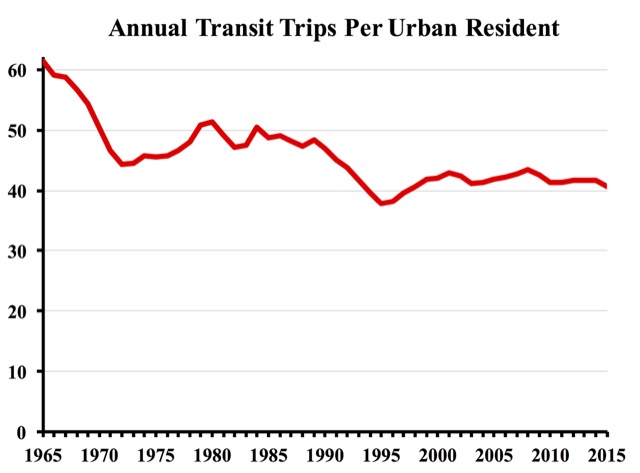
    In 2015, the American Public Transportation Association issued a press release whose headline claimed that transit ridership in 2014 achieved a new record. However, the story revealed that 2014 ridership was the highest since 1956. That’s no more a record than if it was the highest since 2013.

    The truth is that America’s urban population more than doubled between 1956 and 2014. Using the ridership number that really counts–trips per urban resident–2014’s number was a near-record low of 41 trips per person. The only time it was lower before 2014 was a few years in the mid-1990s, when ridership dropped to as low as 38 trips per person. The rate may fall to nearly that level in 2016.

    When Congress passed the Urban Mass Transportation Act of 1964, Americans took an average of 62 transit trips per person. At that time, 82 percent of all transit systems were privately owned. Within a decade, nearly every major transit system and all but a handful of minor ones were “municipalized” and the subsidies began to flow. At first, the federal government provided only capital subsidies, but in 1974 it also provided operating subsidies.

    By 1978, half of operating costs and, of course, all of the capital costs were subsidized. By the late 1980s, fares covered only a little more than a third of operating costs. With most money coming from taxpayers, transit agencies were more beholden to politicians than transit riders, and they became more interested in spending money to please political interests than in boosting transit ridership.

    Since 1965, transit operating subsidies (adjusted for inflation to today’s dollars) total close to $800 billion. We don’t have accurate capital cost data from before 1992, but since then we’ve spent close to $400 billion on capital programs (which in the transit industry include maintenance), most of it on rail transit.

    Thus, well over a trillion dollars in subsidies has resulted in transit ridership falling from 61 trips per urban resident in 1965 to 41 trips in 2015, and even less in 2016. The chart above shows that trips per urbanite have fluctuated since 1970, but those fluctuations are mainly in response to gasoline prices while the general trend is downward. To a large degree, this downward trend is because the subsidies have made transit agencies more responsive to politics than transit riders.

    Advocates of industrial policy argue that government should pick growth industries and nurture them along to help maintain American preeminence in new technologies. Skeptics suggest that government is more likely to pick losers than winners. Transit is clearly one of those losers.

    Most statistics in this post are from the American Public Transportation Association’s 2016 Public Transportation Fact Book data spreadsheet. Data for 2015 is from the National Transit Database. Urban population data are from the Census Bureau.

    This piece first appeared on The Antiplanner.

    Randal O’Toole is a senior fellow with the Cato Institute specializing in land use and transportation policy. He has written several books demonstrating the futility of government planning. Prior to working for Cato, he taught environmental economics at Yale, UC Berkeley, and Utah State University.

    Photo:

  • Father of the Bernie Sanders Presidency

    President Trump’s elite-managed populism opens a path for a more genuine version.

    On the usual political spectrum, there are left and right, people who call themselves progressive or conservative, socialist/social democrat or capitalist. But these labels seem to mean less today than in the past. The Trump phenomenon highlighted another divide that has little to do with the historic left and right. Crudely speaking, we can call it coastal vs. non-coastal, urban vs. rural, ethnically diverse vs. more homogeneous, elitist vs. populist. This at least is the way the dominant media sees it.

    (click chart to enlarge)

    At the same time, the old labels are not completely dead. So if we try to overlay the new on the old and to categorize the Trump following, we could say that some of the old guard conservatives joined forces with the new rural populists. This is a little complicated and barely makes sense given that the former include some of the elites, in other words the very same people who have angered the populists for the past decade. Many people who want lower taxes and free trade and globalization voted for the same person, Donald Trump, as did people who want import tariffs and restrictions on the flows of people, capital and goods. Some of the same people who survived in 2008 thanks to Wall Street bailouts voted for the same candidate as did people who are still seething over the bailouts.

    donald_trump_official_portraitWhen a human construct no longer makes sense because it is the product of decades of layering of one strain over another, it may be better to restart with a clean slate and to find new models to explain the present.

    Our own favorite model is to hypothesize that the country has drifted away from laissez-faire for several decades and that it has been moving towards socialism. The current interregnum is the time when cronies rule the land. Starting around 1990, cronyism corrupted laissez-faire, an unsurprising evolution since laissez-faire is never pure anyway. And later cronyism heralded its own final mutation into socialism. The case we made in The Bridge from Laissez-faire to Socialism is that socialism is not the system that replaces capitalism, but the system that replaces one form of cronyism with another. The sequence therefore is laissez-faire to the first form of cronyism to the second form of cronyism.

    The older form of cronyism claims to be capitalistic (thus the oft-seen oxymoron “crony capitalism”) and the newer form claims to be egalitarian but they are essentially the same, except for the identities of the cronies at the top who extract the most wealth for themselves and their friends. Because egalitarianism is usually less efficient at managing wealth, there may also be a smaller number of cronies under socialism, which makes the infighting among its leaders that much more bitter and savage.

    Feel the Bern 2020

    On this theory and on current trends then, Bernie Sanders would be elected President of the United States in 2020.

    This may look like a bold assertion, mitigated only by the fact that Senator Sanders is already aged 75 today. If he were elected in 2020, could he remain in office until the age of 83? Very possible, given the medical profession’s ability to keep us alive and functioning well into our eighties. For example, another socialist, Robert Mugabe of Zimbabwe, is now 93 and intends to run for another five-year term in 2018.

    At any rate, voters will not care about the Senator’s age, just as they did not care about candidate Trump’s own shortcomings. What will matter to them is that candidate Sanders will be the flag bearer leading in his wake a younger Vice-President and a slew of new generation Democrats who will be just as eager to undo four years of Trump/Pence as Trump/Pence have been to undo eight years of Obama/Biden.

    To every action, there is an equal or, in the case of politics, a greater reaction. When President Obama alienated half of the electorate by passing the Affordable Care Act through unorthodox procedures, the seed for the Tea Party and then for the rise of Trump was planted. And Trump has already planted the seed for Sanders or of his young charismatic political heir, whoever he or she may be. Or, if that seed was already planted thanks to Senator Sanders’ own strong showing during the campaign, the President’s recent actions have provided a truckload of nutritious fertilizer. The anti-Trump blowback so far does not look like a slow growing plant.

    The President’s Barbell Strategy

    Although he has styled himself a populist, Mr. Trump is mainly a populist when he fires messages on Twitter or when he holds rallies in rural settings, places where he would otherwise rarely venture except perhaps to play golf. But when he goes back to New York, Washington or Mar-a-Lago, he is once again surrounded through his own choice by the same usual East Coast elites who for three decades have thrived at the courts of the Bushes, the Clintons and the Obamas.

    President Trump’s entourage is more elitist than populistic. Even the unconventional Steve Bannon graduated from Harvard Business School and was a one-time banker, and cannot therefore claim the life story of an authentic populist. Team Trump’s populism is not truly organic, but looks instead like posturing and voyeurism, like that of investment bankers occupying the most expensive seats at a Bruce Springsteen concert. It can be very enjoyable for the elite to glimpse the world of the working class, so long as they are never at risk of becoming a part of it.

    The President’s barbell strategy of on the one hand giving lip service to blue-collar populism while on the road, and on the other hand appointing some of the same people that a dyed in the wool elitist would have also appointed, has paid off very nicely so far. It is however inherently unstable and unsustainable except under the scenario of a thriving economy. To his credit, Mr. Trump knows this, which is why he will be holding a rally for his base every so often as a way to tell them that he has not forgotten them, even though finance and energy billionaires happen to be among his favorite people in the world. Normally, only a casuist would attempt to square this circle but the President’s distinct genius has enabled him to pull if off so far.

    It will be interesting to see for how long this magical balancing act can be maintained. An easy answer would be: until the next economic slowdown. It is fine to play both sides as long as things are improving, or expected to be improving soon. People believe what they want to believe. But failure to deliver for the thriving elite or for the suffering working class will turn either or both into potent Trump adversaries. And this is how an opening would be created for Senator Sanders.

    TRiUMPh of the Cronies

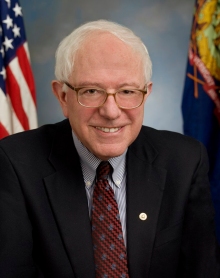
    Sanders-021507-18335- 0004But why Sanders?

    Instead of attacking cronyism, the endemic problem of our age, as a true populist might do, President Trump has instead given it a strong new lease on life. In truth, whether Hillary Clinton or Donald Trump prevailed last November, the die had been cast that the winner would represent the culmination of cronyism in its ultimate triumph. Both Mrs. Clinton and Mr. Trump have crony credentials that exceed those of former presidents. Therefore, the election of POTUS 45 probably signaled the end of something and not the beginning of something, notwithstanding Mr. Trump’s new-dawn declarations to the contrary.

    For evidence of cronyism’s final ascent to the seat of power, consider again Mr. Trump’s selections for cabinet and advisory positions. Several are successful operators in business activities that are often associated with cronyism, in this case narrow sub-sectors of energy, finance, law and real estate. What differentiates them is not their success, which by itself would be admirable, but their success in cracks of the laissez-faire economy that are extractive or rent-seeking and largely reliant on government dealing and connections, which is less admirable.

    The New York Times reported the following on 15 April 2017:

    President Trump is populating the White House and federal agencies with former lobbyists, lawyers and consultants who in many cases are helping to craft new policies for the same industries in which they recently earned a paycheck.

    Socialism’s day would come in four years because Mr. Trump has misread the economic tea leaves and has ascribed the moribund economy to an excess of taxes and regulations instead of to the true culprit, which is deteriorating demographics. As a consequence his efforts to ignite another Reagan style boom and to create 25 million new jobs are unlikely to succeed. Mr. Sanders is one of the most vocal critics of cronyism and his speech will be rich with I-told-you-sos if President Trump’s impending deregulation of Wall Street leads to another financial crisis on top of a weaker economy.

    After being disappointed by both Obama and Trump, the struggling working class and shrinking middle class will be ready to try yet another new thing. Electing a socialist will be the boomers’ last hurrah and the millennials rose-tinted dream of a new paradise finally blanketing the earth. Joel Kotkin recently noted:

    The millennials —arguably the most progressive generation since the ’30s—could drive our politics not only leftward, but towards an increasingly socialist reality, overturning many of the very things that long have defined American life.

    and further:

    The long-term hopes of the American left lie with the millennial generation. The roughly 90 million Americans born between 1984 and 2004 seem susceptible to the quasi socialist ideology of the post-Obama Democratic Party. They are also far more liberal on key social issues—gender and gay rights, immigration, marijuana legalization—than any previous generation. They comprise the most diverse adult generation in American history: some 40 percent of millennials come from minority groups, compared to some 30 percent for boomers and less than 20 percent for the silent and the greatest generations.

    Millennials’ defining political trait is their embrace of activist government. Some 54 percent of millennials, notes Pew, favor a larger government, compared to only 39 percent of older generations. One reason: Millennials face the worst economic circumstances of any generation since the Depression, including daunting challenges to home ownership. More than other generations, they have less reason to be enamored with capitalism.

    Sanders’ Math

    As to Senator Sanders’ math in 2020, it should be remembered that Mr. Trump carried two pivotal states, Michigan and Wisconsin, by very narrow margins in the general election and that Mr. Sanders won both of these states in the primaries. It would not take a lot for both to tip to Mr. Sanders in a possible Sanders-Trump showdown in 2020.

    screen-shot-2017-02-27-at-12-34-45-pm

    The addition of Ohio or Pennsylvania, both of which were won by Trump in 2016 and by Obama in 2008 and 2012, would be sufficient to secure Mr. Sanders victory if no other states changed sides in 2020 vs. 2016.

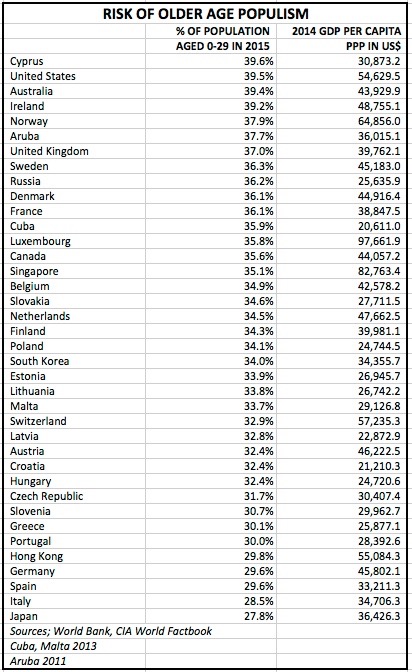
    As noted in So You Want a Revolution, the United States is one of many richer countries at risk of older age populism. These countries have relatively older populations (only 40% or less of the population aged 0-29) and higher GDP per capita ($20,000+).


    Demographics, combined with breakthrough innovations and strong institutions, have made America very wealthy in recent decades. We are now at a critical juncture and at risk of squandering our prosperity by focusing on a wrong set of problems and by empowering the wrong leaders, Trump and stage 1 cronyism that will lead to Sanders and stage 2 cronyism, or socialism.

    Sami Karam is the founder and editor of populyst.net and the creator of the populyst index™. populyst is about innovation, demography and society. Before populyst, he was the founder and manager of the Seven Global funds and a fund manager at leading asset managers in Boston and New York. In addition to a finance MBA from the Wharton School, he holds a Master’s in Civil Engineering from Cornell and a Bachelor of Architecture from UT Austin.

    Bernie Sanders photo by Michael Vadon [CC BY-SA 2.0], via Wikimedia Commons.

  • California Squashes Its Young

    In this era of anti-Trump resistance, many progressives see California as a model of enlightenment. The Golden State’s post-2010 recovery has won plaudits in the progressive press from the New York Times’s Paul Krugman, among others. Yet if one looks at the effects of the state’s policies on key Democratic constituencies— millennials, minorities, and the poor—the picture is dismal. A recent United Way study found that close to one-third of state residents can barely pay their bills, largely due to housing costs. When adjusted for these costs, California leads all states—even historically poor Mississippi—in the percentage of its people living in poverty.

    California is home to 77 of the country’s 297 most “economically challenged” cities, based on poverty and unemployment levels. The population of these cities totals more than 12 million. In his new book on the nation’s urban crisis, author Richard Florida ranks three California metropolitan areas—Los Angeles, San Francisco, and San Diego— among the five most unequal in the nation. California, with housing prices 230 percent above the national average, is home to many of the nation’s most unaffordable urban areas, including not only the predictably expensive large metros but also smaller cities such as Santa Cruz, Santa Barbara, and San Luis Obispo. Unsurprisingly, the state’s middle class is disappearing the fastest of any state.

    California’s young population is particularly challenged. As we spell out in our new report from Chapman University and the California Association of Realtors, California has the third-lowest percentage of people aged 25 to 34 who own their own homes—only New York and Hawaii’s are lower. In San Francisco, Los Angeles, and San Diego, the 25-to-34 homeownership rates range from 19.6 percent to 22.6 percent—40 percent or more below the national average.

    Read the entire piece at City Journal.

    Joel Kotkin is executive editor of NewGeography.com. He is the Roger Hobbs Distinguished Fellow in Urban Studies at Chapman University and executive director of the Houston-based Center for Opportunity Urbanism. His newest book, The Human City: Urbanism for the rest of us, will be published in April by Agate. He is also author of The New Class ConflictThe City: A Global History, and The Next Hundred Million: America in 2050. He lives in Orange County, CA.

    Wendell Cox is principal of Demographia, an international public policy and demographics firm. He is a Senior Fellow of the Center for Opportunity Urbanism (US), Senior Fellow for Housing Affordability and Municipal Policy for the Frontier Centre for Public Policy (Canada), and a member of the Board of Advisors of the Center for Demographics and Policy at Chapman University (California). He is co-author of the “Demographia International Housing Affordability Survey” and author of “Demographia World Urban Areas” and “War on the Dream: How Anti-Sprawl Policy Threatens the Quality of Life.” He was appointed to three terms on the Los Angeles County Transportation Commission, where he served with the leading city and county leadership as the only non-elected member. He served as a visiting professor at the Conservatoire National des Arts et Metiers, a national university in Paris.

    Photo: Dirk Beyer (Own work) [GFDL, CC-BY-SA-3.0 or CC BY-SA 2.5], via Wikimedia Commons

  • The Arrogance of Blue America

    In the wake of the Trumpocalypse, many in the deepest blue cores have turned on those parts of America that supported the president’s election, developing oikophobia—an irrational fear of their fellow citizens.

    The rage against red America is so strong that The New York Time’s predictably progressive Nick Kristoff says his calls to understand red voters were “my most unpopular idea.” The essential logic—as laid out in a particularly acerbic piece in The New Republic—is that Trump’s America is not only socially deplorable, but economically moronic as well. The kind-hearted blue staters have sent their industries to the abodes of the unwashed, and taken in their poor, only to see them end up “more bitter, white, and alt-right than ever.”

    The red states, by electing Trump, seem to have lost any claim on usually wide-ranging progressive empathy. Frank Rich, theater critic turned pundit, turns up his nose at what he calls “hillbilly chic.” Another leftist author suggests that working-class support for Brexit and Trump means it is time “to dissolve” the “more than 150-year-old alliance between the industrial working class and what one might call the intellectual-cultural Left.”

    The fondest hope among the blue bourgeoise lies with the demographic eclipse of their red-state foes. Some clearly hope that the less-educated “dying white America,“ already suffering shorter lifespans, in part due to alcoholism and opioid abuse, is destined to fade from the scene. Then the blue lords can take over a country with which they can identify without embarrassment.

    Marie Antoinette Economics

    In seeking to tame their political inferiors, the blue bourgeoisie are closer to the Marie Antoinette school of political economy than any traditional notion of progressivism. They might seek to give the unwashed red masses “cake” in the form of free health care and welfare, but they don’t offer more than a future status as serfs of the cognitive aristocracy. The blue bourgeoisie, notes urban analyst Aaron Renn, are primary beneficiaries of “the decoupling of success in America.” In blue America, he notes, the top tiers “no longer need the overall prosperity of the country to personally do well. They can become enriched as a small, albeit sizable, minority.”

    Some on the left recognize the hypocrisy of progressives’ abandoning the toiling masses. “Blue state secession is no better an idea than Confederate secession was,” observes one progressive journalist. “The Confederates wanted to draw themselves into a cocoon so they could enslave and exploit people. The blue state secessionists want to draw themselves into a cocoon so they can ignore the exploited people of America.”

    Ironically, many of the most exploited people reside in blue states and cities. Both segregation and impoverishment has worsened during the decades-long urban “comeback,” as even longtime urban enthusiast Richard Florida now notes. Chicago, with its soaring crime rates and middle class out-migration, amidst a wave of elite corporate relocations, epitomizes the increasingly unequal tenor of blue societies.

    In contrast the most egalitarian places, like Utah, tend to be largely Trump-friendly. Among the 10 states (and D.C.) with the most income inequality, seven supported Clinton in 2016, while seven of the 10 most equal states supported Trump.

    If you want to see worst impacts of blue policies, go to those red regions—like upstate New York—controlled by the blue bourgeoise. Backwaters like these tend to be treated at best as a recreational colony that otherwise can depopulate, deindustrialize, and in general fall apart. In California, much of the poorer interior is being left to rot by policies imposed by a Bay Area regime hostile to suburban development, industrial growth, and large scale agriculture. Policies that boost energy prices 50 percent above neighboring states are more deeply felt in regions that compete with Texas or Arizona and are also far more dependent on air conditioning than affluent, temperate San Francisco or Malibu. Six of the 10 highest unemployment rates among the country’s metropolitan areas are in the state’s interior.

    Basic Errors in Geography

    The blue bourgeoisie’s self-celebration rests on multiple misunderstandings of geography, demography, and economics. To be sure, the deep blue cites are vitally important but it’s increasingly red states, and regions, that provide critical opportunities for upward mobility for middle- and working-class families.

    The dominant blue narrative rests on the idea that the 10 largest metropolitan economies represents over one-third of the national GDP. Yet this hardly proves the superiority of Manhattan-like density; the other nine largest metropolitan economies are, notes demographer Wendell Cox, slightly more suburban than the national major metropolitan area average, with 86 percent of their residents inhabiting suburban and exurban areas.

    In some of our most dynamic urban regions, such as Phoenix, virtually no part of the region can be made to fit into a Manhattan-, Brooklyn-, or even San Francisco-style definition of urbanity. Since 2010 more than 80 percent of all new jobs in our 53 leading metropolitan regions have been in suburban locations. The San Jose area, the epicenter of the “new economy,” may be congested but it is not traditionally urban—most people there live in single-family houses, and barely 5 percent of commuters take transit. Want to find dense urbanity in San Jose? You’ll miss it if you drive for more than 10 minutes.

    Urban Innovation

    The argument made by the blue bourgeoisie is simple: Dense core cities, and what goes on there, is infinitely more important, and consequential, than the activities centered in the dumber suburbs and small towns. Yet even in the ultra-blue Bay Area, the suburban Valley’s tech and STEM worker population per capita is twice that of San Francisco. In southern California, suburban Orange County has over 30 percent more STEM workers per capita than far more urban Los Angeles.

    And it’s not just California. Seattle’s suburban Bellevue and Redmond are home to substantial IT operations, including the large Microsoft headquarters facility. Much of Portland’s Silicon Forest is located in suburban Washington County. Indeed a recent Forbes study found that the fastest-growing areas for technology jobs outside the Bay Area are all cities without much of an urban core: Charlotte, Raleigh Durham, Dallas-Fort Worth, Phoenix, and Detroit. In contrast most traditionally urban cities such as New York and Chicago have middling tech scenes, with far fewer STEM and tech workers per capita than the national average.

    The blue bourgeois tend to see the activities that take place largely in the red states—for example manufacturing and energy—as backward sectors. Yet manufacturers employ most of the nation’s scientists and engineers. Regions in Trump states associated with manufacturing as well as fossil fuels—Houston, Dallas-Fort Worth, Detroit, Salt Lake—enjoy among the heaviest concentrations of STEM workers and engineers in the country, far above New York, Chicago, or Los Angeles.

    Besides supplying the bulk of the food, energy, and manufactured goods consumed in blue America, these industries are among the country’s most productive, and still offer better paying options for blue-collar workers. Unlike a monopoly like Microsoft or Google, which can mint money by commanding market share, these sectors face strong domestic and foreign competition. From 1997-2012, labor productivity growth in manufacturing—3.3 percent per year—was a third higher than productivity growth in the private economy overall.

    For its part, the innovative American energy sector has essentially changed the balance of power globally, overcoming decades of dependence on such countries as Saudi Arabia, Russia, and Venezuela. Agriculture—almost all food, including in California, is grown in red-oriented areas—continues to outperform competitors around the world.

    Exports? In 2015, the U.S. exported $2.23 trillion worth of goods and services combined. Of the total, only $716.4 billion, or about a third, consisted of services. In contrast, manufactured goods accounted for 50 percent of all exports. Intellectual property payments, like royalties to Silicon Valley tech companies and entrepreneurs, amounted to $126.5 billion—just 18 percent of service exports and less than 6 percent of total exports of goods and services combined, barely even with agriculture.

    Migration and the American Future

    The blue bourgeoisie love to say “everyone” is moving back to the city; a meme amplified by the concentration of media in fewer places and the related collapse of local journalism. Yet in reality, except for a brief period right after the 2008 housing crash, people have continued to move away from dense areas.

    Indeed the most recent estimates suggest that last year was the best for suburban areas since the Great Recession. In 2012, the suburbs attracted barely 150,000 more people than core cities but in 2016 the suburban advantage was 556,000. Just 10 of the nation’s 53 largest metropolitan regions (including San Francisco, Boston, and Washington) saw their core counties gain more people than their suburbs and exurbs.

    Overall, people are definitively not moving to the most preferred places for cosmopolitan scribblers. Last year, all 10 of the top gainers in domestic migration were Sun Belt cities. The list was topped by Austin, a blue dot in its core county, surrounded by a rapidly growing, largely red Texas sea, followed by Tampa-St. Petersburg, Orlando, and Jacksonville in Florida, Charlotte and Raleigh in North Carolina, Las Vegas, Phoenix, and San Antonio.

    Overall, domestic migration trends affirm Trump-friendly locales. In 2016, states that supported Trump gained a net of 400,000 domestic migrants from states that supported Clinton. This includes a somewhat unnoticed resurgence of migration to smaller cities, areas often friendly to Trump and the GOP. Domestic migration has accelerated to cities between with populations between half a million and a million people, while it’s been negative among those with populations over a million. The biggest out-migration now takes place in Los Angeles, Chicago, and New York.

    Of course, for the blue cognoscenti, there’s only one explanation for such moves: Those people are losers and idiots. This is part of the new blue snobbery: Bad people, including the poor, are moving out to benighted places like Texas but the talented are flocking in. Yet, like so many comfortable assertions, this one does not stand scrutiny. It’s the middle class, particularly in their childbearing years, who, according to IRS data, are moving out of states like California and into ones like Texas. Since 2000, the Golden State has seen a net outflow of $36 billion dollars from migrants.

    Millennials are widely hailed as the generation that will never abandon the deep blue city, but as they reach their thirties, they appear to be following their parents to the suburbs and exurbs, smaller cities, and the Sun Belt. This assures us that the next generation of Americans are far more likely to be raised in Salt Lake City, Atlanta, the four large Texas metropolitan areas, or in suburbs, than in the bluest metropolitan areas like New York, Seattle, or San Francisco—where the number of school-age children trends well below the national average.

    This shift is being driven in large part by unsustainable housing costs. In the Bay Area, techies are increasingly looking for jobs outside the tech hub and some companies are even offering cash bonuses to those willing to leave. A recent poll indicated that 46 percent of millennials in the San Francisco Bay Area want to leave. The numbers of the “best and brightest” have been growing mostly in lower-cost regions such as Austin, Orlando, Houston, Nashville, and Charlotte.

    Quality of Life: The Eye of the Beholder

    Ultimately, in life as well as politics, people make choices of where to live based on economic realities. This may not apply entirely to the blue bourgeoisie, living at the top of the economic food chain or by dint of being the spawn of the wealthy. But for most Americans aspiring to a decent standard of living—most critically, the acquisition of decent living space—the expensive blue city simply is not practicable.

    Indeed, when the cost of living is taken into consideration, most blue areas, except for San Jose/Silicon Valley, where high salaries track the prohibitive cost of living, provide a lower standard of living. People in Houston, Dallas, Austin, Atlanta, and Detroit actually made more on their paychecks than those in New York, San Francisco, or Boston. Deep-blue Los Angeles ranked near the bottom among the largest metropolitan areas.

    These mundanities suggest that the battlegrounds for the future will not be of the blue bourgeoisie’s choosing but in suburbs, particularly around the booming periphery of major cities in red states. Many are politically contestable, often the last big “purple” areas in an increasingly polarized country. In few of these kinds of areas do you see 80 to 90 percent progressive or conservative electorates; many split their votes and a respectable number went for Trump and the GOP. If the blue bourgeoisie want to wage war in these places, they need to not attack the suburban lifestyles clearly preferred by the clear majority.

    Blue America can certainly win the day if this administration continues to falter, proving all the relentless aspersions of its omnipresent critics. But even if Trump fails to bring home the bacon to his supporters, the progressives cannot succeed until they recognize that most Americans cannot, and often do not want to, live the blue bourgeoisie’s preferred lifestyle.

    It’s time for progressives to leave their bastions and bubbles, and understand the country that they are determined to rule.

    This piece first appeared on The Daily Beast.

    Joel Kotkin is executive editor of NewGeography.com. He is the Roger Hobbs Distinguished Fellow in Urban Studies at Chapman University and executive director of the Houston-based Center for Opportunity Urbanism. His newest book, The Human City: Urbanism for the rest of us, was published in April by Agate. He is also author of The New Class ConflictThe City: A Global History, and The Next Hundred Million: America in 2050. He lives in Orange County, CA.

    Photo: Rafał Konieczny (Own work) [CC BY-SA 4.0], via Wikimedia Commons

  • America the Cheap

    America is a price dominant culture, and we need to take responsibility for that when we complain about bad customer service, poor infrastructure, etc. Certainly American business and political leadership could be better, but they aren’t the ones who decided to shop at Wal-Mart instead of the local store (favoring short term financial gain over long term community loss). Nor are they the ones who force us to vote for politicians promising something for nothing.

    This is the subject of my latest City Journal piece, “America the Cheap“:

    American politicians understand this. That’s why they frequently promise voters something for nothing, or free stuff with other people’s money. Republicans promise to “eliminate fraud and waste” or to increase government revenues somehow by slashing taxes, or through some other cost-free method. Democrats say that they are going to tax “the rich,” such as when New York City mayoral candidate Bill de Blasio said that he would give all New Yorkers free pre-K education, funded by a special surtax on high-income households (i.e., somebody else).

    European social democracies offer extensive government services and generously funded safety-net programs. But these come with high taxes for the average citizen. Few American politicians are willing to advocate explicitly for that. They keep promising citizens a free lunch. And why not? It seems to be what we want to hear: there’s some magic elixir that can transmute lead into gold.

    The populists are right that corporate, governmental, and cultural elites have too often let America down, and even sometimes acted disgracefully. But that doesn’t mean that the man on the street is off the hook. Just because someone else is guilty doesn’t mean that we’re all innocent. If populism takes a high view of the ordinary citizen, then it should also recognize the importance of these citizens’ decisions in shaping the world we live in.

    Click through to read the whole thing.

    Aaron M. Renn is a senior fellow at the Manhattan Institute, a contributing editor of City Journal, and an economic development columnist for Governing magazine. He focuses on ways to help America’s cities thrive in an ever more complex, competitive, globalized, and diverse twenty-first century. During Renn’s 15-year career in management and technology consulting, he was a partner at Accenture and held several technology strategy roles and directed multimillion-dollar global technology implementations. He has contributed to The Guardian, Forbes.com, and numerous other publications. Renn holds a B.S. from Indiana University, where he coauthored an early social-networking platform in 1991.

    Photo Credit: Mike Kalasnik, CC BY-SA 2.0

  • The Jungle

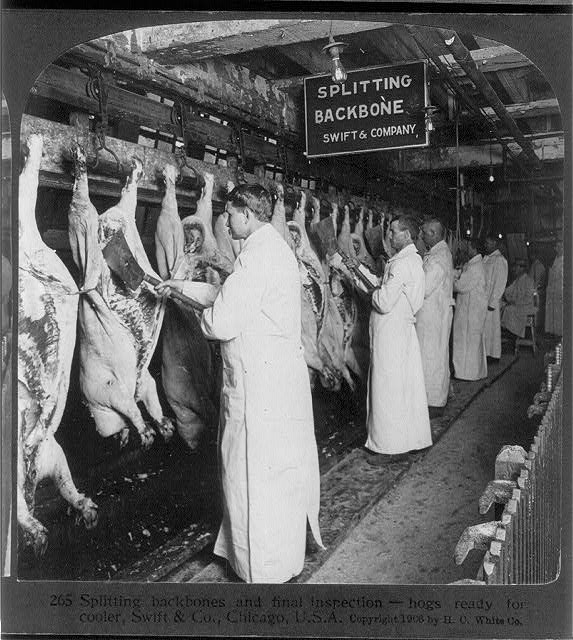
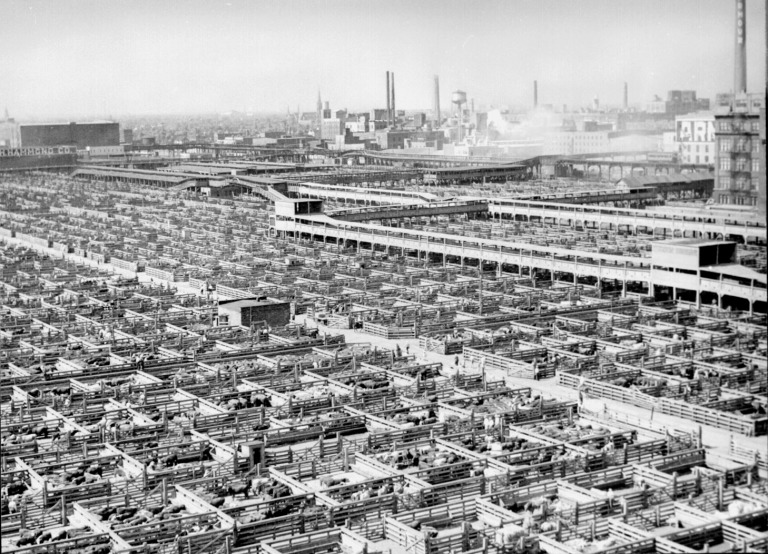
    Upton Sinclair’s 1906 novel The Jungle was intended to inform the larger American public of the miserable working environment and sub survival wages of Chicago’s meat packing employees. The popular response was huge and lead to new government agencies and protections, but not the kind Sinclair had hoped for. By describing the dangerous and unhealthy conditions in slaughterhouses he meant to elicit sympathy for the workers who were denied adequate pay and were routinely maimed or killed on the job with no recourse to improved safety, medical care, or compensation.

    Source

    Source

    What the outraged American public focused on instead was tainted meat from unsanitary facilities. The general population was far less interested in the plight of the Lithuanian immigrant workers Sinclair described than the wholesomeness of the food supply. The Federal Food and Drug Administration was signed in to law by President Theodore Roosevelt in direct response to the uproar over the novel. Making life better for the underclass wasn’t nearly as gripping as making sure fingers weren’t getting ground up into the sausages.

    Source

    Source

    Source

    It wasn’t until the Great Depression of the 1930’s that government – at the insistence of American voters – actually began to create serious labor laws to lift the status of ordinary workers. The pain of being on the wrong end of the stick had migrated from an unloved minority to too many people who thought they were better off – until they weren’t. And it wasn’t until the onset of World War II when labor became scarce relative to the need for wartime production that wages began to rise.

    Americans don’t actually care about the poor and never have. It’s important to keep this in mind. I recently found this comment on an economics website. It sums up the standard response to today’s struggle over increasing inequality.

    “Millions of very decent and good people can’t afford to live in upper middle class cocoon cities like what San Francisco is becoming. We need to allow the responsible members of the shrinking middle class and growing lower classes to isolate themselves from the worst members of the lower classes. People who lack the buying power to move to nice protected towns full of professional workers need ways to separate themselves from social pathology. Our current elites inflict section 8 housing and a growing immigrant lower class on the responsible people who can’t afford bubble city life. This is just so wrong of them. Our elites are our enemies.” Source

    So the problem is that elites are segregating themselves from the declining middle class – and the proposed solution is to provide a separate bubble for the squeezed former middle class to retreat to so they can segregate themselves from people lower down the ladder. Huh? I suppose I have to ask… who decides who is struggling but worthy and who is part of the “social pathology”? And what mechanism might deliver the protection the commentator desires?

    As a society we don’t reach for solutions that might address the underlaying structural flaws that create the underclass or the elites. Instead we look for ways deserving individuals can distance themselves from the effects of those structural defects. We assume a big chunk of the population will be left behind and we don’t mind so long as it’s the undeserving that get screwed. That’s always been our de facto national policy.

    This piece first appeared on Granola Shotgun.

    John Sanphillippo lives in San Francisco and blogs about urbanism, adaptation, and resilience at granolashotgun.com. He’s a member of the Congress for New Urbanism, films videos for faircompanies.com, and is a regular contributor to Strongtowns.org. He earns his living by buying, renovating, and renting undervalued properties in places that have good long term prospects. He is a graduate of Rutgers University.

  • Driving Alone Hits High, Transit Hits Low in “Post-Car” City of Los Angeles

    According to The New York Times, the car used to be “king” in the city (municipality) of Los Angeles. “’A Different Los Angeles’, The City Moves to Alter its Sprawling Image,” was another story that seeks to portray the nation’s second largest municipality as having fundamentally changed. Following this now popular meme, a Slate story in 2016 referred to Los Angeles becoming “America’s next great transit city.” Los Angeles has surely become America’s greatest transit tax city, with Los Angeles County voters in 2016 approving a fourth half-cent sales tax increase principally for transit since 1980. Yet transit’s market share has fallen, not only in the nation’s largest county but even in the city of Los Angeles.

    The Ascent of Transit: A False Narrative

    The Los Angeles political establishment and media is virtually unanimous in its praise for the now quarter century old rail system. Yet, despite more than $15 billion being spent on rail transit the already meager levels of transit commuting in the city have fallen further, while solo driving has risen to an all time high. Unless platitudes are more important than results, rail’s success is a false narrative. People are driving more and using transit less according to the American Community Survey for 2015.

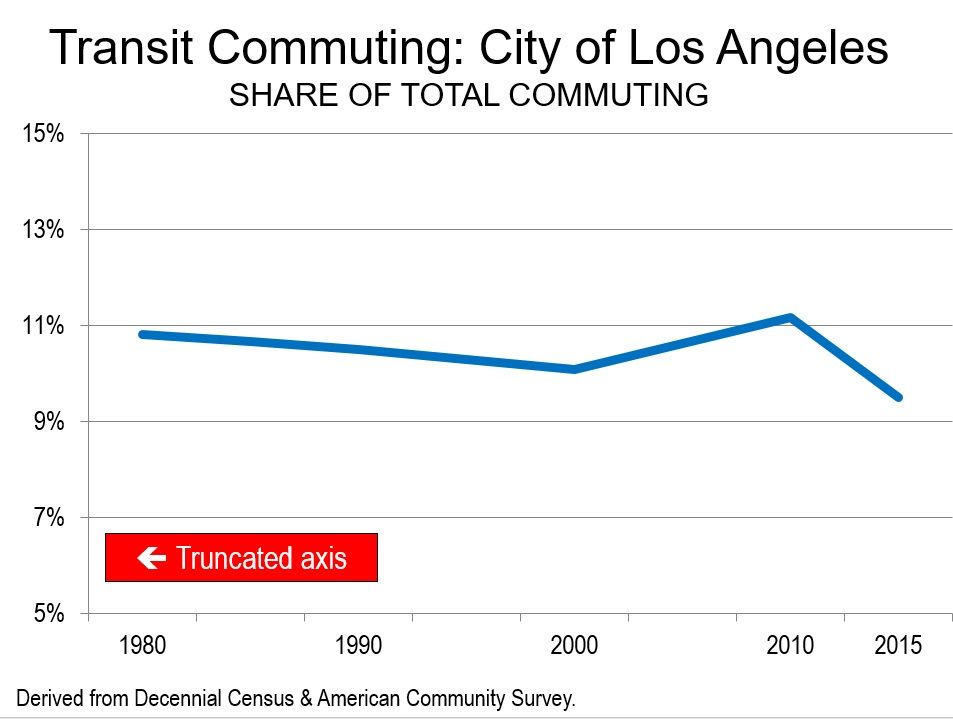
    The share of city of Los Angeles residents commuting by transit fell from 11.2 percent in 2010 to 9.5 percent in 2015 (Figure 1, note truncated axis). The 2010 figure was the highest decennial census year transit figure in the period starting in 1980. Just five years later, in 2015, however, the city of Los Angeles transit commuting share had fallen below 1980 levels.

    In 1980, 10.8 percent of the city’s commuters used transit, a figure that fell to 10.5 percent just before the initial Long Beach “Blue Line” opened in 1990. While new light rail lines and the Metro (subway) line opened after 1990, transit’s market share fell further, to 10.1 percent by 2010. During the 2000s, transit commuting rose 1.1 percentage points to the 11.2 percent figure, propelled by unprecedented gasoline price increases. But progress was short-lived as the share dropped to 9.5 percent in 2015.

    City of Los Angeles Surge in Driving Alone

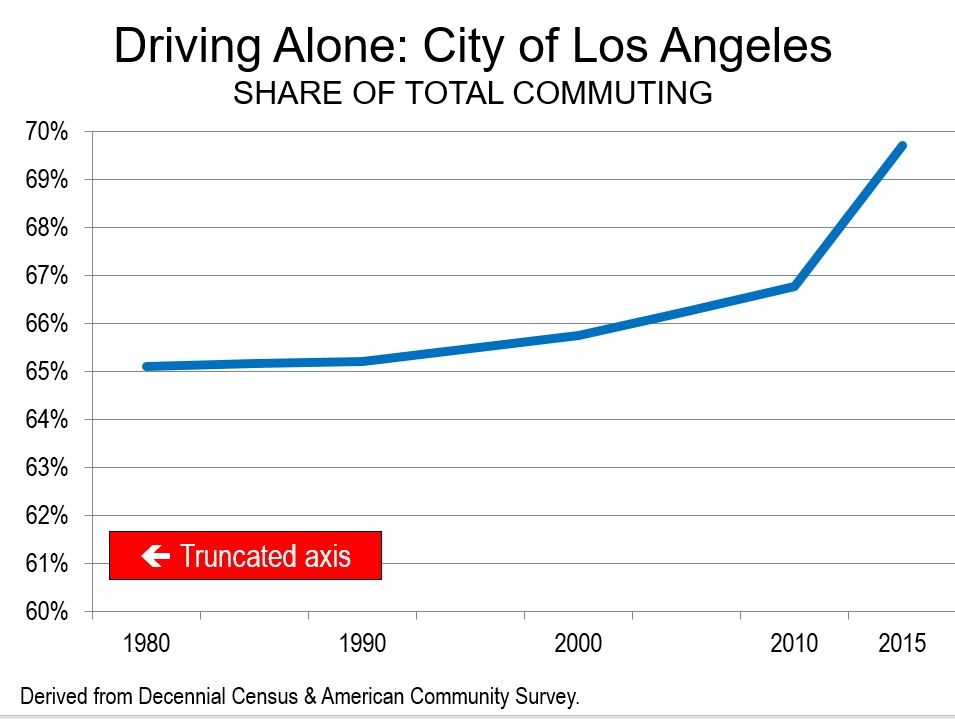
    At the same time, commuters were turning even more to driving alone. In 2015, 69.8 percent of work trip access was by solo drivers. This represents a substantial increase from the 66.8 percent drive alone share in 2010. From 1980 to 2010, driving alone edged up slightly, much less than the increase in the last five years. In 1980, 65.1 percent of commuters drove alone. In 1990, a nearly identical 65.2 percent drove alone. In the last five years, driving alone has risen more than the entire previous 30-year increase in the city of Los Angeles.

    The news could get worse. According to new American Public Transportation (APTA) data, total ridership on all Los Angeles County MTA services dropped more than five percent from 2016. The APTA reported decline is astounding, since the highly touted extension of the Expo light rail line to downtown Santa Monica opened in 2016. Even more astounding is that the expensive, at least seven line (counted at radial line ends plus the transverse Green Line) system has added not a soul to transit ridership on the Los Angeles MTA bus and rail system since 1985. Not all MTA service is in the city of Los Angeles, however, the APTA data could presage a further transit market share decline in the city with the American Community Survey data due in the Autumn.

    All of this is consistent with the larger trend in the Los Angeles metropolitan area (which includes Los Angeles and Orange Counties). Overall, the transit work trip market share in the metropolitan area fell from 6.1 percent in 2010 to 5.1 percent in 2015. The MTA 2016 decline is likely to push this figure lower.

    The Illusion of a “Different Los Angeles”

    Yet to read the press and media accounts in Los Angeles, one might be inclined to believe an alternate reality that LA transit is ascendant.

    Christopher Hawthorne, who teaches urban and environment policy at Occidental College told The New York Times that the recent defeat of a development moratorium, along with approval of the transit tax and an affordable housing measure is “a very clear statement from the voters that they want a different Los Angeles.”

    The voters may want a different Los Angeles, but apparently commuters are sufficiently happy with driving and have been for the more than a quarter century since rail transit was restored to Los Angeles. This is not surprising, since the average commuter can reach 60 times as many jobs by car in 30 minutes in the Los Angeles metropolitan area as by transit. (30 minutes is the average one-way commute time in the metropolitan area). Data is not available for the city of Los Angeles (see: “Access in the City”).

    However, it is a generally hopeless task for transit to be an alternative to the automobile, except for trips to and from the urban core (downtown and nearby). The reality is that it could take as much as the total income, every year, of a metropolitan area to provide transit that could effectively compete with the car throughout a metropolitan area for work and other trips.

    Platitudes do not ride, people do. At least with respect to the implied transit ridership increases and forsaken cars, the “different” Los Angeles is an illusion, completely inconsistent with reality.

    Wendell Cox is principal of Demographia, an international public policy and demographics firm. He is a Senior Fellow of the Center for Opportunity Urbanism (US), Senior Fellow for Housing Affordability and Municipal Policy for the Frontier Centre for Public Policy (Canada), and a member of the Board of Advisors of the Center for Demographics and Policy at Chapman University (California). He is co-author of the “Demographia International Housing Affordability Survey” and author of “Demographia World Urban Areas” and “War on the Dream: How Anti-Sprawl Policy Threatens the Quality of Life.” He was appointed to three terms on the Los Angeles County Transportation Commission, where he served with the leading city and county leadership as the only non-elected member. He served as a visiting professor at the Conservatoire National des Arts et Metiers, a national university in Paris.

    Photo: Los Angeles City Hall (by author)