Blog

  • Moving to North Dakota: The New Census Estimates

    The new state (and DC) population estimates indicate a substantial slowdown in growth, from an annual rate of 0.93 percent during the 2000s to 0.75% between 2011 and 2012. This 20 percent slowdown in growth was driven by a reduction in the crude birth rate to the lowest point ever recorded in the United States (12.6 live births per 1000 population).

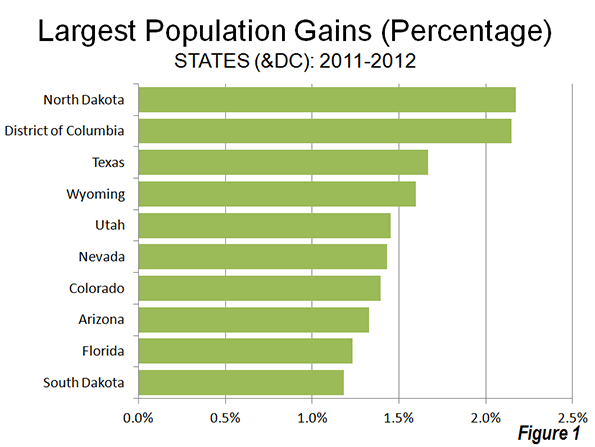
    The big surprise was the population growth leader, North Dakota, which has experienced a strong boom in natural resource extraction. Between 1930 and 2010, North Dakota had lost population. However in the first two years of the new decade, North Dakota has experienced strong growth, and reached its population peak, according to the new estimates, in 2012. North Dakota’s population growth rate between 2011 and 2012 was 2.17%. Nearby South Dakota also grew rapidly, ranking 10th in population growth. The other fastest-growing states were all in the South or the West. The District of Columbia, located in the strongly growing Washington, DC Metropolitan area ranked second in growth rate behind North Dakota (Figure 1).

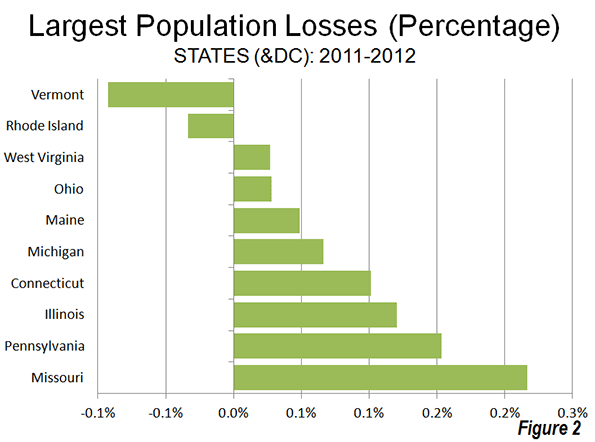
    Two states lost population, Vermont and Rhode Island, as the Northeast and Midwest represented all but one of the 10 slowest growing states. West Virginia, in the South, was also included among the slowest growing states (Figure 2).

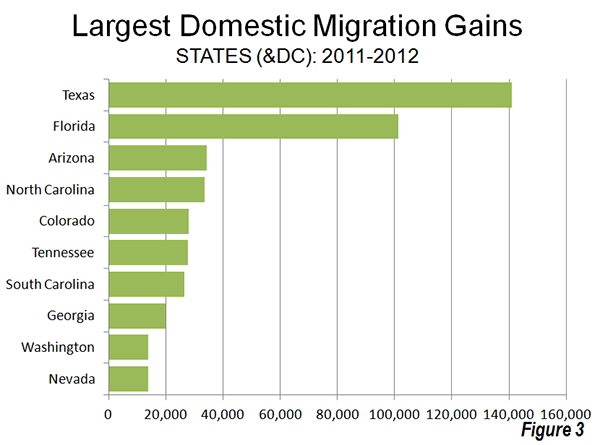
    The domestic migration trends continue to favor the South and West. Texas continues to attract the largest number of domestic migrants (141,000), followed by Florida (101,000). These two states have been the domestic migration leaders in the nation every year since 2000 (Figure 3). Four states gained from 25,000 to 35,000 domestic migrants (Arizona, North Carolina, Tennessee and South Carolina).

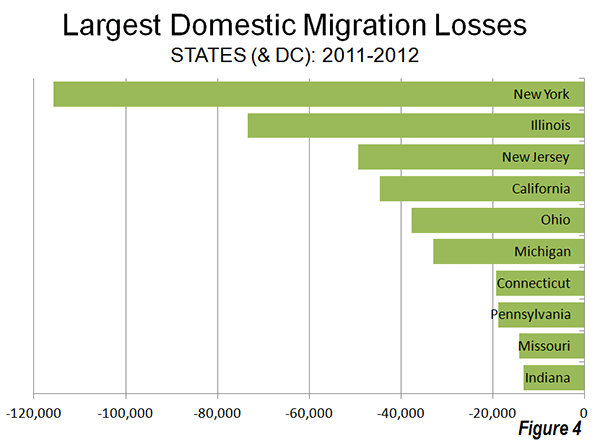
    Generally, the same states continued to dominate domestic migration losses, with New York losing the most migrants, Illinois ranking second, followed by California, Ohio and Michigan. With the exception of California, all of the 10 states losing the largest number of domestic migrants were in the Northeast or the Midwest (Figure 4).

    Overall, domestic migration continues to be dominated by the South, which attracted 354,000 residents from other states. The West added 52,000 domestic migrants, however virtually all of this gain occurred in the Intermountain West. Gains in Oregon and Washington were far more than offset by the large losses in California, as well as losses in Hawaii and Alaska. The Intermountain West gained more than 70,000 domestic migrants. The Northeast lost 221,000 domestic migrants, while the Midwest lost 185,000.

  • America the Mostly Beautiful

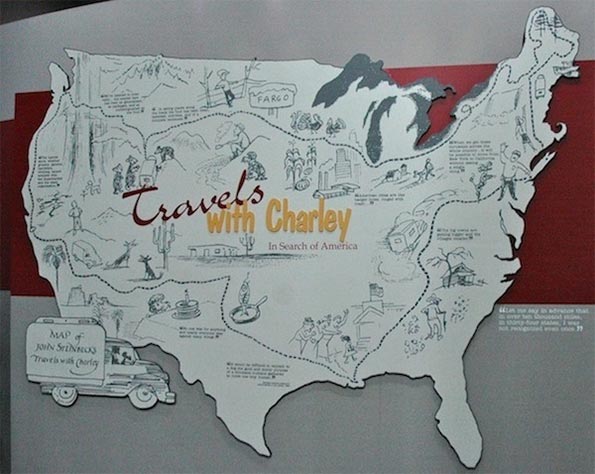
    In the fall of 2010, as part of a book project, ex-newspaperman Bill Steigerwald retraced the route John Steinbeck took in 1960 and turned into his classic “Travels With Charley.” Steigerwald drove 11,276 miles in 43 days from Long Island to the top of Maine to Seattle to San Francisco to New Orleans before heading back to his home in Pittsburgh.  In “Dogging Steinbeck,” his new e-book about how he discovered “Charley” was not nonfiction but a highly fictionalized and dishonest account of Steinbeck’s real trip, Steigerwald describes the America he saw.

    "Big."

    "Empty."

    "Rich."

    "No change since 1960."

    Long after the old farms and new forests of New England disappeared in my rearview mirror, I was still scrawling those words in the reporter’s notebook on my knee. Big, empty, rich and unchanged – that’s a pretty boring scouting report for the America I “discovered” along the Steinbeck Highway. You can add a bunch of other boring but fitting words – “beautiful,” “safe,” “friendly,” “clean,” and “quiet.”

    Like Steinbeck, I didn’t see the Real America or even a representative cross-section of America, neither of which exist anyway. Because I went almost exactly where Steinbeck went and stopped where he stopped, I saw a mostly White Anglo Saxon Protestant Republican America, not a “diverse and politically correct” Obama one. Mostly rural or open country, it included few impoverished or crime-tortured inner cities and no over-developed/underwater suburbs.

    America the Beautiful was hurting in the fall of 2010, thanks to the bums and crooks in Washington and on Wall Street who co-produced the Great Recession.  It still had the usual ills that make libertarians crazy and may never be cured: too many government wars overseas and at home, too many laws, politicians, cops, lawyers, do-gooders and preachers.

    But America was not dead, dying or decaying. There were no signs of becoming a liberal or conservative dystopia. The U.S. of A., as always, was blessed with a diverse population of productive, affluent, generous, decent people and a continent of gorgeous natural resources.

    Everyday of my trip I was surrounded by undeniable evidence of America’s underlying health and incredible prosperity. Everywhere I went people were living in good homes, driving new cars and monster pickup trucks and playing with powerboats, motorcycles and snowmobiles. Roads and bridges and parks and main streets were well maintained. Litter and trash were scarce. Specific towns and regions were hurting, and too many people were out of work, but it was still the same country I knew.

    I didn’t seek out poverty or misery or pollution on my journey, and I encountered little of it. The destitute and jobless, not to mention the increasing millions on food stamps, on welfare or buried in debt, were especially hard to spot in a generous country where taking care of the less fortunate is a huge public-private industry – where even the poor have homes, cars, wide-screen TVs and smart phones.

    I saw the familiar permanent American socioeconomic eyesores – homeless men sleeping on the sidewalks of downtown San Francisco at noon, the sun-bleached ruins of abandoned gas-stations on Route 66, ratty trailer homes parked in beautiful locations surrounded by decades of family junk. I saw Butte’s post-industrial carcass, New Orleans’ struggling Upper Ninth Ward and towns that could desperately use a Japanese car plant.

    But the country as a whole was not crippled or even limping. In the fall of 2010, nine in 10 Americans who said they wanted jobs still had them. The one in 10 who were jobless had 99 weeks of extended unemployment benefits and more than 90 percent of homeowners were still making their mortgage payments.

    Most of the states I shot through – including Maine, northern New Hampshire and Vermont, upstate New York, Wisconsin, Minnesota, North Dakota, Montana – had unemployment and foreclosure rates well below the national averages.

    I didn’t visit the abandoned neighborhoods of poor Detroit. I didn’t see battered Las Vegas, where 14.5 percent of the people were unemployed and one in nine houses – five times the national average – had received some kind of default notice in 2010. But I spent almost two weeks in the Great Train Wreck State of California, where jobless and foreclosure rates were higher than the national average and municipal bankruptcies loomed.

    America had 140 million more people than it did in 1960, but from coast to coast it was noticeably quiet – as if half the population had disappeared. Despite perfect fall weather, public and private golf courses were deserted. Ball fields were vacant. Parks and highway rest stops and ocean beaches were barely populated. Except for metropolises like Manhattan and San Francisco and jumping college towns like Missoula and Northampton, people in throngs simply did not exist. I went through lots of 30-mph towns that looked like they’d been evacuated a year earlier.

    As I drove what’s left of the Old Steinbeck Highway – U.S. routes 5, 2, 1, 11, 20, 12, 10, 101 and 66 – it was obvious many important changes had occurred along it since 1960. Industrial Age powerhouses like Rochester, Buffalo and Gary had seen their founding industries and the humans they employed swept away by the destructive winds of technology and global capitalism. Small towns like Calais in northeastern Maine had lost people and jobs, and vice versa.

    New Orleans had shrunk by half, and not just because of Katrina. The metro areas of Seattle, San Francisco and Albuquerque had exploded and prospered in the digital age. The populations of the West Coast and the Sunbelt had expanded since 1960. The South had shed its shameful system of apartheid and its overt racism, as well as much of its deep-rooted poverty and ignorance. The Northeast had bled people, manufacturing industries and its once overweening role in determining the nation’s political and cultural life.

    Change is inevitable, un-stoppable, pervasive. Nevertheless, it was clear that a great deal of what I saw out my car windows had hardly changed at all since Steinbeck and his French poodle Charley raced by.

    He saw more farmland and fewer forests than I did, especially in the East. But in many places I passed through almost nothing was newly built. Many farms and crossroads and small towns and churches were frozen in the same place and time they were eons ago, particularly in the East and Midwest.

    In Maine the busy fishing village of Stonington was as picturesque as the day Steinbeck left it. He’d recognize the tidy farms of the Corn Belt and the raw beauty of Redwood Country and the buildings if not the people of the Upper Ninth Ward. And at 70 mph whole states – North Dakota and Montana – would look the same to him except for the cell towers and Pilot signs staked out at the interstate exits.

    Steinbeck didn’t like a lot of things about Eisenhower America – sprawl, pollution, the rings of junked cars and rubbish he saw around cities. And he lamented – not in “Charley” but in letters to pals like Adlai Stevenson – that he thought America was a rotting corpse and its people had become too soft and contented to keep their country great and strong.

    But Steinbeck had America’s future wrong by 178 degrees. Fifty years later, despite being stuck in an economic ditch, the country was far wealthier, healthier, smarter and more globally powerful and influential than he could have imagined. Its air, water and landscapes were far less polluted. And, most important, despite the exponential growth of the federal government’s size and scope and its nanny reach, America in 2010 was also a much freer place for most of its 310 million citizens, especially for women, blacks, Latinos and gays.

    You don’t have to be a libertarian to know America is not as free as it should be. But there’s no denying that today our society is freer and more open than ever to entrepreneurs, new forms of media, alternative lifestyles and ordinary people who want to school their own kids, medicate their own bodies or simply choose Fed Ex instead of the U.S. Post Office.

    As for the stereotypical complaints about America being despoiled by overpopulation, overdevelopment and commercial homogenization, forget it. Anyone who drives 50 miles in any direction in an empty state like Maine or North Dakota – or even in north-central Ohio or Upstate New York – can see America’s problem is not overpopulation. More often it’s under-population. Cities like Butte and Buffalo and Gary have been virtually abandoned. Huge hunks of America on both sides of the Mississippi have never been settled.

    From Calais, Me., to Pelahatchie, Miss., I passed down the main streets of comatose small towns whose mayors would have been thrilled to have to deal with the problems of population growth and sprawl.  If anyone thinks rural Minnesota, northwestern Montana, the Oregon Coast, the Texas Panhandle or New Orleans’s Upper Ninth Ward have been homogenized, taken over by chains or destroyed by too much commercial development, it’s because they haven’t been there.

    The America I traveled was unchained from sea to sea. I had no problem eating breakfast, sleeping or shopping for road snacks at mom & pop establishments in every state. The motels along the Oregon and Maine coasts are virtually all independents that have been there for decades. You can go the length of old Route 66 and never sleep or eat in a chain unless you choose to.

    Steinbeck, like many others have since, lamented the loss of regional customs. (I don’t think he meant the local “customs” of the Jim Crow South or the marital mores of the Jerry Lee Lewis clan.)  I didn’t go looking for Native Americans, Amish, Iraqis in Detroit, Peruvians in northern New Jersey or the French-Canadians who have colonized the top edge of Maine.  But I had no trouble spotting local flavor in Wisconsin’s dairy lands, in fishing towns along Oregon’s coast, in the redwood-marijuana belt of Northern California, in San Francisco’s Chinatown or the cattle country of Texas.

    Not to generalize, but the New York-Hollywood elites believe the average Flyover Person lives in a double-wide or a Plasticville suburb, eats only at McDonald’s, votes only Republican, shops only at Wal-Mart and the Dollar Store, hates anyone not whiter than they are, speaks in tongues on Sunday and worships pickup trucks, guns and NASCAR the rest of the week.

    Those stereotypes and caricatures are alive and well in Flyover Country. But though I held radical beliefs about government, immigration and drugs that could have gotten me lynched in many places, I never felt I was in a country I didn’t like or didn’t belong in. Maybe I just didn’t go to enough sports bars, churches and political rallies, but for 11,276 miles I always felt at home.

    Bill Steigerwald, born and raised in Pittsburgh, is a former L.A. Times copy editor and free-lancer who also worked as a docudrama researcher for CBS-TV in Hollywood before becoming a reporter for The Pittsburgh Post-Gazette and a columnist for The Pittsburgh Tribune-Review. He recently retired from daily newspaper journalism.

  • Big things that were never built in Los Angeles

    One of my lesser historical obsessions has been the grandiose stuff that’s been proposed for the Los Angeles area and never built. Things like the amusement park that Walt Disney proposed for Burbank before he put Anaheim on the map with Disneyland, or the assorted hotels, parks, monorails and highways that were given ink in the newspapers but either fell through or were never that real to begin with. I’ve written before about the sketch on my office wall from a 1913 Los Angeles Times front page envisioning a future downtown of skyscrapers, high-altitude auto bridges and curiously a waterfront. Imagine how different the city would be if, for instance, Valley promoters had gotten their way to plant the original LAX due west of the corner of Balboa and Roscoe. Or if the 1930 plan from Olmsted and Bartholomew for a chain of parks and playgrounds across the city had been accomplished.

    Sam Lubell, the West Coast Editor of the Architect’s Newspaper, and Greg Goldin, the architecture critic at Los Angeles Magazine, have mined the landscape and found some real gems. Lloyd Wright’s incredibly grand 1925 Civic Center for downtown (above.) Or the 1952 master plan for LAX by architects Pereira and Luckman. The plan is to use the research to mount an ambitious exhibition next spring at the A+D Architecture and Design Museum on Wilshire. They have launched a Kickstarter campaign to make it happen, and of course you can help.

    Check out their cool video:

    This piece first appeared at LA Observed.

  • Central Banking’s Hogwarts Syndrome

    Central banks—the US Federal Reserve is one—come with the mystique of Oz. While the Fed fiercely denies that it is powerful enough to cure recessions with a click of the heels, there are those who believe it’s true. If, however, you look behind the velvet curtains and columned lobbies, you will find good men, but bad wizards. In mid-December, the bank’s Open Market committee pledged $85 billion a month until unemployment drops below 6.5 percent. Such policies are a long way from Kansas and prudent finance.

    Around the world central banks have become convenient instruments of public and private bailouts, accommodating lenders when citizens reject tax hikes and governments need a few trillion to bail out Greece or prop up the housing market. It helps that they are shrouded in mystery and give the impression that they hold their meetings at Hogwarts, perhaps with Albus Dumbledore presiding.

    The reason that the Federal Reserve, like many of its European counterparts, looks like a failing credit union is that its balance sheet numbers don’t add up. On November 12, 2012, the Fed showed a assets of $2.9 trillion against equity of $69 billion. In other words, the bank’s leverage is 42 times its capital. At its peak, Lehman was geared 36 times; a prudent limit might be eight times. At this time next year, its assets (which would more properly be considered, liabilities) will be $4 trillion.

    $1.6 trillion on the Fed’s book is held in US Treasury securities, although, I can assure you that money has been spent, perhaps on that swell new $3.4 billion “campus” for the Department of Homeland Security.

    Before 2008, the Fed’s balance sheet was less than $900 billion, and assets were short-term interbank loans and Treasury securities. Now the balance sheet is $2.9 trillion, and mixed in with the gold at Fort Knox is $886 billion in mortgage-backed securities, making the Federal Reserve the nation’s Savings & Loan. (Imagine the toasters given away to build up such a loan book.)

    One reason that the Fed’s balance sheet is not available for a congressional audit is that it might scare world markets to death to discover that the US central bank is awash with non-performing assets, not British gilts or J.P. Morgan’s gold bars. As lenders of last resort, many central banks now have vaults that are crammed with junk bonds, subprime exposure, unwound credit default swaps, out-of-the-money options, and sovereign debt issued by governments that have long since vanished.

    Take the European Central Bank. After the 2008 crisis it encouraged banking groups to load up on sovereign credits, hoping that this would prevent further collapse and stimulate local economies.

    The same practice of offloading substandard loans to the Federal Reserve governed the stimulus programs of the Bush and Obama administrations, which “stimulated” the economy by moving bad loans off Wall Street and into the Fed.

    Another definition for quantitative easing (QE3 in its last rendition) might be “government payday loans.” Together, the central banks of the United States and Europe are holding more than $6 trillion as “assets” on their balance sheets, which if they were accurate might read: “Advances against street demonstrations.”

    How did we get to these diminishing returns? In their modern incarnation, central banks replaced market makers and robber barons that got tired of business cycles and having to bail out commercial banks and stock jobbers that had hit the skids.

    In the US, the panic of 1907 (which J.P. Morgan mitigated, although to his own ends) pushed the country to later enact legislation creating the Federal Reserve System that, in the future, would provide liquidity during periods of recession; its current dual mandate is to fight inflation and maximize employment.

    Given that economics was deemed a science of predictions, the presence of strong central banks in North America and Europe was supposed to mean the end of sharp volatility, even though it has been convincingly argued that the Federal Reserve has made little difference in the many recessions since 1913, notably in the Great Depression, when it restricted the money supply.

    In his history of central banking, Lords of Finance: The Bankers Who Broke the World, Liaquat Ahamed makes the point that the leading central banks in and after World War I—those of England, France, the United States, and Germany—routinely made bad decisions when it came to issuing currency, propping up the money supply, or regulating the amounts of credit and bonds in various banking systems.

    The biggest problem with central banks is that they are mortgaged to the political classes and have become the funding arm of various get-elected-quick schemes rather than sticking to their job of fiddling with the money supply. The Fed’s evolution into a casino cashier window started sometime after 1996 and continued into the administration of George W. Bush, when the equity in American homes became just another chip for Wall Street croupiers to sweep into their aprons.

    Under patriotic banners proclaiming that home ownership was a democratic rite of passage, both Congress and the Fed made it easy for banks to grant mortgages based on little, if any, collateral (remember “liar loans?” I bet Alan Greenspan does). They also looked the other way when the administration decided to pay for its wars and tax cuts by using home equity to keep consumer markets irrationally exuberant. Why? Prosperity has a lot to do with reelecting incumbents, and it was those officials who regulated the regulators. Furthermore, member commercial banks, not the US government, own the Fed, even if the US President appoints the chairman.

    What might hasten a reckoning of these wobbly accounts is that central bankers are finding it harder to agree that their temples of finance are ministries of magic. A few, like the German and Swiss central banks, dread inflation and take a dim view of speculators. Those attitudes find little sympathy in Italy, Spain, or Greece—should we add California?—which need to kite checks to pay state pensions.

    The US isn’t sufficiently flush to help bail out the European Union. Alas, not even the Fed has deep enough pockets to fund trillion dollar annual deficits. Nor should anyone think that the US government is a likely candidate to bail out the Fed, as right now it is the Fed that is bailing out America.

    Flickr photo by Lance McCord: Federal Reserve Bank of Atlanta Eagle: Eagle sitting atop a decorative (though once-structural) column outside the Federal Reserve Bank of Atlanta on Peachtree Street; it dates from an earlier incarnation of the Atlanta Fed’s home.

    Matthew Stevenson, a contributing editor of Harper’s Magazine, is the author of Remembering the Twentieth Century Limited, a collection of historical travel essays. His next book is Whistle-Stopping America.

  • America’s Baby Boom And Baby Bust Cities

    At this most familial time of the year, as recent events make us hold our children even closer, we might want to consider what kinds of environments are most conducive to having offspring. Alarm bells are beginning to ring in policy circles over the decline of the U.S. birth rate to a record low. If unaddressed, this could pose a vital threat the nation’s economic and demographic vitality over the next few decades.

    In contrast to last week, when we examined the nearly uniform aging of America’s biggest cities over the last decade, the decline in the country’s youth population has been in relative terms. In 2000, roughly 21.4% of Americans were under 15; in 2010, that percentage had dropped to 19.8%. However, unlike in parts of Europe and East Asia, the number of American children did not decline – there were over a million more in 2010, a 1.7% increase.

    Yet since children are by definition the bearers of the future, knowing where new families and households are forming should be of critical interest not only to demographers, but to investors, businesses and, over time, even politicians. Demographer Wendell Cox crunched Census data for Forbes on the youth populations of the 51 largest U.S. metropolitan statistical areas. His analysis reveals sharp differences between various regions of the country, and suggests where future growth in the country may be the strongest.

    The youth population expanded in 31 of the 51 metro areas from 2000 to 2010. The 10 regions that posted the strongest growth were in Texas, the Southeast and the Intermountain West. Leading the nation is Raleigh, N.C., where the number of children under 15 rose a whopping 45%, or 77,421. Texas is experiencing something of a baby boom, paced by Austin, second among America’s largest metro areas with a youth population expansion of 38%; Dallas-Ft. Worth (sixth); Houston (eighth); and San Antonio (11th).

    Out west, Las Vegas (third place) and Phoenix (fifth) may be better known as retirement destinations, but also have become increasingly attractive to families. Other western cities with a strong increase in children include Riverside-San Bernardino, Calif. (12th), Salt Lake City (13th) and Oklahoma City (15th). Surprisingly some Midwestern cities also perform relatively well, led by Indianapolis (16th) and Columbus, Ohio (18th).

    If these regions are attractive to young families, which ones are not? Outside of last place New Orleans, whose demographic data was distorted by the massive outflow of population due to the Katrina disaster, the sad sacks on this list include many of the usual suspects: aging industrial centers. Buffalo’s youth population declined 16%, Detroit’s, 15%; and Cleveland’s 14%. In these cities, notes Cleveland policy researcher Richey Piiparinen, pessimism about the future, for you and your children, naturally results from “being born into post-industry.”

    Not having kids in what may seem to be a ruined economy is understandable. But many metro areas that are usually associated with youthfulness and aspiration are producing fewer children, including Los Angeles (sixth place on our list of baby bust cities with a decline of 12.4%), New York, NY-NJ-PA (eighth, down 7%) and San Francisco-Oakland (16th, -2.7%). Over the past decade these metro areas have lost hundreds of thousands from their under 15 population; Los Angeles has an astounding 360,000 fewer 15 year olds than in 2000 while New York has almost 270,000 fewer and Boston some 62,000 less.

    What do these trends mean for the future? New York has lost about as many children as Dallas-Ft. Worth has gained — a difference of a half million. The gap between increasingly childless Los Angeles and Houston is even wider, and approaches 600,000. These numbers suggest a tremendous shift in the future locations of new American households, with all that implies for retail sales, workforce growth and residential construction demand.

    Indeed a recent Pitney-Bowes study projects that the largest absolute growth in households in the next five years will be in Houston, with a gain of 140,000, or 6.7%,  while Atlanta is projected to add slightly over 100,000 households, 5.4% more.

    In contrast the largest metropolitan area in the country, the New York region, will grow by a mere 75,000 households, a paltry 1.7% clip, while Los Angeles will add only 46,000. Chicago, the third largest metro area, is only expected to add 33,000 households, a growth rate of barely 1.2%.

    Why is household formation and child-rearing so anemic in these places, which are often celebrated for being attractive to the young and dominate so many key industries? One key reason, suspects demographer Cox, is housing prices relative to incomes. This is largely due to high regulatory costs that discourage new housing supply, particularly the single-family homes preferred by most families. Housing costs relative to incomes are more than two times higher in New York or Los Angeles than in Houston, Dallas-Fort Worth, Atlanta or, for that matter, virtually all the metropolitan areas most attractive to families.

    Another factor may be the impact of density, which, Cox demonstrates, tends to depress fertility rates not only here in the United States, but through much of the world. The fastest-growing youth populations tend to be in lower-density regions such as Austin, Raleigh and Atlanta; the slower growth, outside of the old industrial belt tends to be in the high-density regions.

    These differences also exist on the metro level. Within regions, certain areas attract more families than others. For the most part, despite the media hype about families returning to the city, the biggest declines in the under 15 population tend to be in the core urban areas.

    Take New York, our greatest city and one that has experienced considerable improvement in quality of life over the last two decades. Yet despite this, the under 15 population of New York County (Manhattan) dropped nearly 10% over the past decade, a net loss of 21,000. Barely 12% of Manhattanites are under 15, far below the national rate of 19.8%. Similar declines have occurred as well in Brooklyn, a borough that many priced-out Manhattan couples have seen as a refuge for young families.

    So where are the kids being born in the New York area? The only gainers were in the much-despised, lower-density exurbs such as Rockland County, N.Y., and New Jersey’s Ocean County. A similar, if even more marked pattern can be seen in the greater Chicago area, where Cook County, which contains the Windy City, suffered a 160,000 net drop over the decade in its under 15 population; with an 18% decrease in its student body, it’s not surprising that half of Chicago’s public schools are considered underutilized. Meanwhile exurban Will and Kane counties together have gained some 56,000 children under 15, up over 20%.

    Similar phenomena can be observed in most metropolitan areas, including San Francisco, which increasingly resembles a child-free zone. With just 11.2% of the population under 15, the City by the Bay now has the lowest percentage of children of any large county in the nation.

    These numbers tell us some intriguing things about our demographic future, and perhaps suggest how to address a potential “birth death.” As the percentage of children relative to adults, and particularly seniors, declines, it’s imperative to identify environments attractive to young families. For the most part, this means areas that offer the best mix of job opportunities, reasonable housing costs and, for the most part, lower density living. If developers and investors can transcend the incessant urban hype and look at the numbers, they may want to look more closely at these places as most likely to enjoy future growth.

    Change in Population of Children Under Age 15, 2000-2010
    Rank by % Change Geography Population Under 15, 2000 Population Under 15, 2010 Percent Change
    1 Raleigh-Cary, NC 171,779 249,712 45.4%
    2 Austin-Round Rock-San Marcos, TX 266,816 368,852 38.2%
    3 Las Vegas-Paradise, NV 300,700 408,053 35.7%
    4 Charlotte-Gastonia-Rock Hill, NC-SC 287,728 382,071 32.8%
    5 Phoenix-Mesa-Glendale, AZ 739,916 928,284 25.5%
    6 Dallas-Fort Worth-Arlington, TX 1,222,705 1,488,383 21.7%
    7 Atlanta-Sandy Springs-Marietta, GA 955,906 1,162,405 21.6%
    8 Houston-Sugar Land-Baytown, TX 1,145,997 1,389,377 21.2%
    9 Orlando-Kissimmee-Sanford, FL 341,258 409,103 19.9%
    10 Nashville-Davidson–Murfreesboro–Franklin, TN 272,777 324,763 19.1%
    11 San Antonio-New Braunfels, TX 404,441 478,769 18.4%
    12 Riverside-San Bernardino-Ontario, CA 860,121 992,097 15.3%
    13 Salt Lake City, UT 245,938 280,656 14.1%
    14 Denver-Aurora-Broomfield, CO 467,812 533,326 14.0%
    15 Oklahoma City, OK 231,567 263,717 13.9%
    16 Indianapolis-Carmel, IN 343,176 384,015 11.9%
    17 Tampa-St. Petersburg-Clearwater, FL 438,834 484,416 10.4%
    18 Columbus, OH 347,692 379,627 9.2%
    19 Jacksonville, FL 244,723 265,118 8.3%
    20 Sacramento–Arden-Arcade–Roseville, CA 406,444 439,086 8.0%
    21 Washington-Arlington-Alexandria, DC-VA-MD-WV 1,023,931 1,104,688 7.9%
    22 Kansas City, MO-KS 407,217 435,884 7.0%
    23 Portland-Vancouver-Hillsboro, OR-WA 411,430 438,944 6.7%
    24 Louisville/Jefferson County, KY-IN 242,945 255,445 5.1%
    25 Richmond, VA 229,341 240,779 5.0%
    26 Seattle-Tacoma-Bellevue, WA 624,007 651,605 4.4%
    27 Minneapolis-St. Paul-Bloomington, MN-WI 663,817 680,322 2.5%
    28 Birmingham-Hoover, AL 219,064 223,621 2.1%
    29 San Jose-Sunnyvale-Santa Clara, CA 366,072 373,089 1.9%
    30 Memphis, TN-MS-AR 285,823 287,894 0.7%
    31 Miami-Fort Lauderdale-Pompano Beach, FL 988,407 987,881 -0.1%
    32 Cincinnati-Middletown, OH-KY-IN 443,771 441,086 -0.6%
    33 San Diego-Carlsbad-San Marcos, CA 611,119 596,168 -2.4%
    34 San Francisco-Oakland-Fremont, CA 783,554 764,185 -2.5%
    35 Milwaukee-Waukesha-West Allis, WI 329,359 315,745 -4.1%
    36 Chicago-Joliet-Naperville, IL-IN-WI 2,055,882 1,956,235 -4.8%
    37 Baltimore-Towson, MD 540,894 511,503 -5.4%
    38 Philadelphia-Camden-Wilmington, PA-NJ-DE-MD 1,205,561 1,136,468 -5.7%
    39 Hartford-West Hartford-East Hartford, CT 233,267 219,315 -6.0%
    40 St. Louis, MO-IL 585,403 549,544 -6.1%
    41 Virginia Beach-Norfolk-Newport News, VA-NC 348,293 324,478 -6.8%
    42 New York-Northern New Jersey-Long Island, NY-NJ-PA 3,808,773 3,537,709 -7.1%
    43 Boston-Cambridge-Quincy, MA-NH 868,251 805,699 -7.2%
    44 Providence-New Bedford-Fall River, RI-MA 317,329 281,422 -11.3%
    45 Los Angeles-Long Beach-Santa Ana, CA 2,915,391 2,558,983 -12.2%
    46 Rochester, NY 221,349 192,407 -13.1%
    47 Pittsburgh, PA 447,278 384,818 -14.0%
    48 Cleveland-Elyria-Mentor, OH 455,074 390,730 -14.1%
    49 Detroit-Warren-Livonia, MI 996,019 845,894 -15.1%
    50 Buffalo-Niagara Falls, NY 236,269 198,371 -16.0%
    51 New Orleans-Metairie-Kenner, LA 289,988 225,512 -22.2%
    Source: U.S. Decennial Census 2010 and 2000


    Joel Kotkin is executive editor of NewGeography.com and is a distinguished presidential fellow in urban futures at Chapman University, and contributing editor to the City Journal in New York. He is author of The City: A Global History. His newest book is The Next Hundred Million: America in 2050, released in February, 2010.

    This piece originally appeared at Forbes.com.

    Crossing the street photo by Bigstock.

  • A Volunteer Army’s Attempt to Fill the New York Hurricane Response Gap

    On November 6, eight days after Hurricane Sandy’s surge waters flooded the streets, I started volunteering in the Rockaways, where I stayed for much of the next three weeks.

    On that first day, I joined an ad hoc group of volunteers and took a school bus full of supplies donated by my Brooklyn neighbors out to a church on Beach 67th Street. Unloading the bus alongside parishioners at the Battalion Pentecostal church I learned that it was the first shipment they had received for the immediate area since the storm, and that aside from the traffic cops waving cars through and a National Grid trailer parked in the church lot, there was still no official presence in the neighborhood.

    The donations we brought were being carried away even before the last of them was off the bus, as word spread through the row houses that lined the block. The mother of a disabled girl carried a box of canned food to her powerless apartment and came back to ask for more. Her fridge and cupboards were already emptied.

    The other volunteers and I took the empty bus back to Brooklyn to refill it with more supplies and return later that day. On the drive back, only a mile away from the church, I saw a supermarket parking lot with truckloads of donated material guarded by police and national guardsmen. The people around the church, many of whom lost their cars in the flood, had no way to get the supplies from the parking lot back to their homes, which was incidental since most of them, cut off from any news that didn’t pass by mouth, didn’t even know that the goods were there.

    On my second day in the Rockaways I took some time to drive around and see how things were in other neighborhoods, looking for places like the church on 67th Street that were not yet being helped. I found that at the St. Francis de Sales church in Belle Harbor, on 129th Street, some supplies were already being turned away, as boxes had filled the large main hall and were now overflowing into additional rooms to accommodate the constant influx of donations.

    Several days later I returned to Francis de Sales to ask that they send food to an apartment complex I had found on the tip of the peninsula near Nassau county, where hundreds of elderly residents were living without heat or power, rationing canned goods and prescription medicine. An Australian volunteer at the church told me that he would take care of it, and while I believed he meant it, I also knew that he might be gone the next day, back to work or to his life outside volunteering.

    No one was keeping track.

    There is a city agency charged with just that: the Office of Emergency Management (O.E.M.). Emergencies are, by definition, chaotic, and the office is there to do two things: to compile block-by-block information into a unifying big picture, and to ensure responders and resources are allocated in accordance with that picture. In short: triaging, first understanding needs, and then prioritizing among them. But O.E.M. was conspicuously absent while I was in the Rockaways, and according to volunteers and officials I spoke with while reporting this story.

    Trying to get people food and basic supplies took up much of my first week in the Rockaways, and yet there was no problem with scarcity. The city spent close to $3 million for food and water distribution and, as of November 26, had distributed over 2 million meals, while donations poured in from New York and out-of-state charities.

    Individuals and small groups were doing their best to attend to immediate need, but the lack of direction was acute, resulting in a feast-or-famine situation that varied block by block.

    I visited the parking lot where I had seen the trucks of supplies parked and asked if they could be moved to the under-served church on 67th Street but the National Guardsman posted there explained apologetically that taking supplies neighborhood-to-neighborhood, a more effective manner of distribution, didn’t match their orders.

    Though city officials had been working hard since even before the storm struck, one thing they weren’t doing was taking control of the situation on the ground, canvassing neighborhoods to determine needs and directing services and supplies accordingly. Nor, since they may not have enough staff to do this all themselves, were they effectively organizing and commanding the hodge-podge of official and unofficial groups and the steady stream of volunteers attempting to make themselves useful.

    Relief supplies managed by the city were being delivered to a handful of centralized points without much of a plan for getting them to the people in need, even as the National Guard and the many volunteers looked for ways to help.

    Some volunteer groups had identified this issue early on and attempted to deal with it, on their own, in various ways.

    Some drove around with supplies until they found people who obviously needed them, and some groups like Occupy Sandy and Save the Rockaways used social media and web presence to post alerts identifying where food and volunteers were needed.

    Team Rubicon, a veteran-led relief group, took things even further, using a computer program called Palantir to create an annotated map of conditions in the Rockaways and by stepping up to fill the leadership vacuum. Palantir is a data visualization platform used by the military and intelligence agencies to track and analyze the information gathered from complex environments. It can be highly effective but ultimately relies on human users inputting information gathered from the field.

    The group was initially collecting handwritten work orders and reports on local conditions from team members and local residents to track what work was ongoing and what remained to be done. The task of gathering intelligence and feeding into a single model, whether by writing on a map or using a digital database, is a basic pre-condition for conducting any complex operation—you need to understand an environment in order to address its problems. Once they had Palantir added to their system, Team Rubicon could take any report and add it to their database to create a single fluid model of conditions on the ground.

    When they first arrived in the Rockaways Team Rubicon intended to be a labor force moving supplies and shoveling out flooded basements. But as the crisis dragged on and more volunteers began arriving in the thousands without any government agency directing their work, Rubicon’s leaders shifted their priorities. Rather than doing all the shoveling themselves, they organized the incoming volunteers into small groups with one Rubicon member assigned to each as a team leader, and dispatched the groups to fill the hundreds of work orders that they had compiled through their canvassing.

    As effective as Team Rubicon’s approach was, their reach was limited by their size and the fact that they were only one group among many without any official authority to direct overall efforts. Rubicon’s methodology, collecting and centralizing information in order to coordinate actions, could have been used by the city and implemented on a larger scale and in fact is precisely the approach outlined in the city’s own emergency relief protocols. But, over a month after the hurricane hit, the city’s relief effort still lacks the crucial aspect that has been missing from the start—an effective overhead body leading operations.

    Information management is not just an issue for the next emergency: inefficiencies and failures are still occurring because different volunteer groups are not forced to share information and none of them, despite their working relationships, are really on the same page as the city. As one official in a volunteer group that worked with the city during relief efforts put it, “The city had the intel arms in place, the volunteer groups out in the neighborhoods, but they had no system to receive our reports.”

    When the city finally started to use volunteer groups for canvassing, it appears to have done so only at the urging of those groups, long after the storm hit.

    A Times article details the city housing authority’s failure to properly account for and provide relief to city residents, many of them elderly and unable to evacuate, stuck for weeks in buildings without power or heat. Almost two weeks after the storm, the city called on volunteer groups to go door to door in public housing in Coney Island, surveying to establish how many thousands were stuck in the buildings and what their immediate needs were.

    Responding to complaints from volunteers about the city’s lack of leadership in those relief efforts, Nazli Parvizi, the city’s commissioner for community affairs, is quoted in the Times piece saying that the she didn’t want to disturb the volunteers’ good work by taking control of the situation.

    According to Parvizi, “I wasn’t here to change that narrative [of volunteers leading while the city played a supporting role]. I was asking them, ‘What do you need?’”

    Give Parvizi credit for being honest and not pretending, as many officials have, that the city was aggressively leading relief operations.

    The task of coordinating the efforts of various government agencies, volunteers and non-governmental organizations, and providing an overarching structure for emergency response, is precisely what New York City’s Office of Emergency Management (O.E.M.) was created to do.

    On its website O.E.M. lists “on-scene coordination” as one of the core responsibilities it assumes an emergency. Yet it was only seen sporadically in the hardest-hit parts of the city—including the Rockaways, Staten Island and Coney Island—and was entirely absent from the wave of city-official-sourced tick-tocks and other stories.

    Founded in 1996 by an executive order from Rudy Giuliani, the office effectively took responsibility for emergency planning and response away from the NYPD and gave it directly to the mayor’s office, reportedly to the displeasure of Howard Safir, who was the police commissioner at the time.

    In 2001 after becoming its own independent department outside of the mayor’s office and proving its worth in the eyes of many by its response to the attacks of 9/11, O.E.M. seemed to have justified its founding mission and earned an enduring presence. But things changed when Bloomberg was elected and Ray Kelly returned to take over the NYPD. According to multiple sources and news accounts, Kelly, like Safir before him, saw O.E.M. as an affront to the primacy of the police department’s role in ensuring public safety and pressured the mayor to marginalize the organization.

    Apparently he had some success in this regard. In 2005, O.E.M. commissioner Joseph Bruno testified before the City Council in a hearing over Bloomberg’s decision to place responsibility for handling hazardous materials in a potential terrorist incident into the hands of the NYPD.

    In his testimony, Bruno stated that his office had been more powerful under Giuliani and that in the event of a dispute between the FDNY and NYPD on the site of an emergency he would “give advice,” but “O.E.M. is not going to come in and say, ‘We’ll tell you how to do it.’”

    According to a high-ranking official in a prominent volunteer relief organization who has worked closely with both the mayor’s office and O.E.M., tensions between the offices were obvious during the initial, crucial days following the hurricane and communications terse and perfunctory. This official said that whenever there were disagreements between O.E.M. and the mayor’s office, the mayor’s office won.

    O.E.M. declined to provide comment for this story, but conversations with sources with knowledge of O.E.M.’s operations and a review of the organization’s history and the turf wars that have shaped its current role provide some insight into what went wrong, and ideas about why those problems are likely to recur in the next disaster. On paper, OEM had all of the tools and resources in place to address these problems. The Citywide Asset and Logisitics Management System (CALMS), created in 2003, is touted by the office as its means of facilitating the movement of supplies in emergency response, and as a crucial part of their mission to “[work] with government agencies and nonprofit organizations to provide assistance to disaster victims and manage relief efforts, donations, and spontaneous volunteers.” According to the O.E.M. website, “CALMS integrates multiple resource management systems and provides a single view of the resources managed or accessible to response agencies.”

    But at a meeting held two weeks ago by the New York City chapter of Voluntary Organizations Active in Disaster (VOAD), with an O.E.M. liaison in attendance, the system’s shortcomings were made clear.

    VOAD, which brings together a coalition of volunteer groups to plan and coordinate relief efforts and which has been meeting regularly since before Hurricane Sandy, seems not to have been connected to O.E.M.’s system. The volunteer official that I spoke with attended the VOAD meeting last week and told me that a member of Occupy Sandy stood up to plead for help with ongoing food shortages while across the table a Red Cross official offered that he had a fleet of trucks loaded with food and only needed to know where to send them.

    A second official in a volunteer group I spoke to described driving around the Rockaways on the day of the Northeaster that followed Hurricane Sandy, canvassing neighborhoods to find the people most vulnerable to the coming snowfall. Seeing an O.E.M. setup, he stopped to do some coordination and trade notes and found that the O.E.M. officials were packing up to leave the Rockaways and return to Manhattan in anticipation of the storm.

    “Here we were, volunteers going into the storm, and they were leaving,” he said. “It was just gross negligence on their part.”

    Media coverage of the city’s reaction to the storm mostly reflects the overriding political priority, which is getting as much federal aid money as possible, and figuring out the expected tens of billions in funding once it begins to come in.

    Bloomberg, aware that the polls showed a big majority of New Yorkers approved of the administration’s response to the storm, has focused his limited criticism on flaws in preparedness and on the question of whether to build sea walls.

    A full accounting of the city’s performance will take time and the disclosure of public records not yet available, but the process can start with some simple questions. What should New Yorkers expect of the city when disasters occur? What agencies are responsible for the unique and critical needs that arise from emergencies? Whose job is it to feed individuals and families stuck in homes without power? What is the role of volunteer organizations in disasters of this kind, and to whom are they accountable?

    The core elements of OEM’s mission—on-scene coordination, logistics management, directing government and non-government groups—constitute a short list of the critical functions that have been most lacking in the city’s response. New Yorkers will need real transparency from the office and an accounting of the functioning of city agencies during and after the storm.

    As of this writing, the records of O.E.M.’s action since the hurricane are still minimal, and the office has yet to initiate its own after-action review.

    This piece first appeared at Capital New York.

    Jake Siegel was born and raised in Brooklyn. His writing has appeared in The New York Times, New York Press and New Partisan. HIs short story will appear in "Fire and Forget" an anthology of fiction written by Iraq and Afghanistan veterans being released by Da Capo on February 12, 2013.

    Rockaway Beach hurricane response photo by Bigstock.
  • The Rise of Management Consultants

    The always-entertaining Freakonomics podcast recently devoted a full episode to the emergence of management consulting firms in the U.S. The podcast got our attention right away when Stephen Dubner rattled off labor market statistics — something that always piques our interest — for management consultants.

    DUBNER: Raise your hand if you know somebody who works as a consultant. Yeah, I thought so – pretty much everybody. There are more than 500,000 management consultants in the U.S. – more than 700,000 if you count the self-employed. And there are even more on the way. The Bureau of Labor Statistics estimates the consulting field will grow another 22 percent over the next decade, which means there will be more new jobs for consultants than there will be for computer programmers or lawyers. Now, how does consulting pay? Quite well, thank you. A median salary of about $78,000. That’s more than architects, postsecondary teachers, and a lot of scientists and engineers.

    What Dubner referred to as management consultants are actually known, according to the Bureau of Labor Statistics, as management analysts (SOC 13-1111). In this post we’ll explore the growth of this field, especially among those who work as self-employed or contract consultants, and where it’s grown the most (hint: Washington, D.C. and state capitals with government-heavy workforces).

    Overview of Management Analysts

    Management consulting firms specialize in solving companies’ problems and providing outside advice. And judging by the uptick in employment, they’re providing more of this expertise. The number of management analysts — the wage-and-salary variety who work as employees for big or little firms — has grown 13% since 2001 (from just over 500,000 jobs to an estimated 566,282 in 2012). Approximately 62% of these workers are men, and as Dubner points out, they tend to be young (55% are 25-44 years old). Their median salary is indeed about $79,000 per year ($37.74 per hour), and their wage curve steepens quickly for the top percentile of workers ($68.16 per hour, or nearly $142,000).

    But would you guess that there are more self-employed and extended proprietors than salaried employees in this field? Check out EMSI’s class-of-worker breakdown for management analysts:

    • Salaried employees: 566,282 jobs, 13% growth since 2001
    • Self-employed: 155,801 jobs, 52% growth since 2001
    • Extended proprietors: 462,005, 77% growth since 2001

    Taken together, there are nearly 1.2 million management analyst jobs in the workforce, and 617,807 of those are in the self-employed or extended proprietor category. And as you can see from our breakdown, those last two segments of workers have seen immense growth since 2001, almost all of which occurred before the recession.

    Why So Many Self-Employed and Extended Proprietors?

    What’s driving the huge number of self-employed and extended proprietors in management consulting? One possible explanation is that as business executives near retirement, they start working on their own — or on a contract basis with firms — as management analysts. Consider that 62% of the self-employed and extended proprietors in the field are at least 55 years or old (and 25% are 65 and above). That’s a drastic difference from the age breakdown of salaried workers, as illustrated in the following chart.

    Note: What we refer to as “extended proprietors” are workers who are counted as proprietors, but classify the income as peripheral to their primary employment. Many industries (primarily oil & gas extraction, finance & insurance, and real estate) include people who are considered sole proprietors or part of a partnership, yet have little or no involvement or income in the venture. Read more here.


    The Geography of Management Analysts

    Two of the largest management consulting firms, Boston Consulting Group and Bain, are headquartered in Boston. But the epicenter for management analysts is the Washington, D.C. metro. For salaried employees, the nation’s capital is 4.4 times more concentrated with management analysts than the national average. Overall, D.C. has an estimated 87,486 of these jobs — about the same number as the Boston and Los Angeles metro areas put together.

    D.C. is also the most saturated with self-employed and extended proprietors, with more than twice the national average. But as the table below shows, San Francisco, San Jose, Boston, and Bridgeport, among others, have much larger percentages of independent management analysts as compared to the total workers in the field in each metro. And when it comes to proprietor growth, Atlanta — the second-most concentrated metro overall — has added a whopping 140% since 2001, compared a more tepid 7% among salaried employees.

    Smaller metros also have significant shares of management analysts. Looking at just salaried employees, Madison, Wis., Richmond and Virginia Beach, Va., and Harrisburg, Pa. are among the 10 most concentrated metros.

    The bottom line: Metros with a considerable presence of government workers — state capitals and D.C. — have higher saturations of these workers than metros of comparable size.

    The following map is for all U.S. metros and shows the percentage job growth since 2001 (ranging from 306% growth to 73% decline). Notice the overwhelmingly widespread growth, with a few pockets of job loss.

    MANAGEMENT ANALYSTS – LARGEST 100 METROS
    Salaried Employees Self-Employed and Ext. Proprietors
    MSA Name 2001 Jobs 2012 Jobs Job Change % Job Growth 2012 Conc. Median Hourly Earnings 2001 Jobs 2012 Jobs Job Change % Job Growth Median Hourly Earnings 2012 Conc. Proportion of Total Workforce
    Washington-Arlington-Alexandria, DC-VA-MD-WV 40,607 56,751 16,144 40% 4.44 $45.37 14,538 27,124 12,586 87% $33.49 2.25 32%
    Atlanta-Sandy Springs-Marietta, GA 21,430 23,013 1,583 7% 2.43 $41.06 6,206 14,913 8,707 140% $29.67 1.16 39%
    Madison, WI 2,367 2,938 571 24% 2.07 $32.72 1,000 1,753 753 75% $21.05 1.4 37%
    Richmond, VA 4,468 5,151 683 15% 2 $38.93 1,229 2,478 1,249 102% $24.01 1.1 32%
    Virginia Beach-Norfolk-Newport News, VA-NC 4,963 5,986 1,023 21% 1.76 $36.96 1,390 2,674 1,284 92% $25.60 1.08 31%
    Boston-Cambridge-Quincy, MA-NH 16,997 17,469 472 3% 1.7 $45.44 11,925 17,955 6,030 51% $32.90 1.86 51%
    Harrisburg-Carlisle, PA 2,106 2,210 104 5% 1.68 $30.40 601 937 336 56% $28.38 1.05 30%
    Baltimore-Towson, MD 7,504 8,876 1,372 18% 1.63 $42.86 4,041 7,403 3,362 83% $26.70 1.4 45%
    San Francisco-Oakland-Fremont, CA 12,255 13,547 1,292 11% 1.6 $45.77 12,990 20,311 7,321 56% $34.46 1.87 60%
    Des Moines-West Des Moines, IA 1,954 2,185 231 12% 1.6 $30.50 643 1,139 496 77% $31.60 0.99 34%
    Columbus, OH 5,459 5,904 445 8% 1.52 $35.68 2,179 4,047 1,868 86% $26.43 1.11 41%
    Columbia, SC 1,764 2,251 487 28% 1.52 $29.89 565 1,223 658 116% $25.74 0.79 35%
    Bridgeport-Stamford-Norwalk, CT 2,792 2,523 -269 -10% 1.47 $43.97 2,541 4,188 1,647 65% $37.38 1.5 62%
    San Jose-Sunnyvale-Santa Clara, CA 5,957 5,619 -338 -6% 1.45 $49.58 5,313 8,241 2,928 55% $36.07 2.18 59%
    Chicago-Joliet-Naperville, IL-IN-WI 24,843 25,364 521 2% 1.43 $40.02 11,001 18,566 7,565 69% $30.13 1.04 42%
    Hartford-West Hartford-East Hartford, CT 3,883 3,554 -329 -8% 1.42 $35.62 1,675 2,754 1,079 64% $23.68 1.13 44%
    Sacramento–Arden-Arcade–Roseville, CA 4,219 5,096 877 21% 1.4 $34.80 3,090 4,806 1,716 56% $24.93 1.16 49%
    Palm Bay-Melbourne-Titusville, FL 932 1,054 122 13% 1.3 $38.08 571 1,024 453 79% $21.81 1.08 49%
    Tampa-St. Petersburg-Clearwater, FL 5,340 6,075 735 14% 1.29 $31.06 2,496 4,946 2,450 98% $23.22 0.96 45%
    Seattle-Tacoma-Bellevue, WA 8,023 9,266 1,243 15% 1.25 $41.54 5,669 10,546 4,877 86% $31.69 1.6 53%
    Minneapolis-St. Paul-Bloomington, MN-WI 8,461 9,228 767 9% 1.25 $38.97 4,905 8,771 3,866 79% $27.07 1.33 49%
    San Diego-Carlsbad-San Marcos, CA 5,932 7,085 1,153 19% 1.21 $35.99 6,157 9,098 2,941 48% $28.58 1.4 56%
    North Port-Bradenton-Sarasota, FL 979 1,201 222 23% 1.18 $28.50 1,018 2,152 1,134 111% $29.83 1.11 64%
    Indianapolis-Carmel, IN 3,680 4,292 612 17% 1.17 $31.81 1,927 3,726 1,799 93% $31.06 1.16 46%
    Philadelphia-Camden-Wilmington, PA-NJ-DE-MD 12,418 12,873 455 4% 1.16 $42.35 7,766 14,334 6,568 85% $33.44 1.4 53%
    New York-Northern New Jersey-Long Island, NY-NJ-PA 38,299 40,317 2,018 5% 1.16 $44.99 23,811 42,734 18,923 79% $30.64 1.06 51%
    Jacksonville, FL 2,329 2,889 560 24% 1.16 $33.43 1,310 2,624 1,314 100% $23.78 0.92 48%
    Albany-Schenectady-Troy, NY 1,905 2,040 135 7% 1.15 $33.13 1,309 2,049 740 57% $24.65 1.32 50%
    Kansas City, MO-KS 4,248 4,656 408 10% 1.14 $34.10 2,350 3,949 1,599 68% $30.75 1.01 46%
    Dayton, OH 1,814 1,771 -43 -2% 1.14 $35.69 961 1,286 325 34% $25.49 0.99 42%
    Phoenix-Mesa-Glendale, AZ 7,608 8,340 732 10% 1.13 $32.40 4,639 9,169 4,530 98% $33.22 1.14 52%
    Albuquerque, NM 1,616 1,689 73 5% 1.11 $32.90 1,194 1,863 669 56% $22.58 1.22 52%
    Nashville-Davidson–Murfreesboro–Franklin, TN 2,798 3,465 667 24% 1.09 $35.65 1,974 3,693 1,719 87% $30.35 0.98 52%
    Charleston-North Charleston-Summerville, SC 835 1,372 537 64% 1.09 $33.58 553 1,384 831 150% $35.79 0.84 50%
    Miami-Fort Lauderdale-Pompano Beach, FL 8,493 9,935 1,442 17% 1.08 $32.23 5,861 11,662 5,801 99% $25.00 0.78 54%
    Worcester, MA 1,460 1,449 -11 -1% 1.07 $38.83 1,226 1,823 597 49% $25.44 1.32 56%
    Ogden-Clearfield, UT 693 889 196 28% 1.06 $35.29 516 1,053 537 104% $21.40 0.92 54%
    Denver-Aurora-Broomfield, CO 5,020 5,475 455 9% 1.05 $35.87 4,363 8,222 3,859 88% $31.82 1.28 60%
    Salt Lake City, UT 2,228 2,820 592 27% 1.04 $29.72 1,487 2,495 1,008 68% $28.77 0.98 47%
    Oxnard-Thousand Oaks-Ventura, CA 1,174 1,311 137 12% 1.02 $35.60 1,381 1,783 402 29% $28.25 1.1 58%
    Orlando-Kissimmee-Sanford, FL 3,268 4,289 1,021 31% 1.02 $32.16 1,652 3,374 1,722 104% $21.70 0.84 44%
    Los Angeles-Long Beach-Santa Ana, CA 21,063 22,906 1,843 9% 1.01 $40.18 20,890 27,397 6,507 31% $28.44 0.95 54%
    Milwaukee-Waukesha-West Allis, WI 3,035 3,228 193 6% 0.97 $34.75 1,363 2,343 980 72% $24.85 1.05 42%
    Colorado Springs, CO 1,116 1,144 28 3% 0.95 $39.33 895 1,456 561 63% $24.09 1.11 56%
    Providence-New Bedford-Fall River, RI-MA 2,463 2,628 165 7% 0.95 $36.02 1,986 2,511 525 26% $23.94 0.97 49%
    Cincinnati-Middletown, OH-KY-IN 3,590 3,925 335 9% 0.94 $37.23 2,287 4,179 1,892 83% $29.33 1.13 52%
    Dallas-Fort Worth-Arlington, TX 9,432 11,664 2,232 24% 0.93 $39.31 7,543 16,252 8,709 115% $32.06 1.03 58%
    Cleveland-Elyria-Mentor, OH 3,823 3,779 -44 -1% 0.92 $34.77 2,527 4,022 1,495 59% $27.45 1.07 52%
    Omaha-Council Bluffs, NE-IA 1,548 1,782 234 15% 0.91 $35.49 809 1,336 527 65% $21.03 0.87 43%
    Austin-Round Rock-San Marcos, TX 2,318 3,106 788 34% 0.9 $38.24 2,768 6,827 4,059 147% $30.82 1.52 69%
    Charlotte-Gastonia-Rock Hill, NC-SC 2,525 3,126 601 24% 0.89 $37.00 1,535 3,500 1,965 128% $26.99 1 53%
    Boise City-Nampa, ID 860 973 113 13% 0.88 $25.77 701 1,371 670 96% $26.39 0.97 58%
    Springfield, MA 1,100 1,068 -32 -3% 0.87 $38.83 905 1,341 436 48% $21.14 1.14 56%
    Syracuse, NY 1,033 1,094 61 6% 0.86 $33.49 750 1,084 334 45% $23.92 1.07 50%
    Greensboro-High Point, NC 1,074 1,239 165 15% 0.86 $33.31 583 1,120 537 92% $21.04 0.93 47%
    Oklahoma City, OK 1,832 2,113 281 15% 0.85 $32.65 1,261 2,116 855 68% $21.18 0.76 50%
    New Haven-Milford, CT 1,388 1,259 -129 -9% 0.84 $35.65 1,203 2,018 815 68% $24.78 1.19 62%
    Augusta-Richmond County, GA-SC 642 738 96 15% 0.81 $31.58 326 793 467 143% $25.98 0.7 52%
    Greenville-Mauldin-Easley, SC 941 955 14 1% 0.79 $30.95 475 964 489 103% $29.36 0.79 50%
    Rochester, NY 1,536 1,612 76 5% 0.78 $42.31 1,509 2,093 584 39% $24.08 1.18 56%
    Honolulu, HI 1,414 1,638 224 16% 0.78 $38.00 1,119 1,713 594 53% $23.04 1.03 51%
    Cape Coral-Fort Myers, FL 418 650 232 56% 0.78 $29.02 623 1,192 569 91% $34.26 0.9 65%
    Chattanooga, TN-GA 746 758 12 2% 0.78 $30.21 452 769 317 70% $32.13 0.8 50%
    San Antonio-New Braunfels, TX 2,182 2,798 616 28% 0.74 $36.56 1,898 3,762 1,864 98% $25.26 0.84 57%
    Raleigh-Cary, NC 1,327 1,563 236 18% 0.72 $35.67 1,181 3,057 1,876 159% $28.88 1.4 66%
    Pittsburgh, PA 3,462 3,407 -55 -2% 0.72 $39.85 3,022 4,724 1,702 56% $29.95 1.22 58%
    Houston-Sugar Land-Baytown, TX 6,450 8,067 1,617 25% 0.72 $45.88 7,166 14,480 7,314 102% $34.85 1.06 64%
    Portland-Vancouver-Hillsboro, OR-WA 2,571 3,029 458 18% 0.71 $35.49 3,198 5,632 2,434 76% $29.72 1.22 65%
    Riverside-San Bernardino-Ontario, CA 2,264 3,586 1,322 58% 0.71 $33.82 3,241 4,991 1,750 54% $21.48 0.73 58%
    Knoxville, TN 914 964 50 5% 0.7 $36.29 986 1,579 593 60% $30.40 1.06 62%
    Little Rock-North Little Rock-Conway, AR 869 980 111 13% 0.69 $25.44 614 1,056 442 72% $25.47 0.9 52%
    Louisville/Jefferson County, KY-IN 1,472 1,758 286 19% 0.69 $32.21 1,090 1,905 815 75% $29.22 0.87 52%
    Provo-Orem, UT 403 543 140 35% 0.67 $27.33 569 1,394 825 145% $25.34 1.14 72%
    Detroit-Warren-Livonia, MI 6,388 4,878 -1,510 -24% 0.67 $38.72 3,847 7,756 3,909 102% $25.81 0.99 61%
    Tucson, AZ 901 997 96 11% 0.66 $26.22 1,322 2,098 776 59% $23.63 1.22 68%
    Akron, OH 752 872 120 16% 0.65 $32.30 790 1,243 453 57% $28.09 1.07 59%
    St. Louis, MO-IL 3,908 3,529 -379 -10% 0.65 $36.83 2,717 4,619 1,902 70% $29.33 0.95 57%
    Tulsa, OK 1,141 1,096 -45 -4% 0.63 $32.87 1,045 1,634 589 56% $21.73 0.78 60%
    Bakersfield-Delano, CA 592 760 168 28% 0.63 $41.27 539 809 270 50% $26.87 0.68 52%
    Memphis, TN-MS-AR 1,499 1,505 6 0% 0.61 $36.09 1,115 1,860 745 67% $28.32 0.68 55%
    Allentown-Bethlehem-Easton, PA-NJ 759 828 69 9% 0.59 $37.07 795 1,219 424 53% $27.54 0.98 60%
    Buffalo-Niagara Falls, NY 1,175 1,266 91 8% 0.57 $35.82 1,106 1,634 528 48% $21.49 1.04 56%
    Las Vegas-Paradise, NV 1,580 1,954 374 24% 0.57 $34.80 1,832 3,555 1,723 94% $30.50 0.96 65%
    Wichita, KS 769 688 -81 -11% 0.57 $36.40 583 785 202 35% $25.83 0.67 53%
    Birmingham-Hoover, AL 1,123 1,083 -40 -4% 0.54 $39.70 904 1,893 989 109% $29.65 0.81 64%
    New Orleans-Metairie-Kenner, LA 1,347 1,176 -171 -13% 0.53 $34.93 1,322 2,094 772 58% $34.33 0.74 64%
    Poughkeepsie-Newburgh-Middletown, NY 559 522 -37 -7% 0.5 $34.21 669 1,182 513 77% $26.26 1.04 69%
    Jackson, MS 468 499 31 7% 0.49 $25.35 507 1,011 504 99% $25.58 0.82 67%
    Baton Rouge, LA 686 760 74 11% 0.49 $31.81 705 1,518 813 115% $25.83 0.81 67%
    Stockton, CA 432 437 5 1% 0.49 $33.90 419 606 187 45% $23.69 0.65 58%
    Modesto, CA 330 336 6 2% 0.49 $35.82 279 394 115 41% $21.03 0.58 54%
    Grand Rapids-Wyoming, MI 745 740 -5 -1% 0.48 $31.45 620 1,239 619 100% $21.66 0.88 63%
    Toledo, OH 649 580 -69 -11% 0.47 $38.54 622 935 313 50% $25.12 0.9 62%
    Lakeland-Winter Haven, FL 347 367 20 6% 0.45 $30.15 303 534 231 76% $21.03 0.61 59%
    Fresno, CA 515 590 75 15% 0.41 $33.26 610 851 241 40% $23.13 0.61 59%
    Scranton–Wilkes-Barre, PA 424 419 -5 -1% 0.4 $34.74 362 588 226 62% $23.07 0.73 58%
    Lancaster, PA 330 355 25 8% 0.37 $39.37 484 765 281 58% $27.27 0.76 68%
    El Paso, TX 355 411 56 16% 0.32 $31.72 374 775 401 107% $21.03 0.6 65%
    Youngstown-Warren-Boardman, OH-PA 246 186 -60 -24% 0.2 $28.78 382 571 189 49% $24.92 0.67 75%
    McAllen-Edinburg-Mission, TX 158 195 37 23% 0.2 $35.50 222 555 333 150% $21.03 0.43 74%

    Data and analysis for this infographic came from Analyst, EMSI’s web-based labor market tool. Follow us on Twitter @desktopecon. Email Josh Wright if you have any questions or comments, or would like to see further data.

    Young woman in a field photo by BigStock.

  • IRS to Continue Migration Data

    " The IRS should be applauded" — it is hard to imagine a public statement to this effect, other than from a government insider. But this was the Tax Foundation, improbably and correctly complimenting the Internal Revenue Service in announcing that its annual income tax migration data would continue to be produced. This apparently reverses a decision to discontinue the data. The Tax Foundation noted that there was:

    … outrage when the IRS announced that they were canceling the program. An IRS economist, informed of the decision by higher-ups, told the Daily Caller: "We were just told this morning that the program is indeed going to be discontinued.  It is not our decision at all and we are very disappointed." Jim Pettit, of the activist group Change Maryland, penned a National Review piece noting that the decision came soon after the data put Maryland Governor Martin O’Malley on the defensive (O’Malley has routinely asserted that Maryland has a great tax system and business climate, despite strong evidence to the contrary), and the Washington Examiner followed up with an editorial saying that the data is vital for ascertaining which "model" of states (high-tax, high-service vs. low-tax, low-service) Americans were preferring. Members of Congress also started calling, demanding an explanation.

    We join in the chorus. This data has been valuable for many uses and many will continue to use it in the years to come.

  • Alleviating World Poverty: A Progress Report

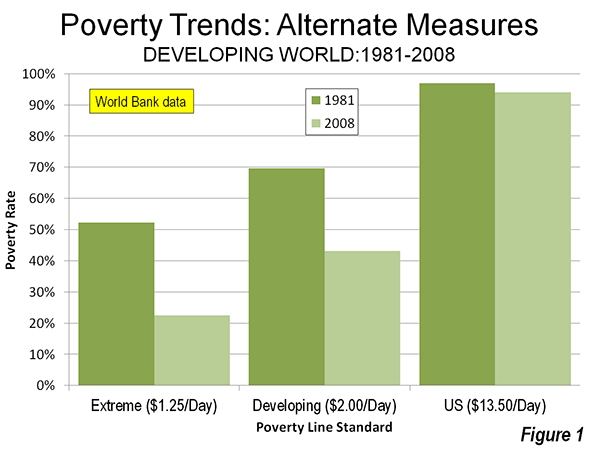
    There has been a substantial reduction in both the extreme poverty rate and the number of people living in extreme poverty since the early 1980s, according to information from the World Bank poverty database. The World Bank maintains data on developing world nations, which include both low income and middle income nations. The analysis below summarizes developing world (low and middle income nations) poverty trends from 1981 to the latest available year, 2008 (Table and Figure 1).

    Evolution of Low and Middle Income World Poverty: 1981-2008
      Poverty Rate Change in Millions % of New Population Not in Poverty
          People in Poverty People Not in Poverty
    POVERTY RATE & Region 1981 2008
    EXTREME POVERTY LINE  ($1.25/Day per capita)      
    East Asia and Pacific 77.2% 14.3%           (812)           1,374 >100.0%
    Europe and Central Asia 1.9% 0.5%                (6)                50 >100.0%
    Latin America and the Caribbean 11.9% 6.5%                (6)              212 >100.0%
    Middle East and North Africa 9.6% 2.7%                (8)              155 >100.0%
    South Asia 61.1% 36.0%                  2              655 99.6%
    Sub-Saharan Africa 51.4% 47.5%             181              233 56.3%
    Total 52.2% 22.4%           (649)           2,679 >100.0%
    DEVELOPING WORLD POVERTY LINE ($2.00/Day per capita)    
    East Asia and Pacific 92.5% 33.4%           (652)           1,214 >100.0%
    Europe and Central Asia 8.4% 2.2%              (26)                70 >100.0%
    Latin America and the Caribbean 23.8% 12.4%              (16)              221 >100.0%
    Middle East and North Africa 30.2% 14.0%                (7)              155 >100.0%
    South Asia 87.3% 71.1%             316              341 51.9%
    Sub-Saharan Africa 72.3% 69.3%             275              139 33.5%
    Total 69.7% 43.1%           (109)           2,140 >100.0%
    US POVERTY LINE: FAMILY OF FOUR ($13.50/Day per capita)    
    East Asia and Pacific 99.8% 96.6%             499                64 11.3%
    Europe and Central Asia 88.3% 72.1%              (38)                82 >100.0%
    Latin America and the Caribbean 86.3% 79.7%             139                66 32.1%
    Middle East and North Africa 96.0% 95.3%             140                   8 5.5%
    South Asia 100.0% 99.7%             652                   5 0.8%
    Sub-Saharan Africa 98.7% 98.6%             408                   6 1.5%
    Total 96.9% 94.0%          1,799              231 11.4%
    Source: World Bank PovcalNet database
    Poverty rates lines in 2005 US$ per capita

    Extreme Poverty Line ($1.25 Daily per Capita)

    Extreme poverty is defined as an income of $1.25 daily per capita, measured in 2005 United States dollars. The extreme poverty line is the average of the poverty rate among the "10 to 20" lowest income nations.

    The World Bank data indicates a nearly 60 percent reduction in the extreme poverty rate between 1981 and 2008, from 52.2 percent to 22.4 percent. By far the largest reduction was in the East Asia and Pacific region (which includes the large nations of China, Indonesia, Viet Nam, the Philippines stretches westerly to Myanmar) where the extreme poverty rate dropped more than 80 percent from 77.2 percent to 14.3 percent. Reductions of more than 70 percent were also experienced in the Middle East and North Africa and Europe and Central Asia, which is by far the most affluent of the developing world regions as designated by the World Bank (generally Eastern Europe, including Russia and Ukraine and the Central Asian nations to the western border of China, such as Kazahkstan).

    In 2008, approximately 650 million fewer people were living in extreme poverty than in 1981. This gain was dominated by East Asia and the Pacific, which experienced a reduction of 812 million people living below the extreme poverty line. Nearly all of the increase (181 million) in people living below the extreme poverty line occurred in Sub – Saharan Africa, a result of surging populations and still insufficient economic growth.

    Even so all six of the regions experienced an increase in the number of people living above the extreme poverty line. Further, in four regions, the increase in people above the extreme poverty line was greater than the overall population increase, and was nearly equal in a fifth. The increase in above extreme poverty population was less than the overall increase only in Sub-Saharan Africa.

    More than one half of the new population living above the extreme poverty line (1.37 billion) are in East Asia and the Pacific. Another quarter (0.65 billion) were in South Asia, which includes India, Pakistan and Bangladesh. Gains of from 155 million to 233 million were made in Sub-Saharan Africa, Latin America and the Caribbean and the Middle East and North Africa (in descending order). The sixth region, Europe and Central Asia had by far the lowest extreme poverty rate among the region, yet still managed a 50 million person improvement.  

    Developing World Poverty Line ($2.00 Daily per Capita)

    The success in reducing poverty was even more skewed to East Asia and the Pacific as measured against a somewhat higher average developing world poverty line of $2.00 daily per capita. The developing world under $2.00 poverty rate declined approximately one-third, from 69.7 percent to 43.1 percent

    The largest reduction was in Europe and Central Asia, where such poverty is rapidly becoming a thing of the past. The poverty rate declined almost three-quarters, to 2.2 percent. The $2.00 poverty rate fell 64 percent in East Asia and the Pacific, from 92.5 percent to 33.4 percent. Each of the other four regions also experienced declines in the $2.00 poverty line.

    There were 109 million fewer people living below the $2.00 poverty line in 2008 than in 1981. The improvement was heavily skewed toward East Asia and the Pacific, where there was a reduction of more than 650 million living below the $2.00 poverty line. There were, however, substantial increases in the number of people living below the $2.00 poverty line in South Asia (275 million) and Sub-Saharan Africa (316 million).

    Nonetheless, more than 2.1 billion additional people lived above the $2.00 poverty line in 2008 than in 1981. All regions experienced gains. East Asia and the Pacific accounted for 1.2 billion of this number, followed by South Asia (341 million) and Latin America and the Caribbean (221 million).

    United States Poverty Line ($13.50 Daily per Capita)

    Despite these gains, the extent of poverty in the developing world is substantial compared to high income world standards. For comparison, the 2008 poverty line for a family of four in the United States is used, which was $13.50 daily per capita. This is more than 10 times the extreme poverty line and nearly 7 times the $2.00 developing world poverty line.

    Between 2001 and 2008, the percentage of people in the developing world living below the US poverty line is estimated to have declined from 96.9 percent to 94.0 percent. Progress was made in each of the six regions, but even in the most affluent developing world region of Europe and Central Asia the poverty rate relative to the US standard remained at 72 percent. Even in largely middle-income Latin America and the Caribbean, the poverty rate, measured by the US standard was 80 percent. All of the other regions were at 95 percent or more. The highest poverty rate relative to the US standard was in South Asia, at 99.7 percent.

    Overall, nearly 1.8 billion additional people lived below the US poverty standard in 2008. The number of people living below the poverty standard declined only in the Europe and Central Asia. The largest increase in people living below the US poverty standard was in South Asia, at 652 million, while both East Asia and the Pacific and Sub – Saharan Africa added between 400 million and 500 million.

    The increase in the number of people living above the US poverty standard was modest, at 231 million. The largest increase was in Europe and Central Africa, at 82 million, while East Asia and the Pacific and Latin America and the Caribbean added approximately 65 million each.

    National Highlights

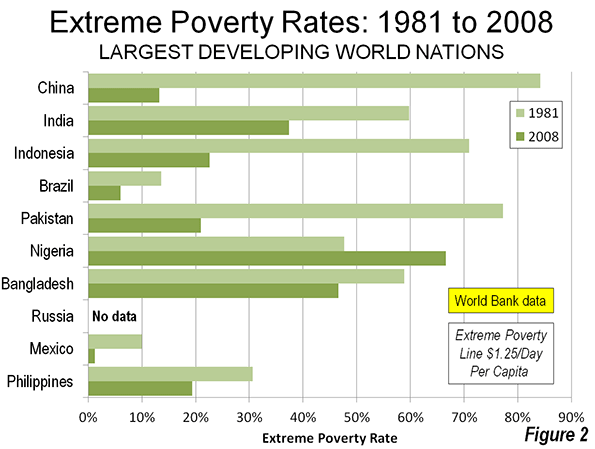
    East Asia and the Pacific have experienced the greatest reduction in poverty rates, as has been shown above. This is largely due to the substantial progress made by its largest nation, China. China experienced the largest reduction in its extreme poverty rate in the world, with a drop from 84.0 percent in 1981 to 13.1 percent in 2008. Among other developing world nations with more than 100 million population, eight experienced significant declines in their extreme poverty rates. One, however, Nigeria, had an increase. There was no data for Russia (Figure 2).

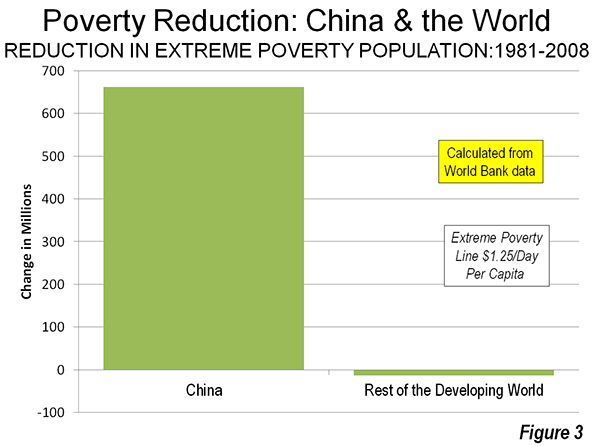
    China’s below extreme poverty line population declined 662 million, more than 10 times the second largest reduction, in Indonesia at 56 million. In fact, China’s reduction in its extreme poverty population exceeded that of the rest of the world (Figure 3).

    The number of people living above the extreme poverty line is increasing across the developing world.
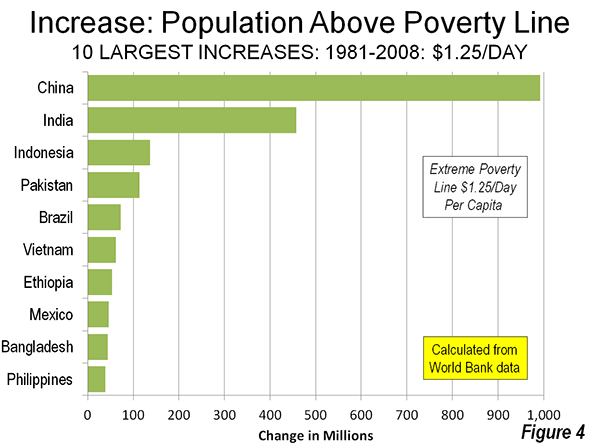
    Nearly 85 percent of China’s 2008 population lived above the extreme poverty line, an increase of nearly one billion from 1981. In India nearly 60 percent of its 2008 population lived above this line, an increase of 450 million. Other large nations experienced large increases in the number of people living above extreme poverty, such as Indonesia (135 million) and Pakistan (115 million) (Figure 4).

    Only a few nations had reductions in their number of people living above the extreme poverty rate. The Democratic Republic of the Congo had the largest increase, at 6 million.

    Eradicating Poverty: The Highest Priority

    The story on world poverty contains both good news to bad news. There is clearly substantial progress is being made in reducing extreme poverty in East Asia and the Pacific but this has not been replicated in other parts of the developing world. The bad news is that, for all the progress, the standards of living for the overwhelming majority of people remain far below first world poverty levels.

    Yet, there are signs of hope. A recent report by the Institute of International Finance indicates that over the last decade, Sub-Saharan Africa, long perceived to be synonymous with the world’s most intense poverty, has ranked second in economic growth only to East Asia for a decade.

    Yet, it can only be hoped that the natural aspiration of the world’s billions for much better lives will be achieved. The highest priority should be placed on eradicating poverty, as the recent Rio +20 Conference declared.

    —–

    Wendell Cox is a Visiting Professor, Conservatoire National des Arts et Metiers, Paris and the author of “War on the Dream: How Anti-Sprawl Policy Threatens the Quality of Life.”

    Photograph: New houses in León (Guanajuato) Mexico (by author)

  • Want to See Better US-Chinese Relations? American and Chinese Millennials Could Be Key

    While it is still fashionable for politicians in both China and the United States to prove their domestic leadership credentials by taking tough stances against their nation’s chief economic rival, the results of recent Pew surveys conducted in the two countries suggest that this type of rhetoric is a holdover from an earlier era. An examination of the beliefs among the youngest generational cohorts in each country shows a distinct lack of the ideological vitriol so common in the 1960s and 1970s. As a result, we might see a far more congenial relationship between the world’s two great powers — at least once the older generations fade away.  

    Let’s hope so, because older generations sometimes seem  more committed to discord  than accord. During the 2012 US presidential campaign both President Barack Obama and Governor Mitt Romney took full advantage of opportunities to criticize their opponent for the softness of his approach to China.  Xi Jinping, who was named the General Secretary of the Chinese Communist Party about a week after Obama was reelected and will become China’s Premier early next year, has been no less willing to rhetorically censure the United States.

    Yet the Pew research indicates that the youngest generational cohort in both the US and China holds positive attitudes toward and favors contact with the other country.   In the United States that youthful cohort is the Millennial Generation (born 1982-2003), America’s largest and most ethnically diverse and tolerant generation to date. Of the 95 million US Millennials, about four in ten are nonwhite and one in twenty is of Asian descent, with Chinese-Americans comprising the largest portion of that segment. By contrast, among U.S. seniors and Boomers, only about one in five is nonwhite and about two-percent of Asian heritage.

    Generational theorists have not definitively named the Millennials’ Chinese counterparts. Some observers, however, have called at least their urban segment “Little Emperors.” Similar to American Millennials, this generation was often reared by their own hovering “helicopter parents” in a highly protected, hyper-attentive manner that reflected the importance of these special children—the  product of China’s  “one child” policy—and the  great expectations their parents had and continue to have for their offspring. The result of this  upbringing are cohorts of civic-minded, pressured, conventional, patriotic American and Chinese young people who revere their parents, are optimistic about their nation’s future, and  open to the world.

    In China, the Pew research, conducted in March and April, 2012, contained a battery of questions probing attitudes toward the United States, its interactions with China, and its influence on Chinese society. Across all of these questions, the youngest cohort (18-29 year olds) held significantly more favorable opinions about America than older Chinese. Given that Chinese who are 50 or older include generations that established the Communist regime in 1949, fought American troops in Korea, and were part of the ideological Red Guards of the 1960s, this is not altogether surprising.   

    Overall, a majority (51%) of China’s youthful cohort held a positive view of the U.S. as compared with only 38% of older Chinese. More specifically, majorities of 18-29 year olds said they admired American technological and scientific advances (77%), American ideas about democracy (59%), U.S. music, movies, and television (56%), and agree that it is good that American ideas and customs are spreading to China (50%). Across all of these dimensions favorable attitudes toward the United States and its influence were at least 15 percentage points higher among the youngest Chinese cohort than the oldest. In only one area, the American way of doing business, did less than a majority of 18-29 year old Chinese (48%) indicate admiration of the United States; even on this dimension there was a 12-point gap between the positive opinions of younger and older Chinese respondents.

    Pew did not ask the same questions in its American surveys that it did in the Chinese study. However, it did examine many of the same dimensions permitting valid comparison of survey results in the two countries. In a November 2011 survey examining the large generation gap in U.S. politics Pew asked if it was better for the United States to build a stronger economic relationship with China or to get tough with China on economic issues. American Millennials, a generation corresponding to Chinese 18-29 year olds, overwhelmingly favored a policy focusing on building stronger trade relations with China rather than one based on toughness (69% to 24%). By contrast, a plurality of the two oldest American generations—Boomers and seniors—believed that a tougher approach instead of closer economic ties with China was best (48% to 45%). These results reflect the far greater support of Millennials than older generations for free trade agreements overall (63% to 42%).

    In its April 2012 Values survey, Pew examined the openness of Americans to “foreign,” if not specifically Chinese, influences. In one question, respondents were asked to agree or disagree with the statement: “It bothers me when I come in contact with immigrants who speak little or no English.” Only 32% of American Millennials compared to 44% of all older generations agreed. In another item Pew asked for agreement or disagreement with this statement: “the growing number of newcomers from other countries threatens traditional American customs and values.” Only four in ten Millennials (41%) as compared with a majority (53%) of Boomers and seniors agreed.

    American Millennials are a generation that seeks to resolve disputes and conflicts by searching for win-win solutions rather than absolute victories over their opponents. Recent research suggests that their Chinese counterparts share many of the same attitudes. This bodes well for relations between their two countries in coming decades. The big question for the more immediate future is whether older generations in America and China will be able and willing to set aside the attitudes based on the ideologies and policies of the past long enough for Millennials on both sides of the Pacific to forge a new, less contentious relationship.  

    Morley Winograd and Michael D. Hais are co-authors of the newly published Millennial Momentum: How a New Generation is Remaking America and Millennial Makeover: MySpace, YouTube, and the Future of American Politics and fellows of NDN and the New Policy Institute.

    Shanghai photo by Bigstock.