Blog

  • Our Dysfunctional Housing Market

    This is the story of how elites prospered while killing the singular trend that built America, and all that you proles got in return was a dysfunctional housing market. In a reversal of more than 100 years of American history, the unique force that built the United States and the wealth of its inhabitants – geographic convergence – has been stopped. Based on labor mobility and the income convergence it engendered, geographic convergence was our great equalizer, our economy’s ace in the hole: even in the worst of times people could always move from where they were to somewhere else to improve their prospects. Well, they can’t anymore, and the reason is housing.

    Who killed geographic and income convergence? Well, we wealthy, older, property-rich elites in desirable zip codes did. Call us the new landed gentry if you like. I would like to say we’re really, really, sorry but I don’t see us doing anything to correct it. It wasn’t on purpose; it was an inadvertent, unintended consequence of well-intentioned laws and regulations concerning land use, zoning, building codes, permits, property taxes and the like. We didn’t undertake those restrictions on building and development specifically to exclude you people (wait – did I really just say “you people?”). Why heck, we’re concerned as all get-out about rising inequality and income disparity, just not in our own neighborhoods, okay? And besides, residential segregation is voluntary, isn’t it? Didn’t you read Bill Bishop’s “The Big Sort”? We all naturally prefer to cluster with the like-minded and socioeconomically similar, don’t we?

    We used to have a housing market that consisted of buyers, sellers, and the supply of homes for sale. Today, the housing market is artificial and even fraudulent — it’s anything but a free market in which inventory is allowed to clear. Millions have defaulted, and millions more are in the pipeline to do so. Because of this massive shadow inventory of underwater and foreclosed homes that is only slowly being leaked out to market, there are millions of people who can’t sell the houses where they live, millions who can’t buy houses where they want to live, and millions who may never get a foot on the housing ladder at all.

    The government response — bless ’em, they do represent us — is to do everything possible to keep housing prices inflated. Interest rates are kept absurdly low (if you can qualify, and we do!), and the federal government now guarantees 90% of all mortgage loans (defaults and delinquencies are staggering, but so what?). Inventory is being constrained by banks which have not only been bailed out, but given the ability to rewrite accounting rules, for example, suspending mark-to-market and taking years to move on non-performing loans. Some of your neighbors haven’t made a mortgage payment in years but have yet to receive a notice of default. The result? In some markets, housing mania has returned. Flippers and non-resident investors are flooding in and crowding out people who actually want to buy homes in which to live. We’re inflating the bubble again. Thank you so much — don’t mind the feudalism!

    All of this allows us to continue to buy expensive homes with low down payments and monthly payments (relative to income, of course, and ours is larger than yours), max out the tax deduction on the back-end, and escape capital gains taxes on the first $500,000 of profit on the sale of a home. Sweet. I guess they’re trying to goose consumption, but with your flat household incomes, it doesn’t seem to be working.

    How We Got Here – In a recent working paper two Harvard economists, Peter Ganong and Daniel Shoag, explain how geographic and income convergence started to slow in the 1960s, when rich people in rich places started constraining land use through regulation. This limited the housing supply in those places, which forced prices up, and started to squeeze out those with lower incomes.

    Housing prices have always been more expensive in high-income places, but the difference now is unbridgeable. The result is that people can’t get on the upward mobility ladder, thus increasing the inequality that these same elites bemoan. But they don’t see or understand the connection between this income divergence and their own regulations and restrictions.

    What to Do? – I recently had the opportunity to contribute to a symposium hosted by CORE (National Community Renaissance), one of the largest nonprofit affordable housing development corporations in the United States. As a catalyst we used an article by Joel Kotkin and Steve PonTell, CORE’s President and CEO, “Is the Dream Dead? Housing’s Next Challenge.” The authors note that homeownership is at a 15-year low, despite the fact that owning a home is now cheaper than renting in most of the top 100 metro areas, but that lower housing prices have not done much to improve the conditions for lower-income people. Indeed, as people who would normally own housing become renters, price pressure has actually worsened for renters.

    Housing has traditionally been the main way Americans accumulated assets, created wealth, raised families, became part of communities, and contributed to social stability. But housing is only one factor squeezing lower and middle income Americans. The real culprit has been stagnant and even declining incomes. The authors conclude, as I read it, that if you want to champion those less well-off, the way to do it is with solutions that are less government-centric: not to give them housing and income, but to take away the barriers to housing, allow the construction of new, market-friendly housing, and boost wealth creation through economic development.

    What If Housing Declines For A Generation? – A strong case can be made that the fundamental supports of the housing market – demographics, employment, creditworthiness and income – will not recover for a generation, and that housing has lost its status as the foundation of middle class wealth, not for a generation, but for the long term.

    Charles Hugh Smith has written that rising rates of home-ownership require five conditions: favorable demographics, rising household formation rates, a large cohort of creditworthy potential buyers, an economy that generates rising incomes to support home-ownership, and an unshakable belief that owning a house is a favorable and secure investment that will rise in value in the decades ahead.

    If the first four conditions have eroded, then the belief in the permanence of a rising housing market will also erode. And they all have in fact eroded:

    • Today’s demographics are not favorable to housing on a number of fronts.
    • Household formation is in a long-term decline.
    • Labor’s share of the national income has plummeted to historic lows, and
      income has declined, especially for young workers.

    • Part-time jobs and temp jobs do not generate enough stable income to support a mortgage. It’s easy to qualify people for a mortgage. The hard part is making sure that they will have enough income and faith to service the mortgage for the next 30 years.

    Arnold King of George Mason University has argued that home ownership subsidies have imposed costs on the economy and society that are large and clear, while the benefits of such subsidies are, at best, small and vague. His conclusion: Who needs home ownership?

    I’m more worried about Smith’s conclusion, which is an idea that few are willing to entertain: the possibility that housing is no longer the foundation of middle class wealth, and that its decline is structural, not cyclical. What if he’s right?

    Dr. Roger Selbert is a trend analyst, researcher, writer and speaker. Growth Strategies is his newsletter on economic, social and demographic trends. Roger is economic analyst, North American representative and Principal for the US Consumer Demand Index, a monthly survey of American households’ buying intentions.

    Flickr photo by Sean Dreilinger: For Sale signs posted in Lake Oswego, Oregon

  • Born Into Ruin: How the Young are Changing Cleveland

    It’s true. I am not happy all the time living in Cleveland. But I don’t want to be happy all the time. That’s unnatural. Said Nietzsche:

    “Sometimes, struggles are exactly what we need in our life. If we were to go through our life without any obstacles, we would be crippled. We would not be as strong as what we could have been.”

    Cleveland is a struggle. But that is how I know it. That is how many Clevelanders in their 20’s to 40’s know it. We didn’t know the city of Mr. Jingeling and Bob Hope—the city of a near million—the “Best Location in Nation”. No, we knew Cleveland on its knees. We knew Cleveland praying. But being born into post-industry is a good first lesson. Life is an obstacle. Cleveland prepares you.

    For what?

    Bullshit, or at least the proclivity of it.

    Aspirations abound now. If you were only creative enough, rich enough, worldly and knowledgeable enough, then: you can become something, a star—evolved from your basic beginnings. Fine. But it’s this ambition-before-all-else mindset that has also extended our eyes from our feet, or our aspirations from our selves, and so for long the country has left its principles behind to build castles in the air with no foundation. Consequently, our culture—our sense of being from somewhere, of bleeding the aesthetic of someplace—has taken a hit. It’s no surprise, then, that our castles keep falling down into a pile of broken promises that never seem to be able to feed, clothe, or employ us properly.

    To hell with it. Time to be proud in the gift of being grounded. It is the only way up.

    Grounded. It’s how we are grown here in the Rust Belt. For you see it everywhere: the reality of things. You see it in the cracked sidewalks, and in the seriousness on the faces of the people all around you. You see it in the empty brownfields behind chain link fences. Yet there is a comfort in the Rust Belt aesthetic, one tied to the fact there’s little pretentiously precious. From the bodies we are built with to the handshakes we make to the food we eat to the buildings we see, shit is heavy here. And it’s a ritual you learn simply by living on Rust Belt ground.

    I am watching this unfold first hand with my 2-year old daughter. You see, I have a place near the rail ties, and each time the train rides through my girl runs to the window to see the power of the “choo choo”. I watch her with a smile as she watches with awe as the force of the box cars enter our bodies through the vibrations coming up from the ground. She is becoming Rust Belt, I think. I do this every time this happens.

    But this groundedness, this Rust Belt-ness, it’s not a settling or a lack of aspiration, but rather—for Clevelanders populating the city that never knew its heights— a chance to look around and see nothing but work to do, and an opportunity to do it. There are a lot of fresh eyes around. The city psychology is changing. And I think this may save Cleveland, because people are no longer waiting for Cleveland to save us.

    This is happening all across the Rust Belt. For instance, Detroit native Bill Morris recently wrote about his trip back to Motown to “see that Detroiters had stopped waiting for salvation from above – a new auto factory, a new government program, a new housing development – because they were too busy saving themselves down at street level.”

    Morris goes on to interview Jack Kushigan, a Detroiter who grew up working in the family’s machine shop before moving to San Francisco and then back. He writes of Kushigan:

    I met him in the woodworking shop he’d set up in a church basement on the city’s hard-hit East Side, where he was teaching neighborhood people how to make furniture out of wood harvested from abandoned buildings, a virtually limitless source of raw materials. “Detroit for years, during its decline, has been hoping for a Messiah,” Kushigian told me. “Detroit has finally given up on that. A lot of people in Detroit have a fire burning inside them that I don’t see anywhere else. My feeling is that the Messiah is us.”

    I feel the same thing is happening in Cleveland. The work the young people are doing. The fact they are entering the broken dreams of past generations with no illusions, little skeletons, but with a determination that comes with being grounded. And it is this kind of collective turn-the-page energy that will end the endless recent history of our decline.

    Call it the benefit of struggle, or of not having your castles yet crumble because you’d been born into the ruin.

    This piece originally appeared on Cool Cleveland.

    Richey Piiparinen is a writer and policy researcher based in Cleveland. He is co-editor of Rust Belt Chic: The Cleveland Anthology. Read more from him at his blog and at Rust Belt Chic.

  • Obama’s Energy Dilemma: Back Energy-Fueled Growth or Please Green Lobby

    Talk all you want about the fiscal cliff, but more important still will be how the Obama administration deals with a potential growth-inducing energy boom. With America about to join the ranks of major natural gas exporters and with the nation’s rising oil production reducing imports, the energy boom seems poised to both  boost our global competitiveness and drive economic growth well above today’s paltry levels.

    This puts President Obama in a dilemma. To please his core green constituency, he can strangle the incipient energy-led boom in its cradle through dictates of federal regulators. On the other hand, he can choose to take credit for an economic expansion that could not only improve the lives of millions of middle- and working-class Americans, but also could assure Democratic political dominance for a decade or more.

    Stronger economic growth remains the only way to solve our nation’s fundamental fiscal problems other than either huge tax hikes or crippling austerity. As economist Bret Swanson has pointed out, the best way to raise revenues and reduce expenditures, particularly for such things as welfare and unemployment, would be to increase overall growth from the current pathetic 2 percent rate to something closer to 3 or 4 percent.

    Swanson suggests in a few simple charts (PDF) that a 4 percent growth rate would drive output to levels that would cover even our current projected spending levels. Even at 3 percent, the additional revenue would be enough, for example, to fill in Medicare’s looming $24.6 billion liability that is projected to 2050. The effects of higher growth are likely far greater than either any anticipated bonanza by raising taxes on the “rich” or enacting the most extreme austerity.

    The energy revolution presents Obama with the clearest path to drive this critical boost to greater economic growth. New technologies for finding and tapping resources, such as fracking and other new technologies to tap older oil fields, could make America potentially the largest oil and gas producer by 2020, according to the International Energy Agency.

    Equally important, an increasingly energy self-sufficient America would enjoy significantly greater independence from pressure from the often hoary influence of such unattractive regimes as Saudi Arabia, Venezuela, and Russia. Approval of the controversial Keystone pipeline from Canada to Texas would cement what would effectively be a North American energy community utterly independent of these trouble spots.

    Those that have embraced the energy revolution have already created a gusher in energy jobs, which pay wages on average higher (roughly $100,000 annually )  than those paid by information, professional services, or manufacturing . The six fastest-growing jobs for 2010-11, according to Economic Modeling Specialists International, are related to oil and gas extraction. In total, nine of the top 11 fast-growing jobs in the nation over the past two years are tied in one way or another to oil and gas extraction.

    Over the decade, the energy sector has created nearly 200,000 jobs in Texas, as well as 40,000 in Oklahoma, and more than 20,000 in Colorado. Growth on a percentage basis is even higher in North Dakota, which saw a 400 percent increase in these jobs, as well as Pennsylvania, where jobs increased by 20,000.

    In contrast California, whose Monterey Formation alone is estimated to be four times larger than North Dakota’s Bakken reserve, has chosen, in its irrepressible quest for ever greater greenness, to sharply limit its fossil-fuel industry As a result, it has generated barely one-tenth the new fossil fuel jobs generated in archrival Texas. Not surprisingly, California and other green-oriented states have lagged behind in GDP and income growth while the energy states have for the most part enjoyed the strongest gains.

    In addition, domestic energy growth directly spurs the construction of new, as well as the rehabilitation of old, industrial facilities. This already is occurring across a vast swath of America, from revived steel mills in Ohio and Pennsylvania to massive new petrochemical plants being planned along the Gulf Coast. Further development of energy resources, according to a study by Price Waterhouse Coopers, could create upwards of a million industrial jobs over the next few years.

    For Obama, getting behind energy boom presents both enormous opportunities as well a serious political dilemma. In terms of cutting emissions, the rising use of natural gas has been a huge boon, allowing the U.S. to make greater cuts than any other major country over the past four years. Yet, the green lobby, once sympathetic to this relatively clean fuel, has turned decisively against any new gas development.

    As a major component of Obama’s wide-ranging  coalition of grievance holders, environmentalists expect  to exercise greater influence in the second Obama term. Hollywood, now virtually an adjunct to the “progressive” coalition, will soon weigh in with Promised Land, a predictably anti-fracking movie, starring Matt Damon. Living up to Hollywood’s tradition of serving as what Lenin called “useful idiots”, the movie is financed in large part  by investors from the United Arab Emirates, whose profits would be threatened by the growth of American energy production.

    The ideological stakes for the green movement are tremendous . Greatly expanded American fossil-fuel production violates the “peak oil” mantra that has underpinned environmental thinking for decades, and undermines some of the core rationale for subsidizing expensive renewables such as solar and wind.

    Geography also may play a major role here. Outside of Colorado, the industrial Midwest and western Pennsylvania, where the shale boom is widely seen as boosting local economies, the vast majority of energy-producing states tilt strongly to the GOP. In contrast, Obama’s strongest support comes from green-oriented coastal residents whose familiarity with energy production starts and ends with turning on a light or switching on an Ipad.

    Obama’s financial base—in contrast to that enjoyed by the Republicans—relies little on the energy industry. The president’s corporate support comes largely from the entertainment, media, and software industries. Many of Obama’s strongest business backers, particularly in Silicon Valley, have become entangled financially with “renewable energy” schemes, many of which can only survive with massive subsidies in the form of tax credits, loans, and surcharges on energy consumers.

    Yet the president has good political reasons not to undermine the energy boom tht can deliver on his promise to deliver high-wage jobs and prosperity to the beleaguered middle class and working classes. In the campaign, the president wisely and openly sublimated his inner green, even taking credit for the expansion of fossil-fuel production. As the campaign came to a close, as Walter Russell Mead observed, “the less we hear about green and the more we hear about brown, about oil and gas drilling.”

    As in so many areas, Obama’s political judgments were on target. His “brown” shift helped deprive the GOP of a key issue in critical swing states such as Colorado, Ohio, and Pennsylvania. Seeming moderation on energy also helped keep Democratic Senate seats in such key producing states as West Virginia, North Dakota, and Montana. A sharp turn back to a hard green position, particularly a ban on fracking, would leave these and other energy-state Democratic miracle babies isolated and vulnerable .

    Right now, the administration’s energy policy seems a bit muddled, as the Obama team emerges from the fog of the campaign wars. On the one hand, there are signs that the Bureau of Land Management may take upwards of 1.5 million acres of western lands off the table for energy production. Yet at the same time, the bureau has announced plans to open 20 million acres off the Gulf Coast for exploration.

    One can understand Obama’s ambivalence on the issue. Embracing the energy boom, and the ensuing economic expansion, could create an economic bonanza while continuing to reduce carbon emissions. This can be further enhanced by backing efforts by natural-gas producers to expand more into the bus, heavy equipment and truck market. On the other hand, this tack will risk the ire of rent-seeking renewable-energy firms and greens,  as well as their media and Hollywood claques.

    Rather than divide the country into green and brown camps, the Breakthrough Institute’s Ted Nordhaus and Michael Shellenberger suggest, the administration should seek “a rapprochement” between the natural gas industry and the environmental movement. Dirtier energy sources, notably coal, could be jettisoned while the country shifts, at least for the medium and short run, toward a greater reliance on cleaner gas energy.

    Ultimately, the decision whether to embrace an energy-led growth strategy may well determine whether President Obama can improve middle-class prospects. In the coming months, he will need to choose between pleasing the green purists around him and generating a long boom that would elevate him to Mount Rushmore levels, and assure his party’s political dominion for a generation.

    Joel Kotkin is executive editor of NewGeography.com and is a distinguished presidential fellow in urban futures at Chapman University, and contributing editor to the City Journal in New York. He is author of The City: A Global History. His newest book is The Next Hundred Million: America in 2050, released in February, 2010.

    This piece originally appeared at The Daily Beast.

    Midwest drilling rig photo by Bigstock.

  • What Is a Global City?

    We hear a lot of talk these days about so-called “global cities.” But what is a global city?

    Saskia Sassen literally wrote the book on global cities back in 2001 (though her global cities work dates back well over a decade prior to that book). She gave a definition that has long struck with me. In short form, in the age of globalization, the activities of production are scattered on a global basis. These complex, globalized production networks require new forms of financial and producer services to manage them. These services are often complex and require highly specialized skills. Thus they are subject to agglomeration economics, and tend to cluster in a limited number of cities. Because specialized talent and firms related to different specialties can cluster in different cities, this means that there are actually a quite a few of these specialized production nodes, because they don’t necessarily directly compete with each other, having different groupings of specialties.

    In this world then, a global city is a significant production point of specialized financial and producer services that make the globalized economy run. Sassen covered specifically New York, London, and Tokyo in her book, but there are many more global cities than this.

    The question then becomes how to identify these cities, and perhaps to determine to what extent they function as global cities specifically, beyond all of the other things that they do simply as cities. Naturally this lends itself to our modern desire to develop league tables.

    A number of studies were undertaken to produce various rankings. However, when you look at them, you see that the definition of global city used is far broader than Sassen’s core version. Wikipedia lists some of the general characteristics people tend to refer to when talking about global cities. It cites a very lengthy list, but some of them are:

    • Home to major stock exchanges and indexes
    • Influential in international political affairs
    • Home to world-renowned cultural institutions
    • Service a major media hub
    • Large mass transit networks
    • Home to a large international airport
    • Having a prominent skyline

    As you can see, this is quite a hodge-podge of items, many of which are only tangentially related to globalization per se. In effect, many of them seek to define cities only in term of global prominence rather than functionally as related to the global economy. That’s certainly a valid way to look at it, but it raises the point that we should probably clarify what we are talking about when we talk about global cities.

    To clarify our thinking, let’s look at how various ranking studies have defined global city for their purposes.

    One oft-cited such ranking was a 1999 research paper called A Roster of World Cities. The authors, Jon Beaverstock, Richard G. Smith and Peter J. Taylor, explicitly reference Sassen’s work, seeking to define global cities in terms of advanced producer services.

    Taking our cue from Sassen (1991, 126), we treat world cities as particular ‘postindustrial production sites’ where innovations in corporate services and finance have been integral to the recent restructuring of the world-economy now widely known as globalization. Services, both directly for consumers and for firms producing other goods for consumers, are common to all cities of course, what we are dealing with here are generally referred to as advanced producer services or corporate services. The key point is that many of these services are by no means so ubiquitous; for Sassen they provide a limited number of leading cities with ‘a specific role in the current phase of the world economy’ (p. 126).

    They took lists of firms in four specific service industries – accounting, advertising, banking, and law – and determined where those firms maintained branches and such around the world in order to determine the importance of various cities as production nodes of these services. This has some weaknesses in that it doesn’t necessarily distinguish whether say a particular accounting firm is doing routine type work of the sort accountants have always been doing, or performing advanced work of a type specific to globalization, but it at least tries to derive lists related to the production of services.

    As the global city concept grew in popularity, various other organizations entered the fray. Most of these newer lists take a very different a much broader approach closer to the Wikipedia type lists of characteristics rather than a Sassen-like definition.

    One example is AT Kearney’s list, developed in conjunction with the Chicago Council on Global Affairs. Their most recent version is the 2012 Global Cities Index. This study uses criteria across five dimensions:

    • Business Activity (headquarters, services firms, capital markets value, number of international conferences, value of goods through ports and airports)
    • Human Capital (size of foreign born population, quality of universities, number of international schools, international student population, number of residents with college degrees)
    • Information Exchange (accessibility of major TV news channels, Internet presence (basically number of search hits), number of international news bureaus, censorship, and broadband subscriber rate)
    • Cultural Experience (number of sporting event, museums, performing arts venues, culinary establishments, international visitors, and sister city relationships).
    • Political Engagement (number of embassies and consulates, think tanks, international organizations, political conferences)

    The Institute for Urban Strategies at The Mori Memorial Foundation in Tokyo published another study called “The Global Power City Index 2011.” This report examined cities in terms of functions demanded by several “actor” types: Manager, Researcher, Artist, Visitor, and Resident. The functional areas were:

    • Economy (Market Attractiveness, Economic Vitality, Business Environment, Regulations and Risk)
    • Research and Development (Research Background, Readiness for Accepting and Supporting Researchers, Research Achievement)
    • Cultural Interaction (Trendsetting Potential, Accommodation Environment, Resources of Attracting Visitors, Dining and Shopping, Volume of Interaction)
    • Livability (Working Environment, Cost of Living, Security and Safety, Life Support Functions)
    • Environment (Ecology, Pollution, Natural Environment)
    • Accessibility (International Transportation Infrastructure, Inner City Transportation Infrastructure)

    Another popular ranking is the Economist Intelligence Unit’s Global City Competitiveness Index. They rank cities on a number of domains:

    • Economic Strength (Nominal GDP, per capita GDP, % of households with economic consumption > $14,000/yr, real GDP growth rate, regional market integration)
    • Human Capital (population growth, working age population, entrepreneurship and risk taking mindset, quality of education, quality of healthcare, hiring of foreign nationals)
    • Institutional Effectiveness (electoral process and pluralism, local government fiscal autonomy, taxation, rule of law, government effectiveness)
    • Financial Maturity (breadth and depth of financial cluster)
    • Global Appeal (Fortune 500 companies, frequency of international flights, international conferences and conventions, leadership in higher education, renowned think tanks)
    • Physical Capital (physical nfrastructure quality, public transport quality, telecom quality)
    • Environment and Natural Hazards (risk of natural disaster, environmental governance)
    • Social and Cultural Character (freedom of expression and human rights, openness and diversity, crime, cultural vibrancy)

    Note that these were not all equal weighted. Economic strength is paramount.

    Yet another ranking comes from the Knight Frank/Citibank Wealth Report. This ranking is purely subjective and was based on surveying wealth advisors as to which cities they felt would be most important to their clients today and in the future based on four areas: economic activity, political power, knowledge and influence, and quality of life.

    It’s worth noting that Sassen contributed to various of these surveys.

    Looking at the newer surveys versus the Roster of World Cities, it’s clear that the game has changed. Rather than attempting to look at specific global economic functions, the global city game has become effectively a balanced scorecard attempt to determine, as I like to put it, the world’s “biggest and baddest” cities.

    There are quite a few differences in methodologies, which is inevitable. But a few things jump out at me. First the focus on aggregate measures in these surveys. For example: total GDP, total foreign population, number of headquarters. There is a remarkable lack of attention to dynamism variables such as growth in various metrics, though the Economist survey includes a couple.

    The focus on static totals versus dynamism tends to reward large, developed world cities versus rapidly growing or emerging market cities. (The AT Kearney survey has a separate emerging cities list). In a sense, these rankings are biased in favor of important legacy cities.

    It’s also interesting to see what was included vs. not included in quality of life type ratings. For example, items like censorship, media access, the rule of law, and the environment are listed. But measures of upward social-economic mobility or income inequality or not.

    Lastly, a number of the rankings suggest a self-consciously elite mindset, such as shopping and dining options. As with many quality of life surveys, these seem to orient them towards expatriate executive types rather than normal folks.

    Looking at these, I can’t help but think that the criteria were the product of an iterative process where the results were refined over time. Thus in a sense the outcomes were likely somewhat pre-determined. That’s not to say that the game was rigged necessarily. But I suspect if anyone were doing a global city survey and London and New York did not rank at the top, the developers would question whether they got the criteria right. In a sense, a global city is like obscenity: we know one when we see it, but we don’t necessarily have a widely agreed upon objective set of criteria to measure it by.

    I sense that these rankings attempt to look at global cities in four basic ways:

    1. Advanced producer services production node. This is basically Sassen’s original definition. I think this one remains particularly important. Because the skills are specialized and subject to clustering economics, the cities that concentrate in these functions have a Buffett-like “wide moat” sustainable competitive advantage in particular very high value activities. For cities with large concentrations of these, those cities can generate significantly above average economic output and incomes per worker.
    2. Economic giants. Namely, this is a fairly simple but important view of that simply measures how big cities are on some metrics like GDP.
    3. International Gateway. Measures of the importance of a city in the international flows of people and goods. Examples would be the airport and cargo gateway figures.
    4. Political and Cultural Hub. An important distinction should perhaps be made here between hubs that may be large but of primarily national or regional importance, and those of truly international significance. For example, there are many media hubs around the world, but few of them are home to outlets like the BBC that drive the global conversation.

    There may potentially be other ways to slice it as well. The fact that these various ways of viewing cities can often overlap can confuse things I think. For example, New York and London score highly on all of these. And there are surely underlying reasons why they do. Yet trying to sum it all up into one overall ranking or score, while making it easy to get press, can end up obscuring important nuance.

    So when thinking about global cities, I think we need to do a couple of things:

    1. Clarify what it is we are talking about at the time.
    2. Relative to the definition we are using, seek to identify the specific parts of the city in question that generate real above average value at the global level.

    Aaron M. Renn is an independent writer on urban affairs and the founder of Telestrian, a data analysis and mapping tool. He writes at The Urbanophile, where this piece first appeared.

    Chicago photo by Bigstock.

  • Separation of Church and Urban Planning

    Recently, the Journal of the American Planning Association (JAPA) published research that directly challenged prevailing views in urban planning. In an article entitled Growing Cities Sustainably, Marcial H. Echenique, and Anthony J. Hargreaves from Cambridge University, Gordon Mitchell (University of Leeds) and Anil Namdeo (University of Newcastle) found that compact development (smart growth) had only a marginal impact on sustainable development and should not "automatically be associated with the preferred spatial growth strategy" (See Questioning The Messianic Conception of Smart Growth). This was particularly unsettling to the powers-that-be in urban planning, who have struggled for years – predating the current greenhouse gas emission (GHG) reduction concerns – to make anything but smart growth virtually illegal.

    The Reaction

    Soon after, the JAPA editor (Randy Crane of UCLA) was criticized by fellow academics in the "PLANET" listserv for permitting publication, at least partly because the research questioned the value of compact development (smart growth) in achieving environmental sustainability.

    In early November, a session was held at the 53rd Annual Association of Collegiate Schools of Planning conference in Cincinnati entitled "Spinning Wheels and Witch Hunts: Debating the Merits of Planning Research," devoted to discussion of what at least some considered the heresy of Echenique, et al. The conference program description of the session included questions such as the following:

    "What are the dangers of applying the “scientific method” in planning?"

    My comment: Any dangers are problems of planners, not the scientific method

    "How do ethics, politics and normative values factor into what gets published?"

    My comment: It is hoped as little as possible, which is why concern is expressed here.

    "On the issue of compact cities, are we spinning our wheels, or are we provocatively challenging conventional wisdom? Is the problem of sprawl still an open question? Do these debates ever end, or, with JAPA’s help, do they keep going indefinitely?"

    My comment: The debates must continue until perfect knowledge has been achieved and all relevant information has been objectively considered (with or without JAPA). Neither condition has been satisfied.

    A Report from the Front

    Professor Lisa Schweitzer of the University of Southern California provided comments on the session in an article entitled ACSP Reflections #1 Should Researchers be Allowed to Question Smart Growth?. Professor Schweitzer describes only the beginning of the session, indicating that she left because the room was too crowded and out of a concern that the authors would not be represented. This is despite the fact that the purpose of the session was, in effect, to discuss whether the researchers were "out of bounds" in raising the issue. Even abbreviated, Professor Schweitzer’s account raises substantial concerns, which are described below.

    The session began with a critique of the Echenique, et al research by Professor Emily Talen of Arizona State University. Professor Schweitzer characterized Talen’s criticism as boiling down to "practitioners have a tough time convincing people to pursue smart growth."

    Censoring Criticisms of Smart Growth?

    Professor Schweitzer continues: "The problem with Talen’s idea is that it suggests researchers ‘owe’ it to practitioners to only inquire within the framework that compact development is unambiguously meritorious and sprawl is ambiguously not." Professor Schweitzer rightly questions how compact development can be considered "unambiguously good" if it is not examined closely.

    In fact, there is no room for icons or the sacred in academic inquiry. The imperative to question is the very justification for publication of the Echenique, et al research.

    Avoided Issues

    Indeed, there is considerable evidence that compact development has not been examined closely enough. For example, urban planning research has usually discounted, ignored or even denied the association of compact development with inordinately higher house prices relative to incomes – despite massive evidence to the contrary. This is because housing is the largest element in the cost of living, higher house prices necessarily reduce discretionary incomes and increase poverty.

    This is an issue not only for high-income cities but also for developing ones. New York University Professor Shlomo Angel expresses concern that: …strict measures to protect the natural environment by blocking urban expansion could "choke the supplies of affordable lands on the fringes of cities and limit the abilities of ordinary people the house themselves." (See: A Planet of People: Angel’s Planet of Cities).

    Similar concern is raised by Brandon Fuller of Charter Cities: … if governments respond by trying to contain urban expansion with greenbelts or urban growth boundaries that artificially restrict the supply of developable land, the result will be prices and rents higher than many arriving families can afford.

    The association between higher densities and more intensive traffic congestion is also avoided in much of the planning press. Echenique, et al are an exception, citing research showing that when density rises, vehicle travel rises almost as much. This is no small matter, since expanding mobility throughout metropolitan areas means more economic growth (read more affluence and less poverty). This is before considering the negative impacts of greater traffic intensity on localized air pollution and health.

    Sanctioning Objective Inquiry?  

    The need for greater openness in academia also caught the attention of Australian transport and urban development consultant Alan Davies (in Will Compact Cities Deliver on the Environment), who wrote:

    There needs to be more consideration of evidence-based research by those interested in cities. One reason why there isn’t is illustrated by the reaction to the Echinique et al paper by some members of the US Association of Collegiate Schools of Planning (ACSA).

    On a similar note, Professor Schweitzer noted that it is common for advocates of compact development to charge skeptics with unethical behavior. This creates an environment that is not conducive to developing objective and reliable strategies that effectively addresses objectives such as environmental sustainability.

    Back to the (17th Century) Future?

    Open minds have always been a threat to dogma and its proponents. Progress comes from the objective application of science, which is the very opposite of dogma.

    Yet, there is a long tradition of sanctioning thought and publication that questions the conventional wisdom. It is not an honorable tradition. In the 17th century, Galileo was bold enough to challenge the doctrines of the Church about the relationship of Earth to the sun. The Church determined that it was inappropriate for him to publish such views and Galileo spent the rest of his life under house arrest. Of course, doctrines change, especially when exposed to the light of new or ignored evidence.

    Researchers like Echenique, et al should not be confined to an ivory tower equivalent of house arrest. Their work and that of researchers disagreeing with them should be roundly debated in an open, academically free environment. All of this requires a separation of church and urban planning.

    Wendell Cox is a Visiting Professor, Conservatoire National des Arts et Metiers, Paris and the author of “War on the Dream: How Anti-Sprawl Policy Threatens the Quality of Life.”

    ——

    Photo: Sather Tower, University of California, Berkeley (by author)

  • The Blue-State Suicide Pact

    With their enthusiastic backing of President Obama and the Democratic Party on Election Day, the bluest parts of America may have embraced a program utterly at odds with their economic self-interest. The almost uniform support of blue states’ congressional representatives for the administration’s campaign for tax “fairness” represents a kind of  bizarre economic suicide pact.

    Any move to raise taxes on the rich — defined as households making over $250,000 annually — strikes directly at the economies of these states, which depend heavily on the earnings of high-income professionals, entrepreneurs and technical workers. In fact, when you examine which states, and metropolitan areas, have the highest concentrations of such people, it turns out they are overwhelmingly located in the bluest states and regions.

    Ironically the new taxes will have relatively little effect on the detested Romney uber-class, who derive most of their income from capital gains,   taxed at a much lower rate. They also have access to all manner of offshore dodges. Nor will it have much impact on Silicon Valley millionaires and billionaires, or the Hollywood moguls and urban land speculators who constitute the Democratic Party’s “good rich,” and enjoy many of the same privileges as their wealthy conservative counterparts.

    The people whose wallets will be drained in the new war on “the rich” are high-earning, but hardly plutocratic professionals like engineers, doctors, lawyers, small business owners and the like. Once seen as the bastion of the middle class, and exemplars of upward mobility, these people are emerging as the modern day “kulaks,” the affluent peasants ruthlessly targeted by Stalin in the early 1930s.

    The ironic geography of the Democratic drive can be seen most clearly by examining the  distribution of the classes now targeted by the coming purge. The top 10 states with the largest percentage of “rich” households under the Obama formula include true blue bastions Washington, D.C., which has the highest concentration of big earners, Connecticut, New Jersey, Maryland, Massachusetts, New York, California and Hawaii. The only historic “swing state” in the top six is Virginia, due largely to the presence of the affluent suburbs of the capital. These same states, according to the Tax Foundation, would benefit the most from an extension of the much-lambasted Bush tax cuts.

    The pattern of distribution of “the rich” is even more marked when we focus on metropolitan areas. Big metro areas supported Obama, particularly their core cities, by margins as high as four to one. Besides New York, the metro areas with the highest percentage of high-earning households include such lockstep blue cities as San Francisco, Washington, San Jose, Atlanta and Los Angeles.

    The income tax hit may not be the only pain inflicted on these areas in the President’s drive for greater “fairness.” Moves to curb mortgage interest deductions for affluent households also would fall predominately on these same areas. The states with the highest listing prices — and the biggest mortgages on average – are the president’s home state of Hawaii, followed by the District of Columbia, New York, California and Connecticut. According to the Census Bureau and the Federal Housing Agency, median home values in California are 200% higher than the national median, and in New York they’re 150% higher; in contrast, red Texas’ prices are below the median.

    The contrast in prices is even greater between metropolitan areas. The highest prices — and thus largest mortgages — are in the deep blue havens of San Francisco, New York and Los Angeles. If the mortgage interest deduction is capped for loans, say, over $300,000, homeowners in these cities will suffer far more than in key red state cities like Dallas or Houston, where homes are at least half the price.

    The curbing of the mortgage interest deduction constitutes only one part of a broader effort to cut back on all itemized deductions. This would hit states with the highest rates of people taking such deductions: California, New York, the District of Columbia, Connecticut and New Jersey, according to the Wall Street Journal. In contrast, the states least vulnerable to this kind of leveling reform would be either red states such as Indiana, Alaska or Kentucky, or classic “swing” states such as Iowa and Ohio.

    Of course, one can argue that these changes follow the precepts of social justice: Rich people and rich regions should pay more. Yet being “rich” means different things in different places, due to vast differences in costs of living. The cost of living   in New York and Los Angeles, for example, is so high that the adjusted value of salaries rank in the bottom fifth in the nation. In other words, a couple with two children with a $150,000 income in Austin or Raleigh may be, in terms of housing and personal consumption, far “richer” than one making twice that in New York or Los Angeles.

    What would a big tax increase on the “rich” mean to the poor and working classes in these areas? To be sure, they may gain via taxpayer-funded transfer payments, but it’s doubtful that higher taxes will make their prospects for escaping poverty much brighter. For the most part, the economies of the key blue regions are very dependent on the earnings of the mass affluent class, and their spending is critical to overall growth. Singling out the affluent may also reduce the discretionary spending that drives employment in the personal services sector, retail and in such key fields as construction.

    This prospect is troubling since many of these areas are already among the most unequal in America. In the expensive blue areas, the lower-income middle class population that would benefit from the Administration’s plan of  keeping the Bush rates for them is proportionally smaller, although  the numbers of the poor, who already pay little or nothing in income taxes, generally greater. Indeed, according to a recent Census analysis, the two places with the highest proportions of poor people are Washington, D.C., and California. By far the highest level of inequality among the country’s 25 most populous counties is in Manhattan.

    Finally we have to consider the impact of the new tax rates on the fiscal health of these states. Four of the five states in the poorest shape fiscally, according to a recent survey by 24/7 Wall Street, all have congressional delegations dominated by Democrats — California, New Jersey, Rhode Island and Illinois (the one red state is Arizona). Slower economic growth brought about by higher taxes — compounded by high state taxes — is unlikely to make their situation any better.

    So what can we expect to happen if the fiscal cliff appears, or if the President and his party get their taxes on the rich? One can expect a proportionally greater impact on citizens and the budgets of the already expensive, high-tax states, where the new kulak class is concentrated. It may also spark a greater migration of people and companies to less expensive, lower-tax areas.

    Perhaps the greatest  irony in all this is that the Republicans, largely detested in the deep blue bastions, are the ones most likely to fall on their swords to maintain lower rates for the the  mass affluent class in the bluest states and metros. If they were something other than the stupid party, or perhaps a bit more cynical, they would respond to the President’s tax proposals by taking a line from their doddering cultural icon, Clint Eastwood: make my day.

    Joel Kotkin is executive editor of NewGeography.com and is a distinguished presidential fellow in urban futures at Chapman University, and contributing editor to the City Journal in New York. He is author of The City: A Global History. His newest book is The Next Hundred Million: America in 2050, released in February, 2010.

    This piece originally appeared at Forbes.

    Income tax photo by Bigstock.

  • No Reservations Cleveland

    There is a new video out marketing Cleveland and a new slogan: “Downtown Cleveland: It’s here”. Now, I struggle with critiquing it. One the one hand, I get its energy and optimism: the energy in Downtown is palpable, real—there is a bit of a youth movement to the core—and hence the compilation of images, sounds, and narratives that are trying to capitalize and communicate what is going down.

    On the other hand, I see it as another missed opportunity. The message reads blasé. Tastes like a spoon of new car smell. In fact it could be about anywhere—Nashville, Cincinnati, Tampa, etc.; that is, instead of exposing what Cleveland really is and what’s unique about it, it’s distinctiveness as an attraction is buried in amenity-driven microphone-ing that screams we have sports teams and a casino and restaurants and the yet-spoiled exuberance of the young. But when you think about Cleveland—I mean honestly think about Cleveland: about its guts and soul and heart and people—is this the kind of stuff that comes to mind?

    Of course not. So why do it?

    Firstly, it speaks to a larger method of city revitalization that has been running America for some time. Here, the creative classification method entails imposing a rather homogenous, universal cool over a given city topography. Glitz, glamor, glass condos, and sports heroes. Bike paths and food trucks. Millennium Park Jr.’s. Etc. But with this whitewashing comes the chipping away at Cleveland’s Rust Belt soul. And it is this soul, mind you, that is a real attraction. After all, what is so hot about going everywhere when you can go somewhere?

    And yes: Cleveland is a somewhere and has a something. This thing is part cultural, part aesthetic, part historical, and part a consequence of having to go on in the face of adversity. It is part wit, part ironic, part self-deprecating, but also part stand your ground in the defense of where you came from. And it’s all real, not ephemeral: our distinctiveness arising less from donning another city’s success than stripping naked and showing our nuts and bolts. Our warts. Our knuckles and heart.

    Secondly, and this speaks to the marketing machine in general, but outfits that produce messaging at this level just cannot get beyond the culture of the boardroom from which the message emerges. Corporatism repels risk. And this not only relates to branding professionals but also to the customers seeking the brand. It’s like everyone knows their audience and their audience is everyone. It’s all about that one type we want, they say, and we want thousands of them. It is a safe strategy, riskless. But Cleveland doesn’t need safe. Playing it conservative has just kept us secure in our knowledge that we are always revitalizing. Instead, step outside, show your face to the world, as branding is and always has been about differentiation. But to do that you need to be aware and secure in knowing what makes you different.

    It is alright. People will like you. And if they don’t, so be it. The coolest will. Said Anthony Bourdain in his “No Reservations: Cleveland” trip:

    I think that troubled cities often tragically misinterpret what’s coolest about themselves. They scramble for cure-alls, something that will “attract business”, always one convention center, one pedestrian mall or restaurant district away from revival. They miss their biggest, best and probably most marketable asset: their unique and slightly off-center character. Few people go to New Orleans because it’s a “normal” city — or a “perfect” or “safe” one. They go because it’s crazy, borderline dysfunctional, permissive, shabby, alcoholic and bat shit crazy — and because it looks like nowhere else. Cleveland is one of my favorite cities. I don’t arrive there with a smile on my face every time because of the Cleveland Philharmonic.

    A friend recently commented to me that authenticity and grit can’t be marketed. Well, check this new video out from Memphis. They got it. I get a feel for who they are. And it makes me want to check the city out.

    Richey Piiparinen is a writer and policy researcher based in Cleveland. He is co-editor of Rust Belt Chic: The Cleveland Anthology. Read more from him at his blog and at Rust Belt Chic, where this piece originally appeared.

    Cleveland nuts photo by Flickr user The Cleveland Kid.

  • Publication Announcement: Urban Travel and Urban Population Density

    Wendell Cox questions the long-held and popular belief that lower density cities have longer average work trip travel times and greater traffic congestion compared to more compact cities.  He puts forward several key evidence, arguments and analyses to show that the opposite is true – that higher urban densities are associated with longer work trip travel times and greater traffic congestion.

    Download the report.

  • China’s Second-Tier Cities: Sichuan Rises

    Recent media attention has focused on a slowdown in China. The actual state of play in China that should be watched, though, is rather different. While residents of first and second-tier cities such as Shanghai, Beijing and Shenzhen can still be seen holding Louis Vuitton bags and iPhones, a significantly larger, yet less individually affluent, market has begun to rise within the country. It is within this terrain of lower-tier cities that China’s breakneck growth is now being demonstrated. It’s still a bit too early for these residents to be showing off designer handbags and Apple gimmickry, yet a solid and highly-sustainable growth wave is happening across China’s fourth, fifth, and sixth-tier cities in the central and western regions.

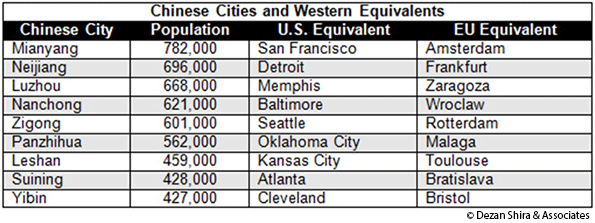
    Here are some examples, in terms of rough population equivalents:

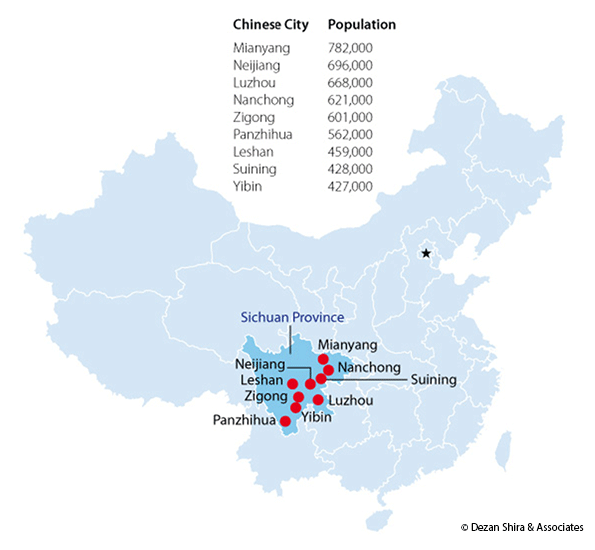
    While many readers are familiar with most of these American and European cities, hardly any know their Chinese counterparts. And all of the Chinese cities in the chart above are in just one province – Sichuan.

    When one factors in Shanxi, Henan, Hubei, Hunan, Anhui, and Jiangxi in Central China, and Gansu, Guizhou, Ningxia, Qinghai, Shaanxi, Yunnan and Xinjiang in West China, the sheer vastness of China’s own emerging markets becomes apparent. There are some 500 cities across the region with populations similar to those listed above.

    What’s happening in these lower-tier Chinese cities? The local populations are now becoming more affluent. Crucially, this is a phenomenon driven by state policy, as Beijing wishes to reduce the national East-West income gap and raise the standards of wealth across the country. It has been doing this by embarking on an aggressive policy of increasing minimum wages on a national basis, and especially so in the hinterlands. That is having the effect of increasing disposable income levels, and these consumers are now upgrading purchases from previously purely Chinese brands towards increasing levels of Western products.

    This includes the use of fast-food chains such as McDonald’s, KFC and Starbucks; massive multi-brand retailers such as Wal-Mart, Carrefour, and others that are also making inroads into these further-flung destinations. The Louis Vuitton bag may still be the preserve of China’s super wealthy in Shanghai, but in cities such as Mianyang, youths are trading up their cheap Chinese sneakers for Nikes, and looking to acquire Levis instead of the local jeans. With these consumer patterns being duplicated across the rest of China’s inland provinces, the result is little less than a revolutionary ‘upgradation’ of inland consumer power.

    The other markets in China worth keeping an eye on are those located along China’s borders. I wrote about Urumqi as a springboard for Central Asia recently. Developments elsewhere in Asia dictate that other border areas will also begin to experience significant growth, not least because of the Association of Southeast Asian Nations’ (ASEAN’s) full free trade agreement that is set to abolish tariffs between member nations by 2015.

    ASEAN includes countries that rub up alongside China’s southwest border, such as Myanmar, Vietnam and Cambodia, and adds to that countries including Laos, Malaysia, and Thailand, while to the south of China (and Guangdong Province in particular), ASEAN nations such Indonesia and the Philippines provide easy access. Why is this important? Because China has its own free trade agreement with ASEAN, and those 0 percent export tariffs among ASEAN nations are largely duplicated within China’s own agreements with the bloc.

    That means cities such as Jinghong and Luxi in Yunnan are also poised to become trade hubs. Jinghong, with a population of 520,000 is equivalent in size to Tuscon, Arizona and Sheffield in the United Kingdom, and borders Vietnam, while Luxi borders Myanmar, and with a population of 350,000 is similar in size to Tampa, Florida or Bilbao.

    Demand from the West does continue to remain sluggish, and inattentive analysts like to point to a drop in national GDP growth rates as evidence of some sort of cataclysmic event concerning development in China. That is only one, rather blinkered way of assessing the situation. Since China’s annual growth has moved briskly along at 10 percent for much of the past 15 years, a deviation from that is greeted by analytical soothsayers with cries of doom. Yet China’s 10 percent growth was never capable of being sustained, as each successive year of double-digit growth has, naturally, expanded the base to the point where it is now the world’s second-largest economy.

    China’s national GDP rates have slipped to between seven and eight percent, and it may be experiencing a “slowdown” to single-digit GDP growth when measured on a national basis. But the real story is the continued fast-paced development of wealth, disposable income, and increasing consumerism in China’s own emerging markets and the fourth, fifth and sixth-tier cities that help make up this this gigantic consumer sector. The challenge for the foreign investor will now be to reach out and go after these less glamorous locations.

    Chris Devonshire-Ellis is the founder of Dezan Shira & Associates. His clients include North American-based legal and tax firms, chambers of commerce, commercial trade institutions and universities. Following a 26-year career based in Asia, including 20 in mainland China, Chris is now based in North America and oversees client development and investment strategies for U.S. corporations looking to invest in China, India and Emerging Asia.

    Flickr photo by Ken Larmon: Downtown mall in Mianyang, Sichuan.

  • South Pacific Island “Undiscovered” by Scientists

    Have you ever tried to visit a South Pacific island near New Caledonia called Sandy Island? A team of Australian scientists attempted just that and found no sign of the supposedly sizeable landmass. Instead, the team from the University of Sydney were greeted by open ocean and nothing more.

    In the 21st century, stories like this are rare. Exciting tales of exploration surface from time to time, like Curiosity’s ongoing scientific expedition to Mars. Such occurrences on Earth are now fleeting – it feels like we have discovered almost everything there is to discover. So, maybe it shouldn’t prove too surprising that the Australian scientists actually ‘undiscovered’ some charted and documented territory.

    Sandy Island was located somewhere between northern Australia and New Caledonia, albeit closer to the latter. Supposedly, it measured 24 km by 4 km and has been ever-present in maps and publications for the last ten years. Praised continuously for its reliability and accuracy, Google’s mapping program also prominently featured this phantom island. According to statistics released in April 2012, Google Maps is the most popular travel website in the United States.

    The entire story seems extremely bizarre – nobody can account for the origin of Sandy Island nor its inclusion on countless maritime charts, maps and online navigation programs. According to Australian news sources, the island would sit within French territorial waters but no trace of it can be found on French government maps.

    A marine research vessel named ‘The Southern Surveyor’ was in the region documenting fragments of the Australian continental crust under the Coral Sea. Passing near Sandy Island, navigational charts displayed the considerable depth of 1,400 meters, generating a sense of curiosity amongst the Australian scientists onboard. They investigated further and were quite surprised by what they found…or more specifically, what they did not find.  Instead of a white sandy beach lined with palm trees and coconuts, they found the clear undisturbed waters of the Coral Sea.

    Dr. Steven Micklethwaite was present on the ship and he shared his views with the Guardian on the expedition to find Sandy Island: “We went upstairs to the bridge and found that the navigation charts the ship uses didn’t have it. And so at that point we thought: Well, who do we trust? Do we trust Google Earth or do we trust the navigation charts? This was one of those intriguing questions. It wasn’t far outside of our path. We decided to actually sail through the island … Lo and behold there was nothing! The ocean floor didn’t ever get shallower than 1300 metres below the wave-base. There’s an island in the middle of nowhere that doesn’t actually exist."

    Apparently, the captain of the Southern Surveyor was concerned about running aground as his ship approached the phantom island. Once they were sailing through it, however, the entire crew had a laugh at Google’s expense. The search engine giant said it always welcomes feedback on its maps and “continuously explore(s) ways to integrate new information from our users and authoritative partners into Google Maps”.

    Experts seemed equally puzzled by Sandy Island’s undiscovery, but most agreed it was probably down to human error or oversight. While some map makers intentionally include phantom streets to avoid copyright violations, maritime charts are usually made as accurate as possible due to the hazards of navigation on the open ocean. Some analysts pointed out that this kind of mistake would never happen in a busy international shipping lane, but due to the immense isolation of the Coral Sea, it escaped attention.

    It is quite possible that Sandy Island does exist somewhere nearby – somebody might have just placed it in the wrong location. People have been making maps for thousands of years and many older charts were compiled through the use of watches and longitude measurements. Before that, sailors travelled using the stars, a technique which can still be used today if our GPS systems and maps somehow fail us.

    Even though there may be one less island in the world today, the map is constantly changing anyway. New island chains sometimes appear and disappear through volcanic activity, so this certainly won’t be the end of the discovery versus undiscovery topic. Even though the mistake may seem embarrassing for Google, it’s nothing compared to the disastrous debut of Apple’s mapping software which, among other things, was missing Israel’s capital and gave the incorrect address for Dulles Airport in Washington D.C. At the end of the day, a small uninhabited island in the South Pacific is just a tiny speck of dust on a massive picture of the world.

    Seamus Murphy grew up in Limerick, Ireland and has since lived in the Netherlands, Germany and Poland. He has a background in public relations and teaching and has become an enthusiastic blogger. Seamus enjoys writing about international affairs, communication, technology and environmental issues at Trenditionist.com. He is a keen fan of traditional Irish music.