Blog

  • The New York Marathon Vs the NFL

    The ING New York City Marathon was cancelled, but the football game of the New York Giants against the Pittsburgh Steelers went ahead. Why? The nation places a higher value on sedentary spectators popping Advil and Viagra, than on lean and wiry runners, whose idea of a big night out is pasta and a few sips of Gatorade. It also helps that pro football has a televised address on 21st and Primetime, while the pleasure of a marathon is simply to finish one, even in the dark.

    In canceling the road race, New York Mayor Michael Bloomberg made the decision that it would have been insensitive to have marathoners running around a city that was still digging out from the wreckage caused by Sandy, or past those lining up with gas cans. Nor did anyone want police officers or emergency health workers officials involved with the marathon when they could be assisting the recovery of Staten Island or Breezy Point.

    On the same Sunday, however, the National Football League, took the position that, even with gasoline short for essential services, the game must go on, much as it did earlier this fall when the regular game officials were locked out of work. The office of NFL Commissioner Roger Goodell spends a lot of time invoking the mysticism of “the Game,” as though it were the Force or the Church—a higher being (“brought to you by Ford…”).

    To protect the interests of the Game, the commissioner regularly suspends or levies fines on coaches or players for putting out bounties, making unfair hits, showing positive drug tests, or for conduct “unbecoming” an NFL player, which ranges from sponsoring dog fighting to taking part in drive-by shootings. His job description is to sustain the illusion that the Raider Nation is the spiritual heir to those chariots of fire.

    The reason the NFL takes itself more seriously than, say, the Vatican, is that its revenue stream is built on the faith that the games are sport: athletic contests with winners and losers, not simply pay-per-view broadcasts that seek to divide each given Sunday into thousands of thirty-second spots, each of which can be sold to beer companies, hotel chains, and airlines.

    The league structure is an oligopoly, sustained by a sweetheart antitrust exemption, with each franchise sharing the collective revenue. Having a winning season doesn’t make the owner of an NFL team richer; the Jets are worth about as much as the 49ers (who actually win their games), and the average value of each franchise is more than $1 billion. The value of the NFL is that it can sell everything from diapers to cures for erectile dysfunction.

    To get an idea of the extent to which team owners have contempt for the actual sport of football, look no further than the Great Referee Crisis. The calamity began when about a hundred NFL game officials, at the time of a contract renegotiation, decided that they were entitled to keep their defined-benefit pension plans—meaning, their retirement packages would continue to be a percentage of their annual salaries, which average about $150,000 (for three hours of work, seventeen weeks a year, with a twenty-minute break for halftime).

    Owners of the NFL’s 32 football franchises—which have annual payrolls (measured in “cap space”) of $120 million and evenly split a revenue jackpot of $9.5 billion—reacted with indignation that the referees had the temerity to expect a pension from the league, and locked them out from work, pending a contract settlement.

    Instead of canceling the games as well, the Dickensian owners scoured the playing fields of Pop Warner and Arena football to find officials capable of throwing a few flags and uttering the phrase, “After further review, the ruling on the field stands.”

    The replacement refs showed up at the games like dads waylaid from the stands to umpire at Little League. They mastered the coin toss, some rudiments of whistle-blowing, and were given directions to the sideline peep shows that rerun the booth reviews of controversial plays. The replacement officials thought they were judging a game, and never understood they were regulating an industry.

    Without the regular officials seamlessly stopping the game after each punt, incomplete pass, out-of-bounds, or change of possession, there would be no way to securitize the game’s three hours into marketable segments lasting thirty seconds, which is how the league pulls down $9.5 billion a year. Untrained in choreography, the stopgap refs had to go.

    In its formative years, when the Game was played with leather helmets, games lasted sixty minutes. At half time, the teams switched ends. The two-minute warning was a courtesy to coaches, but not the occasion to hawk Ram Tough pickups, eTrade, Geico, and Domino’s Pizza. Imagine how little the Game would be worth if the clock simply ran for an hour?

    When football was a sport, players were expected to play offense, defense, kick, tackle, run, pass, and block. Now, as befits a featherbedded monopoly, the average pro team has about twenty coaches and specialists are engaged to handle kick returns, long snapping, field-goal holding, and obscure functions in “nickel” and “dime” formations on defense. Hyped as he might be, Tim Tebow is scorned as a marginal player in the age of free substitution. In the glory days, however, he would have been compared favorably to Jim Thorpe, as he can do it all.

    Perhaps the reason that this year’s New York marathon was deemed unworthy to help heal the wounds of a flooded city is because it is only a sport. Its participants are amateurs who buy their own uniforms, travel at their own expense, and sleep on sofas. The runners are in it for the love of the game, to compete, perchance to finish — not to provide a stage set for Cialis-popping men to leer at their wives.

    When the networks and corporations finally get their hands on the New York City Marathon, maybe then it will become worthy of a superstorm indulgence. It could go on air with about 32 runners, national sponsors, halftime around mile 13, booth reviews, and coaches’ challenges. The spectacle could last all day, and Dan, Shannon, Boomer, and Coach Cowher could analyze the winners. Then no one would mess with the Race.

    Matthew Stevenson, a contributing editor of Harper’s Magazine, is the author of Remembering the Twentieth Century Limited, a collection of historical travel essays. His next book is “Whistle-Stopping America”.

    Flickr photo by Joe Shlabotnik: Little Giants. A wall of New York Giants clothes for sale at BuyBuy Baby.

  • What Stifles Good Housing Development?

    We can’t afford outmoded attitudes in housing development anymore – not as businesses, not as citizens, and certainly not as development professionals. As development consultants, we’re often asked to provide detailed input on project design and the marketing of developments throughout the United States and Canada. We usually work with a local team of engineering consultants that provides construction drawings and serves as an intermediary for the project with local governments. We have concluded that the choice of selecting the engineering consultant is one of the pivotal issues for the success of a development. The developer has to be the one to hold the engineers accountable. Otherwise, all design will continue to be done to minimum standards instead of excellence.

    Problems with the consulting engineer generally fall into two broad groups: complacency and undisclosed conflicts of interest. To illustrate, we’ll look at two recent examples from projects owned by clients of Rick Harrison Site Design Studio.

    The first involves a small proposed neighborhood in Texas. The initial design was drafted before either the site boundaries or floodplain were accurately surveyed, and yielded a total of 35 lots of 0.6 acres or more. Rick prepared an initial revision of the original design, resulting in a more aesthetically pleasing and efficient neighborhood, while maintaining the 0.6 acre minimum lot size. Accurate boundary lines, contours and floodplain were eventually furnished to create a precision plat for submittal. The developer requested that Rick update the revised design, and indicated that he was willing to sacrifice one of the lots in order to allow a more spacious entrance.

    While preparing the precision plat Rick realized that he didn’t know why the lots were at least 0.6 acres instead of the more common 0.5 acres on lots without city sewer. In two rounds of questioning, the consulting engineer indicated that the minimum lot size was 0.6 acres, or 26,000 ft². The area of 6/10th of an acre is actually 26,136 ft², so Rick questioned the engineer again. This time, the engineer explained that the minimum lot size was actually 0.5 acres, but his firm had developed a “rule of thumb” that 26,000 ft² was the 0.5 acre lot net of easement areas. However, in the specific case of this development the only easement required was a 12’-wide utility easement along the front lot line. The extra 0.1 acres per lot was a “fudge factor,” developed over time to compensate for the well-known difficulty in computing precise lot sizing using existing CAD software.

    The “land surface based” technology Rick used to create the revised design requires no additional time to obtain precision areas, so he was able to easily design each lot to meet the actual 21,780 ft² (half acre) minimum exclusive of the 12’ easement. The new design eliminated the fudge factor, and yielded 37 lots, including the more open entrance area (three more than expected). Furthermore, reductions were made to the length of street..

    “Fudge factors” are rules of thumb intended to make the engineer’s work easier, and to provide enough margin in the plans to account for omissions or miscalculations. The problem with fudge factors is that they adversely impact the profitability of their clients’ projects. The chart below demonstrates the differences:


    Initial Plan

    Revised Plan

    Difference

    Lot size

    0.6 acres (minimum)

    0.5 acres

    At least 4,356 ft.² per lot

    Number of lots

    34

    37

    3

    Lot value

    $75,000

    $75,000


    Gross sales

    $2,550,000

    $2,775,000

    $225,000

    Pavement area

    89,479 ft²

    81,509 ft²

    7,970 ft²

    Estimated cost

    $447,400

    $407,550

    $39,850

    Eliminating an imprecise fudge factor would yield a $225,000 increase in gross sales. Since the only increase in costs were per lot consulting fees, almost all of the gross revenue would drop straight to the bottom line. In addition, the community would benefit from a more attractive neighborhood with substantially less street pavement maintained in perpetuity, and a higher property tax base. If the developer was unwilling to sacrifice profits, the cost of each lot would have had to increase by $6,600 to the consumer.

    The second example concerns another proposed residential development, this one in North Dakota, in a city prone to severe flooding. As most people know, paved areas do not absorb rainfall, so it would seem logical that the more pavement area in a new development here, the bigger the potential for runoff, which leads to more flooding. In addition, the wider the streets, the more surface area the city has to snowplow and maintain. All these issues – the snowplowing, the road maintenance and the increased water runoff – are burdens to current and future taxpayers, with no discernible benefits to offset the burden. So imagine Rick’s surprise when the consulting engineer refused to even submit a plan for 50-foot-wide rights-of-way with 28-foot-wide street sections, instead of the 66-foot-wide rights-of-way with 37-foot-wide street sections, as specified by existing city regulations.

    To understand the issue, look at the origin of the standard street width requirement. Centuries ago, roads were unpaved, and were built with wide ditches to handle drainage alongside them. The 66 foot length reflected a land surveyor’s chain, developed in the year 1620 by a British clergyman interested in developing a system that would use easily available tools to survey land in the British countryside. His system caught on, and was brought to the New World by British immigrants and used for hundreds of years. Perhaps as recently as 100 years ago it made sense to use a single surveyors’ chain as the width of community streets, and so many towns did so. Today, most cities have eliminated drainage ditches in modern subdivisions, replacing them with storm sewers and more efficient design. These changes have allowed narrower street and pavement widths, with positive cost and environmental impacts.

    So — the minimum street right-of-way in this modern North Dakota city is the result of a decision to make roads 66 feet wide, due to the fact that 400 years ago an English clergyman connected a hundred links that were 6 1/2 inch long to make a convenient, 66 foot long “chain”. To our knowledge, there is no other reason.

    Given that surrounding cities have adopted modern standards, and that the logic behind narrower streets is solid, Rick could have presented a compelling case. But the engineer refused to even make the proposal. Why not propose a common sense solution? Complacency? Perhaps. The desire to comply with every regulation to avoid conflict? More likely. Are the engineers fees based upon the percentage of construction cost, with wider streets guaranteeing higher fees? Also likely.

    Unsustainable? Absolutely.

    In the first example, outmoded rules of thumb related to inadequate CAD technology would have cost Rick’s client at least $250,000, and would have burdened the local county government with a significantly diminished potential property tax base. In the second example, the engineer’s lack of concern for the long-term benefit of his client (with whom he has a contractual or fiduciary relationship), and to the public (to whom he has a professional responsibility), has burdened the community with exaggerated flooding problems and approximately 33% more pavement to be snow plowed and maintained for as long as the community exists.

    We can’t keep fudging to hide poor practices. If we are ever to achieve a more sustainable world and create better communities and housing products, we simply cannot accept mediocre design, technology and attitude.

    Rick Harrison is President of Rick Harrison Site Design Studio and Neighborhood Innovations, LLC. He is author of Prefurbia: Reinventing The Suburbs From Disdainable To Sustainable and creator of Performance Planning System. His websites are rhsdplanning.com and pps-vr.com. Skip Preble, MAI, CCIM is a real estate analyst and land development consultant specializing in market analysis, feasibility studies, project value optimization and market value opinions. He can be reached through his website, landanlytics.com.

    Flickr Photo by Billy Hunt: “This is from my photo essay observing the course of development in Charlottesville, Virginia“.

  • America’s Most Competitive Metros Since 2010

    The San Jose metro is adding jobs at a faster clip than any other large metro area in the U.S. since the recession. Houston, Austin, Detroit — and a handful of other metros — have also been stellar performers the last few years. But how much of the job growth in these and other metros can be explained by unique regional factors rather than national trends?

    To answer that question, EMSI used a standard economic analysis method called shift share, focusing on overall job change from 2010 to 2012. We followed the same methodology that we used to show which states are gaining in competitiveness. However, for this post, we looked at the 100 most populous metropolitan statistical areas (MSAs) in the U.S.

    The goal is to see which metros are becoming more competitive (that is, gaining a larger share of total job creation) and which are losing their share of the jobs being created. We ranked all 100 metros based on the overall competitive effect and what percentage of jobs (from 2010-2012) are based on competitive effects.

    Our Approach

    Shift-share analysis, which can also be referred to as “regional competitiveness analysis,” helps us distinguish between growth that is primarily based on big national forces (the proverbial “rising tide lifts all boats” analogy) vs. local competitive advantages. The primary components of shift share are as follows:

    • Industrial Mix Effect — This represents the share of regional industry growth explained by the growth of the specific industry at the national level.
    • National Growth Effect — This explains how much of the regional industry’s growth is explained by the overall growth of the national economy.
    • Expected Change – This is simply the rate of growth of the particular industry at the national level (equals the sum of the industrial mix and national growth effects).
    • Regional Competitiveness Effect — This explains how much of the change in a given industry is due to some unique competitive advantage that the region possesses, because the growth cannot be explained by national trends in that industry or the economy as whole.

    Read more on shift share in this article: Understanding Shift Share.

    About the Data

    The infographic and table below display aggregate industry data for the 100 most populous MSAs from 2010-2012. To generate our ranking, we summed the overall competitive effect for each broad 2-digit industry sector (e.g., agriculture, manufacturing, health care, construction, etc.) and added them together to yield a single MSA-wide number that indicates the overall competitiveness of the economy as compared to the total economy. We calculate the competitive effect by subtracting the expected jobs (the number of jobs expected for each MSA based on national economic trends) from the total jobs. The difference between the total and expected is the competitive effect. If the competitive effect is positive, then the MSA has exceeded expectations and created more jobs than national trends would have suggested. It is therefore gaining a greater share of the total jobs being created. If the competitive effect is negative, then the MSA is below what we would expect given national trends. In this case the MSA is losing a greater share of the total jobs being created.

    The Results

    Top Five

    The two metros at the top have been economic stalwarts in recent years. After that, our analysis revealed a couple surprises.

    Note: The figure in parentheses is the percentage of total 2012 jobs that are due to growing (or declining) competitiveness from 2010-2012.

    1. San Jose-Sunnyvale-Santa Clara, Calif. (3.5%) – The heart of Silicon Valley has created 35,803 more jobs than expected since 2010, thanks largely to the information sector (most notably, internet publishing and broadcasting and web search portals and software publishers). Electronic computer manufacturing has also seen more-than-expected growth in the San Jose metro area, as has warehouse clubs and supercenters and private elementary/secondary schools.

    In other words, the high-paying jobs generated in the tech sector appear to be leading to more jobs in the retail trade and education sectors than we would expect based on national trends.

    2. Austin-Round Rock-San Marcos, Texas (3.4%) – Save for government and retail trade, every broad sector in the Austin metro area has exceeded expectations. The result is 30,472 more jobs than expected from 2010 and 2012. The strongest sub-sectors in Austin are wired telecommunications carriers; wholesale trade agents and brokers; and corporate, subsidiary, and regional managing offices.

    3. Bakersfield, Calif. (3.1%) – Bakersfield has one of the highest unemployment rates (12%) among all metropolitan areas. But better-than-expected job growth in the construction and agricultural sectors has propelled this San Joaquin Valley metro to third in our ranking. The agriculture boom has been seen most in crop production and farm labor contractors/crew leaders. Meanwhile, much of the surprising construction growth has been in two sub-sectors — oil and gas pipeline and related structures construction and electrical contractors and other wiring installation contractors.

    4. Provo-Orem, Utah (2.8%) – Next is Provo-Orem, which has the fourth-fewest total jobs of any top 100 metro (an estimated 211,639). This metro area just south of Salt Lake City has seen surprisingly large job gains in professional, scientific, and technical services (see here for more); administrative and support services; specialty trade contractors; state/local government; and computer and electronic product manufacturing.

    A note on Utah: Provo-Orem, Salt Lake City (No. 6), and Ogden-Clearfield (No. 29) are all in the upper third of the top 100 metros in competitiveness.

    5. Houston-Sugar Land-Bayton, Texas (2.7%) — No metro in America has added more jobs than expected since 2010 than Houston (79,815). These jobs aren’t coming in oil & gas extraction or support activities for mining — Houston’s actually doing worse than expected in these two booming industries — but rather in health care, accommodation/food service, and manufacturing. In particular, home health care services, offices of physicians, restaurants, employment services, and fabricated metal product manufacturing are far surpassing expected growth.

    The rest of the top 10:

    • Salt Lake City, Utah (2.6%)
    • Grand Rapids-Wyoming, Mich. (2.4%)
    • Omaha-Council Bluffs, Neb.-Iowa (2.4%)
    • Raleigh-Cary, N.C. (2.1%)
    • Detroit-Warren-Livonia, Mich. (2.1%)

    Bottom Five

    The other side of our ranking is dominated by Southern metros, particularly those in Florida. But an even more common thread with the poor performers is the greater-than-expected losses in administrative and support services, a sub-sector that comprises “establishments engaged in activities that support the day-to-day operations of other organizations,” according to the BLS.

    100. Augusta-Richmond County, Ga.-S.C. (-3.9%) — This metro has lost nearly 9,000 more jobs than expected, most in waste treatment and disposal, employment services, and services to buildings and dwellings.

    99. Albuquerque, N.M. (-3.4%) — Albuquerque has fared worse than Augusta in total unexpected jobs lost (13,691), with the losses coming in similar areas — employment services, architectural/engineering services, electrical/electronic goods merchant wholesalers, and services to buildings and dwellings. Construction and government (local and federal) have also taken worse-than-expected hits.

    98. Palm Bay-Melbourne-Titusville, Fla. (-3.3%) — Like Augusta and Albuquerque, the Palm Bay-Melbourne area has done poorly in administrative and support services (particularly facilities support services) and construction (particularly specialty trade contractors).

    97. Lakeland-Winter Haven, Fla. (-2.4%) — Once again, this Florida metro has seen massive (and unexpected) decline in admin and support services, most notably employment services. Government, manufacturing, and construction have also lost more jobs than expected since 2010.

    96. Modesto, Calif. (-2.3%) — This Central Valley metro area has struggled more than expected in manufacturing (especially the making of snack foods and frozen foods). Elementary and secondary schools have also suffered.

    The rest of the bottom 10:

    • Milwaukee-Waukesha-West Allis, Wis. (-2.3%)
    • Providence-New Bedford-Fall River, R.I.-Mass. (-2.2%)
    • Little Rock-North Little Rock-Conway, Ark. (-2.1%)
    • Birmingham-Hoover, Ala. (-2.0%)
    • St. Louis, Mo.-Ill. (-2.0%)

    For the full list of the largest 100 metros, see our accompanying graphic or the table below.

    MSA
    2012 Jobs
    Expected Jobs (2012)
    Competitive Effect
    % of Jobs Due to Comp. Effect
    Source: QCEW Employees, Non-QCEW Employees & Self-Employed – EMSI 2012.3 Class of Worker
    San Jose-Sunnyvale-Santa Clara, CA
    1,014,025
    978,222
    35,803
    3.5%
    Austin-Round Rock-San Marcos, TX
    894,864
    864,392
    30,472
    3.4%
    Bakersfield-Delano, CA
    320,625
    310,730
    9,895
    3.1%
    Provo-Orem, UT
    211,639
    205,722
    5,918
    2.8%
    Houston-Sugar Land-Baytown, TX
    2,952,899
    2,873,083
    79,815
    2.7%
    Salt Lake City, UT
    692,741
    674,849
    17,892
    2.6%
    Grand Rapids-Wyoming, MI
    402,848
    393,138
    9,709
    2.4%
    Omaha-Council Bluffs, NE-IA
    501,309
    518,223
    12,078
    2.4%
    Raleigh-Cary, NC
    563,555
    551,457
    12,098
    2.1%
    Detroit-Warren-Livonia, MI
    1,902,208
    1,861,948
    40,260
    2.1%
    Charleston-North Charleston-Summerville, SC
    323,937
    317,316
    6,621
    2.0%
    Oklahoma City, OK
    649,469
    636,476
    12,992
    2.0%
    Knoxville, TN
    363,742
    356,712
    7,030
    1.9%
    Louisville/Jefferson County, KY-IN
    654,871
    643,365
    11,506
    1.8%
    McAllen-Edinburg-Mission, TX
    268,924
    264,231
    4,693
    1.7%
    Phoenix-Mesa-Glendale, AZ
    1,916,060
    1,883,203
    32,857
    1.7%
    Seattle-Tacoma-Bellevue, WA
    1,929,525
    1,897,882
    31,643
    1.6%
    Stockton, CA
    236,202
    232,430
    3,773
    1.6%
    Columbus, OH
    998,599
    984,248
    14,351
    1.4%
    Dallas-Fort Worth-Arlington, TX
    3,263,838
    3,219,303
    44,535
    1.4%
    El Paso, TX
    336,649
    332,206
    4,443
    1.3%
    San Francisco-Oakland-Fremont, CA
    2,252,514
    2,224,520
    27,993
    1.2%
    Nashville-Davidson–Murfreesboro–Franklin, TN
    853,134
    843,884
    9,250
    1.1%
    Charlotte-Gastonia-Rock Hill, NC-SC
    909,444
    899,769
    9,675
    1.1%
    Denver-Aurora-Broomfield, CO
    1,367,534
    1,354,042
    13,492
    1.0%
    Boise City-Nampa, ID
    294,333
    291,569
    2,764
    0.9%
    Portland-Vancouver-Hillsboro, OR-WA
    1,140,720
    1,130,624
    10,096
    0.9%
    San Antonio-New Braunfels, TX
    990,899
    982,408
    8,491
    0.9%
    Ogden-Clearfield, UT
    218,356
    216,733
    1,624
    0.7%
    Rochester, NY
    535,248
    531,540
    3,709
    0.7%
    Fresno, CA
    379,331
    377,181
    2,151
    0.6%
    Washington-Arlington-Alexandria, DC-VA-MD-WV
    3,289,069
    3,271,193
    17,876
    0.5%
    San Diego-Carlsbad-San Marcos, CA
    1,538,488
    1,530,699
    7,789
    0.5%
    Indianapolis-Carmel, IN
    942,512
    938,843
    3,669
    0.4%
    Columbia, SC
    380,167
    378,761
    1,406
    0.4%
    Atlanta-Sandy Springs-Marietta, GA
    2,463,751
    2,455,059
    8,691
    0.4%
    Riverside-San Bernardino-Ontario, CA
    1,390,906
    1,386,822
    4,084
    0.3%
    Chattanooga, TN-GA
    251,933
    251,223
    709
    0.3%
    Minneapolis-St. Paul-Bloomington, MN-WI
    1,892,017
    1,886,761
    5,256
    0.3%
    Tulsa, OK
    460,519
    459,782
    737
    0.2%
    Des Moines-West Des Moines, IA
    354,286
    353,772
    514
    0.1%
    Cincinnati-Middletown, OH-KY-IN
    1,066,016
    1,064,816
    1,201
    0.1%
    Honolulu, HI
    541,273
    540,736
    537
    0.1%
    Allentown-Bethlehem-Easton, PA-NJ
    364,683
    364,345
    338
    0.1%
    Greensboro-High Point, NC
    370,755
    370,532
    223
    0.1%
    Cape Coral-Fort Myers, FL
    219,651
    219,550
    101
    0.0%
    New York-Northern New Jersey-Long Island, NY-NJ-PA
    9,111,820
    9,109,799
    2,021
    0.0%
    Baton Rouge, LA
    403,099
    403,086
    12
    0.0%
    Miami-Fort Lauderdale-Pompano Beach, FL
    2,468,634
    2,468,912
    (279)
    0.0%
    Worcester, MA
    353,710
    353,834
    (124)
    0.0%
    Richmond, VA
    657,018
    657,325
    (306)
    0.0%
    Albany-Schenectady-Troy, NY
    459,754
    460,069
    (316)
    -0.1%
    Tampa-St. Petersburg-Clearwater, FL
    1,218,515
    1,219,507
    (992)
    -0.1%
    Jackson, MS
    267,877
    295,684
    (427)
    -0.2%
    Los Angeles-Long Beach-Santa Ana, CA
    6,143,325
    6,154,926
    (11,601)
    -0.2%
    Baltimore-Towson, MD
    1,400,446
    1,403,859
    (3,413)
    -0.2%
    Orlando-Kissimmee-Sanford, FL
    1,071,935
    1,074,559
    (2,624)
    -0.2%
    Pittsburgh, PA
    1,214,245
    1,218,032
    (3,786)
    -0.3%
    Dayton, OH
    402,031
    403,437
    (1,406)
    -0.3%
    Boston-Cambridge-Quincy, MA-NH
    2,665,828
    2,678,362
    (12,534)
    -0.5%
    Akron, OH
    341,435
    343,042
    (1,607)
    -0.5%
    Scranton–Wilkes-Barre, PA
    272,047
    273,574
    (1,527)
    -0.6%
    Greenville-Mauldin-Easley, SC
    315,824
    317,638
    (1,814)
    -0.6%
    Colorado Springs, CO
    316,090
    318,171
    (2,081)
    -0.7%
    New Orleans-Metairie-Kenner, LA
    582,177
    586,123
    (3,946)
    -0.7%
    Chicago-Joliet-Naperville, IL-IN-WI
    4,549,732
    4,582,384
    (32,652)
    -0.7%
    Youngstown-Warren-Boardman, OH-PA
    240,559
    242,321
    (1,762)
    -0.7%
    Toledo, OH
    317,987
    320,534
    (2,548)
    -0.8%
    Lancaster, PA
    252,253
    254,288
    (2,034)
    -0.8%
    Buffalo-Niagara Falls, NY
    562,953
    567,694
    (4,741)
    -0.8%
    Memphis, TN-MS-AR
    653,464
    659,019
    (5,555)
    -0.9%
    Virginia Beach-Norfolk-Newport News, VA-NC
    867,917
    875,329
    (7,412)
    -0.9%
    Jacksonville, FL
    634,680
    640,178
    (5,498)
    -0.9%
    Springfield, MA
    322,963
    325,801
    (2,838)
    -0.9%
    Hartford-West Hartford-East Hartford, CT
    651,931
    658,182
    (6,251)
    -1.0%
    Syracuse, NY
    324,948
    328,190
    (3,242)
    -1.0%
    Oxnard-Thousand Oaks-Ventura, CA
    348,124
    351,742
    (3,618)
    -1.0%
    Bridgeport-Stamford-Norwalk, CT
    458,643
    463,816
    (5,174)
    -1.1%
    Wichita, KS
    312,394
    315,968
    (3,575)
    -1.1%
    North Port-Bradenton-Sarasota, FL
    265,715
    268,786
    (3,071)
    -1.2%
    Kansas City, MO-KS
    1,053,613
    1,066,414
    (12,802)
    -1.2%
    Tucson, AZ
    401,113
    406,033
    (4,920)
    -1.2%
    Sacramento–Arden-Arcade–Roseville, CA
    957,779
    969,534
    (11,755)
    -1.2%
    Poughkeepsie-Newburgh-Middletown, NY
    271,783
    275,231
    (3,447)
    -1.3%
    New Haven-Milford, CT
    394,666
    400,055
    (5,390)
    -1.4%
    Madison, WI
    361,542
    366,488
    (4,946)
    -1.4%
    Las Vegas-Paradise, NV
    883,649
    896,729
    (13,081)
    -1.5%
    Cleveland-Elyria-Mentor, OH
    1,056,167
    1,075,588
    (19,421)
    -1.8%
    Harrisburg-Carlisle, PA
    334,668
    341,123
    (6,454)
    -1.9%
    Philadelphia-Camden-Wilmington, PA-NJ-DE-MD
    2,866,722
    2,922,956
    (56,235)
    -2.0%
    St. Louis, MO-IL
    1,391,853
    1,419,265
    (27,412)
    -2.0%
    Birmingham-Hoover, AL
    520,572
    531,024
    (10,452)
    -2.0%
    Little Rock-North Little Rock-Conway, AR
    362,670
    370,444
    (7,774)
    -2.1%
    Providence-New Bedford-Fall River, RI-MA
    722,008
    738,127
    (16,119)
    -2.2%
    Milwaukee-Waukesha-West Allis, WI
    849,075
    868,393
    (19,318)
    -2.3%
    Modesto, CA
    180,419
    184,600
    (4,181)
    -2.3%
    Lakeland-Winter Haven, FL
    210,233
    215,306
    (5,073)
    -2.4%
    Palm Bay-Melbourne-Titusville, FL
    207,642
    214,568
    (6,926)
    -3.3%
    Albuquerque, NM
    399,997
    413,688
    (13,691)
    -3.4%
    Augusta-Richmond County, GA-SC
    232,695
    241,661
    (8,966)
    -3.9%

    The data and analysis for this post comes from Analyst, EMSI’s web-based labor market data and analysis tool. For more information, email Josh Wright. Follow us on Twitter @DesktopEcon.

    Austin skyline image by Bigstock.

  • Election: “Stop Portland Creep” Resonates in Suburbs

    Election results from all three of Portland, Oregon’s largest suburban counties indicate a reaction against what has been called "Portland Creep," the expansion of the expansive light rail system without voter approval and the imposition of restrictive densification measures by Metro, the regional land-use agency.

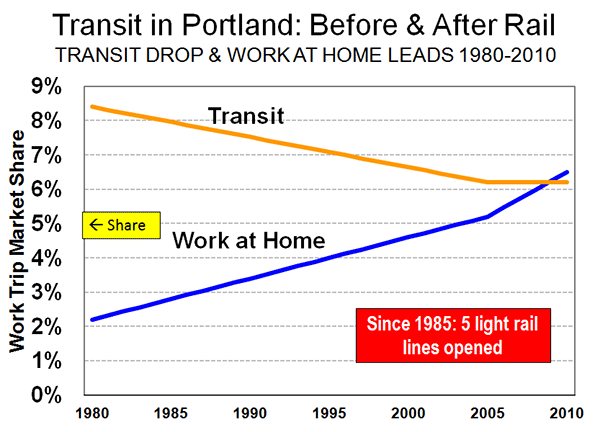
    Portlanders in the three largest Oregon counties (Multnomah, Washington and Clackamas) have previously voted against financing light rail extensions, however the transit agency has found ways to continue the expansion and now operates five lines, with a sixth under construction. While urban rail aficionados tout the success of the Portland system, transit use by commuters has fallen significantly in relative terms from before the opening of the first light rail line. At the same time, working at home, which does not need billions in taxpayer subsidies, has caught up to and passed transit (Figure).

    The electoral events of the past 60 days could severely limit future expansion.

    Clackamas County: Chicanery and its Price

    In a September 2012 election, voters in Clackamas County approved a measure by a 60% – 40% majority requiring that any commitment of funding to rail would require a vote of the people. Perhaps fearing a negative result in the election, the pro-rail Clackamas County commission hastily approved $20 million to support the under construction Portland to Milwaukie (Clackamas County) light rail line.

    Things were to become substantially more difficult for light rail in the November election. In Clackamas County, the two incumbent commissioners on the ballot, both of whom voted for the $20 million bond issue, lost their seats. Voters rewarded their chicanery by replacing them with anti-rail commissioners, leaving the Clackamas County commission with a 3 to 2 anti-rail majority. The Oregonian characterized the election as "a referendum on light rail."

    John Ludlow, who defeated Clackamas County commission chair Charlotte Lehan by a 52% to 48% margin, told The Oregonian:

    "I think the biggest boost my campaign got was when those commissioners agreed to pay that $20 million to TriMet" for Portland-Milwaukie light rail four days before the September election. I think that put Tootie and me over the top." 

    "Tootie" is Tootie Smith, a former state legislator who unseated commissioner Jamie Damon in the same election by a similar margin.

    Washington County, Oregon: Taxpayers Take Control

    Meanwhile, light rail has run into substantial difficulty in suburban Washington County. In September, voters in King City approved a measure to require all light rail funding to be approved by the voters. In the more recent November election, voters in Tigard, the 6th largest city (50,000 population) in the metropolitan area, voted 81%-19% to subject all light rail expenditures to a vote of the people.

    Clark County, Washington: Voters Say No

    Portland’s transit agency also had its eye on expanding light rail service across the state line and the Columbia River to Vancouver, in Clark County, Washington. The plan was to build a new "Interstate Bridge" (Interstate 5) across the river, which would include light rail. The voters of Clark County were asked in a referendum to approve funding for the light rail system and turned it down soundly according to the Columbian, by a 56% – 44% margin.

    But there was more. For some time, citizen activist and business leader David Madore has been working to stop both tolls on the new bridge and light rail service. Madore was elected to the board of commissioners of Clark County at the same time that the light rail referendum was being defeated. Madore, like the two other Clark County commissioners, also hold seats on the transit agency board.

    Tri-Met’s Death Spiral?

    Further, Tri-Met’s dire financial situation could be another barrier to future expansion. As John Charles of the Cascade Policy Institute has shown, Tri-Met’s fringe-benefit bill is astronomically high, at $1.63 for each $1.00 in wages. This is more than five times the average for public employers, according to US Department of Commerce Bureau of Economic Analysis data. Charles refers to Tri-Met as being in a "death spiral" and says that:  

    "The agency is steadily devolving from a transit district to a retirement and health-care center, with unsustainable fringe benefit costs that now far exceed the mere cost of wages."

  • Uniting a Fractured Republic: Innovation, Pragmatism, and the Natural Gas Revolution

    Over the last four years, emissions in the United States declined more than in any other country in the world. Coal plants and coal mines are being shuttered. That’s not from increased use of solar panels and wind turbines, as laudable as those technologies are. Rather it’s due, in large measure, to the technological revolution allowing for the cheap extraction of natural gas from shale. By contrast, Europe, with its cap and trade program, and price on carbon, is returning to coal-burning.

    Could President Obama, during his second term in office, turn this homegrown success story into paradigm-shifting climate strategy? In a speech we gave to the Colorado Oil and Gas Association yesterday, we argue that, after a season of ugly ideological polarization, politicians, environmentalists, and the gas industry have a chance to hit the reset button on energy politics. 

    This will require the natural gas industry to clean up its act, accepting better regulations, cracking down on bad actors, and preventing the leakage of methane, a potent greenhouse gas. It will require environmentalists to consider whether there might be a different path to significant emissions reductions from the one they have pursued over the last 20 years. And it will require Left and Right to put a halt to the tribalism that has characterized the national debate over climate and energy. 

    — Michael and Ted

    Uniting a Fractured Republic

    Innovation, Pragmatism, and the Natural Gas Revolution

    by Ted Nordhaus and Michael Shellenberger

    In 1981, George Mitchell, an independent Texas natural gas entrepreneur, realized that his shallow gas wells in the Barnett were running dry. He had millions of sunk investment in equipment and was looking for a way to generate more return on it. Mitchell was then a relatively small player in an industry that by its own reckoning was in decline. Conventional gas reserves were limited and were getting increasingly played out.

    As he considered how he might save his operation, Mitchell turned his attention to shale. Drillers had been drilling shale since the early 19th Century, but mostly they drilled right through it to get to limestone and other formations. Dan Jarvey, a consultant to Mitchell at the time, told us, "When you look at a [gas drilling] log from the 1930s or 1950s or 1970s it is noted as a ‘gas kick’ or ‘shale gas kick.’ Most categorized it as ‘It’s just a shale gas kick’ – as in, ‘to be expected, but to be ignored.’"

    As Mitchell embarked on his 20-year quest to crack the shale gas code, most of his colleagues in the gas industry thought he was crazy. But Mitchell persisted and his efforts would ultimately culminate in today’s natural gas revolution.

    In doing so, Mitchell upended longstanding assumptions about the future of energy. Just a few years ago, the convention wisdom was that no source of electricity could be cheaper than coal. Today, in the U.S., natural gas is cheaper. As a result, coal’s share as a percentage of electricity generated went from over 50 percent in 2005 to 36 percent in 2012. While global coal use continues to rise, the U.S. is at present leaving much of it in the ground. Meanwhile, estimates of recoverable natural gas results in the United States have nearly doubled, growing from 200 trillion cubic feet in 2005 to 350 trillion cubic feet today.

    The implications for those of us concerned about climate change are also significant. Leaving coal in the ground has been the longstanding goal of those of us concerned about global warming. Natural gas releases emits 45 percent fewer carbon emissions. In large part due to the glut of natural gas, U.S. carbon dioxide emissions will have declined more in the United States than in any other country in the world between 2008 and 2012 — an astonishing 500 million metric tons out of 6 billion, according to the Energy Information Administration.

    While we don’t imagine that any of this is news to most of you in this audience, there is another part of the story that might be. That is the story of the ways in which both the gas industry and the federal government helped Mitchell along the way. In these intensely polarized times, when it seems that almost everyone imagines that either government or corporations are the enemy, and it seems impossible to imagine that the two might actually work together to further the public interest, there are important lessons here too.

    1.
    As Mitchell considered trying his hand at shale, he cast about to see what was known at the time about how to get gas out of shale. A geophysicist who worked with Mitchell recalled telling him that, "It looks similar to the Devonian [shale back east], and the government’s done all this work on the Devonian."

    The work Mitchell’s geophysicist was referring to was the Eastern Gas Shales Project, which was started in 1976 by President Ford. The Shales Project was just one of several aggressive government-led efforts to accelerate technology innovation to increase oil and gas production. Already in 1974 the Bureau of Mines was funding the study of underground fracture formations, enhanced recovery of oil through fluid injection, and the recovery of oil from tar sands. One year later, the government funded the first massive hydofracking at test sites in California, Wyoming and West Virginia, as well as "directionally deviated well-drilling techniques" for both oil and gas drilling.

    The mandate from Congress was for government scientists and engineers to hire private contractors rather than do the work in-house. This was consistent with the tradition of the Bureau of Mines, which would set up trailers around the country to support oil, coal and gas entrepreneurs. This strategy contrasted with the government’s nuclear energy R&D work, which had been hierarchical since its birth in the military’s Manhattan project. This decentralization proved wise, as it ensured that the information would rapidly reach entrepreneurs in the field and not gather dust inside of a federal bureaucracy.

    From early on, Mitchell and his team relied heavily on information coming out of the Eastern Gas Shales project. "We were all reading the DOE papers trying to figure out what the DOE had found in the Eastern Gas Shales," Mitchell geologist Dan Steward told us, "and it wasn’t until 1986 that we concluded that we don’t have open fractures, and that we were making production out of tight shales."

    Through the 1980s, Mitchell didn’t want to ask the government – or the Gas Research Institute, which was funded by a fee on gas pipeline shipments to coordinate government research with experiments being conducted by entrepreneurs in the field – for help because he worried that he wouldn’t be able to take full advantage of the investment he was making in innovation.

    But by the early 1990s Mitchell had concluded that he needed the government’s help, and turned to DOE and the publicly-funded Gas Research Institute for technical assistance. The Gas Research Institute, which had worked with other industry partners to demonstrate the first horizontal fracks, subsidized Mitchell’s first horizontal well. Sandia National Labs provided high-tech underground mapping and supercomputers and a team to help Mitchell interpret the results. Mitchell’s twenty-year quest was also made possible by a $10 billion, 20-year tax credit provided by Congress to subsidize unconventional gas, which was too expensive and risky for most private firms to experiment with otherwise.

    By 2000, the combination of technologies to cheaply frack shale were firmly in place. The final piece of the puzzle was the sale of Mitchell Energy to Devon Energy, which scaled up the use of horizontal wells. Over the next ten years the use of this combination of technologies would spread across the country, resulting in today’s natural gas glut.

    Though the collaboration between Mitchell and the government was one of the most fruitful public-private partnerships in American history, it was mostly unknown until we started interviewing the key players involved around this time last year.

    After our findings were verified by other researches and reporters, including the New York Times and the Associated Press, some in the oil and gas industry, like T. Boone Pickens, have tried to downplay the government’s role.

    But the pioneers of this technology have been forthright. "I’m conservative as hell," Mitchell’s former Vice President Dan Steward told us, but DOE "did a hell of a lot of work and I can’t give them enough credit… You cannot diminish DOE’s involvement." Fred Julander said, “The Department of Energy was there with research funding when no one else was interested and today we are all reaping the benefits." 

    2.
    Today marks the end of one of the most divisive chapters in American political history. There is more partisan polarization in Congress than at any time since Reconstruction. There are vanishingly few swing voters. And the ideological divide between liberals and conservatives at times appears unbridgeable.

    One of the most insidious aspects of today’s political polarization is the way gross exaggerations turn into ossified caricatures. Left and Right view the other as ignorant, insane, or immoral.
    From the Right we have heard that President Obama is taking the country to socialism, and that Big Government is destroying the American dream. From the Left we have heard that Governor Romney would have exported all our jobs to China, and turn Congress over to Big Business. Where this downward spiral takes us is to the conclusion that America is fundamentally broken. The two great institutions of American life — business and government — are viewed by one side or the other as corrupt and nefarious.

    Few issues have become more polarizing than energy. Both sides have taken ever more extreme positions. Prominent conservatives have exaggerated both the size of Obama’s clean energy investments and the number of bankruptcies. They have described global warming and other environmental problems as either not happening or not worth worrying about. Some environmentalists have taken the opposite tack, exaggerating the negative impacts of gas drilling, downplaying the benefits, and accusing anyone who disagrees with them of being on the take.

    As we say in California — everyone needs to chill out. There is too much at stake for America, our environment, and our economy, for such hyper-partisanship to continue.

    In our rush to point fingers and interpret everything in catastrophic terms, we have lost sight of the fact that we are the richest nation on earth, and one with improving environmental quality, precisely because the private sector and the government have worked so well together. The failures of Big Business and Big Government should be put in their appropriate historical context.

    When the Colorado Oil and Gas Association asked us to give this speech at its conference the day after the election, we agreed on two conditions: that we pay our own way and that COGA invite local environmental and elected leaders to attend. We are glad to see them in the audience, because we need a common dialogue.

    As two individuals who came out of the environmental movement, where we spent most of our careers, we are best known for our writings calling for reform and renovation of green politics. In particular, we have advocated that environmentalists drop their apocalyptic rhetoric, which is self-defeating and obscures the very real environmental problems we face.

    And we have argued that environmentalists have been overly focused on regulations, when our focus should also be on revolutionary technological innovation, which is needed to make clean energy and other environmental technologies much cheaper, so that all seven going on 10 billion humans can live modern, prosperous lives on an ecologically vibrant planet.

    But our work has also focused on reminding private investors and corporate executives of the critical role played by the government in creating our national wealth. While economists have long recognized that innovation is responsible for most of our economic growth, few realize that many of our world-changing innovations would have been unlikely to occur without government support. A short list of recognizable technological innovations includes interchangeable parts, computers, the Internet, jet engines, nuclear power and every other major energy technology.

    Consider the information revolution. The government funded the R&D and bought 80 percent of the first microchips. The Internet started out as a federally funded program to connect networks of computers of government. Every major technology in the iPhone can be traced to some connection with government funding. The driver-less robot car that Google has invented relies on technologies that come out of government innovation programs.

    While high tech executives who are our age or younger are unaware of the government roots of the IT revolution, the old-timers of Silicon Valley do, and frequently expresses their gratitude for it.

    While interviewing the participants of the shale gas revolution, we were struck by how much respect and deference each side gave to the other. In many cases the government scientists and engineers acted as consultants to private firms like Mitchell’s — "We never forgot who the customer was," said Alex Crawley, who ran the DOE’s fossil innovation program for many years.

    As environmentalists, we were taught to be suspicious of such cozy relationships between industry and government workers, that government could not simultaneously promote industry while also attempting to regulate it. But when it comes to technology innovation, those cozy relationships, and the revolving door between government agencies, whether DoD or DoE, and private companies like Mitchell Energy, are absolutely essential to allowing knowledge to rapidly spillover and flow throughout the sector.

    And yet, there is also an important role for regulation, not only to protect the public from accidents and environmental degradation, but also to improve technologies and promote better practices throughout the industry. Wise regulation in the long run promotes, rather than hinders, the spread of new technologies and new industries, and this has never been more true than in the case of fracking. While US gas production has taken off, many European nations banned fracking for fear of the local environmental impacts and have started to return to burning coal.

    Last August, George Mitchell and New York Mayor Michael Bloomberg announced they would fund a large effort by the states to establish better fracking practices. They called for stronger control of methane leaks and other air pollution, the disclosure of chemicals used in fracking, optimizing rules for well construction, minimizing water use and properly disposing of waste water, and reducing the impact of gas on communities, roads, and the environment.

    You would be hard pressed to find very many Americans who would call those reforms unreasonable. They are the kinds of things that die-hard anti-fracking activists and much of the natural gas industry could agree to. And indeed, states like Colorado, and environmental groups like the Environmental Defense Fund, deserve credit for bringing regulators and the gas industry together to improve practices. By squarely addressing the methane leakage problem, and reducing the local environmental impacts, the government and the industry can make natural gas an even more obviously better alternative to coal.

    And the good news is that reducing methane leakage is something the industry already knows how to do. Little innovation is required to make sure that old pipelines are not leaking, and that new cement jobs are done properly. Similarly, responsible disposal of fracking fluids is not rocket science, it is something that the oil and gas industry does routinely in other contexts. Promising efforts are also underway to develop more environmentally sound fracking fluids and to further minimize water usage.

    There are costs, of course, associated with all of these efforts. But if the history of fracking proves anything, it is that costs will come down quickly. Indeed, if history is any guide, we will see great improvements to fracking technologies and techniques over the next 30 years that will be mutually beneficial to the industry, the public, and the environment, for the history of the shale gas revolution has been a history of incremental improvements to the technology. The water intensity of fracking, for instance, was originally not an environmental problem for drillers but an economic one. Only once Mitchell and others developed methods that required vastly less water to crack the shale did fracking become economically viable.

    For all of these reasons, we should both regulate fracking fairly and effectively, and also continue to support innovation to improve unconventional gas technologies. Doing so will help assure a future for gas beyond the precincts in which it is already well established. We also need to support innovation in new gas technologies well beyond fracking practices to include carbon capture and storage, which is more viable economically and technologically for gas than for coal, because gas plants are more efficient, and the emissions stream much purer. In a world in which there may remain significant obstacles to moving entirely away from fossil fuels, gas CCS looks much more viable than coal CCS. As such, we need government and the gas industry to work together to demonstrate carbon capture technologies at sites around the country, similar to how we conducted the Eastern Gas Shales Project.

    And the gas industry should support innovation beyond natural gas to include support for innovation in renewables, nuclear and other environmentally important technologies. Championing energy innovation more broadly would do more for the industry than the millions it is currently spending on slick 30-second TV ads and will remind Americans that supporting gas as well as renewables is not a zero sum proposition. Getting our energy from a diversity of sources is in the national interest and gas will thrive for a long time regardless of the energy mix. Moreover, until we have cheap utility scale storage, renewables need cheap gas for backup.

    For all of this to happen, the gas industry and environmentalists alike must change their posture toward regulation. While it is the goal of a small number of us to rid the world of particular practices, whether shale-fracking or atom-splitting, most of the rest of us want to improve them.

    Over the last 10 years, our message to the environmental movement has been that it must change its attitude toward technological innovation. Technologies are not essentially good or bad but rather in a process of continuous improvement. But there is another side to that story that industry must remember. Regulations that are often bitterly opposed sometimes end up being a boon for industry, paving the way for the broad acceptance of new technologies and pushing firms to improve those technologies in ways that make them more economical as well as more environmental.

    In closing we’d like to invoke the title essay of our last e-book, “Love Your Monsters,” which was written by one of our Senior Fellows, a well-known French anthropologist named Bruno Latour. In the essay, Latour monkey-wrenches the Frankenstein fable. The sin of Dr. Frankenstein, according to Latour, was not creating the monster, but rather abandoning him when he turned out to be flawed. We must learn to love our technologies as we do our children, he concluded, constantly helping and improving them. In so doing, we too become all the wiser.

    As we consider the implications of the gas revolution for the future of both our energy economy and our environment, we should commit ourselves to the larger effort of improving our technological creations. In so doing, the gas industry and the environmental movement might together update the concept of sustainability for the 21st Century. We should seek not to put limits on the aspirations of 1.5 billion people who still lack access to electricity, nor on the billions more yearning for enough to power washing machines and refrigerators. Nor should we want to sustain today’s energy technologies to be used in perpetuity. Rather, we should embrace technological innovation as the key to creating cleaner and better substitutes to today’s energy and non-energy resources alike so that we might sustain human civilization far into the future.

  • Why it’s All About Ohio: The Five Nations of American Politics

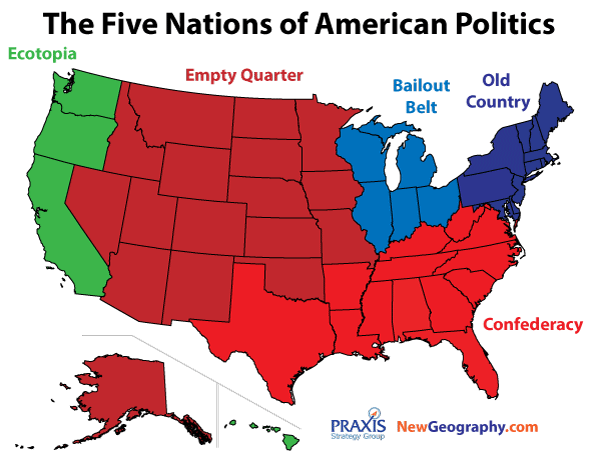
    Looking at Tuesday’s election results, it’s clear the United States has morphed into five distinct political nations. This marks a sharp consolidation of the nine cultural and economic regions that sociologist Joel Garreau laid out 30 years ago in his landmark book “The Nine Nations of North America.”

    In political terms there are two solid blue nations, perched on opposite coasts, that have formed a large and powerful bloc. Opposing them are two almost equally red countries, which include the historic Confederacy as well as the vast open reaches between the Texas panhandle and the Canadian border.

    Between these two largely immovable blocs stands the fifth nation – essentially the Great Lakes industrial heartland. By winning this territory – which could be called “Bailout Nation” – President Barack Obama built a winning coalition. Though this part of the country has suffered economic decline and demographic stagnation for decades, it is now emerging, as former President George W. Bush would put it, as “the decider” of America’s political fate.

    It’s no surprise that the coastal nations voted totally blue, reelecting the president, usually by margins of 10 points or more. The first of these nations can be dubbed “the Old Country,” the most European part of America.

    It stretches along the coast, from Maine to Maryland, and is essentially the Democratic Party’s base. It’s where the intellectual heirs to the traditions of Progressivism, the New Deal and New Frontier are most entrenched.

    Republican presidential nominee Mitt Romney lost by five percentage points or more in every state from this nation. In New York and Massachusetts, Obama won with 60 percent; in Washington, D.C., he received an astronomical 91 percent. Talk about home court advantage.

    This area is heavily urbanized and its economy – except for parts of western Pennsylvania – has become largely de-industrialized. Good jobs here are in the professions and financial services. Unemployment is high in some states, particularly New York and Rhode Island, but low – below 7 percent – in Maryland and Massachusetts.

    In the Old Country, natural resource extraction industries represent a small part of the economy and populations are concentrated in large metropolitan areas, with strong minority communities. It’s ideal territory for today’s Democratic Party, which is devotedly multicultural, strongly supportive of green energy and hostile to fossil fuels, large-scale agriculture and suburban sprawl.

    The region is essentially solid blue – as even the appealing Senator Scott Brown (R-Mass.) found out Tuesday. In the Old Country, things remain more of the same. The election numbers were nearly identical to 2008. States like Rhode Island, for example, didn’t even shift a point, despite lower national polling for Obama and the Dems.

    The Old Country’s coalition partner is Ecotopia, named after the science-fiction best-seller by Ernest Callenbach. “Ecotopia” tells the story of a successful breakaway “green” republic, which embraced most of the totems of West Coast progressivism, everything from renewable energy to militant feminism. This nation includes the states of California, Washington and Oregon. To these you can add Obama’s green-oriented, multicultural home state of Hawaii.

    In political terms, coastal Ecotopians share their states with less progressive regions on the other side of the mountains. Eastern Washington, Oregon and California all tend to be conservative – but are usually outnumbered, as they were this year, by the more densely populated coastal areas.

    Together, these two nations represent 186 electoral votes, almost equal to Romney’s total. They overwhelmingly send Democrats to Congress. And they have outsized influence. Ecotopia is home to Silicon Valley, while the Old Country, along with Hollywood, has turned the culture industry into an adjunct of the Democratic Party.

    For their part, the Republicans increasingly control two nations. One is the former Confederacy, which supported the former Massachusetts governor – only Virginia and possibly Florida slipped over to the Obama. This region has some of the nation’s strongest population growth and a strong allegiance to the military, one key GOP voting bloc.

    Energy defines much of the southern rim of the Confederacy. Texas and Louisiana have seen strong growth from oil and gas. Even the remaining Democrats in this region fear federal energy regulation under Obama will slow their economic growth. President Bill Clinton won Louisiana in 1996; this year the state went for Romney by an astounding 20 points.

    The other nation in the GOP camp is the Empty Quarter, the vast region stretching from the Great Plains and the Inter-mountain West to Alaska. This is where much of America’s food is grown and minerals extracted. Like the Gulf Coast, many in these states feel they have much to lose from a Democratic victory.

    Despite losing Nevada and Colorado and possibly Florida to Obama on Tuesday, these regions have seen expanding shares of Republican vote. Across these two nations, Romney’s margin was considerably better than Senator John McCain’s in 2008. In some states, his margins expanded by 10 points or more. From 2008 to 2012, Obama lost by 10 percentage points in Utah; 7 points in North Dakota and 5 points in Montana, South Dakota, Wyoming and Idaho.

    Yet these Republican nations may not be as stable as their Democratic counterparts. Conservative politics is almost extinct in places like California and New York. But Great Plains voters, however unhappy with Obama, still send some Democrats to the Senate, particularly when the GOP nominates extreme-right candidates.

    Ultimately, the decision comes down to the Great Lakes industrial region – which we can call the Bailout Belt. For these areas, which have high concentrations of manufacturing, the auto bailout was a godsend. And the region is now even more prosperous by the discovery of vast amounts of oil and gas.

    The benefits of the bailouts in this election – communities revived, families uplifted – outweighed those from fossil fuel producers, which now operate under threat of a possible Environmental Protection Agency-ordered shutdown. These states, outside of Indiana, stayed with Obama – by a handsome seven-point margin in Michigan. In virtually all these states, however, Romney did better than McCain.

    The president was quiet about fracking during the election. Now eyes turn to the EPA, since the House of Representatives would likely oppose a ban of any kind. The Bailout Belt may have to decide its energy future before it sides with either party.

    And where this region decides to go, so goes the nation – the entire nation.

    Joel Kotkin is executive editor of NewGeography.com and is a distinguished presidential fellow in urban futures at Chapman University, and contributing editor to the City Journal in New York. He is author of The City: A Global History. His newest book is The Next Hundred Million: America in 2050, released in February, 2010.

    This piece originally appeared at Reuters.

    Barack Obama photo by Bigstock.

  • The Biggest Losers In The 2012 Elections: Entrepreneurs

    Who lost the most in economic terms Tuesday? Certainly energy companies now face a potentially implacable foe — and a re-energized, increasingly hostile bureaucratic apparat. But it’s not them. Nor was it the rhetorically savaged plutocrats who in reality have been nurtured so well by the President’s economic tag team of Ben Bernanke and Tim Geithner.

    The real losers are small business owners, or what might be called the aspirational middle class. The smaller business — with no galleon full of legal slaves pulling for them — will face more regulation of labor, particularly independent contracting. There will be more financial regulation, which is why Romney’s top contributors were all banks.

    Small businesses will also face challenges associated with Obamacare, which now will sail on unchallenged. Health care costs are expected to go up 6.5% per employee. Some 58% of businesses say they will shift the costs to their employees. Many owners will face a higher individual tax bill: couples making $250,000 or more and singles making $200,000 or more will pay a 3.8% Medicare tax starting 2013.

    All this is troubling, as American start-up rates are already falling. Much of what happens now occurs not from a great hunger to succeed as a desire to maintain. Outside of the inherently entrepreneurial immigrant classes, the only group of Americans starting business more than before are the fifty somethings and above. Many of these may simply be former employees of larger firms, now doing work sometimes in the same industry and even for the same company.

    Business owners feel under attack. Gallup reports that, of all professions, those who own or operate their own business dislike President Obama the most.

    So what happens now? As an employment engine, small business will continue to hobble given the expected renewed regulatory onslaught. In the blue states, this may come from local authorities, but everywhere from the increasingly powerful federal bureaucratic class. But there may be growth still in the individual proprietor class. For some of them Obama has cut health care costs and start-up costs and increased deductions. And if you take on no or few employees, many of the most difficult mandates will be less onerous.

    In the next few years, entrepreneurial America will morph increasingly into what might be called “the 1099 economy.” Every state in the union has gained these kind of jobs, which include everything from a handyman to a physicist for rent, even those still way behind their 2007 employment.

    This is occurring in both red and blue states. But increasingly it may become the best strategy to survive in the renewed blue America. If you can’t beat them in a stifling regulatory environment, you look to stay under the radar. No surprise then that self employment now accounts for the highest percentage of the workforce in the bluest of states. California, for example, ranked fourth, behind just Vermont, Maine and Montana.

    Obama’s victory, to be sure, places new barriers in front of entrepreneurs of all kinds. But it will not kill off the entrepreneurial spirit, even if it increasingly occurs in an old closet or at the kitchen table.

    Joel Kotkin is executive editor of NewGeography.com and is a distinguished presidential fellow in urban futures at Chapman University, and contributing editor to the City Journal in New York. He is author of The City: A Global History. His newest book is The Next Hundred Million: America in 2050, released in February, 2010.

    This piece originally appeared at Forbes.

    Barack Obama photo by Bigstock.

  • The Biggest Winners From President Obama’s Re-Election: Crony Capitalists

    President Obama’s re-election does not, as some conservatives suggest, represent a triumph of socialism. Instead, it marks the massive endorsement of an expanding crony capitalism that ultimately could reshape the already troubled American economic system beyond recognition.

    Nowhere is this clearer than in the President’s victory in the Great Lakes states of Ohio, Michigan, Ohio and Wisconsin. All four of these states are highly dependent on manufacturing and, in particular, the auto industry. Without the bailout, it seems doubtful that Obama — who lost the white working class decisively in most of the country — could have won these critical states.

    The auto bailouts have resulted in industrial production growth since February 2010. Furthermore, there has been an industrial revival in the Ohio River valley, with rising output of steel, although much of this has to do with expansion of oil and gas production, which Obama has also taken credit for.

    Other beneficiaries of the election will be other crony capitalists, notably in the beleaguered “green” energy industry. Tied closely to venture capitalists in Silicon Valley, the renewable capitalist have been losing big time in the marketplace, the victims of foreign, largely Chinese competition, and the burgeoning natural gas industry.

    The Obama victory now provides these firms with a new lease on life. Initially Obama promised to create 5 million green jobs and has pledged $150 billion to his green jobs plan over 10 years. Yet with the Republicans in control of the House, he might not be able to fund them as prodigiously as he might have wanted.

    But there may be another way to bail out the “green capitalists.” The federal government and its expanding bureaucracy — another big winner tonight — seems likely to issue Draconian edicts on greenhouse gas, now that the election is over. The whole coal industry is about to get savaged by new regulations and pressure is mounting to regulate fracking as well. Destroying the competition may be the one way to bail out the “green” crony capitalists.

    Other crony capitalists could also benefit form the new regulatory assault: the rise essentially of national zoning. Backed by EPA and HUD, urban land speculators could see their suburban competitors regulated — as is already the case in California — into oblivion. Regions could find themselves obliged to built often expensive, and in some cases, wildly inappropriate transit system. This will benefit not only unions, who will build and operate these systems, but companies like Siemens who push for greater rail expansions at the expense of maintaining and improving such critical infrastructure as roads.

    Ultimately the biggest winners may be those who finance municipal and state debt. Owing his election to the fiscal failures of New York, Illinois and California, Obama could have to use his executive power to forestall looming bankruptcies at the local and even state level. Ironically the biggest winner here in the crony capitalist sweepstakes will be firms like Goldman Sachs, who turned so vehemently against Obama, but have historically made much of their money on financing government operations.

    Some people never seem to lose no matter what the result of the election.

    Joel Kotkin is executive editor of NewGeography.com and is a distinguished presidential fellow in urban futures at Chapman University, and contributing editor to the City Journal in New York. He is author of The City: A Global History. His newest book is The Next Hundred Million: America in 2050, released in February, 2010.

    This piece originally appeared at Forbes.

    Barack Obama photo by Bigstock.